Metal-Decorated C8 Quantum Dots as Lightweight Hydrogen Storage Materials: A Comprehensive DFT Study

 , , , and
Abstract
1. Introduction
2. Computational Methodology
3. Results and Discussion
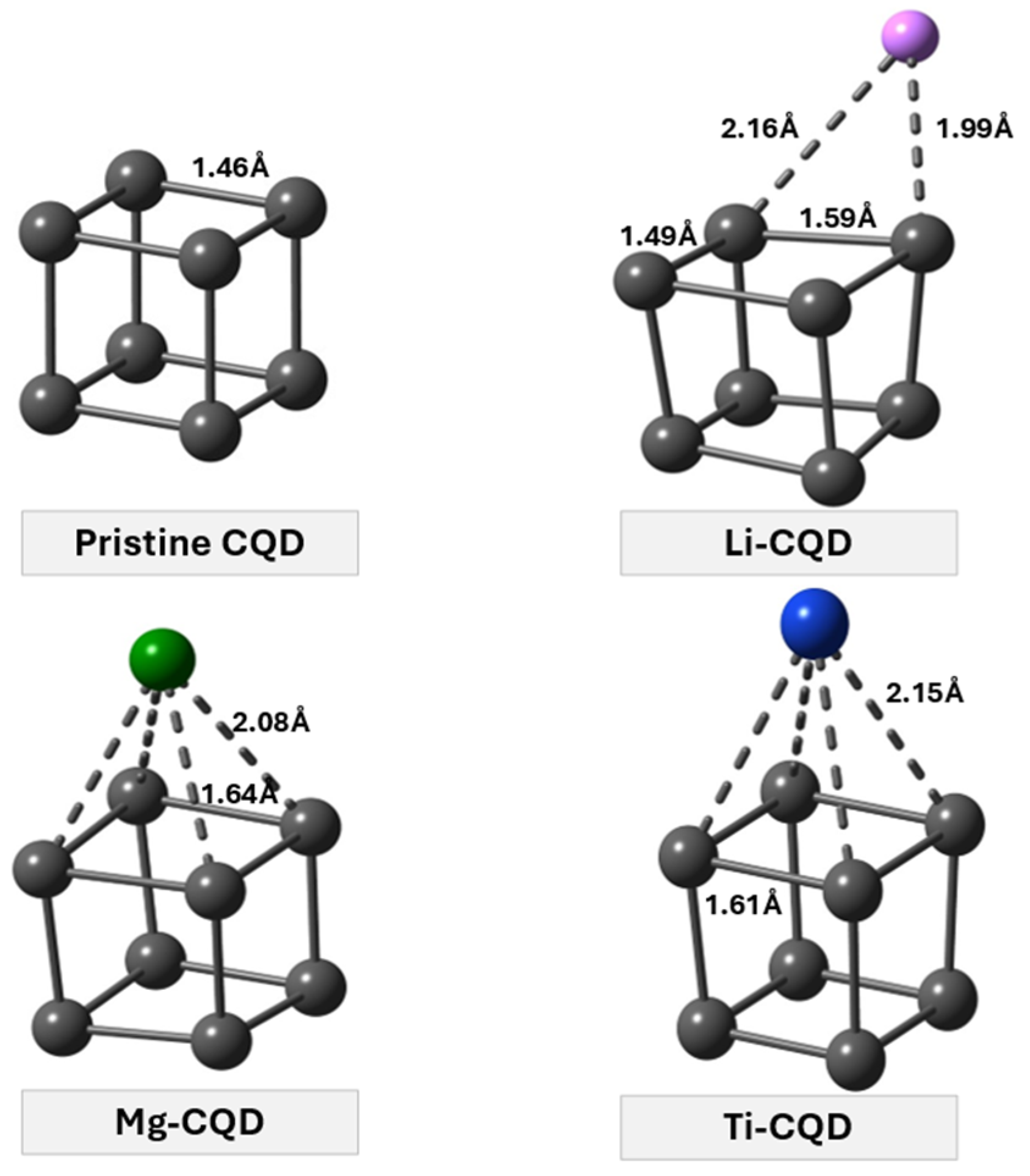
3.1. Structure and Stability of Pristine and Metal-Decorated CQD
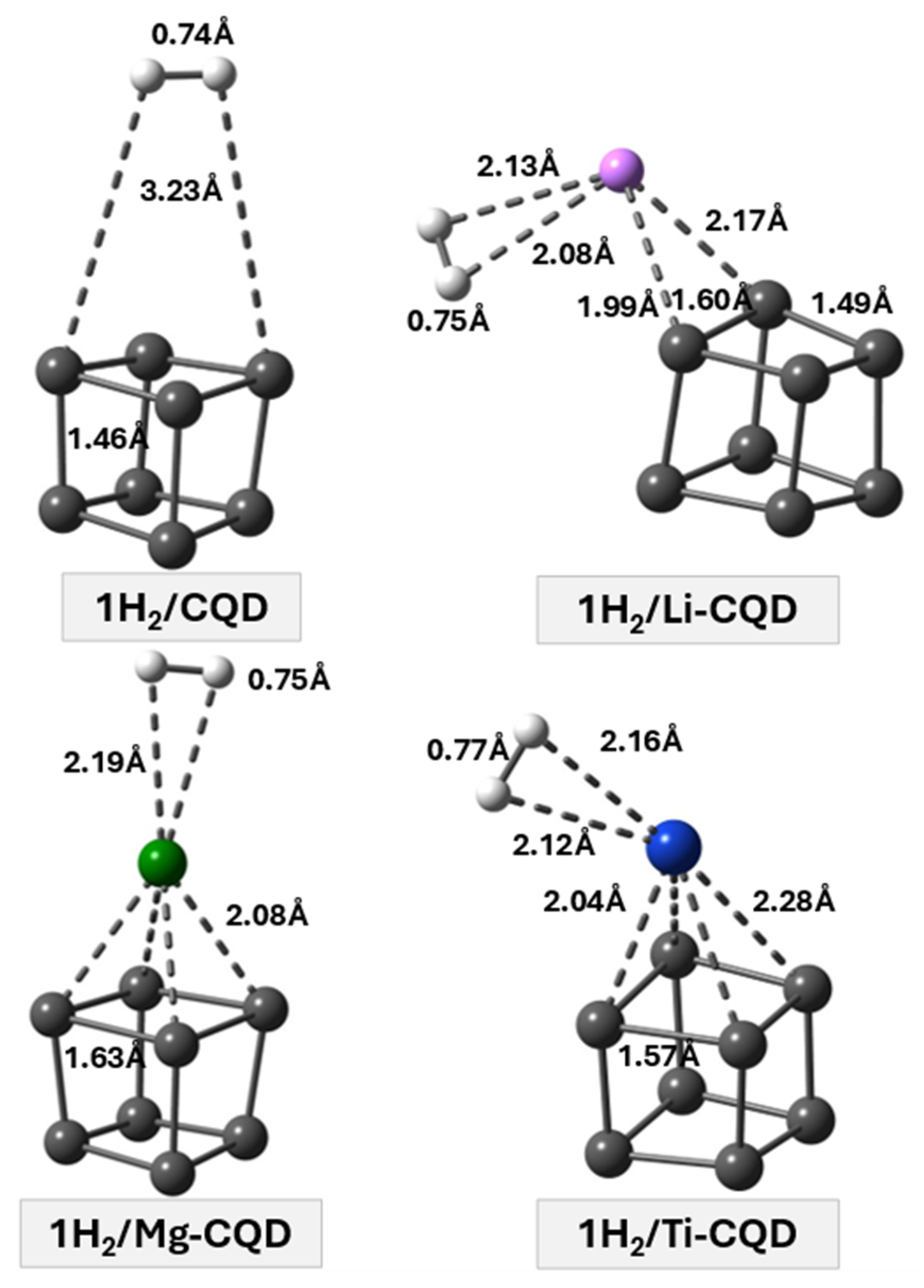
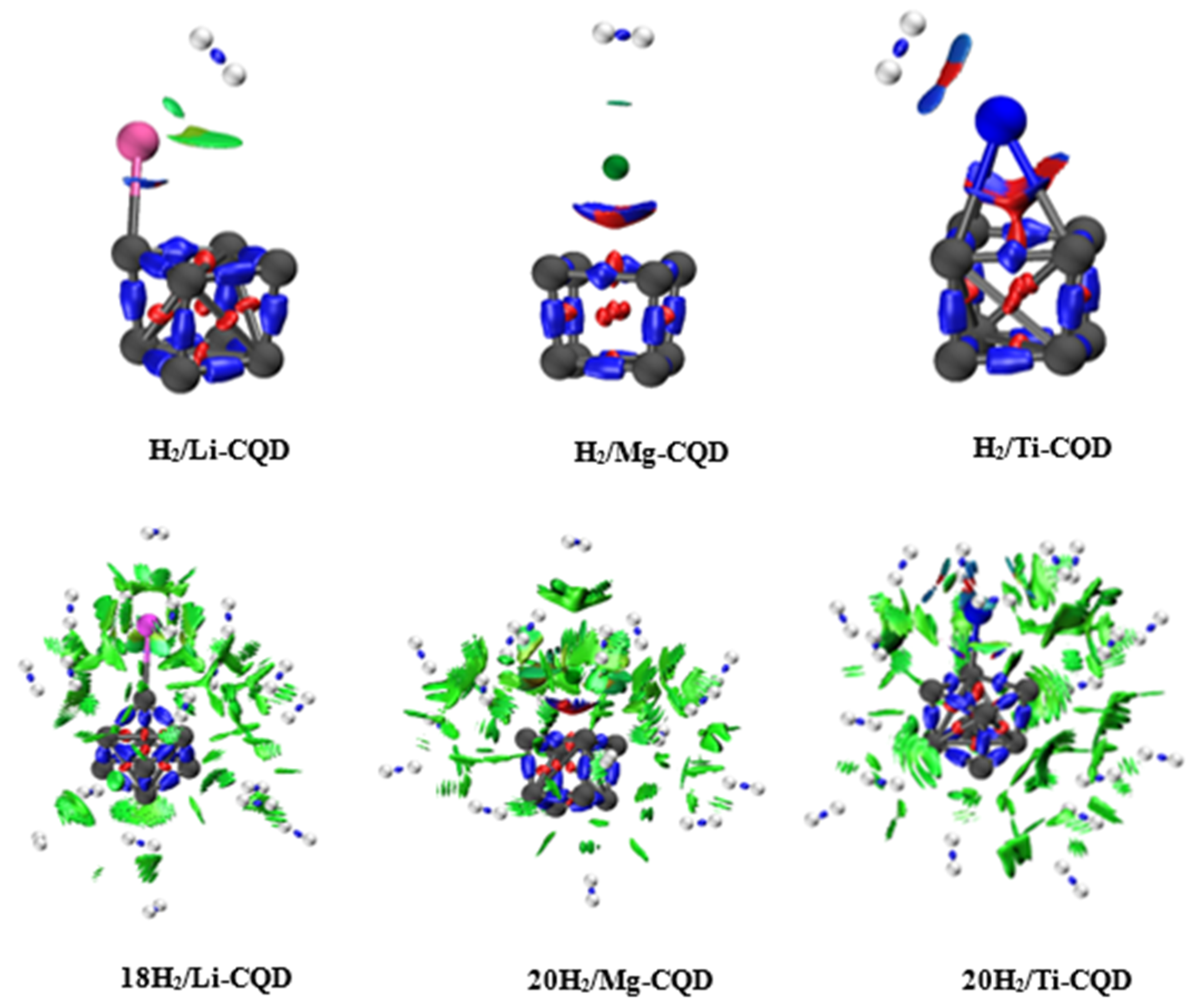
3.2. Single H2 Adsorption Mechanism
3.3. Sequential H2 Adsorption and Maximum Capacity
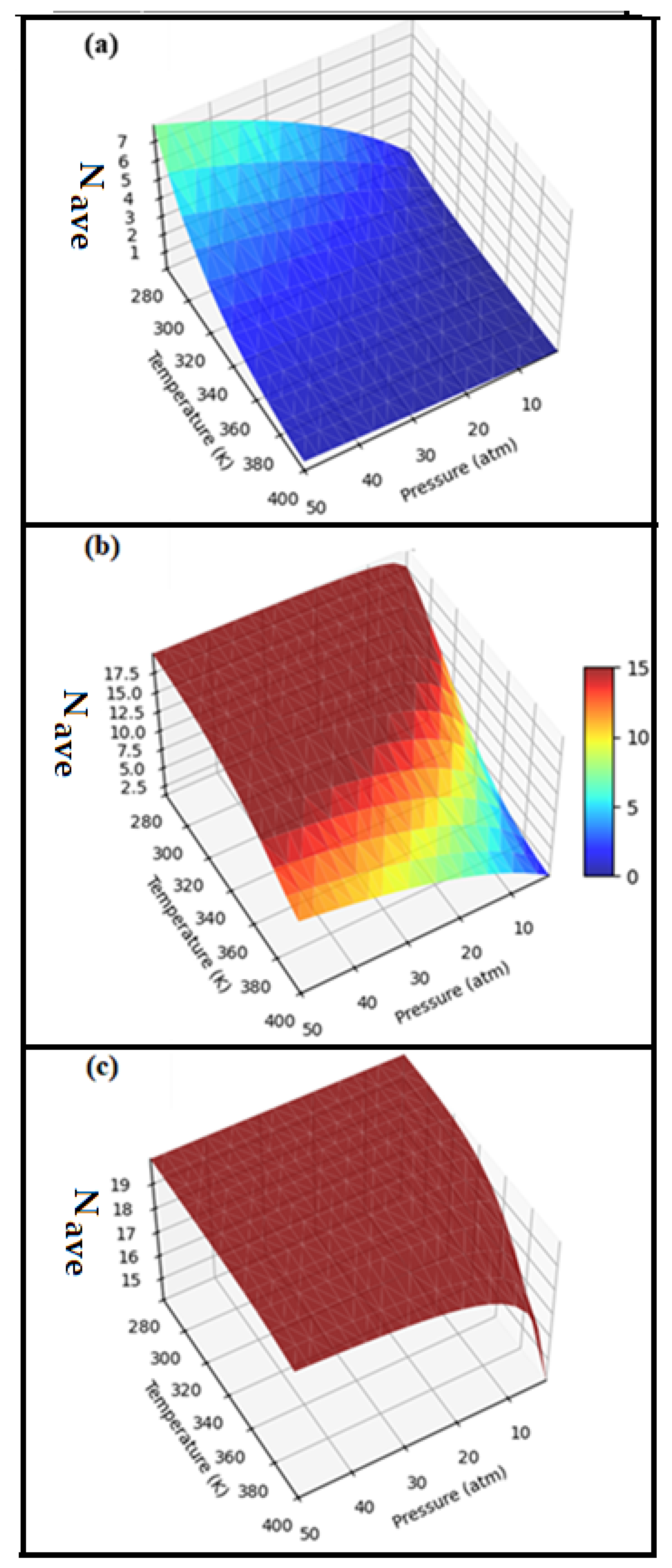
3.4. Thermodynamic and Kinetic Analysis of Reversible Storage
4. Conclusions
Supplementary Materials
Author Contributions
Funding
Data Availability Statement
Acknowledgments
Conflicts of Interest
References
- Schlapbach, L.; Züttel, A. Hydrogen-storage materials for mobile applications. Nature 2001, 414, 353–358. [Google Scholar] [CrossRef]
- Jena, P. Materials for hydrogen storage: Past, present, and future. J. Phys. Chem. Lett. 2011, 2, 206–211. [Google Scholar] [CrossRef]
- Satyapal, S.; Petrovic, J.; Read, C.; Thomas, G.; Ordaz, G. The US Department of Energy’s National Hydrogen Storage Project: Progress towards meeting hydrogen-powered vehicle requirements. Catal. Today 2007, 120, 246–256. [Google Scholar] [CrossRef]
- Bhatia, S.K.; Myers, A.L. Optimum conditions for adsorptive storage. Langmuir 2006, 22, 1688–1700. [Google Scholar] [CrossRef]
- Wang, L.; Yang, R.T. Hydrogen storage on carbon-based adsorbents and storage at ambient temperature by hydrogen spillover. Catal. Rev. 2010, 52, 411–461. [Google Scholar] [CrossRef]
- Niaz, S.; Manzoor, T.; Pandith, A.H. Hydrogen storage: Materials, methods and perspectives. Renew. Sustain. Energy Rev. 2015, 50, 457–469. [Google Scholar] [CrossRef]
- Durgun, E.; Ciraci, S.; Yildirim, T. Functionalization of carbon-based nanostructures with light transition-metal atoms for hydrogen storage. Phys. Rev. B—Condens. Matter Mater. Phys. 2008, 77, 085405. [Google Scholar] [CrossRef]
- Zhang, X.; Tang, C.; Jiang, Q. Electric field induced enhancement of hydrogen storage capacity for Li atom decorated graphene with Stone-Wales defects. Int. J. Hydrogen Energy 2016, 41, 10776–10785. [Google Scholar] [CrossRef]
- Guardado, A.; Marisol, I.-R.; Mayén-Mondragón, R.; Sánchez, M. Hydrogen adsorption on lithium clusters coordinated to a gC3N4 cavity. J. Mol. Graph. Model. 2023, 122, 108491. [Google Scholar] [CrossRef]
- O’Malley, K.; Ordaz, G.; Adams, J.; Randolph, K.; Ahn, C.C.; Stetson, N.T. Applied hydrogen storage research and development: A perspective from the US Department of Energy. J. Alloys Compd. 2015, 645, S419–S422. [Google Scholar] [CrossRef]
- Goler, S. Graphene for Hydrogen Storage. Ph.D. Thesis, Scuola Normale Superiore, Pisa, Italy, 2014. [Google Scholar]
- Raghavachari, K.; Binkley, J. Structure, stability, and fragmentation of small carbon clusters. J. Chem. Phys. 1987, 87, 2191–2197. [Google Scholar] [CrossRef]
- Nesakumar, N.; Srinivasan, S.; Alwarappan, S. Graphene quantum dots: Synthesis, properties, and applications to the development of optical and electrochemical sensors for chemical sensing. Microchim. Acta 2022, 189, 258. [Google Scholar] [CrossRef]
- Lim, S.Y.; Shen, W.; Gao, Z. Carbon quantum dots and their applications. Chem. Soc. Rev. 2015, 44, 362–381. [Google Scholar] [CrossRef]
- Chandrakumar, K.; Ghosh, S.K. Alkali-metal-induced enhancement of hydrogen adsorption in C60 fullerene: An ab initio study. Nano Lett. 2008, 8, 13–19. [Google Scholar] [CrossRef] [PubMed]
- Kubas, G.J. Metal Dihydrogen and σ-Bond Complexes: Structure Theory and Reactivity; Springer: Berlin/Heidelberg, Germany, 2001. [Google Scholar]
- Yildirim, T.; Ciraci, S. Titanium-decorated carbon nanotubes as a potential high-capacity hydrogen storage medium. Phys. Rev. Lett. 2005, 94, 175501. [Google Scholar] [CrossRef]
- Ahmed, M.T.; Roy, D.; Al Roman, A.; Islam, S.; Ahmed, F. A first-principles investigation of Cr adsorption on C8 and B4N4 nanocages in aqueous mediums. Phys. Chem. Chem. Phys. 2023, 25, 32261–32272. [Google Scholar] [CrossRef] [PubMed]
- Jones, R. Density functional study of carbon clusters C2n (2≤n≤16). I. Structure and bonding in the neutral clusters. J. Chem. Phys. 1999, 110, 5189–5200. [Google Scholar] [CrossRef]
- Heiles, S.; Johnston, R.L. Global optimization of clusters using electronic structure methods. Int. J. Quantum Chem. 2013, 113, 2091–2109. [Google Scholar] [CrossRef]
- Kaewmaraya, T.; Thatsami, N.; Tangpakonsab, P.; Kinkla, R.; Kotmool, K.; Menendez, C.; Aguey-Zinsou, K.; Hussain, T. Ultrahigh hydrogen storage using metal-decorated defected biphenylene. Appl. Surf. Sci. 2023, 629, 157391. [Google Scholar] [CrossRef]
- Hashmi, A.; Farooq, M.U.; Khan, I.; Son, J.; Hong, J. Ultra-high capacity hydrogen storage in a Li decorated two-dimensional C 2 N layer. J. Mater. Chem. A 2017, 5, 2821–2828. [Google Scholar] [CrossRef]
- Li, Y.; Zhang, Q.; Ren, L.; Li, Z.; Lin, X.; Ma, Z.; Yang, H.; Hu, Z.; Zou, J. Core–shell nanostructured magnesium-based hydrogen storage materials: A critical review. Ind. Chem. Mater. 2023, 1, 282–298. [Google Scholar] [CrossRef]
- Rahali, S.; Belhocine, Y.; Seydou, M.; Maurel, F.; Tangour, B. Multiscale study of the structure and hydrogen storage capacity of an aluminum metal-organic framework. Int. J. Hydrogen Energy 2017, 42, 15271–15282. [Google Scholar] [CrossRef]
- Rahali, S.; Seydou, M.; Belhocine, Y.; Maurel, F.; Tangour, B. First-principles investigation of hydrogen storage on lead (II)-based metal-organic framework. Int. J. Hydrogen Energy 2016, 41, 2711–2719. [Google Scholar] [CrossRef]
- Park, N.; Choi, K.; Hwang, J.; Kim, D.W.; Kim, D.O.; Ihm, J. Progress on first-principles-based materials design for hydrogen storage. Proc. Natl. Acad. Sci. USA 2012, 109, 19893–19899. [Google Scholar] [CrossRef] [PubMed]
- Jiang, M.; Xu, J.; Munroe, P.; Xie, Z.-H. Hydrogen storage capacity and reversibility of Li-decorated B4CN3 monolayer revealed by first-principles calculations. Int. J. Hydrogen Energy 2022, 47, 38271–38281. [Google Scholar] [CrossRef]
- Selmani, Y.; Bahmad, L. Insights into the physical properties of NaGeH3 perovskite hydride for hydrogen storage applications: A first-principles study. J. Phys. Chem. Solids 2025, 208, 113089. [Google Scholar] [CrossRef]
- Müller, M.; Hansen, A.; Grimme, S. ωB97X-3c: A composite range-separated hybrid DFT method with a molecule-optimized polarized valence double-ζ basis set. J. Chem. Phys. 2023, 158, 014103. [Google Scholar] [CrossRef] [PubMed]
- Neese, F. Software update: The ORCA program system—Version 6.0. Wiley Interdiscip. Rev. Comput. Mol. Sci. 2025, 15, e70019. [Google Scholar] [CrossRef]
- Wang, Y.; Zheng, R.; Gao, H.; Zhang, J.; Xu, B.; Sun, Q.; Jia, Y. Metal adatoms-decorated silicene as hydrogen storage media. Int. J. Hydrogen Energy 2014, 39, 14027–14032. [Google Scholar] [CrossRef]
- Su, P.; Li, H. Energy decomposition analysis of covalent bonds and intermolecular interactions. J. Chem. Phys. 2009, 131, 014102. [Google Scholar] [CrossRef]
- Schmidt, M.W.; Baldridge, K.K.; Boatz, J.A.; Elbert, S.T.; Gordon, M.S.; Jensen, J.H.; Koseki, S.; Matsunaga, N.; Nguyen, K.A.; Su, S. General atomic and molecular electronic structure system. J. Comput. Chem. 1993, 14, 1347–1363. [Google Scholar] [CrossRef]
- Gordon, M.S.; Schmidt, M.W. Advances in electronic structure theory: GAMESS a decade later. In Theory and Applications of Computational Chemistry; Elsevier: Amsterdam, The Netherlands, 2005; pp. 1167–1189. [Google Scholar]
- Barca, G.M.; Bertoni, C.; Carrington, L.; Datta, D.; De Silva, N.; Deustua, J.E.; Fedorov, D.G.; Gour, J.R.; Gunina, A.O.; Guidez, E. Recent developments in the general atomic and molecular electronic structure system. J. Chem. Phys. 2020, 152, 154102. [Google Scholar] [CrossRef] [PubMed]
- Haoyu, S.Y.; He, X.; Li, S.L.; Truhlar, D.G. MN15: A Kohn–Sham global-hybrid exchange–correlation density functional with broad accuracy for multi-reference and single-reference systems and noncovalent interactions. Chem. Sci. 2016, 7, 5032–5051. [Google Scholar]
- Lu, T.; Chen, Q. Interaction region indicator: A simple real space function clearly revealing both chemical bonds and weak interactions. Chemistry—Methods 2021, 1, 231–239. [Google Scholar] [CrossRef]
- Lu, T.; Chen, Q. Visualization analysis of weak interactions in chemical systems. Compr. Comput. Chem. 2024, 2, 240–264. [Google Scholar]
- Humphrey, W.; Dalke, A.; Schulten, K. VMD: Visual molecular dynamics. J. Mol. Graph. 1996, 14, 33–38. [Google Scholar] [CrossRef]
- Ramchiary, A.; Barik, A.; Rabha, B.; Mondal, P. Effect of boron and nitrogen-doping on graphene via sc-decoration for enhanced reversible hydrogen storage. J. Energy Storage 2025, 127, 117035. [Google Scholar] [CrossRef]
- Chai, J.-D.; Head-Gordon, M. Long-range corrected hybrid density functionals with damped atom–atom dispersion corrections. Phys. Chem. Chem. Phys. 2008, 10, 6615–6620. [Google Scholar] [CrossRef] [PubMed]
- Weigend, F.; Ahlrichs, R. Balanced basis sets of split valence, triple zeta valence and quadruple zeta valence quality for H to Rn: Design and assessment of accuracy. Phys. Chem. Chem. Phys. 2005, 7, 3297–3305. [Google Scholar] [CrossRef] [PubMed]
- Mardirossian, N.; Head-Gordon, M. ωB97X-V: A 10-parameter, range-separated hybrid, generalized gradient approximation density functional with nonlocal correlation, designed by a survival-of-the-fittest strategy. Phys. Chem. Chem. Phys. 2014, 16, 9904–9924. [Google Scholar] [CrossRef] [PubMed]
- Mardirossian, N.; Head-Gordon, M. ωB97M-V: A combinatorially optimized, range-separated hybrid, meta-GGA density functional with VV10 nonlocal correlation. J. Chem. Phys. 2016, 144, 214110. [Google Scholar] [CrossRef]
- Perdew, J.P.; Burke, K.; Ernzerhof, M. Generalized gradient approximation made simple. Phys. Rev. Lett. 1996, 77, 3865. [Google Scholar] [CrossRef] [PubMed]
- Zhao, Y.; Truhlar, D.G. The M06 suite of density functionals for main group thermochemistry, thermochemical kinetics, noncovalent interactions, excited states, and transition elements: Two new functionals and systematic testing of four M06-class functionals and 12 other functionals. Theor. Chem. Acc. 2008, 120, 215–241. [Google Scholar]
- Becke, A.D. Density-functional thermochemistry. III. The role of exact exchange. J. Chem. Phys. 1993, 98, 5648–5652. [Google Scholar] [CrossRef]
- Lide, D.R.; Milne, G.W. Handbook of Data on Common Organic Compounds; CRC Press: Boca Raton, FL, USA, 1995. [Google Scholar]
- Haldar, S. Density functional theory study of light metal (Li/Na/Ca) functionalized borophosphene for reversible hydrogen storage. J. Energy Storage 2025, 119, 116165. [Google Scholar] [CrossRef]
- Ma, T.; Wang, H.; Du, J.; Pu, M.; Tang, Y.; Yang, Z.; Lei, M. Hydrogen storage performance of a new two-dimensional B4N4 monolayer decorated with Li atoms: A density functional theory study. Int. J. Hydrogen Energy 2024, 60, 1383–1391. [Google Scholar] [CrossRef]
- Ramirez-Gomez, S.; Arellano-Ramírez, I.; Rebaza, A.G.; Amaya-Roncancio, S. Hydrogen adsorption on germanene doped with Sn, V, Ti, Zn, and Cu and decorated with K, Li, and Mg. A DFT study. J. Energy Storage 2025, 130, 117240. [Google Scholar] [CrossRef]
- Bhat, C.P.; Bandyopadhyay, D. Insights into the reversible hydrogen storage mechanism of transition metal-decorated Irida-graphene: A DFT study. Int. J. Hydrogen Energy 2025, 137, 750–761. [Google Scholar] [CrossRef]
- Sathe, R.Y.; Ussama, M.; Bae, H.; Lee, H.; Dhilip Kumar, T.J. Density functional theory study of Li-functionalized nanoporous R-graphyne–metal–organic frameworks for reversible hydrogen storage. ACS Appl. Nano Mater. 2021, 4, 3949–3957. [Google Scholar] [CrossRef]
- Yuksel, N.; Kose, A.; Fellah, M.F. A DFT investigation of hydrogen adsorption and storage properties of Mg decorated IRMOF-16 structure. Colloids Surf. A Physicochem. Eng. Asp. 2022, 641, 128510. [Google Scholar] [CrossRef]
- Soltan, R.; Amankeldiyeva, A.; Akilbekov, B.; Kalibek, M.; Sarsenova, S.; Kerimkulov, Z.; Abutalip, M.; Magazov, Y.; Almas, N.; Nuraje, N. A Short Review of Density Functional Theory Studies into Hydrogen Storage in Metal-Organic Frameworks. Eng. Sci. 2025, 37, 1828. [Google Scholar] [CrossRef]
- Shangguan, W.; Zhao, H.; Dai, J.-Q.; Cai, J.; Yan, C. First-principles study of hydrogen storage of Sc-modified semiconductor covalent organic framework-1. ACS Omega 2021, 6, 21985–21993. [Google Scholar] [CrossRef] [PubMed]
- Zhao, H.; Guan, Y.; Guo, H.; Du, R.; Yan, C. Hydrogen storage capacity on Li-decorated covalent organic framework-1: A first-principles study. Mater. Res. Express 2020, 7, 035506. [Google Scholar] [CrossRef]
- Parida, S.R.; Amrutha, M.; Sahu, S.; Chakraborty, B. Density functional theory and ab initio molecular dynamics calculations for reversible hydrogen storage in yttrium-decorated azatriphenylene COF. Fuel 2026, 403, 136061. [Google Scholar] [CrossRef]
- Vaidyanathan, A.; Wagh, V.; Rout, C.S.; Chakraborty, B. High capacity reversible hydrogen storage in zirconium doped 2D-covalent triazine frameworks: Density Functional Theory investigations. Int. J. Hydrogen Energy 2021, 46, 14520–14531. [Google Scholar] [CrossRef]
- Amrutha, M.; Jethawa, U.; Ali, S.M.; Chakraborty, B. Enhancing hydrogen storage capacity of newly synthesized AzaCOF via Ti decoration: A theoretical study. J. Energy Storage 2025, 136, 118382. [Google Scholar] [CrossRef]



| Parameter | Pristine CQD | Li-CQD | Mg-CQD | Ti-CQD |
|---|---|---|---|---|
| C–C (Å) | 1.46 | 1.49–1.59 | 1.64 | 1.61 |
| C–C–C (Å) | 89.99–90.01 | 81.12–98.35 | 83.38–97.17 | 86.76–93.30 |
| M–C (Å) | - | 1.99–2.16 | 2.08 | 2.15 |
| Ecoh (eV) | −4.881 | −4.673 | −4.459 | −4.923 |
| Eb (eV) | - | −2.956 | −2.146 | −5.250 |
| ELUMO (eV) | −2.903 | −2.611 | −1.946 | −0.677 |
| EHOMO (eV) | −10.343 | −4.326 | −8.770 | −6.813 |
| ∆Eg (eV) | 7.440 | 1.715 | 6.824 | 6.136 |
| Ecomponent (eV) | H2/Li-CQD | H2/Mg-CQD | H2/Ti-CQD | 18H2/Li-CQD | 20H2/Mg-CQD | 20H2/Ti-CQD |
|---|---|---|---|---|---|---|
| Electrostatic | −0.118 | −0.217 | −0.396 | −0.847 | −1.582 | −2.447 |
| Exchange | 0.024 | −0.137 | 0.015 | 0.435 | 0.038 | −0.931 |
| Polarization | −0.067 | −0.219 | −0.359 | −0.372 | −1.349 | −3.610 |
| Dispersion | −0.343 | −0.351 | −0.757 | −3.046 | −4.410 | −4.848 |
| Repulsion | 0.353 | 0.697 | 1.020 | 2.535 | 5.415 | 9.181 |
| Total energy | −0.151 | −0.227 | −0.477 | −1.296 | −1.889 | −2.655 |
| Li-CQD | Mg-CQD | Ti-CQD | |||||||
|---|---|---|---|---|---|---|---|---|---|
| n (H2) | (eV/H2) | Edes (eV) | H–H (Å) | (eV/H2) | Edes (eV) | H–H (Å) | (eV/H2) | Edes (eV) | H–H (Å) |
| 1 | −0.172 | - | 0.749 | −0.304 | - | 0.752 | −0.451 | - | 0.771 |
| 2 | −0.167 | −0.164 | 0.749 | −0.295 | −0.291 | 0.758 | −0.393 | −0.451 | 0.764 |
| 3 | −0.155 | −0.131 | 0.749 | −0.269 | −0.218 | 0.755 | −0.362 | −0.334 | 0.762 |
| 4 | −0.141 | −0.1 | 0.748 | −0.232 | −0.121 | 0.753 | −0.3 | −0.3 | 0.758 |
| 5 | −0.123 | −0.047 | 0.747 | −0.194 | −0.043 | 0.751 | −0.225 | −0.115 | 0.755 |
| 6 | −0.11 | −0.05 | 0.747 | −0.171 | −0.053 | 0.751 | −0.22 | 0.077 | 0.753 |
| 7 | −0.102 | −0.053 | 0.746 | −0.154 | −0.053 | 0.75 | −0.196 | −0.194 | 0.752 |
| 8 | −0.098 | −0.069 | 0.746 | −0.141 | −0.054 | 0.749 | −0.178 | −0.053 | 0.751 |
| 9 | −0.09 | −0.027 | 0.746 | −0.132 | −0.057 | 0.749 | −0.161 | −0.054 | 0.75 |
| 10 | −0.085 | −0.042 | 0.746 | −0.124 | −0.055 | 0.749 | −0.152 | −0.023 | 0.75 |
| 11 | −0.081 | −0.039 | 0.745 | −0.118 | −0.056 | 0.749 | −0.142 | −0.074 | 0.749 |
| 12 | −0.077 | −0.038 | 0.745 | −0.113 | −0.06 | 0.748 | −0.133 | −0.038 | 0.749 |
| 13 | −0.074 | −0.039 | 0.745 | −0.109 | −0.056 | 0.748 | −0.126 | −0.04 | 0.748 |
| 14 | −0.072 | −0.036 | 0.745 | −0.104 | −0.043 | 0.748 | −0.12 | −0.045 | 0.748 |
| 15 | −0.07 | −0.039 | 0.745 | −0.099 | −0.034 | 0.748 | −0.117 | −0.041 | 0.748 |
| 16 | −0.068 | −0.043 | 0.745 | −0.096 | −0.043 | 0.748 | −0.111 | −0.069 | 0.748 |
| 17 | −0.065 | −0.026 | 0.745 | −0.092 | −0.037 | 0.748 | −0.107 | −0.018 | 0.748 |
| 18 | −0.064 | −0.04 | 0.745 | −0.09 | −0.041 | 0.747 | −0.103 | −0.042 | 0.747 |
| 19 | - | - | - | −0.087 | −0.039 | 0.747 | −0.099 | −0.041 | 0.747 |
| 20 | - | - | - | −0.084 | −0.033 | 0.747 | −0.096 | −0.034 | 0.747 |
| System | Li-CQD | Mg-CQD | Ti-CQD |
|---|---|---|---|
| TD (1 bar) | 76.71 | 102.28 | 127.85 |
| TD (3 bar) | 87.28 | 116.37 | 145.46 |
| TD (30 bar) | 122.70 | 163.60 | 204.51 |
| TD (100 bar) | 155.76 | 207.68 | 259.61 |
| τ (233 K) | 0.03 | 0.06 | 0.15 |
| τ (298 K) | 0.02 | 0.03 | 0.10 |
| τ (358 K) | 0.01 | 0.02 | 0.04 |
| τ (400 K) | 0.01 | 0.01 | 0.02 |
| CT (wt%) | 25.91 | 24.95 | 21.75 |
| NT | 18 | 20 | 20 |
| NA | 3.43 | 19.41 | 19.99 |
| ND | 0.06 | 2.75 | 17.66 |
| NP | 3.38 | 16.66 | 2.34 |
| CE (wt%) | 6.16 | 21.7 | 3.1 |
| Material | Metal Decoration | (eV/H2) | wt% | Refs. |
|---|---|---|---|---|
| 2D C2N layer | Li | ≈−0.25 | 9 | [22] |
| Graphene | Li | −0.15 to −0.25 | 6–8 | [8] |
| Defected graphene | Li, Mg | −0.20 to −0.35 | 8–10 | [27] |
| Carbon nanotubes | Ti | −0.40 to −0.60 | 4 | [7] |
| C60 fullerene | Li | −0.20 to −0.30 | 7 | [15] |
| Defected biphenylene | TM | −0.35 to −0.55 | 10 | [21] |
| Irida-graphene | Sc | −0.18 to −0.45 | 21.6 | [52] |
| R-graphyne-MOF | Li | −0.25 to −0.27 | 11.9 | [53] |
| IRMOF-16 | Mg | - | 5.8 | [54] |
| MOF-519 | - | −0.12 | 10 | [24] |
| IRMOF-10 | Li | - | 8.3 | [55] |
| COF-1 | Sc | −0.28 | 5.23 | [56] |
| COF-1 | Li | −0.26 | 7.7 | [57] |
| Azatriphenylene-COF | Y | −0.45 | 6.4 | [58] |
| CTF-1 | Zr | −0.38 | 7.1 | [59] |
| AzaCOF | Ti | −0.43 | 9.3 | [60] |
| CQD | Li | −0.172 | 6.2 | This work |
| CQD | Mg | −0.304 | 21.7 | This work |
| CQD | Ti | −0.451 | 3.1 | This work |
Disclaimer/Publisher’s Note: The statements, opinions and data contained in all publications are solely those of the individual author(s) and contributor(s) and not of MDPI and/or the editor(s). MDPI and/or the editor(s) disclaim responsibility for any injury to people or property resulting from any ideas, methods, instructions or products referred to in the content. |
© 2026 by the authors. Licensee MDPI, Basel, Switzerland. This article is an open access article distributed under the terms and conditions of the Creative Commons Attribution (CC BY) license.
Share and Cite
Rahali, S.; Said, R.B.; Belhocine, Y.; Makawi, S.; Mustafa, B. Metal-Decorated C8 Quantum Dots as Lightweight Hydrogen Storage Materials: A Comprehensive DFT Study. Nanomaterials 2026, 16, 286. https://doi.org/10.3390/nano16050286
Rahali S, Said RB, Belhocine Y, Makawi S, Mustafa B. Metal-Decorated C8 Quantum Dots as Lightweight Hydrogen Storage Materials: A Comprehensive DFT Study. Nanomaterials. 2026; 16(5):286. https://doi.org/10.3390/nano16050286
Chicago/Turabian StyleRahali, Seyfeddine, Ridha Ben Said, Youghourta Belhocine, Suzan Makawi, and Bakheit Mustafa. 2026. "Metal-Decorated C8 Quantum Dots as Lightweight Hydrogen Storage Materials: A Comprehensive DFT Study" Nanomaterials 16, no. 5: 286. https://doi.org/10.3390/nano16050286
APA StyleRahali, S., Said, R. B., Belhocine, Y., Makawi, S., & Mustafa, B. (2026). Metal-Decorated C8 Quantum Dots as Lightweight Hydrogen Storage Materials: A Comprehensive DFT Study. Nanomaterials, 16(5), 286. https://doi.org/10.3390/nano16050286