Detection and Capture of Volatile Fluorinated Compounds Using Porous Materials

 ,
,
Abstract
1. Introduction
2. Design Strategies of Functional Porous Structures for Capturing VFCs
- (1)
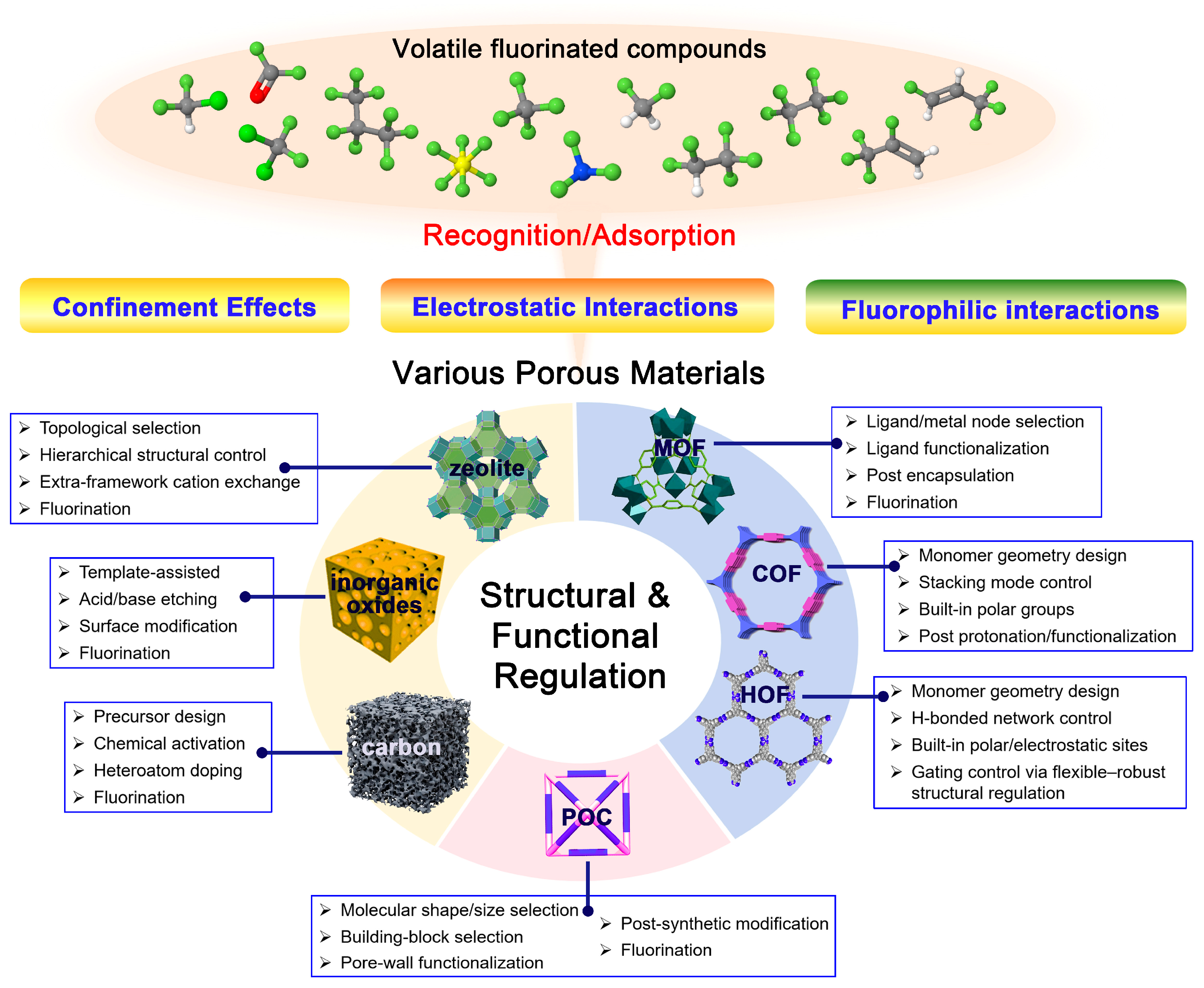
- Confinement effects. In the absence of strong electrostatic or chemical bonding, nanoscale confinement, where pore dimensions closely match the molecular size of VFCs, can substantially enhance adsorption through cumulative van der Waals interactions [19]. This “pore-filling” effect often yields high adsorption enthalpies, despite the molecule’s inherent inertness, and may be particularly effective for larger VFCs [20].
- (2)
- Electrostatic interactions. Although many VFCs possess weak or zero permanent dipoles, they often exhibit significant quadrupole moments or highly localized negative charge densities on fluorine atoms. Materials engineered with strong local electric fields, such as those featuring open metal sites, extra-framework cations, or polar functional groups, can leverage ion–quadrupole or polarization-induced interactions, and dipole-induced dipole interactions to achieve selective binding [21].
- (3)
- Fluorophilic interactions. Certain chemical micro-environments, exemplified by perfluorinated interfaces or particular metal coordination sites, exhibit a marked thermodynamic preference for fluorinated substrates relative to their non-fluorinated analogs [22,23,24]. This selectivity arises from the unique electronic characteristics and low surface energy of F, enabling effective recognition even in complex gas mixtures.
2.1. Modulation Strategies for Pore Architecture
2.2. Modulation Strategies by Surface Chemistry
2.3. Design Criteria for VFC Sensing and Capture
3. Porous Materials for VFC Management
3.1. Porous Materials in VFC Sensing
3.1.1. Chemi-Resistive Transduction
3.1.2. Optical and Gravimetric Transduction
3.1.3. Catalytic Conversion-Based Sensing
3.2. Selective Adsorption of Targeted VFCs
3.2.1. Trapping of Electron-Industrial Gases (SF6 and NF3)
3.2.2. Recovery of Refrigerants (PFCs, HFCs, CFCs, HFOs)
Perfluorocarbons (PFCs)
Hydrofluorocarbons (HFCs)
Chlorofluorocarbons (CFCs) and Hydrofluoroolefins (HFOs)
3.2.3. Other VFC Species
3.3. Comparative Assessment of Porous Adsorbents and Practical Considerations
4. Perspectives on Integrated “Sense-and-Capture” System for VFC Management
5. Conclusions and Outlook
Author Contributions
Funding
Data Availability Statement
Acknowledgments
Conflicts of Interest
Abbreviations
| ADC | Anthracene-9,10-dicarboxylic acid |
| Al-Fum | Aluminum fumarate |
| AlNNS | Aluminum nitride nanosheet |
| ASA | Active surface area |
| ATC-Cu | Adamantane tetracarboxylate-copper |
| BPM | 4,4′-dihydroxybiphenyl-3,3′-dicarboxylic acid |
| BPP | 2,2′-dihydroxybiphenyl-5,5′-dicarboxylic acid |
| BPZ | 4,4′-bipyrazole |
| bzc | 5-(trifluoromethyl)-1H-pyrazole-4-carboxylic acid |
| CALF | Calgary framework |
| CC3 | Covalent cage-3 |
| CFC | Chlorofluorocarbon |
| COF | Covalent organic framework |
| CPOF | Covalent porous organic framework |
| Cu/AC | Copper-supported activated carbon |
| DABCO | 1,4-diazabicyclo[2.2.2]octane |
| DFT | Density functional theory |
| DUT | Dresden University of Technology |
| Eu-FDA | Europium-furandicarboxylate |
| fba | 4,4′-(hexafluoroisopropylidene)bis-benzoate |
| GCMC | Grand Canonical Monte Carlo |
| GWP | Global warming potential |
| H4ATC | 1,3,5,7-adamantanetetracarboxylic acid |
| H6TDBB | 1,3,5-tris (3′,5′-dicarboxy-[1,1′-biphenyl]-4-yl) benzene |
| hBN-graphene | Hexagonal boron nitride–graphene |
| HCFC | Hydrochlorofluorocarbon |
| HF | Hydrogen fluoride |
| HFC | Hydrofluorocarbon |
| HFC-32 | Difluoromethane (R-32) |
| HFC-125 | Pentafluoroethane (R-125) |
| HFC-134a | 1,1,1,2-tetrafluoroethane (R-134a) |
| HFO-1234yf | 2,3,3,3-tetrafluoroprop-1-ene (R-1234yf) |
| H2FDA (FDCA) | 2,5-furandicarboxylic acid |
| HFO | Hydrofluoroolefin |
| HOF | Hydrogen-bonded organic framework |
| IAST | Ideal adsorbed solution theory |
| INA | Isonicotinic acid |
| KSP | Potassium hydrogen phthalate |
| LSPR | Localized surface plasmon resonance |
| LTA | Linde Type A |
| MIL | Matériaux Institut Lavoisier |
| MOF | Metal–organic frameworks |
| pca | Pyrazinecarboxylic acid |
| pyz | Pyrazine |
| PAS | Photoacoustic spectroscopy |
| PET | Polyethylene terephthalate |
| PFAS | Per- and polyfluoroalkyl substances |
| PFC | Perfluorocarbon |
| PFOA | Perfluorooctanoic acid |
| PMA | Pyromellitic acid |
| POC | Porous organic cage |
| PVDF | Polyvinylidene fluoride |
| QCM | Quartz crystal microbalance |
| RCOF | Reconstructed covalent organic framework |
| SBU | Secondary building unit |
| SNAr | Nucleophilic Aromatic Substitution |
| TAPM | Tetra(4-aminophenyl)methane |
| tBu-TFPPy | 7-tert-butyl-1,3,5,9-tetrakis(4-formylphenyl)pyrene |
| TPM | 3,3″-dihydroxy-2′,5′-dimethyl-[1,1′:4′,1″-terphenyl]-4,4″-dicarboxylic acid |
| TPP | 4,4″-dihydroxy-2′,5′-dimethyl-[1,1′:4′,1″-terphenyl]-3,3″-dicarboxylic acid |
| UV-vis | Ultraviolet–visible |
| VFC | Volatile fluorinated compound |
| VOC | Volatile organic compound |
References
- Dwivedi, O.D.; Barsukov, Y.; Jubin, S.; Vella, J.R.; Kaganovich, I. Orientation-dependent etching of silicon by fluorine molecules: A quantum chemistry computational study. J. Vac. Sci. Technol. A 2025, 41, 052602. [Google Scholar]
- Rossen, K. Fluorinated organic compounds-how to imagine a future. Org. Process Res. Dev. 2023, 27, 1421. [Google Scholar] [CrossRef] [Scilit]
- Sheldon, D.J.; Crimmin, M.R. Repurposing of F-gases: Challenges and opportunities in fluorine chemistry. Chem. Soc. Rev. 2022, 51, 4977–4995. [Google Scholar] [CrossRef] [Scilit] [PubMed]
- Bai, F.; Jiang, P.; An, M.; Zhao, X.; Chen, Z.; Zhang, X.; Hu, J. Fluorinated greenhouse gas mitigation potential and routes in China and globally. J. Environ. Manag. 2025, 377, 124715. [Google Scholar] [CrossRef] [Scilit] [PubMed]
- Knebel, A.; Caro, J. Metal-organic frameworks and covalent organic frameworks as disruptive membrane materials for energy-efficient gas separation. Nat. Nanotechnol. 2022, 17, 911–923. [Google Scholar] [CrossRef] [Scilit] [PubMed]
- Sohrabi, H.; Ghasemzadeh, S.; Ghoreishi, Z.; Majidi, M.R.; Yoon, Y.; Dizge, N.; Khataee, A. Metal-organic frameworks (MOF)-based sensors for detection of toxic gases: A review of current status and future prospects. Mater. Chem. Phys. 2023, 299, 127512. [Google Scholar] [CrossRef] [Scilit]
- Wang, W.; Su, K.; Yuan, D. Porous organic cages for gas separations. Mater. Chem. Front. 2023, 7, 5247–5262. [Google Scholar] [CrossRef] [Scilit]
- Ling, B.; Agrawal, R.; He, D.; Poole, R.J.; Cooper, A.I.; Liu, M.; García-Tuñón, E. 3D-printed porous organic cages for gas filtration: Fabrication and flow simulations. Adv. Funct. Mater. 2024, 34, 2405320. [Google Scholar] [CrossRef] [Scilit]
- Zhao, M.; Sun, L.; Yang, Y.; Gu, X.-S.; Lai, C.-J.-S. Hydrogen-bonded organic framework: Construction and gas separation application. Coord. Chem. Rev. 2024, 514, 215881. [Google Scholar] [CrossRef] [Scilit]
- Wang, Q.; Hu, Y.; Gu, Y. Molecular mechanism behind the capture of fluorinated gases by metal-organic frameworks. Nano-Micro Lett. 2025, 17, 118. [Google Scholar] [CrossRef] [Scilit] [PubMed]
- Santiago, A.R.; Dutta, A.; Wu, J.-C.; Yin, S.; Lee, Y.W.; Hou, C.-H.; Shukla, D.; Su, X. Investigating the structure-function relationships of fluorinated interfaces for PFAS capture and electrochemically-mediated release. Adv. Funct. Mater. 2025, 35, 2502317. [Google Scholar] [CrossRef] [Scilit]
- Majhi, S.M.; Ali, A.; Rai, P.; Greish, Y.E.; Alzamly, A.; Surya, S.G.; Qamhieh, N.; Mahmoud, S.T. Metal-organic frameworks for advanced transducer based gas sensors: Review and perspectives. Nanoscale Adv. 2022, 4, 697–732. [Google Scholar] [CrossRef] [Scilit] [PubMed]
- Yancey, A.D.; Terian, S.J.; Shaw, B.J.; Bish, T.M.; Corbin, D.R.; Shiflett, M.B. A review of fluorocarbon sorption on porous materials. Microporous Mesoporous Mater. 2022, 331, 111654. [Google Scholar] [CrossRef] [Scilit]
- Zhao, Y.-L.; Zhang, X.; Li, M.-Z.; Li, J.-R. Non-CO2 greenhouse gas separation using advanced porous materials. Chem. Soc. Rev. 2024, 53, 2056–2098. [Google Scholar] [CrossRef] [Scilit] [PubMed]
- Wang, S.-M.; Duan, P.; Yang, Q.-Y. Advances in porous adsorbents for perfluorocarbon greenhouse gas sorption and separation. Coord. Chem. Rev. 2025, 525, 216339. [Google Scholar] [CrossRef] [Scilit]
- Panda, S.; Mehlawat, S.; Dhariwal, N.; Kumar, A.; Sanger, A. Comprehensive review on gas sensors: Unveiling recent developments and addressing challenges. Mater. Sci. Eng. B 2024, 308, 117616. [Google Scholar] [CrossRef] [Scilit]
- Zhang, C.; Qian, L.; Zeng, W. MOS based gas sensor in detection of volatile organic compounds: A review. Sens. Actuators A Phys. 2025, 393, 116818. [Google Scholar] [CrossRef] [Scilit]
- Han, B.; Rupam, T.H.; Chakraborty, A.; Saha, B.B. A comprehensive review on VOCs sensing using different functional materials: Mechanisms, modifications, challenges and opportunities. Renew. Sustain. Energy Rev. 2024, 196, 114365. [Google Scholar] [CrossRef] [Scilit]
- Haick, H. Advances in volatile organic compounds detection: From fundamental research to real-world applications. Appl. Phys. Rev. 2024, 11, 040401. [Google Scholar] [CrossRef] [Scilit]
- Zhang, M.; Lv, K.; Xie, M.; Duan, L.; Jin, Z. Interfacial phenomena in shale reservoirs: Molecular insights into adsorption, wettability, and nanoconfined flow. Adv. Colloid Interface Sci. 2026, 354, 103894. [Google Scholar] [CrossRef] [Scilit] [PubMed]
- Cho, H.S.; Yang, J.; Gong, X.; Zhang, Y.-B.; Momma, K.; Weckhuysen, B.M.; Deng, H.; Kang, J.K.; Yaghi, O.M.; Terasaki, O. Isotherms of individual pores by gas adsorption crystallography. Nat. Chem. 2019, 11, 562–570. [Google Scholar] [CrossRef] [Scilit] [PubMed]
- Fan, Z.; Wang, Y.; Yuan, M.; Zhou, X.; Duan, Z.; Fu, H. Synergistic enhancement of CO2 adsorption in multi-modified MOFs: Structure-performance relationship of electrostatic interaction and exposure site. J. Environ. Chem. Eng. 2026, 14, 122547. [Google Scholar] [CrossRef] [Scilit]
- Wang, Q.; Zhu, J.; Yan, J. Cooperative binding in a fluorinated nanoporous polyketaminal network for highly selective SF6 and CF4 capture. ACS Macro Lett. 2025, 14, 1535–1542. [Google Scholar] [CrossRef] [Scilit] [PubMed]
- Amooghin, A.E.; Sanaeepur, H.; Luque, R.; Garcia, H.; Chen, B. Fluorinated metal–organic frameworks for gas separation. Chem. Soc. Rev. 2022, 51, 7427–7508. [Google Scholar] [CrossRef] [Scilit] [PubMed]
- Ahrens, T.; Kohlmann, J.; Ahrens, M.; Braun, T. Functionalization of fluorinated molecules by transition-metal-mediated C-F bond activation to access fluorinated building blocks. Chem. Rev. 2015, 115, 931–972. [Google Scholar] [CrossRef] [Scilit] [PubMed]
- Shen, Y.; Yang, X.; Zheng, J.; Liang, Y.; Zhao, X.; Ying, Z.; Zhao, J.; Ye, J.; Zhang, S. Molecule-Pore size matching mechanism in Amine-Functionalized zeolites for efficient CO2 adsorption with low energy Penalty. Sep. Purif. Technol. 2025, 373, 133488. [Google Scholar] [CrossRef] [Scilit]
- Xue, D.-X.; Belmabkhout, Y.; Shekhah, O.; Jiang, H.; Adil, K.; Cairns, A.J.; Eddaoudi, M. Tunable rare earth fcu-MOF platform: Access to adsorption kinetics driven gas/vapor separations via pore size contraction. J. Am. Chem. Soc. 2015, 137, 5034–5040. [Google Scholar] [CrossRef] [Scilit] [PubMed]
- Khojastehnezhad, A.; Rhili, K.; Shehab, M.K.; Gamraoui, H.; Peng, Z.; ElDouhaibi, A.S.; Touzani, R.; Hammouti, B.; El-Kaderi, H.M.; Siaj, M. Rapid, mild, and catalytic Synthesis of 2D and 3D COFs with promising supercapacitor applications. ACS Appl. Energy Mater. 2023, 6, 12216–12225. [Google Scholar] [CrossRef] [Scilit]
- An, Y.; Fu, Q.; Zhang, D.; Wang, Y.; Tang, Z. Performance evaluation of activated carbon with different pore sizes and functional groups for VOC adsorption by molecular simulation. Chemosphere 2019, 227, 9–16. [Google Scholar] [CrossRef] [Scilit] [PubMed]
- Tang, Z.; Chen, J.; Sheng, L.; Li, Z.; Yang, Y.; Wang, J.; Tang, Y.; He, X.; Xu, H. Enhancing gas adsorption in three-dimensional covalent organic frameworks via conformational effects. Chem. Mater. 2025, 37, 5217–5225. [Google Scholar] [CrossRef] [Scilit]
- Li, P.; Ryder, M.R.; Stoddart, J.F. Hydrogen-bonded organic frameworks: A rising class of porous molecular materials. Acc. Mater. Res. 2020, 1, 77–87. [Google Scholar] [CrossRef] [Scilit]
- Samanta, J.; Zhang, Y.; Zhang, M.; Chen, A.D.; Ke, C. Single-crystalline hydrogen-bonded crosslinked organic frameworks and their dynamic guest sorption. Acc. Mater. Res. 2022, 3, 1186–1200. [Google Scholar] [CrossRef] [Scilit]
- Song, Z.; Wang, Y.; Zha, Z.; Wang, Z.; Zhao, S. Porous organic cage separation membranes: Exploratory journey from preparation to application. Adv. Membr. 2025, 5, 100125. [Google Scholar] [CrossRef] [Scilit]
- Tian, K.; Zhang, W.-S.; Othayoth, A.K.; Schuldt, M.P.; Walenszus, F.; Rominger, F.; Schröder, R.R.; Elbert, S.M.; Mastalerz, M. Highly selective adsorption of fluorinated gases by porous organic cages-effects of fluorinated side-chains. Adv. Mater. 2026, 38, e16358. [Google Scholar] [CrossRef] [Scilit] [PubMed]
- Zhang, W.; Xin, Y.; Xiong, Y.; Li, F.; Fa, Y.; Liu, H. Porous organic cages for radio-nuclide and heavy metal adsorption: Structure–activity relationships. J. Mater. Chem. A 2025, 13, 35133–35153. [Google Scholar] [CrossRef] [Scilit]
- Li, S.; Chernobrovkina, A.; Tang, Z.; Fu, X.; Gao, G.; Wang, L.; Lv, M. Porous organic cages: Synthetic strategies and advances in chromatography separation and adsorption. Microchem. J. 2026, 228, 118977. [Google Scholar] [CrossRef] [Scilit]
- Liang, Y.; Xie, G.; Liu, K.-K.; Jin, M.; Chen, Y.; Yang, X.; Guan, Z.-J.; Xing, H.; Fang, Y. Mechanochemical “Cage-on-MOF” Strategy for Enhancing Gas Adsorption and Separation through Aperture Matching. Angew. Chem. Int. Ed. 2025, 64, e202416884. [Google Scholar] [CrossRef] [Scilit] [PubMed]
- Li, Y.; Yu, J. New Stories of Zeolite Structures: Their Descriptions, Determinations, Predictions, and Evaluations. Chem. Rev. 2014, 114, 7268–7316. [Google Scholar] [CrossRef] [Scilit] [PubMed]
- Wu, Y.; Xia, C.; Cai, L.; Shi, S.Q. Controlling pore size of activated carbon through self-activation process for removing contaminants of different molecular sizes. J. Colloid Interface Sci. 2018, 518, 41–47. [Google Scholar] [CrossRef] [Scilit] [PubMed]
- Yu, B.; Tao, Y.; Yao, X.; Jin, Y.; Liu, S.; Xu, T.; Wang, H.; Wu, H.; Zhou, W.; Zhou, X.; et al. Single-crystalline 3D covalent organic frameworks with exceptionally high specific surface areas and gas storage capacities. J. Am. Chem. Soc. 2024, 146, 28932–28940. [Google Scholar] [CrossRef] [Scilit] [PubMed]
- Li, Z.; Yang, Y.-W. Macrocycle-based porous organic polymers for separation, sensing, and catalysis. Adv. Mater. 2022, 34, 2107401. [Google Scholar] [CrossRef] [Scilit] [PubMed]
- Lee, G.; Choi, D.; Oh, M. Activating the gate-opening of a metal-organic framework and maximizing its adsorption capacity. J. Am. Chem. Soc. 2025, 147, 12811–12820. [Google Scholar] [CrossRef] [Scilit] [PubMed]
- Chen, K.; Mousavi, S.H.; Singh, R.; Snurr, R.Q.; Li, G.; Webley, P.A. Gating effect for gas adsorption in microporous materials-mechanisms and applications. Chem. Soc. Rev. 2022, 51, 1139–1166. [Google Scholar] [CrossRef] [Scilit] [PubMed]
- Hashimoto, T.; Oketani, R.; Hisaki, I. Composition dependent dynamic behaviors of non-stoichiometric cocrystalline hydrogen-bonded organic frameworks. Small 2025, 21, e08763. [Google Scholar] [CrossRef] [Scilit] [PubMed]
- Hartmann, Y.; Oestreich, R.; Wada, Y.; de Bary, P.; Kawano, M.; Janiak, C.; Schmidt, B.M. Dynamic covalent radical recombination for the assembly of tunable responsive porous organic cages. Angew. Chem. Int. Ed. 2026, 65, e7638565. [Google Scholar] [CrossRef] [Scilit] [PubMed]
- Little, M.A.; Cooper, A.I. The chemistry of porous organic molecular materials. Adv. Funct. Mater. 2020, 30, 1909842. [Google Scholar] [CrossRef] [Scilit]
- Qin, L.; Li, Y.; Liang, F.; Li, L.; Lan, Y.; Li, Z.; Lu, X.; Yang, M.; Ma, D. A microporous 2D cobalt-based MOF with pyridyl sites and open metal sites for selective adsorption of CO2. Microporous Mesoporous Mater. 2022, 341, 112098. [Google Scholar] [CrossRef] [Scilit]
- Kim, H.; Sohail, M.; Yim, K.; Park, Y.C.; Chun, D.H.; Kim, H.J.; Han, S.O.; Moon, J.-H. Effective CO2 and CO separation using [M2(DOBDC)] (M = Mg, Co, Ni) with unsaturated metal sites and excavation of their adsorption sites. ACS Appl. Mater. Interfaces 2019, 11, 7014–7021. [Google Scholar] [CrossRef] [Scilit] [PubMed]
- Jiang, C.; Wang, X.; Ouyang, Y.; Lu, K.; Jiang, W.; Xu, H.; Wei, X.; Wang, Z.; Dai, F.; Sun, D. Recent advances in metal-organic frameworks for gas adsorption/separation. Nanoscale Adv. 2022, 4, 2077–2089. [Google Scholar] [CrossRef] [Scilit] [PubMed]
- Zeng, Q.-W.; Hu, L.; Niu, Y.; Wang, D.; Kang, Y.; Jia, H.; Dou, W.-T.; Xu, L. Metal-organic cages for gas adsorption and separation. Chem. Commun. 2024, 60, 3469–3483. [Google Scholar] [CrossRef] [Scilit] [PubMed]
- Bhati, G.; Dharanikota, N.P.S.K.; Uppaluri, R.V.S.; Mandal, B. Influence of cation exchange on the selective CO2 adsorption performance of Zeolite-Y over CH4 and N2. Microporous Mesoporous Mater. 2025, 387, 113537. [Google Scholar] [CrossRef] [Scilit]
- Ramirez-de-Arellano, J.M.; Canales, M.; Magaña, L.F. Carbon nanostructures doped with transition metals for pollutant gas adsorption systems. Molecules 2021, 26, 5346. [Google Scholar] [CrossRef] [Scilit] [PubMed]
- Gao, Z.; Liu, Y.; Wu, S.; Tang, J.; Yuan, K.; Pan, C.; Yu, G. Metal-decorated porous organic polymers: Bridged the gap between organic and inorganic scaffolds. Chin. J. Chem. 2024, 42, 2902–2934. [Google Scholar] [CrossRef] [Scilit]
- Tao, H.; Shi, G.; Jiang, L.; Lin, W.; Li, H.; Wang, C. Tuning the anion for ultrahigh and selective adsorption of low-concentration SO2 by functionalized ionic porous organic polymers. Sep. Purif. Technol. 2024, 333, 125974. [Google Scholar] [CrossRef] [Scilit]
- Richard, A.J.; Chen, Z.; Islamoglu, T.; Farha, O.K.; El-Kaderi, H.M. Heteroatom-doped porous carbons as effective adsorbers for toxic industrial gasses. ACS Appl. Mater. Interfaces 2022, 14, 33173–33180. [Google Scholar] [CrossRef] [Scilit] [PubMed]
- Zhi, S.; Dai, Q.; Wang, H.; Wu, D.; Zhao, L.; Hu, C.; Dai, L. Heteroatom-doped carbon materials for multifunctional noncatalytic applications. ACS Nano 2025, 19, 29860–29897. [Google Scholar] [CrossRef] [Scilit] [PubMed]
- Yin, Q.; Yin, K.; Weng, S.; Ye, F.; Huang, H.; Yang, L.; Fu, M. Preparation of green hydrophobic ZSM-5 zeolite and its toluene adsorption performance under high humidity conditions. New J. Chem. 2025, 49, 9806–9815. [Google Scholar] [CrossRef] [Scilit]
- Liu, H.; Wang, X.; Gao, F.; Wang, Y.; Sun, M.; Xie, D.; Chen, W.; Kang, Z.; Wang, R.; Fan, W.; et al. Pore surface fluorination and PDMS deposition within commercially viable metal-organic framework for efficient C2H2/CO2 separation. Sci. China Mater. 2024, 67, 3692–3699. [Google Scholar] [CrossRef] [Scilit]
- Fu, K.; Huang, J.; Luo, F.; Fang, Z.; Yu, D.; Zhang, X.; Wang, D.; Xing, M.; Luo, J. Understanding the selective removal of per-fluoroalkyl and polyfluoroalkyl substances via fluorine-fluorine interactions: A critical review. Environ. Sci. Technol. 2024, 58, 16669–16689. [Google Scholar] [CrossRef] [Scilit] [PubMed]
- Tian, Q.; Chen, S.; Shi, M.; Gao, T.; Zhang, M.; Liao, C.; Li, X.; Dong, Q.; Wang, C. Fluorine-functionalized MOF modified GCE for highly sensitive electrochemical detection of persistent pollutant perfluorooctanoic acid. Sens. Actuators B Chem. 2024, 404, 135309. [Google Scholar] [CrossRef] [Scilit]
- Yu, S.; Jia, X.; Zhang, J.; Yang, W.; Song, H. Recent advances in different materials for moisture resistance of metal oxide-based gas sensors: A review. Chem. Eng. J. 2025, 505, 159639. [Google Scholar] [CrossRef] [Scilit]
- Hu, C.; Zhang, W.; Yang, J.; Pei, Y.; Tan, X.; Dong, B.; Song, H.; Xu, L. Chemiresistive gas sensors for intelligent sensing: Design strategies, emerging applications and future challenges. Chem. Soc. Rev. 2025, 54, 11302–11367. [Google Scholar] [CrossRef] [Scilit] [PubMed]
- Benedetto, G.; Mirica, K.A. Conductive framework materials for chemiresistive detection and differentiation of toxic gases. Acc. Chem. Res. 2024, 57, 2775–2789. [Google Scholar] [CrossRef] [Scilit] [PubMed]
- Lei, T.; Lv, F.; Jiang, B. A DFT study on adsorption of SF6 decomposition products on Zr-MOF-808. Chemosensors 2023, 11, 402. [Google Scholar] [CrossRef] [Scilit]
- Zhou, M.; Li, Y.; Xu, G. Advances in microporous framework materials as chemiresistive gas sensors. TrAC Trends Anal. Chem. 2024, 174, 117679. [Google Scholar] [CrossRef] [Scilit]
- Deng, W.-H.; Xiao, K.; Cheng, Z.; Liu, C.-L.; Xiang, S.; Xu, G. Dimensionally engineered MOF films for chemiresistive sensors. Chem. Soc. Rev. 2026, 55, 910–940. [Google Scholar] [CrossRef] [Scilit] [PubMed]
- Sharma, A.; Eadi, S.B.; Noothalapati, H.; Otyepka, M.; Lee, H.-D.; Jayaramulu, K. Porous materials as effective chemiresistive gas sensors. Chem. Soc. Rev. 2024, 53, 2530–2577. [Google Scholar] [CrossRef] [PubMed]
- Kumar, A.; Mazumder, J.T.; Joyen, K.; Favier, F.; Mirzaei, A.; Kim, J.-Y.; Kwoka, M.; Bechelany, M.; Jha, R.K.; Kumar, M.; et al. Defect engineering approaches for metal oxide semiconductor-based chemiresistive gas sensing. Coord. Chem. Rev. 2025, 541, 216836. [Google Scholar] [CrossRef] [Scilit]
- Tian, M.; Wu, Y.; Zhao, Z.; Chen, Z.; Zhu, N.; Jiang, X. Materials design strategies for semiconducting metal-oxide chemiresistive gas sensors: A review. RSC Appl. Interfaces 2026, 3, 616–639. [Google Scholar] [CrossRef] [Scilit]
- Phansiri, N.; Maenosono, D.; Furumoto, T.; Sato, H.; Nakano, M.; Suehiro, J. Detection of CF4 gas using a nanomaterial-based gas sensor fabricated by dielectrophoresis. In Proceedings of the 21st International Symposium on High Voltage Engineering; Springer: Berlin/Heidelberg, Germany, 2020; pp. 481–488. [Google Scholar]
- Arora, A.K.; Mahajan, S.; Verma, M.; Haridas, D. Study of structural and morphological properties of RF-sputtered SnO2 thin films and their effect on gas-sensing phenomenon. Int. J. Smart Sens. Intell. Syst. 2023, 16, 20230003. [Google Scholar] [CrossRef] [Scilit]
- Meng, H.; Liu, Z.; Wang, X.; Feng, L. A fluorinated greenhouse gas sensor based on N-doped tin oxide materials. Environ. Sci. Nano 2024, 11, 459–469. [Google Scholar] [CrossRef] [Scilit]
- Wu, P.; Li, Y.; Xiao, S.; Chen, J.; Tang, J.; Chen, D.; Zhang, X. SnO2 nanoparticles based highly sensitive gas sensor for detection of C4F7N: A new eco-friendly gas insulating medium. J. Hazard. Mater. 2022, 422, 126882. [Google Scholar] [CrossRef] [Scilit] [PubMed]
- Wu, P.; Li, Y.; Xiao, S.; Chen, D.; Chen, J.; Tang, J.; Zhang, X. Room-temperature detection of perfluoroisobutyronitrile with SnO2/Ti3C2Tx gas sensors. ACS Appl. Mater. Interfaces 2022, 14, 48200–48211. [Google Scholar] [CrossRef] [Scilit] [PubMed]
- Xiao, S.; Xue, Y.; Li, Z.; Wu, C.; Zhang, Y.; Wu, P.; Tang, J.; Zhang, X.; Yuan, H.; Li, Y. High-performance Co3O4 nanoparticle-based gas sensor for leakage detection of eco-friendly insulating gas C4F7N. ACS Sens. 2025, 10, 2976–2985. [Google Scholar] [CrossRef] [Scilit] [PubMed]
- Fan, J.; Wang, X.; Cong, S.; Zhang, R.; Lv, W.; Li, L.; Pan, Q.; Bai, X.; Shi, K. Interface-engineered ZrO2@Co3O4 core-shell materials from bimetallic MOFs for enhanced room temperature NO2 sensing. Chem. Eng. J. 2026, 543, 178268. [Google Scholar] [CrossRef] [Scilit]
- Li, Z.; Shi, W.; Seo, J.-M.; Jung, H.; Kim, M.H.; Wang, Z.; Jin, Y.; Li, C.; Yoo, J.-W.; Lee, Z.; et al. Tuning electronic skeleton properties of porphyrin covalent organic frameworks (COFs) for high-performance selective gas chemiresistive sensing. Nano Lett. 2026, 26, 42–50. [Google Scholar] [CrossRef] [Scilit] [PubMed]
- Wu, Q.; Yang, T.; Shi, J.; Jia, L.; Xie, B.; Lu, W.; Zhao, T.; Yu, C.; Mo, X.; Xie, W.; et al. Application of fluorescent covalent organic frameworks in gas sensors. Nanoscale 2026, 18, 6184–6202. [Google Scholar] [CrossRef] [Scilit] [PubMed]
- Shen, Z.; Li, W.; Tang, W.; Jiang, X.; Qi, K.; Liu, H.; Xu, W.; Xu, W.; Zang, S.; Zhen, K.; et al. Fluorophor embedded MOFs steering gas ultra-recognition. Adv. Funct. Mater. 2024, 34, 2401631. [Google Scholar] [CrossRef] [Scilit]
- Jrad, A.; Das, G.; Alkhatib, N.; Prakasam, T.; Benyettou, F.; Varghese, S.; Gándara, F.; Olson, M.; Kirmizialtin, S.; Trabolsi, A. Cationic covalent organic framework for the fluorescent sensing and cooperative adsorption of perfluorooctanoic acid. Nat. Commun. 2024, 15, 10490. [Google Scholar] [CrossRef] [Scilit] [PubMed]
- Han, Z.; Liu, Z.; Wang, K.-Y.; Wu, Y.; Huo, J.; Yang, Y.; Liang, R.-R.; Shi, W.; Zhou, H.-C. Systematic coordination symmetry engineering in Eu-metal–organic frameworks for luminescence recognition of perfluorooctanoic acid. CCS Chem. 2026, 8, 219–225. [Google Scholar] [CrossRef] [Scilit]
- Han, Z.; Guo, Y.; Wang, K.-Y.; Li, W.; Huo, J.; Huang, Q.; Bakhmutov, V.I.; Yang, Y.; Liang, R.-R.; Taylor, P.R.; et al. Enhanced-type quantitative luminescence recognition for per- and polyfluoroalkyl substances (PFAS) by a metal-organic framework single crystal. Angew. Chem. Int. Ed. 2025, 65, e15775. [Google Scholar] [CrossRef] [Scilit] [PubMed]
- Yin, X.; Dong, L.; Wu, H.; Zhang, L.; Ma, W.; Yin, W.; Jia, S.; Tittel, F.K. Highly sensitive photoacoustic multicomponent gas sensor for SF6 decomposition online monitoring. Opt. Express 2019, 27, A224–A234. [Google Scholar] [CrossRef] [Scilit] [PubMed]
- Wei, Q.; Li, B.; Zhao, B.; Wang, Y. Highly sensitive photoacoustic multi-gas detection of SF6 decomposition components. Photonic Sens. 2025, 15, 250430. [Google Scholar] [CrossRef] [Scilit]
- Ji, X.; Mu, K.; Shi, N.; Feng, M.; Chen, P.; Liang, M.; Jiao, M.; Qiao, Y.; Li, L.; Shan, C. Enhanced photoacoustic SF6 sensor using a blackbody radiation source with spherical helmholtz resonator. Sens. Actuators B Chem. 2026, 449, 139137. [Google Scholar] [CrossRef] [Scilit]
- Zhao, Y.; Li, Z.; Xia, Y.; Jia, Q.; Zhao, L.; Maboudia, R. Advances in micro- and nano-scale resonant mass-sensitive gas sensors: Mechanisms, materials, functionalization and applications. Sens. Actuators B Chem. 2025, 431, 137415. [Google Scholar] [CrossRef] [Scilit]
- Golshadi, Z.; Dinari, M.; Knebel, A.; Lützenkirchen, J.; Monjezi, B.H. Metal organic and covalent organic framework-based QCM sensors for environmental pollutant detection and beyond. Coord. Chem. Rev. 2024, 521, 216163. [Google Scholar] [CrossRef] [Scilit]
- Yang, M.; Chang, H.; Chen, J.; Zhu, X. Materials design, sensing performance and mechanism of anhydrous hydrogen fluoride gas sensor based on amino-functionalized MIL-101(Cr) for new energy vehicles. Coatings 2022, 12, 260. [Google Scholar] [CrossRef] [Scilit]
- HF-QCM Sensors, MS Technologies Inc. Available online: https://ms-detection.com/technologies/hf-qcm-sensors/ (accessed on 29 April 2026).
- Industrial ChemSense, MS Technologies Inc. Available online: https://www.ms-technologies.com/product/industrial-chemsense/ (accessed on 29 April 2026).
- Leong, A.; Kashan, M.A.M.; Swamy, V.; Ramakrishnan, N. 2D material attached quartz crystal microbalance for sensing SF6 gas flow under humid condition. Electron. Lett. 2020, 56, 1139–1141. [Google Scholar] [CrossRef] [Scilit]
- Allsop, T.; Neal, R. A review: Application and implementation of optic fibre sensors for gas detection. Sensors 2021, 21, 6755. [Google Scholar] [CrossRef] [Scilit] [PubMed]
- Maekawa, T.; Minagoshi, C.; Ishibashi, K.; Miyazaki, H. Catalytic-Conversion-Type Sensor. U.S. Patent Application No. 2018/0328873 A1, 15 November 2018. [Google Scholar]
- Dominelli, N.; Wylie, I.; Lee, K. Method and Device for the Detection of SF6 Decomposition Products. U.S. Patent Application No. 2005/0233463 A1, 20 October 2005. [Google Scholar]
- Dervos, C.T.; Vassiliou, P. Sulfur hexafluoride (SF6): Global environmental effects and toxic byproduct formation. J. Air Waste Manag. Assoc. 2000, 50, 137–141. [Google Scholar] [CrossRef] [Scilit] [PubMed]
- Nie, W.-W.; Ma, H.-F.; Xiao, H.-P.; Fu, X.-P.; Liu, Q.-Y.; Wang, Y.-L. Achieving efficient SF6 recovery from SF6/N2 separation within isoreticular metal-organic frameworks by programmed chlorination of organic linkers. Sep. Purif. Technol. 2026, 380, 135207. [Google Scholar] [CrossRef] [Scilit]
- Woo, S.; Kwon, T.; Kang, M.; Kang, D.W. Optimal pore environments for effective NF3/N2 separation in robust metal-organic frameworks. Coord. Chem. Res. 2026, 3, 100023. [Google Scholar] [CrossRef] [Scilit]
- Kim, M.-B.; Kim, T.-H.; Yoon, T.-U.; Kang, J.H.; Kim, J.-H.; Bae, Y.-S. Efficient SF6/N2 separation at high pressures using a zirconium-based mesoporous metal-organic framework. J. Ind. Eng. Chem. 2020, 84, 179–184. [Google Scholar] [CrossRef] [Scilit]
- Wang, S.-M.; Zhang, Q.; Li, Y.-T.; Liu, S.-C.; Yang, Q.-Y. Destructive adsorption of nitrogen trifluoride (NF3) using M-MOF-74 with open metal sites. Chem. Bio Eng. 2024, 1, 535–540. [Google Scholar] [CrossRef] [Scilit] [PubMed]
- Li, Y.-T.; Li, W.; Zhang, L.-P.; Geng, N.; Xu, L.; Wang, S.-M.; Zhu, T.; Guan, Q.; Guo, Y.; Li, X.; et al. A scalable zinc-based coordination network for energy-efficient NF3/CF4 separation with unprecedented selectivity. Chem. Sci. 2025, 16, 16225–16231. [Google Scholar] [CrossRef] [Scilit] [PubMed]
- Fan, Z.-W.; Wang, Y.; Liu, J.; Cheng, Z.-T.; Wang, C.; Niu, Z. Metal-organic framework-based NF3 nanotrap for the separation of NF3 and CF4. ACS Appl. Mater. Interfaces 2025, 17, 2349–2354. [Google Scholar] [CrossRef] [Scilit] [PubMed]
- Zhang, Y.; Chen, S.; Wu, Y.; Zhang, Z.; Zhang, W.; Ma, H. Enhanced adsorption selectivity of ultra-microporous porphyrin-based MOFs for F-gases via induced polarization effect. Sep. Purif. Technol. 2025, 374, 133716. [Google Scholar] [CrossRef] [Scilit]
- Jia, J.; Lian, X.; Liu, S.; Wang, J.; Chai, Y.; Wu, G.; Li, L. Efficient capture of SF6 by faujasite zeolites. J. Energy Chem. 2026, 117, 703–708. [Google Scholar] [CrossRef] [Scilit]
- Zhang, Y.; Wu, Y.; Yan, T.; Zhang, Z.; Zhang, W.; Ma, H. Enhanced F-gases’ recovery by introducing Lewis acid sites into MFI zeolites. Ind. Eng. Chem. Res. 2025, 64, 13388–13396. [Google Scholar] [CrossRef] [Scilit]
- Chuah, C.Y.; Yu, S.; Na, K.; Bae, T.-H. Enhanced SF6 recovery by hierarchically structured MFI zeolite. J. Ind. Eng. Chem. 2018, 62, 64–71. [Google Scholar] [CrossRef] [Scilit]
- Fu, W.; Wang, J.; Li, Y.; Sui, Z.; Xiao, B.; Xu, X. Highly-efficient separation of SF6/N2 and NF3/N2 with record selectivity on one-step synthesized carbon nanosheet. Sep. Purif. Technol. 2024, 330, 125496. [Google Scholar] [CrossRef] [Scilit]
- Wang, J.; Fu, W.; Wang, L.; Li, Y.; Li, Y.; Sui, Z.; Xu, X. Modulation of pore structure in a microporous carbon for enhanced adsorption of perfluorinated electron specialty gases with efficient separation. Chem. Eng. J. 2023, 477, 147128. [Google Scholar] [CrossRef] [Scilit]
- Shi, Y.; Wang, J.; Li, Y.; Sui, Z.; Xu, X. Unveiling the ambient CO2-mediated K2CO3 activation pathway in KOH post-treated activated carbon for exceptional SF6 adsorption. Chem. Eng. J. 2025, 520, 166100. [Google Scholar] [CrossRef] [Scilit]
- Wang, J.; Shi, Y.; Rong, C.; Li, Y.; Sui, H.; Xu, X. Self-activated microporous carbon with tailored pore structures and surface polarity for efficient SF6/N2 and NF3/N2 separation. Carbon 2025, 244, 120647. [Google Scholar] [CrossRef] [Scilit]
- Liang, H.; Zhang, Q.; Liu, F.; Pan, H.; Tao, D.-J.; Zhao, T. Pore structure modulation of chitosan-derived porous carbon materials for enhanced sulfur hexafluoride gas adsorption. Chem. Eng. J. 2025, 505, 159159. [Google Scholar] [CrossRef] [Scilit]
- Shi, Y.; Wang, J.; Fu, W.; Li, Y.; Sui, Z.; Xu, X. In-situ activated carbon adsorbents with tailored pore structures for efficient SF6 capture and high-purity recovery. Sep. Purif. Technol. 2025, 360, 130978. [Google Scholar] [CrossRef] [Scilit]
- Zhao, R.; Chen, S.; Liang, C.; Gao, K.; Xiao, L.; Hou, L. The key role of heteroatom effects in COF separation of SF6/N2: A theoretical study. J. Chem. Phys. 2026, 164, 104702. [Google Scholar] [CrossRef] [Scilit] [PubMed]
- Liao, Q.; Xu, H.; Ke, C.; Zhang, Y.; Han, Q.; Zhang, Y.; Xu, Y.; Wang, D.; Xi, K. Rational regulating pore structures of covalent organic frameworks for sulfur hexafluoride capture and separation. Sep. Purif. Technol. 2023, 306, 122595. [Google Scholar] [CrossRef] [Scilit]
- Zhao, Y.; Meng, C.; Chen, Y.; Gong, W.; Xing, G.; Yuan, D.; Ben, T. tert-Butyl functionalized ultra-microporous three-dimensional covalent organic framework for efficient SF6/N2 separation. Angew. Chem. Int. Ed. 2025, 64, e202508493. [Google Scholar] [CrossRef] [Scilit] [PubMed]
- Hasell, T.; Miklitz, M.; Stephenson, A.; Little, M.A.; Chong, S.Y.; Clowes, R.; Chen, L.; Holden, D.; Tribello, G.A.; Jelfs, K.E.; et al. Porous organic cages for sulfur hexafluoride separation. J. Am. Chem. Soc. 2016, 138, 1653–1659. [Google Scholar] [CrossRef] [Scilit] [PubMed]
- Yang, J.; Yu, S.; Zhang, W.; Yang, S.; Hu, D.; Guan, Y.; Li, H.; Liu, M. Chemically stable tetrazine-based porous organic cages with post-synthetic modification via inverse-electron-demand Diels-Alder reactions for SF6/N2 and CO2/N2 separation. Angew. Chem. Int. Ed. 2025, 64, e202512561. [Google Scholar] [CrossRef] [Scilit] [PubMed]
- Yao, J.; Hu, Q.; Yu, L.; Zhao, S.; Fan, Q.; Lv, D.; Chen, D.; Ding, L.; Li, Z.; Xia, Q. Highly-efficient recovering SF6 from SF6/N2 mixture by microporous lignin-derived carbon via one-step carbonization. Carbon 2025, 237, 120147. [Google Scholar] [CrossRef] [Scilit]
- Lickley, M.; Solomon, S.; Fletcher, S.; Velders, G.J.M.; Daniel, J.; Rigby, M.; Montzka, S.A.; Kuijpers, L.J.M.; Stone, K. Quantifying contributions of chlorofluorocarbon banks to emissions and impacts on the ozone layer and climate. Nat. Commun. 2020, 11, 1380. [Google Scholar] [CrossRef] [Scilit] [PubMed]
- Zhang, X.; Li, Y. A review of recent research on hydrofluoroolefin (HFO) and hydrochlorofluoroolefin (HCFO) refrigerants. Energy 2024, 311, 133423. [Google Scholar] [CrossRef] [Scilit]
- Wan, Z.; Yan, T.; Chang, M.; Yang, M.; Liu, D. Nickel-based metal-organic framework for efficient capture of CF4 with a high CF4/N2 selectivity. Sep. Purif. Technol. 2023, 306, 122617. [Google Scholar] [CrossRef] [Scilit]
- Whitehead, B.S.; Brennessel, W.W.; Michtavy, S.S.; Silva, H.A.; Kim, J.; Milner, P.J.; Porosoff, M.D.; Barnett, B.R. Selective adsorption of fluorinated super greenhouse gases within a metal-organic framework with dynamic corrugated ultramicropores. Chem. Sci. 2024, 15, 5964–5972. [Google Scholar] [CrossRef] [Scilit] [PubMed]
- Tian, K.; Elbert, S.M.; Hu, X.-Y.; Kirschbaum, T.; Zhang, W.-S.; Rominger, F.; Schroeder, R.R.; Mastalerz, M. Highly selective adsorption of perfluorinated greenhouse gases by porous organic cages. Adv. Mater. 2022, 34, 2202290. [Google Scholar] [CrossRef] [Scilit] [PubMed]
- Zhu, J.; Hu, J.; Xiao, H.; Yang, L.; Yang, M.; Wang, S.; Zhang, J.; Xing, H. Aluminum-based metal organic frameworks for greenhouse gases CF4 and C2F6 capture with excellent capacity and selectivity. Sep. Purif. Technol. 2024, 331, 125614. [Google Scholar] [CrossRef] [Scilit]
- Xu, G.; Ke, T.; Fan, R.; Tan, K.; Zhang, W.; Su, B.; Zhang, Z.; Bao, Z.; Ren, Q.; Yang, Q. Divergent adsorption regulation in metal-organic frameworks for highly efficient CF4/C2F6 separation. Adv. Sci. 2024, 12, 2411083. [Google Scholar] [CrossRef] [Scilit] [PubMed]
- Zheng, M.; Xue, W.; Yan, T.; Jiang, Z.; Fang, Z.; Huang, H.; Zhong, C. Fluorinated MOF-based hexafluoropropylene nanotrap for highly efficient purification of octafluoropropane electronic specialty gas. Angew. Chem. Int. Ed. 2024, 63, e202401770. [Google Scholar] [CrossRef] [Scilit] [PubMed]
- Lv, X.; Zheng, M.; Jiang, Z.; Huang, H.; Bao, Z.; Zhong, C. Amino-functionalized MOF for efficient purification of octafluoropropane electronic special gas by hexafluoropropylene/octafluoropropane sieving separation. Chem. Eng. J. 2025, 522, 168005. [Google Scholar] [CrossRef] [Scilit]
- Ma, H.-F.; Fu, X.-P.; Xiao, H.-P.; Liu, L.C.; Wang, Q.-Y. Achieving efficient perfluorinated propylene/propane separation by pore cage engineering in metal-organic frameworks. Sci. China Chem. 2026, 69, 3455–3461. [Google Scholar] [CrossRef] [Scilit]
- Xia, W.; Zhou, Z.; Sheng, L.; Chen, L.; Zheng, F.; Zhang, Z.; Yang, Q.; Ren, Q.; Bao, Z. Deep purification of perfluorinated electronic specialty gas with a scalable metal-organic framework featuring tailored positive potential traps. Sci. Bull. 2025, 70, 232–240. [Google Scholar] [CrossRef] [Scilit] [PubMed]
- Fang, Z.; Huang, H.; Sun, L.; Zheng, M.; Lv, Z.; Yan, T.; Zhong, C. A low-cost and stable metal-organic framework featuring electropositive microenvironment for efficient recovery of C3F8 electronic specialty gas and record C3F8/N2 separation. Chem. Eng. J. 2025, 516, 163987. [Google Scholar] [CrossRef] [Scilit]
- Lan, L.; Wei, S.-J.; Xia, W.; Zhang, Q.; Liu, Y.; Bao, C.; Cheng, M.; Qian, Z.-Y.; Wang, L.-L.; Li, Y.-L.; et al. Trace capture hexafluoropropylene from octafluoropropane via complete molecular sieving mechanism in a highly robust metal-organic framework. Angew. Chem. Int. Ed. 2026, 65, e6037453. [Google Scholar] [CrossRef] [Scilit] [PubMed]
- Yancey, A.D.; Corbin, D.R.; Shiflett, M.B. Difluoromethane (HFC-32) and pentafluoroethane (HFC-125) sorption on Linde type A (LTA) zeolites for the separation of azeotropic hydrofluorocarbon refrigerant mixtures. Langmuir 2022, 38, 1937–1953. [Google Scholar] [CrossRef] [Scilit] [PubMed]
- Xiong, Y.-Y.; Krishna, R.; Pham, T.; Forrest, K.A.; Chen, C.-X.; Wei, Z.-W.; Jiang, J.-J.; Wang, H.-P.; Fan, Y.; Pan, M.; et al. Pore-nanospace engineering of mixed-ligand metal-organic frameworks for high adsorption of hydrofluorocarbons and hydrochlorofluorocarbons. Chem. Mater. 2022, 34, 5116–5124. [Google Scholar] [CrossRef] [Scilit]
- Zheng, J.; Barpaga, D.; Trump, B.A.; Shetty, M.; Fan, Y.; Bhattacharya, P.; Jenks, J.J.; Su, C.-Y.; Brown, C.M.; Maurin, G.; et al. Molecular insight into fluorocarbon adsorption in pore expanded metal-organic framework analogs. J. Am. Chem. Soc. 2020, 142, 3002–3012. [Google Scholar] [CrossRef] [Scilit] [PubMed]
- Sultan, M.; Miyazaki, T.; Saha, B.B.; Koyama, S.; Kil, H.-S.; Nakabayashi, K.; Miyawaki, J.; Yoon, S.-H. Adsorption of difluoromethane (HFC-32) onto phenol resin based adsorbent: Theory and experiments. Int. J. Heat Mass Transf. 2018, 127, 348–356. [Google Scholar] [CrossRef] [Scilit]
- Ji, Z.; Zhou, Y.; Krishna, R.; Hong, M.; Wu, M. Scalable synthesis of stable hydrogen-bonded organic framework for efficient hexafluoroethane purification. Angew. Chem. Int. Ed. 2025, 64, e202513398. [Google Scholar] [CrossRef] [Scilit] [PubMed]
- Chokbunpiam, T.; Fritzsche, S.; Ploymeerusmee, T.; Chanajaree, R.; Thompho, S.; Janke, W.; Hannongbua, S. Separation of the chlorofluorocarbon (CFC) CCl2F2 from N2 in NaY zeolite, in MIL-127(Fe) and in the two carbon nanotubes CNT (9,9) and CNT (11,11). J. Mol. Graph. Model. 2023, 125, 108597. [Google Scholar] [CrossRef] [Scilit] [PubMed]
- Esaki, T.; Sugai, Y. Evaluation of adsorption characteristics of HFO-1234yf refrigerant with different adsorbents. Int. J. Ambient Energy 2024, 45, 2315486. [Google Scholar] [CrossRef] [Scilit]
- Cai, S.; Tian, S.; Lu, Y.; Wang, G.; Pu, Y.; Peng, K. Molecular simulations of adsorption and energy storage of R1234yf, R1234ze(z), R134a, R32, and their mixtures in M-MOF-74 (M = Mg, Ni) nanoparticles. Sci. Rep. 2020, 10, 7265. [Google Scholar] [CrossRef] [Scilit] [PubMed]
- Tsai, W.T.; Chen, H.P.; Hsien, W.Y. A review of uses, environmental hazards and recovery/recycle technologies of perfluorocarbons (PFCs) emissions from the semiconductor manufacturing processes. J. Loss Prev. Process Ind. 2002, 15, 65–75. [Google Scholar] [CrossRef] [Scilit]
- Shamim, J.A.; Nawaz, K.; Hu, M.H.; Pasqualin, P.; Krishnan, E.N.; Kowalski, S.P.; Bhowmik, P.K.; Parameshwaran, R.; Hsu, W.L.; Hwang, Y.; et al. Review of the potential and challenges of MOF-based adsorption heat pumps for sustainable cooling and heating in the buildings. Energy 2025, 323, 1135846. [Google Scholar] [CrossRef] [Scilit]
- Yancey, A.D.; Broom, D.P.; Roper, M.G.; Benham, M.J.; Corbin, D.R.; Shiflett, M.B. Separation of azeotropic hydrofluorocarbon refrigerant mixtures: Thermodynamic and kinetic modeling for binary adsorption of HFC-32 and HFC-125 on zeolite 5A. Langmuir 2022, 38, 10836–10853. [Google Scholar] [CrossRef] [Scilit] [PubMed]
- Sosa, J.E.; Malheiro, C.; Ribeiro, R.P.P.L.; Castro, P.J.; Piñeiro, M.M.; Araújo, J.M.M.; Plantier, F.; Mota, J.P.B.; Pereiro, A.B. Adsorption of fluorinated greenhouse gases on activated carbons: Evaluation of their potential for gas separation. J. Chem. Technol. Biotechnol. 2020, 95, 1892–1905. [Google Scholar] [CrossRef] [Scilit]
- Mizukami, K.; Takaba, H.; Katagiri, M.; Kubo, M.; Stirling, A.; Broclawik, E.; Miyamoto, A. Atomistic mechanism of the adsorption of CFCs in zeolite as investigated by Monte Carlo simulation. Stud. Surf. Sci. Catal. 1997, 105, 1811–1818. [Google Scholar] [CrossRef] [Scilit]
- Wang, H.; Yu, L.; Lin, Y.; Peng, J.; Teat, S.J.; Williams, L.J.; Li, J. Adsorption of fluorocarbons and chlorocarbons by highly porous and robust fluorinated zirconium metal-organic frameworks. Inorg. Chem. 2020, 59, 4167–4171. [Google Scholar] [CrossRef] [Scilit] [PubMed]
- Gao, W.; Posada, L.; Shiravand, V.; Shubhashish, S.; Price, C.; Zhang, B.; Potyrailo, R.; Younsi, K.; Shan, S.; Ndiaye, I.; et al. Decomposition characteristics of C4F7N-based SF6-alternative gas mixtures. J. Appl. Phys. 2024, 135, 063302. [Google Scholar] [CrossRef] [Scilit]
- Xiao, S.; Chen, J.; Wu, P.; Yao, Q.; Li, L.; Pang, X.; Zhang, S.; Zhang, X.; Li, Y. Research on the adsorption of environmentally friendly insulating gas C4F7N decomposed components on the surface of γ-Al2O3. High Volt. 2022, 8, 274–282. [Google Scholar] [CrossRef] [Scilit]
- Wang, W.; Yan, X.; Wang, H.; Gao, K. Comparative studies of C4F7N-based gas mixtures as the eco-friendly alternative to SF6 for interrupting applications. High Volt. 2025, 10, 228–242. [Google Scholar] [CrossRef] [Scilit]
- González Fá, A.J.; Luna, C.R.; Marchetti, J.M.; López-Corral, I. DFT study of adsorption and potential detection of carbonyl fluoride on B-doped aluminum nitride nanosheets. Appl. Surf. Sci. 2025, 680, 161285. [Google Scholar] [CrossRef] [Scilit]
- Johnson, B.J.; Leska, I.A.; Melde, B.J.; Taft, J.R. Self-reporting materials: Dual use for porphyrin-embedded sorbents. Sens. Actuators B Chem. 2013, 176, 399–404. [Google Scholar] [CrossRef] [Scilit]
- Hayashi, J.; Iwamura, S.; Nakasaka, Y.; Wang, M.; Shoji, S.; Kitagawa, Y.; Fushimi, K.; Mukai, S.R.; Hasegawa, Y. Luminescence changeable CO2-storage cylinder: Triple-stranded helical Eu(III)/Tb(III) fluorinated MOFs with amide linkers. Chem. Eur. J. 2024, 30, e202403224. [Google Scholar] [CrossRef] [Scilit] [PubMed]
- Fernández-Bartolomé, E.; Sangrador-Pérez, J.; Urieta-Mora, J.; Martínez-Martínez, A.; Utrera-Melero, R.; Turo-Cortés, R.; Gándara, F.; Sañudo, E.C.; Poloni, R.; Fairen-Jiménez, D.; et al. Room-temperature solid-state luminescence switching via CO2 weak interaction in a stable europium metal-organic framework. Adv. Funct. Mater. 2025, 35, e12487. [Google Scholar] [CrossRef] [Scilit]
- Gutiérrez, Y.; Giangregorio, M.M.; Palumbo, F.; González, F.; Brown, A.S.; Moreno, F.; Losurdo, M. Sustainable and tunable Mg/MgO plasmon-catalytic platform for the grand challenge of SF6 environmental remediation. Nano Lett. 2020, 20, 3352–3360. [Google Scholar] [CrossRef] [Scilit] [PubMed]
- Xiong, X.-H.; Song, L.; Wang, W.; Zheng, H.-T.; Zhang, L.; Meng, L.-L.; Chen, C.-X.; Jiang, J.-J.; Wei, Z.-W.; Su, C.-Y. Capture fluorocarbon and chlorofluorocarbon from air using DUT-67 for safety and semi-quantitative analysis. Adv. Sci. 2024, 11, 2308123. [Google Scholar] [CrossRef] [Scilit] [PubMed]


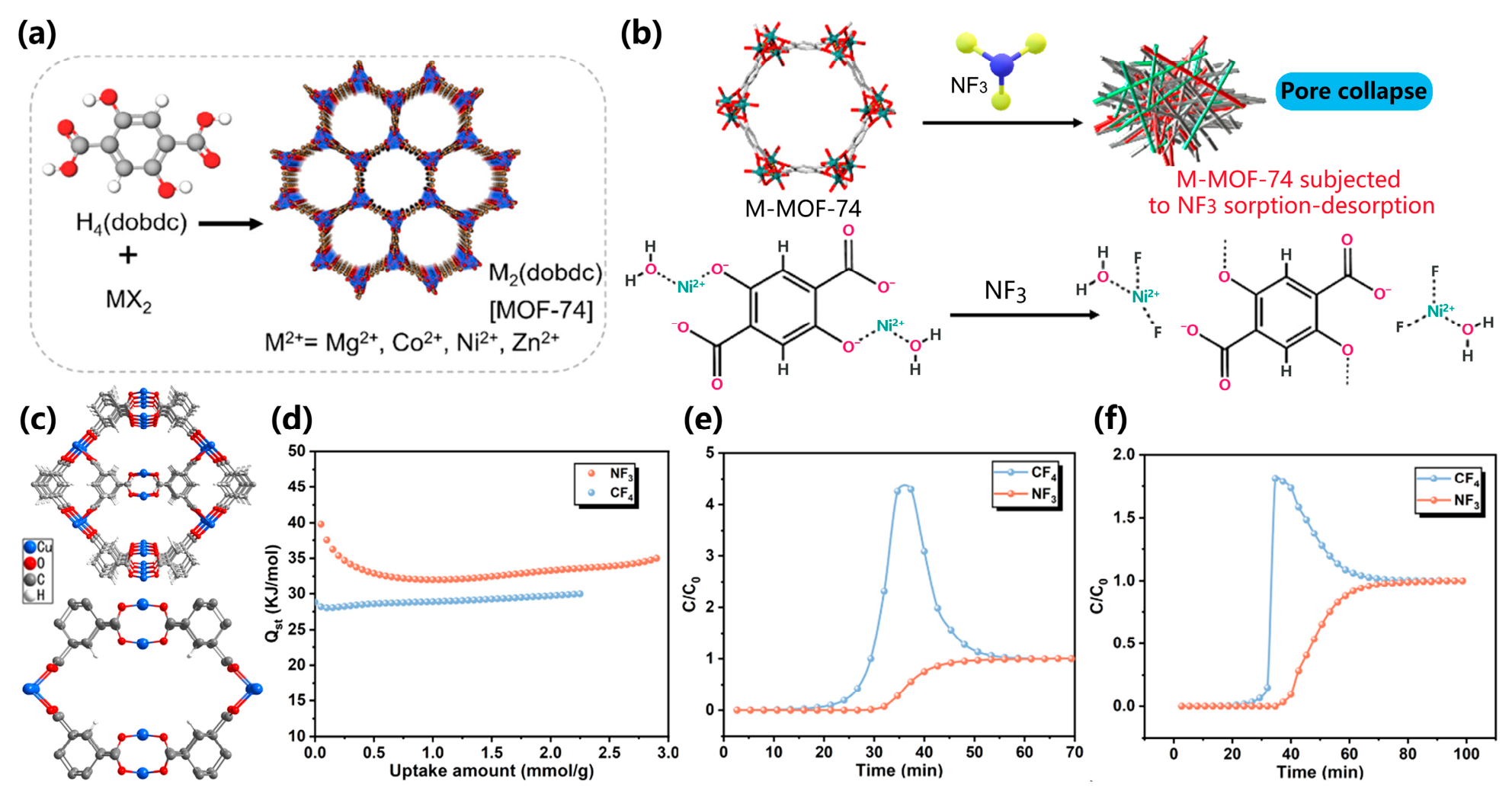
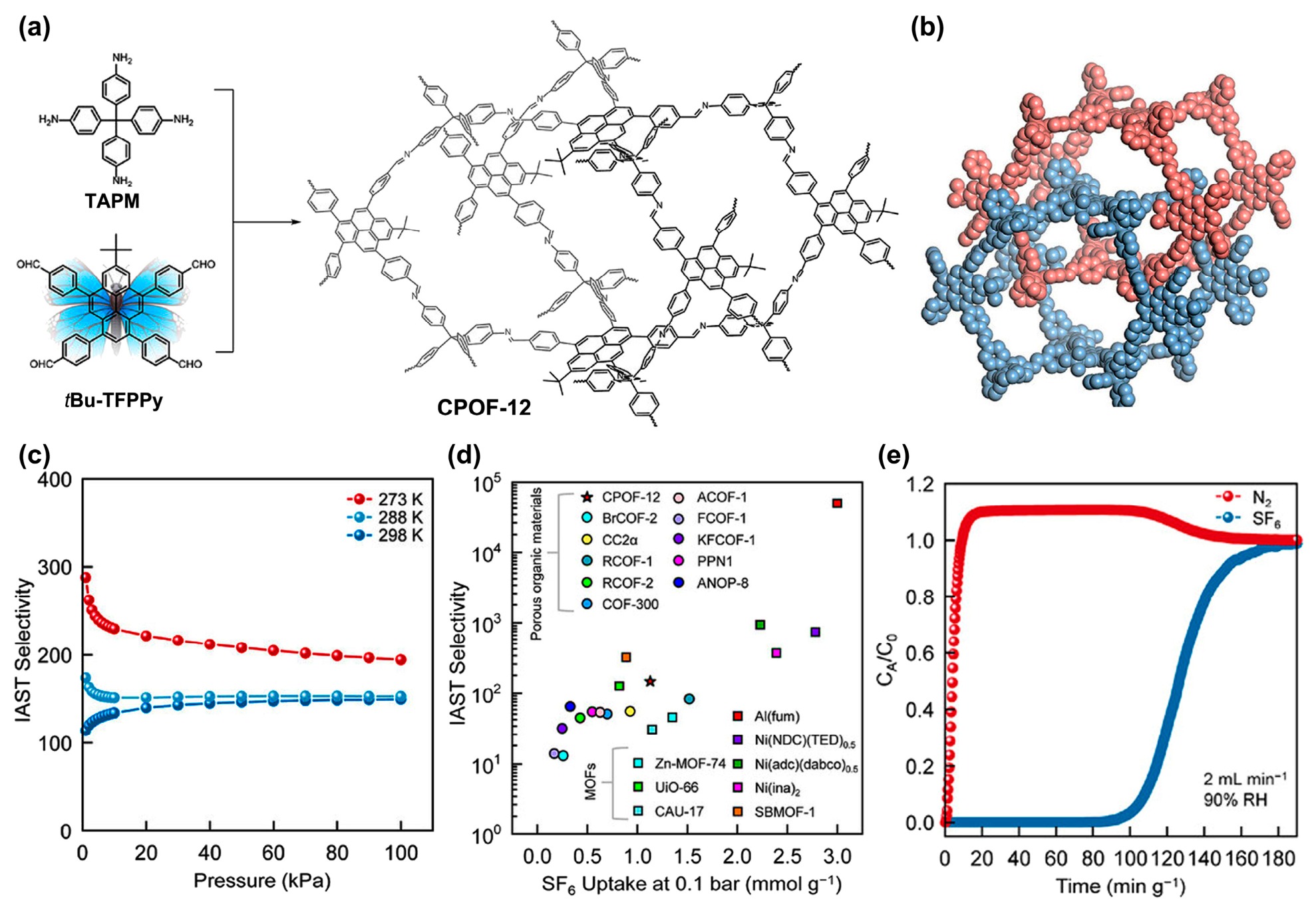

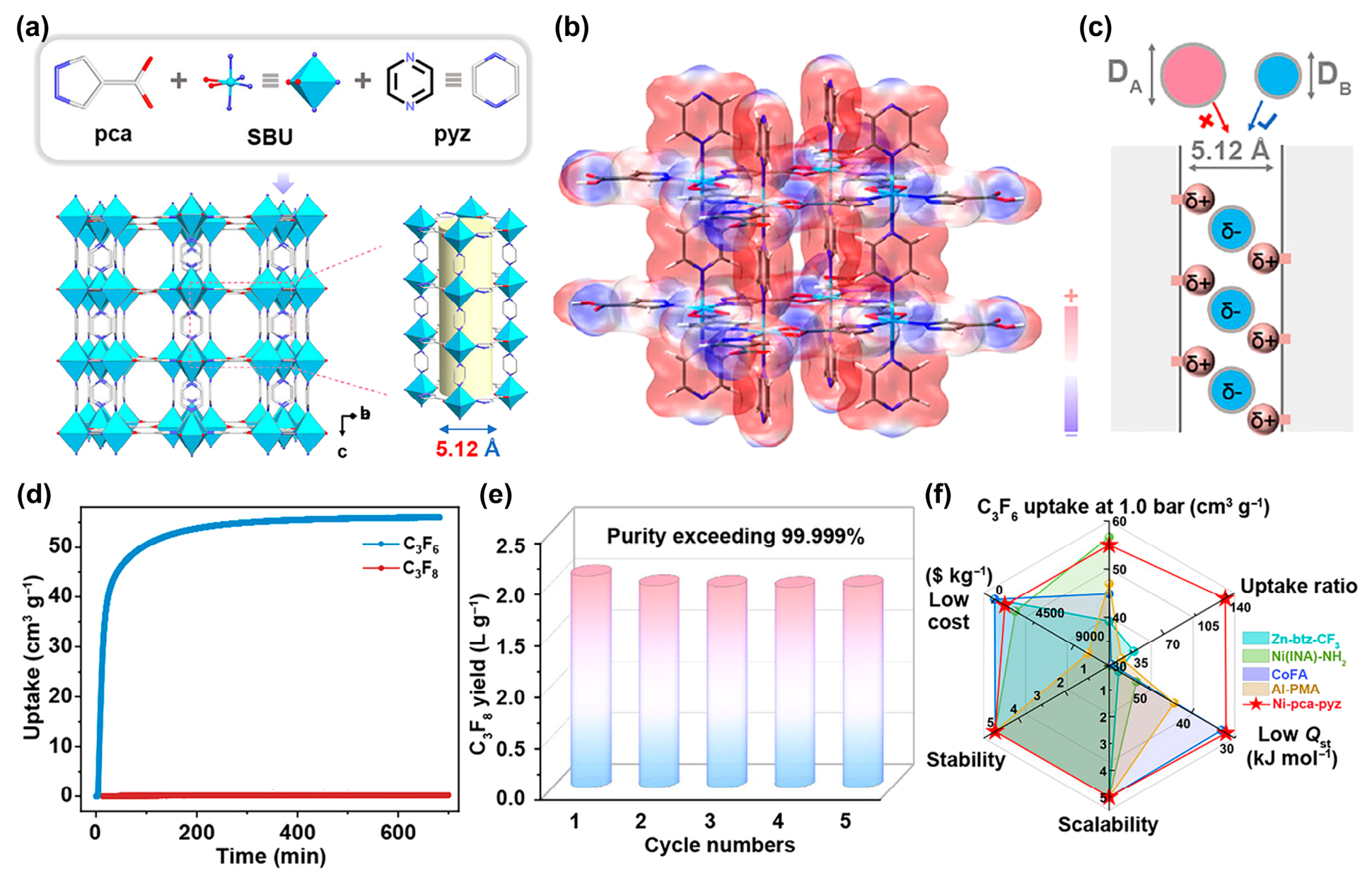
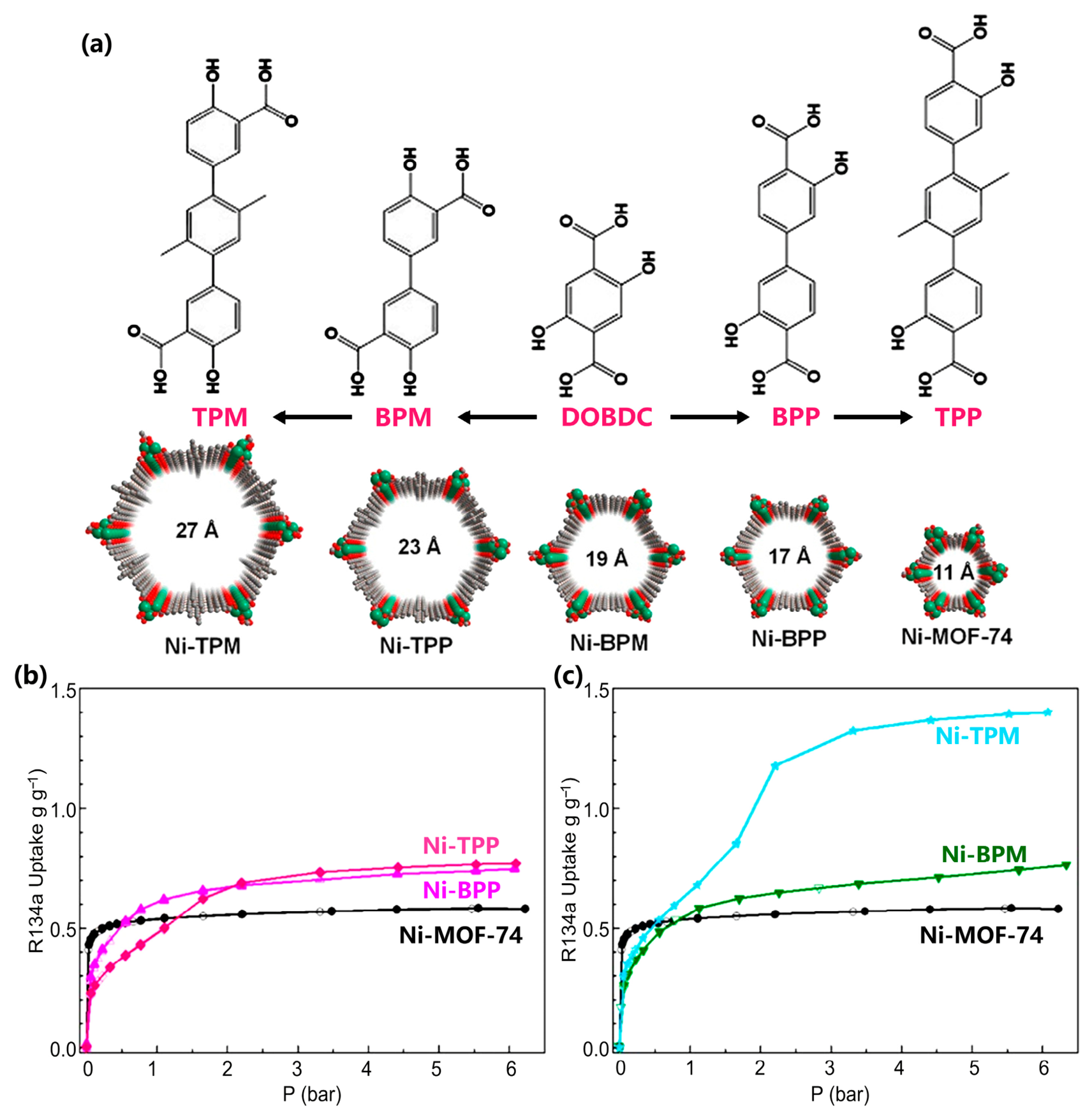



| Adsorbent | Key Structural Features | SF6 Uptake/ Selectivity | NF3 Uptake/ Selectivity | Adsorption Data Type | Ref. |
|---|---|---|---|---|---|
| MOFs | |||||
| DMOF-4Cl | Pore size 6.5 Å; BET surface area 1023 m2·g−1; chlorination modification | 2.0 mmol·g−1; SF6/N2 (1/9, v/v) selectivity 122 (298 K, 1 bar) | - | Cal. (IAST); Exp. (sorption isotherms, breakthrough) | [96] |
| Ni(AIN)2 | –NH2 networks with moisture stability; pore size 4.6 × 4.6 Å; BET surface area 674 m2·g−1 | - | ~55 cm3·g−1; NF3/N2 (1/9, v/v) selectivity ~25; (298 K,101 kPa) | Cal. (IAST); Exp. (sorption isotherms, breakthrough) | [97] |
| UiO-67(Zr) | Dual pore size 12 and 23 Å; BET surface area 2411 m2·g−1 | 9.66 mmol·g−1 (298 K, 1 bar); SF6/N2 (1/9, v/v) selectivity 37 (298 K,10 bar) | - | Cal. (IAST); Exp. (sorption isotherms) | [98] |
| Co-MOF-74 | Pore size 11 Å; BET surface area 1313.4 m2·g−1; open metal sites | - | 54.0 cm3·g−1 (chemisorption); NF3/N2 (1/9, v/v) selectivity 299.6 (298 K, 1 bar) | Cal. (IAST); Exp. (sorption isotherms) | [99] |
| CALF-20 | Pore size 4.8 Å; BET surface area 458 m2·g−1; cyclability (stable 5 cycles) | - | 51.1 cm3·g−1 (273 K, 1 bar); NF4/CF4 (1/1, v/v) selectivity ~4 (298 K, 1 bar) | Cal. (IAST); Exp. (sorption isotherms, breakthrough) | [100] |
| ATC-Cu | Rectangular channels (4.43 × 5.39 Å2); BET surface area 703 m2·g−1; overlapping electric fields | 63.9 cm3·g−1; NF3/CF4 (1/1, v/v) selectivity 2.16 (298 K, 1 bar) | Cal. (IAST); Exp. (sorption isotherms, breakthrough) | [101] | |
| Al-PMOF | A 3D porous network (elliptical pores 6 × 11 Å and rectangular pores 5 Å); BET surface area 1271 m2·g−1; abundant Al–O cluster polar sites | 6.15 mmol·g−1; SF6/N2 (1/9, v/v) selectivity 581 (298 K, 1 bar) | 3.00 mmol·g−1; NF3/N2 (1/9, v/v) selectivity 18.2 (298 K, 1 bar) | Cal. (IAST); Exp. (sorption isotherms, breakthrough) | [102] |
| Zeolite | |||||
| K-Y zeolite | FAU framework; pore size 7.4 Å; BET surface area 458 m2·g−1 | 1.94 mmol·g−1; dynamic SF6/N2 (1/9, v/v) selectivity 97.0 (298 K, 0.1 bar) | - | Exp. (breakthrough) | [103] |
| W-MFI | Pore size 5.7 Å; BET surface area 451.7 m2·g−1; Lewis acid sites | 44.6 mL·g−1; SF6/N2 (1/99, v/v) selectivity 260 (298 K,1 bar) | 30.8 mL·g−1; NF3/N2 (1/99, v/v) selectivity 25.3 (298 K,1 bar) | Cal. (IAST); Exp. (sorption isotherms, breakthrough) | [104] |
| Porous Carbons | |||||
| LG-750-3 | Lignin-derived; pore size 5.8 Å; BET surface area 1609 m2·g−1; cyclability (stable 5 cycles) | 2.66 mmol·g−1; SF6/N2 (1/9, v/v) selectivity 635 (298 K,1 bar) | - | Cal. (IAST); Exp. (sorption isotherms, breakthrough) | [105] |
| PC-750 | Dense micropore (7 Å) with mesopore; BET surface area 1392.8 m2·g−1 | 4.09 mmol·g−1; SF6/N2 (1/9, v/v) selectivity 436.4 (298 K, 1 bar) | 2.27 mmol·g−1 NF3/N2 (1/9, v/v) selectivity 61.4 (298 K, 1 bar) | Cal. (IAST); Exp. (sorption isotherms, breakthrough) | [106] |
| ACK1 | KOH-modified; pore size 5–9 Å; 97.6% microporosity; BET surface area 1053 m2·g−1 | 3.10 mmol·g−1; SF6/N2 (1/9, v/v) selectivity 683.9 (298 K,1 bar) | 2.09 mmol·g−1 NF3/N2 (1/9, v/v) selectivity 29.5 (298 K,1 bar) | Cal. (IAST); Exp. (sorption isotherms, breakthrough) | [107] |
| ACK1-800 | K2CO3-activated; pore size 7 Å; BET surface area 1167 m2·g−1; humidity tolerance | 4.35 mmol·g−1 (298 K,1 bar) | - | Exp. (sorption isotherms, breakthrough) | [108] |
| PVDF-800 | Pore size 6.8 Å; BET surface area 1089 m2·g−1 | 1.93 mmol·g−1 (298 K, 0.1 bar); SF6/N2 (1/9, v/v) selectivity about 350 (298 K,1 bar) | 0.57 mmol·g−1 (298 K, 0.1 bar); NF3/N2 (1/9, v/v) selectivity about 28 (298 K,1 bar) | Cal. (IAST); Exp. (sorption isotherms, breakthrough) | [109] |
| AC-KOH(1:1)-800 | KOH-activated chitosan; 0.5–1.0 nm micropores; BET surface area 1852 m2·g−1; cyclability (stable 8 cycles) | 5.88 mmol·g−1; SF6/N2 selectivity 126 (298 K, 1 bar) | - | Cal. (IAST); Exp. (sorption isotherms, breakthrough) | [110] |
| KHP-800 | Pore size 5.2–8.0 Å; BET surface area 1672 m2·g−1; cyclability (stable 5 cycles) | 2.41 mmol·g−1; SF6/N2 uptake ratio 5.2 (298 K, 0.1 bar) | - | Exp. (sorption isotherms, breakthrough) | [111] |
| COFs | |||||
| COF-2O | Heteroatom functionalization; pore size 8.5 Å; ASA 2158.62 m2·g−1 | 6.44 mmol·g−1; SF6/N2 (1/9, v/v) selectivity 400.79 (298 K, 1 bar) | - | Sim. (GCMC) | [112] |
| RCOF-1 | Pore size 9.0 Å; BET surface area 1139 m2·g−1; cyclability (stable 5 cycles) | 3.46 mmol·g−1; SF6/N2 (1/9, v/v) selectivity 83 (298K, 1 bar) | - | Cal. (IAST); Exp. (sorption isotherms, breakthrough) | [113] |
| CPOF-12 | A 3D COF; tert-butyl functionalization; pore size 5.9 Å; BET surface area 1140 m2·g−1; cyclability (stable 5 cycles) | 2.20 mmol·g−1; SF6/N2 (1/9, v/v) selectivity 149.4 (298 K, 1 bar) | - | Cal. (IAST); Exp. (sorption isotherms, breakthrough) | [114] |
| POCs | |||||
| CC3α | Flexible molecular crystal; window diameter ~3.6 Å | Three SF6 molecules per cage; SF6/N2 (1/9, v/v) selectivity 76.5 (298 K, 1 bar) | - | Cal. (IAST) Exp. (sorption isotherms, breakthrough) | [115] |
| TC1 | Triangular windows ~1.4 nm; BET surface area 1157 m2·g−1; multiple triazine and tetrazine moieties; cyclability (stable 5 cycles) | 2.59 mmol·g−1; SF6/N2 (1/9, v/v) selectivity 135 (298 K, 1 bar) | - | Cal. (IAST); Exp. (sorption isotherms, breakthrough) | [116] |
| Gas Family | Adsorbent | Key Structural Features | Adsorption Performance | Adsorption Data Type | Ref. |
|---|---|---|---|---|---|
| PFCs | Ni(ADC)(DABCO)0.5 | Anthracene-functionalized; pore size 5.2 Å; BET surface area 712 m2·g−1; cyclability (stable 5 cycles) | CF4 uptake 0.52 mmol·g−1 (298 K, 0.1 bar); CF4/N2 (1/9, v/v) selectivity 23 (298 K, 1 bar) | Cal. (IAST); Exp. (sorption isotherm, breakthrough) | [120] |
| Zn(fba) | Feature 1D channels with size 6.0 Å; BET surface area 345 m2·g−1; water stable | CF4 uptake 1.05 mmol g−1; CF4/N2 (1/9, v/v) selectivity 29 (298 K, 1 bar) | Cal. (IAST); Exp. (sorption isotherm, breakthrough) | [121] | |
| PFC-cage (F-cage) | Perfluorinated side chains; cage size ~1.3 nm; BET surface area 752 m2·g−1; cyclability (stable 7 cycles) | c-C4F8 uptake 1.66 mmol g−1; c-C4F8/N2 (1/99, v/v) selectivity 4385 (313 K, 1 bar); | Cal. (IAST); Exp. (sorption isotherm, breakthrough) | [122] | |
| Al-Fum | Pore size 6.8 Å; BET surface area 1085 m2·g−1; cyclability (stable 5 cycles) | C2F6 uptake 3.30 mmol·g−1; C2F6/N2 (1/9, v/v) selectivity 299.6 (298 K, 1 bar) | Cal. (IAST); Exp. (sorption isotherm, breakthrough) | [123] | |
| Zn(BPZ) | Open metal sites; pore size 5.6 × 5.6 Å2; BET surface area 862 m2·g−1; cyclability (stable 5 cycles) | C2F6 uptake 2.90 mmol·g−1; C2F6/N2 (3/97, v/v) selectivity 24.8 (298 K, 1 bar) | Cal. (IAST); Exp. (sorption isotherm, breakthrough) | [124] | |
| Zn-bzc-CF3 | –CF3 functionalized; window aperture size 5.13 × 4.84 Å2; cyclability (stable 5 cycles) | C2F6 uptake 47 cm3·g−1 (298 K, 1 bar) | Exp. (sorption isotherm, breakthrough) | [125] | |
| Ni(INA)2-NH2 | –NH2 functionalized channels; window aperture size 5.63 × 5.12 Å2; BET surface area 436.9 m2·g−1; cyclability (stable 5 cycles) | C3F6 uptake 56.7 cm3·g−1; C3F8 uptake 5.5 cm3·g−1 (298 K, 1 bar) | Exp. (sorption isotherm, breakthrough) | [126] | |
| JXNU-22(Me) | Cage-based MOF; methyl-substituents; cages size 5.4–7.8 Å; BET surface area 1828.2 m2·g−1; cyclability (stable 5 cycles) | C3F6 uptake 138.3 cm3·g−1; C3F6/C3F8 (1/9, v/v) selectivity about 9.2 (298 K, 1 bar) | Cal. (IAST); Exp. (sorption isotherm, breakthrough) | [127] | |
| Al-PMA | Hydroxyl-lined channels (μ2-OH); aperture size 5.3 × 4.7 Å2; BET surface area 394 m2·g−1; cyclability (stable 5 cycles) | C3F6 uptake 39.2 cm3·g−1; C3F8 uptake 1.06 cm3·g−1 (298 K, 1 bar) | Exp. (sorption isotherm, breakthrough) | [128] | |
| A520 (Al-MOF) | Feature 1D channels lined with μ-OH and fumarate; aperture size 5.7 × 6.0 Å2; BET surface area 1049 m2·g−1; cyclability (stable 5 cycles) | C3F8 uptake 65.6 cm3·g−1; C3F8/N2(1/9, v/v) selectivity 6034 (298 K, 1 bar) | Cal. (IAST); Exp. (sorption isotherm, breakthrough) | [129] | |
| Ni-pca-pyz | Pore size 5.12 Å; BET surface area 1015.91 m2·g−1; cyclability (stable 5 cycles) | C3F8 uptake 55.02 cm3·g−1; C3F6/C3F8 uptake ratio 137.6 (298 K, 1 bar) | Exp. (sorption isotherm, breakthrough) | [130] | |
| HFCs | Zeolite 5A (Ca2+-exchanged) | LTA framework (5 Å); open metal sites (Ca) | HFC-32 uptake 4.99 mmol·g−1 (298 K, 1 bar); HFC-32/HFC-125 selectivity 9.6–10.9 (25–75 mol% HFC-125) | Cal. (IAST); Exp. (sorption isotherm) | [131] |
| LIFM-66 | Pore size 1.62 nm; BET surface area 3631 m2·g−1 | R134a uptake 1.09–1.14 g·g−1; R134a/N2 selectivity (1/99, v/v) (298 K, 1 bar) | Cal. (IAST); Exp. (sorption isotherm, breakthrough) | [132] | |
| Ni-TPM | Open metal sites (Ni); pore size 27 Å; BET surface area 2420 m2·g−1 | HFC-134a uptake 1.12 g·g−1 (298 K, 1 bar) | Exp. (sorption isotherm) | [133] | |
| Phenol resin-derived carbon | Average pore diameter 1.62 nm; BET surface area 2992 m2·g−1 | HFC-32 uptake 2.34 g·g−1 (303 K, 1 bar); no hysteresis | Exp. (sorption isotherm) | [134] | |
| HOF-TDBB | Abundant aromatic rings and carboxylate oxygen atoms at pore surface; pore size 9.6–9.8 Å; BET surface area 1346.2 m2·g−1; cyclability (stable 30 cycles) | CF3CH2F uptake 109.9 cm3·g−1; CF3CH2F/C2F6 selectivity 18 (298 K, 1 bar) | Cal. (IAST); Exp. (sorption isotherm, breakthrough) | [135] | |
| CFCs/HFOs | CNT(11,11) | Armchair conformation; internal diameter 1.49 nm; metallic conductivity | CCl2F2/N2 selectivity up to 104 (CNT(11,11), simulated) | Sim. (GCMC) | [136] |
| Maxsorb III (activated carbon) | Pore size 2.0–2.14 nm; BET surface area ~3000 m2·g−1 | HFO-1234yf uptake 1.3 g·g−1 (313 K, 300 kPa) | Exp. (sorption isotherm) | [137] | |
| Mg-MOF-74 | Open metal site; channel size about 11 Å | R134a uptake about 0.70 g·g−1; R32 uptake about 0.65 g·g−1; R1234ze uptake about 0.61 g·g−1 (313 K, 10 bar) | Sim. (GCMC) | [138] |
| Gas Family | Representative Sensing Materials and Mechanisms | Representative Capture Materials | Shared Design Principles |
|---|---|---|---|
| SF6/NF3 | SnO2, Co3O4, SnO2/MXene (chemiresistive) | MOFs, zeolites, carbons, COFs, POCs | Lewis acid sites, polarizability-based recognition, pore confinement |
| PFC | SnO2 (chemiresistive) | MOFs, POCs | Size-sieving, fluorophilic surfaces, molecular topology |
| HFC | MOF (QCM) | Zeolites, carbons, MOFs, HOFs | Polarity-based recognition, hydrogen bonding, pore engineering |
| CFC/HFO | - | Zeolites, fluorinated MOFs, carbons | Enthalpy-driven selectivity, fluorophilic interactions |
Disclaimer/Publisher’s Note: The statements, opinions and data contained in all publications are solely those of the individual author(s) and contributor(s) and not of MDPI and/or the editor(s). MDPI and/or the editor(s) disclaim responsibility for any injury to people or property resulting from any ideas, methods, instructions or products referred to in the content. |
© 2026 by the authors. Licensee MDPI, Basel, Switzerland. This article is an open access article distributed under the terms and conditions of the Creative Commons Attribution (CC BY) license.
Share and Cite
Hou, J.; Tao, X.; Zhang, C.; Zhang, Z.; Kong, H.; Ji, Q.; Quan, H.; Fuchs, H. Detection and Capture of Volatile Fluorinated Compounds Using Porous Materials. Nanomaterials 2026, 16, 1125. https://doi.org/10.3390/nano16171125
Hou J, Tao X, Zhang C, Zhang Z, Kong H, Ji Q, Quan H, Fuchs H. Detection and Capture of Volatile Fluorinated Compounds Using Porous Materials. Nanomaterials. 2026; 16(17):1125. https://doi.org/10.3390/nano16171125
Chicago/Turabian StyleHou, Jiejing, Xinlei Tao, Ce Zhang, Zidan Zhang, Huihui Kong, Qingmin Ji, Hengdao Quan, and Harald Fuchs. 2026. "Detection and Capture of Volatile Fluorinated Compounds Using Porous Materials" Nanomaterials 16, no. 17: 1125. https://doi.org/10.3390/nano16171125
APA StyleHou, J., Tao, X., Zhang, C., Zhang, Z., Kong, H., Ji, Q., Quan, H., & Fuchs, H. (2026). Detection and Capture of Volatile Fluorinated Compounds Using Porous Materials. Nanomaterials, 16(17), 1125. https://doi.org/10.3390/nano16171125