
Article

UV-Activated NO2 Gas Sensing: Photoactivated Processes on the Surface of Metal Oxides

1
Chemistry Department, Moscow State University, 119991 Moscow, Russia
2
Federal Research Center Kazan Scientific Center RAS, 420111 Kazan, Russia
*
Authors to whom correspondence should be addressed.
Nanomaterials 2025, 15(23), 1795; https://doi.org/10.3390/nano15231795
Submission received: 19 October 2025 / Revised: 19 November 2025 / Accepted: 21 November 2025 / Published: 28 November 2025
(This article belongs to the Special Issue Trends and Prospects in Gas-Sensitive Nanomaterials)

Abstract

In recent years, wide bandgap metal oxide semiconductors have become the base materials of choice for semiconductor gas sensor design. In this work, nanocrystalline ZnO, In2O3, and SnO2 were investigated when detecting NO2 under UV-photoactivation conditions. The materials were characterized by XRD, low-temperature nitrogen adsorption, and electron microscopy. The article considers the mechanism of sensor signal formation, as well as the mechanism of action of UV-light photoactivation, using an in situ multi-method approach. In situ mass spectrometry and in situ TR-DRIFTS were employed to study the impact of UV-light photoactivation on target gas adsorption equilibrium as well as the electrical and gas-sensing properties of the materials.

1. Introduction

Metal oxides ZnO, In2O3, and SnO2 are n-type wide-bandgap semiconductors with oxygen non-stoichiometry. The dependence of their surface composition, electrical conductivity, and work function on the composition of the gas phase above a sample is well known [1,2] and was first suggested as early as the 1950s for single-element semiconductors such as germanium [3]. Since then, semiconducting metal oxides (SMOXs) have become the backbone of semiconductor gas sensors [2,4,5], with considerable attention being given to the aspects of high surface area material synthesis and sensor element manufacturing [4,6,7,8], sensor response modeling [9,10,11], sensitivity enhancement, and selectivity tuning.
Despite being quite versatile, conventional SMOX-based materials for gas-sensing applications still possess some drawbacks. A majority of such materials require the sensor to be operated at elevated temperatures (300–500 °C) to achieve the proper sensor signal, response time, and lifetime values (“thermal activation”). For these purposes, semiconductor gas sensor devices usually incorporate a heater in the form of a nichrome string or a ceramic micro-hotplate [4,12,13]. Consequently, the operation of an uncovered electric heater element leads to high sensor power consumption and makes the sensors non-explosion-proof. A promising alternative to the thermal activation of the sensor response is photoactivation [14,15,16,17]. Photoactivation can be accomplished either by illuminating the material with short-wavelength light (from UV light to blue light) [15,18,19,20], or by first introducing photo-sensitive dopants (usually organic dyes), which permit the use of longer wavelengths (from green to red) [21,22,23]. Since nowadays UV LEDs have become readily available, the former implementation of photoactivation may be preferable due to lower manufacturing costs.
A large number of papers report that photoactivation results in an increase in the sensor signal of SMOX-based materials utilized to detect both reducing (mainly VOCs) and oxidizing (for example, NO2) gases [14,18,19,20,24,25]. However, in most cases, the scope of such studies is limited to the investigation of the sensor response itself, which is calculated as a function of the electrical conductivity (or resistivity) of the material, while the exact nature of the physico-chemical processes pertaining to the formation of said sensor signal is left out. Some studies do recognize the role of target gas adsorption equilibrium in sensor signal formation and thus do attempt to characterize the surface composition of the material under different conditions by means of DRIFTS, TR-DRIFTS, Raman spectroscopy, or XPS [24,26,27,28,29,30,31]. Frequently, however, the aforementioned methods are applied ex situ [24], and therefore, the results cannot definitively prove what processes are directly involved in sensor signal formation. True in situ or operando techniques suitable for the in-depth investigation of the sensor signal mechanism have emerged relatively recently and are being developed in the fields of both gas sensing and photocatalysis [29,31,32,33].
This work is an attempt to investigate the mechanism of sensor signal formation, as well as the mechanism of action of UV-light photoactivation, using an in situ multi-method approach. Nanocrystalline oxide materials ZnO, In2O3, and SnO2 were selected for this study based on their common n-type wide-bandgap semiconductor nature, their gas sensitivity when exposed to a wide range of target gases, and the variation in their electronic properties, particularly the equilibrium charge carrier concentration. A series of three samples was first characterized ex situ using XRD, specific surface area measurements (BET), and electron microscopy. Next, in situ mass spectrometry was utilized in conjunction with in situ TR-DRIFTS and gas-sensing measurements to try to prove which of the mechanisms of formation of the sensor response to NO2 suggested in the literature describe the underlying processes most accurately.

2. Materials and Methods

2.1. Synthesis of Nanocrystalline ZnO, In2O3, and SnO2

Nanocrystalline ZnO was synthesized by the thermal decomposition of zinc basic carbonate (CAS Number 5263-02-5, purum p.a., Sigma Aldrich, St. Louis, MO, USA) in air at 300 °C for 24 h according to the following reaction:
Zn5(CO3)2(OH)6 → 5 ZnO + 2 CO2 + 3 H2O
The resulting zinc oxide powder was allowed to cool down in air and then stored in a sealed container to prevent contamination by carbon dioxide or moisture.
Nanocrystalline indium (III) oxide was synthesized via a sol–gel route, starting with commercially available indium oxide. First, the commercially available In2O3 (CAS Number 1312-43-2, Sigma Aldrich, St. Louis, MO, USA; purified grade, >99.9%) was dissolved in a stoichiometric amount of 10% hydrochloric acid (CAS Number 1312-43-2, Sigma Aldrich, St. Louis, MO, USA; purified grade) plus a 5% excess, using magnetic stirring at 80 °C under reflux (2).
In2O3 + 6 HCl → 2 InCl3 + 3 H2O
The indium chloride solution was then diluted with distilled water (to a target concentration of 100 g/L) and then carefully titrated with an aqueous ammonia solution (CAS Number 7647-01-0, Sigma Aldrich, St. Louis, MO, USA; 25%, purified grade) until the pH reached 5. During this process, a gel consisting of indium hydroxide and hydrated indium oxides was formed (3).
2 InCl3 + 6 NH3·H2O → In2O3·xH2O↓ + 6 NH4Cl + (6 − x) H2O
The synthesis of nanocrystalline tin (IV) oxide was also accomplished via a sol–gel route, commencing with commercially available tin tetrachloride pentahydrate (CAS Number 10026-06-9, Sigma Aldrich, St. Louis, MO, USA). First, tin (IV) chloride pentahydrate was dissolved in distilled water to obtain a 100 g/L solution. The tin tetrachloride solution was then titrated with an aqueous ammonia solution (25%, purified grade) until the pH reached 5. In the course of the process, a gel composed of stannic acid was formed (4).
SnCl4 · 5H2O + 4 NH3 · H2O → SnO2 · xH2O↓ + 4 NH4Cl + (9 − x) H2O
Next, the In2O3·xH2O or SnO2·xH2O gel was repeatedly washed with distilled and deionized water, using centrifugation to separate the gel from the solution. The washing steps continued until the supernatant passed the silver chloride test (using AgNO3). The gel was then dried at 60 °C in a drying oven, and the resulting xerogel was ground in an agate mortar into a fine powder. The powder was subsequently annealed in a furnace at 500 °C for 24 h, forming nanocrystalline In2O3 or SnO2.

2.2. Materials Characterization

The phase composition and crystal structure of the synthesized oxides were studied by powder X-ray diffraction (XRD) with a DRON-4-07 diffractometer using CuKα radiation (wavelength λ = 1.54059 Å). The average crystallite size D was calculated using the Sherrer equation:
D   =   k λ β c o s Θ
where λ is the wavelength of the X-ray radiation, nm; β is the full width at half maximum (FWHM) of a diffraction peak, rad; θ is the diffraction angle; and k is a coefficient equal to 0.9. The peak width was corrected for instrumental broadening using the following equation:
β   =   β e x p 2 β a p p 2
where βexp is the observed peak width at half height and βapp is the instrumental broadening, which was taken as 0.09°. The three most prominent reflections for each oxide were used for the calculations.
The elemental composition of the materials was confirmed by X-ray fluorescence (XRF) analysis using a M1 Mistral (Bruker) micro-X-ray spectrometer.
The specific surface area of the nanocrystalline oxides was measured using the low-temperature nitrogen adsorption method and the BET adsorption isotherm. The experimental procedure was carried out using a Chemisorb 2750 instrument (Micromeritics). The relative error of specific surface area determination was 5%.
The morphology of the materials was studied by means of scanning (SEM) and transmission (TEM) electron microscopy, using Prisma E (Thermo Scientific, Brno, Czech Republic) and JEM-2100 (JEOL, Tokyo, Japan) instruments.

2.3. Gas Sensing Measurements

The experimental setup involves miniature gas sensor devices with embedded microheaters and is described in detail in [32]. In brief, the devices were constructed using a 1.5 × 1.5 mm Al2O3 ceramic substrate suspended in air on 4 platinum wires that connected to its top and bottom layers. The bottom layer was coated with a thin film of platinum to form an embedded micro-heater, while the top layer housed a pattern of platinum electrodes for the sensing material to be applied onto. The temperature and electrical resistance of the sensors were controlled and logged by a custom instrument described previously in [34] (see Supplementary Materials) or a compatible one.
Two types of gas sensing measurements were conducted.
The first type was used to provide the electrical conductivity profiles of the materials during mass spectrometry experiments. The data from both mass spectrometry and the corresponding gas-sensing experiments for a given material could then be unified on a single plot. In order to achieve this, a cylindrical chamber (V = 50 mL), made of glass and holding up to 4 gas sensors and a UV LED, was connected to the output of the flow cell used in in situ mass spectrometry experiments, and the latter experiments were repeated with an empty flow cell but with 3 sensors mounted in the sensor chamber. The LED inside the sensor chamber was activated synchronously with that of the flow cell.
The second type was utilized to provide data for the sensor signal calculations. These experiments feature cyclical NO2 concentration profiles, which first expose the sensors to dry purifier air, then to the target gas, then again to dry purified air, and so forth. The sensor signal values (S) can be calculated according to Formula (7).
S = (Rgas/Rair) − 1
where Rgas is the resistance of the material in an atmosphere containing nitrogen dioxide, and Rair is the resistance in dry purified air. Gas-sensing experiments of this type were conducted in a separate device as described in [32]. Briefly, the setup consisted of a measurement chamber (vertical cylinder shape, V = 50 mL, made of PTFE); a constant-current LED driver (I = 0.1 A); a gas mixing system; and a custom-made device for sensor heater control and sensing material resistance measurement. The sensors were placed at the bottom of the chamber, and a UV LED was mounted in the upper part of the chamber. The gases were mixed in real time using a source of purified dry air, a certified NO2 100 ppm gas cylinder, and multiple mass-flow controllers (Bronkhorst High-Tech B.V., Ruurlo, The Netherlands). The resulting mixture was fed into the chamber inlet located in its top wall (the exhaust port was located at the bottom of the chamber). The UV LED, the sensors’ micro-heaters, and the mass-flow controllers were all simultaneously controlled by PC software according to the experiment plan.

2.4. In Situ TR-DRIFTS

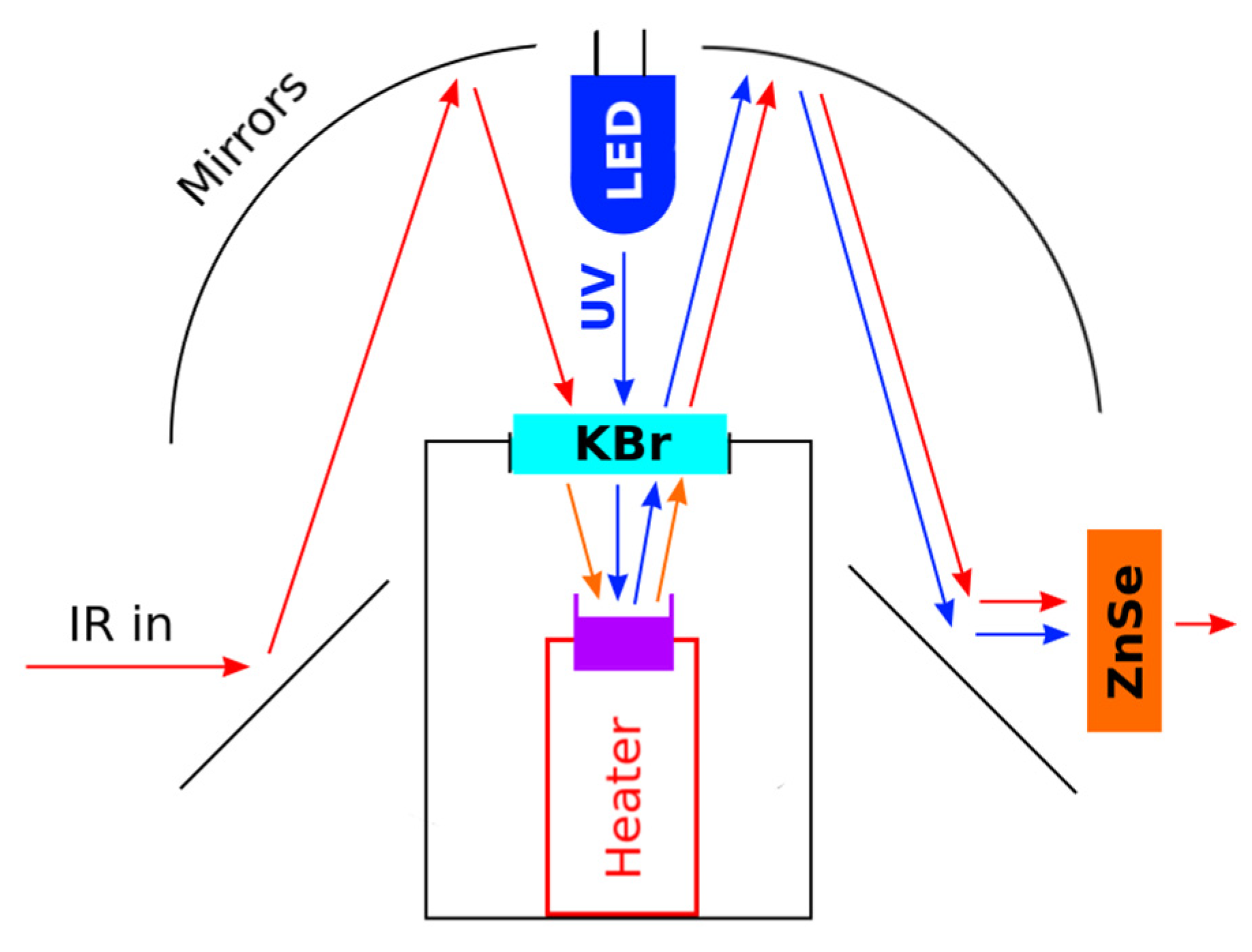
The in situ time-resolved diffuse reflectance IR spectra were obtained using a Frontier FTIR spectrometer (Perkin Elmer, Shelton, CT, USA), which was fitted with a Pike DiffuseIR diffuse reflectance accessory (Pike Technologies). The DiffuseIR accessory includes a flow cell with a heater and can be equipped with a KBr window to allow simultaneous UV illumination of the sample and IR spectra acquisition. To make simultaneous IR spectra acquisition and UV illumination possible, a UV LED (Lite-ON LTPL-C034UVH365 or compatible) was mounted inside the accessory over the sample cell in such a way that it did not interfere with the IR beams (Figure 1). The UV LED was driven in constant-current mode at 120 mA. The precise central wavelength of the UV LED was determined to be 371 nm (span of 355–395 nm) using an OceanOptics SR-series dispersive spectrometer. In order to avoid UV interference and possible detector damage, a ZnSe window was inserted into the outgoing beam path (on the right side of the accessory).
The spectra acquisition range was set to 500–4000 cm−1 with 1 cm−1 resolution and an accumulation value of 30 raw spectra per averaged spectrum (the acquisition of a single averaged spectrum takes approx. 2 min). The sample powder was placed in a sapphire crucible and flattened by pressing. The crucible was put into the heater inside the flow cell, and the cell was closed with a KBr window on top.
A typical in situ TR-DRIFTS experiment protocol is similar to that of the mass spectrometry experiments and includes the following steps: sample preparation at 150 °C in dry air (100 mL/min) for 5 min, followed by slow cooling down to 30 °C; switching to a gas mixture containing 100 ppm NO2 (10–20 mL/min) and waiting for 60 min; and two UV illumination cycles each lasting 30 min (at 30 °C and 100 °C).
Kinetic curves derived from TR-DRIFTS data were calculated using custom software that implemented the trapezoidal integration algorithm with an endpoint-weighted linear baseline approximation. Since the exact extinction coefficients for most bands are not known, the raw peak areas were used as a measure of relative adsorbate concentration. It should be noted that these values can only be used to characterize how the adsorbate surface concentration evolves with time and cannot be used to compare the adsorbate surface concentrations to each other.

2.5. In Situ Mass Spectrometry

In situ photostimulated mass spectrometry studies were conducted in the previously described custom-made apparatus [32,35], consisting of a flat flow-reactor-type sample cell with top and bottom quartz windows. It allows simultaneous sample heating, UV illumination of the sample surface, and control over the gas mixture composition flowing over the sample powder. The gas flow inside the flow cell was modeled with the SimFlow CFD software (version 4.0) to ensure that the cell geometry creates a turbulent flow regime, thereby ensuring the CSTR mode of operation while minimizing excess volume effects such as unswept eddies (the results can be found in the Supplementary Material, Figures S1 and S2). The gas mixture exiting the cell was fed into an MS7-200D quadrupole mass spectrometer (equipped with an RGA-200 analyzer, Stanford Research Systems, Sunnyvale, CA, USA) over a heated PEEK capillary. The mass spectra acquisition was performed with CDEM enabled (gain 993). The ionizer settings were as follows: electron energy 70 eV, emission current 1.0 mA, focus voltage −90 V, ion energy 12 eV. The CDEM gain was accounted for during data processing. The noise floor (NF) was set to 3.

2.6. Long-Term NO2 Adsorption Measurements

The terms “prolonged NO2 adsorption” and “long-term NO2 adsorption” will be used to refer to adsorption processes that take well over 6 h (up to days or months) to reach saturation even when the total surface area of the sample is less than 1 m2 (which is the typical total surface area of a sample). Long-term NO2 adsorption can be characterized using in situ mass spectrometry and in situ TR-DRIFTS data, as the corresponding experiments typically last from 6 to 12 h, while providing information about the NO2 adsorption rate and surface concentrations of the NO2 adsorbate species, respectively.
Additionally, for ZnO, we employed an independent method for long-term NO2 adsorption measurement (CAPS spectroscopy) to confirm the conclusions that can be derived from in situ mass spectrometry and in situ TR-DRIFTS data. The experiment was conducted in the same flow cell that was used in the TR-DRIFTS experiments. The output of the flow cell was connected to a Teledyne API N500 CAPS NOx Analyzer. The data were collected continuously over a Modbus-TCP interface. It was established that at a total flow rate of 100 mL/min of gas mixture through the flow cell and 1 L/min through the analyzer (diluted with purified air), rapid removal and insertion of the sample did not introduce artifacts into the measurement due to the large time constant of the analyzer.

3. Results

3.1. Phase Composition and Morphology

3.1.1. Zinc Oxide

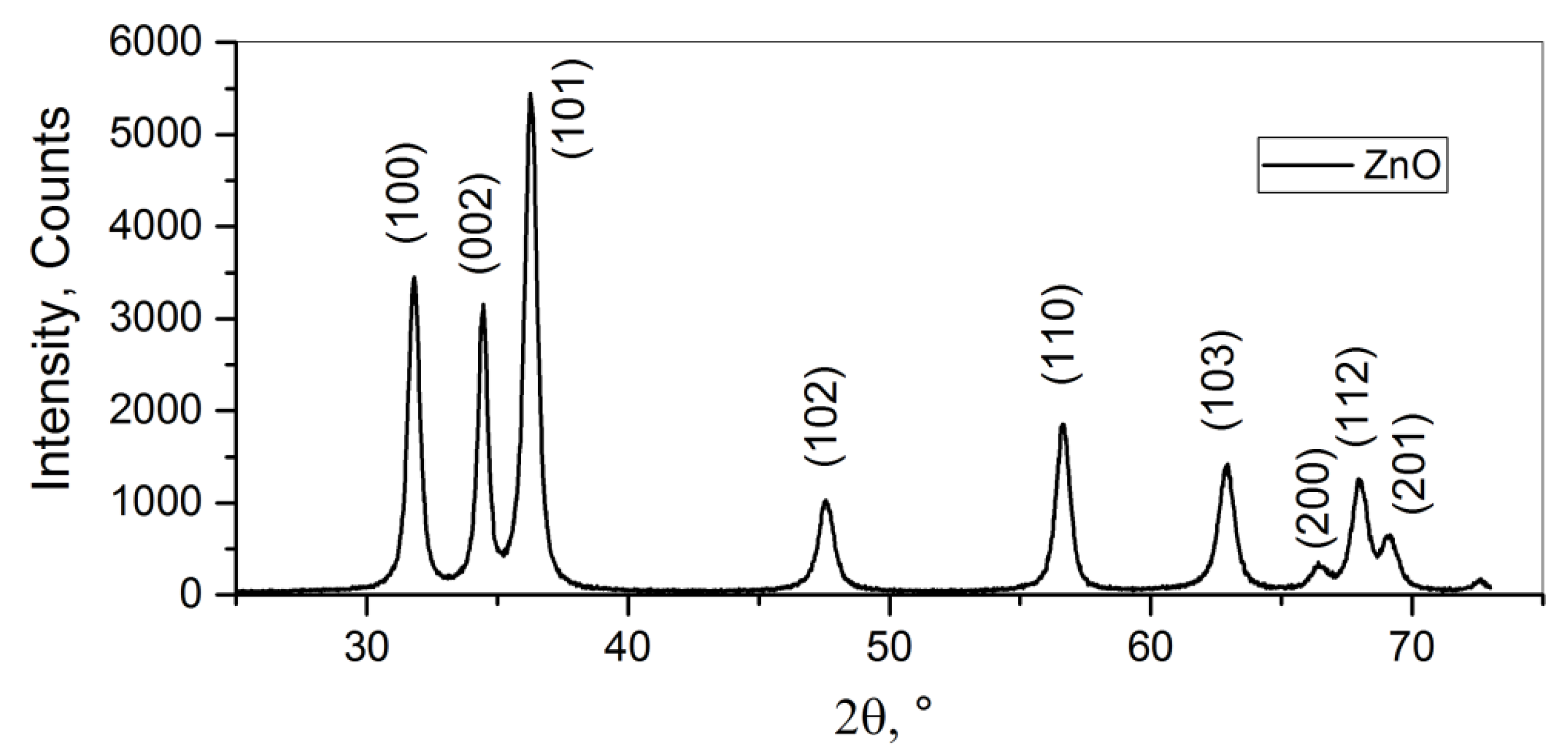
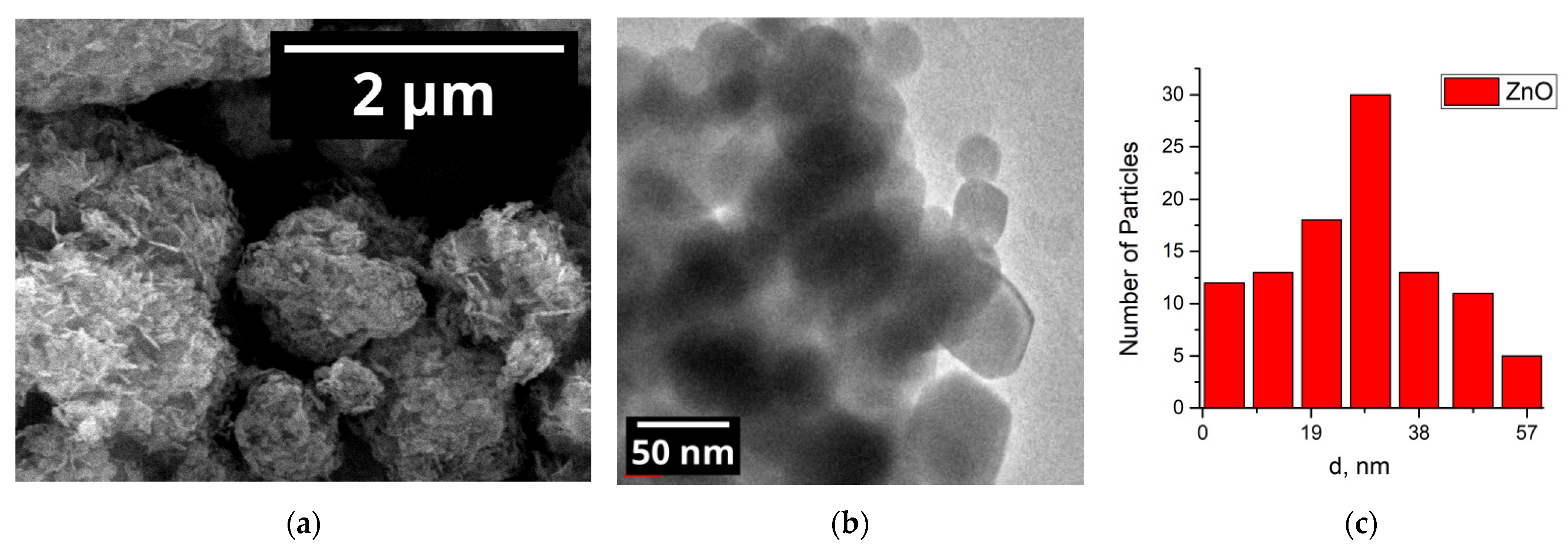
The powder diffraction pattern of the nanocrystalline ZnO is shown in Figure 2. The sample contains only a single phase with all of the reflections belonging to the wurtzite (hexagonal) phase of zinc oxide. The average crystallite size, as calculated using Formula (5), is 15 nm. As reported previously, zinc oxide crystallites exhibit anisotropy [32,35] and grow as needles or plates (Figure 3) with a characteristic length of ~100 nm and a characteristic thickness of 10 to 20 nm. Those needles and plates tend to form larger porous agglomerates. According to the BET model, the specific surface area of the nanocrystalline ZnO is about 4 m2/g.
TEM imaging revealed that the anisotropic structures of the nanocrystalline ZnO are composed of multiple grains and break apart upon ultrasonication, which is involved in the TEM sample preparation process (Figure 3b). This is consistent with literature data on the ultrasonic treatment of ZnO nanoparticles [36]. Since the needles and plates observed by SEM comprise multiple loosely bound nearly spherical grains, such anisotropy is unlikely to cause significant changes to the electronic properties of the semiconductor. The grain size distribution calculated based on TEM data (Figure 3c) is centered at 25 nm (SD = 18 nm).
The choice of a different annealing temperature (300 °C) for ZnO was made intentionally to produce nanocrystalline zinc oxide that has a comparable mean particle size and specific surface area to that of nanocrystalline indium and tin oxides annealed at 500 °C. It is well known that higher annealing temperatures produce material with a significantly larger mean particle size and a lower specific surface area [37]. Comparable morphology makes differences caused by chemical composition and electronic properties stand out, simplifying the interpretation of experimental data.

3.1.2. Indium Oxide

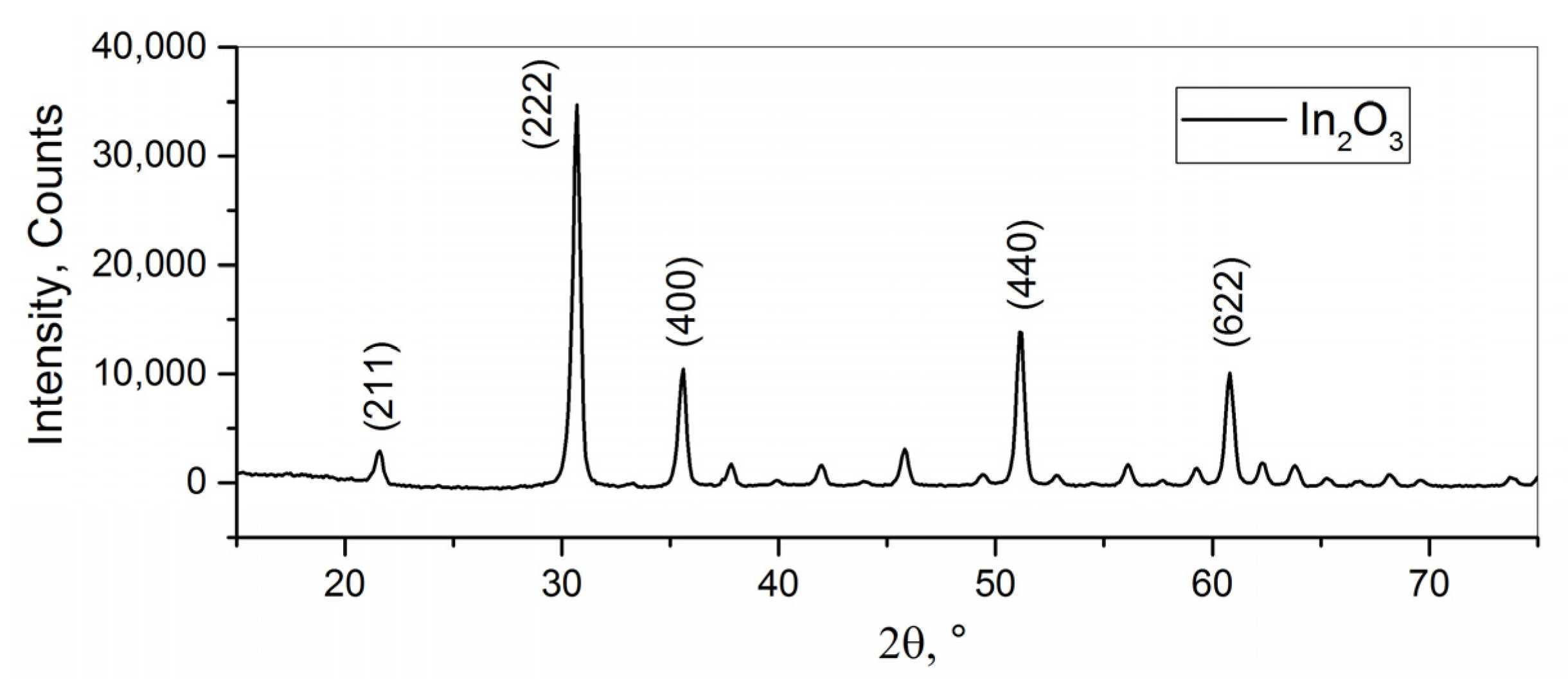
The powder diffraction pattern of the nanocrystalline In2O3 is shown in Figure 4. All of the reflections belong to the bixbyite (cubic) phase of indium oxide. The average crystallite size, as calculated using Formula (5), is 22 nm. According to the BET model, the specific surface area of the nanocrystalline In2O3 was determined to be 10 m2/g.
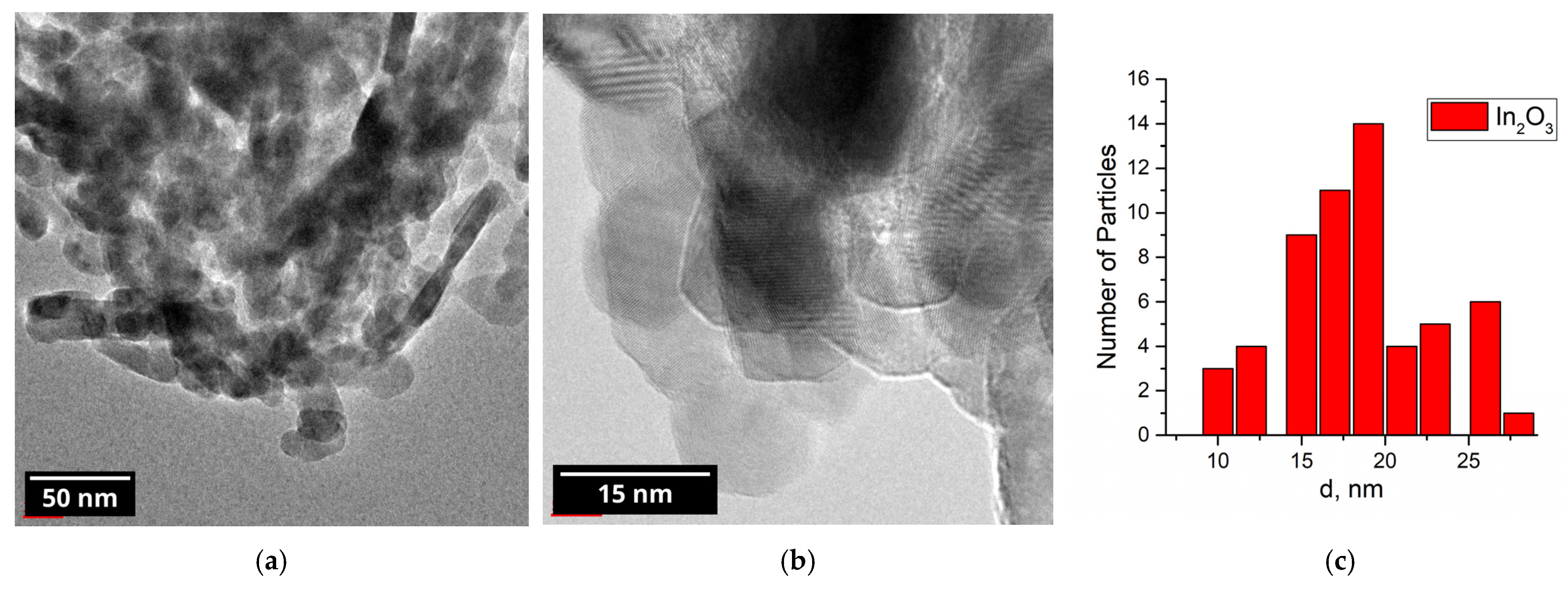
According to TEM imaging (Figure 5), the shape of the indium oxide nanoparticles is mostly spherical with particle size varying from 5 to 33 nm. Occasional rod-like structures having a characteristic length of 30–60 nm were also observed.

3.1.3. Tin Oxide

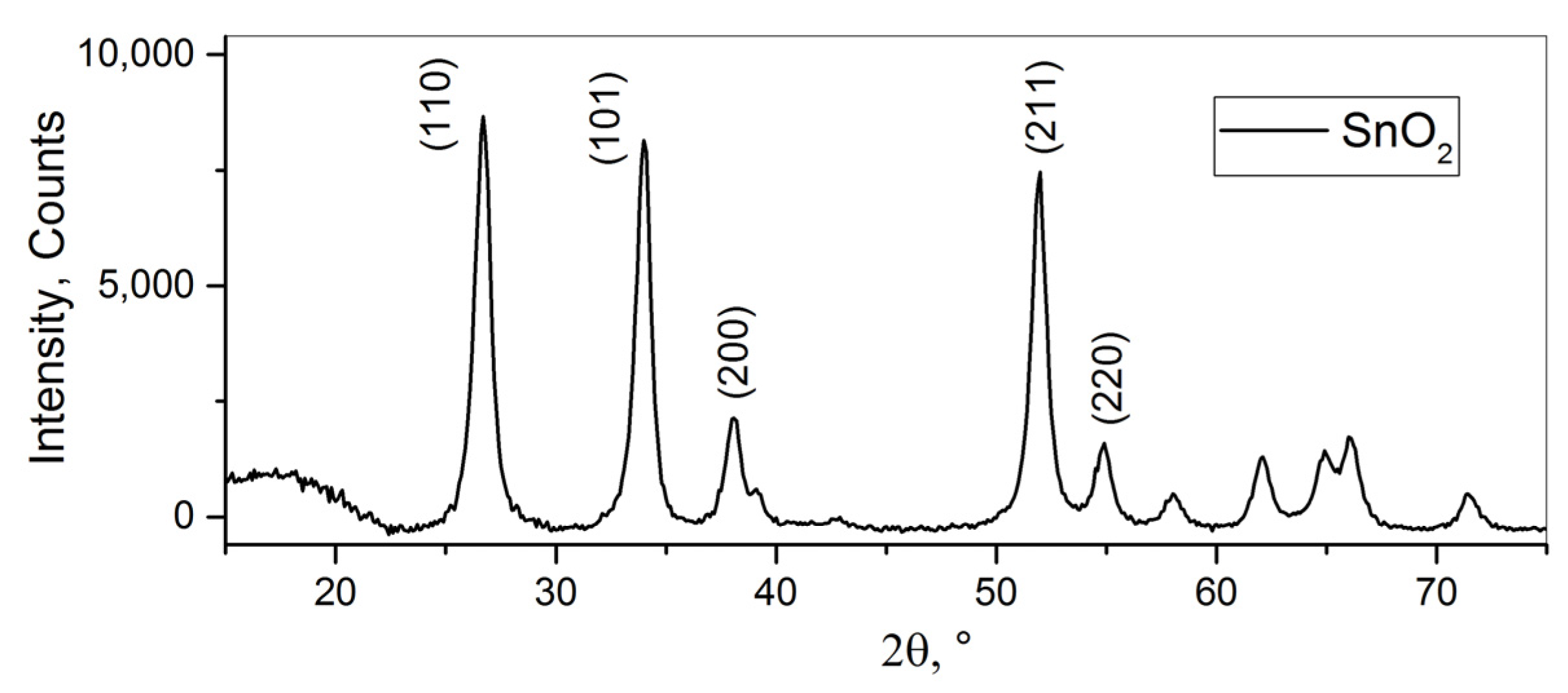
The powder diffraction pattern of the nanocrystalline SnO2 is shown in Figure 6. All of the reflections belong to the cassiterite (tetragonal) phase of tin oxide. The average crystallite size, as calculated using Formula (5), is 11 nm. According to the BET model, the specific surface area of the nanocrystalline SnO2 was calculated to be 25 m2/g.
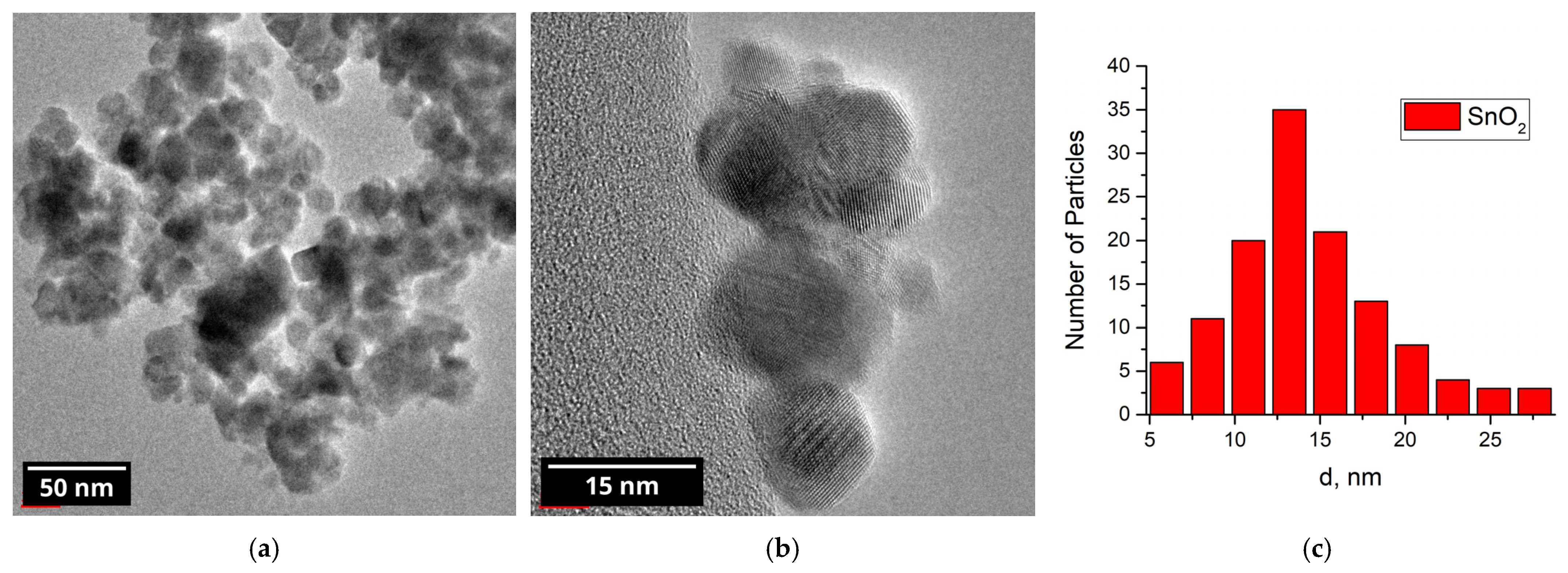
TEM imaging (Figure 7) revealed that the particle size of the nanocrystalline SnO2 varies from 6 to 34 nm with a relatively narrow size distribution (SD = 5 nm) centered at 16 nm.

3.2. Photostimulated Processes on Pure Oxides

Photostimulated processes taking place on the surfaces of the oxide materials were first studied by in situ mass spectrometry in an atmosphere of high-purity helium mixed with 100 ppm of nitrogen dioxide. To demonstrate the effect of UV illumination of the samples, the experiment was designed as follows. First, the gas mixture was passed through the cell under dark conditions at RT (room temperature) for 2 h to achieve a steady state at 30 °C. Next, the UV light was turned on for a period of 30 min; then, the UV light was switched off, and the sample was allowed to rest for 30 min. Afterwards, the cycle was repeated at 50 °C and 100 °C with the time taken to achieve a steady state at a new temperature setting being shortened to 30–45 min. Concentrations of NO2 and O2 in the gas mixture leaving the sample cell correspond to ion currents for ions with m/z = 30 (NO+ fragment) and 32 (O2+), respectively. An ion current at m/z = 46 (NO2+) can also correspond to the NO2 concentration. However, in our setup, its intensity was found to be significantly lower than that of the signal at m/z = 30, which was due to the significant NO2 fragmentation that occurs when operating the ionizer at factory default settings. Furthermore, NO2+ is not the only ion capable of generating an ion current at m/z = 46. Particularly in the case of ZnO, adsorbed carbon dioxide can also generate ion currents at m/z = 12, 22, 44, 45, and 46, obscuring the NO2+ due to the relatively high natural abundance of the isotopes 18O, 17O, and 13C. It can also be noted that adding nitrogen to the helium carrier gas leads to the direct UV-activated photolysis of NO2, possibly by enabling the last step of the photolysis that requires the activated complex to be struck by another particle with sufficient energy [38]. In pure helium with an empty sample cell, no direct photolysis was observed. Conductivity data were obtained separately, albeit under the same experimental conditions, and then overlaid onto the mass spectrometry data.

3.2.1. Zinc Oxide

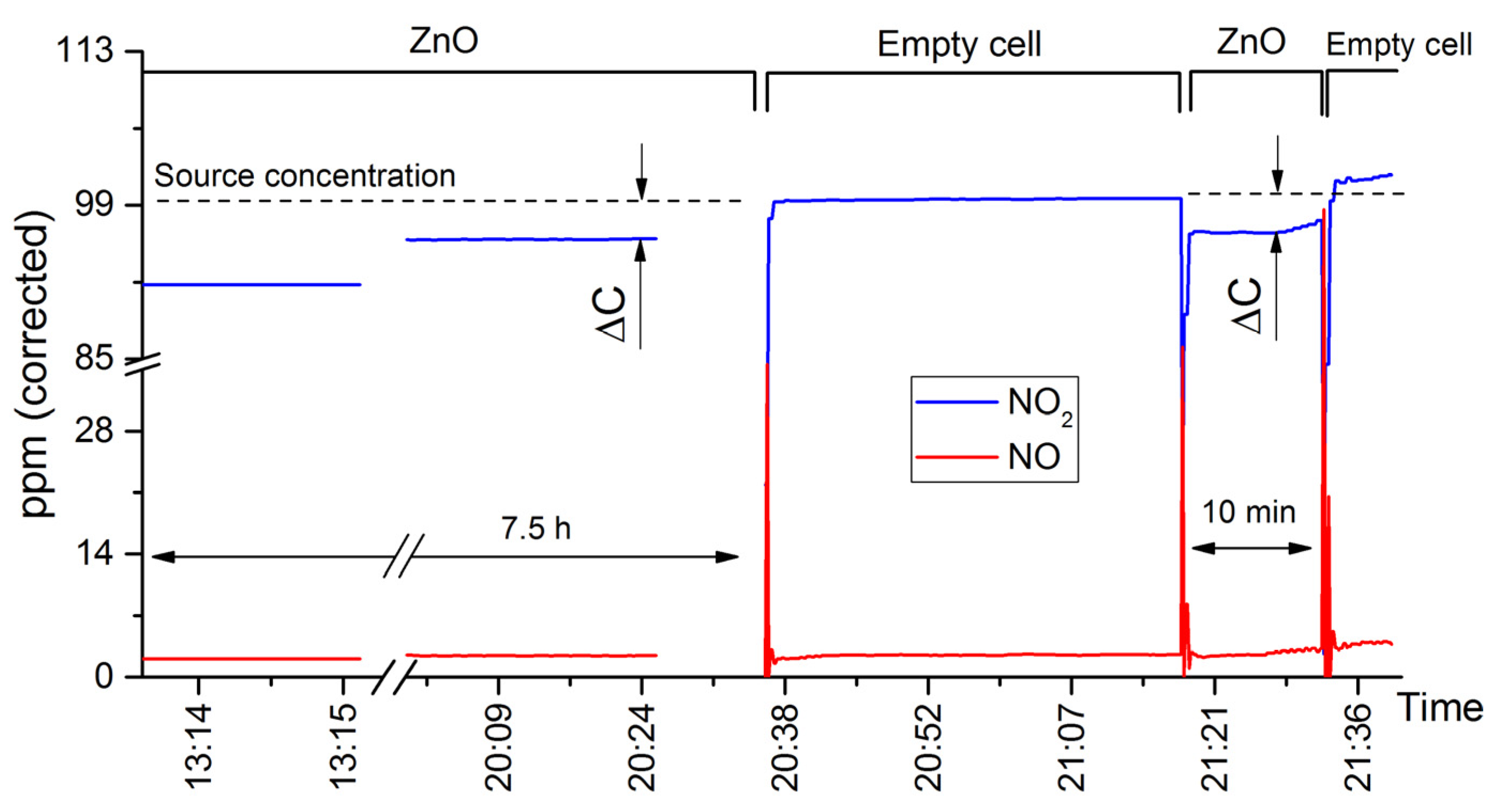
In situ mass spectrometry data concerning the nanocrystalline ZnO were discussed in detail in our previous work [32]. In short, UV illumination of ZnO causes an apparent irreversible photoadsorption of both nitrogen dioxide and oxygen. However, it is crucial to emphasize that this apparent photoadsorption, as seen in ion current plots, does not necessarily represent a reversal of adsorption equilibrium (compared to that in dark conditions). If the material exhibits prolonged NO2 adsorption in dark conditions (or even absorption by means of a chemical reaction), then an increase in the adsorption reaction rate will produce the same results. While mass spectrometry experiments can be utilized to detect long-term NO2 adsorption under dark conditions (since their total duration is around 12 h), NO2 fragmentation issues initially impeded any decisive interpretation of the results. Therefore, an independent method, making use of CAPS spectroscopy, was also applied to this task (in addition to in situ mass spectrometry): a crucible containing ZnO was placed into a flow cell fed with 100 ppm of NO2 in N2, and the sample was left to adsorb NO2 for 6 h. Afterwards, the crucible was quickly extracted from the cell and then reintroduced again; the cycle was repeated twice (Figure 8). The output of the cell was continuously monitored by a CAPS NOx analyzer. The difference between NO2 concentrations at the cell’s inlet and at its output (ΔC) is directly related to the adsorption reaction rate according to the mass conservation law; therefore, the results clearly show that nanocrystalline ZnO indeed is capable of prolonged NO2 adsorption (this point will be explained further in the discussion). Because different flow cells were used for mass spectrometry and CAPS spectroscopy measurements, the influence of NO2 adsorption on the exact NO2 concentration inside the cell’s outlet is less pronounced in Figure 8 than in the mass spectrometry results.
In situ TR-DRIFT spectroscopy data are presented as differential spectra [39]. This means that after each experimental stage, a new baseline was acquired, and the spectrum for the subsequent stage was recorded relative to this new baseline. This way, each curve in the TR-DRIFTS plots represents only the changes that happened during a selected experimental stage. Full, chronological TR-DRIFT spectra are provided in the Supplementary Material (Figures S3–S6, S8 and S9).
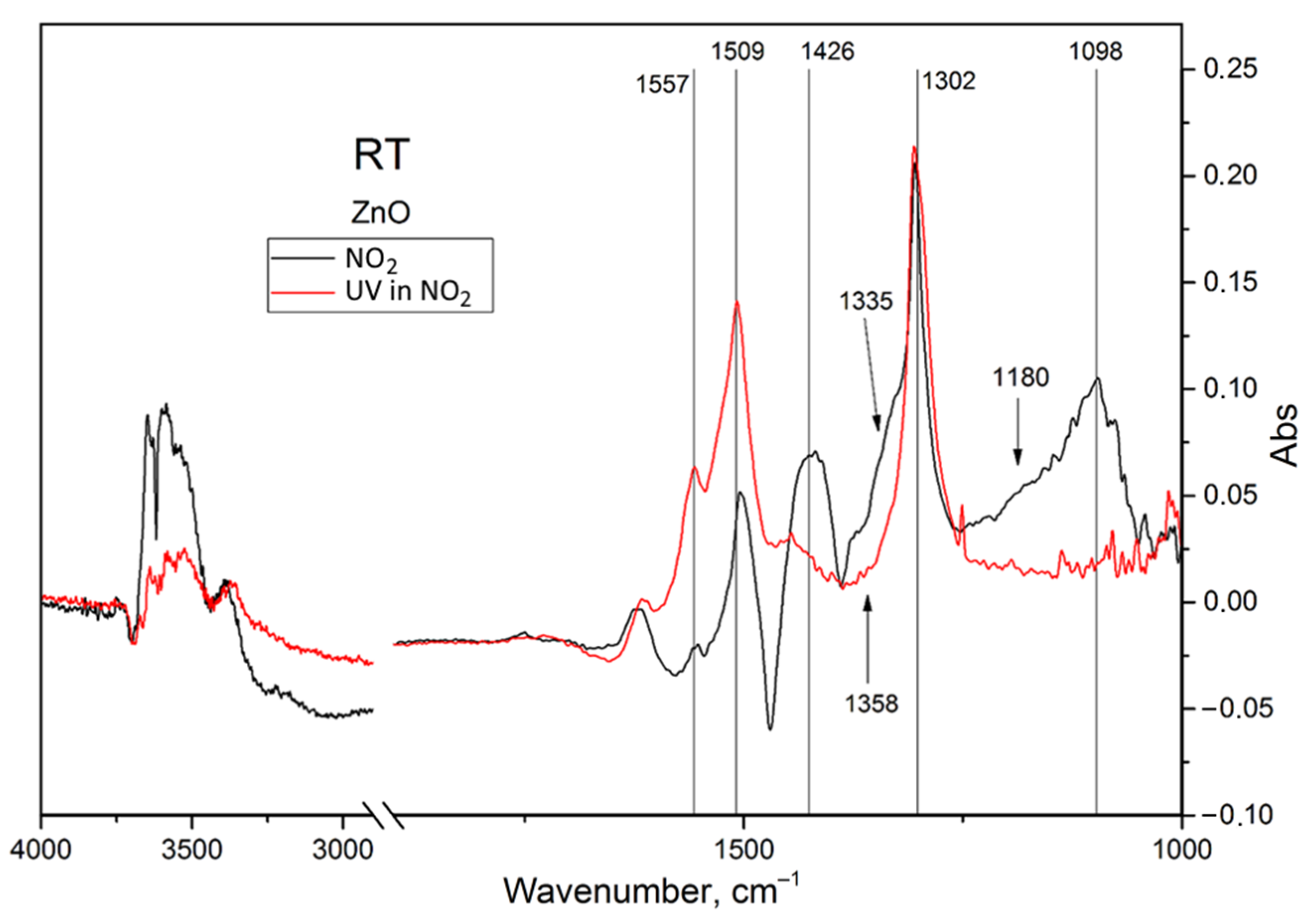
In situ TR-DRIFTS data confirm that pure nanocrystalline ZnO adsorbs NO2; room-temperature TR-DRIFT spectra are presented in Figure 9. The exposure of ZnO to nitrogen dioxide leads to the formation of a plethora of adsorbates (Table 1), including mono- and bidentate nitrates, nitrites, and possibly nitro groups (N-coordinated NO2). Surface hydroxylation (3400–3700 cm−1) can also be observed, while the broadened band at ~3100 cm−1 turns negative, which suggests a dissociation of adsorbed water [40]; however, these effects can also be a consequence of the subtle humidity changes caused by gas mixture switching.
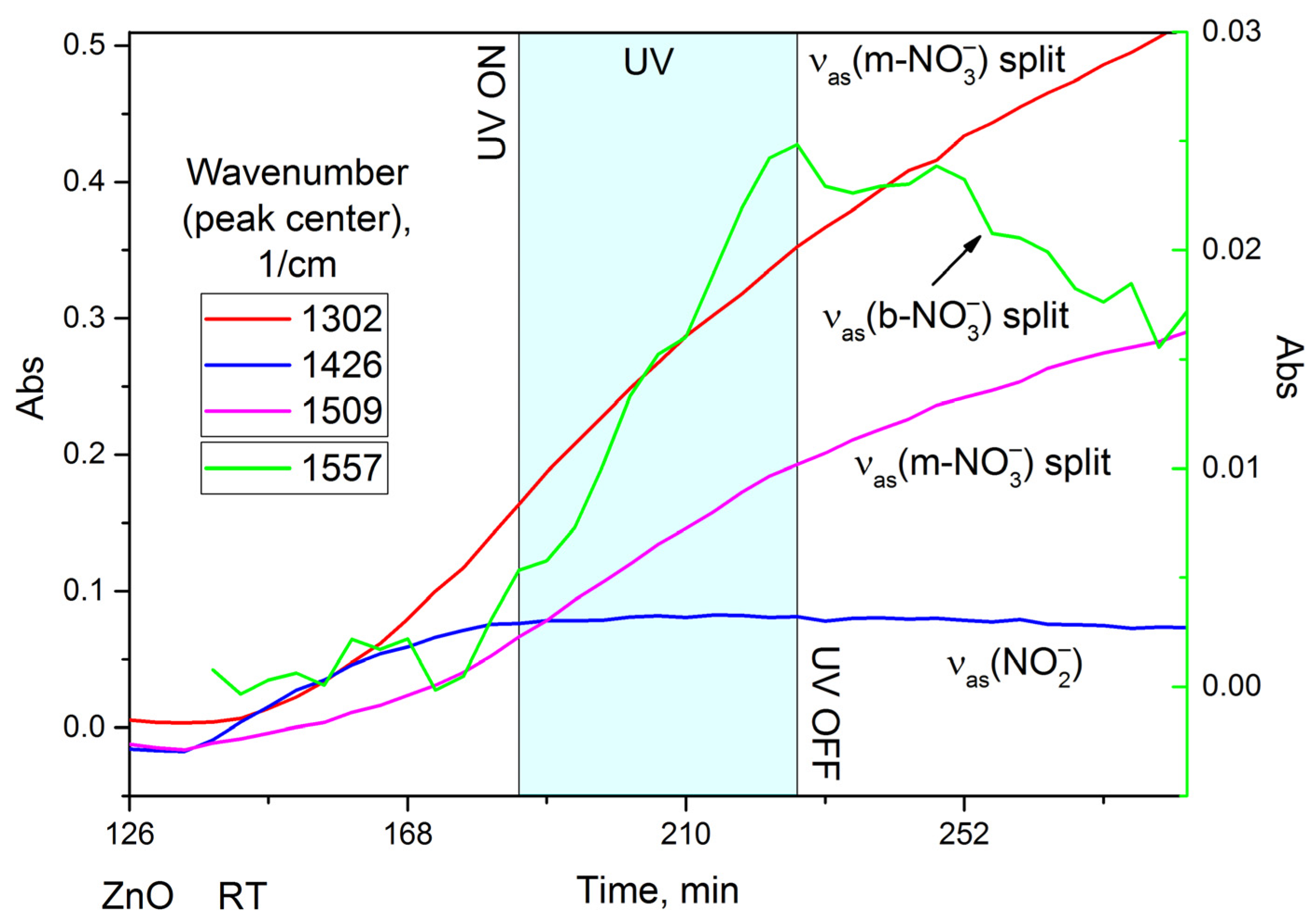
It is possible to calculate kinetic curves for effective surface concentrations of adsorbates using in situ TR-DRIFTS results (Figure 10). Once again, the kinetic curves prove that ZnO demonstrates prolonged NO2 adsorption, but these data make it possible to discern what the product of prolonged adsorption is: namely, the monodentate nitrate (m-NO3). At the same time, the surface concentration of nitrites and nitro groups quickly reaches saturation. As expected, UV illumination of nanocrystalline ZnO speeds up NO2 adsorption but, curiously, only the one resulting in bidentate nitrate (b-NO3) formation. These data provide an experimental basis for the separation between “long-term” and “short-term” NO2 adsorption processes.
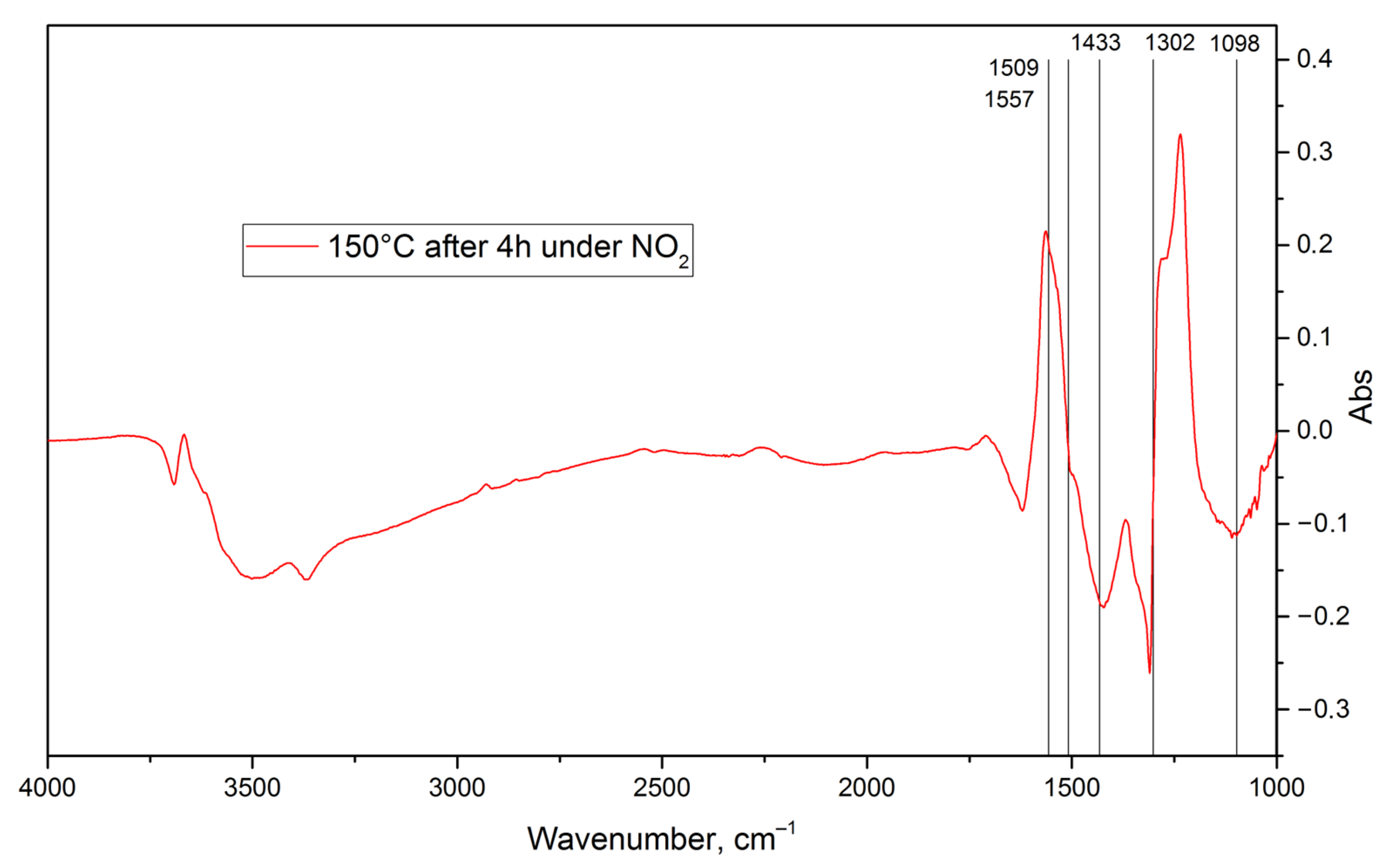
Temperature increase has two major consequences (Figure 11). First, most nitrate ions transition to bidentate or bridging coordination, as illustrated by the redshift of the absorption band ca. 1302 cm−1 and the blue shift of the absorption band ca. 1509 cm−1. Second, negative peaks at ca. 1433 cm−1 and ca. 1098 cm−1 in the differential spectrum indicate a partial thermal-activated desorption of surface nitrate and nitrite species.

3.2.2. Indium Oxide

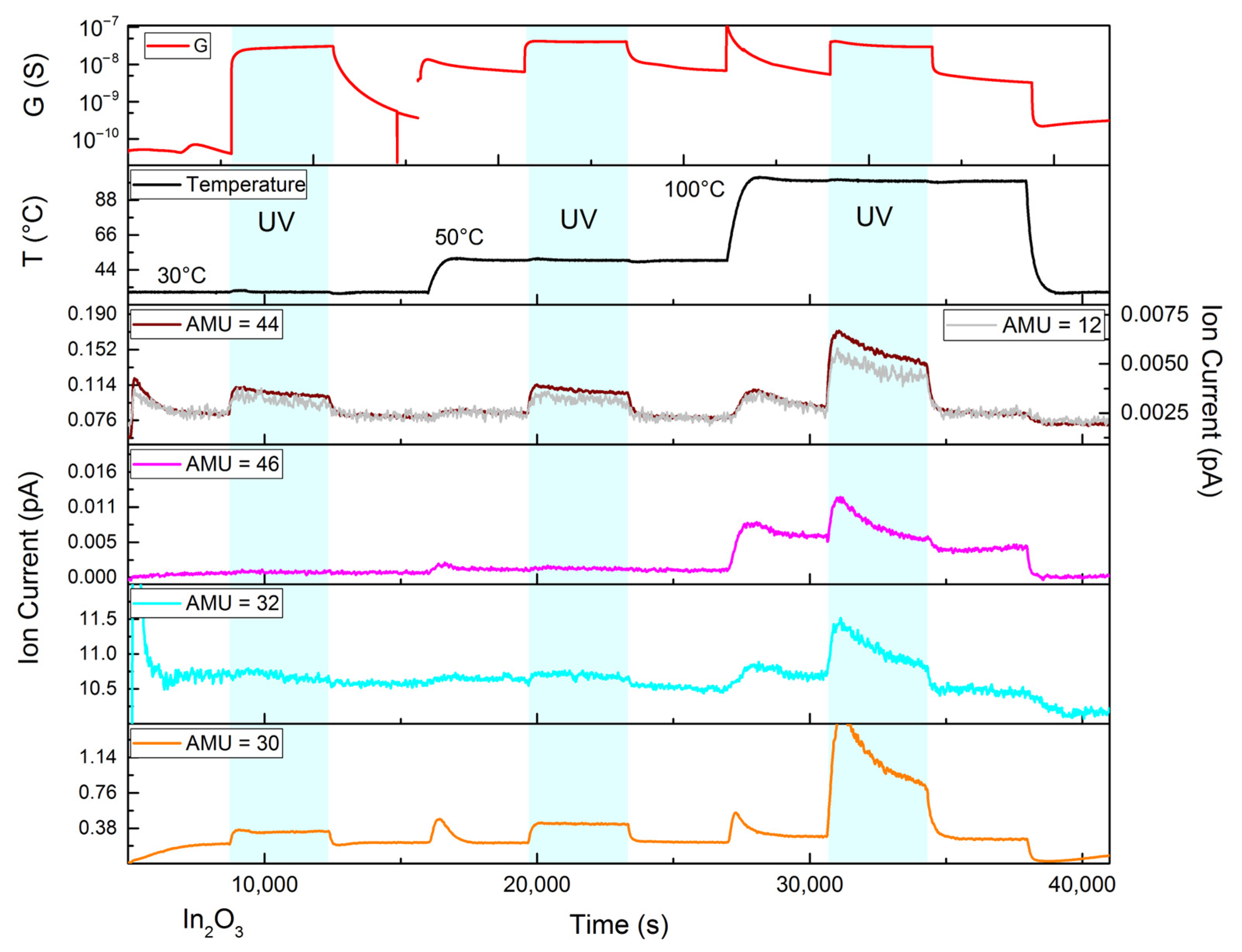
In situ mass spectrometry results for the nanocrystalline indium (III) oxide are presented in Figure 12. Indium oxide, like zinc oxide, contains some adsorbed carbon dioxide and exhibits CO2 thermal desorption and photodesorption. However, in this case, the latter produces weaker ion currents. Together with a significantly larger concentration of NO2 exiting the flow cell, represented by larger ion currents at m/z = 30 and 46, it becomes possible to ascribe most of the ion current at m/z = 46 to NO2+. Therefore, it can be stated that nanocrystalline In2O3 demonstrates an apparent photodesorption of NO2, which is probably the result of the adsorption reaction slowing down under UV illumination. Interestingly, at higher temperatures (100 °C), the shape of the curve corresponding to the ion current at m/z = 32, which is assigned to O2+, starts to closely resemble those of NO2 (m/z = 30, 46). It can be assumed that at elevated temperatures, a real desorption of adsorbates containing an excess of oxygen (like nitrates [31]) may take place or at least that the mechanism of the underlying process changes.
An increase in sample conductance under UV illumination occurs mainly due to the photogeneration of non-equilibrium charge carriers and subsides after the UV light is turned off because of recombination and, possibly, electron trapping by the continuous ionosorption of NO2 [26]. Increasing the temperature of the sample (from 30 °C to 50 °C) leads to an increase in the conductance in accordance with the Fermi–Dirac statistics of charge carriers in semiconductors [1]. Any further increase in temperature, though, leads to the opposite effect: a slight negative trend appears that can be explained by carrier lifetime reduction.
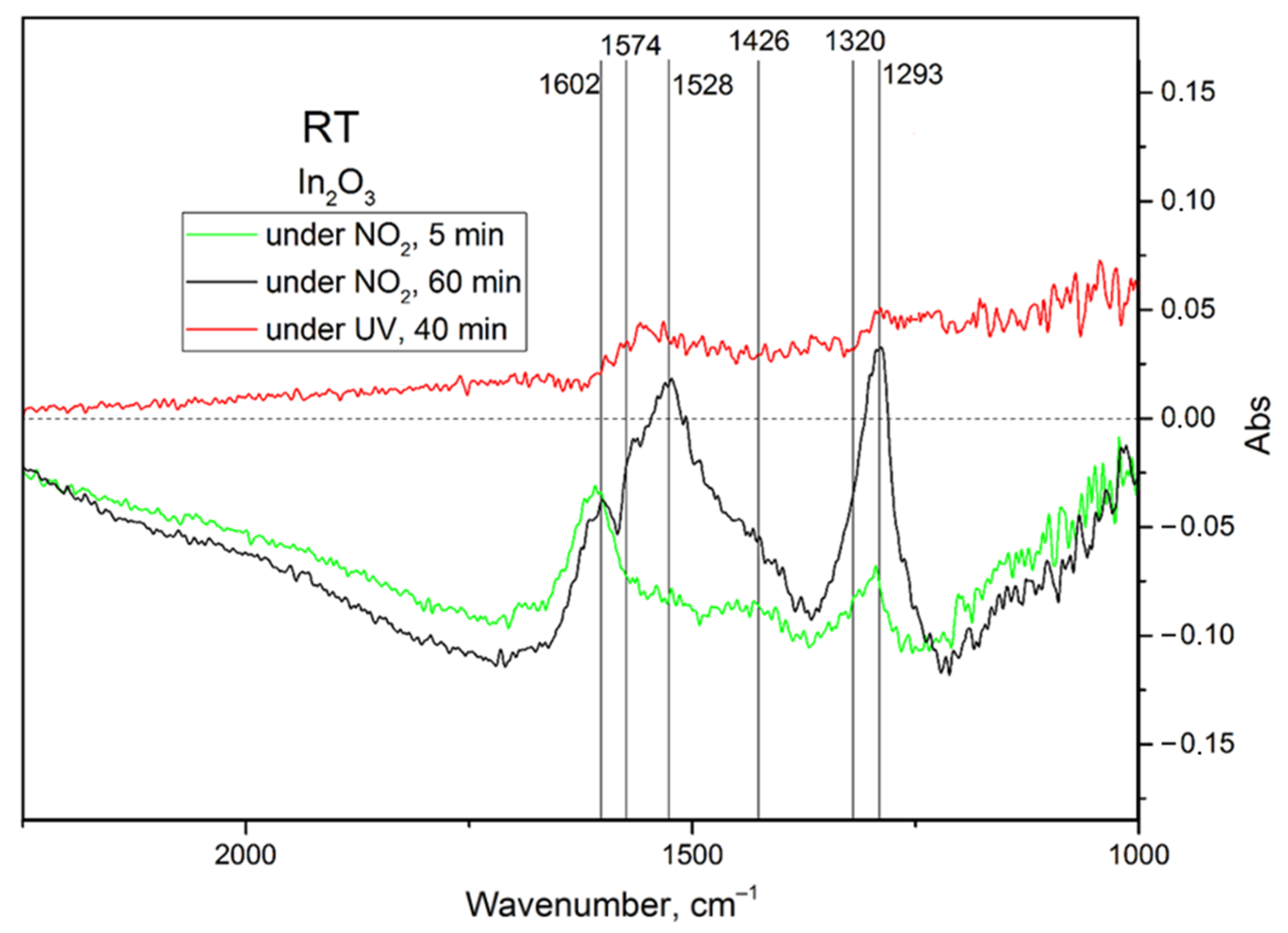
The in situ TR-DRIFT spectroscopy results for indium oxide are similar to those for zinc oxide: all possible adsorbates of NO2 can be found on the surface of indium oxide, including mono- and bidentate nitrates, nitrites, and possible nitro groups (Table 2). The differential spectra (Figure 13) corroborate that the apparent photodesorption observed in mass spectrometry data at room temperature is, in fact, due to a decrease in the adsorption rate. There is no evidence of desorption on differential spectra, i.e., there are no sharp “negative” peaks. Considering two differential spectra corresponding to periods of 5 and 60 min of exposure to an atmosphere containing NO2, it is possible to separate two stages of NO2 adsorption with the band at 1602 cm−1 being assigned to physisorbed NO2 based on its proximity to that of free NO2 (1612–1618 cm−1) [8,43]. The aforementioned band quickly starts to overlap with the higher-energy components of doublets belonging to nitrates vibrations; nevertheless, during the first minutes of the experiment, this band is a singlet and thus represents NO2. The slight redshift of the band, compared to gaseous NO2, is expected, since interactions with adsorbed water or hydroxyl layers lower the bond strengths within the molecule. A significant baseline drift after exposure to both NO2 and UV light can be explained as a change in free charge carrier concentration, resulting in altered reflectivity according to the Drude model [44].
TR-DRIFT spectra acquired at elevated temperatures (100 °C, Figure S6) show no signs of UV-activated desorption of any nitrogen dioxide adsorbates. Similarly to the case of ZnO, nitrate adsorbate species undergo a coordination change from monodentate to bidentate.

3.2.3. Tin Oxide

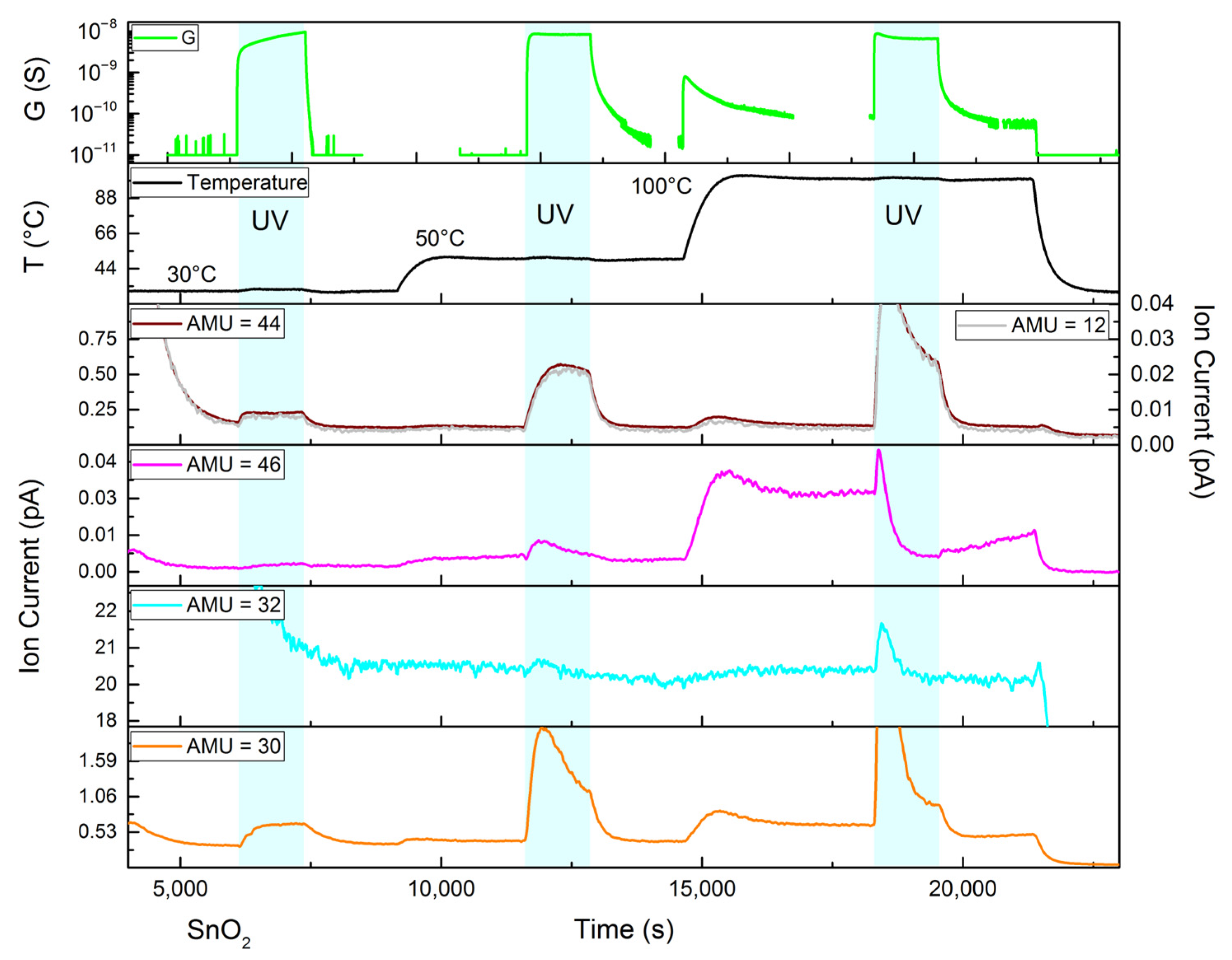
The in situ mass spectrometry results for the nanocrystalline SnO2 are presented in Figure 14. The conductance plot does not match the ion current plots as closely as it did in previous experiments due to a small change in the mass spectrometric experiment timings (more time is allocated to relaxation after UV illumination and after heating). Once again, the oxide possesses carbon dioxide on its surface, resulting in an overlap of ion currents at m/z = 46. In this case, the overlap is significant, yet it is still possible to note a feature emerging at 50–100 °C that was not present for the other oxides. A pronounced decrease in ion current corresponding to the NO2+ at 100 °C can be observed despite the overlap. Simultaneously, there is an increase in the ion current corresponding to NO+, suggesting that the ion current generated by O2+ is probably balanced by two opposing processes: oxygen photoadsorption and NO2 photoactivated dissociation. Photodesorption of NO2 is also possible at 50 °C.
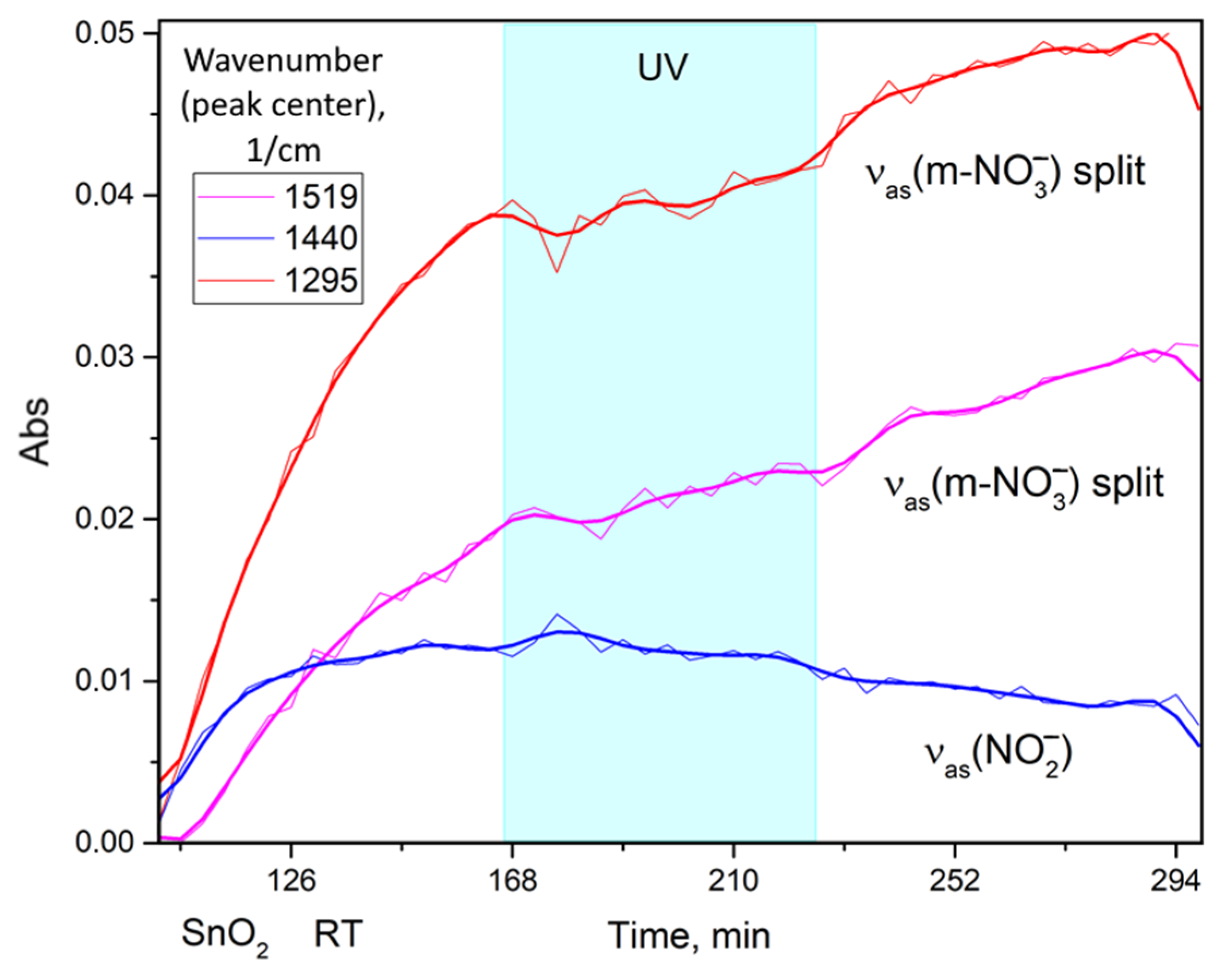
According to in situ TR-DRIFTS, tin oxide adsorbs nitrogen dioxide, forming surface nitrates and nitro groups (no nitrites were found in this case). The spectrum is similar to that of indium oxide discussed above (Figure S7). The band assignment is given in Table 3. The IR band broadening in the tin oxide spectra is smaller than in indium oxide spectra; therefore, it was possible to accurately calculate the kinetic curves (Figure 15). The latter once again show that prolonged nitrogen dioxide adsorption results in the accumulation of nitrates on the surface, while adsorption leading to nitro-group formation quickly reaches saturation. UV illumination causes the rate of the prolonged adsorption to decline and may lead to a small photodesorption (right after the UV light is turned on). Despite numerous attempts, TR-DRIFTS experiments at elevated temperatures (100 °C) were unsuccessful in detecting the photodesorption suggested by the mass spectrometry results.
As for the possible photo-dissociation, the TR-DRIFT spectra do not directly support this assumption. However, the presence of a photo-dissociation process does not necessarily require that its products appear in TR-DRIFT spectra. If the products undergo rapid desorption, their corresponding adsorbate species can be regarded as intermediates. The surface concentration of intermediates approaches zero, which makes their detection with DRIFTS tricky, especially when large amounts of other adsorbate species are present. Furthermore, previous spectroscopic studies revealed that one of the expected photo-dissociation products—ionosorbed oxygen—can only be detected on reduced SnO2 surfaces [45].

3.3. Gas-Sensing Measurements

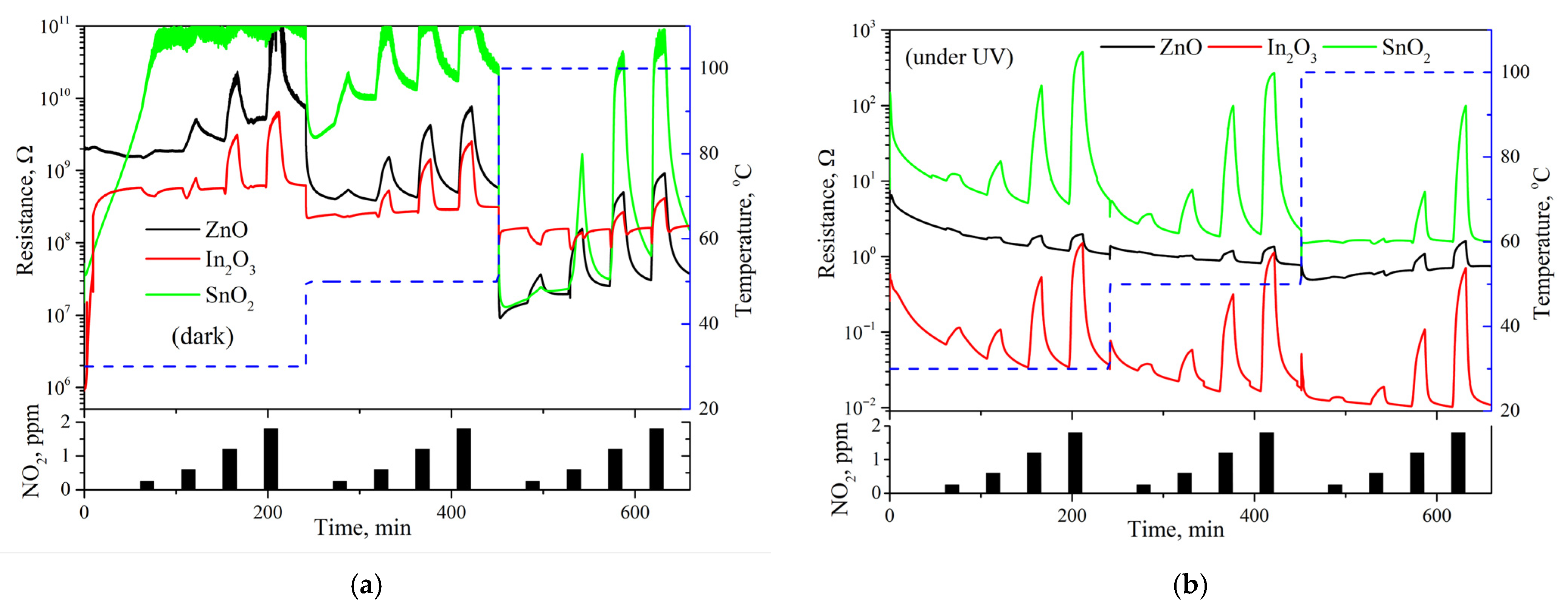
Figure 16 shows the changes in electrical resistance of sensors cyclically exposed to 0.5–2 ppm of NO2 at 30 °C, 50 °C, and 100 °C, both in dark conditions and under constant UV illumination. The measurements were performed in dry purified air. At high concentrations of NO2 (>1 ppm), the resistance of all three materials increases upon exposure to nitrogen dioxide, which is a classic n-type semiconductor gas sensor response to oxidizing gases. The ionosorption of oxidizing gases on the surface of the oxides leads to band bending and, in turn, to a rise in resistivity [4,9,46]. Both UV activation and an increase in temperature cause the resistivity of the oxide material to drop by increasing the charge carrier concentration inside the conduction band, though the effect of UV illumination is far more pronounced. The variation in Rair of the materials encompasses variations in multiple parameters, including layer thickness and mean particle size, and cannot be attributed to differences in the equilibrium charge carrier concentration alone. For this reason, the Rair of SnO2 quickly approaches the range limit of the instrument upon exposure to NO2 and therefore cannot be accurately determined at room temperature.
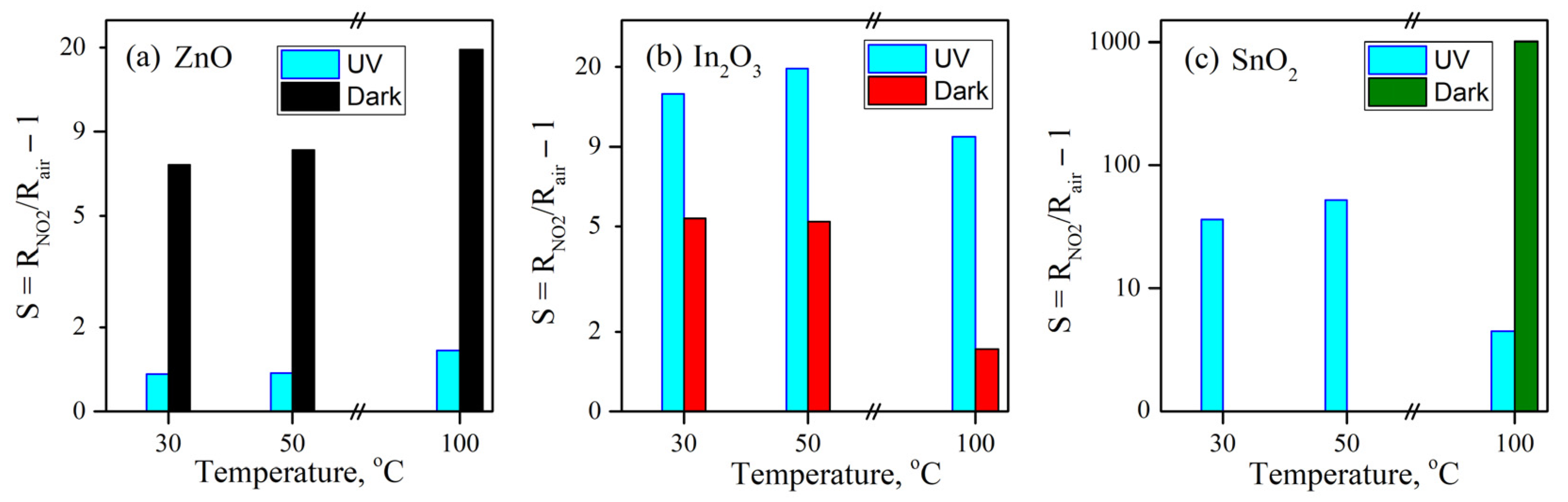
The UV activation of nanocrystalline ZnO and In2O3 yields two distinct results (Figure 17). The sensor signal of ZnO plummets when UV activation is used, while that of In2O3 increases 3–10 fold (the UV effect grows with temperature). Despite the similarities between SnO2 and In2O3 observed in mass spectrometry and TR-DRIFTS experiments, the influence of UV activation on the sensor signal of SnO2 at 100 °C differs strikingly from its effect on the sensor signal of In2O3: the signal is reduced almost 100 times when UV activation is used.
An attempt to calculate sensor response (air-to-gas transition) and relaxation (gas-to-air transition) times according to the exponential decay Formula (8) revealed that in most cases, two different time constants are present (Table S1). This treatment excludes an additional 3-minute-long transient period that occurs after each gas mixture switching, corresponding to the gas mixing inside the cell (the cell’s time constant is approx. 30 s). It was found that UV activation leads to the following changes: first, it consistently shortens relaxation times (both τ1 and τ2 decrease under UV illumination); second, it speeds up the sensor response of ZnO but slows down that of In2O3 and SnO2 (both τ1 and τ2 are affected). Although it is tempting to assign the τ2 of the response process to the long-term nitrate formation process, the absolute values of the calculated time constant values should be treated with caution due to the strong influence of the range of the data selected for the regression on the results.
R t = R 0 + R 1 exp t t 0 τ 1 + R 2 exp t t 0 τ 2 ,     τ 1 τ 2
Equation (8) includes the following terms: R(t)—sensor resistance (Ω) as a function of time; R0, R1, R2, t0—regression variables; τ1, τ2—regression variables, representing time constants (s); t—experiment time (s).

4. Discussion

One of the classic [8,26,30,31,32] model representations of the sensor signal formation of SMOX-based materials used for detecting NO2 is the simple ionosorption with nitrite formation (9). The nitrite formation, albeit limited, was indeed observed in the TR-DRIFT spectra reported in this work, as well as in Raman spectra reported previously [27], thus supporting this model. Moreover, the kinetics of nitrite formation coincide with that of conductivity changes in the material: both the surface nitrite concentration and the conductivity changes caused by exposure to NO2 quickly reach a plateau, as opposed to the long-term nitrate formation.
N O 2 g a s + e C . B . N O 2 a d s
This model suggests that gaseous NO2 is adsorbed on the surface of the material, trapping an electron from the conduction band. This trapping creates a surface charge that gives rise to an electric field, which penetrates the semiconductor’s bulk according to the Poisson–Boltzmann equation and the Debye length (10), leading to band bending [10].
λ D = ϵ ϵ 0 k T q 2 n b u l k
Depending on the grain size and Debye length of the material, the porous sensing layer operates in either the flat bands mode or grain-boundary mode [9,11]. Therefore, it is a feasible suggestion that in dark conditions, nanocrystalline indium oxide material, with the highest nbulk out of all three materials, operates in grain-boundary mode, while the other two materials operate in the flat bands condition (especially ZnO). A transition from flat-bands mode to grain-boundary mode, arising from non-equilibrium carrier photogeneration, can (partially) explain the degradation of the sensor signal of ZnO and SnO2 when operated with UV activation. It is unclear whether the possible photodissociation of NO2 on the surface of SnO2, which was observed at 100 °C (Figure 14), contributed to the signal degradation, since process (11) leaves chemisorbed oxygen on the semiconductor surface, and oxygen desorption under UV illumination is unlikely because the oxides are known to exhibit oxygen photoadsorption [47,48].
2 N O 2 a d s + e 2 N O ( g a s ) + O 2 a d s
Furthermore, regarding the influence of UV activation on the sensor signal, it should be noted that according to the Formula (7), non-equilibrium carrier photogeneration alone may be sufficient to increase the signal value due to the diminishing of Rair.
Based on in situ TR-DRIFTS findings for In2O3 presented above, we can amend the mechanism (9) and include the physisorption stage (12), noting that the process of surface nitrite formation (accompanied by the electron trapping) takes measurable time.
N O 2 g a s N O 2 a d s
It is a widespread point of view [49,50,51,52] that UV activation enhances the properties of SMOX-based gas sensors employed for NO2 detection by causing a photodesorption of surface nitrites and thus releasing the trapped charge carriers back into the conduction band, relieving the surface charge and decreasing surface contamination. However, the combined in situ mass spectrometry and in situ TR-DRIFTS results prove that all three oxides are prone to prolonged NO2 adsorption at room temperature even when UV activation is used. Under the conditions considered in this work, UV activation at room temperature was found to be able to either promote or suppress the long-term adsorption rate of NO2 but not to reverse the direction of the process. Photodesorption can be observed only in mass spectrometry results for In2O3 and SnO2 and only at elevated temperatures (50–150 °C) together with the photoactivated dissociation of NO2. The lack of hypothesized photodesorption of the surface nitrite species is likely a consequence of the poor or even non-existent mobility of states belonging to the valence zone (holes) [1].
The fact that the long-term NO2 adsorption (with surface nitrate formation) demonstrates no matching significant long-term conductivity changes should not come as a surprise, because the surface charge density cannot surpass the Weisz limit [53]. This implies that nitrate formation does not require a charge transfer from the conduction band of the semiconductor to the adsorbate. Only a single model representation (13) of NO2 adsorption that satisfies the aforementioned condition (though on TiO2) can be found in the literature [54].
2 + n N O 2 a d s + n O l a t 2 + e 1 + n N O 3 a d s + N O g a s + n V O
The model first assumes that the dimerization of NO2 into N2O4, followed by nitrosyl nitrate formation (14), is thermodynamically favorable on the oxide surface (recently confirmed by DFT calculations [55]). Next, the nitrosyl cation reacts with the lattice oxygen (15) to form an adsorbed nitrogen dioxide molecule that can undergo dimerization (with any adjacent adsorbed NO2 molecule) again, continuing the process (13) in a chain-reaction manner. And every chain reaction has a termination reaction: in this case, the nitrosyl cation can be reduced to NO by the oxide (16), requiring the adsorption of a “replacement” NO2 molecule to continue the dimerization and the nitrate formation processes. Single-charged oxygen vacancies are known to be unstable in ZnO; they quickly undergo disproportionation according to reaction (16).
2 N O 2 a d s O N O N O 2 a d s N O a d s + + N O 3 a d s
N O a d s + + O l a t 2 N O 2 a d s + V O
N O a d s + + e N O g a s
2 V O V O + V O 2
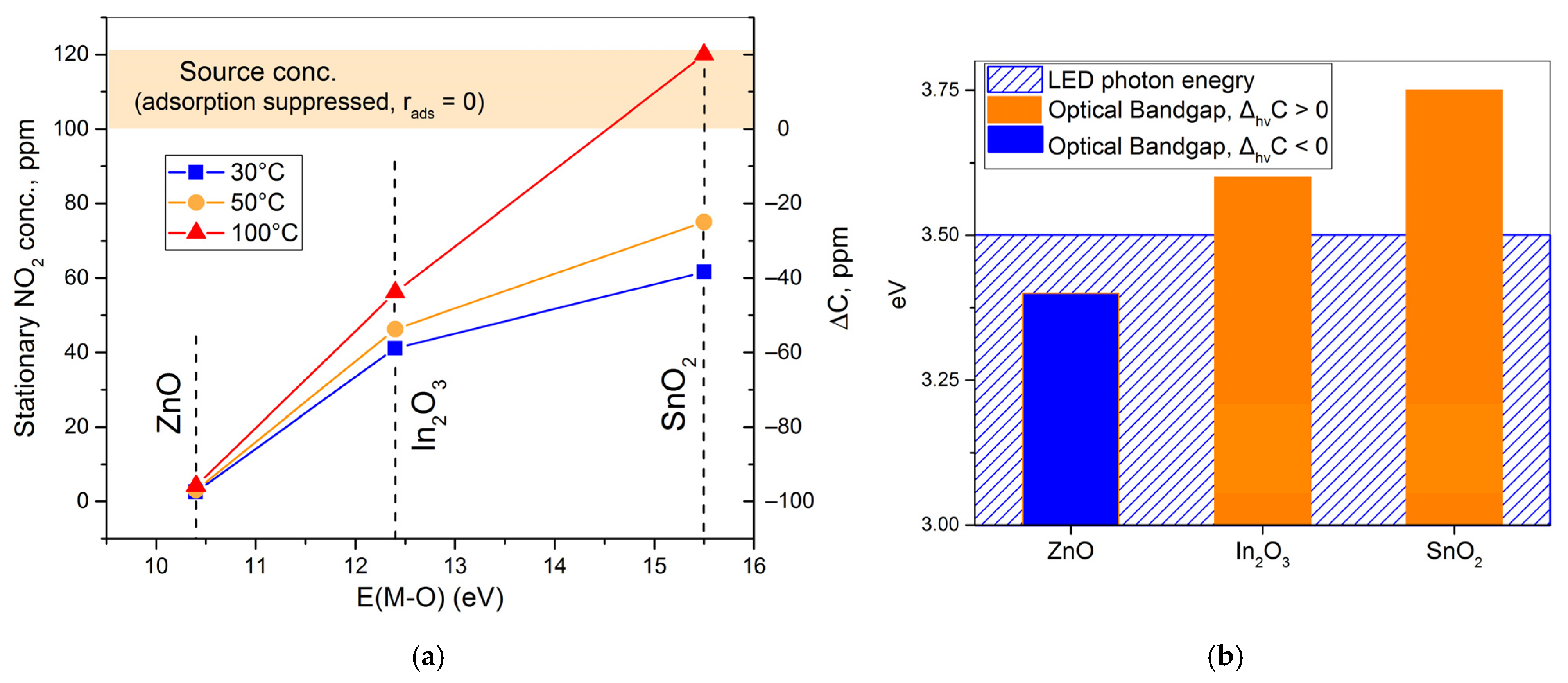
At first glance, the notion of a surface reaction leading to the formation of a number of oxygen vacancies might seem counterintuitive, but the experimental data actually support this model. The ion current value at m/z = 30 (fragment NO+) corresponding to 100 ppm of NO2 was calibrated to be 0.55 ± 10% pA using a certified gas cylinder. Comparing this value to the corresponding ion current values under dark conditions in Figure 12 and Figure 14, as well as to the data published previously [32], it is possible to plot the stationary concentration of NO2 determined at the output of the in situ mass spectrometry flow cell at different cell temperatures versus the metal–oxygen bond energy of the materials (Figure 18a). The stationary concentration of NO2 exiting the cell corresponds to its adsorption rate according to the mass conservation law, which can be written as (18):
d C d t = s d θ d t + w V C 0 C t = 0
where C(t) is the volume concentration of NO2 measured at the cells outlet, s is the effective area of the sample, θ is the surface coverage, w is the volumetric flow rate, V is the reactor volume, and C0 is the source concentration (100 ppm). Note that the first term of the sum represents the adsorption reaction rate. Hence, the deviation of the NO2 concentration (as measured at the outlet of the cell) from the source concentration can be expressed as (19):
Δ C = s V w r a d s
The resulting plot (Figure 18a) demonstrates that the long-term adsorption rate decreases as the metal–oxygen bond energy increases, indicating that the reaction (15) indeed involves lattice oxygen. The temperature dependence of the adsorption rate follows the trend predicted by thermodynamics: the entropy change in adsorption (ΔadsS) must be negative; therefore, the system (provided that surface coverage is lower than its equilibrium value) approaches the equilibrium state when the temperature is increased, and thus the adsorption rate decreases.
At this point, one question remains unaddressed: why does UV activation speed up NO2 adsorption for ZnO but slows it down for In2O3 and SnO2? It is worth pointing out that the maximum photon energy of the UV LEDs used is 3.5 eV, which is lower than the optical bandgap energy of In2O3 and SnO2 (Figure 18b). Although the optical bandgap values of nanocrystalline materials can be lowered by the formation of “tails” of density of states (consisting of defect or surface states) near band edges [58], as well as by the symmetry implications of the nanocrystalline state, it is reasonable to consider the possibility of exciton generation in In2O3 and SnO2 under UV illumination [59,60]. Since excitons are neutral quasiparticles, their generation enables the non-equilibrium (photogenerated) charge carriers to reach the surface in spite of the presence of a large negative surface potential caused by ionosorption. Once the excitons reach the surface, they can participate in surface reactions, in particular in the reaction (16), increasing its rate and, in turn, slowing down the overall chain reaction of the surface nitrate formation (13). A decrease in the rate of a reaction that does not contribute to the sensor signal formation can have a beneficial effect on the gas-sensing properties of the material, giving rise to the sensor signal increase observed for UV-activated In2O3. In the case of ZnO, UV light almost certainly causes interband transitions to begin with, so no excitons can reach its surface. But the UV radiation can contribute to the nitrosyl nitrate formation step (14) through photo-excitation of the adsorbate molecules, ramping up the nitrate formation reaction rate and negatively impacting the sensor signal.

5. Conclusions

We have studied gas-sensor materials for NO2 detection based on ZnO, In2O3 and SnO2 using an in situ multi-method approach. For all the three materials, a significant irreversible contamination of the surface with nitrate species was observed during long-term operation in NO2-rich atmosphere at room temperature. We found no evidence of the photodesorption (promoted by photoactivation with UV light) of nitrogen dioxide adsorbates from the surface of the materials at room temperature. Still, under the aforementioned conditions, UV activation strongly impacts the sensor signal by controlling both electronic properties of the semiconductor (charge carrier density, porous layer conduction regime, exciton generation) and surface reaction rates. UV activation was found to suppress the sensor signal of ZnO and SnO2 but increase that of In2O3. Nevertheless, UV activation can be beneficial for both In2O3- and SnO2-based materials, since in both cases, it slows down sensor material degradation by reducing the rate of the reactions that lead to surface contamination (possibly through exciton generation). In addition, UV activation lowers the resistivity of the materials, driving down the complexity and cost of the measurement circuits. The impact of UV activation on the sensor kinetics is complex: on the one hand, it shortens the relaxation time; on the other hand, it can increase the response time (as observed for In2O3 and SnO2), creating a possible tradeoff between the response time and the material degradation rate. The presented in situ techniques open possibilities for the further investigation of NO2 adsorption kinetics in relation to the electrical properties of the materials under UV activation conditions.

Supplementary Materials

The following supporting information can be downloaded at https://www.mdpi.com/article/10.3390/nano15231795/s1, Figure S1: Flow cell construction for mass spectrometry investigations; Figure S2: Flow simulation results, showing no extra-volume effects (no eddies in the corners) and instability of the laminar flow regime; Figure S3: Chronological TR-DRIFT spectra for ZnO exposed to 100 ppm NO2 at room temperature (with photoactivation); Figure S4: Chronological TR-DRIFT spectra for ZnO exposed to 100 ppm NO2 at 100 °C (with photoactivation); Figure S5: Chronological TR-DRIFT spectra for In2O3 exposed to 100 ppm NO2 at room temperature (with photoactivation); Figure S6: Chronological TR-DRIFT spectra for In2O3 exposed to 100 ppm NO2 at 100 °C (with photoactivation); Figure S7: Differential TR-DRIFT spectra for SnO2 exposed to 100 ppm NO2 at room temperature (with photoactivation); Figure S8: Chronological TR-DRIFT spectra for SnO2 exposed to 100 ppm NO2 at room temperature (with photoactivation); Figure S9: Chronological TR-DRIFT spectra for SnO2 exposed to 100 ppm NO2 at 100 °C (with photoactivation); Table S1: Calculated exponential time constants (in seconds) of sensor response and relaxation. Blank means only a single time constant is present (either t1 or t2). “NA” means no data are available. All values were calculated for 2 ppm NO2 step. A 3 min transient period was excluded from the calculations.

Author Contributions

Conceptualization, M.R. and P.K.; methodology, P.K. and M.R.; software, P.K.; validation, P.K.; formal analysis, P.K.; investigation, P.K., D.K. and S.M.; writing—original draft preparation, P.K.; writing—review and editing, P.K. and M.R. All authors have read and agreed to the published version of the manuscript.

Funding

This research was funded by a grant from the Ministry of Science and Higher Education of the Russian Federation, grant number 075-15-2024-646.

Data Availability Statement

The original contributions presented in this study are included in the article/Supplementary Material. Further inquiries can be directed to the corresponding authors.

Acknowledgments

TR-DRIFTS experiments and long-term NO2 adsorption measurements employing a photoluminescence analyzer were carried out using equipment (Frontier FTIR spectrometer with Pike DiffuseIR diffuse reflectance accessory; Teledyne API N500 CAPS NOx Analyzer) purchased with funds from the Lomonosov Moscow State University Program of the Development. The authors are grateful to A.S. Chizhov for his help with gas-sensing measurements.

Conflicts of Interest

The authors declare no conflicts of interest. The funders had no role in the design of the study; in the collection, analyses, or interpretation of data; in the writing of the manuscript; or in the decision to publish the results.

Abbreviations

The following abbreviations are used in this manuscript:
TR-DRIFTSTime-resolved diffuse reflectance infrared Fourier transform spectroscopy
XRDX-ray diffraction
BETBrunauer–Emmet–Teller isotherm
SEMScanning electron microscopy
TEMTransmission electron microscopy
UVUltraviolet
LEDLight-emitting diode
FWHMFull width at height maximum
AbsAbsorbance
CAPSCavity-attenuated phase-shift spectroscopy
AMUAtomic mass unit
m/zIon mass-to-charge ratio
SDStandard deviation
PTFEPolytetrafluoroethylene

References

  1. Wolkenstein, T. Electronic Processes on Semiconductor Surfaces During Chemisorption; Springer: New York, NY, USA, 1991; ISBN 978-0-306-11029-0. [Google Scholar]
  2. Moseley, P.T. Progress in the Development of Semiconducting Metal Oxide Gas Sensors: A Review. Meas. Sci. Technol. 2017, 28, 082001. [Google Scholar] [CrossRef]
  3. Brattain, W.H.; Bardeen, J. Surface Properties of Germanium. Bell Syst. Tech. J. 1953, 32, 1–41. [Google Scholar] [CrossRef]
  4. Gurlo, A.; Bârsan, N.; Weimar, U. Gas Sensors Based on Semiconducting Metal Oxides. In Metal Oxides; CRC Press: Boca Raton, FL, USA, 2005; ISBN 978-1-4200-2812-6. [Google Scholar]
  5. Das, S.; Jayaraman, V. SnO2: A Comprehensive Review on Structures and Gas Sensors. Prog. Mater. Sci. 2014, 66, 112–255. [Google Scholar] [CrossRef]
  6. Strobel, B.R.; Pratsinis, S.E. Flame Synthesis of Supported Platinum Group Metals for Catalysis and Sensors: Novel flame processes allow synthesis of supported PGMs in a single step. Platin. Met. Rev. 2009, 53, 11–20. [Google Scholar] [CrossRef]
  7. Batal, M.A.; Jneed, F.H. Tin Oxide N-Type Semiconductor Inverted to p-Type Semiconductor Prepared by Sol-Gel Method. Energy Procedia 2011, 6, 1–10. [Google Scholar] [CrossRef]
  8. Chen, M.; Wang, Z.; Han, D.; Gu, F.; Guo, G. High-Sensitivity NO2 Gas Sensors Based on Flower-like and Tube-like ZnO Nanomaterials. Sens. Actuators B Chem. 2011, 157, 565–574. [Google Scholar] [CrossRef]
  9. Barsan, N.; Weimar, U. Conduction Model of Metal Oxide Gas Sensors. J. Electroceramics 2001, 7, 143–167. [Google Scholar] [CrossRef]
  10. Gomri, S.; Seguin, J.-L.; Guerin, J.; Aguir, K. Adsorption–Desorption Noise in Gas Sensors: Modelling Using Langmuir and Wolkenstein Models for Adsorption. Sens. Actuators B Chem. 2006, 114, 451–459. [Google Scholar] [CrossRef]
  11. Bârsan, N. Conduction Models in Gas-Sensing SnO2 Layers: Grain-Size Effects and Ambient Atmosphere Influence. Sens. Actuators B Chem. 1994, 17, 241–246. [Google Scholar] [CrossRef]
  12. Majhi, S.M.; Mirzaei, A.; Kim, H.W.; Kim, S.S.; Kim, T.W. Recent Advances in Energy-Saving Chemiresistive Gas Sensors: A Review. Nano Energy 2021, 79, 105369. [Google Scholar] [CrossRef] [PubMed]
  13. Liu, H.; Zhang, L.; Li, K.H.H.; Tan, O.K. Microhotplates for Metal Oxide Semiconductor Gas Sensor Applications—Towards the CMOS-MEMS Monolithic Approach. Micromachines 2018, 9, 557. [Google Scholar] [CrossRef]
  14. Li, G.; Sun, Z.; Zhang, D.; Xu, Q.; Meng, L.; Qin, Y. Mechanism of Sensitivity Enhancement of a ZnO Nanofilm Gas Sensor by UV Light Illumination. ACS Sens. 2019, 4, 1577–1585. [Google Scholar] [CrossRef]
  15. Lee, S.; Lee, G.H.; Choi, M.; Park, G.; Kim, D.; Lee, S.; Lee, J.-O.; Cho, D. Photoactivated Metal Oxide-Based Chemiresistors: Revolutionizing Gas Sensing with Ultraviolet Illumination. J. Sens. Sci. Technol. 2024, 33, 274–287. [Google Scholar] [CrossRef]
  16. Lee, J.; Kim, M.; Park, S.; Ahn, J.; Kim, I. Materials Engineering for Light-Activated Gas Sensors: Insights, Advances, and Future Perspectives. Adv. Mater. 2025, 37, e08204. [Google Scholar] [CrossRef] [PubMed]
  17. Kumar, R.; Liu, X.; Zhang, J.; Kumar, M. Room-Temperature Gas Sensors Under Photoactivation: From Metal Oxides to 2D Materials. Nano-Micro Lett. 2020, 12, 164. [Google Scholar] [CrossRef]
  18. Wang, T.; Chen, J.; Chen, J.; Yao, X.; Chen, G.; Jiao, Z.; Zhao, J.-T.; Cheng, S.; Yang, X.-C.; Li, Q. UV-Light Enhanced Gas Sensor Based on Ga Doped ZnO for Ultra-High Sensitive and Selective n-Butanol Detection. Appl. Surf. Sci. 2023, 641, 158551. [Google Scholar] [CrossRef]
  19. Solomatin, M.A.; Glukhova, O.E.; Fedorov, F.S.; Sommer, M.; Shunaev, V.V.; Varezhnikov, A.S.; Nasibulin, A.G.; Ushakov, N.M.; Sysoev, V.V. The UV Effect on the Chemiresistive Response of ZnO Nanostructures to Isopropanol and Benzene at PPM Concentrations in Mixture with Dry and Wet Air. Chemosensors 2021, 9, 181. [Google Scholar] [CrossRef]
  20. Agrawal, A.V.; Kumar, R.; Venkatesan, S.; Zakhidov, A.; Yang, G.; Bao, J.; Kumar, M.; Kumar, M. Photoactivated Mixed In-Plane and Edge-Enriched p-Type MoS2 Flake-Based NO2 Sensor Working at Room Temperature. ACS Sens. 2018, 3, 998–1004. [Google Scholar] [CrossRef]
  21. Paolesse, R.; Nardis, S.; Monti, D.; Stefanelli, M.; Di Natale, C. Porphyrinoids for Chemical Sensor Applications. Chem. Rev. 2017, 117, 2517–2583. [Google Scholar] [CrossRef] [PubMed]
  22. Zhang, C.; Wang, J.; Olivier, M.-G.; Debliquy, M. Room Temperature Nitrogen Dioxide Sensors Based on N719-Dye Sensitized Amorphous Zinc Oxide Sensors Performed under Visible-Light Illumination. Sens. Actuators B Chem. 2015, 209, 69–77. [Google Scholar] [CrossRef]
  23. Peng, L.; Qin, P.; Zeng, Q.; Song, H.; Lei, M.; Mwangi, J.J.N.; Wang, D.; Xie, T. Improvement of Formaldehyde Sensitivity of ZnO Nanorods by Modifying with Ru(Dcbpy)2(NCS)2. Sens. Actuators B Chem. 2011, 160, 39–45. [Google Scholar] [CrossRef]
  24. Watanabe, K.; Matsumoto, K.; Ohgaki, T.; Sakaguchi, I.; Ohashi, N.; Hishita, S.; Haneda, H. Development of ZnO-Based Surface Plasmon Resonance Gas Sensor and Analysis of UV Irradiation Effect on NO2 Desorption from ZnO Thin Films. J. Ceram. Soc. Jpn. 2010, 118, 193–196. [Google Scholar] [CrossRef]
  25. Espid, E. UV-LED Photo-Activated Metal Oxide Semiconductors for Gas Sensing Application: Fabrication and Performance Evaluation. Ph.D. Thesis, University of British Columbia, Vancouver, BC, Canada, 2016. [Google Scholar] [CrossRef]
  26. Marikutsa, A.; Rumyantseva, M.; Konstantinova, E.A.; Gaskov, A. The Key Role of Active Sites in the Development of Selective Metal Oxide Sensor Materials. Sensors 2021, 21, 2554. [Google Scholar] [CrossRef] [PubMed]
  27. Sergent, N.; Epifani, M.; Comini, E.; Faglia, G.; Pagnier, T. Interactions of Nanocrystalline Tin Oxide Powder with NO2: A Raman Spectroscopic Study. Sens. Actuators B Chem. 2007, 126, 1–5. [Google Scholar] [CrossRef]
  28. Rumyantseva, M.N.; Gaskov, A.M.; Rosman, N.; Pagnier, T.; Morante, J.R. Raman Surface Vibration Modes in Nanocrystalline SnO2: Correlation with Gas Sensor Performances. Chem. Mater. 2005, 17, 893–901. [Google Scholar] [CrossRef]
  29. Tavaglione, E.; Spagnoli, E.; Valt, M.; Bernardoni, P.; Della Ciana, M.; Bottegoni, F.; Negri, M.; Scali, F.; Zucchetti, C.; Ferroni, M.; et al. Photosensitivity and Gas Sensing Mechanisms: Validation of an Operando DRIFT Spectroscopy Apparatus for Light-Activated Chemoresistive Gas Sensors. Sens. Actuators B Chem. 2025, 444, 138504. [Google Scholar] [CrossRef]
  30. Di Stasio, S.; Dal Santo, V. DRIFTS Study of Surface Reactivity to NO2 by Zinc Nanoparticle Aggregates and Zinc Hollow Nanofibers. Appl. Surf. Sci. 2006, 253, 2899–2910. [Google Scholar] [CrossRef]
  31. Roso, S.; Degler, D.; Llobet, E.; Barsan, N.; Urakawa, A. Temperature-Dependent NO2 Sensing Mechanisms over Indium Oxide. ACS Sens. 2017, 2, 1272–1277. [Google Scholar] [CrossRef]
  32. Chizhov, A.; Kutukov, P.; Gulin, A.; Astafiev, A.; Rumyantseva, M. UV-Activated NO2 Gas Sensing by Nanocrystalline ZnO: Mechanistic Insights from Mass Spectrometry Investigations. Chemosensors 2022, 10, 147. [Google Scholar] [CrossRef]
  33. Mikhaylov, R.V.; Lisachenko, A.A.; Titov, V.V. Investigation of Photostimulated Oxygen Isotope Exchange on TiO2 Degussa P25 Surface upon UV–Vis Irradiation. J. Phys. Chem. C 2012, 116, 23332–23341. [Google Scholar] [CrossRef]
  34. Krivetskiy, V.V.; Andreev, M.D.; Efitorov, A.O.; Gaskov, A.M. Statistical Shape Analysis Pre-Processing of Temperature Modulated Metal Oxide Gas Sensor Response for Machine Learning Improved Selectivity of Gases Detection in Real Atmospheric Conditions. Sens. Actuators B Chem. 2021, 329, 129187. [Google Scholar] [CrossRef]
  35. Chizhov, A.; Kutukov, P.; Gulin, A.; Astafiev, A.; Rumyantseva, M. Highly Active Nanocrystalline ZnO and Its Photo-Oxidative Properties towards Acetone Vapor. Micromachines 2023, 14, 912. [Google Scholar] [CrossRef]
  36. Mahdavi, R.; Ashraf Talesh, S.S. The Effect of Ultrasonic Irradiation on the Structure, Morphology and Photocatalytic Performance of ZnO Nanoparticles by Sol-Gel Method. Ultrason. Sonochemistry 2017, 39, 504–510. [Google Scholar] [CrossRef]
  37. Ayon, S.A.; Billah, M.M.; Hossain, M.N. Effect of Annealing Temperature on Structural, Optical, and Photocatalytic Properties of Modified Sol–Gel-driven ZnO Nanoparticles. Surf. Interface Anal. 2023, 55, 443–449. [Google Scholar] [CrossRef]
  38. Ford, H. Seven mechanisms in the photolysis of NO2 between 3100 and 3700 Å. Can. J. Chem. 1960, 38, 1780–1794. [Google Scholar] [CrossRef]
  39. Wooton, D.L.; Schomburg, C.; Swanson, D. In-Service Samples: An Infrared Differential Spectra Issue. Available online: https://www.spectroscopyonline.com/view/in-service-samples-an-infrared-differential-spectra-issue (accessed on 30 September 2025).
  40. Woll, C. The Chemistry and Physics of Zinc Oxide Surfaces. Prog. Surf. Sci. 2007, 82, 55–120. [Google Scholar] [CrossRef]
  41. Pozdnyakov, D.V.; Filimonov, V.N. Infrared Study of Molecular Complexes Arising from Adsorption of NO and NO2 on the Surface of Oxides. Adv. Mol. Relax. Process. 1973, 5, 55–63. [Google Scholar] [CrossRef]
  42. Nakamoto, K. Infrared and Raman Spectra of Inorganic and Coordination Compounds: Applications in Coordination, Organometallic, and Bioinorganic Chemistry, 6th ed.; John Wiley & Sons, Incorporated: New York, NY, USA, 2009; ISBN 978-0-471-74493-1. [Google Scholar]
  43. Hadjiivanov, K.I. Identification of Neutral and Charged NxOy Surface Species by IR Spectroscopy. Catal. Rev. 2000, 42, 71–144. [Google Scholar] [CrossRef]
  44. Qiu, Z.; Le, C.; Dai, Y.; Xu, B.; He, J.B.; Yang, R.; Chen, G.; Hu, J.; Qiu, X. Infrared Spectroscopic Studies of the Topological Properties in CaMnSb2. Phys. Rev. B 2018, 98, 115151. [Google Scholar] [CrossRef]
  45. Gurlo, A. Interplay between O2 and SnO2: Oxygen Ionosorption and Spectroscopic Evidence for Adsorbed Oxygen. ChemPhysChem 2006, 7, 2041–2052. [Google Scholar] [CrossRef]
  46. Marikutsa, A.V.; Rumyantseva, M.N.; Gaskov, A.M.; Samoylov, A.M. Nanocrystalline Tin Dioxide: Basics in Relation with Gas Sensing Phenomena. Part I. Physical and Chemical Properties and Sensor Signal Formation. Inorg. Mater. 2015, 51, 1329–1347. [Google Scholar] [CrossRef]
  47. Chizhov, A.; Kutukov, P.; Astafiev, A.; Rumyantseva, M. Photoactivated Processes on the Surface of Metal Oxides and Gas Sensitivity to Oxygen. Sensors 2023, 23, 1055. [Google Scholar] [CrossRef] [PubMed]

  48. Volodin, A.M.; Zakharenko, V.S.; Cherkashin, A.E. ESR Studies of Spectral Dependences and Kinetics of O2 Photoadsorption on SnO2. React. Kinet. Catal. Lett. 1981, 18, 321–324. [Google Scholar] [CrossRef]
  49. Comini, E.; Faglia, G.; Sberveglieri, G. UV Light Activation of Tin Oxide Thin Films for NO2 Sensing at Low Temperatures. Sens. Actuators B Chem. 2001, 78, 73–77. [Google Scholar] [CrossRef]
  50. Platonov, V.; Malinin, N.; Vasiliev, R.; Rumyantseva, M. Room Temperature UV-Activated NO2 and NO Detection by ZnO/rGO Composites. Chemosensors 2023, 11, 227. [Google Scholar] [CrossRef]
  51. Gonzalez, O.; Roso, S.; Vilanova, X.; Llobet, E. Enhanced Detection of Nitrogen Dioxide via Combined Heating and Pulsed UV Operation of Indium Oxide Nano-Octahedra. Beilstein J. Nanotechnol. 2016, 7, 1507–1518. [Google Scholar] [CrossRef] [PubMed]
  52. Šetka, M.; Claros, M.; Chmela, O.; Vallejos, S. Photoactivated Materials and Sensors for NO2 Monitoring. J. Mater. Chem. C 2021, 9, 16804–16827. [Google Scholar] [CrossRef]
  53. Izydorczyk, W. Numerical Analysis of an Influence of Oxygen Adsorption at a SnO2 Surface on the Electronic Parameters of the Induced Depletion Layer. Phys. Status Solidi B 2011, 248, 694–699. [Google Scholar] [CrossRef]
  54. Sivachandiran, L.; Thevenet, F.; Rousseau, A.; Bianchi, D. NO2 Adsorption Mechanism on TiO2: An in-situ Transmission Infrared Spectroscopy Study. Appl. Catal. B Environ. 2016, 198, 411–419. [Google Scholar] [CrossRef]
  55. Wang, Z.; Zhang, C.; Lv, G.; Sun, X. Theoretical Insight into the Oxidation Mechanism of NO2 and SO2 on TiO2 Surface: The Role of H2O, NH3 and SO42−. Atmos. Environ. 2021, 246, 118068. [Google Scholar] [CrossRef]
  56. Pan, X.; Yang, M.-Q.; Fu, X.; Zhang, N.; Xu, Y.-J. Defective TiO2 with Oxygen Vacancies: Synthesis, Properties and Photocatalytic Applications. Nanoscale 2013, 5, 3601. [Google Scholar] [CrossRef] [PubMed]
  57. Forsh, E.A.; Abakumov, A.M.; Zaytsev, V.B.; Konstantinova, E.A.; Forsh, P.A.; Rumyantseva, M.N.; Gaskov, A.M.; Kashkarov, P.K. Optical and Photoelectrical Properties of Nanocrystalline Indium Oxide with Small Grains. Thin Solid Film. 2015, 595, 25–31. [Google Scholar] [CrossRef]
  58. Ibrahim, A.; Al-Ani, S.K.J. Models of Optical Absorption in Amorphous Semiconductors at the Absorption Edge—A Review and Re-Evaluation. Czech. J. Phys. 1994, 44, 785–797. [Google Scholar] [CrossRef]
  59. Nagasawa, M.; Shionoya, S. Exciton Structure in Optical Absorption of SnO2 Crystals. Phys. Lett. 1966, 22, 409–410. [Google Scholar] [CrossRef]
  60. Titov, V.V.; Lisachenko, A.A.; Labzovskaya, M.E.; Akopyan, I.K.; Novikov, B.V. Exciton Channel of Photoactivation for Redox Reactions on the Surface of 2D ZnO Nanostructures. J. Phys. Chem. C 2019, 123, 27399–27405. [Google Scholar] [CrossRef]
Figure 1. Schematic representation of the modified accessory for in situ TR-DRFITS. The sample crucible is painted purple. Both the heater and the sample are located inside the flow cell. Red arrows represent infrared light. Blue arrows represent ultraviolet light.
Nanomaterials 15 01795 g001
Figure 2. XRD pattern of the nanocrystalline ZnO.
Nanomaterials 15 01795 g002
Figure 3. (a) SEM image of the nanocrystalline ZnO; (b) TEM image of the nanocrystalline ZnO; (c) particle size distribution, calculated based on the TEM data.
Nanomaterials 15 01795 g003
Figure 4. XRD pattern of the nanocrystalline indium (III) oxide.
Nanomaterials 15 01795 g004
Figure 5. (a,b) TEM images of the nanocrystalline In2O3; (c) particle size distribution.
Nanomaterials 15 01795 g005
Figure 6. XRD pattern of the nanocrystalline tin (IV) oxide.
Nanomaterials 15 01795 g006
Figure 7. (a,b) TEM images of the nanocrystalline SnO2; (c) particle size distribution.
Nanomaterials 15 01795 g007
Figure 8. Long-term NO2 adsorption measurement (using CAPS NOx analyzer) for the nanocrystalline ZnO at room temperature. The concentration scale was calibrated against a reference standard (certified 100 ppm NO2 gas mixture). NO concentration is at the instrument noise level. ΔC represents the difference between NO2 concentrations at the cell’s inlet and at its output.
Nanomaterials 15 01795 g008
Figure 9. Differential TR-DRIFT spectra of the nanocrystalline ZnO exposed to 100 ppm of NO2 and then subjected to UV illumination in the same gas mixture (RT means “at room temperature”).
Nanomaterials 15 01795 g009
Figure 10. Kinetic curves calculated based on TR-DRIFTS data for nanocrystalline ZnO subjected to 100 ppm of NO2 and UV illumination (cyan region) at room temperature.
Nanomaterials 15 01795 g010
Figure 11. Differential TR-DRIFT spectrum of the nanocrystalline ZnO heated up to 150 °C after a 4-hour-long exposure to 100 ppm of NO2.
Nanomaterials 15 01795 g011
Figure 12. In situ mass spectrometry ion current plot for the nanocrystalline indium oxide subjected to 100 ppm NO2 in helium and UV illumination (cyan regions) at 30 °C, 50 °C and 100 °C. The curves for 12 and 44 m/z are geometrically similar, indicating that the ion current at 44 m/z indeed corresponds to CO2. NO2 at 46 m/z partially overlaps with CO18O. Top curve: electrical conductance (G, S = Ω−1) during a separate gas-sensing experiment (under the same conditions).
Nanomaterials 15 01795 g012
Figure 13. Differential TR-DRIFT spectra of the nanocrystalline In2O3 exposed to 100 ppm of NO2 and then subjected to UV illumination in the same gas mixture.
Nanomaterials 15 01795 g013
Figure 14. In situ mass spectrometry ion current plot for the nanocrystalline tin oxide subjected to 100 ppm NO2 in helium and UV illumination (cyan regions) at 30 °C, 50 °C and 100 °C. The curves for 12 and 44 m/z are geometrically similar, indicating that the ion current at 44 m/z indeed corresponds to CO2. NO2 at 46 m/z partially overlaps with CO18O. Top curve: electrical conductance (G, S = Ω−1) during a separate gas-sensing experiment (under the same conditions).
Nanomaterials 15 01795 g014
Figure 15. Kinetic curves calculated based on TR-DRIFTS data for the nanocrystalline SnO2 subjected to 100 ppm of NO2 and UV illumination (cyan region) at room temperature.
Nanomaterials 15 01795 g015
Figure 16. (a) Raw electrical resistance plots for the gas-sensing experiment conducted in dark conditions. The dashed line represents temperature. (b) Raw electrical resistance plots for the gas-sensing experiment conducted under UV illumination. The dashed line represents temperature.
Nanomaterials 15 01795 g016
Figure 17. Calculated sensor signal values.
Nanomaterials 15 01795 g017
Figure 18. (a) Trend diagram for the stationary concentration of NO2 exiting the flow cell during in situ mass spectrometry experiments, metal–oxygen bond energy [26,48], and temperature. (b) Correlation diagram for optical bandgap energy [14,46,56,57] and UV photon energy.
Nanomaterials 15 01795 g018
Table 1. Possible IR absorption band assignments for the nanocrystalline ZnO [8,41,42,43].
BandAssignment
1098 v s   N O 2 / N O 3   (characteristic of all symmetric N-O modes)
1180 N ,   O - b i d e n t a t e   N O 2   ( N - O )
1302–1294 v a s   N O 3   s p l i t   Z n - O - N   a s s y m .
1335 v s   N O 2   n i t r o
1358 N O 2   n i t r o   (frequently observed during decomposition of nitro-compounds)
1426 v a s   N O 2   n i t r o
1509 v a s   m o n o d e n t .   N O 3   s p l i t   ( N = O   a s s y m . )
1517–1530 N ,   O - b i d e n t a t e   N O 2   ( N = O ) , v a s   m o n o d e n t .   N O 3   s p l i t   ( N = O )
1557 v a s   b i d e n t a t e   N O 3   s p l i t   ( N = O )
Table 2. Possible IR absorption band assignments for the nanocrystalline In2O3 [41,42,43].
BandAssignment
1240 v s   N , O - b i d e n t a t e   N O 2   N = O
1290 v a s   N O 3   s p l i t   Z n - O - N   a s s y m .
1320 v s   N O 2   n i t r o
1426 v a s   N O 2   n i t r o
1528 v a s   N ,   O - b i d e n t .   N O 2   ( N = O )
v a s   m o n o d e n t .   N O 3   s p l i t   ( N = O   a s s y m . )
1553–1574 v a s   b i d e n t .   N O 3   s p l i t   ( N = O )
1602 v a s   N O 2 a d s .
Table 3. Possible IR absorption band assignments for the nanocrystalline SnO2 [41,42,43].
BandAssignment
1295 v a s   N O 3   s p l i t   M e - O - N   a s s y m .
1335 v s   N O 2   n i t r o
1440 v a s   N O 2   n i t r o
1519 v a s   m o n o d e n t .   N O 3   s p l i t   ( N = O   a s s y m . )
1578 v a s   b i d e n t . N O 3   s p l i t   ( N = O )
Disclaimer/Publisher’s Note: The statements, opinions and data contained in all publications are solely those of the individual author(s) and contributor(s) and not of MDPI and/or the editor(s). MDPI and/or the editor(s) disclaim responsibility for any injury to people or property resulting from any ideas, methods, instructions or products referred to in the content.