Review

Electroactive Polymer-Based Composites for Artificial Muscle-like Actuators: A Review

by
Aleksey V. Maksimkin
1,*,
Tarek Dayyoub
1,*,
Dmitry V. Telyshev
1,2 and
Alexander Yu. Gerasimenko
1,2
1
Institute for Bionic Technologies and Engineering, I.M. Sechenov First Moscow State Medical University, Bolshaya Pirogovskaya Street 2-4, 119991 Moscow, Russia
2
Institute of Biomedical Systems, National Research University of Electronic Technology, 124498 Moscow, Russia
*
Authors to whom correspondence should be addressed.
Nanomaterials 2022, 12(13), 2272; https://doi.org/10.3390/nano12132272
Submission received: 10 June 2022 / Revised: 27 June 2022 / Accepted: 28 June 2022 / Published: 1 July 2022

Abstract

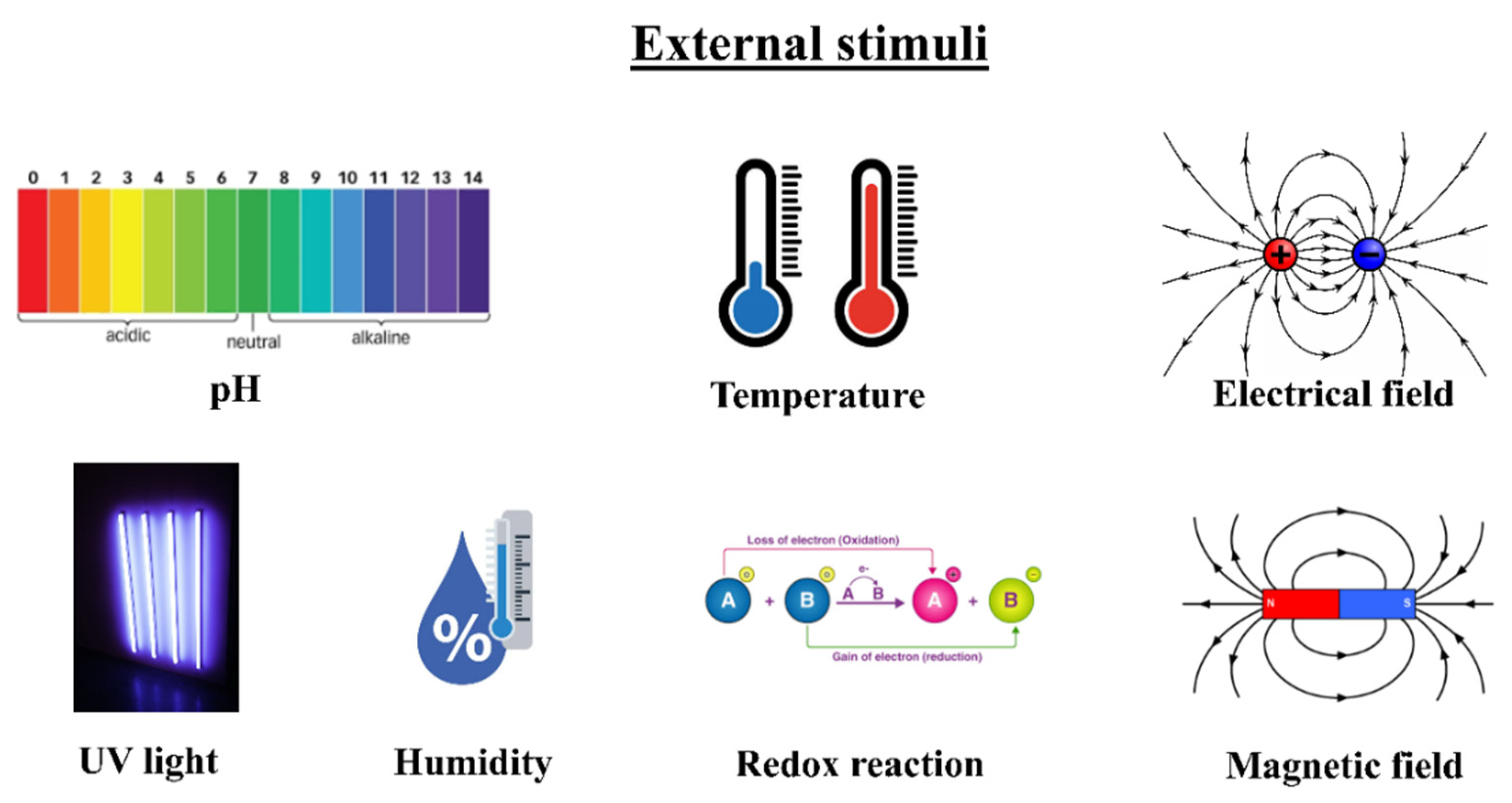
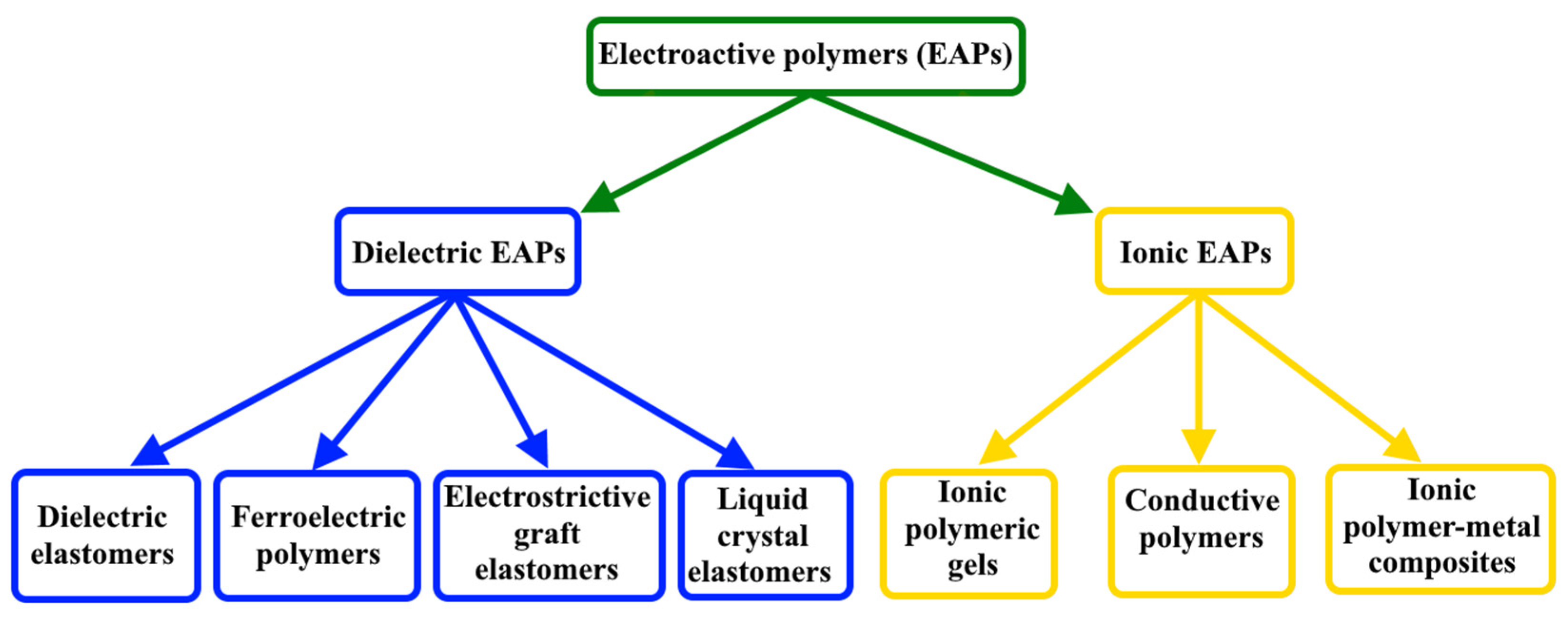
Unlike traditional actuators, such as piezoelectric ceramic or metallic actuators, polymer actuators are currently attracting more interest in biomedicine due to their unique properties, such as light weight, easy processing, biodegradability, fast response, large active strains, and good mechanical properties. They can be actuated under external stimuli, such as chemical (pH changes), electric, humidity, light, temperature, and magnetic field. Electroactive polymers (EAPs), called ‘artificial muscles’, can be activated by an electric stimulus, and fixed into a temporary shape. Restoring their permanent shape after the release of an electrical field, electroactive polymer is considered the most attractive actuator type because of its high suitability for prosthetics and soft robotics applications. However, robust control, modeling non-linear behavior, and scalable fabrication are considered the most critical challenges for applying the soft robotic systems in real conditions. Researchers from around the world investigate the scientific and engineering foundations of polymer actuators, especially the principles of their work, for the purpose of a better control of their capability and durability. The activation method of actuators and the realization of required mechanical properties are the main restrictions on using actuators in real applications. The latest highlights, operating principles, perspectives, and challenges of electroactive materials (EAPs) such as dielectric EAPs, ferroelectric polymers, electrostrictive graft elastomers, liquid crystal elastomers, ionic gels, and ionic polymer–metal composites are reviewed in this article.
Keywords: electroactive polymers (EAPs); artificial muscles; dielectric EAPs; ionic gels; electrostrictive graft elastomers; liquid crystal elastomers; ionic gels; conductive polymers; ionic polymer-metal composites electroactive polymers (EAPs); artificial muscles; dielectric EAPs; ionic gels; electrostrictive graft elastomers; liquid crystal elastomers; ionic gels; conductive polymers; ionic polymer-metal composites