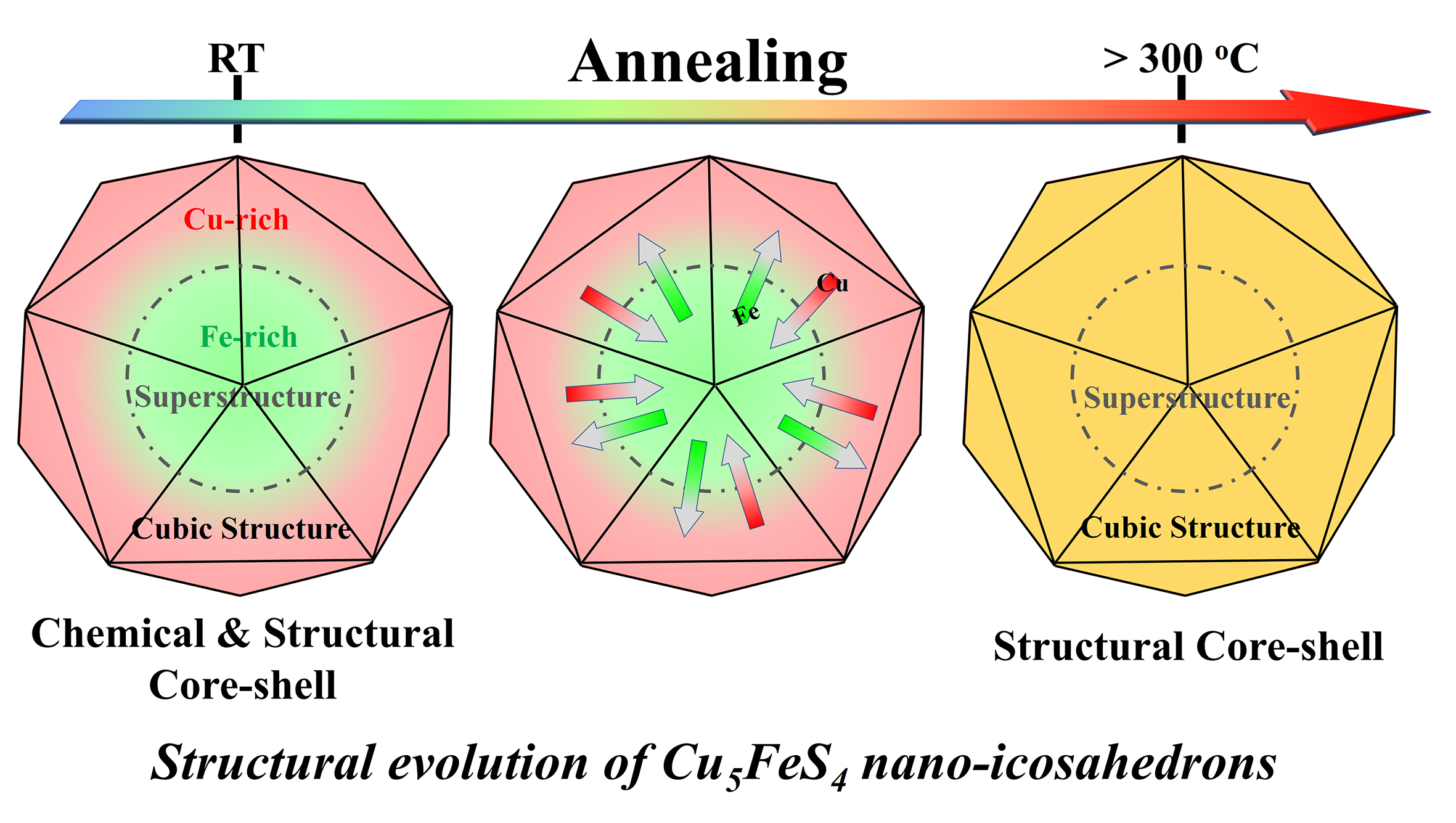
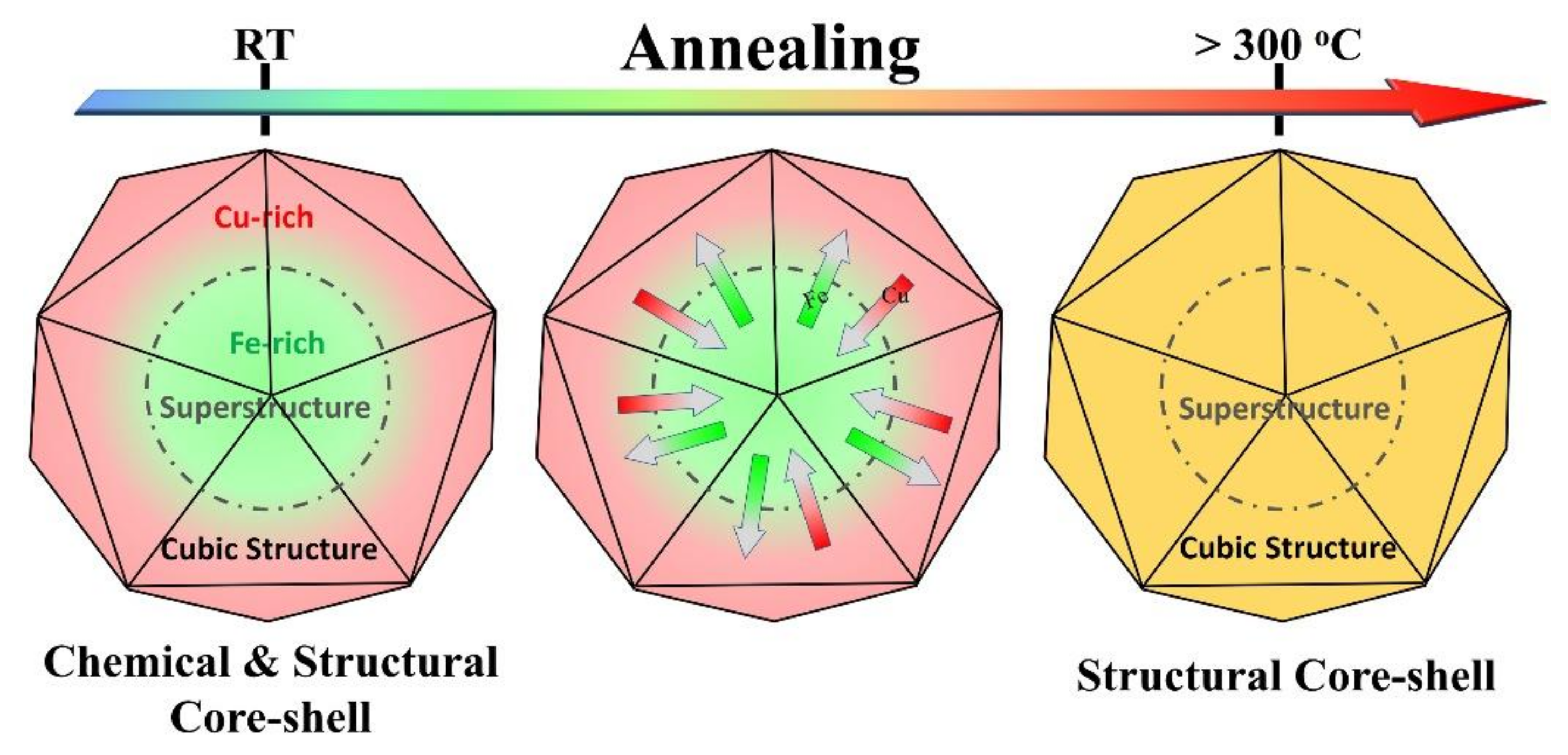
Structural Core-Shell beyond Chemical Homogeneity in Non-Stoichiometric Cu5FeS4 Nano-Icosahedrons: An in Situ Heating TEM Study

 and
and Abstract
Share and Cite
Zhang, B.; Zhao, X.; Dong, T.; Zhang, A.; Zhang, X.; Han, G.; Zhou, X. Structural Core-Shell beyond Chemical Homogeneity in Non-Stoichiometric Cu5FeS4 Nano-Icosahedrons: An in Situ Heating TEM Study. Nanomaterials 2020, 10, 4. https://doi.org/10.3390/nano10010004
Zhang B, Zhao X, Dong T, Zhang A, Zhang X, Han G, Zhou X. Structural Core-Shell beyond Chemical Homogeneity in Non-Stoichiometric Cu5FeS4 Nano-Icosahedrons: An in Situ Heating TEM Study. Nanomaterials. 2020; 10(1):4. https://doi.org/10.3390/nano10010004
Chicago/Turabian StyleZhang, Bin, Xiaowei Zhao, Tianrui Dong, Aijuan Zhang, Xiao Zhang, Guang Han, and Xiaoyuan Zhou. 2020. "Structural Core-Shell beyond Chemical Homogeneity in Non-Stoichiometric Cu5FeS4 Nano-Icosahedrons: An in Situ Heating TEM Study" Nanomaterials 10, no. 1: 4. https://doi.org/10.3390/nano10010004
APA StyleZhang, B., Zhao, X., Dong, T., Zhang, A., Zhang, X., Han, G., & Zhou, X. (2020). Structural Core-Shell beyond Chemical Homogeneity in Non-Stoichiometric Cu5FeS4 Nano-Icosahedrons: An in Situ Heating TEM Study. Nanomaterials, 10(1), 4. https://doi.org/10.3390/nano10010004