
Towards Sustainable Bone Grafting: Life Cycle Assessment of Donor Cadaver-Derived Allograft (BMG) Production Using a BMP-Preserving Approach

 , ,
, ,  , and
, and
Abstract
1. Introduction
2. Materials and Methods
- Definition of the goal and scope, including the functional unit and system boundaries
- Compilation and evaluation of the life cycle inventory (LCI) using available databases
- Life cycle impact assessment (LCIA), including midpoint and endpoint impact categories
- Interpretation and evaluation of the results
2.1. Objective and Scope
2.1.1. Goal, Scope
2.1.2. Functional Unit
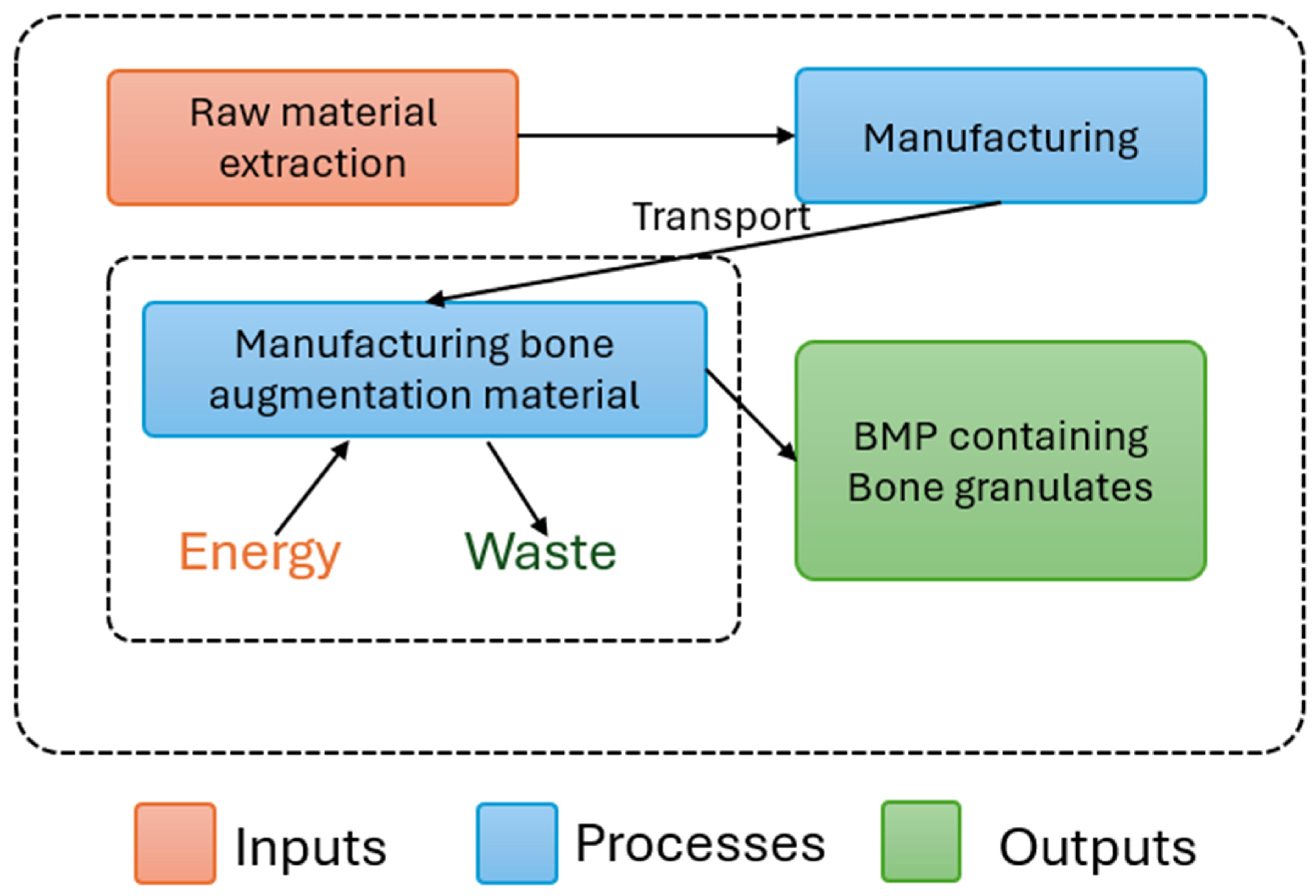
2.1.3. System Boundaries
- Downstream processes were not included. The clinical use of allografts may vary, and their follow-up and standardization would be methodologically uncertain; however, the results obtained in this study may serve as input data for future life cycle assessments of surgical procedures involving allograft-based bone substitutes.
- The tools used during processing (e.g., glass containers for chemical solutions and forceps used during packaging) were excluded from the system boundaries, as they are used minimally during the process, repeatedly reused, and therefore assumed to have a negligible environmental impact.
- Device maintenance was also excluded from the system boundaries, as maintenance activities occur infrequently throughout the production process and are therefore assumed to have a negligible impact.
- The activities of Tissue Bank staff were not included within the system boundaries, as their tasks are diverse, cannot be attributed exclusively to the production of cadaver-derived allografts, and the individual production steps are temporally separated, making allocation methodologically undefined and uncertain.
- Serological testing of donors was also excluded from the system boundaries, as it is conducted outside the Tissue Bank’s activities and is required for the transplantation of all donor tissues; therefore, its allocation specifically to bone graft production is associated with a high degree of uncertainty.
2.2. Analysis of the Life Cycle Inventory
- In one processing cycle, the diaphysis of long tubular bones (humerus, radius, ulna, femur, tibia, fibula) from one donor cadaver is processed.
- All procedures are performed by a single operator wearing full personal protective equipment, including a sterile surgical gown, surgical mask, hair cover, and shoe covers.
- Prior to processing, the bones are stored in a freezer for an average of 28 days.
- Residual soft tissue is removed from the bones during the procedure using a bone-cleaning machine.
- The epiphyses are removed from the bones, and the cortical bone is sectioned to facilitate the degreasing process.
- The degreasing process is carried out in a methanol–chloroform solution and lasts an average of 21 days. The solution is initially replaced every 2 days and subsequently every 3 days. After completion of the degreasing process, the bones are ground.
- Waste generated during bone grinding is treated as infectious waste, as it becomes unsuitable for further use as an allograft due to contamination with metal particles.
- The ground bone is subjected to a specialized processing methodology and treated with various chemical solutions (HCl, CaCl2, EDTA, LiCl, H2O2) with the aim of preserving bone morphogenetic proteins (BMPs) in the bone substitute. Between solution changes, the bone is rinsed with deionized water. This BMP-preserving processing method differs from conventional allograft techniques by including the demineralization step to release BMPs, followed by remineralization to restore the bone matrix.
- Bone granules are sieved using a sieving machine and packaged separately according to particle size.
- The bone substitutes are sterilized using ethylene oxide at 50 °C, which, unlike gamma irradiation, does not degrade BMPs in the bone substitute.
- Allografts are handled under sterile conditions on sterile fields throughout the processing steps.
- The sterilized bone substitutes are lyophilized to enable long-term storage at room temperature. The lyophilization process lasts 24 h.
- The lyophilized bone substitutes are individually packaged in 1 g packages under sterile conditions in a laminar airflow cabinet and subsequently double-wrapped to ensure appropriate use during surgery.
- Packaging materials are sterilized separately in advance using an autoclave.
Life Cycle Inventory
2.3. Assessing the Life Cycle Impact
3. Results

4. Discussion
Limitations of the Study
5. Conclusions
Supplementary Materials
Author Contributions
Funding
Institutional Review Board Statement
Informed Consent Statement
Data Availability Statement
Acknowledgments
Conflicts of Interest
Abbreviations
| LCA | Life Cycle Assessment |
| ISO | International Organization for Standardization |
| CO2 | carbon dioxide |
| LCI | Life Cycle Inventory |
| LCIA | Life Cycle Impact Assessment |
| HIV | Human Immunodeficiency Virus |
| GHG | greenhouse gases |
| DALY | disability-adjusted life years |
| BMP | bone morphogenetic protein |
| PDGF | platelet-derived growth factor |
| VEGF | vascular endothelial growth factor |
| FGF | fibroblast growth factor |
| HLA | human leukocyte antigen |
| BMG | bone matrix gelatin |
References
- Reikerås, O.; Reinholt, F.; Zinöcker, S.; Shergafi, H.; Rolstad, B. Healing of Long-Term Frozen Orthotopic Bone Allografts Is Not Affected by MHC Differences between Donor and Recipient. Clin. Orthop. Relat. Res. 2011, 469, 1479–1486. [Google Scholar] [CrossRef] [PubMed][Green Version]
- Zhang, J.; Zhang, W.; Yue, W.; Qin, W.; Zhao, Y.; Xu, G. Research Progress of Bone Grafting: A Comprehensive Review. Int. J. Nanomed. 2025, 20, 4729–4757. [Google Scholar] [CrossRef]
- Smith, C.; Richardson, S.; Eagle, M.; Rooney, P.; Board, T.; Hoyland, J. The Use of a Novel Bone Allograft Wash Process to Generate a Biocompatible, Mechanically Stable and Osteoinductive Biological Scaffold for Use in Bone Tissue Engineering. J. Tissue Eng. Regen. Med. 2015, 9, 595–604. [Google Scholar] [CrossRef]
- Smith, M.; Shivanna, S.; Kohen, Y.; Naseri, S.; Mawani, Y.; Peel, S. Development of a Growth Factor Bioavailability Enhanced Allograft (GFBA) for Bone Regeneration. Cell Tissue Bank. 2026, 27, 6. [Google Scholar] [CrossRef] [PubMed]
- Maheshwari, V.; Dhingra, M.; Sharma, D.; Kurmi, A.; Das, S. Retrospective Outcome Analysis of Allogenic Bone Graft. South Asian J. Cancer 2023, 14, 711–715. [Google Scholar] [CrossRef]
- Battafarano, G.; Rossi, M.; De Martino, V.; Marampon, F.; Borro, L. Strategies for Bone Regeneration: From Graft to Tissue Engineering. Int. J. Mol. Sci. 2021, 22, 1128. [Google Scholar] [CrossRef] [PubMed]
- Fekry, Y.; Mahmoud, N. Vertical Ridge Augmentation of Atrophic Posterior Mandible with Corticocancellous Onlay Symphysis Graft versus Sandwich Technique: Clinical and Radiographic Analysis. Odontology 2023, 111, 993–1002. [Google Scholar] [CrossRef]
- Yeniyol, S.; Özlü Ucan, G. Short-Term Retrospective Analysis of Radiographic Evaluation of Graft Height Changes after Maxillary Sinus Floor Augmentation with Xenograft and Simultaneous Dental Implant Placement: A Two-Dimensional Radiographic Study. BMC Oral Health 2025, 25, 1920. [Google Scholar] [CrossRef]
- Kawai, T.; Ogawa, A.; Ikeda, Y.; Fukutoku, A.; Takahashi, N.; Kon, K.; Izumisawa, M.; Yamada, H. Alveolar Bone Augmentation Using Octacalcium Phosphate and Collagen Composite with Custom-Made Titanium Mesh: A Case Report. Am. J. Case Rep. 2025, 26, e948537. [Google Scholar] [CrossRef]
- Archunan, M.; Petronis, S. Bone Grafts in Trauma and Orthopaedics. Cureus 2021, 13, e17705. [Google Scholar] [CrossRef]
- Steijvers, E.; Ghei, A.; Xia, Z. Manufacturing Artificial Bone Allografts: A Perspective. Biomater. Transl. 2022, 3, 65–80. [Google Scholar] [CrossRef]
- Rasch, A.; Naujokat, H.; Wang, F.; Seekamp, A.; Fuchs, S.; Klüter, T. Evaluation of Bone Allograft Processing Methods: Impact on Decellularization Efficacy, Biocompatibility and Mesenchymal Stem Cell Functionality. PLoS ONE 2019, 14, e0218404. [Google Scholar] [CrossRef]
- Balaji, V.; Manikandan, D.; Ramsundar, A. Bone Grafts in Periodontics. Matrix Sci. Medica 2020, 4, 57. [Google Scholar] [CrossRef]
- Moore, M.; Samsell, B.; McLean, J. Allograft Tissue Safety and Technology. In Biologics in Orthopaedic Surgery; Elsevier: Amsterdam, The Netherlands, 2019; pp. 49–62. [Google Scholar] [CrossRef]
- Black, C.; Goriainov, V.; Gibbs, D.; Kanczler, J.; Tare, R.; Oreffo, R. Bone Tissue Engineering. Curr. Mol. Biol. Rep. 2015, 1, 132–140. [Google Scholar] [CrossRef]
- Ibrahim, T.; Stafford, H.; Esler, C.; Power, R. Cadaveric Allograft Microbiology. Int. Orthop. 2004, 28, 315–318. [Google Scholar] [CrossRef][Green Version]
- Galagali, D.; Bhatia, A.; Kumar, P.; Ajoy, S. A New Indication for Use of Bone Allografts-A 10-Year Data Analysis. Indian J. Orthop. 2023, 57, 1490–1496. [Google Scholar] [CrossRef]
- Csönge, L.; Bozsik, Á.; Tóth-Bagi, Z.; Gyuris, R.; Kónya, J. Regenerative Medicine: Characterization of Human Bone Matrix Gelatin (BMG) and Folded Platelet-Rich Fibrin (F-PRF) Membranes Alone and in Combination (Sticky Bone). Cell Tissue Bank. 2021, 22, 711–717. [Google Scholar] [CrossRef] [PubMed]
- Eitler, T.; Csönge, L.; Hahn, O. Humán Liofilizált Csontmátrix-Zselatin Alkalmazása a Szájsebészeti Gyakorlatban (Elözetes Közlemény) [The Use of Human Lyophilized Bone Matrix Gelatin in Oral Surgery (Preliminary Report)]. Fogorvosi Szle. 1997, 90, 67–74. [Google Scholar]
- De Waele, J.; Hunfeld, N.; Baid, H.; Ferrer, R.; Iliopoulou, K.; Ioan, A.; Leone, M.; Ostermann, M.; Scaramuzzo, G.; Theodorakopoulou, M.; et al. Environmental Sustainability in Intensive Care: The Path Forward. An ESICM Green Paper. Intensiv. Care Med. 2024, 50, 1729–1739. [Google Scholar] [CrossRef] [PubMed]
- Kirchhoffer, D.; Pratt, B. Healthcare Resource Allocation and Environmental Sustainability. Bioethics 2025, 39, 527–529. [Google Scholar] [CrossRef]
- Pradere, B.; Mallet, R.; de la Taille, A.; Bladou, F.; Prunet, D.; Beurrier, S.; Bardet, F.; Game, X.; Fournier, G.; Lechevallier, E.; et al. Sustainability Task Force of the French Association of Urology. Climate-Smart Actions in the Operating Theatre for Improving Sustainability Practices: A Systematic Review. Eur. Urol. 2023, 83, 331–342. [Google Scholar] [CrossRef]
- Thöne, M.; Lask, J.; Hennenlotter, J.; Saar, M.; Tsaur, I.; Stenzl, A. Potential Impacts to Human Health from Climate Change: A Comparative Life-Cycle Assessment of Single-Use versus Reusable Devices Flexible Ureteroscopes. Urolithiasis 2024, 52, 166. [Google Scholar] [CrossRef]
- Chaban, Y.; Vosshenrich, J.; McKee, H.; Gunaserkaran, S.; Brown, M.; Atalay, M.; Heye, T.; Markl, M.; Woolen, S.; Simonetti, O.; et al. Environmental Sustainability and MRI: Challenges, Opportunities, and a Call for Action. J. Magn. Reson. Imaging 2024, 59, 1149–1167. [Google Scholar] [CrossRef]
- Dolcini, M.; Ferrè, F.; Brambilla, A.; Capolongo, S. Integrating Environmental Sustainability into Hospitals Performance Management Systems: A Scoping Review. BMC Health Serv. Res. 2025, 25, 764. [Google Scholar] [CrossRef] [PubMed]
- Gorgun, E.; Dehipawala, S.; O’Hara, M.; Naoumtchik, E.; Gangoli, G.; Ricketts, C.; Tommaselli, G. Environmental Sustainability Initiatives in the Operating Room: A Scoping Review. Ann. Surg. Open 2024, 5, e451. [Google Scholar] [CrossRef] [PubMed]
- Rajagopalan, S.; McAlister, S.; Jay, J.; Pham, R.; Brook, R.; Nasir, K.; Nieuwenhujisen, M.; Landrigan, P.; Wiesler, A.; Sanborn, C.; et al. Environmental Sustainability in Cardiovascular Practice: Current Challenges and Future Directions. Nat. Rev. Cardiol. 2025, 22, 241–254. [Google Scholar] [CrossRef] [PubMed]
- Ali, F.; BSDS Sustainability Subgroup Collaborative; Wernham, A.; Abbott, R. Environmental Sustainability in Dermatological Surgery. Part 1: Reducing Carbon Intensity. Clin. Exp. Dermatol 2025, 50, 503–511. [Google Scholar] [CrossRef]
- Ang, T.; Choolani, M.; Poh, K. Healthcare and Environmental Sustainability. Singap. Med. J. 2024, 65, 203. [Google Scholar] [CrossRef]
- DesRoche, C.; Soulez, G.; Boucher, L.; Fohlen, A.; Menard, A. Steps Toward Environmental Sustainability in Interventional Radiology. Can. Assoc. Radiol. J. 2025, 76, 603–610. [Google Scholar] [CrossRef]
- Dixon, J.; Field, J.; Gibson, E.; Martin, N. Curriculum Content for Environmental Sustainability in Dentistry. J. Dent. 2024, 147, 105021. [Google Scholar] [CrossRef]
- Cohen, E.; Kouwenberg, L.; Moody, K.; Sperna Weiland, N.; Kringos, D.; Timmermans, A.; Hehenkamp, W. Environmental Sustainability in Obstetrics and Gynaecology: A Systematic Review. BJOG 2024, 131, 555–567. [Google Scholar] [CrossRef]
- Chua, M.; Chung, L.; Ng, E.; Lim, H.; Cheung, N.; Lim, C.; Kuan, W. Climate Change and Environmental Sustainability in Emergency Medicine: A Narrative Review. Ann. Transl. Med. 2025, 13, 31. [Google Scholar] [CrossRef] [PubMed]
- Available online: https://Healthcarelca.com/ (accessed on 10 February 2026).
- Marshall, K.; Wojciechowski, J.; Jayawarna, V.; Hasan, A.; Echalier, C.; Øvrebø, Ø.; Yang, T.; Zhou, K.; Kanczler, J.; Mata, A.; et al. Considerations of Growth Factor and Material Use in Bone Tissue Engineering Using Biodegradable Scaffolds in Vitro and in Vivo. Sci Rep 2024, 14, 25832. [Google Scholar] [CrossRef] [PubMed]
- Roberts, T.; Rosenbaum, A. Bone Grafts, Bone Substitutes and Orthobiologics: The Bridge between Basic Science and Clinical Advancements in Fracture Healing. Organogenesis 2012, 8, 114–124. [Google Scholar] [CrossRef]
- Ashfaq, R.; Kovács, A.; Berko, S.; Budai-Szűcs, M. Developments in Alloplastic Bone Grafts and Barrier Membrane Biomaterials for Periodontal Guided Tissue and Bone Regeneration. Int. J. Mol. Sci. 2024, 25, 7746. [Google Scholar] [CrossRef]
- Ciszyński, M.; Dominiak, S.; Dominiak, M.; Gedrange, T.; Hadzik, J. Allogenic Bone Graft in Dentistry: A Review of Current Trends and Developments. Int. J. Mol. Sci. 2023, 24, 16598. [Google Scholar] [CrossRef] [PubMed]
- Qi, J.; Wu, H.; Liu, G. Novel Strategies for Spatiotemporal and Controlled BMP-2 Delivery in Bone Tissue Engineering. Cell Transpl. 2024, 33, 9636897241276733. [Google Scholar] [CrossRef]
- Bostrom, M.; Seigerman, D. The Clinical Use of Allografts, Demineralized Bone Matrices, Synthetic Bone Graft Substitutes and Osteoinductive Growth Factors: A Survey Study. HSS J. 2005, 1, 9–18. [Google Scholar] [CrossRef]
- Khoury, E.; Sagheb, K.; Al-Nawas, B.; König, J.; Schiegnitz, E. Does Alveolar Ridge Preservation Reduce the Need for Sinus Floor Elevation: A Comparative Study to Spontaneous Healing. Clin. Implant. Dent. Relat. Res. 2024, 26, 1325–1337. [Google Scholar] [CrossRef]
- Pogacian-Maier, A.; Mester, A.; Morariu, R.; Campian, R.; Tent, A. The Use of Allograft Bone in the Lateral Approach of Sinus Floor Elevation: A Systematic Review of Clinical Studies. Medicina 2024, 60, 252. [Google Scholar] [CrossRef]
- Said Ahmed, W.; Arafa, A. L- Shape Symphyseal Autogenous Bone Block for Alveolar Ridge Augmentation in Anterior Maxilla and Mandible, a Prospective Single Arm Clinical Study. BMC Oral Health 2025, 25, 326. [Google Scholar] [CrossRef]
- Ayman, D.; Shawky, M.; Aly, L.; Mounir, M.; Zekry, A. Bone Gain and Accuracy Assessment of Computer-Guided Workflow for Horizontal Augmentation of Atrophic Anterior Maxilla with Symphyseal Cortical Plates: A Randomized Controlled Trial. BMC Oral Health 2025, 25, 1039. [Google Scholar] [CrossRef]
- Korn, P.; Melnikov, A.; Kuhn, M.; Farahzadi, S.; Lauer, G.; Schröder, T. Proximal Tibia for Alveolar Augmentation and Augmentative Rhinoplasty-a Suitable Option? A Retrospective Clinical Study on Donor and Recipient Site Morbidity. Head Face Med. 2024, 20, 66. [Google Scholar] [CrossRef]
- Naidu, P. Allografts in Periodontal Regeneration. Madridge J. Case Rep. Stud. 2019, 3, 121–125. [Google Scholar] [CrossRef]
- Kovac, Z.; Cabov, T.; Blaskovic, M.; Morelato, L. Regeneration of Horizontal Bone Defect in Edentulous Maxilla Using the Allogenic Bone-Plate Shell Technique and a Composite Bone Graft-A Case Report. Medicina 2023, 59, 494. [Google Scholar] [CrossRef]
- Vlasa, A.; Bud, E.; Lazar, L.; Ilies, S.; Stoica, A.; Lazar, A.; Martu, I.; Bud, A. Systematic Review Regarding the Clinical Implications of Allograft and Alloplastic Bone Substituents Used for Periodontal Regenerative Therapy. J. Clin. Med. 2025, 14, 894. [Google Scholar] [CrossRef]
- Behrend, C.; Carmouche, J.; Millhouse, P.; Ritter, L.; Moskal, J.; Rubery, P.; Puzas, E. Allogeneic and Autogenous Bone Grafts Are Affected by Historical Donor Environmental Exposure. Clin. Orthop. Relat. Res. 2016, 474, 1405–1409. [Google Scholar] [CrossRef][Green Version]
- Ferraz, M. Bone Grafts in Dental Medicine: An Overview of Autografts, Allografts and Synthetic Materials. Materials 2023, 16, 4117. [Google Scholar] [CrossRef] [PubMed]
- Xu, X.; Xu, P.; Liu, S.; Yang, Y.; Cheng, Y.; Zhang, W.; Yu, D.; Lu, L. Clinical Study on Horizontal Bone Augmentation Using an Alveolar Mucosa-Periosteal Bone Flap. BMC Oral Health 2025, 25, 202. [Google Scholar] [CrossRef] [PubMed]
- Puisys, A.; Vindasiute-Narbute, E.; Razukevicius, D.; Akhondi, S.; Galluci, G.; Pedrinaci, I. Clinical Efficacy of Two Vertical Soft Tissue Augmentation Techniques for Peri-Implant Crestal Bone Level Stability: A Randomized Clinical Trial. Clin. Implant. Dent. Relat. Res. 2024, 26, 1086–1100. [Google Scholar] [CrossRef] [PubMed]
- Veress, S.; Kerekes-Máthé, B.; Székely, M. Environmentally Friendly Behavior in Dentistry. Med. Pharm. Rep. 2023, 96, 199–205. [Google Scholar] [CrossRef] [PubMed]
- Kobayashi, Y.; Peters, G.; Ashbolt, N.; Shiels, S.; Khan, S. Assessing Burden of Disease as Disability Adjusted Life Years in Life Cycle Assessment. Sci. Total Environ. 2015, 530–531, 120–128. [Google Scholar] [CrossRef]
- Da Tan, T.Y.; Duane, B.; Hussein, A.; Samsonova, A.; Sizun, G.; Shakerdi, L.; Taqi, R.; Wolfram, S.; Ziaeefard, N.; Sagheri, D. Environmental Sustainability of Post-Orthodontic Dental Retainers: A Comparative Life-Cycle Assessment of Hawley and Essix Retainers. Eur. J. Orthodontics. 2024, 46, cjae012. [Google Scholar] [CrossRef]
- Sattler, M.; Abdelnour, M.; McKay, V.; Burnham, J. Environmental Sustainability in the Outpatient Clinic Setting. Open Forum Infect. Dis. 2024, 12, ofae586. [Google Scholar] [CrossRef]
- Borglin, L.; Pekarski, S.; Saget, S.; Duane, B. The life cycle analysis of a dental examination: Quantifying the environmental burden of an examination in a hypothetical dental practice. Community Dent. Oral Epidemiol. 2021, 49, 581–593, Erratum in Community Dent. Oral Epidemiol. 2024, 52, 613–617. https://doi.org/10.1111/cdoe.12952. [Google Scholar] [CrossRef] [PubMed]
- Künzle, P.; Frank, A.C.; Paris, S. Environmental Impact of a Tooth Extraction: Life Cycle Analysis in a University Hospital Setting. Community Dent. Oral Epidemiol. 2026, 54, 30–39. [Google Scholar] [CrossRef] [PubMed] [PubMed Central]
- Varekar, V.; Sangle, K.; Attar, P. Environmental Sustainability: Challenges and Solutions. Environ. Sci. Pollut. Res. 2025, 32, 7194–7195. [Google Scholar] [CrossRef]
- Smith, E. Social, Economic, and Environmental Sustainability in Assistive Technology. Assist. Technol. Off. J. RESNA 2025, 37, 1–2. [Google Scholar] [CrossRef]
- Guiu Segura, J. [Translated Article] Environmental Sustainability in Drug Procurement Strategy. Farm. Hosp. 2025, 49, T127–T128. [Google Scholar]
- Ali, F.; BSDS Sustainability Subgroup Collaborative; Wernham, A.; Abbott, R. Environmental Sustainability in Dermatological Surgery. Part 2: Reducing Activity and Future Ecological Strategies. Clin. Exp. Dermatol. 2025, 50, 512–519. [Google Scholar] [CrossRef] [PubMed]
- Veress, S.; Bögözi, B.; Csönge, L.; Kerekes-Máthé, B.; Székely, M. Recycling of Medical Waste in the Circular Economy: LCA Analysis of the Production of Bone Allografts from Femoral Heads Used in Dental Implantology. Prosthesis 2026, 8, 14. [Google Scholar] [CrossRef]
- Xie, C.; Reynolds, D.; Awad, H.; Rubery, P.; Pelled, G.; Gazit, D.; Guldberg, R.; Schwarz, E.; O’Keefe, R.; Zhang, X. Structural Bone Allograft Combined with Genetically Engineered Mesenchymal Stem Cells as a Novel Platform for Bone Tissue Engineering. Tissue Eng. 2007, 13, 435–445. [Google Scholar] [CrossRef] [PubMed]
- Senusi, F. Mahmood Environmental Impact for 3D Bone Tissue Engineering Scaffolds Life Cycle: An Assessment. Biointerface res. Appl. Chem 2021, 12, 6504–6515. [Google Scholar]
- Tajurahim, N.; Mahmood, S.; Saman, M.; Ngadiman, N. Life Cycle Assessment of 3D-Printed Bone Tissue Engineering Scaffolds. Research Square 2021. [Google Scholar] [CrossRef]
- Senusi, F.; Mahmood, S.; Ngadiman, N.H.A.; Mat Saman, M.Z. Application of GaBi Software in Identifying Potential Environmental Impacts in Fabrication of 3D Bone Tissue Engineering. In Proceedings of the ICE-SEAM 2021: Special Edition; UTeM Press: Melaka, Malaysia, 2022. [Google Scholar]
- Borovecki, A.; Mlinaric, A.; Horvat, M.; Supak Smolcic, V. Informed consent and ethics committee approval in laboratory medicine. Biochem. Medica 2018, 28, 030201. [Google Scholar] [CrossRef] [PubMed] [PubMed Central]


| Nr | Device | Model | Performance |
|---|---|---|---|
| 1 | Fridge/Freezer | Midea Chest Freezer HS-543CN, Midea Group, China, Beijao | 333 W |
| 2 | Bone-cleaning machine | N/A | 350 W |
| 3 | Bone cutting machine | N/A | 1500 W |
| 4 | Bone grinding machine | Ikaweke, IKA-Werke GmbH&Co. KG, Germany, Staufen | 1000 W |
| 5 | Sieve machine | Retsch AS 200, Retsch GmbH, Germany, Haan | 315 W |
| 6 | Thermostat | L MIM | 5500 W |
| 7 | Ethylen oxide sterilizer | Steri/Vac 5XL Gas Sterilizer, 3M Company, USA, Minneapolis, MN | 2300 W |
| 8 | Sealer machine | Steriking RS 3200, Wipak, Finland, Helsinki | 240 W |
| 9 | Lyophilizer | Scanvac Coolsafe 90-80 Superior, LaboGene A/S, Denmark, Allerød | 2100 W |
| 10 | Air conditioner | AUX, AUX Group, China, Ningbo | 5400 W |
| 11 | Laptop | Lenovo E1 Vision, Lenovo Group Limited, China, Beijing | 15 W |
| 12 | Laminar box | Laminar Box Airflow BPV-1200 FRM, Radel&Hahn zrt, Hungary, Debrecen | 750 W |
| 13 | Autoclave | N/A | 100 W |
| Impact Category | Reference Unit | Results |
|---|---|---|
| Acidification: terrestrial (TAP) | kg SO2-Eq | 3.576 |
| Climate change (GWP) | kg CO2-Eq | 6.675 × 101 |
| Ecotoxicity: freshwater (FETP) | kg 1,4-DCB-Eq | 4.927 × 10⁻¹ |
| Ecotoxicity: marine (METP) | kg 1,4-DCB-Eq | 8.029 × 10⁻¹ |
| Ecotoxicity: terrestrial (TETP) | kg 1,4-DCB-Eq | 2.637 × 10² |
| Energy resources: non-renewable, fossil (FFP) | kg oil-Eq | 2.922 |
| Eutrophication: freshwater (FEP) | kg P-Eq | 3.840 × 10⁻³ |
| Eutrophication: marine (MEP) | kg N-Eq | 6.460 × 10⁻⁴ |
| Human toxicity: carcinogenic (HTPc) | kg 1,4-DCB-Eq | 1.081 |
| Human toxicity: non-carcinogenic (HTPnc) | kg 1,4-DCB-Eq | 2.836 × 101 |
| Ionizing radiation (IRP) | kBq Co-60-Eq | 1.848 × 101 |
| Land use (LOP) | m2*a crop-Eq | 1.658 × 10⁻¹ |
| Material resources: metals/minerals (SOP) | kg Cu-Eq | 4.613 × 10² |
| Ozone depletion (ODP) | kg CFC-11-Eq | 2.772 × 10⁻⁴ |
| Particulate matter formation (PMFP) | kg PM2.5-Eq | 1.080 |
| Photochemical oxidant formation: human health (HOFP) | kg NOx-Eq | 2.702 × 10⁻¹ |
| Photochemical oxidant formation: terrestrial ecosystems (EOFP) | kg NOx-Eq | 2.759 × 10⁻¹ |
| Water use (WCP) | m3 | 5.022 × 10⁻³ |
| DALYs | Results |
|---|---|
| Climate change: human health | 6.195 × 10⁻⁵ |
| Human toxicity: carcinogenic | 3.590 × 10⁻⁶ |
| Human toxicity: non-carcinogenic | 6.466 × 10⁻⁶ |
| Ionizing radiation | 1.570 × 10⁻⁷ |
| Ozone depletion | 1.471 × 10⁻⁷ |
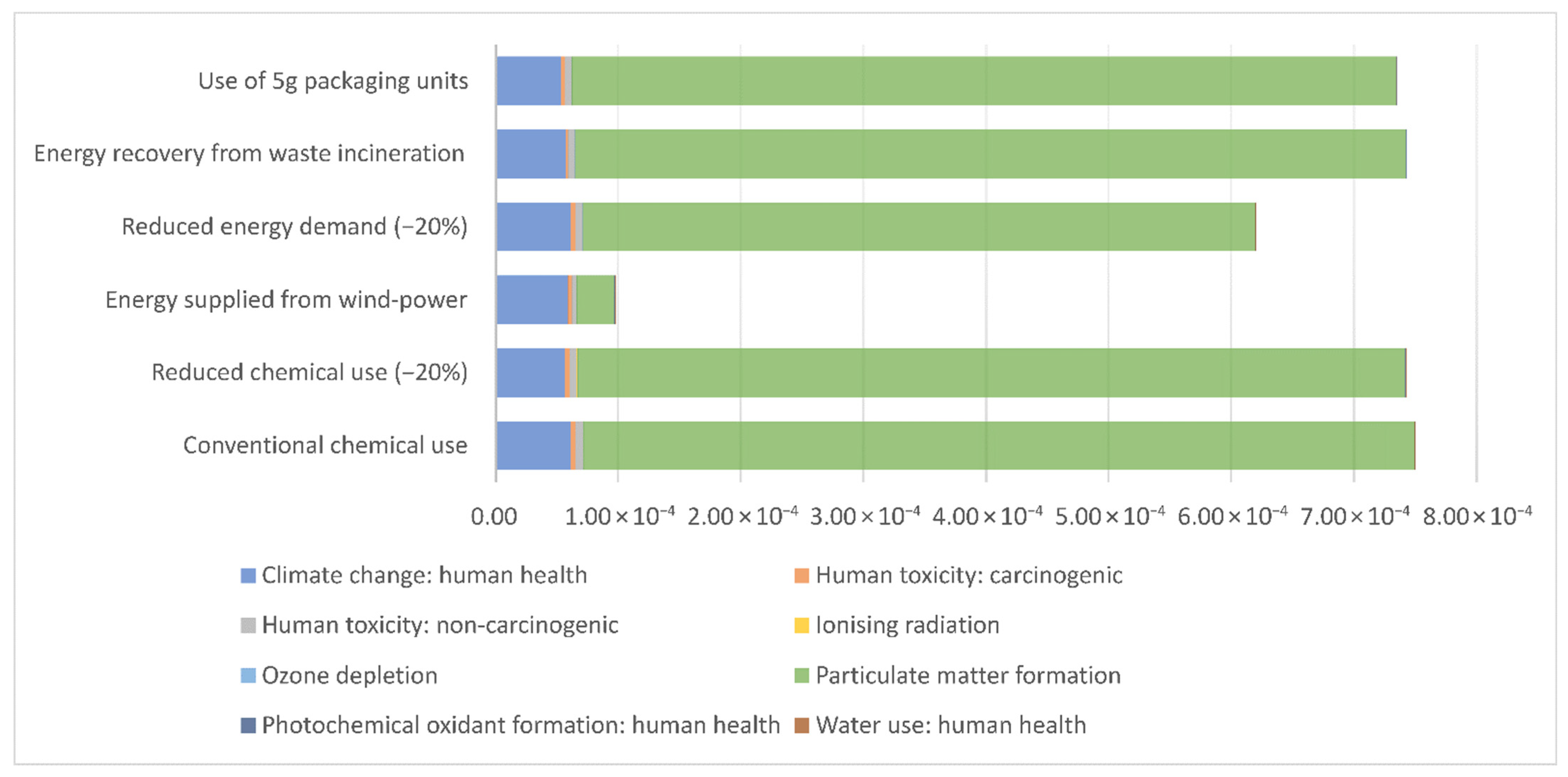
| Particulate matter formation | 6.783 × 10⁻⁴ |
| Photochemical oxidant formation: human health | 2.459 × 10⁻⁷ |
| Water use: human health | 1.115 × 10⁻⁸ |
| Total: | 7.508 × 10⁻⁴ |
| Total in days: | 2.742 × 10⁻¹ |
| Total in hours: | 6.582 |
Disclaimer/Publisher’s Note: The statements, opinions and data contained in all publications are solely those of the individual author(s) and contributor(s) and not of MDPI and/or the editor(s). MDPI and/or the editor(s) disclaim responsibility for any injury to people or property resulting from any ideas, methods, instructions or products referred to in the content. |
© 2026 by the authors. Licensee MDPI, Basel, Switzerland. This article is an open access article distributed under the terms and conditions of the Creative Commons Attribution (CC BY) license.
Share and Cite
Veress, S.K.; Golu, M.V.; Csönge, L.; Kerekes-Máthé, B.; Székely, M.; Bögözi, B.B. Towards Sustainable Bone Grafting: Life Cycle Assessment of Donor Cadaver-Derived Allograft (BMG) Production Using a BMP-Preserving Approach. J. Funct. Biomater. 2026, 17, 171. https://doi.org/10.3390/jfb17040171
Veress SK, Golu MV, Csönge L, Kerekes-Máthé B, Székely M, Bögözi BB. Towards Sustainable Bone Grafting: Life Cycle Assessment of Donor Cadaver-Derived Allograft (BMG) Production Using a BMP-Preserving Approach. Journal of Functional Biomaterials. 2026; 17(4):171. https://doi.org/10.3390/jfb17040171
Chicago/Turabian StyleVeress, Szidonia Krisztina, Mihai Vlad Golu, Lajos Csönge, Bernadette Kerekes-Máthé, Melinda Székely, and Bálint Botond Bögözi. 2026. "Towards Sustainable Bone Grafting: Life Cycle Assessment of Donor Cadaver-Derived Allograft (BMG) Production Using a BMP-Preserving Approach" Journal of Functional Biomaterials 17, no. 4: 171. https://doi.org/10.3390/jfb17040171
APA StyleVeress, S. K., Golu, M. V., Csönge, L., Kerekes-Máthé, B., Székely, M., & Bögözi, B. B. (2026). Towards Sustainable Bone Grafting: Life Cycle Assessment of Donor Cadaver-Derived Allograft (BMG) Production Using a BMP-Preserving Approach. Journal of Functional Biomaterials, 17(4), 171. https://doi.org/10.3390/jfb17040171