

Efficiency and Risk Assessment of Dental Bridge Removal Tools on Implant Abutments

 ,
,  , , and
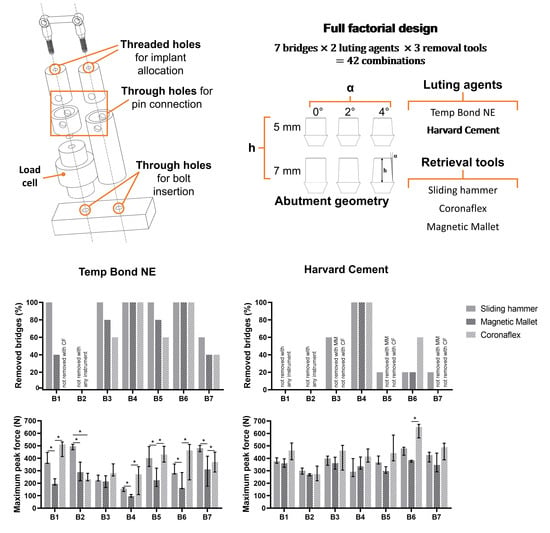
Abstract
1. Introduction
2. Materials and Methods
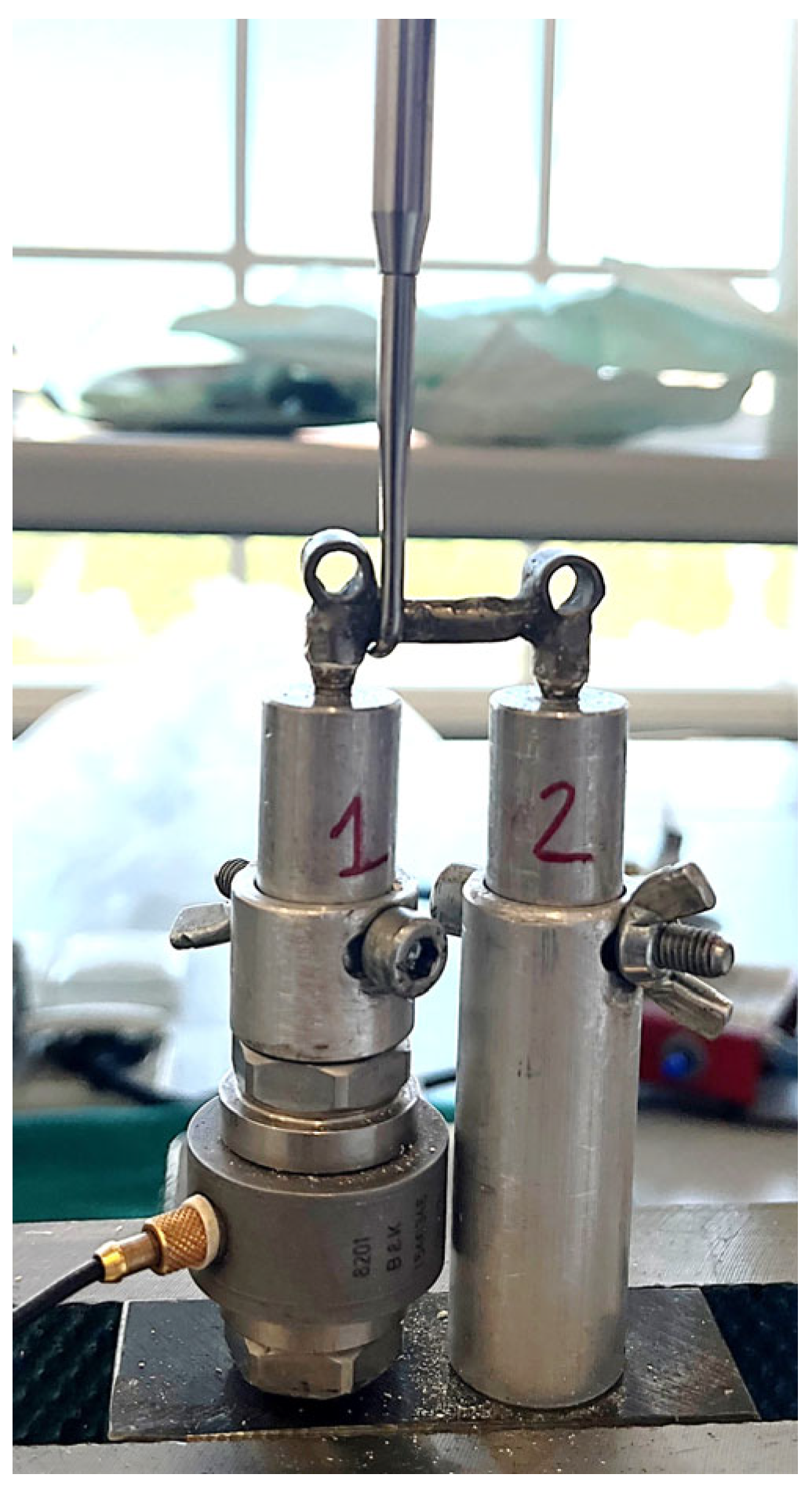
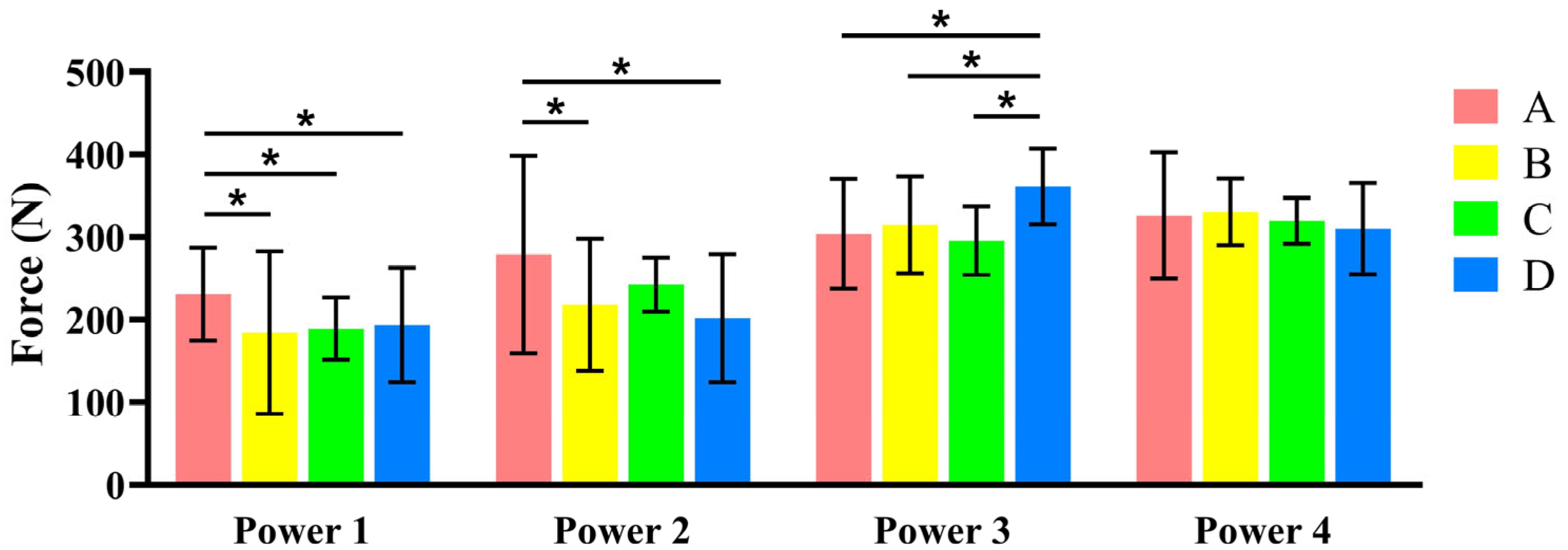
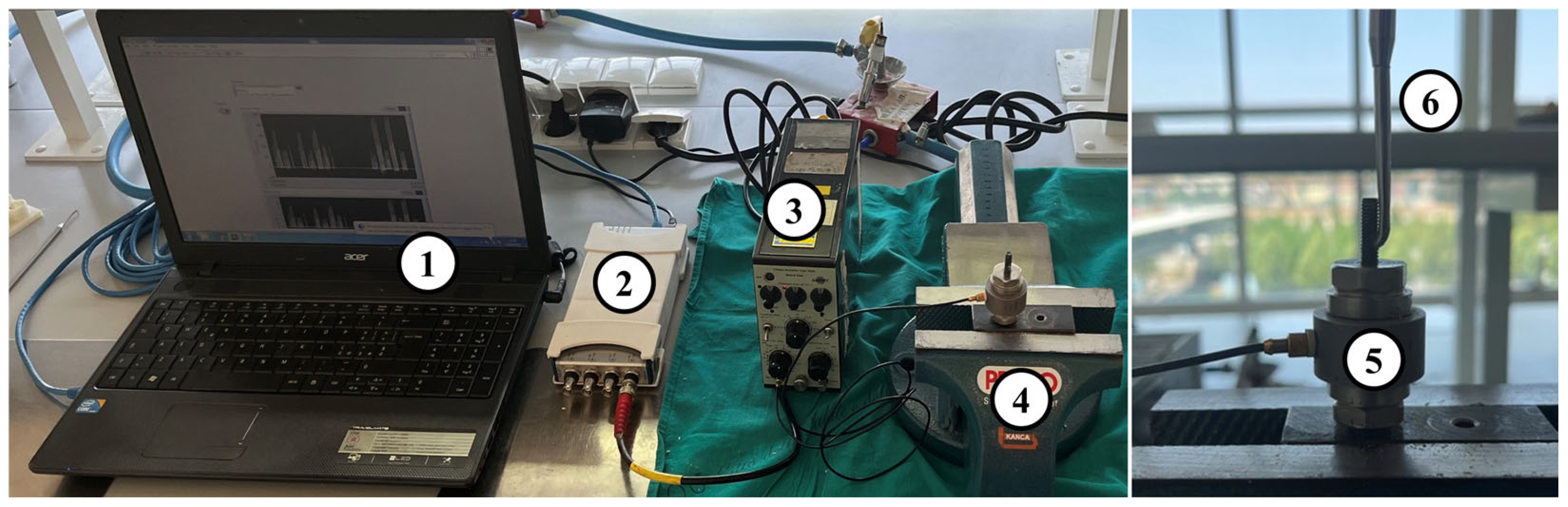
2.1. Magnetic Mallet Force Repeatability

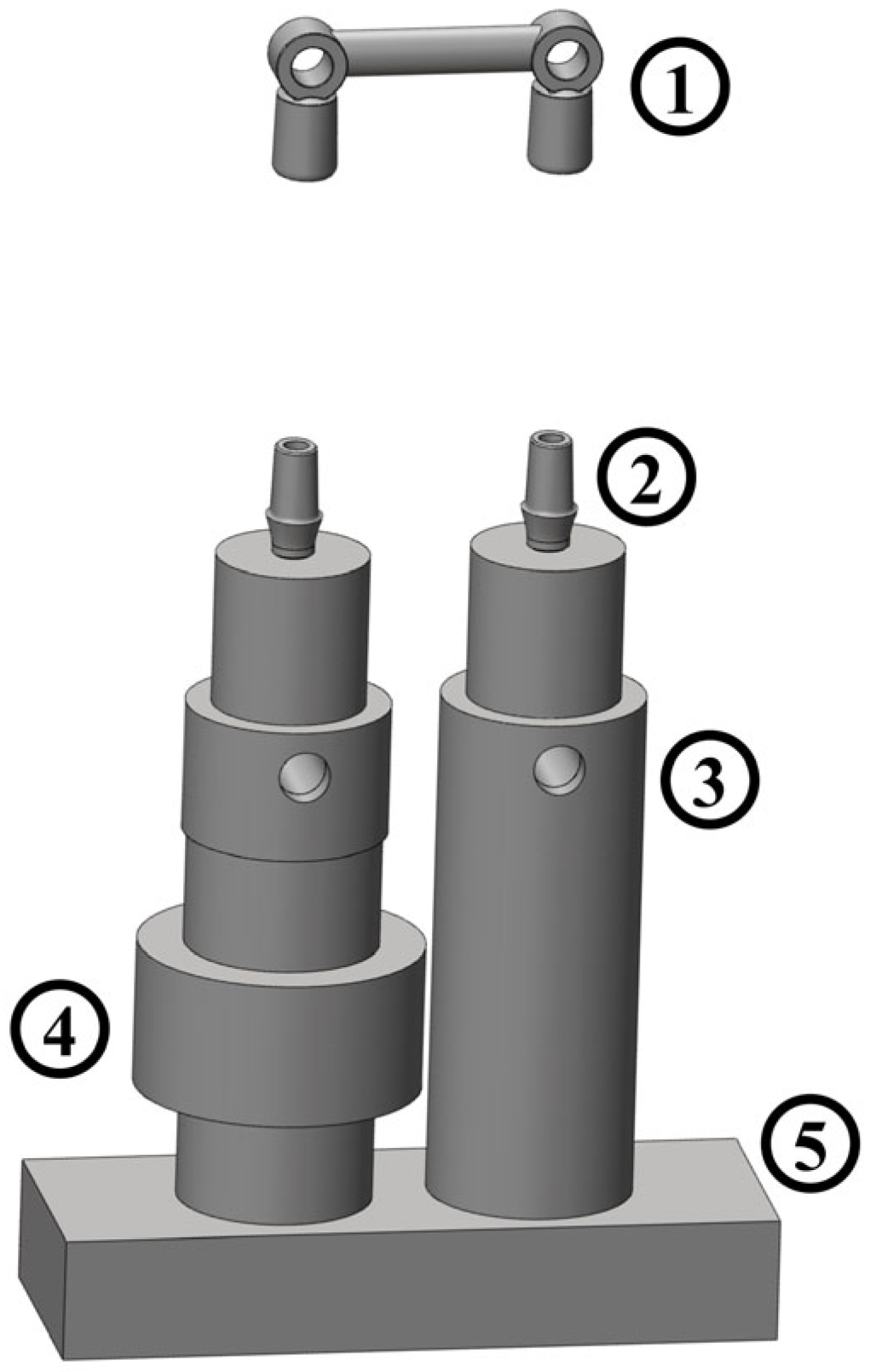
2.2. Efficiency Comparison Between Tools
- In case of no visible cement failure, 5 impulses were delivered on the most retentive side, followed by 5 impulses on the least retentive one, alternating the two sides until a maximum of 50 impulses.
- In case of cement failure at any coping, the following impulses were delivered at the opposite end of the bridge until complete cement failure or until a maximum of 50 impulses were delivered in total.
- In case of visible partial cement failure at both ends of the bridge with no complete separation between the copings and the abutments, the test continued following the protocol described in the previous two points.
- The impulses were delivered with an interval of approximately one second between each, and a record of the location of each applied impulse was kept for all tests.
2.3. Statistical Analysis
3. Results
3.1. Magnetic Mallet Force Repeatability
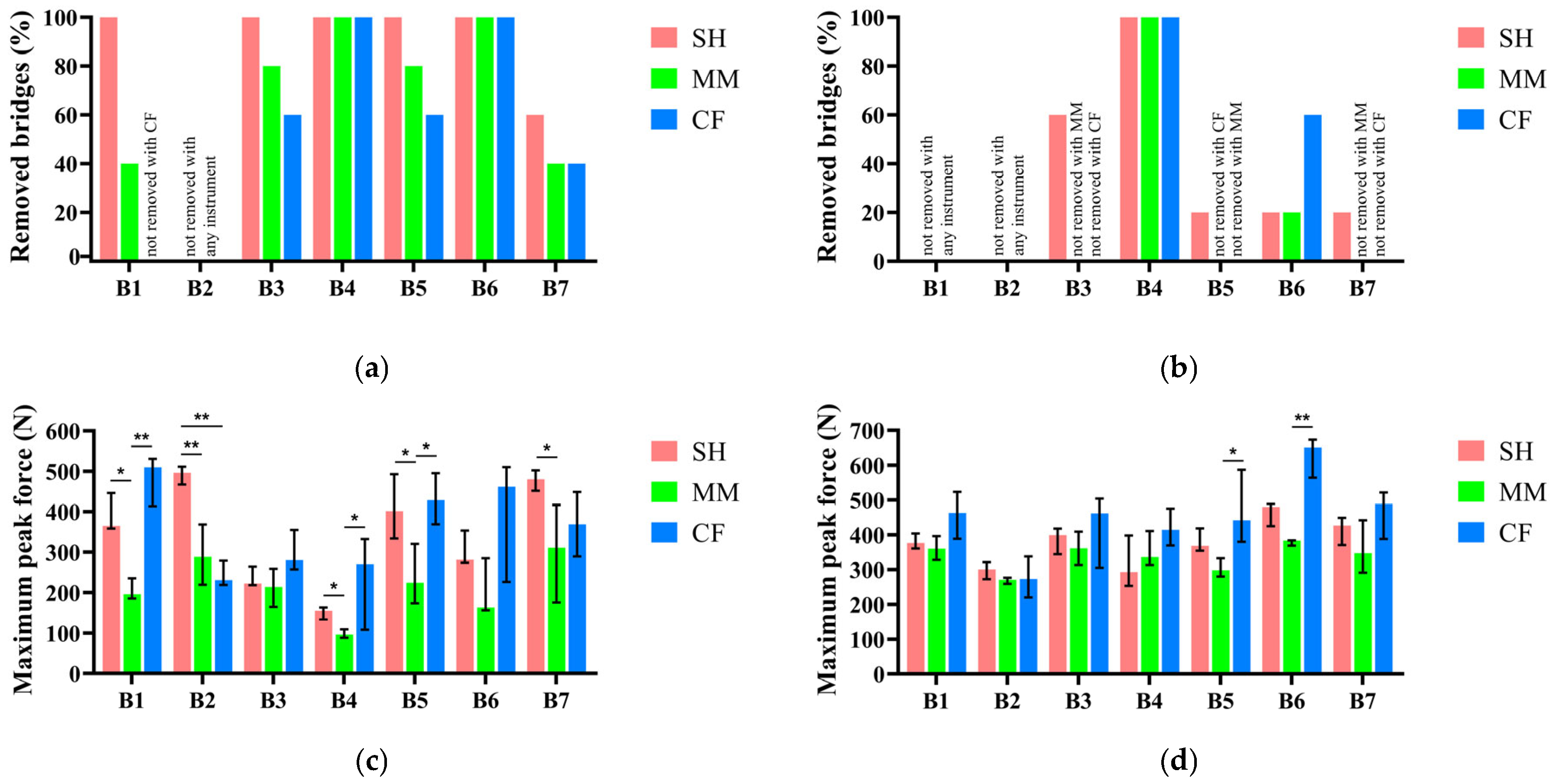
3.2. Efficiency Comparison Between Tools
4. Discussion
5. Conclusions
Supplementary Materials
Author Contributions
Funding
Institutional Review Board Statement
Informed Consent Statement
Data Availability Statement
Acknowledgments
Conflicts of Interest
References
- Guillaume, B. Dental Implants: A Review. Morphologie 2016, 100, 189–198. [Google Scholar] [CrossRef] [PubMed]
- Elani, H.W.; Starr, J.R.; Da Silva, J.D.; Gallucci, G.O. Trends in Dental Implant Use in the U.S., 1999–2016, and Projections to 2026. J. Dent. Res. 2018, 97, 1424–1430. [Google Scholar] [CrossRef] [PubMed]
- Block, M.S. Dental Implants: The Last 100 Years. J. Oral Maxillofac. Surg. 2018, 76, 11–26. [Google Scholar] [CrossRef] [PubMed]
- Sadowsky, S.J.; Brunski, J.B. Are Teeth Superior to Implants? A Mapping Review. J. Prosthet. Dent. 2021, 126, 181–187. [Google Scholar] [CrossRef]
- Bassi, F.; Cicciù, M.; Di Lenarda, R.; Galindo Moreno, P.; Galli, F.; Herford, A.S.; Jokstad, A.; Lombardi, T.; Nevins, M.; Sennerby, L.; et al. Piezoelectric Bone Surgery Compared with Conventional Rotary Instruments in Oral Surgery and Implantology: Summary and Consensus Statements of the International Piezoelectric Surgery Academy Consensus Conference 2019. Int. J. Oral Implantol. 2020, 13, 235–239. [Google Scholar]
- Fu, J.; Wang, H. Breaking the Wave of Peri-implantitis. Periodontology 2000 2020, 84, 145–160. [Google Scholar] [CrossRef]
- Baima, G.; Romano, F.; Chuachamsai, S.; Ciccarelli, M.; Giudice, A.L.; Ventricelli, M.; Mariani, G.M.; Romandini, M.; Schierano, G.; Aimetti, M. Prevalence and Risk Indicators of Peri-Implant Diseases and Buccal Soft-Tissue Dehiscence: A Cross-Sectional Study From a University-Based Cohort. J. Periodontal Res. 2025. Online ahead of print. [CrossRef]
- Wilson, T.G., Jr. The Positive Relationship Between Excess Cement and Peri-Implant Disease: A Prospective Clinical Endoscopic Study. J. Periodontol. 2009, 80, 1388–1392. [Google Scholar] [CrossRef]
- Lin, G.; Lee, E.; Barootchi, S.; Rosen, P.S.; Curtis, D.; Kan, J.; Wang, H. The Influence of Prosthetic Designs on Peri-implant Bone Loss: An AO/AAP Systematic Review and Meta-analysis. J. Periodontol. 2025, 96, 634–651. [Google Scholar] [CrossRef]
- Shadid, R.; Sadaqa, N. A Comparison between Screw-and Cement-Retained Implant Prostheses. A Literature Review. J. Oral Implantol. 2012, 38, 298–307. [Google Scholar] [CrossRef]
- Ozkir, S.E.; Unal, S.M.; Yurekli, E.; Güven, S. Effects of Crown Retrieval on Implants and the Surrounding Bone: A Finite Element Analysis. J. Adv. Prosthodont. 2016, 8, 131. [Google Scholar] [CrossRef]
- Kraus, R.D.; Epprecht, A.; Hämmerle, C.H.F.; Sailer, I.; Thoma, D.S. Cemented vs Screw-retained Zirconia-based Single Implant Reconstructions: A 3-year Prospective Randomized Controlled Clinical Trial. Clin. Implant. Dent. Relat. Res. 2019, 21, 578–585. [Google Scholar] [CrossRef]
- Gaddale, R.; Mishra, S.K.; Chowdhary, R. Complications of Screw- and Cement-Retained Implant-Supported Full-Arch Restorations: A Systematic Review and Meta-Analysis. Int. J. Oral Implantol. 2020, 13, 11–40. [Google Scholar]
- Garzon, H.; Camilo, A.; Camilo, T.; Johana, C.; Javier, C.; Jefferson, C.; Nidia, T. Relationship Between Dental Cement Materials of Implant-Supported Crowns with Peri-Implantitis Development in Humans: A Systematic Review of Literature. J. Long Term Eff. Med. Implant. 2018, 28, 223–232. [Google Scholar] [CrossRef] [PubMed]
- Mansour, A.; Ercoli, C.; Graser, G.; Tallents, R.; Moss, M. Comparative Evaluation of Casting Retention Using the ITI Solid Abutment with Six Cements. Clin. Oral Implant. Res. 2002, 13, 343–348. [Google Scholar] [CrossRef] [PubMed]
- Squier, R.S.; Agar, J.R.; Duncan, J.P.; Taylor, T.D. Retentiveness of Dental Cements Used with Metallic Implant Components. Int. J. Oral Maxillofac. Implant. 2002, 16, 793–798. [Google Scholar]
- Pan, Y.; Lin, C. The Effect of Luting Agents on the Retention of Dental Implant-Supported Crowns. Chang. Gung Med. J. 2005, 28, 403–410. [Google Scholar]
- Wahl, C.; França, F.M.G.; Brito, R.B.; Basting, R.T.; Smanio, H. Assessment of the Tensile Strength of Hexagonal Abutments Using Different Cementing Agents. Braz. Oral Res. 2008, 22, 299–304. [Google Scholar] [CrossRef]
- Al Hamad, K.Q.; Al Rashdan, B.A.; Abu-Sitta, E.H. The Effects of Height and Surface Roughness of Abutments and the Type of Cement on Bond Strength of Cement-Retained Implant Restorations. Clin. Oral Implant. Res. 2011, 22, 638–644. [Google Scholar] [CrossRef]
- Mehl, C.; Harder, S.; Schwarz, D.; Steiner, M.; Vollrath, O.; Kern, M. In Vitro Influence of Ultrasonic Stress, Removal Force Preload and Thermocycling on the Retrievability of Implant-Retained Crowns. Clin. Oral Implant. Res. 2012, 23, 930–937. [Google Scholar] [CrossRef]
- Gultekin, P.; Gultekin, B.A.; Aydin, M.; Yalcin, S. Cement Selection for Implant-Supported Crowns Fabricated with Different Luting Space Settings. J. Prosthodont. 2013, 22, 112–119. [Google Scholar] [CrossRef]
- Ghodsi, S.; Arzani, S.; Shekarian, M.; Aghamohseni, M. Cement Selection Criteria for Full Coverage Restorations: A Comprehensive Review of Literature. J. Clin. Exp. Dent. 2021, 13, e1154–e1161. [Google Scholar] [CrossRef] [PubMed]
- Bresciano, M.; Schierano, G.; Manzella, C.; Screti, A.; Bignardi, C.; Preti, G. Retention of Luting Agents on Implant Abutments of Different Height and Taper. Clin. Oral Implant. Res. 2005, 16, 594–598. [Google Scholar] [CrossRef] [PubMed]
- Lugas, A.T.; Terzini, M.; Zanetti, E.M.; Schierano, G.; Manzella, C.; Baldi, D.; Bignardi, C.; Audenino, A.L. In Vitro Simulation of Dental Implant Bridges Removal: Influence of Luting Agent and Abutments Geometry on Retrievability. Materials 2020, 13, 2797. [Google Scholar] [CrossRef] [PubMed]
- Lugas, A.T.; Terzini, M.; Zanetti, E.M.; Schierano, G.; Manzella, C.; Baldi, D.; Bignardi, C.; Audenino, A.L. In Vitro Impact Testing to Simulate Implant-Supported Prosthesis Retrievability in Clinical Practice: Influence of Cement and Abutment Geometry. Materials 2020, 13, 1749. [Google Scholar] [CrossRef]
- Bignardi, C.; Zanetti, E.M.; Terzini, M.; Ciccola, A.R.; Schierano, G.; Audenino, A.L. Reliability, Learnability and Efficiency of Two Tools for Cement Crowns Retrieval in Dentistry. Open Biomed. Eng. J. 2018, 12, 27–35. [Google Scholar] [CrossRef]
- Schierano, G.; Manzella, C.; Menicucci, G.; Parrotta, A.; Zanetti, E.M.; Audenino, A.L. In Vitro Standardization of Two Different Removal Devices in Cemented Implant Prosthesis. Clin. Oral Implant. Res. 2016, 27, 1026–1030. [Google Scholar] [CrossRef]
- Schiessl, C.; Schaefer, L.; Winter, C.; Fuerst, J.; Rosentritt, M.; Zeman, F.; Behr, M. Factors Determining the Retentiveness of Luting Agents Used with Metal- and Ceramic-Based Implant Components. Clin. Oral Investig. 2013, 17, 1179–1190. [Google Scholar] [CrossRef]
- Bernal, G.; Okamura, M.; Muñoz, C.A. The Effects of Abutment Taper, Length and Cement Type on Resistance to Dislodgement of Cement-Retained, Implant-Supported Restorations. J. Prosthodont. 2003, 12, 111–115. [Google Scholar] [CrossRef]
- Dudley, J.E.; Richards, L.C.; Abbott, J.R. Retention of Cast Crown Copings Cemented to Implant Abutments. Aust. Dent. J. 2008, 53, 332–339. [Google Scholar] [CrossRef]
- Cano-Batalla, J.; Soliva-Garriga, J.; Campillo-Funollet, M.; Munoz-Viveros, C.A.; Giner-Tarrida, L. Influence of Abutment Height and Surface Roughness on in Vitro Retention of Three Luting Agents. Int. J. Oral Maxillofac. Implant. 2012, 27, 36–41. [Google Scholar]
- Carnaggio, T.V.; Conrad, R.; Engelmeier, R.L.; Gerngross, P.; Paravina, R.; Perezous, L.; Powers, J.M. Retention of CAD/CAM All-Ceramic Crowns on Prefabricated Implant Abutments: An In Vitro Comparative Study of Luting Agents and Abutment Surface Area. J. Prosthodont. 2012, 21, 523–528. [Google Scholar] [CrossRef]
- Mehl, C.; Harder, S.; Steiner, M.; Vollrath, O.; Kern, M. Influence of Cement Film Thickness on the Retention of Implant-Retained Crowns. J. Prosthodont. 2013, 22, 618–625. [Google Scholar] [CrossRef] [PubMed]
- Almehmadi, N.; Kutkut, A.; Al-Sabbagh, M. What Is the Best Available Luting Agent for Implant Prosthesis? Dent. Clin. N. Am. 2019, 63, 531–545. [Google Scholar] [CrossRef] [PubMed]
- Mehl, C.; Harder, S.; Shahriari, A.; Steiner, M.; Kern, M. Influence of Abutment Height and Thermocycling on Retrievability of Cemented Implant-Supported Crowns. Int. J. Oral Maxillofac. Implant 2012, 27, 1106–1115. [Google Scholar]
- Mehl, C.; Harder, S.; Wolfart, M.; Kern, M.; Wolfart, S. Retrievability of Implant-Retained Crowns Following Cementation. Clin. Oral Implant. Res. 2008, 19, 1304–1311. [Google Scholar] [CrossRef]
- Worni, A.; Gholami, H.; Marchand, L.; Katsoulis, J.; Mericske-Stern, R.; Enkling, N. Retrievability of Implant-Supported Crowns When Using Three Different Cements: A Controlled Clinical Trial. Int. J. Prosthodont. 2015, 28, 22–29. [Google Scholar] [CrossRef]
- Moore, R.; Brødsgaard, I. Dentists’ Perceived Stress and Its Relation to Perceptions about Anxious Patients. Community Dent. Oral Epidemiol. 2001, 29, 73–80. [Google Scholar] [CrossRef]
- Pop-Jordanova, N.; Radojkova-Nikolovska, V.; Markovska-Simoska, S. Perceived Stress in Dental Practice. Pril 2013, 34, 135–141. [Google Scholar]
- Finkelstein, J.; Zhang, F.; Levitin, S.A.; Cappelli, D. Using Big Data to Promote Precision Oral Health in the Context of a Learning Healthcare System. J. Public Health Dent. 2020, 80, S43–S58. [Google Scholar] [CrossRef]
- Frantsve-Hawley, J.; Abt, E.; Carrasco-Labra, A.; Dawson, T.; Michaels, M.; Pahlke, S.; Rindal, D.B.; Spallek, H.; Weyant, R.J. Strategies for Developing Evidence-Based Clinical Practice Guidelines to Foster Implementation into Dental Practice. J. Am. Dent. Assoc. 2022, 153, 1041–1052. [Google Scholar] [CrossRef]
- Nagarkar, S.; Loguercio, A.D.; Perdigão, J. Evidence-Based Fact Checking for Selective Procedures in Restorative Dentistry. Clin. Oral Investig. 2023, 27, 475–488. [Google Scholar] [CrossRef] [PubMed]
- Lewinstein, I.; Block, L.; Lehr, Z.; Ormianer, Z.; Matalon, S. An in Vitro Assessment of Circumferential Grooves on the Retention of Cement-Retained Implant-Supported Crowns. J. Prosthet. Dent. 2011, 106, 367–372. [Google Scholar] [CrossRef]
- AlShaarani, F.; Alaisami, R.M.; Aljerf, L.; Jamous, I.A.; Elias, K.; Jaber, A. An Auxiliary Factor for Increasing the Retention of Short Abutments. Heliyon 2019, 5, e02674. [Google Scholar] [CrossRef]
- Rathod, A.; Jalaluddin, M.; Shrinivas; Devadiga, T.J.; Jha, S.; Alzahrani, K.M. Geometry of Implant Abutment Surface Improving Cement Effectiveness. J. Pharm. Bioallied Sci. 2021, 13, S1093–S1097. [Google Scholar] [CrossRef]
- Mishra, K. Evaluation of Change in Implant Abutment after Teeth Surface Modifications. Bioinformation 2021, 17, 157–161. [Google Scholar] [CrossRef]



| Bridge | Abutment 1 | Abutment 2 |
|---|---|---|
| B1 | 5 mm—0° | 5 mm—0° |
| B2 | 7 mm—0° | 7 mm—0° |
| B3 | 7 mm—2° | 7 mm—2° |
| B4 | 5 mm—2° | 5 mm—4° |
| B5 | 5 mm—0° | 5 mm—4° |
| B6 | 7 mm—2° | 7 mm—4° |
| B7 | 7 mm—0° | 7 mm—4° |
Disclaimer/Publisher’s Note: The statements, opinions and data contained in all publications are solely those of the individual author(s) and contributor(s) and not of MDPI and/or the editor(s). MDPI and/or the editor(s) disclaim responsibility for any injury to people or property resulting from any ideas, methods, instructions or products referred to in the content. |
© 2026 by the authors. Licensee MDPI, Basel, Switzerland. This article is an open access article distributed under the terms and conditions of the Creative Commons Attribution (CC BY) license.
Share and Cite
Schierano, G.; Baldi, D.; Bignardi, C.; Terzini, M.; Lugas, A.T. Efficiency and Risk Assessment of Dental Bridge Removal Tools on Implant Abutments. J. Funct. Biomater. 2026, 17, 33. https://doi.org/10.3390/jfb17010033
Schierano G, Baldi D, Bignardi C, Terzini M, Lugas AT. Efficiency and Risk Assessment of Dental Bridge Removal Tools on Implant Abutments. Journal of Functional Biomaterials. 2026; 17(1):33. https://doi.org/10.3390/jfb17010033
Chicago/Turabian StyleSchierano, Gianmario, Domenico Baldi, Cristina Bignardi, Mara Terzini, and Andrea Tancredi Lugas. 2026. "Efficiency and Risk Assessment of Dental Bridge Removal Tools on Implant Abutments" Journal of Functional Biomaterials 17, no. 1: 33. https://doi.org/10.3390/jfb17010033
APA StyleSchierano, G., Baldi, D., Bignardi, C., Terzini, M., & Lugas, A. T. (2026). Efficiency and Risk Assessment of Dental Bridge Removal Tools on Implant Abutments. Journal of Functional Biomaterials, 17(1), 33. https://doi.org/10.3390/jfb17010033