

Advances in Tissue Engineering and Biomaterials for Minimizing Wound Scarring: Current Status and Future Challenges

Abstract
1. Introduction
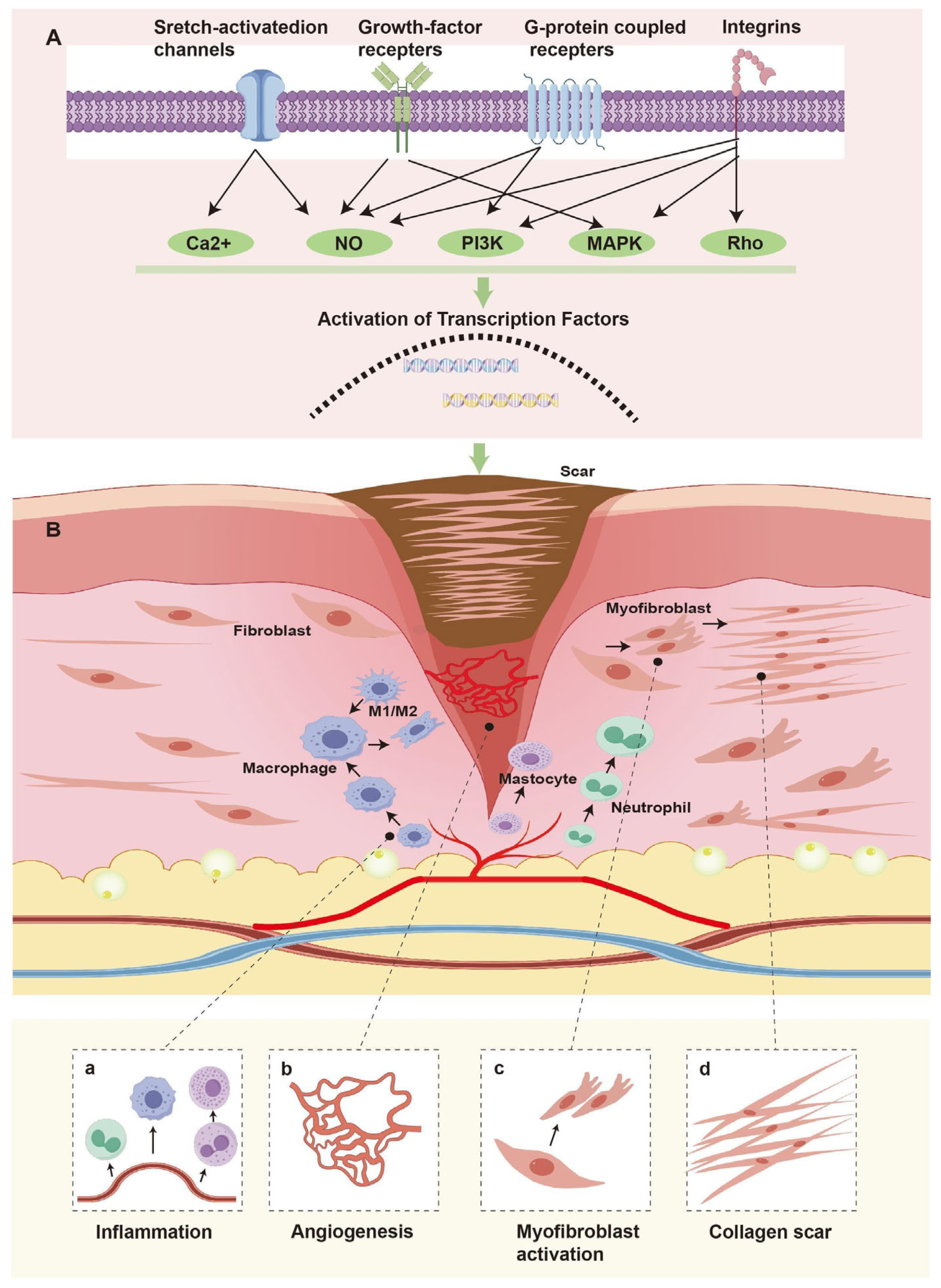
2. Scar Healing Mechanism

| Pathway | Primary Activators | Core Pro-Fibrotic Functions in Scarring | References |
|---|---|---|---|
| TGF-β/Smad | Excessive inflammation Increased wound tension | Promotes fibroblast proliferation/migration, stimulates collagen synthesis, inhibits collagen degradation. | [11,12,13,14] |
| Rho/ROCK | TGF-β | Drives fibroblast proliferation and matrix protein synthesis, leading to excessive ECM deposition. | [15] |
| p38MAPK | TGF-β1 | Mediates TGF-β1 secretion and ECM synthesis, critical in tension-associated scarring. | [16,17] |
| ERK | CTGF, EGF | Coordinate the proliferation of fibroblasts, promote the synthesis of collagen. | [18] |
| Integrin | Increased wound tension (Mechanotransduction) | Transduces mechanical force into chemical signals, promote fibroblast activation and fibrosis. | [19,20] |
| PI3K | Angiogenic factors (VEGF, PDGF, FGF) | Mediates pathological angiogenesis, linked to vascular overgrowth in scars. | [24] |
3. Characteristics of Fetal Scarless Healing
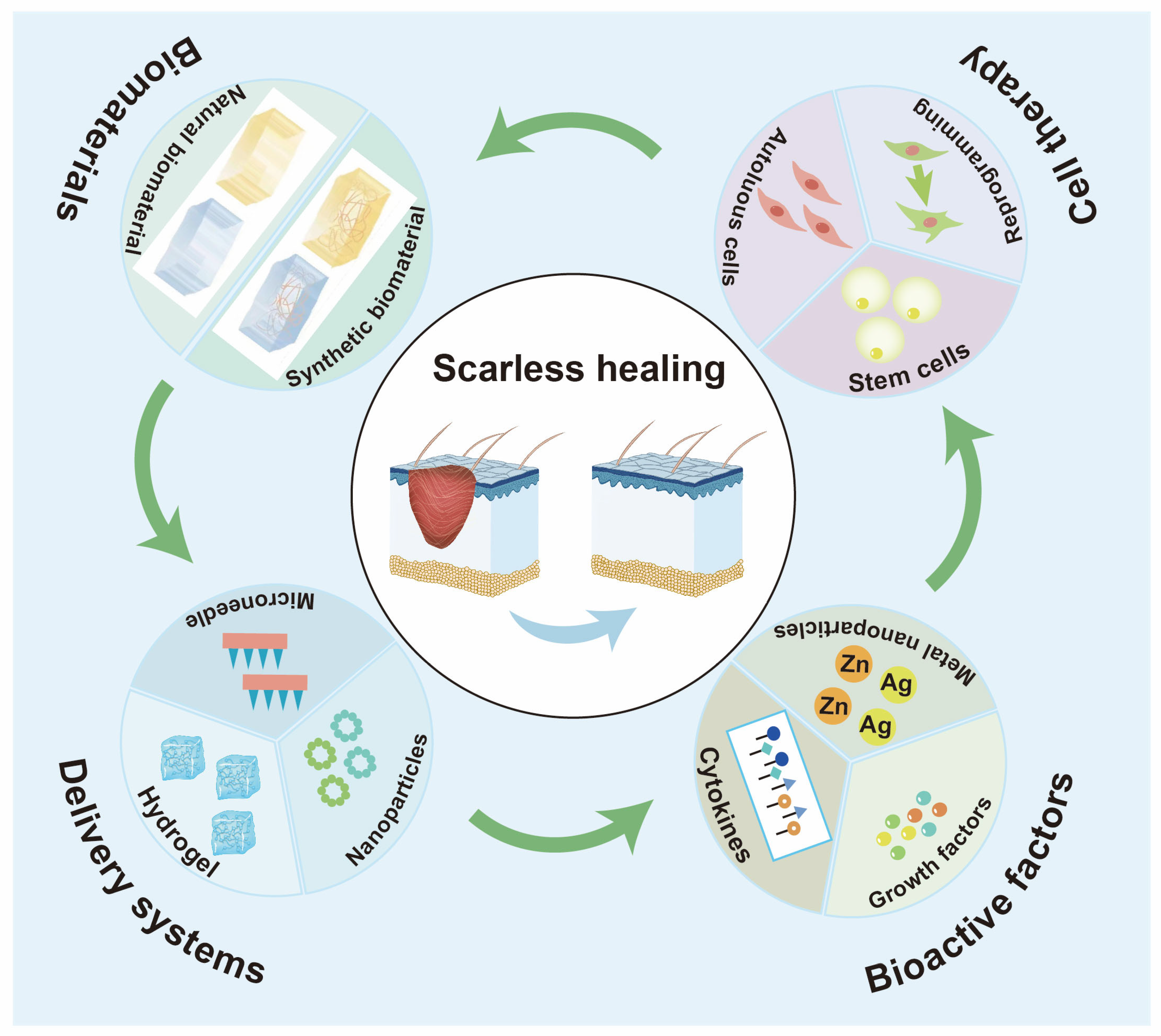
4. Biomaterials for Scarless Healing
4.1. Pure Biomaterial
4.1.1. Natural Polymer Materials
4.1.2. Synthetic Polymer Materials
4.2. Biomaterials Incorporated with Bioactive Factors
4.3. Biomaterials Combined with Cell Therapy
5. Innovative Application of Biomaterials in Scarless Healing
5.1. From “Passive Support” to “Active Regulation”: A New Intelligent Biomaterial for Reprogramming Wound Immune Microenvironment
5.2. Beyond Single-Factor Release: Spatio Temporal Sequential or On-Demand Precision Delivery Strategy
6. Conclusions
Author Contributions
Funding
Institutional Review Board Statement
Informed Consent Statement
Data Availability Statement
Conflicts of Interest
Abbreviations
| ECM | Extracellular matrix |
| MMPs | Matrix metalloproteases |
| α-SMA | Alpha-smooth muscle actin |
| TGF-β | Transforming growth factor-β |
| Fbs | Fibroblasts |
| CTGF | Connective tissue growth factor |
| EGF | Epidermal growth factor |
| VEGF | Vascular endothelial growth factor |
| ENF | En1-lineage-negative |
| EPF | Pro-fibrotic En1-positive |
| PDGF | Platelet-derived growth factor |
| HA | Hyaluronic acid |
| BC | Bacterial cellulose |
| SF | Silk fibroin |
| ADM | Acellular dermal matrices |
| PLCL | Poly(L-lactide-co-ε-capro-lactone) |
| HTS | Hypertrophic scar |
| PHBV | Poly(3-hydroxybutyrate-co-3-hydroxyvalerate) |
| PEGMA | Poly (ethylene glycol) methacrylate |
| bFGF | Basic fibroblast growth factor |
| IL-10 | Interleukin-10 |
| Rg3 | Ginsenoside-Rg3 |
| PDP | Pressure-driven permeation |
| TA | Triamcinolone acetonide |
| 5-Fu | 5-Fluorouracil |
| BMN | Bilayer dissolving microneedle |
| ZnS-NP | Zinc sulfide nanoparticles |
| ADSCs | Adipose-derived stem cells |
| MSCs | Mesenchymal stromal cells |
| GF | Graphene foam |
| BM-MSCs | Bone-marrow-derived mesenchymal stem cells |
| WJ-MSCs | Wharton’s jelly-derived mesenchymal stem cells |
References
- Rahimnejad, M.; Derakhshanfar, S.; Zhong, W. Biomaterials and tissue engineering for scar management in wound care. Burn. Trauma 2017, 5, 4. [Google Scholar] [CrossRef]
- Monavarian, M.; Kader, S.; Moeinzadeh, S.; Jabbari, E. Regenerative Scar-Free Skin Wound Healing. Tissue Eng. Part B: Rev. 2019, 25, 294–311. [Google Scholar] [CrossRef]
- El Ayadi, A.; Jay, J.W.; Prasai, A. Current Approaches Targeting the Wound Healing Phases to Attenuate Fibrosis and Scarring. Int. J. Mol. Sci. 2020, 21, 1105. [Google Scholar] [CrossRef] [PubMed]
- Poetschke, J.; Gauglitz, G.G. Current options for the treatment of pathological scarring. J. Dtsch. Dermatol. Ges. 2016, 14, 467–477. [Google Scholar] [CrossRef] [PubMed]
- Takeo, M.; Lee, W.; Ito, M. Wound Healing and Skin Regeneration. Cold Spring Harb. Perspect. Med. 2015, 5, a023267. [Google Scholar] [CrossRef] [PubMed]
- Singer, A.J.; Clark, R.A. Cutaneous Wound Healing. N. Engl. J. Med. 1999, 341, 738–746. [Google Scholar] [CrossRef]
- O Polanco, T.; Xylas, J.; Lantis, J.C. Extracellular Matrices (ECM) for Tissue Repair. Surg. Technol. Int. 2016, 28, 43–57. [Google Scholar]
- Huguier, V.; Giot, J.-P.; Simonneau, M.; Levillain, P.; Charreau, S.; Garcia, M.; Jégou, J.-F.; Bodet, C.; Morel, F.; Lecron, J.-C.; et al. Oncostatin M exerts a protective effect against excessive scarring by counteracting the inductive effect of TGFβ1 on fibrosis markers. Sci. Rep. 2019, 9, 2113. [Google Scholar] [CrossRef]
- Coentro, J.Q.; Pugliese, E.; Hanley, G.; Raghunath, M.; Zeugolis, D.I. Current and upcoming therapies to modulate skin scarring and fibrosis. Adv. Drug Deliv. Rev. 2019, 146, 37–59. [Google Scholar] [CrossRef]
- Klifto, K.M.; Asif, M.; Hultman, C.S. Laser management of hypertrophic burn scars: A comprehensive review. Burn. Trauma 2020, 8, tkz002. [Google Scholar] [CrossRef]
- Zi, Z.; Chapnick, D.A.; Liu, X. Dynamics of TGF-β/Smad signaling. FEBS Lett. 2012, 586, 1921–1928. [Google Scholar] [CrossRef] [PubMed]
- Xu, P.; Liu, J.; Derynck, R. Post-translational regulation of TGF-β receptor and Smad signaling. FEBS Lett. 2012, 586, 1871–1884. [Google Scholar] [CrossRef] [PubMed]
- Chang, Z.; Kishimoto, Y.; Hasan, A.; Welham, N.V. TGF-β3 modulates the inflammatory environment and reduces scar formation following vocal fold mucosal injury in rats. Dis. Model. Mech. 2014, 7, 83–91. [Google Scholar] [CrossRef] [PubMed]
- Wang, X.; Gao, Z.; Wu, X.; Zhang, W.; Zhou, G.; Liu, W. Inhibitory effect of TGF-βpeptide antagonist on the fibrotic phenotype of human hypertrophic scar fibroblasts. Pharm. Biol. 2016, 54, 1189–1197. [Google Scholar] [CrossRef]
- Ko, J.H.; Kim, P.S.; Zhao, Y.; Hong, S.J.; Mustoe, T.A. HMG-CoA Reductase Inhibitors (Statins) Reduce Hypertrophic Scar Formation in a Rabbit Ear Wounding Model. Plast. Reconstr. Surg. 2012, 129, 252e–261e. [Google Scholar] [CrossRef]
- Yu, L.; Hébert, M.C.; Zhang, Y.E. TGF-beta receptor-activated p38 MAP kinase mediates Smad-independent TGF-beta responses. EMBO J. 2002, 21, 3749–3759. [Google Scholar] [CrossRef]
- Du, Q.-C.; Zhang, D.-Z.; Chen, X.-J.; Lan-Sun, G.; Wu, M.; Xiao, W.-L. The Effect of p38MAPK on Cyclic Stretch in Human Facial Hypertrophic Scar Fibroblast Differentiation. PLoS ONE 2013, 8, e75635. [Google Scholar] [CrossRef]
- Fang, L.; Zhan, S.; Huang, C.; Cheng, X.; Lv, X.; Si, H.; Li, J. TRPM7 channel regulates PDGF-BB-induced proliferation of hepatic stellate cells via PI3K and ERK pathways. Toxicol. Appl. Pharmacol. 2013, 272, 713–725. [Google Scholar] [CrossRef]
- Kanchanawong, P.; Calderwood, D.A. Organization, dynamics and mechanoregulation of integrin-mediated cell–ECM adhesions. Nat. Rev. Mol. Cell Biol. 2023, 24, 142–161. [Google Scholar] [CrossRef]
- Balasubramanian, S.; Quinones, L.; Kasiganesan, H.; Zhang, Y.; Pleasant, D.L.; Sundararaj, K.P.; Zile, M.R.; Bradshaw, A.D.; Kuppuswamy, D. β3 Integrin in Cardiac Fibroblast Is Critical for Extracellular Matrix Accumulation during Pressure Overload Hypertrophy in Mouse. PLoS ONE 2012, 7, e45076. [Google Scholar] [CrossRef]
- Eming, S.A.; Brachvogel, B.; Odorisio, T.; Koch, M. Regulation of angiogenesis: Wound healing as a model. Prog Histochem. Cyto. 2007, 42, 115–170. [Google Scholar] [CrossRef] [PubMed]
- Jang, Y.C.; Arumugam, S.; Gibran, N.S.; Isik, F.F. Role of alpha(v) integrins and angiogenesis during wound repair. Wound Repair Regen. 1999, 7, 375–380. [Google Scholar] [CrossRef] [PubMed]
- Fujiwara, M.; Muragaki, Y.; Ooshima, A. Keloid-derived fibroblasts show increased secretion of factors involved in collagen turnover and depend on matrix metalloproteinase for migration. Br. J. Dermatol. 2005, 153, 295–300. [Google Scholar] [CrossRef] [PubMed]
- Shi, J.; Li, J.; Guan, H.; Cai, W.; Bai, X.; Fang, X.; Hu, X.; Wang, Y.; Wang, H.; Zheng, Z.; et al. Anti-Fibrotic Actions of Interleukin-10 against Hypertrophic Scarring by Activation of PI3K/AKT and STAT3 Signaling Pathways in Scar-Forming Fibroblasts. PLoS ONE 2014, 9, e98228. [Google Scholar] [CrossRef]
- Wong, V.W.; Paterno, J.; Sorkin, M.; Glotzbach, J.P.; Levi, K.; Januszyk, M.; Rustad, K.C.; Longaker, M.T.; Gurtner, G.C. Mechanical force prolongs acute inflammation via T-cell-dependent pathways during scar formation. FASEB J. 2011, 25, 4498–4510. [Google Scholar] [CrossRef]
- Larson, B.J.B.; Longaker, M.T.M.; Lorenz, H.P. Scarless Fetal Wound Healing: A Basic Science Review. Plast. Reconstr. Surg. 2010, 126, 1172–1180. [Google Scholar] [CrossRef]
- Wulff, B.C.; Yu, L.; Parent, A.E.; Wilgus, T.A. Novel differences in the expression of inflammation-associated genes between mid- and late-gestational dermal fibroblasts. Wound Repair Regen. 2013, 21, 103–112. [Google Scholar] [CrossRef]
- Martin, P.; D’SOuza, D.; Martin, J.; Grose, R.; Cooper, L.; Maki, R.; McKercher, S.R. Wound Healing in the PU.1 Null Mouse—Tissue Repair Is Not Dependent on Inflammatory Cells. Curr. Biol. 2003, 13, 1122–1128. [Google Scholar] [CrossRef]
- Walraven, M.; Talhout, W.; Beelen, R.H.; van Egmond, M.; Ulrich, M.M. Healthy human second-trimester fetal skin is deficient in leukocytes and associated homing chemokines. Wound Repair Regen. 2016, 24, 533–541. [Google Scholar] [CrossRef]
- Rinkevich, Y.; Walmsley, G.G.; Hu, M.S.; Maan, Z.N.; Newman, A.M.; Drukker, M.; Januszyk, M.; Krampitz, G.W.; Gurtner, G.C.; Lorenz, H.P.; et al. Identification and isolation of a dermal lineage with intrinsic fibrogenic potential. Science 2015, 348, aaa2151. [Google Scholar] [CrossRef]
- Jiang, D.; Correa-Gallegos, D.; Christ, S.; Stefanska, A.; Liu, J.; Ramesh, P.; Rajendran, V.; De Santis, M.M.; Wagner, D.E.; Rinkevich, Y. Two succeeding fibroblastic lineages drive dermal development and the transition from regeneration to scarring. Nat. Cell Biol. 2018, 20, 422–431. [Google Scholar] [CrossRef]
- Yokoyama, M.; Rafii, S. Setting up the dermis for scar-free healing. Nat. Cell Biol. 2018, 20, 365–366. [Google Scholar] [CrossRef] [PubMed]
- Aller, M.; Blanco-Rivero, J.; Arias, J.; Balfagon, G.; Arias, J. The wound-healing response and upregulated embryonic mechanisms: Brothers-in-arms forever. Exp. Dermatol. 2012, 21, 497–503. [Google Scholar] [CrossRef] [PubMed]
- Penn, J.W.; Grobbelaar, A.O.; Rolfe, K.J. The role of the TGF-beta family in wound healing, burns and scarring: A review. Int. J. Burn. Trauma 2012, 2, 18–28. [Google Scholar]
- Walraven, M.; Gouverneur, M.; Middelkoop, E.; Beelen, R.H.J.; Ulrich, M.M.W. Altered TGF-β signaling in fetal fibroblasts: What is known about the underlying mechanisms? Wound Repair Regen. 2014, 22, 3–13. [Google Scholar] [CrossRef]
- Bullard, K.M.; Cass, D.L.; Banda, M.J.; Adzick, N. Transforming growth factor beta-1 decreases interstitial collagenase in healing human fetal skin. J. Pediatr. Surg. 1997, 32, 1023–1027. [Google Scholar] [CrossRef]
- Helmo, F.R.; Machado, J.R.; Guimarães, C.S.d.O.; Teixeira, V.d.P.A.; dos Reis, M.A.; Corrêa, R.R.M. Fetal Wound Healing Biomarkers. Dis. Markers 2013, 35, 939–944. [Google Scholar] [CrossRef]
- A Iocono, J.; Ehrlich, H.; A Keefer, K.; Krummel, T.M. Hyaluronan induces scarless repair in mouse limb organ culture. J. Pediatr. Surg. 1998, 33, 564–567. [Google Scholar] [CrossRef]
- Kishi, K.; Okabe, K.; Shimizu, R.; Kubota, Y. Fetal Skin Possesses the Ability to Regenerate Completely: Complete Regeneration of Skin. Keio J. Med. 2012, 61, 101–108. [Google Scholar] [CrossRef]
- Syed, F.; Ahmadi, E.; Iqbal, S.; Singh, S.; McGrouther, D.; Bayat, A. Fibroblasts from the growing margin of keloid scars produce higher levels of collagen I and III compared with intralesional and extralesional sites: Clinical implications for lesional site-directed therapy. Br. J. Dermatol. 2011, 164, 83–96. [Google Scholar] [CrossRef]
- Giri, S.; Machens, H.-G.; Bader, A. Therapeutic potential of endogenous stem cells and cellular factors for scar-free skin regeneration. Drug Discov. Today 2019, 24, 69–84. [Google Scholar] [CrossRef] [PubMed]
- Hu, M.; Sabelman, E.E.; Cao, Y.; Chang, J.; Hentz, V.R. Three-dimensional hyaluronic acid grafts promote healing and reduce scar formation in skin incision wounds. J. Biomed. Mater. Res. B: Appl. Biomater. 2003, 67B, 586–592. [Google Scholar] [CrossRef] [PubMed]
- Thibeault, S.L.; Klemuk, S.A.; Chen, X.; Johnson, B.H.Q. In Vivo Engineering of the Vocal Fold ECM with Injectable HA Hydro-gels-Late Effects on Tissue Repair and Biomechanics in a Rabbit Model. J. Voice 2011, 25, 249–253. [Google Scholar] [CrossRef] [PubMed][Green Version]
- He, W.; Wu, J.; Xu, J.; Mosselhy, D.A.; Zheng, Y.D.; Yang, S.M. Bacterial Cellulose: Functional Modification and Wound Healing Applications. Adv. Wound. Care 2021, 10, 623–640. [Google Scholar] [CrossRef]
- Czaja, W.K.; Young, D.J.; Kawecki, M.; Brown, R.M. The Future Prospects of Microbial Cellulose in Biomedical Applications. Biomacromolecules 2007, 8, 1–12. [Google Scholar] [CrossRef]
- Li, J.; Chen, M.; Fan, X.; Zhou, H. Recent advances in bioprinting techniques: Approaches, applications and future prospects. J. Transl. Med. 2016, 14, 271. [Google Scholar] [CrossRef]
- Rastogi, S.; Modi, M.; Sathian, B. The Efficacy of Collagen Membrane as a Biodegradable Wound Dressing Material for Surgical Defects of Oral Mucosa: A Prospective Study. J. Oral Maxillofac. Surg. 2009, 67, 1600–1606. [Google Scholar] [CrossRef]
- Meinel, L.; Hofmann, S.; Karageorgiou, V.; Kirker-Head, C.; McCool, J.; Gronowicz, G.; Zichner, L.; Langer, R.; Vunjak-Novakovic, G.; Kaplan, D.L. The inflammatory responses to silk films in vitro and in vivo. Biomaterials 2005, 26, 147–155. [Google Scholar] [CrossRef]
- Zhang, Q.; Shi, L.; He, H.; Liu, X.; Huang, Y.; Xu, D.; Yao, M.; Zhang, N.; Guo, Y.; Lu, Y.; et al. Down-Regulating Scar Formation by Microneedles Directly via a Mechanical Communication Pathway. ACS Nano 2022, 16, 10163–10178. [Google Scholar] [CrossRef]
- Peng, L.-H.; Chen, X.; Chen, L.; Li, N.; Liang, W.-Q.; Gao, J.-Q. Topical Astragaloside IV-Releasing Hydrogel Improves Healing of Skin Wounds in Vivo. Biol. Pharm. Bull. 2012, 35, 881–888. [Google Scholar] [CrossRef]
- Shan, Y.-H.; Peng, L.-H.; Liu, X.; Chen, X.; Xiong, J.; Gao, J.-Q. Silk fibroin/gelatin electrospun nanofibrous dressing functionalized with astragaloside IV induces healing and anti-scar effects on burn wound. Int. J. Pharm. 2015, 479, 291–301. [Google Scholar] [CrossRef]
- Weng, T.; Zhang, W.; Xia, Y.; Wu, P.; Yang, M.; Jin, R.; Xia, S.; Wang, J.; You, C.; Han, C.; et al. 3D bioprinting for skin tissue engineering: Current status and perspectives. J. Tissue Eng. 2021, 12. [Google Scholar] [CrossRef] [PubMed]
- Janis, J.E.; Nahabedian, M.Y. Acellular Dermal Matrices in Surgery. Plast. Reconstr. Surg. 2012, 130, 7S–8S. [Google Scholar] [CrossRef] [PubMed]
- Feng, X.; Tan, J.; Pan, Y.; Wu, Q.; Ruan, S.; Shen, R.; Chen, X.; Du, Y. Control of hypertrophic scar from inception by using xenogenic (porcine) acellular dermal matrix (ADM) to cover deep second degree burn. Burns 2006, 32, 293–298. [Google Scholar] [CrossRef] [PubMed]
- Feng, X.; Shen, R.; Tan, J.; Chen, X.; Pan, Y.; Ruan, S.; Zhang, F.; Lin, Z.; Zeng, Y.; Wang, X.; et al. The study of inhibiting systematic inflammatory response syndrome by applying xenogenic (porcine) acellular dermal matrix on second-degree burns. Burns 2007, 33, 477–479. [Google Scholar] [CrossRef]
- Jiong, C.; Jiake, C.; Chunmao, H.; Yingen, P.; Qiuhe, W.; Zhouxi, F.; Xiangsheng, F. Clinical Application and Long-Term Follow-Up Study of Porcine Acellular Dermal Matrix Combined with Autoskin Grafting. J. Burn. Care Res. 2010, 31, 280–285. [Google Scholar] [CrossRef]
- Lorden, E.R.; Miller, K.J.; Bashirov, L.; Ibrahim, M.M.; Hammett, E.; Jung, Y.; Medina, M.A.; Rastegarpour, A.; Selim, M.A.; Leong, K.W.; et al. Mitigation of hypertrophic scar contraction via an elastomeric biodegradable scaffold. Biomaterials 2015, 43, 61–70. [Google Scholar] [CrossRef]
- Lorden, E.R.; Miller, K.J.; Ibrahim, M.M.; Bashirov, L.; Hammett, E.; Chakraborty, S.; Quiles-Torres, C.; Selim, M.A.; Leong, K.W.; Levinson, H. Biostable electrospun microfibrous scaffolds mitigate hypertrophic scar contraction in an immune-competent murine model. Acta Biomater. 2016, 32, 100–109. [Google Scholar] [CrossRef]
- Kim, H.S.; Chen, J.; Wu, L.-P.; Wu, J.; Xiang, H.; Leong, K.W.; Han, J. Prevention of excessive scar formation using nanofibrous meshes made of biodegradable elastomer poly(3-hydroxybutyrate-co-3-hydroxyvalerate). J. Tissue Eng. 2020, 11. [Google Scholar] [CrossRef]
- Zhao, H.; Huang, J.; Li, Y.; Lv, X.; Zhou, H.; Wang, H.; Xu, Y.; Wang, C.; Wang, J.; Liu, Z. ROS-scavenging hydrogel to promote healing of bacteria infected diabetic wounds. Biomaterials 2020, 258, 120286. [Google Scholar] [CrossRef]
- Kim, H.S.; Sun, X.; Lee, J.-H.; Kim, H.-W.; Fu, X.; Leong, K.W. Advanced drug delivery systems and artificial skin grafts for skin wound healing. Adv. Drug Deliv. Rev. 2019, 146, 209–239. [Google Scholar] [CrossRef] [PubMed]
- Shokrani, H.; Shokrani, A.; Jouyandeh, M.; Seidi, F.; Gholami, F.; Kar, S.; Munir, M.T.; Kowalkowska-Zedler, D.; Zarrintaj, P.; Rabiee, N.; et al. Green Polymer Nanocomposites for Skin Tissue Engineering. ACS Appl. Bio Mater. 2022, 5, 2107–2121. [Google Scholar] [CrossRef] [PubMed]
- Akita, S.; Akino, K.; Hirano, A. Basic Fibroblast Growth Factor in Scarless Wound Healing. Adv. Wound Care 2013, 2, 44–49. [Google Scholar] [CrossRef] [PubMed]
- Xu, H.; Chen, P.; ZhuGe, D.; Zhu, Q.; Jin, B.; Shen, B.; Xiao, J.; Zhao, Y. Liposomes with Silk Fibroin Hydrogel Core to Stabilize bFGF and Promote the Wound Healing of Mice with Deep Second-Degree Scald. Adv. Heal. Mater. 2017, 6, 1700344. [Google Scholar] [CrossRef]
- Kim, Y.S.; Lew, D.H.; Tark, K.C.; Rah, D.K.; Hong, J.P. Effect of Recombinant Human Epidermal Growth Factor Against Cutaneous Scar Formation in Murine Full-thickness Wound Healing. J. Korean Med. Sci. 2010, 25, 589–596. [Google Scholar] [CrossRef]
- Kong, X.; Fu, J.; Shao, K.; Wang, L.; Lan, X.; Shi, J. Biomimetic hydrogel for rapid and scar-free healing of skin wounds inspired by the healing process of oral mucosa. Acta Biomater. 2019, 100, 255–269. [Google Scholar] [CrossRef]
- Lee, M.S.; Ahmad, T.; Lee, J.; Awada, H.K.; Wang, Y.; Kim, K.; Shin, H.; Yang, H.S. Dual delivery of growth factors with coacervate-coated poly(lactic-co-glycolic acid) nanofiber improves neovascularization in a mouse skin flap model. Biomaterials 2017, 124, 65–77. [Google Scholar] [CrossRef]
- Shi, J.; Wang, H.; Guan, H.; Shi, S.; Li, Y.; Wu, X.; Li, N.; Yang, C.; Bai, X.; Cai, W.; et al. IL10 inhibits starvation-induced autophagy in hypertrophic scar fibroblasts via cross talk between the IL10-IL10R-STAT3 and IL10-AKT-mTOR pathways. Cell Death Dis. 2016, 7, e2133. [Google Scholar] [CrossRef]
- Lichtman, M.K.; Otero-Vinas, M.; Falanga, V. Transforming growth factor beta (TGF-β) isoforms in wound healing and fibrosis. Wound Repair Regen. 2016, 24, 215–222. [Google Scholar] [CrossRef]
- Park, U.; Lee, M.S.; Jeon, J.; Lee, S.; Hwang, M.P.; Wang, Y.; Yang, H.S.; Kim, K. Coacervate-mediated exogenous growth factor delivery for scarless skin regeneration. Acta Biomater. 2019, 90, 179–191. [Google Scholar] [CrossRef]
- Sun, X.; Cheng, L.; Zhu, W.; Hu, C.; Jin, R.; Sun, B.; Shi, Y.; Zhang, Y.; Cui, W. Use of ginsenoside Rg3-loaded electrospun PLGA fibrous membranes as wound cover induces healing and inhibits hypertrophic scar formation of the skin. Colloids Surfaces B: Biointerfaces 2014, 115, 61–70. [Google Scholar] [CrossRef] [PubMed]
- Yang, B.; Dong, Y.; Shen, Y.; Hou, A.; Quan, G.; Pan, X.; Wu, C. Bilayer dissolving microneedle array containing 5-fluorouracil and triamcinolone with biphasic release profile for hypertrophic scar therapy. Bioact. Mater. 2021, 6, 2400–2411. [Google Scholar] [CrossRef] [PubMed]
- Manuja, A.; Raguvaran, R.; Kumar, B.; Kalia, A.; Tripathi, B. Accelerated healing of full thickness excised skin wound in rabbits using single application of alginate/acacia based nanocomposites of ZnO nanoparticles. Int. J. Biol. Macromol. 2020, 155, 823–833. [Google Scholar] [CrossRef] [PubMed]
- Han, B.; Fang, W.H.; Zhao, S.; Yang, Z.; Hoang, B.X. Zinc sulfide nanoparticles improve skin regeneration. Nanomed. Nanotechnol. Biol. Med. 2020, 29, 102263. [Google Scholar] [CrossRef]
- Qiu, H.; Liu, S.; Wu, K.; Zhao, R.; Cao, L.; Wang, H. Prospective application of exosomes derived from adipose-derived stem cells in skin wound healing: A review. J. Cosmet. Dermatol. 2020, 19, 574–581. [Google Scholar] [CrossRef]
- Dong, Y.; Cui, M.; Qu, J.; Wang, X.; Kwon, S.H.; Barrera, J.; Elvassore, N.; Gurtner, G.C. Conformable hyaluronic acid hydrogel delivers adipose-derived stem cells and promotes regeneration of burn injury. Acta Biomater. 2020, 108, 56–66. [Google Scholar] [CrossRef]
- Spiekman, M.; van Dongen, J.A.; Willemsen, J.C.; Hoppe, D.L.; van der Lei, B.; Harmsen, M.C. The power of fat and its adipose-derived stromal cells: Emerging concepts for fibrotic scar treatment. J. Tissue Eng. Regen. Med. 2017, 11, 3220–3235. [Google Scholar] [CrossRef]
- Deng, J.; Shi, Y.; Gao, Z.; Zhang, W.; Wu, X.; Cao, W.; Liu, W. Inhibition of Pathological Phenotype of Hypertrophic Scar Fibroblasts Via Coculture with Adipose-Derived Stem Cells. Tissue Eng. Part A 2018, 24, 382–393. [Google Scholar] [CrossRef]
- Yao, Y.; Dong, Z.; Liao, Y.; Zhang, P.; Ma, J.; Gao, J.; Lu, F. Adipose Extracellular Matrix/Stromal Vascular Fraction Gel: A Novel Adipose Tissue–Derived Injectable for Stem Cell Therapy. Plast. Reconstr. Surg. 2017, 139, 867–879. [Google Scholar] [CrossRef]
- Zonari, A.; Martins, T.M.; Paula, A.C.C.; Boeloni, J.N.; Novikoff, S.; Marques, A.P.; Correlo, V.M.; Reis, R.L.; Goes, A.M. Polyhydroxybutyrate-co-hydroxyvalerate structures loaded with adipose stem cells promote skin healing with reduced scarring. Acta Biomater. 2015, 17, 170–181. [Google Scholar] [CrossRef]
- Huang, S.; Wu, Y.; Gao, D.; Fu, X. Paracrine action of mesenchymal stromal cells delivered by microspheres contributes to cutaneous wound healing and prevents scar formation in mice. Cytotherapy 2015, 17, 922–931. [Google Scholar] [CrossRef]
- Li, Z.; Wang, H.; Yang, B.; Sun, Y.; Huo, R. Three-dimensional graphene foams loaded with bone marrow derived mesenchymal stem cells promote skin wound healing with reduced scarring. Mater. Sci. Eng. C 2015, 57, 181–188. [Google Scholar] [CrossRef] [PubMed]
- Sun, J.; Zhang, Y.; Song, X.; Zhu, J.; Zhu, Q. The Healing Effects of Conditioned Medium Derived from Mesenchymal Stem Cells on Radiation-Induced Skin Wounds in Rats. Cell Transplant. 2019, 28, 105–115. [Google Scholar] [CrossRef] [PubMed]
- Adams, S.; Wuescher, L.M.; Worth, R.; Yildirim-Ayan, E. Mechano-Immunomodulation: Mechanoresponsive Changes in Macrophage Activity and Polarization. Ann. Biomed. Eng. 2019, 47, 2213–2231. [Google Scholar] [CrossRef] [PubMed]
- Leung, A.; Crombleholme, T.M.; Keswani, S.G. Fetal wound healing. Curr. Opin. Pediatr. 2012, 24, 371–378. [Google Scholar] [CrossRef]
- Chaudhuri, O.; Cooper-White, J.; Janmey, P.A.; Mooney, D.J.; Shenoy, V.B. Effects of extracellular matrix viscoelasticity on cellular behaviour. Nature 2020, 584, 535–546. [Google Scholar] [CrossRef]
- Li, Z.; Zhang, L.; Wang, Y.; Zhu, Y.; Shen, H.; Yuan, J.; Li, X.; Yu, Z.; Song, B. LA-peptide Hydrogel—Regulation of macrophage and fibroblast fates and their crosstalk via attenuating TGF-β to promote scarless wound healing. Bioact. Mater. 2025, 47, 417–431. [Google Scholar] [CrossRef]
- Xing, D.; Xia, G.; Tang, X.; Zhuang, Z.; Shan, J.; Fang, X.; Qiu, L.; Zha, X.; Chen, X. A Multifunctional Nanocomposite Hydrogel Delivery System Based on Dual-Loaded Liposomes for Scarless Wound Healing. Adv. Heal. Mater. 2024, 13, e2401619. [Google Scholar] [CrossRef]
- Chen, T.; Jiang, Y.; Huang, J.-P.; Wang, J.; Wang, Z.-K.; Ding, P.-H. Essential elements for spatiotemporal delivery of growth factors within bio-scaffolds: A comprehensive strategy for enhanced tissue regeneration. J. Control. Release 2024, 368, 97–114. [Google Scholar] [CrossRef]
- Oliva, N.; Almquist, B.D. Spatiotemporal delivery of bioactive molecules for wound healing using stimuli-responsive biomaterials. Adv. Drug Deliv. Rev. 2020, 161–162, 22–41. [Google Scholar] [CrossRef]
- Zhang, X.; Wu, Y.; Gong, H.; Xiong, Y.; Chen, Y.; Li, L.; Zhi, B.; Lv, S.; Peng, T.; Zhang, H. A Multifunctional Herb-Derived Glycopeptide Hydrogel for Chronic Wound Healing. Small 2024, 20, e2400516. [Google Scholar] [CrossRef]
- Chu, L.; Shen, J.-M.; Xu, Z.; Huang, J.; Ning, L.; Feng, Z.; Jiang, Y.; Wu, P.; Gao, C.; Wang, W.; et al. Stimuli-responsive hydrogel with spatiotemporal co-delivery of FGF21 and H2S for synergistic diabetic wound repair. J. Control. Release 2025, 382, 113749. [Google Scholar] [CrossRef]


| Methods | Principle | Advantages | Disadvantages | Cost |
|---|---|---|---|---|
| Silicone-based Products (Gel/Sheets) | Forms a protective, | Non-invasive and safe. Easy to use. | Requires long-term, consistent use (months). Less effective for severe, established hypertrophic scars. | Low to medium cost. |
| Pressure Therapy | Applies continuous pressure, causing local tissue hypoxia, which flattens and softens the scar. | Effective for large-area scars, especially after burns. | Poor comfort; must be worn for long periods daily. Difficult to maintain effective pressure on joints or mobile areas. | Relatively high cost. Primarily the cost of custom-made pressure garments. |
| Corticosteroid Injections | Inhibits inflammatory response and collagen synthesis, softens, and flattens raised scars (hypertrophic scars and keloids). | Direct and effective for raised scars. | Requires multiple sessions. Potential side effects: skin atrophy, telangiectasia, hypopigmentation. Invasive and pain. | Medium cost per session. |
| Laser Therapy | Uses laser light for photothermal effects: stimulates collagen remodeling, ablates abnormal tissue, and improves scar color, texture, and thickness. | Minimally invasive with relatively quick recovery. Can be highly precise. Significant improvement in scar appearance. | Typically requires multiple treatment sessions. Risk of temporary redness, swelling, or hyper/hypopigmentation. | Relatively high cost. |
| Surgical Operation | Directly excises scar tissue and repairs the wound with fine suturing techniques or skin grafts/flaps. | Immediate effect for severe scars. Can correct functional impairments (e.g., contractures). | Invasive, with a longer recovery period. Risk of new scar formation. Usually requires combination with other therapies to prevent recurrence. | High cost. |
| Dissimilarities | Adult Wound Healing | Fetal Wound Healing | |
|---|---|---|---|
| Inflammatory Response | Immune Cells | Abundant neutrophil infiltration; Predominantly pro-inflammatory M1 macrophages | Few neutrophils; Predominantly anti-inflammatory M2 macrophages and regulatory T cells |
| Cytokine | High levels of IL-1β, PDGF, IL-6, and TNF-α | Low levels of IL-1β and IL-6; High levels of IL-10. | |
| Cellular Phenotype & Activity | Fibroblasts | Slower proliferation; High propensity to differentiate into myofibroblasts | Rapid proliferation and migration; Minimal myofibroblast differentiation. |
| Immune cell-fibroblast interaction | Powerful pro-inflammation and fibrosis interaction | Effective anti-inflammatory and regenerative interaction | |
| ECM | Collagen | Predominantly Collagen I; Thick, disorganized fibers with high cross-linking | Higher Collagen III; Fine, reticular, and highly organized fibers |
| Hyaluronic Acid | Transient early peak, rapidly degraded | Sustained high levels with abundant expression of HA receptors | |
| Growth Factors | TGF-β Superfamily | High TGF-β1 and TGF-β2 | High TGF-β3 |
| Fibroblast Growth Factors | Relatively lower levels | High levels, potently stimulating fibroblast proliferation and migration | |
Disclaimer/Publisher’s Note: The statements, opinions and data contained in all publications are solely those of the individual author(s) and contributor(s) and not of MDPI and/or the editor(s). MDPI and/or the editor(s) disclaim responsibility for any injury to people or property resulting from any ideas, methods, instructions or products referred to in the content. |
© 2025 by the authors. Licensee MDPI, Basel, Switzerland. This article is an open access article distributed under the terms and conditions of the Creative Commons Attribution (CC BY) license.
Share and Cite
Weng, T.; Zhang, L.; Liu, Y.; Zhao, X.; Yue, X. Advances in Tissue Engineering and Biomaterials for Minimizing Wound Scarring: Current Status and Future Challenges. J. Funct. Biomater. 2026, 17, 3. https://doi.org/10.3390/jfb17010003
Weng T, Zhang L, Liu Y, Zhao X, Yue X. Advances in Tissue Engineering and Biomaterials for Minimizing Wound Scarring: Current Status and Future Challenges. Journal of Functional Biomaterials. 2026; 17(1):3. https://doi.org/10.3390/jfb17010003
Chicago/Turabian StyleWeng, Tingting, Lulu Zhang, Yuxin Liu, Xiong Zhao, and Xiaojie Yue. 2026. "Advances in Tissue Engineering and Biomaterials for Minimizing Wound Scarring: Current Status and Future Challenges" Journal of Functional Biomaterials 17, no. 1: 3. https://doi.org/10.3390/jfb17010003
APA StyleWeng, T., Zhang, L., Liu, Y., Zhao, X., & Yue, X. (2026). Advances in Tissue Engineering and Biomaterials for Minimizing Wound Scarring: Current Status and Future Challenges. Journal of Functional Biomaterials, 17(1), 3. https://doi.org/10.3390/jfb17010003