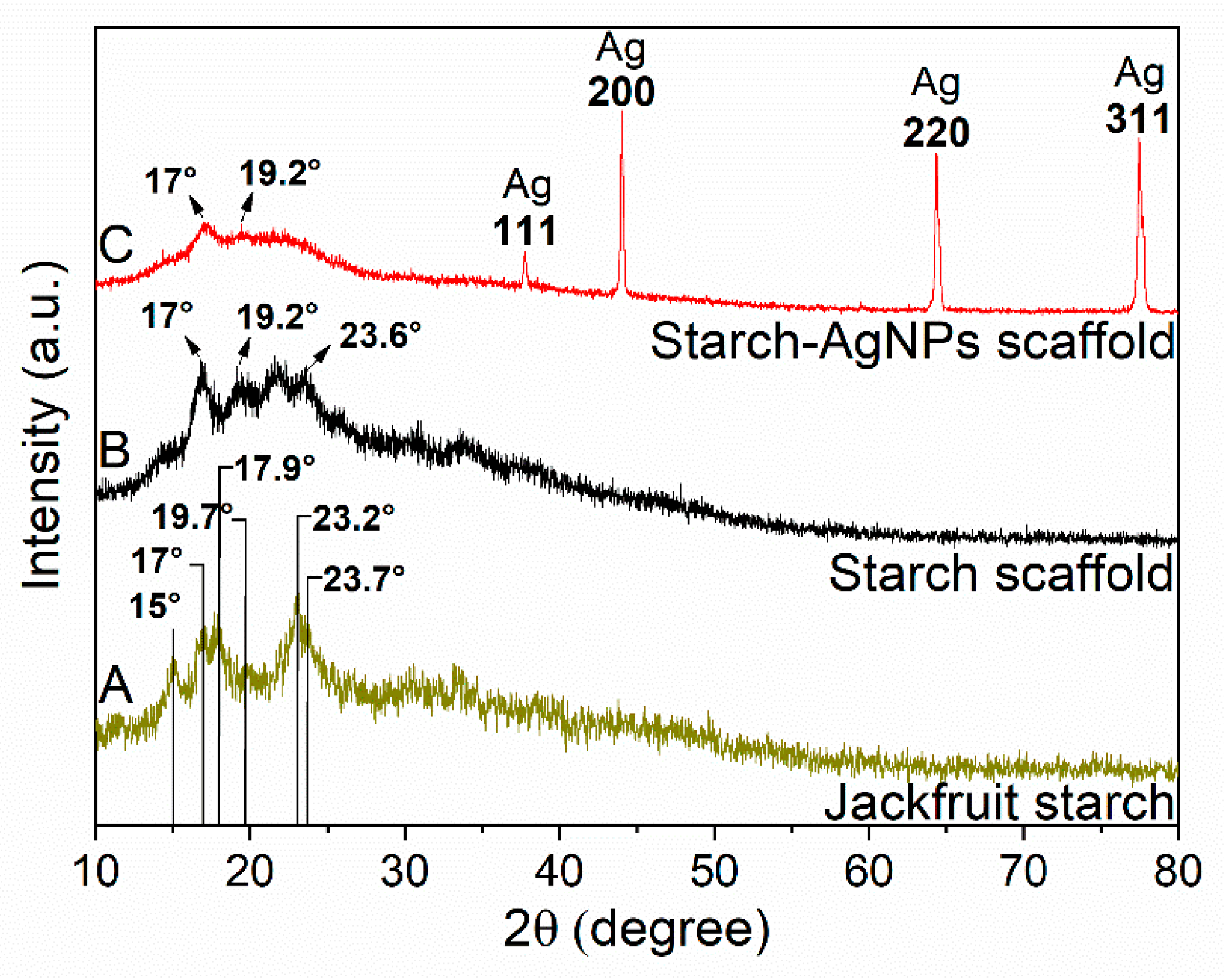
Correction: Rodrigues et al. Physicochemical, Morphological, and Cytotoxic Properties of Brazilian Jackfruit (Artocarpus heterophyllus) Starch Scaffold Loaded with Silver Nanoparticles. J. Funct. Biomater. 2023, 14, 143

 , , and
Error in Figure
Text Correction
Reference
- Rodrigues, J.F.B.; Azevedo, V.S.; Medeiros, R.P.; Barreto, G.B.d.C.; Pinto, M.R.d.O.; Fook, M.V.L.; Montazerian, M. Physicochemical, Morphological, and Cytotoxic Properties of Brazilian Jackfruit (Artocarpus heterophyllus) Starch Scaffold Loaded with Silver Nanoparticles. J. Funct. Biomater. 2023, 14, 143. [Google Scholar] [CrossRef] [PubMed]

Disclaimer/Publisher’s Note: The statements, opinions and data contained in all publications are solely those of the individual author(s) and contributor(s) and not of MDPI and/or the editor(s). MDPI and/or the editor(s) disclaim responsibility for any injury to people or property resulting from any ideas, methods, instructions or products referred to in the content. |
© 2025 by the authors. Licensee MDPI, Basel, Switzerland. This article is an open access article distributed under the terms and conditions of the Creative Commons Attribution (CC BY) license (https://creativecommons.org/licenses/by/4.0/).
Share and Cite
Rodrigues, J.F.B.; Azevedo, V.S.; Medeiros, R.P.; Barreto, G.B.d.C.; Pinto, M.R.d.O.; Fook, M.V.L.; Montazerian, M. Correction: Rodrigues et al. Physicochemical, Morphological, and Cytotoxic Properties of Brazilian Jackfruit (Artocarpus heterophyllus) Starch Scaffold Loaded with Silver Nanoparticles. J. Funct. Biomater. 2023, 14, 143. J. Funct. Biomater. 2025, 16, 464. https://doi.org/10.3390/jfb16120464
Rodrigues JFB, Azevedo VS, Medeiros RP, Barreto GBdC, Pinto MRdO, Fook MVL, Montazerian M. Correction: Rodrigues et al. Physicochemical, Morphological, and Cytotoxic Properties of Brazilian Jackfruit (Artocarpus heterophyllus) Starch Scaffold Loaded with Silver Nanoparticles. J. Funct. Biomater. 2023, 14, 143. Journal of Functional Biomaterials. 2025; 16(12):464. https://doi.org/10.3390/jfb16120464
Chicago/Turabian StyleRodrigues, José Filipe Bacalhau, Valeriano Soares Azevedo, Rebeca Peixoto Medeiros, Gislaine Bezerra de Carvalho Barreto, Maria Roberta de Oliveira Pinto, Marcus Vinicius Lia Fook, and Maziar Montazerian. 2025. "Correction: Rodrigues et al. Physicochemical, Morphological, and Cytotoxic Properties of Brazilian Jackfruit (Artocarpus heterophyllus) Starch Scaffold Loaded with Silver Nanoparticles. J. Funct. Biomater. 2023, 14, 143" Journal of Functional Biomaterials 16, no. 12: 464. https://doi.org/10.3390/jfb16120464
APA StyleRodrigues, J. F. B., Azevedo, V. S., Medeiros, R. P., Barreto, G. B. d. C., Pinto, M. R. d. O., Fook, M. V. L., & Montazerian, M. (2025). Correction: Rodrigues et al. Physicochemical, Morphological, and Cytotoxic Properties of Brazilian Jackfruit (Artocarpus heterophyllus) Starch Scaffold Loaded with Silver Nanoparticles. J. Funct. Biomater. 2023, 14, 143. Journal of Functional Biomaterials, 16(12), 464. https://doi.org/10.3390/jfb16120464