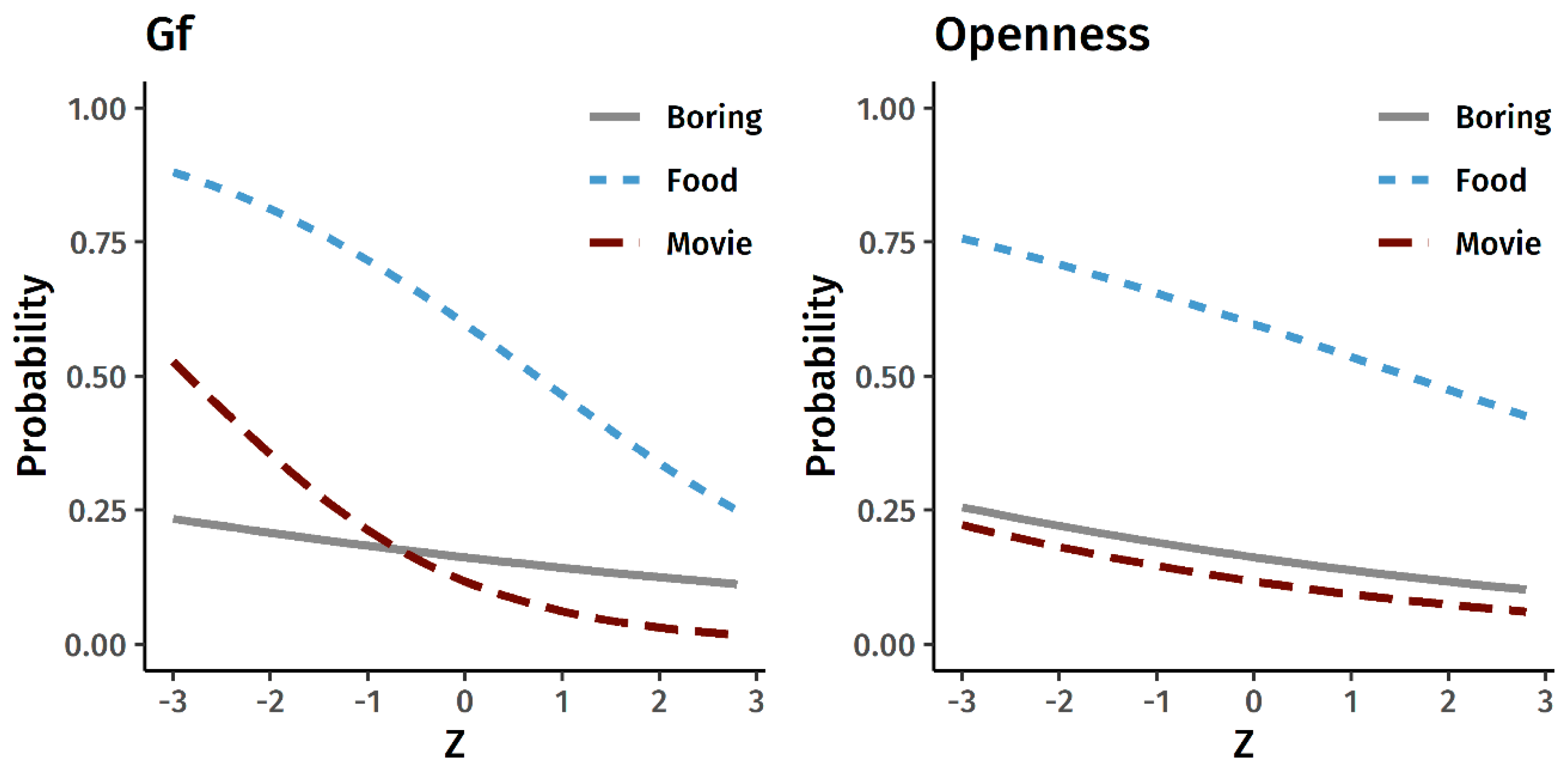
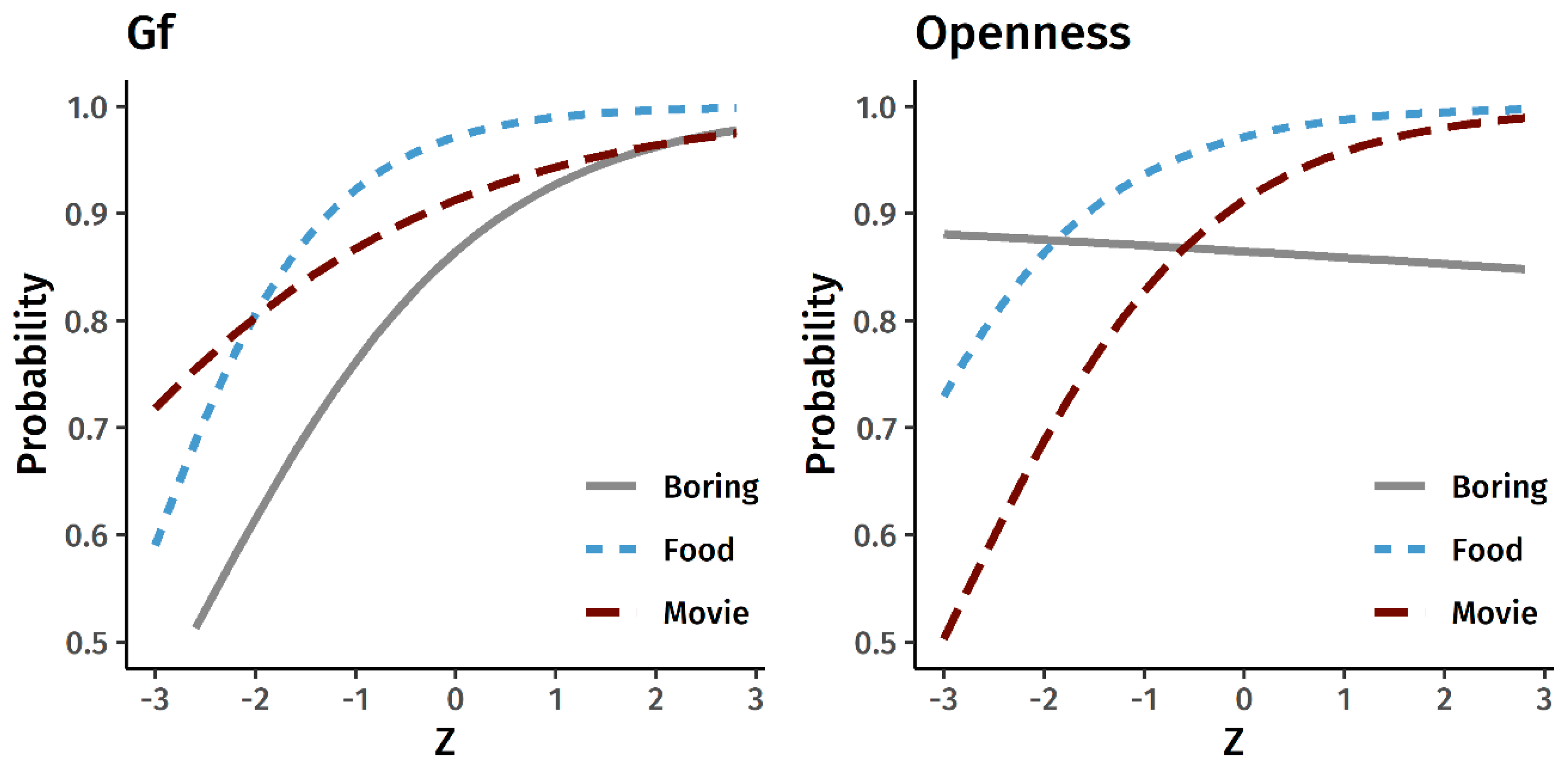
When Figurative Language Goes off the Rails and under the Bus: Fluid Intelligence, Openness to Experience, and the Production of Poor Metaphors


Abstract
1. Introduction
1.1. Crafting Creative Metaphors
1.2. Diving into the Shallow End: The Present Research
2. Materials and Methods
2.1. Participants
2.2. Procedure
2.2.1. Metaphor Assessment
- Think about the worst movie or TV show you have ever seen. What was it like to watch it? Please describe the experience with a metaphor.
- Think of the most boring high-school or college class that you have ever had: What was it like to sit through? Please describe the experience with a metaphor.
- Think about the most disgusting thing you ever ate or drank. What was it like to eat or drink it? Please describe the experience with a metaphor.
2.2.2. Rating the Responses
2.2.3. Coding Non-Metaphors
2.2.4. Coding Real-But-Bad Metaphors
2.2.5. Coding Subcategories
2.2.6. Fluid Intelligence
2.2.7. Openness to Experience
3. Results
3.1. Analysis Plan
3.2. Non-Metaphors
- Adjective Slip. As expected, many non-metaphors were adjective phrases, not figurative expressions. In these responses, people did not compare the topic to something else or subsume the topic and vehicle in the same category. Although the intended meaning was correct—the gross food was indeed described as gross—people expressed the meaning adjectivally using the defining feature of the attributive category.
- Wayward Attribute. Many responses misplaced the vehicle—the response used an incorrect attributive category. For example, such responses did not attribute a proper feature to the topic: a boring class was described as fun or a gross drink was described as fine.
- Off-Topic Idiom. Many responses were expressions that had a metaphor structure but were literally off-topic: the metaphor was about something other than the topic in the prompt. These responses were usually idioms, song lyrics, motivational sayings, and other accessible phrases drawn from memory.
3.3. Bad Metaphors
- Exemplary Exemplar. Many bad metaphors lacked semantic distance. The vehicle was an exemplar of the attributive category, but it was so exemplary that the metaphor was obvious, boring, and predictable. These responses tended to have the abstract structure “x is/is like the most salient and typical member of category y.”
- Retrieved Cliché. Other bad metaphors were stock phrases and dead metaphors retrieved from memory. These were often the most obvious possible idioms, such as describing being in a boring class as like “watching paint dry” or “watching grass grow,” given by participants who were presumably not trying to avoid clichés like the plague.
4. Discussion
Author Contributions
Funding
Institutional Review Board Statement
Informed Consent Statement
Conflicts of Interest
Appendix A. Task Instructions
References
- Ackerman, Phillip L., and Eric D. Heggestad. 1997. Intelligence, personality, and interests: Evidence for overlapping traits. Psychological Bulletin 121: 219–45. [Google Scholar] [CrossRef] [Scilit] [PubMed]
- Beaty, Roger E., and Paul J. Silvia. 2013. Metaphorically speaking: Cognitive abilities and the production of figurative language. Memory and Cognition 41: 255–67. [Google Scholar] [CrossRef] [Scilit] [PubMed]
- Beaty, Roger E., Paul J. Silvia, and Mathias Benedek. 2017. Brain networks underlying novel metaphor production. Brain and Cognition 111: 163–70. [Google Scholar] [CrossRef] [Scilit] [PubMed]
- Benedek, Mathias, Emanuel Jauk, Andreas Fink, Karl Koschutnig, Gernot Reishofer, Franz Ebner, and Aljoscha C. Neubauer. 2014a. To create or to recall? Neural mechanisms underlying the generation of creative new ideas. NeuroImage 88: 125–33. [Google Scholar] [CrossRef] [Scilit] [PubMed]
- Benedek, Mathias, Roger Beaty, Emanuel Jauk, Karl Koschutnig, Andreas Fink, Paul J. Silvia, Beate Dunst, and Aljoscha C. Neubauer. 2014b. Creating metaphors: The neural basis of figurative language production. NeuroImage 90: 99–106. [Google Scholar] [CrossRef] [Scilit]
- Christensen, Alexander P., Paul J. Silvia, Emily C. Nusbaum, and Roger E. Beaty. 2018. Clever people: Intelligence and humor production ability. Psychology of Aesthetics, Creativity, and the Arts 12: 136–43. [Google Scholar] [CrossRef] [Scilit]
- Christensen, Alexander P., Katherine N. Cotter, and Paul J. Silvia. 2019. Reopening openness to experience: A network analysis of four openness to experience inventories. Journal of Personality Assessment 106: 574–88. [Google Scholar] [CrossRef] [Scilit]
- Chrysikou, Evangelia G. 2019. Creativity in and out of (cognitive) control. Current Opinion in Behavioral Sciences 27: 94–99. [Google Scholar] [CrossRef] [Scilit]
- Conner, Tamlin S., and Paul J. Silvia. 2015. Creative days: A daily diary study of emotion, personality, and everyday creativity. Psychology of Aesthetics, Creativity, and the Arts 9: 463–70. [Google Scholar] [CrossRef] [Scilit]
- Costa, Paul T., Jr., and Robert R. McCrae. 1992. Revised NEO Personality Inventory (NEO-PI-R) and NEO Five-Factor Inventory (NEO-FFI) Professional Manual. Odessa: Psychological Assessment Resources. [Google Scholar]
- de Barros, Débora P., Ricardo Primi, Fabiano Koich Miguel, Leandro S. Almeida, and Ema P. Oliveira. 2010. Metaphor creation: A measure of creativity or intelligence? European Journal of Education and Psychology 3: 103–15. [Google Scholar]
- Dygert, Sarah K., and Andrew F. Jarosz. 2020. Individual differences in creative cognition. Journal of Experimental Psychology: General 149: 1249–74. [Google Scholar] [CrossRef] [Scilit] [PubMed]
- Frith, Emily, Daniel Elbich, Alexander P. Christensen, Monica D. Rosenberg, Qunlin Chen, Paul J. Silvia, Paul Seil, and Roger E. Beaty. in press. Intelligence and creativity share a common cognitive and neural basis. Journal of Experimental Psychology: General. [CrossRef] [Scilit]
- Gilhooly, Kenneth J., E. E. Fioratou, S. H. Anthony, and V. V. Wynn. 2007. Divergent thinking: Strategies and executive involvement in generating novel uses for familiar objects. British Journal of Psychology 98: 611–25. [Google Scholar] [CrossRef] [Scilit]
- Glucksberg, Sam. 2001. Understanding Figurative Language: From Metaphors to Idioms. New York: Oxford University Press. [Google Scholar]
- Glucksberg, Sam. 2003. The psycholinguistics of metaphor. Trends in Cognitive Sciences 7: 92–96. [Google Scholar] [CrossRef] [Scilit]
- Glucksberg, Sam. 2008. How metaphors create categories—Quickly. In Cambridge Handbook of Metaphor and Thought. Edited by Raymond W. Gibbs, Jr. Cambridge: Cambridge University Press, pp. 67–83. [Google Scholar]
- Goatly, Andrew. 2011. The Language of Metaphors, 2nd ed. London: Routledge. [Google Scholar]
- Karwowski, Maciej, and Izabela Lebuda. 2016. The big five, the huge two, and creative self-beliefs: A meta-analysis. Psychology of Aesthetics, Creativity, and the Arts 10: 214–32. [Google Scholar] [CrossRef] [Scilit]
- Karwowski, Maciej, Izabela Lebuda, and Ronald A. Beghetto. 2019. Creative self-beliefs. In Cambridge Handbook of Creativity. Edited by James C. Kaufman and Robert J. Sternberg. Cambridge: Cambridge University Press, pp. 396–417. [Google Scholar]
- Lee, Christine S., and David J. Therriault. 2013. The cognitive underpinnings of creative thought: A latent variable analysis exploring the roles of intelligence and working memory in three creative thinking processes. Intelligence 41: 306–20. [Google Scholar] [CrossRef] [Scilit]
- Martin, Demetri. 2006. These Are Jokes [Audio Recording]. New York: Comedy Central Records. [Google Scholar]
- Menashe, Shay, Rotem Leshem, Vered Heruti, Anat Kasirer, Tami Yair, and Nira Mashal. 2020. Elucidating the role of selective attention, divergent thinking, language abilities, and executive functions in metaphor generation. Neuropsychologia 142: 107458. [Google Scholar] [CrossRef] [Scilit] [PubMed]
- Nusbaum, Emily C., and Paul J. Silvia. 2011. Are intelligence and creativity really so different? Fluid intelligence, executive processes, and strategy use in divergent thinking. Intelligence 39: 36–45. [Google Scholar] [CrossRef] [Scilit]
- Nusbaum, Emily C., Paul J. Silvia, and Roger E. Beaty. 2014. Ready, set, create: What instructing people to “be creative” reveals about the meaning and mechanisms of divergent thinking. Psychology of Aesthetics, Creativity, and the Arts 8: 423–32. [Google Scholar] [CrossRef] [Scilit]
- Nusbaum, Emily C., Paul J. Silvia, and Roger E. Beaty. 2017. Ha ha? Assessing individual differences in humor production ability. Psychology of Aesthetics, Arts, and Creativity 11: 231–41. [Google Scholar] [CrossRef] [Scilit]
- Pierce, Russell S., and Dan L. Chiappe. 2009. The roles of aptness, conventionality, and working memory in the production of metaphors and similes. Metaphor and Symbol 24: 1–19. [Google Scholar] [CrossRef] [Scilit]
- Primi, Ricardo. 2014. Divergent productions of metaphors: Combining many-facet Rasch measurement and cognitive psychology in the assessment of creativity. Psychology of Aesthetics, Creativity, and the Arts 8: 461–74. [Google Scholar] [CrossRef] [Scilit]
- Silvia, Paul J. 2006. Exploring the Psychology of Interest. New York: Oxford University Press. [Google Scholar]
- Silvia, Paul J., and Roger E. Beaty. 2012. Making creative metaphors: The importance of fluid intelligence for creative thought. Intelligence 40: 343–51. [Google Scholar] [CrossRef] [Scilit]
- Silvia, Paul J., Emily C. Nusbaum, Christopher Berg, Christopher Martin, and Alejandra O’Connor. 2009. Openness to experience, plasticity, and creativity: Exploring lower-order, high-order, and interactive effects. Journal of Research in Personality 43: 1087–90. [Google Scholar] [CrossRef] [Scilit]
- Skalicky, Stephen. 2020. Exploring perceptions of novelty and mirth in elicited figurative language production. Metaphor and Symbol 35: 77–96. [Google Scholar] [CrossRef] [Scilit]
- Sutin, Angelina R. 2017. Openness. In Oxford Handbook of the Five Factor Model. Edited by Thomas A. Widiger. Oxford: Oxford University Press, pp. 83–104. [Google Scholar]
- Sutu, Andrea, Cassandra N. Phetmisy, and Rodica Ioana Damian. in press. Open to laugh: The role of openness to experience in humor production ability. Psychology of Aesthetics, Creativity, and the Arts. [CrossRef] [Scilit]
- Taylor, Calvin W. 1947. A factorial study of fluency in writing. Psychometrika 12: 239–62. [Google Scholar] [CrossRef] [Scilit]
- Welhaf, Matthew S., Bridget A. Smeekens, Matt E. Meier, Paul J. Silvia, Thomas R. Kwapil, and Michael J. Kane. 2020. Worst performance rule, or not-best performance rule? Latent-variable analyses of working memory capacity, mind-wandering propensity, and reaction time. Journal of Intelligence 8: 25. [Google Scholar] [CrossRef] [Scilit]


| Task | Description | Terrible Movie | Boring Class | Gross Food |
|---|---|---|---|---|
| Ravens Progressive Matrices | Select the item that completes a 3 × 3 matrix (12 min) | X | ||
| Culture-Fair Matrix Completion | Select the item that completes a matrix (3 min) | X | ||
| Culture-Fair Series Completion | Select the item that logically completes a series of shapes (3 min) | X | X | X |
| Letter Series | Discern the pattern governing sets of 4 letters, and pick the set that violates the rule (4 min) | X | X | X |
| Number Series | Discern the pattern underlying a series of numbers (4.5 min) | X | X | |
| Paper Folding | Select the item that represents what a square of paper would look like if folded and punched with holes (3 min) | X | X | X |
| Metaphor Type | Terrible Movie | Boring Class | Gross Food | |
|---|---|---|---|---|
| Non-Metaphors | Total of All Responses | 11.7% (16 of 137) | 15.4% (19 of 123) | 6.0% (12 of 201) |
| Adjective Slip | 31.3% (5) | 0% (0) | 33.3% (4) | |
| Wayward Attribute | 12.5% (2) | 26.3% (5) | 25.0% (3) | |
| Off-Topic Idiom | 37.5% (6) | 47.4% (9) | 8.3% (1) | |
| Other | 18.8% (3) | 26.3% (5) | 33.3% (4) | |
| Bad Metaphors | Total of Metaphors | 13.2% (16 of 121) | 16.3% (17 of 104) | 58.2% (110 of 189) |
| Exemplary Exemplar | 18.8% (3) | 17.6% (3) | 60.9% (67) | |
| Retrieved Cliché | 50.0% (8) | 58.8% (10) | 0% (0) | |
| Other | 31.3% (5) | 23.5% (4) | 39.1% (43) |
| Response Type | Terrible Movie | Boring Class | Gross Food | |
|---|---|---|---|---|
| Non-Metaphors | Adjective Slip | “That movie was sad” “Being in the theater was horrible” | none | “That drink was dirty” “Eating that was destructive” “It burned my throat and stomach” |
| Wayward Attribute | “Sitting through that show was like going on an amazing and wonderful journey.” “Being in that theater was like a sunset on the beach” | “Sitting in that class was like laying out on a sunny day: HOTTT!!!” “That class was like a clown, humorous yet attention getting.” | “That coconut milk was like drinking strong sweet water” | |
| Off-Topic Idiom | “Relationships are like hot chocolate” “I miss you like an idiot misses the point” | “Paying my bill is like getting my period every month: Painful but all for a good cause.” “Love is like the sea in many aspects: it gets deeper and can send you in many directions.” | Participant quoted lengthy song lyrics about self-harm | |
| Bad Metaphors | Exemplary Exemplar | “That movie was like torture” “That movies was like dying” | “Sitting in that class was like being in hell” “Being in that class was like hell, it was not fun at all.” | “That drink tasted like crap” “Drinking that was like tasting urine” “Eating that was like eating dirt” “Eating that is like actually tasting rotten eggs” |
| Idiom Retrieval | “That movie hit me like a ton of bricks.” “Sitting through that show was like watching grass grow.” | “That class was like being forced to listen to nails on a chalkboard.” “Sitting through that class was like watching paint dry.” | none |
Publisher’s Note: MDPI stays neutral with regard to jurisdictional claims in published maps and institutional affiliations. |
© 2021 by the authors. Licensee MDPI, Basel, Switzerland. This article is an open access article distributed under the terms and conditions of the Creative Commons Attribution (CC BY) license (http://creativecommons.org/licenses/by/4.0/).
Share and Cite
Silvia, P.J.; Beaty, R.E. When Figurative Language Goes off the Rails and under the Bus: Fluid Intelligence, Openness to Experience, and the Production of Poor Metaphors. J. Intell. 2021, 9, 2. https://doi.org/10.3390/jintelligence9010002
Silvia PJ, Beaty RE. When Figurative Language Goes off the Rails and under the Bus: Fluid Intelligence, Openness to Experience, and the Production of Poor Metaphors. Journal of Intelligence. 2021; 9(1):2. https://doi.org/10.3390/jintelligence9010002
Chicago/Turabian StyleSilvia, Paul J., and Roger E. Beaty. 2021. "When Figurative Language Goes off the Rails and under the Bus: Fluid Intelligence, Openness to Experience, and the Production of Poor Metaphors" Journal of Intelligence 9, no. 1: 2. https://doi.org/10.3390/jintelligence9010002
APA StyleSilvia, P. J., & Beaty, R. E. (2021). When Figurative Language Goes off the Rails and under the Bus: Fluid Intelligence, Openness to Experience, and the Production of Poor Metaphors. Journal of Intelligence, 9(1), 2. https://doi.org/10.3390/jintelligence9010002