The Emotion Regulation Flexibility Questionnaire: A Rasch-Validated Version for Children




Abstract
1. Introduction
1.1. Emotion Regulation and Emotion Regulation Flexibility
1.2. Correlates of Emotion Regulation Flexibility
1.3. Emotion Regulation Flexibility as a Mediator Between Malleability Beliefs and Well-Being
1.4. Measurement of Emotion Regulation Flexibility
1.5. The Present Study
- The first aim was to examine the factorial structure of the ERFQ-C. We hypothesized that the scale would exhibit a unidimensional structure (Hypothesis 1a, H1a; Mignolli et al., 2025; Monsoon et al., 2022). Additionally, we expected the measure to demonstrate measurement invariance (MI) across sex (i.e., a binary classification given at birth; American Psychological Association, 2024) and school level (primary and lower secondary schools; H1b).
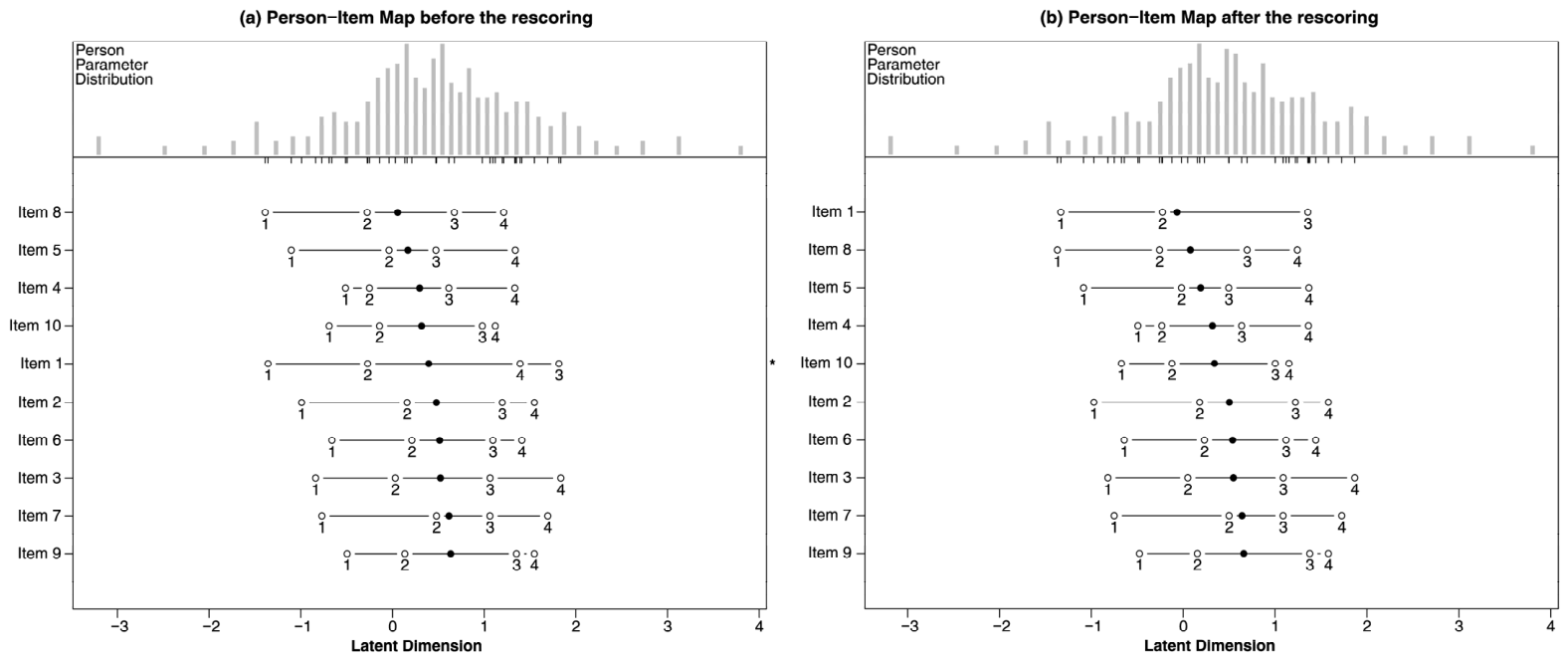
- The second aim was to apply RA to the ERFQ-C after verifying its key assumptions (Andrich, 1988; Bond & Fox, 2007). We hypothesized that the assumptions of monotonicity, unidimensionality, and local independence would be satisfied (H2a). Furthermore, we expected the ERFQ-C to demonstrate adequate fit to the Rasch model (H2b). Finally, we expected the ERFQ-C to provide precise and invariant measurement, as evidenced by adequate person separation index (PSI) estimates, satisfactory person–item targeting, and the absence of significant differential item functioning (DIF; H2c).
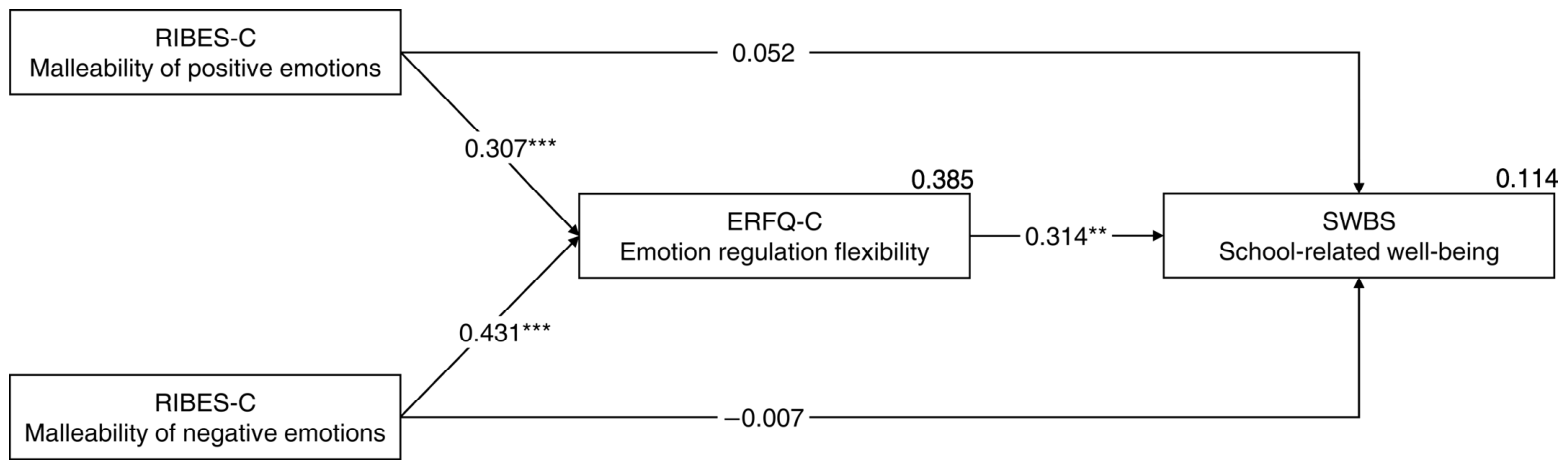
- The third aim was to investigate the mediating role of ERF perception in the relation between malleability beliefs of positive and negative emotions and school-related well-being. In line with the sparse literature on youth, we hypothesized that stronger malleability beliefs would be positively associated with higher perceived ERF (H3a; McKone et al., 2024), which in turn would be positively associated with greater school-related well-being (H3b; De France & Hollenstein, 2019; Haag et al., 2024; Parsafar et al., 2019; Quiñones-Camacho & Davis, 2018). Based on the literature on adults (Monsoon et al., 2022), we finally explored whether ERF perception would function as a partial or full mediator in this relation, while acknowledging limitations related to the cross-sectional design.
2. Materials and Methods
2.1. Participants and Procedure
2.2. Measures
2.2.1. Emotion Regulation Flexibility
2.2.2. Malleability of Emotions
2.2.3. School-Related Well-Being
2.3. Data Analysis
3. Results
3.1. Confirmatory Factor Analysis and Measurement Invariance (Aim 1)
3.2. Rasch Analysis (Aim 2)
3.3. Path Analyses (Aim 3)
4. Discussion
4.1. Theoretical and Practical Implications
4.2. Limitations and Future Directions
5. Conclusions
Author Contributions
Funding
Institutional Review Board Statement
Informed Consent Statement
Data Availability Statement
Acknowledgments
Conflicts of Interest
References
- Aldao, A., Sheppes, G., & Gross, J. J. (2015). Emotion regulation flexibility. Cognitive Therapy and Research, 39(3), 263–278. [Google Scholar] [CrossRef] [Scilit]
- American Psychological Association. (2024, October). Gender. APA Style. Available online: https://apastyle.apa.org/style-grammar-guidelines/bias-free-language/gender (accessed on 26 May 2026).
- Andersen, E. B. (1973). A goodness of fit test for the Rasch model. Psychometrika, 38(1), 123–140. [Google Scholar] [CrossRef] [Scilit]
- Andrich, D. (1988). Rasch models for measurement. Sage Publications. [Google Scholar]
- Asparouhov, T., & Muthén, B. (2009). Exploratory structural equation modeling. Structural Equation Modeling, 16(3), 397–438. [Google Scholar] [CrossRef] [Scilit]
- Battaglini, A. M., Rnic, K., Jameson, T., Jopling, E., & LeMoult, J. (2023). Interpersonal emotion regulation flexibility: Effects on affect in daily life. Emotion, 23(4), 1048–1060. [Google Scholar] [CrossRef] [Scilit]
- Blackwell, L. S., Trzesniewski, K. H., & Dweck, C. S. (2007). Implicit theories of intelligence predict achievement across an adolescent transition: A longitudinal study and an intervention. Child Development, 78(1), 246–263. [Google Scholar] [CrossRef] [Scilit]
- Bonanno, G. A., & Burton, C. L. (2013). Regulatory flexibility: An individual differences perspective on coping and emotion regulation. Perspectives on Psychological Science, 8(6), 591–612. [Google Scholar] [CrossRef] [Scilit]
- Bonanno, G. A., Papa, A., Lalande, K., Westphal, M., & Coifman, K. (2004). The importance of being flexible: The ability to both enhance and suppress emotional expression predicts long-term adjustment. Psychological Science, 15(7), 482–487. [Google Scholar] [CrossRef] [Scilit] [PubMed]
- Bond, T. G., & Fox, C. M. (2007). Applying the Rasch model: Fundamental measurement in the human sciences (2nd ed.). Lawrence Erlbaum Associates. [Google Scholar]
- Braet, J., Debra, G., Rein, M. T., Gross, J. J., Werner, K. M., & Giletta, M. (2026). Handling the ups and downs of adolescence: The role of emotion regulation repertoires. Affective Science. Advance online publication. [Google Scholar] [CrossRef] [Scilit]
- Burnette, J. L., O’Boyle, E. H., VanEpps, E. M., Pollack, J. M., & Finkel, E. J. (2013). Mind-sets matter: A metaanalytic review of implicit theories and self-regulation. Psychological Bulletin, 139(3), 655–701. [Google Scholar] [CrossRef] [Scilit]
- Chen, F. F. (2007). Sensitivity of goodness of fit indexes to lack of measurement invariance. Structural Equation Modeling: A Multidisciplinary Journal, 14(3), 464–504. [Google Scholar] [CrossRef] [Scilit]
- Cohen, J. (1988). Statistical power analysis for the behavioral sciences (2nd ed.). Lawrence Erlbaum Associates. [Google Scholar]
- Crawford, C. M., Griffith, J. M., Hankin, B. L., & Young, J. F. (2021). Implicit beliefs about emotions in youth: Associations with temperamental negative emotionality and depression. Journal of Social and Clinical Psychology, 40(2), 121–144. [Google Scholar] [CrossRef] [Scilit]
- Cronbach, L. J. (1951). Coefficient alpha and the internal structure of tests. Psychometrika, 16, 297–324. [Google Scholar] [CrossRef] [Scilit]
- Daniel, S. K., Abdel-Baki, R., & Hall, G. B. (2020). The protective effect of emotion regulation on child and adolescent wellbeing. Journal of Child and Family Studies, 29(7), 2010–2027. [Google Scholar] [CrossRef] [Scilit]
- De Castella, K., Goldin, P., Jazaieri, H., Ziv, M., Dweck, C. S., & Gross, J. J. (2013). Beliefs about emotion: Links to emotion regulation, well-being, and psychological distress. Basic and Applied Social Psychology, 35(6), 497–505. [Google Scholar] [CrossRef] [Scilit]
- De France, K., & Hollenstein, T. (2017). Assessing emotion regulation repertoires: The Regulation of Emotion Systems Survey. Personality and Individual Differences, 119, 204–215. [Google Scholar] [CrossRef] [Scilit]
- De France, K., & Hollenstein, T. (2019). Emotion regulation and relations to well-being across the lifespan. Developmental Psychology, 55(8), 1768–1774. [Google Scholar] [CrossRef] [Scilit] [PubMed]
- De France, K., & Hollenstein, T. (2021). Implicit theories of emotion and mental health during adolescence: The mediating role of emotion regulation. Cognition and Emotion, 35(2), 367–374. [Google Scholar] [CrossRef] [Scilit] [PubMed]
- Dickerson, K., Flynn, E., Levine, L. J., & Quas, J. A. (2018). Are emotions controllable? Maltreated and non-maltreated youth’s implicit beliefs about emotion and aggressive tendencies. Child Abuse & Neglect, 77, 222–231. [Google Scholar] [CrossRef] [Scilit]
- Doorley, J. D., Goodman, F. R., Kelso, K. C., & Kashdan, T. B. (2020). Psychological flexibility: What we know, what we do not know, and what we think we know. Social and Personality Psychology Compass, 14(12), 1–11. [Google Scholar] [CrossRef] [Scilit]
- Double, K. S., Pinkus, R. T., & MacCann, C. (2022). Emotionally intelligent people show more flexible regulation of emotions in daily life. Emotion, 22(2), 397–402. [Google Scholar] [CrossRef] [Scilit]
- Dweck, C. S. (2006). Mindset: The new psychology of success. Random House. [Google Scholar]
- Eldesouky, L., & English, T. (2021). Always in flux: The role of attentional focus in emotion regulation dynamics. Cognition and Emotion, 36(2), 345–351. [Google Scholar] [CrossRef] [Scilit]
- English, T., & Eldesouky, L. (2020). Emotion regulation flexibility: Challenges and promise of using ecological momentary assessment. European Journal of Psychological Assessment, 36(3), 456–459. [Google Scholar] [CrossRef] [Scilit]
- Ford, B. Q., & Gross, J. J. (2019). Why beliefs about emotion matter: An emotion-regulation perspective. Current Directions in Psychological Science, 28(1), 74–81. [Google Scholar] [CrossRef] [Scilit]
- Ford, B. Q., Lwi, S. J., Gentzler, A. L., Hankin, B., & Mauss, I. B. (2018). The cost of believing emotions are uncontrollable: Youths’ beliefs about emotion predict emotion regulation and depressive symptoms. Journal of Experimental Psychology: General, 147(8), 1170–1190. [Google Scholar] [CrossRef] [Scilit]
- Garnefski, N., Kraaij, V., & Spinhoven, P. (2001). Negative life events, cognitive emotion regulation and emotional problems. Personality and Individual Differences, 30(8), 1311–1327. [Google Scholar] [CrossRef] [Scilit]
- Goodman, F. R., Daniel, K. E., Eldesouky, L., Brown, B. A., & Kneeland, E. T. (2021). How do people with social anxiety disorder manage daily stressors? Deconstructing emotion regulation flexibility in daily life. Journal of Affective Disorders Reports, 6, 100210. [Google Scholar] [CrossRef] [Scilit]
- Grommisch, G., Koval, P., Hinton, J. D. X., Gleeson, J., Hollenstein, T., Kuppens, P., & Lischetzke, T. (2020). Modeling individual differences in emotion regulation repertoire in daily life with multilevel latent profile analysis. Emotion, 20(8), 1462–1474. [Google Scholar] [CrossRef] [Scilit]
- Gross, J. J. (1998). The emerging field of emotion regulation: An integrative review. Review of General Psychology, 2(3), 271–299. [Google Scholar] [CrossRef]
- Gross, J. J. (2015). The extended process model of emotion regulation: Elaborations, applications, and future directions. Psychological Inquiry, 26(1), 130–137. [Google Scholar] [CrossRef] [Scilit]
- Gyurak, A., Gross, J. J., & Etkin, A. (2011). Explicit and implicit emotion regulation: A dual-process framework. Cognition and Emotion, 25(3), 400–412. [Google Scholar] [CrossRef] [Scilit]
- Haag, A. C., Bagrodia, R., & Bonanno, G. A. (2024). Emotion regulation flexibility in adolescents: A systematic review from conceptualization to methodology. Clinical Child and Family Psychology Review, 27(3), 697–713. [Google Scholar] [CrossRef] [Scilit]
- Harley, J. M., Pekrun, R., Taxer, J. L., & Gross, J. J. (2019). Emotion regulation in achievement situations: An integrated model. Educational Psychologist, 54(2), 106–126. [Google Scholar] [CrossRef] [Scilit]
- Hascher, T. (2007). Exploring student’s well-being by taking a variety of looks into the classroom. Hellenic Journal of Psychology, 4, 331–349. [Google Scholar]
- Hu, L. T., & Bentler, P. M. (1999). Cutoff criteria for fit indexes in covariance structure analysis: Conventional criteria versus new alternatives. Structural Equation Modeling: A Multidisciplinary Journal, 6(1), 1–55. [Google Scholar] [CrossRef] [Scilit]
- Jiang, X., Paley, N., & Shi, D. (2022). Examining the validity and measurement invariance across gender and race of the implicit thoughts, emotion, and behavior questionnaire. School Psychology, 37(4), 330–338. [Google Scholar] [CrossRef] [Scilit] [PubMed]
- Jodoin, M. G., & Gierl, M. J. (2001). Evaluating type I error and power rates using an effect size measure with the logistic regression procedure for DIF detection. Applied Measurement in Education, 14(4), 329–349. [Google Scholar] [CrossRef] [Scilit]
- Junghänel, M., Wand, H., Dose, C., Thöne, A. K., Treier, A. K., Hanisch, C., Ritschel, A., Kölch, M., Lincke, L., Roessner, V., Kohls, G., Ravens-Sieberer, U., Kaman, A., Banaschewski, T., Aggensteiner, P. M., Görtz-Dorten, A., Döpfner, M., & ADOPT Consortium. (2022). Validation of a new emotion regulation self-report questionnaire for children. BMC Psychiatry, 22(1), 820. [Google Scholar] [CrossRef] [Scilit] [PubMed]
- Kaiser, H. F. (1974). An index of factorial simplicity. Psychometrika, 39, 31–36. [Google Scholar] [CrossRef] [Scilit]
- Kalokerinos, E. K., & Koval, P. (2024). Emotion regulation flexibility. In J. J. Gross, & B. Q. Ford (Eds.), Handbook of emotion regulation (3rd ed., pp. 265–273). The Guilford Press. [Google Scholar]
- Kashdan, T. B., & Rottenberg, J. (2010). Psychological flexibility as a fundamental aspect of health. Clinical Psychology Review, 30(7), 865–878. [Google Scholar] [CrossRef] [Scilit]
- Kirkcaldy, B., Furnham, A., & Siefen, G. (2004). The relationship between health efficacy, educational attainment, and well-being among 30 nations. European Psychologist, 9(2), 107–119. [Google Scholar] [CrossRef] [Scilit]
- Lougheed, J. P., & Hollenstein, T. (2012). A limited repertoire of emotion regulation strategies is associated with internalizing problems in adolescence. Social Development, 21(4), 704–721. [Google Scholar] [CrossRef] [Scilit]
- Maciejewski, D. F., van Lier, P. A. C., Branje, S. J. T., Meeus, W. H. J., & Koot, H. M. (2017). A daily diary study on adolescent emotional experiences: Measurement invariance and developmental trajectories. Psychological Assessment, 29(1), 35–49. [Google Scholar] [CrossRef] [Scilit] [PubMed]
- Martin-Löf, P. (1966). The definition of random sequences. Information and Control, 9(6), 602–619. [Google Scholar] [CrossRef] [Scilit]
- Masters, G. N., & Wright, B. D. (1997). The partial credit model. In W. J. van der Linden, & R. K. Hambleton (Eds.), Handbook of modern item response theory. Springer. [Google Scholar] [CrossRef] [Scilit]
- Mayer, J. D., Caruso, D. R., & Salovey, P. (2016). The ability model of emotional intelligence: Principles and updates. Emotion Review, 8(4), 290–300. [Google Scholar] [CrossRef] [Scilit]
- Mayer, J. D., & Salovey, P. (1997). What is emotional intelligence? In P. Salovey, & J. D. Mayer (Eds.), Emotional development and emotional intelligence: Educational implications (pp. 3–34). Basic Books. [Google Scholar]
- McDonald, R. P. (1999). Test theory: A unified treatment. Erlbaum. [Google Scholar]
- McKone, K. M., Edershile, E. A., Ladouceur, C. D., & Silk, J. S. (2024). Real-world flexibility in adolescent girls’ emotion regulation strategy selection: An investigation of strategy switching. Development and Psychopathology, 36(1), 181–195. [Google Scholar] [CrossRef] [Scilit]
- McLachlan, J., Mehdikhani, M., Larham, B., & Centifanti, L. C. M. (2022). Borderline personality traits and emotion regulation strategies in adolescents: The role of implicit theories. Child Psychiatry & Human Development, 53(5), 899–907. [Google Scholar] [CrossRef] [Scilit]
- Mignolli, G., Colledani, D., Tommasi, F., & Meneghini, A. M. (2025). Investigating the psychometric properties of the Emotion Regulation Flexibility Questionnaire in the Italian context. European Journal of Investigation in Health, Psychology and Education, 15(8), 165. [Google Scholar] [CrossRef] [Scilit]
- Monsoon, A. D., Preece, D. A., & Becerra, R. (2022). Control and acceptance beliefs about emotions: Associations with psychological distress and the mediating role of emotion regulation flexibility. Australian Psychologist, 57(4), 236–248. [Google Scholar] [CrossRef] [Scilit]
- Parsafar, P., Fontanilla, F. L., & Davis, E. L. (2019). Emotion regulation strategy flexibility in childhood: When do children switch between different strategies? Journal of Experimental Child Psychology, 183, 1–18. [Google Scholar] [CrossRef] [Scilit] [PubMed]
- Pekrun, R. (2006). The Control-Value Theory of achievement emotions: Assumptions, corollaries, and implications for educational research and practice. Educational Psychology Review, 18(4), 315–341. [Google Scholar] [CrossRef] [Scilit]
- Pekrun, R. (2020). Self-report is indispensable to assess students’ learning. Frontline Learning Research, 8(3), 185–193. [Google Scholar] [CrossRef] [Scilit]
- Pekrun, R. (2024). Control-value theory: From achievement emotion to a general theory of human emotions. Educational Psychology Review, 36(3), 83. [Google Scholar] [CrossRef] [Scilit]
- Pekrun, R., & Bühner, M. (2014). Self-report measures of academic emotions. In R. Pekrun, & L. Linnenbrink-Garcia (Eds.), International handbook of emotions in education (pp. 561–579). Routledge/Taylor & Francis Group. [Google Scholar]
- Peña-Sarrionandia, A., Mikolajczak, M., & Gross, J. J. (2015). Integrating emotion regulation and emotional intelligence traditions: A meta-analysis. Frontiers in Psychology, 6, 160. [Google Scholar] [CrossRef] [Scilit]
- Phillips, K. F. V., & Power, M. J. (2007). A new self-report measure of emotion regulation in adolescents: The regulation of emotions questionnaire. Clinical Psychology & Psychotherapy, 14(2), 145–156. [Google Scholar] [CrossRef] [Scilit]
- Pruessner, L., Barnow, S., Holt, D. V., Joormann, J., & Schulze, K. (2020). A cognitive control framework for understanding emotion regulation flexibility. Emotion, 20(1), 21–29. [Google Scholar] [CrossRef] [Scilit] [PubMed]
- Putnick, D. L., & Bornstein, M. H. (2016). Measurement invariance conventions and reporting: The state of the art and future directions for psychological research. Developmental Review, 41, 71–90. [Google Scholar] [CrossRef] [Scilit]
- Putwain, D. W., Loderer, K., Gallard, D., & Beaumont, J. (2020). School-related subjective well-being promotes subsequent adaptability, achievement, and positive behavioural conduct. British Journal of Educational Psychology, 90(1), 92–108. [Google Scholar] [CrossRef] [Scilit]
- Quiñones-Camacho, L. E., & Davis, E. L. (2018). Discrete emotion regulation strategy repertoires and parasympathetic physiology characterize psychopathology symptoms in childhood. Developmental Psychology, 54(4), 718–730. [Google Scholar] [CrossRef] [Scilit] [PubMed]
- Raccanello, D., Brondino, M., & Moè, A. (2022). Malleability beliefs shape mathematics-related achievement emotions: The mediating role of emotion regulation in primary school children. Learning and Individual Differences, 97, 102177. [Google Scholar] [CrossRef] [Scilit]
- Raccanello, D., Vicentini, G., Moè, A., Lichtenfeld, S., & Burro, R. (2025). Malleability of emotions: Developing the Robust Incremental Beliefs about Emotion Scale for elementary school Children (RIBES-C). Applied Developmental Science. Advance online publication. [Google Scholar] [CrossRef] [Scilit]
- Raccanello, D., Vicentini, G., Trifiletti, E., & Burro, R. (2021). A Rasch analysis of the School-Related Well-being (SRW) scale: Measuring well-being in the transition from primary to secondary school. International Journal of Environmental Research and Public Health, 18(1), 23. [Google Scholar] [CrossRef] [Scilit] [PubMed]
- R Core Team. (2026). R: A language and environment for statistical computing. R Foundation for Statistical Computing. [Google Scholar] [CrossRef] [Scilit]
- Riley, A. W. (2004). Evidence that school-age children can self-report on their health. Ambulatory Pediatrics, 4(4), 371–376. [Google Scholar] [CrossRef] [Scilit] [PubMed]
- Romero, C., Master, A., Paunesku, D., Dweck, C. S., & Gross, J. J. (2014). Academic and emotional functioning in middle school: The role of implicit theories. Emotion, 14(2), 227–234. [Google Scholar] [CrossRef] [Scilit]
- Rosseel, Y. (2012). Lavaan: An R package for structural equation modeling. Journal of Statistical Software, 48(2), 1–36. [Google Scholar] [CrossRef] [Scilit]
- Rydell, A.-M., Thorell, L. B., & Bohlin, G. (2007). Emotion regulation in relation to social functioning: An investigation of child self-reports. European Journal of Developmental Psychology, 4(3), 293–313. [Google Scholar] [CrossRef] [Scilit]
- Salovey, P., & Mayer, J. D. (1990). Emotional intelligence. Imagination, Cognition and Personality, 9(3), 185–211. [Google Scholar] [CrossRef] [Scilit]
- Schleider, J. L., & Weisz, J. R. (2016). Implicit theories relate to youth psychopathology, but how? A longitudinal test of two predictive models. Child Psychiatry and Human Development, 47(4), 603–617. [Google Scholar] [CrossRef] [Scilit]
- Skymba, H. V., Troop-Gordon, W., Modi, H. H., Davis, M. M., Weldon, A. L., Xia, Y., Heller, W., & Rudolph, K. D. (2022). Emotion mindsets and depressive symptoms in adolescence: The role of emotion regulation competence. Emotion, 22(6), 1255–1269. [Google Scholar] [CrossRef] [Scilit]
- Smith, E. N., Romero, C., Donovan, B., Herter, R., Paunesku, D., Cohen, G. L., Dweck, C. S., & Gross, J. J. (2018). Emotion theories and adolescent well-being: Results of an online intervention. Emotion, 18(6), 781–788. [Google Scholar] [CrossRef] [Scilit]
- Southward, M. W., Altenburger, E. M., Moss, S. A., Cregg, D. R., & Cheavens, J. S. (2018). Flexible, yet firm: A model of healthy emotion regulation. Journal of Social and Clinical Psychology, 37(4), 231–251. [Google Scholar] [CrossRef] [Scilit] [PubMed]
- Specker, P., & Nickerson, A. (2024). Investigating the effectiveness of instructing emotion regulation flexibility to individuals with low and high anxiety. Anxiety, Stress, & Coping, 37(1), 143–156. [Google Scholar] [CrossRef] [Scilit]
- Stockinger, K., Vogl, E., & Pekrun, R. (2023). The School-Related Well-Being Scale (SWBS): A brief and reliable measure of students’ overall psychological well-being (User’s manual). PsyArXiv. [Google Scholar] [CrossRef] [Scilit]
- Tamir, M., John, O., Srivastava, S., & Gross, J. (2007). Implicit theories of emotion. Journal of Personality and Social Psychology, 92(4), 731–744. [Google Scholar] [CrossRef] [Scilit] [PubMed]
- Toh, W. X., & Yang, H. (2024). To switch or not to switch? Individual differences in executive function and emotion regulation flexibility. Emotion, 24(1), 52–66. [Google Scholar] [CrossRef] [Scilit]
- World Health Organization. (1948). World Health Organization constitution. Basis documents. World Health Organization. [Google Scholar]
- Wright, B. D., & Masters, G. N. (1982). Rating scale analysis: Rasch measurement. Mesa Press. [Google Scholar]
- Zimmer-Gembeck, M. J., & Skinner, E. A. (2011). The development of coping across childhood and adolescence: An integrative review and critique of research. International Journal of Behavioral Development, 35(1), 1–17. [Google Scholar] [CrossRef] [Scilit]
- Zimmermann, M., Bledsoe, C., & Papa, A. (2021). Longitudinal associations between emotion malleability beliefs and avoidance in college students. Cognition and Emotion, 35(6), 1238–1247. [Google Scholar] [CrossRef] [Scilit] [PubMed]
- Zumbo, B. D. (1999). A handbook on the theory and methods of differential item functioning (DIF): Logistic regression modeling as a unitary framework for binary and likert-type (ordinal) item scores. Directorate of Human Resources Research and Evaluation, Department of National Defense. [Google Scholar]
- Zumbo, B. D., & Thomas, D. R. (1997). A measure of effect size for a model-based approach for studying DIF. Working paper. Edgeworth Laboratory for Quantitative Behavioral Science, University of Northern British Columbia. [Google Scholar]


| Item Number | English Version | Italian Version | Loadings |
|---|---|---|---|
| 1 | I have many strategies I can choose from to manage my emotions. | Ho molte strategie tra cui posso scegliere per gestire le mie emozioni. | 0.770 |
| 2 | When I want to manage an emotion, I know exactly what strategy(s) to use. | Quando voglio gestire un’emozione, so esattamente che strategia/e usare. | 0.722 |
| 3 | I use many different strategies to regulate my emotions. | Uso tante strategie diverse per regolare le mie emozioni. | 0.772 |
| 4 | When an emotion regulation strategy does not work, I try to use a different one. | Quando una strategia di regolazione delle emozioni non funziona, provo a usarne una diversa. | 0.633 |
| 5 | I use different types of emotion regulation strategies for different types of situations or problems. | Uso diversi tipi di strategie di regolazione delle emozioni per diversi tipi di situazioni o problemi. | 0.645 |
| 6 | I combine different types of regulation strategies when trying to manage my emotions (for example, using different strategies together or using them one after the other). | Combino diversi tipi di strategie di regolazione quando provo a gestire le mie emozioni (per esempio, usando diverse strategie insieme oppure usandole una dopo l’altra). | 0.590 |
| 7 | If one emotion regulation strategy doesn’t work, I usually know what to use instead. | Se una strategia di regolazione delle emozioni non funziona, di solito so cosa usare al suo posto. | 0.653 |
| 8 | The emotion regulation strategies that I use usually work well for me. | Le strategie di regolazione delle emozioni che uso di solito funzionano bene per me. | 0.667 |
| 9 | When I use an emotion regulation strategy, I know for how long it is better to use it. | Quando uso una strategia di regolazione delle emozioni, so per quanto tempo è meglio usarla. | 0.580 |
| 10 | I use different emotion regulation strategies depending on the type or intensity of the emotion. | Uso diverse strategie di regolazione delle emozioni a seconda del tipo o dell’intensità dell’emozione. | 0.651 |
| Groups | Model Comparison | ΔCFI | ΔRMSEA | ΔSRMR |
|---|---|---|---|---|
| Sex | Configural → Metric | −0.005 | 0.012 | 0.009 |
| Metric → Scalar | 0.005 | −0.023 | −0.008 | |
| School level | Configural → Metric | −0.005 | 0.011 | 0.009 |
| Metric → Scalar | 0.006 | −0.023 | −0.008 |
| Item Number | 1 | 2 | 3 | 4 | 5 | 6 | 7 | 8 | 9 | 10 |
|---|---|---|---|---|---|---|---|---|---|---|
| 1 | — | 0.134 | 0.136 | −0.099 | −0.152 | −0.234 | −0.095 | −0.002 | −0.209 | −0.154 |
| 2 | — | 0.005 | −0.226 | −0.239 | −0.165 | −0.030 | 0.000 | −0.085 | −0.274 | |
| 3 | — | −0.196 | −0.050 | −0.174 | −0.173 | −0.018 | −0.132 | −0.183 | ||
| 4 | — | −0.089 | −0.043 | −0.085 | −0.201 | −0.166 | 0.022 | |||
| 5 | — | −0.125 | −0.193 | 0.026 | −0.238 | 0.020 | ||||
| 6 | — | −0.101 | −0.198 | 0.050 | −0.157 | |||||
| 7 | — | −0.120 | −0.122 | −0.122 | ||||||
| 8 | — | −0.215 | −0.211 | |||||||
| 9 | — | −0.023 | ||||||||
| 10 | — |
| Item Number | Infit-MNSQ | Outfit-MNSQ |
|---|---|---|
| 1 | 0.775 | 0.784 |
| 2 | 0.870 | 0.883 |
| 3 | 0.762 | 0.768 |
| 4 | 0.973 | 1.029 |
| 5 | 0.959 | 1.000 |
| 6 | 1.040 | 1.035 |
| 7 | 0.919 | 1.037 |
| 8 | 0.944 | 0.937 |
| 9 | 1.060 | 1.058 |
| 10 | 0.957 | 0.902 |
| Item Number | χ2 (LRT) | p | p (adj) | R2 | Effect Size |
|---|---|---|---|---|---|
| 1 | 0.49/2.71 | .780/.258 | .842/.629 | 0.0003/0.0015 | Negligible/Negligible |
| 2 | 2.29/0.39 | .318/.822 | .636/.822 | 0.0010/0.0002 | Negligible/Negligible |
| 3 | 0.40/1.95 | .817/.378 | .842/.629 | 0.0002/0.0009 | Negligible/Negligible |
| 4 | 4.04/5.66 | .132/.059 | .384/.296 | 0.0018/0.0037 | Negligible/Negligible |
| 5 | 6.59/2.00 | .037/.367 | .370/.629 | 0.0057/0.0008 | Negligible/Negligible |
| 6 | 0.41/1.37 | .816/.505 | .842/.647 | 0.0002/0.0008 | Negligible/Negligible |
| 7 | 0.34/0.64 | .842/.725 | .842/.805 | 0.0003/0.0004 | Negligible/Negligible |
| 8 | 4.42/2.80 | .109/.247 | .384/.629 | 0.0030/0.0017 | Negligible/Negligible |
| 9 | 3.74/1.32 | .154/.518 | .384/.647 | 0.0030/0.0008 | Negligible/Negligible |
| 10 | 1.51/6.15 | .471/.046 | .785/.296 | 0.0014/0.0058 | Negligible/Negligible |
| Raw Total Scores | Logit Rasch Scores | Logit Rasch Scores (0–100) |
|---|---|---|
| 10 | −3.974 | 0.000 |
| 11 | −3.184 | 9.258 |
| 12 | −2.464 | 17.701 |
| 13 | −2.030 | 22.776 |
| 14 | −1.715 | 26.477 |
| 15 | −1.463 | 29.427 |
| 16 | −1.251 | 31.906 |
| 17 | −1.067 | 34.063 |
| 18 | −0.903 | 35.987 |
| 19 | −0.754 | 37.737 |
| 20 | −0.616 | 39.352 |
| 21 | −0.487 | 40.861 |
| 22 | −0.365 | 42.286 |
| 23 | −0.249 | 43.643 |
| 24 | −0.138 | 44.945 |
| 25 | −0.031 | 46.203 |
| 26 | 0.072 | 47.427 |
| 27 | 0.175 | 48.623 |
| 28 | 0.275 | 49.798 |
| 29 | 0.374 | 50.959 |
| 30 | 0.472 | 52.111 |
| 31 | 0.570 | 53.260 |
| 32 | 0.669 | 54.412 |
| 33 | 0.768 | 55.573 |
| 34 | 0.868 | 56.749 |
| 35 | 0.970 | 57.947 |
| 36 | 1.075 | 59.177 |
| 37 | 1.184 | 60.447 |
| 38 | 1.297 | 61.771 |
| 39 | 1.416 | 63.164 |
| 40 | 1.542 | 64.646 |
| 41 | 1.679 | 66.244 |
| 42 | 1.828 | 67.996 |
| 43 | 1.995 | 69.958 |
| 44 | 2.188 | 72.215 |
| 45 | 2.419 | 74.914 |
| 46 | 2.710 | 78.328 |
| 47 | 3.115 | 83.075 |
| 48 | 3.803 | 91.135 |
| 49 | 4.560 | 100.000 |
| 1 | 2 | 3 | 4 | |
|---|---|---|---|---|
| 1. ERFQ-C | - | |||
| 2. RIBES-C—Malleability of positive emotions | 0.538 *** | - | ||
| 3. RIBES-C—Malleability of negative emotions | 0.512 *** | 0.642 *** | - | |
| 4. SWBS | 0.337 *** | 0.207 *** | 0.201 *** | - |
| Range | 0–100 | 1–10 | 1–10 | 1–10 |
| M | 51.582 | 6.009 | 5.617 | 5.706 |
| SD | 13.015 | 1.561 | 1.748 | 1.731 |
| 95% CI | [50.172, 52.991] | [5.839, 6.177] | [5.427, 5.806] | [5.518, 5.893] |
Disclaimer/Publisher’s Note: The statements, opinions and data contained in all publications are solely those of the individual author(s) and contributor(s) and not of MDPI and/or the editor(s). MDPI and/or the editor(s) disclaim responsibility for any injury to people or property resulting from any ideas, methods, instructions or products referred to in the content. |
© 2026 by the authors. Licensee MDPI, Basel, Switzerland. This article is an open access article distributed under the terms and conditions of the Creative Commons Attribution (CC BY) license.
Share and Cite
Burro, R.; Vicentini, G.; Mignolli, G.; Meneghini, A.M.; Raccanello, D. The Emotion Regulation Flexibility Questionnaire: A Rasch-Validated Version for Children. J. Intell. 2026, 14, 129. https://doi.org/10.3390/jintelligence14070129
Burro R, Vicentini G, Mignolli G, Meneghini AM, Raccanello D. The Emotion Regulation Flexibility Questionnaire: A Rasch-Validated Version for Children. Journal of Intelligence. 2026; 14(7):129. https://doi.org/10.3390/jintelligence14070129
Chicago/Turabian StyleBurro, Roberto, Giada Vicentini, Giada Mignolli, Anna Maria Meneghini, and Daniela Raccanello. 2026. "The Emotion Regulation Flexibility Questionnaire: A Rasch-Validated Version for Children" Journal of Intelligence 14, no. 7: 129. https://doi.org/10.3390/jintelligence14070129
APA StyleBurro, R., Vicentini, G., Mignolli, G., Meneghini, A. M., & Raccanello, D. (2026). The Emotion Regulation Flexibility Questionnaire: A Rasch-Validated Version for Children. Journal of Intelligence, 14(7), 129. https://doi.org/10.3390/jintelligence14070129