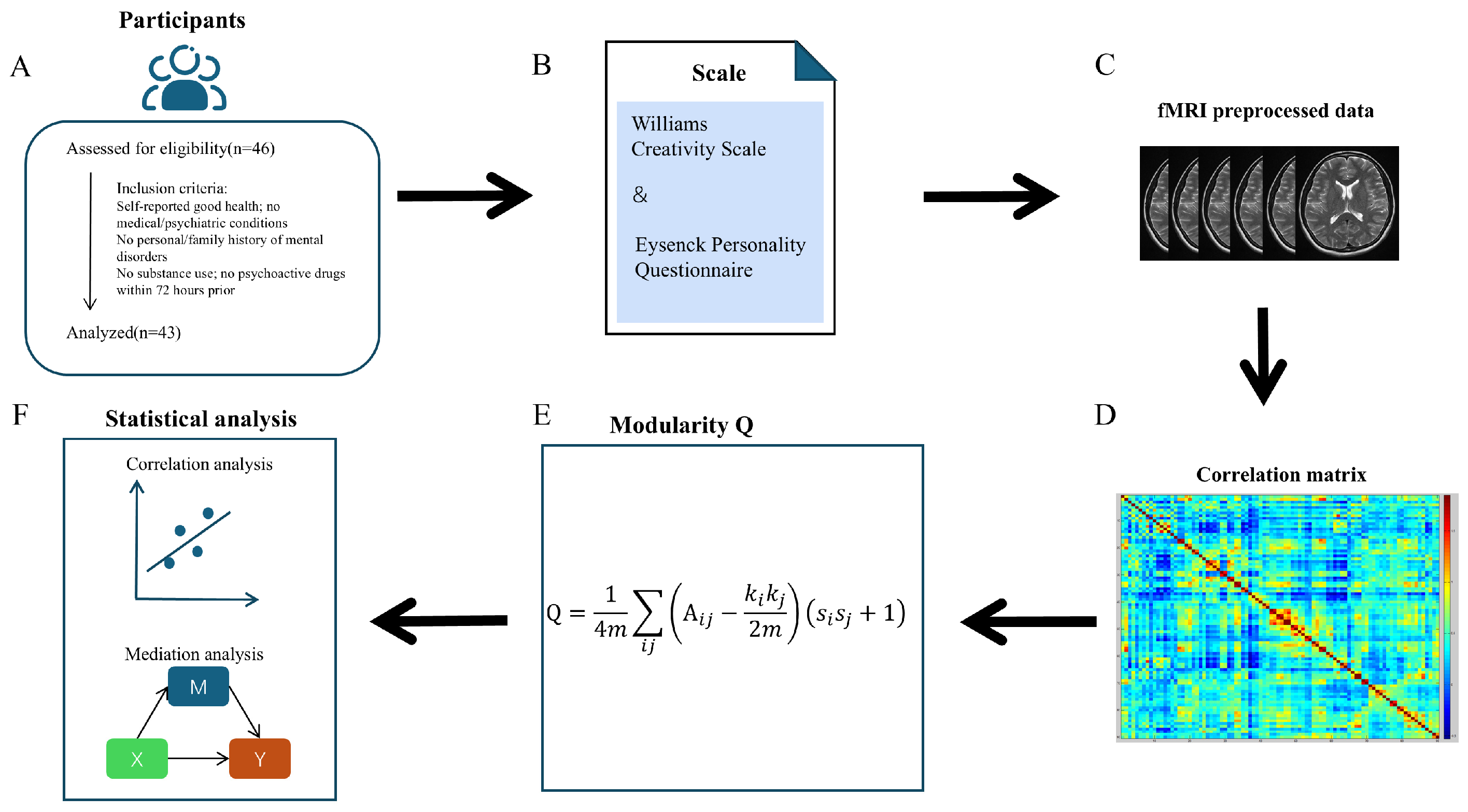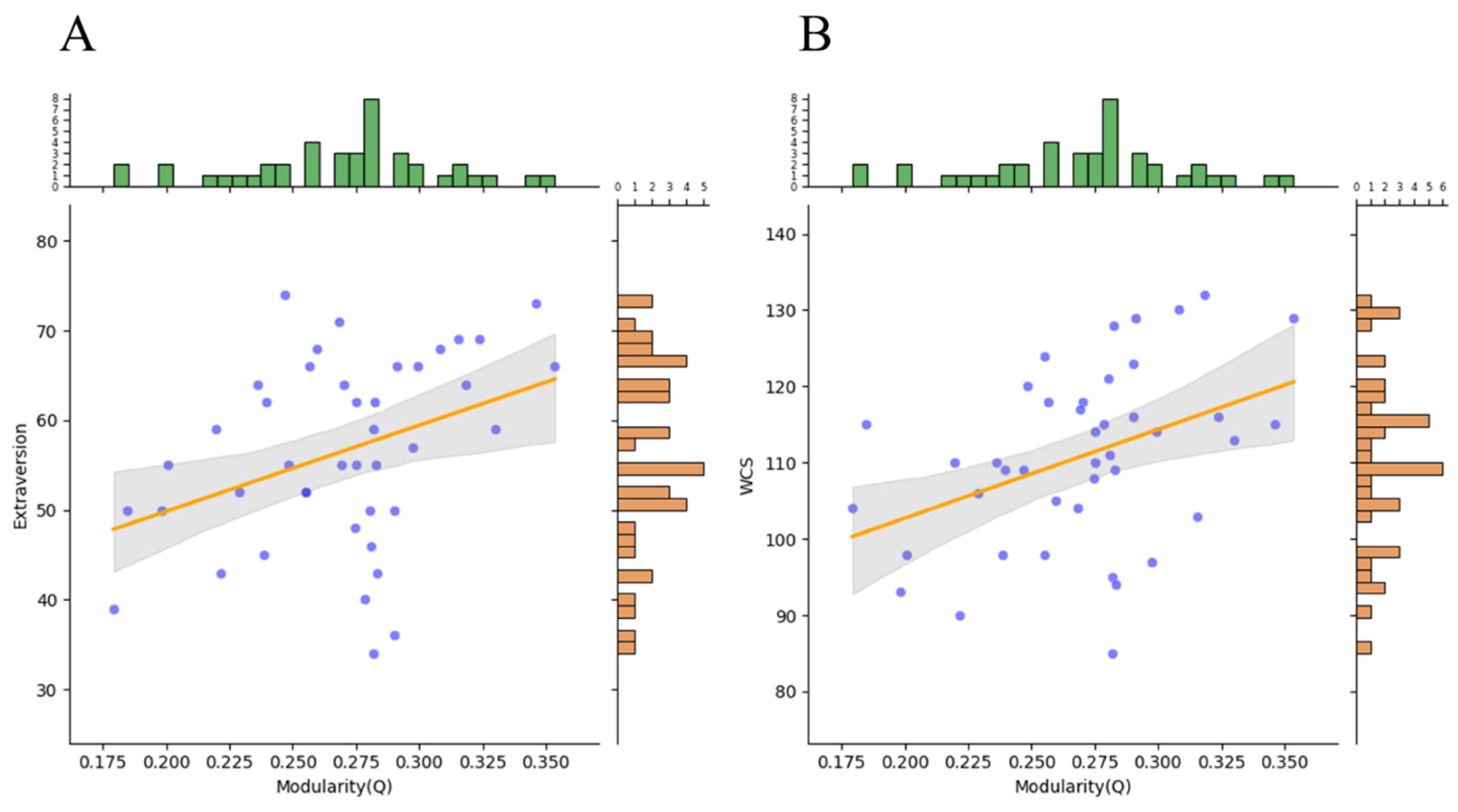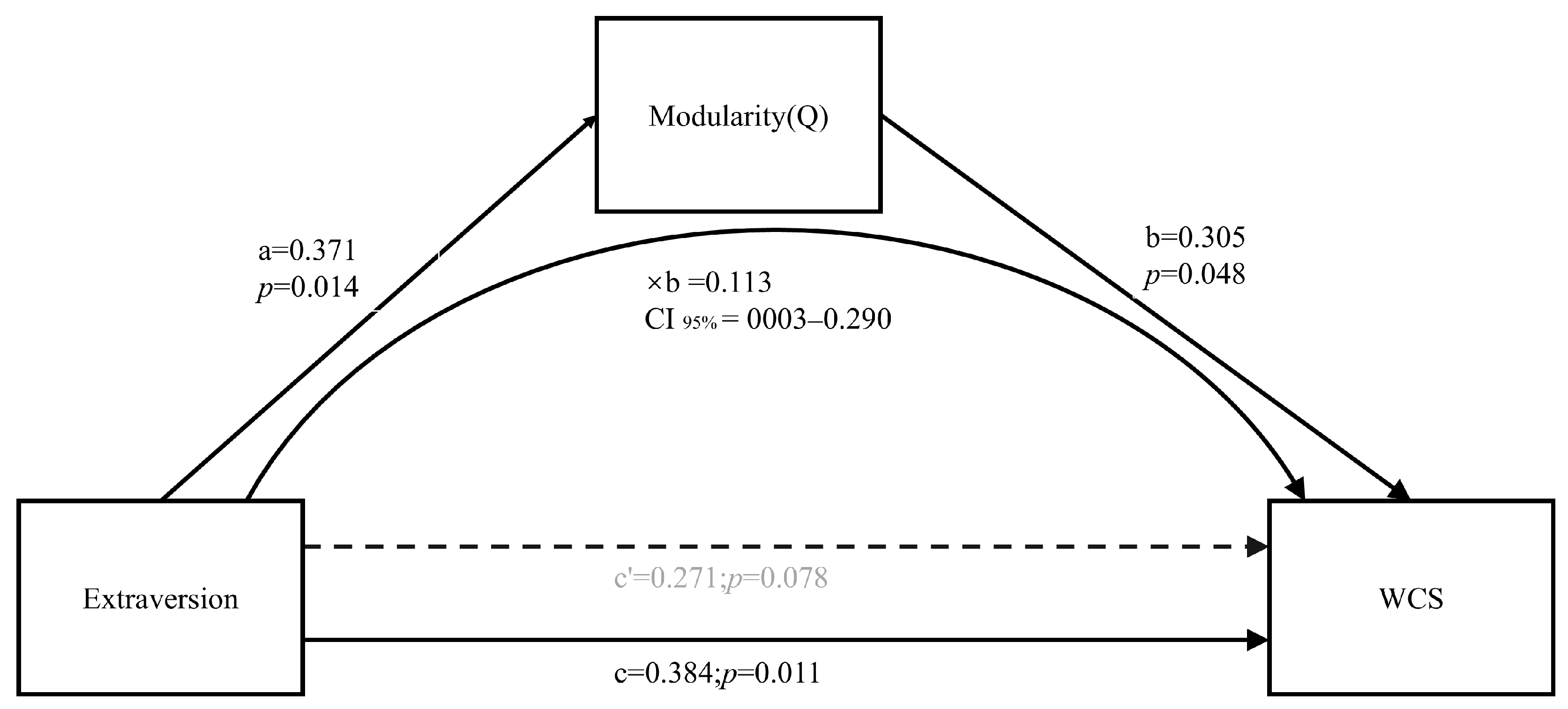
Neural Correlates of Extraversion and Trait Creativity: A Graph Theory-Based Whole-Brain Functional Network Modularity Analysis


Abstract
1. Introduction
2. Materials and Methods
2.1. Participants
2.2. Measurement Questionnaires
2.2.1. Eysenck Personality Questionnaire
2.2.2. The Williams Creativity Scale
2.3. Resting-State fMRI Data Acquisition
2.4. Resting-State fMRI Data Processing and Calculation
2.5. Correlation and Mediation Analysis
3. Results
3.1. Statistical Hypothesis Testing
3.2. Correlations Among Extraversion, Trait Creativity, and Modularity
3.3. Mediation Analysis
4. Discussion
5. Conclusions
Supplementary Materials
Author Contributions
Funding
Institutional Review Board Statement
Informed Consent Statement
Data Availability Statement
Acknowledgments
Conflicts of Interest
Abbreviations
| EPQ | The Eysenck Personality Questionnaire |
| Q | The modularity index of the whole brain |
| WCS | Williams Trait Creativity Tendency Inventory |
References
- Acar, S., & Runco, M. A. (2012). Psychoticism and creativity: A meta-analytic review. Psychology of Aesthetics, Creativity, and the Arts, 6(4), 341. [Google Scholar] [CrossRef]
- Ackerman, C. E. (2017). Big five personality traits: The OCEAN model explained. Available online: https://positivepsychology.com/big-five-personality-theory (accessed on 17 May 2025).
- Adnan, A., Beaty, R., Lam, J., Spreng, R. N., & Turner, G. R. (2019). Intrinsic default—Executive coupling of the creative aging brain. Social Cognitive and Affective Neuroscience, 14(3), 291–303. [Google Scholar] [CrossRef] [PubMed]
- Amin, A., Basri, S., Rahman, M., Capretz, L. F., Akbar, R., Gilal, A. R., & Shabbir, M. F. (2020). The impact of personality traits and knowledge collection behavior on programmer creativity. Information and Software Technology, 128, 106405. [Google Scholar] [CrossRef]
- Arul, S. M., Senthil, G., Jayasudha, S., Alkhayyat, A., Azam, K., & Elangovan, R. (2023). Graph theory and algorithms for network analysis. E3S Web of Conferences, 399, 08002. [Google Scholar] [CrossRef]
- Beaty, R. E., Benedek, M., Barry Kaufman, S., & Silvia, P. J. (2015). Default and executive network coupling supports creative idea production. Scientific Reports, 5(1), 10964. [Google Scholar] [CrossRef]
- Beaty, R. E., Kenett, Y. N., Christensen, A. P., Rosenberg, M. D., Benedek, M., Chen, Q., Fink, A., Qiu, J., Kwapil, T. R., Kane, M. J., & Silvia, P. J. (2018). Robust prediction of individual creative ability from brain functional connectivity. Proceedings of the National Academy of Sciences, 115(5), 1087–1092. [Google Scholar] [CrossRef] [PubMed]
- Boldt, G. T., Ivcevic, Z., & Kaufman, J. C. (2026). Do you think you are creative? Patterns of self-perceived creativity in adolescents and young adults. Creativity Research Journal, 38(1), 48–63. [Google Scholar] [CrossRef]
- Chaddock-Heyman, L., Weng, T. B., Kienzler, C., Weisshappel, R., Drollette, E. S., Raine, L. B., Westfall, D. R., Kao, S.-C., Baniqued, P., Castelli, D. M., Hillman, C. H., & Kramer, A. F. (2020). Brain network modularity predicts improvements in cognitive and scholastic performance in children involved in a physical activity intervention. Frontiers in Human Neuroscience, 14, 346. [Google Scholar] [CrossRef]
- Chen, Q., Kenett, Y. N., Cui, Z., Takeuchi, H., Fink, A., Benedek, M., Zeitlen, D. C., Zhuang, K., Lloyd-Cox, J., Kawashima, R., & Beaty, R. E. (2025). Dynamic switching between brain networks predicts creative ability. Communications Biology, 8(1), 54. [Google Scholar] [CrossRef]
- Cosgrove, A. L., Beaty, R. E., Diaz, M. T., & Kenett, Y. N. (2023). Age differences in semantic network structure: Acquiring knowledge shapes semantic memory. Psychology and Aging, 38(2), 87. [Google Scholar] [CrossRef]
- Cowan, R., & Jonard, N. (2023). Modular organization and informal structure: Modularity, performance, and the alignment of organizational networks. Industrial and Corporate Change, 32(1), 181–207. [Google Scholar] [CrossRef]
- Ding, X., Liu, Y., Dai, F., Tang, R., & Tang, Y. Y. (2026). Amygdala clustering coefficients modulate the effect of neuroticism on the sensation of boredom. Brain Structure & Function, 231(3), 35. [Google Scholar] [CrossRef]
- Dumas, G., Nadel, J., Soussignan, R., Martinerie, J., & Garnero, L. (2010). Inter-brain synchronization during social interaction. PLoS ONE, 5(8), e12166. [Google Scholar] [CrossRef] [PubMed]
- Eysenck, H., & Eysenck, S. (1991). Manual of Eysenck personality scales (EPS adult). Hodder & Stoughton. [Google Scholar]
- Furnham, A., Hughes, D. J., & Marshall, E. (2013). Creativity, OCD, Narcissism and the Big Five. Thinking Skills and Creativity, 10, 91–98. [Google Scholar] [CrossRef]
- Goclowska, M. A., Ritter, S. M., Elliot, A. J., & Baas, M. (2019). Novelty seeking is linked to openness and extraversion, and can lead to greater creative performance. Journal of Personality, 87(2), 252–266. [Google Scholar] [CrossRef]
- Grajzel, K., Acar, S., & Singer, G. (2023). The Big Five and divergent thinking: A meta-analysis. Personality and Individual Differences, 214, 112338. [Google Scholar] [CrossRef]
- Guo, J., Su, Q., & Zhang, Q. (2017). Individual Creativity during the ideation phase of product innovation: An interactional perspective. Creativity and Innovation Management, 26(1), 31–48. [Google Scholar] [CrossRef]
- Hearne, L. J., Mattingley, J. B., & Cocchi, L. (2016). Functional brain networks related to individual differences in human intelligence at rest. Scientific Reports, 6(1), 32328. [Google Scholar] [CrossRef] [PubMed]
- Henriksen, D., Henderson, M., Creely, E., Carvalho, A. A., Cernochova, M., Dash, D., Davis, T., & Mishra, P. (2021). Creativity and risk-taking in teaching and learning settings: Insights from six international narratives. International Journal of Educational Research Open, 2, 100024. [Google Scholar] [CrossRef]
- Ivcevic, Z. (2007). Artistic and everyday creativity: An act-frequency approach. Journal of Creative Behavior, 41(4), 271–290. [Google Scholar] [CrossRef]
- Jiao, B., Zhang, D., Liang, A., Liang, B., Wang, Z., Li, J., Cai, Y., Gao, M., Gao, Z., & Chang, S. (2017). Association between resting-state brain network topological organization and creative ability: Evidence from a multiple linear regression model. Biological Psychology, 129, 165–177. [Google Scholar] [CrossRef] [PubMed]
- Kabbara, A., Paban, V., Weill, A., Modolo, J., & Hassan, M. (2020). Brain network dynamics correlate with personality traits. Brain Connectivity, 10(3), 108–120. [Google Scholar] [CrossRef] [PubMed]
- Kenett, Y. N., Betzel, R. F., & Beaty, R. E. (2020). Community structure of the creative brain at rest. NeuroImage, 210, 116578. [Google Scholar] [CrossRef]
- Kinney, T. B. (2007). Task and individual characteristics as predictors of performance in a job-relevant multi-tasking environment. The Pennsylvania State University. Available online: https://search.proquest.com/openview/d5c255471f5712939c2993ee61b03a0f/1?pq-origsite=gscholar&cbl=18750 (accessed on 19 March 2025).
- Koivisto, M., & Toivanen, H. (2026). Schizotypy and creativity: Divergent thinking, inhibitory control, and the spontaneous flow of thought. Creativity Research Journal, 38(2), 297–317. [Google Scholar] [CrossRef]
- Kovács, B., & Palla, G. (2021). The inherent community structure of hyperbolic networks. Scientific Reports, 11(1), 16050. [Google Scholar] [CrossRef]
- Langley, S. (2018). Facilitating positive emotions for greater creativity and innovation. In Individual, relational, and contextual dynamics of emotions (Vol. 14, pp. 259–270). Emerald Publishing Limited. [Google Scholar] [CrossRef]
- Li, C.-P., Liu, X.-H., Wang, X.-J., & He, L.-P. (2023). Trait creativity, personality, and physical activity: A structural equation model. Annals of Palliative Medicine, 12(1), 14149–14149. [Google Scholar] [CrossRef] [PubMed]
- Li, Q., Chen, T., Lai, H., Li, J., & Wang, S. (2025). Extraversion and the resting brain: A coordinate-based meta-analysis of resting-state functional brain imaging studies. Brain Structure and Function, 230(8), 158. [Google Scholar] [CrossRef]
- Li, W., Li, X., Huang, L., Kong, X., Yang, W., Wei, D., Li, J., Cheng, H., Zhang, Q., Qiu, J., & Liu, J. (2015). Brain structure links trait creativity to openness to experience. Social Cognitive and Affective Neuroscience, 10(2), 191–198. [Google Scholar] [CrossRef]
- Li, Y., Kenett, Y. N., Hu, W., & Beaty, R. E. (2021). Flexible semantic network structure supports the production of creative metaphor. Creativity Research Journal, 33(3), 209–223. [Google Scholar] [CrossRef]
- Liu, J., Li, M., Pan, Y., Lan, W., Zheng, R., Wu, F.-X., & Wang, J. (2017). Complex brain network analysis and its applications to brain disorders: A survey. Complexity, 2017, e8362741. [Google Scholar] [CrossRef]
- Mammadov, S. (2022). Individual difference predictors of creative ideation. SENG Journal: Exploring the Psychology of Giftedness, 1(1), 37–44. [Google Scholar] [CrossRef]
- McCrae, R. R. (1987). Creativity, divergent thinking, and openness to experience. Journal of Personality and Social Psychology, 52(6), 1258–1265. [Google Scholar] [CrossRef]
- McCrae, R. R., & John, O. (1992). An introduction to the 5-factor model and its applications. Journal of Personality, 60(2), 175–215. [Google Scholar] [CrossRef]
- Meunier, D., Lambiotte, R., & Bullmore, E. T. (2010). Modular and hierarchically modular organization of brain networks. Frontiers in Neuroscience, 4, 200. [Google Scholar] [CrossRef]
- Muhammad, K., Nadeem, M., & Nadeem, A. (2021). Relationship between psychoticism and creativity. Journal of Professional & Applied Psychology, 2(2), 199–205. [Google Scholar] [CrossRef]
- Newman, M. E. J. (2006). Modularity and community structure in networks. Proceedings of the National Academy of Sciences of the United States of America, 103(23), 8577–8582. [Google Scholar] [CrossRef]
- Ovando-Tellez, M., Kenett, Y. N., Benedek, M., Bernard, M., Belo, J., Beranger, B., Bieth, T., & Volle, E. (2022). Brain connectivity–based prediction of real-life creativity is mediated by semantic memory structure. Science Advances, 8(5), eabl4294. [Google Scholar] [CrossRef] [PubMed]
- Power, J. D., Cohen, A. L., Nelson, S. M., Wig, G. S., Barnes, K. A., Church, J. A., Vogel, A. C., Laumann, T. O., Miezin, F. M., & Schlaggar, B. L. (2011). Functional network organization of the human brain. Neuron, 72(4), 665–678. [Google Scholar] [CrossRef] [PubMed]
- Puryear, J. S., Kettler, T., & Rinn, A. N. (2017). Relationships of personality to differential conceptions of creativity: A systematic review. Psychology of Aesthetics Creativity and the Arts, 11(1), 59–68. [Google Scholar] [CrossRef]
- Qian, M., Wu, G., Zhu, R., & Zhang, S. (2000). Development of the revised Eysenck personality questionnaire short scale for Chinese (EPQ-RSC). Acta Psychologica Sinica, 32(03), 317. Available online: https://journal.psych.ac.cn/acps/EN/Y2000/V32/I03/317 (accessed on 17 May 2025).
- Qu, R., Janssen, O., & Shi, K. (2015). Transformational leadership and follower creativity: The mediating role of follower relational identification and the moderating role of leader creativity expectations. Leadership Quarterly, 26(2), 286–299. [Google Scholar] [CrossRef]
- Qu, R., Janssen, O., & Shi, K. (2017). Leader-member exchange and follower creativity: The moderating roles of leader and follower expectations for creativity. International Journal of Human Resource Management, 28(4), 603–626. [Google Scholar] [CrossRef]
- Rawlings, D. (1985). Psychoticism, creativity and dichotic shadowing. Personality and Individual Differences, 6(6), 737–742. [Google Scholar] [CrossRef]
- Rocklin, T., & Revelle, W. (1981). The measurement of extroversion: A comparison of the eysenck personality inventory and the eysenck personality questionnaire. British Journal of Social Psychology, 20(4), 279–284. [Google Scholar] [CrossRef]
- Rolls, E. T., Huang, C. C., Lin, C. P., Feng, J., & Joliot, M. (2020). Automated anatomical labelling atlas 3. Neuroimage, 206, 116189. [Google Scholar] [CrossRef]
- Runco, M. A., & Jaeger, G. J. (2012). The standard definition of creativity. Creativity Research Journal, 24(1), 92–96. [Google Scholar] [CrossRef]
- Sassenberg, T. A., Safron, A., & DeYoung, C. G. (2024). Stable individual differences from dynamic patterns of function: Brain network flexibility predicts openness/intellect, intelligence, and psychoticism. Cerebral Cortex, 34(9), bhae391. [Google Scholar] [CrossRef]
- Schmidt, A. L. (2010). The battle for creativity: Frontiers in science and science education. Bioessays, 32(12), 1016–1019. [Google Scholar] [CrossRef]
- Sen, A., & Hagtvet, K. (1993). Correlations among creativity, intelligence, personality, and academic-achievement. Perceptual and Motor Skills, 77(2), 497–498. [Google Scholar] [CrossRef]
- Shaw, A., & Yu, Q. (2023). Different personality factors drive work and non-work creativity. Frontiers in Psychology, 14, 1078874. [Google Scholar] [CrossRef] [PubMed]
- Soler-Pastor, E., Bobowik, M., Benet-Martínez, V., & Repke, L. (2023). Disentangling the link between diverse social networks and creativity: The role of personality traits. The Spanish Journal of Psychology, 26, e10. [Google Scholar] [CrossRef]
- Sporns, O. (2018). Graph theory methods: Applications in brain networks. Dialogues in Clinical Neuroscience, 20(2), 111–121. [Google Scholar] [CrossRef]
- Sporns, O., & Betzel, R. F. (2016). Modular brain networks. Annual Review of Psychology, 67(1), 613–640. [Google Scholar] [CrossRef]
- Stevens, A. A., Tappon, S. C., Garg, A., & Fair, D. A. (2012). Functional brain network modularity captures Inter- and Intra-individual variation in working memory capacity. PLoS ONE, 7(1), e30468. [Google Scholar] [CrossRef]
- Tang, C., Xu, J., Mao, S., & Naumann, S. E. (2024). The effects of creative personality on scientist creativity. Thinking Skills and Creativity, 51, 101465. [Google Scholar] [CrossRef]
- Tardiff, N., Medaglia, J. D., Bassett, D. S., & Thompson-Schill, S. L. (2021). The modulation of brain network integration and arousal during exploration. NeuroImage, 240, 118369. [Google Scholar] [CrossRef]
- Tompson, S. H., Falk, E. B., O’Donnell, M. B., Cascio, C. N., Bayer, J. B., Vettel, J. M., & Bassett, D. S. (2020). Response inhibition in adolescents is moderated by brain connectivity and social network structure. Social Cognitive and Affective Neuroscience, 15(8), 827–837. [Google Scholar] [CrossRef]
- van Allen, Z. M., Walker, D. L., Streiner, T., & Zelenski, J. M. (2021). Enacted extraversion as a well-being enhancing strategy in everyday life: Testing across three, week-long interventions. Collabra: Psychology, 7(1), 29931. [Google Scholar] [CrossRef]
- van Wijk, B. C. M., van, Stam, C. J., & Daffertshofer, A. (2010). Comparing brain networks of different size and connectivity density using graph theory. PLoS ONE, 5(10), e13701. [Google Scholar] [CrossRef]
- Verduyn, P., & Brans, K. (2012). The relationship between extraversion, neuroticism and aspects of trait affect. Personality and Individual Differences, 52(6), 664–669. [Google Scholar] [CrossRef]
- Wang, Y., & Wu, Q. (2023). Comparison of trait creativity between medical students and humanities students. Alternative Therapies in Health and Medicine, 29(4), 72–74. [Google Scholar]
- Wei, L., Duan, X., Yang, Y., Liao, W., Gao, Q., Ding, J. R., Zhang, Z., Zeng, W., Li, Y., Lu, G., & Chen, H. (2011). The synchronization of spontaneous BOLD activity predicts extraversion and neuroticism. Brain Research, 1419, 68–75. [Google Scholar] [CrossRef]
- Wu, C.-L., & Chen, H.-C. (2023). Dual-process accounts of the creative problem solving and human connectome. The American Journal of Psychology, 136(1), 47–57. [Google Scholar] [CrossRef]
- Yao, X., & Li, R. (2021). Big five personality traits as predictors of employee creativity in probation and formal employment periods. Personality and Individual Differences, 182, 109914. [Google Scholar] [CrossRef]
- Zou, L., Su, L., Qi, R., Zheng, S., & Wang, L. (2018). Relationship between extraversion personality and gray matter volume and functional connectivity density in healthy young adults: An fMRI study. Psychiatry Research: Neuroimaging, 281, 19–23. [Google Scholar] [CrossRef]
- Zuckerman, M., & Kuhlman, D. M. (2000). Personality and risk-taking: Common bisocial factors. Journal of Personality, 68(6), 999–1029. [Google Scholar] [CrossRef]



| Skewness | Kurtosis | |
|---|---|---|
| Extraversion | −0.3510 | 2.4226 |
| WCS | −0.2268 | 2.4165 |
| Modularity (Q) | −0.1594 | 3.0335 |
| M | SD | Extraversion | WCS | Modularity (Q) | |
|---|---|---|---|---|---|
| Extraversion | 56.51 | 10.27 | - | 0.38 * | 0.37 * |
| WCS | 111.12 | 11.57 | 0.38 * | - | 0.41 ** |
| Modularity (Q) | 0.27 | 0.04 | 0.37 * | 0.41 ** | - |
| Model | Coeff | se | t | p | 95% Bootstrap | |
|---|---|---|---|---|---|---|
| LLCI | ULCI | |||||
| a | 0.371 | 0.145 | 2.557 | 0.014 | 0.086 | 0.711 |
| b | 0.305 | 0.15 | 2.036 | 0.048 | 0.042 | 0.583 |
| c | 0.384 | 0.144 | 2.659 | 0.011 | 0.089 | 0.703 |
| c′ | 0.271 | 0.15 | 1.807 | 0.078 | −0.047 | 0.605 |
| a × b | 0.113 | \ | \ | 0.111 | 0.003 | 0.290 |
Disclaimer/Publisher’s Note: The statements, opinions and data contained in all publications are solely those of the individual author(s) and contributor(s) and not of MDPI and/or the editor(s). MDPI and/or the editor(s) disclaim responsibility for any injury to people or property resulting from any ideas, methods, instructions or products referred to in the content. |
© 2026 by the authors. Licensee MDPI, Basel, Switzerland. This article is an open access article distributed under the terms and conditions of the Creative Commons Attribution (CC BY) license.
Share and Cite
Ding, X.; Dai, F.; Gai, X.; Tang, Y.-Y. Neural Correlates of Extraversion and Trait Creativity: A Graph Theory-Based Whole-Brain Functional Network Modularity Analysis. J. Intell. 2026, 14, 94. https://doi.org/10.3390/jintelligence14060094
Ding X, Dai F, Gai X, Tang Y-Y. Neural Correlates of Extraversion and Trait Creativity: A Graph Theory-Based Whole-Brain Functional Network Modularity Analysis. Journal of Intelligence. 2026; 14(6):94. https://doi.org/10.3390/jintelligence14060094
Chicago/Turabian StyleDing, Xiaoqian, Fabin Dai, Xingbang Gai, and Yi-Yuan Tang. 2026. "Neural Correlates of Extraversion and Trait Creativity: A Graph Theory-Based Whole-Brain Functional Network Modularity Analysis" Journal of Intelligence 14, no. 6: 94. https://doi.org/10.3390/jintelligence14060094
APA StyleDing, X., Dai, F., Gai, X., & Tang, Y.-Y. (2026). Neural Correlates of Extraversion and Trait Creativity: A Graph Theory-Based Whole-Brain Functional Network Modularity Analysis. Journal of Intelligence, 14(6), 94. https://doi.org/10.3390/jintelligence14060094