The Distinct Roles of Personal and Perceived School Intelligence Mindsets in Learning Motivation and Achievement


Abstract
1. Introduction
1.1. An SDT Perspective on the Roles of a PSIM and PIM in Students’ Learning Outcomes
1.2. The Different Pathways from a PSIM and a PIM to Learning Motivation and Achievement
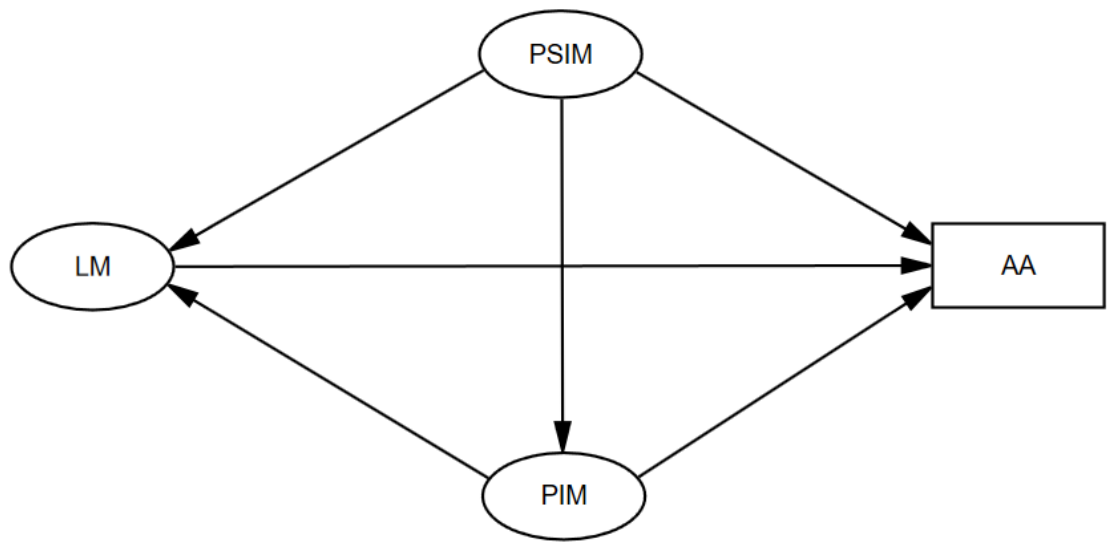
1.3. The Present Study
2. Methodology
2.1. Participants and Procedures
2.2. Instruments
2.2.1. PSIM
2.2.2. PIM
2.2.3. Learning Motivation
2.3. Statistical Analysis
3. Results
3.1. Bivariate Analyses
3.2. SEM
3.2.1. Model Fit
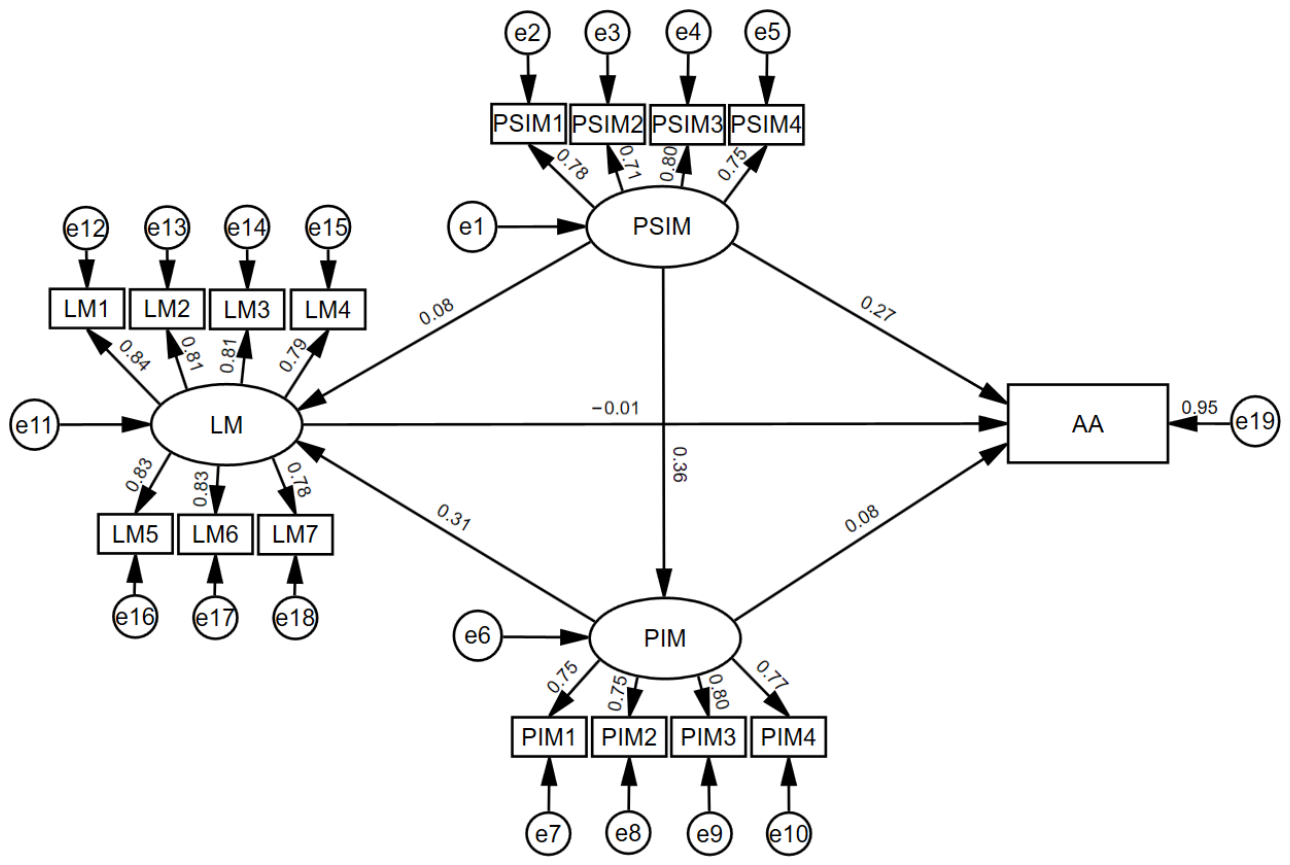
3.2.2. Structural Paths
4. Discussion
4.1. Theoretical Implications
4.2. Practical Implications
5. Limitations and Directions for Future Research
6. Conclusions
Author Contributions
Funding
Institutional Review Board Statement
Informed Consent Statement
Data Availability Statement
Acknowledgments
Conflicts of Interest
References
- Bardach, L., Bostwick, K. C., Fütterer, T., Kopatz, M., Hobbi, D. M., Klassen, R. M., & Pietschnig, J. (2024). A meta-analysis on teachers’ growth mindset. Educational Psychology Review, 36, 84. [Google Scholar] [CrossRef] [Scilit]
- Bozhani, E. F., Momeni, K., & Moradi, A. (2025). The relationship between school culture and students’ academic well-being through the mediating role of the satisfaction of the basic psychological needs: A correlational study. Health Science Reports, 8, e70379. [Google Scholar] [CrossRef] [Scilit]
- Burke, N. J., Bird, J. A., Clark, M. A., Rakowski, W., Guerra, C., Barker, J. C., & Pasick, R. J. (2009). Social and cultural meanings of self-efficacy. Health Education & Behavior, 36, 111S–128S. [Google Scholar] [CrossRef] [Scilit]
- Burnette, J. L., O’boyle, E. H., VanEpps, E. M., Pollack, J. M., & Finkel, E. J. (2013). Mind-sets matter: A meta-analytic review of implicit theories and self-regulation. Psychological Bulletin, 139, 655–701. [Google Scholar] [CrossRef] [Scilit]
- Canning, E. A., Muenks, K., Green, D. J., & Murphy, M. C. (2019). STEM faculty who believe ability is fixed have larger racial achievement gaps and inspire less student motivation in their classes. Science Advances, 5, eaau4734. [Google Scholar] [CrossRef] [Scilit]
- Canning, E. A., Murphy, M. C., Emerson, K. T., Chatman, J. A., Dweck, C. S., & Kray, L. J. (2020). Cultures of genius at work: Organizational mindsets predict cultural norms, trust, and commitment. Personality and Social Psychology Bulletin, 46, 626–642. [Google Scholar] [CrossRef] [Scilit]
- Cheung, M. W. L. (2009). Constructing approximate confidence intervals for parameters with structural equation models. Structural Equation Modeling: A Multidisciplinary Journal, 16, 267–294. [Google Scholar] [CrossRef] [Scilit]
- Dixson, D. D. (2022). How hope measures up: Hope predicts school variables beyond growth mindset and school belonging. Current Psychology, 41, 4612–4624. [Google Scholar] [CrossRef] [Scilit]
- Dweck, C. S. (1999). Self-theories: Their role in motivation, personality, and development. Psychology Press. [Google Scholar]
- Dweck, C. S. (2017). The journey to children’s mindsets—And beyond. Child Development Perspectives, 11, 139–144. [Google Scholar] [CrossRef] [Scilit]
- Eccles, J. S., & Roeser, R. W. (2011). Schools as developmental contexts during adolescence. Journal of Research on Adolescence, 21, 225–241. [Google Scholar] [CrossRef] [Scilit]
- Emerson, K. T., & Murphy, M. C. (2015). A company I can trust? Organizational lay theories moderate stereotype threat for women. Personality and Social Psychology Bulletin, 41, 295–307. [Google Scholar] [CrossRef] [Scilit] [PubMed]
- Enders, C. K., & Bandalos, D. L. (2001). The relative performance of full information maximum likelihood estimation for missing data in structural equation models. Structural Equation Modeling, 8, 430–457. [Google Scholar] [CrossRef] [Scilit]
- Gagné, F., & St. Père, F. (2001). When IQ is controlled, does motivation still predict achievement? Intelligence, 30, 71–100. [Google Scholar] [CrossRef] [Scilit]
- Giel, L. I., Noordzij, G., Noordegraaf-Eelens, L., & Denktaş, S. (2020). Fear of failure: A polynomial regression analysis of the joint impact of the perceived learning environment and personal achievement goal orientation. Anxiety, Stress, & Coping, 33, 123–139. [Google Scholar]
- Guay, F., Morin, A. J., Litalien, D., Valois, P., & Vallerand, R. J. (2015). Application of exploratory structural equation modeling to evaluate the academic motivation scale. The Journal of Experimental Education, 83, 51–82. [Google Scholar] [CrossRef] [Scilit]
- He, W. J., & Zhang, K. (2024). The moderating effect of cultural orientation on the relationship between growth mindset and learning self-efficacy: A dimension-specific pattern. Behavioral Sciences, 14, 1155. [Google Scholar] [CrossRef] [Scilit]
- Hu, C., Wang, C., Liu, W., & Wang, D. (2022). Depression and reasoning ability in adolescents: Examining the moderating role of growth mindset. Frontiers in Psychology, 13, 636368. [Google Scholar] [CrossRef] [Scilit]
- Hu, L. T., & Bentler, P. M. (1999). Cutoff criteria for fit indexes in covariance structure analysis: Conventional criteria versus new alternatives. Structural Equation Modeling: A Multidisciplinary Journal, 6, 1–55. [Google Scholar] [CrossRef] [Scilit]
- Kim, M. H., Han, J., Buford, K. N., Osterhage, J. L., & Usher, E. L. (2024). Undergraduate student perceptions of instructor mindset and academic performance: A motivational climate theory perspective. Contemporary Educational Psychology, 77, 102280. [Google Scholar] [CrossRef] [Scilit]
- Lam, K. K. L., & Zhou, M. (2025). A meta-analysis of the relationship between growth mindset and grit. Acta Psychologica, 255, 104872. [Google Scholar] [CrossRef] [Scilit] [PubMed]
- Ledermann, T., Rudaz, M., & Fritz, M. S. (2025). On partial versus full mediation and the importance of effect sizes. Advances in Methods and Practices in Psychological Science, 8, 1–19. [Google Scholar] [CrossRef] [Scilit]
- Legault, L., Green-Demers, I., & Pelletier, L. (2006). Why do high school students lack motivation in the classroom? Toward an understanding of academic amotivation and the role of social support. Journal of Educational Psychology, 98, 567. [Google Scholar] [CrossRef] [Scilit]
- Little, T. D., Cunningham, W. A., Shahar, G., & Widaman, K. F. (2002). To parcel or not to parcel: Exploring the question, weighing the merits. Structural Equation Modeling, 9, 151–173. [Google Scholar] [CrossRef] [Scilit]
- Liu, W. C. (2021). Implicit theories of intelligence and achievement goals: A look at students’ intrinsic motivation and achievement in mathematics. Frontiers in Psychology, 12, 593715. [Google Scholar] [CrossRef] [Scilit]
- Muenks, K., Canning, E. A., LaCosse, J., Green, D. J., Zirkel, S., Garcia, J. A., & Murphy, M. C. (2020). Does my professor think my ability can change? Students’ perceptions of their STEM professors’ mindset beliefs predict their psychological vulnerability, engagement, and performance in class. Journal of Experimental Psychology: General, 149, 2119. [Google Scholar] [CrossRef] [Scilit] [PubMed]
- Murphy, M. C., & Dweck, C. S. (2010). A culture of genius: How an organization’s lay theory shapes people’s cognition, affect, and behavior. Personality and Social Psychology Bulletin, 36, 283–296. [Google Scholar] [CrossRef] [Scilit]
- Papageorgiou, E., Wong, J., Liu, Q., Khalil, M., & Cabo, A. J. (2025). A systematic review on student engagement in undergraduate mathematics: Conceptualization, measurement, and learning outcomes. Educational Psychology Review, 37, 66. [Google Scholar] [CrossRef] [Scilit]
- Park, D., Yu, A., Baelen, R. N., Tsukayama, E., & Duckworth, A. L. (2018). Fostering grit: Perceived school goal-structure predicts growth in grit and grades. Contemporary Educational Psychology, 55, 120–128. [Google Scholar] [CrossRef] [Scilit] [PubMed]
- Preacher, K. J., & Hayes, A. F. (2008). Asymptotic and resampling strategies for assessing and comparing indirect effects in multiple mediator models. Behavior Research Methods, 40, 879–891. [Google Scholar] [CrossRef] [Scilit]
- Quaigrain, R. A., Owusu-Manu, D., Edwards, D. J., & Danquah, D. D. (2026). Investigating the relationship between organizational mindset orientation and project performance of large organizations in the Ghanaian construction industry. International Journal of Construction Education and Research, 22, 2–26. [Google Scholar] [CrossRef] [Scilit]
- Ryan, R. M., & Deci, E. L. (2000). Self-determination theory and the facilitation of intrinsic motivation, social development, and well-being. American Psychologist, 55, 68–78. [Google Scholar] [CrossRef]
- Satterwhite, A. K., & Luchner, A. F. (2016). Exploring the relationship among perceived resilience, dependency, and self-criticism: The role of culture and social support. North American Journal of Psychology, 18, 1–14. [Google Scholar]
- Song, S. (2018). Cultivating a growth mindset: An exploration of teacher beliefs and learning environments [Doctoral dissertation, University of Southern California]. [Google Scholar]
- Taylor, G., Jungert, T., Mageau, G. A., Schattke, K., Dedic, H., Rosenfield, S., & Koestner, R. (2014). A self-determination theory approach to predicting school achievement over time: The unique role of intrinsic motivation. Contemporary Educational Psychology, 39, 342–358. [Google Scholar] [CrossRef] [Scilit]
- Tian, X., & Tang, Y. (2025). The long-term impact of moral education on college students’ psychological well-being: A longitudinal study revealing multidimensional synergistic mechanisms. Behavioral Sciences, 15, 217. [Google Scholar] [CrossRef] [Scilit]
- Trautwein, U., Lüdtke, O., Köller, O., & Baumert, J. (2006). Self-esteem, academic self-concept, and achievement: How the learning environment moderates the dynamics of self-concept. Journal of Personality and Social Psychology, 90, 334. [Google Scholar] [CrossRef] [Scilit] [PubMed]
- Vallerand, R. J., Pelletier, L. G., Blais, M. R., Briere, N. M., Senecal, C., & Vallieres, E. F. (1992). The academic motivation scale: A measure of intrinsic, extrinsic, and amotivation in education. Educational and Psychological Measurement, 52, 1003–1017. [Google Scholar] [CrossRef] [Scilit]
- Yu, J., & Kreijkes, P. (2017, October 27–28). Factor structure of mindset: Evidence for unidimensionality and developmental stability [Conference presentation]. BPS Psychology of Education Section Annual Conference, Faculty of Education, University of Cambridge, Cambridge, UK. [Google Scholar]
- Zeng, G., Hou, H., & Peng, K. (2016). Effect of growth mindset on school engagement and psychological well-being of Chinese primary and middle school students: The mediating role of resilience. Frontiers in Psychology, 7, 1873. [Google Scholar] [CrossRef] [Scilit]
- Zhang, K., & He, W. J. (2024). The predictive effect of cultural orientation and perceived school climate on the formation of teachers’ growth mindsets. Frontiers in Education, 9, 1428890. [Google Scholar] [CrossRef] [Scilit]
- Zhao, H., Zhang, M., Li, Y., & Wang, Z. (2023). The effect of growth mindset on adolescents’ meaning in life: The roles of self-efficacy and gratitude. Psychology Research and Behavior Management, 16, 4647–4664. [Google Scholar] [CrossRef] [Scilit] [PubMed]



| Variables | Mean (SD) | 1 | 2 | 3 | 4 | 5 | 6 | 7 |
|---|---|---|---|---|---|---|---|---|
| 1. Age | 13.72 (1.58) | - | ||||||
| 2. Gender | - | 0.01 | - | |||||
| 3. Edu | 7.84 (1.36) | 0.81 *** | 0.03 | - | ||||
| 4. PSIM | 2.58 (0.43) | 0.05 | 0.02 | 0.04 | (0.80) | |||
| 5. PIM | 4.02 (0.62) | 0.05 | 0.02 | 0.02 | 0.42 *** | (0.82) | ||
| 6. LM | 4.53 (0.81) | 0.04 | 0.03 | 0.02 | 0.10 * | 0.36 *** | (0.84) | |
| 7. AA | 78.15 (13.57) | 0.06 | 0.02 | 0.03 | 0.32 *** | 0.11 * | −0.02 | - |
| (Panel A) | ||||
| Pathway | β | B | S.E. | p |
| PSIM → PIM | 0.36 | 0.51 | 0.08 | <.001 |
| PIM → LM | 0.31 | 0.22 | 0.04 | <.001 |
| PSIM → LM | 0.08 | 0.08 | 0.05 | n.s. |
| PSIM → AA | 0.27 | 3.60 | 0.62 | <.001 |
| PIM → AA | 0.08 | 0.74 | 0.41 | n.s. |
| LM → AA | −0.01 | −0.11 | 0.58 | n.s. |
| (Panel B) | ||||
| Indirect Pathway | Total Effect (β) | Direct Effect (β) | Indirect Effect (β) | 95% CI |
| PSIM → PIM → LM | 0.19 | 0.08 | 0.11 | [0.07, 0.17] |
| PSIM → PIM → AA | 0.30 | 0.27 | 0.03 | [−0.02, 0.08] |
Disclaimer/Publisher’s Note: The statements, opinions and data contained in all publications are solely those of the individual author(s) and contributor(s) and not of MDPI and/or the editor(s). MDPI and/or the editor(s) disclaim responsibility for any injury to people or property resulting from any ideas, methods, instructions or products referred to in the content. |
© 2026 by the authors. Licensee MDPI, Basel, Switzerland. This article is an open access article distributed under the terms and conditions of the Creative Commons Attribution (CC BY) license.
Share and Cite
Zhang, K.; He, W.-j.; Jiang, H.-f. The Distinct Roles of Personal and Perceived School Intelligence Mindsets in Learning Motivation and Achievement. J. Intell. 2026, 14, 81. https://doi.org/10.3390/jintelligence14050081
Zhang K, He W-j, Jiang H-f. The Distinct Roles of Personal and Perceived School Intelligence Mindsets in Learning Motivation and Achievement. Journal of Intelligence. 2026; 14(5):81. https://doi.org/10.3390/jintelligence14050081
Chicago/Turabian StyleZhang, Kai, Wu-jing He, and Hui-fei Jiang. 2026. "The Distinct Roles of Personal and Perceived School Intelligence Mindsets in Learning Motivation and Achievement" Journal of Intelligence 14, no. 5: 81. https://doi.org/10.3390/jintelligence14050081
APA StyleZhang, K., He, W.-j., & Jiang, H.-f. (2026). The Distinct Roles of Personal and Perceived School Intelligence Mindsets in Learning Motivation and Achievement. Journal of Intelligence, 14(5), 81. https://doi.org/10.3390/jintelligence14050081