Machine Learning Approach for Predicting Older Adults’ Responsiveness to Cognitive Training Interventions: Data from the ACTIVE Study



Abstract
1. Introduction
Study Aims and Research Questions
2. Materials and Methods
2.1. Data
2.1.1. Participants
2.1.2. Study Design and Intervention
2.1.3. Materials
- General cognitive functioning: Mini-Mental State Examination (MMSE) score (Folstein et al., 1975).
- Measures of specific cognitive abilities: three memory measures: the Hopkins Verbal Learning Test (HVLT) (Brandt, 1991), Rey Auditory–Verbal Learning Test (AVLT) (Rey, 1941) and Rivermead Behavioral Memory Test immediate recall (RVM) (Wilson et al., 1985); three reasoning measures: Letter Series (LS) (Thurstone & Thurstone, 1949), Letter Sets (LT) (Ekstrom et al., 1976) and Word Series (WS) (Gonda & Schaie, 1985); and four speed-of-processing measures: subtests of Useful Field of View (UFOV) (Owsley et al., 1998).
- Measures of daily functioning: three subjective measures of daily functioning from the Minimum Data Set for Home Care (MDS) (Morris et al., 1997), including results in subscales: (a) performance of instrumental activities of daily living (IADL), (b) performance in basic ADL and (c) perceived degree of difficulty in completing ADL; and one performance-based measure of daily functioning: Everyday Problems Test (EPT) (Willis et al., 1998).
- Measure of depressive symptoms: Center for Epidemiological Studies—Depression (CES-D) (Radloff, 1977).
2.2. Predictive Models
2.2.1. Features
2.2.2. Classes
2.2.3. Machine Learning Algorithms
2.3. Cluster Analysis
2.4. Statistical Analysis
3. Results
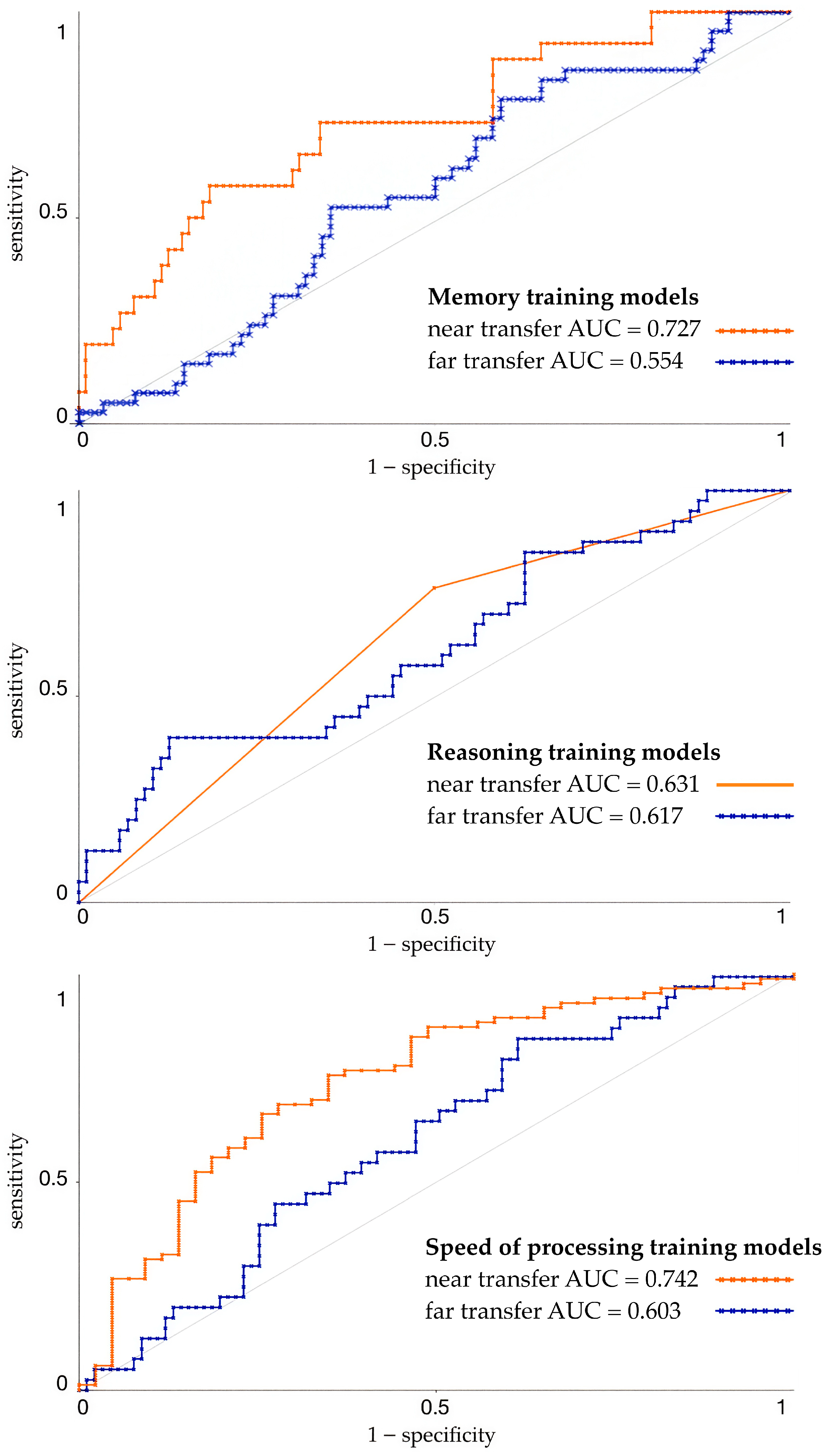
3.1. Predictive Machine Learning Models
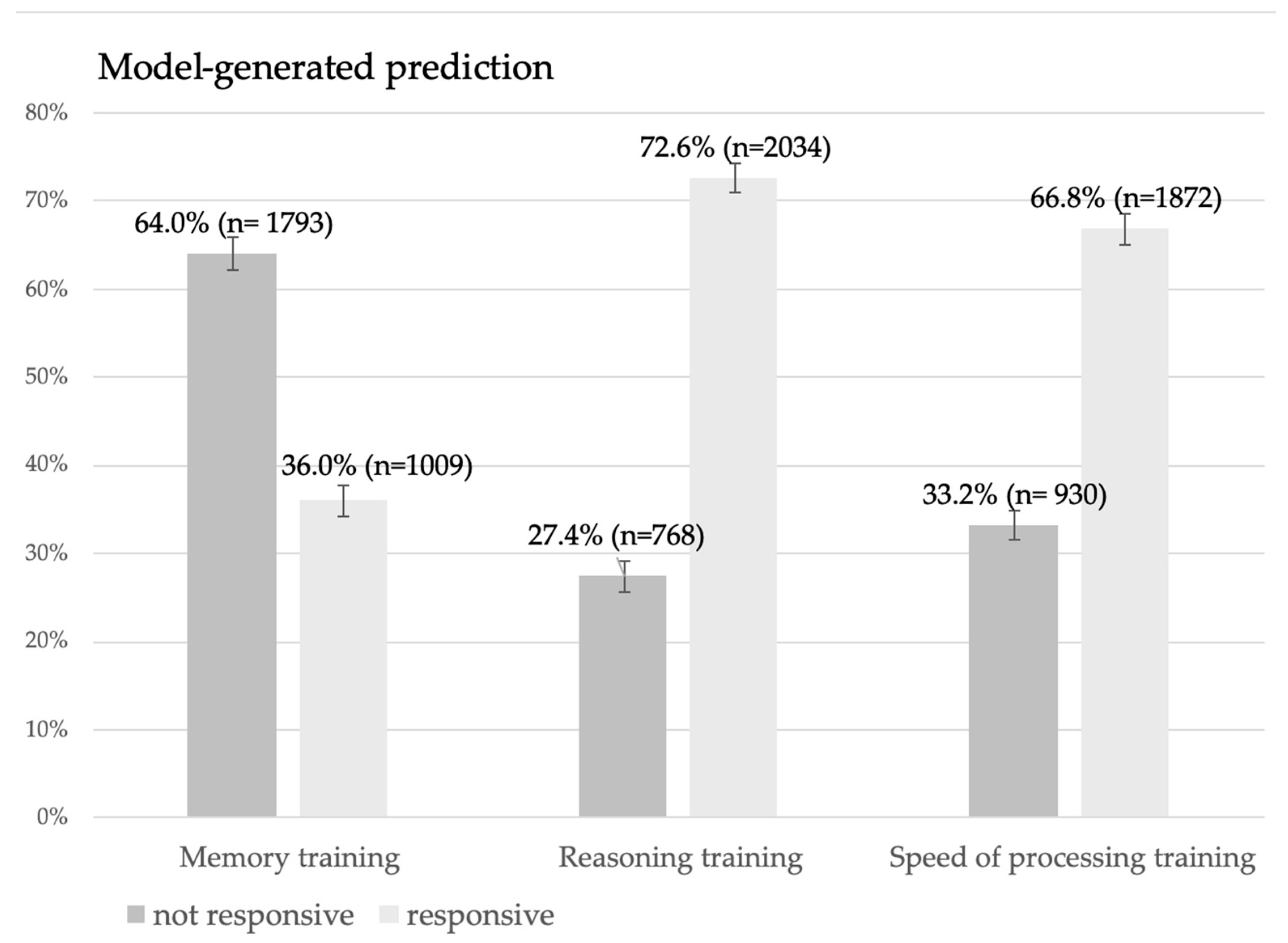
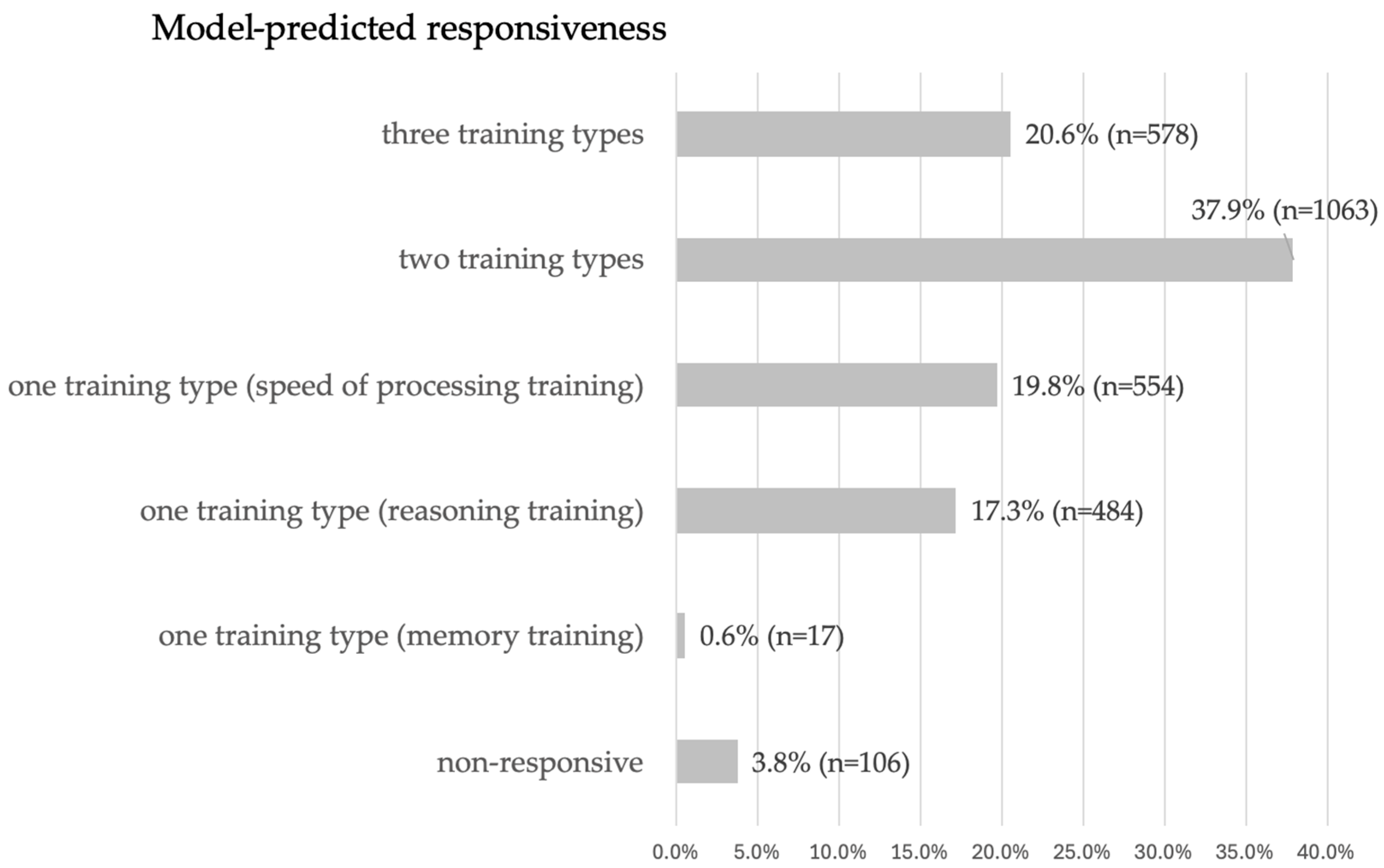
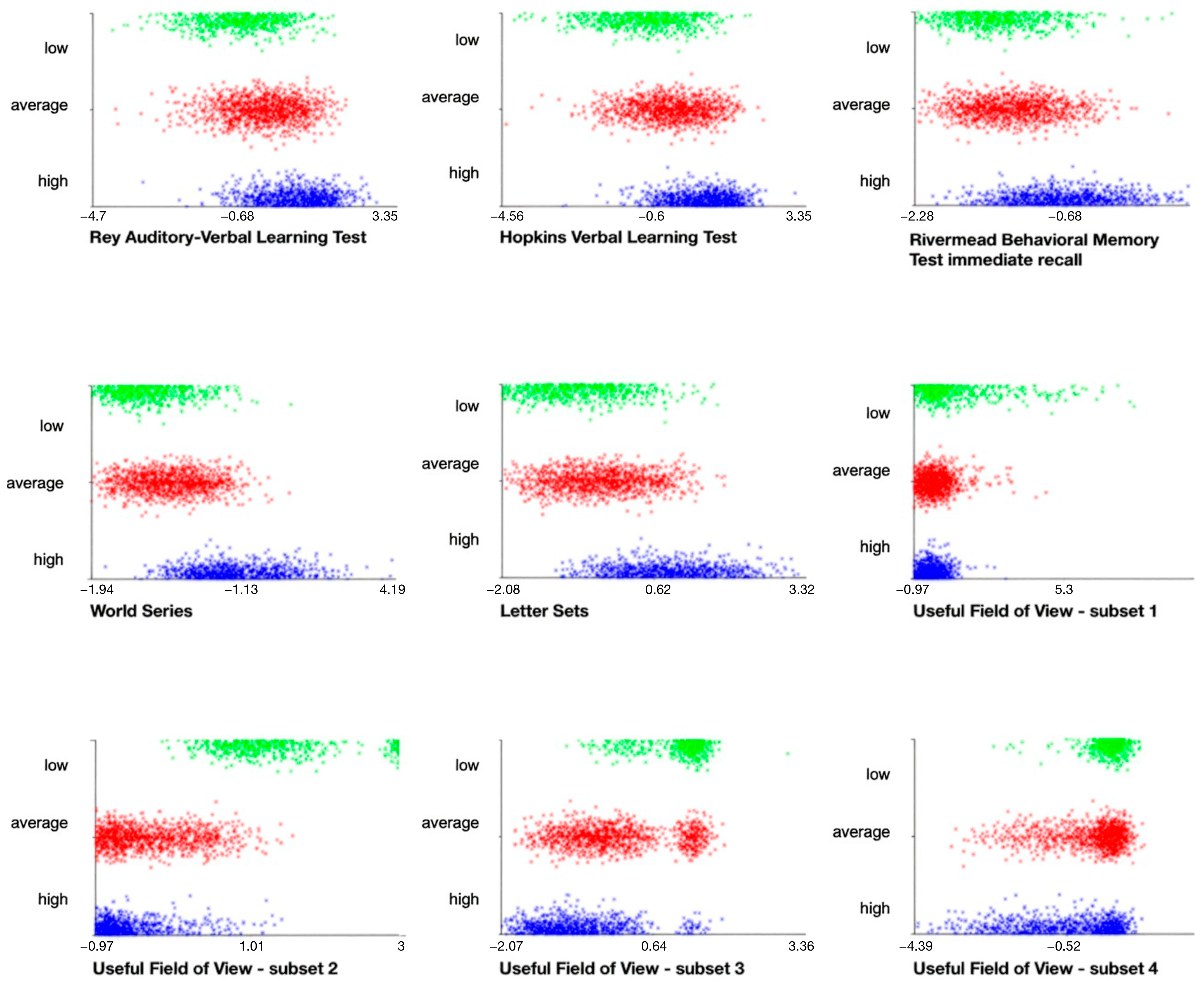
3.2. Predicted Responsiveness to Cognitive Training Interventions
4. Discussion
4.1. Predicted Responsiveness to Cognitive Training
4.2. Limitations and Future Directions
5. Conclusions
Supplementary Materials
Author Contributions
Funding
Institutional Review Board Statement
Informed Consent Statement
Data Availability Statement
Acknowledgments
Conflicts of Interest
| 1 | Datasets for near transfer and far transfer in speed-of-processing training were not reported separately due to negligible differences attributable to small difference in sample (10 cases). Dataset with N = 653 was used in descriptive analyses. |
References
- Adolphe, M., Pech, M., Sawayama, M., Maurel, D., Delmas, A., Oudeyer, P. Y., & Sauzeon, H. (2025). Exploring the potential of artificial intelligence in individualized cognitive training: A systematic review. PLoS ONE, 20(6), e0316860. [Google Scholar] [CrossRef]
- Alloway, T. P., Bibile, V., & Lau, G. (2013). Computerized working memory training: Can it lead to gains in cognitive skills in students? Computers in Human Behavior, 29(3), 632–638. [Google Scholar] [CrossRef]
- Ball, K., Berch, D. B., Helmers, K. F., Jobe, J. B., Leveck, M. D., Marsiske, M., Morris, J. N., Rebok, G. W., Smith, D. M., Tennstedt, S. L., Unverzagt, F. W., Willis, S. L., & ACTIVE Study Group. (2002). Effects of cognitive training interventions with older adults a randomized controlled trial. JAMA, 288(18), 2271–2281. [Google Scholar] [CrossRef] [PubMed]
- Ball, K. K., Ross, L. A., Roth, D. L., & Edwards, J. D. (2013). Speed of processing training in the ACTIVE study: How much is needed and who benefits? Journal of Aging and Health, 25(Suppl. 8), 65S–84S. [Google Scholar] [CrossRef] [PubMed]
- Baltes, P. B., & Lindenberger, U. (1988). On the range of cognitive plasticity in old age as a function of experience: 15 years of intervention research. Behavior Therapy, 19(3), 283–300. [Google Scholar] [CrossRef]
- Basak, C., Qin, S., & O’Connell, M. A. (2020). Differential effects of cognitive training modules in healthy aging and mild cognitive impairment: A comprehensive meta-analysis of randomized controlled trials. Psychology and Aging, 35(2), 220–249. [Google Scholar] [CrossRef]
- Bedoya, Ó., & Polanco, P. A. F. (2025). Systematic review of AI-based cognitive training programs: Algorithms, populations, and stimulated cognitive domains. Revista EIA, 22(43), 18. [Google Scholar] [CrossRef]
- Brandt, J. (1991). The Hopkins verbal learning test: Development of a new memory test with six equivalent forms. Clinical Neuropsychologist, 5(2), 125–142. [Google Scholar] [CrossRef]
- Bruno, J. L., Shaw, J. S., & Hosseini, S. M. H. (2024). Toward personalized cognitive training in older adults: A pilot investigation of the effects of baseline performance and age on cognitive training outcomes. Journal of Alzheimer’s Disease, 97(1), 327–343. [Google Scholar] [CrossRef]
- Bürki, C. N., Ludwig, C., Chicherio, C., & de Ribaupierre, A. (2014). Individual differences in cognitive plasticity: An investigation of training curves in younger and older adults. Psychological Research, 78(6), 821–835. [Google Scholar] [CrossRef]
- Câmara, J., de Aguiar, S. C., Paulino, T., Faria, A. L., Bermúdez, I. B. S., Vilar, M., & Fermé, E. (2025). Comparing adaptive tablet-based cognitive training and paper-and-pencil cognitive training: A pilot randomized controlled trial with community-dwelling stroke survivors. International Journal of Clinical and Health Psychology, 25(3), 100627. [Google Scholar] [CrossRef] [PubMed]
- Cortes, C., & Vapnik, V. (1995). Support-vector networks. Machine Learning, 20(3), 273–297. [Google Scholar] [CrossRef]
- Coutanche, M. N., & Hallion, L. S. (2020). Machine learning for clinical psychology and clinical neuroscience. Cambridge University Press. [Google Scholar] [CrossRef][Green Version]
- Cronbach, L. J. (1951). Coefficient alpha and the internal structure of tests. Psychometrika, 16, 297–334. [Google Scholar] [CrossRef]
- de Hond, A. A. H., Steyerberg, E. W., & van Calster, B. (2022). Interpreting area under the receiver operating characteristic curve. The Lancet Digital Health, 4(12), e853–e855. [Google Scholar] [CrossRef] [PubMed]
- Ekstrom, R., French, J., Harman, H., & Derman, D. (1976). Kit of factor-referenced cognitive tests (rev. ed.). Educational Testing Service. [Google Scholar]
- Estrada, E., Ferrer, E., & Pardo, A. (2019). Statistics for evaluating pre-post change: Relation between change in the distribution center and change in the individual scores. Frontiers in Psychology, 9, 2696. [Google Scholar] [CrossRef] [PubMed]
- Feng, Y., Seitz, A., Barbour, D., & Jaeggi, S. (2023). Unicorn, hare, or tortoise? Using machine learning to predict working memory training performance. Journal of Cognition, 6, 53. [Google Scholar] [CrossRef]
- Folstein, M. F., Folstein, S. E., & McHugh, P. R. (1975). “Mini-mental state”: A practical method for grading the cognitive state of patients for the clinician. Journal of Psychiatric Research, 12(3), 189–198. [Google Scholar] [CrossRef]
- Foster, J. L., Harrison, T. L., Hicks, K. L., Draheim, C., Redick, T. S., & Engle, R. W. (2017). Do the effects of working memory training depend on baseline ability level? Journal of Experimental Psychology: Learning, Memory, and Cognition, 43(11), 1677–1689. [Google Scholar] [CrossRef]
- Fu, L., Kessels, R. P. C., & Maes, J. H. R. (2020). The effect of cognitive training in older adults: Be aware of CRUNCH. Aging Neuropsychology and Cognition, 27(6), 949–962. [Google Scholar] [CrossRef]
- Gavelin, H. M., Lampit, A., Hallock, H., Sabatés, J., & Bahar-Fuchs, A. (2020). Cognition-oriented treatments for older adults: A systematic overview of systematic reviews. Neuropsychology Review, 30(2), 167–193. [Google Scholar] [CrossRef]
- Gobet, F., & Sala, G. (2023). Cognitive training: A field in search of a phenomenon. Perspectives on Psychological Science, 18(1), 125–141. [Google Scholar] [CrossRef] [PubMed]
- Gonda, J., & Schaie, K. (1985). Schaie-thurstone mental abilities test: Word series test. Consulting Psychologists Press. [Google Scholar]
- Graessel, E., Jank, M., Scheerbaum, P., Scheuermann, J.-S., & Pendergrass, A. (2024). Individualised computerised cognitive training (iCCT) for community-dwelling people with mild cognitive impairment (MCI): Results on cognition in the 6-month intervention period of a randomised controlled trial (MCI-CCT study). BMC Medicine, 22(1), 472. [Google Scholar] [CrossRef] [PubMed]
- Green, S. C., Bavelier, D., Kramer, A. F., Vinogradov, S., Ansorge, U., Ball, K. K., Bingel, U., Chein, J. M., Colzato, L. S., Edwards, J. D., Facoetti, A., Gazzaley, A., Gathercole, S. E., Ghisletta, P., Gori, S., Granic, I., Hillman, C. H., Hommel, B., Jaeggi, S. M., … Witt, C. M. (2019). Improving methodological standards in behavioral interventions for cognitive enhancement. Journal of Cognitive Enhancement, 3(1), 2–29. [Google Scholar] [CrossRef]
- Guye, S., De Simoni, C., & von Bastian, C. C. (2017). Do individual differences predict change in cognitive training performance? A latent growth curve modeling approach. Journal of Cognitive Enhancement, 1(4), 374–393. [Google Scholar] [CrossRef]
- Jacobson, N. S., & Truax, P. (1991). Clinical significance: A statistical approach to defining meaningful change in psychotherapy research. Journal of Consulting and Clinical Psychology, 59, 12–19. [Google Scholar] [CrossRef]
- Jaeggi, S. M., Buschkuehl, M., Shah, P., & Jonides, J. (2014). The role of individual differences in cognitive training and transfer. Memory & Cognition, 42(3), 464–480. [Google Scholar] [CrossRef]
- Jiang, T., Gradus, J. L., & Rosellini, A. J. (2020). Supervised machine learning: A brief primer. Behavior Therapy, 51(5), 675–687. [Google Scholar] [CrossRef]
- Jobe, J. B., Smith, D. M., Ball, K., Tennstedt, S. L., Marsiske, M., Willis, S. L., Rebok, G. W., Morris, J. N., Helmers, K. F., Leveck, M. D., & Kleinman, K. (2001). ACTIVE: A cognitive intervention trial to promote independence in older adults. Controlled Clinical Trials, 22(4), 453–479. [Google Scholar] [CrossRef]
- Karbach, J., Könen, T., & Spengler, M. (2017). Who benefits the most? Individual differences in the transfer of executive control training across the lifespan. Journal of Cognitive Enhancement, 1(4), 394–405. [Google Scholar] [CrossRef]
- Lövdén, M., Brehmer, Y., Li, S. C., & Lindenberger, U. (2012). Training-induced compensation versus magnification of individual differences in memory performance. Frontiers in Human Neuroscience, 6, 141. [Google Scholar] [CrossRef]
- Melby-Lervåg, M., Redick, T. S., & Hulme, C. (2016). Working memory training does not improve performance on measures of intelligence or other measures of “far transfer”: Evidence from a meta-analytic review. Perspectives on Psychological Science, 11(4), 512–534. [Google Scholar] [CrossRef]
- Mewborn, C. M., Lindbergh, C. A., & Stephen Miller, L. (2017). Cognitive interventions for cognitively healthy, mildly impaired, and mixed samples of older adults: A systematic review and meta-analysis of randomized-controlled trials. Neuropsychology Review, 27(4), 403–439. [Google Scholar] [CrossRef] [PubMed]
- Morris, J. N., Fries, B. E., Steel, K., Ikegami, N., Bernabei, R., Carpenter, G. I., Gilgen, R., Hirdes, J. P., & Topinková, E. (1997). Comprehensive clinical assessment in community setting: Applicability of the MDS-HC. Journal of the American Geriatrics Society, 45(8), 1017–1024. [Google Scholar] [CrossRef] [PubMed]
- Orrù, G., Monaro, M., Conversano, C., Gemignani, A., & Sartori, G. (2020). Machine learning in psychometrics and psychological research. Frontiers in Psychology, 10, 2970. [Google Scholar] [CrossRef] [PubMed]
- Owsley, C., Ball, K., McGwin, J. G., Sloane, M. E., Roenker, D. L., White, M. F., & Overley, E. T. (1998). Visual processing impairment and risk of motor vehicle crash among older adults. JAMA, 279(14), 1083–1088. [Google Scholar] [CrossRef]
- Park, D., Gutchess, A., Meade, M., & Stine-Morrow, E. (2007). Improving cognitive function in older adults: Nontraditional approaches. The Journals of Gerontology. Series B, Psychological Sciences and Social Sciences, 62(1), 45–52. [Google Scholar] [CrossRef]
- Pedullà, L., Brichetto, G., Tacchino, A., Vassallo, C., Zaratin, P., Battaglia, M. A., Bonzano, L., & Bove, M. (2016). Adaptive vs. non-adaptive cognitive training by means of a personalized app: A randomized trial in people with multiple sclerosis. Journal of NeuroEngineering and Rehabilitation, 13(1), 88. [Google Scholar] [CrossRef]
- Pencina, M. J., D’Agostino, R. B., Pencina, K. M., Janssens, A. C., & Greenland, P. (2012). Interpreting incremental value of markers added to risk prediction models. American Journal of Epidemiology, 176(6), 473–481. [Google Scholar] [CrossRef]
- Peretz, C., Korczyn, A. D., Shatil, E., Aharonson, V., Birnboim, S., & Giladi, N. (2011). Computer-based, personalized cognitive training versus classical computer games: A randomized double-blind prospective trial of cognitive stimulation. Neuroepidemiology, 36(2), 91–99. [Google Scholar] [CrossRef]
- Radloff, L. S. (1977). The CES-D scale: A self-report depression scale for research in the general population. Applied Psychological Measurement, 1(3), 385–401. [Google Scholar] [CrossRef]
- Rennie, J. P., Jones, J., & Astle, D. E. (2021). Training-dependent transfer within a set of nested tasks. Quarterly Journal of Experimental Psychology, 74(8), 1327–1343. [Google Scholar] [CrossRef]
- Rennie, J. P., Zhang, M., Hawkins, E., Bathelt, J., & Astle, D. E. (2020). Mapping differential responses to cognitive training using machine learning. Developmental Science, 23(4), e12868. [Google Scholar] [CrossRef] [PubMed]
- Rey, A. (1941). L’examen psychologique dans les cas d’encéphalopathie traumatique. (Les problems.) [The psychological examination in cases of traumatic encepholopathy. Problems.]. Archives de Psychologie, 28, 215–285. [Google Scholar]
- Sala, G., Aksayli, N. D., Tatlidil, K. S., Tatsumi, T., Gondo, Y., & Gobet, F. (2019). Near and far transfer in cognitive training: A second-order meta-analysis. Collabra: Psychology, 5(1), 18. [Google Scholar] [CrossRef]
- Sandeep, S., Shelton, C. R., Pahor, A., Jaeggi, S. M., & Seitz, A. R. (2020). Application of machine learning models for tracking participant skills in cognitive training. Frontiers in Psychology, 11, 1532. [Google Scholar] [CrossRef]
- Shani, R., Tal, S., Zilcha-Mano, S., & Okon-Singer, H. (2019). Can machine learning approaches lead toward personalized cognitive training? Frontiers in Behavioral Neuroscience, 13, 64. [Google Scholar] [CrossRef] [PubMed]
- Shatil, E., Metzer, A., Horovitz, O., & Miller, A. (2010). Home-based personalized cognitive training in MS patients: A study of adherence and cognitive performance. NeuroRehabilitation, 26, 143–153. [Google Scholar] [CrossRef]
- Shaw, J. S., & Hosseini, S. M. H. (2021). The effect of baseline performance and age on cognitive training improvements in older adults: A qualitative review. JPAD-Journal of Prevention of Alzheimer’s Disease, 8(1), 100–109. [Google Scholar] [CrossRef]
- Smid, C. R., Karbach, J., & Steinbeis, N. (2020). Toward a science of effective cognitive training. Current Directions in Psychological Science, 29(6), 531–537. [Google Scholar] [CrossRef]
- Stepankova, H., Lukavsky, J., Buschkuehl, M., Kopecek, M., Ripova, D., & Jaeggi, S. M. (2014). The malleability of working memory and visuospatial skills: A randomized controlled study in older adults. Developmental Psychology, 50(4), 1049–1059. [Google Scholar] [CrossRef]
- Stern, Y., Arenaza-Urquijo, E. M., Bartres-Faz, D., Belleville, S., Cantilon, M., Chetelat, G., Ewers, M., Franzmeier, N., Kempermann, G., Kremen, W. S., Okonkwo, O., Scarmeas, N., Soldan, A., Udeh-Momoh, C., Valenzuela, M., Vemuri, P., Vuoksimaa, E., & Reserve Resilience Protective, F. (2020). Whitepaper: Defining and investigating cognitive reserve, brain reserve, and brain maintenance. Alzheimer’s & Dementia, 16(9), 1305–1311. [Google Scholar] [CrossRef]
- Teixeira-Santos, A. C., Moreira, C. S., Magalhães, R., Magalhães, C., Pereira, D. R., Leite, J., Carvalho, S., & Sampaio, A. (2019). Reviewing working memory training gains in healthy older adults: A meta-analytic review of transfer for cognitive outcomes. Neuroscience & Biobehavioral Reviews, 103, 163–177. [Google Scholar] [CrossRef] [PubMed]
- Tennstedt, S. L., & Unverzagt, F. W. (2013). The ACTIVE study: Study overview and major findings. Journal of Aging and Health, 25(Suppl. 8), 3S–20S. [Google Scholar] [CrossRef] [PubMed]
- Thurstone, L., & Thurstone, T. (1949). Examiner manual for the SRA primary mental abilities test (form 10–14). Science Research Associates. [Google Scholar]
- Traut, H. J., Guild, R. M., & Munakata, Y. (2021). Why does cognitive training yield inconsistent benefits? A meta-analysis of individual differences in baseline cognitive abilities and training outcomes. Frontiers in Psychology, 12, 662139. [Google Scholar] [CrossRef]
- Turunen, M., Hokkanen, L., Backman, L., Stigsdotter-Neely, A., Hanninen, T., Paajanen, T., Soininen, H., Kivipelto, M., & Ngandu, T. (2019). Computer-based cognitive training for older adults: Determinants of adherence. PLoS ONE, 14(7), e0219541. [Google Scholar] [CrossRef]
- Vladisauskas, M., Belloli, L. M. L., Fernández Slezak, D., & Goldin, A. P. (2022). A machine learning approach to personalize computerized cognitive training interventions. Frontiers in Artificial Intelligence, 5, 788605. [Google Scholar] [CrossRef]
- von Bastian, C. C., & Oberauer, K. (2014). Effects and mechanisms of working memory training: A review. Psychological Research, 78(6), 803–820. [Google Scholar] [CrossRef]
- Willis, S. L., Allen-Burge, R., Dolan, M. M., Bertrand, R. M., Yesavage, J., & Taylor, J. L. (1998). Everyday problem solving among individuals with Alzheimer’s disease. The Gerontologist, 38(5), 569–577. [Google Scholar] [CrossRef]
- Willis, S. L., Tennstedt, S. L., Marsiske, M., Ball, K., Elias, J., Koepke, K. M., Morris, J. N., Rebok, G. W., Unverzagt, F. W., & Stoddard, A. M. (2006). Long-term effects of cognitive training on everyday functional outcomes in older adults. JAMA, 296(23), 2805–2814. [Google Scholar] [CrossRef]
- Wilson, B. A., J., C., & Baddeley, A. (1985). Rivermead behavioural memory test. Thames Valley Test Company. [Google Scholar]
- Yarkoni, T., & Westfall, J. (2017). Choosing prediction over explanation in psychology: Lessons from machine learning. Perspectives on Psychological Science, 12(6), 1100–1122. [Google Scholar] [CrossRef]



| Multilayer Perceptron |
| Hidden layers: a ((attribute + classes)/2), i (attributes), o (classes), t (attribute + classes) Learning Rate: 0.1, 0.3, 0.5 Momentum: 0.1, 0.2, 0.5 Training Time: 500, 1000, 1500 |
| Support Vector Machines |
| The complexity parameter c= 0.1, 1, 10 Epsilon (ε): 1.0−12, 0.001, 0.1 Kernel: Poly Kernel, RBF Kernel |
| Random Forest |
| Depth = 0, 1, 5, 10 Number of Iterations = 100, 500, 1000, 1500, 2000 |
| Step | Input Data | Action |
|---|---|---|
| 1 | Memory CT group | Build ML models for memory intervention (near- and far-transfer) |
| Reasoning CT group | Build ML models for reasoning intervention (near- and far-transfer) | |
| Speed-of-processing CT group | Build ML models for speed of processing intervention (near- and far-transfer) | |
| 2 | Whole dataset (all groups combined, including control group) | Apply selected ML models for all intervention types (near-transfer) |
| 3 | Predicted outcomes of all three models | Define and analyze predicted responsiveness to cognitive training |
| Memory Training | Reasoning Training | Speed-of-Processing Training | |||||||
|---|---|---|---|---|---|---|---|---|---|
| Excluded (n = 62) | Included (n = 641) | Total (n = 703) | Excluded (n = 70) | Included (n = 629) | Total (n = 699) | Excluded (n = 49) | Included (n = 653) | Total (n = 702) | |
| Age; M (SD) | 74.95 (6.44) | 73.39 (5.97) | 73.53 (6.02) | 74.33 (6.63) | 73.45 (5.65) | 73.53 (5.76) | 73.73 (6.99) | 73.40 (5.68) | 73.42 (5.78) |
| Years of education; M (SD) | 13.24 (2.84) | 13.62 (2.72) | 13.59 (2.73) | 13.44 (2.88) | 13.51 (2.67) | 13.50 (2.69) | 13.31 (2.79) | 13.68 (2.68) | 13.65 (2.68) |
| Gender, female; n (%) | 45 (72.6) | 492 (76.8) | 537 (76.4) | 57 (81.4) | 480 (76.3) | 537 (76.8) | 41 (83.7) | 497 (76.1) | 538 (76.6) |
| Feature | Memory Training n = 641 | Reasoning Training n = 629 | Speed-of-Processing Training n = 653 | |
|---|---|---|---|---|
| Age | M (SD); min–max | 73.39 (5.97); 65–93 | 73.45 (5.65); 65–90 | 73.40 (5.68); 65–91 |
| Years of Education | M (SD); min–max | 13.62 (2.72); 5–20 | 13.51 (2.67); 4–20 | 13.68 (2.68); 5–20 |
| Gender, female | N (%) | 492 (76.76%) | 480 (76.31%) | 497 (76.11%) |
| MMSE total | M (SD); min–max | 27.39 (2.01); 23–30 | 27.31 (1.98); 23–30 | 27.45 (1.97); 23–30 |
| HVLT | M (SD); min–max | 26.28 (5.33); 4–36 | 25.89 (5.40); 4–36 | 26.19 (5.31); 6–36 |
| AVLT | M (SD); min–max | 48.93 (10.04); 8–71 | 48.64 (9.79); 17–70 | 48.36 (10.29); 0–72 |
| Rivermead | M (SD); min–max | 6.32 (2.82); 0–15.5 | 6.38 (2.78); 0–17 | 6.28 (2.75); 0–15.5 |
| Word Series | M (SD); min–max | 9.86 (4.95); 0–25 | 9.51 (4.91); 0–28 | 9.66 (4.83); 0–30 |
| Letter Sets | M (SD); min–max | 5.98 (2.75); 0–14 | 5.85 (2.79); 0–13 | 5.76 (2.64); 0–14 |
| UFOV Task 1 score | M (SD); min–max | 30.70 (40.38); 16–500 | 29.00 (32.27); 16–250 | 29.79 (37.63); 16–343 |
| UFOV Task 2 score | M (SD); min–max | 127.69 (123.29); 16–500 | 125.48 (118.99); 16–500 | 129.93 (117.62); 16–500 |
| UFOV Task 3 score | M (SD); min–max | 312.76 (134.56); 63–500 | 316.95 (136.31); 63–500 | 322.07 (131.61); 66–500 |
| UFOV Task 4 score | M (SD); min–max | 452.42 (71.02); 173–500 | 457.32 (67.90); 153–500 | 455.34 (71.55); 170–500 |
| IADL performance | M (SD); min–max | 4.56 (5.13); 0–26 | 4.37 (5.01); 0–23 | 4.22 (4.92); 0–25 |
| IADL difficulty | M (SD); min–max | 1.32 (2.29); 0–17 | 1.44 (2.48); 0–20 | 1.45 (2.47); 0–16 |
| ADL performance | M (SD); min–max | 0.30 (0.86); 0–10 | 0.33 (0.90); 0–8 | 0.26 (0.90); 0–9 |
| EPT | M (SD); min–max | 19.08 (5.64); 2–28 | 18.75 (5.69); 0–28 | 18.97 (5.64); 2–28 |
| CES-D | M (SD); min–max | 5.19 (4.98); 0–27 | 5.40 (5.42); 0–34 | 5.08 (4.88); 0–27 |
| Outcome | Algorithm | True-Positive Rate/Recall [95% CI] | False-Positive Rate [95% CI] | Precision [95% CI] | F1-Score [95% CI] | Brier Score [95% CI] | AUC [95% CI] |
|---|---|---|---|---|---|---|---|
| Training with 10-k CV (80% dataset) | |||||||
| near transfer | Ensemble * | 0.691 [0.652, 0.732] | 0.345 [0.283, 0.407] | 0.742 [0.707, 0.776] | 0.707 [0.680, 0.735] | 0.201 [0.176, 0.225] | 0.706 [0.651, 0.761] |
| Test (20% dataset) | |||||||
| 0.667 [0.586, 0.748] | 0.314 [0.234, 0.394] | 0.783 [0.712, 0.854] | 0.698 [0.635, 0.761] | 0.213 [0.161, 0.264] | 0.727 [0.598, 0.856] | ||
| Training with 10-k CV (80% dataset) | |||||||
| far transfer | Naïve Bayes | 0.611 [0.569, 0.653] | 0.488 [0.445, 0.531] | 0.592 [0.550, 0.635] | 0.591 [0.552, 0.630] | 0.261 [0.229, 0.293] | 0.569 [0.519, 0.619] |
| Test (20% dataset) | |||||||
| 0.574 [0.489, 0.659] | 0.600 [0.516, 0.684] | 0.548 [0.462, 0.634] | 0.559 [0.482, 0.637] | 0.263 [0.187, 0.339] | 0.554 [0.450, 0.658] | ||
| Near-Transfer Models | Confusion Matrix | Overall Model | Model Performance for Responsive Class (1) [95% CI] | |||||
|---|---|---|---|---|---|---|---|---|
| Memory Training | n (% Row, % Column) | Accuracy | True-Positive Rate/Recall | Precision | F1-Score | AUC | ||
| Predicted | ||||||||
| Actual | Not responsive | Responsive | Total | 0.691 | 0.692 | 0.340 | 0.456 | 0.727 |
| Not responsive | 68 (66.0%, 89.5%) | 35 (34.0%, 66.0%) | 103 (79.8%) | [0.652, 0.732] | [0.515–0.869] | [0.212–0.467] | [0.335, 0.577] | [0.598, 0.856] |
| Responsive | 8 (30.8%, 10.5%) | 18 (69.2%, 34.0%) | 26 (20.2%) | |||||
| Total | 76 (58.9%) | 53 (41.1%) | 129 (100%) | |||||
| Reasoning training | Predicted | |||||||
| Actual | Not responsive | Responsive | Total | 0.667 | 0.763 | 0.726 | 0.744 | 0.631 |
| Not responsive | 23 (50.0%, 54.8%) | 23 (50.0%, 27.4%) | 46 (36.5%) | [0.585, 0.749] | [0.670–0.856] | [0.631–0.821] | [0.677, 0.811] | [0.533, 0.729] |
| Responsive | 19 (23.8%, 45.2%) | 61 (76.3%, 72.6%) | 80 (63.5%) | |||||
| Total | 42 (33.3%) | 84 (66.7%) | 126 (100%) | |||||
| Speed of processing training | Predicted | |||||||
| Actual | Not responsive | Responsive | Total | 0.705 | 0.767 | 0.786 | 0.776 | 0.742 |
| Not responsive | 25 (58.1%, 55.6%) | 18 (41.9%, 21.4%) | 43 (33.3%) | [0.627, 0.784] | [0.678–0.856] | [0.698–0.873] | [0.714, 0.838] | [0.652, 0.832] |
| Responsive | 20 (23.3%, 44.4%) | 66 (76.7%, 78.6%) | 86 (66.7%) | |||||
| Total | 45 (34.9%) | 84 (65.1%) | 129 (100%) | |||||
| Far-Transfer Models | Confusion Matrix | Overall Model | Model Performance for Responsive Class (1) [95% CI] | |||||
|---|---|---|---|---|---|---|---|---|
| Memory Training | n (% Row, % Column) | Accuracy | True-Positive Rate/Recall | Precision | F1-Score | AUC | ||
| Predicted | ||||||||
| Actual | Not responsive | Responsive | Total | 0.574 | 0.238 | 0.303 | 0.267 | 0.554 |
| Not responsive | 64 (73.6%, 66.7%) | 23 (26.4%, 69.7%) | 87 (67.4%) | [0.489, 0.659] | [0.109, 0.367] | [0.146–0.460] | [0.118–0.417] | [0.450, 0.658] |
| Responsive | 32 (76.2%, 33.3%) | 10 (23.8%, 30.3%) | 42 (32.6%) | |||||
| Total | 96 (74.4%) | 33 (25.6%) | 129 (100%) | |||||
| Reasoning training | Predicted | |||||||
| Actual | Not responsive | Responsive | Total | 0.635 | 0.400 | 0.421 | 0.410 | 0.617 |
| Not responsive | 64 (74.4%, 72.7%) | 22 (25.6%, 57.9%) | 86 (68.3%) | [0.551, 0.719] | [0.248–0.552] | [0.264–0.578] | [0.302, 0.520] | [0.509–0.725] |
| Responsive | 24 (60.0%, 27.3%) | 16 (40.0%, 42.1%) | 40 (31.7%) | |||||
| Total | 88 (69.8%) | 38 (30.2%) | 126 (100%) | |||||
| Speed of processing | Predicted | |||||||
| Actual | Not responsive | Responsive | Total | 0.542 | 0.675 | 0.365 | 0.474 | 0.603 |
| Not responsive | 44 (48.4%, 77.2%) | 47 (51.6%, 63.5%) | 91 (69.5%) | [0.457, 0.627] | [0.530–0.820] | [0.255–0.475] | [0.375, 0.573] | [0.495–0.711] |
| Responsive | 13 (32.5%, 22.8%) | 27 (67.5%, 36.5%) | 40 (30.5%) | |||||
| Total | 57 (43.5%) | 74 (56.5%) | 131 (100%) | |||||
| Outcome | Algorithm | True-Positive Rate/Recall [95% CI] | False-Positive Rate [95% CI] | Precision [95% CI] | F1-Score [95% CI] | Brier Score [95% CI] | AUC [95% CI] |
|---|---|---|---|---|---|---|---|
| Training with 10-k CV (80% dataset) | |||||||
| Near transfer | Support Vector Machines * | 0.650 [0.608, 0.692] | 0.443 [0.400, 0.486] | 0.640 [0.598, 0.682] | 0.629 [0.583, 0.675] | 0.350 [0.308, 0.392] | 0.604 [0.555, 0.654] |
| Test (20% dataset) | |||||||
| 0.667 [0.585, 0.749] | 0.404 [0.318, 0.490] | 0.661 [0.578, 0.744] | 0.663 [0.605, 0.721] | 0.333 [0.251, 0.416] | 0.631 [0.533, 0.729] | ||
| Training with 10-k CV (80% dataset) | |||||||
| Far transfer | Random Forest ** | 0.708 [0.668, 0.748] | 0.435 [0.392, 0.478] | 0.710 [0.670, 0.750] | 0.709 [0.675, 0.743] | 0.212 [0.176, 0.248] | 0.672 [0.622, 0.722] |
| Test (20% dataset) | |||||||
| 0.635 [0.551, 0.719] | 0.491 [0.404, 0.578] | 0.630 [0.546, 0.714] | 0.632 [0.572, 0.692] | 0.223 [0.151, 0.296] | 0.617 [0.509–0.725] | ||
| Outcome | Algorithm | True-Positive Rate/Recall [95% CI] | False-Positive Rate [95% CI] | Precision [95% CI] | F1-Score [95% CI] | Brier Score [95% CI] | AUC [95% CI] |
|---|---|---|---|---|---|---|---|
| Training with 10-k CV (80% dataset) | |||||||
| Near transfer | Random Forest * | 0.770 [0.734, 0.806] | 0.305 [0.265, 0.345] | 0.768 [0.732, 0.804] | 0.769 [0.743, 0.795] | 0.162 [0.130, 0.194] | 0.821 [0.786, 0.856] |
| Test (20% dataset) | |||||||
| 0.705 [0.627, 0.784] | 0.357 [0.274, 0.440] | 0.709 [0.631, 0.787] | 0.707 [0.651, 0.763] | 0.199 [0.130, 0.268] | 0.742 [0.652, 0.832] | ||
| Training with 10-k CV (80% dataset) | |||||||
| Far transfer | Logistic Regression | 0.600 [0.558, 0.642] | 0.401 [0.359, 0.443] | 0.673 [0.633, 0.713] | 0.619 [0.589, 0.649] | 0.239 [0.203, 0.276] | 0.619 [0.564, 0.674] |
| Test (20% dataset) | |||||||
| 0.542 [0.457, 0.627] | 0.383 [0.300, 0.466] | 0.648 [0.566, 0.730] | 0.558 [0.497, 0.619] | 0.244 [0.170, 0.317] | 0.603 [0.495, 0.711] | ||
| Predicted Responsiveness | Non-Responsive n = 106 (0) | Memory CT Only n = 17 (1) | Reasoning CT Only n = 484 (2) | Speed CT Only n = 554 (3) | Two CTs n = 1063 (4) | All CTs n = 578 (5) | |
|---|---|---|---|---|---|---|---|
| Age | Median (IQR) | 79 (73–82) | 78 (76–79) | 72 (68–76) | 77 (71–82) | 72 (69–77) | 71 (68–74) |
| [min, max] | [65, 93] | [68, 86] | [65, 90] | [65, 93] | [65, 94] | [65, 87] | |
| Kruskal–Wallis test, H = 276.53; p < 0.001, η2 = 0.099 (medium effect) | |||||||
| Post hoc Mann–Whitney test, p < 0.001, r ≥ 0.3: 0 > 2 (r = 0.31); 0 > 5 (r = 0.36), 2 < 3 (r = 0.31); 3 > 5 (r = 0.41) | |||||||
| Gender; Male | n (% row, % column) | 22 (3.3; 20.8) | 5 (0.7; 29.4) | 141 (20.9; 29.1) | 120 (17.8; 21.7) | 236 (34.9; 22.2) | 152 (22.5; 26.3) |
| Female | n (% row, % column) | 84 (4.0; 79.2) | 12 (0.6; 70.6) | 343 (16.1; 70.9) | 434 (20.4; 78.3) | 827 (38.9; 77.8) | 426 (20.0; 73.7) |
| Chi-square = 13.02, df = 5, p = 0.023, Cramer’s V = 0.068 | |||||||
| Years of Education | Median (IQR) | 12 (11–13) | 13 (13–13) | 13 (12–14) | 12 (11–13) | 13 (12–16) | 14 (13–17) |
| [min, max] | [6, 20] | [10, 18] | [6, 20] | [4, 20] | [6, 20] | [9, 20] | |
| Kruskal–Wallis test, H = 391.07; p < 0.001, η2 = 0.139 (near-large effect) | |||||||
| Post hoc Mann–Whitney test, p < 0.001, r ≥ 0.3: 0 < 5 (r = 0.38), 2 < 5 (r = 0.31); 3 < 4 (r = 0.35); 3 < 5 (r = 0.51) | |||||||
| Predicted Responsiveness | Non-Responsive n = 106 (0) | Memory CT Only n = 17 (1) | Reasoning CT Only n = 484 (2) | Speed CT Only n = 554 (3) | Two CTs n = 1063 (4) | All CTs n = 578 (5) | |
|---|---|---|---|---|---|---|---|
| MMSE total | Median (IQR) | 25 (23–26) | 27 (25–27) | 28 (27–29) | 25 (24–27) | 28 (27–29) | 29 (27–29) |
| [min, max] | [23, 29] | [24, 30] | [23, 30] | [23, 30] | [23, 30] | [23, 30] | |
| Kruskal–Wallis test, H = 760.66; p < 0.001, η2 = 0.271 (large effect) | |||||||
| Post hoc Mann–Whitney test, p < 0.001, r ≥ 0.3: 0 < 2 (r = 0.47); 0 < 4 (r = 0.37); 0 < 5 (r = 0.52); 2 > 3 (r = 0.54); 3 < 4 (r = 0.54); 3 < 5 (r = 0.66) | |||||||
| Memory (mean z-score) | Median (IQR) | −1.03 (−1.37–(−0.58)) | −1.37 (−1.75–(−0.89)) | 0.32 (−0.22–0.87) | −0.81 (−1.22–(−0.35)) | 0.24 (−0.25–0.79) | 0.17 (−0.25–0.59) |
| [min, max] | [−3.16, 0.29] | [−2.28, −0.32] | [−1.55, 3.35] | [−2.78, 0.97] | [−3.42, 2.53] | [−2.21, 1.90] | |
| Kruskal–Wallis test, H= 868.40; p <0.001, η2 = 0.310 (large effect) | |||||||
| Post hoc Mann–Whitney test, p < 0.001, r ≥ 0.3: 0 < 2 (r = 0.57); 0 < 4 (r = 0.40); 0 < 5 (r = 0.54); 2 > 3 (r = 0.65); 3 < 4 (r = 0.58); 3 < 5 (r = 0.64) | |||||||
| Reasoning (mean z-score) | Median (IQR) | −0.87 (−1.13–(−0.49)) | −0.39 (−0.64–(−0.25)) | 0.01 (−0.52–0.63) | −0.94 (−1.21–(−0.63)) | 0.07 (−0.37–0.62) | 0.53 (0.04–1.05) |
| [min, max] | [−1.68, 0.54] | [−1.24, 0.34] | [−1.58, 3.58] | [−1.88, 0.92] | [−1.58, 3.16] | [−1.07, 3.22] | |
| Kruskal–Wallis test, H = 1082.49; p < 0.001, η2 = 0.386 (large effect) | |||||||
| Post hoc Mann–Whitney test, p < 0.001, r ≥ 0.3: 0 < 2 (r = 0.43); 0 < 4 (r = 0.36); 0 < 5 (r = 0.56); 2 > 3 (r = 0.61); 3 < 4 (r = 0.65); 3 < 5 (r = 0.80) | |||||||
| Speed of processing (mean z-score) | Median (IQR) | −0.08 (−0.24–0.12) | −0.04 (−1.97–0.07) | −0.63 (−0.90–(−0.29)) | 0.73 (0.45–1.20) | −0.13 (−0.54–0.31) | −0.18 (−0.38–0.20) |
| [min, max] | [−1.03, 1.21] | [−0.62, 0.71] | [−1.74, 0.67] | [−0.78, 4.14] | [−1.67, 4.14] | [−1.09, 1.40] | |
| Kruskal–Wallis test, H = 1138.13; p < 0.001, η2 = 0.408 (large effect) | |||||||
| Post hoc Mann–Whitney test, p < 0.001, r ≥ 0.3: 0 > 2 (r = 0.44); 0 < 3 (r = 0.51); 2 < 3 (r = 0.83); 2 < 4 (r = 0.38); 2 < 5 (r = 0.53); 3 > 4 (r = 0.61), 3 > 5 (r = 0.71) | |||||||
| Predicted Responsiveness | Non-Responsive n = 106 | Memory CT Only n = 17 | Reasoning CT Only n = 484 | Speed CT Only n = 554 | Two CTs n = 1063 | All CTs n = 578 | |
|---|---|---|---|---|---|---|---|
| Cognitive profile; high functioning n = 948 | n (% row, % column) | 0 a (0.0; 0.0) | 0 a (0.0; 0.0) | 234 b (24.7; 48.3) | 0 a (0.0; 0.0) | 427 c (45.0; 40.2) | 287 b (30.3; 49.7) |
| adjusted residual | −7.5 | −3.0 | 7.4 | −18.8 | 5.5 | 9.0 | |
| Average functioning n = 1259 | n (% row, % column) | 90 a (7.1; 84.9) | 14 a,b (1.1; 82.4) | 248 b,c (19.7; 51.2) | 152 d (12.1; 27.4) | 495 b,c (39.3; 46.6) | 260 c (20.7; 45.0) |
| adjusted residual | 8.4 | 3.1 | 3.1 | −9.2 | 1.4 | 0.0 | |
| Low functioning n = 595 | n (% row, % column) | 16 a (2.7; 15.1) | 3 a,b (0.5; 17.6) | 2 c (0.3; 0.4) | 402 d (67.6; 72.6) | 141 a (23.7; 13.3) | 31 b (5.2; 5.4) |
| adjusted residual | −1.6 | −0.4 | −12.3 | 33.0 | −8.1 | −10.5 | |
| Chi-square = 1288.73, df = 10, p < 0.001, Cramer’s V = 0.480 (near-large effect) | |||||||
| Predicted Responsiveness | Not Responsive n = 106 (0) | Memory CT Only n = 17 (1) | Reasoning CT Only n = 484 (2) | Speed CT Only n = 554 (3) | Two CTs n = 1063 (4) | All CTs n = 578 (5) | |
|---|---|---|---|---|---|---|---|
| IADL performance | Median (IQR) | 3 (1–6) | 7 (1–11) | 3 (0–6) | 3 (0–7) | 3 (0–6) | 3 (0–7) |
| [min, max] | [0, 23] | [0, 20] | [0, 22] | [0, 25] | [0, 26] | [0, 23] | |
| Kruskal–Wallis test, H = 16.85; p = 0.005, η2 = 0.006 | |||||||
| IADL difficulty | Median (IQR) | 1 (0–4) | 3 (1–6) | 0 (0–2) | 1 (0–3) | 0 (0–2) | 0 (0–1) |
| [min, max] | [0, 16] | [0, 11] | [0, 10] | [0, 16] | [0, 20] | [0, 17] | |
| Kruskal–Wallis test, H = 96.78; p < 0.001, η2 = 0.035 | |||||||
| ADL performance | Median (IQR) | 0 (0–0) | 0 (0–0) | 0 (0–0) | 0 (0–0) | 0 (0–0) | 0 (0–0) |
| [min, max] | [0, 9] | [0, 2] | [0, 7] | [0, 11] | [0, 5] | [0, 7] | |
| Kruskal–Wallis test, H = 46.06; p < 0.001, η2 = 0.016 | |||||||
| EPT | Median (IQR) | 13 (9–16) | 18 (16–21) | 20 (16–23) | 12 (9–16) | 21 (17–24) | 23 (20–25) |
| [min, max] | [0, 22] | [13, 25] | [4, 28] | [0, 25] | [3, 28] | [10, 28] | |
| Kruskal–Wallis test, H= 1085.92; p < 0.001, η2 = 0.389 | |||||||
| Post hoc Mann–Whitney test, p < 0.001, r ≥ 0.3: 0 < 1 (r = 0.42); 0 < 2 (r = 0.48); 0 < 4 (r = 0.39); 0 < 5 (r = 0.58); 2 > 3 (r = 0.63); 2 < 5 (r = 0.31); 3 < 4 (r = 0.65); 3 < 5 (0.79) | |||||||
| CES-D | Median (IQR) | 4 (1–7) | 12 (6–14) | 3 (1–6) | 4 (1–8) | 4 (1–8) | 5 (2–9) |
| [min, max] | [0, 25] | [0, 34] | [0, 23] | [0, 34] | [0, 28] | [0, 27] | |
| Kruskal–Wallis test, H = 60.39; p < 0.001, η2 = 0.022 | |||||||
Disclaimer/Publisher’s Note: The statements, opinions and data contained in all publications are solely those of the individual author(s) and contributor(s) and not of MDPI and/or the editor(s). MDPI and/or the editor(s) disclaim responsibility for any injury to people or property resulting from any ideas, methods, instructions or products referred to in the content. |
© 2026 by the authors. Licensee MDPI, Basel, Switzerland. This article is an open access article distributed under the terms and conditions of the Creative Commons Attribution (CC BY) license.
Share and Cite
Vargek, P.; Karakatič, S.; Bakračevič, K. Machine Learning Approach for Predicting Older Adults’ Responsiveness to Cognitive Training Interventions: Data from the ACTIVE Study. J. Intell. 2026, 14, 56. https://doi.org/10.3390/jintelligence14040056
Vargek P, Karakatič S, Bakračevič K. Machine Learning Approach for Predicting Older Adults’ Responsiveness to Cognitive Training Interventions: Data from the ACTIVE Study. Journal of Intelligence. 2026; 14(4):56. https://doi.org/10.3390/jintelligence14040056
Chicago/Turabian StyleVargek, Petra, Sašo Karakatič, and Karin Bakračevič. 2026. "Machine Learning Approach for Predicting Older Adults’ Responsiveness to Cognitive Training Interventions: Data from the ACTIVE Study" Journal of Intelligence 14, no. 4: 56. https://doi.org/10.3390/jintelligence14040056
APA StyleVargek, P., Karakatič, S., & Bakračevič, K. (2026). Machine Learning Approach for Predicting Older Adults’ Responsiveness to Cognitive Training Interventions: Data from the ACTIVE Study. Journal of Intelligence, 14(4), 56. https://doi.org/10.3390/jintelligence14040056