The Priming Effect of Auxiliary Line Construction on Mathematical Creative Thinking: An fNIRS Study

Abstract
1. Introduction
2. Literature Review
2.1. Mathematical Creative Thinking
2.2. Auxiliary Line Construction and Its Potential Link to Mathematical Creative Thinking
2.3. Current Study
- (1)
- Behavioral hypothesis: The auxiliary line group will score significantly higher in mathematical creative thinking in the post-test than the control group, confirming the immediate priming effect.
- (2)
- Neural hypothesis: During the priming stage, the auxiliary line group will show stronger activation in the prefrontal cortex (e.g., superior frontal gyrus, middle frontal gyrus) and higher variability in dynamic functional connectivity; during the post-test stage, they will maintain enhanced activation in these core brain regions and exhibit a brain network pattern with better global integration.
3. Materials and Methods
3.1. Participants
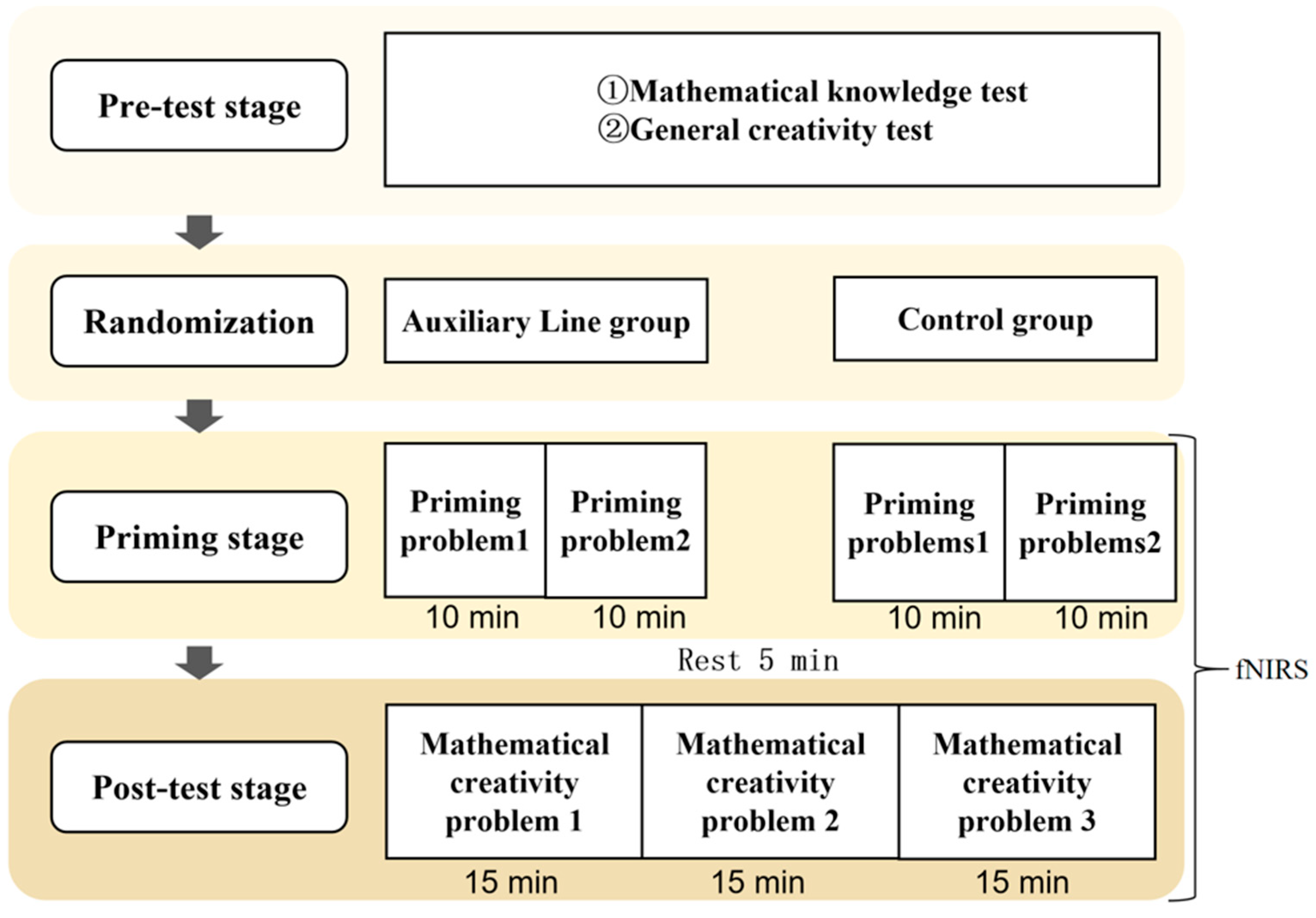
3.2. Experimental Design
3.3. Tests
3.3.1. Pre-Tests
3.3.2. Priming Tests
3.3.3. Post-Tests
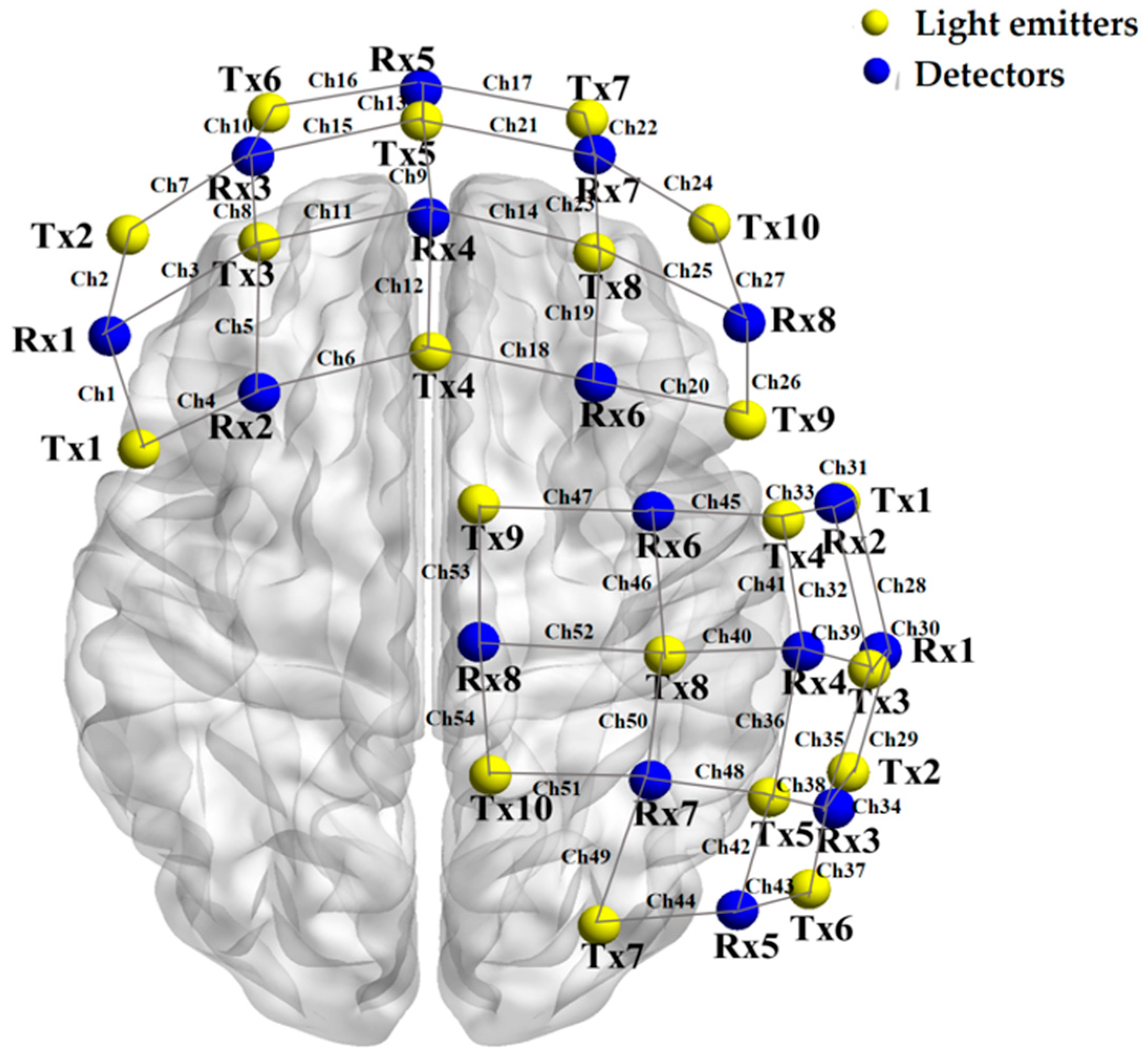
3.4. fNIRS Data Acquisition
3.5. Data Analysis
3.5.1. Behavioral Data Analysis
3.5.2. fNIRS Data Analysis
4. Results
4.1. Behavioral Results
4.2. Priming Stage fNIRS Results
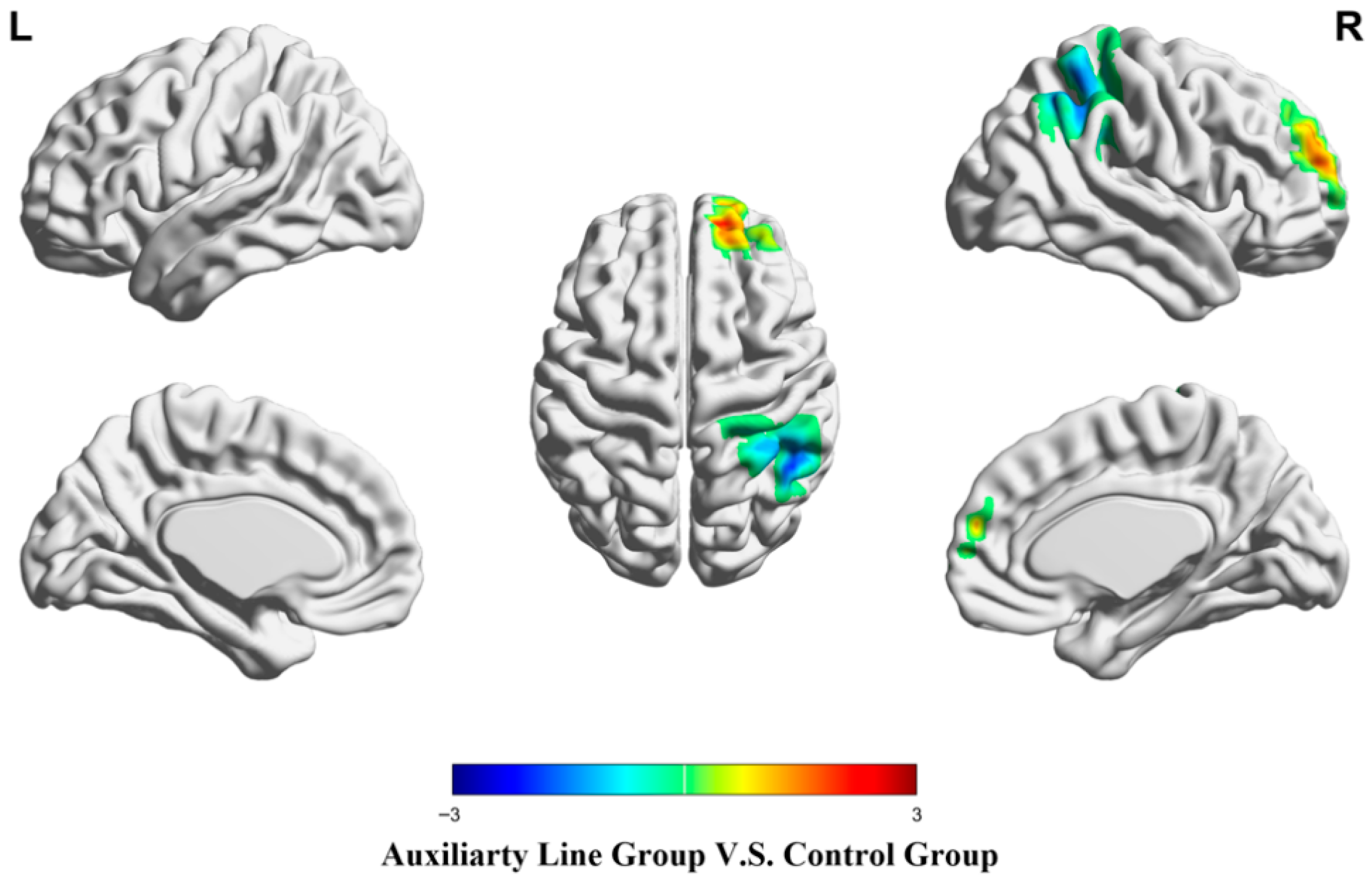
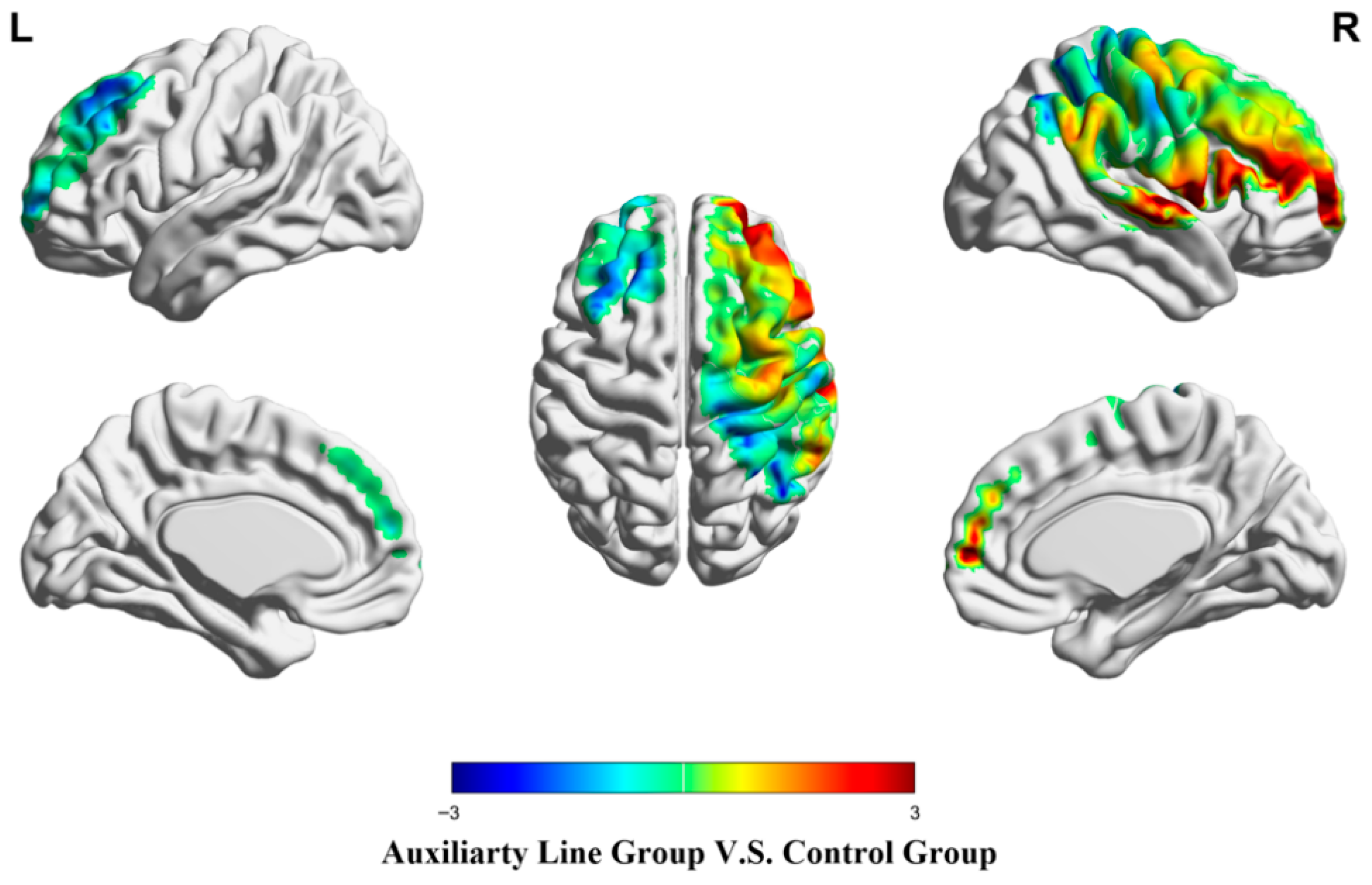
4.2.1. Activation Analysis Results of Priming Stage
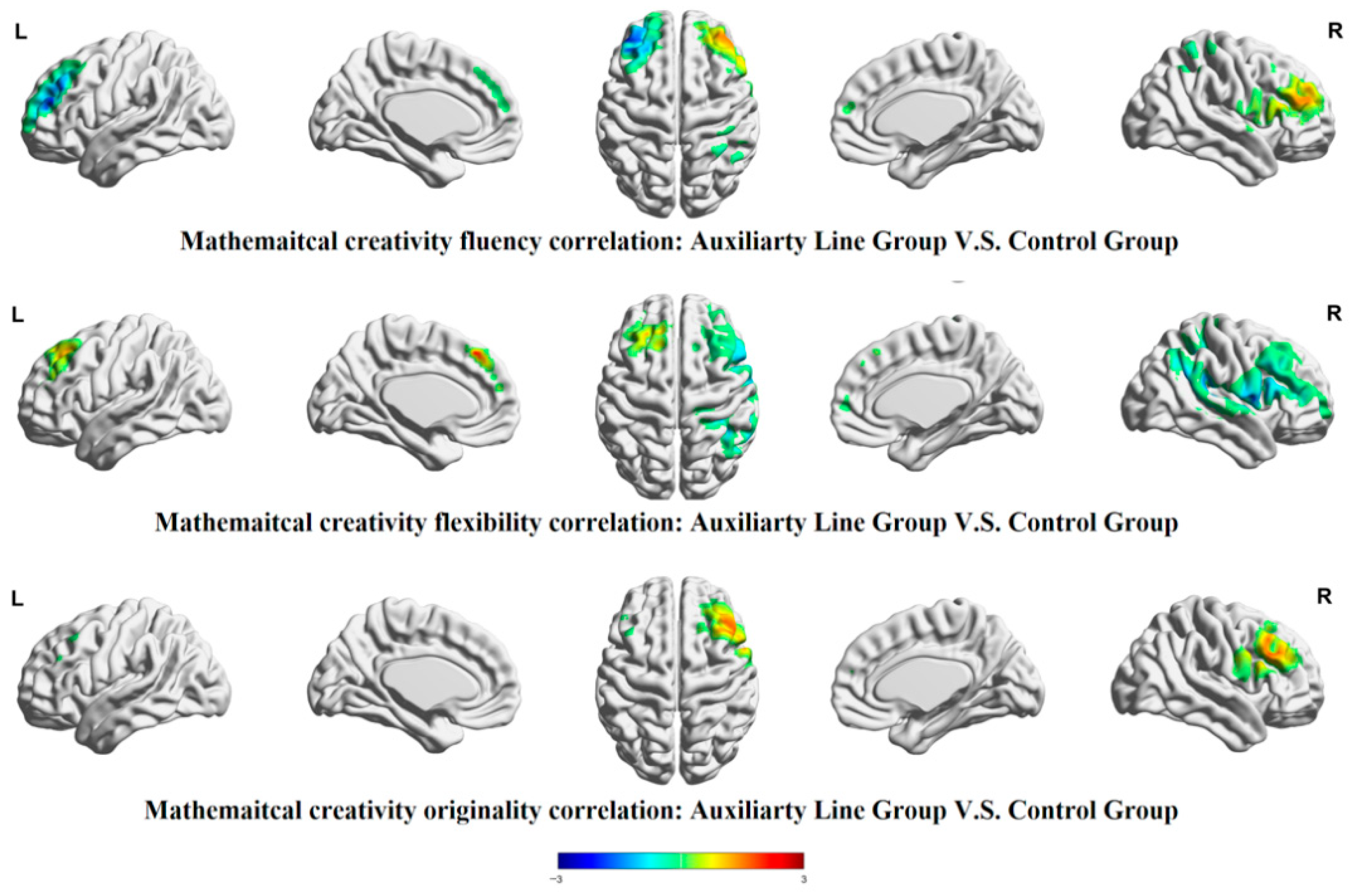
4.2.2. Brain–Behavior Correlation Analysis Results
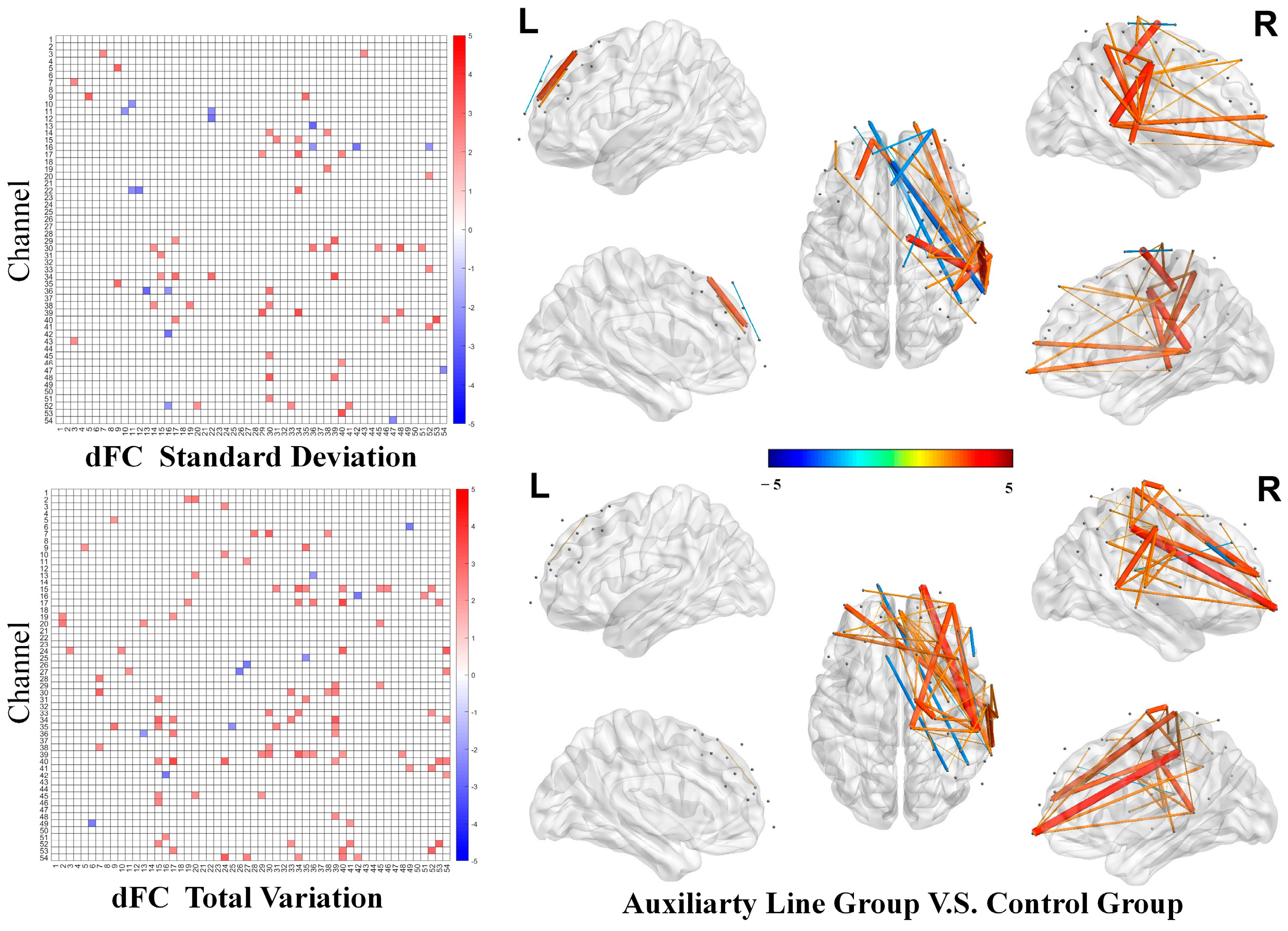
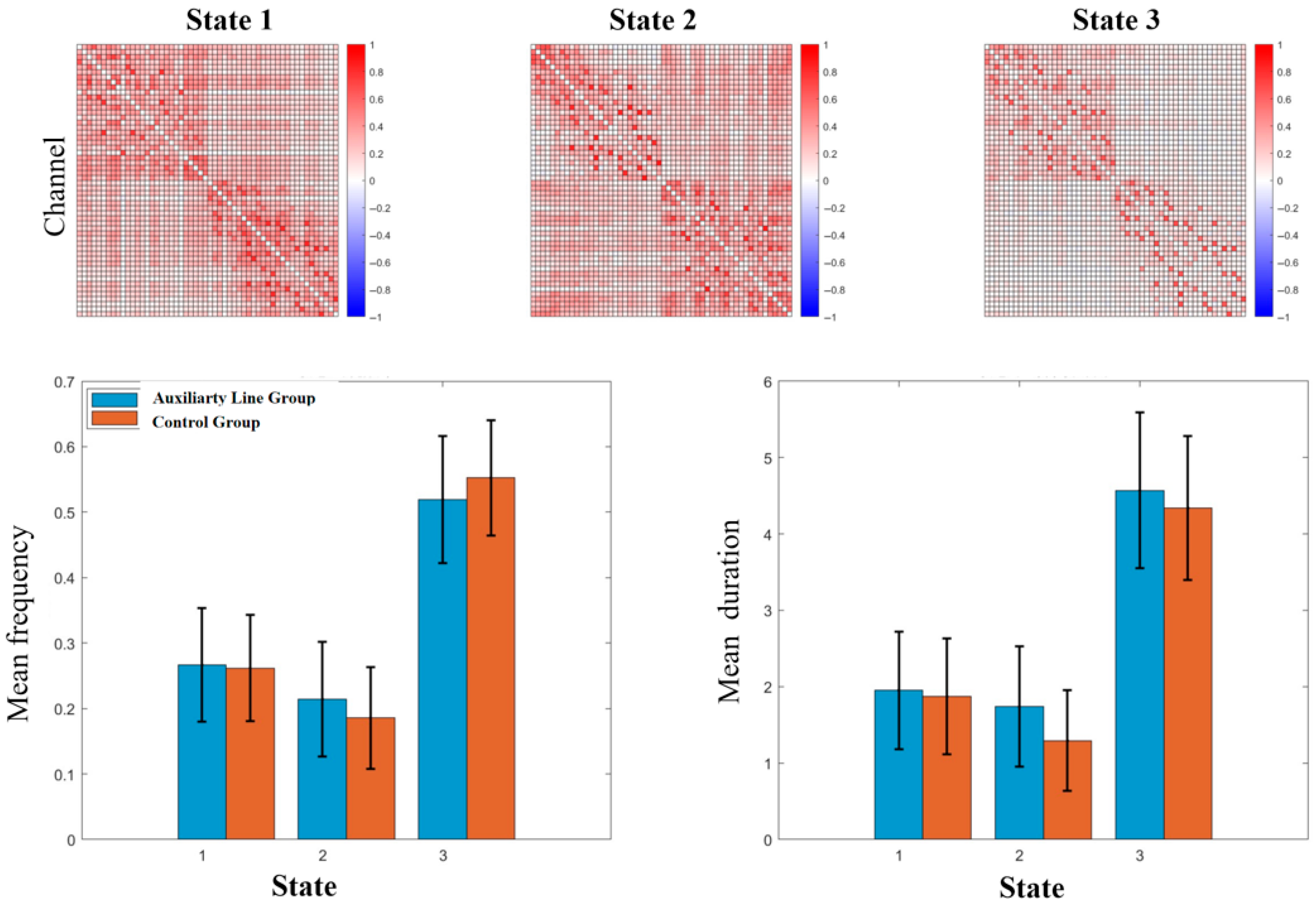
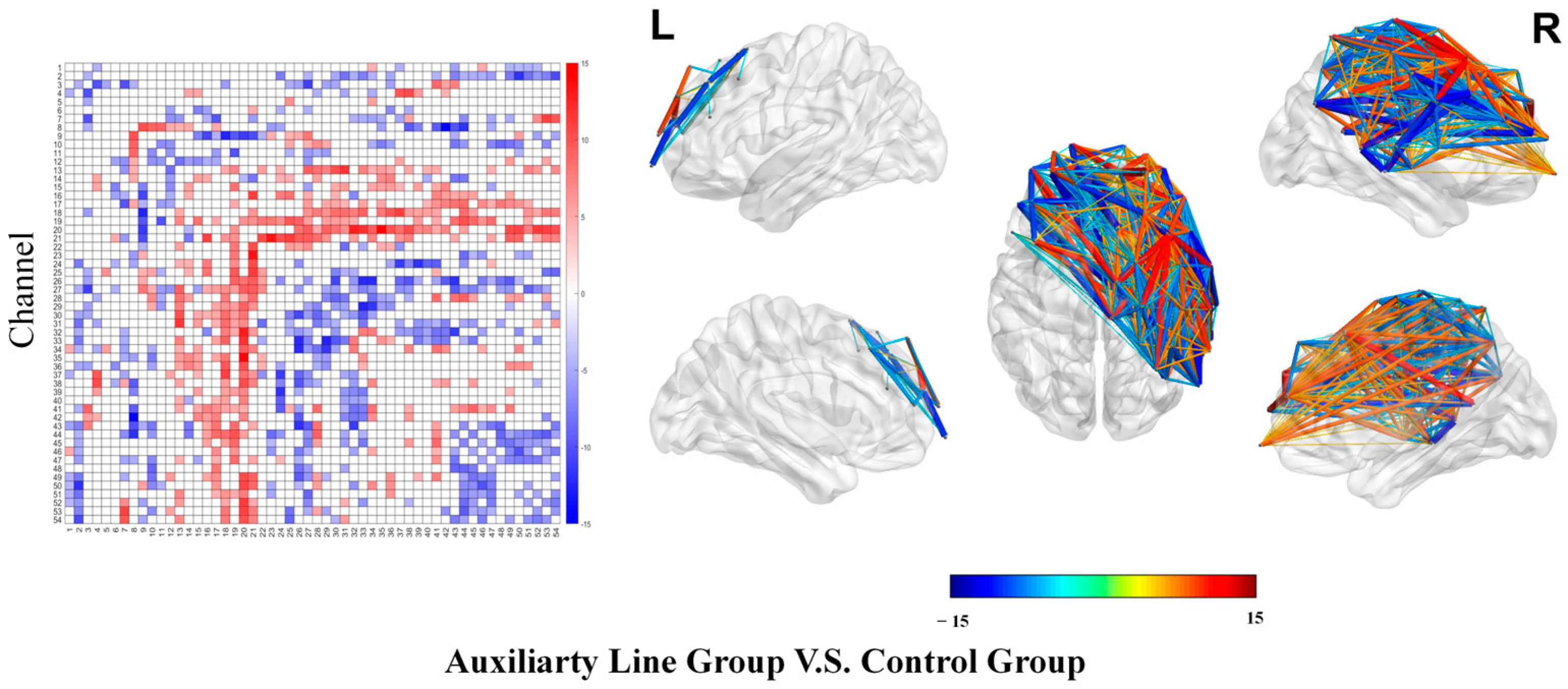
4.2.3. Results of Dynamic Functional Connectivity Analysis
4.3. Post-Test Stage fNIRS Results
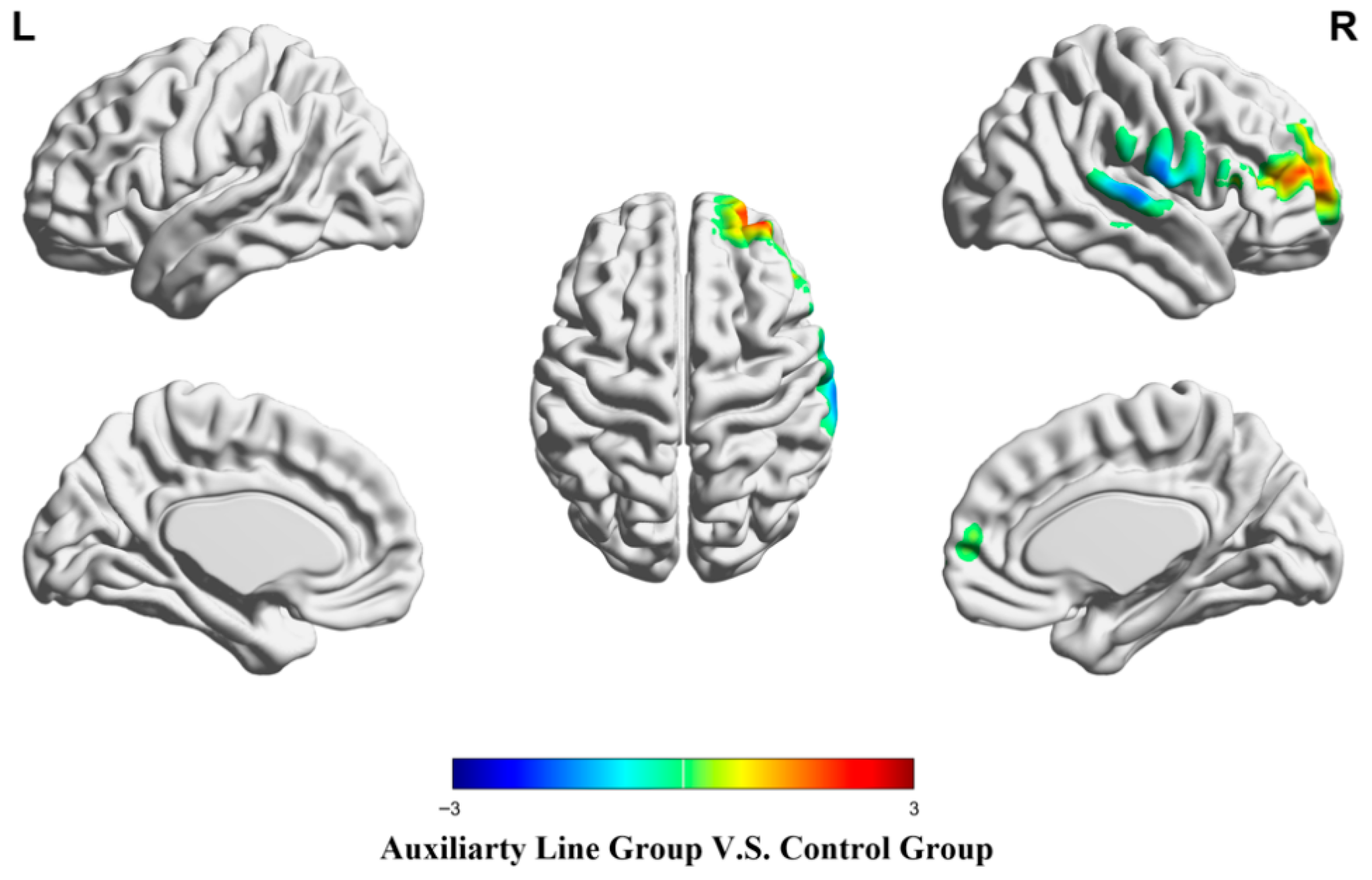
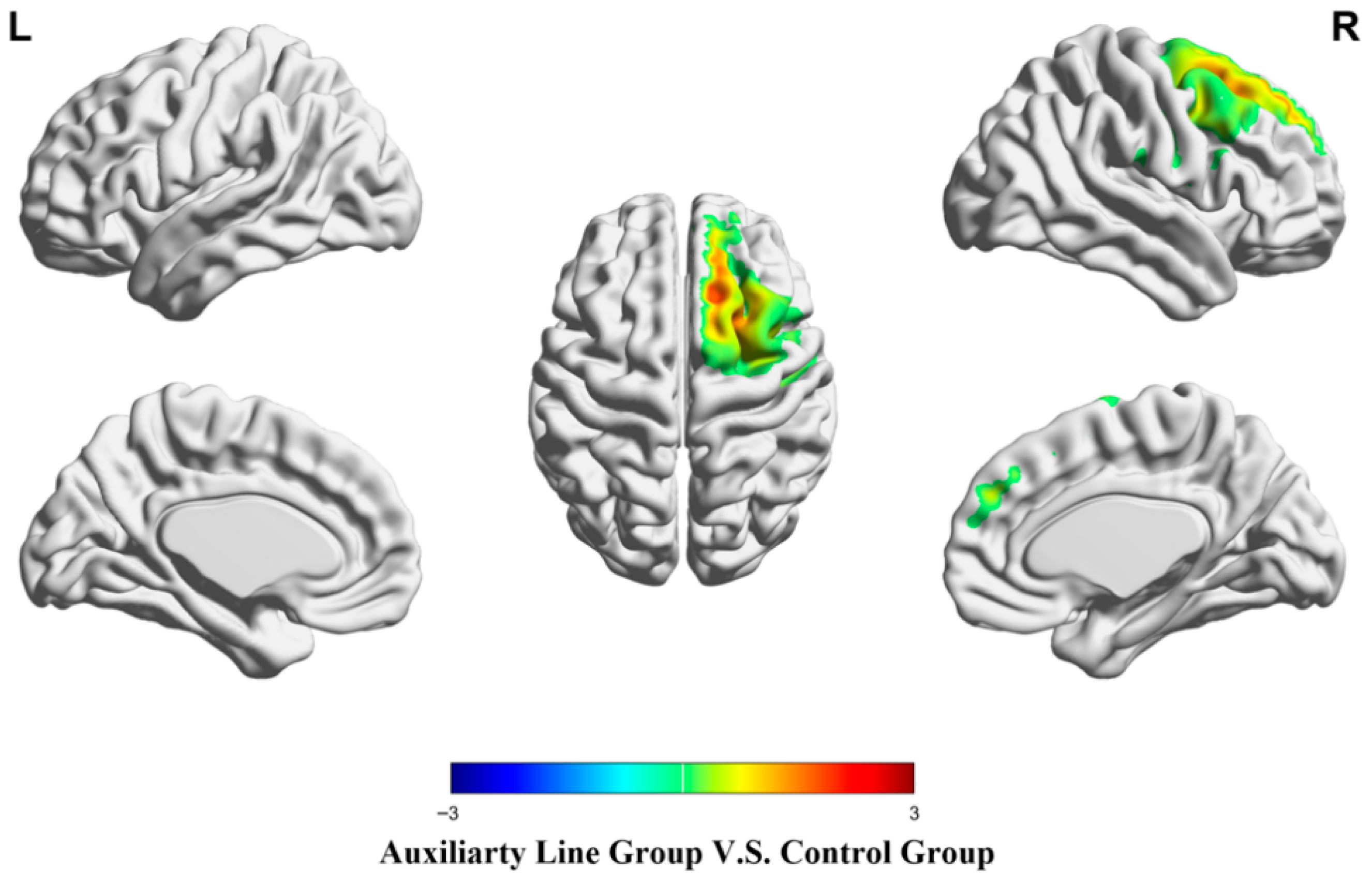
4.3.1. Activation Analysis Results of Post-Test Stage
4.3.2. Brain Behavior Correlation Analysis Results
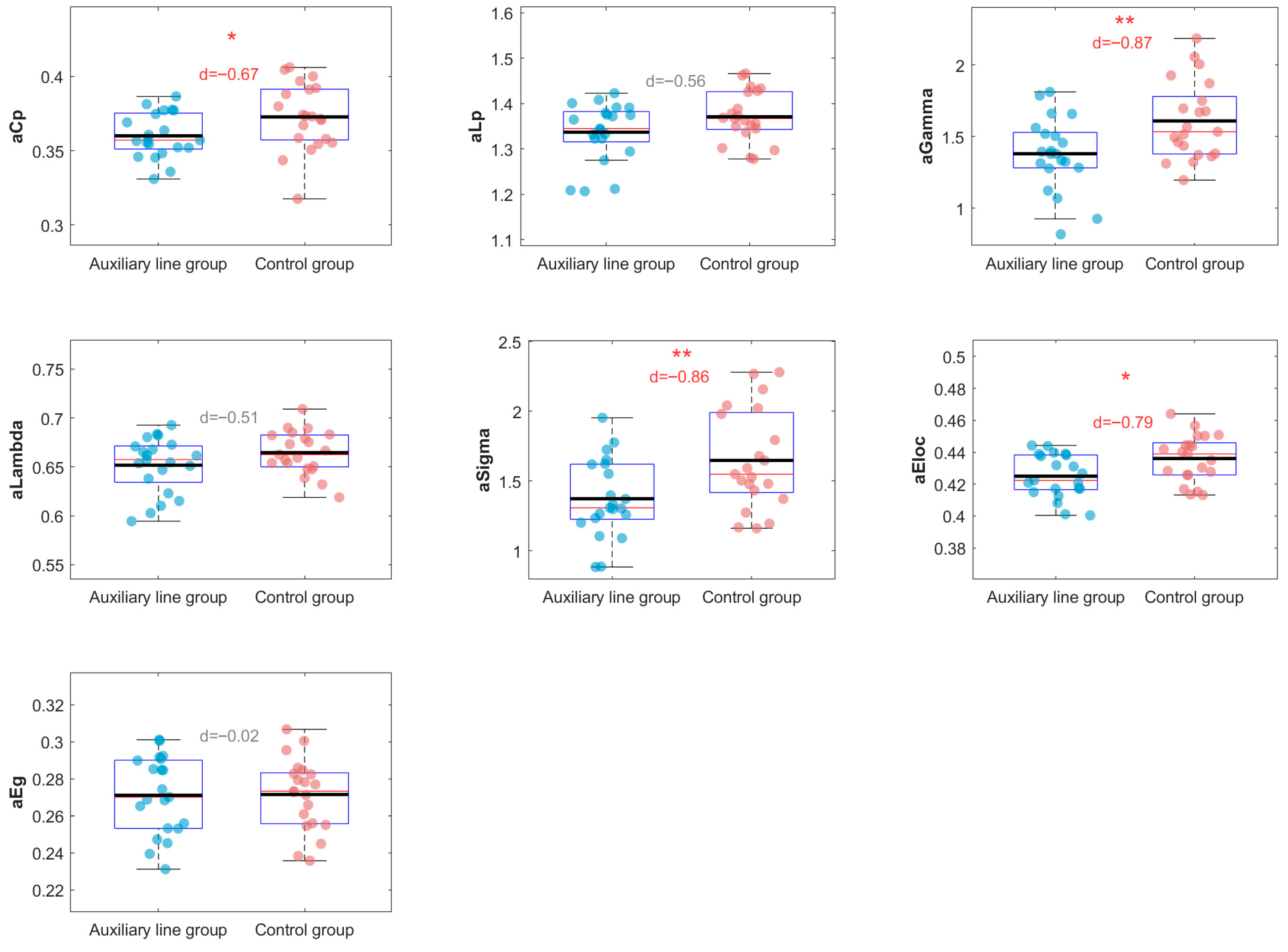
4.3.3. Functional Connectivity Analysis Results
4.3.4. Supplementary Analysis
5. Discussion
5.1. Behavioral Promoting Effect of Auxiliary Line Construction on Mathematical Creative Thinking
5.2. Brain Region Activation and Network Flexibility During the Priming Stage
5.3. Frontoparietal Network Activity and Global Integration Mode During the Post-Test Stage
5.4. Implications for Education
5.5. Limitations
6. Conclusions
Author Contributions
Funding
Institutional Review Board Statement
Informed Consent Statement
Data Availability Statement
Acknowledgments
Conflicts of Interest
Appendix A. Mathematics Knowledge Test
- Please write down the derivation method of the area of a trapezoid.

- 2.
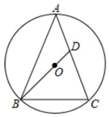
- In △ABC, AB = AC, and ⊙O is the circumcircle of △ABC. The extension of BO intersects side AC at point D.
- (1)
- Prove that: ∠BAC = 2∠ABD;
- (2)
- When △BCD is an isosceles triangle, find the measure of ∠BCD.
Appendix B. Tasks for the Priming Stage
Appendix B.1. Auxiliary Line Group Questionnaire
- Prove that the area of triangle AED is half the area of parallelogram ABCD. (Please prove it in as many ways as possible, and each method must use auxiliary lines. Just write down the key steps. If the reserve figures are not enough, you can add your own. Time limit: 10 min)

- 2.
- Please divide the trapezoid into two parts of equal area with a straight line. (Please try to draw the division methods in as many ways as possible. Just write down the key steps. If the backup pictures are not enough, you can add your own. Time limit: 10 min.)

Appendix B.2. Control Group Questionnaire
- Prove that the area of triangle AED is half the area of parallelogram ABCD. (Please write down all the steps as detailed as possible.)
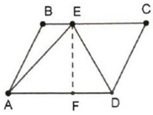
- 2.
- Given trapezoid ABCD, take point E on AD and point F on BC, and connect EF. Please prove that the area of quadrilateral ABEF is equal to the area of quadrilateral EFDC. (Please write down all the steps as detailed as possible.)
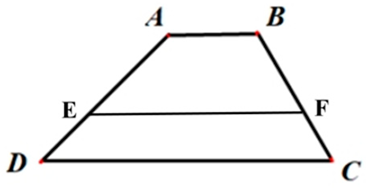
- Prove that the area of triangle AED is half the area of parallelogram ABCD. (Please write down all the steps as detailed as possible.)
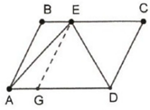
- 2.
- Given trapezoid ABCD as shown in the figure, E is the midpoint of AB and F is the midpoint of CD. Connect EF. Please prove that the area of quadrilateral ADFE is equal to the area of quadrilateral EFCB. (Please write down all the steps as detailed as possible.)

Appendix C. Mathematical Creative Thinking Test
- Draw a polygon with an area of 2 cm2 on the dotted paper. Please ensure that the polygons you draw are different (the horizontal and vertical distances between these points are 1 cm). (Please answer in the order of the numbers. Time limit: 15 min.)
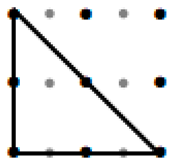
- 2.
- Remove the two jokers from a deck of playing cards. From the remaining 52 cards, randomly draw 4 cards to form a hand. Using any arithmetic operations such as addition, subtraction, multiplication, and division (parentheses are allowed), make the final result of the hand equal to 24. Each card in the hand must be used exactly once. (Please write down as many hands and equations as you can think of. Different calculations for the same hand count as two answers. Time limit: 15 min.)
- 3.
- AB is the diameter of circle O, and C and D are points on circle O such that AC // OD. E is the intersection point of AC and DB. Prove that DB = DC. (Please provide as many methods of proof as possible. Number your answers in the order you provide them, such as ①, ②, etc. Time limit: 15 min)

Appendix D. Scoring Criteria for Mathematical Creative Thinking Test
Appendix D.1. Scoring Criteria for Question 1
- (1)
- Fluency: One point is awarded for each correct answer.
- (2)
- Flexibility: One point is awarded for each category change.
- (3)
- Originality: Originality was evaluated using a statistical infrequency approach based on the distribution of responses across the full sample. Responses occurring in less than 1% of the sample were awarded 5 points; those occurring in 1.01–3% received 4 points; 3.01–5% received 3 points; 5.01–10% received 2 points; 10.01–15% received 1 point; and responses occurring in more than 15% of the sample received 0 points.
Appendix D.2. Scoring Criteria for Question 2
- (1)
- Fluency: The number of correct answers.
- (2)
- Flexibility: Conversion between algorithms (including +, −, ×, ÷). For example, 5 + 5 + 5 + 9, 5 × 4 + 2 + 2, 3 + 4 + 8 + 9, 4 × 8 − 5 − 3, flexibility scores 3 points.
- (3)
- Originality: Scored criteria same with Question 1.
Appendix D.3. Scoring Criteria for Question 3
- (1)
- Fluency: One point is awarded for each correct answer (no points are given if the proof is incomplete or lacks key steps/auxiliary lines).
- (2)
- Flexibility: One point is awarded for each category switch, specifically including:
- (i)
- C and D are on the same side of AB.
- ①
- Prove that △OCD ≌ △OBD
- ②
- Connect AD. In △ABE, the three lines are coincident (The median line, altitude and angle bisector on the base of an isosceles triangle coincide). Prove that △CDE ≌ △PDB
- ③
- Prove that quadrilateral AODC is a rhombus, and then prove that quadrilateral OBDC is a rhombus
- ④
- ∠BOD = ∠COD, BD = DC (Equal arcs imply equal chords)
- ⑤
- ∠BOD = ∠COD, BD = DC (Equal angles imply equal chords)
- ⑥
- By the cosine rule, DB2 = DC2, and the formula expansion shows that the angles are equal
- ⑦
- OD is the median line, D is the midpoint, DC = DE (Angle chasing)
- ⑧
- An exterior angle equals the opposite interior angle, ∠ECD = ∠OBD, equilateral, prove that △DCE ≌ △DBO
- ⑨
- By the theorem of the median to the hypotenuse, prove that CD = 1/2 BE + median line
- (ii)
- C and D are on opposite sides of AB
- ⑩
- Prove that △OCD ≌ △OBD
- ⑪
- Prove that ∠COD = ∠BOD, equal angles imply equal chords
- (3)
- Originality: Scored criteria same with Question 1.
Appendix E. MNI Coordinates of fNIRS Channel Midpoints
| Chanel | Name | x | y | z |
| 1 | L Middle frontal gyrus | −51 | 23 | 46 |
| 2 | L Middle frontal gyrus | −49 | 40 | 22 |
| 3 | L Middle frontal gyrus | −42 | 39 | 44 |
| 4 | L Middle frontal gyrus | −40 | 17 | 56 |
| 5 | L Middle frontal gyrus | −26 | 34 | 56 |
| 6 | L Supplementary motor area | −10 | 23 | 61 |
| 7 | L Middle frontal gyrus | −42 | 58 | 17 |
| 8 | L Middle frontal gyrus | −29 | 56 | 35 |
| 9 | L Superior frontal gyrus | −14 | 62 | 21 |
| 10 | L Superior frontal gyrus | −19 | 72 | 11 |
| 11 | L Superior frontal gyrus | −14 | 48 | 53 |
| 12 | L Medial superior frontal gyrus | −1 | 30 | 47 |
| 13 | L Medial superior frontal gyrus | −1 | 47 | 32 |
| 14 | R Superior frontal gyrus | 15 | 46 | 53 |
| 15 | R Medial superior frontal gyrus | 1 | 57 | 12 |
| 16 | L Superior frontal gyrus, orbital part | −17 | 68 | −8 |
| 17 | R Superior frontal gyrus, orbital part | 16 | 69 | −10 |
| 18 | R Superior frontal gyrus | 15 | 24 | 59 |
| 19 | R Superior frontal gyrus | 27 | 34 | 53 |
| 20 | R Middle frontal gyrus | 42 | 21 | 57 |
| 21 | R Superior frontal gyrus | 13 | 59 | 21 |
| 22 | R Superior frontal gyrus | 29 | 68 | 11 |
| 23 | R Middle frontal gyrus | 29 | 56 | 35 |
| 24 | R Middle frontal gyrus | 38 | 61 | 15 |
| 25 | R Middle frontal gyrus | 42 | 42 | 39 |
| 26 | R Middle frontal gyrus | 54 | 25 | 39 |
| 27 | R Middle frontal gyrus | 52 | 44 | 23 |
| 28 | R Superior temporal gyrus | 65 | −12 | −6 |
| 29 | R Middle temporal gyrus | 67 | −29 | −8 |
| 30 | R Superior temporal gyrus | 72 | −22 | 7 |
| 31 | R Superior temporal gyrus | 62 | 3 | 6 |
| 32 | R Supramarginal gyrus | 62 | −16 | 19 |
| 33 | R Postcentral gyrus | 64 | 2 | 34 |
| 34 | R Middle temporal gyrus | 68 | −43 | 6 |
| 35 | R Superior temporal gyrus | 59 | −29 | 19 |
| 36 | R Angular gyrus | 62 | −50 | 38 |
| 37 | R Middle temporal gyrus | 62 | −54 | 16 |
| 38 | R Supramarginal gyrus | 67 | −24 | 40 |
| 39 | R postcentral gyrus | 60 | −13 | 51 |
| 40 | R Inferior parietal lobule | 57 | −32 | 53 |
| 41 | R Superior parietal lobule | 51 | −32 | 62 |
| 42 | R Inferior parietal lobule | 50 | −57 | 49 |
| 43 | R Angular gyrus | 60 | −61 | 33 |
| 44 | R Angular gyrus | 41 | −67 | 54 |
| 45 | R Middle frontal gyrus | 49 | 3 | 60 |
| 46 | R Precentral gyrus | 35 | −10 | 66 |
| 47 | R Superior frontal gyrus | 22 | 4 | 72 |
| 48 | R Superior parietal lobule | 44 | −47 | 63 |
| 49 | R Superior parietal lobule | 35 | −61 | 66 |
| 50 | R postcentral gyrus | 35 | −34 | 73 |
| 51 | R Superior frontal gyrus | 25 | −46 | 79 |
| 52 | R Precentral gyrus | 26 | −23 | 78 |
| 53 | R Superior frontal gyrus | 11 | −8 | 77 |
| 54 | R postcentral gyrus | 11 | −30 | 79 |
Appendix F. Details of Data Analysis
- Behavioral Data Analysis
- 2.
- fNIRS Data Analysis
- 2.1.
- Preprocessing
- 2.2.
- Priming Stage Analysis
- 2.3.
- Post-Test Stage Analysis
Appendix G. Analysis Results Table of Startup Stage Time
| Passage | Name | x | y | z | Time Window (t) | |||||||||
| 1 | 2 | 3 | 4 | 5 | 6 | 7 | 8 | 9 | 10 | |||||
| 1 | L middle frontal gyrus | −51 | 23 | 46 | 0 | 0 | 0 | 0 | 0 | 2.03 | 0 | 0 | 0 | 0 |
| 2 | L middle frontal gyrus | −49 | 40 | 22 | 0 | 0 | 0 | 0 | 0 | 0 | 0 | 0 | 0 | 0 |
| 3 | L middle frontal gyrus | −42 | 39 | 44 | 0 | 0 | 0 | 0 | 0 | 2.59 | 0 | 0 | 0 | 0 |
| 4 | L middle frontal gyrus | −40 | 17 | 56 | 0 | 0 | 0 | 0 | 0 | 0 | 0 | 0 | 0 | 0 |
| 5 | L middle frontal gyrus | −26 | 34 | 56 | −2.13 | 0 | 0 | 0 | 0 | 0 | 0 | 0 | 0 | −2.4 |
| 6 | L supplementary motor area | −10 | 23 | 61 | 0 | 0 | 0 | 0 | 0 | 0 | 0 | 0 | 0 | 0 |
| 7 | L middle frontal gyrus | −42 | 58 | 17 | 0 | 0 | 2.03 | 0 | 0 | 0 | 0 | 0 | 0 | 0 |
| 8 | L middle frontal gyrus | −29 | 56 | 35 | 0 | 0 | 0 | 0 | 0 | 0 | 0 | 0 | 2.05 | 0 |
| 9 | L superior frontal gyrus | −14 | 62 | 21 | 0 | 0 | 0 | 0 | 0 | 0 | 0 | 0 | 2.32 | 0 |
| 10 | L superior frontal gyrus | −19 | 72 | 11 | 0 | 0 | 0 | 0 | 0 | 0 | 0 | 0 | 0 | 0 |
| 11 | L superior frontal gyrus | −14 | 48 | 53 | 0 | 0 | 0 | 0 | 0 | 0 | 0 | 0 | 0 | 0 |
| 12 | L medial superior frontal gyrus | −1 | 30 | 47 | 0 | 0 | 0 | 0 | 0 | 0 | 0 | 0 | 0 | 0 |
| 13 | L medial superior frontal gyrus | −1 | 47 | 32 | 0 | 0 | 0 | 0 | 0 | 0 | 0 | 0 | 0 | 2 |
| 14 | R superior frontal gyrus | 15 | 46 | 53 | 0 | 0 | 0 | 0 | 0 | 0 | 0 | 0 | 0 | 0 |
| 15 | R medial superior frontal gyrus | 1 | 57 | 12 | 0 | 0 | 0 | 0 | 0 | 0 | 0 | 0 | 0 | 0 |
| 16 | L orbital part of superior frontal gyrus | −17 | 68 | −8 | 0 | 0 | 0 | 0 | 0 | 0 | 0 | 0 | 0 | 0 |
| 17 | R orbital part of superior frontal gyrus | 16 | 69 | −10 | 0 | 0 | 0 | 0 | 0 | 0 | 0 | 0 | 0 | 0 |
| 18 | R superior frontal gyrus | 15 | 24 | 59 | 0 | 0 | 0 | 0 | 2 | 0 | 0 | 0 | 0 | 2.67 |
| 19 | R superior frontal gyrus | 27 | 34 | 53 | 0 | 0 | 0 | 0 | 0 | 0 | 0 | 0 | 0 | 0 |
| 20 | R middle frontal gyrus | 42 | 21 | 57 | 0 | 0 | 0 | 0 | 0 | 0 | 0 | 0 | 0 | 0 |
| 21 | R superior frontal gyrus | 13 | 59 | 21 | 0 | 0 | 0 | 0 | 0 | 0 | 0 | 0 | 2.05 | 0 |
| 22 | R superior frontal gyrus | 29 | 68 | 11 | 0 | 0 | 0 | 0 | 0 | 0 | 0 | 0 | 0 | 0 |
| 23 | R middle frontal gyrus | 29 | 56 | 35 | 0 | 0 | 0 | 0 | 0 | 0 | 0 | 0 | 0 | 0 |
| 24 | R middle frontal gyrus | 38 | 61 | 15 | 0 | 0 | 0 | 2.52 | 0 | 0 | 0 | 0 | 0 | 0 |
| 25 | R middle frontal gyrus | 42 | 42 | 39 | 0 | 0 | 0 | 0 | 0 | 0 | 0 | 0 | 0 | 0 |
| 26 | R middle frontal gyrus | 54 | 25 | 39 | 0 | 0 | 0 | 0 | 0 | 0 | 0 | 0 | 0 | 0 |
| 27 | R middle frontal gyrus | 52 | 44 | 23 | 0 | 0 | 0 | 0 | 0 | 0 | 0 | 0 | 0 | −2.11 |
| 28 | R superior temporal gyrus | 65 | −12 | −6 | 0 | 0 | 0 | 0 | 0 | 0 | 0 | 0 | 0 | 0 |
| 29 | R middle temporal gyrus | 67 | −29 | −8 | 0 | 0 | 0 | 0 | 0 | 0 | 0 | 0 | 0 | 0 |
| 30 | R superior temporal gyrus | 72 | −22 | 7 | 0 | 0 | 0 | 0 | 0 | 2 | 0 | 0 | 2.28 | 0 |
| 31 | R superior temporal gyrus | 62 | 3 | 6 | 0 | 0 | 0 | 0 | 0 | 0 | 0 | 0 | 0 | 0 |
| 32 | R superior parietal gyrus | 62 | −16 | 19 | −2 | 0 | 0 | 0 | 0 | 0 | 0 | 0 | 0 | 0 |
| 33 | R postcentral gyrus | 64 | 2 | 34 | 0 | 0 | 0 | 0 | 0 | 0 | 0 | 0 | 0 | 0 |
| 34 | R middle temporal gyrus | 68 | −43 | 6 | 0 | 0 | 0 | 0 | 0 | 0 | 0 | 0 | 0 | 0 |
| 35 | R superior temporal gyrus | 59 | −29 | 19 | 0 | 0 | 0 | 0 | −2.12 | 0 | 0 | 0 | 0 | 0 |
| 36 | R angular gyrus | 62 | −50 | 38 | 0 | 0 | 0 | 0 | 0 | 0 | 0 | 0 | 0 | 0 |
| 37 | R middle temporal gyrus | 62 | −54 | 16 | 0 | 0 | 0 | 0 | 0 | 0 | 0 | 0 | 0 | −2.14 |
| 38 | R superior parietal gyrus | 67 | −24 | 40 | 2.63 | 0 | 0 | 0 | 0 | 2.56 | 0 | 0 | 0 | 0 |
| 39 | R postcentral gyrus | 60 | −13 | 51 | 0 | 0 | 0 | 0 | 0 | 0 | 0 | 0 | 2.74 | 0 |
| 40 | R inferior parietal lobule | 57 | −32 | 53 | 0 | 0 | 0 | 0 | 0 | 0 | 2.64 | 0 | 0 | 0 |
| 41 | R superior parietal lobule | 51 | −32 | 62 | 0 | 0 | 0 | 0 | 0 | 0 | 0 | 0 | 0 | 0 |
| 42 | R inferior parietal lobule | 50 | −57 | 49 | 0 | −2.16 | 0 | 0 | 0 | 0 | 0 | −2.72 | 0 | 0 |
| 43 | R angular gyrus | 60 | −61 | 33 | 0 | 0 | 0 | 0 | 2.29 | 0 | 0 | 0 | 0 | 0 |
| 44 | R angular gyrus | 41 | −67 | 54 | 0 | 0 | 0 | 2.51 | 0 | 0 | 0 | 0 | 0 | 0 |
| 45 | R middle frontal gyrus | 49 | 3 | 60 | 0 | 0 | 0 | 0 | 0 | 0 | 0 | 0 | 0 | 0 |
| 46 | R precentral gyrus | 35 | −10 | 66 | 0 | 0 | 0 | 0 | 0 | 0 | 0 | 0 | 0 | 0 |
| 47 | R superior frontal gyrus | 22 | 4 | 72 | 0 | 0 | 0 | 0 | 0 | 0 | 0 | 0 | 0 | 0 |
| 48 | R superior parietal lobule | 44 | −47 | 63 | 0 | 0 | 0 | 0 | 0 | 0 | 0 | 0 | 2.41 | 0 |
| 49 | R superior parietal lobule | 35 | −61 | 66 | 0 | 0 | 0 | 0 | 0 | 0 | 0 | 0 | 2.51 | 0 |
| 50 | R postcentral gyrus | 35 | −34 | 73 | 2.2 | 0 | 0 | 0 | 0 | 0 | 0 | −2.24 | 2.03 | 0 |
| 51 | R superior parietal lobule | 25 | −46 | 79 | 0 | 0 | 0 | 0 | 0 | 0 | 0 | −2.54 | 2.61 | 0 |
| 52 | R precentral gyrus | 26 | −23 | 78 | 0 | 0 | 0 | 0 | 0 | 0 | 0 | 0 | 2.16 | −2.24 |
| 53 | R superior frontal gyrus | 11 | −8 | 77 | 0 | 0 | 0 | 0 | 0 | 0 | 0 | 0 | 0 | 0 |
| 54 | R postcentral gyrus | 11 | −30 | 79 | 0 | 0 | 0 | 0 | −2.06 | 0 | 0 | 0 | 2.14 | 0 |
Appendix H. PLSC Analysis Results of Brain-Behavior Correlation During the Post-Test Stage
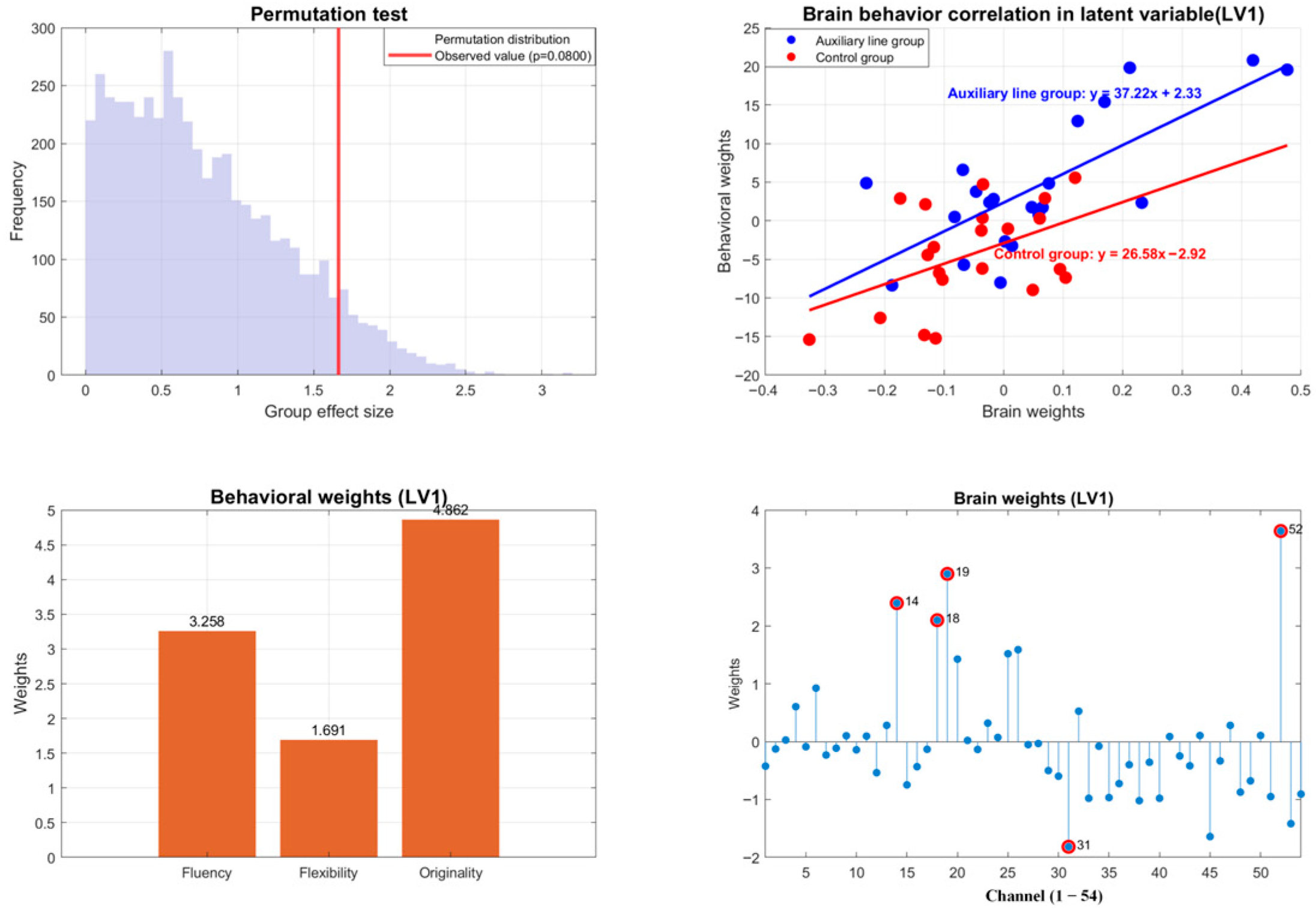

| Channel | Brain Region | x | y | z | w |
|---|---|---|---|---|---|
| 52 | R Precentral gyrus | 26 | −23 | 78 | 3.64 |
| 19 | R Superior Frontal Gyrus | 27 | 34 | 53 | 2.90 |
| 14 | R Superior Frontal Gyrus | 15 | 46 | 53 | 2.39 |
| 18 | R Superior Frontal Gyrus | 15 | 24 | 59 | 2.09 |
| 31 | R Superior Temporal Gyrus | 62 | 3 | 6 | −1.82 |
Appendix I. Correlation Between Priming Stage and Post-Test Stage

| Channel | Brain Region | x | y | z | r1 | r2 | z |
|---|---|---|---|---|---|---|---|
| 4 | L Middle Frontal Gyrus | −40 | 17 | 56 | −0.46 | 0.62 | −2.38 |
| 5 | L Middle Frontal Gyrus | −26 | 34 | 56 | −0.20 | 0.66 | −3.02 |
| 15 | R Medial superior frontal gyrus | 1 | 57 | 12 | 0.89 | 0.42 | 2.97 |
| 16 | R Orbital part of Superior Frontal Gyrus | −17 | 68 | −8 | −0.67 | −0.04 | −2.31 |
| 17 | R Orbital part of Superior Frontal Gyrus | 16 | 69 | −10 | 0.06 | −0.90 | 4.62 |
| 22 | R Superior Frontal Gyrus | 29 | 68 | 11 | 0.51 | −0.60 | 3.78 |
| 24 | R Middle Frontal Gyrus | 38 | 61 | 15 | 0.68 | −0.08 | 2.72 |
| 27 | R Middle Frontal Gyrus | 52 | 44 | 23 | −0.17 | −0.71 | 2.17 |
| 28 | R Superior Temporal Gyrus | 65 | −12 | −6 | 0.43 | −0.88 | 5.56 |
| 31 | R Superior Temporal Gyrus | 62 | 3 | 6 | 0.09 | −0.73 | 3.08 |
| 36 | R Angular gyrus | 62 | −50 | 38 | 0.42 | −0.46 | 2.82 |
| 39 | R Postcentral gyrus | 60 | −13 | 51 | −0.22 | 0.45 | −2.13 |
| 44 | R Angular gyrus | 41 | −67 | 54 | −0.14 | 0.82 | −3.87 |
| 46 | R Precentral gyrus | 35 | −10 | 66 | 0.04 | −0.59 | 2.18 |
| 54 | R Postcentral gyrus | 11 | −30 | 79 | −0.32 | 0.33 | −2.05 |
References
- Adiastuty, N., Sumarni, Riyadi, M., Nisa, A., & Waluya. (2021, June). Neuroscience study: Analysis of mathematical creative thinking ability levels in terms of gender differences in vocational high school students. In Journal of physics: Conference series (Vol. 1933, No. 1, p. 012072). IOP Publishing. [Google Scholar]
- Adiastuty, N., Waluya, S. B., Rochmad, & Aminah, N. (2020, August). Neuroscience study: Gender and mathematical creative thinking skills in vocational high school students. In Journal of physics: Conference series (Vol. 1613, No. 1, p. 012056). IOP Publishing. [Google Scholar]
- Bassett, D. S., & Bullmore, E. (2006). Small-world brain networks. Neuroscientist, 12(6), 512–523. [Google Scholar] [CrossRef]
- Beaty, R. E., Benedek, M., Silvia, P. J., & Schacter, D. L. (2016). Creative cognition and brain network dynamics. Trends in Cognitive Sciences, 20(2), 87–95. [Google Scholar] [CrossRef] [PubMed]
- Beaty, R. E., Cortes, R. A., Merseal, H. M., Hardiman, M. M., & Green, A. E. (2025). Brain networks supporting scientific creative thinking. Psychology of Aesthetics, Creativity, and the Arts, 19(6), 1321–1331. [Google Scholar] [CrossRef]
- Benedek, M., Jauk, E., Sommer, M., Arendasy, M., & Neubauer, A. C. (2014). Neural correlates of fluency, flexibility, and originality in creative idea generation. Cerebral Cortex, 24(9), 2212–2221. [Google Scholar] [CrossRef][Green Version]
- Bogen, J. E. (1969). The other side of the brain I: Dysgraphia and dyscopia following cerebral commissurotomy. Bulletin of the Los Angeles Neurological Societies, 34(2), 73–105. [Google Scholar]
- Burger, W. F., & Shaughnessy, J. M. (1986). Characterizing the van Hiele levels of development in geometry. Journal for Research in Mathematics Education, 17(1), 31–48. [Google Scholar] [CrossRef]
- De Vink, I. C., Willemsen, R. H., Keijzer, R., Lazonder, A. W., & Kroesbergen, E. H. (2023). Supporting creative problem solving in primary geometry education. Thinking Skills and Creativity, 48, 101307. [Google Scholar] [CrossRef]
- Dietrich, A., & Kanso, R. (2010). A review of EEG, ERP, and neuroimaging studies of creativity and insight. Psychological Bulletin, 136(5), 822–848. [Google Scholar] [CrossRef]
- Duval, R. (1995). Geometrical pictures: Kinds of representation and specific processings. In R. Sutherland, & J. Mason (Eds.), Exploiting mental imagery with computers in mathematics education (pp. 142–157). Springer. [Google Scholar]
- Duval, R. (2017). Understanding the mathematical way of thinking—The registers of semiotic representations. Springer. [Google Scholar]
- Elgrably, H., & Leikin, R. (2021). Creativity as a function of problem-solving expertise: Posing new problems through investigations. ZDM—Mathematics Education, 53(6), 891–904. [Google Scholar] [CrossRef]
- Fan, L., Qi, C., Liu, X., Wang, Y., & Lin, M. (2017). Does a transformation approach improve students’ ability in constructing auxiliary lines for solving geometric problems? An intervention-based study with two Chinese classrooms. Educational Studies in Mathematics, 96(2), 229–248. [Google Scholar] [CrossRef]
- Flaherty, A. W. (2005). Frontotemporal and dopaminergic control of idea generation and creative drive. The Journal of Comparative Neurology, 493(1), 147–153. [Google Scholar] [CrossRef] [PubMed]
- Gridos, P., Avgerinos, E., Mamona-Downs, J., & Vlachou, R. (2021). Geometrical figure apprehension, construction of auxiliary lines, and multiple solutions in problem solving: Aspects of mathematical creativity in school geometry. International Journal of Science and Mathematics Education, 20(3), 619–636. [Google Scholar] [CrossRef]
- Herbst, P., & Brach, C. (2006). Proving and doing proofs in high school geometry classes. Cognition and Instruction, 24(1), 73–122. [Google Scholar] [CrossRef]
- Hsu, H. Y., & Silver, E. A. (2014). Cognitive complexity of mathematics instructional tasks in a Taiwanese classroom: An examination of task sources. Journal for Research in Mathematics Education, 45(4), 460–496. [Google Scholar] [CrossRef]
- Latora, V., & Marchiori, M. (2001). Efficient behavior of small-world networks. Physical Review Letters, 87(19), 198701. [Google Scholar] [CrossRef]
- Leikin, R. (2009). Exploring mathematical creativity using multiple solution tasks. In R. Leikin, A. Berman, & B. Koichu (Eds.), Creativity in mathematics and the education of gifted students (pp. 129–145). Brill. [Google Scholar] [CrossRef]
- Leikin, R., Leikin, M., & Waisman, I. (2011). What is special about the brain activity of mathematically gifted adolescents? In R. Leikin, & B. Sriraman (Eds.), Creativity and giftedness (pp. 165–182). Springer. [Google Scholar] [CrossRef]
- Leikin, R., & Lev, M. (2007, July 8–13). Multiple solution tasks as a tool for assessing mathematical creativity. 31st Conference of the International Group for the Psychology of Mathematics Education (Vol. 3, pp. 161–168), Seoul, Republic of Korea. [Google Scholar]
- Lev, M., & Leikin, R. (2013). The interplay between excellence in school mathematics and general giftedness: Focusing on mathematical creativity. In R. Leikin, & B. Sriraman (Eds.), Creativity and giftedness (pp. 225–238). Springer. [Google Scholar] [CrossRef]
- Li, Q., & Kim, S. (2025). Meta-analysis of fMRI studies related to mathematical creativity. Frontiers in Psychology, 15, 1400328. [Google Scholar] [CrossRef]
- Mann, E. L. (2006). Creativity: The essence of mathematics. Journal for the Education of the Gifted, 30(2), 236–260. [Google Scholar] [CrossRef]
- Morin, T. M., Moore, K. N., Isenburg, K., Ma, W., & Stern, C. E. (2023). Functional reconfiguration of task-active frontoparietal control network facilitates abstract reasoning. Cerebral Cortex, 33(10), 5761–5773. [Google Scholar] [CrossRef]
- Muzaini, M., Rahayuningsih, S., Ikram, M., & Az-Zahrah, F. (2023). Mathematical creativity: Student geometrical figure apprehension in geometry problem-solving using new auxiliary elements. International Journal of Educational Methodology, 9(1), 139–150. [Google Scholar] [CrossRef]
- Naseer, N., & Hong, K. S. (2015). fNIRS-based brain-computer interfaces: A review. Frontiers in Human Neuroscience, 9, 3. [Google Scholar] [CrossRef]
- OECD. (2024). PISA 2022 results (Volume III): Creative minds, creative schools. OECD Publishing. [Google Scholar] [CrossRef]
- Palatnik, A., & Dreyfus, T. (2019). Students’ reasons for introducing auxiliary lines in proving situations. Journal of Mathematical Behavior, 55, 100679. [Google Scholar] [CrossRef]
- Palatnik, A., & Sigler, A. (2019). Focusing attention on auxiliary lines when introduced into geometric problems. International Journal of Mathematical Education in Science and Technology, 50(2), 202–215. [Google Scholar] [CrossRef]
- Pehkonen, E. (1997). The state-of-art in mathematical creativity. ZDM–Mathematics Education, 29(3), 63–67. [Google Scholar] [CrossRef]
- Polya, G. (2004). How to solve it: A new aspect of mathematical method (Vol. 85). Princeton University Press. [Google Scholar]
- Savic, M., Karakok, G., Tang, G., & El Turkey, H. (2015). Developing a creativity-in-progress rubric on proving. In T. Fukawa-Connelly (Ed.), Proceedings of the 18th annual conference on research in undergraduate mathematics education (pp. 939–945). Mathematical Association of America. [Google Scholar]
- Singer, F. M., & Voica, C. (2015). When mathematics meets real objects: How does creativity interact with expertise in problem solving and posing? In R. Leikin, & B. Sriraman (Eds.), Creativity and giftedness (pp. 75–104). Springer. [Google Scholar] [CrossRef]
- Skau, S., Helenius, O., Sundberg, K., Bunketorp-Käll, L., & Kuhn, H.-G. (2022). Proactive cognitive control, mathematical cognition and functional activity in the frontal and parietal cortex in primary school children: An fNIRS study. Trends in Neuroscience and Education, 28, 100180. [Google Scholar] [CrossRef] [PubMed]
- Sporns, O. (2013). Structure and function of complex brain networks. Dialogues in Clinical Neuroscience, 15(3), 247–262. [Google Scholar] [CrossRef] [PubMed]
- Suherman, S., & Vidákovich, T. (2022). Assessment of mathematical creative thinking: A systematic review. Thinking Skills and Creativity, 44, 101019. [Google Scholar] [CrossRef]
- Tam, Y. P., & Chan, W. W. L. (2022). The differential relations between sub-domains of spatial abilities and mathematical performance in children. Contemporary Educational Psychology, 71, 102101. [Google Scholar] [CrossRef]
- Wang, L., Cao, C., Zhou, X., & Qi, C. (2022). Spatial abilities associated with open math problem solving. Applied Cognitive Psychology, 36(2), 306–317. [Google Scholar] [CrossRef]
- Zhu, W., Chen, Q., Xia, L., Beaty, R. E., Yang, W., Tian, F., Sun, J., Cao, G., Zhang, Q., Chen, X., & Qiu, J. (2017). Common and distinct brain networks underlying verbal and visual creativity. Human Brain Mapping, 38(4), 2094–2111. [Google Scholar] [CrossRef]


| Stage | Tests | Group | M (SD) | t | p | d |
|---|---|---|---|---|---|---|
| Pre-test | 1. Mathematical knowledge test | ALG | 14.90 (4.55) | −0.87 | 0.39 | −0.27 |
| CG | 16.19 (4.95) | |||||
| 2.1. General creativity fluency | ALG | 13.43 (5.60) | 0.91 | 0.37 | 0.28 | |
| CG | 12.10 (3.70) | |||||
| 2.2. General creativity flexibility | ALG | 11.24 (4.93) | 0.52 | 0.61 | 0.36 | |
| CG | 10.57 (3.20) | |||||
| 2.3. General creativity originality | ALG | 1.33 (2.54) | −1.10 | 0.28 | −0.34 | |
| CG | 2.14 (2.22) | |||||
| Priming | 3. Priming test | ALG | 30.48 (5.22) | 0.12 | 0.91 | 0.04 |
| CG | 30.29 (5.29) | |||||
| Post-test | 4.1. Mathematical creative thinking fluency | ALG | 51.90 (21.77) | 2.06 * | 0.04 | 0.64 |
| CG | 39.62 (16.44) | |||||
| 4.2. Mathematical creative thinking flexibility | ALG | 22.33 (5.73) | 1.18 | 0.25 | 0.36 | |
| CG | 20.14 (6.31) | |||||
| 4.3. Mathematical creative thinking originality | ALG | 11.57 (4.35) | 2.08 * | 0.04 | 0.64 | |
| CG | 9.14 (3.11) |
| Channel | Brain Region | x | y | z | t |
|---|---|---|---|---|---|
| 21 | R Superior frontal gyrus | 13 | 59 | 21 | 3.12 |
| 42 | R Inferior Parietal Lobule | 50 | −57 | 49 | −2.52 |
| Channel | Brain Region | x | y | z | r1 | r2 | z |
|---|---|---|---|---|---|---|---|
| 23 | R Middle Frontal Gyrus | 29 | 60 | 35 | 0.43 | −0.20 | 1.99 |
| 24 | R Middle Frontal Gyrus | 38 | 62 | 15 | 0.42 | −0.47 | 2.86 |
| 30 | R Superior Temporal Gyrus | 72 | −22 | 7 | −0.42 | 0.52 | −3.09 |
| Channel | Brain Region | x | y | z | t |
|---|---|---|---|---|---|
| 14 | R Middle Frontal Gyrus | 15 | 46 | 53 | 2.26 |
| 18 | R Middle Frontal Gyrus | 15 | 24 | 59 | 2.15 |
| Behavior Index | Ch. | Brain Region | x | y | z | r1 | r2 | z |
|---|---|---|---|---|---|---|---|---|
| Mathematical creative thinking fluency | 2 | L Middle Frontal Gyrus | −49 | 40 | 22 | −0.48 | 0.34 | −2.61 |
| 25 | R Middle Frontal Gyrus | 42 | 42 | 39 | 0.26 | −0.38 | 2.00 | |
| 27 | R Middle Frontal Gyrus | 52 | 44 | 23 | 0.31 | −0.34 | 2.03 | |
| 48 | R Superior parietal lobule | 44 | −47 | 63 | −0.16 | 0.47 | −2.03 | |
| Mathematical creative thinking flexibility | 12 | L Medial superior frontal | −1 | 30 | 47 | 0.51 | −0.32 | 2.75 |
| 31 | R Superior Temporal Gyrus | 62 | 3 | 6 | −0.03 | 0.56 | −1.99 | |
| 37 | R Middle temporal gyrus | 62 | −54 | 16 | −0.46 | 0.25 | −2.27 | |
| 43 | R Angular | 60 | −61 | 33 | −0.34 | 0.32 | −2.06 | |
| Mathematical creative thinking originality | 3 | L Middle Frontal Gyrus | −42 | 39 | 44 | −0.39 | 0.29 | −2.11 |
| 26 | R Middle Frontal Gyrus | 54 | 25 | 39 | 0.32 | −0.43 | 2.39 |
Disclaimer/Publisher’s Note: The statements, opinions and data contained in all publications are solely those of the individual author(s) and contributor(s) and not of MDPI and/or the editor(s). MDPI and/or the editor(s) disclaim responsibility for any injury to people or property resulting from any ideas, methods, instructions or products referred to in the content. |
© 2026 by the authors. Licensee MDPI, Basel, Switzerland. This article is an open access article distributed under the terms and conditions of the Creative Commons Attribution (CC BY) license.
Share and Cite
Zhang, C.; An, K.; Li, J.; Yang, Q.; Song, M.; Wang, L. The Priming Effect of Auxiliary Line Construction on Mathematical Creative Thinking: An fNIRS Study. J. Intell. 2026, 14, 40. https://doi.org/10.3390/jintelligence14030040
Zhang C, An K, Li J, Yang Q, Song M, Wang L. The Priming Effect of Auxiliary Line Construction on Mathematical Creative Thinking: An fNIRS Study. Journal of Intelligence. 2026; 14(3):40. https://doi.org/10.3390/jintelligence14030040
Chicago/Turabian StyleZhang, Chunli, Kai An, Jiacheng Li, Qinchen Yang, Meihui Song, and Li Wang. 2026. "The Priming Effect of Auxiliary Line Construction on Mathematical Creative Thinking: An fNIRS Study" Journal of Intelligence 14, no. 3: 40. https://doi.org/10.3390/jintelligence14030040
APA StyleZhang, C., An, K., Li, J., Yang, Q., Song, M., & Wang, L. (2026). The Priming Effect of Auxiliary Line Construction on Mathematical Creative Thinking: An fNIRS Study. Journal of Intelligence, 14(3), 40. https://doi.org/10.3390/jintelligence14030040