
Article

Adjoint-Based Joint Reconstruction of Heat Source and Initial Condition with Uncertainty Quantification

1
Department of Mathematics, King Fahd University of Petroleum and Minerals, Dhahran 31261, Saudi Arabia
2
Interdisciplinary Research Center for Refining and Advanced Chemicals, King Fahd University of Petroleum and Minerals, Dhahran 31261, Saudi Arabia
Computation 2026, 14(7), 162; https://doi.org/10.3390/computation14070162

Submission received: 17 June 2026 / Revised: 14 July 2026 / Accepted: 16 July 2026 / Published: 19 July 2026
(This article belongs to the Section Computational Engineering)

Abstract

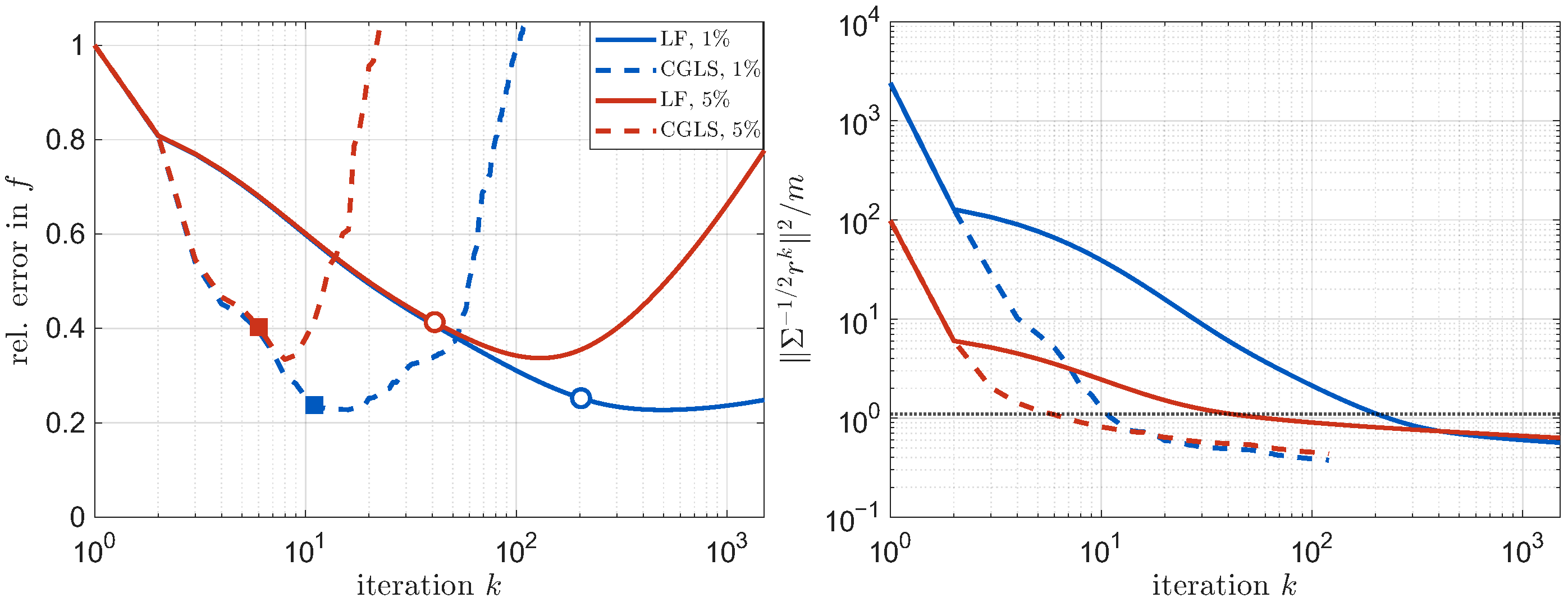
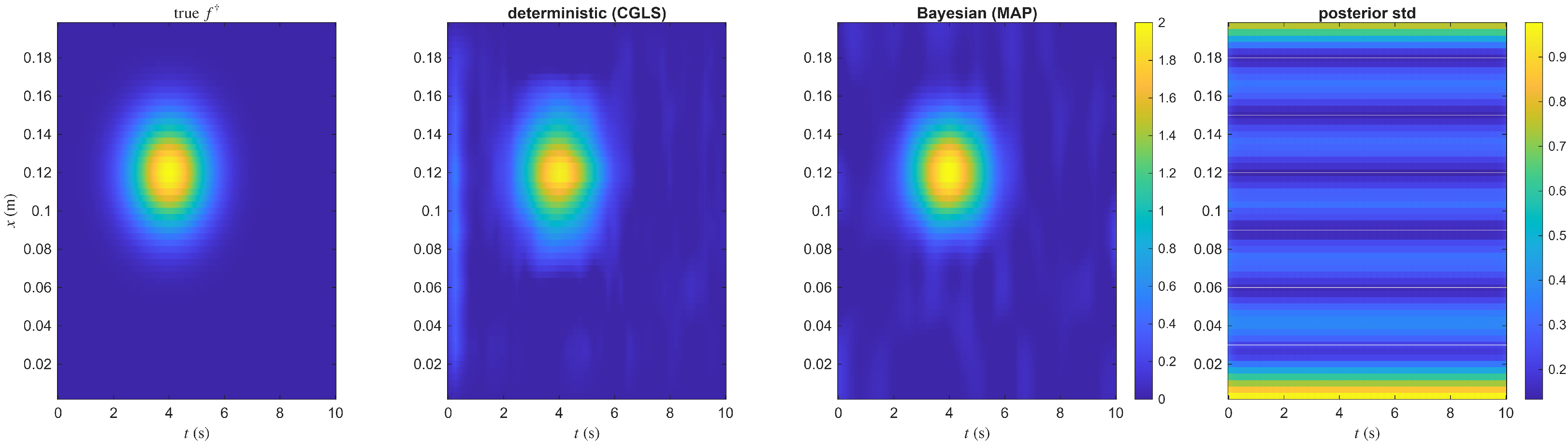
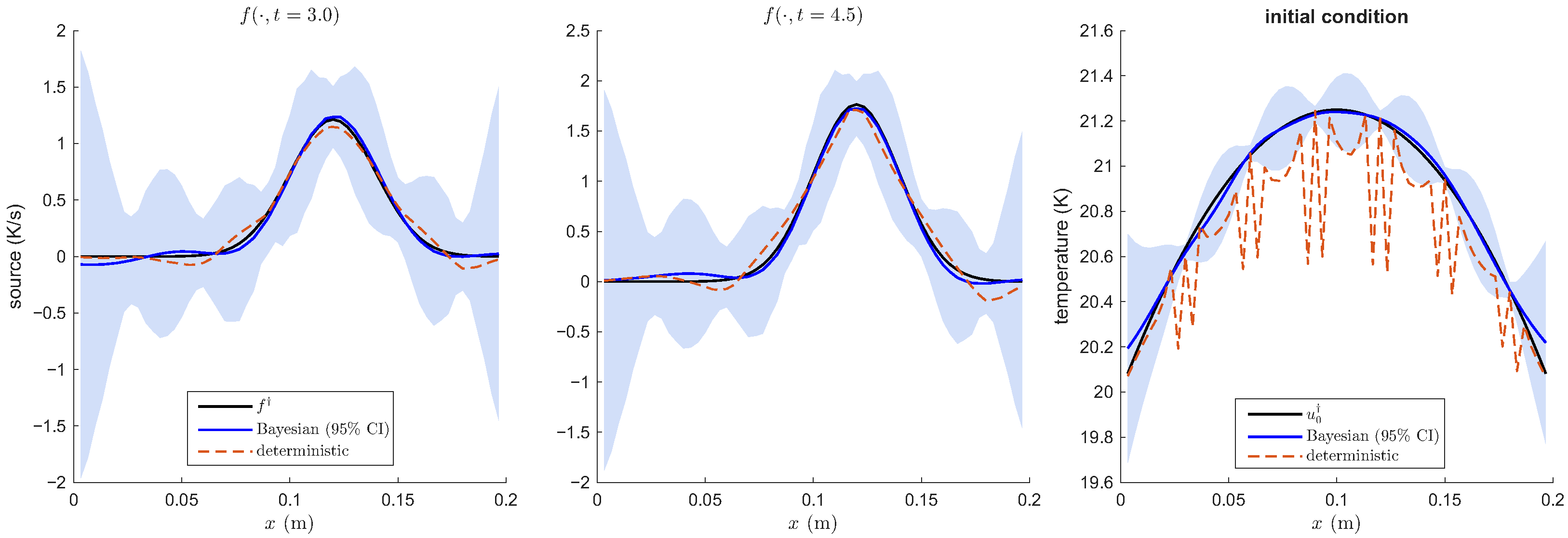
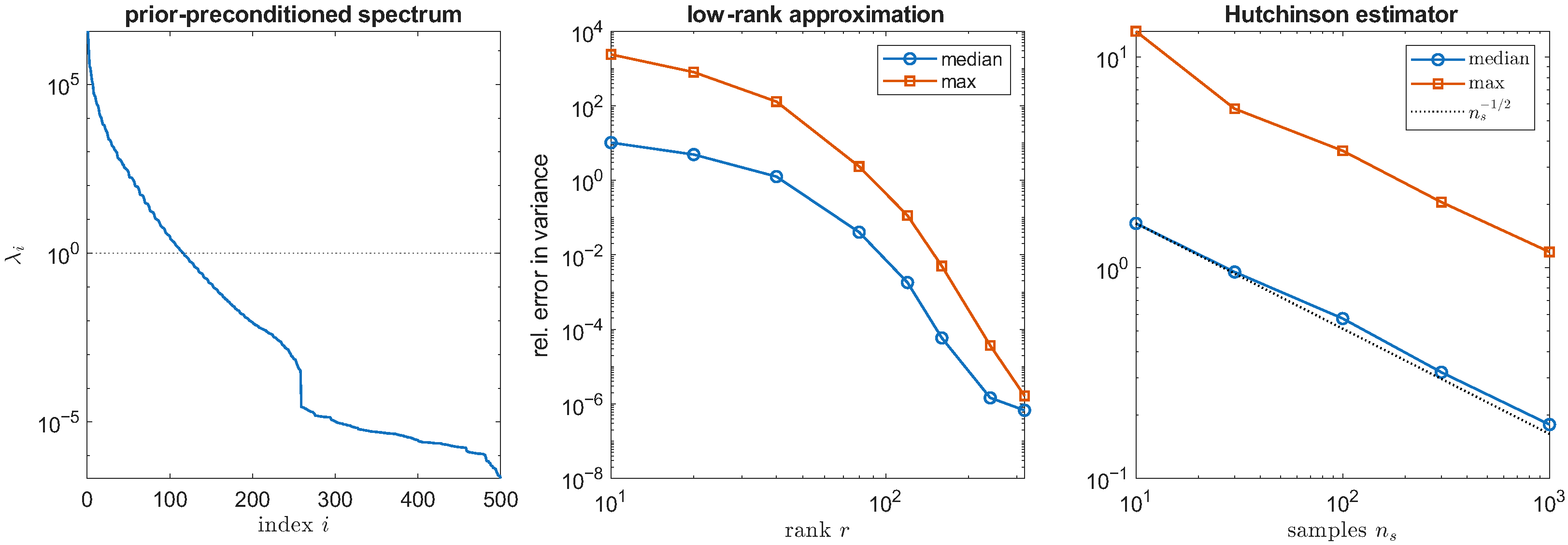
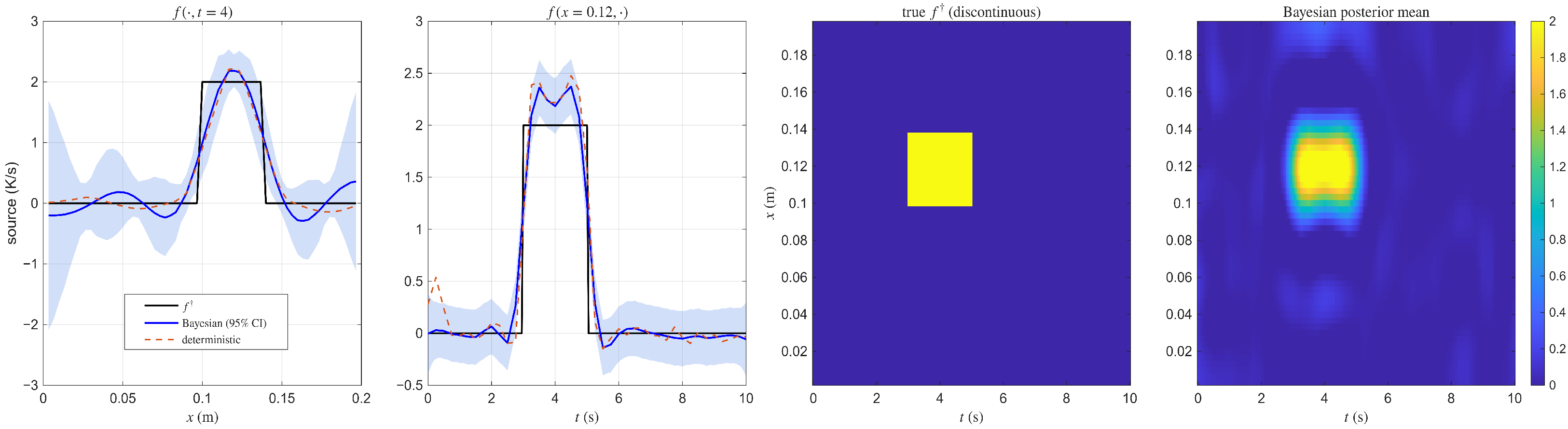
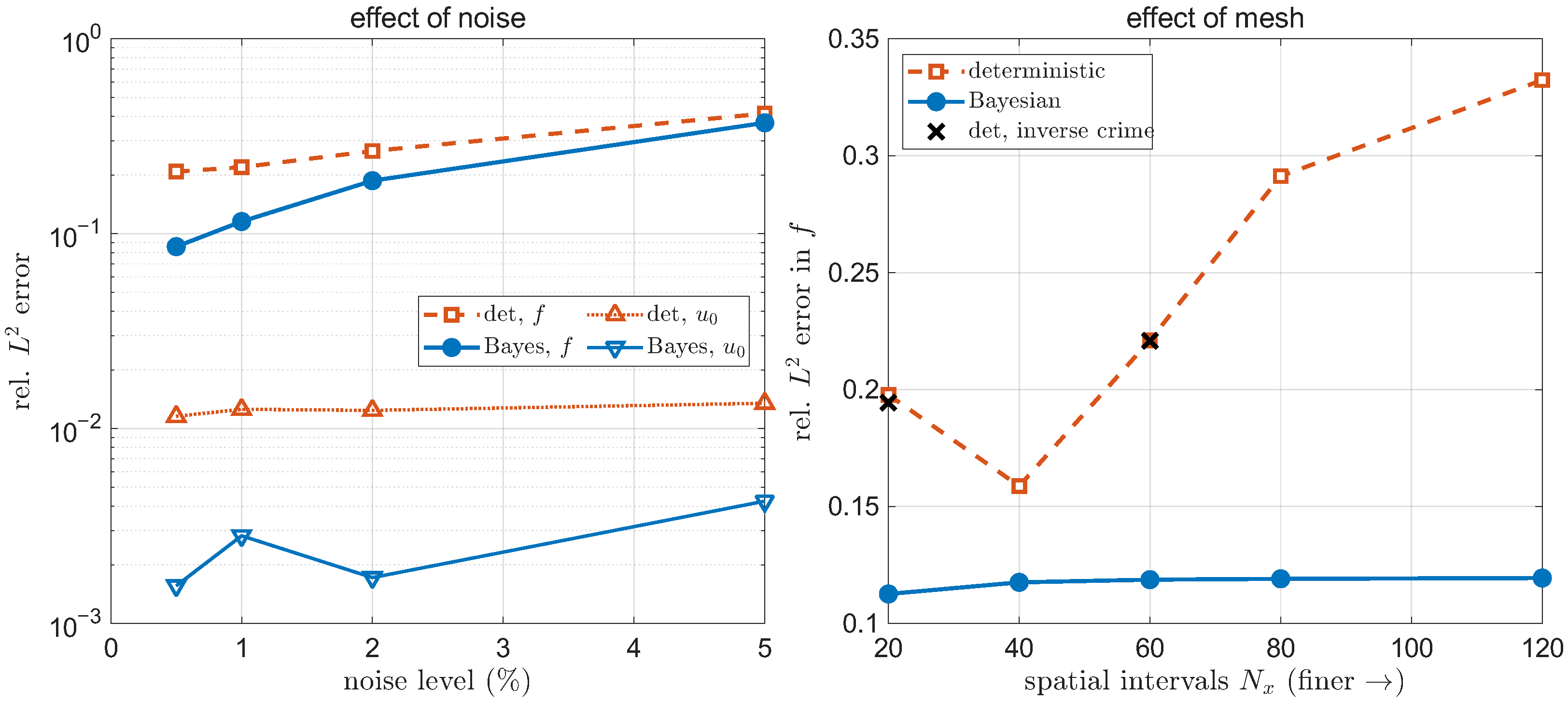
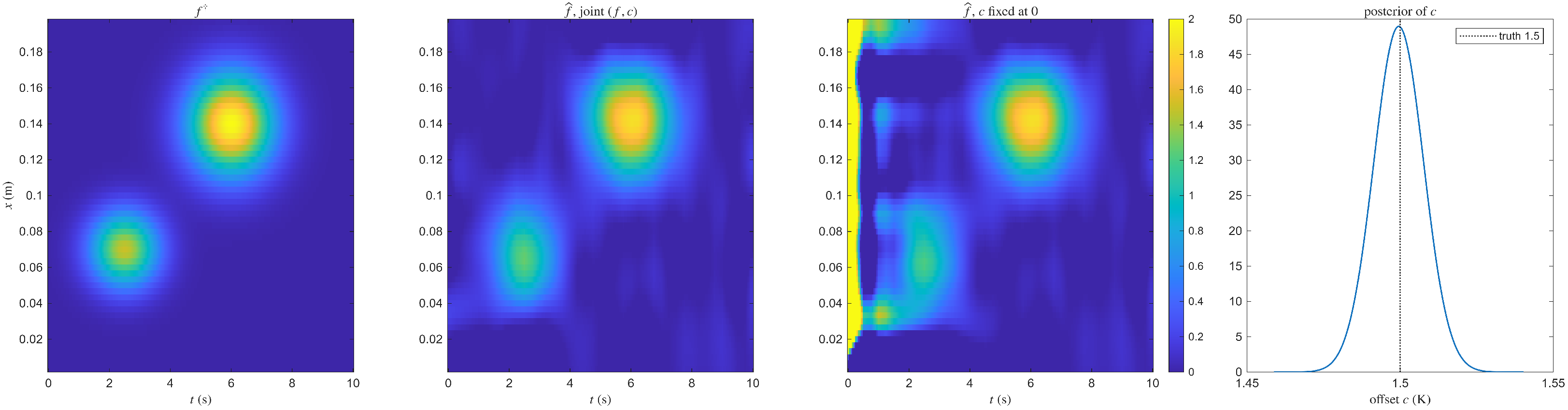
This paper develops an adjoint-based framework for jointly reconstructing a space–time-dependent internal heat source and an unknown initial temperature field from sparse, noisy measurements. A single adjoint solve supplies the gradients with respect to both fields, so each iteration requires one forward and one adjoint solve. Deterministically, CGLS with discrepancy-principle stopping reaches a comparable regularized solution in about an order of magnitude fewer iterations than Landweber–Fridman. In the Bayesian formulation, Gaussian noise and Matérn priors yield an exact Gaussian posterior; prior-preconditioned conjugate gradients compute the maximum a posteriori estimate, while a low-rank approximation of the prior-preconditioned data-misfit Hessian provides pointwise credible bands. The exact discrete adjoint gives machine-precision gradients, and prior-predictive experiments verify nominal pointwise coverage. Numerical experiments compare the reconstructions and assess sensitivity to noise, discretization, and prior hyperparameters. The Bayesian reconstruction is more accurate and mesh-robust in the reported tests. A calibrated generalized-χ2 discrepancy diagnostic detects misspecification caused by an omitted initial-temperature offset and, less strongly, by discontinuous sources outside the prior model. These experiments demonstrate joint reconstruction and scalable uncertainty quantification using only forward and adjoint heat-equation solves.
Keywords: heat equation; inverse source problem; initial condition reconstruction; adjoint method; iterative regularization; conjugate gradient; Bayesian inverse problems; uncertainty quantification heat equation; inverse source problem; initial condition reconstruction; adjoint method; iterative regularization; conjugate gradient; Bayesian inverse problems; uncertainty quantification