
Voice, Speech, and Large Language Models in Neurology: From Acoustic Biomarkers to Conversational AI


Abstract
1. Introduction
2. Methods
AI Tools Used
3. Traditional Acoustic Biomarkers: Background
4. Speech Foundation Models and Automatic Speech Recognition
4.1. From Handcrafted Features to Learned Representations
4.2. wav2vec 2.0, HuBERT, and WavLM
4.3. Whisper and Clinical ASR
4.4. Transfer Learning
5. Large Language Models and NLP for Clinical Speech Analysis
5.1. Transformer-Based NLP for Speech Transcripts
5.2. GPT and LLM-Based Analysis
5.3. Discourse Coherence Analysis
5.4. Automated Test Scoring
6. Conversational AI and Dialogue-Based Assessment
6.1. From Monologic to Dialogic Assessment
6.2. Chatbot-Based Cognitive Screening
6.3. Dialogue Structure Analysis
6.4. Interactive Voice Assistants for Monitoring
6.5. Toward End-to-End Assessment
7. Multimodal Integration and Longitudinal Monitoring
7.1. Multimodal Fusion
7.2. Home-Based and Remote Monitoring
7.3. Digital Phenotyping
7.4. Toward Integrated Neurological Speech Agents
8. Discussion
8.1. Methodological Gaps
8.2. Cross-Linguistic Generalizability
8.3. The Fluency-Reasoning Gap
8.4. Ethical Considerations
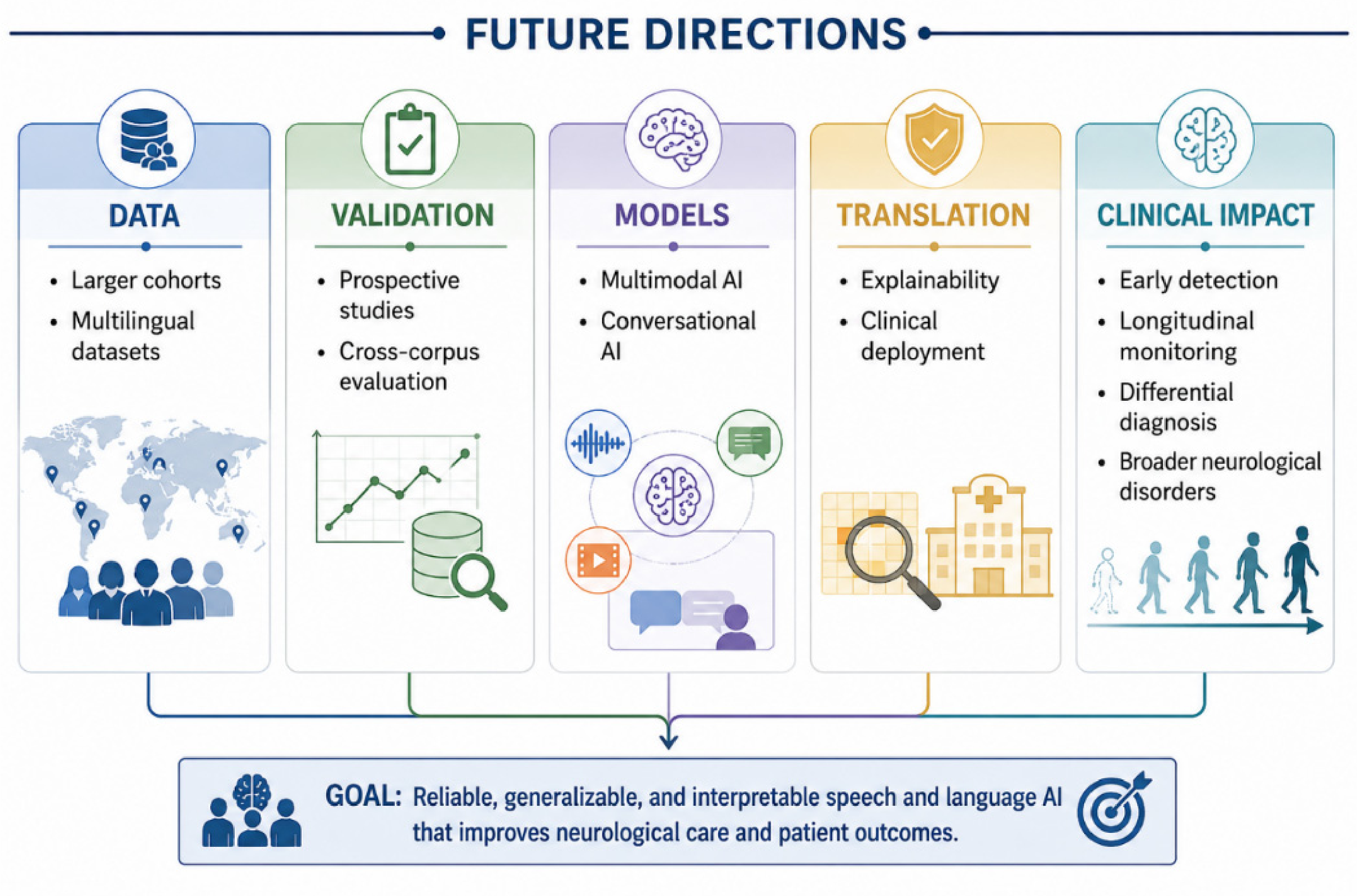
8.5. Future Directions
8.6. Regulatory Pathways and Clinical Implementation
8.7. Limitations
9. Conclusions
Supplementary Materials
Funding
Institutional Review Board Statement
Data Availability Statement
Acknowledgments
Conflicts of Interest
Abbreviations
| AD | Alzheimer’s Disease |
| AI | Artificial Intelligence |
| ALS | Amyotrophic Lateral Sclerosis |
| ASR | Automatic Speech Recognition |
| AUC | Area Under the Receiver Operating Characteristic Curve |
| BERT | Bidirectional Encoder Representations from Transformers |
| FTD | Frontotemporal Dementia |
| GPT | Generative Pre-trained Transformer |
| HuBERT | Hidden-Unit BERT |
| ICASSP | International Conference on Acoustics, Speech, and Signal Processing |
| Interspeech | Annual Conference of the International Speech Communication Association |
| LLM | Large Language Model |
| MCI | Mild Cognitive Impairment |
| NLP | Natural Language Processing |
| PD | Parkinson’s Disease |
| RMSE | Root Mean Squared Error |
| SSL | Self-Supervised Learning |
| TTR | Type-Token Ratio |
| MLU | Mean Length of Utterance |
References
- Duffy, J.R. Motor Speech Disorders: Substrates, Differential Diagnosis, and Management, 4th ed.; Elsevier: Amsterdam, The Netherlands, 2019. [Google Scholar]
- Levelt, W.J.M. Speaking: From Intention to Articulation; MIT Press: Cambridge, MA, USA, 1989. [Google Scholar]
- Rusz, J.; Cmejla, R.; Ruzickova, H.; Ruzicka, E. Quantitative acoustic measurements for characterization of speech and voice disorders in early untreated Parkinson’s disease. J. Acoust. Soc. Am. 2011, 129, 350–367. [Google Scholar] [CrossRef] [Scilit] [PubMed]
- Cummings, L. Clinical Linguistics; Edinburgh University Press: Edinburgh, UK, 2008. [Google Scholar]
- Darley, F.L.; Aronson, A.E.; Brown, J.R. Differential diagnostic patterns of dysarthria. J. Speech Hear. Res. 1969, 12, 246–269. [Google Scholar] [CrossRef] [Scilit] [PubMed]
- Goodglass, H.; Kaplan, E. The Assessment of Aphasia and Related Disorders, 2nd ed.; Lea & Febiger: Philadelphia, PA, USA, 1983. [Google Scholar]
- Tsanas, A.; Little, M.A.; McSharry, P.E.; Spielman, J.; Ramig, L.O. Novel speech signal processing algorithms for high-accuracy classification of Parkinson’s disease. IEEE Trans. Biomed. Eng. 2012, 59, 1264–1271. [Google Scholar] [CrossRef] [Scilit] [PubMed]
- Meilan, J.J.G.; Martinez-Sanchez, F.; Carro, J.; Lopez, D.E.; Millian-Morell, L.; Arana, J.M. Speech in Alzheimer’s disease: Can temporal and acoustic parameters discriminate dementia? Dement. Geriatr. Cogn. Disord. 2014, 37, 327–334. [Google Scholar] [PubMed]
- Fraser, K.C.; Meltzer, J.A.; Rudzicz, F. Linguistic features identify Alzheimer’s disease in narrative speech. J. Alzheimers Dis. 2016, 49, 407–422. [Google Scholar] [PubMed]
- Le, D.; Licata, K.; Provost, E.M. Automatic quantitative analysis of spontaneous aphasic speech. Speech Commun. 2018, 100, 1–12. [Google Scholar] [CrossRef] [Scilit]
- Robin, J.; Harrison, J.E.; Kaufman, L.D.; Rudzicz, F.; Simpson, W.; Yancheva, M. Evaluation of speech-based digital biomarkers: Review and recommendations. Digit. Biomark. 2020, 4, 99–108. [Google Scholar] [CrossRef] [Scilit] [PubMed]
- de la Fuente Garcia, S.; Ritchie, C.W.; Luz, S. Artificial intelligence, speech, and language processing approaches to monitoring Alzheimer’s disease: A systematic review. J. Alzheimers Dis. 2020, 78, 1547–1574. [Google Scholar] [CrossRef] [Scilit] [PubMed]
- Brabenec, L.; Mekyska, J.; Galaz, Z.; Rektorova, I. Speech disorders in Parkinson’s disease: Early diagnostics and effects of medication and brain stimulation. J. Neural Transm. 2017, 124, 303–334. [Google Scholar] [CrossRef] [Scilit] [PubMed]
- Baevski, A.; Zhou, Y.; Mohamed, A.; Auli, M. wav2vec 2.0: A framework for self-supervised learning of speech representations. Adv. Neural Inf. Process. Syst. 2020, 33, 12449–12460. [Google Scholar]
- Hsu, W.N.; Bolte, B.; Tsai, Y.H.; Lakhotia, K.; Salakhutdinov, R.; Mohamed, A. HuBERT: Self-supervised speech representation learning by masked prediction of hidden units. IEEE/ACM Trans. Audio Speech Lang. Process. 2021, 29, 3451–3460. [Google Scholar] [CrossRef] [Scilit]
- Chen, S.; Wang, C.; Chen, Z.; Wu, Y.; Liu, S.; Chen, Z.; Li, J.; Kanda, N.; Yoshioka, T.; Xiao, X.; et al. WavLM: Large-scale self-supervised pre-training for full stack speech processing. IEEE J. Sel. Top. Signal Process. 2022, 16, 1505–1518. [Google Scholar] [CrossRef] [Scilit]
- Radford, A.; Kim, J.W.; Xu, T.; Brockman, G.; McLeavey, C.; Sutskever, I. Robust speech recognition via large-scale weak supervision. Proc. ICML 2023, 202, 28492–28518. [Google Scholar]
- OpenAI. GPT-4 technical report. arXiv 2023, arXiv:2303.08774. [Google Scholar]
- Touvron, H.; Lavril, T.; Izacard, G.; Martinet, X.; Lachaux, M.-A.; Lacroix, T.; Roziere, B.; Goyal, N.; Hambro, E.; Azhar, F.; et al. LLaMA: Open and efficient foundation language models. arXiv 2023, arXiv:2302.13971. [Google Scholar]
- Singhal, K.; Azizi, S.; Tu, T.; Mahdavi, S.S.; Wei, J.; Chung, H.W.; Scales, N.; Tanwani, A.; Cole-Lewis, H.; Pfohl, S.; et al. Large language models encode clinical knowledge. Nature 2023, 620, 172–180. [Google Scholar] [CrossRef] [Scilit] [PubMed]
- Moor, M.; Banerjee, O.; Abad, Z.S.H.; Krumholz, H.M.; Leskovec, J.; Topol, E.J.; Rajpurkar, P. Foundation models for generalist medical artificial intelligence. Nature 2023, 616, 259–265. [Google Scholar] [CrossRef] [Scilit] [PubMed]
- Thirunavukarasu, A.J.; Ting, D.S.J.; Elangovan, K.; Gutierrez, L.; Tan, T.F.; Ting, D.S.W. Large language models in medicine. Nat. Med. 2023, 29, 1930–1940. [Google Scholar] [CrossRef] [Scilit] [PubMed]
- Violeta, L.P.; Huang, W.-C.; Toda, T. Investigating self-supervised pretraining frameworks for pathological speech recognition. arXiv 2022, arXiv:2203.15431. [Google Scholar]
- Nori, H.; King, N.; McKinney, S.M.; Carignan, D.; Horvitz, E. Capabilities of GPT-4 on medical challenge problems. arXiv 2023, arXiv:2303.13375. [Google Scholar]
- Tu, T.; Azizi, S.; Driess, D.; Schaekermann, M.; Amin, M.; Chang, P.-C.; Carroll, A.; Lau, C.; Tanno, R.; Ktena, I.; et al. Towards generalist biomedical AI. NEJM AI 2024, 1, AIoa2300138. [Google Scholar] [CrossRef] [Scilit]
- GBD 2021 Nervous System Disorders Collaborators. Global, regional, and national burden of disorders affecting the nervous system, 1990–2021: A systematic analysis for the Global Burden of Disease Study 2021. Lancet Neurol. 2024, 23, 344–381. [CrossRef] [Scilit] [PubMed]
- Green, B.N.; Johnson, C.D.; Adams, A. Writing narrative literature reviews for peer-reviewed journals: Secrets of the trade. J. Chiropr. Med. 2006, 5, 101–117. [Google Scholar] [CrossRef] [Scilit] [PubMed]
- Baumeister, R.F.; Leary, M.R. Writing narrative literature reviews. Rev. Gen. Psychol. 1997, 1, 311–320. [Google Scholar] [CrossRef]
- Ho, A.K.; Iansek, R.; Marigliani, C.; Bradshaw, J.L.; Gates, S. Speech impairment in a large sample of patients with Parkinson’s disease. Behav. Neurol. 1999, 11, 131–137. [Google Scholar] [CrossRef] [Scilit] [PubMed]
- Ramig, L.O.; Fox, C.; Sapir, S. Speech treatment for Parkinson’s disease. Expert. Rev. Neurother. 2008, 8, 297–309. [Google Scholar] [CrossRef] [Scilit] [PubMed]
- Little, M.A.; McSharry, P.E.; Hunter, E.J.; Spielman, J.; Ramig, L.O. Suitability of dysphonia measurements for telemonitoring of Parkinson’s disease. IEEE Trans. Biomed. Eng. 2009, 56, 1015–1022. [Google Scholar] [CrossRef] [Scilit] [PubMed]
- Skodda, S.; Visser, W.; Schlegel, U. Vowel articulation in Parkinson’s disease. J. Voice 2011, 25, 467–472. [Google Scholar] [CrossRef] [Scilit] [PubMed]
- Rusz, J.; Hlavnicka, J.; Tykalova, T.; Buskova, J.; Ulmanova, O.; Ruzicka, E.; Sonka, K. Quantitative assessment of motor speech abnormalities in idiopathic rapid eye movement sleep behaviour disorder. Sleep Med. 2016, 19, 141–147. [Google Scholar] [CrossRef] [Scilit] [PubMed]
- Orozco-Arroyave, J.R.; Arias-Londono, J.D.; Vargas-Bonilla, J.F.; Gonzalez-Rativa, M.C.; Noth, E. New Spanish speech corpus database for the analysis of people suffering from Parkinson’s disease. In LREC; European Language Resources Association (ELRA): Luxembourg, 2014; pp. 342–347. [Google Scholar]
- Szatloczki, G.; Hoffmann, I.; Vincze, V.; Kalman, J.; Pakaski, M. Speaking in Alzheimer’s disease, is that an early sign? Importance of changes in language abilities in Alzheimer’s disease. Front. Aging Neurosci. 2015, 7, 195. [Google Scholar] [CrossRef] [Scilit] [PubMed]
- Ahmed, S.; Haigh, A.M.; de Jager, C.A.; Garrard, P. Connected speech as a marker of disease progression in autopsy-proven Alzheimer’s disease. Brain 2013, 136, 3727–3737. [Google Scholar] [CrossRef] [Scilit] [PubMed]
- Luz, S.; Haider, F.; de la Fuente Garcia, S.; Fromm, D.; MacWhinney, B. Alzheimer’s Dementia Recognition through Spontaneous Speech: The ADReSS Challenge. Front. Comput. Sci. 2021, 3, 780169. [Google Scholar] [CrossRef] [Scilit] [PubMed]
- Luz, S.; Haider, F.; de la Fuente Garcia, S.; Fromm, D.; MacWhinney, B. Detecting cognitive decline using speech only: The ADReSSo Challenge. arXiv 2021, arXiv:2104.09356. [Google Scholar]
- Green, J.R.; Yunusova, Y.; Kuruvilla, M.S.; Wang, J.; Pattee, G.L.; Synhorst, L.; Zinman, L.; Berry, J.D. Bulbar and speech motor assessment in ALS: Challenges and future directions. Amyotroph. Lateral Scler. Front. Degener. 2013, 14, 494–500. [Google Scholar] [CrossRef] [Scilit]
- Stegmann, G.M.; Hahn, S.; Liss, J.; Shefner, J.; Rutkove, S.; Shelton, K.; Duncan, C.J.; Berisha, V. Early detection and tracking of bulbar changes in ALS via frequent and remote speech analysis. npj Digit. Med. 2020, 3, 132. [Google Scholar] [CrossRef] [Scilit] [PubMed]
- Fusaroli, R.; Lambrechts, A.; Bang, D.; Bowler, D.M.; Gaigg, S.B. Is voice a marker for autism spectrum disorder? A systematic review and meta-analysis. Autism Res. 2017, 10, 384–407. [Google Scholar] [PubMed]
- Bone, D.; Lee, C.-C.; Black, M.P.; Williams, M.E.; Lee, S.; Levitt, P.; Narayanan, S. The psychologist as an interlocutor in autism spectrum disorder assessment: Insights from a study of spontaneous prosody. J. Speech Lang. Hear. Res. 2014, 57, 1162–1177. [Google Scholar] [CrossRef] [Scilit] [PubMed]
- Feijó, A.V.; Parente, M.A.; Behlau, M.; Haussen, S.; de Veccino, M.C.; Martignago, B.C. Acoustic analysis of voice in multiple sclerosis patients. J. Voice 2004, 18, 341–347. [Google Scholar] [CrossRef] [Scilit] [PubMed]
- Noffs, G.; Perera, T.; Kolbe, S.C.; Shanahan, C.J.; Boonstra, F.M.C.; Evans, A.; Butzkueven, H.; van der Walt, A.; Vogel, A.P. What speech can tell us: A systematic review of dysarthria characteristics in multiple sclerosis. Autoimmun. Rev. 2018, 17, 1202–1209. [Google Scholar] [CrossRef] [Scilit] [PubMed]
- Rusz, J.; Saft, C.; Schlegel, U.; Hoffmann, R.; Skodda, S. Phonatory dysfunction as a preclinical symptom of Huntington disease. PLoS ONE 2014, 9, e113412. [Google Scholar] [CrossRef] [Scilit] [PubMed]
- Coelho, C.A.; Liles, B.Z.; Duffy, R.J. Impairments of discourse abilities and executive functions in traumatically brain-injured adults. Brain Inj. 1995, 9, 471–477. [Google Scholar] [CrossRef] [Scilit] [PubMed]
- Mohamed, A.; Lee, H.-Y.; Borgholt, L.; Havtorn, J.D.; Edin, J.; Igel, C.; Kirchhoff, K.; Li, S.-W.; Livescu, K.; Maaloe, L.; et al. Self-supervised speech representation learning: A review. IEEE J. Sel. Top. Signal Process. 2022, 16, 1179–1210. [Google Scholar] [CrossRef] [Scilit]
- Yang, S.-W.; Chi, P.-H.; Chuang, Y.-S.; Lai, C.-I.J.; Lakhotia, K.; Lin, Y.Y.; Liu, A.T.; Shi, J.; Chang, X.; Lin, G.-T.; et al. SUPERB: Speech processing universal PERformance benchmark. arXiv 2021, arXiv:2105.01051. [Google Scholar]
- Bayerl, S.P.; Wagner, D.; Noth, E.; Riedhammer, K. Detecting Dysfluencies in Stuttering Therapy Using wav2vec 2.0. arXiv 2022, arXiv:2204.03417. [Google Scholar]
- Javanmardi, F.; Tirronen, S.; Kodali, M.; Alku, P. wav2vec-based detection and severity level classification of dysarthria from speech. In Icassp 2023–2023 IEEE International Conference on Acoustics, Speech and Signal Processing (Icassp); IEEE: New York, NY, USA, 2023; pp. 1–5. [Google Scholar]
- Balagopalan, A.; Eyre, B.; Rudzicz, F.; Novikova, J. To BERT or not to BERT: Comparing speech and language-based approaches for Alzheimer’s disease detection. arXiv 2020, arXiv:2008.01551. [Google Scholar]
- Pappagari, R.; Cho, J.; Joshi, S.; Moro-Velazquez, L.; Zelasko, P.; Villalba, J.; Dehak, N. Automatic detection and assessment of Alzheimer disease using speech and language technologies in low-resource scenarios. In Proceedings of Interspeech 2021; ISCA: Antwerp, Belgium, 2021; pp. 3825–3829. [Google Scholar]
- Favaro, A.; Tsai, Y.-T.; Butala, A.; Thebaud, T.; Villalba, J.; Dehak, N.; Moro-Velazquez, L. Interpretable speech features vs. DNN embeddings: What to use in the automatic assessment of Parkinson’s disease in multi-lingual scenarios. Comput. Biol. Med. 2023, 166, 107559. [Google Scholar] [CrossRef] [Scilit] [PubMed]
- Rowe, H.P.; Gutz, S.E.; Maffei, M.F.; Tomanek, K.; Green, J.R. Characterizing dysarthria diversity for automatic speech recognition: A tutorial from the clinical perspective. Front. Comput. Sci. 2022, 4, 770210. [Google Scholar] [CrossRef] [Scilit] [PubMed]
- Xiong, F.; Barker, J.; Yue, Z.; Christensen, H. Source domain data selection for improved transfer learning targeting dysarthric speech recognition. In ICASSP 2020–2020 IEEE International Conference on Acoustics, Speech and Signal Processing (ICASSP); IEEE: New York, NY, USA, 2020; pp. 7424–7428. [Google Scholar]
- Rudzicz, F.; Namasivayam, A.K.; Wolff, T. The TORGO database of acoustic and articulatory speech from speakers with dysarthria. Lang. Resour. Eval. 2012, 46, 523–541. [Google Scholar]
- Kim, H.; Hasegawa-Johnson, M.; Perlman, A.; Gunderson, J.; Huang, T.S.; Watkin, K.; Frame, S. Dysarthric speech database for universal access research. In Proceedings of Interspeech 2008; ISCA: Antwerp, Belgium, 2008; pp. 1741–1744. [Google Scholar]
- Haulcy, R.; Glass, J. Classifying Alzheimer’s disease using audio and text-based representations of speech. Front. Psychol. 2021, 11, 624137. [Google Scholar] [CrossRef] [Scilit] [PubMed]
- Pasad, A.; Chou, J.C.; Livescu, K. Layer-wise analysis of a self-supervised speech representation model. In 2021 IEEE Automatic Speech Recognition and Understanding Workshop (ASRU); IEEE: New York, NY, USA, 2021; pp. 914–921. [Google Scholar]
- Bucks, R.S.; Singh, S.; Cuerden, J.M.; Wilcock, G.K. Analysis of spontaneous, conversational speech in dementia of Alzheimer type: Evaluation of an objective technique for analysing lexical performance. Aphasiology 2000, 14, 71–91. [Google Scholar] [CrossRef] [Scilit]
- Devlin, J.; Chang, M.W.; Lee, K.; Toutanova, K. BERT: Pre-training of deep bidirectional transformers for language understanding. In Proceedings of the 2019 Conference of the North American Chapter of the Association for Computational Linguistics: Human Language Technologies, Volume 1 (Long and Short Papers); Association for Computational Linguistics (ACL): Stroudsburg, PA, USA, 2019; pp. 4171–4186. [Google Scholar]
- Lee, J.; Yoon, W.; Kim, S.; Kim, D.; Kim, S.; So, C.H.; Kang, J. BioBERT: A pre-trained biomedical language representation model for biomedical text mining. Bioinformatics 2020, 36, 1234–1240. [Google Scholar] [PubMed]
- Alsentzer, E.; Murphy, J.R.; Boag, W.; Weng, W.-H.; Jindi, D.; Naumann, T.; McDermott, M. Publicly available clinical BERT embeddings. In Proceedings of the 2nd Clinical Natural Language Processing Workshop; Association for Computational Linguistics (ACL): Stroudsburg, PA, USA, 2019; pp. 72–78. [Google Scholar]
- Balagopalan, A.; Novikova, J. Comparing acoustic-based approaches for Alzheimer’s disease detection. arXiv 2021, arXiv:2106.01555. [Google Scholar]
- Yuan, J.; Cai, X.; Church, K. Pause-encoded language models for recognition of Alzheimer’s disease and emotion. In ICASSP 2021–2021 IEEE International Conference on Acoustics, Speech and Signal Processing (ICASSP); IEEE: New York, NY, USA, 2021. [Google Scholar]
- Agbavor, F.; Liang, H. Predicting dementia from spontaneous speech using large language models. PLoS Digit. Health 2022, 1, e0000168. [Google Scholar] [CrossRef] [Scilit] [PubMed]
- Balamurali, B.T.; Chen, J.-M. Performance assessment of ChatGPT versus Bard in detecting Alzheimer’s dementia. Diagnostics 2024, 14, 817. [Google Scholar] [CrossRef] [Scilit]
- Taherinezhad, F.; Momeni Nezhad, M.J.; Karimi, S.; Rashidi, S.; Zolnour, A.; Dadkhah, M.; Haghbin, Y.; Azadmaleki, H.; Zolnoori, M. Large language model adaptation strategies in speech-based cognitive screening: Systematic evaluation. JMIR AI 2026, 5, e82608. [Google Scholar] [CrossRef] [Scilit] [PubMed]
- Chlasta, K.; Struzik, P.; Wojcik, G.M. Enhancing dementia and cognitive decline detection with large language models and speech representation learning. Front. Neuroinform. 2025, 19, 1679664. [Google Scholar] [CrossRef] [Scilit] [PubMed]
- Kurland, J.; Varadharaju, V.; Liu, A.; Stokes, P.; Gupta, A.; Hudspeth, M.; O’Connor, B. Large language models’ ability to assess main concepts in story retelling: A proof-of-concept comparison of human versus machine ratings. Am. J. Speech Lang. Pathol. 2025, 34, 3636–3646. [Google Scholar] [CrossRef] [Scilit] [PubMed]
- Fei, X.; Tang, Y.; Zhang, J.; Zhou, Z.; Yamamoto, I.; Zhang, Y. Evaluating cognitive performance: Traditional methods vs. ChatGPT. Digit. Health 2024, 10, 20552076241264639. [Google Scholar] [CrossRef] [Scilit] [PubMed]
- Laine, M.; Laakso, M.; Vuorinen, E.; Rinne, J. Coherence and informativeness of discourse in two dementia types. J. Neurolinguist. 1998, 11, 79–87. [Google Scholar] [CrossRef] [Scilit]
- Ash, S.; Moore, P.; Antani, S.; McCawley, G.; Work, M.; Grossman, M. Trying to tell a tale: Discourse impairments in progressive aphasia and frontotemporal dementia. Neurology 2006, 66, 1405–1413. [Google Scholar] [CrossRef] [Scilit] [PubMed]
- Iter, D.; Yoon, J.; Jurafsky, D. Automatic detection of incoherent speech for diagnosing schizophrenia. In Proceedings of the Fifth Workshop on Computational Linguistics and Clinical Psychology: From Keyboard to Clinic; Association for Computational Linguistics (ACL): Stroudsburg, PA, USA, 2018; pp. 136–146. [Google Scholar]
- Mota, N.B.; Vasconcelos, N.A.P.; Lemos, N.; Pieretti, A.C.; Kinouchi, O.; Cecchi, G.A.; Copelli, M.; Ribeiro, S. Speech graphs provide a quantitative measure of thought disorder in psychosis. PLoS ONE 2012, 7, e34928. [Google Scholar] [CrossRef] [Scilit] [PubMed]
- Ilias, L.; Askounis, D. Multimodal deep learning models for detecting dementia from speech and transcripts. Front. Aging Neurosci. 2022, 14, 830943. [Google Scholar] [CrossRef] [Scilit] [PubMed]
- Hobbs, J.R. Coherence and coreference. Cogn. Sci. 1979, 3, 67–90. [Google Scholar] [CrossRef] [Scilit]
- Kaplan, E.; Goodglass, H.; Weintraub, S. The Boston Naming Test, 2nd ed.; Lea & Febiger: Philadelphia, PA, USA, 1983. [Google Scholar]
- Troyer, A.K.; Moscovitch, M.; Winocur, G. Clustering and switching as two components of verbal fluency: Evidence from younger and older healthy adults. Neuropsychology 1997, 11, 138–146. [Google Scholar] [CrossRef] [PubMed]
- Toth, L.; Hoffmann, I.; Gosztolya, G.; Vincze, V.; Szatloczki, G.; Banreti, Z.; Pakaski, M.; Kalman, J. A speech recognition-based solution for the automatic detection of mild cognitive impairment from spontaneous speech. Curr. Alzheimer Res. 2018, 15, 130–138. [Google Scholar] [CrossRef] [Scilit] [PubMed]
- Lehr, M.; Prud’hommeaux, E.; Shafran, I.; Roark, B. Fully automated neuropsychological assessment for detecting mild cognitive impairment. In Proceedings of Interspeech 2012; ISCA: Antwerp, Belgium, 2012. [Google Scholar]
- Fristed, E.; Skirrow, C.; Meszaros, M.; Lenain, R.; Meepegama, U.; Cappa, S.; Aarsland, D.; Weston, J. A remote speech-based AI system to screen for early Alzheimer’s disease via smartphones. Alzheimers Dement. 2022, 14, e12366. [Google Scholar] [CrossRef] [Scilit]
- Heritage, J.; Maynard, D.W. Communication in Medical Care: Interaction Between Primary Care Physicians and Patients; Cambridge University Press: Cambridge, UK, 2006. [Google Scholar]
- Perkins, L.; Whitworth, A.; Lesser, R. Conversing in dementia: A conversation analytic approach. J. Neurolinguist. 1998, 11, 33–53. [Google Scholar] [CrossRef] [Scilit]
- Mirheidari, B.; Blackburn, D.; Walker, T.; Reuber, M.; Christensen, H. Dementia detection using automatic analysis of conversations. Comput. Speech Lang. 2019, 53, 65–79. [Google Scholar] [CrossRef] [Scilit]
- Mirheidari, B.; Blackburn, D.; Walker, T.; Reuber, M.; Christensen, H. Diagnosing people with dementia using automatic conversation analysis. In Proceedings of Interspeech 2016; ISCA: Antwerp, Belgium, 2016; pp. 1220–1224. [Google Scholar]
- Tanaka, H.; Adachi, H.; Ukita, N.; Ikeda, M.; Kazui, H.; Kudo, T.; Nakamura, S. Detecting dementia through interactive computer avatars. IEEE J. Transl. Eng. Health Med. 2017, 5, 2200111. [Google Scholar] [CrossRef] [Scilit] [PubMed]
- Takeshige-Amano, H.; Oyama, G.; Ogawa, M.; Fusegi, K.; Kambe, T.; Shiina, K.; Ueno, S.-I.; Okuzumi, A.; Hatano, T.; Motoi, Y.; et al. Digital detection of Alzheimer’s disease using smiles and conversations with a chatbot. Sci. Rep. 2024, 14, 26309. [Google Scholar] [CrossRef] [Scilit] [PubMed]
- Serafimovska, A.; Swavley, K.; Zhang Qian Ao, A.; Challinor, K.L.; Florio, T. Cognitive status assessment of older adults: Test administration by conversational artificial intelligence (AI) chatbot: Proof-of-concept investigation. J. Clin. Exp. Neuropsychol. 2025, 47, 472–484. [Google Scholar] [CrossRef] [Scilit] [PubMed]
- Konig, A.; Kohler, S.; Troger, J.; Duzel, E.; Glanz, W.; Butryn, M.; Mallick, E.; Priller, J.; Altenstein, S.; Spottke, A.; et al. Automated remote speech-based testing of individuals with cognitive decline: Bayesian agreement of transcription accuracy. Alzheimers Dement. 2024, 16, e70011. [Google Scholar]
- Pakhomov, S.; Solinsky, J.; Michalowski, M.; Bachanova, V. A conversational agent for early detection of neurotoxic effects of medications through automated intensive observation. Pac. Symp. Biocomput. 2024, 29, 24–38. [Google Scholar] [PubMed]
- Ter Huurne, D.; Ramakers, I.; Possemis, N.; Konig, A.; Linz, N.; Troger, J.; Langel, K.; Verhey, F.; de Vugt, M. User experience of a (semi-) automated cognitive phone-based assessment within a memory clinic population. Arch. Clin. Neuropsychol. 2025, 40, 319–329. [Google Scholar] [PubMed]
- Sacks, H.; Schegloff, E.A.; Jefferson, G. A simplest systematics for the organization of turn-taking for conversation. Language 1974, 50, 696–735. [Google Scholar] [CrossRef] [Scilit]
- Orange, J.B.; Lubinski, R.B.; Higginbotham, D.J. Conversational repair by individuals with dementia of the Alzheimer’s type. J. Speech Hear. Res. 1996, 39, 881–895. [Google Scholar] [CrossRef] [Scilit] [PubMed]
- McNamara, P.; Durso, R. Pragmatic communication skills in patients with Parkinson’s disease. Brain Lang. 2003, 84, 414–423. [Google Scholar] [CrossRef] [Scilit] [PubMed]
- Elsey, C.; Drew, P.; Jones, D.; Blackburn, D.; Wakefield, S.; Harkness, K.; Venneri, A.; Reuber, M. Towards diagnostic conversational profiles of patients presenting with dementia or functional memory disorders to memory clinics. Patient Educ. Couns. 2015, 98, 1071–1077. [Google Scholar] [CrossRef] [Scilit] [PubMed]
- Jones, D.; Drew, P.; Elsey, C.; Blackburn, D.; Wakefield, S.; Harkness, K.; Reuber, M. Conversational assessment in memory clinic encounters: Interactional profiling for differentiating dementia from functional memory disorders. Aging Ment. Health 2016, 20, 500–509. [Google Scholar] [PubMed]
- Robin, J.; Xu, M.; Kaufman, L.D.; Simpson, W. Using digital speech assessments to detect early signs of cognitive impairment. Front. Digit. Health 2021, 3, 749758. [Google Scholar] [CrossRef] [Scilit] [PubMed]
- Sabbagh, M.N.; Boada, M.; Borson, S.; Chilukuri, M.; Dubois, B.; Ingram, J.; Iwata, A.; Porsteinsson, A.P.; Possin, K.L.; Rabinovici, G.D.; et al. Early detection of mild cognitive impairment (MCI) in primary care. J. Prev. Alzheimers Dis. 2020, 7, 165–170. [Google Scholar] [CrossRef] [Scilit] [PubMed]
- Rohanian, M.; Hough, J.; Purver, M. Multi-modal fusion with gating using audio, lexical and disfluency features for Alzheimer’s dementia recognition from spontaneous speech. arXiv 2020, arXiv:2106.09668. [Google Scholar]
- Gorno-Tempini, M.L.; Hillis, A.E.; Weintraub, S.; Kertesz, A.; Mendez, M.; Cappa, S.F.; Ogar, J.M.; Rohrer, J.D.; Black, S.; Boeve, B.F.; et al. Classification of primary progressive aphasia and its variants. Neurology 2011, 76, 1006–1014. [Google Scholar] [CrossRef] [Scilit] [PubMed]
- Duffy, J.R.; Strand, E.A.; Clark, H.M.; Machulda, M.M.; Whitwell, J.L.; Josephs, K.A. Primary progressive apraxia of speech: Clinical features and acoustic and neurologic correlates. Am. J. Speech Lang. Pathol. 2015, 24, 88–100. [Google Scholar] [CrossRef] [Scilit] [PubMed]
- OpenAI. GPT-4o System Card. 2024. Available online: https://openai.com/index/gpt-4o-system-card/ (accessed on 15 June 2026).
- Gemini Team Google. Gemini: A family of highly capable multimodal models. arXiv 2023, arXiv:2312.11805. [Google Scholar]
- Dorsey, E.R.; Glidden, A.M.; Holloway, M.R.; Birbeck, G.L.; Schwamm, L.H. Teleneurology and mobile technologies: The future of neurological care. Nat. Rev. Neurol. 2018, 14, 285–297. [Google Scholar] [CrossRef] [Scilit] [PubMed]
- Tsanas, A.; Little, M.A.; McSharry, P.E.; Ramig, L.O. Accurate telemonitoring of Parkinson’s disease progression by noninvasive speech tests. IEEE Trans. Biomed. Eng. 2010, 57, 884–893. [Google Scholar] [CrossRef] [Scilit] [PubMed]
- Lipsmeier, F.; Taylor, K.I.; Kilchenmann, T.; Wolf, D.; Scotland, A.; Schjodt-Eriksen, J.; Cheng, W.-Y.; Fernandez-Garcia, I.; Siebourg-Polster, J.; Jin, L.; et al. Evaluation of smartphone-based testing to generate exploratory outcome measures in a phase 1 Parkinson’s disease clinical trial. Mov. Disord. 2018, 33, 1287–1297. [Google Scholar] [CrossRef] [Scilit] [PubMed]
- Connaghan, K.P.; Green, J.R.; Paganoni, S.; Chan, J.; Weber, H.; Collins, E.; Richburg, B.; Eshghi, M.; Onnela, J.-P.; Berry, J.D. Use of Beiwe smartphone application to identify and track speech decline in amyotrophic lateral sclerosis. In Proceedings of Interspeech 2019; ISCA: Antwerp, Belgium, 2019; pp. 4504–4508. [Google Scholar]
- Laird, N.M.; Ware, J.H. Random-effects models for longitudinal data. Biometrics 1982, 38, 963–974. [Google Scholar] [CrossRef] [Scilit] [PubMed]
- Torous, J.; Kiang, M.V.; Lorme, J.; Onnela, J.P. New tools for new research in psychiatry: A scalable and customizable platform to empower data driven smartphone research. JMIR Ment. Health 2016, 3, e16. [Google Scholar] [CrossRef] [Scilit] [PubMed]
- Insel, T.R. Digital phenotyping: Technology for a new science of behavior. JAMA 2017, 318, 1215–1216. [Google Scholar] [CrossRef] [Scilit] [PubMed]
- Fagherazzi, G.; Fischer, A.; Ismael, M.; Despotovic, V. Voice for health: The use of vocal biomarkers from research to clinical practice. Digit. Biomark. 2021, 5, 78–88. [Google Scholar] [CrossRef] [Scilit] [PubMed]
- Martinez-Martin, N.; Kreitmair, K. Ethical issues for direct-to-consumer digital psychotherapy apps: Addressing accountability, data protection, and consent. JMIR Ment. Health 2018, 5, e32. [Google Scholar] [CrossRef] [Scilit] [PubMed]
- Gerke, S.; Minssen, T.; Cohen, G. Ethical and legal challenges of artificial intelligence-driven healthcare. In Artificial Intelligence in Healthcare; Bohr, A., Memarzadeh, K., Eds.; Academic Press: New York, NY, USA, 2020; pp. 295–336. [Google Scholar]
- Topol, E.J. High-performance medicine: The convergence of human and artificial intelligence. Nat. Med. 2019, 25, 44–56. [Google Scholar] [CrossRef] [Scilit] [PubMed]
- Becker, J.T.; Boller, F.; Lopez, O.L.; Saxton, J.; McGonigle, K.L. The natural history of Alzheimer’s disease: Description of study cohort and accuracy of diagnosis. Arch. Neurol. 1994, 51, 585–594. [Google Scholar] [CrossRef] [Scilit] [PubMed]
- Wroge, T.J.; Ozkanca, Y.; Demiroglu, C.; Si, D.; Atkins, D.C.; Ghomi, R.H. Parkinson’s disease diagnosis using machine learning and voice. In Proceedings of the 2018 IEEE Signal Processing in Medicine and Biology Symposium (SPMB); IEEE: New York, NY, USA, 2018; pp. 1–7. [Google Scholar]
- Shellikeri, S.; Green, J.R.; Kulkarni, M.; Rong, P.; Martino, R.; Zinman, L.; Yunusova, Y. Speech movement measures as markers of bulbar disease in amyotrophic lateral sclerosis. J. Speech Lang. Hear. Res. 2016, 59, 887–899. [Google Scholar] [CrossRef] [Scilit] [PubMed]
- Ma, J.K.; Whitehill, T.L.; So, S.Y. Intonation contrast in Cantonese speakers with hypokinetic dysarthria associated with Parkinson’s disease. J. Speech Lang. Hear. Res. 2010, 53, 836–849. [Google Scholar] [CrossRef] [Scilit] [PubMed]
- Weiner, J.; Herff, C.; Schultz, T. Speech-based detection of Alzheimer’s disease in conversational German. In Proceedings of Interspeech 2016; ISCA: Antwerp, Belgium, 2016; pp. 1938–1942. [Google Scholar]
- Lee, P.; Bubeck, S.; Petro, J. Benefits, limits, and risks of GPT-4 as an AI chatbot for medicine. N. Engl. J. Med. 2023, 388, 1233–1239. [Google Scholar] [CrossRef] [Scilit] [PubMed]
- Bates, D.W.; Levine, D.; Syrowatka, A.; Kuznetsova, M.; Thomas Craig, K.J.; Rui, A.; Jackson, G.P.; Rhee, K. The potential of artificial intelligence to improve patient safety: A scoping review. npj Digit. Med. 2021, 4, 54. [Google Scholar] [CrossRef] [Scilit] [PubMed]
- Coiera, E. The last mile: Where artificial intelligence meets reality. J. Med. Internet Res. 2019, 21, e16323. [Google Scholar] [CrossRef] [Scilit] [PubMed]
- Ienca, M.; Wangmo, T.; Jotterand, F.; Kressig, R.W.; Elger, B. Ethical design of intelligent assistive technologies for dementia: A descriptive review. Sci. Eng. Ethics 2018, 24, 1035–1055. [Google Scholar] [PubMed]
- Koenecke, A.; Nam, A.; Lake, E.; Nudell, J.; Quartey, M.; Mengesha, Z.; Toups, C.; Rickford, J.R.; Jurafsky, D.; Goel, S. Racial disparities in automated speech recognition. Proc. Natl. Acad. Sci. USA 2020, 117, 7684–7689. [Google Scholar] [CrossRef] [Scilit] [PubMed]
- Mittelstadt, B.D.; Allo, P.; Taddeo, M.; Wachter, S.; Floridi, L. The ethics of algorithms: Mapping the debate. Big Data Soc. 2016, 3, 2053951716679679. [Google Scholar] [CrossRef] [Scilit]
- Mongan, J.; Moy, L.; Kahn, C.E., Jr. Checklist for Artificial Intelligence in Medical Imaging (CLAIM): A guide for authors and reviewers. Radiol. Artif. Intell. 2020, 2, e200029. [Google Scholar] [CrossRef] [Scilit] [PubMed]
- Cruz Rivera, S.; Liu, X.; Chan, A.-W.; Denniston, A.K.; Calvert, M.J. Guidelines for clinical trial protocols for interventions involving artificial intelligence: The SPIRIT-AI extension. Nat. Med. 2020, 26, 1351–1363. [Google Scholar] [CrossRef] [Scilit] [PubMed]
- Bhati, D.; Neha, F.; Bandaru, D.S.; Weber, M.; Gajera, I.D. Mapping the LLM landscape: A cross-family survey of architectures, alignment methods, and benchmark performance. AI 2026, 7, 142. [Google Scholar] [CrossRef] [Scilit]
- Neha, F.; Bhati, D.; Shukla, D.K. Retrieval-augmented generation (RAG) in healthcare: A comprehensive review. AI 2025, 6, 226. [Google Scholar] [CrossRef] [Scilit]

Disclaimer/Publisher’s Note: The statements, opinions and data contained in all publications are solely those of the individual author(s) and contributor(s) and not of MDPI and/or the editor(s). MDPI and/or the editor(s) disclaim responsibility for any injury to people or property resulting from any ideas, methods, instructions or products referred to in the content. |
© 2026 by the author. Licensee MDPI, Basel, Switzerland. This article is an open access article distributed under the terms and conditions of the Creative Commons Attribution (CC BY) license.
Share and Cite
Shelly, S. Voice, Speech, and Large Language Models in Neurology: From Acoustic Biomarkers to Conversational AI. Computation 2026, 14, 160. https://doi.org/10.3390/computation14070160
Shelly S. Voice, Speech, and Large Language Models in Neurology: From Acoustic Biomarkers to Conversational AI. Computation. 2026; 14(7):160. https://doi.org/10.3390/computation14070160
Chicago/Turabian StyleShelly, Shahar. 2026. "Voice, Speech, and Large Language Models in Neurology: From Acoustic Biomarkers to Conversational AI" Computation 14, no. 7: 160. https://doi.org/10.3390/computation14070160
APA StyleShelly, S. (2026). Voice, Speech, and Large Language Models in Neurology: From Acoustic Biomarkers to Conversational AI. Computation, 14(7), 160. https://doi.org/10.3390/computation14070160