


Abstract
Understanding the hemodynamics of the carotid artery is essential for assessing atherosclerotic disease progression and identifying regions vulnerable to plaque formation. Background: Disturbed flow patterns and abnormal shear stresses, particularly near the carotid bifurcation, are known to influence endothelial dysfunction; therefore, this study aims to quantify the impact of patient-specific carotid artery geometry on key hemodynamic parameters associated with atherosclerotic risk. Methods: Four patient-specific carotid artery geometries were reconstructed from medical imaging data, processed using MIMICS, and analyzed using computational fluid dynamics in ANSYS Fluent, with blood modeled as an incompressible non-Newtonian fluid using the Carreau–Yasuda viscosity model under pulsatile flow conditions; velocity streamlines, pressure distribution, time-averaged wall shear stress (TAWSS), and oscillatory shear index (OSI) were evaluated at early systole, peak systole, and peak diastole. Results: The simulations revealed complex flow behaviour, including flow reversal, pressure build-up, and low-shear regions concentrated near the carotid bulb and bifurcation, with TAWSS consistently identifying low-shear zones (<1 Pa) across all geometries and OSI exhibiting pronounced directional oscillations in models with increased curvature and wider bifurcation angles. Conclusions: These findings demonstrate that geometric characteristics such as bifurcation angle, vessel tortuosity, and asymmetry play a critical role in shaping local haemodynamics, underscoring the utility of patient-specific CFD analysis as a diagnostic and predictive tool for atherosclerotic risk assessment and supporting more informed, personalized clinical decision-making.
1. Introduction
Cardiovascular diseases (CVD) continue to be the primary cause of illness and death globally, with cerebrovascular conditions like ischemic stroke and transient ischemic attacks (TIAs) representing some of the most severe and disabling outcomes [1,2]. TIAs—brief episodes of reduced cerebral blood flow—often signal increased risk of future strokes. One of the leading causes of such cerebrovascular incidents is the narrowing, or stenosis, of the carotid arteries, which play a crucial role in transporting oxygenated blood to the brain [3]. These arteries branch into the internal carotid artery (ICA), supplying the brain and the external carotid artery (ECA), which provides blood to the face and scalp [4]. The carotid bifurcation, due to its curvature, branching, and varying diameter, is prone to disturbed flow and atherosclerotic plaque formation. The development and progression of plaques are strongly influenced by local haemodynamics, particularly wall shear stress (WSS) and oscillatory shear index (OSI). Computational fluid dynamics (CFD) has become a powerful, non-invasive tool for investigating these parameters in anatomically realistic vascular models. Unlike traditional imaging, CFD captures complex flow phenomena—such as flow separation, recirculation, and secondary vortices—that are critical in understanding plaque-prone regions [5,6,7].
With advances in medical imaging and segmentation softwares such as Materialise, Simpleware, 3D Slicer etc., patient-specific CFD modeling has become increasingly feasible. These models account for anatomical variability that generic models often overlook, enabling more accurate predictions of haemodynamic risk markers such as time-averaged WSS (TAWSS), OSI, and helicity [8,9]. Prior studies have shown that inter-patient differences in geometry significantly influence these parameters, underscoring the value of individualized modelling in assessing vascular health [10,11]. Accurate CFD simulation also requires an appropriate representation of blood rheology. Blood behaves as a non-Newtonian fluid, with viscosity decreasing at higher shear rates due to its cellular composition. The Carreau–Yasuda model is widely used to capture this shear-thinning behavior, especially important in low-shear regions near the arterial wall where atherosclerosis often develops [12,13,14]. Using a Newtonian model can lead to the underestimation or misrepresentation of critical haemodynamic variables [15,16]. Boundary conditions also play a crucial role in simulating realistic flow [17,18]. Physiologically accurate, pulsatile inlet velocity profiles and pressure-based outlet conditions are essential to capture natural flow splitting and transient dynamics [19,20,21]. Studies have shown that deviations in assumed inlet profiles or improperly defined outlet conditions can significantly alter simulation outcomes, affecting clinical interpretation [22,23,24]. Building on this foundation, the present study investigates haemodynamic variations across four patient-specific carotid artery geometries reconstructed from CT imaging. Using ANSYS Fluent (ANSYS 2022 R2), simulations incorporated the Carreau–Yasuda model and pulsatile flow conditions over a full cardiac cycle. Key parameters analyzed include TAWSS, OSI, and velocity streamlines.
By comparing haemodynamic patterns across geometries, the study identifies regions prone to disturbed flow and low shear stress—both of which are associated with atherosclerosis risk. The findings emphasize the role of individual anatomy in shaping vascular flow and reinforce the potential of CFD as a personalized diagnostic tool for cerebrovascular disease. These insights may guide early risk stratification, treatment planning, and stent design tailored to patient-specific vascular profiles.
2. Methodology
2.1. Theory
Blood flow in the carotid artery is modeled as incompressible, laminar, and non-Newtonian in nature, and is governed by the Navier–Stokes equations for incompressible fluid motion [25]. The governing equations for incompressible fluid flow, expressed in tensor notation, represent the conservation of mass and momentum and are given in Equation (1).
The continuity equation, also known as the conservation of mass, describes how mass is conserved within a fluid flow. Where the rate of change in mass density () with respect to time () is expressed as the divergence operator is represented by ∇, which estimates the divergence of the mass flow rate. The mass density of the fluid is defined by . The velocity vector of the fluid is defined by v. According to this equation, the net mass flow into or out of a control volume balances the change in mass within the control volume. The Navier–Stokes equations, which comprise three different equations for each of the three spatial dimensions (x, y, and z), describe momentum conservation [26]. The Navier–Stokes equation is expressed in the general form in Equation (2).
∇·represents the divergence operator for the velocity vector (v). is the mass density of the fluid. is the gradient of pressure. is the body force per unit volume. Considering pressure, viscous effects, and gravitational forces, this equation expresses the change in momentum inside a control volume [27,28].
The Carreau–Yasuda (CY) model combines the Newtonian and power law models to solve shear thinning and thickening fluid problems. In contrast to the power law model, this model works in both high- and low-shear rate situations [29]. Including the viscosity values at zero and infinite shear in the formulation at extremely high and very low shear rates is necessary. The effective viscosity for the CY model is given by Equation (3).
The Carreau–Yasuda model defines the dynamic viscosity () of blood as a function of shear rate (), accounting for its non-Newtonian, shear-thinning behavior. In this model, is influenced by the viscosity at zero shear rate ( = 0.056 Pa·s) and at infinite shear rate ( = 0.00345 Pa·s). The parameters (1.902 s) and n (0.22) are material time and power law indices, respectively, while a (1.25) is the Yasuda constant, which adjusts the transition between the Newtonian plateaus [18,30].
2.2. Vessel Segmentation and Geometry Construction
Four patient-specific carotid artery geometries were selected from anonymized clinical CT angiography datasets based on image quality and clear visualization of the common, internal, and external carotid arteries suitable for accurate three-dimensional reconstruction. The selected cases represent variations in bifurcation angle, curvature, and vessel asymmetry to enable a comparative haemodynamic assessment. The relatively small cohort size reflects the exploratory and mechanistic nature of the study rather than an attempt at statistical population-level inference. All imaging data were used in compliance with institutional ethical guidelines. The study protocol was approved by the Institutional Ethics Committee (Approval No. 569/2020, dated 2 February 2024), and all patient data were anonymized prior to analysis.
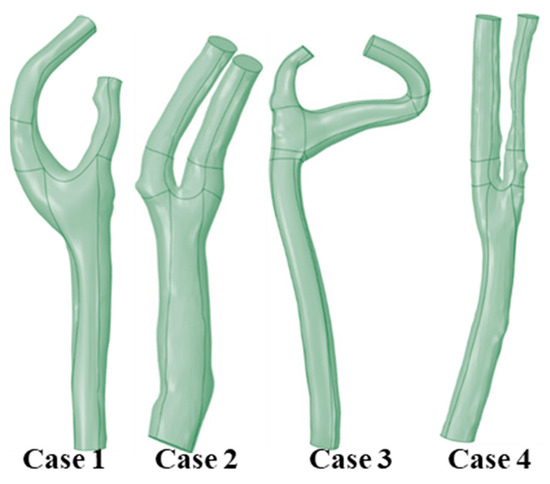
In this study, carotid artery geometries were reconstructed using Materialise MIMICS (V19). The DICOM-format images were segmented by applying an intensity-based thresholding (120–150 HU) to isolate the arterial lumen in the neck region. A 3D surface model of the carotid vasculature was generated using the vessel segmentation method, followed by smoothing to remove artifacts and irregularities. The resulting surface models were exported in STL format, refined in ANSYS Space Claim (ANSYS 2022 R2) to create watertight solid geometries, and saved in STEP format for CFD analysis as illustrated in Figure 1.
Figure 1.
Reconstructed patient-specific carotid artery geometries used in the study.
Ensuring the fidelity of the reconstructed vessel geometries, validation was performed by comparing lumen diameters and bifurcation angles derived from the 3D models with radiologist-provided measurements from the original CT images. The geometrical parameters were extracted using MIMICS software (V19), with the vessel centerline serving as the basis for quantification. The reconstructed dimensions were in close agreement with the radiologist’s measurements, with deviations remaining within a 5% error margin, which is considered acceptable for patient-specific modeling. Furthermore, the calculated geometrical values were consistent with previously published anatomical data, confirming the accuracy and reliability of the reconstructed carotid artery geometries.
The four carotid artery geometries display notable inter-patient and intra-patient anatomical variation, including differences in lumen diameter, bifurcation angle between the ICA and ECA, tortuosity, and curvature of the CCA and its bifurcation. These variations are of particular interest, as prior studies have shown that such geometric factors can significantly alter the local haemodynamic environment and affect flow patterns, wall shear stress (WSS), and susceptibility to plaque formation [12,31,32].
2.3. Meshing and Simulation
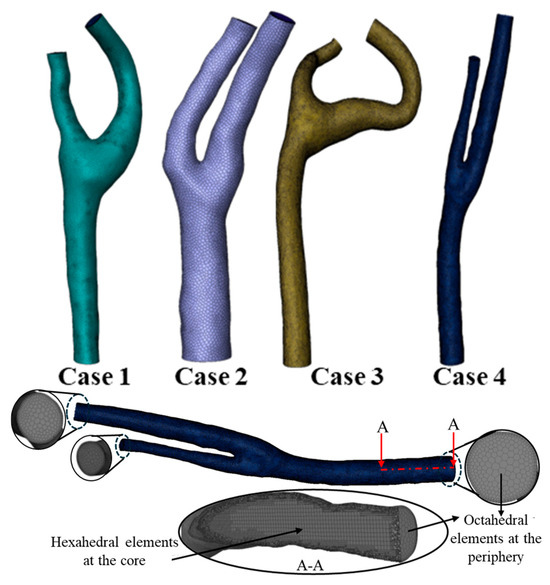
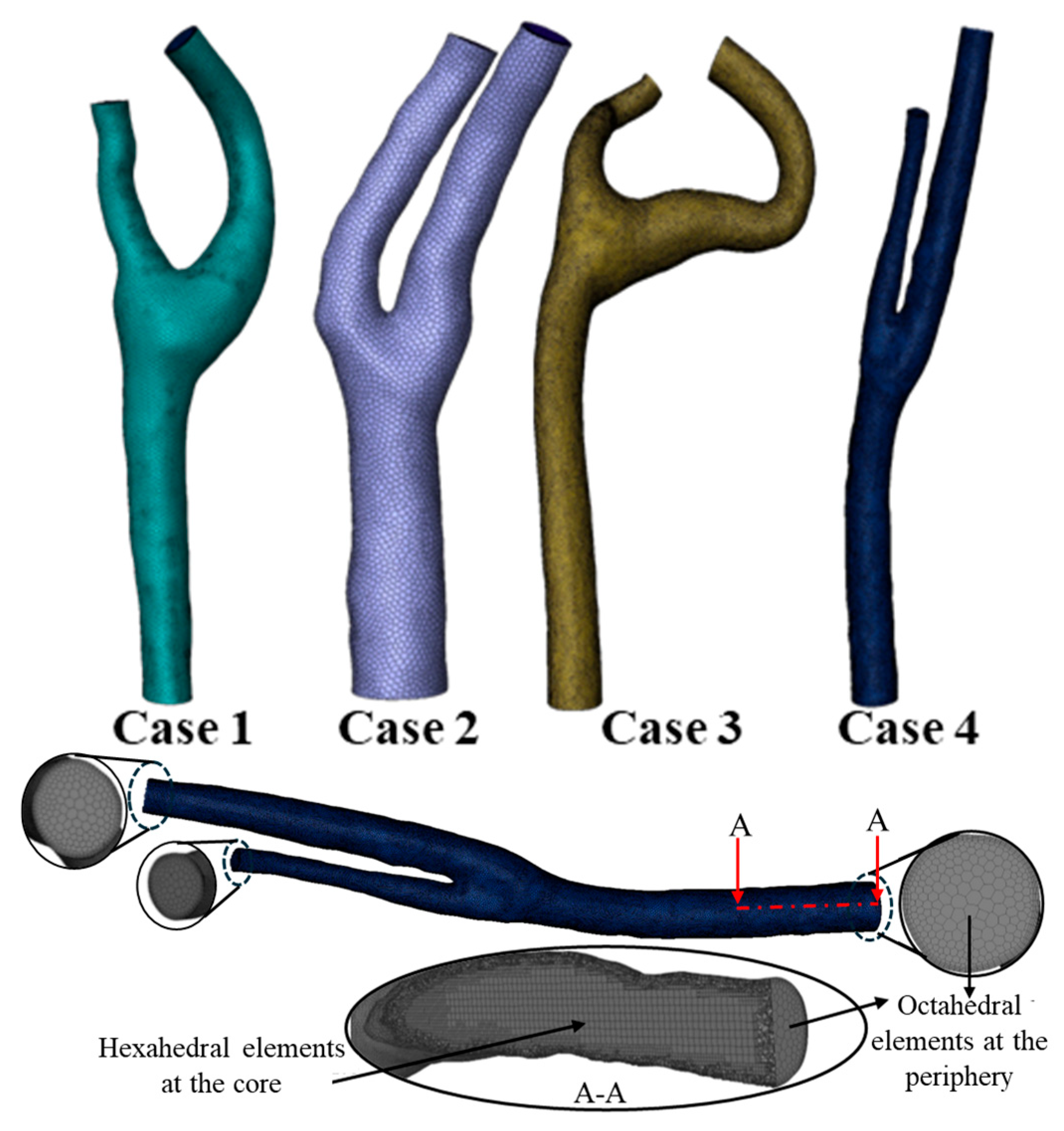
Following geometry preparation, meshing and simulation were performed in ANSYS Fluent, using the integrated Fluent Meshing module. A high-fidelity surface mesh was generated for the vessel wall, with five inflation layers applied near the wall to accurately capture velocity and shear stress gradients, as shown in Figure 2. A polyhedral volumetric mesh was used for enhanced accuracy and stability, especially around the complex carotid bifurcation.
Figure 2.
Meshed model of patient-specific carotid artery geometries used in the study.
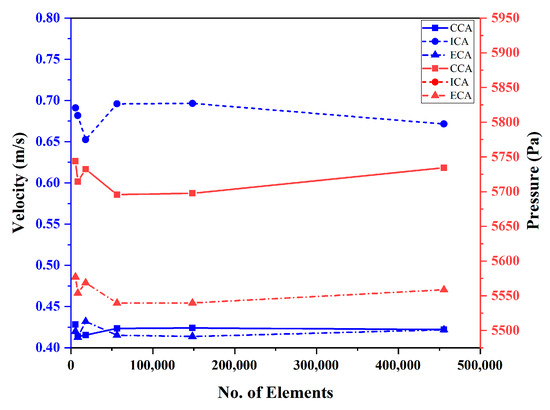
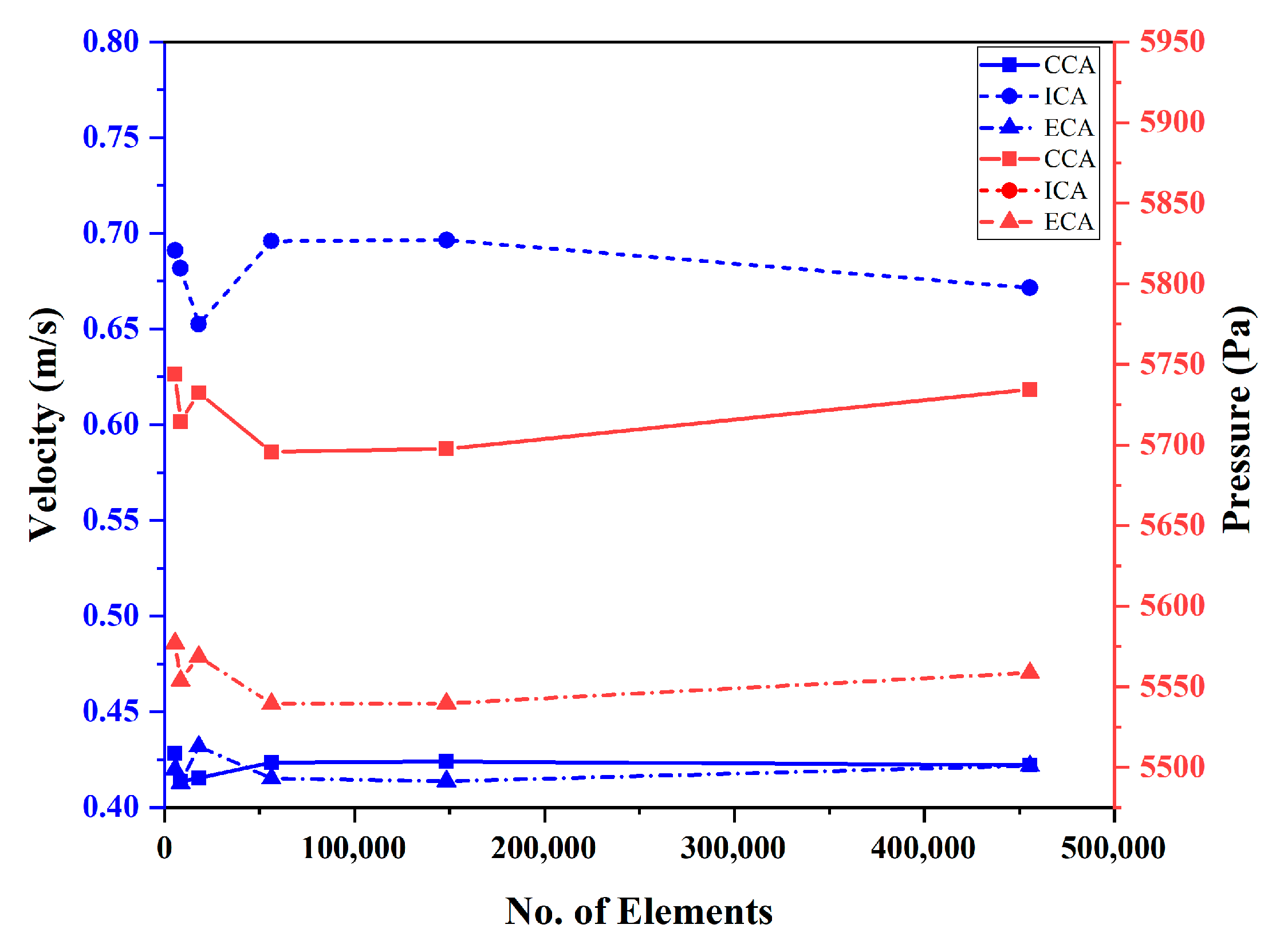
A grid independence study was conducted to assess the sensitivity of the numerical solution to spatial discretization. Pressure and velocity were evaluated at representative locations in the CCA, ICA, and ECA across progressively refined meshes. As illustrated in Figure 3, both the velocity and pressure exhibited asymptotic convergence with increasing mesh density. The variation between the medium and fine mesh configurations was minimal (<2%), indicating spatially independent solutions. A mesh size of approximately 0.2 mm was adopted for spatial discretization following the grid independence analysis, which demonstrated negligible variation in velocity and pressure between successive refinements. Since wall shear stress is derived from near-wall velocity gradients, and five inflation layers were employed to accurately resolve boundary-layer flow, the converged velocity field ensures the reliable prediction of shear-sensitive haemodynamic indices.
Figure 3.
Grid independence study: Velocity (left axis) and Pressure (right axis) convergence at representative CCA, ICA, and ECA sections.
In the present study, the representative inlet waveform was derived from Doppler ultrasound measurements in healthy subjects and captures the characteristic systolic acceleration and diastolic decay phases [33,34].
To represent the effect of downstream vascular resistance, a resistance-based formulation was used to derive the pulsatile outlet pressure waveform applied at the ICA and ECA boundaries. In a lumped parameter representation of the peripheral circulation, the relationship between pressure and volumetric flow rate can be expressed as
where is the outlet pressure, represents a reference pressure level, denotes the equivalent hydraulic resistance of the downstream vascular network, and is the instantaneous volumetric flow rate.
The downstream vascular resistance was estimated using the pressure–flow relationship , where represents the mean pressure drop across the distal vascular bed and denotes the mean volumetric flow rate. The mean pressure drop was estimated from physiological carotid arterial pressure ranges reported in the previous studies [4,19], while the mean volumetric flow rate was obtained from the prescribed inlet pulsatile velocity waveform.
The volumetric flow rate is obtained by integrating the velocity normal to the outlet surface:
where u is the velocity vector, and n is the unit normal vector to the outlet boundary.
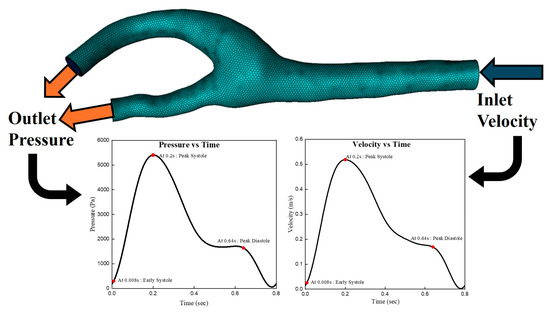
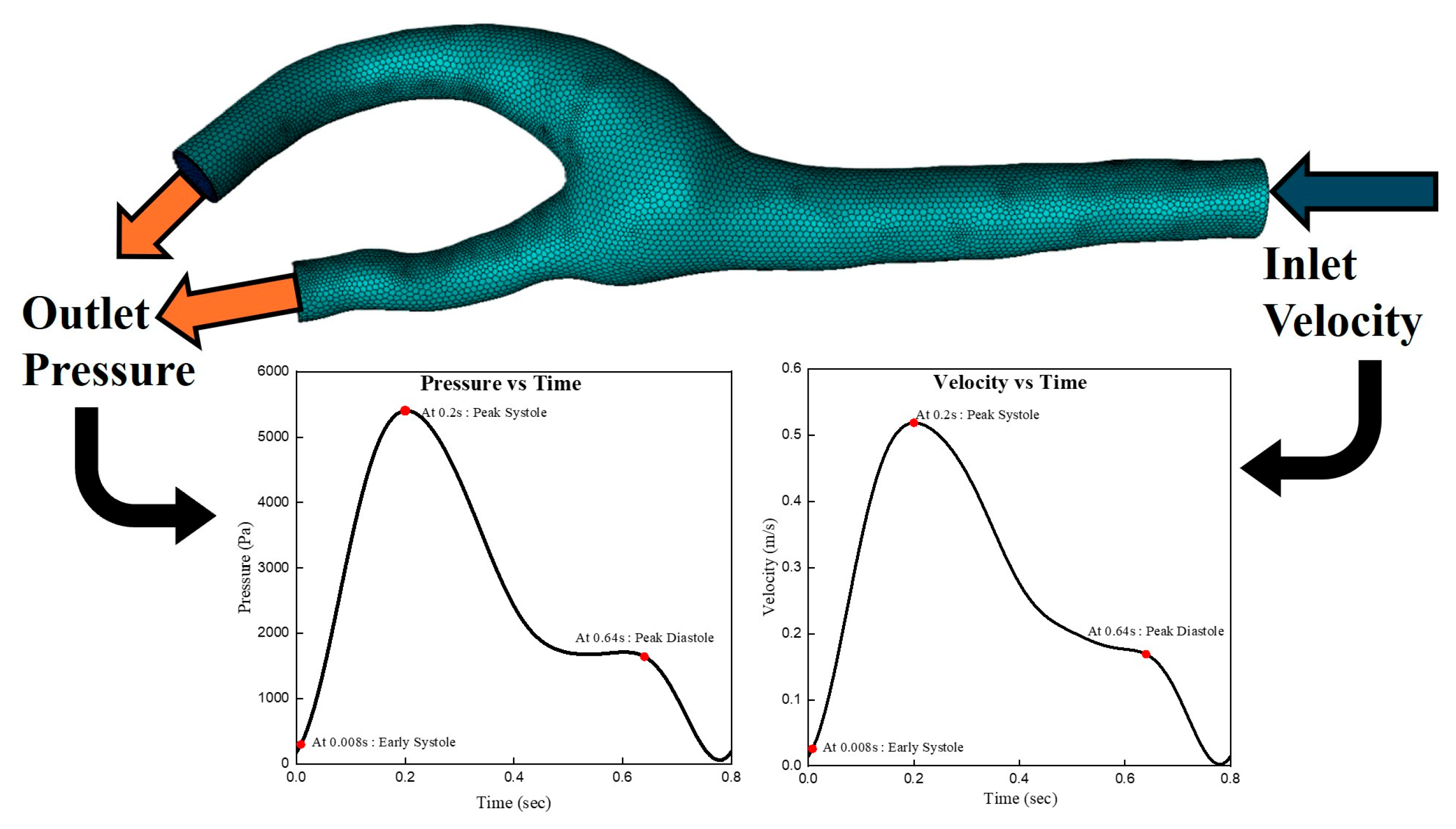
Using this relationship, a physiologically representative pulsatile pressure waveform was generated to reflect the resistance of the downstream arterial bed. At the ICA and ECA outlets, a resistance-based pulsatile pressure boundary condition was implemented to account for downstream vascular impedance and peripheral resistance. The applied pressure waveform ranged from approximately 1600 Pa (diastolic) to 5400 Pa (systolic), consistent with physiological carotid pulse amplitudes. The inlet velocity and outlet pressure waveforms were synchronized without imposed phase delay to maintain physiologically consistent transient behaviour. A schematic representation of the applied inlet and outlet boundary conditions, along with the corresponding pulsatile waveforms, is provided in Figure 4. Since identical pressure conditions are applied at the ICA and ECA outlets, the value of the pressure, or the shape of the pressure profile do not actually have any effect on the calculated velocity field. This was confirmed by an additional verification simulation using a constant zero-gauge pressure boundary condition at both outlets instead of the pressure waveform (Figure 4), leading to the same velocity field. Nevertheless, the resistance-based pulsatile pressure formulation has been presented in the manuscript because it provides a physiologically consistent, more general framework that may become important in future investigations involving different outlet boundary conditions, patient-specific flow partitioning, or pathological conditions such as carotid stenosis where pressure gradients may play a more significant role.
Figure 4.
Boundary condition implementation in the patient-specific carotid artery model. A physiologically realistic pulsatile velocity waveform was applied at the CCA inlet (right), while time-varying pressure boundary conditions were imposed at the ICA and ECA outlets (left).
An additional verification simulation was performed by applying a constant zero-gauge pressure at both outlets to evaluate the influence of the outlet pressure waveform. Even when identical pressure conditions are applied at the ICA and ECA outlets, the velocity fields remain strongly dependent on vascular geometry. Variations in bifurcation angle, curvature, and branch diameter alter the local hydraulic resistance and energy dissipation within the flow domain, thereby influencing pressure gradients, flow partitioning, and shear stress distribution near the carotid bifurcation.
The vessel walls were considered rigid, and a no-slip condition was applied at the boundaries. The transient simulations were performed across four complete cardiac cycles using a pressure-based solver with second-order accuracy in both space and time. Data from the final cycle was utilized for post-processing. Blood flow was assumed to be incompressible and non-Newtonian in nature, with the Carreau–Yasuda model employed to capture shear-thinning behaviour, and a k–ε turbulence model was implemented to account for complex flow structures and potential transitional effects in the carotid bifurcation region.
The flow regime was quantitatively characterized using Reynolds and Womersley numbers calculated for the four patient-specific carotid artery geometries based on CCA diameter and pulsatile inlet velocity tabulated in Table 1. Reynolds numbers are reported for both mean and peak systolic velocities, while the Womersley number characterizes the pulsatile nature of carotid artery blood flow. Across the four patient-specific geometries, the Reynolds number ranged from approximately 405 to 1266, indicating physiologically realistic arterial flow conditions. The pulsatile nature of the flow was further characterized using the Womersley numbers, which ranged from 3.97 to 6.21, consistent with typical carotid artery haemodynamics and indicating the presence of significant pulsatile inertial effects during the cardiac cycle.
Table 1.
Flow regime parameters for the patient-specific carotid artery models.
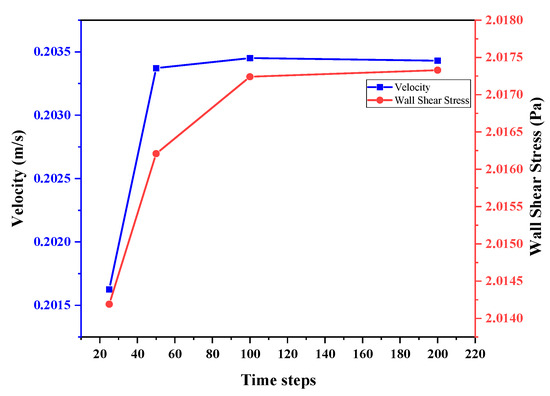
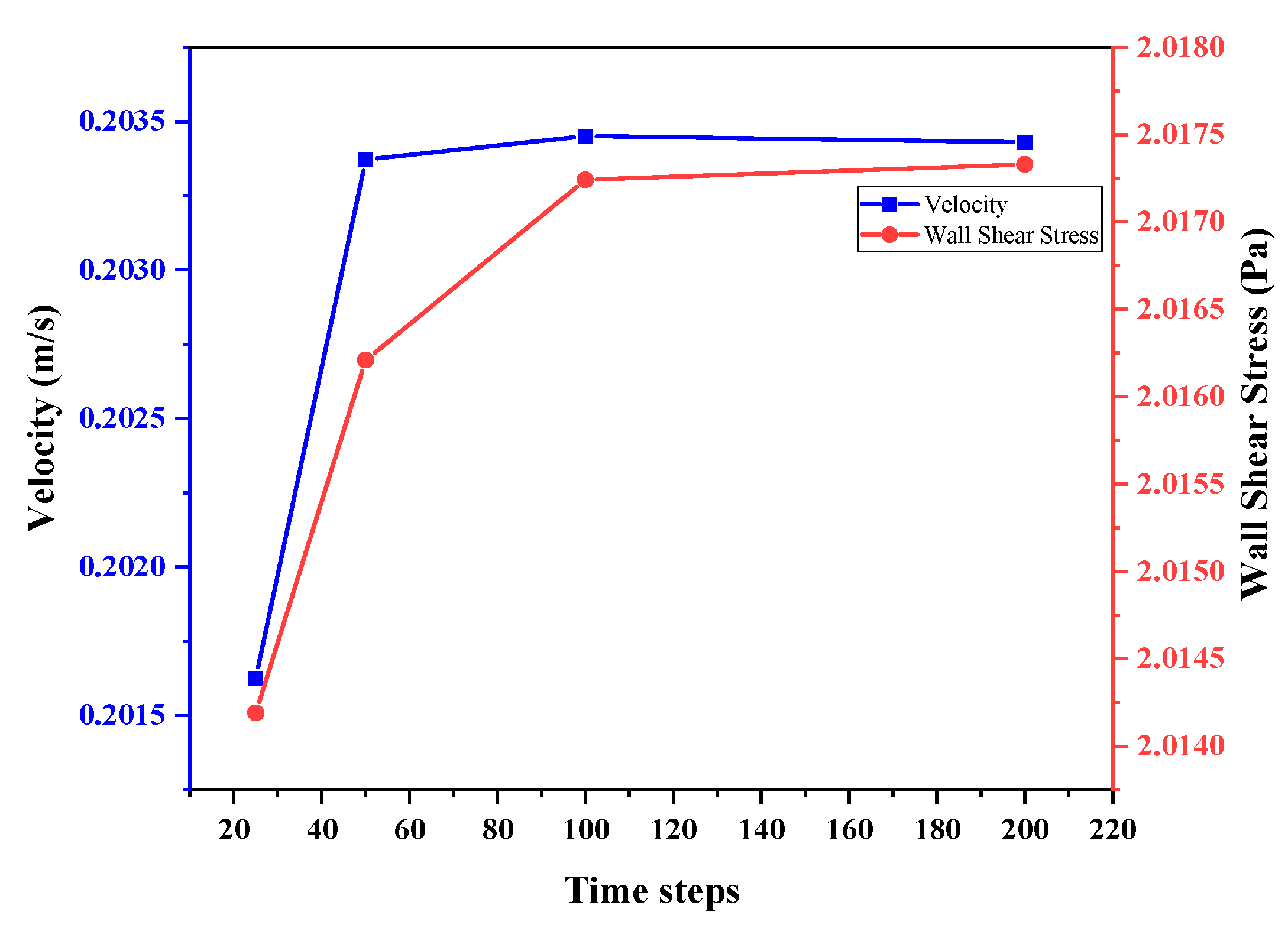
To evaluate temporal discretization effects, simulations were performed with progressively reduced time-step sizes, and velocity and WSS were monitored at peak systole. As shown in Figure 5, both parameters demonstrated asymptotic convergence with decreasing Δt, with less than 0.1% variation in WSS between the two finest time-step configurations. Based on this analysis, a time step of Δt = 0.008 s (100-time steps per 0.8 s cardiac cycle) was selected for the transient simulations. This temporal resolution ensures the accurate capture of pulsatile dynamics and reliable computation of shear-dependent indices such as TAWSS and OSI.
Figure 5.
Time-step sensitivity analysis showing convergence of velocity (left axis) and wall shear stress (right axis) with progressively reduced temporal discretization (Δt). Negligible variation between the two finest time-step configurations confirms temporal independence.
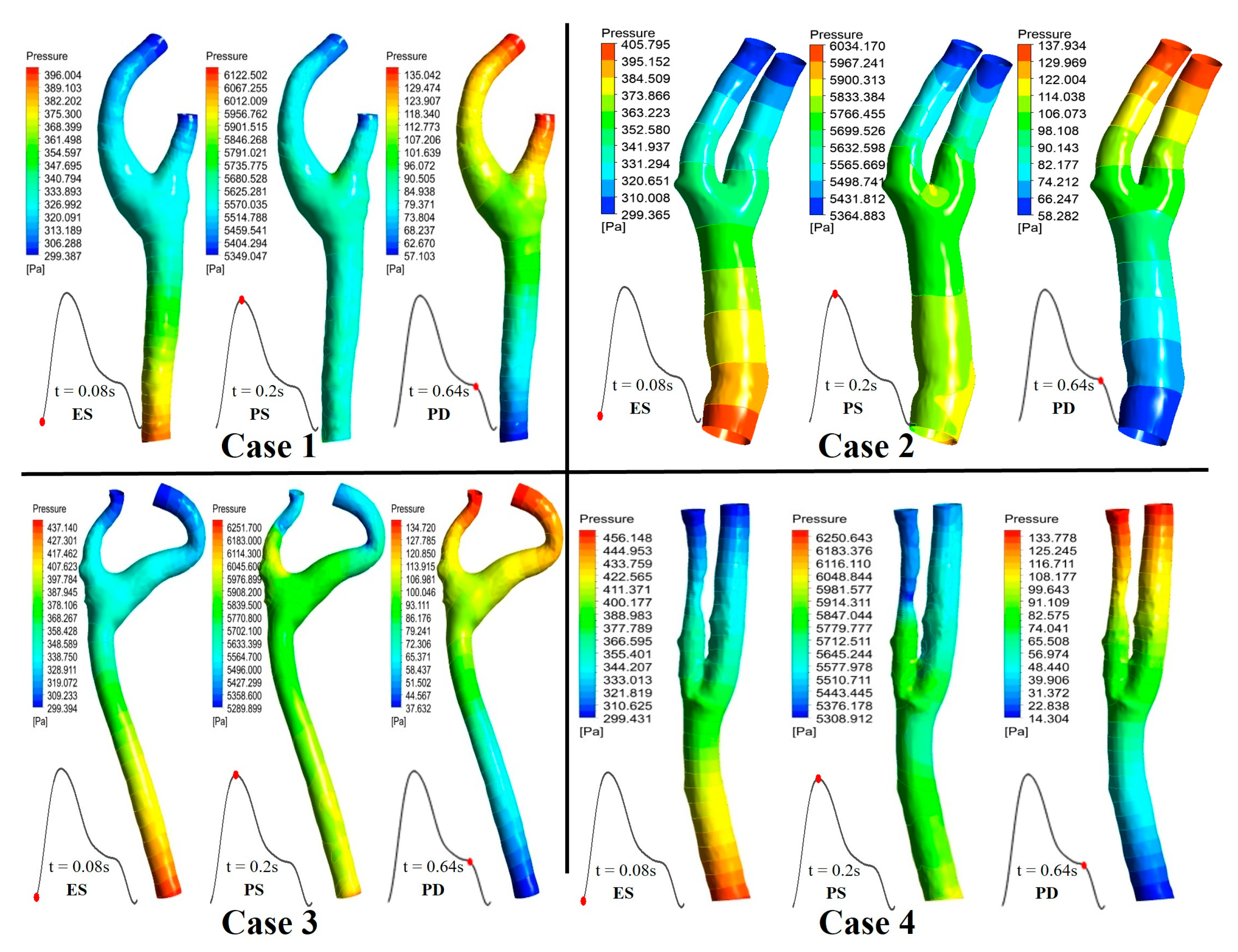
The haemodynamic behavior of blood flow in the four patient-specific carotid artery models was investigated using transient CFD simulations. To effectively characterize the pulsatile nature of blood flow, the simulation results were evaluated at three key phases of the cardiac cycle: early systole (ES) at t = 0.08 s, peak systole (PS) at t = 0.2 s, and peak diastole (PD) at t = 0.64 s. These time points were selected to represent distinct haemodynamic conditions throughout the cycle and to provide meaningful insight into flow dynamics under varying pressure and velocity states. These specific time points were selected to represent the accelerating, peak, and decelerating phases of the flow cycle, respectively. At each of these phases, detailed flow features were extracted, including velocity streamlines, and pressure distribution contours. In addition to the transient results, the study also evaluated two important haemodynamic indices derived over the full cardiac cycle: TAWSS and OSI.
3. Results
3.1. Velocity Streamline
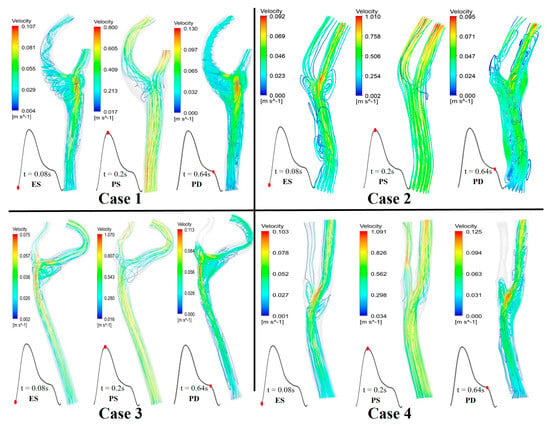
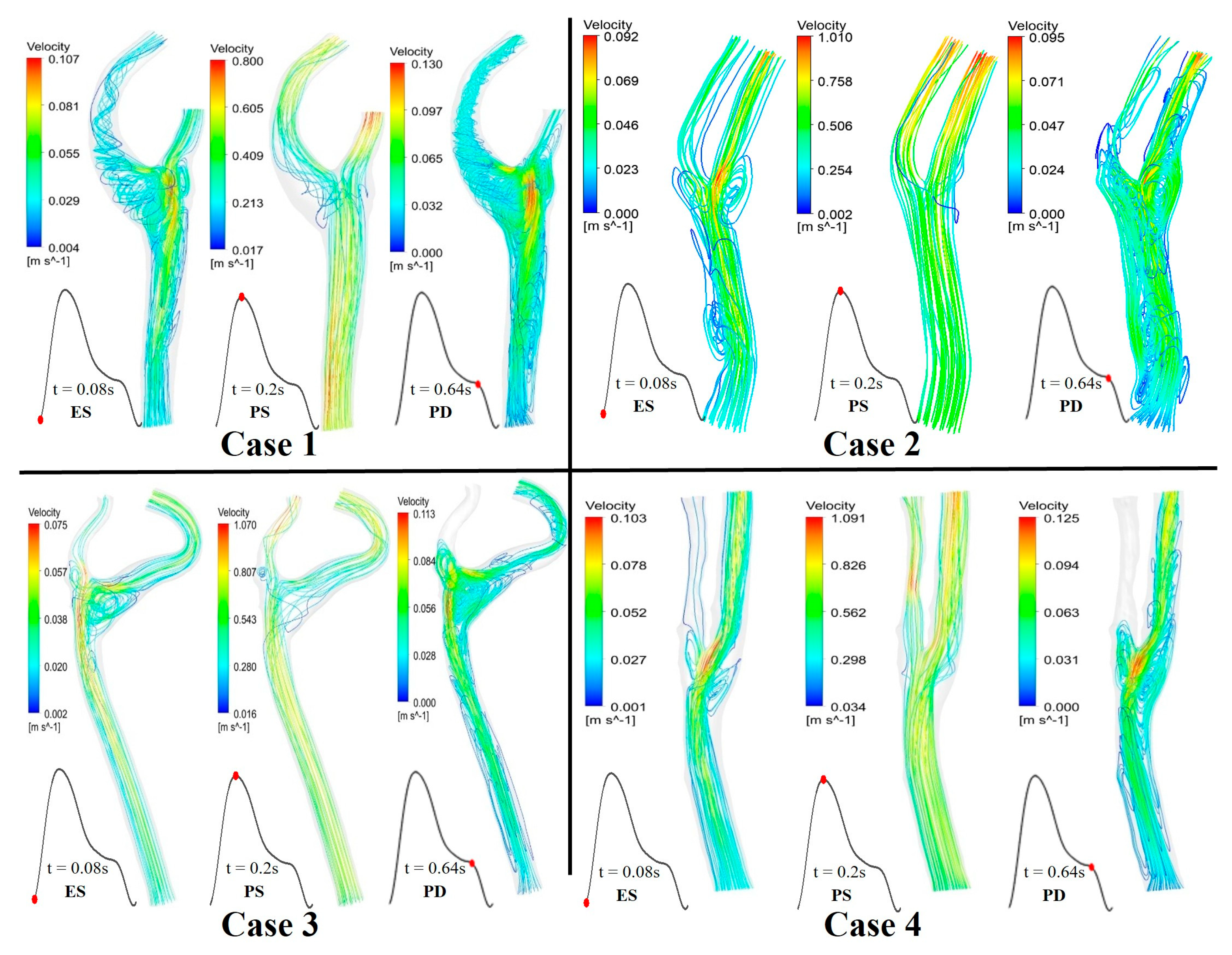
Velocity streamline plots represent instantaneous flow trajectories that are tangent to the local velocity vectors at every point in the fluid domain. They serve as a prevailing visualization tool to understand complex flow behavior, especially within anatomically intricate geometries like the carotid bifurcation. Figure 6 presents the velocity streamline plots for all four patient-specific cases at three distinct phases of the cardiac cycle. Across all cases, flow reversal phenomena are clearly observed in the carotid bulb region, particularly near the bifurcation. These regions are well-known to experience disturbed and recirculating flow due to sudden geometric expansion and changes in vessel direction [24,35,36]. Among the three cardiac phases, early systole exhibits minimal flow reversal, as the flow is just beginning to accelerate. Conversely, peak diastole shows the most prominent recirculation zones, characterized by detached flow structures and low-velocity swirling patterns. At peak systole, the flow becomes more streamlined and predominantly laminar, with a uniform velocity profile and negligible recirculation, indicative of strong inertial dominance during the phase of maximum flow rate.
Figure 6.
Velocity streamline plots for all four patient-specific carotid artery models at three phases of the cardiac cycle. The streamlines visualize flow direction and magnitude, with colour indicating velocity. Flow reversal and recirculation are more prominent during PD, while laminar, high-velocity flow is observed during PS. Case-wise anatomical differences significantly influence local flow dynamics, especially near the bifurcation and in the ICA and ECA branches.
3.2. Pressure
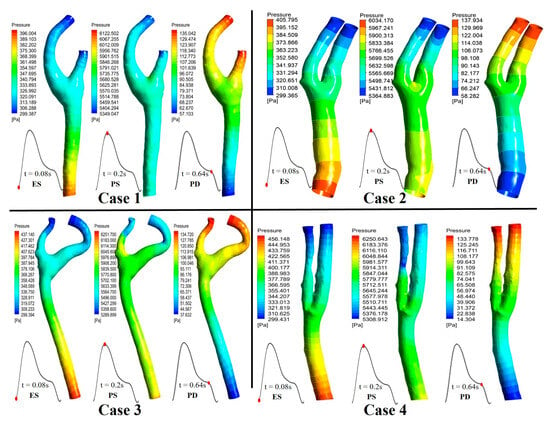
The pressure distribution contours for all four patient-specific carotid artery models at three characteristic phases of the cardiac cycle are illustrated in Figure 7. The pressure patterns provide insight into the spatial variations in flow resistance and vessel curvature-induced haemodynamic stress. The pressure within Case 2 and Case 4 is observed to be uniform throughout the geometry. This can be attributed to the relatively straight morphology, which promotes a more streamlined flow and minimal pressure loss.
Figure 7.
Pressure distribution contours in four patient-specific carotid arteries. Each case demonstrates the variation in pressure with respect to vascular geometry. Higher pressure zones are evident in regions with curvature or sharp bifurcation angles, while straighter geometries show more uniform pressure gradients. Pressure peaks are observed at the bifurcation and distal segments during systole, gradually reducing toward diastole.
The elevated pressure in the curved geometries is consistent with prior findings [14,16], where arterial curvatures are associated with increased local pressure due to centrifugal effects and abrupt directional changes. Specifically, Case 1 and Case 3 show sustained high pressure extending into the mid-CCA, with relatively uniform pressure at the bifurcation itself, possibly due to symmetric flow division and gradual geometric transition.
3.3. Wall Shear Stress
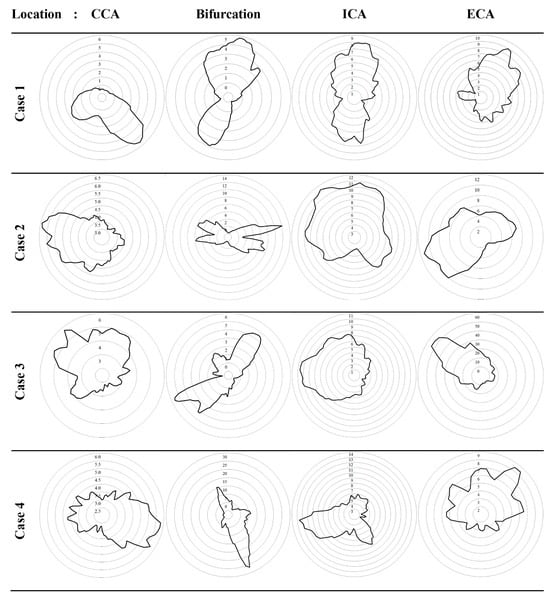
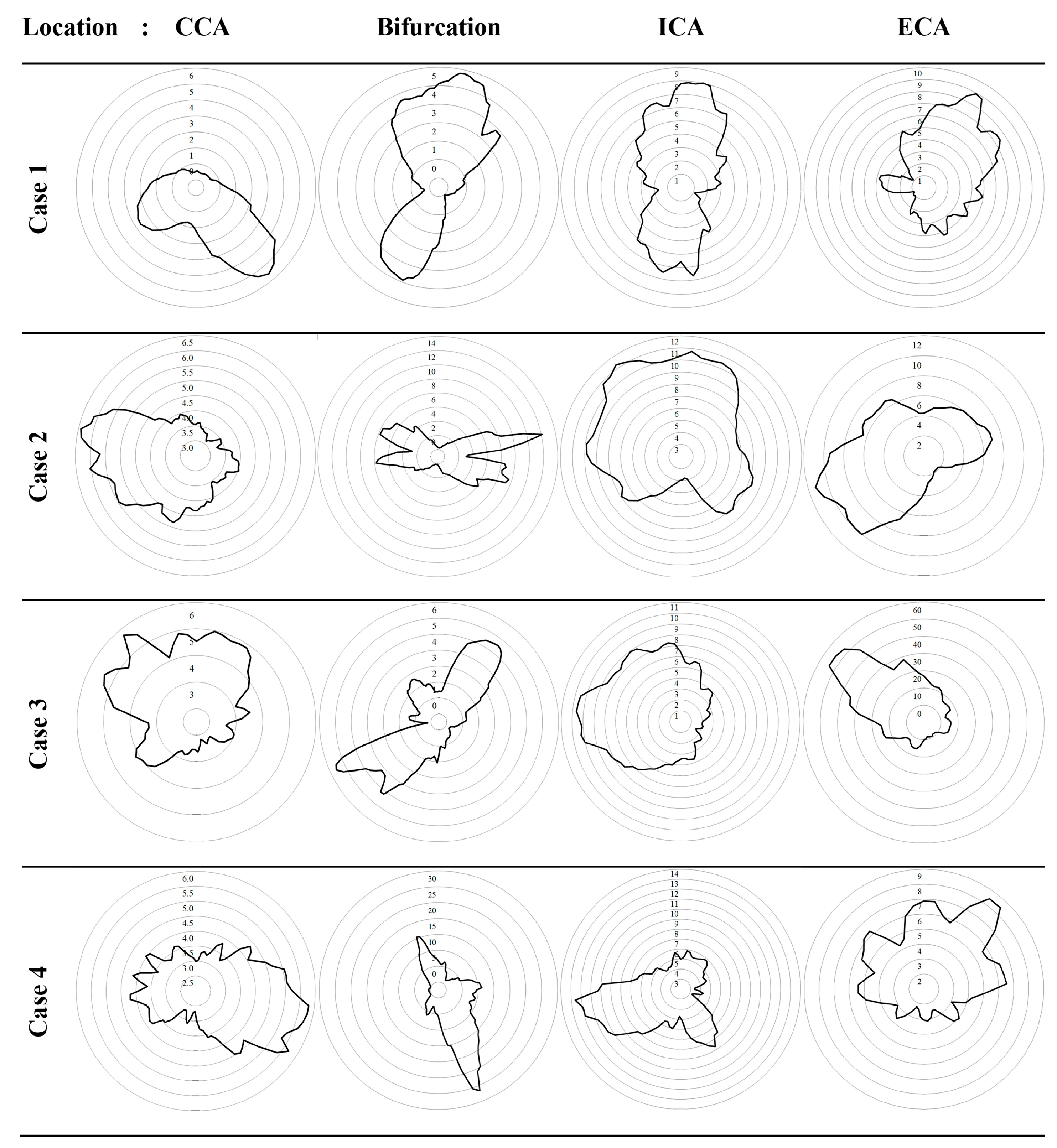
The polar plots of WSS presented across the carotid artery segments CCA, bifurcation, ICA, and ECA as shown in Figure 8, offer detailed insight into the spatial distribution of shear forces around the arterial walls in all four cases. These plots visualize the radial variation in WSS, capturing flow asymmetries and localized peaks resulting from complex arterial geometries [12,37,38].
Figure 8.
WSS magnitude at selected cross-sections—CCA, bifurcation, ICA, and ECA—for all four cases. The angular variation in WSS highlights differences in flow uniformity and regions of high shear due to geometry-induced flow complexity.
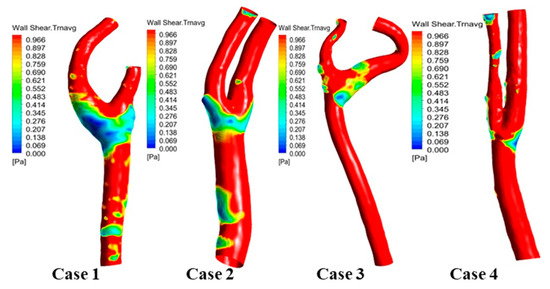
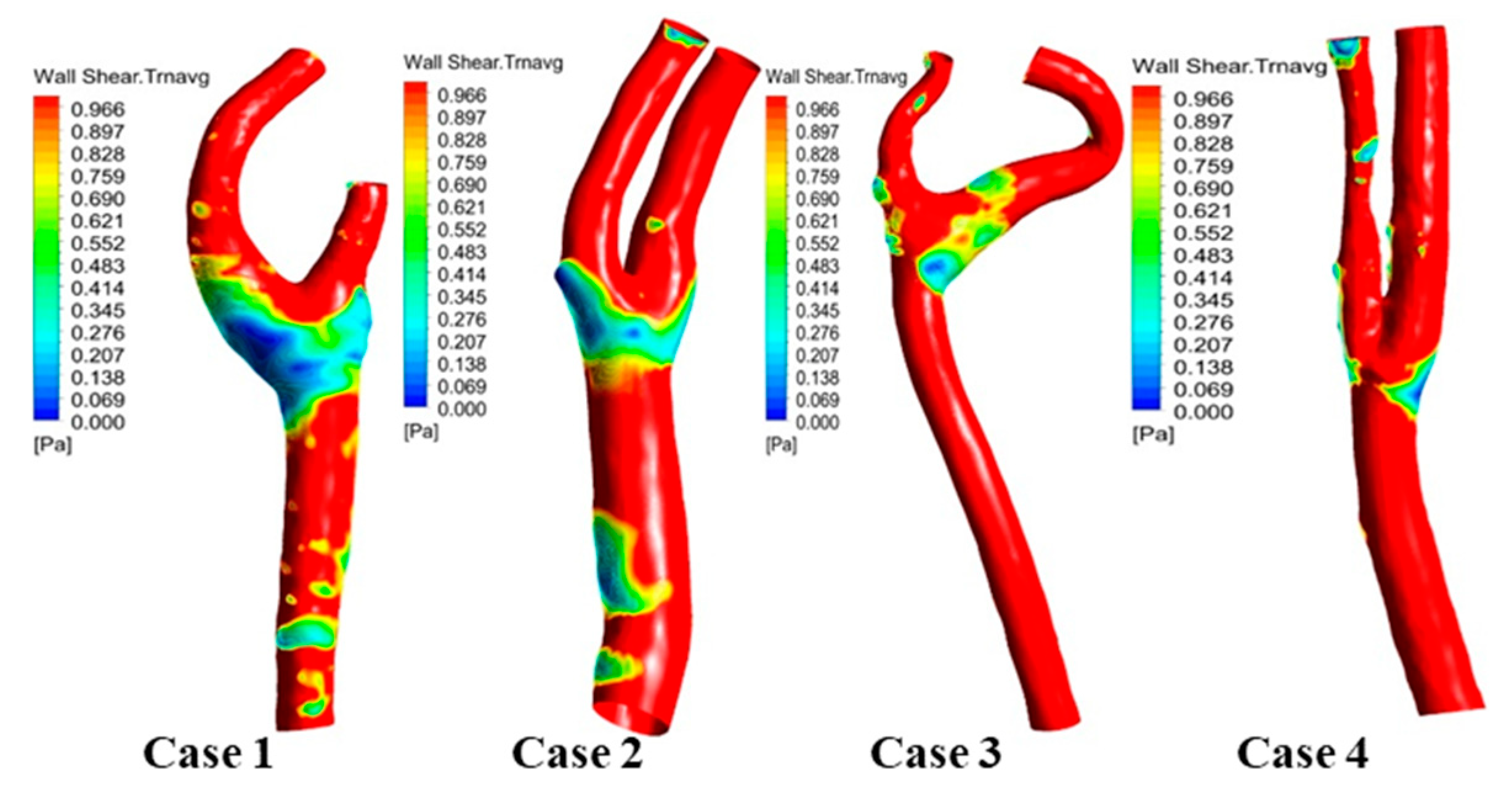
The distribution of time-averaged wall shear stress (TAWSS), highlighting regions prone to atherosclerotic development, is illustrated in Figure 9. Across all four carotid artery models, low TAWSS zones (<1 Pa), shown in green to blue shades, are primarily located near the bifurcation and bulb—areas associated with disturbed flow and recirculation.
Figure 9.
Distribution of time-averaged wall shear stress (TAWSS) for four carotid artery cases. The colour maps represent TAWSS magnitudes, with red indicating higher shear stress and green to blue regions indicating lower shear stress (<1 Pa).
3.4. Oscillatory Shear Index
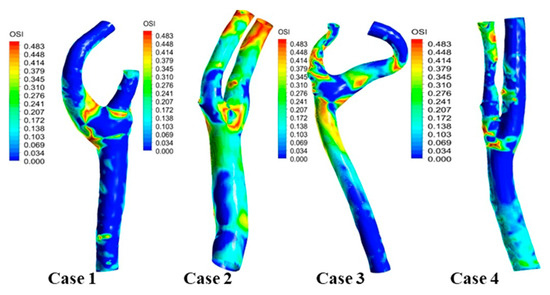
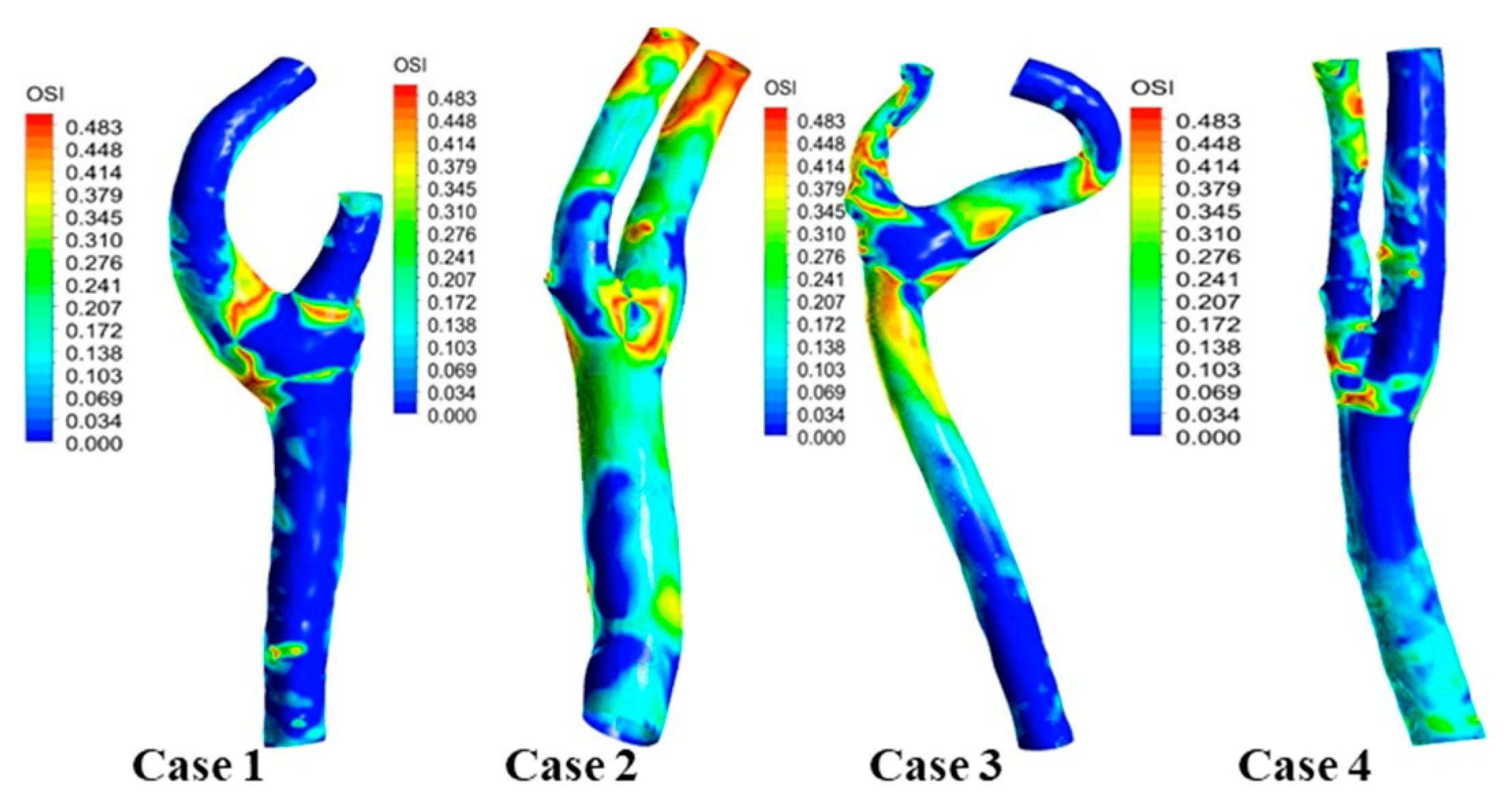
The OSI ranges from 0 to 0.5, where higher values reflect greater fluctuations in the direction of wall shear stress (WSS), while lower values indicate a more consistent, unidirectional shear [39,40]. Across all models analyzed, elevated OSI values are predominantly found in the carotid bulb and bifurcation regions, as shown in Figure 10. Notably, models with smaller bifurcation angles generally exhibit a reduced surface area exposed to high OSI. A detailed comparison reveals that arterial segments with pronounced curvature, bifurcation, or tortuous geometry undergo more substantial directional shifts in flow relative to the previous orientation of maximum WSS, resulting in increased OSI values.
Figure 10.
Contour plots of oscillatory shear index (OSI) for all four carotid artery models. Higher OSI values (approaching 0.5) are predominantly observed at the bifurcation and carotid bulb regions, indicating increased directional changes in wall shear stress. Geometric factors such as curvature, bifurcation angle, and tortuosity contribute significantly to localized OSI distribution, with models exhibiting lower bifurcation angles showing reduced areas of elevated OSI.
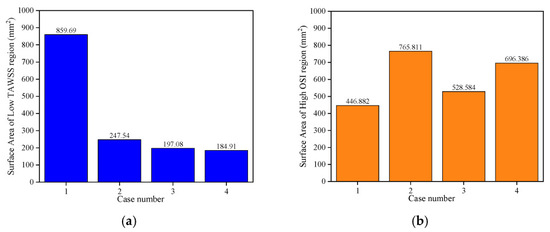
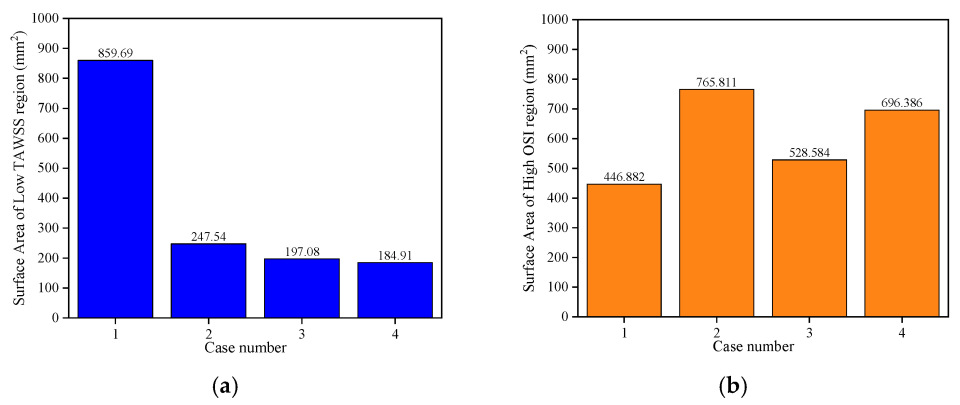
In addition to qualitative observations, inter-patient variability in haemodynamic indices was quantified to highlight the influence of anatomical differences on flow behaviour. Figure 11 presents the distribution of time-averaged wall shear stress (TAWSS) and oscillatory shear index (OSI) across four patient-specific carotid artery models. The results indicate substantial variation, with the surface area of low TAWSS values ranging from 184.9 mm2 to 859.7 mm2, corresponding to an approximate 365% difference among the cases. Similarly, the OSI exhibited notable variability, spanning from 446.8 to 765.8, reflecting a 71% increase between the lowest and highest values. These findings suggest that haemodynamic indices are highly sensitive to individual arterial geometry, which may explain inter-patient differences in plaque localization and progression. Such variability is clinically significant, as it underscores the importance of patient-specific assessment when evaluating stenosis severity or predicting post-stenting outcomes.
Figure 11.
Quantitative comparison of haemodynamic indices across four patient-specific carotid artery models: (a) surface area of low TAWSS region and (b) surface area of high OSI region.
4. Discussion
The present study demonstrates that patient-specific carotid artery geometry significantly influences local haemodynamic patterns, particularly within the bifurcation and bulb regions. Variations in curvature, bifurcation angle, and vessel asymmetry were associated with marked differences in velocity distribution, pressure gradients, and wall shear stress metrics across the four cases.
Higher velocity magnitudes were observed in the distal ICA and ECA branches, while reduced velocity and disturbed flow were evident in the ICA compared to the CCA due to flow partitioning at the bifurcation. Pressure distributions revealed proximal elevation in regions of curvature and geometric constriction, with peak systolic pressure typically localized along the inner wall of the bifurcation. These findings indicate that vascular geometry governs local momentum redistribution and pressure gradient formation.
An additional simulation, prescribing a constant zero-gauge pressure at both the ICA and ECA outlets, evaluated the influence of the outlet pressure boundary condition. The resulting velocity field, streamline structures, and wall shear stress distributions were found to be essentially identical to those obtained using the pulsatile pressure waveform. This confirms that when identical pressure conditions are applied at both outlets in incompressible flow with rigid vessel walls, the computed haemodynamics are primarily governed by the inlet flow waveform and vascular geometry rather than by the specific temporal form of the outlet pressure profile. Nevertheless, the resistance-based pulsatile pressure formulation has been retained in the present study because it provides a flexible framework for future investigations where outlet conditions may differ between branches or where pathological geometries such as stenosis introduce significant pressure gradients.
During the deceleration phase of the cardiac cycle, adverse pressure gradients develop near the carotid bifurcation, particularly in geometries with larger bifurcation angles or increased curvature. These gradients promote boundary layer separation and the formation of recirculation zones within the carotid bulb. The resulting flow reversal and secondary helical structures generate oscillatory shear patterns and prolonged blood residence times, which manifest as regions of low TAWSS and elevated OSI. Such disturbed haemodynamic environments are widely recognized as atheroprone, as sustained low shear stress and directional shear oscillations are associated with endothelial dysfunction, inflammatory activation, and increased vascular permeability. Therefore, the geometric modulation of flow physics directly influences biologically relevant shear stress indices.
Low TAWSS regions were predominantly observed in the carotid bulb and bifurcation areas across all cases, while elevated OSI values were localized in regions exhibiting curvature-induced flow disturbance. Inter-case variability in the surface area exposed to low TAWSS and high OSI further highlights the sensitivity of shear-based metrics to anatomical differences. Although a detailed statistical correlation between the haemodynamic indices and geometric descriptors (bifurcation angle, diameter ratio, curvature index) was not performed due to the limited cohort size (n = 4), the observed trends suggest that geometric factors play a substantial role in modulating local shear environments. Future studies involving larger patient populations are necessary to establish statistically robust correlations and reduce potential bias.
In the absence of patient-specific Doppler or PC-MRI measurements, the predicted velocity, TAWSS, and OSI magnitudes were compared with established carotid haemodynamic data reported in the literature. The computed values were found to lie within physiologically acceptable ranges, supporting the realism, numerical stability, and physiological plausibility of the present simulations.
From a translational perspective, the identification of patient-specific regions exposed to disturbed flow may contribute to improved risk stratification and personalized management strategies. CFD-derived haemodynamic markers have the potential to complement conventional imaging modalities by identifying plaque-prone regions prior to significant stenosis development, thereby informing surveillance protocols and potentially guiding interventional planning.
Several limitations should be acknowledged. The arterial walls were assumed rigid, and fluid–structure interaction effects due to vascular compliance were not incorporated, which may influence local shear distributions. The inlet and outlet boundary conditions were derived from the literature-based physiological waveforms rather than patient-specific haemodynamic measurements, potentially affecting quantitative predictions. Although the Reynolds number estimation indicated physiologically realistic flow conditions, transitional effects during deceleration may not be fully captured depending on modelling assumptions. Furthermore, the limited sample size restricts statistical generalization and direct correlation with plaque morphology or clinical outcomes. Future investigations incorporating larger cohorts, compliant wall modeling, patient-specific boundary conditions, and longitudinal clinical validation are required to further enhance translational applicability.
5. Conclusions
This study presents a patient-specific CFD investigation of carotid artery haemodynamics, examining velocity patterns, pressure distribution, WSS, TAWSS, and OSI under pulsatile flow conditions. The results demonstrate that geometric features such as bifurcation angle, curvature, and vessel asymmetry significantly modulate local flow physics, particularly in the carotid bulb and bifurcation regions. Adverse pressure gradients during flow deceleration promote separation and recirculation, leading to localized regions of low TAWSS and elevated OSI haemodynamic environments widely recognized as atheroprone.
The predicted velocity and shear stress magnitudes were consistent with reported physiological ranges, supporting the credibility of the numerical framework. Inter-case variability in shear-based indices further highlights the sensitivity of haemodynamic metrics to individual anatomical differences, reinforcing the importance of patient-specific modeling in vascular biomechanics research. A supplementary simulation employing identical constant pressure boundary conditions at both outlets yielded negligible differences in the predicted velocity field and shear stress distributions, indicating that under the present assumptions of incompressible flow and rigid arterial walls, the haemodynamic behaviour is primarily governed by the inlet pulsatile flow and vascular geometry rather than by the specific temporal form of the outlet pressure profile.
Although the study is limited by rigid-wall assumptions, the literature-derived boundary conditions, and a small sample size, the findings provide mechanistic insight into geometry-driven flow disturbances in carotid arteries. Overall, the work underscores the role of patient-specific vascular morphology in shaping haemodynamic environments and supports the potential of CFD as a complementary tool for investigating individualized risk patterns in carotid artery disease.
Author Contributions
Conceptualization, S.M.A.K., M.T. and R.P.B.; methodology, A.H.N. and G.S.B.; software, A.H.N., S.M.A.K., H.K. and K.A.M.; validation, M.T., S.M.A.K. and M.Z.; supervision, R.P.B., P.K. and G.K.; simulations, A.H.N. and H.K.; writing and editing, K.A.M., M.Z. and I.A.B. All authors have read and agreed to the published version of the manuscript.
Funding
This work was supported by the DST-INTERNATIONAL BILATERAL COOPERATION DIVISION GRANT [DST/JSPS/P-293/2019].
Institutional Review Board Statement
The study was approved by the Institutional Ethics Committee of KASTURBA MEDICAL COLLEGE and KASTURBA HOSPITAL (569/2020 and 2 February 2024) for studies involving humans.
Informed Consent Statement
Informed consent was waived due to the retrospective nature of the study and the use of anonymized patient data, as approved by the Institutional Ethics Committee.
Data Availability Statement
The original contributions presented in this study are included in the article. Further inquiries can be directed to the corresponding authors.
Acknowledgments
The authors would like to thank the Manipal Institute of Technology, Manipal Academy of Higher Education, Manipal, India, for the computing resources provided to carry out this work.
Conflicts of Interest
The authors declare no conflicts of interest.
Correction Statement
This article has been republished with a minor correction to the Informed Consent Statement. This change does not affect the scientific content of the article.
Abbreviations
The following abbreviations are used in this manuscript:
| CVD | Cardiovascular diseases |
| TIA | Transient ischemic attacks |
| CFD | Computational fluid dynamics |
| CCA | Common carotid artery |
| ICA | Internal carotid artery |
| ECA | External carotid artery |
| ES | Early systole |
| PD | Peak diastole |
| ED | Early diastole |
| CY | Carreau–Yasuda |
| WSS | Wall shear stress |
| TAWSS | Time-averaged wall shear stress |
| OSI | Oscillatory shear index |
References
- Townsend, N.; Wilson, L.; Bhatnagar, P.; Wickramasinghe, K.; Rayner, M.; Nichols, M. Cardiovascular Disease in Europe: Epidemiological Update 2016. Eur. Heart J. 2016, 37, 3232–3245. [Google Scholar] [CrossRef] [Scilit]
- Sreeniwas Kumar, A.; Sinha, N. Cardiovascular Disease in India: A 360 Degree Overview. Med. J. Armed Forces India 2020, 76, 1–3. [Google Scholar] [CrossRef] [Scilit] [PubMed]
- Yang, J.; Zhang, Y.; Xue, J.; Guo, Y.; Liu, S.; Yao, Y.; Zhong, H.; Quan, A.; Yang, J. Hemodynamic Effects of Stenosis with Varying Severity in Different Segments of the Carotid Artery Using Computational Fluid Dynamics. Sci. Rep. 2025, 15, 4896. [Google Scholar] [CrossRef] [Scilit] [PubMed]
- Ku, D.N. Blood Flow in Arteries. Annu. Rev. Fluid Mech. 1997, 29, 399–434. [Google Scholar] [CrossRef] [Scilit]
- Guerciotti, B.; Vergara, C.; Azzimonti, L.; Forzenigo, L.; Buora, A.; Biondetti, P.; Domanin, M. Computational Study of the Fluid-Dynamics in Carotids before and after Endarterectomy. J. Biomech. 2016, 49, 26–38. [Google Scholar] [CrossRef] [Scilit]
- Ngo, M.T.; Lee, U.Y.; Ha, H.; Jin, N.; Chung, G.H.; Kwak, Y.G.; Jung, J.; Kwak, H.S. Comparison of Hemodynamic Visualization in Cerebral Arteries: Can Magnetic Resonance Imaging Replace Computational Fluid Dynamics? J. Pers. Med. 2021, 11, 253. [Google Scholar] [CrossRef] [Scilit]
- Ya, X.; Ma, L.; Li, H.; Ge, P.; Zheng, Z.; Mou, S.; Liu, C.; Zhang, Y.; Wang, R.; Zhang, Q.; et al. Exploring the Relationship between Hemodynamics and the Immune Microenvironment in Carotid Atherosclerosis: Insights from CFD and CyTOF Technologies. J. Cereb. Blood Flow Metab. 2024, 44, 1733–1744. [Google Scholar] [CrossRef] [Scilit]
- Gessaghi, V.C.; Raschi, M.A.; Tanoni, D.Y.; Perazzo, C.A.; Larreteguy, A.E. Growth Model for Cholesterol Accumulation in the Wall of a Simplified 3D Geometry of the Carotid Bifurcation. Comput. Methods Appl. Mech. Eng. 2011, 200, 2117–2125. [Google Scholar] [CrossRef] [Scilit]
- Bit, A.; Ghagare, D.; Rizvanov, A.A.; Chattopadhyay, H. Assessment of Influences of Stenoses in Right Carotid Artery on Left Carotid Artery Using Wall Stress Marker. BioMed Res. Int. 2017, 2017, 2935195. [Google Scholar] [CrossRef] [Scilit]
- Bae, T.; Ko, J.H.; Chung, J. Turbulence Intensity as an Indicator for Ischemic Stroke in the Carotid Web. World Neurosurg. 2021, 154, e443–e457. [Google Scholar] [CrossRef] [Scilit]
- Cao, J.; Tan, Z.; Tang, Y.; Liu, Z.; Huang, J.; Huo, G.; Yao, Z.; Zhou, Y.; Zhou, D. Hemodynamic Simulation Analysis of Tandem Carotid Artery Stenosis Based on a Patient-Specific Case. J. Biomech. 2025, 191, 112907. [Google Scholar] [CrossRef] [Scilit] [PubMed]
- Fu, Y.; Qiao, A.; Jin, L. The Influence of Hemodynamics on the Ulceration Plaques of Carotid Artery Stenosis. J. Mech. Med. Biol. 2015, 15, 1550008. [Google Scholar] [CrossRef] [Scilit]
- Massai, D.; Soloperto, G.; Gallo, D.; Xu, X.Y.; Morbiducci, U. Shear-Induced Platelet Activation and Its Relationship with Blood Flow Topology in a Numerical Model of Stenosed Carotid Bifurcation. Eur. J. Mech. B/Fluids 2012, 35, 92–101. [Google Scholar] [CrossRef] [Scilit]
- Urevc, J.; Zun, I.; Brumen, M.; Stok, B. Modeling the Effect of Red Blood Cells Deformability on Blood Flow Conditions in Human Carotid Artery Bifurcation. J. Biomech. Eng. 2017, 139, 011011. [Google Scholar] [CrossRef] [Scilit]
- Morbiducci, U.; Gallo, D.; Massai, D.; Ponzini, R.; Deriu, M.A.; Antiga, L.; Redaelli, A.; Montevecchi, F.M. On the Importance of Blood Rheology for Bulk Flow in Hemodynamic Models of the Carotid Bifurcation. J. Biomech. 2011, 44, 2427–2438. [Google Scholar] [CrossRef] [Scilit]
- Sia, S.F.; Zhao, X.; Yu, Y.; Zhang, Y. Multiphase Particle-in-Cell Simulation in Severe Internal Carotid Artery Stenosis. Powder Technol. 2019, 358, 62–67. [Google Scholar] [CrossRef] [Scilit]
- Guerciotti, B.; Vergara, C. Computational Comparison between Newtonian and Non-Newtonian Blood Rheologies in Stenotic Vessels. In Biomedical Technology: Modeling, Experiments and Simulation; Lecture Notes in Applied and Computational Mechanics; Springer: Cham, Switzerland, 2018; Volume 84, pp. 169–183. [Google Scholar]
- Lee, S.H.; Han, K.S.; Hur, N.; Cho, Y.I.; Jeong, S.K. The Effect of Patient-Specific Non-Newtonian Blood Viscosity on Arterial Hemodynamics Predictions. J. Mech. Med. Biol. 2019, 19, 1940054. [Google Scholar] [CrossRef] [Scilit]
- Hoi, Y.; Wasserman, B.A.; Lakatta, E.G.; Steinman, D.A. Carotid Bifurcation Hemodynamics in Older Adults: Effect of Measured versus Assumed Flow Waveform. J. Biomech. Eng. 2010, 132, 071006. [Google Scholar] [CrossRef] [Scilit]
- Hoi, Y.; Wasserman, B.A.; Lakatta, E.G.; Steinman, D.A. Effect of Common Carotid Artery Inlet Length on Normal Carotid Bifurcation Hemodynamics. J. Biomech. Eng. 2010, 132, 121008. [Google Scholar] [CrossRef] [Scilit]
- Subramaniam, T.; Rasani, M.R. Pulsatile CFD Numerical Simulation to Investigate the Effect of Various Degree and Position of Stenosis on Carotid Artery Hemodynamics. J. Adv. Res. Appl. Sci. Eng. Technol. 2022, 26, 29–40. [Google Scholar] [CrossRef] [Scilit]
- Nithiarasu, P.; Bevan, R.; Sazonov, I.; Van Loon, R.; Luckraz, H.; Collins, M.; Garnham, A. Influences of Domain Extensions to a Moderately Stenosed Patient-Specific Carotid Bifurcation: Investigation of Wall Quantities. Int. J. Numer. Methods Heat Fluid Flow 2011, 21, 952–979. [Google Scholar] [CrossRef] [Scilit]
- Morbiducci, U.; Gallo, D.; Massai, D.; Consolo, F.; Ponzini, R.; Antiga, L.; Bignardi, C.; Deriu, M.A.; Redaelli, A. Outflow Conditions for Image-Based Hemodynamic Models of the Carotid Bifurcation: Implications for Indicators of Abnormal Flow. J. Biomech. Eng. 2010, 132, 091005. [Google Scholar] [CrossRef] [Scilit] [PubMed]
- Rayz, V.L.; Berger, S.A.; Saloner, D. Transitional Flows in Arterial Fluid Dynamics. Comput. Methods Appl. Mech. Eng. 2007, 196, 3043–3048. [Google Scholar] [CrossRef] [Scilit]
- Raghuvir Pai, B.; Ayachit, A.; Abdul Khader, S.M.; Ahmed, K.A.; Rao, V.R.K.; Kamath, S.G.; Gupta, P.D. Effect of Postural Changes on Normal and Stenosed Common Carotid Artery Using FSI. Australas. Phys. Eng. Sci. Med. 2014, 37, 139–152. [Google Scholar] [CrossRef] [Scilit]
- Kim, C.S.; Kiris, C.; Kwak, D.; David, T. Numerical Simulation of Local Blood Flow in the Carotid and Cerebral Arteries Under Altered Gravity. J. Biomech. Eng. 2006, 128, 194–202. [Google Scholar] [CrossRef] [Scilit]
- Fung, Y.C. Biodynamics; Springer: New York, NY, USA, 1984. [Google Scholar] [CrossRef] [Scilit]
- Ferziger, J.H.; Perić, M. Computational Methods for Fluid Dynamics; Springer: Berlin/Heidelberg, Germany, 2002. [Google Scholar] [CrossRef] [Scilit]
- Khan, M.; Sardar, H.; Gulzar, M.M.; Alshomrani, A.S. On Multiple Solutions of Non-Newtonian Carreau Fluid Flow over an Inclined Shrinking Sheet. Results Phys. 2018, 8, 926–932. [Google Scholar] [CrossRef] [Scilit]
- Weddell, J.C.; Kwack, J.H.; Imoukhuede, P.I.; Masud, A. Hemodynamic Analysis in an Idealized Artery Tree: Differences in Wall Shear Stress between Newtonian and Non-Newtonian Blood Models. PLoS ONE 2015, 10, e0124575. [Google Scholar] [CrossRef] [Scilit]
- Gallo, D.; Steinman, D.A.; Bijari, P.B.; Morbiducci, U. Helical Flow in Carotid Bifurcation as Surrogate Marker of Exposure to Disturbed Shear. J. Biomech. 2012, 45, 2398–2404. [Google Scholar] [CrossRef] [Scilit]
- Li, C.H.; Gao, B.L.; Wang, J.W.; Liu, J.F.; Li, H.; Yang, S.T. Hemodynamic Factors Affecting Carotid Sinus Atherosclerotic Stenosis. World Neurosurg. 2019, 121, e262–e276. [Google Scholar] [CrossRef] [Scilit]
- Khader, S.M.A.; Kumar, N.; Pai, R.; Khader, S.M.A.; Kumar, N.; Pai, R. Fluid Structure Interaction Study of Stenosed Carotid Artery Considering the Effects of Blood Pressure and Altered Gravity. In Finite Element Methods and Their Applications; IntechOpen: London, UK, 2020. [Google Scholar] [CrossRef] [Scilit]
- Ningappa, A.H.; Patil, S.; Belur, G.S.; Barboza, A.B.V.; Kumar, N.; Ballambat, R.P.; Basri, A.A.; Khader, S.M.A.; Tamagawa, M. Influence of Altered Pressures on Flow Dynamics in Carotid Bifurcation System Using Numerical Methods. J. Adv. Res. Fluid Mech. Therm. Sci. 2022, 97, 47–61. [Google Scholar] [CrossRef] [Scilit]
- Perktold, K.; Rappitsch, G. Computer Simulation of Local Blood Flow and Vessel Mechanics in a Compliant Carotid Artery Bifurcation Model. Biomechanics 1995, 28, 845–856. [Google Scholar] [CrossRef] [Scilit]
- Gharahi, H.; Zambrano, B.A.; Zhu, D.C.; DeMarco, J.K.; Baek, S. Computational Fluid Dynamic Simulation of Human Carotid Artery Bifurcation Based on Anatomy and Volumetric Blood Flow Rate Measured with Magnetic Resonance Imaging. Int. J. Adv. Eng. Sci. Appl. Math. 2016, 8, 46–60. [Google Scholar] [CrossRef] [Scilit]
- Sousa, L.C.; Castro, C.F.; António, C.C.; Sousa, F.; Santos, R.; Castro, P.; Azevedo, E. Computational Simulation of Carotid Stenosis and Flow Dynamics Based on Patient Ultrasound Data—A New Tool for Risk Assessment and Surgical Planning. Adv. Med. Sci. 2016, 61, 32–39. [Google Scholar] [CrossRef] [Scilit]
- Harrison, G.J.; How, T.V.; Poole, R.J.; Brennan, J.A.; Naik, J.B.; Vallabhaneni, S.R.; Fisher, R.K. Closure Technique after Carotid Endarterectomy Influences Local Hemodynamics. J. Vasc. Surg. 2014, 60, 418–427. [Google Scholar] [CrossRef] [Scilit]
- Ku, D.N.; Giddens, D.P.; Zarins, C.K.; Glagov, S. Pulsatile Flow and Atherosclerosis in the Human Carotid Bifurcation. Positive Correlation between Plaque Location and Low Oscillating Shear Stress. Arterioscler. Off. J. Am. Heart Assoc. Inc. 1985, 5, 293–302. [Google Scholar] [CrossRef] [Scilit]
- He, X.; Ku, D.N. Pulsatile Flow in the Human Left Coronary Artery Bifurcation: Average Conditions. J. Biomech. Eng. 1996, 118, 74–82. [Google Scholar] [CrossRef] [Scilit]

Disclaimer/Publisher’s Note: The statements, opinions and data contained in all publications are solely those of the individual author(s) and contributor(s) and not of MDPI and/or the editor(s). MDPI and/or the editor(s) disclaim responsibility for any injury to people or property resulting from any ideas, methods, instructions or products referred to in the content. |
© 2026 by the authors. Licensee MDPI, Basel, Switzerland. This article is an open access article distributed under the terms and conditions of the Creative Commons Attribution (CC BY) license.