Communication

TOTEMS: Histogram of Evolutionarily Conserved Amino Acids

1
Department of Biology, University of Delaware, Newark, DE 19716, USA
2
Bioinformatics and Computational Biology, School of Marine Science and Policy, University of Delaware, Newark, DE 19716, USA
3
Center for Bioinformatics and Computational Biology, DENIN Delaware Environmental Institute, University of Delaware, Newark, DE 19716, USA
*
Author to whom correspondence should be addressed.
Computation 2026, 14(2), 52; https://doi.org/10.3390/computation14020052
Submission received: 20 October 2025 / Revised: 30 January 2026 / Accepted: 30 January 2026 / Published: 18 February 2026
(This article belongs to the Section Computational Biology)

Abstract

We have developed a tool that allows us to easily visualize evolutionary variation via complementary multiple sequence alignments and frequency-based stacked Sequence Logos. This tool, TOTEMS (hisTogram of evOluTionarily consErved aMino acidS), visualizes conserved regions in a multiple sequence alignment within regions of a three-dimensional structure that share similar degrees of evolutionary conservation as revealed in ConSurf output data. Unlike Sequence Logos that illustrate the relative frequency of individual amino acid residues (as in MSAViewer), or moving window averages that focus on properties such as hydrophobicity or electrical charge (as in CATH), TOTEMS can help users discriminate degrees of evolutionary conservation in adjacent positions within a three-dimensional structure. Thus, we offer a tool that serves to complement pre-existing visualization applications such as ConSurf, MSAViewer, and CATH. TOTEMS and its source code are freely available.

1. Introduction

TOTEMS is an application that visualizes the degree of evolutionary conservation per amino acid site one dimensionally and conveniently offers conservation-linked information by site (primary) and three-dimensional (tertiary) positions with a simple one-dimensional output. A distinct advantage of the TOTEMS tool is that output includes a simple bar chart whose color scheme is correlated to the familiar ConSurf scheme [1]. Within this scheme, the evolutionary variation is represented for each aligned residue with the added feature that clusters of preservation are easily identified by neighboring peaks of similar expression of color.
In the 30 years since the development of Sequence Logos, numerous other sequence visualization tools have been developed [2]. We describe many of these, including their distinctive features, in Table 1. TOTEMS has features both common and distinct to two well known visualization applications, MSAViewer and CATH. While all utilize a bar chart to visualize position-specific conservation, there are notable differences in scale and color scheme offered. Of the two visualization tools under consideration, MSAViewer is the closest in functionality to TOTEMS [3].
Similar to TOTEMS, MSAViewer displays a bar chart below a conservation per position Sequence Logo and above a sequence alignment. Notably, TOTEMS differs from MSAViewer when scale and color scheme are considered. The visual presentation of the bar chart for MSAViewer is on a much smaller scale than that of TOTEMS, which makes identification of conserved sequence motifs more difficult when compared to the TOTEMS tool. Furthermore, the color scheme for each bar for the MSAViewer application is monochromatic. TOTEMS utilizes the ConSurf nine color scheme for conservation, further resolving detection of conserved regions.
Another comparable visualization tool is CATH by Dawson et al. (2017) [16] that displays vertical multi-colored bars at each position. The bar colors correlate to physicochemical properties of individual amino acids residues that are preserved preferentially at a position but do not convey the conservation relative to the three-dimensional structure of the protein being examined.
TOTEMS utilizes the ConSurf coloring scheme in a manner such that there is a close correspondence between the primary and tertiary structure of the protein under consideration. It has the fortuitous properties of also showing both amino acid conservation per position and in a manner that simultaneously couples this with the three-dimensional structure of the protein using a familiar coding scheme.

2. Materials and Methods

TOTEMS was developed to visualize evolutionary variation through complementary multiple sequence alignments and frequency-based stacked Sequence Logos, enabling integrated analysis of sequence conservation in both one- and three-dimensional contexts. By applying ConSurf estimates TOTEMS reveals conservation by position on a primary structure related by region in a three-dimensional structure. Here, we further describe visualization of the degree of evolutionary conservation per site via the discrete, 9-bin vertical color scheme of Consurf as part of TOTEMS plug-in like functionality. When mapped onto an X-ray crystallographic three-dimensional structure of a protein, TOTEMS generates a one-dimensional sequence overlapped with a vertical Confurf key.
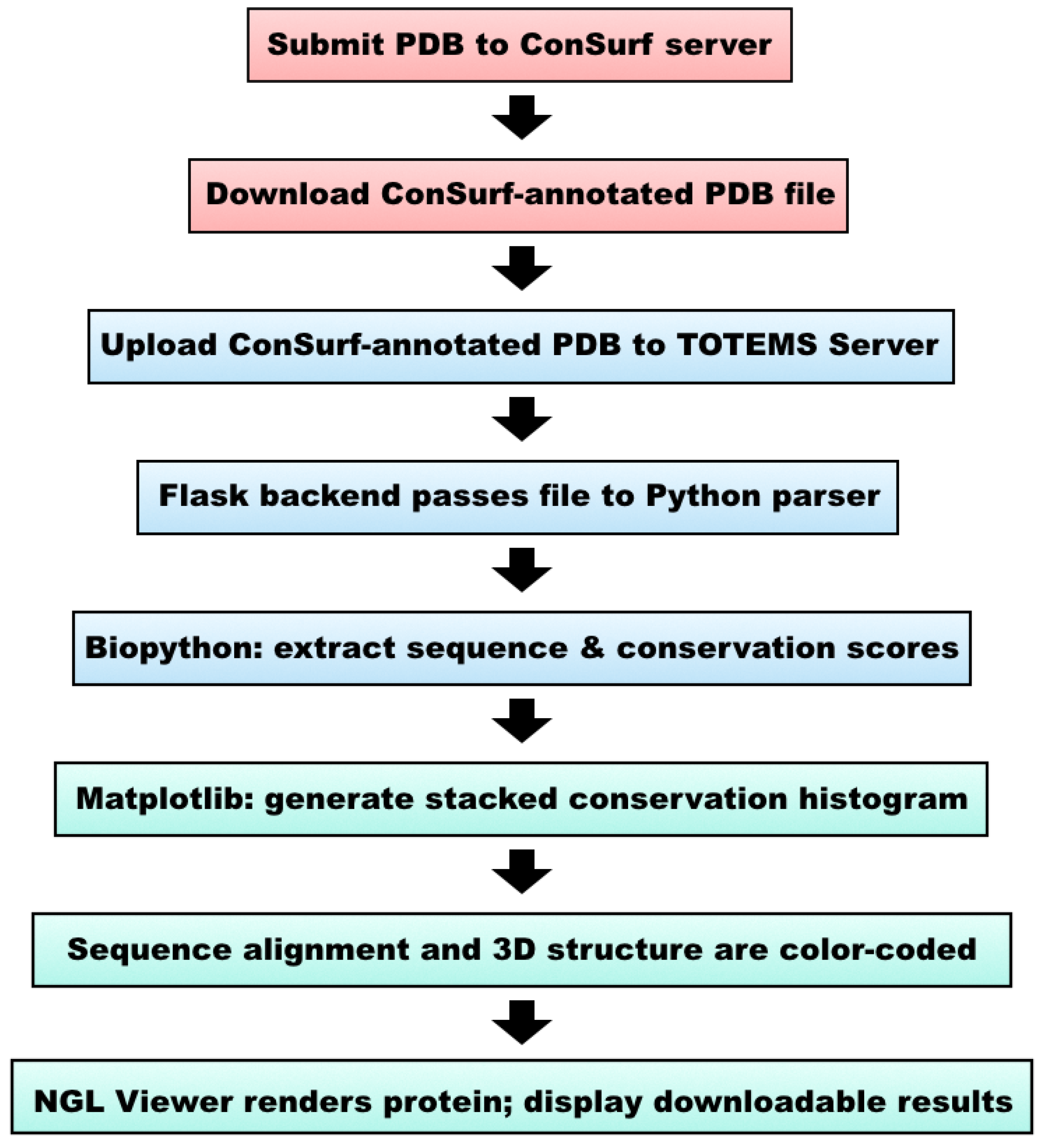
TOTEMS is a Python 3-based web application served through the Flask framework. As illustrated in Figure 1, the workflow begins when the user submits a modified PDB file containing residue-specific conservation estimates stored in the temperature factor column. This input file may be generated by the user or obtained directly from the default output of the ConSurf server. Upon submission, the PDB file is passed through Flask to the underlying Python application, where it is parsed with Biopython to extract both the amino acid sequence and the associated conservation scores. These data are then processed with Matplotlib to generate the TOTEMS stacked box plot [21]. In addition, conservation scores are converted to hexadecimal color values, which are applied to produce a color-coded sequence alignment in which shading intensity reflects the degree of conservation.
In addition to the TOTEMS plot, we have chosen to further the user experience by providing an interactive macromolecular visualization as a companion wherein the protein is shaded according to the aforementioned hexadecimal conservation scores. The resource-efficient NGL-viewer has been conscripted for the purpose of protein visualization. Finally, the NGL-rendered conservation-shaded protein is presented in conjunction with the TOTEMS plot to the user as the final TOTEMS output.
Software Availability and Licensing.
TOTEMS is released as fully open-source software and is freely available to users for academic and non-academic purposes. The source code is publicly accessible through the TOTEMS website and its associated GitHub repository, allowing users to inspect, modify, and deploy the software locally if desired.
TOTEMS is implemented using widely adopted open-source libraries, including the Flask web framework, Biopython for structural parsing, Matplotlib for visualization, and the NGL Viewer for interactive molecular graphics. All third-party components are distributed under permissive open-source licenses (e.g., BSD, MIT, or Apache-style licenses) that permit reuse and redistribution within integrated software tools. TOTEMS does not bundle or redistribute proprietary software and adheres to the licensing terms of all dependent libraries.
Users may interact with TOTEMS either through the hosted web server or by installing and running the application locally, subject to the terms of the respective open-source licenses. This design ensures transparency, reproducibility, and compliance with standard open-source distribution practices while allowing broad adoption within research and educational settings.

Web Server Deployment and Usage Considerations

The TOTEMS web server is designed to operate within practical constraints that ensure responsiveness and broad accessibility for end users. Input files are limited to a sliding window of up to 100 amino acid residues, which bounds memory usage and computational cost while remaining sufficient for local motif and regional conservation analysis. Because conservation scores are precomputed (e.g., via ConSurf) and supplied within the uploaded PDB file, server-side computation is limited to file parsing, data extraction, and visualization rendering. As a result, execution time scales linearly with sequence length and remains on the order of seconds for all supported inputs on standard hardware.
TOTEMS is implemented as a browser-based web application and has been tested across all major modern browsers, including Chrome, Firefox, Safari, and Edge. The application is functional on mobile platforms, including iOS browsers; however, minor graphical artifacts may occur on smaller screens due to reduced rendering resolution and touch-based interaction constraints.
Uploaded PDB files are processed transiently and are not retained beyond the duration of the visualization session. No user authentication, cookies, or persistent storage of uploaded data is required, minimizing exposure of potentially sensitive structural information. Files are parsed using standard libraries without execution of embedded code, and uploads are restricted to expected file formats, reducing the risk of malicious payloads. These design choices collectively prioritize user privacy, security, and reliable cross-platform performance.

3. Results

3.1. Visualization Outputs

TOTEMS produces two primary visualization outputs that, together, illustrate conservation at both the sequence and structural levels.
1.
Conservation Histogram: A one-dimensional stacked bar chart displays the conservation score of each residue, color-coded using the nine-color ConSurf scale. This format facilitates rapid identification of regions with high or low evolutionary variability.
The histogram is encoded on the discrete ConSurf 1–9 scale: each residue is drawn as a vertical stack of uniform boxes where bar height corresponds to conservation grade, and color follows the standard ConSurf nine-bin palette (cyan/teal = variable through pink/magenta = highly conserved). Figure 2 provides a visual guide to interpreting the combined height-and-color encoding used throughout TOTEMS outputs.
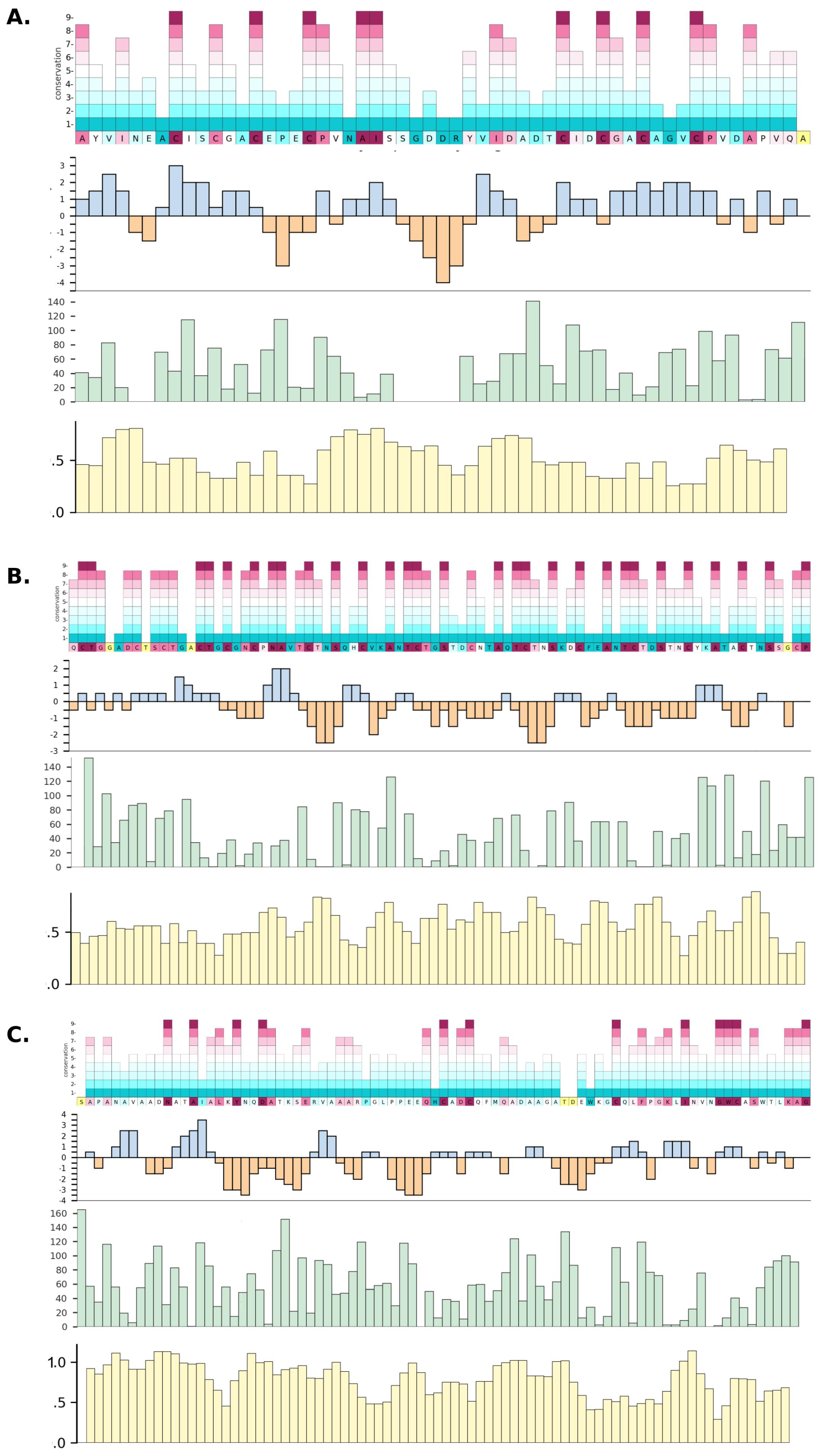
To illustrate how TOTEMS relates to common residue-level biophysical descriptors, we compared TOTEMS conservation profiles to Kyte–Doolittle hydrophilicity, solvent accessibility, and relative mutability for three representative proteins (Figure 3). Figure 3A–C correspond to the ferredoxin 2FDN, the antifreeze protein 1EZG, and the high-potential iron–sulfur protein 1HIP, respectively.
The TOTEMS plot reveals biologically meaningful conservation patterns that extend beyond what is captured by individual biophysical descriptors (Figure 3). In the ferredoxin structure 2FDN, the cysteine residues coordinating the two [4Fe–4S] clusters are embedded within strongly conserved sequence regions, reflecting their essential role in cluster integrity and electron transfer. Notably, the region separating these two cysteine-rich motifs is comparatively variable, a feature that emerges clearly in the TOTEMS representation. This variable inter-cluster segment correlates with increased hydrophilicity. We infer that while the electron-transfer centers themselves are under strong evolutionary constraint, the connecting region can tolerate sequence divergence while remaining solvent-exposed and flexible. Despite this variability, the paired iron–sulfur sites exhibit coordinated conservation, consistent with synergistic evolution of two spatially separated but mechanically and electronically coupled centers. Such coordination is critical for efficient electron tunneling, where precise geometric and electrostatic relationships modulate redox potential and electron transfer efficiency [22,23].
In the antifreeze protein 1EZG, the TOTEMS plot highlights pronounced conservation at residues corresponding to turns and structural pivots, consistent with the preservation of backbone geometry required to maintain the flat, ordered ice-binding surface characteristic of antifreeze proteins. Structural studies have shown that antifreeze activity depends on the precise spatial arrangement of residues along planar ice-binding surfaces, with backbone turns playing a central role in maintaining this geometry [24].
In contrast, the high-potential iron–sulfur protein 1HIP displays a markedly different conservation landscape. Its TOTEMS profile reveals discrete clusters of conserved residues embedded within more variable sequence regions, a pattern consistent with functional specialization rather than uniform evolutionary constraint. Such localized conservation is characteristic of proteins whose activity depends on specific structural motifs or protein–protein interaction interfaces, rather than on globally conserved electrostatic pathways required for long-range electron transfer [1]. Together, these comparisons demonstrate that TOTEMS captures higher-order evolutionary relationships by linking conservation, structural context, and physicochemical properties, providing insight into how different protein classes balance functional constraint and adaptive variability.
While the descriptor tracks capture general physicochemical tendencies, TOTEMS highlights residue-specific evolutionary constraint patterns that are not recoverable from any single descriptor, helping to pinpoint functionally important sites that are not necessarily maximally buried, strongly hydrophobic, or uniformly low in mutability. Hydrophilicity and relative mutability scores were obtained using established amino acid scales implemented in the ExPASy ProtScale web server [25]. Solvent accessibility values were computed using the GETAREA server, which implements an analytical calculation of solvent-accessible surface area for macromolecules [26].
2.
Three-Dimensional Structure: A corresponding 3D model of the protein, rendered with the NGL Viewer, applies the same color mapping directly to the molecular surface or cartoon representation. This allows spatial comparison between conserved and variable regions within the protein fold.
Together, these outputs provide users with an integrated visual framework for assessing sequence conservation within a structural context.

3.2. Comparison with Existing Visualization Tools

TOTEMS was designed to complement existing visualization utilities such as MSAViewer [3] and CATH [16]. While all three tools employ bar charts or color-coded representations of amino acid conservation, several distinctions make TOTEMS particularly effective for linking sequence and structure:
  • The TOTEMS histogram operates at a larger scale than the bar charts in MSAViewer, enhancing readability and motif detection.
  • The ConSurf color scheme provides full-spectrum color differentiation, unlike the monochromatic or limited palettes used in other applications.
  • The 3D integration of the NGL Viewer enables immediate spatial interpretation of conservation scores, a feature absent in most purely sequence-based tools.

3.3. Performance and User Interaction

TOTEMS operates entirely within a web environment, leveraging Flask for file handling and communication between the user interface and the Python backend. The tool executes rapidly even for large proteins, with parsing and visualization typically completed within seconds on standard computing hardware.
Users may interactively explore the NGL-rendered model, rotate and zoom on conserved regions, and download the resulting TOTEMS plot and legend for publication or further analysis.

3.4. Comparative Summary

Table 2 summarizes several representative sequence visualization tools and their distinctive features, highlighting how TOTEMS integrates complementary approaches into a unified framework.
These results demonstrate that TOTEMS provides an effective and accessible visualization approach that unifies evolutionary, sequence-based, and structural perspectives within a single interactive application. In contrast to the other tools summarized in Table 2, TOTEMS presents conservation information using a uniquely scaled, color-integrated histogram aligned directly with both sequence position and three-dimensional structure, enabling visual discrimination of conserved regions that is not achievable with frequency logos, alignment viewers, or structure-only displays alone.

4. Discussion

Visualization of evolutionary conservation within a structural context provides a powerful means to identify amino acid residues critical for protein function, stability, and evolutionary adaptation. By linking conservation estimates derived from multiple sequence alignments to both one-dimensional (1D) and three-dimensional (3D) representations, TOTEMS bridges the gap between traditional bioinformatic and structural analyses.

4.1. Integration of Sequence and Structure

Existing conservation visualization tools, such as ConSurf [1], MSAViewer [3], and CATH [16], each provide valuable perspectives on sequence or structure but rarely offer simultaneous integration of both. TOTEMS uniquely combines these dimensions through the use of color-coded histograms aligned with spatially shaded molecular models. This integration enables researchers to recognize not only which residues are conserved, but also where those residues are located within the protein’s tertiary architecture.
The use of the ConSurf nine-color scheme allows intuitive cross-comparison between linear and spatial representations. For instance, contiguous peaks of conservation within the histogram often correspond to localized structural motifs or functional sites in the 3D model. This correspondence provides immediate visual cues for further exploration, such as identification of potential active sites, binding regions, or structurally constrained domains.

4.2. Utility for Functional and Evolutionary Studies

TOTEMS was originally designed as a companion to ConSurf but has broader applicability across evolutionary and functional analyses. Researchers can employ TOTEMS to visualize data from alternative conservation scoring systems, site-specific biochemical properties, or predicted mutational effects. The framework’s modular Python architecture facilitates easy extension to new datasets and scoring schemes.
The ability to rapidly visualize conserved clusters in both sequence and structure space may aid in hypothesis generation for experimental studies. For example, regions exhibiting strong conservation in both domains are prime candidates for site-directed mutagenesis, while asymmetric or discontinuous conservation may indicate dynamic or adaptive regions under differential evolutionary constraints.

4.3. Advantages and Future Development

A key advantage of TOTEMS is its accessibility. Implemented as a lightweight web application, it requires no local installation or command-line expertise, allowing students and researchers alike to explore conservation landscapes interactively. The integration of Flask, Biopython, and NGL ensures broad compatibility and low computational overhead.
Future improvements to TOTEMS could include automated import of conservation scores from additional sources, integration with electrostatic potential or hydrophobicity profiles, and support for multi-chain protein assemblies. In future, depending on feedback from the user community, we will consider adding additional visualization modes, such as conservation heatmaps, domain- or region-specific views, and chain-wise comparisons, to extend the applicability of TOTEMS beyond single-chain or localized analyses. We also anticipate providing users with increased control over visualization parameters, including optional selection of the sequence window displayed (within the current 100-residue limit), to facilitate targeted exploration of larger proteins. Together, these enhancements would further expand the tool’s capacity to reveal correlations between sequence conservation, physicochemical properties, and functional mechanisms while preserving the clarity and simplicity of the current interface.

4.4. Context Within the Visualization Landscape

TOTEMS complements the ecosystem of bioinformatics visualization tools rather than replacing them. By uniting one-dimensional bar plots and three-dimensional renderings within a single, user-friendly platform, it encourages a more holistic view of protein evolution and structure. This integrative approach may prove especially valuable for comparative analyses of homologous proteins or for educational applications illustrating structure–function relationships.

5. Conclusions

TOTEMS provides a unified framework for visualizing evolutionary conservation across both the linear amino acid sequence and the three-dimensional protein structure. By coupling ConSurf-derived conservation scores with interactive graphics, the tool enables simultaneous exploration of sequence variability and structural context. Herein, we compare the histographic output of TOTEMS with three histogram-based displays derived from physicochemical and mutability descriptors and demonstrate that TOTEMS reveals conservation patterns that are not readily captured by hydrophobicity, solvent accessibility, or relative mutability measures alone. By encoding residue-level conservation as a scaled histogram aligned to sequence position, TOTEMS exposes conservation patterns that are not easily discerned from three-dimensional structure views or color-coded sequence displays, highlighting relationships that emerge only at an intermediate level of representation.
The integration of Python-based data processing with modern web technologies such as Flask and NGL Viewer makes TOTEMS both efficient and accessible. Its dual visualization—stacked bar histogram and structure-colored model—enhances the interpretability of conservation data and allows researchers to identify conserved motifs, functionally critical residues, and regions under differential selective pressure.
Beyond its use as a companion to ConSurf, TOTEMS can easily accommodate conservation or physicochemical data from alternative sources, providing a flexible platform for comparative and functional studies. The approach fosters deeper understanding of structure-–function relationships, evolutionary dynamics, and molecular design principles.
By combining ease of use, computational efficiency, and cross-platform accessibility, TOTEMS represents a valuable addition to the bioinformatics visualization landscape. Its capability to unite sequence- and structure-level perspectives may assist both researchers and educators in interpreting evolutionary patterns and generating new hypotheses for experimental validation.

Author Contributions

Conceptualization and methodology, M.J.F.; software, M.J.F.; validation, A.G.M.; writing—original draft, M.J.F.; writing—review and editing, M.J.F., J.R.J. and A.G.M.; visualization and investigation, A.G.M.; project administration, A.G.M.; supervision, J.R.J. and A.G.M.; resources (advisory and research environment support), conceptualization (project naming and direction), J.R.J. All authors have read and agreed to the published version of the manuscript.

Funding

This research received no external funding.

Data Availability Statement

All software used in this study is openly available through the Totems website at https://totemsonline.org, which provides access to the corresponding GitHub repository.

Conflicts of Interest

The authors declare no conflicts of interest.

References

  1. Ashkenazy, H.; Abadi, S.; Martz, E.; Chay, O.; Mayrose, I.; Pupko, T.; Ben-Tal, N. Consurf 2016: An improved methodology to estimate and visualize evolutionary conservation in macromolecules. Nucleic Acids Res. 2016, 44, W344–W350. [Google Scholar] [CrossRef]
  2. Schneider, T.D.; Stephens, R.M. Sequence logos: A new way to display consensus sequences. Nucleic Acids Res. 1990, 18, 6097–6100. [Google Scholar] [CrossRef]
  3. Yachdav, G.; Wilzbach, S.; Rauscher, B.; Sheridan, R.; Sillitoe, I.; Procter, J.; Lewis, S.E.; Rost, B.; Goldberg, T. Msaviewer: Interactive javascript visualization of multiple sequence alignments. Bioinformatics 2016, 32, 3501–3503. [Google Scholar] [CrossRef] [PubMed]
  4. Schreiber, M.; Brown, C. Compensation for nucleotide bias in a genome by representation as a discrete channel with noise. Bioinformatics 2002, 18, 507–512. [Google Scholar] [CrossRef] [PubMed]
  5. Crooks, G.E.; Hon, G.; Chandonia, J.M.; Brenner, S.E. WebLogo: A sequence logo generator. Genome Res. 2004, 14, 1188–1190. [Google Scholar] [CrossRef] [PubMed]
  6. Workman, C.T.; Yin, Y.; Corcoran, D.L.; Ideker, T.; Stormo, G.D.; Benos, P.V. Enologos: A versatile web tool for energy normalized sequence logos. Nucleic Acids Res. 2005, 33, W389–W392. [Google Scholar] [CrossRef]
  7. Bindewald, E.; Schneider, T.D.; Shapiro, B.A. Correlogo: An online server for 3d sequence logos of rna and dna alignments. Nucleic Acids Res. 2006, 34, W405–W411. [Google Scholar] [CrossRef]
  8. Chang, T.H.; Horng, J.T.; Huang, H.D. Rnalogo: A new approach to display structural rna alignment. Nucleic Acids Res. 2008, 36, W91–W96. [Google Scholar] [CrossRef][Green Version]
  9. Li, W.; Yang, B.; Liang, S.; Wang, Y.; Whiteley, C.; Cao, Y.; Wang, X. Blogo: A tool for visualization of bias in biological sequences. Bioinformatics 2008, 24, 2254–2255. [Google Scholar] [CrossRef][Green Version]
  10. Sharma, V.; Murphy, D.P.; Provan, G.; Baranov, P.V. Codonlogo: A sequence logo-based viewer for codon patterns. Bioinformatics 2012, 28, 1935–1936. [Google Scholar] [CrossRef]
  11. Thomsen, M.C.F.; Nielsen, M. Seq2logo: A method for construction and visualization of amino acid binding motifs and sequence profiles including sequence weighting, pseudo counts and two-sided representation of amino acid enrichment and depletion. Nucleic Acids Res. 2012, 40, W281–W287. [Google Scholar] [CrossRef] [PubMed]
  12. Olsen, L.R.; Kudahl, U.J.; Simon, C.; Sun, J.; Schönbach, C.; Reinherz, E.L.; Zhang, G.L.; Brusic, V. Blocklogo: Visualization of peptide and sequence motif conservation. J. Immunol. Methods 2013, 400, 37–44. [Google Scholar] [CrossRef] [PubMed]
  13. Kultys, M.; Nicholas, L.; Schwarz, R.; Goldman, N.; King, J. Sequence bundles: A Novel Method for Visualising, Discovering and Exploring Sequence Motifs. In BMC Proceedings; Springer: Berlin/Heidelberg, Germany, 2014; Volume 8, pp. 1–10. [Google Scholar]
  14. Wheeler, T.J.; Clements, J.; Finn, R.D. Skylign: A tool for creating informative, interactive logos representing sequence alignments and profile hidden markov models. BMC Bioinform. 2014, 15, 7. [Google Scholar] [CrossRef] [PubMed]
  15. Waese, J.; Pasha, A.; Wang, T.T.; van Weringh, A.; Guttman, D.S.; Provart, N.J. Gene slider: Sequence logo interactive data-visualization for education and research. Bioinformatics 2016, 32, 3670–3672. [Google Scholar] [CrossRef]
  16. Dawson, N.L.; Lewis, T.E.; Das, S.; Lees, J.G.; Lee, D.; Ashford, P.; Orengo, C.A.; Sillitoe, I. Cath: An expanded resource to predict protein function through structure and sequence. Nucleic Acids Res. 2017, 45, D289–D295. [Google Scholar] [CrossRef]
  17. Wagih, O. ggseqlogo: A versatile r package for drawing sequence logos. Bioinformatics 2017, 33, 3645–3647. [Google Scholar] [CrossRef]
  18. Tareen, A.; Kinney, J.B. Logomaker: Beautiful sequence logos in python. Bioinformatics 2020, 36, 2272–2274. [Google Scholar] [CrossRef]
  19. Frazer, J.; Notin, P.; Dias, M.; Gomez, A.; Min, J.K.; Brock, K.; Gal, Y.; Marks, D.S. Disease variant prediction with deep generative models of evolutionary data. Nature 2021, 599, 91–95. [Google Scholar] [CrossRef]
  20. Jumper, J.; Evans, R.; Pritzel, A.; Green, T.; Figurnov, M.; Ronneberger, O.; Tunyasuvunakool, K.; Bates, R.; Žídek, A.; Potapenko, A.; et al. Highly accurate protein structure prediction with AlphaFold. Nature 2021, 596, 583–589. [Google Scholar] [CrossRef]
  21. Hunter, J.D. Matplotlib: A 2d graphics environment. IEEE Ann. Hist. Comput. 2007, 9, 90–95. [Google Scholar] [CrossRef]
  22. Page, C.C.; Moser, C.C.; Chen, X.; Dutton, P.L. Natural engineering principles of electron tunnelling in biological oxidation–reduction. Nature 1999, 402, 47–52. [Google Scholar] [CrossRef] [PubMed]
  23. Gray, H.B.; Winkler, J.R. Electron transfer in proteins. Q. Rev. Biophys. 2003, 36, 341–372. [Google Scholar] [CrossRef]
  24. Davies, P.L. Ice-binding proteins: A remarkable diversity of structures for stopping and starting ice growth. Trends Biochem. Sci. 2014, 39, 548–555. [Google Scholar] [CrossRef]
  25. Wilkins, M.R.; Gasteiger, E.; Bairoch, A.; Sanchez, J.C.; Williams, K.L.; Appel, R.D.; Hochstrasser, D.F. Protein identification and analysis tools in the ExPASy server. Methods Mol. Biol. 1999, 112, 531–552. [Google Scholar] [CrossRef]
  26. Fraczkiewicz, R.; Braun, W. Exact and efficient analytical calculation of the accessible surface areas and their gradients for macromolecules. J. Comput. Chem. 1998, 19, 319–333. [Google Scholar] [CrossRef]
Figure 1. Workflow of the TOTEMS pipeline. A protein structure annotated with residue-specific evolutionary conservation scores generated by ConSurf is submitted by the user. The ConSurf-annotated PDB file is uploaded to the TOTEMS web server, where a Flask-based backend passes the file to the core Python application for parsing. Biopython is used to extract the amino acid sequence and associated conservation scores, which are rendered as a stacked conservation histogram using Matplotlib. In parallel, the sequence alignment and three-dimensional protein structure are color-coded using the same ConSurf-based conservation scheme. The final output, including the conservation histogram, interactive molecular visualization rendered with the NGL Viewer, and downloadable results, is presented to the user.
Computation 14 00052 g001
Figure 2. TOTEMS conservation histogram and ConSurf color interpretation. TOTEMS summarizes residue-specific evolutionary conservation (derived from ConSurf scores stored in the PDB temperature-factor/B-factor field) as a one-dimensional, per-position histogram aligned to the amino acid sequence (letters along the x-axis). Each residue position is represented by a vertical stack of uniform boxes; bar height encodes the conservation grade on the discrete 1–9 ConSurf scale. Taller bars indicate more highly conserved sites. Colors follow the standard ConSurf nine-bin palette: positions graded as more variable are shown in cyan/teal hues, intermediate conservation transitions through pale/white tones, and the most conserved sites appear as pink/magenta hues. Residues colored yellow correspond to positions for which conservation estimates are ambiguous or based on insufficient sequence data. This coupling of (i) discrete height (grade) and (ii) familiar ConSurf coloring enables rapid visual identification of conserved motifs: neighboring columns with similarly tall, similarly colored peaks indicate contiguous clusters of strong evolutionary constraint, whereas shorter, cooler-colored columns indicate variable regions. Example shown for a ferredoxin (PDB: 2FDN) to illustrate how TOTEMS highlights conserved residue blocks in a compact, publication-friendly format.
Computation 14 00052 g002
Figure 3. Comparison of TOTEMS conservation histograms with per-residue biophysical descriptors for three proteins. Each panel shows (top) the TOTEMS conservation histogram (ConSurf-style coloring) aligned by residue position with (second) Kyte–Doolittle hydrophilicity values, (third) solvent accessibility scores, and (bottom) relative mutability scores. (A) 2[4Fe–4S] ferredoxin (2fdn). (B) Antifreeze protein (1ezg). (C) High-potential iron–sulfur protein (1hip). While hydropathy, solvent accessibility, and relative mutability report general physicochemical tendencies, TOTEMS captures residue-specific evolutionary constraint that is not recoverable from any single biophysical descriptor. Together, the panels illustrate that evolutionary conservation can highlight functionally critical residues that are neither maximally buried, strongly hydrophobic, nor uniformly low in mutability.
Computation 14 00052 g003
Table 1. Representative tools for visualization of sequence conservation and related sequence-based features. Tools are compared according to their ability to display residue-level conservation using one-dimensional representations, integrate conservation information with three-dimensional protein structures, and support identification of conserved or functionally constrained regions within a structural context.
Tool1D
Histogram
3D
Structure
ConSurf
Colors
Interactive
Web
Hotspot
Detection
Reference
ConSurf [1]
Sequence Logos [2]
Logopaint [4]
WebLogo [5]
enoLogos [6]
CorreLogo [7]
RNALogo [8]
BLogo [9]
CODON LOGO [10]
Seq2Logo [11]
BlockLogo [12]
Sequence Bundles [13]
Skylign [14]
MSAViewer [3]
Gene Slider [15]
CATH [16]
ggseqlogo [17]
LogoMaker [18]
EVE [19]
AlphaFold DB [20]
TOTEMSThis work
Table 2. Comparison of sequence visualization tools relevant to conservation analysis.
ToolPrimary FunctionReference
Sequence LogosFrequency logos for residue variability[2]
MSAViewerInteractive multiple sequence alignment viewer[3]
CATHStructural classification of protein domains[16]
TOTEMSConservation histogram with 3D mappingThis work
Disclaimer/Publisher’s Note: The statements, opinions and data contained in all publications are solely those of the individual author(s) and contributor(s) and not of MDPI and/or the editor(s). MDPI and/or the editor(s) disclaim responsibility for any injury to people or property resulting from any ideas, methods, instructions or products referred to in the content.