


Abstract
Quadrotor unmanned aerial vehicles (QUAVs) are widely used in civil and defense applications, yet reliable trajectory tracking remains challenging under external disturbances and limited sensing. Conventional backstepping–sliding mode controllers ensure robustness only by selecting discontinuous gains larger than the disturbance bound, which increases chattering and limits the use of smooth switching functions. This paper addresses these limitations by integrating explicit disturbance compensation into a backstepping–sliding framework through a super-twisting observer (STO). The STO reconstructs matched disturbances acting on the translational and rotational dynamics in real time, and the estimated signals are directly injected into the control law. This approach enables effective disturbance rejection beyond the nominal sliding gain while preserving robustness under smooth control actions. Simulation results under single- and multi-frequency perturbations demonstrate accurate disturbance reconstruction (FIT indices above 95%), improved tracking performance, and a significant reduction in chattering. The proposed strategy provides a robust control solution for QUAVs operating in uncertain environments.
1. Introduction
Quadrotor unmanned aerial vehicles (QUAVs) are widely used in civilian, industrial, and defense applications owing to their high maneuverability, hovering capability, and suitability for autonomous navigation tasks [1,2]. Their widespread deployment in inspection, mapping, precision agriculture, and search-and-rescue operations increasingly demands control strategies that ensure reliable trajectory tracking under uncertain and dynamic conditions [3,4]. Despite significant progress in nonlinear control methods, achieving consistent performance in QUAVs remains challenging [5,6]. This is largely due to the underactuated structure of the vehicle, the strong coupling between translational and rotational dynamics, and the persistent influence of external disturbances such as wind gusts, payload variations, and sensor noise [7,8].
To address these challenges, extensive research has been devoted to the development of robust control strategies [9]. Classical robust control frameworks, such as control and -synthesis, have been investigated for QUAVs, providing systematic robustness guarantees typically derived from linearized models in the frequency domain, but often at the cost of conservative designs and increased implementation complexity [10,11]. More recently, predictive and hybrid disturbance-rejection approaches—including model predictive control for aerial payload transportation [12] and active disturbance rejection generalized predictive control [13]—have been proposed to handle constraints and disturbance estimation explicitly; however, their practical deployment commonly relies on linearized representations and entails online optimization or frequency-domain tuning requirements that may limit real-time applicability.
Among robust nonlinear control strategies, backstepping control has gained prominence for underactuated systems due to its recursive design structure and its ability to handle nonlinearities systematically [14]. However, despite its strong theoretical foundation, classical backstepping control assumes full state availability and tends to exhibit performance degradation in the presence of modeling uncertainties and disturbances [15]. To enhance robustness, sliding mode control (SMC) techniques have been widely adopted, leveraging their capability to reject matched disturbances and enforce finite-time convergence through discontinuous control actions [16].
Recent studies have demonstrated the effectiveness of backstepping–sliding mode frameworks in QUAV applications. For instance, in [17], a cascade active disturbance rejection control strategy combined with backstepping sliding-mode control was proposed to achieve robust trajectory tracking under model uncertainties. Adaptive backstepping sliding-mode approaches have also been investigated to cope with uncertain environmental parameters and external disturbances, as reported in [18], where adaptive laws are employed to compensate for unknown dynamics and improve tracking accuracy. Similarly, adaptive backstepping controllers incorporating disturbance estimators have been proposed to address parametric uncertainties and slowly varying perturbations [19].
From a comparative standpoint, existing robust control approaches for QUAVs differ primarily in the way disturbances are modeled, estimated, and compensated within the control loop, as well as in their computational and implementation requirements [14,15,16]. Frequency-domain robust controllers and predictive strategies typically rely on linearized models and indirect disturbance attenuation mechanisms, whereas nonlinear designs based on backstepping and sliding modes explicitly exploit system nonlinearities and matched disturbance rejection, often at the expense of high switching gains or full state availability [17,18,19].
While these contributions demonstrate the viability of backstepping–sliding mode control architectures under uncertainty, they also reveal that performance and robustness are strongly influenced by how disturbance-related information is modeled, estimated, and incorporated into the control law. Most existing designs either rely on implicit disturbance attenuation or treat disturbances as bounded but unknown signals, without explicitly feeding reconstructed disturbance information back into the control law. As a result, disturbance rejection is typically achieved indirectly, through conservative gain selection rather than explicit compensation.
As a consequence, the robustness of conventional SMC-based designs depends on selecting a discontinuous control gain that exceeds the worst-case disturbance magnitude. In practical applications, such disturbance bounds are seldom available a priori and cannot be assumed to remain constant across different operating conditions [20]. Huge sliding gains, although theoretically ensuring robustness, inevitably induce chattering, increase actuator wear, and amplify measurement noise—effects that are particularly detrimental for small-scale aerial platforms [21]. To mitigate chattering, smooth switching functions such as saturation, sigmoid, or hyperbolic tangent mappings have been introduced [21]. However, these continuous approximations reduce the effective robustness margin, and tracking performance degrades. This persistent trade-off between robustness and smooth actuation remains a fundamental limitation of conventional SMC and its variants [22].
Several works have attempted to address this limitation through adaptive and observer-based strategies [23,24]. Adaptive backstepping and sliding-mode schemes have been proposed to estimate disturbance online and adjust controller gains accordingly [25,26]. Neural-network-based estimators, such as radial basis function neural networks, have also been integrated with backstepping sliding-mode control to approximate complex disturbance signals [27]. While effective, such approaches often introduce increased computational complexity and require extensive tuning or training data, which may limit their applicability in real-time embedded systems.
Higher-order sliding mode techniques offer an alternative and computationally efficient solution [28]. Among them, second-order sliding modes—particularly the super-twisting algorithm (STA)—ensure finite-time convergence with continuous control action, thereby mitigating chattering effects while preserving robustness [29]. When embedded in observer structures, the resulting super-twisting observer (STO) enables finite-time estimation of unmeasured states and lumped uncertainties without requiring output derivatives [28]. STO-based observers have been successfully employed for state estimation in QUAVs with limited sensing capabilities [30,31].
Despite these developments, a key differentiating factor between adaptive-SMC and observer-based schemes is how disturbance-related information is incorporated into the control law and how the associated robustness margins are achieved. In most existing observer-based designs, the STO is primarily used to reconstruct unmeasured variables, while the disturbance-related information contained in the observer injection terms is not explicitly exploited for control design [20]. Although disturbance observers and extended state observers have been incorporated into backstepping frameworks [32,33], the explicit reconstruction and direct compensation of matched disturbances within a backstepping–sliding mode control law—particularly under conditions where the sliding gain is deliberately chosen below the disturbance magnitude—remains insufficiently explored [34].
This paper addresses this gap by proposing a disturbance-compensated control architecture for QUAVs that integrates a backstepping–sliding mode controller (BSMC) with a super-twisting observer (STO). Unlike conventional approaches, the STO is not only used for state reconstruction but is explicitly exploited to reconstruct matched disturbances in real time and inject them directly into the control law. This mechanism enables effective disturbance rejection without requiring large sliding-mode gains, thereby allowing smooth control implementations while preserving finite-time convergence and robustness.
The main contributions of this work are summarized as follows:
- A disturbance-compensated backstepping–sliding mode control architecture for QUAVs, in which a super-twisting observer is integrated to explicitly reconstruct matched disturbances acting on both translational and rotational dynamics.
- An explicit disturbance reconstruction and compensation mechanism that directly exploits the STO injection terms within the control law, enabling robust trajectory tracking without requiring a priori knowledge of disturbance bounds or high-gain discontinuous control actions.
- A smooth sliding-mode realization achieved through observer-based disturbance compensation, which allows the use of continuous switching functions—such as the hyperbolic tangent—while preserving robustness and finite-time convergence.
- A Lyapunov-based stability analysis that explicitly accounts for bounded disturbances and disturbance estimation errors, and establishes a quantitative link between disturbance estimation accuracy and the required robustness margins.
The effectiveness of the proposed control strategy is rigorously evaluated through multiple simulation scenarios, including nominal operation, single-frequency and multi-frequency disturbances, and smooth sliding-mode implementation. Quantitative performance indices and disturbance reconstruction metrics demonstrate that the proposed BSMC–STO scheme achieves superior tracking accuracy, enhanced disturbance rejection, and smoother control action compared to the nominal backstepping–sliding mode controller.
2. Dynamic Modeling, Observer Design, and Robust Control of the QUAV
This section presents the methodological framework adopted for the modeling, observation, and control of the quadrotor unmanned aerial vehicle (QUAV) under matched external disturbances. First, a nonlinear dynamic model of the QUAV is formulated, explicitly incorporating bounded perturbations in the translational and rotational dynamics. Second, a super-twisting observer (STO) is developed to reconstruct the unknown disturbances affecting the QUAV. Building upon these estimates, an observer-based robust backstepping–sliding mode control strategy is then designed to ensure accurate trajectory tracking and disturbance rejection. Finally, the stability of the combined observer–controller scheme is established using Lyapunov analysis.
2.1. Dynamic Model of the Quadrotor with External Disturbances
Quadrotor unmanned aerial vehicles (QUAVs) are aerial robotic systems that combine a compact mechanical architecture with high maneuverability, making them well-suited for diverse applications in civil, industrial, and defense sectors. From a control-theoretic perspective, QUAVs are underactuated nonlinear systems with coupled translational and rotational dynamics, possessing six degrees of freedom but only four independent control inputs [35]. These control inputs are generated by the collective and differential thrusts of the four rotors and regulate the total vertical lift as well as the roll, pitch, and yaw torque [6]. This intrinsic underactuation, together with strong nonlinear coupling between the translational and rotational dynamics, poses significant challenges for the design of robust and stable control laws [6,35].
The motion of the QUAV is described by a nonlinear dynamic model derived from the Euler–Lagrange formulation. In this work, a widely adopted modeling framework is employed, which assumes small angular displacements and angular rates. This assumption enables the simplification of nonlinear trigonometric couplings while preserving the dominant dynamic characteristics of the vehicle, as reported in [36].
The state vector of the QUAV model is defined as , where denote roll, pitch, and yaw angles, respectively, and and represent the vehicle position expressed in the inertial reference frame. The even-indexed states correspond to the associated angular and linear velocities. The control inputs are the collective thrust , and the control torques , and , applied about the body-fixed axes to regulate the vehicle attitude and translational motion.
To account for unknown exogenous effects, the QUAV dynamic model is augmented with disturbance terms. In this work, external disturbances are modeled as matched disturbances entering the system through the same channels as the control inputs. This assumption is justified by the quadrotor’s actuation structure, in which the total thrust and control torques directly influence the translational and rotational dynamics, respectively [1]. Disturbances such as wind gusts, aerodynamic drag variations, and parametric uncertainties primarily affect these dynamics additively and can therefore be reasonably represented as matched disturbances [15]. Under these assumptions, the nonlinear state-space model of the QUAV with external perturbations can be written as
where is the state vector, is the mass of the QUAV, is the gravitational acceleration, and the rest of the parameters of the QUAV model are defined as follows
where C and S denote the cosine and sine trigonometric functions, respectively. The parameters , and are coupling coefficients arising from differences in the quadrotor’s moments of inertia. The constants and represent input scaling factors that map the applied control torques to the corresponding angular accelerations. The control inputs are the collective thrust and the roll, pitch, and yaw torques, denoted by and , respectively. Finally, , for denotes unknown but bounded matched disturbances. Although the disturbances acting on the rotational dynamics are dominant and have a stronger influence on the quadrotor behavior, disturbance terms affecting the translational acceleration channels are also considered. These terms represent secondary uncertainties such as aerodynamic effects and thrust variations and are included for completeness [1]. Their presence does not increase the structural complexity of the control law, as they are handled in a unified manner by the proposed observer-based backstepping–sliding mode framework.
It is acknowledged that perturbations, including sensor noise, unmodeled coupling effects, and structural asymmetries, may introduce unmatched disturbance components. Although sliding-mode-based control laws cannot completely reject such disturbances, their effects are typically bounded and appear as performance degradation rather than instability [15]. The proposed control strategy, combined with the super-twisting observer, enhances robustness against the dominant matched disturbances, which are the primary source of performance deterioration in practical quadrotor operations.
2.2. Super-Twisting Observer for Disturbance Estimation
In practical applications, especially on cost-constrained platforms, QUAVs often lack direct measurements of linear and angular velocities. Onboard sensors typically provide position and orientation through GPS, barometers, and low-cost IMUs, while velocity variables must be estimated using observer-based techniques [1].
The limited availability of measured variables presents a significant challenge for feedback control design, especially when the system is subject to external perturbations. To overcome this limitation, a super-twisting observer (STO) is developed to estimate the unmeasurable velocity states and simultaneously reconstruct the matched perturbations affecting the system [20].
In this framework, only the translational position and the attitude angles are assumed to be directly measurable. Accordingly, the QUAV dynamic model is reformulated into a structure suitable for observer synthesis by partitioning the state vector as which contains the measurable position and attitude angles, and corresponding to the unmeasured linear and angular velocity components. Under this state partitioning, the system dynamics can be rewritten in the following form
where captures the system nonlinearities and control inputs and is expressed as
and collects the unknown but bounded external disturbance components acting on the rotational and translational dynamics. The control input vector is defined as .
The proposed STO is expressed as
where , are the observer state estimates, and , are correction terms defined as
with gain vectors , and . The function is defined by substituting into the nonlinear dynamic expressions as
Letting and denote the estimation errors, the corresponding error dynamics can be written as
A finite-time convergence property for the estimation error can be established under the standard assumptions typically invoked for super-twisting-type observers. In particular, if the nonlinear term is locally Lipschitz with respect to its arguments, and if uncertainty term , admits a known uniform upper bound , then the estimation error is guaranteed to converge to the origin in finite time. Based on this requirement, the observer gains are selected such that and are satisfied [37,38].
Remark: In practical implementations, the bound does not need to be known exactly. It can be selected using conservative estimates based on physical constraints of the quadrotor, such as bounds on angular rates, velocities, actuator limits, and expected external disturbances. Such bounds are commonly obtained from prior modeling knowledge, simulation studies, or experimental tuning, and their conservative selection does not compromise the finite-time convergence property of the STO [38].
In sliding mode theory, it is well established that the equivalent output injection term of a sliding-mode observer encapsulates essential information about unmodeled dynamics, external disturbances, and uncertain inputs acting on the systems [37]. This property arises from the fact that, under ideal sliding conditions, the injection term must asymptotically counteract the unknown input to enforce the sliding manifold. As such, it can be leveraged as a foundation for disturbance reconstruction in nonlinear control systems, including mechanical platforms such as QUAVs [39].
In the present framework, the STO estimates all the even states, (i.e.,) based on the measurements of the odd states (i.e., ). Since the finite time convergence of the STO guarantees the existence of a time such that, for all , the dynamics of the observation errors satisfy and . Under this condition, the error dynamics in Equation (9) reduce to
Note that since one way of the sliding mode is established , then ; therefore, the equivalent output injection term is given by
From a theoretical perspective, the equivalent injection signal corresponds to the average value of an ideal infinite-frequency switching process. Consequently, the injection term contains high-frequency components that must be attenuated. To eliminate the high-frequency component, we will use the filter of the form
where denotes the filter time constant, selected such that , and is the sampling step. The filtered equivalent injection signal is then used to define the disturbance estimate vector as
which relates to the actual disturbance vector according to
where represents the bounded estimation error introduced by the filtering process. The resulting estimation error explicitly captures the delay introduced by the filtering process and is formally accounted for in the subsequent stability analysis.
Hence, the proposed STO provides a direct estimate of the external disturbance vector from the filtered equivalent output injection signal. The resulting reconstruction error remains bounded and is primarily determined by the filter time constant and the sampling period. This disturbance estimate is then used in the control design to enhance robustness against external perturbations, as detailed in the following section.
2.3. Disturbance-Compensating Backstepping Sliding Mode Controller
In QUAV applications, robust trajectory tracking must be achieved despite the presence of uncertainties and external disturbances, particularly when only partial-state measurements are available. Traditional backstepping-sliding mode controllers (BSMC) offer robustness through discontinuous control actions, but they typically neglect explicit disturbance reconstruction, leading to conservative designs and limited performance under dynamic perturbations [20].
In this work, we enhance the classical BSMC framework by integrating an active disturbance compensation mechanism based on STO estimates. The core idea is to exploit the STO’s correction term, which—under sliding motion—converges to the equivalent injection needed to cancel matched perturbations. These estimates are then directly incorporated into the control law, improving robustness and reducing steady-state error. The design avoids dependence on velocity measurements and assumes only position and attitude signals are available.
Let the state vector of the quadrotor unmanned aerial vehicle (QUAV) be defined as
where denotes the vector of attitude angles and position coordinates, and represents the corresponding angular and linear velocities.
The desired trajectory is defined as
where denote the desired attitude and position variables, and their corresponding derivatives. Accordingly, the tracking error vectors are defined as
The QUAV dynamics can be written in second-order form as
where is the control input and denotes matched external disturbances.
The nonlinear vector field is defined as
and the control effectiveness matrix is given by
Substituting Equation (18) into the second equation of (17) yields
Sliding Surface Definition
To ensure finite-time convergence of the tracking errors, a first-order sliding manifold is defined as
where . The parameter is a design constant that determines the relative weight between position and velocity tracking errors in the sliding surface. Increasing accelerates convergence of the tracking errors but increases the control effort, while smaller values result in smoother responses with slower convergence. In practice, is selected to achieve a compromise between transient performance and actuator limitations, and their value is chosen sufficiently small to avoid excessive sensitivity to measurement noise [15,20].
Once is reached, the error dynamics satisfy a stable linear differential equation, thereby ensuring the exponential convergence of the tracking errors. Differentiating Equation (22) and using Equation (21), the sliding surface dynamic is obtained as
Equivalent Control Design
The control objective is to design such that the reachability condition is satisfied. To this end, the control input is decomposed into a continuous nominal component and additional terms devoted to robustness.
The control input is decomposed as
where is the equivalent control defined as
The equivalent control represents the continuous term that enforces sliding motion along the manifold under nominal conditions (i.e., neglecting switching and disturbance dynamics.
The discontinuous control term is defined as
where , are constant positive gains. This term constitutes the discontinuous component of the control law and is introduced to guarantee the reachability condition of the sliding manifold.
Remark.
Unlike conventional backstepping–SMC designs, the proposed framework does not rely on high-gain discontinuous terms for disturbance rejection. Instead, robustness is explicitly achieved through observer-based disturbance compensation, improving modularity and reducing control chattering.
Disturbance Compensation
To guarantee robustness against external disturbances, the compensated control law is defined as
where , is the disturbance compensation term obtained from the equivalent output injection term of the STO (as defined in Equation (13)). Incorporating the estimated disturbance into the control law allows for active compensation of matched perturbations, effectively attenuating their influence on the closed-loop dynamics.
Owing to the diagonal structure of each control channel can be explicitly isolated, yielding the following individual control laws.
where with denote the individual components of the sliding surface vector . The terms with represent the first-order derivatives of the position and attitude tracking errors, while the signals denote the first-order derivative of the reference trajectory. The quantities denote the estimates of the matched external disturbances.
The coefficients , , are known positive control effectiveness parameters associated with the roll, pitch, and yaw torque channels, respectively, while denotes the total mass of the vehicle. The trigonometric terms C and S denote the cosine and sine functions, respectively, and is the gravitational acceleration.
The positive constants and are the sliding-mode gains that determine the convergence speed toward the sliding manifold and the damping behavior along the surface, respectively. And is a design parameter that shapes the transient response of the tracking error dynamics.
Finally, the control inputs and correspond to the collective thrust and the roll, pitch, and yaw control torques of the QUAV, respectively. The variables and are virtual control inputs introduced in the backstepping design to regulate the translational motion in the horizontal plane.
2.4. Lyapunov Stability
This subsection is devoted to the stability analysis of the proposed BSMC–STO strategy. A Lyapunov framework is employed to establish the convergence properties of the closed-loop system, explicitly accounting for bounded disturbances and observer-induced estimation errors.
Assumption 1.
The desired trajectory , as well as its first- and second-time derivatives, are bounded.
Assumption 2.
The external disturbance vectoris bounded, i.e.,
Assumption 3.
The super-twisting observer provides a bounded disturbance estimation error defined as
such that , where is a known finite constant.
Theorem 1.
Consider the nonlinear quadrotor system described by Equations (3) and (4) and the sliding surface defined in Equation (22). Suppose that Assumptions 1–3 are satisfied.
If the proposed backstepping–sliding mode control law, together with the super-twisting-based disturbance estimation scheme, is applied, and the control gains and are selected such that
then the sliding variable reaches the origin in finite time. Consequently, the sliding manifold is reached in finite time, and the closed-loop quadrotor system is robust with respect to bounded matched disturbances.
Proof.
clearly, for all , and if and only if . Taking the time derivative of along the system trajectories yields
Consider the following positive definite Lyapunov function candidate defined on the sliding surface as
From the sliding surface dynamics in Equation (23) and the closed-loop error dynamics obtained after applying the control law, one has
where denotes the disturbance estimation error vector.
The switching control term is defined as
Substituting into yields
Using the inequality , and applying the Cauchy–Schwarz inequality to the disturbance estimation error, one obtains
Therefore,
By selecting the scalar gain such that , if follows that for all . Hence, the siding surface is finite-time reachable.
It is worth emphasizing that the disturbance estimation provided by the STO directly reduces the required magnitude of the discontinuous control gains. This feature significantly mitigates chattering while preserving finite-time convergence, constituting a key advantage over conventional sliding mode control approaches that rely solely on high-gain switching actions.
3. Results
This section presents a comparative evaluation of the proposed disturbance-compensated backstepping–sliding mode controller (BSMC) across four simulation scenarios. In all cases, the QUAV is required to track a reference trajectory under various disturbance conditions. The scenarios assess the controller’s behavior when (i) no compensation is applied, (ii) disturbance estimation and compensation are activated, (iii) perturbations vary in frequency, and (iv) a smooth hyperbolic tangent (tanh) function replaces the discontinuous sign function.
All simulations were executed in MATLAB 2024b using a fixed-step numerical integration scheme with a step size of 0.0001 s. The total simulation time for each simulation scenario was set to 15 s, and the QUAV was initialized from rest conditions. The physical parameters of the QUAV employed in the simulations are summarized in Table 1. The desired trajectory of the angles and positions in the simulation study were selected as , which combine smooth oscillatory motion in the lateral and angular coordinates with a linear ascent in the vertical direction.
Table 1.
Nominal parameters of the QUAV model [35].
The controller parameters were set as , , and . The parameter influences the convergence rate of the position error; higher values accelerate error decay but may increase control effort. The gain governs the damping of the sliding variable, improving steady-state smoothness while mitigating oscillations. The discontinuous gain provides robustness against bounded disturbances and estimation errors; larger values enhance disturbance rejection at the cost of increased chattering.
The observer gains and were chosen sufficiently large to dominate the expected disturbance bounds and ensure finite-time convergence of the estimation errors. The STO gains were set as , and . Both controller and observer gains remained consistent across all simulation cases. This consistent tuning ensures that observed performance variations are attributable exclusively to disturbances and to the activation of the compensation mechanism, rather than to gain re-adjustment.
External disturbances are modeled as bounded sinusoidal functions and are injected into the six acceleration channels of the QUAV. Unless otherwise stated, the disturbance applied is , a value intentionally selected to exceed the discontinuous sliding-mode gains used in the simulations. This choice is deliberate. Classical SMC guarantees robustness only when the gain exceeds the peak disturbance amplitude. By violating this condition in Case 1, the limitations of the nominal BSMC are exposed, whereas Cases 2–4 show how disturbance reconstruction and compensation can restore robustness even under gain-deficient conditions.
The control performance is quantified using standard evaluation metrics, including the integral squared error (ISE) and the integral absolute error (IAE), defined as follows
where is the tracking error vector, denotes the desired trajectory state vector, represents the actual state vector, and is the total simulation time.
To quantitatively assess the accuracy of the disturbance reconstruction performed by the super-twisting observer (STO), the fit index (FIT) is employed as an additional performance metric. The FIT criterion, based on the normalized root-mean-square error (NRMSE), provides a percentage-based measure of how closely the estimated disturbance matches the true injected disturbance. This metric is particularly relevant in Cases 2–4, where disturbance compensation relies directly on the observer-generated estimates. The FIT is defined as
where denotes the true disturbance vector and denotes its estimate obtained via the STO. A FIT value close to 1 (or 100%) indicates excellent reconstruction accuracy, whereas lower values reflect diminished correspondence between the true and estimated signals.
Remark: The proposed control law is derived in continuous time and evaluated through numerical simulations. Practical implementation aspects related to finite-precision arithmetic and discretization effects are not explicitly considered in this study. Rounding errors introduced by digital processors can be regarded as bounded perturbations on the control inputs, whose effect is mitigated by the inherent robustness of the proposed control structure [21].
3.1. Case 1—Nominal BSMC Without Disturbance Compensation
This first simulation scenario evaluates the baseline performance of the BSMC without incorporating disturbance compensation. The QUAV is subjected to a sinusoidal disturbance of the form , injected into the translational and rotational dynamics. The disturbance amplitude is deliberately selected to exceed the sliding gains, thereby violating the classical matching condition required for robustness in conventional SMC. This configuration highlights the inherent limitation of standard SMC when the discontinuous control gain is smaller than the magnitude of the external disturbance.
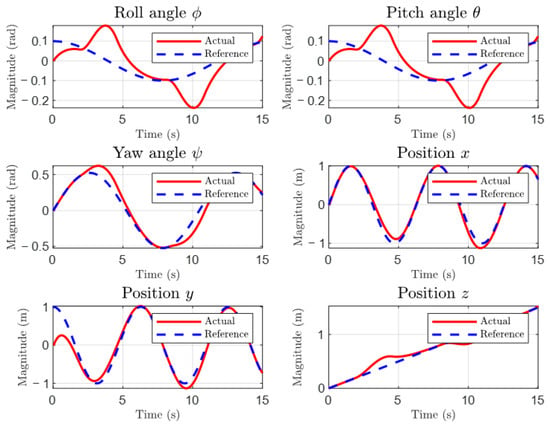
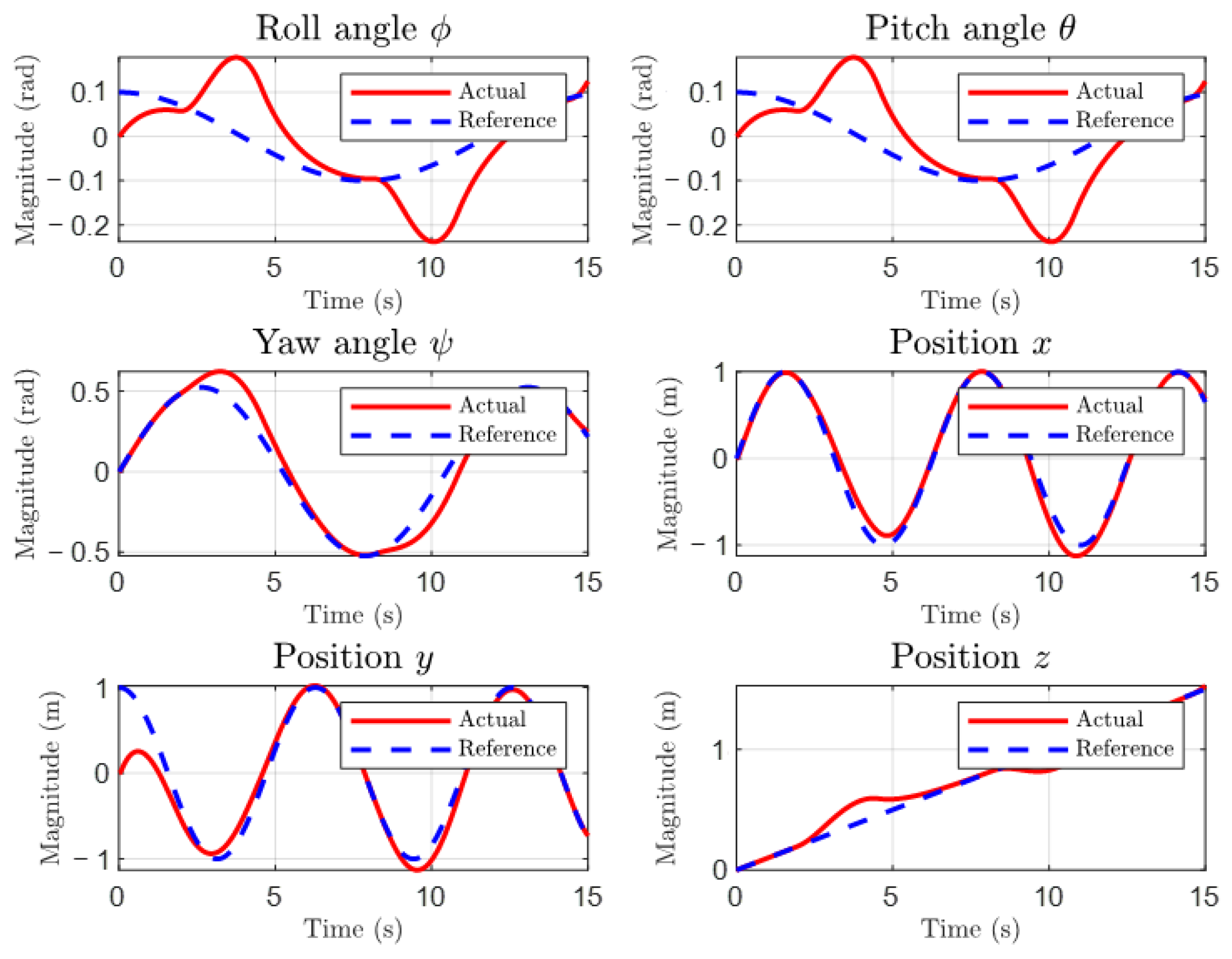
Figure 1 illustrates the tracking performance of the quadrotor’s translational and rotational variables under the nominal BSMC when no disturbance compensation is applied. As expected, due to the violation of the sliding-gain condition, the controller is unable to counteract the disturbances, and the QUAV fails to track the prescribed reference trajectory. In the angular position (), the actual responses diverge from the reference shortly after the maneuver begins, displaying pronounced oscillations whose amplitude and phase are strongly influenced by the injected disturbance. Although partial alignment with the reference is intermittently observed—most notably near the final seconds of the simulation—accurate tracking is never achieved. The translational position () exhibit even more pronounced degradation. The x- and y-axis responses show large deviations during the entire trajectory, while the z-axis motion displays a persistent drift that prevents convergence to the desired altitude profiles.
Figure 1.
Position and attitude tracking response of the QUAV under Case 1.
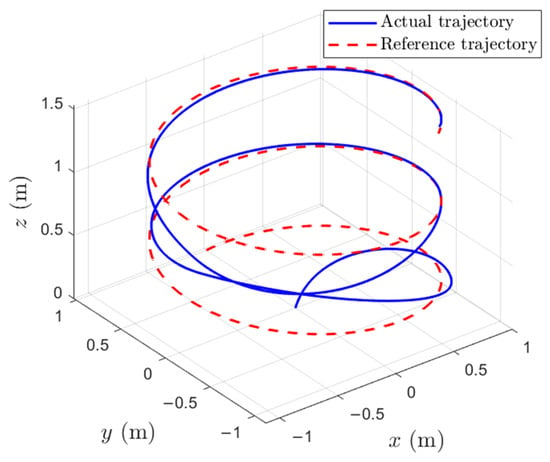
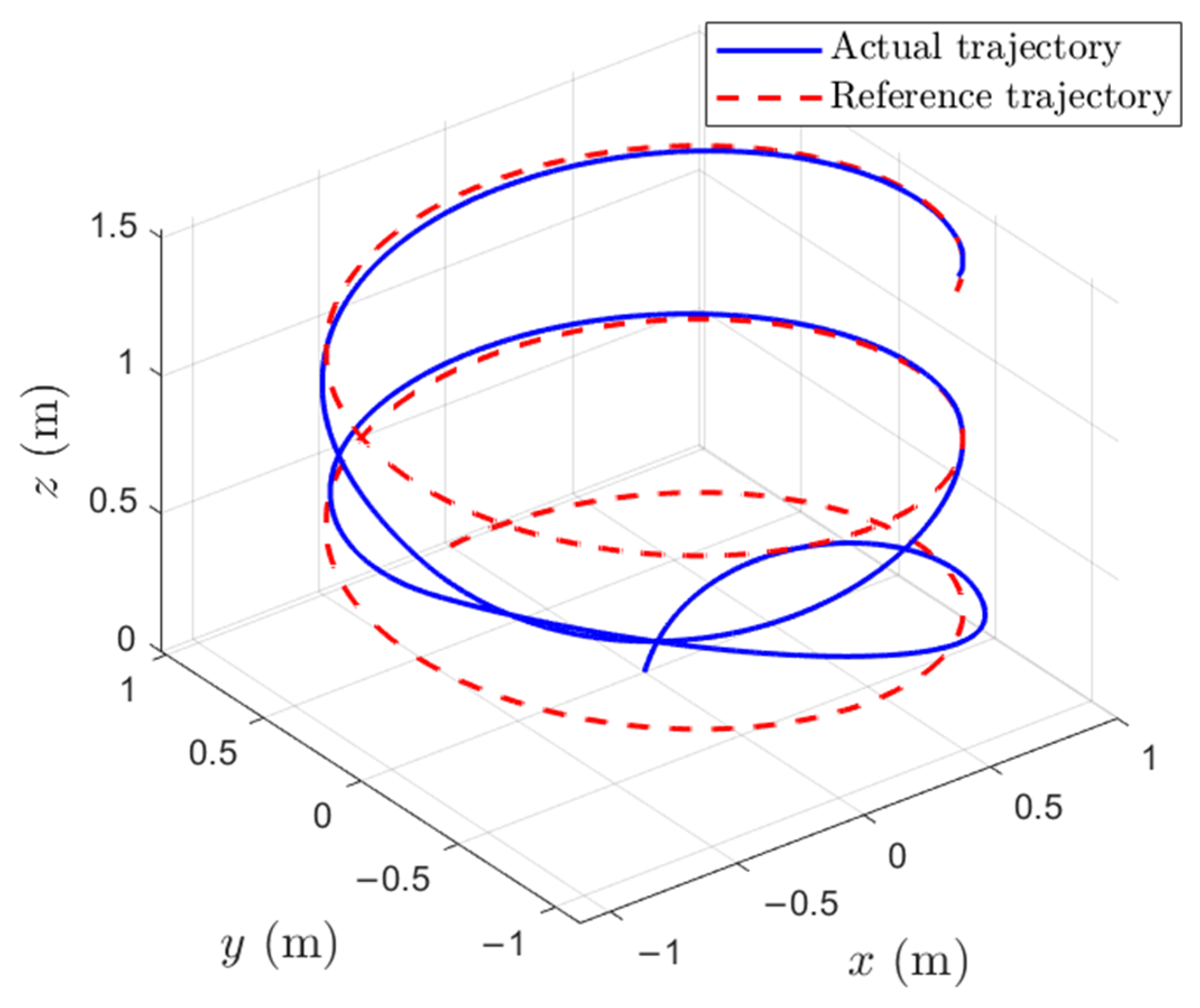
Figure 2 depicts the three-dimensional trajectory of the QUAV under the nominal BSMC without disturbance compensation. The QUAV deviates sharply from the desired path immediately after the maneuver begins, reflecting the controller’s inability to counteract the injected sinusoidal disturbance whose amplitude surpasses the selected sliding gains. Throughout most of the simulation, the vehicle remains significantly displaced from the reference trajectory, exhibiting large oscillations and drift in all spatial coordinates as a direct consequence of the violated matching condition. Only near the final segment of the simulation does the quadrotor partially converge toward the commanded path, yet a noticeable offset persists, confirming that the nominal BSMC cannot enforce robust tracking when the disturbance magnitude exceeds the discontinuous control authority.
Figure 2.
Three-dimensional flight trajectory of the QUAV under Case 1.
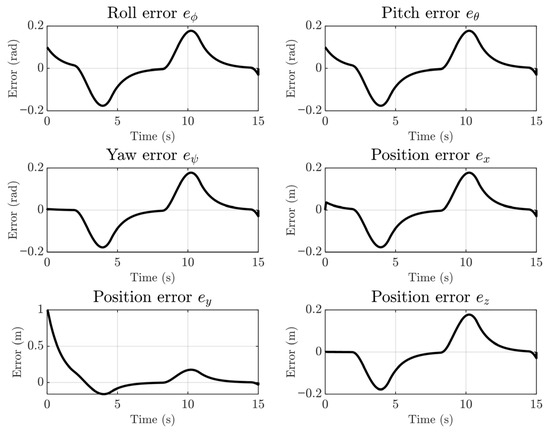
To further assess the controller behavior, Figure 3 presents the tracking error signals for both the position and orientation of the QUAV. As observed, none of the error trajectories converge to the origin; instead, all exhibit a characteristic oscillatory pattern driven by the external disturbance. In the rotational variables (), the errors initially drift away from zero and subsequently evolve periodically, with peak-to-peak amplitudes close to 0.2 rad, reflecting the controller’s inability to counteract a perturbation whose magnitude exceeds the sliding gain. A similar behavior is evident in the translational errors, particularly in the lateral y-axis, where the deviation grows significantly during the first seconds of flight and persists throughout the trajectory, consistent with the pronounced lateral drift seen in the 3D path. Although a slight reduction in the error magnitude appears near the end of the simulation—when the disturbance phase momentarily aligns with the controller dynamics—the signals never approach a neighborhood of zero, confirming that the sliding surfaces cannot be enforced under gain-deficient conditions.
Figure 3.
Position and orientation tracking errors of the QUAV under Case 1.
Table 2 summarizes the quantitative tracking performance obtained in Case 1, using the baseline BSMC without disturbance compensation. As expected from the qualitative behavior observed in Figure 1, Figure 2 and Figure 3, the error indices confirm that the controller fails to guarantee accurate tracking when the amplitude of the injected sinusoidal disturbance exceeds the selected sliding-mode gains. The ISE and IAE values for all position and orientation variables are significantly elevated, reflecting persistent tracking deviations that persist throughout the maneuver. In particular, the lateral position y exhibits the largest degradation (ISE = 0.619259, IAE = 1.704568). The angular variables (,,) show slightly lower error magnitudes, yet their indices remain substantially higher than those typically associated with stable sliding behavior, corroborating the inability of the controller to reject perturbations whose magnitude surpasses the discontinuous control gain. Overall, these metrics provide quantitative evidence that the nominal BSMC structure, without explicit disturbance cancellation, is unable to maintain stability and accurate tracking under the imposed disturbance profile, thereby motivating the development of the compensation strategy evaluated in the subsequent cases.
Table 2.
Tracking error indices (ISE and IAE) under Case 1.
3.2. Case 2—BSMC with STO-Based Disturbance Estimation and Compensation
This second simulation scenario evaluates the performance of the proposed disturbance-compensated BSMC in conjunction with the STO. Unlike Case 1, where the controller operates without access to disturbance information, the STO reconstructs in real time the sinusoidal perturbations injected into the translational and rotational dynamics of the QUAV model. The estimated disturbance signals are then explicitly incorporated into the control law, enabling the controller to counteract the perturbation rather than relying solely on discontinuous sliding-mode action. Importantly, the same controller and observer gains used in Case 1 are retained here, ensuring that any performance improvement arises exclusively from activating the estimation–compensation loop rather than from gain retuning.
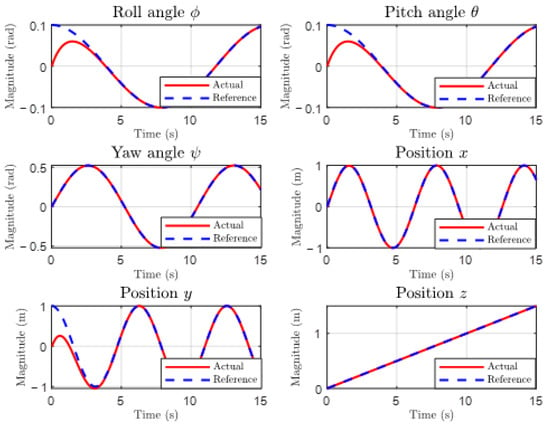
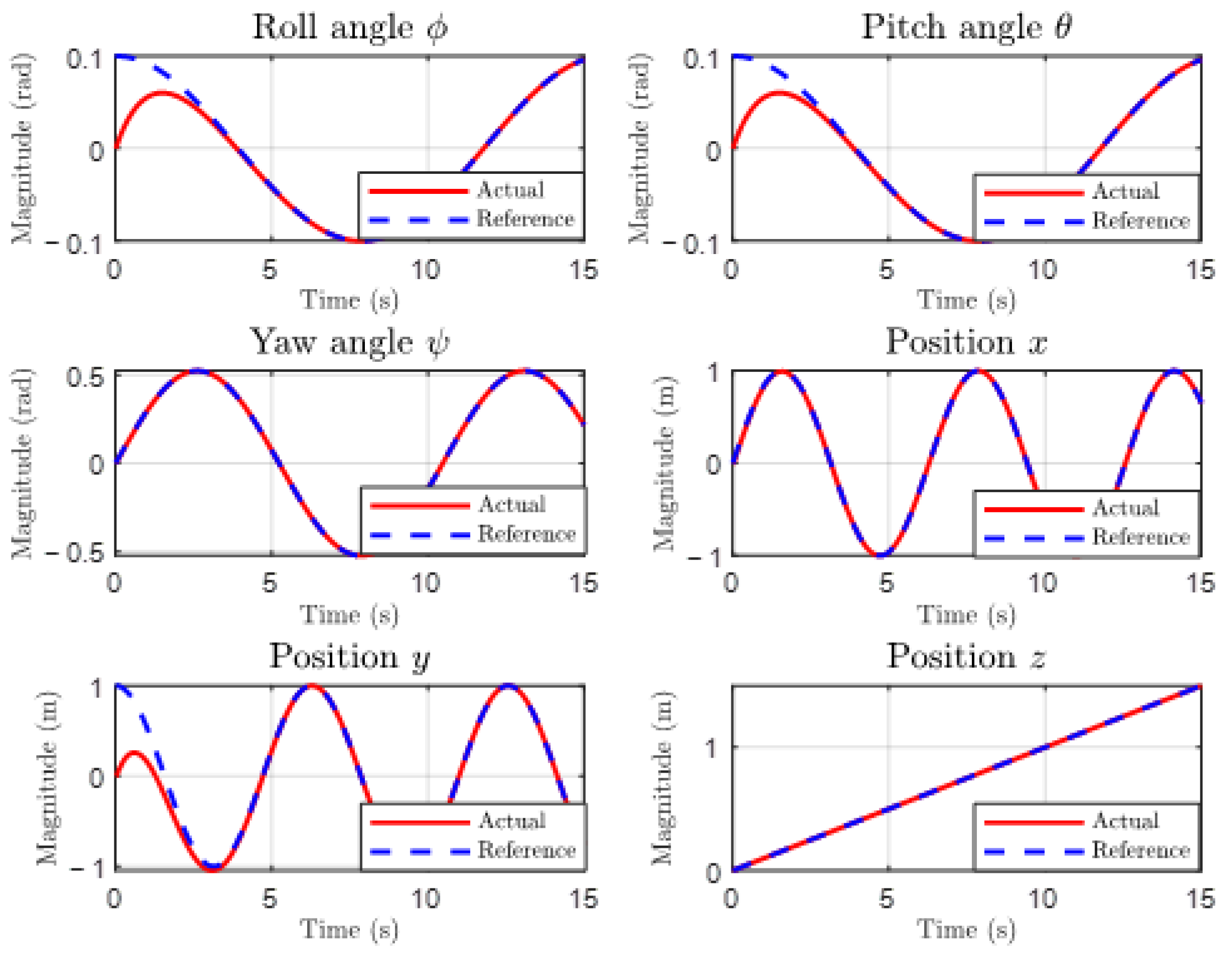
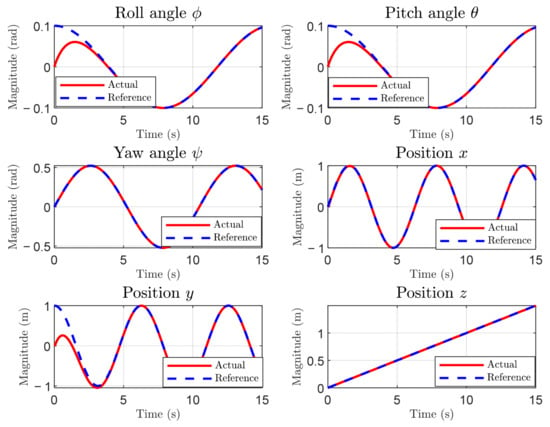
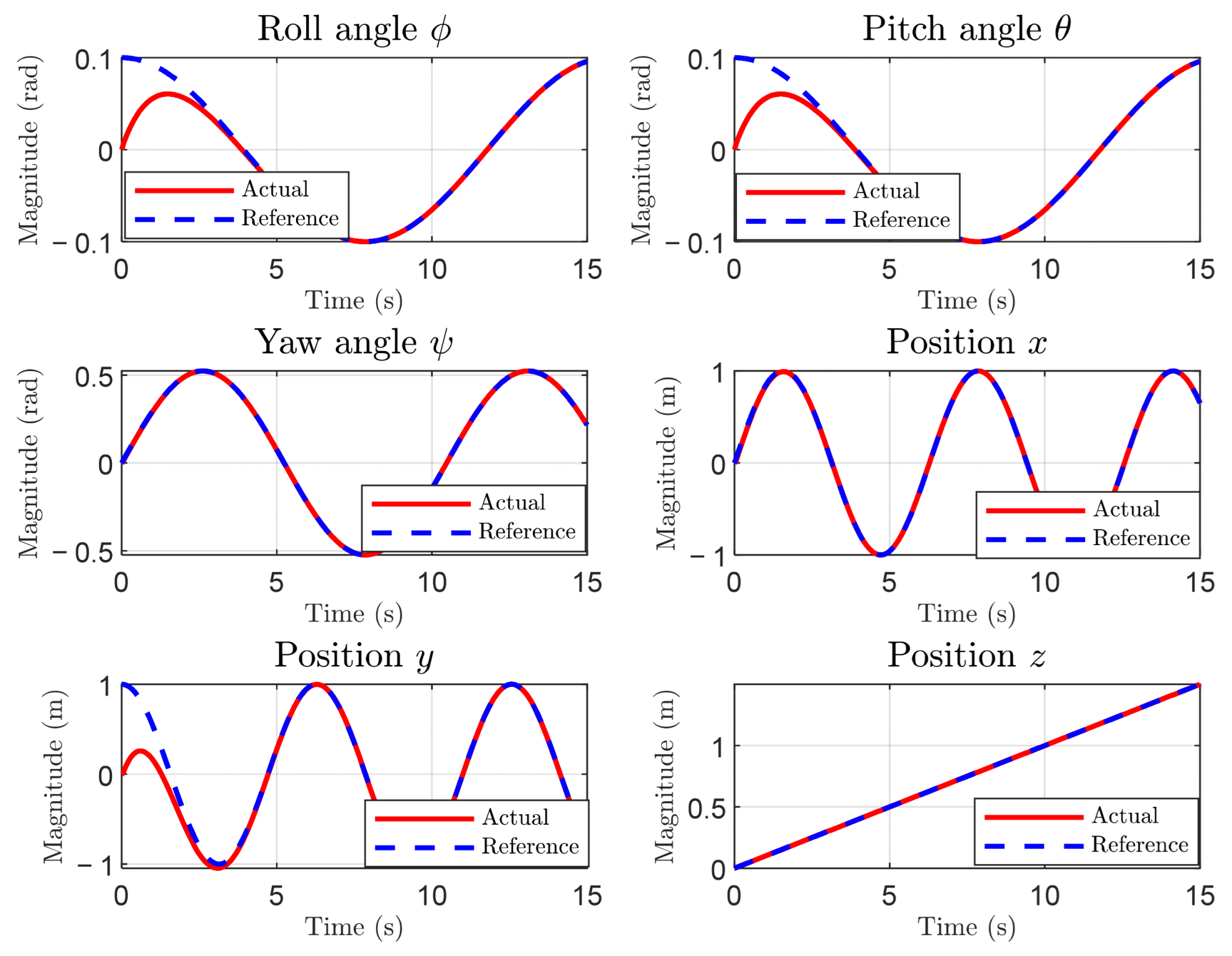
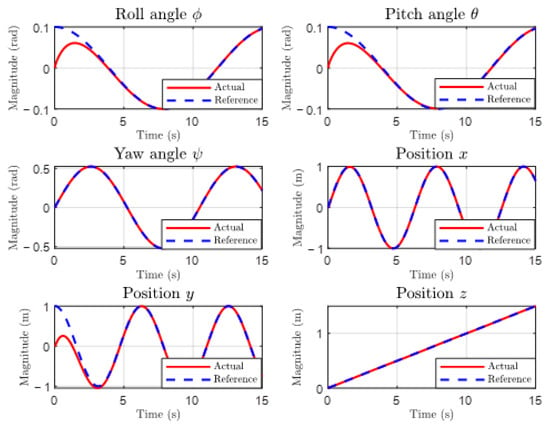
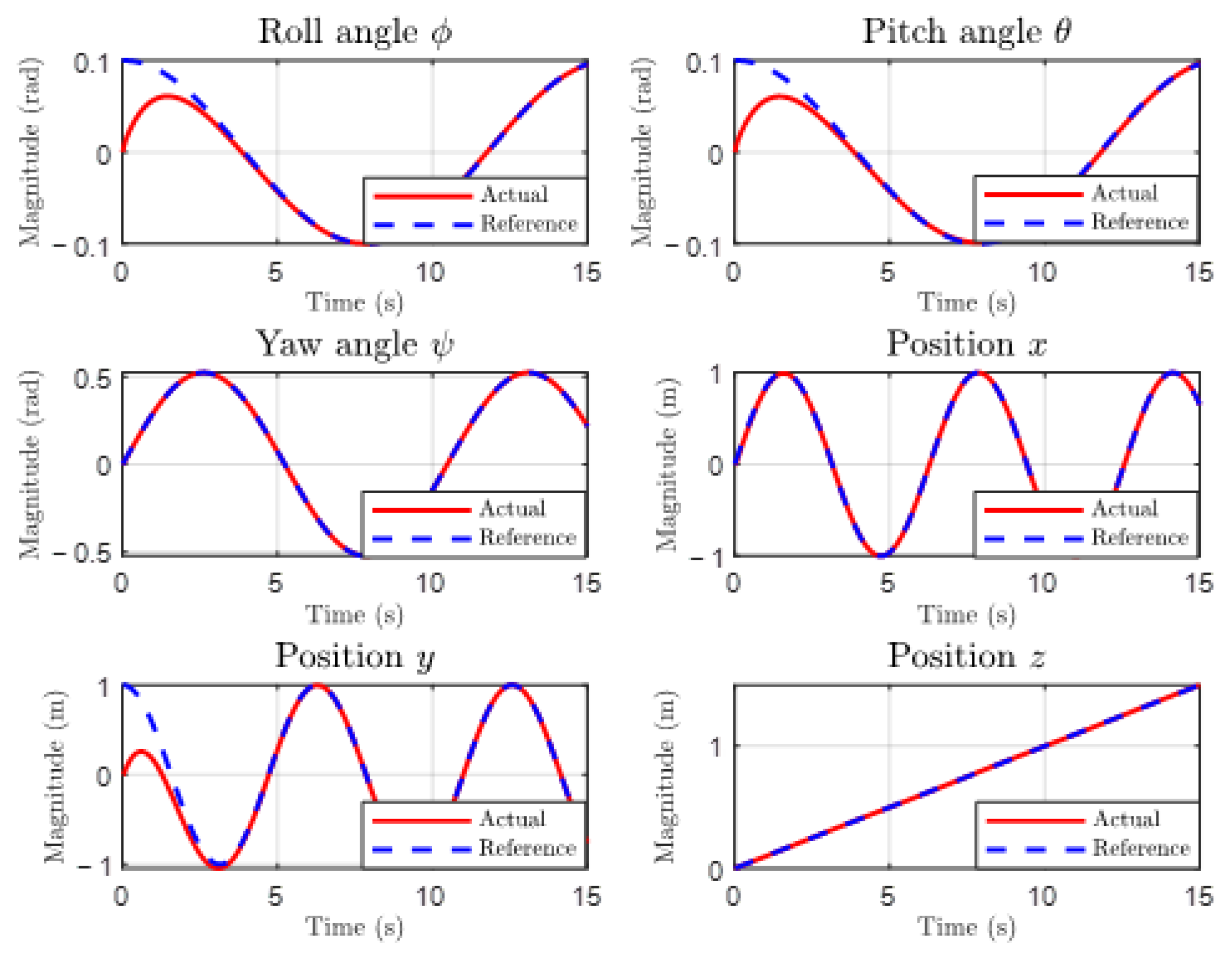
Figure 4 illustrates the position and attitude tracking response of the QUAV when the disturbance-compensation mechanism is activated through the STO. In contrast to the degraded performance observed in Case 1, the trajectories in both position and attitude now exhibit close and uniform correspondence with the reference signals throughout the entire maneuver. The observer-based reconstruction of the injected sinusoidal disturbance enables the controller to counteract its effect in real time, thereby preventing the large deviations and phase lags previously induced by the perturbation exceeding the sliding gains. As shown in Figure 4, both the translational and rotational variables converge smoothly to the desired trajectories shortly after the transient phase, with minimal overshoot and no oscillatory distortions characteristic of unmatched sliding conditions.
Figure 4.
Position and attitude tracking response of the QUAV under Case 2.
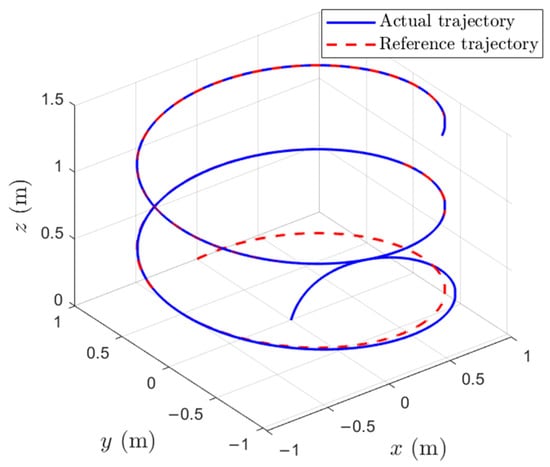
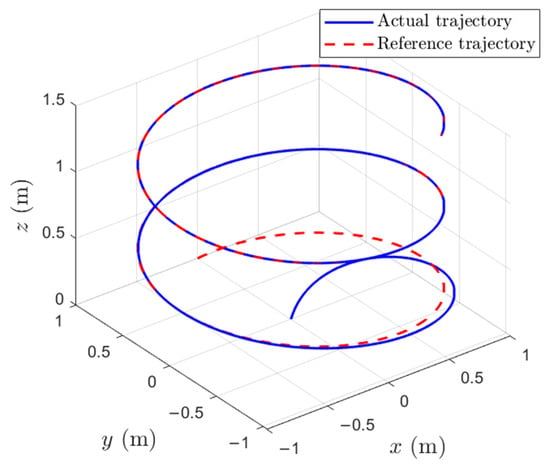
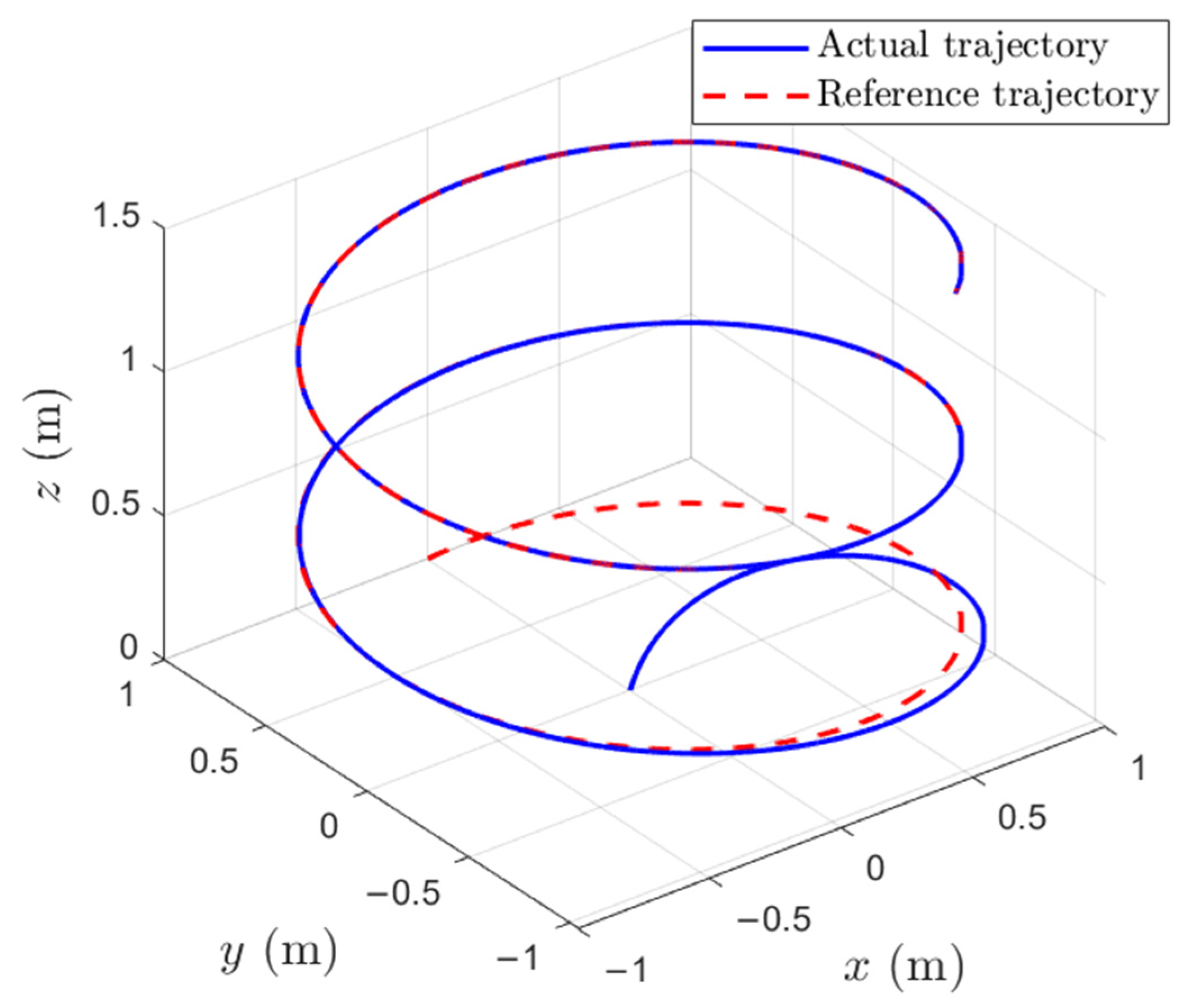
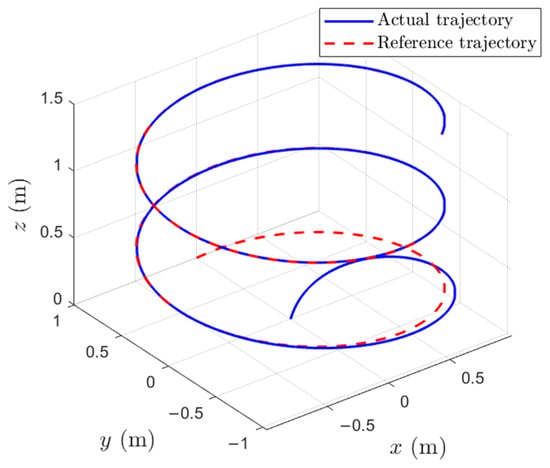
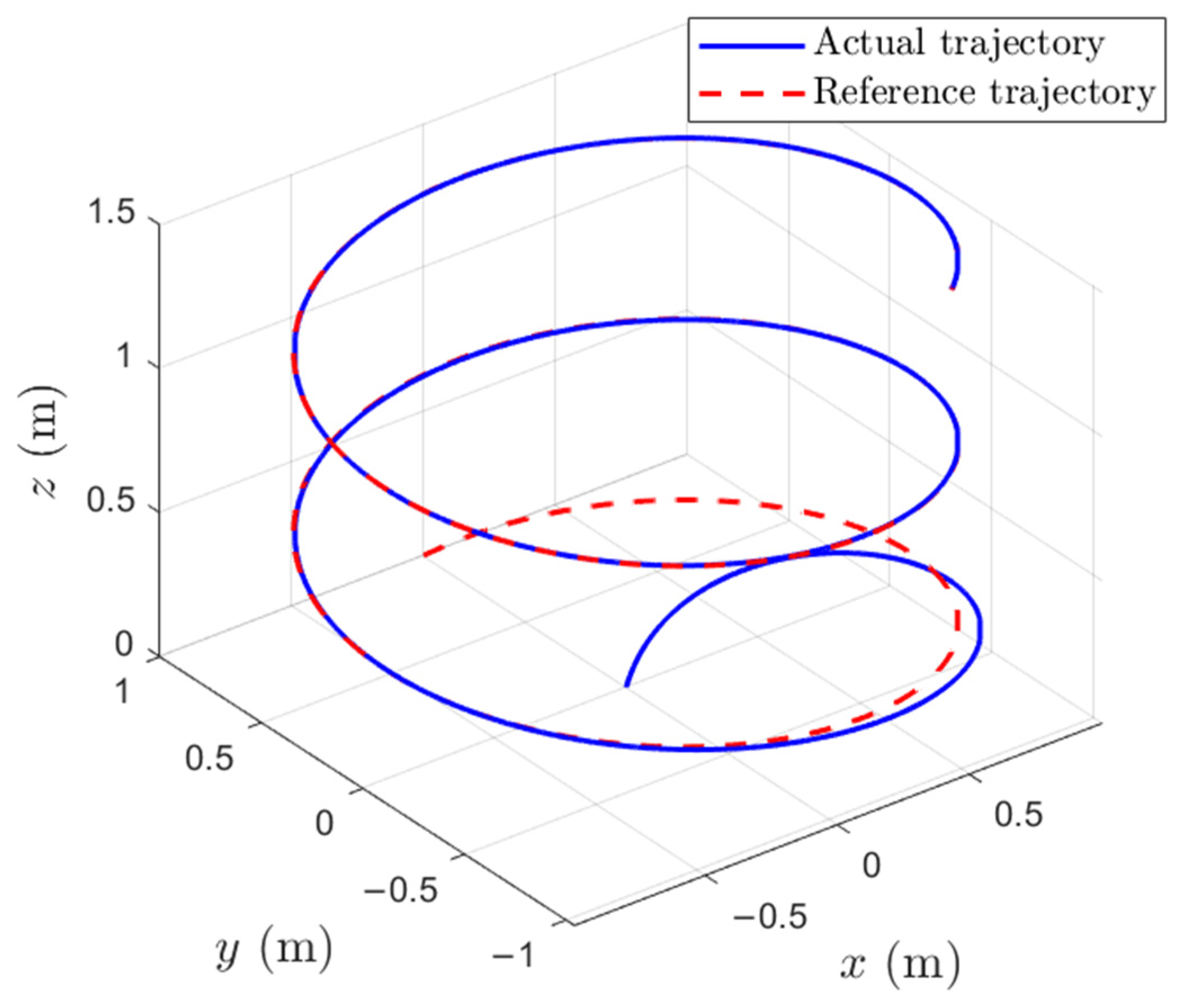
Figure 5 depicts the three-dimensional flight trajectory of the QUAV under Case 2. The results show that the actual trajectory closely follows the helical reference path across all spatial dimensions, with negligible deviation throughout the maneuver. In contrast to the significant errors observed in Case 1, the compensated controller keeps the vehicle tightly confined to the desired trajectory, even during segments with strong curvature or rapid vertical transitions.
Figure 5.
Three-dimensional flight trajectory of the QUAV under Case 2.
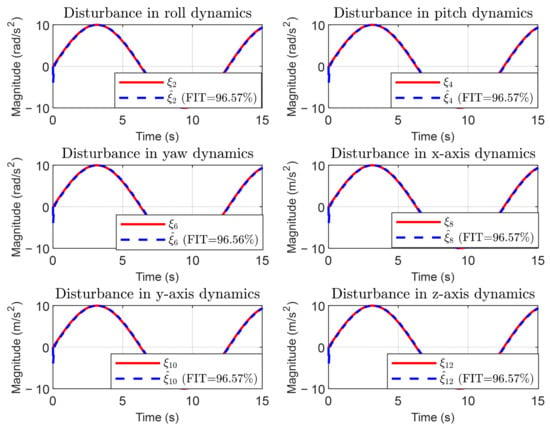
Figure 6 shows the STO-based reconstruction of disturbances injected into the translational and rotational dynamics of the QUAV. In each subplot, the estimated disturbance closely follows the injected sinusoidal signal after a brief transient, demonstrating consistent convergence and minimal steady-state deviation. The FIT values—between 96.56% and 96.57%—confirm the high accuracy of the estimation, reproducing the amplitude and phase characteristics of the applied perturbations. This reliable reconstruction is essential for the effectiveness of the compensation mechanism activated in Case 2, and the results substantiate the STO’s capability to provide disturbance information with sufficient precision to enhance closed-loop robustness.
Figure 6.
Disturbance reconstruction using the STO under Case 2.
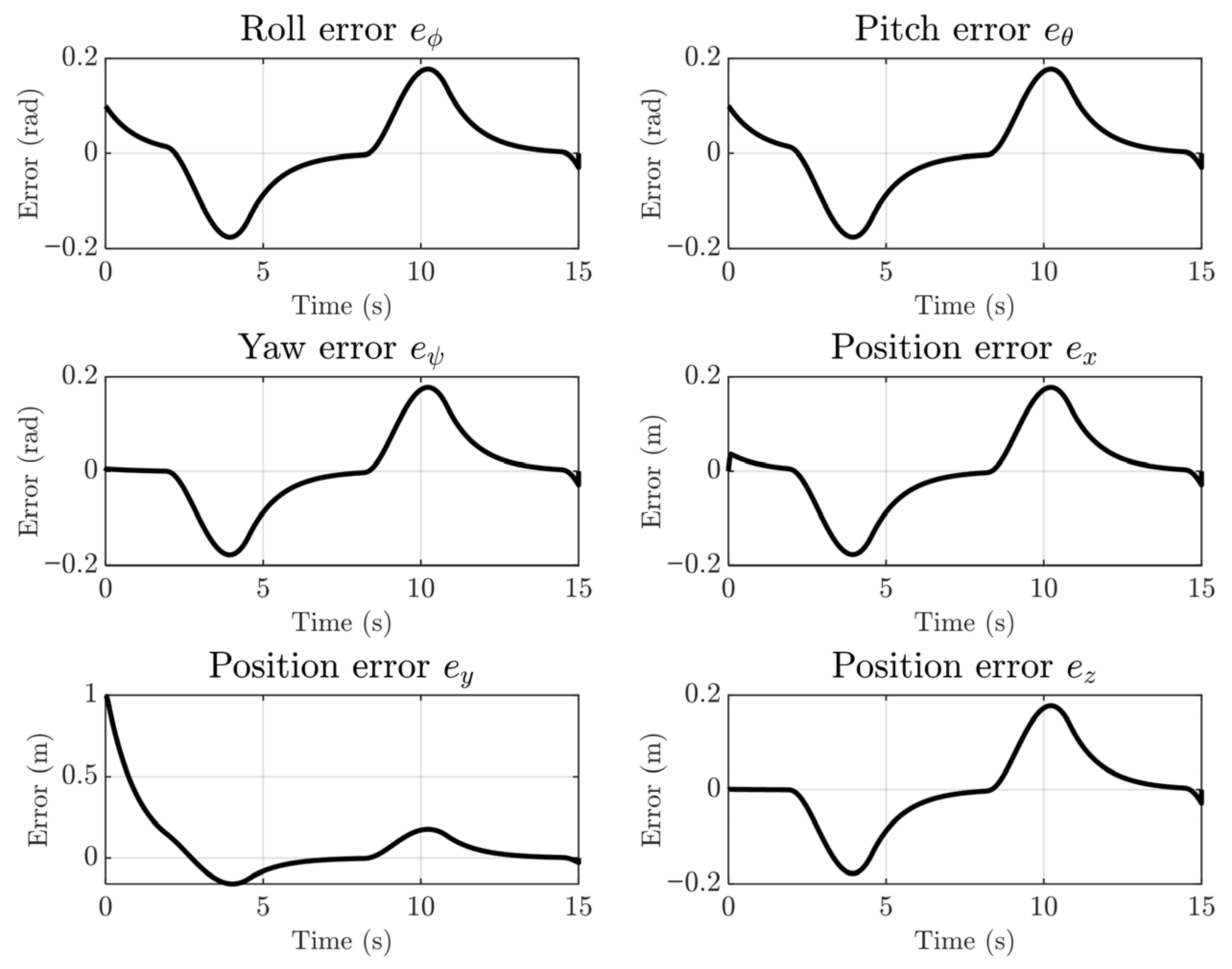
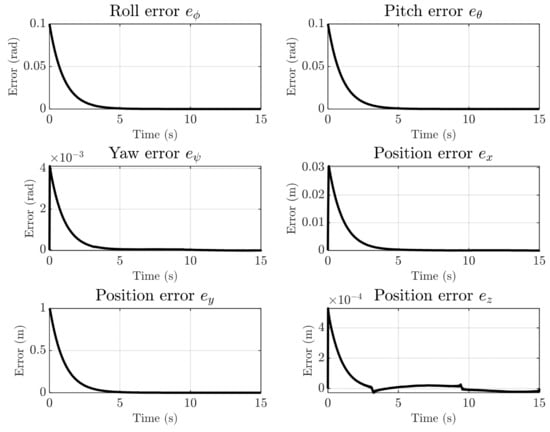
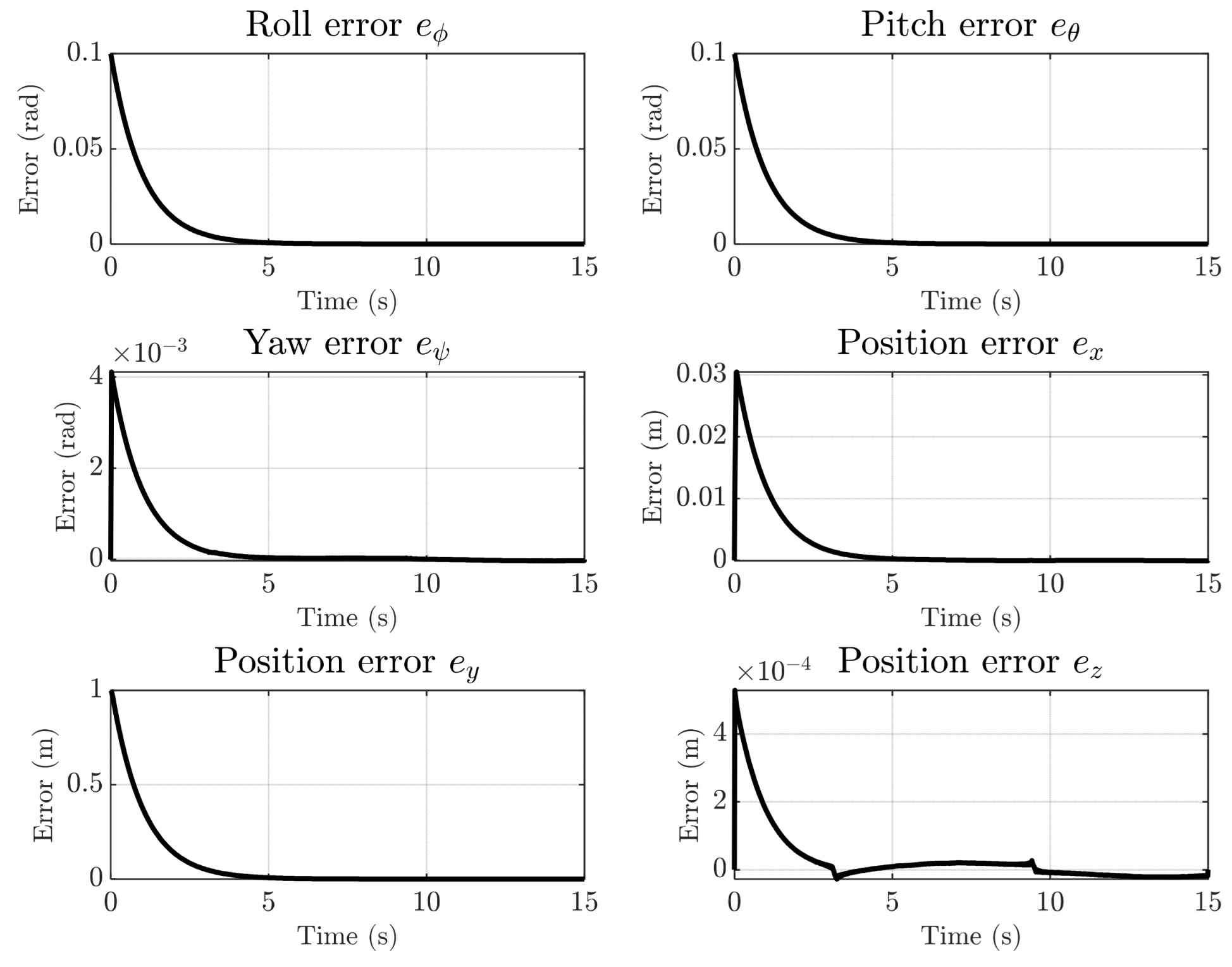
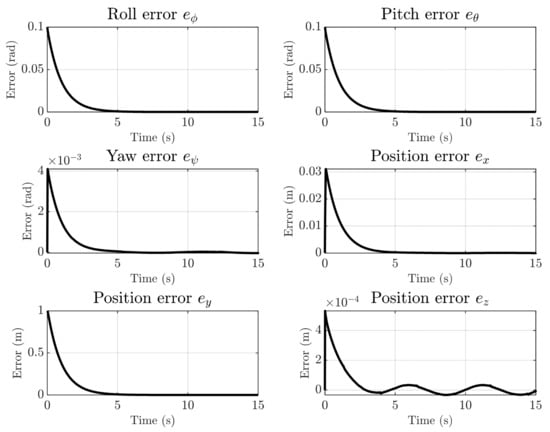
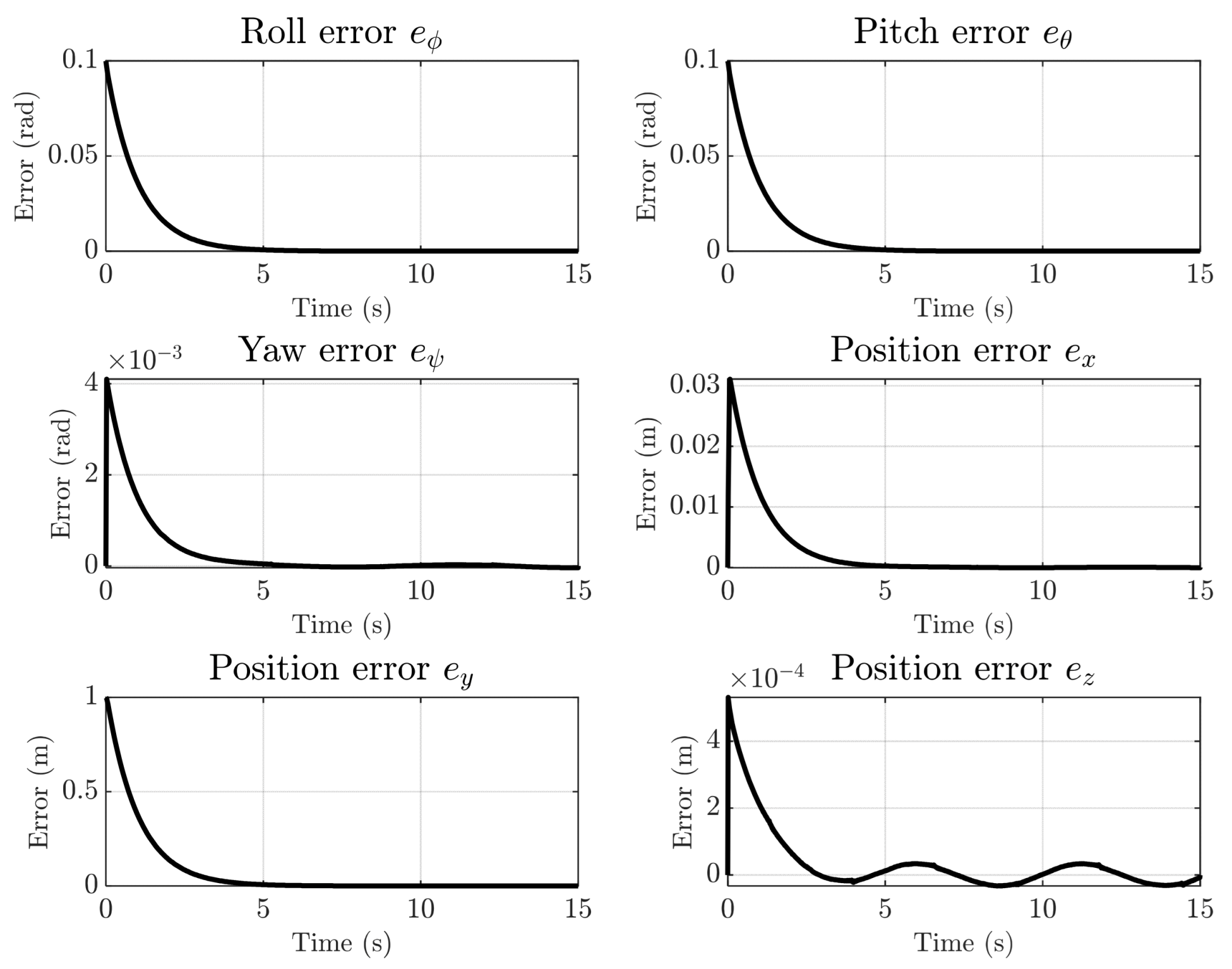
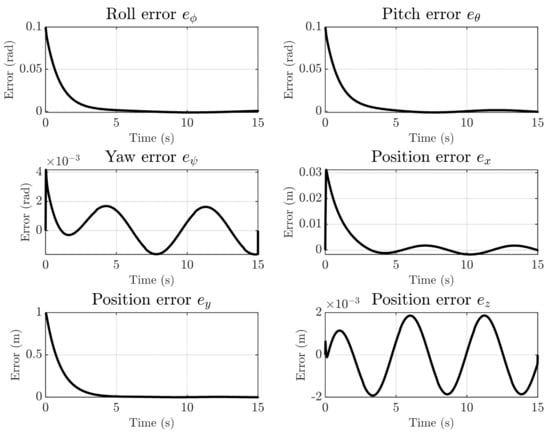
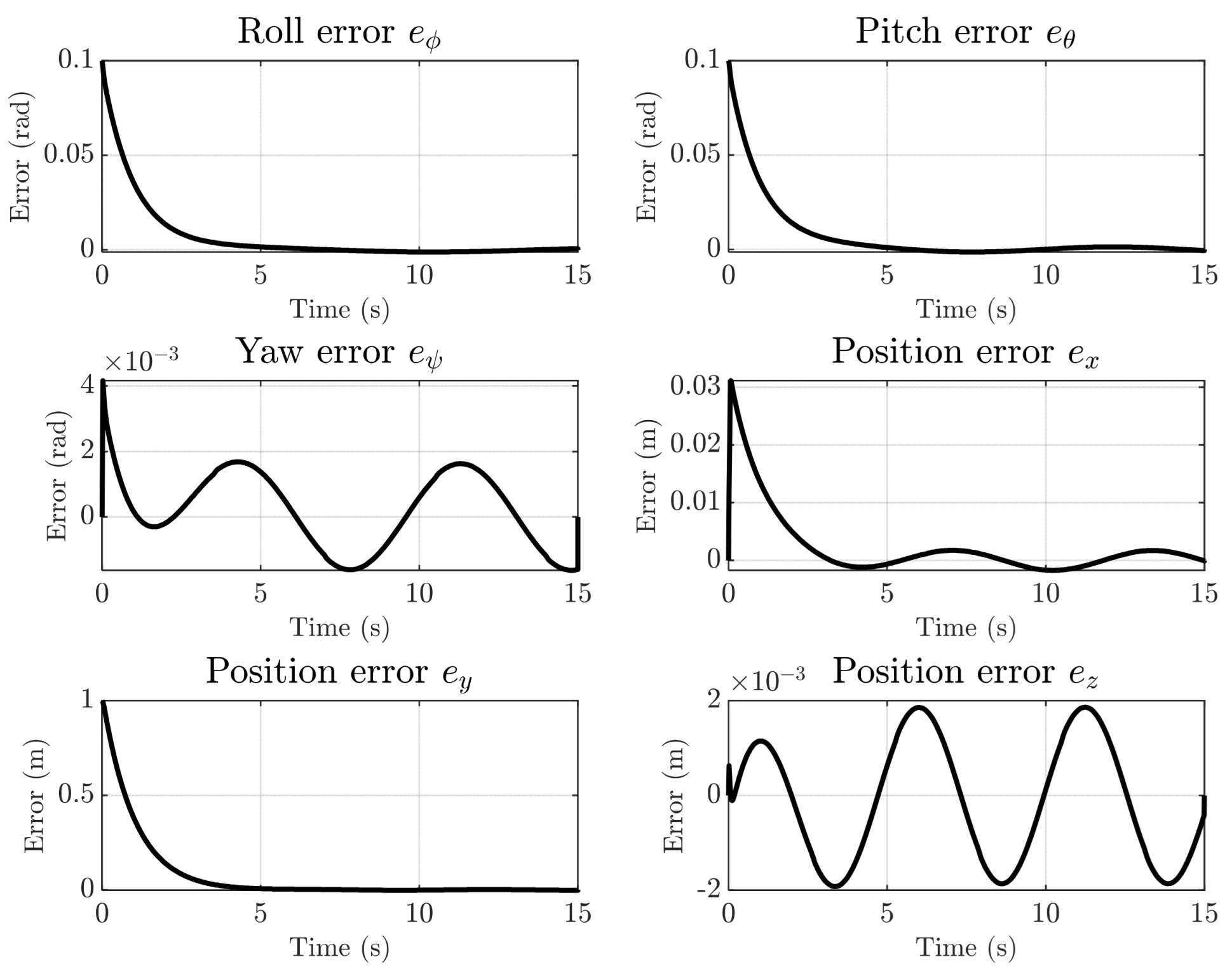
Figure 7 shows the position and orientation tracking errors of the QUAV under Case 2. All error trajectories decay rapidly from their initial offsets, converging to zero without overshoot or oscillation. Rotational errors converge within the first few seconds, while translational errors follow a similar trend with slightly slower dynamics due to coupled motion. The small steady-state residuals are consistent with the bounded disturbance reconstruction accuracy reported in Figure 6.
Figure 7.
Position and orientation tracking errors of the QUAV under Case 2.
Table 3 summarizes the QUAV’s tracking performance under Case 2, using the ISE and IAE indices. The angular variables (,,) exhibit low accumulated error, reflecting the fast convergence observed in the attitude responses. The translational variables also show small error magnitudes, with the x- and z-axes achieving particularly low ISE and IAE values, consistent with their smooth tracking behavior. The slightly higher indices on the y-axis correspond to the more demanding components of the reference trajectory but remain within acceptable bounds for stable operation. Overall, the metrics confirm that the disturbance-compensated controller maintains accurate tracking despite the presence of external perturbations.
Table 3.
Tracking error indices (ISE and IAE) under Case 2.
3.3. Case 3 –BSMC with STO-Based Compensation Under Multi-Frequency Disturbances
In this third scenario, the QUAV is subjected to a more demanding perturbation environment to assess the robustness of the proposed compensation strategy as the disturbance spectrum becomes richer and more representative of real-world operational conditions. Unlike Case 2—where a single-frequency sinusoidal disturbance was applied uniformly across all velocity channels—here each of the six acceleration equations is excited by a sinusoid of identical amplitude but distinct frequencies. This configuration introduces phase and excitation-rate variations across the translational and rotational dynamics, producing a heterogeneous disturbance profile that is significantly harder to counteract and commonly encountered in outdoor flights, where wind gusts, platform vibrations, and aerodynamic coupling do not act coherently.
Figure 8 shows the tracking response of the QUAV when subjected to the multi-frequency disturbance scenario of Case 3. At the qualitative level, the trajectories closely resemble those obtained in Case 2. The actual variables follow their references with no visually appreciable degradation in the transient or steady-state segments, despite the higher spectral richness of the injected perturbations. The attitude and position responses remain well aligned with their respective commands, and no additional oscillatory behavior or tracking drift is apparent from the plots.
Figure 8.
Position and attitude tracking response of the QUAV under Case 3.
Figure 9 illustrates the three-dimensional trajectory followed by the QUAV in Case 3. The vehicle traces the helical path with a high degree of fidelity, maintaining a smooth ascent and consistent lateral progression. The alignment between the actual and reference paths indicates that the disturbance compensation remains effective at the spatial level, confirming that the controller preserves the global motion pattern despite the increased variability in the excitation of the translational dynamics.
Figure 9.
Three-dimensional flight trajectory of the QUAV under Case 3.
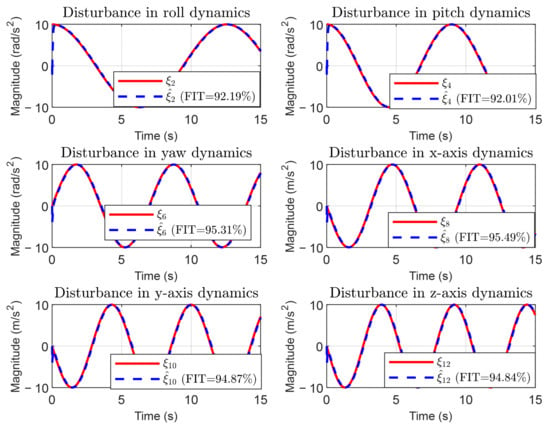
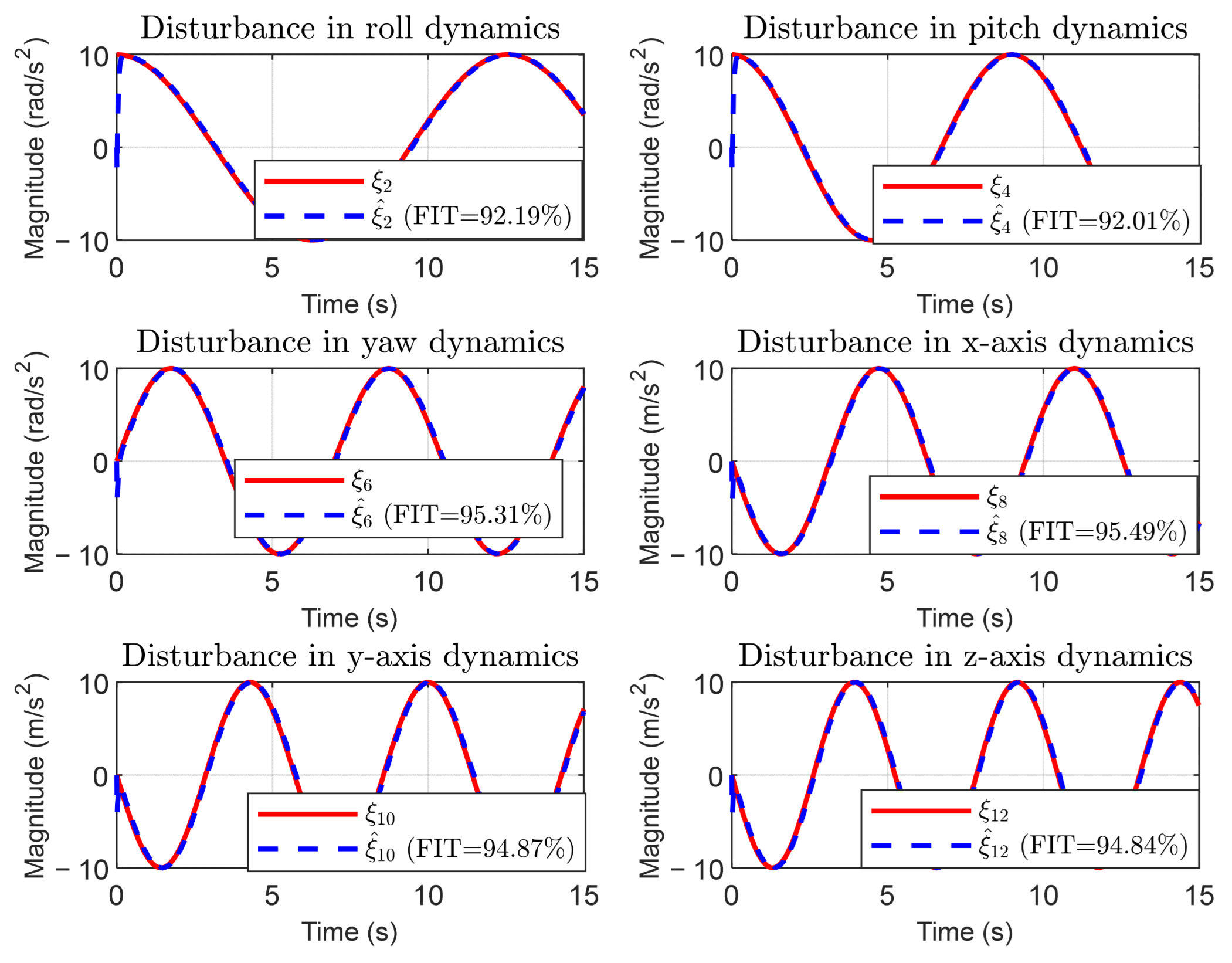
Figure 10 depicts the reconstruction of the multi-frequency disturbances injected into the translational and rotational acceleration channels of the QUAV. Under this more demanding excitation profile—characterized by the superposition of sinusoidal components with different frequencies—the STO maintains reliable convergence, reproducing the main amplitude and phase characteristics of the injected signals after a brief transient. Although the disturbance profiles exhibit faster oscillations and increased spectral richness compared with the single-frequency conditions of Case 2, the observer accurately captures their overall structure across all channels.
Figure 10.
Disturbance reconstruction using the STO under Case 3.
The FIT percentages, which range from 92% to 95%, confirm that the STO preserves high estimation accuracy despite the additional dynamic complexity introduced in this scenario. The slight reduction in accuracy relative to Case 2 is expected and reflects the inherent difficulty of reconstructing rapidly varying, multi-harmonic perturbations. Nevertheless, the consistency of the FIT values among all acceleration-governing states demonstrates the robustness of the STO and its capability to deliver disturbance estimates with sufficient precision to support effective compensation within the BSMC framework.
Figure 11 presents the tracking errors obtained in Case 3. A clear distinction emerges between the attitude and position variables; the angular errors converge rapidly with negligible residual oscillations, indicating that the rotational subsystem remains largely insensitive to the gain reduction. In contrast, the translational errors exhibit the expected periodic components inherited from the injected disturbances, particularly in the y and z dynamics, where the multi-frequency content is more apparent. Despite these oscillatory patterns, the error amplitudes remain bounded and small, showing that the closed-loop structure effectively contains the disturbance influence even under a less aggressive observation scheme.
Figure 11.
Position and orientation tracking errors of the QUAV under Case 3.
Table 4 summarizes the ISE and IAE indices obtained in Case 3. The attitude errors maintain uniformly low magnitudes, with ISE values on the order of 10−3 and IAEs below 0.1, confirming that the rotational subsystem remains largely unaffected by the multi-frequency disturbances. The translational dynamics also exhibit small error indices in the x- and z-axes, reflecting effective compensation and stable tracking. As expected, the y-axis—where the injected disturbance contains the richest spectral content—shows noticeably higher ISE and IAE values. Yet, these remain bounded and consistent with the oscillatory patterns observed in the error trajectories. Overall, the indices indicate that the STO-assisted BSMC preserves satisfactory tracking accuracy across all variables despite the increased disturbance complexity introduced in Case 3.
Table 4.
Tracking error indices (ISE and IAE) under Case 3.
3.4. Case 4 –BSMC with STO-Based Compensation Using a Smooth Tanh-Based Sliding Function
In this fourth scenario, the QUAV is subjected to the same multi-frequency disturbance conditions described in Case 3. However, the discontinuous sign function in the BSMC is replaced with a smooth hyperbolic tangent function. This modification enables a continuous sliding action with reduced chattering while deliberately operating with a sliding gain smaller than the magnitude of the injected disturbances. Under these more challenging conditions, the goal is to assess whether robustness is preserved when the inherent discontinuity of the traditional sliding mode is removed. The compensation mechanism remains unchanged. The STO reconstructs the heterogeneous disturbance profile and feeds its estimate back into the control law. As shown in the subsequent results, accurate disturbance estimates enable the controller to maintain effective disturbance rejection and closed-loop stability. Moreover, the proposed smooth tanh-based formulation preserves robustness and produces smoother control action without degrading tracking performance.
Figure 12 shows the position and attitude tracking response of the QUAV under Case 4. The transition from the discontinuous sign function to the smooth tanh-based sliding action does not produce any noticeable degradation in tracking performance. All translational and rotational variables follow their references with comparable accuracy to the previous scenarios. The trajectories remain well aligned throughout the maneuver.
Figure 12.
Position and attitude tracking response of the QUAV under Case 4.
Figure 13 shows the three-dimensional trajectory obtained in Case 4. The QUAV follows the reference trajectory with small deviations throughout the maneuver. The observed radial and vertical deviations during ascent remain bounded and do not drift, suggesting that the reduction in switching activity does not adversely affect the disturbance-rejection capability of the STO-assisted controller.
Figure 13.
Three-dimensional flight trajectory of the QUAV under Case 4.
Figure 14 shows the tracking errors obtained when the smooth tanh-based sliding term is used. As in previous cases, the attitude errors decay rapidly and remain near zero, confirming that the reduced discontinuity in the control law does not compromise the stabilization of the rotational subsystem. For the translational dynamics, the errors retain the periodic signatures induced by the multi-frequency disturbances, though with slightly smoother envelopes than in Case 3, reflecting the effect of the softened sliding action. Importantly, these oscillations remain bounded and of small amplitude, indicating that disturbance compensation remains effective even under a less aggressive control structure. Overall, the results verify that the tanh replacement preserves robustness while reducing chattering and yielding well-behaved error trajectories.
Figure 14.
Position and orientation tracking errors of the QUAV under Case 4.
Table 5 summarizes the ISE and IAE indices for Case 4 under multi-frequency disturbances, with the discontinuous sign function replaced by a smooth tanh-based formulation. The attitude variables remain accurately regulated, with ISE values on the order of 10−3 and IAEs near 0.1, indicating effective control of the rotational dynamics despite the reduced sliding gain and the absence of discontinuous switching. For translational motion, the tracking errors along the x- and z-axes remain small and bounded, whereas the y-axis—subject to the richest spectral excitation—exhibits larger but still well-contained error indices. Overall, the close agreement with Case 3 confirms that the STO-assisted BSMC preserves its robustness and disturbance rejection capability while enabling continuous control that mitigates chattering without compromising tracking accuracy.
Table 5.
Tracking error indices (ISE and IAE) under Case 4.
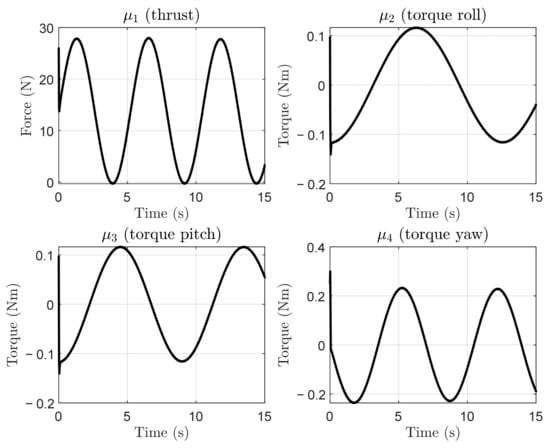
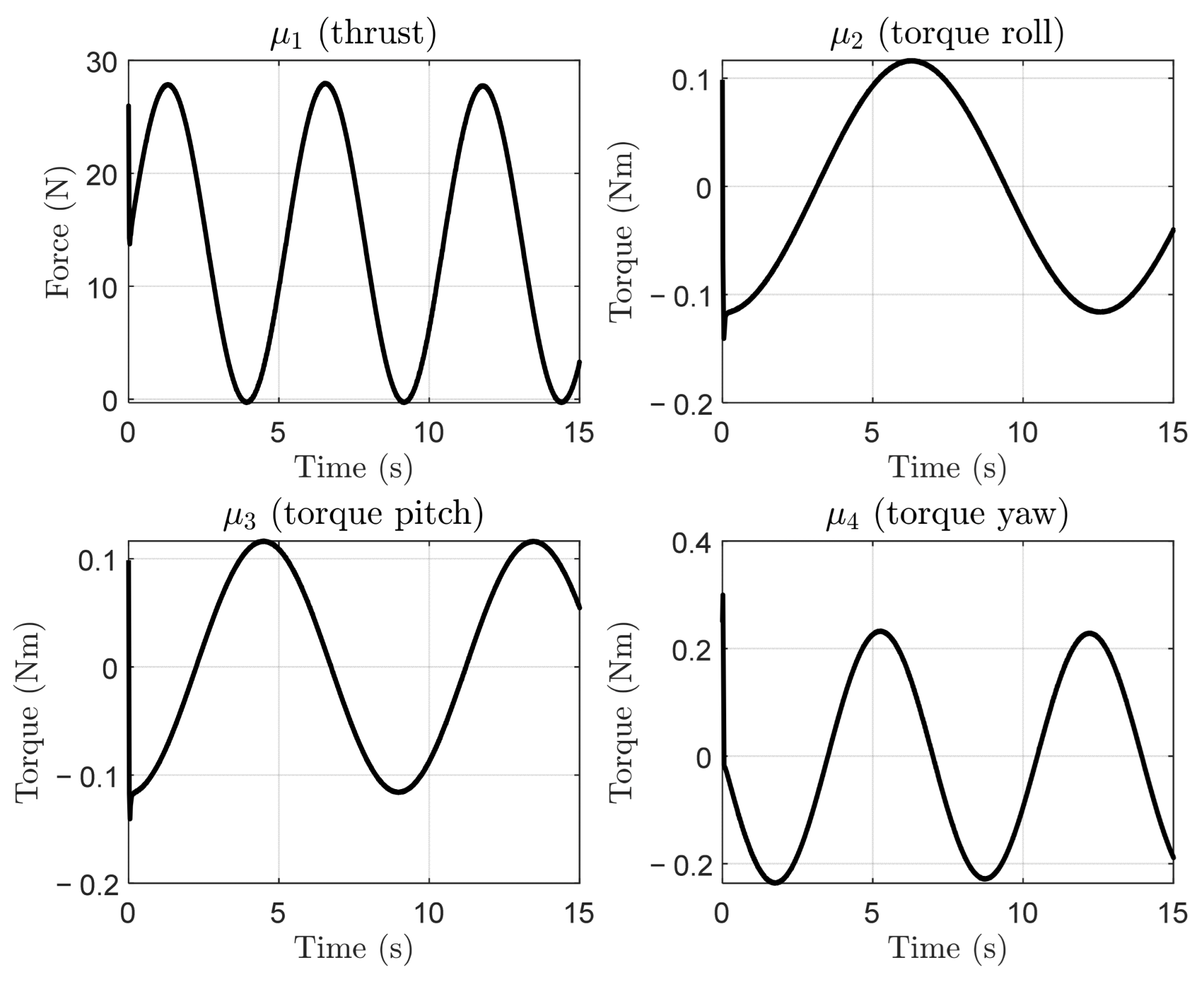
Figure 15 shows the control effort produced under Case 4, where the discontinuous sign function of the sliding term is replaced by its smooth tanh-based counterpart. The four control signals exhibit the expected attenuation of high-frequency components that previously characterized the discontinuous formulation, leading to noticeably smoother actuation profiles despite the presence of multi-frequency disturbances. The thrust and torque commands remain well-structured and free of the high-frequency switching inherent in classical SMC, indicating that the continuous approximation effectively suppresses chattering while preserving sufficient control authority.
Figure 15.
Control inputs of the BSMC-STO using a smooth tanh-based sliding function under Case 4.
It is worth emphasizing that the simulation scenarios presented in this section are intentionally formulated under deterministic conditions. This choice allows isolating and clearly highlighting the fundamental contribution of the proposed BSMC–STO scheme, namely, its ability to preserve robust trajectory tracking when the switching gain is selected smaller than the disturbance magnitude, a condition under which the classical BSMC fails. By explicitly compensating matched disturbances through the observer-based injection term, the proposed approach enables the use of smooth switching functions without loss of robustness, which directly translates into reduced chattering and smoother control actions. The inclusion of sensor noise, processor noise, and actuator saturation effects, while highly relevant for practical implementations, would require additional noise-aware observer or filtering mechanisms and is, therefore, left for future investigation, particularly in the context of experimental validation.
4. Conclusions
This study addressed the problem of robust trajectory tracking for quadrotor unmanned aerial vehicles (QUAVs) in the presence of unknown but bounded external disturbances affecting both translational and rotational dynamics. A disturbance-compensated backstepping–sliding mode control (BSMC) framework was proposed, in which a super-twisting observer (STO) is integrated into a conventional BSMC structure to enable active disturbance rejection.
Simulation results clearly demonstrate the limitations of the nominal BSMC when the magnitude of external disturbances exceeds the selected discontinuous control gains. Under such conditions, the baseline controller is unable to maintain the sliding manifold, leading to a pronounced degradation in both position and attitude tracking performance.
By contrast, when the STO-based disturbance estimation and compensation mechanism is incorporated, the closed-loop behavior improves substantially. Without modifying the nominal controller gains, the proposed BSMC–STO scheme consistently restores robust tracking performance in both position and attitude tracking. The STO accurately reconstructs the matched disturbances, as quantified by the reported FIT indices, and the explicit injection of these estimates into the control law effectively attenuates their impact on the closed-loop dynamics.
The effectiveness of the proposed framework was further evaluated under multi-frequency disturbance scenarios, in which the QUAV dynamics are subjected to perturbations with distinct temporal characteristics. Even under these heterogeneous excitation conditions, the STO maintains reliable disturbance reconstruction accuracy, and the controller preserves accurate tracking performance without requiring gain retuning.
In addition, replacing the discontinuous sign function with a smooth hyperbolic tangent function significantly reduces chattering while preserving robustness, provided that disturbance estimates are available. The resulting smooth sliding behavior leads to well-conditioned control inputs and bounded tracking errors, further demonstrating that observer-based disturbance compensation effectively reduces reliance on strongly discontinuous control actions.
It is important to emphasize that the robustness properties established in this work are derived under the standard matching condition commonly assumed in sliding-mode-based control frameworks. Within this framework, the proposed BSMC–STO scheme explicitly compensates matched external disturbances acting on the quadrotor dynamics. An explicit evaluation of robustness with respect to parametric uncertainties would require extending the observer structure with adaptive or parameter-estimation mechanisms.
Future work will focus on experimental validation, the inclusion of sensor and actuator nonidealities, extension to fault scenarios, and adaptive tuning of the observer and control gains to further enhance robustness under rapidly varying operating conditions.
Author Contributions
Conceptualization, V.B.-J. and M.C.-R.; methodology, V.B.-J.; software, V.B.-J.; validation, V.B.-J., J.S.V.-M. and A.R.-M.; formal analysis, V.B.-J., A.R.-M., G.R.-Z., M.B.-E., J.S.V.-M. and M.C.-R.; investigation, V.B.-J. and M.C.-R.; resources, V.B.-J. and G.R.-Z.; data curation, V.B.-J. and A.R.-M.; writing—original draft preparation, V.B.-J.; writing—review and editing, V.B.-J., A.R.-M., G.R.-Z., M.B.-E., J.S.V.-M. and M.C.-R.; visualization, J.S.V.-M. and A.R.-M.; supervision, V.B.-J. and M.C.-R.; project administration, V.B.-J. and M.B.-E. All authors have read and agreed to the published version of the manuscript.
Funding
This research received no external funding.
Data Availability Statement
The original contributions presented in this study are included in the article. Further inquiries can be directed to the corresponding author.
Acknowledgments
We would like to thank the Mexican people who supported this research through the SECIHTI (Secretaria de Ciencia, Humanidades, Tecnología e Innovación— Secretary of Science, Humanities, Technology and Innovation), Mexico.
Conflicts of Interest
The authors declare no conflicts of interest.
References
- Idrissi, M.; Salami, M.; Annaz, F. A Review of Quadrotor Unmanned Aerial Vehicles: Applications, Architectural Design and Control Algorithms. J. Intell. Robot. Syst. 2022, 104, 22. [Google Scholar] [CrossRef] [Scilit]
- Ahmed, F.; Mohanta, J.C.; Keshari, A.; Yadav, P.S. Recent Advances in Unmanned Aerial Vehicles: A Review. Arab. J. Sci. Eng. 2022, 47, 7963–7984. [Google Scholar] [CrossRef] [Scilit]
- Sonugür, G. A Review of Quadrotor UAV: Control and SLAM Methodologies Ranging from Conventional to Innovative Approaches. Robot. Auton. Syst. 2023, 161, 104342. [Google Scholar] [CrossRef] [Scilit]
- Obaid, L.; Hamad, K.; Al-Ruzouq, R.; Dabous, S.A.; Ismail, K.; Alotaibi, E. State-of-the-Art Review of Unmanned Aerial Vehicles (UAVs) and Artificial Intelligence (AI) for Traffic and Safety Analyses: Recent Progress, Applications, Challenges, and Opportunities. Transp. Res. Interdiscip. Perspect. 2025, 33, 101591. [Google Scholar] [CrossRef] [Scilit]
- Lopez-Sanchez, I.; Moreno-Valenzuela, J. PID Control of Quadrotor UAVs: A Survey. Annu. Rev. Control 2023, 56, 100900. [Google Scholar] [CrossRef] [Scilit]
- Rinaldi, M.; Primatesta, S.; Guglieri, G. A Comparative Study for Control of Quadrotor UAVs. Appl. Sci. 2023, 13, 3464. [Google Scholar] [CrossRef] [Scilit]
- Meng, W.; Zhang, X.; Zhou, L.; Guo, H.; Hu, X. Advances in UAV Path Planning: A Comprehensive Review of Methods, Challenges, and Future Directions. Drones 2025, 9, 376. [Google Scholar] [CrossRef] [Scilit]
- Telli, K.; Kraa, O.; Himeur, Y.; Ouamane, A.; Boumehraz, M.; Atalla, S.; Mansoor, W. A Comprehensive Review of Recent Research Trends on Unmanned Aerial Vehicles (UAVs). Systems 2023, 11, 400. [Google Scholar] [CrossRef] [Scilit]
- Guettal, L.; Chelihi, A.; Ajgou, R.; Touba, M.M. Robust Tracking Control for Quadrotor with Unknown Nonlinear Dynamics Using Adaptive Neural Network Based Fractional-Order Backstepping Control. J. Frankl. Inst. 2022, 359, 7337–7364. [Google Scholar] [CrossRef] [Scilit]
- Hamza, A.; Hossam, A.; El-Badawy, A. Robust H∞ Control for a Quadrotor UAV. In Proceedings of the AIAA Science and Technology Forum and Exposition (AIAA SciTech 2022), San Diego, CA, USA, 3–7 January 2022. [Google Scholar] [CrossRef] [Scilit]
- Panza, S.; Lovera, M.; Sato, M.; Muraoka, K. Structured μ-Synthesis of Robust Attitude Control Laws for a Quad-Tilt-Wing Unmanned Aerial Vehicle. J. Guid. Control Dyn. 2020, 43, 2258–2274. [Google Scholar] [CrossRef] [Scilit]
- Urbina-Brito, N.; Guerrero-Sánchez, M.E.; Valencia-Palomo, G.; Hernández-González, O.; López-Estrada, F.R.; Hoyo-Montaño, J.A. A Predictive Control Strategy for Aerial Payload Transportation with an Unmanned Aerial Vehicle. Mathematics 2021, 9, 1822. [Google Scholar] [CrossRef] [Scilit]
- Cheng, Y.; Dai, L.; Li, A.; Yuan, Y.; Chen, Z. Active Disturbance Rejection Generalized Predictive Control of a Quadrotor UAV via Quantitative Feedback Theory. IEEE Access 2022, 10, 37912–37923. [Google Scholar] [CrossRef] [Scilit]
- Mulualem, Y.L.; Jin, G.G.; Kwon, J.; Ahn, J. Backstepping Sliding Mode Control of Quadrotor UAV Trajectory. Mathematics 2025, 13, 3205. [Google Scholar] [CrossRef] [Scilit]
- Labbadi, M.; Boukal, Y.; Cherkaoui, M. Robust Nonlinear Backstepping SMC for QUAV Subjected to External Disturbances. Stud. Syst. Decis. Control 2022, 384, 103–122. [Google Scholar] [CrossRef] [Scilit]
- Kuang, J.; Chen, M. Adaptive Sliding Mode Control for Trajectory Tracking of Quadrotor Unmanned Aerial Vehicles under Input Saturation and Disturbances. Drones 2024, 8, 614. [Google Scholar] [CrossRef] [Scilit]
- Xu, L.X.; Ma, H.J.; Guo, D.; Xie, A.H.; Song, D.L. Backstepping Sliding-Mode and Cascade Active Disturbance Rejection Control for a Quadrotor UAV. IEEE/ASME Trans. Mechatron. 2020, 25, 2743–2753. [Google Scholar] [CrossRef] [Scilit]
- Hou, Y.; Chen, D.; Yang, S. Adaptive Robust Trajectory Tracking Controller for a Quadrotor UAV with Uncertain Environment Parameters Based on Backstepping Sliding Mode Method. IEEE Trans. Autom. Sci. Eng. 2025, 22, 4446–4456. [Google Scholar] [CrossRef] [Scilit]
- Xie, W.; Cabecinhas, D.; Cunha, R.; Silvestre, C. Adaptive Backstepping Control of a Quadcopter with Uncertain Vehicle Mass, Moment of Inertia, and Disturbances. IEEE Trans. Ind. Electron. 2022, 69, 549–559. [Google Scholar] [CrossRef] [Scilit]
- Borja-Jaimes, V.; García-Morales, J.; Escobar-Jiménez, R.F.; Guerrero-Ramírez, G.V.; Adam-Medina, M. A Backstepping Sliding Mode Control of a Quadrotor UAV Using a Super-Twisting Observer. Appl. Sci. 2025, 15, 10120. [Google Scholar] [CrossRef] [Scilit]
- Yesmin, A.; Sinha, A. Sliding Mode Controller for Quadcopter UAVs: A Comprehensive Survey. Drones 2025, 9, 625. [Google Scholar] [CrossRef] [Scilit]
- Zhao, C.; Li, W.; Hao, S.; Gao, R.; Wu, S.; Li, H. Global Fast Terminal Sliding Mode Control for Trajectory Tracking Control of Quadrotor UAVs. Sensors 2025, 25, 7480. [Google Scholar] [CrossRef] [Scilit]
- Yu, S.; Fan, X.; Qi, J.; Wan, L.; Liu, B. Attitude Control of Quadrotor UAV Based on Integral Backstepping Active Disturbance Rejection Control. Trans. Inst. Meas. Control 2024, 46, 703–715. [Google Scholar] [CrossRef] [Scilit]
- Chen, F.; Jiang, R.; Zhang, K.; Jiang, B.; Tao, G. Robust Backstepping Sliding-Mode Control and Observer-Based Fault Estimation for a Quadrotor UAV. IEEE Trans. Ind. Electron. 2016, 63, 5044–5056. [Google Scholar] [CrossRef] [Scilit]
- Maaruf, M.; Abubakar, A.N.; Gulzar, M.M. Adaptive Backstepping and Sliding Mode Control of a Quadrotor. J. Braz. Soc. Mech. Sci. Eng. 2024, 46, 630. [Google Scholar] [CrossRef] [Scilit]
- Ahmed, N.; Hajlaoui, K.; Ma, M. Adaptive Backstepping Trajectory Tracking Control without Velocity Measurements for Quadrotor UAVs under Multiple Unknown Disturbances. Int. J. Dyn. Control 2025, 13, 306. [Google Scholar] [CrossRef] [Scilit]
- Wei, L.; Tan, M.K.; Lim, K.G.; Teo, K.T.K. Adaptive Disturbance Stability Control for Uncrewed Aerial Vehicles Based on Radial Basis Function Neural Networks and Backstepping Sliding-Mode Control. IEEE Trans. Aerosp. Electron. Syst. 2025, 61, 11208–11219. [Google Scholar] [CrossRef] [Scilit]
- Zhao, Z.; Cao, D.; Yang, J.; Wang, H. High-Order Sliding Mode Observer-Based Trajectory Tracking Control for a Quadrotor UAV with Uncertain Dynamics. Nonlinear Dyn. 2020, 102, 2583–2596. [Google Scholar] [CrossRef] [Scilit]
- Rosales, C.; Vacca Sisterna, C.; Rossomando, F.; Gandolfo, D.; Soria, C.; Carelli, R. Super-Twisting Adaptive Control of a Quadrotor. ISA Trans. 2025, 166, 241–249. [Google Scholar] [CrossRef] [Scilit] [PubMed]
- Shi, D.; Wu, Z.; Chou, W. Super-Twisting Extended State Observer and Sliding Mode Controller for Quadrotor UAV Attitude System in Presence of Wind Gust and Actuator Faults. Electronics 2018, 7, 128. [Google Scholar] [CrossRef] [Scilit]
- Chen, A.J.; Sun, M.J.; Wang, Z.H.; Feng, N.Z.; Shen, Y. Attitude Trajectory Tracking of Quadrotor UAV Using Super-Twisting Observer-Based Adaptive Controller. Proc. Inst. Mech. Eng. G J. Aerosp. Eng. 2021, 235, 1146–1157. [Google Scholar] [CrossRef] [Scilit]
- Wu, Y.; Ling, G.; Shi, Y. Robust Trajectory Tracking Fault-Tolerant Control for Quadrotor UAVs Based on Adaptive Sliding Mode and Fault Estimation. Computation 2025, 13, 162. [Google Scholar] [CrossRef] [Scilit]
- Sun, Z.; Xiao, M.; Li, D.; Chu, J. Tracking Controller Design for Quadrotor UAVs under External Disturbances Using a High-Order Sliding Mode-Assisted Disturbance Observer. Meas. Control 2025, 58, 155–167. [Google Scholar] [CrossRef] [Scilit]
- Hassani, H.; Mansouri, A.; Ahaitouf, A. Model-Based Robust Tracking Attitude and Altitude Control of an Uncertain Quadrotor under Disturbances. Int. J. Aeronaut. Space Sci. 2024, 25, 1464–1478. [Google Scholar] [CrossRef] [Scilit]
- Hernández-Pérez, M.A.; Delgado-Reyes, G.; Borja-Jaimes, V.; Valdez-Martínez, J.S.; Cervantes-Bobadilla, M. An Adaptation of a Sliding Mode Classical Observer to a Fractional-Order Observer for Disturbance Reconstruction of a UAV Model: A Riemann–Liouville Fractional Calculus Approach. Mathematics 2023, 11, 4876. [Google Scholar] [CrossRef] [Scilit]
- Borja-Jaimes, V.; Coronel-Escamilla, A.; Escobar-Jiménez, R.F.; Adam-Medina, M.; Guerrero-Ramírez, G.V.; Sánchez-Coronado, E.M.; García-Morales, J. Fractional-Order Sliding Mode Observer for Actuator Fault Estimation in a Quadrotor UAV. Mathematics 2024, 12, 1247. [Google Scholar] [CrossRef] [Scilit]
- Li, Y.; Tan, P.; Liu, J.; Chen, Z. A Super-Twisting Extended State Observer for Nonlinear Systems. Mathematics 2022, 10, 3584. [Google Scholar] [CrossRef] [Scilit]
- Salgado, I.; Chairez, I.; Moreno, J.; Fridman, L.; Poznyak, A. Generalized Super-Twisting Observer for Nonlinear Systems. IFAC Proc. Vol. 2011, 44, 14353–14358. [Google Scholar] [CrossRef] [Scilit]
- Chughtai, M.R.; Ahmad, I.; Mughees, A.; Iqbal, M.; Almakhles, D.; Abdelrahim, M. Third-Order Sliding Mode Control for Trajectory Tracking of Quadcopters Using Particle Swarm Optimization. Drones 2025, 9, 172. [Google Scholar] [CrossRef] [Scilit]

Disclaimer/Publisher’s Note: The statements, opinions and data contained in all publications are solely those of the individual author(s) and contributor(s) and not of MDPI and/or the editor(s). MDPI and/or the editor(s) disclaim responsibility for any injury to people or property resulting from any ideas, methods, instructions or products referred to in the content. |
© 2026 by the authors. Licensee MDPI, Basel, Switzerland. This article is an open access article distributed under the terms and conditions of the Creative Commons Attribution (CC BY) license.