
TOTEMS: Histogram of Evolutionarily Conserved Amino Acids



Abstract
1. Introduction
2. Materials and Methods
Web Server Deployment and Usage Considerations
3. Results
3.1. Visualization Outputs
- 1.
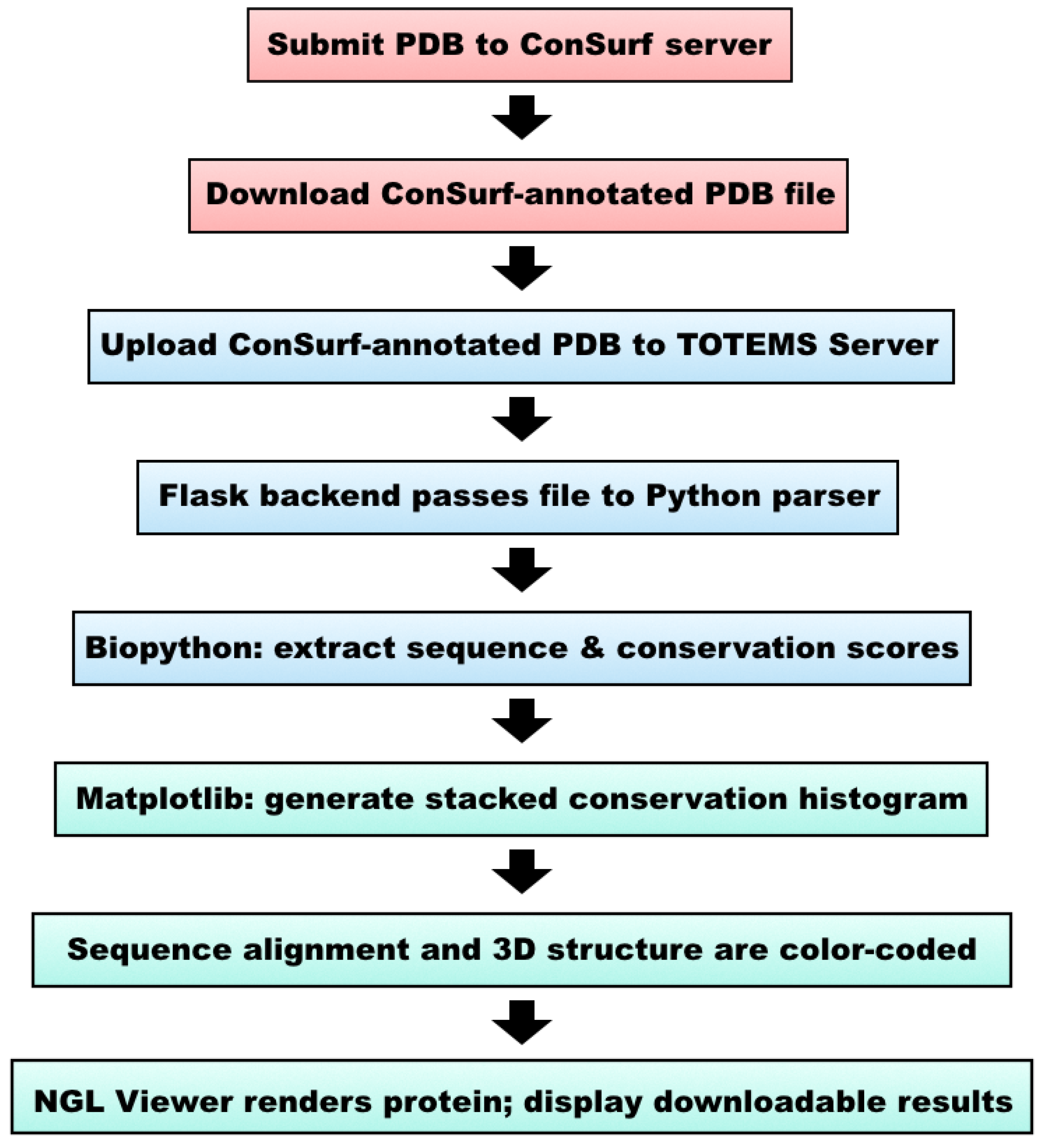
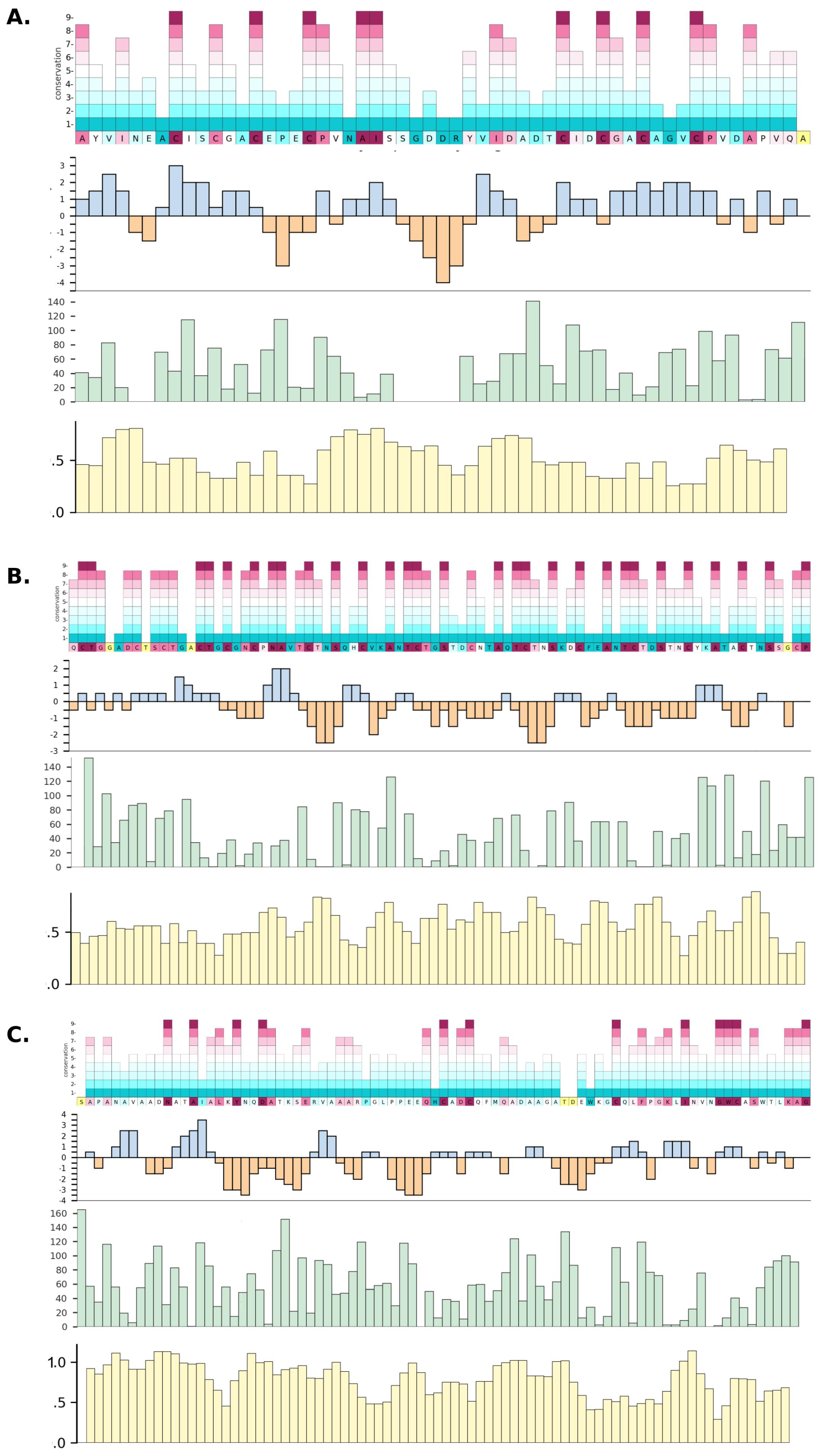
- Conservation Histogram: A one-dimensional stacked bar chart displays the conservation score of each residue, color-coded using the nine-color ConSurf scale. This format facilitates rapid identification of regions with high or low evolutionary variability.The histogram is encoded on the discrete ConSurf 1–9 scale: each residue is drawn as a vertical stack of uniform boxes where bar height corresponds to conservation grade, and color follows the standard ConSurf nine-bin palette (cyan/teal = variable through pink/magenta = highly conserved). Figure 2 provides a visual guide to interpreting the combined height-and-color encoding used throughout TOTEMS outputs.To illustrate how TOTEMS relates to common residue-level biophysical descriptors, we compared TOTEMS conservation profiles to Kyte–Doolittle hydrophilicity, solvent accessibility, and relative mutability for three representative proteins (Figure 3). Figure 3A–C correspond to the ferredoxin 2FDN, the antifreeze protein 1EZG, and the high-potential iron–sulfur protein 1HIP, respectively.The TOTEMS plot reveals biologically meaningful conservation patterns that extend beyond what is captured by individual biophysical descriptors (Figure 3). In the ferredoxin structure 2FDN, the cysteine residues coordinating the two [4Fe–4S] clusters are embedded within strongly conserved sequence regions, reflecting their essential role in cluster integrity and electron transfer. Notably, the region separating these two cysteine-rich motifs is comparatively variable, a feature that emerges clearly in the TOTEMS representation. This variable inter-cluster segment correlates with increased hydrophilicity. We infer that while the electron-transfer centers themselves are under strong evolutionary constraint, the connecting region can tolerate sequence divergence while remaining solvent-exposed and flexible. Despite this variability, the paired iron–sulfur sites exhibit coordinated conservation, consistent with synergistic evolution of two spatially separated but mechanically and electronically coupled centers. Such coordination is critical for efficient electron tunneling, where precise geometric and electrostatic relationships modulate redox potential and electron transfer efficiency [22,23].In the antifreeze protein 1EZG, the TOTEMS plot highlights pronounced conservation at residues corresponding to turns and structural pivots, consistent with the preservation of backbone geometry required to maintain the flat, ordered ice-binding surface characteristic of antifreeze proteins. Structural studies have shown that antifreeze activity depends on the precise spatial arrangement of residues along planar ice-binding surfaces, with backbone turns playing a central role in maintaining this geometry [24].In contrast, the high-potential iron–sulfur protein 1HIP displays a markedly different conservation landscape. Its TOTEMS profile reveals discrete clusters of conserved residues embedded within more variable sequence regions, a pattern consistent with functional specialization rather than uniform evolutionary constraint. Such localized conservation is characteristic of proteins whose activity depends on specific structural motifs or protein–protein interaction interfaces, rather than on globally conserved electrostatic pathways required for long-range electron transfer [1]. Together, these comparisons demonstrate that TOTEMS captures higher-order evolutionary relationships by linking conservation, structural context, and physicochemical properties, providing insight into how different protein classes balance functional constraint and adaptive variability.While the descriptor tracks capture general physicochemical tendencies, TOTEMS highlights residue-specific evolutionary constraint patterns that are not recoverable from any single descriptor, helping to pinpoint functionally important sites that are not necessarily maximally buried, strongly hydrophobic, or uniformly low in mutability. Hydrophilicity and relative mutability scores were obtained using established amino acid scales implemented in the ExPASy ProtScale web server [25]. Solvent accessibility values were computed using the GETAREA server, which implements an analytical calculation of solvent-accessible surface area for macromolecules [26].
- 2.
- Three-Dimensional Structure: A corresponding 3D model of the protein, rendered with the NGL Viewer, applies the same color mapping directly to the molecular surface or cartoon representation. This allows spatial comparison between conserved and variable regions within the protein fold.
3.2. Comparison with Existing Visualization Tools
- The TOTEMS histogram operates at a larger scale than the bar charts in MSAViewer, enhancing readability and motif detection.
- The ConSurf color scheme provides full-spectrum color differentiation, unlike the monochromatic or limited palettes used in other applications.
- The 3D integration of the NGL Viewer enables immediate spatial interpretation of conservation scores, a feature absent in most purely sequence-based tools.
3.3. Performance and User Interaction
3.4. Comparative Summary
4. Discussion
4.1. Integration of Sequence and Structure
4.2. Utility for Functional and Evolutionary Studies
4.3. Advantages and Future Development
4.4. Context Within the Visualization Landscape
5. Conclusions
Author Contributions
Funding
Data Availability Statement
Conflicts of Interest
References
- Ashkenazy, H.; Abadi, S.; Martz, E.; Chay, O.; Mayrose, I.; Pupko, T.; Ben-Tal, N. Consurf 2016: An improved methodology to estimate and visualize evolutionary conservation in macromolecules. Nucleic Acids Res. 2016, 44, W344–W350. [Google Scholar] [CrossRef]
- Schneider, T.D.; Stephens, R.M. Sequence logos: A new way to display consensus sequences. Nucleic Acids Res. 1990, 18, 6097–6100. [Google Scholar] [CrossRef]
- Yachdav, G.; Wilzbach, S.; Rauscher, B.; Sheridan, R.; Sillitoe, I.; Procter, J.; Lewis, S.E.; Rost, B.; Goldberg, T. Msaviewer: Interactive javascript visualization of multiple sequence alignments. Bioinformatics 2016, 32, 3501–3503. [Google Scholar] [CrossRef] [PubMed]
- Schreiber, M.; Brown, C. Compensation for nucleotide bias in a genome by representation as a discrete channel with noise. Bioinformatics 2002, 18, 507–512. [Google Scholar] [CrossRef] [PubMed]
- Crooks, G.E.; Hon, G.; Chandonia, J.M.; Brenner, S.E. WebLogo: A sequence logo generator. Genome Res. 2004, 14, 1188–1190. [Google Scholar] [CrossRef] [PubMed]
- Workman, C.T.; Yin, Y.; Corcoran, D.L.; Ideker, T.; Stormo, G.D.; Benos, P.V. Enologos: A versatile web tool for energy normalized sequence logos. Nucleic Acids Res. 2005, 33, W389–W392. [Google Scholar] [CrossRef]
- Bindewald, E.; Schneider, T.D.; Shapiro, B.A. Correlogo: An online server for 3d sequence logos of rna and dna alignments. Nucleic Acids Res. 2006, 34, W405–W411. [Google Scholar] [CrossRef]
- Chang, T.H.; Horng, J.T.; Huang, H.D. Rnalogo: A new approach to display structural rna alignment. Nucleic Acids Res. 2008, 36, W91–W96. [Google Scholar] [CrossRef][Green Version]
- Li, W.; Yang, B.; Liang, S.; Wang, Y.; Whiteley, C.; Cao, Y.; Wang, X. Blogo: A tool for visualization of bias in biological sequences. Bioinformatics 2008, 24, 2254–2255. [Google Scholar] [CrossRef][Green Version]
- Sharma, V.; Murphy, D.P.; Provan, G.; Baranov, P.V. Codonlogo: A sequence logo-based viewer for codon patterns. Bioinformatics 2012, 28, 1935–1936. [Google Scholar] [CrossRef]
- Thomsen, M.C.F.; Nielsen, M. Seq2logo: A method for construction and visualization of amino acid binding motifs and sequence profiles including sequence weighting, pseudo counts and two-sided representation of amino acid enrichment and depletion. Nucleic Acids Res. 2012, 40, W281–W287. [Google Scholar] [CrossRef] [PubMed]
- Olsen, L.R.; Kudahl, U.J.; Simon, C.; Sun, J.; Schönbach, C.; Reinherz, E.L.; Zhang, G.L.; Brusic, V. Blocklogo: Visualization of peptide and sequence motif conservation. J. Immunol. Methods 2013, 400, 37–44. [Google Scholar] [CrossRef] [PubMed]
- Kultys, M.; Nicholas, L.; Schwarz, R.; Goldman, N.; King, J. Sequence bundles: A Novel Method for Visualising, Discovering and Exploring Sequence Motifs. In BMC Proceedings; Springer: Berlin/Heidelberg, Germany, 2014; Volume 8, pp. 1–10. [Google Scholar]
- Wheeler, T.J.; Clements, J.; Finn, R.D. Skylign: A tool for creating informative, interactive logos representing sequence alignments and profile hidden markov models. BMC Bioinform. 2014, 15, 7. [Google Scholar] [CrossRef] [PubMed]
- Waese, J.; Pasha, A.; Wang, T.T.; van Weringh, A.; Guttman, D.S.; Provart, N.J. Gene slider: Sequence logo interactive data-visualization for education and research. Bioinformatics 2016, 32, 3670–3672. [Google Scholar] [CrossRef]
- Dawson, N.L.; Lewis, T.E.; Das, S.; Lees, J.G.; Lee, D.; Ashford, P.; Orengo, C.A.; Sillitoe, I. Cath: An expanded resource to predict protein function through structure and sequence. Nucleic Acids Res. 2017, 45, D289–D295. [Google Scholar] [CrossRef]
- Wagih, O. ggseqlogo: A versatile r package for drawing sequence logos. Bioinformatics 2017, 33, 3645–3647. [Google Scholar] [CrossRef]
- Tareen, A.; Kinney, J.B. Logomaker: Beautiful sequence logos in python. Bioinformatics 2020, 36, 2272–2274. [Google Scholar] [CrossRef]
- Frazer, J.; Notin, P.; Dias, M.; Gomez, A.; Min, J.K.; Brock, K.; Gal, Y.; Marks, D.S. Disease variant prediction with deep generative models of evolutionary data. Nature 2021, 599, 91–95. [Google Scholar] [CrossRef]
- Jumper, J.; Evans, R.; Pritzel, A.; Green, T.; Figurnov, M.; Ronneberger, O.; Tunyasuvunakool, K.; Bates, R.; Žídek, A.; Potapenko, A.; et al. Highly accurate protein structure prediction with AlphaFold. Nature 2021, 596, 583–589. [Google Scholar] [CrossRef]
- Hunter, J.D. Matplotlib: A 2d graphics environment. IEEE Ann. Hist. Comput. 2007, 9, 90–95. [Google Scholar] [CrossRef]
- Page, C.C.; Moser, C.C.; Chen, X.; Dutton, P.L. Natural engineering principles of electron tunnelling in biological oxidation–reduction. Nature 1999, 402, 47–52. [Google Scholar] [CrossRef] [PubMed]
- Gray, H.B.; Winkler, J.R. Electron transfer in proteins. Q. Rev. Biophys. 2003, 36, 341–372. [Google Scholar] [CrossRef]
- Davies, P.L. Ice-binding proteins: A remarkable diversity of structures for stopping and starting ice growth. Trends Biochem. Sci. 2014, 39, 548–555. [Google Scholar] [CrossRef]
- Wilkins, M.R.; Gasteiger, E.; Bairoch, A.; Sanchez, J.C.; Williams, K.L.; Appel, R.D.; Hochstrasser, D.F. Protein identification and analysis tools in the ExPASy server. Methods Mol. Biol. 1999, 112, 531–552. [Google Scholar] [CrossRef]
- Fraczkiewicz, R.; Braun, W. Exact and efficient analytical calculation of the accessible surface areas and their gradients for macromolecules. J. Comput. Chem. 1998, 19, 319–333. [Google Scholar] [CrossRef]



| Tool | 1D Histogram | 3D Structure | ConSurf Colors | Interactive Web | Hotspot Detection | Reference |
|---|---|---|---|---|---|---|
| ConSurf | ✓ | ✓ | ✓ | ✓ | [1] | |
| Sequence Logos | ✓ | [2] | ||||
| Logopaint | ✓ | [4] | ||||
| WebLogo | ✓ | ✓ | [5] | |||
| enoLogos | ✓ | ✓ | [6] | |||
| CorreLogo | ✓ | ✓ | [7] | |||
| RNALogo | ✓ | ✓ | [8] | |||
| BLogo | ✓ | [9] | ||||
| CODON LOGO | ✓ | [10] | ||||
| Seq2Logo | ✓ | ✓ | [11] | |||
| BlockLogo | ✓ | [12] | ||||
| Sequence Bundles | ✓ | [13] | ||||
| Skylign | ✓ | ✓ | [14] | |||
| MSAViewer | ✓ | ✓ | ✓ | [3] | ||
| Gene Slider | ✓ | ✓ | [15] | |||
| CATH | ✓ | ✓ | [16] | |||
| ggseqlogo | ✓ | [17] | ||||
| LogoMaker | ✓ | [18] | ||||
| EVE | ✓ | ✓ | [19] | |||
| AlphaFold DB | ✓ | ✓ | ✓ | [20] | ||
| TOTEMS | ✓ | ✓ | ✓ | ✓ | ✓ | This work |
| Tool | Primary Function | Reference |
|---|---|---|
| Sequence Logos | Frequency logos for residue variability | [2] |
| MSAViewer | Interactive multiple sequence alignment viewer | [3] |
| CATH | Structural classification of protein domains | [16] |
| TOTEMS | Conservation histogram with 3D mapping | This work |
Disclaimer/Publisher’s Note: The statements, opinions and data contained in all publications are solely those of the individual author(s) and contributor(s) and not of MDPI and/or the editor(s). MDPI and/or the editor(s) disclaim responsibility for any injury to people or property resulting from any ideas, methods, instructions or products referred to in the content. |
© 2026 by the authors. Licensee MDPI, Basel, Switzerland. This article is an open access article distributed under the terms and conditions of the Creative Commons Attribution (CC BY) license.
Share and Cite
Fajardo, M.J.; Marsh, A.G.; Jungck, J.R. TOTEMS: Histogram of Evolutionarily Conserved Amino Acids. Computation 2026, 14, 52. https://doi.org/10.3390/computation14020052
Fajardo MJ, Marsh AG, Jungck JR. TOTEMS: Histogram of Evolutionarily Conserved Amino Acids. Computation. 2026; 14(2):52. https://doi.org/10.3390/computation14020052
Chicago/Turabian StyleFajardo, Michael J., Adam G. Marsh, and John R. Jungck. 2026. "TOTEMS: Histogram of Evolutionarily Conserved Amino Acids" Computation 14, no. 2: 52. https://doi.org/10.3390/computation14020052
APA StyleFajardo, M. J., Marsh, A. G., & Jungck, J. R. (2026). TOTEMS: Histogram of Evolutionarily Conserved Amino Acids. Computation, 14(2), 52. https://doi.org/10.3390/computation14020052