
Article

Numerical Simulation of Diffusion in Cylindrical Pores: The Influence of Pore Radius on Particle Capture Kinetics

by
Valeriy E. Arkhincheev
1,2,*,†,
Bair V. Khabituev
3,
Daniil F. Deriugin
3 and
Stanislav P. Maltsev
3
1
Atomic Molecular and Optical Physics Research Group, Institute for Advanced Study in Technology, Ton Duc Thang University, Ho Chi Minh City 700000, Vietnam
2
Faculty of Electrical and Electronics Engineering, Ton Duc Thang University, Ho Chi Minh City 700000, Vietnam
3
Institute of Mathematics, Physics and Computer Sciences, Buryat State University, Ulan-Ude 670000, Russia
*
Author to whom correspondence should be addressed.
At the time of submission, Valeriy E. Arkhincheev was affiliated with Buryat State University, but is currently affiliated with Ton Duc Thang University.
Computation 2026, 14(1), 15; https://doi.org/10.3390/computation14010015
Submission received: 28 November 2025 / Revised: 19 December 2025 / Accepted: 6 January 2026 / Published: 8 January 2026
(This article belongs to the Section Computational Engineering)

Abstract

The diffusion and trapping of particles in complex porous media are fundamental processes in materials science and bioengineering. This study systematically investigates the influence of pore radius on particle capture kinetics within a three-dimensional cylindrical pore containing randomly distributed absorbing traps. Numerical simulations were performed for a wide range of pore radii (from 3a to 81a, a is a minimal length of the problem, arbitrary unit) and trap concentrations M (from 100 to 5090, these numbers are determined by the pore geometry) using a random walk algorithm. The particle lifetime (τ), characterizing the capture rate, was calculated and analyzed. Results reveal three distinct capture regimes dependent on trap concentration: a diffusion-limited regime at low concentration M (<1000), a transition regime at medium M (1000 < M < 2000), and a trap-density-dominated saturation regime at high M (>2000). For each regime, optimal approximating functions for τ(M) were identified. Furthermore, empirical relationships between the approximating coefficients and the pore radius were derived, which enable the prediction of particle lifetimes. The findings demonstrate that while the pore radius significantly impacts capture kinetics at low trap densities, its influence diminishes as trap concentration increases, converging towards a universal behavior dominated by trap density.

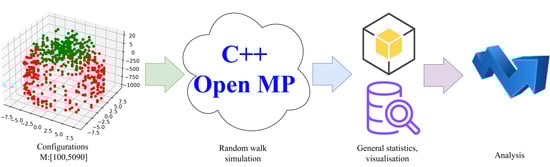
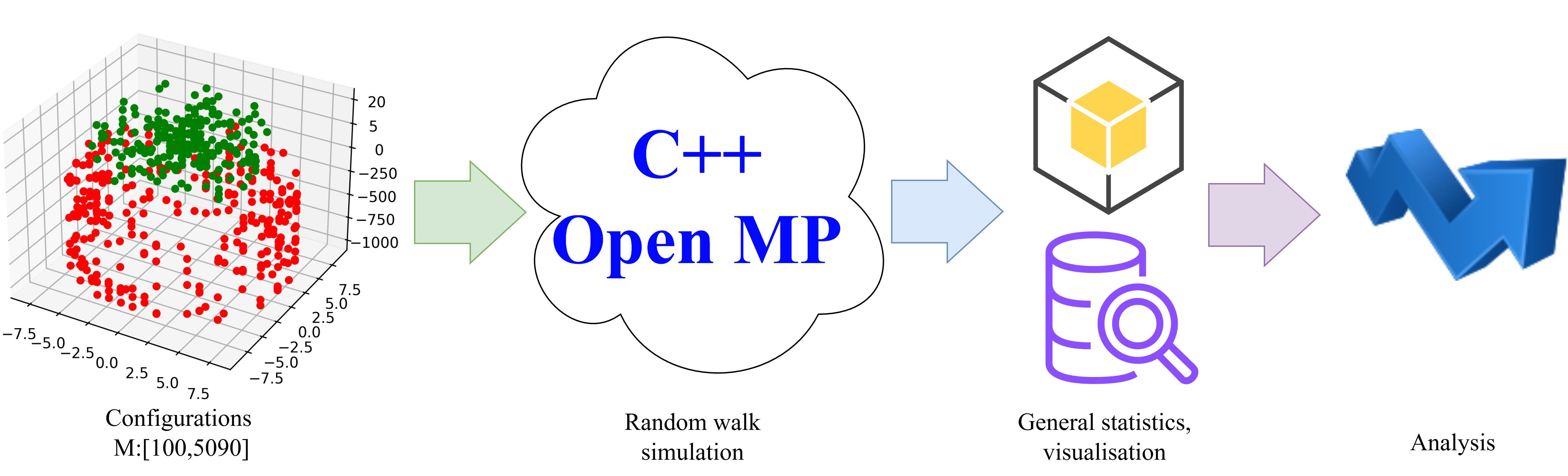
Graphical Abstract

1. Introduction

The foundational theory of random walks on lattices with traps was established in [1,2,3,4], while the diffusion-reaction kinetics among traps was further developed in [5,6]. Interest is also driven by the expected new features in particle transport, and its applications [7,8,9,10,11]. A particularly relevant application involves investigating diffusion and trapping processes of active particles within porous dielectric low-k materials [12,13,14,15]. This problem is relevant for stability, mechanical strength and process compatibility of low k materials [16].
Additionally, the problem of diffusion in complex heterogeneous media and trapping also appeared in emerging bioengineering fields, e.g., in bone nanostructure [17,18], cartilage [19], or brain extracellular space [20]. This problem is studied by different methods, including numerical simulation [21,22,23]. Furthermore, the process of diffusion in pores has a directed form and this driven transport is called active and it is described in some experimentally important situations. This process was recently considered in detail in [24,25,26].
In parallel, significant research attention has recently focused on the dynamic aspects of capture processes. For instance, studies of active (self-propelled) particles in confined geometries have demonstrated a marked deviation of capture kinetics from passive diffusion, largely due to effects like boundary accumulation and motility-induced clustering [27,28]. Furthermore, research into the influence of external fields (e.g., electrical, flow) has revealed complex, nonlinear dependencies in capture probability [29,30]. Modern hybrid and accelerated numerical methods (e.g., [31]) now enable the detailed simulation of such intricate dynamic scenarios within complex geometries. The present study addresses a fundamental yet insufficiently explored question within this broader context: the role of a purely static geometric parameter—the pore radius—in the absence of external fields. Establishing this baseline understanding serves as a necessary foundation for the future analysis of more complex, dynamic cases involving active transport or field-driven processes.
Recently the theory of the capture on traps in the electric field was developed [32] and the numerical simulation of influence of the electric field in two-dimensional homogeneous media was performed [33]. However, these results are not included in this paper, because the driven transport in porous media requires a separate study.
In our previous study [34], we reported numerical simulations of particle diffusion in a three-dimensional cylindrical pore with traps for some values of radius of pore R = 3a, 9a, 27a, and 81a, where a denotes the characteristic system length scale. Notably, the behavior observed for R = 3a, 9a, and 27a differed significantly from that for R = 81a.
In this article, we study particle capture in cylindrical pores to account for the influence of pore radius on particle capture kinetics in a wide range of radius such as R = 3a, 6a, 9a, 15a, 18a, 21a, 27a, 30a, 40a, 50a, 60a, 70a, 81a in more details. Through comprehensive numerical experiments spanning a broad range of pore radii, we systematically investigate the influence of pore radius on particle capture kinetics by analyzing particle lifetime statistics, developing mathematical approximations for these lifetimes, and characterizing the behavior of the corresponding approximating functions as a function of pore radius.

2. Problem Statement and Simulation Algorithm

We numerically investigate the diffusion of active particles within a cylindrical pore of radius R and height H as a simplified model of porous media. The inner pore surface contains randomly distributed absorbing traps, with the trap concentration varied systematically. The initial condition corresponds to a uniform density of N0 particles released at the pore entrance (the Z = 0 plane), simulating a constant particle flux. This setup is motivated by applications such as the diffusion of active species (e.g., oxygen, termed O-particles) through porous materials containing trapping sites (C-particles) [35,36]. While prior studies have employed one-dimensional approximations with multiple particle types [37,38], this work focuses explicitly on the influence of the pore radius R on the particle capture kinetics in a three-dimensional geometry.
A comprehensive set of pore radii R was selected to systematically investigate the geometric influence across a broad spectrum. The initial series R = 3a, 9a, 27a, 81a [34], chosen as a geometric progression, uncovered a qualitative shift in capture kinetics at R = 81a. To perform a detailed analysis of this transitional regime and to establish continuous parameter dependencies on R, the present study employs an extended series of radii. This expanded set incorporates both values that are multiples of the fundamental scale 3a (e.g., 15a, 18a, 21a, 30a) and values that are multiples of 10a (i.e., 40a, 50a, 60a, 70a). This approach ensures uniform coverage of the range from highly confined (3a) to relatively large (81a) pores and facilitates the detection of potential nonlinearities in the scaling relationships.
A critical feature of our comparative analysis is that for each fixed trap number M, an identical set of angular and longitudinal coordinates (θ,z) was used to position traps on the surface for every pore radii R. This methodological choice guarantees that any differences in the calculated mean lifetime τ arise solely from changes in the pore geometry (i.e., the radius R) and are not confounded by random variations in the trap layout. As a direct consequence, the fluctuations in τ as a function of M observed in Figure 1 (and related figures) are not statistical noise but instead reflect the deterministic influence of specific, shared spatial patterns in the trap distributions—such as local clusters or voids along the pore axis—on the capture kinetics. These patterns are identical across all radii, leading to the synchronized fluctuations visible in the plots.
In this paper, we use the same algorithms as in our previous work [34], which include two main components: the Algorithm for Simulations of Diffusion Processes in Media with Traps and the Algorithm for Placing Traps. We described these algorithms in Appendix A.

3. Modeling Process and Results of Numerical Simulation

3.1. Particle Lifetime and the Three Capture Regimes

To characterize the rate of particle capture by traps, we define the lifetime parameter, denoted as τ, based on the exponential decay model:
N t = N 0 exp t τ
Here, N0 is the initial number of particles, and Nt is the number of active particles at iteration t. The lifetime τ corresponds to the characteristic time (in iteration steps) at which the number of particles decreases by a factor of e. Equation (1) describes the simple process of capture on traps with “death” of particle after capture, and the trap can capture particle only one time. However, it differs from CTRW transport [1]. In the CTRW the particles only delays on the traps and there is a possibility to leave the traps, usually described by delay function with the power law kernel.
Numerical experiments revealed that this exponential dependence stabilizes for pores with radii 3a, 9a, and 27a when the number of traps satisfies M ≥ 180 [34]. In contrast, for the larger pore radius 81a, stabilization requires a higher number of traps (M ≥ 220). Qualitatively, this behavior arises due to the increased diffusion volume and the consequently reduced probability of particles reaching the pore surface where traps are located.
In this study, we investigated cylindrical pores with radii R ∈ {3a, 6a, 9a, 15a, 18a, 21a, 27a, 30a, 40a, 50a, 60a, 70a, 81a}, where a denotes the characteristic length scale of the system. The computed lifetime values τ for each pore radius, derived from numerical simulations under consistent trap concentration and distribution conditions, are comprehensively tabulated in Appendix B.
In diffusion processes within media containing traps, a characteristic length scale emerges—the mean distance between traps—which introduces an associated with diffusion the timescale. For one-dimensional diffusion, this timescale is proportional to the square of the inter-trap distance. In higher dimensions, geometric constraints and pore curvature further influence the capture kinetics, necessitating the systematic analysis presented in this work. For one-dimensional diffusion the characteristic time is equal to
t c = 1 D c 2
In this context, D represents the diffusion coefficient, and c denotes the concentration of traps.
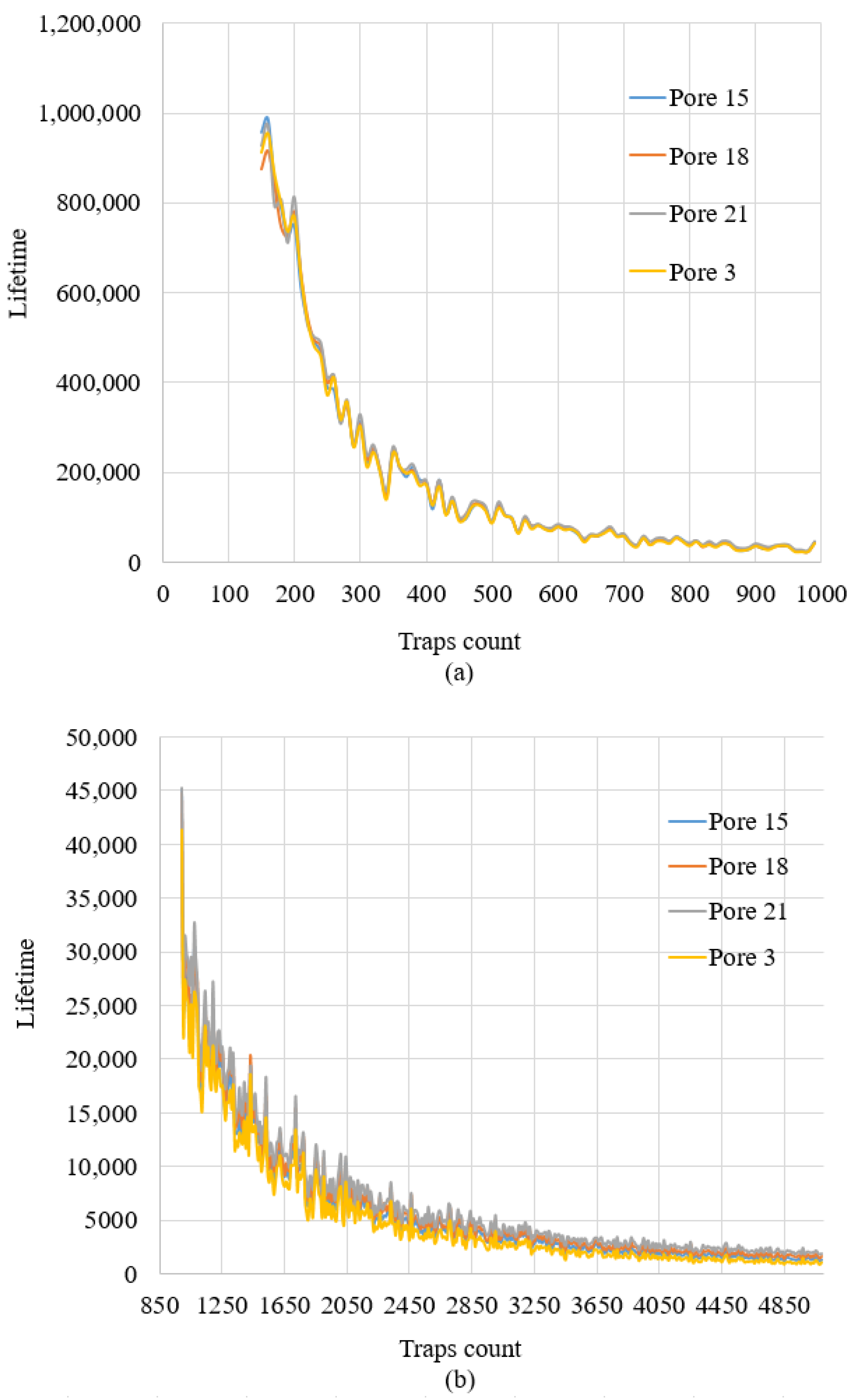
To investigate the influence of pore radius on particle capture kinetics, we analyzed the asymptotic behavior of the lifetime (2) for pores with radii 3a, 15a, 18a, and 21a. We determine the dependence of the average lifetime ⟨τ⟩ on the number of traps M.
Analysis of the curves in Figure 1 reveals that for a fixed pore radius R, a relative reduction in the lifetime (e.g., by 50%) corresponds to a comparable relative increase in the trap number M. This behavior suggests that the dependence τ(M) for a given R can be approximated by a power-law function within the identified concentration intervals. Specifically, in the regime M < 1000, the relationship closely follows τ∝1/M2, characteristic of a diffusion-limited capture process. In contrast, in the saturation regime M > 2000, the effective power-law exponent approaches zero, indicating a weak dependence on M. This observed scaling confirms the universality of the identified regimes and provides a means to predict kinetic changes due to variations in M within a single regime.
The relationship between ⟨τ⟩ and M, illustrated in Figure 1, exhibits two different regimes:
1.
Low trap concentration regime (M < 1000):
The lifetime ⟨τ⟩ decreases rapidly with increasing M, consistent with the scaling according to (2). This behavior reflects a diffusion capture process where the mean distance between traps governs the timescale of particle trapping.
2.
Trap-density-dominated saturation regime (M > 1000):
The lifetime reaches a plateau, indicating that the capture process becomes less sensitive to further increases in trap concentration. In this regime, the system transitions to a state where capture kinetics are dominated by other factors, such as spatial coverage of traps or geometric constraints, rather than by diffusion alone.
These results highlight the critical role of trap concentration and pore radius in determining capture efficiency and provide insight into the underlying mechanisms governing particle trapping in confined geometries.
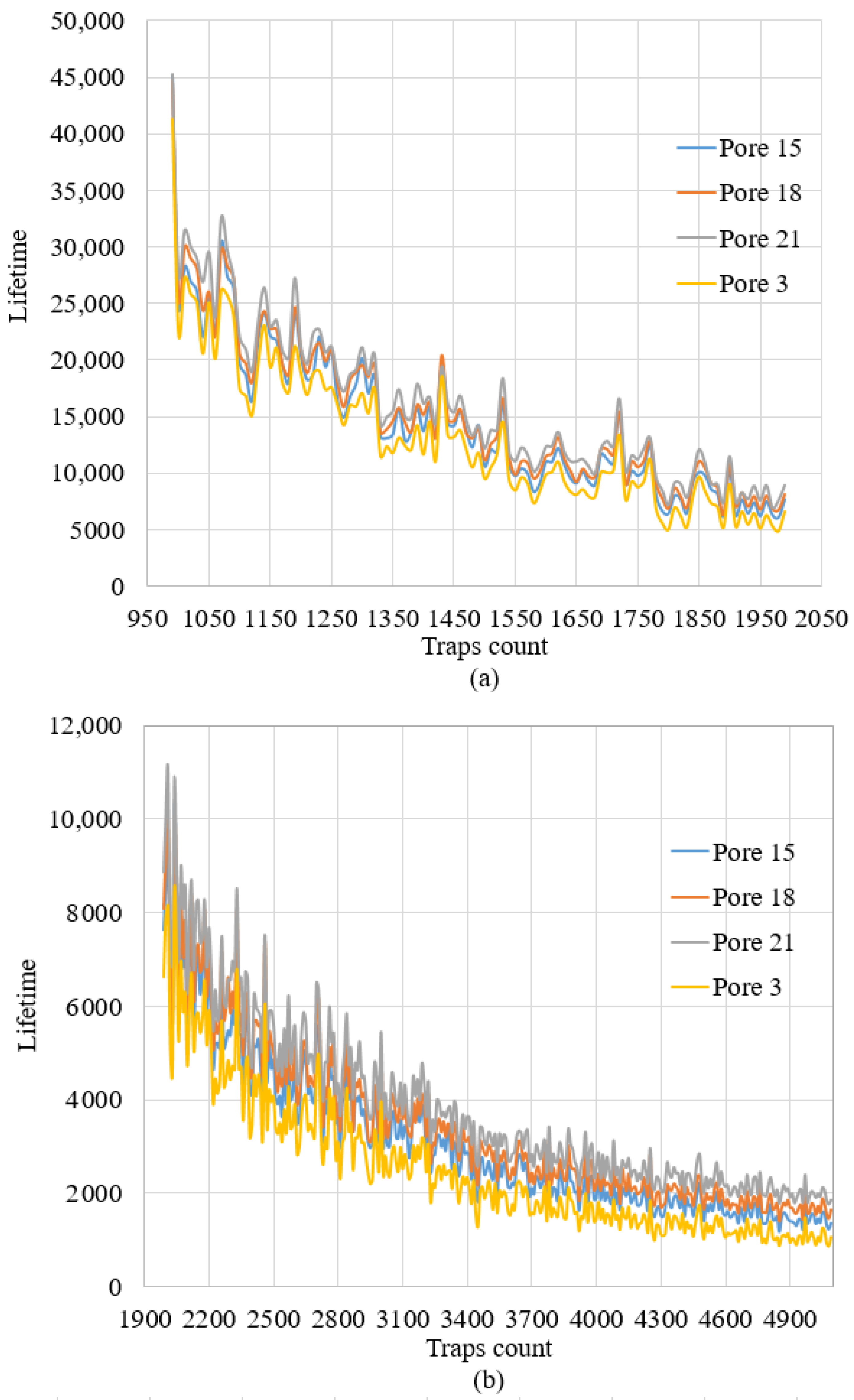
We analyze the dependence of particle lifetime τ on trap concentration M over the extended range M ∈ [1000; 5090], as shown in Figure 2.
A detailed examination of the plots (Figure 1 and Figure 2) and numerical data allows us to specify the following key observations:
  • The observed increase in the mean lifetime τ with pore radius R for a fixed trap number M directly results from the longer average time required for a particle to diffuse from the pore entrance to the cylindrical wall where the traps reside.
  • The functional form of the τ(M) dependence shows a high degree of similarity across different pore radii, pointing to a universal character of the capture kinetics, particularly in the regime of high trap concentrations.
  • The oscillatory behavior of the τ(M) curves for neighboring M values stems from the stochastic nature of the trap placement algorithm. This leads to inherent fluctuations in the local trap density—specifically, variations in their distribution along the longitudinal coordinate z—for each individual spatial configuration.
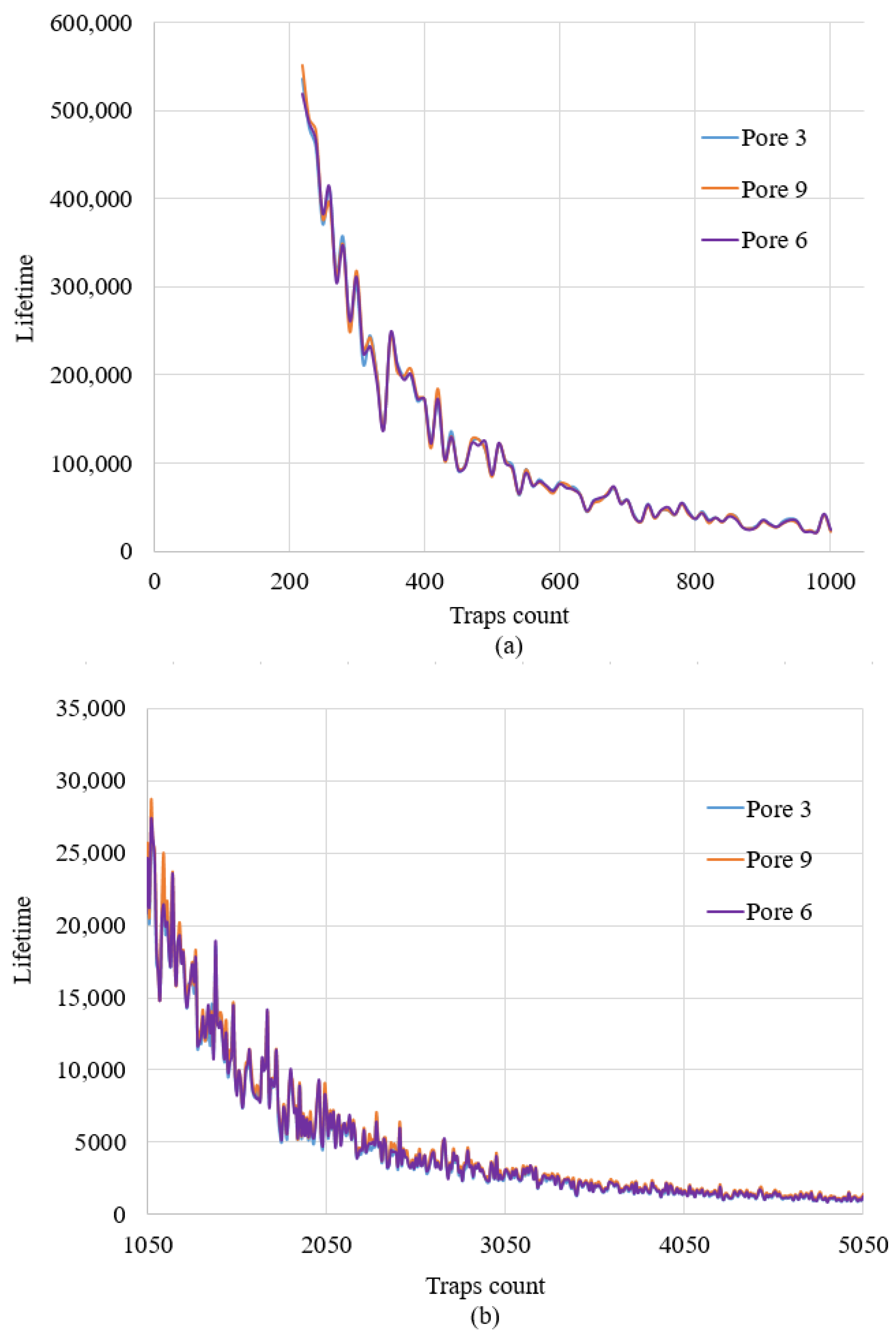
To elucidate the influence of pore radius on particle capture kinetics, we examine in detail the lifetime dynamics within small-radius pores. Figure 3 presents the dependence of the lifetime τ on the number of traps M for pore radii 3a, 6a, and 9a. The behavior of τ for these small radii is nearly identical, suggesting that geometric effects are minimal in this regime.
The nearly identical behavior of the curves for different radii in both regimes demonstrates the unified capture kinetics in small pores, where geometric differences have minimal effect on the diffusion-limited trapping process.
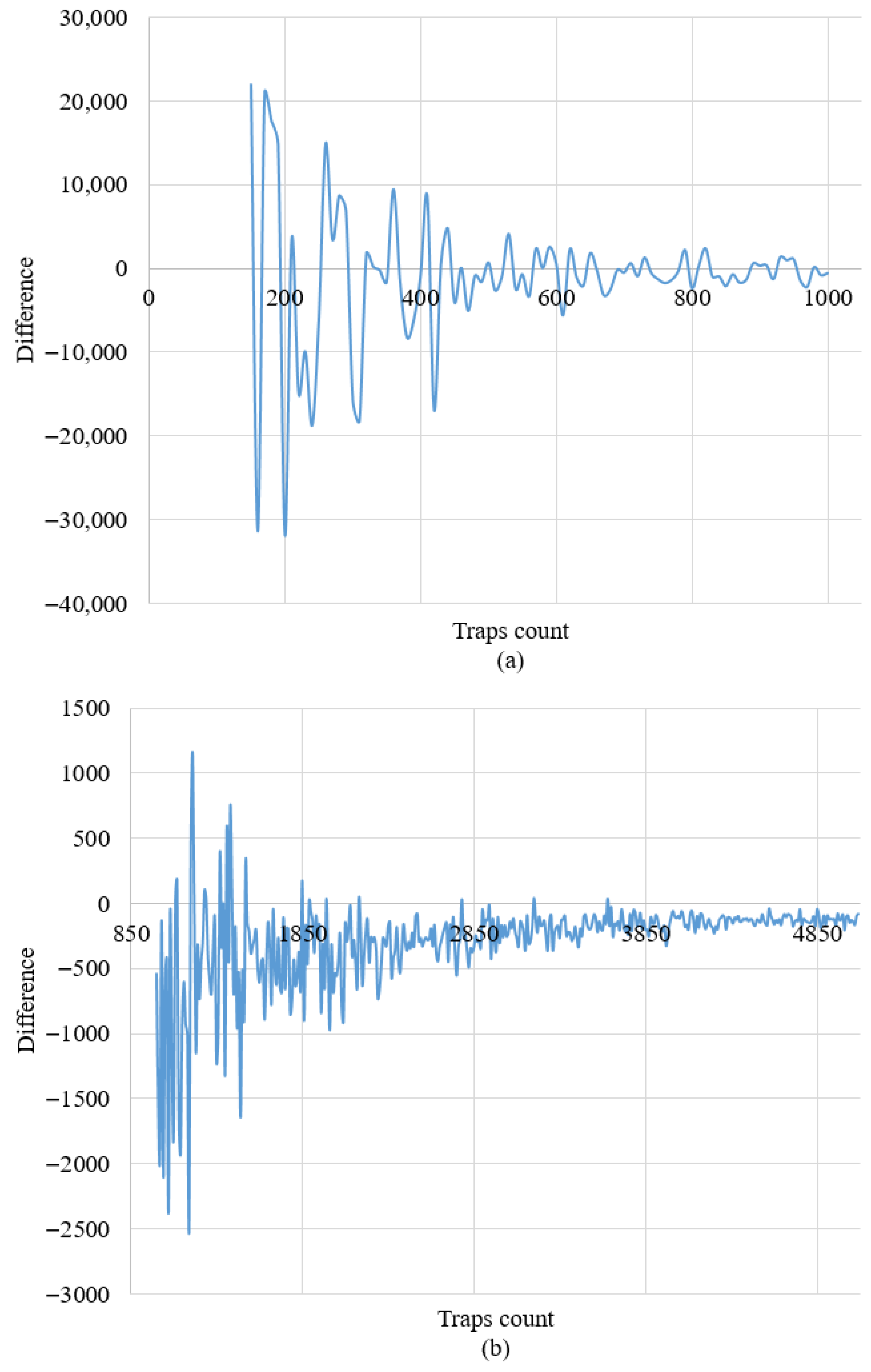
For quantitative analysis, we compute the lifetime difference Δτ = τ(3a) − τ(9a) to compare capture efficiency between pores of radii 3a and 9a. Figure 4 illustrates the dependence of Δτ on M. Positive values of Δτ (above the abscissa) indicate a longer lifetime in the 3a pore, implying slower capture, while negative values reflect a longer lifetime in the 9a pore. The observed variation in Δτ with M highlights subtle differences in capture kinetics due to pore size, even when radii are relatively small.
Figure 1. Dependence of particle lifetime (τ) on the number of traps (M) for different pore radii. The top figure (a) corresponds to the low trap concentration regime (M < 1000), while the bottom figure (b) shows the high concentration regime (M > 1000). Figures illustrate the transition from a steep, radius-dependent decrease in lifetime at low M to a convergence towards a plateau at high M, highlighting the influence of trap density.
Computation 14 00015 g001
Figure 2. Dependence of particle lifetime (τ) on trap concentration (M) for different pore radii. The top figure (a) displays the medium concentration regime (1000 < M < 2000), while the bottom figure (b) shows the high concentration regime (M > 2000). The plots demonstrate the continuing convergence of lifetime values across different pore radii with increasing M, indicating the transition to a trap-density-dominated capture process where geometric parameters become less significant.
Computation 14 00015 g002
Figure 3. Dependence of particle lifetime (τ) on trap concentration (M) for small-radius pores (3a, 6a, 9a). The top figure (a) shows the low concentration regime (M < 1000), while the bottom figure (b) presents the high concentration regime (M > 1000).
Computation 14 00015 g003
Figure 4 shows that the absolute magnitude of the lifetime difference between the 3a and 9a pores, ∣Δτ∣, decreases monotonically as the number of traps M increases. The maximum absolute values of Δτ occur in the low trap concentration regime (M < 1500), while for M→3000, the difference diminishes sharply. The observed decrease in the absolute difference ∣Δτ∣ with increasing M (Figure 4) can be largely attributed to the reduction in the overall magnitude of the mean lifetime τ and the corresponding decrease in the variance of its estimate. At low M, τ values are large and exhibit considerable dispersion, resulting in significant fluctuations in Δτ. A more direct indication of a transition to a regime where pore geometry exerts a diminished influence is the universalization of the functional form of the τ(M) dependence across different radii. This is evident in Figure 1, where the curves for various R values converge, showing a similar functional trend.
Figure 4. Difference in particle lifetime (Δτ = τ3a − τ9a) between pores of radii 3a and 9a as a function of trap concentration (M). The top (a) shows the low concentration regime (M < 1000), where significant differences in lifetime are observed due to geometric effects. The bottom (b) displays the high concentration regime (M > 1000), demonstrating the convergence of lifetime values as trap density becomes the dominant factor in capture kinetics. Positive Δτ values indicate longer lifetime in the 3a pore.
Computation 14 00015 g004
To further quantify the variability in lifetime among small-radius pores (3a, 6a, 9a), we analyzed the range of τ values, defined as
R τ   M = max τ 3 a , τ 6 a , τ 9 a min τ 3 a , τ 6 a , τ 9 a ,
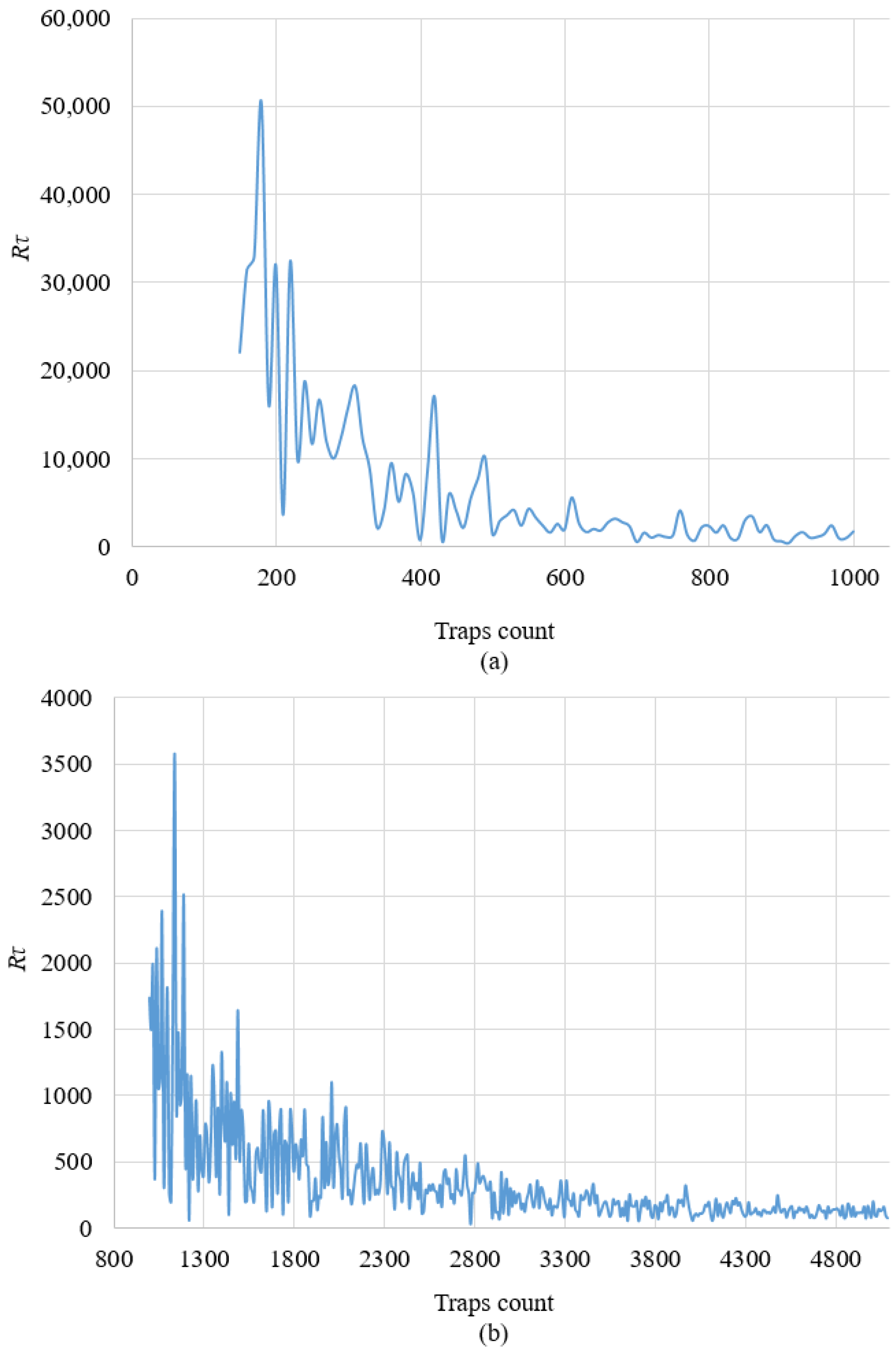
Figure 5 presents the dependence of Rτ on M. The range Rτ provides a measure of the dispersion in lifetimes due to pore size differences, complementing the pairwise comparison in Figure 4.
For small radii (3a, 6a, 9a), the absolute magnitude of this range is indeed substantial: in the low-concentration regime (M < 1000), Rτ reaches up to ~50,000 iterations (Figure 5a). Expressed relative to the mean lifetime τ for a given M, this corresponds to a spread of approximately 10–25%. This suggests that while the qualitative shape of the kinetic curves is similar for these small pores, the quantitative efficiency of capture differs notably. For M > 1000, the value of Rτ(M) decreases, reflecting both a faster overall capture process and a diminishing influence of the pore radius as trap density becomes the dominant factor.
To further elucidate these observations, we analyze the pore size dependence of the maximum lifetime τmax. Table 1 summarizes the pore radius at which the maximum lifetime τmax is achieved for each trap concentration M, providing insight into how optimal capture conditions shift with system parameters.
For trap concentrations exceeding M > 2000, the maximum lifetime τmax was predominantly observed in pores of radius 9a, indicating that larger pores can sustain longer particle lifetimes under high trap density conditions. This result highlights the critical interplay between geometric confinement and trap density in determining capture kinetics. Specifically, while higher trap concentrations generally enhance capture efficiency, the pore radius modulates this effect by influencing diffusion paths and particle-surface interaction probabilities.
These findings underscore the necessity of simultaneously optimizing both geometric parameters (e.g., pore radius) and trap density when designing porous materials for applications requiring controlled particle capture or retention. Future work could extend this analysis to more complex pore geometries and broader parameter ranges to further refine design principles.

3.2. Approximation of Lifetime Dependence on Trap Concentration

As demonstrated in previous work [29], the lifetime τ, which characterizes the capture rate by traps, exhibits a strong dependence on trap concentration M. To quantitatively analyze this relationship, the range of M was divided into three distinct intervals based on concentration levels:
  • Low concentration: M < 1000
  • Medium concentration: 1000 < M < 2000
  • High concentration: M > 2000
For each interval, three candidate functions were evaluated to approximate τ(M):
  • Hyperbola: τ(M) = a/M + b
  • Quadratic hyperbola: τ(M) = a/M2 + b
  • Parabola: τ(M) = a + bM + cM2
Approximation was performed using nonlinear least-squares optimization via the curve_fit function from the scipy module in Python 3.8. The quality of each fit was assessed using the mean absolute error (MAE) between predicted and simulated values. Detailed numerical results and error metrics are provided in Appendix C.
For all pore radii studied, the optimal approximating functions are established:
  • M < 1000: Quadratic hyperbola (captures initial steep decay)
  • 1000 < M < 2000: Hyperbola (balances simplicity and accuracy)
  • M > 2000: Parabola (describes saturation behavior effectively)
The average approximation error for the selected functions was below 15% for all pores, meeting the acceptable accuracy threshold.
These results indicate a transition in the functional form of τ(M) across concentration regimes, reflecting underlying changes in the dominance of physical mechanisms, such as diffusion-limited capture at low M and transition to density-driven saturation at high M.
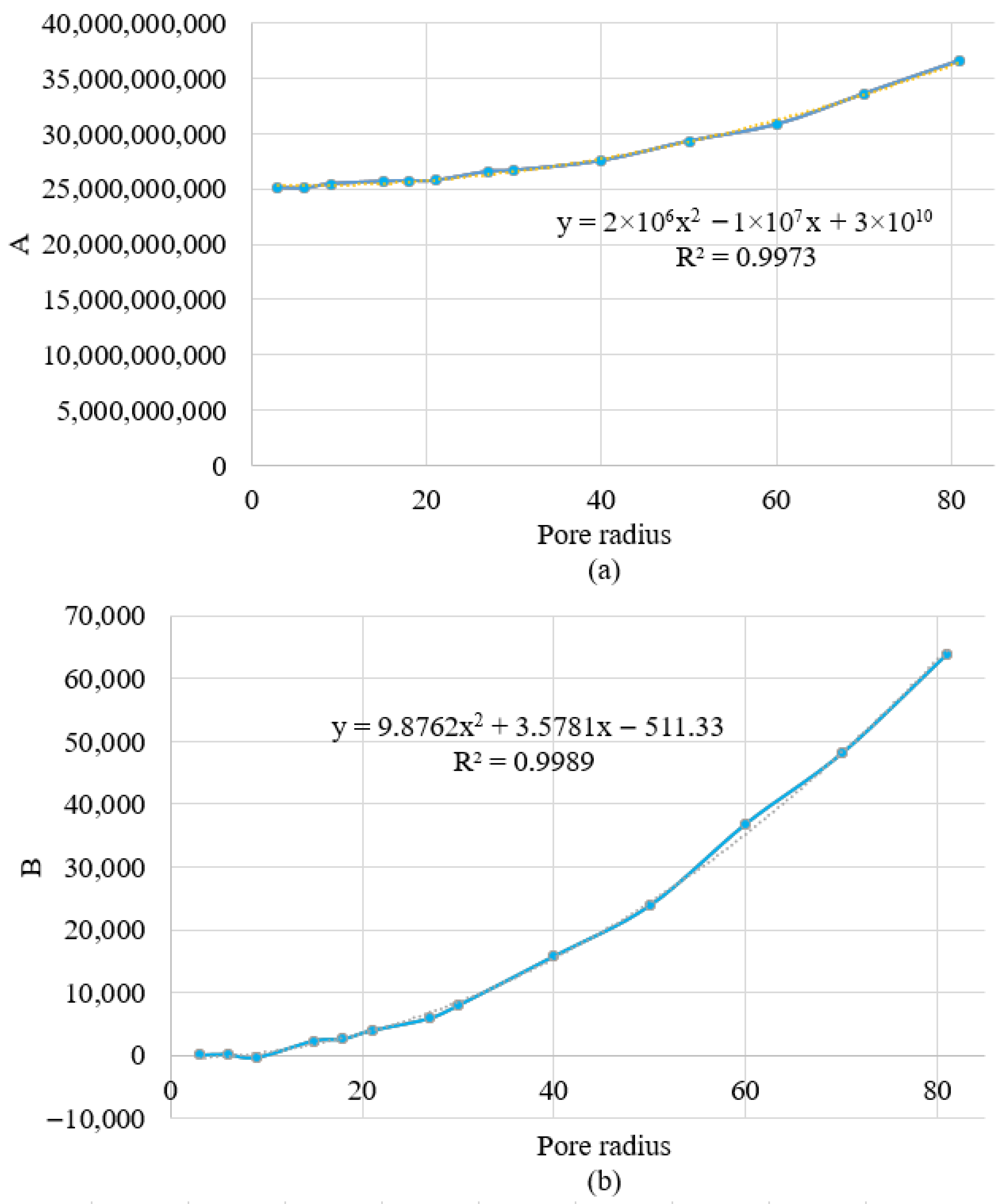
The dependence of the approximating function coefficients on pore radius was analyzed for both low and medium trap concentration regimes. Figure 6 illustrates the relationship between the coefficients A and B of the quadratic hyperbola τ(M) = A/M2 + B, used to model lifetime τ for M < 1000, and the pore radius R.
The nonlinear relationships demonstrate how geometric scaling affects capture kinetics parameters, with notable deviations observed for larger pore radii (R > 60a) due to finite-size effects and transition in diffusion regimes. A notable shift in the behavior of these coefficients is observed as the pore radius increases, with significant deviations occurring for larger radii (60a, 70a, 81a). These deviations can be attributed to the following factors:
  • Transition to a qualitatively distinct diffusion regime, where bulk diffusion characteristics become more dominant;
  • Manifestation of finite-size effects, as the pore dimensions approach the scale of the system;
  • Alterations in the nature of particle interactions due to reduced confinement.
The relationship between the coefficients and pore radius is nonlinear, particularly for coefficient B. A second-order polynomial approximation was applied to quantify this dependence:
For coefficient A: A(R) = (175.637 R2 – 604.571 R + 2.53 × 106) × 104
with a coefficient of determination R2 = 0.9973.
For coefficient B: B(R) = 10.441 R2 – 28.387 R – 311.530
with R2 = 0.9989.
The high R2 values confirm the accuracy of the polynomial approximations, providing a reliable empirical basis for predicting coefficient behavior across varying pore radii.
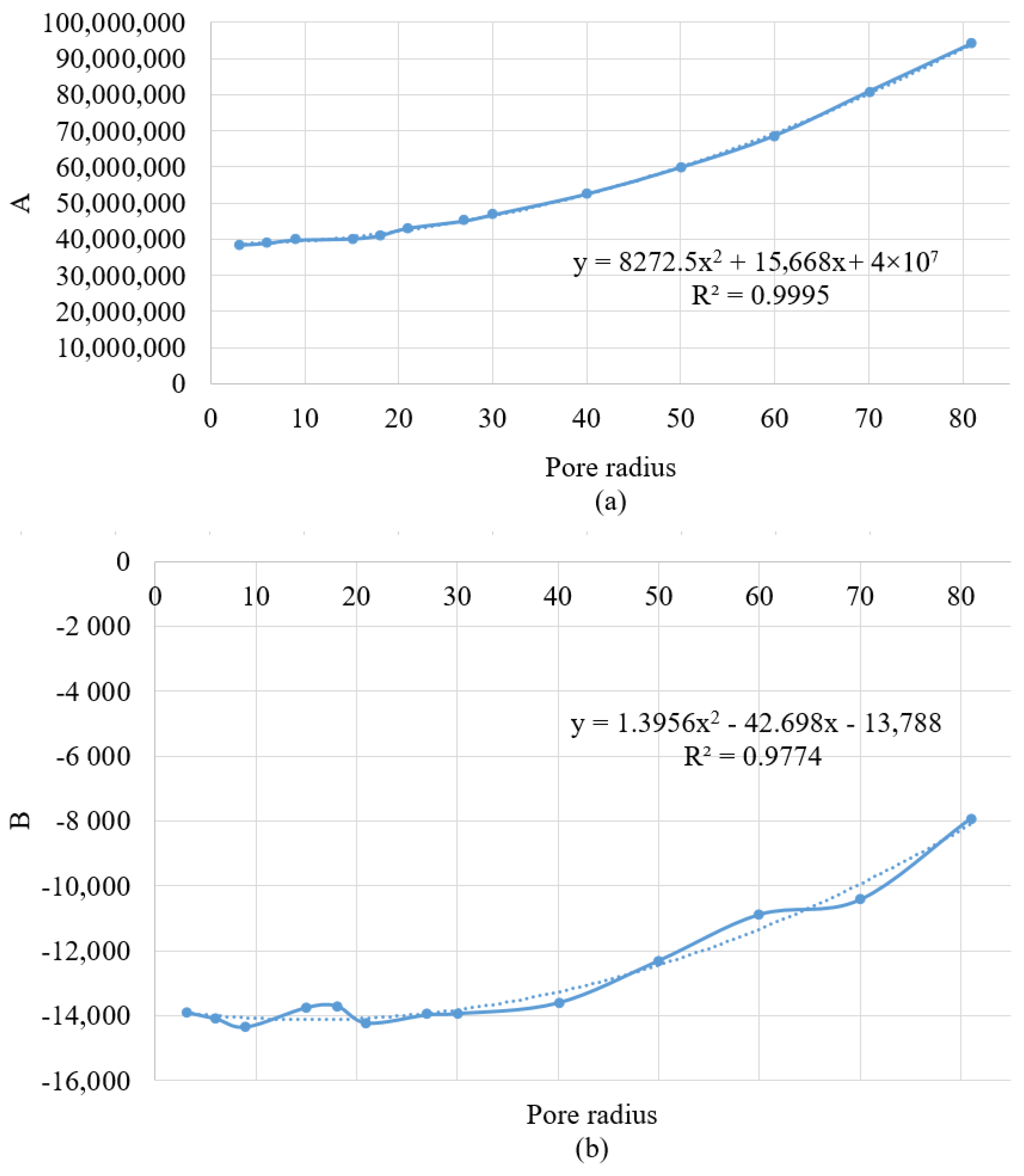
Figure 7 illustrates the dependence of the coefficients A and B of the hyperbolic function τ(M) = A/M + B (used to approximate the lifetime τ for 1000 < M < 2000) on the pore radius R.
The observed trends highlight the influence of pore size on capture kinetics in the medium concentration regime. To quantify this dependence, a second-order polynomial approximation was applied to both coefficients:
For coefficient A: A(R) = (0.827 R2 + 1.567 R + 3856.749) × 104
For coefficient B: B(R) = 1.396 R2 – 42.698 R – 13,788.25
The dependencies of the coefficients A and B on the pore radius R (Figure 6 and Figure 7) provide a quantitative characterization of geometric effects on the capture kinetics. The monotonic increase in coefficient B with R shows that the asymptotic lifetime in the saturation regime is governed by the time required for diffusion to the pore wall—a timescale that grows with the pore radius. Coefficient A captures how the sensitivity of the lifetime τ to the trap concentration M is itself modulated by the pore size.
The high-order polynomial model effectively captures the nonlinear relationship between the approximating function coefficients and the pore radius, underscoring the complex interplay between geometric confinement and trap distribution in the medium concentration regime. These empirical formulas serve as a predictive tool for estimating lifetime behavior across diverse pore sizes, highlighting the critical role of pore geometry in modulating capture efficiency.
The derived coefficients allow for the direct calculation of lifetime approximating functions, eliminating the need for further numerical simulations. To validate this approach, we assessed the performance of these functions against data for pore radii ranging from a to 81a. A comparison of the approximation errors is presented in Table 2. The first row of the table indicates the trap concentration range for which the lifetime was approximated, while the subsequent rows provide the following data:
  • SO: The mean approximation error obtained from direct numerical fitting of the lifetime data.
  • SO2: The mean approximation error resulting from the application of the coefficient formulas derived above.

This comparison demonstrates the accuracy and utility of the empirical coefficient formulas in predicting lifetime behavior, reducing computational costs while maintaining high fidelity to the full numerical results.
Table 2. Comparison of approximation errors between direct fitting (SO) and formula-based (SO2) methods.
M < 10001000 < M < 2000
R SO SO2 SO SO2
3a13.85413.82213.84514.131
6a13.49813.48513.47813.612
9a13.46213.55113.47413.432
15a-13.3812.69712.595
18a12.27512.28311.75711.589
21a12.79912.77610.76210.456
27a12.02612.1210.32210.302
30a11.29911.335109.937
40a11.16411.18.2168.373
50a9.6179.6477.4317.422
60a10.42710.1736.1136.117
70a9.6119.7215.4945.527
81a8.7689.0234.6534.63
During the approximation procedure using the curve_fit function for the pore radius R = 15a in the low concentration regime (M < 1000), a non-convergence error of the covariance matrix was encountered. However, application of the empirical coefficient formulas described in Section 3.2 yielded a satisfactory result, with a mean approximation error of 13.38.
In the low concentration range (M < 1000), the maximum discrepancy between the direct numerical approximation error (SO) and the formula-based error (SO2) was 0.255 for R = 81a, while the minimum discrepancy was 0.004 for R = 50a. The average discrepancy in this regime was 0.084. For the medium concentration range (1000 <M <2000), the maximum discrepancy reached 0.306 (R = 21a), the minimum was 0.015 (R = 50a), and the average discrepancy was 0.103.
Analysis of the accuracy of the two approximation methods (direct numerical fitting, SO, and the formula-based approach, SO2) across different trap concentration ranges revealed the following key patterns:
  • High Consistency: Both methods exhibit exceptionally high consistency across all pore radii, with correlation coefficients r > 0.998 in both concentration ranges, confirming the reliability of the proposed empirical approach.
  • Radius-Dependent Accuracy: The mean approximation errors decrease systematically with increasing pore radius, reflecting the influence of geometric parameters on modeling accuracy.
  • Small Discrepancies: The maximum discrepancies between SO and SO2 are 0.084 for M < 1000 and 0.306 for 1000 < M < 2000, representing less than 3% of the average error values in each regime.
  • Statistical Validation: The Wilcoxon signed-rank test confirmed the absence of statistically significant differences between the methods (p > 0.38), supporting the use of the formula-based approach for calculating approximating function coefficients.
These results demonstrate that the empirical coefficient formulas provide a computationally efficient and accurate alternative to direct numerical fitting, enabling reliable estimation of particle lifetimes without the need for extensive numerical experiments.

4. Discussion

Let us discuss the results obtained from the numerical simulation of particle diffusion in porous media. Our investigation reveals several key patterns regarding the influence of pore radius and trap concentration on the capture rate of diffusing particles:
1.
Behavior with Geometric Modulation: The lifetime (τ) of particles exhibits a similar dependence on the number of traps (M) across various pore radii. However, for significantly larger radii (R > 50a), this dependence undergoes substantial modifications. These changes are attributed to a transition into a qualitatively different diffusion regime, where finite-size effects and diminished confinement alter particle dynamics.
2.
Concentration-Driven Convergence: The difference in lifetime values for different pore radii markedly decreases as trap concentration increases. This convergence indicates that at high trap densities, the capture process becomes dominated by the abundance of traps rather than by geometric constraints.
3.
Identification of Capture Regimes: Three distinct operational regimes for particle capture were identified and characterized based on trap concentration:
  • Low concentration regime (M < 1000): Capture is strongly influenced by diffusion limitations and pore geometry.
  • Medium concentration regime (1000 < M < 2000): A transition region where both trap density and geometry play significant roles.
  • High concentration regime (M > 2000): Capture is primarily controlled by trap density, with geometric parameters having a diminished effect.
4.
Physical Origin of the Observed Trapping Regimes: Role of Discrete Geometry and Trap Coverage. The empirical boundaries between the trapping regimes (at M ≈ 1000 and M ≈ 2000) can be attributed to the discrete geometry of the system and the trap placement algorithm. Since the cylinder height is H = 1000 lattice nodes and the traps are placed at integer z-coordinates, a condition M << 1000 means many discrete z-levels contain no traps. This creates localized regions with low trap density, allowing particles entering from the pore opening to diffuse deeper before being captured. This effect accounts for the relatively long lifetimes τ observed in the low-concentration regime. When M ≈ 1000, there is on average one trap per discrete z-value, leading to a near-continuous coverage of the pore wall. At this point, the system transitions to a regime where the search for a trap on this now densely populated surface becomes the rate-limiting step in the capture kinetics. A further increase in M to ~2000 results in an average of two traps per z-coordinate. This significantly minimizes local fluctuations in coverage and effectively eliminates the possibility of extended, trap-free regions. Consequently, the system enters a saturation regime where the wall can be considered uniformly and densely coated. In this regime, the lifetime τ becomes largely independent of M and is instead governed primarily by the time required for a particle to diffuse from the pore entrance to the wall—a timescale dependent on the pore radius R. Thus, the qualitative division into three distinct regimes is a general consequence of the chosen cylindrical geometry and trap-placement algorithm. The specific numerical values of the thresholds are directly linked to the discrete spatial scale of the model, particularly the cylinder height H.
5.
Optimal Approximation Functions: For each regime, an optimal approximating function was determined:
  • Low concentrations (M < 1000): τ(M) = b + a/M2
  • Medium concentrations (1000 < M < 2000): τ(M) = b + a/M
  • High concentrations (M > 2000): τ(M) = a + bM + cM2
6.
Empirical Coefficient Calculation: We proposed a method for calculating the coefficients of these approximating functions using empirical relationships derived from the pore radius. A comparative evaluation with directly fitted functions demonstrates the high accuracy of this method, providing a reliable and computationally efficient predictive tool.
7.
Prospects for Application and Further Research. The quantitative relationships and empirical approximations derived for particle lifetime in cylindrical pores provide a foundational basis for engineering estimates in designing porous materials with tailored sorption or catalytic properties, where precise control over active particle delivery and capture rates is crucial. Specifically, these results are applicable to optimizing the microstructure of low-permittivity dielectrics (low-k materials) and analyzing transport phenomena in biomineralized tissues. To extend the model’s applicability, several important directions for future development are identified: (1) incorporating external force fields (e.g., electric, chemical potential gradients) to simulate driven or active transport; (2) considering dynamic (fluctuating) or partially reflective traps; (3) including interactions among diffusing particles; and (4) generalizing the geometry to more complex, fractal, or anisotropic pore networks. Pursuing these extensions will facilitate the creation of a more universal model, applicable to a broader range of challenges in filtration, separation, targeted drug delivery, and the analysis of intracellular transport.
The findings of this study are significant for the design and engineering of porous materials with tailored sorption properties. The developed approximation dependencies enable the prediction of particle capture kinetics across a wide range of geometric parameters, facilitating the optimization of material performance for specific applications.
The investigation of diffusion processes and capture by traps is also important for cell metabolism and protein activity [39]. The processes of water transfer are responsible for the diffusion of nutrients, metabolic exchange, and ion transport within bone structures. They contribute to the mechanism of bone adaptation, the stabilization of the mineral structure, and the interaction between minerals and collagen [40,41,42].
Another promising application is the modeling of migration and entrapment for heavy organic components, such as asphaltene clusters, within porous hydrocarbon reservoirs. Diffusive transport under a gravitational field and the subsequent precipitation of asphaltenes onto active mineral surface sites—which can be represented as traps in our framework—are potential key mechanisms in the formation of tar mats (high-viscosity zones critical for reservoir development) [43]. Our core model, extended to account for an external driving field (e.g., a concentration or gravity gradient), could provide a foundation for the quantitative assessment of the conditions and kinetics governing such capture processes.

Author Contributions

Conceptualization, V.E.A. and B.V.K.; methodology, V.E.A. and B.V.K.; software, B.V.K. and D.F.D.; validation, B.V.K. and S.P.M.; formal analysis, V.E.A. and B.V.K.; investigation, V.E.A.; resources, B.V.K. and S.P.M.; data curation, S.P.M.; writing—original draft preparation, V.E.A. and B.V.K.; writing—review and editing, V.E.A. and B.V.K.; visualization, S.P.M. and D.F.D.; supervision, V.E.A.; project administration, V.E.A.; funding acquisition, V.E.A. All authors have read and agreed to the published version of the manuscript.

Funding

The research was funded by the Russian Science Foundation № 24-21-00356, https://rscf.ru/project/24-21-00356/ (accessed on 2 October 2025).

Data Availability Statement

The original materials presented in this study are hosted on the github repository: https://github.com/bairinc0/MDPI_Diffustion_3_D_pores-_comprasion (accessed on 3 October 2025). Further inquiries can be directed to the corresponding author.

Acknowledgments

We thank the Institute of Mathematics, Physics and Computer Sciences, Buryat State University, for supporting this research through provision of computational resources and facilities. Valeriy E. Arkhincheev is now affiliated with Ton Duc Thang University.

Conflicts of Interest

The authors declare no conflicts of interest.

Appendix A

Appendix A.1. Algorithm of Simulations for Diffusion Processes in Media with Traps

Let us briefly describe the modeling algorithm in cylindrical pores with traps on the surfaces of cylinders. Particles undergo random walk diffusion within a cylindrical pore. We modeled particle movement as a discrete step of size 1a in one of the coordinate directions. At each iteration, a random number generator selects the direction of movement (i.e., the coordinate to change). We evaluate the following boundary and interaction conditions:
  • Free Position Movement: If the target coordinate is unoccupied, the particle moves to the new position.
  • Obstacle Encounter: If the target coordinate is occupied, the particle remains at its current position.
  • Boundary Condition: Upon reaching the cylindrical boundary without trap, the particle returns to its previous position.
  • Trap Interaction: If a particle attempts to move to a lattice site occupied by a trap, the particle is permanently captured and removed from the simulation, and the trap is simultaneously deactivated.
All numerical simulations were implemented in C++ (ISO C++17 standard [44]) using the Microsoft Visual Studio 2022 development environment. To ensure statistical reliability and robustness of the results, we perform 20 independent runs for each unique parameter set. We used the Mersenne Twister algorithm (mt19937) to generate random numbers.

Appendix A.2. Placing of Traps

This study presents a comparative analysis of particle capture efficiency in cylindrical pores with different radii, under constant trap concentration conditions. The simulations established that the use of identical spatial distributions of traps relative to the cylindrical coordinate system (i.e., same axial z and angular θ positions) for different pore radii is essential for ensuring a valid and controlled comparison of capture kinetics. This approach isolates the effect of pore geometry by eliminating confounding variables associated with random variations in trap placement. Trap positions were defined in a cylindrical coordinate system as (Rncosθ, Rnsinθ, z), where Rn is the pore radius, θ is the azimuthal angle, and z is the axial coordinate. We used the following algorithm to generate trap placements:
  • Coordinate Sampling: The axial coordinate z and the azimuthal angle θ were independently sampled from uniform distributions over predefined intervals [zmin, zmax] and [0,2π), respectively.
  • Radial Coordinate: The radial coordinate was fixed to the pore radius R, where R∈{3a, 6a, 9a, 15a, 18a, 21a, 27a, 30a, 40a, 50a, 60a, 70a, 81a}.
  • Discretization: The calculated Cartesian coordinates (x, y, z) were discretized by truncating) the fractional part, mapping them to the simulation lattice.
This approach ensures that the relative distribution of traps along the axial and angular coordinates is identical for all pore radii, isolating the effect of the radius change itself. Maintaining this consistency in trap placement along z and θ is essential for the rigorous comparison of capture dynamics across varying pore sizes, as it isolates the effect of radius change from random variations in trap layout.

Appendix A.3. Limitations

The interpretation of our results is governed by the key assumptions of the numerical model, which also define its current limitations and scope of applicability.
  • Diffusion Model: Particle transport is modeled as a discrete random walk on a simple cubic lattice. This assumes isotropic diffusion with a constant coefficient and does not incorporate memory effects or anomalous (non-Fickian) diffusion.
  • Trap Properties: Traps are treated as perfect absorbers. They are immobile, non-interacting, and represent idealized, static capture sites.
  • Particle–Particle Interactions: The model does not include explicit interactions (e.g., volume exclusion, cooperative effects) between diffusing particles, consistent with the assumption of a dilute system. A weak, algorithmic excluded-volume constraint is implemented: if a particle attempts to move to an already occupied site, it remains at its original position. Our simulations show that such events are exceedingly rare (<0.0001% of total steps), confirming that inter-particle interactions are negligible under the studied conditions.
  • Initial/Boundary Conditions: The initial condition—an instantaneous point source of particles at the pore entrance—idealizes a constant influx. The cylindrical wall (except for trap sites) is perfectly reflecting.
These assumptions were essential to isolate and systematically investigate the influence of pore radius and trap density. Consequently, the direct application of our results is limited for systems featuring strong inter-particle interactions, dynamic or correlated traps, or significantly inhomogeneous/anisotropic diffusion properties. Future work will be directed towards relaxing these constraints to broaden the model’s applicability.

Appendix B

Lifetime Achievement Analysis

Using the developed algorithm, we generated 500 distinct spatial configurations of traps. The trap concentration M varied across the range 100 ≤ M ≤ 5090 with a discrete step size of ΔM = 10. For each value of M, identical spatial distributions of traps were created for the entire set of studied pore radii: {3a, 6a, 9a, 15a, 18a, 21a, 27a, 30a, 40a, 50a, 60a, 70a, 81a}.
Computational Parameters:
  • Number of independent simulation runs per configuration: 20
  • Initial number of particles, N0: 200
  • Maximum number of iterations per simulation: 1,000,000
The minimum concentration of traps required to determine the lifetime meaningfully is M > 125. This threshold is derived from the definition of lifetime, where Nt = N0/e ≈ 74, ensuring a sufficient number of capture events for statistical significance. At these low concentrations, nearly all traps participate in the capture process. The corresponding lifetime statistics for this low-concentration regime are presented in Table A1.
Table A1. Calculated particle lifetime (τ) statistics for the low trap concentration regime (M > 125).
M/R3a6a9a15a18a21a27a30a40a50a60a70a81a
1300000000000000
1400000000000000
1501818181316161110103000
1603614133120000
17020201919201918201510920
1902020202020202020202016117
2002020192019202020201516127
21020202020202020202020201819
22020202020202020202020202020
A value of ‘0’ indicates that the lifetime τ could not be reliably determined (insufficient capture events) for the given M and R.
The table is structured with the pore radii listed in the header and the number of traps M in the first column. Analysis of the results reveals the following key findings:
The lifetime behavior stabilizes (i.e., is consistently achieved across all simulation runs) for pore radii in the range 3a to 60a when the number of traps meets or exceeds M ≥ 210.
For larger pore radii (70a and 81a), a similar stabilization of lifetime behavior occurs at a slightly higher trap count of M ≥ 220.
This observed difference in the stabilization threshold highlights the influence of pore geometry on the capture process. The increased volume and surface area of larger pores require a higher density of traps to achieve a consistent and reliable measurement of the particle lifetime, as the characteristic diffusion time scales with the system size.

Appendix C

Approximation

A visual analysis of the obtained dependencies τ(M) was conducted, leading to the evaluation of three distinct approximating functions for each concentration interval:
  • Hyperbola: τ(M) = a/M + b
  • Quadratic hyperbola: τ(M) = a/M2 + b
  • Parabola: τ(M) = a + bM + cM2
The quality of each approximation was quantified using the mean absolute error (MAE) between the model predictions and the simulation data. The results of this analysis, including the MAE for each function and pore radius, are summarized in Table A2.
Table A2. Mean absolute error (MAE) of the approximating functions for the lifetime τ(M) across different pore radii.
Low ConcentrationMedium ConcentrationHigh Concentration
R MAE (Hyperbola) MAE (Quadratic
Hyperbola)
MAE (Hyperbola) MAE (Quadratic
Hyperbola)
MAE (Parabola)
3a 29.93 13.854 13.845 46.197 13.877
6a 30.18 13.498 13.478 45.355 14.215
9a 30.751 13.462 13.474 44.691 13.294
15a 28.387 120.041 12.697 12.469 11.659
18a 27.965 12.275 11.757 11.509 10.555
21a 28.027 12.799 10.762 10.555 9.974
27a 26.088 12.026 10.322 36.932 7.943
81a 12.168 8.768 4.653 20.722 3.147
The table presents the values of the mean absolute error (MAE) for the approximating functions across different pore radii. The first row specifies the trap concentration ranges (M). The second row contains the headers for the approximating functions: hyperbola (τ(M) = a/M + b), quadratic hyperbola (τ(M) = a/M2 + b), and parabola (τ(M) = a + bM + cM2). The first column lists the pore radii, while the main body of the table displays the corresponding MAE values.
Hyperbolic functions were applied for low and medium concentration regimes; however, for high concentrations (M > 2000), these functions did not yield acceptable accuracy. Following established recommendations, where the mean approximation error should not exceed 15%, our results support the use of the following functions for each concentration regime:
  • Low concentration (M < 1000): Quadratic hyperbola (τ(M) = a/M2 + b)
  • Medium concentration (1000 < M < 2000): Hyperbola (τ(M) = a/M + b)
  • High concentration (M > 2000): Parabola (τ(M) = a + bM + cM2)
This selection ensures optimal accuracy and reliability in predicting particle lifetime across diverse geometric and trap concentration conditions.

References

  1. Montrol, E.W.; Weiss, G.H. Random Walks on Lattices. J. Math. Phys. 1965, 6, 167–175. [Google Scholar] [CrossRef]
  2. Ryazanov, G.V. Random walks on a flat lattice with traps. Theor. Math. Phys. 1972, 10, 271–277. [Google Scholar] [CrossRef]
  3. Balagurov, B.Y.; Vaks, V.G. Theory of diffuse phase transitions. J. Exp. Theor. Phys. 1973, 65, 1600–1604. [Google Scholar]
  4. Balagurov, B.Y.; Vaks, V.G. Random walks of particles on lattices with traps. J. Exp. Theor. Phys. 1973, 65, 1939–1943. [Google Scholar]
  5. Kozlov, S.V.; Ovchinnikov, A.A.; Yenikolopyan, N.S. Diffusion control in reactions between macromolecules. Polym. Sci. USSR 1970, 12, 1115–1123. [Google Scholar] [CrossRef]
  6. Torquato, S. Diffusion and Reaction Among Traps: Some Theoretical and Simulation Results. J. Stat. Phys. 1991, 65, 1173. [Google Scholar] [CrossRef]
  7. Skolnick, M.; Torquato, S. Simulated diffusion spreadability for characterizing the structure and transport properties of two-phase materials. Acta Mater. 2023, 250, 118857. [Google Scholar] [CrossRef]
  8. Donsker, M.; Varadhan, S. Asymptotics for the Wiener sausage. Commun. Pure Appl. Math. 1975, 28, 525–565. [Google Scholar] [CrossRef]
  9. Benitez, F.; Duclut, C.; Chaté, H.; Delamotte, B.; Dornic, I.; Muñoz, M.A. Langevin Equations for Reaction-Diffusion Processes. Phys. Rev. Lett. 2016, 117, 100601. [Google Scholar] [CrossRef]
  10. Agliari, E.; Burioni, R.; Uguzzoni, G. The true reinforced random walk with bias. New J. Phys. 2012, 14, 063027. [Google Scholar] [CrossRef]
  11. Ioffe, D.; Velenik, Y. Self-Attractive Random Walks: The Case of Critical Drifts. Commun. Math. Phys. 2012, 313, 209–235. [Google Scholar] [CrossRef]
  12. Maex, K.; Baklanov, M.R.; Shamiryan, D.; Iacopi, F.; Brongersma, S.H.; Yanovitskaya, Z.S. Low Dielectric Constant Materials for Micro Electronics. J. Appl. Phys. 2003, 93, 8793–8841. [Google Scholar] [CrossRef]
  13. Kunnen, E.; Barkema, G.T.; Maes, C.; Shamiryan, D.; Urbanowicz, A.; Struyf, A.; Baklanov, M.R. Integrated diffusion–recombination model for describing the logarithmic time dependence of plasma damage in porous low-k materials. Microelectron. Eng. 2011, 88, 631–634. [Google Scholar] [CrossRef][Green Version]
  14. Rasadujjaman, M.; Wang, X.; Wang, Y.; Zhang, J.; Arkhincheev, V.E.; Baklanov, M.R. Analytical Study of Porous Organosilicate Glass Films Prepared from Mixtures of 1,3,5- and 1,3-Alkoxysilylbenzenes. Materials 2021, 14, 1881. [Google Scholar] [CrossRef] [PubMed]
  15. Baklanov, M.R.; Mogilnikov, K.P.; Vishnevskiy, A.S. Challenges in porosity characterization of thin films:cross-evaluation of different techniques. J. Vac. Sci. Technol. A Vac. Surf. Film. 2021, 41, 050802. [Google Scholar] [CrossRef]
  16. Gerelt-Od, M.; Rasadujjaman, M.; Arkhincheev, V.E.; Vorotilov, K.A.; Baklanov, M.R. Phenomenological analysis of percolation phenomena in porous low-k dielectrics. Coatings 2025, 15, 1138. [Google Scholar] [CrossRef]
  17. Nicholson, C. Diffusion and Related Transport Mechanisms in Brain Tissue. Rep. Prog. Phys. 2001, 64, 815–884. [Google Scholar] [CrossRef]
  18. Bini, F.; Pica, A.; Novelli, S.; Pecci, R.; Bedini, R.; Marinozzi, A.; Marinozzi, F. 3D FEM Model to Simulate Brownian Motion inside Trabecular Tissue from Human Femoral Head. Comput. Methods Biomech. Biomed. Eng. Imaging Vis. 2022, 10, 500–507. [Google Scholar] [CrossRef]
  19. Bini, F.; Pica, A.; Marinozzi, A.; Marinozzi, F. 3D random walk model of diffusion in human Hypo- and Hyper- mineralized collagen fibrils. J. Biomech. 2021, 125, 110586. [Google Scholar] [CrossRef]
  20. Bini, F.; Pica, A.; Marinozzi, A.; Marinozzi, F. A 3D model of the effect of tortuosity and constrictivity on the diffusion in mineralized collagen fibril. Sci. Rep. 2019, 9, 2658. [Google Scholar] [CrossRef]
  21. Momot, K.I. Diffusion tensor of water in articular cartilage. Eur. Biophys. J. 2011, 40, 81–91. [Google Scholar] [CrossRef]
  22. Jin, S.; Zador, Z.; Verkman, A. Random-Walk model of diffusion in three dimensions in brain extracellular space: Comparison with microfiberoptic photobleaching measurements. Biophys. J. 2008, 95, 1785–1794. [Google Scholar] [CrossRef]
  23. Maghsoudi-Ganjeh, M.; Wang, X.; Zeng, X. Computational investigation of the effect of water on the nanomechanical behavior of bone. J. Mech. Behav. Biomed. Mater. V 2020, 101, 103454. [Google Scholar] [CrossRef] [PubMed]
  24. Akimoto, T.; Cherstvy, A.G.; Metzler, R. Enhancement, slow relaxation, ergodicity and rejuvenation of diffusion in biased continuous-time random walks. Phys. Rev. E 2018, 98, 022105. [Google Scholar] [CrossRef]
  25. Evstigneev, M.; Zvyagolskaya, O.; Bleil, S.; Eichhorn, R.; Bechinger, C.; Reimann, P. Diffusion of colloidal particles in a tilted periodic potential: Theory versus experiment. Phys. Rev. E Stat. Nonlinear Soft Matter Phys. 2008, 77, 041107. [Google Scholar] [CrossRef] [PubMed]
  26. Reimann, P.; Eichhorn, R. Weak Disorder Strongly Improves the Selective Enhancement of Diffusion in a Tilted Periodic Potential. Phys. Rev. Lett. 2008, 101, 180601. [Google Scholar] [CrossRef] [PubMed]
  27. Lloyd, J.R.; Murray, C.E.; Ponoth, S.; Cohen, S.; Liniger, E. The effect of Cu diffusion on the TDDB behavior in low-k interlevel dielectrics. Microelectron. Reliab. 2006, 46, 1643–1647. [Google Scholar] [CrossRef]
  28. Burkey, D.D.; Gleason, K.K. Structure and mechanical properties of thin films deposited from 1,3,5-trimethyl-1,3,5-trivinylcyclotrisiloxane and water. J. Appl. Phys. 2003, 93, 5143–5150. [Google Scholar] [CrossRef]
  29. Wu, C.; Li, Y.; Barbarin, Y.; Ciofi, I.; Croes, K.; Bömmels, J.; De Wolf, I.; Tőkei, Z. Correlation between field dependent electrical conduction and dielectric breakdown in a SiCOH based low-k (k = 2.0) dielectric. Appl. Phys. Lett. 2013, 103, 032902. [Google Scholar] [CrossRef]
  30. Hong, C.; Milor, L. Electric field enhancement caused by porosity in ultra-low-k dielectrics. In Proceedings of the ISSM 2005, IEEE International Symposium on Semiconductor Manufacturing, San Jose, CA, USA, 13–15 September 2005; IEEE: Piscataway, NJ, USA, 2005; pp. 434–437. [Google Scholar] [CrossRef]
  31. Flegg, M.B.; Chapman, S.J.; Erban, R. The two-regime method for optimizing stochastic reaction-diffusion simulations. J. R. Soc. Interface 2012, 9, 859–868. [Google Scholar] [CrossRef] [PubMed] [PubMed Central]
  32. Arkhincheev, V.E. Effect of drift on the temporal asymptotic form of the particle survival probability in media with absorbing traps. J. Exp. Theor. Phys. 2017, 124, 275–278. [Google Scholar] [CrossRef]
  33. Arkhincheev, V.E.; Khabituev, B.V.; Maltsev, S.P. The effect of drift on the temporal asymptotics of the probability of particle survival in media with absorbing traps: Numerical simulation. J. Exp. Theor. Phys. 2025, 167, 703–710. [Google Scholar] [CrossRef]
  34. Arkhincheev, V.E.; Khabituev, B.V.; Maltsev, S.P. Numerical Simulation of Capture of Diffusing Particles in Porous Media. Computation 2025, 13, 82. [Google Scholar] [CrossRef]
  35. Safaverdi, S.; Barkema, G.T.; Kunnen, E.; Urbanowicz, A.M.; Maes, C. Saturation of front propagation in a reaction-diffusion process describing plasma damage in porous low-k materials. Phys. Rev. B 2011, 83, 245320. [Google Scholar] [CrossRef]
  36. Vilinski-Mazur, K.; Kirillov, B.; Rogozin, O.; Kolomenskiy, D. Numerical modeling of oxygen diffusion in tissue spheroids undergoing fusion using function representation and finite volumes. Sci. Rep. 2025, 15, 5054. [Google Scholar] [CrossRef]
  37. Sycheva, A.A.; Voronina, E.N.; Rakhimova, T.V.; Rakhimov, A.T. Influence of porosity and pore size on sputtering of nanoporous structures by low-energy Ar ions: Molecular dynamics study. Appl. Surf. Sci. 2019, 475, 1021–1032. [Google Scholar] [CrossRef]
  38. Arkhincheev, V.E.; Kunnen, E.; Baklanov, M.R. Active species in porous media: Random walk and capture in traps. J. Microelectron. 2011, 88, 686–689. [Google Scholar] [CrossRef]
  39. Sycheva, A.A.; Voronina, E.N.; Palov, A.P. Analysis of results of silicon sputtering simulation with various Ar–Si potentials. J. Surf. Investig. X-Ray Synchrotron Neutron Tech. 2019, 13, 1272–1279. [Google Scholar] [CrossRef]
  40. Surowiec, R.K.; Allen, M.R.; Wallace, J.M. Bone Hydration: How We Can Evaluate It, What Can It Tell Us, and Is It an Effective Therapeutic Target? Bone Rep. 2022, 16, 101161. [Google Scholar] [CrossRef] [PubMed]
  41. Wang, Y.; Von Euw, S.; Fernandes, F.M.; Cassaignon, S.; Selmane, M.; Laurent, G.; Pehau-Arnaudet, G.; Coelho, C.; Bonhomme-Coury, L.; Giraud-Guille, M.M.; et al. Water-Mediated Structuring of Bone Apatite. Nat. Mater. 2013, 12, 1144–1153. [Google Scholar] [CrossRef] [PubMed]
  42. Rai, R.K.; Sinha, N. Dehydration-Induced Structural Changes in the Collagen-Hydroxyapatite Interface in Bone by High-Resolution Solid-State NMR Spectroscopy. J. Phys. Chem. C 2011, 115, 14219–14227. [Google Scholar] [CrossRef]
  43. Mullins, O.C.; Mohamed, T.S.; Kristensen, M.; Pan, S.; Wang, K.; Akkutlu, I.Y.; Torres-Verdin, C. Measurement and Modeling of Viscous Oil and Tar Mat Formation with a Single, Low-maturity Charge. Energy Fuels 2024, 38, 23387–23397. [Google Scholar] [CrossRef]
  44. Programming languages—C++. International Organization for Standardization: Geneva, Switzerland, 2017. Available online: https://www.iso.org/standard/68564.html (accessed on 18 December 2018).
Figure 5. Lifetime range Rτ for small-radius pores as a function of trap concentration M. The top (a) corresponds to the low concentration regime (M < 1000). The bottom (b) represents the high concentration regime (M > 1000).
Computation 14 00015 g005
Figure 6. Dependence of approximation function coefficients A and B (τ(M) = A/M2 + B) on pore radius R in the low trap concentration regime (M < 1000). The top (a) shows coefficient A, with units of iteration. Panel (b) shows constant term B, with units of iteration.
Computation 14 00015 g006
Figure 7. Dependence of approximation function coefficients A and B (τ(M) = A/M + B) on pore radius R in the low trap concentration regime (M < 1000). The top (a) shows coefficient A, with units of iteration. Panel (b) shows constant term B, with units of iteration.
Computation 14 00015 g007
Table 1. Pore radius corresponding to the maximum lifetime τmax for varying trap concentrations M.
Pore Radius Number of Configurations
with Maximum Lifetime τmax
%
3a408.1
6a5611.3
9a39980.6
Disclaimer/Publisher’s Note: The statements, opinions and data contained in all publications are solely those of the individual author(s) and contributor(s) and not of MDPI and/or the editor(s). MDPI and/or the editor(s) disclaim responsibility for any injury to people or property resulting from any ideas, methods, instructions or products referred to in the content.