
Assessment of Computational Tools for Analysing the Observability and Accessibility of Nonlinear Models



Abstract
1. Introduction
2. Materials and Methods
2.1. Modelling Framework
2.2. Concepts
2.2.1. Structural Identifiability and Observability (SIO)
2.2.2. Nonlinear Accessibility and Controllability (NAC)
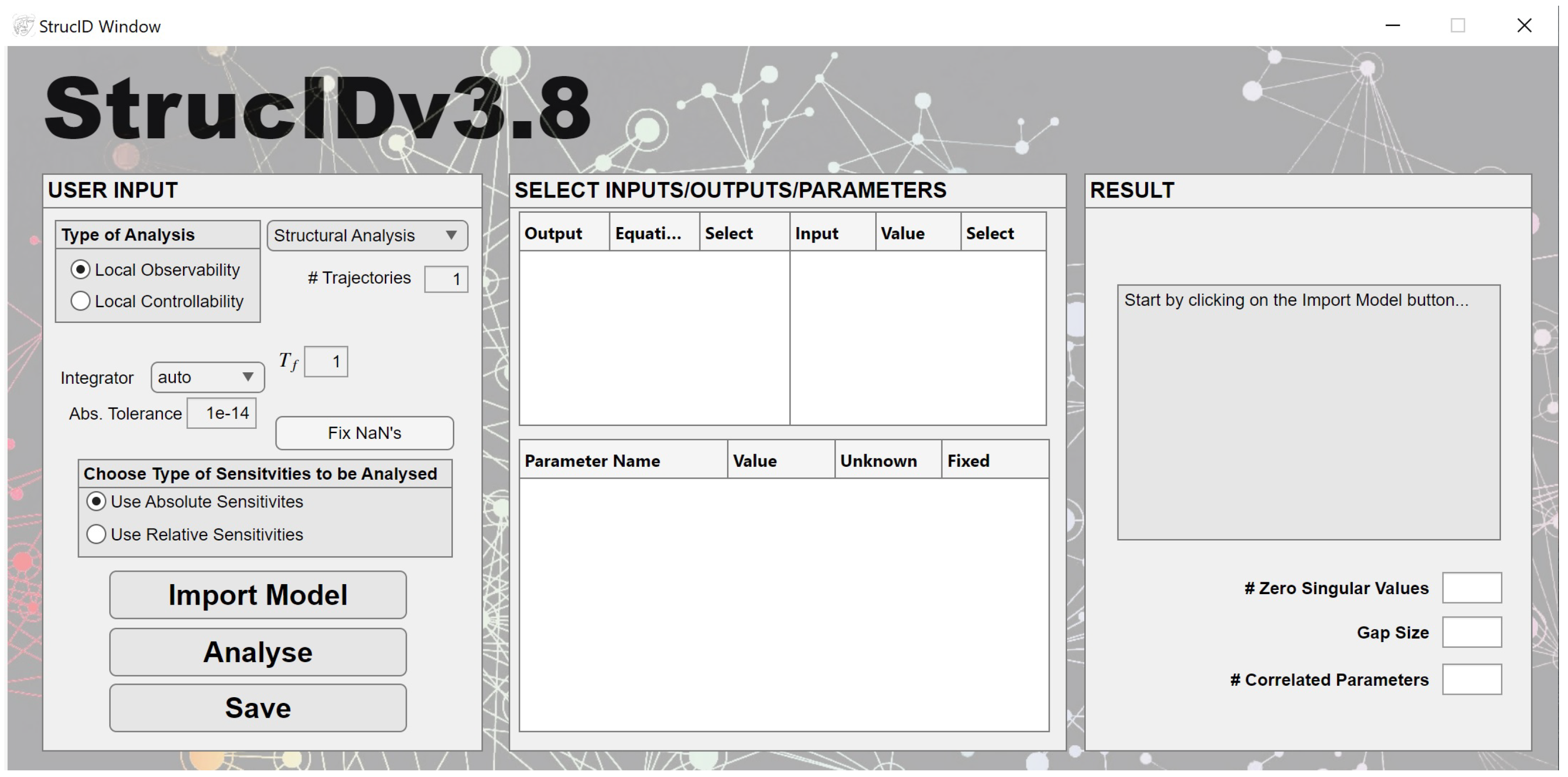
2.3. StrucID
2.3.1. SIO Analysis with StrucID
2.3.2. NAC Analysis with StrucID
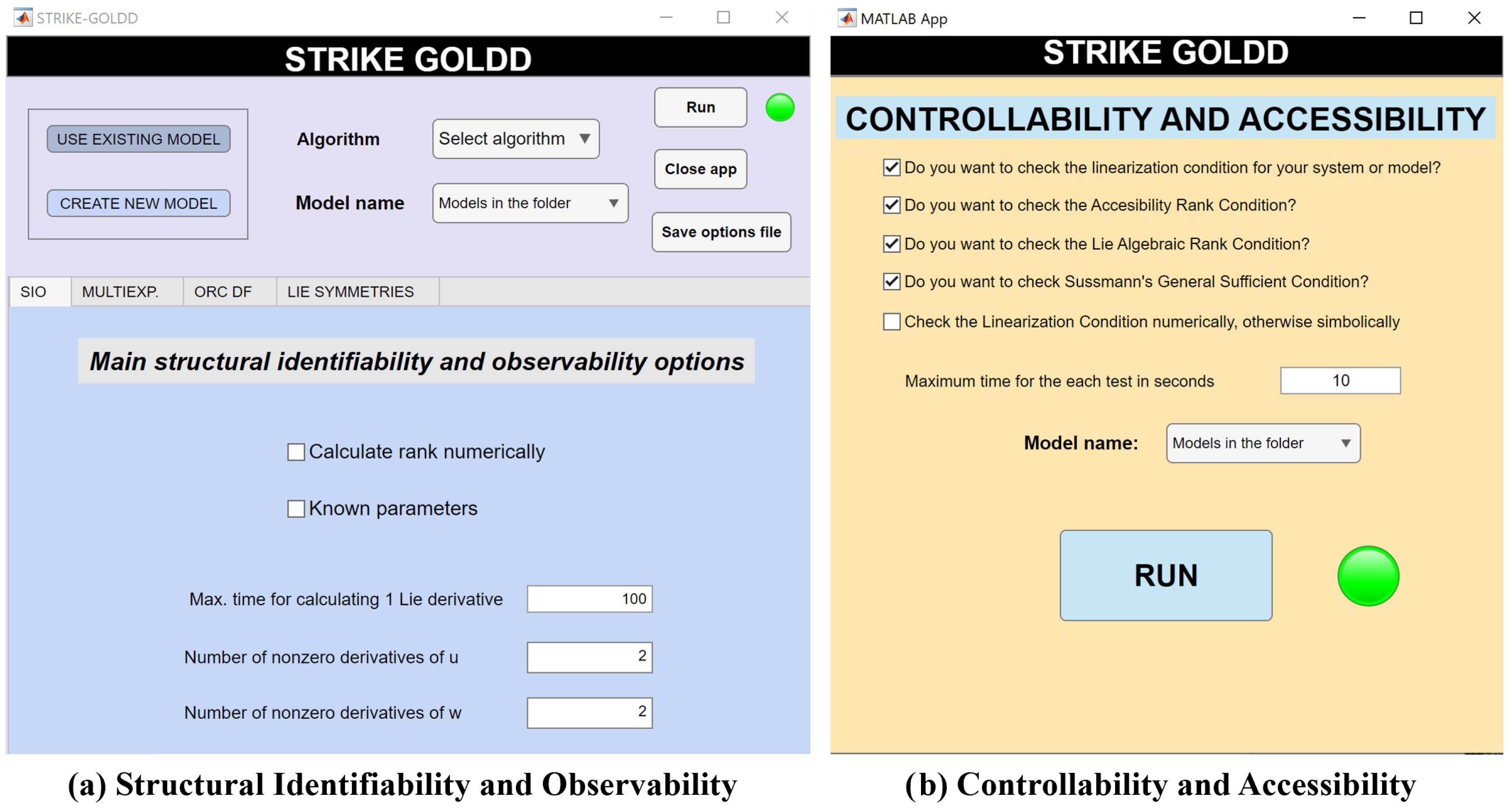
2.4. STRIKE-GOLDD
2.4.1. SIO Analysis in STRIKE-GOLDD
- FISPO
- ProbObsTest
2.4.2. NAC Analysis with STRIKE-GOLDD
- Lie Algebra Rank Condition (LARC)
- General Sufficient Condition (GSC)
2.5. Case Studies
3. Results
3.1. Observability and Identifiability Analyses
3.1.1. Applicability
3.1.2. Reliability
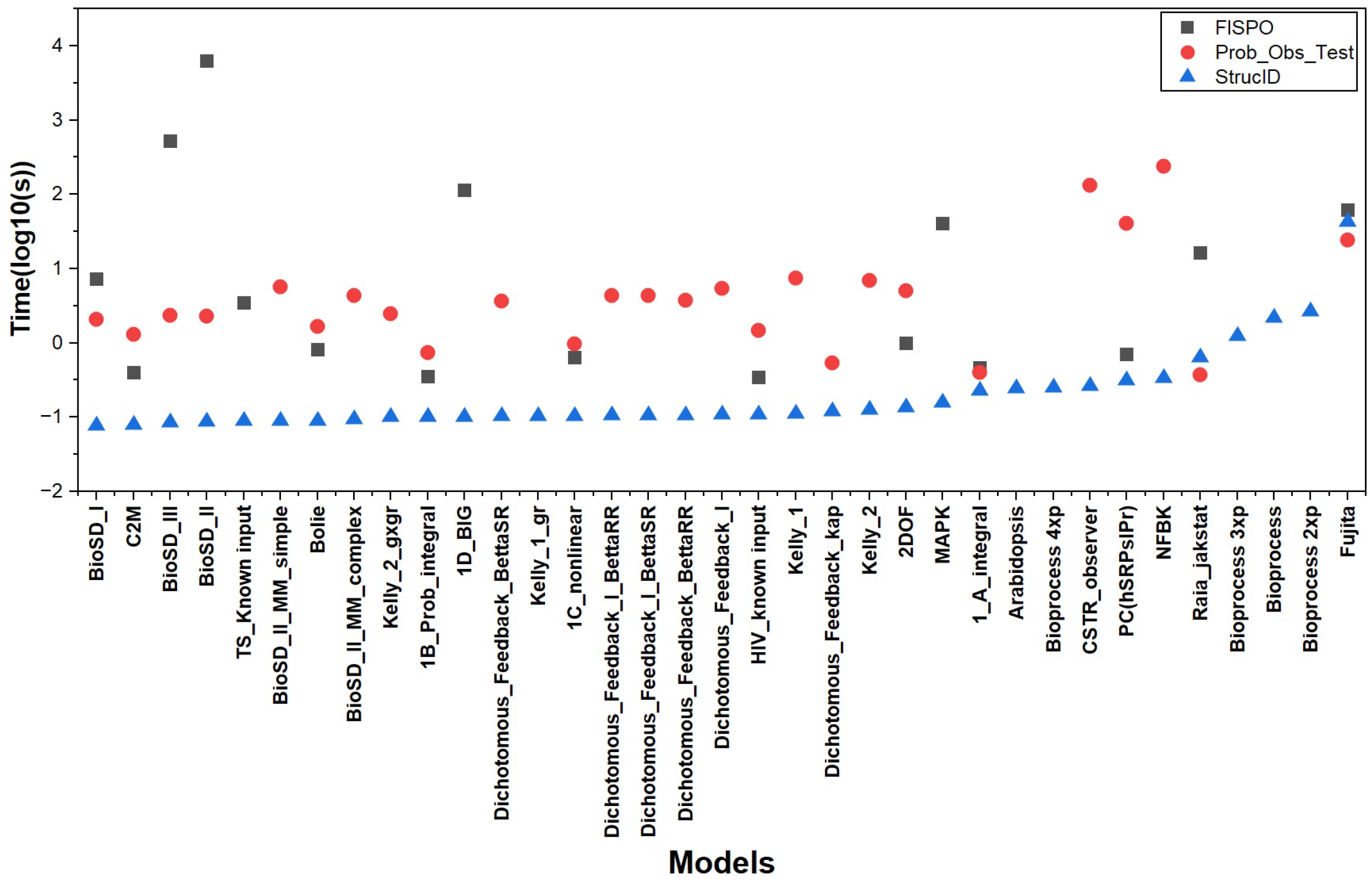
3.1.3. Computational Efficiency
3.2. Accessibility and Controllability Analyses
3.2.1. Applicability
3.2.2. Reliability
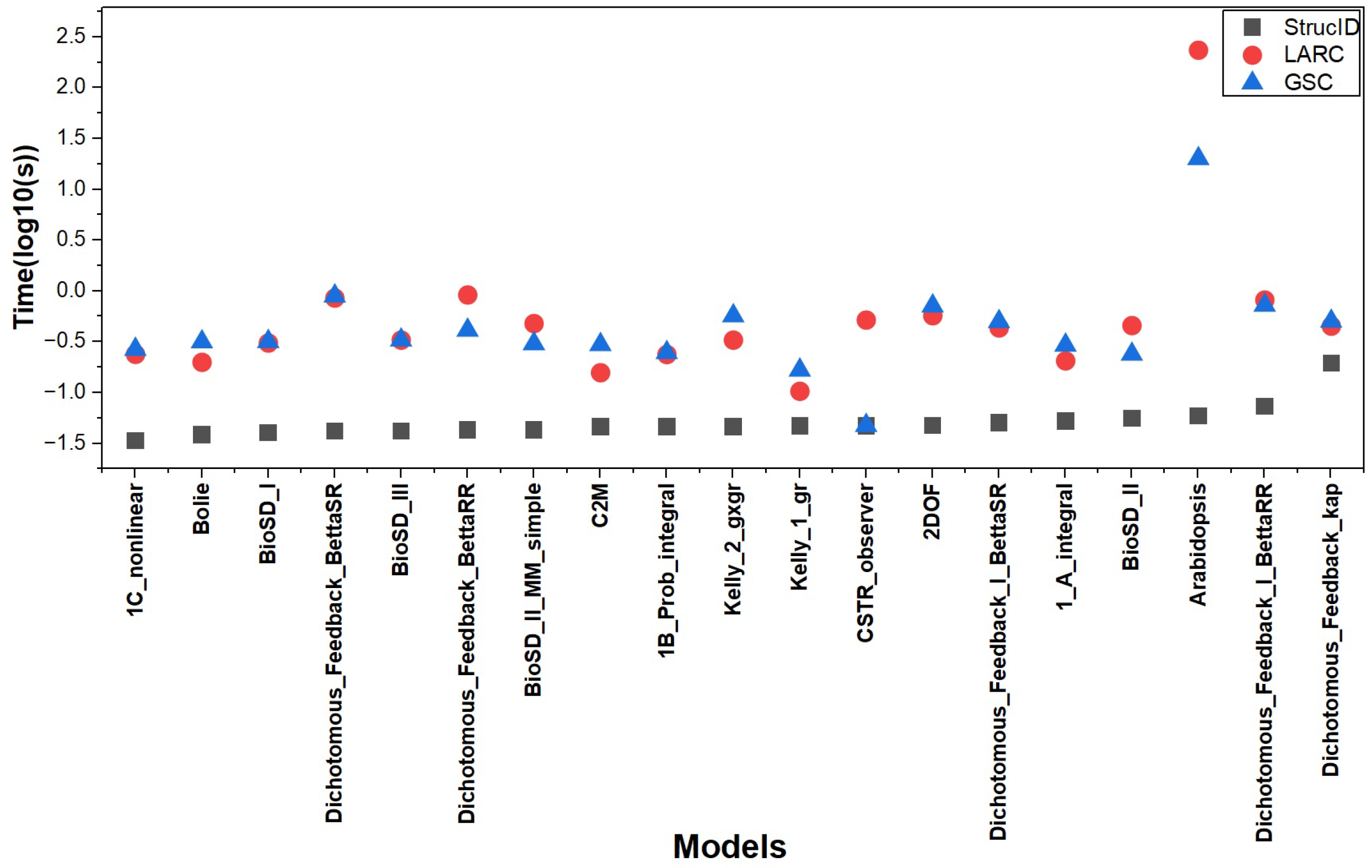
3.2.3. Computational Efficiency
3.3. Discussion
4. Conclusions
Author Contributions
Funding
Data Availability Statement
Conflicts of Interest
References
- Bellman, R.; Åström, K.J. On structural identifiability. Math. Biosci. 1970, 7, 329–339. [Google Scholar] [CrossRef]
- Anstett-Collin, F.; Denis-Vidal, L.; Millérioux, G. A priori identifiability: An overview on definitions and approaches. Annu. Rev. Control 2020, 50, 139–149. [Google Scholar] [CrossRef]
- Chatzis, M.; Chatzi, E.; Smyth, A. On the observability and identifiability of nonlinear structural and mechanical systems. Struct. Control Health Monit. 2014, 22, 574–593. [Google Scholar] [CrossRef]
- Miao, H.; Xia, X.; Perelson, A.S.; Wu, H. On identifiability of nonlinear ODE models and applications in viral dynamics. SIAM Rev. 2011, 53, 3–39. [Google Scholar] [CrossRef] [PubMed]
- Kalman, R. Contribution to the Theory of Optimal Control. Bol. Soc. Mat. Mex. 2001, 5, 102–119. [Google Scholar]
- Martinelli, A. Observability: A New Theory Based on the Group of Invariance; SIAM: Philadelphia, PA, USA, 2020. [Google Scholar]
- Hermann, R.; Krener, A. Nonlinear controllability and observability. IEEE Trans. Autom. Control 1977, 22, 728–740. [Google Scholar] [CrossRef]
- Tunali, E.; Tarn, T.J. New Results for Identifiability of Nonlinear Systems. Autom. Control. IEEE Trans. 1987, 32, 146–154. [Google Scholar] [CrossRef]
- Lam, N.N.; Docherty, P.D.; Murray, R. Practical identifiability of parametrised models: A review of benefits and limitations of various approaches. Math. Comput. Simul. 2022, 199, 202–216. [Google Scholar] [CrossRef]
- Wieland, F.G.; Hauber, A.L.; Rosenblatt, M.; Tönsing, C.; Timmer, J. On structural and practical identifiability. Curr. Opin. Syst. Biol. 2021, 25, 60–69. [Google Scholar] [CrossRef]
- Mitra, E.D.; Hlavacek, W.S. Parameter estimation and uncertainty quantification for systems biology models. Curr. Opin. Syst. Biol. 2019, 18, 9–18. [Google Scholar] [CrossRef]
- Plank, M.J.; Simpson, M.J. Structured methods for parameter inference and uncertainty quantification for mechanistic models in the life sciences. R. Soc. Open Sci. 2024, 11, 240733. [Google Scholar] [CrossRef] [PubMed]
- Rey Barreiro, X.; Villaverde, A.F. Benchmarking tools for a priori identifiability analysis. Bioinformatics 2023, 39, btad065. [Google Scholar] [CrossRef]
- Villaverde, A.; Barreiro, A.; Papachristodoulou, A. Structural Identifiability of Dynamic Systems Biology Models. PLoS Comput. Biol. 2016, 12, e1005153. [Google Scholar] [CrossRef]
- Díaz-Seoane, S.; Rey Barreiro, X.; Villaverde, A.F. STRIKE-GOLDD 4.0: User-friendly, efficient analysis of structural identifiability and observability. Bioinformatics 2023, 39, btac748. [Google Scholar] [CrossRef]
- Stigter, H.; Molenaar, J. A Fast Algorithm to Assess Local Structural Identifiability. Automatica 2015, 58, 118–124. [Google Scholar] [CrossRef]
- Stigter, H.; Joubert, D. Computing Measures of Identifiability, Observability, and Controllability for a Dynamic System Model with the StrucID App. IFAC-PapersOnLine 2021, 54, 138–143. [Google Scholar] [CrossRef]
- Isidori, A. Nonlinear Control Systems; Communications and Control Engineering; Springer: London, UK, 2013. [Google Scholar]
- Nijmeijer, H.; van der Schaft, A. Nonlinear Dynamical Control Systems; Springer: New York, NY, USA, 2013. [Google Scholar]
- Sontag, E.D. Mathematical Control Theory: Deterministic Finite Dimensional Systems; Springer Science & Business Media: Berlin/Heidelberg, Germany, 2013; Volume 6. [Google Scholar]
- Sontag, E.D. Controllability is Harder to Decide than Accessibility. SIAM J. Control Optim. 1988, 26, 1106–1118. [Google Scholar] [CrossRef]
- Haynes, G.; Hermes, H. Nonlinear controllability via Lie theory. SIAM J. Control 1970, 8, 450–460. [Google Scholar] [CrossRef]
- Sussmann, H.J. Nonlinear Controllability and Optimal Control; Routledge: London, UK, 2017. [Google Scholar]
- Díaz-Seoane, S.; Barreiro Blas, A.; Villaverde, A.F. Controllability and accessibility analysis of nonlinear biosystems. Comput. Methods Programs Biomed. 2023, 242, 107837. [Google Scholar] [CrossRef]
- van Willigenburg, G.; Stigter, H.; Molenaar, J. Establishing local strong accessibility of large-scale nonlinear systems by replacing the Lie algebraic rank condition. In Proceedings of the 2021 European Control Conference (ECC), Virtual, 29 June–2 July 2021; pp. 2645–2650. [Google Scholar] [CrossRef]
- Szederkényi, G.; Kovács, M.; Hangos, K. Reachability of nonlinear fed-batch fermentation processes. Int. J. Robust Nonlinear Control 2002, 12, 1109–1124. [Google Scholar] [CrossRef]
- Wang, L.; Qi, J. Efficient Structural Parameter Identifiability Analysis for Generator Dynamic Models. In Proceedings of the IEEE 2024 56th North American Power Symposium (NAPS), El Paso, TX, USA, 13–15 October 2024; pp. 1–6. [Google Scholar]
- Heinrich, M.; Rosenblatt, M.; Wieland, F.G.; Stigter, H.; Timmer, J. On structural and practical identifiability: Current status and update of results. Curr. Opin. Syst. Biol. 2025, 41, 100546. [Google Scholar] [CrossRef]
- Himpe, C. emgr—The Empirical Gramian Framework. Algorithms 2018, 11, 91. [Google Scholar] [CrossRef]
- Leoca, D.A.I.; Falavarjani, M.S.; Villaverde, A.F. Comparativa de metodologías de análisis de identificabilidad estructural y observabilidad para modelos no lineales. Jornadas De Automática 2025, 46, 72. [Google Scholar]
- DiStefano, J., III. Dynamic Systems Biology Modeling and Simulation; Academic Press: Cambridge, MA, USA, 2015. [Google Scholar]
- Iglesias, P.A.; Ingalls, B.P. Control Theory and Systems Biology; MIT Press: Cambridge, MA, USA, 2010. [Google Scholar]
- Walter, E.; Pronzato, L. Identification of Parametric Models: From Experimental Data; Springer: Berlin/Heidelberg, Germany, 1997. [Google Scholar]
- Oana, C.; Banga, J.; Balsa-Canto, E. Structural Identifiability of Systems Biology Models: A Critical Comparison of Methods. PLoS ONE 2011, 6, e27755. [Google Scholar] [CrossRef]
- Sarafrazi, M.A.; Kotta, Ü.; Bartosiewicz, Z. Finite determination of accessibility and singular points of nonlinear systems: An algebraic approach. Syst. Control Lett. 2020, 136, 104600. [Google Scholar] [CrossRef]
- Stigter, J.H.; van Willigenburg, L.G. Model Reduction of Complex Dynamical Systems: A Sensitivity Based Approach. IFAC-PapersOnLine 2025, 59, 457–462. [Google Scholar] [CrossRef]
- Stigter, J.; van Willigenburg, L.; Molenaar, J. An Efficient Method to Assess Local Controllability and Observability for Non-Linear Systems. IFAC-PapersOnLine 2018, 51, 535–540. [Google Scholar] [CrossRef]
- Díaz-Seoane, S.; Sellán, E.; Villaverde, A.F. Structural Identifiability and Observability of Microbial Community Models. Bioengineering 2023, 10, 483. [Google Scholar] [CrossRef] [PubMed]
- Villaverde, A.F.; Tsiantis, N.; Banga, J.R. Full observability and estimation of unknown inputs, states and parameters of nonlinear biological models. J. R. Soc. Interface 2019, 16, 20190043. [Google Scholar] [CrossRef]
- Maes, K.; Chatzis, M.; Lombaert, G. Observability of nonlinear systems with unmeasured inputs. Mech. Syst. Signal Process. 2019, 130, 378–394. [Google Scholar] [CrossRef]
- Villaverde, A.F.; Evans, N.D.; Chappell, M.J.; Banga, J.R. Input-Dependent Structural Identifiability of Nonlinear Systems. IEEE Control Syst. Lett. 2019, 3, 272–277. [Google Scholar] [CrossRef]
- Sedoglavic, A. A Probabilistic Algorithm to Test Local Algebraic Observability in Polynomial Time. J. Symb. Comput. 2002, 33, 735–755. [Google Scholar] [CrossRef]
- Sussmann, H.J. A general theorem on local controllability. SIAM J. Control Optim. 1987, 25, 158–194. [Google Scholar] [CrossRef]
- Villaverde, A.; Banga, J. Dynamical compensation and structural identifiability of biological models: Analysis, implications, and reconciliation. PLoS Comput. Biol. 2017, 13, e1005878. [Google Scholar] [CrossRef]
- Locke, J.; Millar, A.; Turner, M. Modelling genetic networks with noisy and varied experimental data: The circadian clock in Arabidopsis thaliana. J. Theor. Biol. 2005, 234, 383–393. [Google Scholar] [CrossRef]
- Bolie, V.W. Coefficients of normal blood glucose regulation. J. Appl. Physiol. 1961, 16, 783–788. [Google Scholar] [CrossRef] [PubMed]
- Fujita, K.A.; Toyoshima, Y.; Uda, S.; Ozaki, Y.; Kubota, H.; Kuroda, S. Decoupling of Receptor and Downstream Signals in the Akt Pathway by Its Low-Pass Filter Characteristics. Sci. Signal. 2010, 3, ra56. [Google Scholar] [CrossRef]
- Neddermeyer, F.; Marhold, V.; Menzel, C.; Krämer, D.; King, R. Modelling the production of soluble hydrogenase in Ralstonia eutropha by on-line optimal experimental design. IFAC-PapersOnLine 2016, 49, 627–632. [Google Scholar] [CrossRef]
- Lugagne, J.B.; Sosa Carrillo, S.; Kirch, M.; Köhler, A.; Batt, G.; Hersen, P. Balancing a genetic toggle switch by real-time feedback control and periodic forcing. Nat. Commun. 2017, 8, 1671. [Google Scholar] [CrossRef]
- Merkt, B.; Timmer, J.; Kaschek, D. Higher-order Lie symmetries in identifiability and predictability analysis of dynamic models. Phys. Rev. E Stat. Nonlinear Soft Matter Phys. 2015, 92, 012920. [Google Scholar] [CrossRef]
- Raia, V.; Schilling, M.; Böhm, M.; Hahn, B.; Roller, A.; Raue, A.; Sticht, C.; Bohl, S.; Saile, M.; Möller, P.; et al. Dynamic Mathematical Modeling of IL13-Induced Signaling in Hodgkin and Primary Mediastinal B-Cell Lymphoma Allows Prediction of Therapeutic Targets. Cancer Res. 2011, 71, 693–704. [Google Scholar] [CrossRef] [PubMed]
- Nguyen, L.; Degasperi, A.; Cotter, P.; Kholodenko, B. DYVIPAC: An integrated analysis and visualisation framework to probe multi-dimensional biological networks. Sci. Rep. 2015, 5, 12569. [Google Scholar] [CrossRef] [PubMed]
- Alexis, E.; Schulte, C.C.; Cardelli, L.; Papachristodoulou, A. Biomolecular mechanisms for signal differentiation. iScience 2021, 24, 103462. [Google Scholar] [CrossRef] [PubMed]
- Sootla, A.; Delalez, N.; Alexis, E.; Norman, A.; Steel, H.; Wadhams, G.; Papachristodoulou, A. Dichotomous feedback: A signal sequestration-based feedback mechanism for biocontroller design. J. R. Soc. Interface 2022, 19, 20210737. [Google Scholar] [CrossRef]
- Kelly, C.; Harris, A.; Steel, H.; Hancock, E.; Heap, J.; Papachristodoulou, A. Synthetic negative feedback circuits using engineered small RNAs. Nucleic Acids Res. 2018, 46, 9875–9889. [Google Scholar] [CrossRef]
- Mursyitah, D.; Faizal, A.; Aini, Z. Performance of High-Gain Observer (HGO) For Level Estimation in Continuous Stirred Tank Reactor (CSTR). J. Ecotipe (Electron. Control. Telecommun. Inf. Power Eng.) 2024, 11, 117–124. [Google Scholar] [CrossRef]
- Hong, H.; Ovchinnikov, A.; Pogudin, G.; Yap, C. SIAN: Software for structural identifiability analysis of ODE models. Bioinformatics 2019, 35, 2873–2874. [Google Scholar] [CrossRef]
- Chatzis, M.; Maes, K.; Lombaert, G. Observability of nonlinear discrete-time systems with unmeasured inputs. Mech. Syst. Signal Process. 2025, 238, 113142. [Google Scholar] [CrossRef]



| Model | Description | Ref. |
|---|---|---|
| 1_A_integral | Linear circuit with integral feedback | [44] |
| 1B_Prob_integral | Linear circuit with proportional-integral feedback | [44] |
| 1C_nonlinear | Nonlinear circuit model of hormonal reactions | [44] |
| 2DOF | A mechanical system with two independent motions | [40] |
| Arabidopsis | Circadian rhythm in the plant Arabidopsis thaliana | [45] |
| Bolie | Glucose-insulin regulatory system in humans | [46] |
| C2M | Compartmental model with two compartments | [41] |
| Fujita | Epidermal Growth Factor-dependent Protein Kinase B signalling pathway | [47] |
| HIV_known input | HIV infection dynamics | [4] |
| Bioprocess | Biochemical reactions | [48] |
| TS_Known input | Genetic toggle switch | [49] |
| 1D_BIG | Glucose-insulin regulation via -cell and insulin | [44] |
| NFKB (Merkt) | NF-B (Nuclear Factor kappa B) signalling pathway | [50] |
| PC (hSRPsIPr) | A phage cocktail, describing bacteriophage-bacteria interactions and the host immune response | [38] |
| Raia_jakstat | JAK/STAT signalling pathway in lymphoma cells | [51] |
| MAPK | Mitogen Activated Protein Kinase signalling pathway | [52] |
| BioSD_I | Two-species synthetic biology circuit for signal differentiation | [53] |
| BioSD_II | Three-species synthetic biology circuit for signal differentiation | [53] |
| BioSD_III | Three-species synthetic biology circuit for signal differentiation with positive and negative feedback | [53] |
| BioSD_II_MM_simple | Three-species synthetic biology circuit for signal differentiation with simple kinetics | [53] |
| BioSD_II_MM_complex | Three-species synthetic biology circuit for signal differentiation with complex kinetics | [53] |
| Dichotomous_Feedback_BettaRR | Synthetic biology circuit implementing dichotomous feedback—RR molecules (Response Regulator) | [54] |
| Dichotomous_Feedback_BettaSR | Synthetic biology circuit implementing dichotomous feedback—SR molecules (Sequestering Regulator) | [54] |
| Dichotomous_Feedback_kap | Synthetic biology circuit with input signal | [54] |
| Dichotomous_Feedback_I_BettaRR | Synthetic biology circuit with dichotomous feedback, input I, and RR molecules | [54] |
| Dichotomous_Feedback_I_BettaSR | Synthetic biology circuit with dichotomous feedback, input I, and SR molecules | [54] |
| Dichotomous_Feedback_I | Synthetic biology circuit with dichotomous feedback, with input signal I | [54] |
| Kelly_1 | Synthetic biology circuit implementing negative feedback via sRNA-tuned autorepression | [55] |
| Kelly_1_gr | Synthetic biology circuit with generalised regulatory dynamics | [55] |
| Kelly_2 | Synthetic biology circuit implementing negative feedback via closed-loop sRNA regulation | [55] |
| Kelly_2_gxgr | Synthetic biology circuit with generalised regulatory dynamics | [55] |
| CSTR_observer | Continuous Stirred Tank Reactor with High Gain Observer | [56] |
| Models | FISPO (STRIKE-GOLDD) | Prob_Obs_Test (STRIKE-GOLDD) | StrucID | |||||||||
|---|---|---|---|---|---|---|---|---|---|---|---|---|
| Identifiable | Non-Id | Obs | Non-Obs | Identifiable | Non-Id | Obs | Non-Obs | Identifiable | Non-Id | Obs | Non-Obs | |
| 1_A_integral | All | All | All | All | All | All | ||||||
| 1B_Prob_integral | All | All | All | All | All | All | ||||||
| 2DOF | All | All | All | All | All | All | ||||||
| C2M | All | All | All | All | x4 | x3, x5, x6 | x1 | x2 | ||||
| Fujita | All | All | All | All | R_2_k2, R_3_k1, R_4_k1, R_5_k2, R_6_k1, R_7_k1, R_8_k1 | SF_p, SF_pAkt, SF_pS6,EGFR_turnover, R_1_k1, R_1_k2, R_2_k1, R_5_k1, R_9_k1 | pS6, EGFR, pEGFR, pEGFR_Akt, Akt, pAkt, S6, pAkt_S6, EGF_EGFR | |||||
| MAPK | All | All | not rational | All | All | |||||||
| HIV | All | All | All | All | All | All | ||||||
| PC | All | All | All | All | All | All | ||||||
| 1C-nonlinear | p1, p2 | x1 | x2, x3 | p1, p2 | x1 | x2, x3 | p1, p2 | x1 | x2, x3 | |||
| Bolie | Vp, p1, p3 | p2, p4 | q1 | q2 | p1, p3, Vp | p2, p4 | q1 | q2 | p1, p2, p3, p4, Vp | q1, q2 | ||
| Raia-jakstat | t1, t10, t12, t13, t14, t16, t18, t19, t2, t20, t3, t4, t5, t6, t7, t8, t9 | t11, t15, t17, t21, t22 | x1, x11, x2, x3, x4, x5, x6, x8 | x10 | t1, t2, t3, t4, t5, t6, t7, t8, t9, t10, t12, t13, t14, t16, t18, t19, t20 | t11, t15, t17, t21, t22 | x1, x2, x3, x4, x5, x6, x8, x11, x13 | x10 | t1, t2, t3, t4, t5, t6, t7, t8, t9, t10, t12, t13, t14, t16, t18, t19, t20 | t11, t15, t17, t21, t22, x10 | x1, x2, x3, x4, x5, x6, x8, x11, x13 | x10 |
| BioSD-I | p1, p2 | p3, p4, p5, p6 | x1 | x2 | p1, p2 | p3, p4, p5, p6 | x1 | x2 | p1, p2, p3, p4, p5, p6 | x2 | ||
| BioSD-II | p1, p2, p4 | p3, p5, p6, p7 | x1 | x2, x3 | p1, p2, p4 | p3, p5, p6, p7 | x1 | x2, x3 | p4 | p1, p2, p3, p5, p6, p7 | x1 | x2, x3 |
| BioSD-III | p1, p2 | p3, p4, p5, p6, p7 | x1 | x2, x3 | p1, p2 | p3, p4, p5, p6, p7 | x1 | x2, x3 | p1, p2, p3, p4, p5, p6, p7 | x2, x3 | ||
| TS-Known input | All | All | not rational | k01, k1, ntetr, k02, k2, nlaci | tatc, natc, tiptg, niptg | x1, x2 | ||||||
| 1D-BIG | p3, p4, p5 | p1, p2 | x1 | x2, x3 | p3, p4, p5 | p1, p2 | x1 | x2, x3 | p3, p4, p5 | p1, p2 | x1 | x2, x3 |
| NFKB | t1, t2, c3a, c4a, c5, k1, k3, kprod, kdeg, i1, e2a, i1a, a1, a2, a3, c1a, c2a, c5a, c6a, c1, c2, c3, kv, e1a | k2, c4, c1c, c2c, c3c | x1, x3, x4, x5, x6, x10, x11, x13, x14 | x8, x15 | t1, t2, c3a, c4a, c5, k1, k3, kprod, kdeg, i1, e2a, i1a, a1, a2, a3, c1a, c2a, c5a, c6a, c1, c2, c3, kv, e1a | k2, c4, c1c, c2c, c3c | x1, x3, x4, x5, x6, x10, x11, x13, x14 | x8, x15 | ||||
| BioSD-II-MM-simple | p1, p2, p4, p6 | p3, p5, p7, p8 | x1 | x2, x3 | p4, p6 | p1, p2, p3, p5, p7, p8 | x1 | x2, x3 | ||||
| BioSD-II-MM-complex | p1, p2, p4, p5, p7 | p3, p6, p8, p9 | x1 | x2, x3 | p4, p5, p7 | p1, p2, p3, p6, p8, p9 | x1 | x2, x3 | ||||
| Dichotomous-F-BettaRR | All | All | All | All | ||||||||
| Dichotomous-F-BettaSR | All | All | All | All | ||||||||
| Dichotomous-F-kap | All | All | All | All | ||||||||
| Dichotomous-F-I | All | All | p1, p2, p3, p4, p5, p6, p7, p8, p9 | p10, p11 | All | |||||||
| Kelly-1 | All | All | p1, p5, p6, p7, p10, p13, p14 | p2, p3, p4, p8, p9, p11, p12 | t, s | c, T | ||||||
| CSTR-observer | All | All | All | All | ||||||||
| Dichotomous-F-I-BettaRR | p1, p2, p4, p5, p7, p8, p9 | p3, p10, p11 | All | p1, p2, p4, p5, p7, p8, p9 | p3, p10, p11 | All | ||||||
| Dichotomous-F-I-BettaSR | p1, p2, p4, p5, p6, p7, p9 | p3, p10, p11 | All | p1, p2, p4, p5, p6, p7, p9 | p3, p10, p11 | All | ||||||
| Kelly-2 | p2, p3, p4, p8, p10, p11 | p1, p5, p6, p7, p9 | r, s, c | p4, p8, p11 | p1, p2, p3, p5, p6, p7, p9, p10 | R | r, s, c | |||||
| Kelly-2-gxgr | p4, p5, p7, p8, p11 | p6 | r, s | c | p4, p5, p7, p8, p11 | p6 | r, s, R | c | ||||
| Arabidopsis | not rational | a, n1, r3, k1, k4, m1, m4, n2, q2, r1, r2, r4 | g1, g2, k2, k3, k5, k6, k7, m2, m3, m5, m6, m7, p1, p2, p3, q1 | x1, x4 | x2, x3, x5, x6, x7 | |||||||
| Bioprocess | not rational | p1, p2, p3, p4, p5, p6, p7, p8 | x1, x2, x3, x4, x5 | |||||||||
| Bioprocess2xp | not rational | p1, p2, p3, p4, p5, p6, p7, p8 | x1E1, x2E1, x3E1, x4E1, x5E1, x1E2, x2E2, x3E2, x4E2, x5E2 | |||||||||
| Bioprocess3xp | not rational | p1, p2, p3 | p4, p5, p6, p7 | x1E1, x2E1, x3E1, x4E1, x5E1, x1E2, x2E2, x3E2, x4E2, x5E2, x1E3, x2E3, x3E3, x4E3, x5E3 | ||||||||
| Bioprocess4xp | not rational | All | All | |||||||||
| Kelly-1-gr | not rational | p1, p5, p6, p7, p10, p13, p14 | p2, p3, p4, p11, p12 | t, s | c, T | |||||||
| Models | STRIKE_GOLDD | StrucID | SIAN | ||||
|---|---|---|---|---|---|---|---|
| FISPO | Prob_Obs_Test | Non-Id. | Id. | Non-Id. | |||
| Id. | Non-Id. | Id. | Non-Id. | ||||
| C2M | All | All | x3, x5, x6, x2 | All | |||
| Fujita | All | All | scaleFactor_p, EGFR, scaleFactor_p, Akt, scaleFactor_pS6, EGFR_turnover, R_1_k1, R_1_k2, R_2_k1, R_5_k1, R_9_k1, EGFR, pEGFR, pEGFR_Akt, Akt, pAkt, S6, pAkt_S6, pS6, EGF_EGFR | All | |||
| Bolie | Vp, p1, p3, q1 | p2, p4, q2 | Vp, p1, p3, q1 | p2, p4, q2 | p1, p2, p3, p4, Vp, q1, q2 | p1, p3, Vp, q1 | q2, p4, p2 |
| BioSD_I | p2, p1, x1 | p4, p3, p6, p5, x2 | p2, p1, x1 | p4, p3, p6, p5, x2 | p1, p2, p3, p4, p5, p6, x2 | p2, p1, x1 | p4, p3, p6, p5, x2 |
| BioSD_II | p2, p1, p4, x1 | p3, p6, p7, p5, x3, x2 | p2, p1, p4, x1 | p3, p6, p7, p5, x3, x2 | p1, p2, p3, p5, p6, p7, x2, x3 | p2, p1, p4, x1 | p3, p6, p7, p5, x3, x2 |
| BioSD_III | p2, p1, x1 | p4, p3, p6, p7, p5, x3, x2 | p2, p1, x1 | p4, p3, p6, p7, p5, x3, x2 | p1, p2, p3, p4, p5, p6, p7, x2, x3 | p2, p1, x1 | p4, p3, p6, p7, p5, x3, x2 |
| BioSD_II_MM_simple | p2, p1, p4, p6, x1 | p3, p5, p7, p8, x3, x2 | p1, p2, p3, p6, p8, p9, x2, x3 | p2, p1, p4, p6, x1 | p3, p5, p7, p8, x3, x2 | ||
| BioSD_II_MM_complex | p2, p4, p5, p1, p7, x1 | p3, p6, p8, p9, x3, x2 | p1, p2, p3, p6, p8, p9, x2, x3 | p2, p4, p5, p1, p7, x1 | p3, p6, p8, p9, x3, x2 | ||
| Dichotomous_Feedback_I | All | p10, p11 | All | - | |||
| Kelly_1 | All | p2, p3, p4, p8, p9, p11, p12, c, T | error | ||||
| Kelly_2 | p2, p3, p4, p8, p10, p11 | p9, p5, p1, p6, p7, s, c, r | p1, p2, p3, p5, p6, p7, p9, p10, r, s, c | p10, p4, p2, p3, p11, p8 | p9, p5, p1, p6, p7, s, c, r | ||
| Case Study | LARC | GSC | StrucID |
|---|---|---|---|
| 1_A_integral | Accessible | STLC | Accessible |
| 1B_Prob_integral | Accessible | STLC | Accessible |
| 1C_nonlinear | Accessible | STLC | Accessible |
| 2DOF | Accessible | STLC | Accessible |
| Arabidopsis | Accessible | — | Accessible |
| Boile | Accessible | — | Accessible |
| C2M | Accessible | STLC | Accessible |
| CSTR_observer | Accessible | STLC | Accessible |
| BioSD_I | Accessible | STLC | Accessible |
| BioSD_II | Accessible | STLC | Accessible |
| BioSD_II_MM_simple | Accessible | STLC | Accessible |
| Kelly_1_gr | Accessible | STLC | inAccessible |
| Kelly_2_gxgr | Accessible | STLC | inAccessible |
| BioSD_III | Accessible | STLC | inAccessible |
| Dichotomous_Feedback_BettaRR | Accessible | STLC | Accessible |
| Dichotomous_Feedback_BettaSR | Accessible | STLC | Accessible |
| Dichotomous_Feedback_kap | Accessible | STLC | Accessible |
| Dichotomous_Feedback_I_BettaRR | Accessible | STLC | Accessible |
| Dichotomous_Feedback_I_BettaSR | Accessible | STLC | Accessible |
| Raia_jakstat | Accessible | — | inAccessible |
| Fujita | inAccessible | — | inAccessible |
| HIV | — | — | Accessible |
| Dichotomous_Feedback_I | not Affine in “U” | Accessible | |
| BioSD_II_MM_complex | not Affine in “U” | Accessible | |
| Kelly_1 | not Affine in “U” | inAccessible | |
| Kelly_2 | not Affine in “U” | inAccessible | |
| Bioprocess | not Affine in “U” | inAccessible | |
| Bioprocess 2xp | not Affine in “U” | Accessible | |
| Bioprocess 3xp | not Affine in “U” | inAccessible | |
| Bioprocess 4xp | not Affine in “U” | Accessible | |
| TS | not Affine in “U” | inAccessible | |
| 1D_BIG | computation limit | inAccessible | |
| Bachman jackstat | computation limit | inAccessible | |
| NFKB (Merkt) | computation limit | Accessible | |
| PC | computation limit | Accessible | |
Disclaimer/Publisher’s Note: The statements, opinions and data contained in all publications are solely those of the individual author(s) and contributor(s) and not of MDPI and/or the editor(s). MDPI and/or the editor(s) disclaim responsibility for any injury to people or property resulting from any ideas, methods, instructions or products referred to in the content. |
© 2025 by the authors. Licensee MDPI, Basel, Switzerland. This article is an open access article distributed under the terms and conditions of the Creative Commons Attribution (CC BY) license (https://creativecommons.org/licenses/by/4.0/).
Share and Cite
Shams Falavarjani, M.; González Vázquez, A.; Villaverde, A.F. Assessment of Computational Tools for Analysing the Observability and Accessibility of Nonlinear Models. Computation 2025, 13, 281. https://doi.org/10.3390/computation13120281
Shams Falavarjani M, González Vázquez A, Villaverde AF. Assessment of Computational Tools for Analysing the Observability and Accessibility of Nonlinear Models. Computation. 2025; 13(12):281. https://doi.org/10.3390/computation13120281
Chicago/Turabian StyleShams Falavarjani, Mahmoud, Adriana González Vázquez, and Alejandro F. Villaverde. 2025. "Assessment of Computational Tools for Analysing the Observability and Accessibility of Nonlinear Models" Computation 13, no. 12: 281. https://doi.org/10.3390/computation13120281
APA StyleShams Falavarjani, M., González Vázquez, A., & Villaverde, A. F. (2025). Assessment of Computational Tools for Analysing the Observability and Accessibility of Nonlinear Models. Computation, 13(12), 281. https://doi.org/10.3390/computation13120281