
Abstract
This paper presents a statistically grounded algorithm for surface imaging with linear frequency-modulated continuous wave synthetic aperture radar. The approach is based on the maximum likelihood principle, where solving the optimization problem naturally leads to the introduction of a spectral decorrelation filter. The proposed method increases the effective number of statistically independent samples, reduces speckle, and improves the accuracy of radar cross section estimation. Simulation experiments demonstrate consistent advantages over classical SAR processing: the proposed method achieves up to a 21% improvement in feature similarity metrics and an average 4% improvement across standard quantitative image quality measures.
1. Introduction
Synthetic aperture radar (SAR) systems are widely used in aerospace [1], navigation [2], and remote sensing [3] applications due to their ability to produce high-resolution radar images with compact antenna dimensions. Of particular interest is linear frequency-modulated continuous wave (LFM-CW) SAR [4,5,6] which compared with pulsed systems [7] offers the following advantages: higher energy efficiency, greater compactness and cost-effectiveness of equipment, simplified radio frequency and digital signal processing, and reduced radar visibility. However, the primary drawback of LFM-CW SAR is its limited transmitted signal power, an inherent constraint of the system design. During continuous transmission of a high-power signal, a portion of the signal inevitably leaks from the transmitting antenna to the adjacent receiving antenna, causing receiver oversaturation. This overwhelms weak reflected signals from the surface, significantly reducing receiver sensitivity and restricting the maximum permissible radiated power. Despite these limitations, LFM-CW SAR systems are particularly well suited for deployment on unmanned aerial vehicles (UAVs) [8], where operational ranges are short and hardware compactness and power efficiency are critical for the platform.
Despite considerable progress in synthetic aperture radar (SAR) technology in recent decades, fundamental challenges remain in achieving optimal signal processing performance under conditions characterized by stochastic reflections and additive noise. Traditional imaging techniques [9,10,11,12] predominantly employ pulsed signals and linear filtering approaches, which exhibit a suboptimal performance in high-noise scenarios and introduce spatial resolution degradation attributable to speckle noise interference. Article [11] demonstrates that conventional image quality assessment methods and processing algorithms frequently fail to consider the physical and statistical properties of reflected signals, instead relying primarily on metrics sensitive to geometric and brightness distortions. However, for radar imaging applications, signal decorrelation plays a critical role by enabling an increase in statistically independent samples, thereby improving the accuracy of effective scattering surface reconstruction.
A critical review of the existing literature [12,13] reveals that numerous studies on radar imaging fail to account for the stochastic nature of surface complex reflection coefficients. Prevailing approaches predominantly employ deterministic reflection models, which while mathematically convenient, inadequately represent actual physical scattering phenomena. These conventional models [14,15] characterize scattering as a deterministic function of spatial coordinates rather than as a random process dependent on surface texture, microstructure, and material composition. Such oversimplification precludes the formal application of statistical optimization techniques, including correlation-aware filter synthesis. Consequently, fundamental problems involving the determination of inverse correlation functions, essential for deriving optimal estimators within random process theory, remain unaddressed. This limitation substantially compromises algorithmic performance, particularly under high-noise conditions or when operating with varying observation geometries.
It is particularly noteworthy that numerous studies on radar signal processing fail to account for the discrete nature of frequency transitions in continuous LFM signals [16,17]. In practical implementations, frequency modulation is typically realized as a piecewise constant sawtooth waveform, where the signal frequency remains fixed during discrete time intervals. This implementation detail significantly affects the characteristics of reflected signals and must be properly incorporated into mathematical models. Neglecting this crucial aspect results in oversimplified approaches that cannot fully capture the essential features required for optimal signal processing.
Furthermore, the majority of existing research primarily addresses the secondary processing of preformed radar images, such as visualization enhancement [18], noise reduction [19], or target classification [20]. These approaches, however, fail to provide end-to-end optimization encompassing the complete signal processing chain: from statistical problem formulation and signal/noise modeling to image formation and quality assessment. This fragmented methodology fundamentally constrains the potential for achieving global optimization in radar system design.
This study addresses these limitations by developing a statistically grounded algorithm for radar image formation using LFM-CW signals that incorporates their actual physical characteristics. The proposed method employs likelihood function maximization combined with spectral decorrelation techniques, which collectively enhance spatial resolution while mitigating random noise effects. Furthermore, the work establishes a comprehensive processing framework encompassing rigorous problem formulation, the mathematical modeling of signal and noise characteristics, image reconstruction, and systematic quality evaluation using contemporary performance metrics.
Moreover, the proposed methodology successfully addresses the challenging problem of determining inverse correlation functions in the spectral domain for nonstationary stochastic processes.
Conventional radar systems typically avoid such problems due to their inherent mathematical complexity and the stringent requirements for the precise statistical characterization of both signals and noise. However, the proper determination of the inverse correlation function enables the synthesis of adaptive decorrelation filters that dynamically adjust to varying observation conditions. This approach effectively extends the usable bandwidth of the radar image proportionally to the signal-to-noise ratio, resulting in substantially improved estimation accuracy for the effective scattering area and enhanced overall image quality.
2. Materials and Methods
2.1. Models of Signals, Noise, and Observation Equations
In accordance with the considered LFM-CW SAR operation principle, we assume that the transmitter generates a probing LFM-CW signal, where the frequency varies according to a periodic stepwise sawtooth function. The stepwise frequency variation reflects a practical implementation in modern oscillators based on voltage-controlled oscillators (VCOs) with phase-locked loops. The transmitting antenna converts the signal into electromagnetic waves and radiates them in a strictly lateral direction relative to the flight path toward the ground surface. Let us express the spatial and temporal field distribution in the immediate vicinity of the surface within the irradiation area of the antenna’s radiation pattern as follows:
where is the radiation pattern of the transmitting antenna projected onto the surface, is the constant probing signal amplitude, is the rectangular pulse defining one period length of the LFM-CW signal, is the sawtooth frequency modulation period, is the modulation period number, is the rectangular pulse marking the constant frequency chirp segment within one period, is the frequency-constant time interval, is the pulse number of , is the initial frequency, is the initial phase, is the sawtooth modulation slope, is the frequency deviation, and is the maximum attainable frequency of the LFM-CW signal.
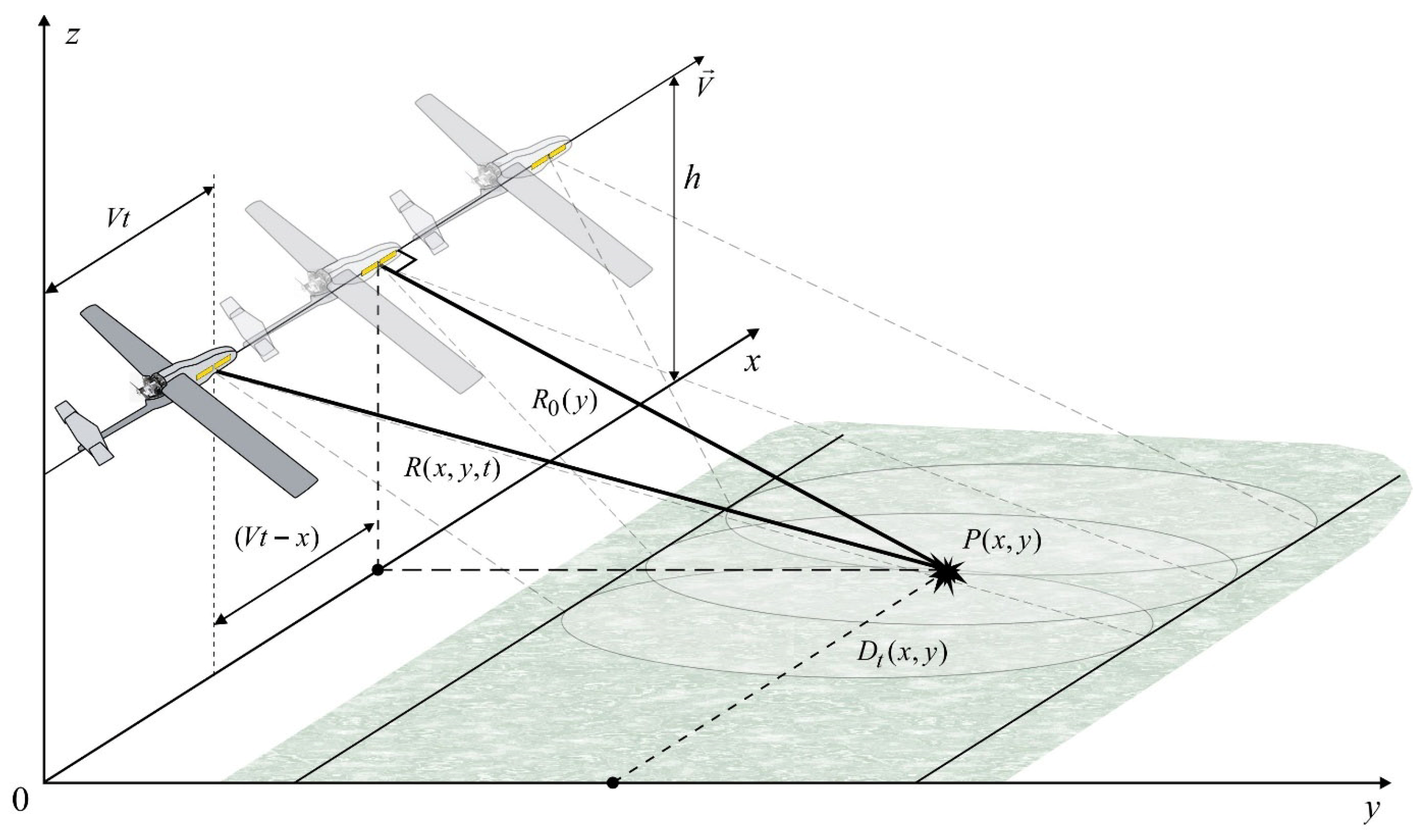
Upon reaching the ground surface, signal (1) is reflected from each point, taking into account the complex reflection coefficient at that location. The surface-scattered signals are received by the observation area mounted on the aerospace platform, following the geometry shown in Figure 1. It is assumed that the aircraft is flying in a straight line along the axis , at a fixed altitude and a constant velocity .
Figure 1.
Geometry of surface sensing from an airborne platform.
The field observed by the receiving antenna can be determined by solving exact electrodynamic problems using Kirchhoff’s formula [21], Green’s theorem [22], the Helmholtz–Kirchhoff theorem [21], the Rayleigh–Sommerfeld theorem [23], and other related methods. These mathematical tools are applicable for certain test models, structures with well-defined dimensions, or objects with simple geometric shapes. However, it is nearly impossible to accurately solve such problems for fields scattered by natural surfaces such as agricultural fields, forests, or urban areas which are typical for aerospace radar imaging systems. When electromagnetic waves reflect off these surfaces, their amplitudes and phases change rapidly and unpredictably, resulting in a random spatial process. The correlation function of the reflection coefficient is extremely narrow, and even with the highest resolution currently achievable in SAR systems, it remains significantly narrower than the ambiguity functions in azimuth and range. This observation suggests modeling the reflection coefficient as white noise with a spatially varying power spectral density and correlation function as follows:
where is the symbol denoting statistical averaging over an ensemble of realizations (i.e., the mathematical expectation) and is the Dirac delta function.
In radar measurements of surface parameters is referred to as the radar cross section. In this context, it is reasonable to formulate the signal processing optimization problem specifically for estimating this statistical characteristic of the random process . Otherwise, the resulting estimates will be inconsistent and will require additional averaging over certain spatial intervals, as is commonly performed in practice.
To describe nonstationary electrodynamic fields within this problem framework, we employ the Huygens–Fresnel principle along with a phenomenological approach [24,25]. According to this approach, the signals at the antenna output can be expressed in the following form:
where
is the unit signal that would be received by the radar from a single point on the surface with , is the directional pattern of the receiving antenna, represented in surface coordinates, or the footprint of the antenna’s directivity pattern on the surface, the signal propagation delay time from the transmitting antenna to each point on the surface and back to the receiving antenna, is the speed of electromagnetic wave propagation, and the total path length traveled by the electromagnetic waves.
Given the geometry shown in Figure 1, the range to each point on the surface from the aircraft can be expressed as follows:
where is the current position coordinate of the aircraft moving along the axis x, and is the range to the point when its observed at a strictly lateral angle in azimuth. In practical measurements the value under the square root is small so by applying a Taylor series expansion we can approximate it as follows:
By substituting Equation (6) into the unit signal expression (4), we obtain
where is the complex envelope of the probing signal.
When the signals are received by the radar, internal white Gaussian noise is added, which is characterized by the following correlation function:
The fluctuations that are subject to further optimal processing will be referred to as the observation equations. Under the considered conditions the observation equation takes the following form:
Taking into account Equations (2) and (9), the correlation function of the observation equation is given by
The correlation function in Equation (10) contains all the necessary information required to solve the optimization problem.
2.2. Problem Statement
Based on the reception results from the onboard coherent radar mounted on the aircraft, which detects the useful signal reflected from the surface and observed against the background of internal receiver noise , it is necessary to optimally form a radar image of the underlying surface using the maximum likelihood method. The image is represented in the form of an energy parameter , which constitutes a statistical characteristic of the received signal fluctuations .
2.3. Statistical Optimization of Radar Imaging Algorithm
We define the optimal method for radar imaging of the underlying surface within the framework of the maximum likelihood method, which, for correlated stochastic processes, requires maximizing the following likelihood function [26]:
Expression (11) includes a certain multiplier that depends on the energy parameters, the observation time constant , the inverse correlation function , and the mathematical expectation of the process . The mathematical expectation is given by
thus, Equation (11) can be rewritten in the following form:
The function is defined through the following integral equation:
By finding the mathematical expression corresponding to the maximum of Equation (13), we obtain the necessary operations for constructing optimal estimates of the radar image of the underlying surface , where symbol denotes an estimate. The estimate differs from the true value by the limiting measurement error.
The maximum of expression (13) could be determined by taking the ordinary derivative and equating it to zero. However, in this case, the radar cross section , which is a function of spatial coordinates, is the parameter being estimated, and the ordinary derivative cannot be taken with respect to a function. Therefore, it is necessary to apply the mathematical apparatus of variational derivatives. We represent the estimate as the sum of two components
where is the true value and is the variation in the estimate, defined as a deviation from the true value
where is an arbitrary, nondeterministic deviation function with unit amplitude and is the magnitude of the deviation. Clearly, for the true value of the radar image is obtained. Thus, instead of directly minimizing expression (13) over a function , we may find the minimum by taking the ordinary derivative with respect to at the point .
From expression (13), it also follows that the likelihood function is an exponential function with a certain coefficient. Applying the natural logarithm to Equation (13) does not change the location of the maximum point of the likelihood function. In this case, the optimization problem takes the following form:
The result of differentiating and equating (17) to zero is known as the likelihood equation [26,27,28]. The solution of (17) under specified conditions of the problem is shown in Appendix A. As observed in Appendix A, the optimal algorithm for processing the received signal can be expressed as follows
where
The essence of the processing (18) lies in computing a correlation integral or performing matched filtering of using a filter whose impulse response replicates the unit signal in (19). Unlike existing approaches, the unit signal (19) incorporates a decorrelation operation, which allows an increasing number of uncorrelated samples in the output result . In this context, the unit signal (19) is also referred to as the reference signal and in image reconstruction tasks it can be factorized into reference signals for compression in both the azimuth and range directions.
The integrals in (19), describing the convolution of the correlation function with the unit signal, represent a new class of signals that must be applied for the optimal estimation of the statistical properties of the random surface reflection coefficient. Unlike conventional operations, these convolutions require additional inverse filtering using a filter whose frequency response corresponds to the spectrum of the inverse correlation function . In radar system theory, such inverse filters are also known as whitening filters whose primary purpose is to increase the accuracy of parameter estimation in random processes, especially under white noise conditions.
3. Results
3.1. Time Domain Algorithm
To obtain a result based on Equation (18), we will substitute expressions (19) and (7) into it
It is rather difficult to immediately analyze the physical essence of the filtering algorithm for received oscillations in a filter whose impulse response coincides with the sum of time-delayed decorrelated high-frequency pulses. It is therefore reasonable to first define the basic operations in the time domain, without considering decorrelation, assuming that . In this case, expression (20) takes the form
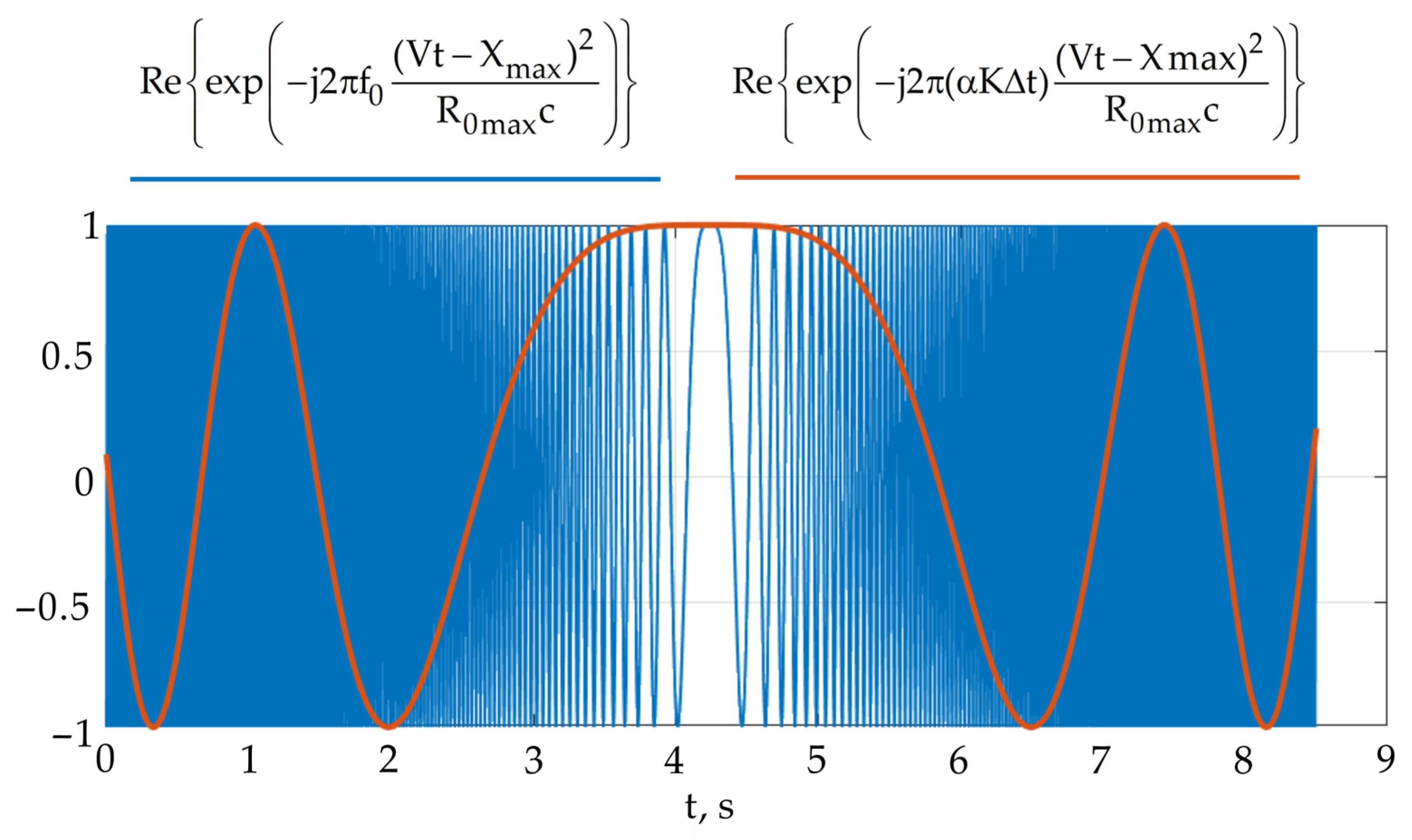
Let us examine the arguments of some functions included in Equation (21). Suppose that the aircraft’s flight altitude is 1500 m and the maximum viewing angle from nadir is 45°. Then the maximum range and delay time are and . The maximum coordinate deviation is determined by the half the width of the radiation pattern in the azimuthal direction. To calculate it we suppose that the length of the antenna is 30 cm, the RF input frequency is 10 GHz, the frequency deviation of the LFM-CW signal is 100 MHz, and . Then the maximum coordinate deviation is 106 m. The maximum signal delay time is . The maximum observation time is determined by the width of the illuminated spot on the surface in the azimuthal direction and the speed of the aircraft, . At a travel speed of 90 km/h, the maximum observation time is approximately . Based on these values, simulation modeling of the functions and was carried out, and the results are shown in Figure 2.
Figure 2.
Simulation of reference functions.
The function is well known from classical high-resolution radar imaging algorithms used in pulse-mode radar operation. It serves as the basis for recovering fine details in the primary image, or in other words, for synthesizing the antenna aperture. Compared with the function is more low-frequency and thus does not allow the recovery of small-scale details in radar images and it may be neglected in future considerations. The smaller the ratio of the frequency deviation of the probing signal to the carrier frequency, the less significant the influence of the multiplier will be.
It should also be noted that the maximum delay caused by the expansion of the antenna beam pattern in the azimuth direction is 70 ns, which is 200 times less than the maximum range delay. Therefore, the delay of rectangular pulses by this amount can be neglected. We can also suppose that does not depend on . Indeed, it is not feasible to align rectangular pulse delays for every range, so we will use an approximation . Taking into account these assumptions, algorithm (21) can be rewritten as follows:
where
is the discrete Fourier transform of the result of multiplying the received observation signal by all possible pulses with specific frequencies defined by the expression
Since it is impossible to accurately determine the arrival time of signals reflected from the surface when continuous signals are used, it is more practical to use a copy of the probing signal and its quadrature component as the multiplier in Equation (24).
3.2. Signal Decorrelation in the Frequency Domain
Having analyzed the basic optimal operations defined for a single signal, it is now reasonable to consider the effect of the decorrelating filter. Determining an analytical form from Equation (14) is difficult, so we propose determining the form of the decorrelating filter in the spectral domain. To do this, we first represent the correlation function as a sum
and substitute it into Equation (14)
Equation (26) is a Fredholm’s integral equation of the first kind. To solve it, one must move to the spectral domain, determine the spectrum of , and apply the inverse Fourier transform. and the useful signal are nonstationary random processes. This nonstationarity is evidenced by the correlation function (25), which depends not only on the difference but also on the absolute time . In such cases, to determine the spectral density of a nonstationary random process, a double Fourier transform over the variables and is required.
In the spectral domain, Expression (26) becomes
where and are the generalized power spectral densities. Equation (27) represents the spectrum of the decorrelation filter
To apply the resulting expression further, Equation (19) is also transformed into the spectral domain
Substituting (28) into (29), we obtain the frequency response of the optimal matched filter for the coherent processing of received oscillations
To determine the physical impact of the decorrelation operation, we will calculate the generalized power spectral density of the nonstationary random useful signal . This is performed by sequentially applying the Fourier transform to with respect to the variables and
Substituting (31) into (30), we obtain the unit signal decorrelated in the spectral domain
It should be emphasized that in Equation (32), the unit signal in the numerator is the complex conjugate of the radiated signal. This processing is fully consistent with matched filtering as described in the classical theory of optimal parameter estimation [29,30,31]. The novelty lies in the decorrelation operation, which increases the number of uncorrelated samples used in the processing of stochastic signals. To determine in the new optimal algorithm (22), it is necessary to apply the inverse Fourier transform to Equation (32).
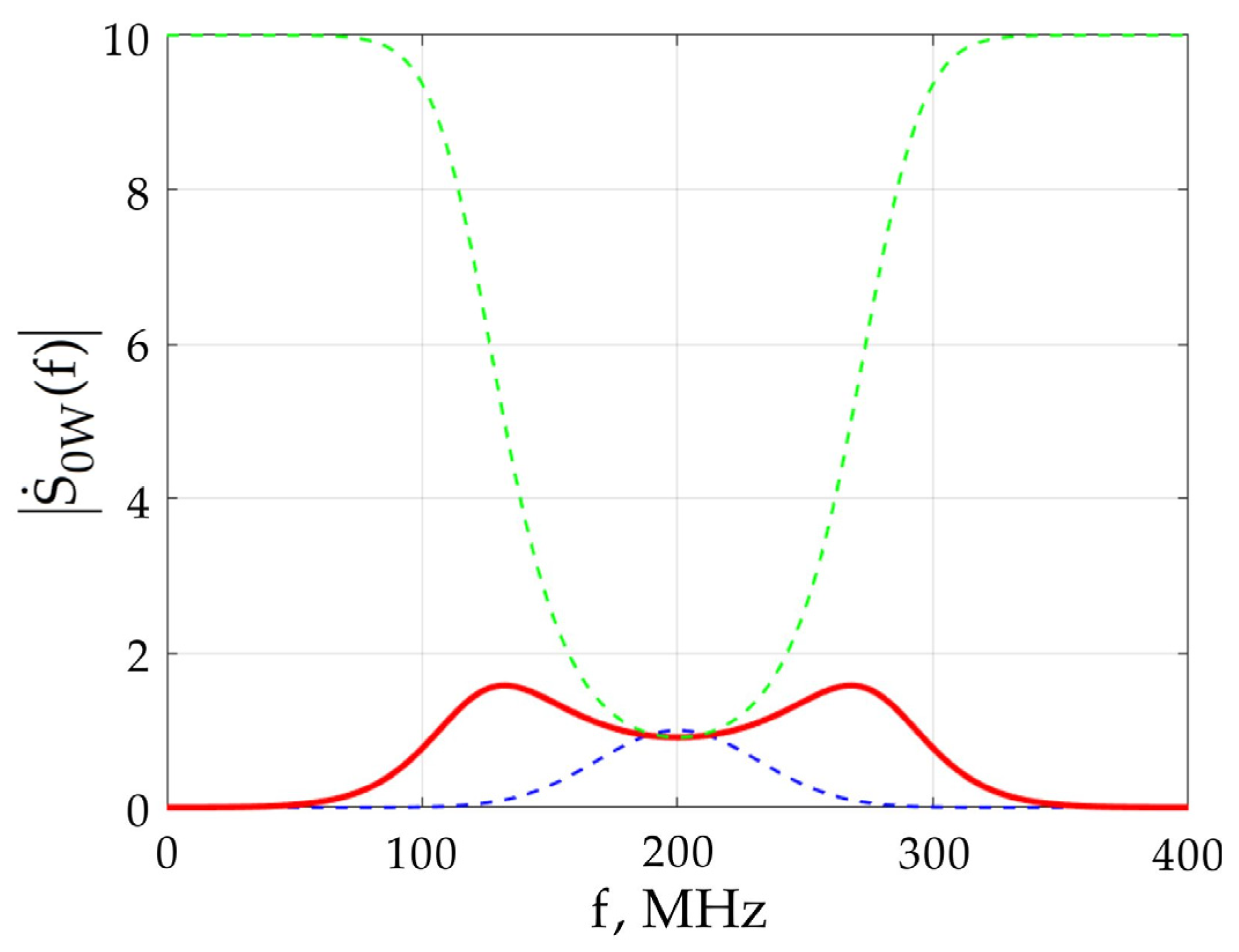
Figure 3 shows an example of the amplitude spectrum of the output signal, the inverse filter
and the unit signal after decorrelation at a signal-to-noise ratio of 20 dB.
Figure 3.
Amplitude spectra: blue dashed line—radiated signal; green dashed line—inverse filter; red solid line—decorrelated unit signal.
The obtained graphs show that when the signal level exceeds that of the noise, the reference signal exhibits a broader spectrum and increased amplitudes in the attenuation regions of the probing signal’s spectrum. Given the randomness of the reflected signals and their wide spectral content, the unit signal adapts to the received fluctuations by expanding its bandwidth. However, this expansion does not extend to infinity—the degree of decorrelation and the extent of adaptation to amplitude and phase variations in the surface-reflected signal are governed by the signal-to-interference ratio.
3.3. Structural Diagram LFM-CW SAR
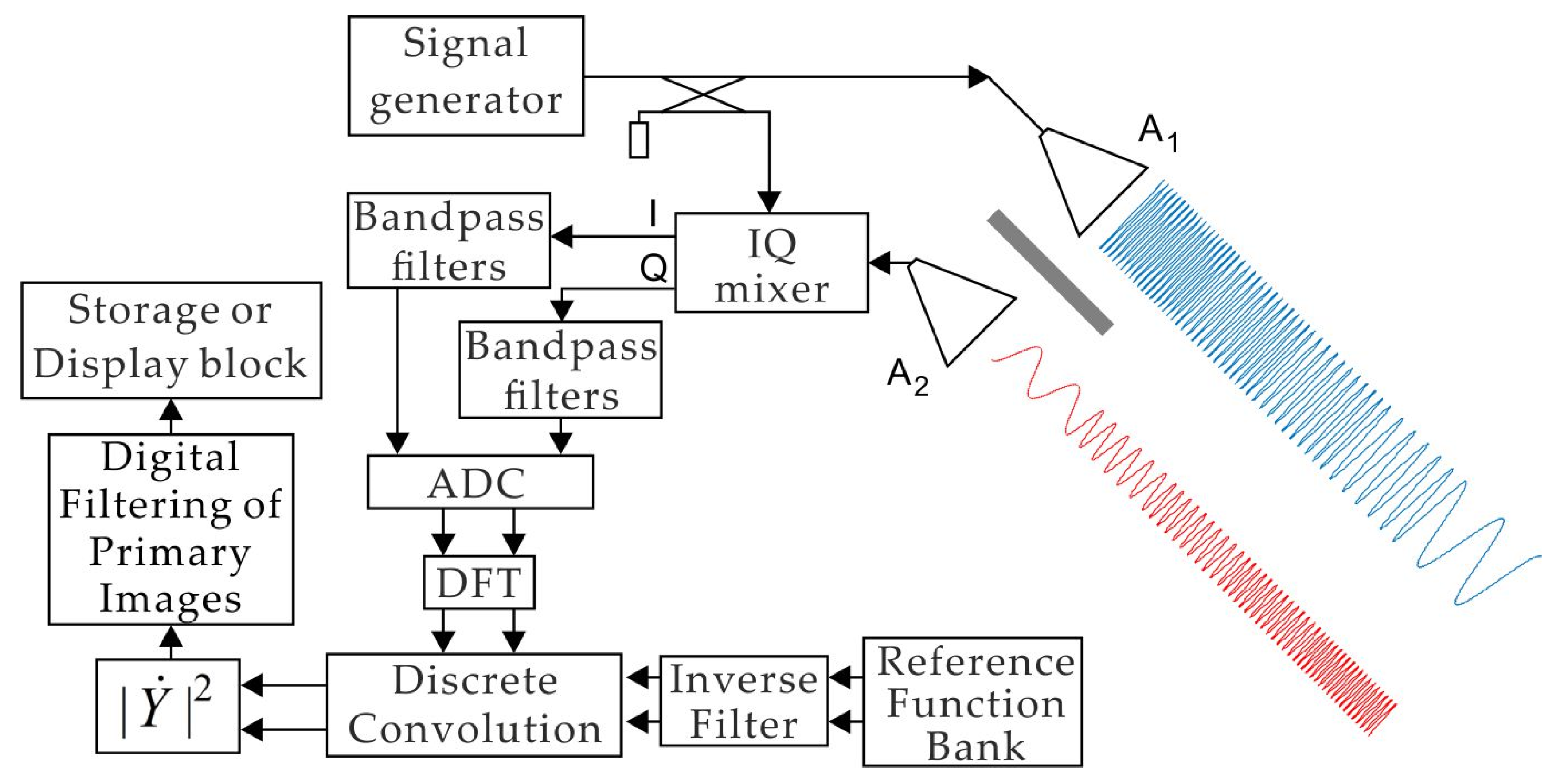
Based on the derived optimal operations (18) and (22)–(24), the main functional components of the radar system for terrain imaging using continuous LFM signals are established. The structural diagram of the system is shown in Figure 4.
Figure 4.
Structural diagram of the onboard radar system for surface imaging using LFM-CW signals.
The radar system operates as follows. The probing signal (1) is generated in the signal generator and is then converted into electromagnetic waves by antenna A1, which radiates the signal toward the surface. A portion of the signal is simultaneously directed into the receiving channel via a directional coupler. The electromagnetic waves reflected from the surface are received by antenna A2 and converted into the received signal, as described by model (2). The first optimal processing step is the quadrature detection of the received signals. This is equivalent to multiplying the received signal with both the delayed transmitted signal and its quadrature component, implemented in an IQ mixer. At the output of the IQ mixer, the in-phase (I) and quadrature (Q) components appear at an intermediate frequency. The next step is the computation of the discrete Fourier transform (DFT) over the range dimension , performed in the DFT block. However, it is not necessary to compute the full spectrum from zero to infinity. It is reasonable to limit the observed range defined by the minimum and maximum distances of interest. Since the range interval corresponds to a specific frequency difference range, bandpass filters are placed after the multiplier to reduce the load on the analog-to-digital converter (ADC). The lower cutoff frequency of this filter defines the minimum range, while the upper cutoff determines the maximum. Thus, following quadrature detection, the signals and pass sequentially through the bandpass filter, ADC, and DFT block.
The output of the DFT contains a two-dimensional signal that varies with time and range. The next stage performs temporal processing to synthesize the antenna aperture along the azimuth direction. This involves dividing the data into range lines and processing each in the discrete convolution block. Each line is convolved with a reference function generated in the reference function bank and decorrelated using the inverse filter. The squared magnitude of the convolution result is then computed. After processing each range line and computing the modulus squared, a preliminary radar image is formed. According to Equation (17), this image must be averaged over an ensemble of realizations. Since repeated flights over the same area are typically impractical, an ensemble-averaging analog is implemented using digital filtering with suitable window functions in. This operation is performed in the digital filtering of primary images block. Various filtering methods are available and discussed in [32,33,34,35]. The final filtered result is passed to the storage or display block.
4. Discussion
To assess the effectiveness of the derived optimal operations, simulation modeling of radar images was performed. In the structural description it was assumed that the surface reflection coefficient behaves as a spatial Gaussian white noise process, with the correlation function given by Equation (2). Since true white noise cannot be realized computationally, the following discrete model is used
The complex process consists of real and imaginary parts
where and are spatially delta-correlated processes with unit variance.
The variance of Equation (34) is
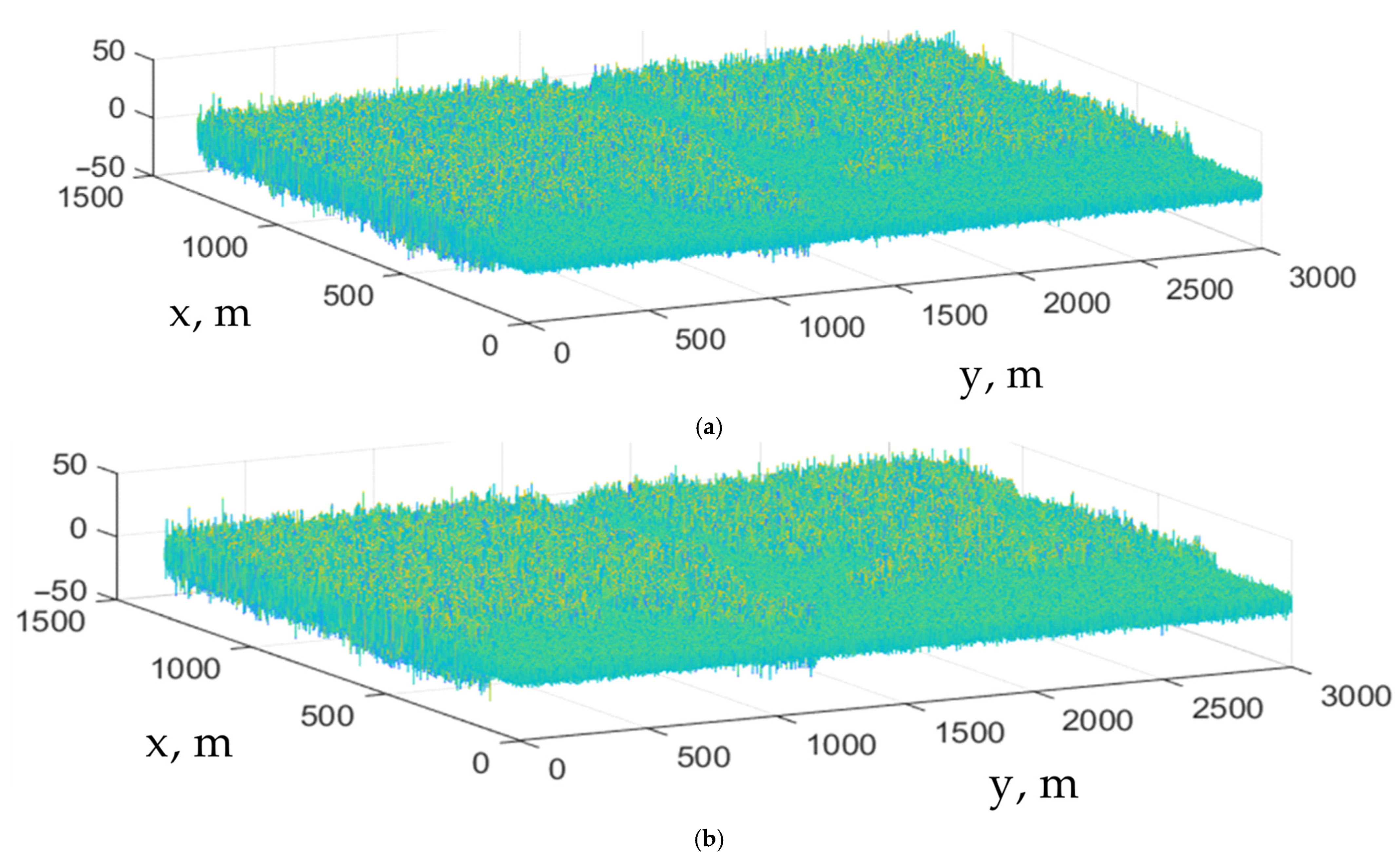
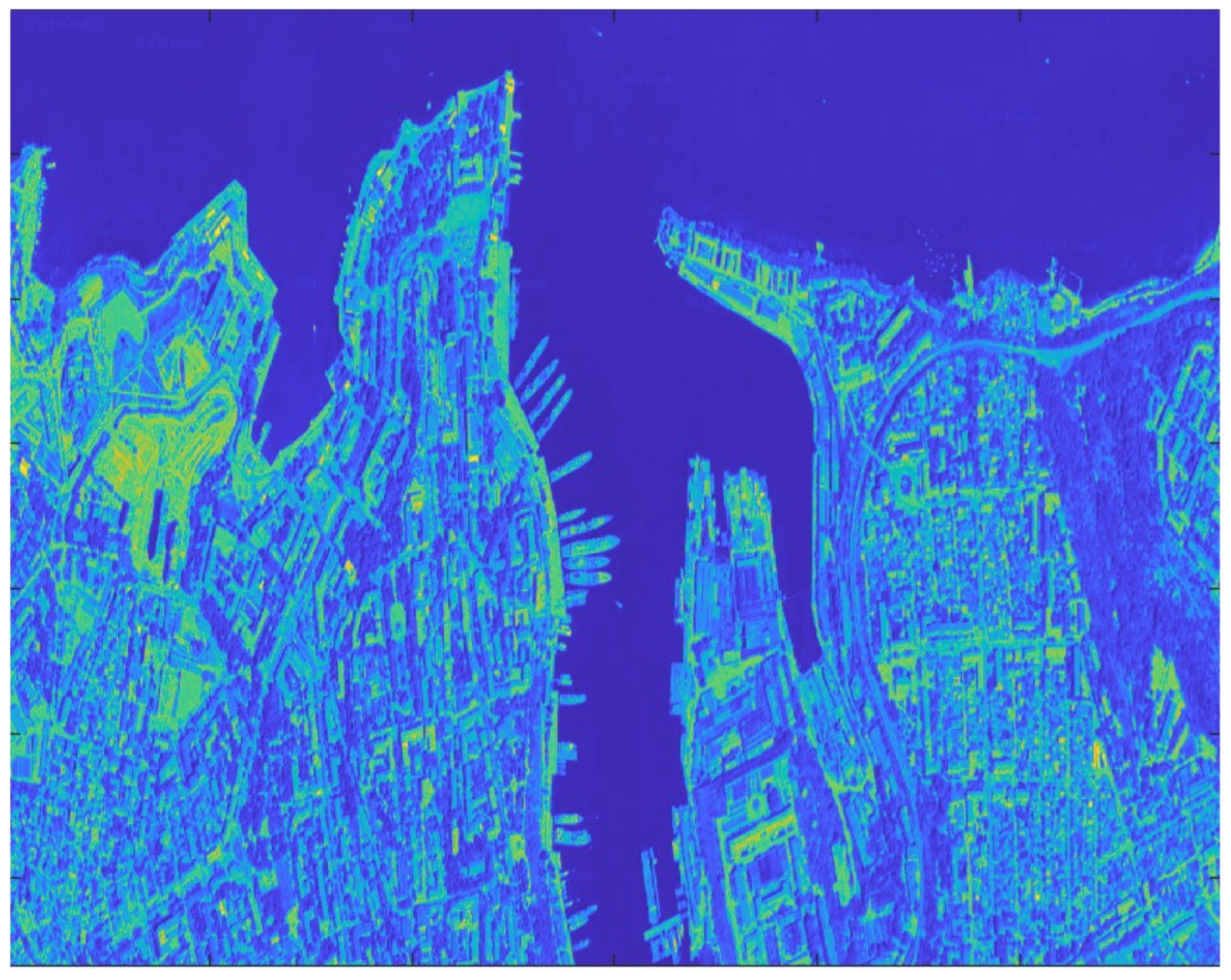
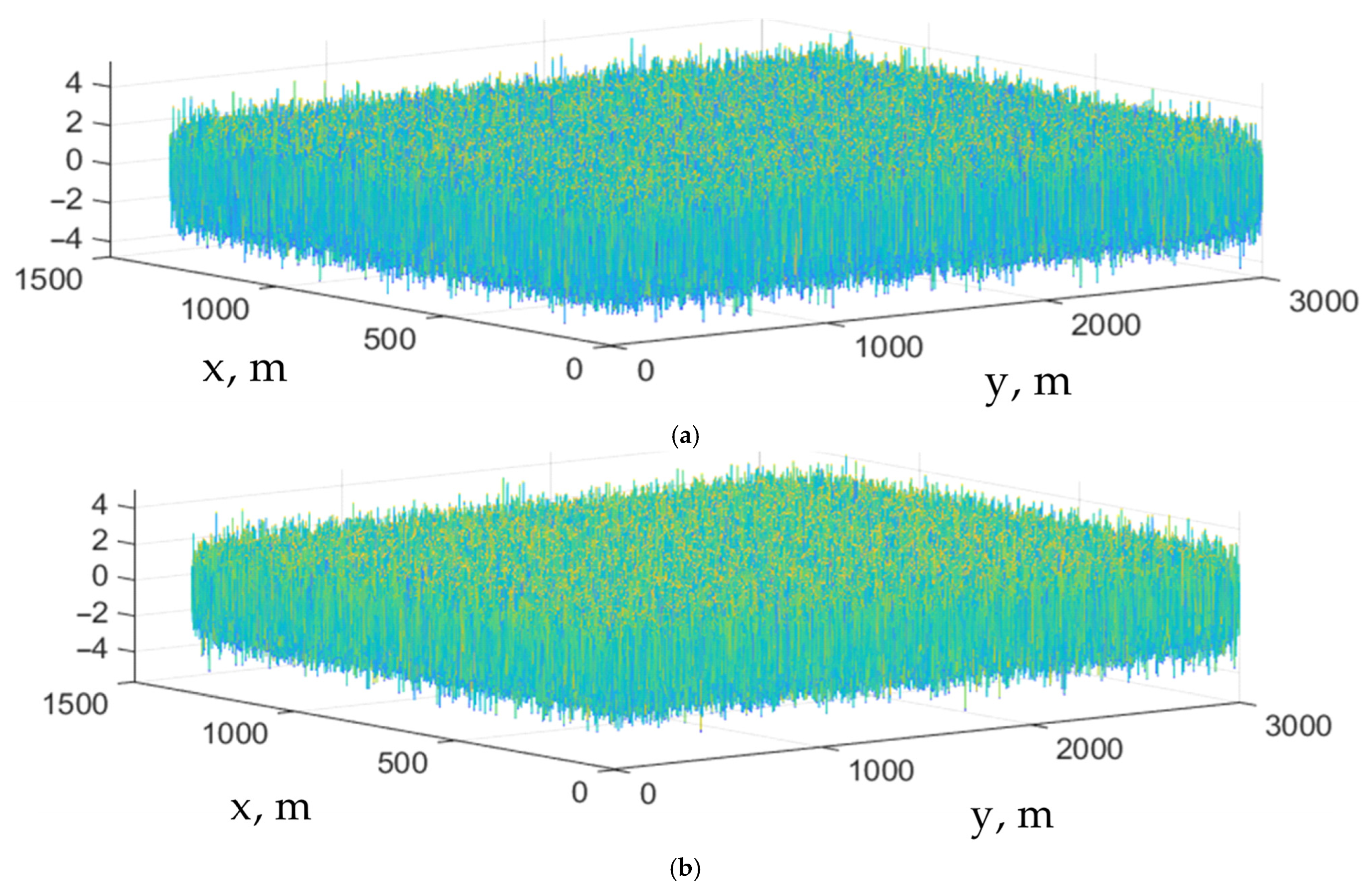
Figure 5 illustrates the variance distribution representing the true incoherent radar image. Based on model (34), Figure 6 shows the random components and . Figure 7 displays the distribution of the complex reflection coefficient ( and ) over the surface.
Figure 5.
Reference radar cross section.
Figure 6.
Noise components of the digital radar image model: (a)—, (b)—.
Figure 7.
Model of radar image: (a)—, (b)—.
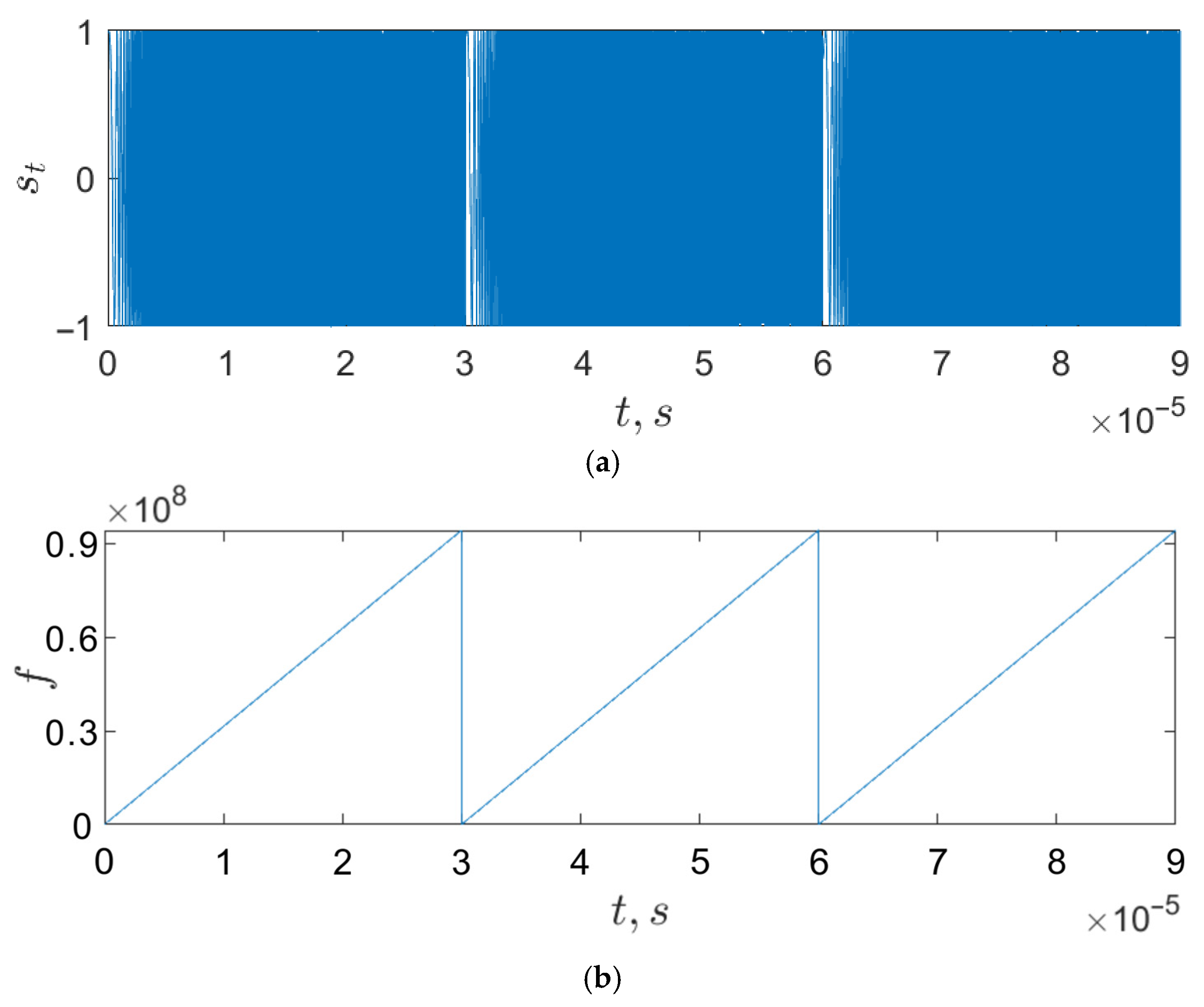
To model the baseband signal, three periods were used with a frequency deviation of 100 MHz and a modulation period of 30 μs, as shown in Figure 8. Figure 8a shows variation of the signal over time and Figure 8b presents frequency deviation over time.
Figure 8.
Model of the transmitted signal: (a) LFM signal, (b) frequency deviation over time.
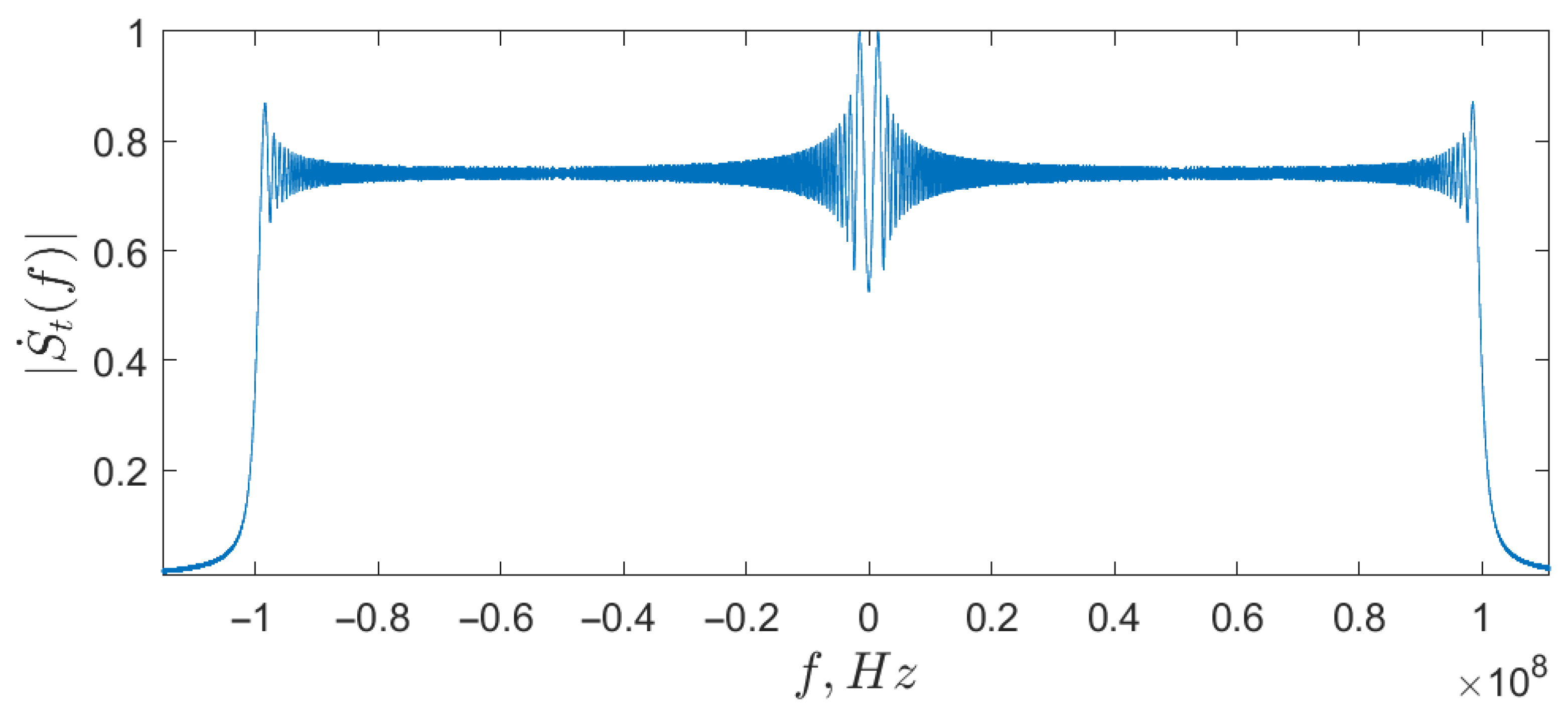
The spectrum of the transmitted signal is shown in Figure 9.
Figure 9.
Transmitted signal spectrum.
Considering the geometry of UAV-based terrain imaging, we assume that the distance to the nearest point on the surface is 1500 m, the distance to the farthest point is 2121.3 m, the UAV speed is 90 m/s, the wavelength is near 3 cm, and the azimuthal width of the ground scene behind the antenna beam is 106 m.
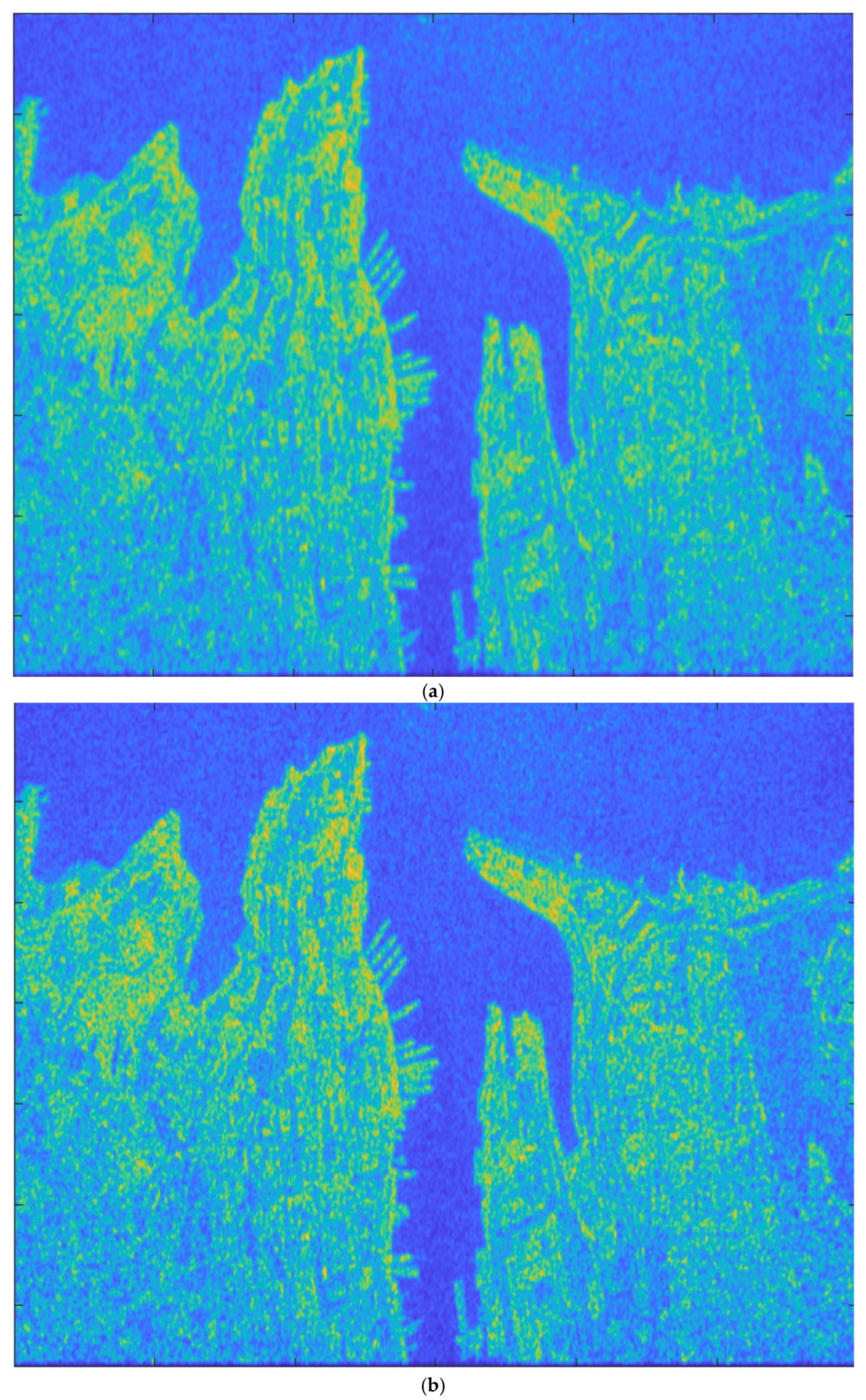
The radar images obtained through the classical and proposed decorrelation-based methods are shown in Figure 10.
Figure 10.
Radar images of the surface: (a) obtained using the classical method, (b) obtained using the decorrelation operation.
The qualitative analysis of the images confirms that the proposed optimal decorrelation operation does not distort the result and that the algorithm performs effectively. To provide a quantitative evaluation of the reconstructed radar images, we compared the results of both the classical and the proposed decorrelation-based method with a numerically generated reference image that corresponds to the true statistical model of the scattering surface (Figure 5). The comparison was carried out using a set of well-established image quality metrics that are commonly applied in radar and remote sensing studies. Specifically, Average Difference (AD) [36] and Mean Square Error (MSE) together with Peak Signal-to-Noise Ratio (PSNR) [37] measure pixel-wise deviation from the reference image. Structural Similarity Index (SSIM) [38], Normalized Cross-Correlation (NCC) [39], and Feature Similarity Extended (FSE) [40] quantify structural and perceptual similarity. Noise Quality Measure (NQM) [41] reflects the influence of additive noise on reconstructed image fidelity. Structural Content (SC) [42] evaluates the preservation of the overall energy and content of the image. In addition, two advanced methods—Singular Value Decomposition-based Image Quality Assessment (SVD-IQA) [43] and Visual Information Fidelity (VIF) [44]—were included to assess high-level structural and informational consistency with the reference image. The calculated values of these metrics for the images in Figure 10 are presented in Table 1. For all metrics, higher values of SSIM, NCC, FSE, VIF, PSNR, and SC, as well as lower values of AD and MSE, correspond to a higher image quality. The “Ideal test” values listed in Table 1 represent benchmark conditions under which the reconstructed image would perfectly match the reference.
Table 1.
Quantitative metrics for radar image quality assessment.
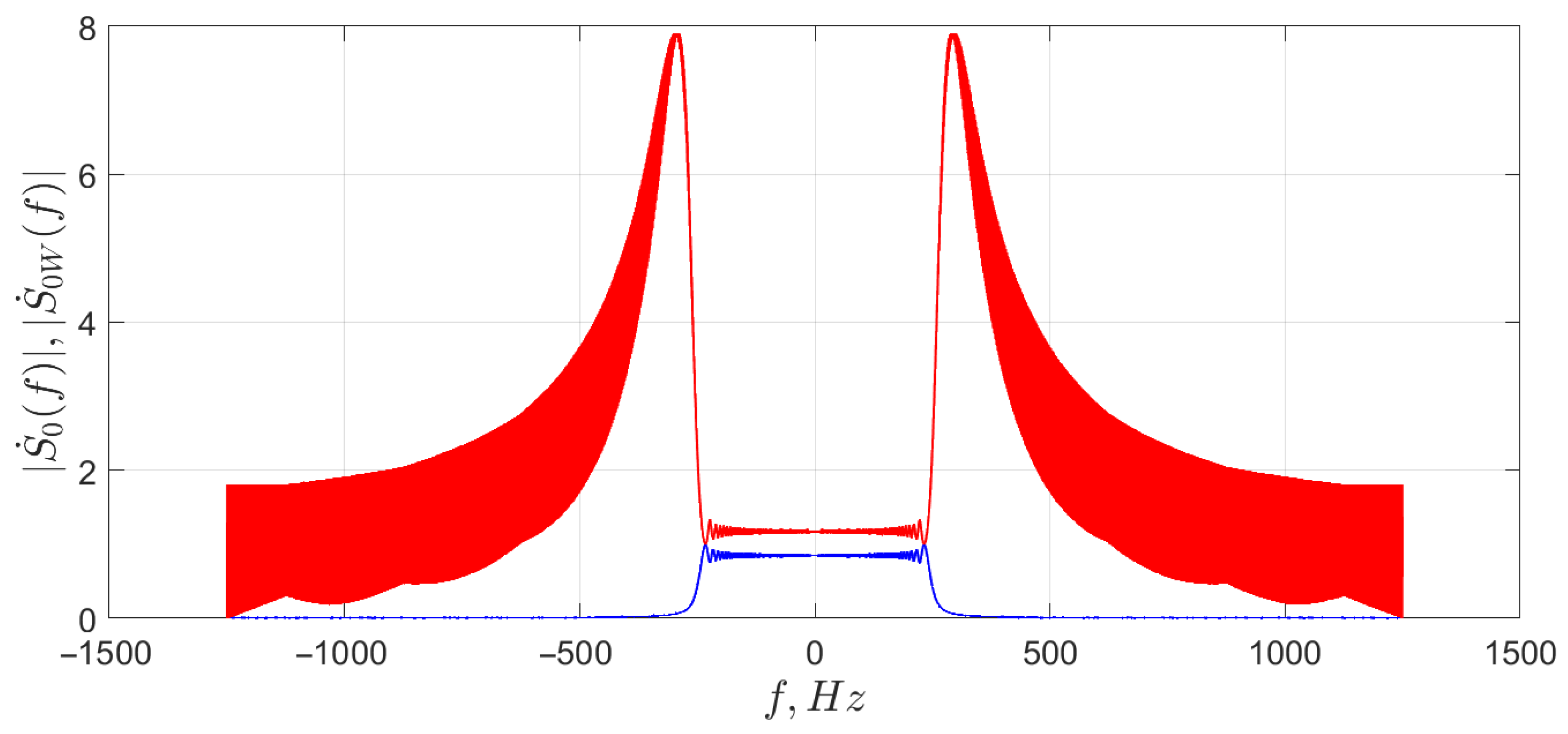
An analysis of Table 1 shows that, according to most quality metrics, the radar image produced using the decorrelation method is preferable. Although the improvement is not expressed in multiples or in percentage gains of hundreds, the results demonstrate that this approach is effective and deserves further investigation. To evaluate the enhancement in radar image reconstruction, we analyze the squared modulus of the mismatch functions given in Equation (25) for both the classical method and the new synthesized method. For this purpose, Figure 11 presents the spectrum of the azimuthal reference signal for a single range cell, along with the spectrum of the same signal after decorrelation. The plots show that the optimal algorithm strengthens frequency components in the received signal that are attenuated by the probing signal’s spectrum. The extent of spectral component recovery depends on the signal-to-noise ratio. For the spectrum and radar image shown in Figure 10b, the signal-to-noise ratio was 20 dB.
Figure 11.
Amplitude spectra: blue line shows the reference signal for azimuth compression of radar measurements using classical processing; red line shows the reference signal for azimuth compression after inverse filtering.
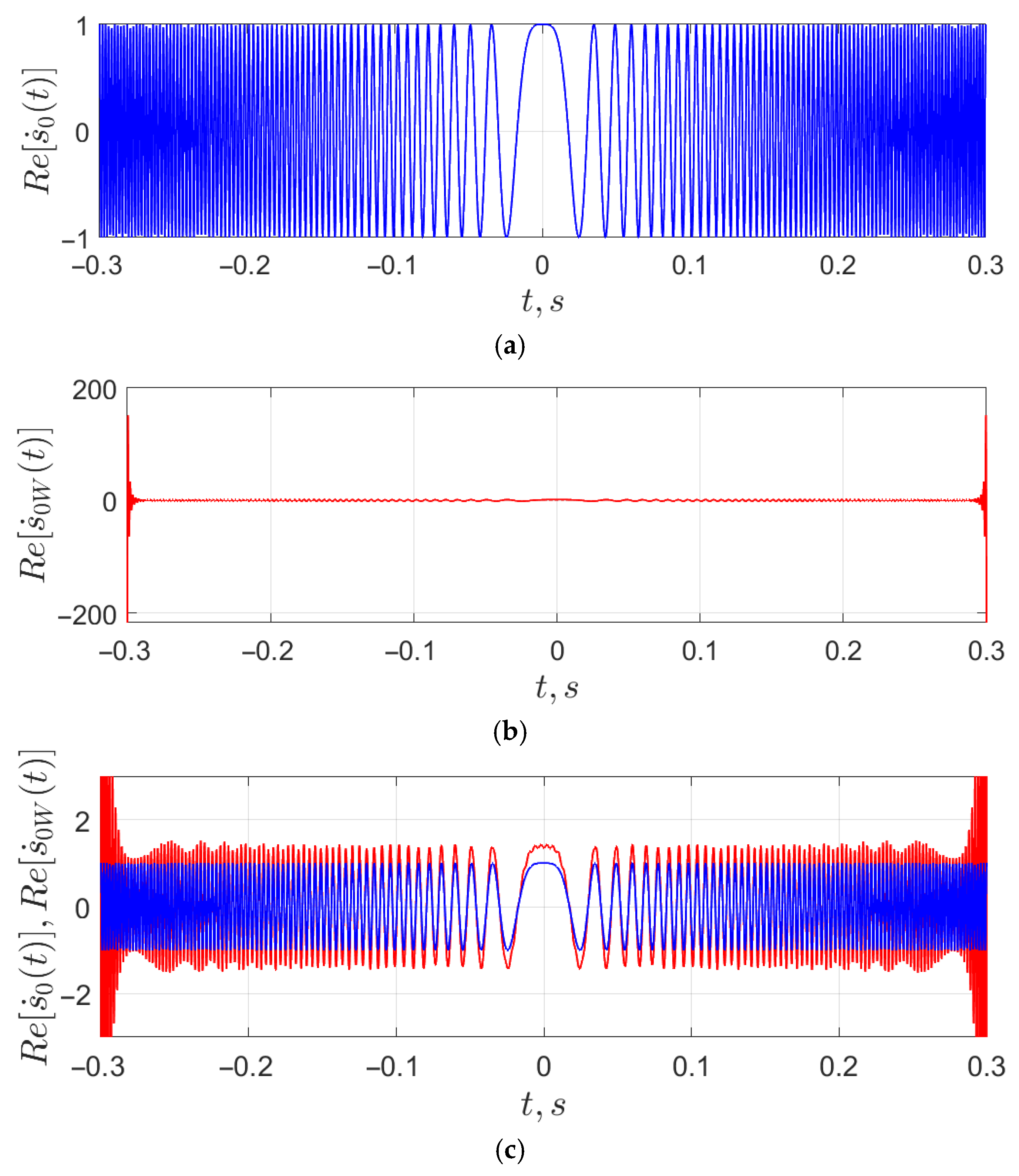
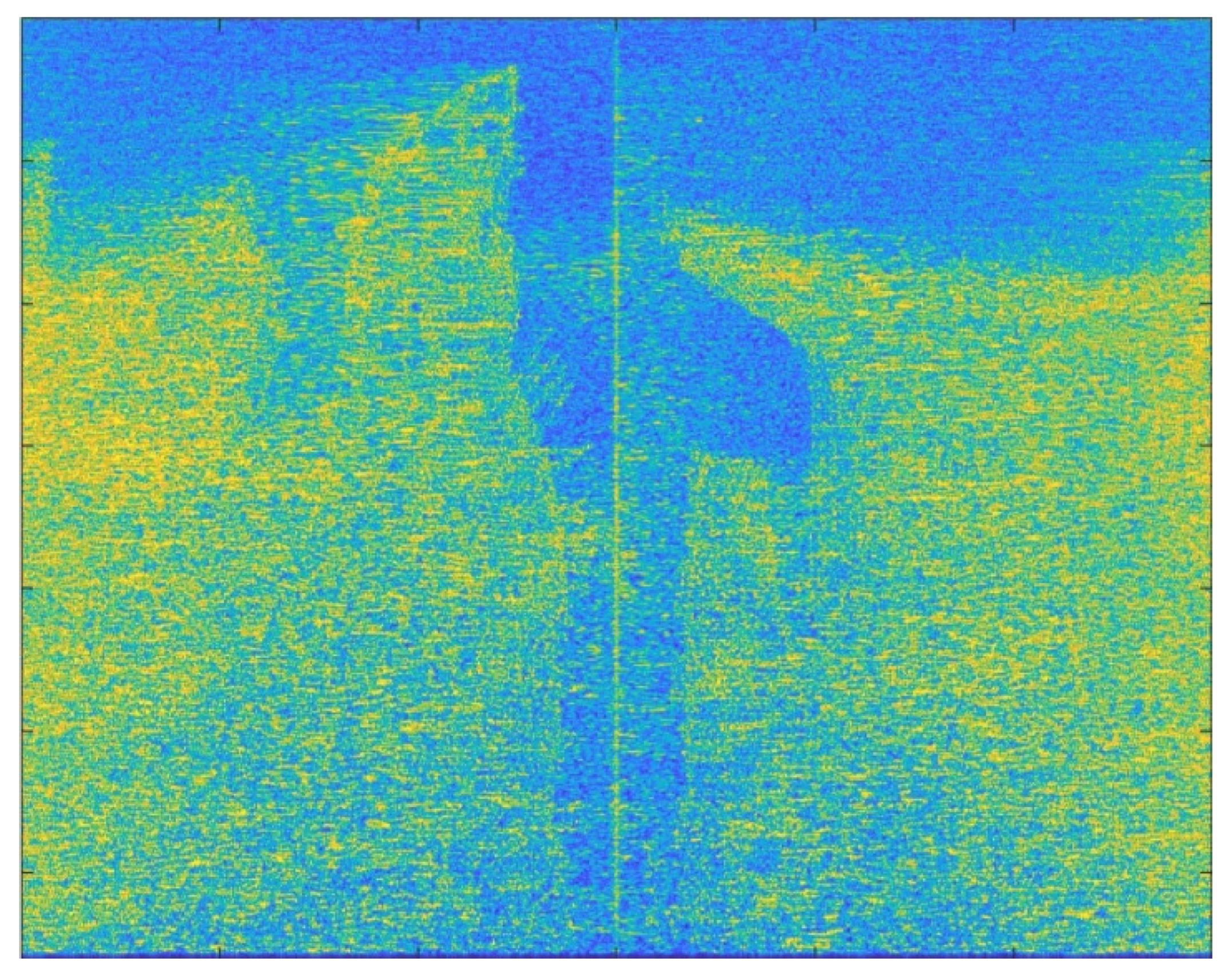
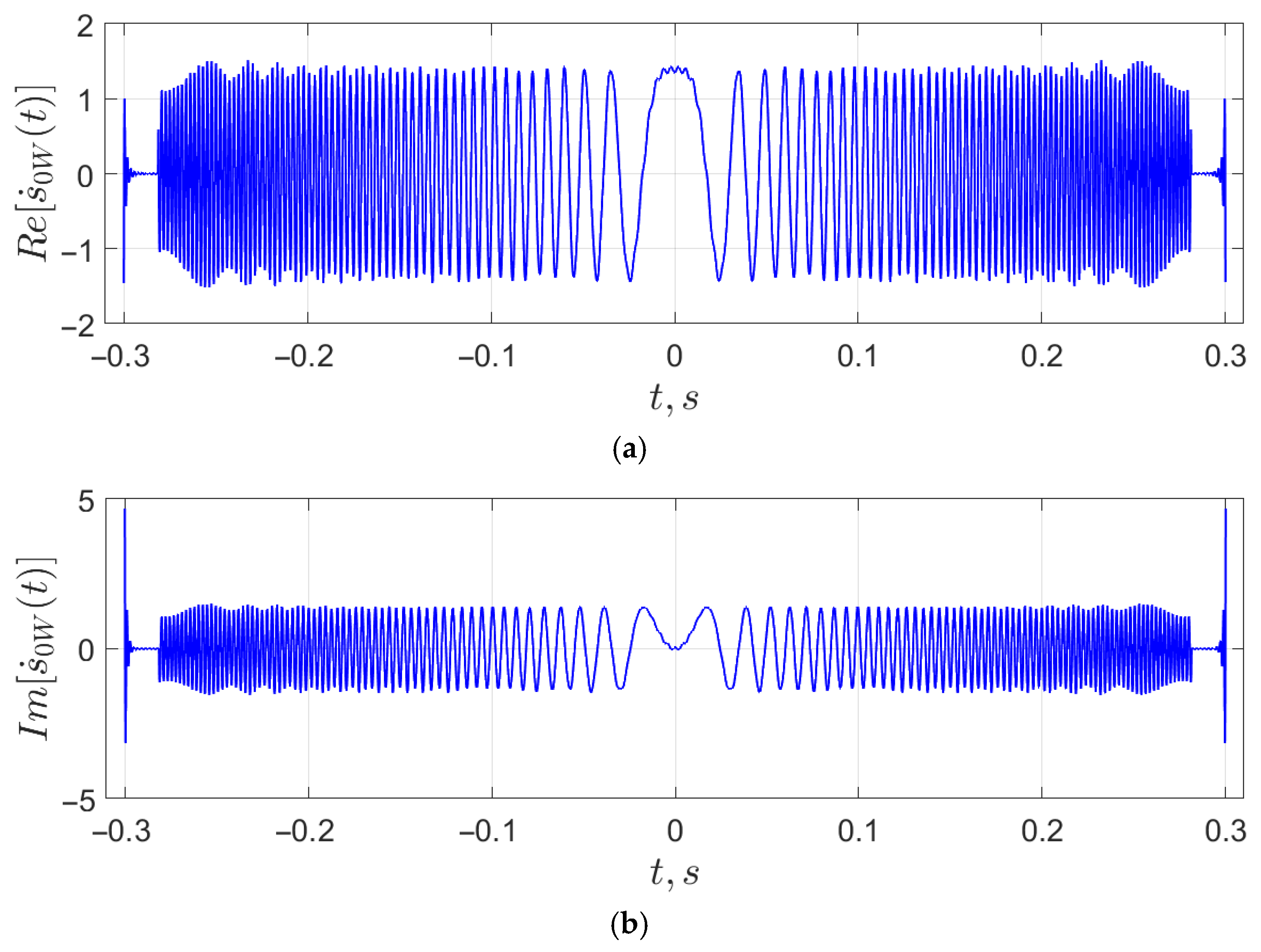
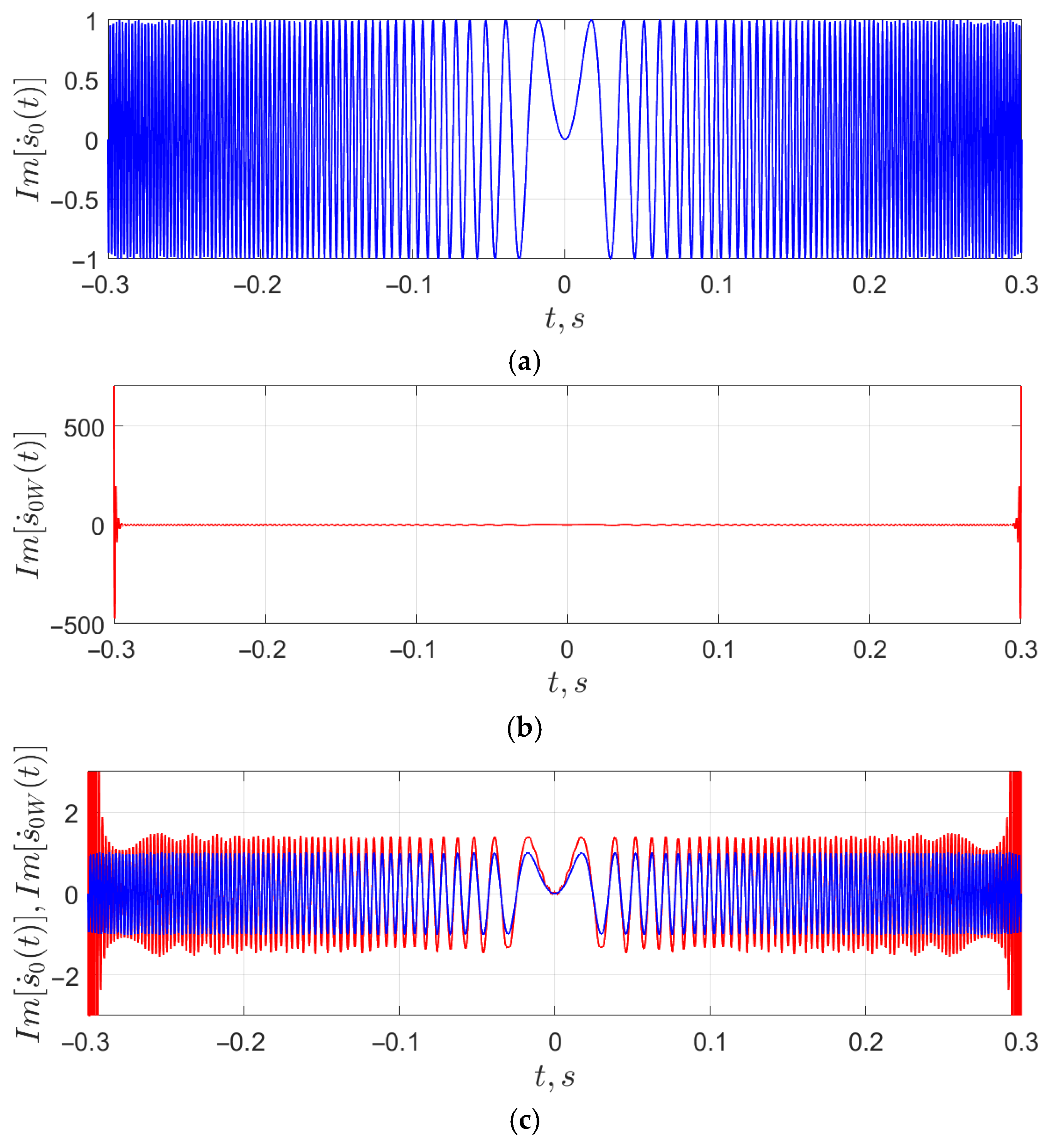
Figure 12 and Figure 13 compare the azimuthal reference signals used in the radar image synthesis for the classical and decorrelation-based methods. The graphs indicate that significant amplitude peaks appear at the beginning and end of the reference signal after decorrelation. The effect of using such a signal is shown in Figure 14 where a vertical bright stripe appears in the radar image. This stripe is an artifact resulting from those amplitude peaks. These amplitude anomalies are caused by the limited duration of the discretely sampled signal and the finite spectral bandwidth of the real signal. To eliminate these shortcomings in practical signal processing, a weighting function was applied. This function significantly reduces the amplitude at the boundaries of the reference signal, as shown in Figure 15. The result of applying the modified reference signal with decorrelation is illustrated in Figure 10b, which clearly shows the absence of artifacts and confirms the effectiveness of this adjustment.
Figure 12.
In-phase (I) component of the reference signal for azimuth compression of radar measurements: (a) classical method; (b) new synthesized method; (c) enhanced reference signal using the new synthesized method.
Figure 13.
Quadrature (Q) component of the reference signal for azimuth compression of radar measurements: (a) classical method; (b) new synthesized method; (c) enhanced reference signal using the new synthesized method.
Figure 14.
Example of a reconstructed radar image using a decorrelated reference signal with artifacts.
Figure 15.
Reference signals after correction: (a) I component; (b) Q component.
As shown in Figure 14, the reconstructed image obtained with a decorrelated reference signal contains several noticeable artifacts. The most prominent one is the vertical stripe crossing the scene, which appears due to the incomplete compensation of correlation at the spectral edges. In addition, local intensity anomalies can be observed in the homogeneous background, caused by the residual amplification of noise after whitening. These artifacts do not obscure the main structural features of the image, but they indicate the limitations of the decorrelation approach when applied without additional spectral windowing.
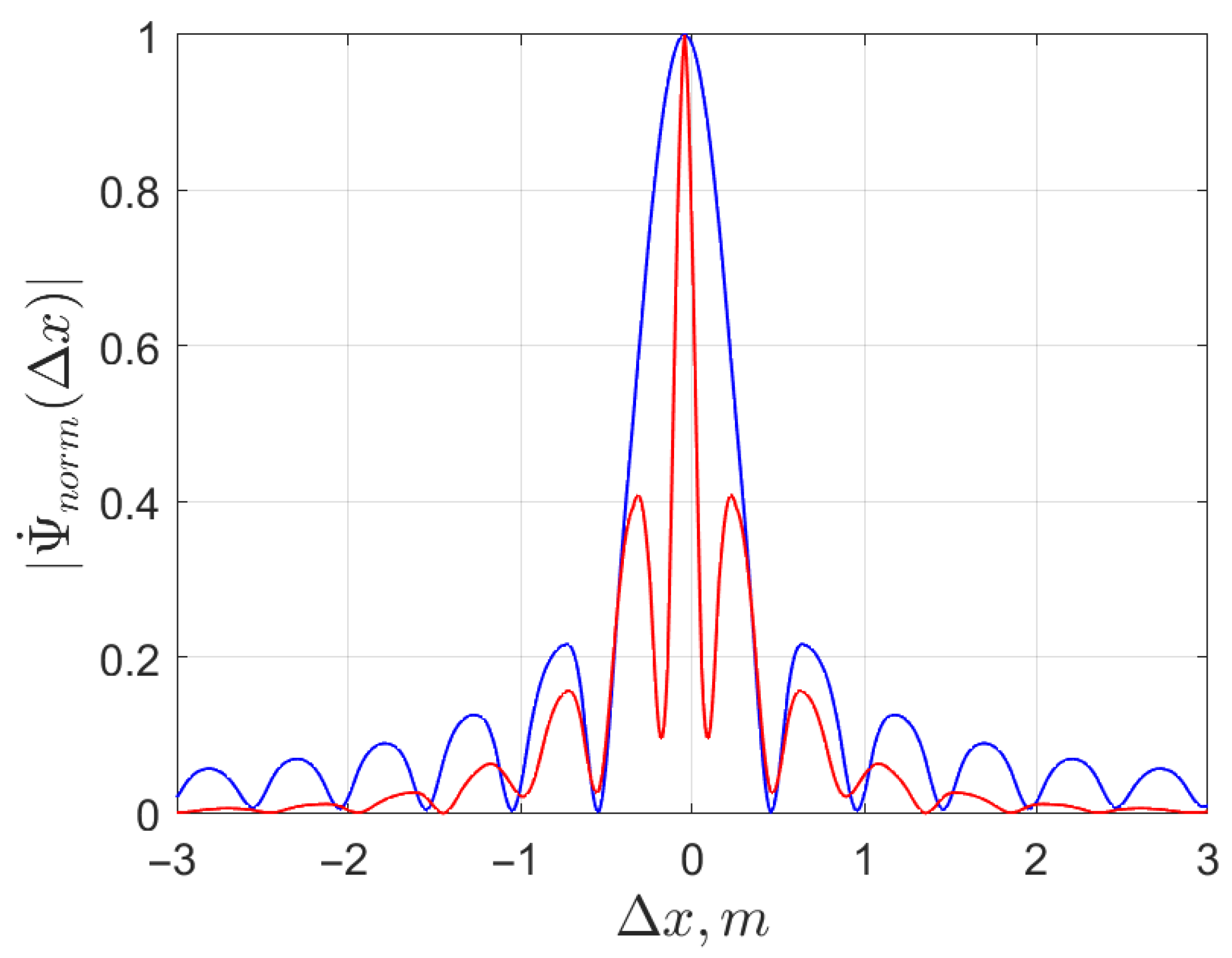
After determining all the characteristics of reference signal formation with decorrelation, Figure 16 presents the azimuth mismatch functions of the radar imaging system. The graphs represent the results of Formula (A6) calculated in surface coordinates, comparing the classical radar imaging method (blue line) with the newly synthesized method incorporating the decorrelation operation (red line). The decorrelation was applied assuming a signal-to-noise ratio of 20 dB. The plots show that the mismatch function produced by the modified method is approximately twice as wide as that of the classical method and also exhibits side lobes that are twice as high. To mitigate the influence of these elevated side lobes, more optimal and efficient weighting windows can be applied to the reference signal after decorrelation. Overall, the use of decorrelation filters in the processing chain led to a maximum improvement of 21% in FSE quality metrics, while the average enhancement across all metrics amounted to approximately 4%, as summarized in Table 1.
Figure 16.
Spatial ambiguity function: blue line—classical method; red line—new synthesized method.
5. Conclusions
This paper presents an optimal algorithm for generating radar images using LFM-CW SAR. The key innovation lies in the statistical foundation of the signal processing approach, which accounts for both the stochastic nature of surface reflections and the internal noise of the radar system. Using the maximum likelihood method, the algorithm enables the optimal estimation of the radar cross section. A central focus is the introduction of a decorrelation operation, which increases the number of statistically independent signal samples, reduces speckle noise, and significantly enhances image quality.
An inverse filter in the spectral domain has been developed, with a spectral response that adapts to the signal-to-noise ratio. This enables adaptive signal processing that expands the effective bandwidth and improves spatial resolution. Simulation modeling confirms the superiority of the proposed approach compared with classical methods. According to multiple image quality metrics, the decorrelation method delivers improved results, achieving a maximum improvement of 21% in FSE quality metrics, while the average enhancement across all metrics amounted to approximately 4%.
A complete structural implementation scheme is also presented, covering all stages of the radar imaging process from signal generation and reception to discrete transformation and azimuthal processing. This makes the algorithm particularly well suited for integration into modern SAR systems, especially on unmanned aerial platforms where compactness and energy efficiency are critical.
The results underscore the promise of the proposed method and support its potential for further development in the field of advanced radar imaging.
Author Contributions
D.K., Conceptualization, methodology, investigation, resources, writing—original draft, project administration; S.Z., Conceptualization, methodology, investigation, writing—original draft, supervision; V.T., Validation, formal analysis, investigation, resources, data curation, writing—review & editing, visualization; D.V., Software, validation, investigation, writing—original draft, visualization, project administration; I.P., Software, validation, investigation, data curation; O.K., Validation, investigation, data curation, visualization; M.V., Software, validation, investigation, data curation. All authors have read and agreed to the published version of the manuscript.
Funding
This research received no external funding.
Data Availability Statement
The data presented in this study are not publicly available because they form part of an ongoing research project. Requests to access the data should be directed to corresponding author, provided that such sharing complies with institutional and regulatory restrictions.
Conflicts of Interest
The authors declare no conflicts of interest.
Abbreviations
The following abbreviations are used in this manuscript:
| SAR | Synthetic aperture radar |
| LFM-CW | Linear frequency-modulated continuous wave |
| UAV | Unmanned aerial vehicle |
| VCO | Voltage-controlled oscillator |
| PLL | Phase-locked loop |
| DFT | Discrete Fourier transform |
| ADC | Analog-to-digital converter |
| AD | Average Difference |
| FSE | Feature Similarity Extended |
| SSIM | Structural Similarity Index |
| NCC | Normalized Cross-Correlation |
| NQM | Noise Quality Measure |
| PSNR | Peak Signal-To-Noise Ratio |
| MSE | Mean Square Error |
| SC | Structural Content |
| SVD IQA | SVD-based image quality assessment |
| VIF | Visual Information Fidelity |
Appendix A
Under the specified conditions of the problem, Equation (17) takes the form
For further solving of the likelihood equation, all of its components are defined as
Substituting (A2)–(A4) into (A1), we obtain
where is the optimal algorithm for processing the received signal.
The function
is called the spatial ambiguity function or the impulse response of the radar imaging system to a point source. This function defines the spatial resolution of the radar that implements the proposed decorrelation-based processing.
Expression
defines the energy of the unit signal, taking into account the decorrelation.
References
- Miccinesi, L.; Beni, A.; Bigazzi, L.; Pieraccini, M. Synthetic Aperture Radar Aboard an Unmanned Aerial System for Detecting Foreign Object Debris on Airport Runways. IEEE Access 2024, 12, 106735–106743. [Google Scholar] [CrossRef]
- Joshi, P.; Srigyan, M.; Oza, S.; Ray, Y.; Beg, J. Bringing SAR Capability to a Safer Ice Navigation during Indian Antarctic Expedition in Near Real-Time Mode. Polar Sci. 2022, 34, 100900. [Google Scholar] [CrossRef]
- Vitale, R.; Milillo, P. Simulating SAR Constellations Systems for Rapid Damage Mapping in Urban Areas: Case Study of the 2023 Turkey-Syria Earthquake. Int. J. Appl. Earth Obs. Geoinf. 2024, 134, 104226. [Google Scholar] [CrossRef]
- Ashry, M.M.; Mashaly, A.S.; Sheta, B.I. Proposed SAR Range Focusing Algorithm Based on Simulation Analysis and SDR Implementation. Arab. J. Geosci. 2023, 16, 476. [Google Scholar] [CrossRef]
- Hosseiny, B.; Amini, J.; Esmaeilzadeh, M.; Nekoee, M. Evaluating an S-Band Ground-Based Synthetic Aperture Radar Imaging System for LFMCW SAR Processing. Earth Obs. Geomat. Eng. 2021, 5, 1–11. [Google Scholar] [CrossRef]
- Zozaya, A.; Bolaños, R. Implementing the LFM-CW MIT Radar at the Ecuadorian Space Institute: Some Results. J. Aerosp. Technol. Manag. 2020, 12, e1220. [Google Scholar] [CrossRef]
- Jancco-Chara, J.; Palomino-Quispe, F.; Coaquira-Castillo, R.J.; Herrera-Levano, J.C.; Florez, R. Doppler Factor in the Omega-k Algorithm for Pulsed and Continuous Wave Synthetic Aperture Radar Raw Data Processing. Appl. Sci. 2024, 14, 320. [Google Scholar] [CrossRef]
- Kaniewski, P.; Komorniczak, W.; Leśnik, C.; Cyrek, J.; Susek, W.; Serafin, P.; Łabowski, M. S-Band and Ku-Band SAR System Development for UAV-Based Applications. Metrol. Meas. Syst. 2019, 26, 53–64. [Google Scholar] [CrossRef]
- Moreira, A.; Prats-Iraola, P.; Younis, M.; Krieger, G.; Hajnsek, I.; Papathanassiou, K.P. A Tutorial on Synthetic Aperture Radar. IEEE Geosci. Remote Sens. Mag. 2013, 1, 6–43. [Google Scholar] [CrossRef]
- Meyer, F. Spaceborne Synthetic Aperture Radar—Principles, Data Access, and Basic Processing Techniques. In SAR Handbook: Comprehensive Methodologies for Forest Monitoring and Biomass Estimation; Flores, A., Herndon, K., Thapa, R., Cherrington, E., Eds.; NASA: Washington, DC, USA, 2019. [Google Scholar] [CrossRef]
- Yu, Z.; Dong, G.; Liu, H. SAR Image Quality Assessment: From Sample-Wise to Class-Wise. Remote Sens. 2023, 15, 2110. [Google Scholar] [CrossRef]
- Yu, Y.; Takeuchi, W. Analysis of Scattering Mechanisms in SAR Image Simulations of Japanese Wooden Buildings Damaged by Earthquake. Buildings 2024, 14, 3585. [Google Scholar] [CrossRef]
- Plank, S. Rapid Damage Assessment by Means of Multi-Temporal SAR—A Comprehensive Review and Outlook to Sentinel-1. Remote Sens. 2014, 6, 4870–4906. [Google Scholar] [CrossRef]
- Hammer, H.; Schulz, K. Coherent Simulation of SAR Images. In Proceedings of the Image and Signal Processing for Remote Sensing XV, Berlin, Germany, 31 August–2 September 2009; pp. 406–414. [Google Scholar] [CrossRef]
- Chen, S.-W.; Li, Y.-Z.; Wang, X.-S.; Xiao, S.-P.; Sato, M. Modeling and Interpretation of Scattering Mechanisms in Polarimetric Synthetic Aperture Radar: Advances and Perspectives. IEEE Signal Process. Mag. 2014, 31, 79–89. [Google Scholar] [CrossRef]
- Li, Y. Frequency-Modulated Continuous-Wave Synthetic-Aperture Radar: Improvements in Signal Processing. Ph.D. Thesis, Memorial University of Newfoundland, St. John’s, NL, Canada, 2016. [Google Scholar]
- Li, Y.; O’Young, S. Focusing Bistatic FMCW SAR Signal by Range Migration Algorithm Based on Fresnel Approximation. Sensors 2015, 15, 32123–32137. [Google Scholar] [CrossRef]
- Elnazer, A.A.; Ewida, E.H.; Sayed, W.M. Landsat Image Enhancement Using SAR Image (Case Study: High Aswan Dam, Egypt). Int. J. Adv. Res. 2015, 3, 834–841. [Google Scholar]
- Chan, D.; Gambini, J.; Frery, A.C. Speckle Noise Reduction in SAR Images Using Information Theory. Int. Arch. Photogramm. Remote Sens. Spat. Inf. Sci. 2020, XLII-3/W12, 141–146. [Google Scholar] [CrossRef]
- Liang, W.; Zhang, T.; Diao, W.; Sun, X.; Zhao, L.; Fu, K.; Wu, Y. SAR Target Classification Based on Sample Spectral Regularization. Remote Sens. 2020, 12, 3628. [Google Scholar] [CrossRef]
- Born, M. Fundamentals of Optics; Nauka: Moscow, Russia, 1973. (In Russian) [Google Scholar]
- Goodman, J.W. Introduction to the Fourier Optics; Mir: Moscow, Russia, 1970. (In Russian) [Google Scholar]
- Zommerfel’d, A. Optics; Izdat Inostrannoy Literatury: Moscow, Russia, 1953. (In Russian) [Google Scholar]
- Volosyuk, V.K.; Pavlikov, V.V.; Zhyla, S.S. Phenomenological Description of the Electromagnetic Field and Coherent Images in Radio Engineering and Optical Systems. In Proceedings of the 2018 IEEE 17th International Conference on Mathematical Methods in Electromagnetic Theory (MMET), Kyiv, Ukraine, 2–5 July 2018; pp. 302–305. [Google Scholar] [CrossRef]
- Volosyuk, V.K.; Zhyla, S.S.; Kolesnikov, D.V. Phenomenological Description of Coherent Radar Images Based on the Concepts of the Measure of Set and Stochastic Integral. Telecommun. Radio Eng. 2019, 78, 19–30. [Google Scholar] [CrossRef]
- Kravchenko, V.F.; Kutuza, B.G.; Volosyuk, V.K.; Pavlikov, V.V.; Zhyla, S.S. Super-Resolution SAR Imaging: Optimal Algorithm Synthesis and Simulation Results. In Proceedings of the 2017 Progress in Electromagnetics Research Symposium—Spring (PIERS), St. Petersburg, Russia, 22–25 May 2017; pp. 419–425. [Google Scholar] [CrossRef]
- Volosyuk, V.K.; Kravchenko, V.F. Statistical Theory of Radio Engineering Systems for Remote Sensing and Radar; Fizmatlit: Moscow, Russia, 1988. (In Russian) [Google Scholar]
- Volosyuk, V.K.; Pavlikov, V.V.; Zhyla, S.S. Algorithms Synthesis and Potentiality Analysis of Optimum Ultrawideband Signal Processing in the Radiometric System with Modulation. In Proceedings of the 2011 VIII International Conference on Antenna Theory and Techniques (ICATT), Kyiv, Ukraine, 20–23 September 2011; pp. 235–237. [Google Scholar] [CrossRef]
- Pavlikov, V.; Volosyuk, V.; Zhyla, S.; Van, H.N.; Van, K.N. UWB Active Aperture Synthesis Radar: The Operating Principle and Development of the Radar Block Diagram. In Proceedings of the 2017 IEEE Microwaves, Radar and Remote Sensing Symposium (MRRS), Kiev, Ukraine, 29–31 August 2017; pp. 27–30. [Google Scholar] [CrossRef]
- Pavlikov, V.V.; Volosyuk, V.K.; Zhyla, S.S.; Van, H.N. Active Aperture Synthesis Radar for High Spatial Resolution Imaging. In Proceedings of the 2018 9th International Conference on Ultrawideband and Ultrashort Impulse Signals (UWBUSIS), Odessa, Ukraine, 4–7 September 2018; pp. 252–255. [Google Scholar] [CrossRef]
- Pavlikov, V.V.; Zhyla, S.S.; Kiem, N.V.; Odokienko, O.V. Optimal Signal Processing for Radiometric Imaging with Multi-Antenna & Multi-Band Passive Radars. In Proceedings of the 2015 International Conference on Antenna Theory and Techniques (ICATT), Kharkiv, Ukraine, 21–24 April 2015; pp. 1–3. [Google Scholar] [CrossRef]
- Rubel, O.; Lukin, V.; Rubel, A.; Egiazarian, K. Selection of Lee Filter Window Size Based on Despeckling Efficiency Prediction for Sentinel SAR Images. Remote Sens. 2021, 13, 1887. [Google Scholar] [CrossRef]
- Rubel, O.; Lukin, V.; Rubel, A.; Egiazarian, K. NN-Based Prediction of Sentinel-1 SAR Image Filtering Efficiency. Geosciences 2019, 9, 290. [Google Scholar] [CrossRef]
- Liashuk, O.M.; Vishnevyy, S.V.; Zhuk, S.Y. Homomorphic Two-Stage Image Sequence Filtering Algorithm in the Presence of Correlated Speckle Noise. Visnyk NTUU KPI Ser. Radiotekh. Radioaparatobud. 2017, 71, 52–59. [Google Scholar] [CrossRef]
- Lavreniuk, M.; Kussul, N.; Meretsky, M.; Lukin, V.; Abramov, S.; Rubel, O. Impact of SAR Data Filtering on Crop Classification Accuracy. In Proceedings of the 2017 IEEE First Ukraine Conference on Electrical and Computer Engineering (UKRCON), Kyiv, Ukraine, 29 May–1 June 2017; pp. 912–917. [Google Scholar] [CrossRef]
- Bhola, V.K.; Sharma, T.; Bhatnagar, J. Image Quality Assessment Techniques. IJITKM Spec. 2014, 7, 156–161, ISSN 0973-4414. [Google Scholar]
- Kordov, K.; Zhelezov, S. Steganography in Color Images with Random Order of Pixel Selection and Encrypted Text Message Embedding. PeerJ Comput. Sci. 2021, 7, e380. [Google Scholar] [CrossRef]
- Wang, Z.; Bovik, A.C.; Sheikh, H.R.; Simoncelli, E.P. Image Quality Assessment: From Error Visibility to Structural Similarity. IEEE Trans. Image Process. 2004, 13, 600–612. [Google Scholar] [CrossRef] [PubMed]
- Zhao, F.; Huang, Q.; Gao, W. Image Matching by Normalized Cross-Correlation. In Proceedings of the 2006 IEEE International Conference on Acoustics Speech and Signal Processing, Toulouse, France, 14–19 May 2006; pp. II-729–II-732. [Google Scholar] [CrossRef]
- Ngo, D.; Lee, S.; Nguyen, Q.-H.; Ngo, T.M.; Lee, G.-D.; Kang, B. Single Image Haze Removal from Image Enhancement Perspective for Real-Time Vision-Based Systems. Sensors 2020, 20, 5170. [Google Scholar] [CrossRef] [PubMed]
- de Freitas Zampolo, R.; Seara, R. A Comparison of Image Quality Metric Performances under Practical Conditions. In Proceedings of the IEEE International Conference on Image Processing 2005, Genova, Italy, 11–14 September 2005; p. III–1192. [Google Scholar] [CrossRef]
- Sanjith, S.; Ganesan, R. Overview of Image Quality Metrics with Perspective to Satellite Image Compression. Int. J. Eng. Res. Afr. 2016, 24, 112–123. [Google Scholar] [CrossRef]
- Shnayderman, A.; Eskicioglu, A.M. Evaluating the Visual Quality of Watermarked Images. Proc. SPIE 2006, 6072, 788–799. [Google Scholar] [CrossRef]
- Rezazadeh, S.; Coulombe, S. Low-Complexity Computation of Visual Information Fidelity in the Discrete Wavelet Domain. In Proceedings of the 2010 IEEE International Conference on Acoustics, Speech and Signal Processing, Dallas, TX, USA, 14–19 March 2010; pp. 2438–2441. [Google Scholar] [CrossRef]
Disclaimer/Publisher’s Note: The statements, opinions and data contained in all publications are solely those of the individual author(s) and contributor(s) and not of MDPI and/or the editor(s). MDPI and/or the editor(s) disclaim responsibility for any injury to people or property resulting from any ideas, methods, instructions or products referred to in the content. |
© 2025 by the authors. Licensee MDPI, Basel, Switzerland. This article is an open access article distributed under the terms and conditions of the Creative Commons Attribution (CC BY) license (https://creativecommons.org/licenses/by/4.0/).