Article

RiDW-YOLO: A Low-Light Traffic Sign Detection Algorithm Integrating Illumination Enhancement

by
Yinyin Li
1,
Lei Liu
1,
Fangzheng Tong
1,
Qingyu Liu
1 and
Yeguo Sun
2,*
1
School of Computer Science, Huainan Normal University, Huainan 232038, China
2
School of Finance and Mathematics, Huainan Normal University, Huainan 232038, China
*
Author to whom correspondence should be addressed.
Information 2026, 17(9), 894; https://doi.org/10.3390/info17090894
Submission received: 5 August 2026 / Revised: 8 September 2026 / Accepted: 10 September 2026 / Published: 15 September 2026

Abstract

To address difficulties in traffic sign detection under low-light environments, this paper proposes RiDW-YOLO, an improved detection algorithm based on YOLOv11n. The Retinexformer network is embedded as a trainable front-end module at the first layer of the YOLOv11n backbone, performing online image enhancement during forward propagation without offline preprocessing. Its weights are updated end-to-end with the subsequent detection sub-network, improving brightness and contrast while suppressing noise, thereby strengthening feature extraction for traffic sign targets. An iterative attentional feature fusion (iAFF) block is integrated into the feature-fusion architecture of YOLOv11n, enabling adaptive weighted multi-level feature aggregation and enhancing feature representation. DySample, a dynamic up-sampling operator, replaces conventional interpolation methods by learning offset coordinates to better preserve fine-grained feature information. Wise-IoU (WIoU) replaces the original Complete-Intersection over Union (CIoU) loss function, leveraging dynamically adjusted gradient weights to suppress low-quality samples interference and boost bounding-box localization performance. Experimental results demonstrate that compared with the YOLOv11n baseline model, the improved algorithm achieves an increase of 15.2 percentage points in precision, 6.2 percentage points in recall, and 11.0 percentage points in mAP@50. Overall, this work provides a feasible solution for traffic-sign detection under low-light conditions and emphasizes the importance of balanced module design and frank discussion of current limitations.

1. Introduction

Traffic sign detection is a fundamental task in Advanced Driver Assistance Systems (ADAS) and the perception module of autonomous vehicles [1]. It aims to recognize regulatory, warning, and indicative signs in real time and output their precise locations and semantic categories, thereby providing essential reference information for vehicle decision-making and control. Given its direct impact on driving safety and traffic efficiency, reliable traffic sign detection is of paramount importance [2].
With the progressive deployment of intelligent vehicles in all-weather and all-scenario environments, low-light conditions—including nighttime, tunnel entrances, backlighting, and heavy shadows—have become routine rather than exceptional. Under insufficient illumination, captured images typically suffer from multiple degradation factors, such as reduced brightness, poor contrast, blurred edges, increased noise, and color distortion [3]. These defects severely weaken the visual distinctiveness of traffic signs and impose considerable difficulties, especially for detecting small, distant, or partially occluded targets [4]. Moreover, conventional detection models trained on well-lit, uniformly illuminated datasets exhibit substantial performance drops when directly applied to low-light scenarios, leading to higher miss rates and increased false positives [5,6]. This degradation remains a critical bottleneck that hinders the reliable round-the-clock operation of autonomous driving systems.
The past several years have witnessed rapid progress in deep-learning-driven object detection methodologies. Single-stage detectors are widely adopted in vehicular vision systems due to their end-to-end architecture, high speed, and ease of deployment. As a representative framework, the YOLO series has undergone multiple iterations, achieving an excellent balance between accuracy and speed [7]. YOLOv11n [8], released as the stable version by the Ultralytics team in 2024, possesses stronger feature extraction capabilities and generalization performance in conventional scenarios by optimizing the backbone network, lightweight structures, and feature fusion strategies [9]. However, the YOLOv11n baseline model is still primarily trained on bright and clear images, and the network has not been specifically designed for low-light degradation, noise interference, and sparse features of small objects [10]. In low-light traffic sign detection, it still suffers from the following limitations: insufficient effective feature extraction capability under weak illumination; severe loss of small object features during deep downsampling; inadequate multi-scale information fusion; and insufficient regression accuracy of the detection head for blurred and noisy samples [11].
Extensive studies have focused on tackling the inherent difficulties in low-light object detection. Current solutions generally fall into two technical categories: image enhancement preprocessing and structural improvement of detection networks. In terms of image enhancement, low-light enhancement algorithms such as Retinex theory, Zero-Reference Deep Curve Estimation (Zero-DCE) [12], SCI [13], and EnlightenGAN [14] have been employed to improve image brightness and contrast. Dai et al. [15] combined enhancement with denoising and proposed VD-YOLOv5, achieving a 6.2 percentage point improvement in mAP@50 on the ExDark dataset. However, the paradigm of separate enhancement and detection tends to amplify noise and distort details, precludes end-to-end joint optimization, and introduces additional inference overhead, which may limit its applicability in time-sensitive scenarios [16].
In the direction of network improvement, researchers have enhanced low-light robustness through attention mechanisms, feature pyramid enhancement, and denoising module embedding. Lin et al. [17] proposed YOLO-LLTS, constructing a Prior-Guided Feature Enhancement (PGFE) module and a high-resolution small object detection branch, which achieved mAP@50 improvement on the TT100K-night dataset. Liu et al. [18] designed Dark-YOLO based on YOLOv8, introducing adaptive enhancement and multi-dimensional attention mechanisms. Sun et al. [19] improved YOLOv7 for low-light traffic scenes by combining filtering-based denoising with attention residual modules. Additionally, methods such as DSF-YOLO [20] and IDOD-YOLOv7 [21] have been optimized for composite adverse conditions including rain, fog, and low light, further validating the effectiveness of structural improvements for low-quality image detection.
Although certain progress has been achieved in current research, existing low-light traffic sign detection methods still confront several practical challenges. Under low-light conditions, image degradations including low brightness, noise interference and blurred object contours suppress discriminative feature information of traffic signs, which degrades the feature extraction performance of detectors [22]. Traffic signs exhibit distinct multi-scale characteristics, whereas conventional feature fusion structures fail to fully activate multi-scale structural priors and lead to insufficient utilization of features at different scales [23]. Fixed-sampling operations adopted in mainstream networks may discard valuable fine-grained features or introduce redundant feature responses, further constraining the representation capability for small targets. Moreover, complex illumination interference and partial occlusion frequently disturb bounding-box regression, and general loss functions tend to yield unstable localization results for small-sized traffic sign instances.
To alleviate the above-mentioned issues, this work embeds Retinexformer, iAFF, DySample and WIoU loss into the lightweight baseline YOLOv11n network, instead of adopting simplistic module stacking. Retinexformer is introduced to restore degraded low-light features, enhance the discriminative representation of dim and blurred traffic signs, and suppress the adverse effects of noise and insufficient illumination. The iAFF module constructs adaptive multi-scale feature interaction mechanisms to fully exploit the multi-scale structural priors of traffic signs and address the problem of insufficient cross-scale feature utilization. DySample replaces traditional fixed sampling strategies, retaining fine-grained detail features of small targets and reducing invalid redundant feature responses. Meanwhile, the WIoU loss function optimizes bounding box regression, improving the localization robustness of small-sized and partially occluded traffic signs under complex illumination conditions. The four modules cooperate systematically to form a complete optimization pipeline covering low-light feature restoration, multi-scale feature fusion, adaptive feature sampling and precise regression optimization. On this basis, this integrated framework achieves balanced detection performance for low-light traffic sign tasks without substantial structural modification, providing a feasible solution for complex real-world nighttime traffic sign detection scenarios.

2. Methodology

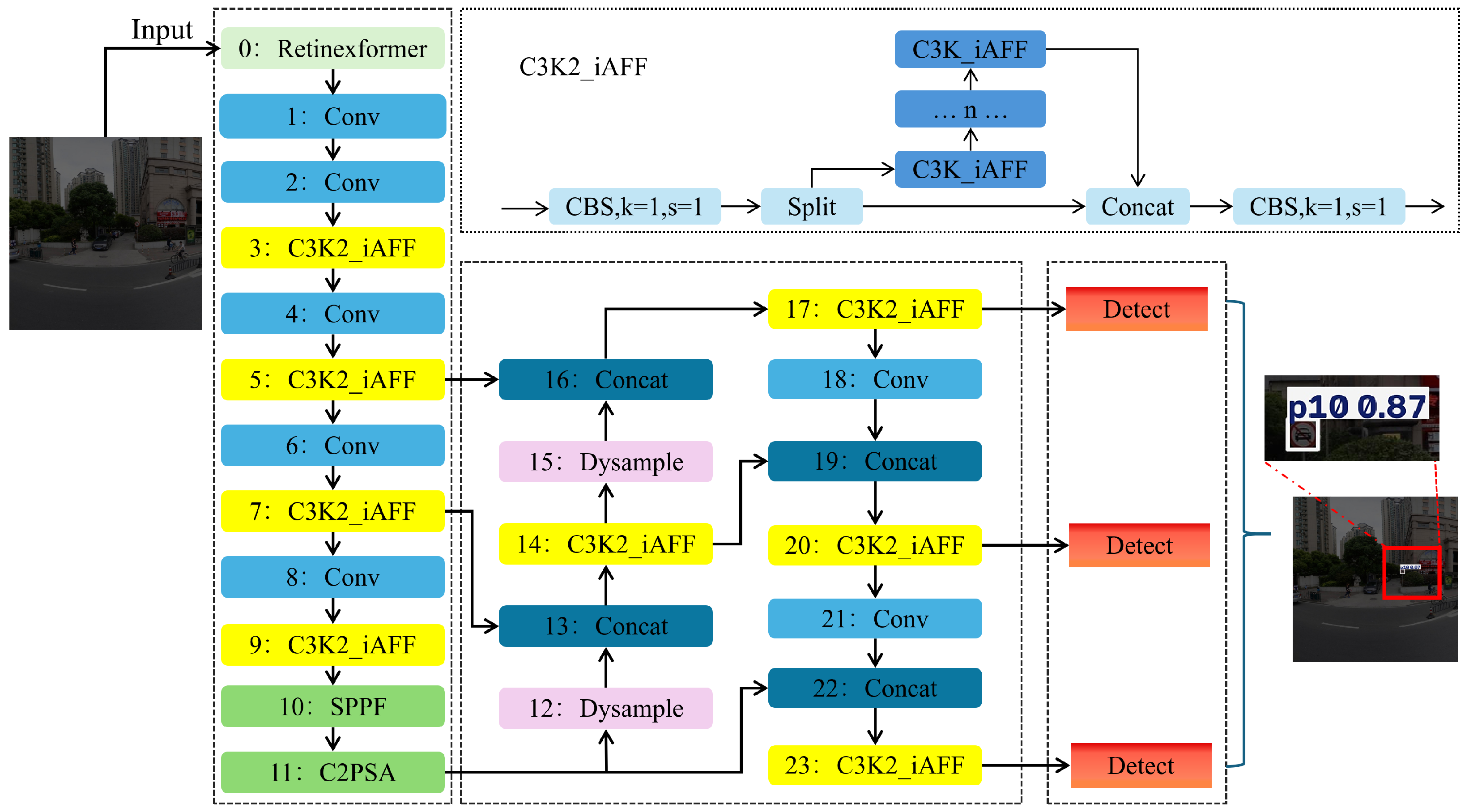
YOLOv11n, as the lightweight foundational detection model of the YOLOv11 series, inherits the classic single-stage detection architecture of backbone-neck-detection head, and has undergone iterative network structure upgrades based on previous lightweight versions such as YOLOv8 and YOLOv10. The network replaces the vanilla C2f module with the C3K2 module. Benefiting from an optimized cross-stage partial convolution architecture, redundant calculations are streamlined to reduce model parameters and computational costs without impairing the network’s multi-scale feature extraction capability. In addition, the introduced C2PSA incorporates position-sensitive spatial attention. This design strengthens the network’s focus on key target regions and effectively suppresses background noise interference. When directly applied to low-light traffic sign detection tasks, the native YOLOv11n is susceptible to factors such as uneven nighttime illumination, low image signal-to-noise ratio, the small scale of traffic sign targets, and insufficient foreground contrast, leading to weakened object features and increased missed and false detections. To this end, Retinexformer is applied to achieve brightness equalization and noise suppression in low-light images, strengthening effective traffic sign features; utilizes the iAFF module to enhance deep-shallow feature interaction and fusion, improving the utilization of small-sized traffic sign features; and leverages DySample dynamic sampling to optimize the feature reconstruction process, mitigating feature information loss caused by upsampling. A schematic overview of the RiDW-YOLO network architecture is provided in Figure 1.
As shown in Figure 1, to embed iAFF into YOLOv11n, the vanilla C3K2 block is replaced with the improved C3K2-iAFF unit. Within each C3K2-iAFF, the feature maps are split into two branches after passing through the CBS layer. One branch passes through stacked C3K-iAFF sub-modules for iterative cross-scale attention-based feature interaction, while the other branch preserves the original features. The two branches are then concatenated and fed into an additional CBS layer to produce enhanced representations. Multiple C3K2-iAFF units are deployed in both the backbone (Layers 3, 5, 7, 9) and the neck (Layers 14, 17, 20, 23) to enable multi-level feature aggregation. As for DySample, it is integrated into the neck after the Concat operations (Layers 12 and 15), replacing the original static upsampling operator. This dynamic upsampling module adaptively reconstructs features and reduces feature loss for small traffic signs under low-light conditions.

2.1. Low-Light Enhancement Network Retinexformer

In low-light driving scenarios, lighting conditions are typically poor. Due to insufficient ambient natural light and the limited illumination range and angle of vehicle lighting equipment, distant and lateral traffic signs often suffer from underexposure and insufficient contrast. Although the retro-reflective materials used on traffic sign surfaces can improve visibility under headlight illumination, they may also cause glare, halos, and local overexposure, leading to contour distortion and loss of texture and character details. Meanwhile, complex interfering factors such as road shadows, road surface reflections, oncoming vehicle glare, and rain and fog further degrade the imaging quality of low-light traffic signs. Under such challenging low-light conditions, conventional visual recognition algorithms are prone to producing numerous missed and false detections, and the overall recognition accuracy and scene adaptability are insufficient to meet practical application requirements.
To address the difficulties faced in traffic sign recognition under nighttime low-light environments, this paper introduces the Retinexformer [24] image enhancement network at the first layer of the YOLOv11n backbone. Retinexformer is embedded within the network pipeline as a trainable front-end module rather than an offline preprocessing step. Its weights are updated together with the subsequent detection sub-network during end-to-end training, and image enhancement is performed online in the forward pass of each batch, without generating enhanced images in advance. It improves brightness and contrast while suppressing noise of input low-light images, and further strengthens the model’s feature extraction capability for traffic sign targets, so as to boost the detection accuracy under nighttime scenarios.
Retinexformer is a single-stage enhancement network that integrates Retinex illumination-decomposition theory with the global feature modeling capability of Transformers [25]. Built upon the One-stage Retinex-based Framework (ORF), it realizes end-to-end integrated optimization and abandons the redundant multi-stage step-by-step processing pipeline adopted by traditional Retinex-based algorithms. Benefiting from simplified training logic and lower deployment barriers, its self-attention mechanism can accurately capture both global illumination distribution and fine-grained texture features of input images.
The Retinex model represents a captured image as the element-wise product of two latent maps: a reflectance component encoding the intrinsic color and texture of scene surfaces, and an illumination component capturing the spatial distribution of incident light. The fundamental decomposition formula is defined as
I ( x , y ) = R ( x , y ) · L ( x , y )
where ( x , y ) indexes pixel coordinates. The goal of enhancement is to recover R ( x , y ) —the illumination-invariant, clear representation of the scene—from the observed degraded input I ( x , y ) .
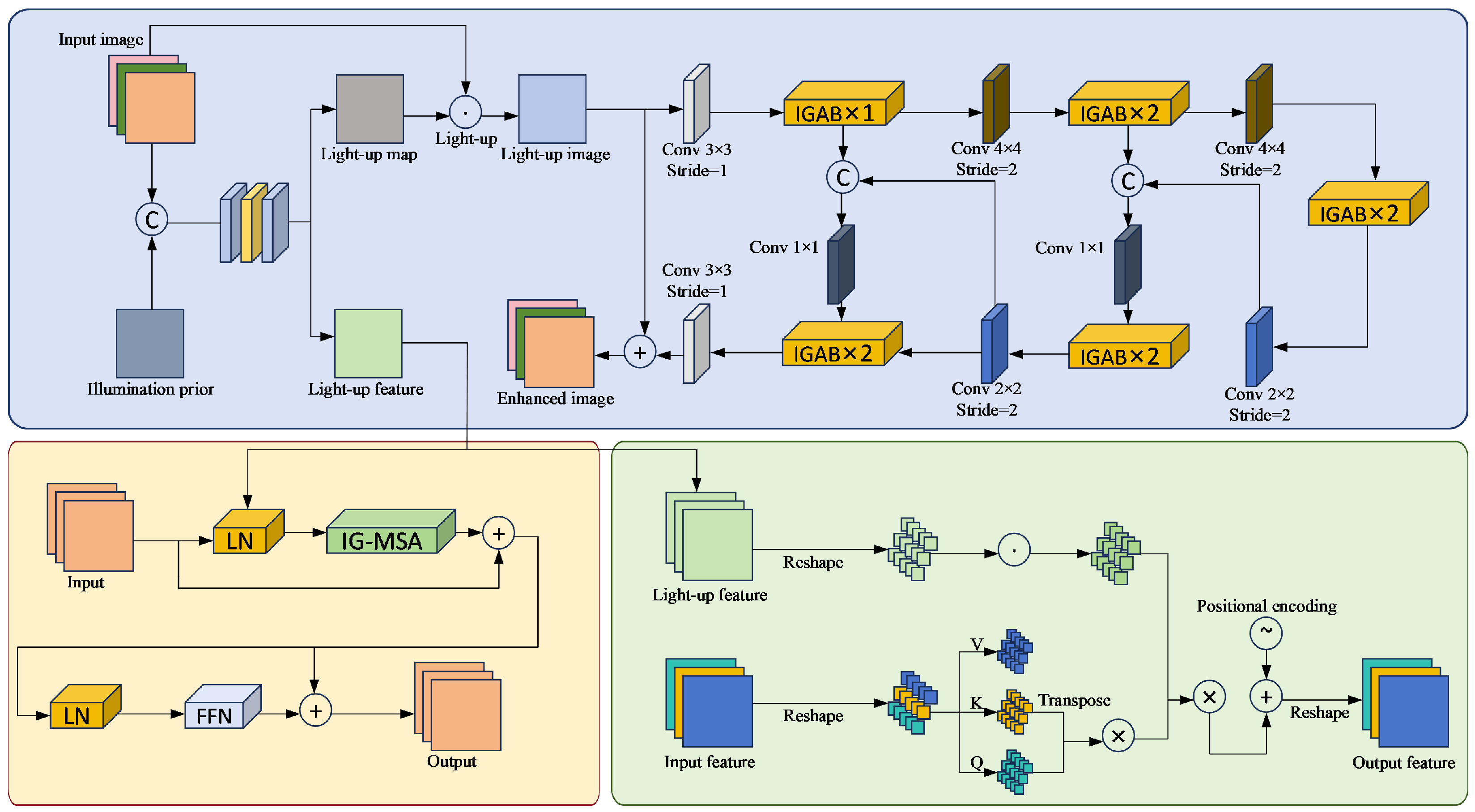
Conventional Retinex methods rely on handcrafted prior constraints to estimate the illumination component, which are prone to issues such as over-correction, loss of texture details, and color distortion. To address these deficiencies, Retinexformer unifies the traditional multi-stage process into an end-to-end single-stage mapping within the One-stage Retinex-based Framework (ORF). The ORF consists of two core modules connected in series. The illumination estimator takes the low-light image I and the illumination prior map L p (i.e., a single-channel map obtained by pixel-wise averaging across the RGB channels of I) as input, models contextual interactions across different illumination regions through depthwise separable convolutions, and outputs a three-channel illumination adjustment map L ¯ and illumination features F l u , from which the preliminarily enhanced image I l u is computed. The corruption restorer takes I l u and F l u as input and employs the Illumination-Guided Transformer (IGT) to repair noise, artifacts, and color degradation exposed during the preliminary enhancement process. The IGT adopts a three-scale U-shaped encoder–decoder architecture, preserving multi-scale detail information through skip connections. Its fundamental building block is the Illumination-Guided Attention Block (IGAB), each consisting of layer normalization, Illumination-Guided Multi-head Self-Attention (IG-MSA), and a feed-forward network stacked together. To this end, Retinexformer introduces perturbation terms into the reflectance and illumination components, respectively, modifying the conventional model to
I = ( R + R ˜ ) · ( L + L ^ )
where R ˜ is the reflectance perturbation term modeling noise and artifacts hidden in dark regions, and  L ^ is the illumination perturbation term modeling overexposure, underexposure, and color deviation during the enhancement process. By performing element-wise multiplication on both sides of Equation (2) with the three-channel illumination adjustment map output by the illumination estimator (satisfying L ¯ · L 1 ) and simplifying, the core relational expression of the ORF framework is obtained:
I l u = R C
where I l u = I · L ¯ is the preliminarily enhanced image output by the illumination estimator, R is the clear reflectance image to be recovered, and  C is the composite degradation term encompassing noise amplification, artifact manifestation, overexposure and underexposure, and color deviation. Equation (3) reveals the core design principle of ORF: the network does not need to explicitly decompose the illumination and reflectance components. Instead, after the illumination estimator nonlinearly brightens the low-light image, the IGT implicitly models and suppresses various degradation factors in C , recovering a clear image in an end-to-end residual learning manner. This achieves comprehensive capability spanning from simple brightness enhancement to complex degradation restoration. The overall architecture of this network is illustrated in Figure 2.

2.2. iAFF Iterative Attentional Feature Fusion

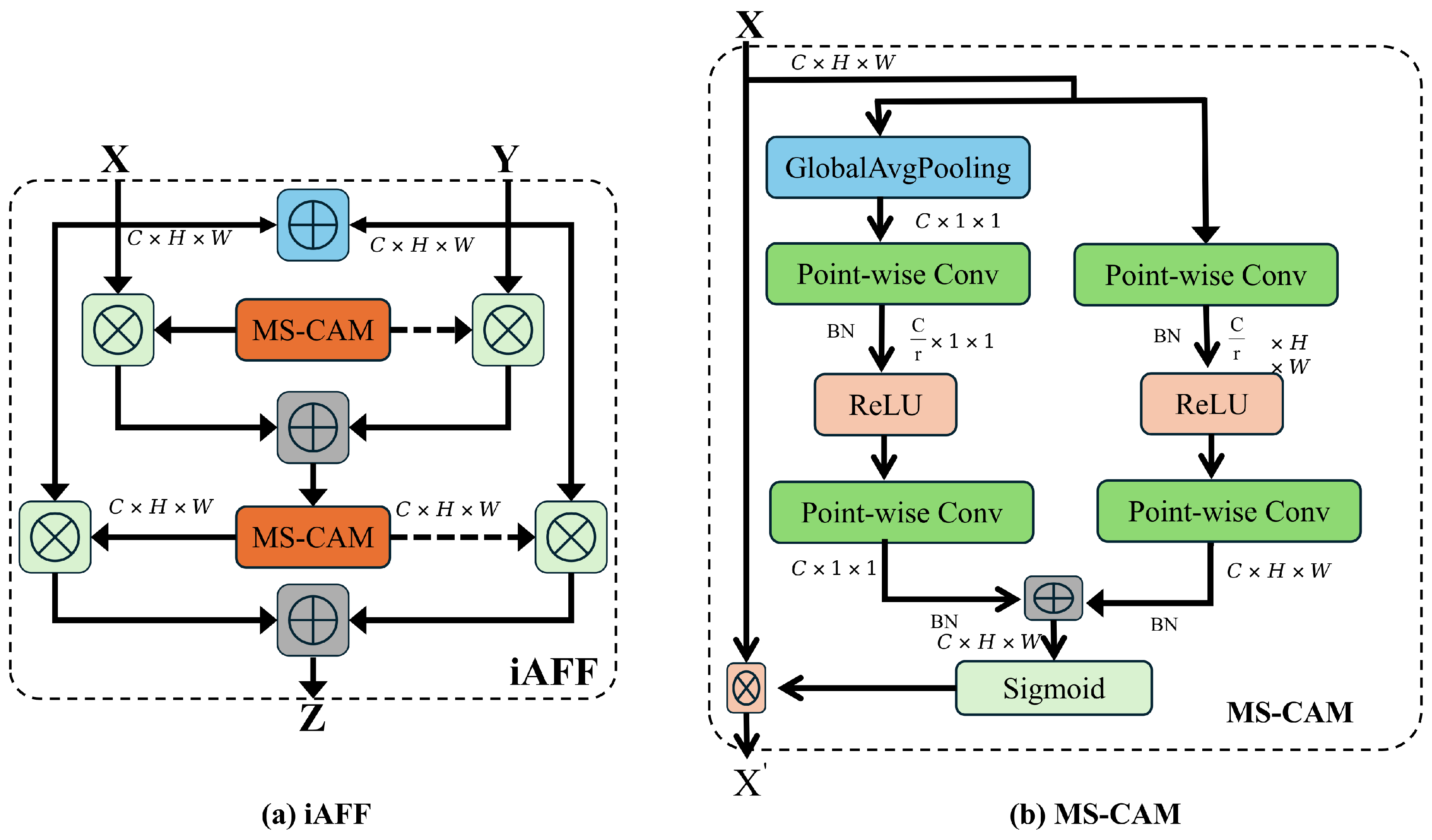
iAFF [26] is a strategy that progressively optimizes the fusion weights of multi-source features through repeated application of attention mechanisms. Its feature diagram is shown in Figure 3. Given two feature maps to be fused, the core idea of iAFF is to dynamically update the attention weights used in the current fusion based on the fusion result from the previous iteration at each step. Let the fused feature after the t-th iteration be denoted as F t ; its update process can be uniformly described as
F t = A t X + ( 1 A t ) Y
where ⊙ denotes element-wise multiplication, 1 is an all-ones tensor of the same shape as the fused feature, and  A t is the attention weight map generated at the t-th iteration, with each element taking values in [ 0 , 1 ] . In practical applications, to balance performance and efficiency, the number of iterations is typically set to T = 2 , and the initial fusion is set as the simple average of X and Y or directly adopts one of the inputs.
In low-light traffic sign detection tasks, the iAFF module can leverage its adaptive weight selection capability to automatically reduce the fusion weight of noise-contaminated shallow features and strengthen the proportion of deep semantic features rich in object localization information, effectively improving the detection accuracy of small and occluded objects in low-light scenes.

2.3. DySample Upsampling

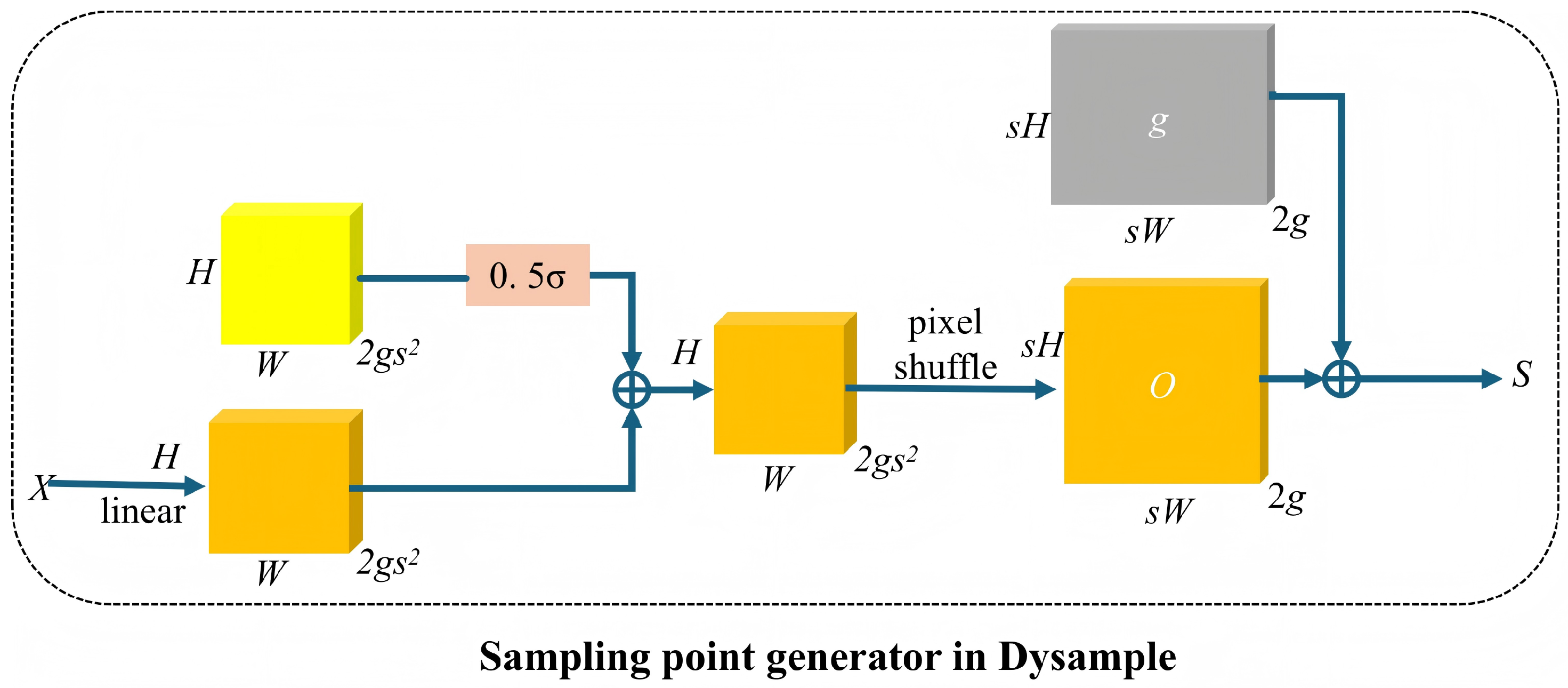
DySample [27] is an ultra-lightweight yet efficient dynamic upsampler. Its core innovation lies in reconstructing the upsampling process from a point sampling perspective. Given an input feature map and an upsampling scale factor s, the module generates content-aware sampling points to perform resampling on this continuous map. Figure 4 illustrates the upsampling process of DySample.
In RiDW-YOLO, DySample replaces the conventional nearest-neighbor interpolation in the top-down pathway of the YOLOv11n neck, so that the upscaled feature maps are resampled by content-aware offsets rather than fixed kernels. DySample adaptively preserves edge and texture details during feature map upscaling, effectively mitigating feature blurring and information loss caused by insufficient illumination, and particularly enhancing the model’s representation capability for small-sized objects.

2.4. WIoU Loss Function

To improve the localization accuracy of the detection head for blurred, occluded, and low-contrast traffic signs, this study replaces the default CIoU bounding box regression loss of YOLOv11n with Wise-IoU (WIoU) [28]. Among the three WIoU variants, WIoU v3 is adopted, which augments the base WIoU v1 objective with a dynamic non-monotonic focusing mechanism to suppress the harmful gradients originating from low-quality training samples.
The base WIoU v1 loss couples the standard IoU loss with a distance-attention term that amplifies the loss of ordinary-quality anchor boxes:
L WIoU   v 1 = R WIoU L IoU , L IoU = 1 IoU
R WIoU = exp ( x x g t ) 2 + ( y y g t ) 2 ( W g 2 + H g 2 )
where ( x , y ) and ( x g t , y g t ) denote the center coordinates of the predicted and ground-truth boxes, respectively, and  W g and H g are the width and height of the smallest enclosing box covering both boxes. The superscript indicates that W g and H g are detached from the computational graph, so the denominator is treated as a constant during backpropagation. Since R WIoU [ 1 , e ] and L IoU [ 0 , 1 ] , the distance attention amplifies the loss of ordinary-quality boxes while shrinking that of well-fitted boxes.
WIoU v3 additionally quantifies the quality of each anchor box through an outlier degree β , defined as the ratio of the individual IoU loss to its running average:
β = L IoU L ¯ IoU [ 0 , + )
where L ¯ IoU is the exponential running average of L IoU , updated once per training iteration with momentum m:
L ¯ IoU ( 1 m ) L ¯ IoU + m L IoU
A small β corresponds to a high-quality inlier, whereas a large β corresponds to a low-quality outlier. The final WIoU v3 loss scales the base loss by a non-monotonic focusing coefficient r:
L WIoU   v 3 = r L WIoU   v 1 , r = β δ α β δ
where α > 0 and δ > 0 are two hyperparameters controlling the focusing intensity and the quality threshold, respectively. Since L IoU and L ¯ IoU are detached from the computation graph, r acts as a constant gradient-gain coefficient rather than a differentiable term. Its behavior is non-monotonic with respect to β : when β = δ , r = 1 and the gradient is left unmodified; when β < δ (high-quality inliers), r > 1 grants a larger gradient gain, which peaks at intermediate β and then declines for the very easiest samples; when β > δ (low-quality outliers, e.g., severely blurred or occluded signs), r decreases monotonically toward zero, attenuating the interference of harmful gradients without discarding the samples entirely.
Following the original implementation, the hyperparameters are set to α = 1.9 , δ = 3 , and the running-average momentum m = 1 0 . 5 1 / 7000 , making the proposed loss readily reproducible.

3. Experimental Platform and Model Evaluation Metrics

3.1. Experimental Data

In this study, the dataset consists of synthetic low-light samples derived from TT100K [29] and real-world urban road low-light samples selected from CCTSDB2021 [30]. Both datasets are publicly available. The dataset covers three major categories of traffic signs: mandatory, warning, and prohibitory, which are further divided into 45 sub-categories such as speed limit, height limit, and no-U-turn. Specifically, brightness degradation is performed on 4500 images of the TT100K training set, 400 images of the test set, and 1395 images of the validation set. Using the ImageEnhance.Brightness module from the PIL library, the global brightness of each image is uniformly scaled to 0.3 times the original intensity, while the original bounding-box annotations and category labels are fully preserved.
Notably, such globally uniform brightness attenuation cannot simulate real-world noise, local highlights, and color distortion, leading to certain discrepancies compared with real-captured low-light images. To supplement real low-light data, 2244 traffic sign images captured under real-world low-light scenarios such as nighttime and overcast conditions are selected from CCTSDB2021. These images are annotated with the LabelImg tool following the TT100K dataset format, among which 1203 images are included in the training subset, 526 in the test subset, and 515 in the validation subset.
The merged dataset contains 8539 images in total. Following the partitioning protocol of TT100K, the merged dataset is split into training, test, and validation subsets containing 5703, 926, and 1910 images respectively. No cross-subset sample leakage is permitted among the training, validation, and test sets, avoiding overly optimistic evaluation metrics and guaranteeing reliable experimental assessment. Furthermore, comparative experiments against baseline models are carried out on the public low-light dataset ExDark [31] to verify the performance of the proposed RiDW-YOLO model. The category distribution of the dataset is shown in Table 1. The values in the Number column represent the count of object instances. The abbreviated class labels follow the definition of the public TT100K dataset. Detailed explanations for each label can be found in the TT100K dataset documentation.

3.2. Experimental Platform

The experimental environment is built on the Ubuntu 24.04 operating system. The hardware platform is equipped with two NVIDIA RTX 4090 GPUs, each providing 24 GB video memory. PyCharm Community Edition 2024.1.1 and Conda 24.7.1 are adopted as integrated development tools. The proposed model is implemented based on the PyTorch 2.5.1 framework with CUDA 12.1, and Python 3.9 is utilized as the programming language. The Ultralytics library with version 8.4.96 is employed for model development. Key training hyper-parameters are listed in Table 2.

3.3. Model Evaluation Metrics

The experiments primarily employ four evaluation metrics: precision (P), recall (R), mean average precision (mAP@50), and mAP@50:95. Additionally, metric such as FPS is used for comparative evaluation. Precision (P) denotes the proportion of correctly classified samples among all detected samples, while recall (R) denotes the proportion of correctly detected samples among all samples of a given class.
P = T P T P + F P
R = T P T P + F N
where T P denotes the number of correctly detected samples, F P denotes the number of falsely detected samples, and F N denotes the number of undetected samples.
mAP@50 represents the mean average precision calculated across all classes at a fixed IoU threshold of 0.5, computed as
mAP = 1 M i = 1 M A P i
where M is the total number of classes. mAP@50:95 denotes the mean of mAP values computed at IoU thresholds from 0.5 to 0.95 with a step size of 0.05.
The frames-per-second (FPS) metric is adopted to evaluate the inference speed. All FPS measurements are conducted on a single NVIDIA RTX 4090 GPU with a batch size of 1 under FP32 precision mode with a fixed input resolution of 640 × 640 . Before formal timing, a warm-up procedure of 50 iterations is executed to eliminate the influence of GPU initialization overhead. Subsequently, the inference latency of 200 consecutive iterations is recorded for statistical calculation of FPS. The reported FPS values cover the full inference pipeline, including Retinexformer enhancement module inference, network forward propagation, postprocessing and non-maximum suppression (NMS).

4. Experimental Results and Analysis

4.1. Comparative Experiments with Different Illumination Enhancement Modules

In the YOLO framework, the introduction of an illumination enhancement module not only affects the inference speed of the model but also directly determines the key performance metrics of traffic sign detection in low-light scenarios. To investigate the impact of the Retinexformer module on model recognition accuracy, this study systematically compares it with other illumination enhancement algorithms, including PE, FFA-Net, and SCI-Net. The comparative experimental results are shown in Table 3, and the effects of different low-light enhancement methods on traffic signs are illustrated in Figure 5.
To ensure a fair comparison, all enhancement networks involved were trained under identical settings. Specifically, for each compared baseline scheme, the enhancement network was jointly trained from scratch with YOLO on the synthesized low-light traffic sign dataset. By contrast, in the final training stage of RiDW-YOLO, the Retinexformer module remained trainable.
Regarding the evaluation protocol, we chose to assess the effectiveness of each enhancement module indirectly through downstream detection accuracy, rather than using quantitative image quality metrics such as PSNR, SSIM, or LPIPS. This decision is based on two considerations. First, the ultimate goal of traffic sign detection is to ensure the accuracy of downstream recognition and localization; improvements in subjective visual quality do not necessarily translate into better detection performance, as over-enhancement may introduce artifacts or distort critical geometric features, thereby adversely affecting detection. Second, different enhancement algorithms are optimized for different objectives—some prioritize visual perception effects over feature fidelity—making it potentially unfair to apply a uniform set of image quality metrics for cross-comparison. Therefore, evaluating enhancement performance through detection accuracy is more aligned with the practical objective of this study and provides a more objective measure of each module’s actual contribution to the detection task.
The comparative results demonstrate that Retinexformer achieves the best performance in terms of precision, recall, and mAP@50. Retinexformer is a Transformer architecture designed based on Retinex theory, which intelligently decomposes images into illumination and reflectance components. Its core advantage lies in selectively enhancing the illumination component while fully preserving the texture and edge details in the reflectance component, dynamically adjusting uneven illumination without destroying critical geometric features such as arrows, text, or numbers on the signs.

4.2. Comparative Experiments with Different Loss Functions

The design of the loss function not only affects the convergence speed of the model but also directly determines the localization accuracy and confidence assessment quality of object detection under low-light environments. Through refined modeling of the bounding box regression task, key geometric constraints such as center point distance, aspect ratio consistency, and object scale adaptability can be quantified as loss values, thereby providing explicit gradient directions for model optimization under complex illumination conditions. To further investigate the performance improvement brought by the WIoU loss function, this study systematically compares it with other mainstream bounding box regression loss functions (e.g., CIoU, EIoU, SIoU) to address challenges such as blurred object edges, difficulty in localizing small-sized signs, and severe background noise interference in low-light traffic sign detection. The comparative experimental results are shown in Table 4.
From the experimental results, it can be observed that WIoU achieves superior performance in both mAP@50 and precision compared with CIoU, EIoU, and SIoU, though its recall is slightly lower than that of CIoU. The results indicate that WIoU, through its dynamic non-monotonic focusing mechanism, effectively suppresses harmful gradients generated by low-quality samples, reducing false detections while improving precision. However, this suppression effect on low-quality samples may also moderately impair the model’s ability to recall challenging positive samples. Overall, WIoU demonstrates favorable detection performance under the current experimental conditions, though its generalization capability across different scenarios remains to be further verified.

4.3. Ablation Study

To verify the effectiveness of different modules in the improved method, this study incrementally introduces the aforementioned modified modules into the YOLO11n baseline model and comparatively analyzes their impact on model improvement. The experimental results are presented in Table 5, where “✓” indicates that the corresponding module is incorporated, and a dash indicates its absence.
All main experiments were conducted with a fixed random seed of 0. To account for variability during the training process, both the baseline model and the complete RiDW-YOLO model were additionally trained using three different random seeds (seed = 0, 96, 145) in the ablation experiments. The mean and standard deviation of mAP@50 and mAP@50:95 are reported.
The ablation experiment results are presented in Table 5. Model-1 introduces only the Retinexformer low-light enhancement module on top of the baseline, achieving improvements of 5.4 percentage points in precision and 3.9 percentage points in mAP@50, along with varying degrees of improvement in recall and mAP@50:95, demonstrating that illumination enhancement preprocessing effectively improves the model’s detection capability on low-light images.
Model-2 introduces only the iAFF iterative attentional feature fusion module, achieving a 1.1 percentage point increase in precision, while recall, mAP@50, and mAP@50:95 remain nearly unchanged or slightly decrease compared with the baseline. This indicates that although the feature fusion module alone can enhance certain semantic information, its overall performance gain is limited without preceding enhancement processing.
Model-3 introduces only the DySample dynamic upsampling module, achieving a 2.0 percentage point increase in precision, while recall drops from 0.638 to 0.630, mAP@50 improves by only 0.2 percentage points, and mAP@50:95 also declines. This suggests that replacing the upsampling strategy alone preserves some fine-grained features but does not yield significant overall detection gains, and may even adversely affect recall due to offset sampling points.
Model-4 introduces only the WIoU loss function, achieving increases of 3.5 percentage points in precision, 1.0 percentage point in mAP@50, and 0.7 percentage points in mAP@50:95, while recall decreases slightly by 0.7 percentage points. This demonstrates that WIoU effectively improves localization accuracy by dynamically adjusting sample weights, though its improvement in recall is limited.
Model-5 further introduces the iAFF module on top of Model-1 (i.e., Retinexformer + iAFF). Compared with Model-1, precision decreases by 1.3 percentage points, while recall increases by 1.9 percentage points and mAP@50 by 0.6 percentage points, though mAP@50:95 slightly decreases by 0.6 percentage points. This combination achieves gains in recall at a modest trade-off in precision.
Model-6 incorporates the DySample module based on Model-5 (i.e., Retinexformer + iAFF + DySample). Compared with Model-5, precision improves by 5.8 percentage points, mAP@50 by 0.3 percentage points, and mAP@50:95 by 1.2 percentage points, while recall decreases by 3.3 percentage points. This suggests that the addition of DySample contributes to precision gains, with a corresponding trade-off in recall.
Finally, our proposed method introduces WIoU on top of Model-6 (i.e., incorporating all four improvement strategies). Compared with Model-6, precision improves by 5.3 percentage points, recall by 4.8 percentage points, mAP@50 by 6.2 percentage points, and mAP@50:95 by 4.2 percentage points, with all metrics showing gains. Compared with the baseline YOLOv11n, the final model achieves increases of 15.2 percentage points in precision, 6.2 percentage points in recall, 11.0 percentage points in mAP@50, and 8.4 percentage points in mAP@50:95. These results show that the integration of the four improvement strategies brings performance gains over the baseline, and verify the effectiveness of the proposed algorithmic enhancements.

4.4. Comparative Experiments

The improved algorithm proposed in this paper is compared with current mainstream object detection algorithms, including YOLOv3-tiny, YOLOv5, YOLOv8, YOLOv10, YOLOv12 [32], YOLOv26 [33], SSD (VGG-16), and Faster-RCNN (ResNet-50-FPN), to verify its advantages after improvement. The comparative experimental results are shown in Table 6. All compared models were trained from scratch with identical hardware-software environments, dataset splits, input resolutions, and hyperparameter settings to ensure a fair comparison. While these models exhibit discrepancies with respect to parameter volume and computational overhead, they are extensively employed as benchmark baselines within this research domain. Such comparative analysis enables the proposed approach to be contextualized in the performance–efficiency trade-off spectrum, and validates its practical competitiveness for traffic-sign detection under low-light scenarios.
Compared with other models, the proposed algorithm achieves consistent improvements in mAP@50 across all comparisons. Specifically, relative to YOLOv3-tiny (0.574), YOLOv5 (0.693), YOLOv8 (0.709), YOLOv10 (0.691), YOLOv12 (0.603), and YOLOv26 (0.710), our method improves mAP@50 by 24.7, 12.8, 11.2, 13.0, 21.8, and 11.1 percentage points, respectively. Compared with SSD (0.652) and Faster-RCNN (0.703), the improvements are 16.9 and 11.8 percentage points, respectively. Even when compared with the YOLOv11 baseline (0.711), which already achieves relatively high average precision, our method still attains an improvement of 11.0 percentage points, reaching 0.821.
In terms of precision, the proposed algorithm outperforms YOLOv3-tiny, YOLOv5, YOLOv8, YOLOv10, YOLOv11, YOLOv12, YOLOv26, SSD, and Faster-RCNN by 13.7, 14.6, 12.0, 14.3, 15.2, 24.7, 11.0, 18.1, and 15.3 percentage points, respectively. In terms of recall, the proposed algorithm also achieves varying degrees of improvement over the other models.
From the methodological perspective, Retinexformer is a mature image enhancement module for low-light scenes. Instead of simply cascading it with the detection network as an independent processing step, RiDW-YOLO embeds the enhanced feature representations into the subsequent detection network. Combined with iAFF, DySample and WIoU, the proposed framework establishes an optimization paradigm for feature fusion, sampling and loss calculation, thereby reducing the feature discrepancy between illumination enhancement and traffic sign detection.
However, the improved algorithm exhibits a slight decrease in inference speed (FPS) compared with the baseline YOLOv11, dropping from 144.9 to 117.6. This trade-off primarily stems from two factors: the front-end Retinexformer low-light enhancement network introduces additional computational overhead, and the iAFF iterative attentional feature fusion module further increases network complexity. Consequently, the model parameters increase from 2.9 M to 6.1 M, and the computational cost rises from 6.7 GFLOPs to 16.2 GFLOPs, leading to a marginal increase in inference latency. Overall, the proposed method improves detection accuracy at acceptable computational cost, while its inference performance on embedded and automotive edge hardware requires further investigation in future work.

4.5. Comparative Experiments on the ExDark Dataset

To further examine the behavior of the proposed method under low-light conditions, we conducted additional experiments on the ExDark dataset. ExDark contains 7363 real low-light images across 12 object categories, including several traffic-related targets such as pedestrians and vehicles, captured under diverse nighttime and weak-illumination settings. In this experiment, we retrained compared models on the ExDark dataset, with the data partition following the original split provided by ExDark. The experimental configurations were kept consistent with those described in previous sections. The comparative results are presented in Table 7.
On the ExDark dataset, the proposed method (RiDW-YOLO) achieves an mAP@50 of 0.581, improving over the baseline YOLOv11n (0.557) by 2.4 percentage points. Precision increases from 0.643 to 0.731, an improvement of 8.8 percentage points; recall improves from 0.514 to 0.524, an improvement of 1.0 percentage points; and mAP@50:95 improves from 0.338 to 0.358, an improvement of 2.0 percentage points. These experimental results show that the proposed method obtains moderate performance gains on this low-light dataset, preliminarily demonstrating its applicable potential under different low-light data distributions. It should be acknowledged, however, that the improvements on the ExDark dataset are relatively limited, which may be attributed to domain discrepancies between the datasets in terms of category definitions, image acquisition conditions, illumination intensity distributions, and object scale ranges, also implying that the transferability of the proposed method across domains warrants further investigation.

4.6. Visualization of Detection Results

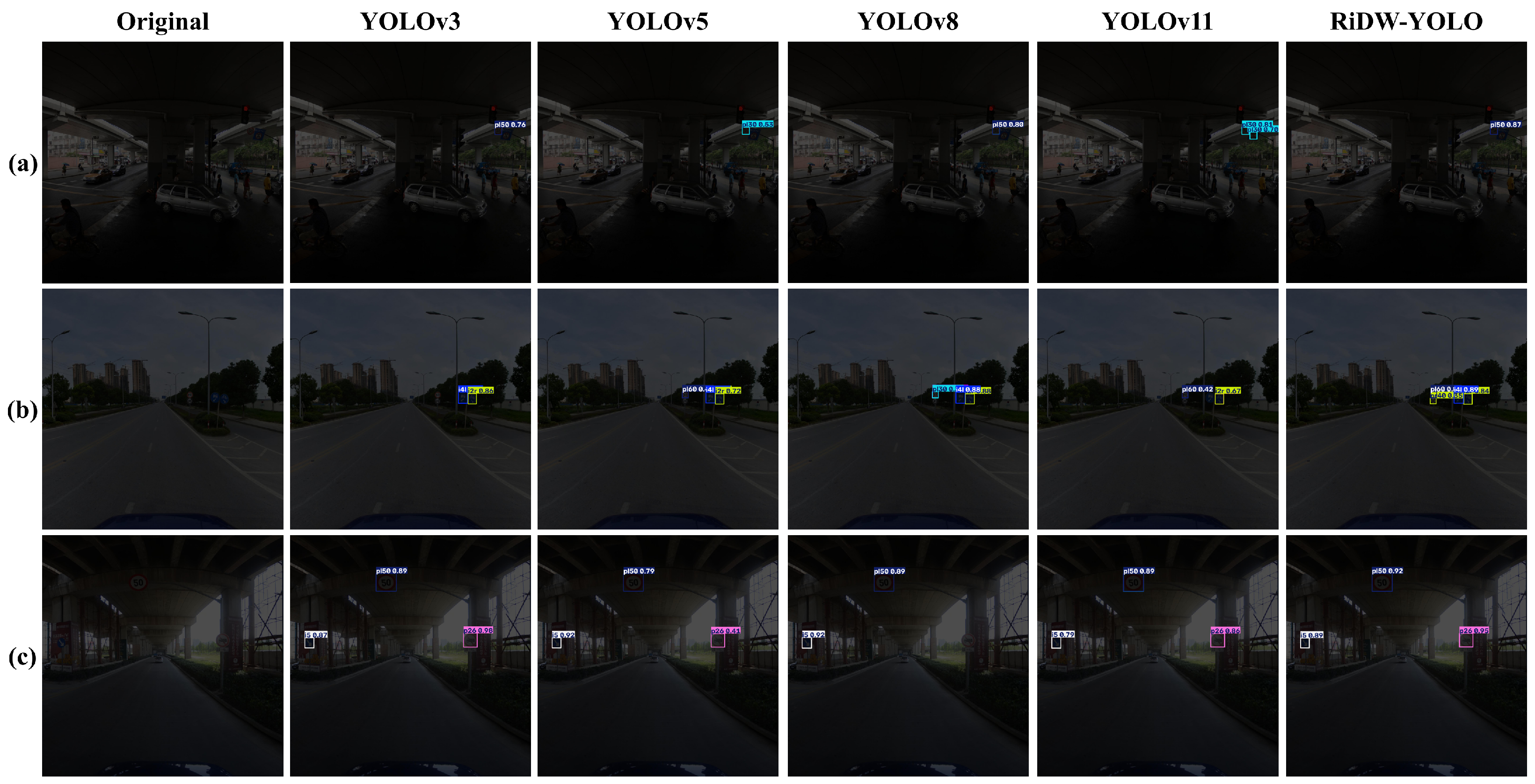
To further verify the traffic sign detection performance of different models in real-world low-light environments, traffic images containing interfering factors such as low-light conditions and small objects are selected for testing in this paper. Figure 6 presents the visual comparison results between state-of-the-art YOLO models and RiDW-YOLO.
As shown in Figure 6a, under low-light conditions, RiDW-YOLO can accurately detect the speed-limit-50 traffic sign (pl50) with a confidence score of 0.87, which is higher than 0.76 of YOLOv3 and 0.80 of YOLOv8. By contrast, YOLOv5 and YOLOv11 misidentify it as the speed-limit-30 traffic sign (pl30).
For the small-sized traffic signs in the low-light scenario illustrated in Figure 6b, there are four ground-truth traffic signs in the real scene, namely speed-limit-60 (pl60), end-of-speed-limit-40 (pr40), motor-vehicles-keep-left (i4l), and non-motor-vehicles-keep-right (i2r). YOLOv3 detects two traffic signs: i4l and i2r. YOLOv5 detects three traffic signs: pl60, i4l and i2r. YOLOv8 detects three traffic signs including pl30 (ground-truth is pl60), i4l and i2r, indicating detection errors. YOLOv11 detects two traffic signs: pl60 and i2r. All the above models suffer from mis-detection or missed detection. The proposed RiDW-YOLO successfully detects all four traffic signs. It can also be observed from Figure 6c that RiDW-YOLO achieves superior overall performance for low-light traffic sign detection.
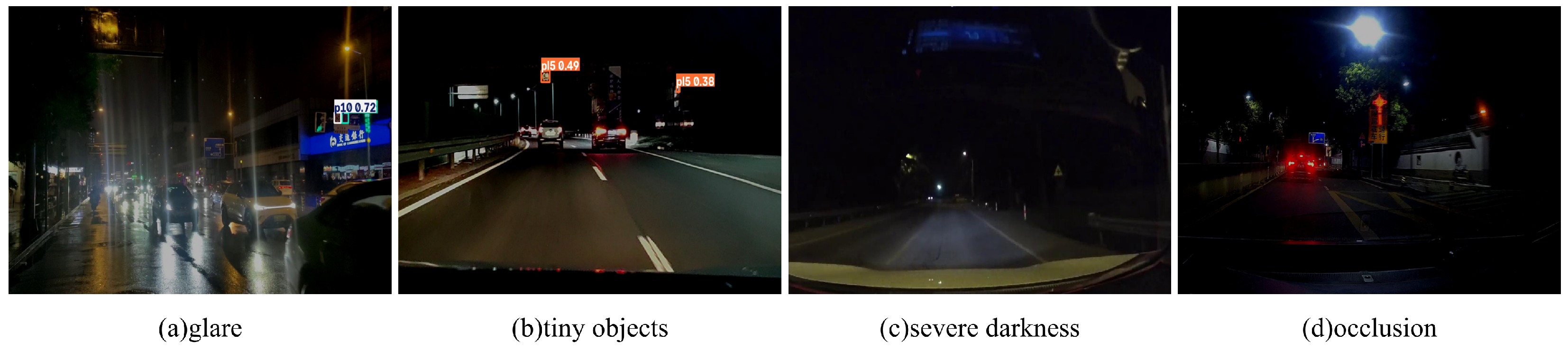
Nevertheless, although RiDW-YOLO achieves promising detection performance, it still suffers from missed detections and false positives under conditions of severe darkness, lens flare, partial occlusion and tiny traffic sign targets. hese failure cases are illustrated in Figure 7. As illustrated in Figure 7a, the speed-limit-60 sign (pl60) is misclassified as the no-parking sign (p10) under intensive lens flare. In Figure 7b, the tiny and confusing height-limit-5 m sign is incorrectly recognized as the speed-limit-5 sign (pl5). Moreover, missed detections can be observed for targets under severe darkness and partial occlusion, as shown in Figure 7c,d.

5. Discussion

This paper proposes RiDW-YOLO by optimizing image enhancement, feature fusion, upsampling strategies, and loss-function design to boost traffic sign detection performance under low-light road conditions. Experimental results indicate that these improvements contribute to detection performance under low-light conditions, although certain limitations persist.
The embedded enhancement module improves low-light image brightness, but cannot reconstruct target details in fully saturated pixels where the original scene information has been permanently lost. The feature processing module implements adaptive multi-level feature recalibration and content-aware dynamic sampling, which help alleviate semantic mismatches across feature layers and improve localization performance for distant, small-scale traffic sign targets. The WIoU loss function mitigates misleading gradient contributions arising from low-quality samples caused by ambiguity or occlusion during training. Overall, the integration of the four improvement strategies yields higher mAP@50 compared with the baseline model.
Nevertheless, the enhanced branch introduces additional computational overhead during inference, reducing the frame rate to 117.6 FPS. This illustrates the trade-off between detection accuracy and processing speed, which should be carefully considered for potential deployment in future real-world vehicular applications.
In addition, this study has several limitations that deserve further examination. As illustrated by the failure cases in Figure 7, RiDW-YOLO may still produce false positives or missed detections under challenging conditions such as extreme darkness, severe lens flare, or partial occlusion. The low-light samples in the adopted dataset are synthesized via uniform brightness attenuation, which cannot fully reproduce real nighttime image degradation including spatially non-uniform illumination, glare, noise and color distortion. Its generalization ability across different datasets and diverse road scenarios requires further validation. Moreover, the additional computational cost introduced by the augmentation module remains an issue that warrants attention.
From the application perspective, the proposed detection approach provides an effective technical reference for low-light traffic-sign perception under complex night-time driving conditions. Reliable detection of traffic signs under dim illumination is critical for intelligent transportation systems, as missed or false detections may bring potential risks to driving safety. By improving detection performance in low-light scenarios, this work can support the perception module of on-board sensing equipment for autonomous and assisted driving. Furthermore, the analytical conclusions derived from this study can offer auxiliary reference for road-infrastructure planning. For instance, it provides indirect insights for evaluating the recognizability of traffic-sign layouts under poor lighting conditions, helping to guide the optimization of sign layout and auxiliary lighting configuration. Nevertheless, the present method still faces challenges when handling severe local glare caused by retro-reflective sign materials, which deserves further investigation in follow-up research.
Future work will explore lightweight network compression techniques to reduce redundant computations and better accommodate the hardware constraints of onboard systems. Further evaluations will also be conducted under adverse weather conditions, including rain and fog, to enhance the perceptual robustness of the model for intelligent transportation applications.

6. Conclusions

Motivated by existing difficulties in traffic sign detection under low-light conditions, this paper presents RiDW-YOLO based on the YOLOv11 framework. Optimizations are carried out from four dimensions: image enhancement, feature fusion, upsampling strategy, and loss-function design. An illumination enhancement module is introduced to restore brightness and texture information for degraded low-light inputs and support subsequent detection. Adaptive multi-level feature recalibration and dynamic sampling are adopted to ease cross-layer semantic mismatch and strengthen localization for distant small traffic sign instances. The WIoU loss is utilized to suppress misleading gradients from blurred and occluded samples, so that the training process concentrates more on valid high-quality samples. Combined effects of these optimizations yield improved mAP@50 compared with the baseline model.
Nevertheless, RiDW-YOLO still has several limitations. Under conditions of extreme darkness, severe lens flare, and partial occlusion, the algorithm is prone to false-positive and missed detections, as demonstrated by the presented failure cases. The introduced enhancement module imposes extra inference-time computational overhead. In addition, the generalization capability across diverse datasets and real-world road scenarios requires further verification.
For future research, lightweight compression will be explored to relieve computational burden for edge hardware. More evaluations under adverse-weather conditions such as rain and fog will be performed, and richer low-light traffic sign data will be prepared to promote cross-domain generalization. Practical onboard deployment tests will also be considered to advance its application in intelligent transportation perception.

Author Contributions

Conceptualization, Y.L. and Y.S.; methodology, Y.L., L.L. and F.T.; software, Y.L., Q.L. and F.T.; validation, Y.L., L.L. and Q.L.; formal analysis, Y.L. and F.T.; investigation, Y.L., L.L. and Q.L.; resources, Y.L. and Y.S.; data curation, Y.L. and Q.L.; writing—original draft preparation, Y.L., L.L. and Q.L.; writing—review and editing, Y.S. and F.T.; visualization, Y.L. and F.T.; supervision, Y.S.; project administration, Y.L. and Y.S.; funding acquisition, Y.S. All authors have read and agreed to the published version of the manuscript.

Funding

This research was funded by the Natural Science Foundation of Anhui Provincial Department of Education (Key Project, No. 2025AHGXZK30743, Research on Lightweight Recognition Technology of Traffic Signs Based on Deep Learning), the University Natural Science Foundation of Anhui Province (No. 2025AHGXZK20224), the Natural Science Foundation of Huainan Normal University (Key Project, No. 2025XJZD007, Research on Lightweight Autonomous Navigation System Based on Edge AI), and the Excellent Scientific Research and Innovation Team of Universities in Anhui Province: Photoelectric Detection and Intelligent Control (Grant No. 2022AH010085).

Institutional Review Board Statement

Not applicable.

Informed Consent Statement

Not applicable.

Data Availability Statement

The datasets used in this study are available from the corresponding author upon reasonable request.

Acknowledgments

During the preparation of this manuscript, the authors used Claude (Anthropic, Claude Code 2026) for language polishing, structural refinement, and LaTeX formatting assistance. The authors have reviewed and edited all AI-generated content and take full responsibility for the content of this publication.

Conflicts of Interest

The authors declare no conflicts of interest.

Abbreviations

The following abbreviations are used in this manuscript:
YOLOYou Only Look Once
ADASAdvanced Driver Assistance Systems
CNNConvolutional Neural Network
mAPMean Average Precision
IoUIntersection over Union
WIoUWise Intersection over Union
iAFFIterative Attentional Feature Fusion
ORFOne-stage Retinex-based Framework
IGTIllumination-Guided Transformer
IGABIllumination-Guided Attention Block
IG-MSAIllumination-Guided Multi-head Self-Attention
MS-CAMMulti-Scale Channel Attention Module
FPNFeature Pyramid Network
FPSFrames Per Second
TPTrue Positive
FPFalse Positive
FNFalse Negative

References

  1. Gao, G.; Tan, B.; Chen, X.R. A survey of road traffic sign detection. Mod. Bus. Trade Ind. 2017, 12, 176–178. [Google Scholar] [CrossRef]
  2. Olmos Medina, J.S.; Maradey Lázaro, J.G.; Rassõlkin, A.; Ibrahim, M. The road ahead: A comprehensive review of recent advances in traffic sign and lane line recognition for autonomous systems. IEEE Open J. Veh. Technol. 2026, 7, 160–178. [Google Scholar] [CrossRef] [Scilit]
  3. Zhang, L.; Liu, S.; Ge, F.; Si, Y.; Liu, Z.; Wang, Y.; Wang, W.; Li, C.; Hu, J.; Fang, B.; et al. Low-light image enhancement based on nanoscale stochastic magnetic tunnel junctions. ACS Appl. Mater. Interfaces 2026, 18, 35821–35828. [Google Scholar] [CrossRef] [Scilit] [PubMed]
  4. Ouyang, J.; Lu, J.; Zeng, L. Fourier feature pyramid network for improved small object detection in complex traffic scenes. Res. Sq. 2025, preprint. [Google Scholar] [CrossRef] [Scilit] [PubMed]
  5. Cao, W.; Wu, Y.; Chakraborty, C.; Li, D.; Zhao, L.; Ghosh, S.K. Sustainable and transferable traffic sign recognition for intelligent transportation systems. IEEE Trans. Intell. Transp. Syst. 2023, 24, 15784–15794. [Google Scholar] [CrossRef] [Scilit]
  6. Kumari, R.; Singh, S.; Saurabh, P. A systematic review of image enhancement and object detection in low-light scenarios with benchmark experiments. Appl. Soft Comput. 2026, 201, 115607. [Google Scholar] [CrossRef] [Scilit]
  7. Hussain, M. YOLOv1 to v8: Unveiling each variant—A comprehensive review of YOLO. IEEE Access 2024, 12, 42816–42833. [Google Scholar] [CrossRef] [Scilit]
  8. Khanam, R.; Hussain, M. YOLOv11: An overview of the key architectural enhancements. arXiv 2024, arXiv:2410.17725. [Google Scholar] [CrossRef] [Scilit]
  9. Zhu, D.; Zhou, H.; Gao, Y.; Wang, Y. YOLOv11-ND: A Method for Identifying Traffic Targets in Nighttime Urban Environments. IEEE Access 2025, 13, 124483–124493. [Google Scholar] [CrossRef] [Scilit]
  10. Sun, X.Y.; Bi, N. Low-Light Environment Object Detection Algorithm Based on Improved YOLO11. Laser Optoelectron. Prog. 2025, 62, 426–436. [Google Scholar] [CrossRef] [Scilit]
  11. Yu, R.W.; Zhang, Y.X.; Cao, S.M.; Wang, L.N. Traffic sign detection method based on improved YOLOv8 model. J. Wuhan Univ. (Nat. Sci. Ed.) 2025, 71, 453–462. [Google Scholar] [CrossRef]
  12. Guo, C.; Li, C.; Guo, J.; Loy, C.C.; Hou, J.; Kwong, S. Zero-reference deep curve estimation for low-light image enhancement. In Proceedings of the IEEE/CVF Conference on Computer Vision and Pattern Recognition (CVPR), Seattle, WA, USA, 13–19 June 2020; pp. 1777–1786. [Google Scholar] [CrossRef] [Scilit]
  13. Ma, L.T.; Ma, T.; Liu, R.; Fan, X.; Luo, Z. Toward fast, flexible, and robust low-light image enhancement. In Proceedings of the IEEE/CVF Conference on Computer Vision and Pattern Recognition (CVPR), New Orleans, LA, USA, 18–24 June 2022; pp. 5637–5646. [Google Scholar] [CrossRef] [Scilit]
  14. Jiang, Y.; Gong, X.; Liu, D.; Cheng, Y.; Fang, C.; Shen, X. EnlightenGAN: Deep light enhancement without paired supervision. IEEE Trans. Image Process. 2021, 30, 2340–2349. [Google Scholar] [CrossRef] [Scilit] [PubMed]
  15. Dai, Q.; Liu, Y.; Luo, Z.Y.; Luo, X. Low-Light Environment Object Detection Based on YOLO. In Proceedings of the 2024 6th International Academic Exchange Conference on Science and Technology Innovation, Guangzhou, China, 6–8 December 2024; pp. 639–642. [Google Scholar] [CrossRef] [Scilit]
  16. Zhu, L. Research on Low-Light Image Enhancement and Detection. Master’s Thesis, Hubei University of Automotive Technology, Shiyan, China, 2025. [Google Scholar] [CrossRef]
  17. Lin, Z.Y.; Wu, Y.F.; Ma, Y.H.; Chen, J.; Zhang, R.; Wu, J.; Yin, G.; Lin, L. YOLO-LLTS: Real-Time Low-Light Traffic Sign Detection via Prior-Guided Enhancement and Multi-Branch Feature Interaction. arXiv 2025, arXiv:2503.13883v3. [Google Scholar] [CrossRef] [Scilit]
  18. Liu, Y.; Li, S.X.; Zhou, L.M.; Liu, H.; Li, Z. Dark-YOLO: A Low-Light Object Detection Algorithm Integrating Multiple Attention Mechanisms. Appl. Sci. 2025, 15, 5170. [Google Scholar] [CrossRef] [Scilit]
  19. Sun, T.; Yang, J.; Li, J.X.; Wang, Y.Z. Optimization of YOLOv7 road sign detection algorithm for low-light traffic scenes. Comput. Eng. 2025, 51, 342–351. [Google Scholar] [CrossRef]
  20. Li, J.; Deng, Q.W.; Gao, W.X.; Yang, B.; Jia, L.; Zhou, J.; Pu, H. DSF-YOLO for robust multiscale traffic sign detection under adverse weather conditions. Sci. Rep. 2025, 15, 24550. [Google Scholar] [CrossRef] [Scilit] [PubMed]
  21. Qiu, Y.S.; Lu, Y.Y.; Wang, Y.T.; Jiang, H. IDOD-YOLOV7: Image-Dehazing YOLOV7 for Object Detection in Low-Light Foggy Traffic Environments. Sensors 2023, 23, 1347. [Google Scholar] [CrossRef] [Scilit] [PubMed]
  22. Akbar, W.; Li, S.; Hussain, A.; Shah, T.A.; Soomro, A.; Haq, M.I.U. A Hybrid Attention-Enhanced Deep Learning Model for Robust Nighttime Traffic Sign Detection. In Proceedings of the 2026 International Conference on Robotics, Automation and Intelligent Transportation Systems (RAITS), Xi’an, China, 23–25 January 2026; pp. 1–6. [Google Scholar] [CrossRef] [Scilit]
  23. Huang, J.; Zhan, Y.; Hu, F. Traffic Sign Recognition under Complex Conditions. Comput. Syst. Appl. 2025, 34, 110–117. [Google Scholar] [CrossRef]
  24. Cai, Y.; Bian, H.; Lin, J.; Wang, H.; Timofte, R.; Zhang, Y. Retinexformer: One-stage Retinex-based Transformer for Low-light Image Enhancement. In Proceedings of the IEEE/CVF International Conference on Computer Vision (ICCV), Paris, France, 2–6 October 2023; pp. 12470–12479. [Google Scholar] [CrossRef] [Scilit]
  25. Vaswani, A.; Shazeer, N.; Parmar, N.; Uszkoreit, J.; Jones, L.; Gomez, A.N.; Kaiser, L.; Polosukhin, I. Attention is all you need. In Proceedings of the 31st International Conference on Neural Information Processing Systems (NeurIPS), Long Beach, CA, USA, 4–9 December 2017; pp. 5998–6008. [Google Scholar] [CrossRef] [Scilit]
  26. Dai, Y.; Gieseke, F.; Oehmcke, S.; Wu, Y.; Barnard, K. Attentional Feature Fusion. In Proceedings of the IEEE/CVF Winter Conference on Applications of Computer Vision (WACV), Virtual, 5–9 January 2021; pp. 3560–3569. [Google Scholar] [CrossRef] [Scilit]
  27. Liu, W.Z.; Lu, H.; Fu, H.T.; Cao, Z. Learning to Upsample by Learning to Sample. In Proceedings of the IEEE/CVF International Conference on Computer Vision (ICCV), Paris, France, 2–6 October 2023; pp. 6027–6037. [Google Scholar] [CrossRef] [Scilit]
  28. Tong, Z.J.; Chen, Y.H.; Xu, Z.W.; Yu, R. Wise-IoU: Bounding Box Regression Loss with Dynamic Focusing Mechanism. arXiv 2023, arXiv:2301.10051. [Google Scholar] [CrossRef] [Scilit]
  29. Zhu, Z.; Liang, D.; Zhang, S.; Huang, X.; Li, B.; Hu, S. Traffic-Sign Detection and Classification in the Wild. In Proceedings of the IEEE Conference on Computer Vision and Pattern Recognition (CVPR), Las Vegas, NV, USA, 27–30 June 2016; pp. 2110–2118. [Google Scholar] [CrossRef] [Scilit]
  30. Zhang, J.; Zou, X.; Kuang, L.D.; Wang, J.; Sherratt, R.S.; Yu, X. CCTSDB 2021: A More Comprehensive Traffic Sign Detection Benchmark. Hum. Cent. Comput. Inf. Sci. 2022, 12, 23. [Google Scholar] [CrossRef]
  31. Loh, Y.P.; Chan, C.S. Getting to Know Low-light Images with the Exclusively Dark Dataset. Comput. Vis. Image Underst. 2019, 178, 30–42. [Google Scholar] [CrossRef] [Scilit]
  32. Tian, Y.; Ye, Q.; Doermann, D. YOLOv12: Attention-Centric Real-Time Object Detectors. In Proceedings of the 39th Conference on Neural Information Processing Systems (NeurIPS), San Diego, CA, USA, 2–7 December 2025; pp. 87151–87175. [Google Scholar] [CrossRef] [Scilit]
  33. Jocher, G.; Qiu, J.; Liu, M.; Lyu, S.; Akyon, F.C.; Kalfaoglu, M.E. Ultralytics YOLO26: Unified Real-Time End-to-End Vision Models. arXiv 2026, arXiv:2606.03748. [Google Scholar] [CrossRef] [Scilit]
Figure 1. RiDW-YOLO network architecture.
Information 17 00894 g001
Figure 2. Architecture of the Retinexformer network.
Information 17 00894 g002
Figure 3. Schematic diagram of iAFF structure: (a) iAFF iterative attentional feature fusion; (b) MS-CAM multi-scale channel attention module.
Information 17 00894 g003
Figure 4. DySample upsampling process.
Information 17 00894 g004
Figure 5. Effects of different low-light enhancement networks.
Information 17 00894 g005
Figure 6. Visualization of detection results of different models. (a) Low-light road scene with small targets; (b) Low-light scene of the main arterial road; (c) Road scene under the bridge.
Information 17 00894 g006
Figure 7. Typical detection failure cases of the proposed RiDW-YOLO under severe darkness, lens flare, and partial occlusion.
Information 17 00894 g007
Table 1. Category distribution of the merged low-light traffic sign dataset.
LabelNumberLabelNumber
pl80823pn2857
p697w55142
p5357p26532
pm55108p13213
pl60695pr40158
ip277pl20115
p111328pm30101
i2r356pl401132
p23197i2356
pg132pl120168
il80262w32116
ph4106ph5107
i4763il60392
pl70113w57341
pne1563pl100562
ph4.5102w59189
p12132il100114
p3121p19113
pl5469pm20125
w1387i51598
i4l283p27109
pl30539pl50932
p10285
Table 2. Key training hyperparameters of the proposed RiDW-YOLO model.
ParameterConfiguration
Epochs300
Image size640
Batch size64
Workers8
OptimizerSGD
lr00.01
lrf0.01
weight_decay0.0005
momentum0.937
close_mosaic20
seed0
Table 3. Comparative experimental results of different illumination enhancement modules.
ModelModulePRmAP@50
YOLOv11nPENet0.6670.5010.551
FFANet0.6690.5200.572
SCINet0.7600.6430.723
Retinexformer0.7740.6660.750
Table 4. Comparison results of different loss functions.
ModelLoss FunctionPRmAP@50
YOLOv11nCIoU0.7200.6380.711
EIoU0.7250.6240.696
SIoU0.7260.6250.696
WIoU0.7550.6310.721
Table 5. Results of ablation experiment.
ModelRetinex
Former
iAFFDy
Sample
WIoUPRmAP@50mAP
@50:95
YOLOv11n0.7200.6380.711 ± 0.0020.541 ± 0.001
Model-10.7740.6660.7500.577
Model-20.7310.6380.7110.537
Model-30.7400.6300.7130.538
Model-40.7550.6310.7210.548
Model-50.7610.6850.7560.571
Model-60.8190.6520.7590.583
Ours0.8720.7000.821 ± 0.0030.625 ± 0.002
Table 6. Comparison of different models.
ModelPRmAP@50Params (M)GFLOPsFPS
YOLOv3-tiny0.7350.4960.5749.514.4270.2
YOLOv5n0.7260.6280.6932.25.9140.8
YOLOv8n0.7520.6250.7092.76.9151.5
YOLOv10n0.7290.6180.6912.78.3116.3
YOLOv11n0.7200.6380.7112.96.7144.9
YOLOv12n0.6250.5500.6032.56.480.6
YOLOv26n0.7620.6270.7102.66.4106.4
SSD0.6910.5780.65227.232.374.2
Faster-RCNN0.7190.6820.70336.4126.817.6
Ours0.8720.7000.8216.116.2117.6
Table 7. Comparison results of YOLOv11n and the proposed RiDW-YOLO on the ExDark dataset.
ModelPRmAP@50mAP@50:95
YOLOv11n0.6430.5140.5570.338
Ours0.7310.5240.5810.358
Disclaimer/Publisher’s Note: The statements, opinions and data contained in all publications are solely those of the individual author(s) and contributor(s) and not of MDPI and/or the editor(s). MDPI and/or the editor(s) disclaim responsibility for any injury to people or property resulting from any ideas, methods, instructions or products referred to in the content.