Article

RiDW-YOLO: A Low-Light Traffic Sign Detection Algorithm Integrating Illumination Enhancement

by
Yinyin Li
1,
Lei Liu
1,
Fangzheng Tong
1,
Qingyu Liu
1 and
Yeguo Sun
2,*
1
School of Computer Science, Huainan Normal University, Huainan 232038, China
2
School of Finance and Mathematics, Huainan Normal University, Huainan 232038, China
*
Author to whom correspondence should be addressed.
Information 2026, 17(9), 894; https://doi.org/10.3390/info17090894
Submission received: 5 August 2026 / Revised: 8 September 2026 / Accepted: 10 September 2026 / Published: 15 September 2026

Abstract

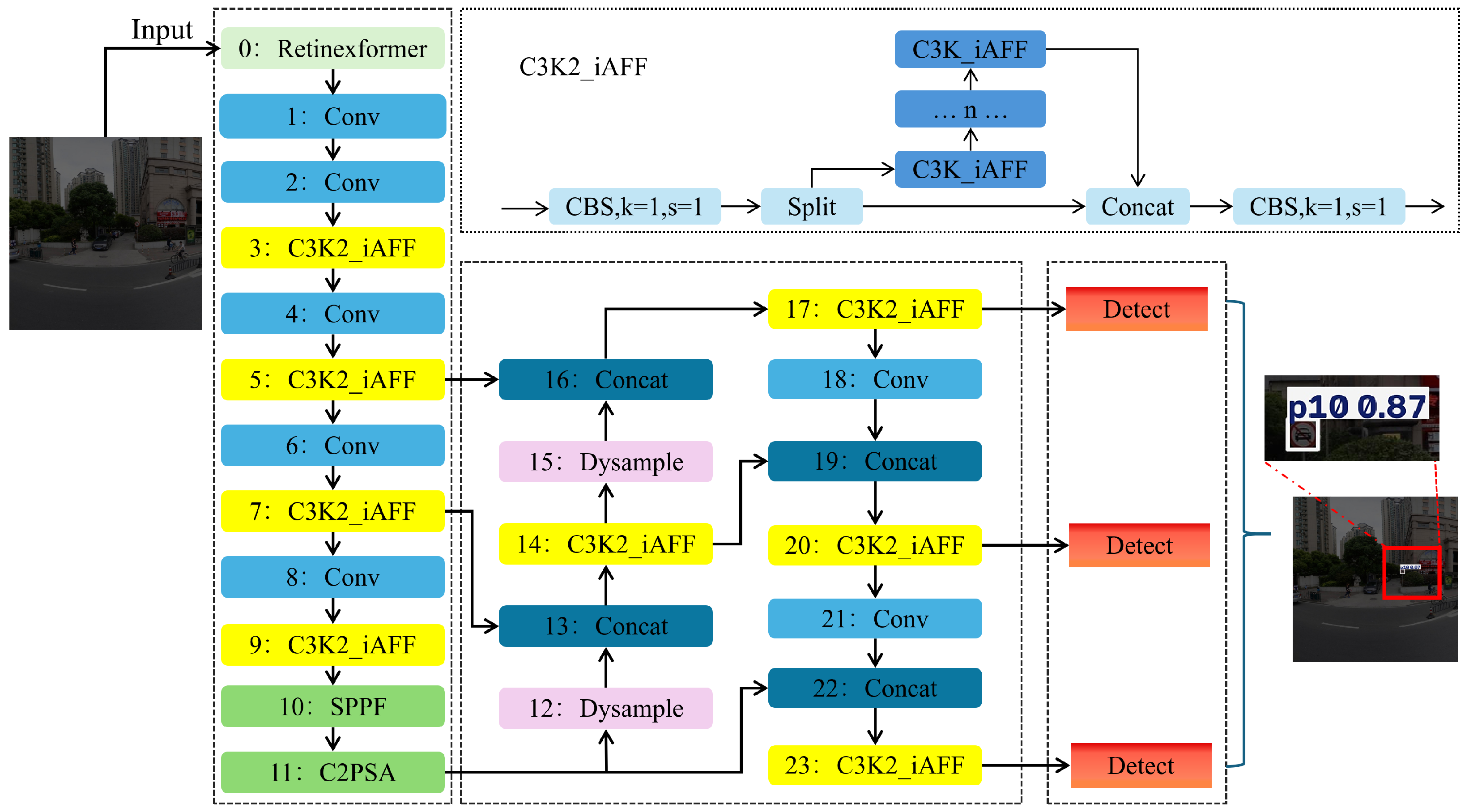
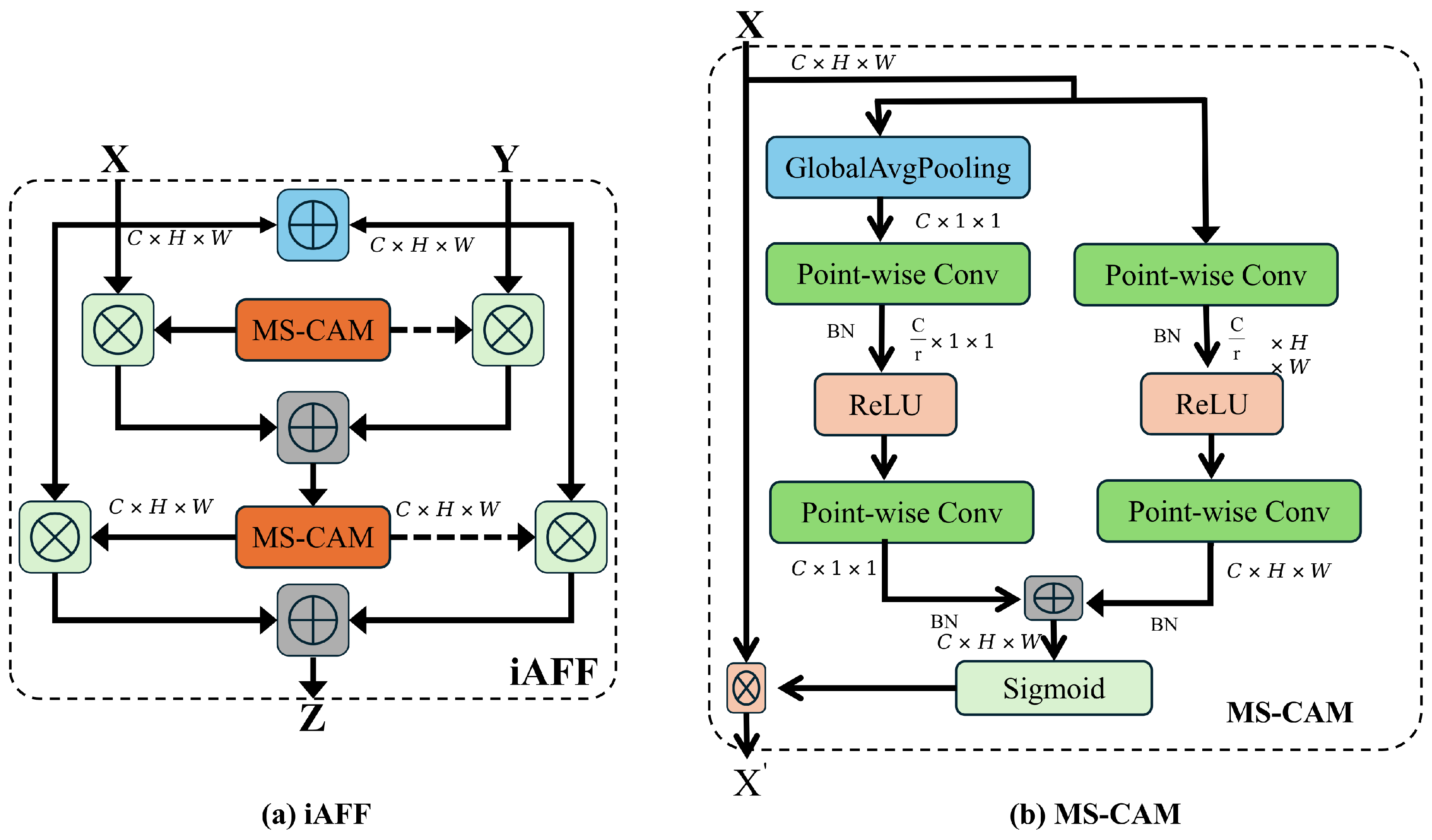
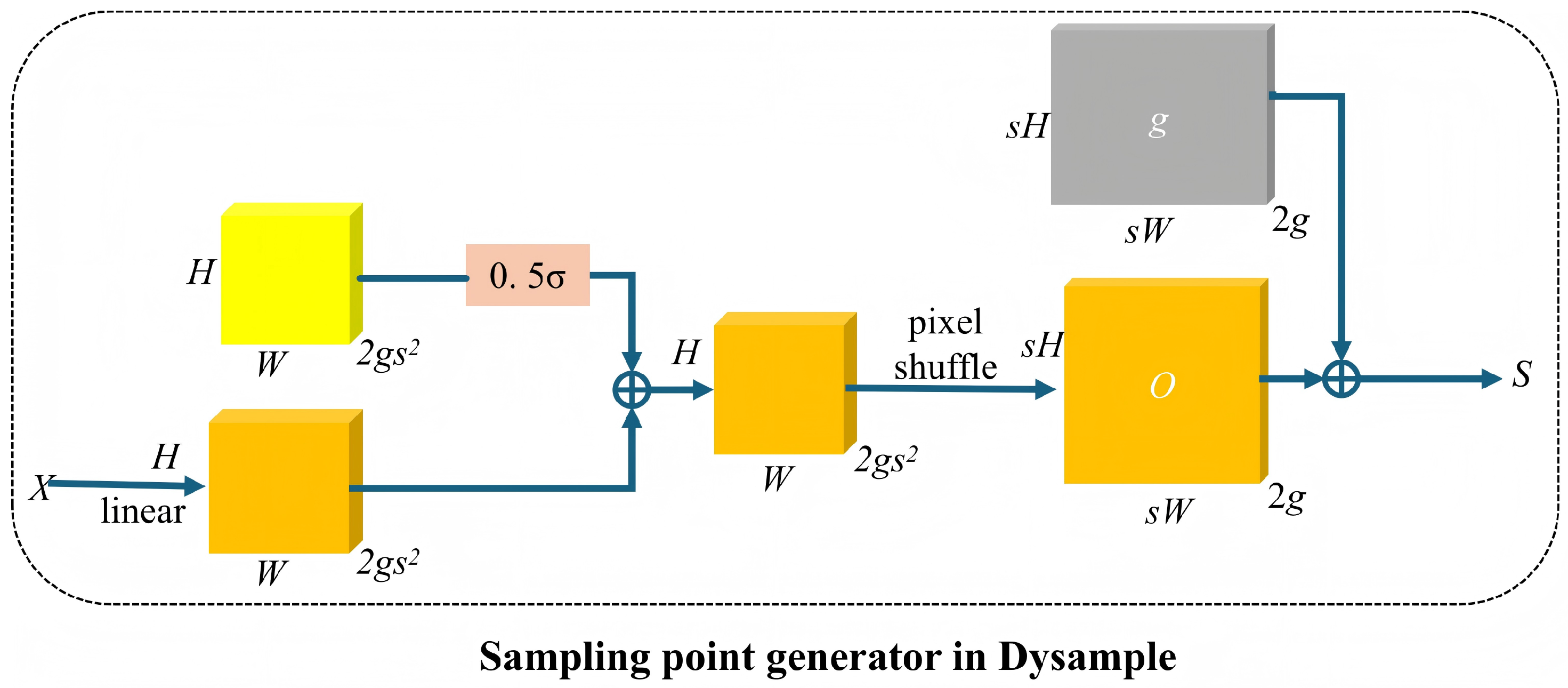
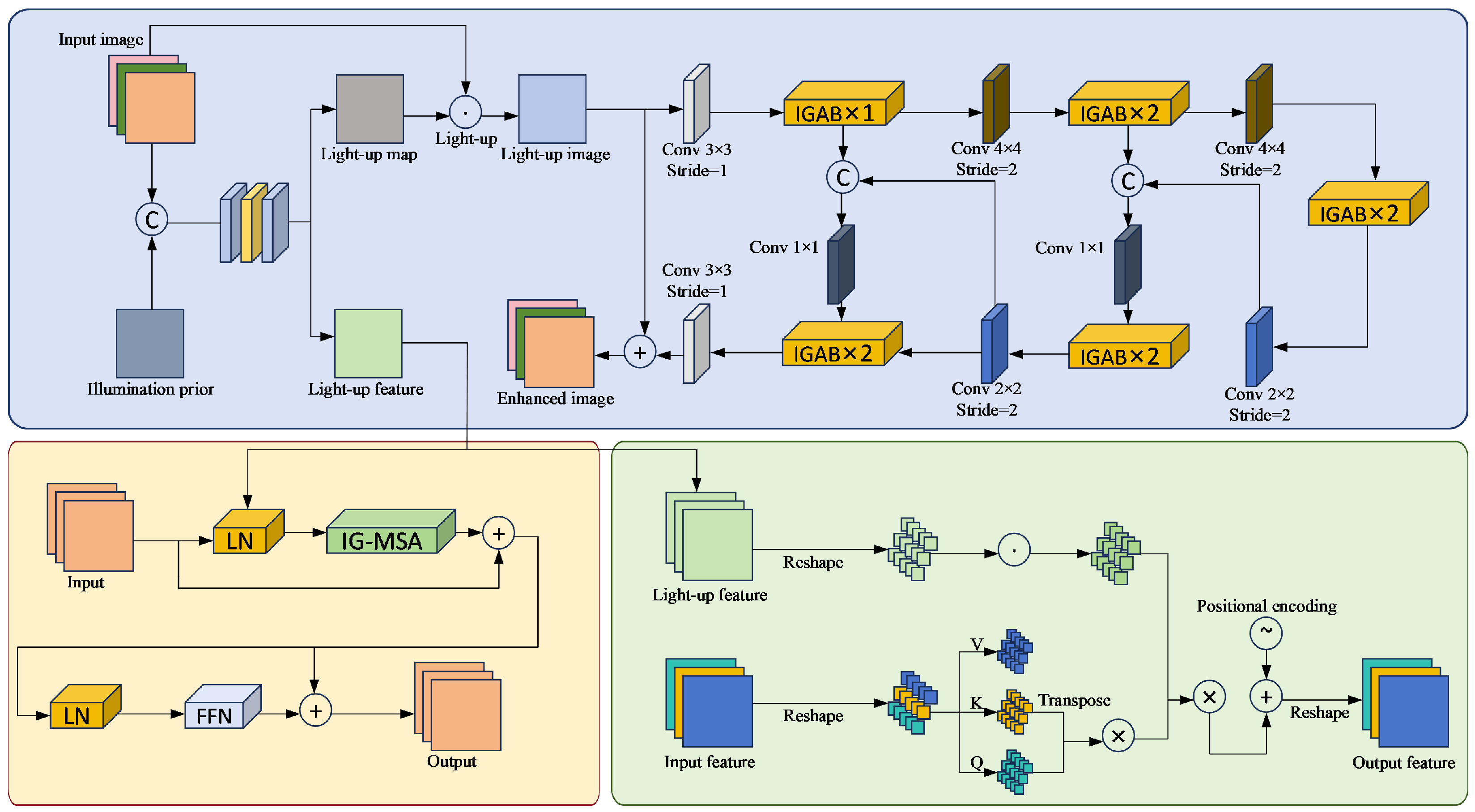
To address difficulties in traffic sign detection under low-light environments, this paper proposes RiDW-YOLO, an improved detection algorithm based on YOLOv11n. The Retinexformer network is embedded as a trainable front-end module at the first layer of the YOLOv11n backbone, performing online image enhancement during forward propagation without offline preprocessing. Its weights are updated end-to-end with the subsequent detection sub-network, improving brightness and contrast while suppressing noise, thereby strengthening feature extraction for traffic sign targets. An iterative attentional feature fusion (iAFF) block is integrated into the feature-fusion architecture of YOLOv11n, enabling adaptive weighted multi-level feature aggregation and enhancing feature representation. DySample, a dynamic up-sampling operator, replaces conventional interpolation methods by learning offset coordinates to better preserve fine-grained feature information. Wise-IoU (WIoU) replaces the original Complete-Intersection over Union (CIoU) loss function, leveraging dynamically adjusted gradient weights to suppress low-quality samples interference and boost bounding-box localization performance. Experimental results demonstrate that compared with the YOLOv11n baseline model, the improved algorithm achieves an increase of 15.2 percentage points in precision, 6.2 percentage points in recall, and 11.0 percentage points in mAP@50. Overall, this work provides a feasible solution for traffic-sign detection under low-light conditions and emphasizes the importance of balanced module design and frank discussion of current limitations.
Keywords: low-light; traffic sign detection; YOLO; Retinexformer; dynamic sampling low-light; traffic sign detection; YOLO; Retinexformer; dynamic sampling