Article

Re-Evaluating AI Nativeness: Competence Foundations, GenAI Use/Access Profiles, and Institutional Mediation


1
College of Teacher Education, Ningbo University, Ningbo 315000, China
2
School of Global Communication and Law, Ningbo Tech University, Ningbo 315000, China
3
School of Education, City University of Macau, Macao, China
*
Author to whom correspondence should be addressed.
Information 2026, 17(9), 857; https://doi.org/10.3390/info17090857
Submission received: 14 July 2026 / Revised: 30 August 2026 / Accepted: 2 September 2026 / Published: 4 September 2026
(This article belongs to the Special Issue Generative AI Technologies: Shaping the Future of Higher Education)

Abstract

The notion of “AI natives” is increasingly used to describe young learners’ presumed ease with generative artificial intelligence (GenAI), but the label often turns age and exposure into proxies for competence. This study re-examines that assumption through an exploratory secondary analysis of two open student datasets and proposes a practice-based relational framework for AI nativeness. In this framework, AI nativeness is not a generational identity, but a testable configuration of competence foundations, GenAI use practices, access conditions, and institutional mediation. Because the two datasets do not measure all four dimensions within the same learners, the framework is motivated rather than fully tested here. The results show that basic operational skills do not, on their own, explain AI readiness; critical information literacy is the most consistent positive predictor in the regression models. Student GenAI use and access conditions are also heterogeneous, forming four interpretable GenAI use/access profiles: low-adoption learners, high-intensity multi-taskers, mobile-dependent moderate users, and balanced cognitive adopters. These findings do not establish who is or is not an AI native. They show why the age-based label is analytically insufficient and why future research should examine AI nativeness through competence, practice, access, and institutional mediation together.

1. Introduction

Generative artificial intelligence (GenAI) has quickly become part of students’ everyday learning routines, from writing and information retrieval to problem-solving and creative production [1]. In this setting, the metaphor of the “AI native” has gained public and policy appeal. It suggests that young learners encounter AI technologies with unusual ease and may already possess the capabilities needed to use them well [2]. The attraction of the metaphor is clear: it offers a simple generational explanation for a complex process of technological adaptation.
That explanation is also risky. Productive GenAI use requires more than access to a tool or frequent interaction with it. Students must formulate tasks, evaluate generated content, revise outputs, recognize task boundaries, and decide when AI assistance is appropriate. These requirements make GenAI different from earlier forms of routine digital operation. A student may be comfortable with devices, searches, and applications while still struggling with the higher-order judgments required for AI readiness. Birth cohort and everyday exposure can therefore provide context, but they cannot explain students’ AI capabilities on their own.
This study treats “AI nativeness” as a concept requiring reconstruction rather than as a generational fact. It uses two open student datasets to examine whether AI readiness and GenAI use/access conditions show internal differentiation. The first dataset is used to analyze the relationship between basic digital operational skills, critical information literacy, computational problem-solving, advanced creative/systemic skills, and AI readiness. The second dataset is used to identify profiles of university students’ GenAI use and access conditions. The two datasets are not pooled or treated as a unified population. They provide two empirical windows into a broader practice-based relational framework in which AI nativeness is understood through competence foundations, GenAI use practices, access conditions, and institutional mediation. The present study does not identify which students are “AI natives,” nor does it claim to fully verify this framework within individual learners.

2. Literature Review and Conceptual Background

2.1. The Origin and Critique of the Digital-Native Concept

The notion of the “AI native” has a direct theoretical lineage in Prensky’s [3] metaphor of “digital natives” and “digital immigrants.” Prensky portrayed young people who grew up surrounded by digital technologies as intuitive insiders, while depicting those who encountered digital technologies later in life as immigrants who must undergo a process of adaptation. The vivid generational narrative and strong rhetorical appeal of this metaphor quickly carried it into educational research, policy documents, and public discussion, where it has long been invoked to explain differences in technological experience between students and teachers. Yet the classic debates surrounding digital nativeness also show that inferring competence from birth cohort, while analytically convenient, remains vulnerable to criticisms of insufficient empirical evidence, blurred conceptual boundaries, and overgeneralization of the population [4,5,6].
Subsequent research has progressively qualified this generational framing. Bennett et al. [4] observed that within-cohort differences in technological competence often exceed between-cohort differences, so young learners cannot be treated as a homogeneous group of technology experts. Helsper and Eynon [5] further found that technological experience, educational opportunity, and socioeconomic conditions explain individual differences in digital competence more effectively than birth year. Bayne and Ross [7] added a critical-discursive perspective, arguing that the native metaphor can convert institutional shortfalls and structural inequalities into matters of individual competence, thereby obscuring the responsibilities that educational systems should bear. Empirical studies by Kirschner and De Bruyckere [6] and Margaryan et al. [8] likewise failed to support the assumption that digital natives possess innate advantages in higher-order cognition, learning strategies, or complex technology use.
Further research has shown that the so-called digital natives are themselves internally differentiated. Kennedy et al. [9] and Kennedy et al. [10], drawing on Australian university samples, found that young students’ technological proficiency, frequency of use, and types of application were too heterogeneous to fit a single digital-native category; they were better understood as distinct types of technology users. Hargittai [11] similarly noted that even within the same networked generation, family resources, socioeconomic background, and learning opportunities produce substantial differences in internet skills. In line with these empirical findings, Teo [12] attempted to translate the digital-native label from a generational marker into a set of measurable psychological and behavioral traits, while White and Le Cornu [13] proposed the “visitor-resident” continuum as an alternative to the native-immigrant binary. In short, the dominant direction of the later literature has not been to reinforce the simple claim that youth equals nativeness, but to move toward differentiated analyses of learners’ technological experience, competence traits, and modes of participation.
Overall, the problem with the digital-native metaphor is not that it lacks descriptive value entirely, but that it tends to collapse technology access, operational experience, higher-order competence, and learning performance into a single, sweeping generational identity. The evolution of digital-native research indicates that the relationship between learners and technology cannot be explained by age or birth cohort alone; it must be analyzed through resources, experience, competence structure, and practical context. For this reason, when the native metaphor is carried over into AI education and used to talk about “AI natives,” particular care is needed to avoid repeating the conceptual overextension that characterized the earlier literature and to remain empirically and interpretively cautious.

2.2. The Risk of Concept Transfer from Digital Natives to AI Natives

The GenAI context amplifies the core problems already present in the digital-native debate. Early digital tools could often be described in terms of device access, software operation, web searching, and information retrieval. By contrast, GenAI use sits more deeply within processes of knowledge production, meaning-making, and task completion. When students use GenAI for writing, programming, translation, or creative generation, they must do more than invoke the tool; they must judge whether the output is credible, whether it satisfies task requirements, whether it needs further revision, and whether it raises issues of citation, attribution, originality, and academic integrity. Differences in competence in the GenAI context therefore appear not only as differences in tool adoption but also as differences in the ability to verify, rewrite, interrogate, attribute, and take responsibility for generated outputs. AI-related competence spans understanding, use, evaluation, and ethics, rather than reducing it to a single tool-operation skill [14]. AI competence is neither identical to frequency of AI tool contact nor reducible to basic digital operational proficiency.
Transferring the digital-native framework directly into an “AI native” judgment therefore entails at least three risks. The first is the risk of competence simplification: surface behaviors such as being able to use devices, call AI tools, and obtain generated outputs quickly are mistaken for adequate AI readiness. The second is the risk of population homogenization: students are treated as a group that is naturally high in competence, high in use, and low in adaptation costs, thereby obscuring differences in competence structure, purpose of use, task context, resource access, and normative awareness. The third is the risk of governance obscuration: questions about AI use are over-attributed to individual competence or generational traits, while the ethical responsibilities, academic norms, institutional support, and instructional governance that GenAI brings into education are neglected. UNESCO’s [15] guidance on GenAI in education and research and the work of Ponce Rojo et al. [16] on “AI natives” in higher education both suggest that students’ relationship with AI is better understood through AI literacy, media and information literacy, normative use, and institutional boundaries than by age-based intuition. The “empirical re-evaluation” undertaken in this study is precisely an attempt to bring differences in competence, practice, risk, and conditions back into the conceptual discussion of AI nativeness that age labels have tended to obscure.

2.3. From Generational Identity to a Practice-Based Relational Framework

At a more fundamental explanatory level, “AI nativeness” should not be accepted first as an age identity; it should be reconstructed as a practice-based relational framework. This framework disaggregates AI-related engagement into four dimensions: competence foundations, including basic digital operation, critical information literacy, computational problem-solving, and advanced creative/systemic skills; GenAI use practices, including adoption breadth, adoption intensity, symbolic-cognitive use, and creative-generative use; access conditions, including device availability, network access, platform access, and mobile dependence; and institutional mediation, including classroom rules, assessment norms, AI policies, disciplinary expectations, platform permissions, and teacher guidance. In this sense, AI nativeness is not a learner identity but a testable sociotechnical practice configuration.
The four dimensions are relational rather than merely additive. Competence foundations condition whether GenAI practices become productive rather than superficial. GenAI use practices may, over time, reshape competence through repeated tasks, feedback, and reflection. Access conditions enable or constrain the range and form of AI use. Institutional mediation helps define what counts as appropriate, responsible, or competent AI use in a particular educational setting. This point is consistent with AI literacy and GenAI governance work [14,15] and with scholarship on the social risks of deployed AI, sociotechnical abstraction, AI-mediated communication, and situated technology use [17,18,19,20,21].
This reconstruction also clarifies what is retained from the term “AI native.” The term is retained only as a heuristic and testable hypothesis, not as a natural generational identity or stable learner type. In this study, the practice-based relational framework is conceptually broader than the empirical GenAI use/access profiles reported below. The latter are data-driven clusters based only on GenAI use and access variables and should not be interpreted as complete configurations of AI nativeness. A full empirical test of the framework would require competence foundations, GenAI use practices, access conditions, and institutional mediation to be measured within the same learners.
In this study, practice profile refers to an analytical typology that captures relatively distinguishable configurations of competence foundations, technology practices, and access conditions. It does not represent a fixed learner identity or stable psychological trait. Rather, it provides an empirical lens for examining how students’ AI-related engagement varies across different combinations of capabilities, practices, and contextual constraints.

3. Research Gaps and Research Questions

The digital-native debate has already weakened the assumption that age can stand in for technological competence. What remains less settled is how that critique should be carried into the GenAI context. AI literacy research points to capacities such as understanding, use, evaluation, and ethical judgment [14], while UNESCO’s guidance places GenAI use within institutional boundaries and responsibility frameworks [15]. These perspectives shift attention away from whether young people are “naturally” close to AI and toward the observable dimensions through which students actually differ: their competence base, their patterns of GenAI use, and the conditions under which they access digital tools.
Two empirical gaps follow from this shift. The first concerns AI readiness. If readiness is inferred from device operation, software use, or general digital fluency, the analysis may miss the role of critical information judgment, computational problem-solving, and advanced creative or systemic skills. The second concerns GenAI practice. Existing critiques of age-based labels show that students should not be treated as a homogeneous AI-using group, but they do not show what kinds of use profiles emerge when adoption breadth, use intensity, task orientation, digital access, and mobile dependence are examined together. Because no single open dataset captures all of these dimensions, the present analysis uses two student datasets as construct-level evidence rather than as a pooled sample.
This study approaches AI nativeness as an empirical claim about the relationship between students and AI technologies, but it narrows that claim to what the available secondary data can support. If AI nativeness reflects more than simple technological exposure, it should be examined through competence foundations, GenAI practices, access conditions, and institutional mediation. The current datasets do not measure all of these dimensions within the same individuals. Therefore, this study does not aim to identify which students are “AI natives”; instead, it examines two empirical components that can motivate a broader practice-based relational framework.
The study therefore asks two research questions:
RQ1: To what extent does basic digital operational competence predict AI readiness, relative to critical information literacy and higher-order skills?
RQ2: What GenAI use/access profiles can be identified among university students, and how do these profiles vary in use structure and access conditions?
RQ1 examines whether AI readiness can be represented by basic operational fluency or whether information judgment and higher-order competences carry greater explanatory weight. RQ2 examines whether students’ GenAI use/access conditions form a uniform pattern or differentiate by breadth of use, intensity of use, task orientation, digital access, and mobile dependence. Together, these analyses are used to motivate, but not fully test, a practice-based relational framework of AI nativeness.

4. Data and Methods

4.1. Data Sources

This study uses two open student datasets, corresponding, respectively, to AI readiness and GenAI use/access profiles. The first is the open Zenodo dataset “Dataset for: The Illusion of Competence: Self-Perceived Digital Literacy and AI Readiness Among European Secondary Students” by Rodriguez-Alvarez et al. [22], hereafter the “AI readiness dataset.” The second is the open figshare dataset “Dataset: Generative AI Adoption and Academic Integrity Risk-A Student Taxonomy in Latin American Higher Education” by Torres [23], hereafter the “GenAI profile dataset.” Neither dataset was designed to measure the concept of AI nativeness directly, so the relevant variables are treated as proxies for exploring competence foundations and GenAI use/access conditions. The final analytic samples were 243 students in the AI readiness dataset and 3415 students in the GenAI profile dataset; no missing values were present in the variables used for the reported analyses.

4.2. Rationale for Combining the Two Student Datasets

The integration of the two datasets is not a statistical pooling of samples or a direct comparison of the same population; it is a construct-level convergence of evidence around the concept of AI nativeness. The AI readiness dataset supplies evidence on competence foundations, addressing whether AI readiness can be represented by basic digital operational skills. The GenAI profile dataset supplies evidence on GenAI use/access profiles, addressing whether students’ GenAI use and access conditions exhibit internal differentiation.
This design is necessary because AI nativeness is not a single-variable concept. If it is understood as a practice-based relational framework, then competence foundations, GenAI use practices, access conditions, and institutional mediation should ideally be observed together. The current open datasets do not allow for that full test. Institutional mediation is not directly measured here; it is included as a theoretically necessary dimension for future research. The two datasets are therefore treated as exploratory empirical windows rather than as a basis for proving who is or is not an AI native.

4.3. Construct Operationalization

As shown in Table 1, this study disaggregates “AI nativeness” into two dataset-level analytical modules. The first is the AI readiness and competence-foundation module, drawn mainly from the AI readiness dataset. It examines whether AI readiness can be represented by basic digital operational skills or whether it requires the joint contribution of higher-order competences such as critical information literacy, computational problem-solving, and advanced creative/systemic skills. Variables in this module include AI readiness, basic digital operational skills, critical information literacy, computational problem-solving, advanced creative/systemic skills, and the competence-illusion gap. The competence-illusion gap denotes the discrepancy between basic operational skills and advanced skills, reflecting the possible inconsistency between “knowing how to operate” and “being able to carry out complex cognitive and creative applications.”
The second is the GenAI use practice and access-condition module, drawn mainly from the GenAI profile dataset. It identifies practical differences in students’ GenAI use and access conditions. Variables include GenAI adoption breadth, adoption intensity, symbolic-cognitive use, creative-generative use, digital access, and mobile device dependence. Through this operationalization, the study provides evidence for two components of the proposed framework, while acknowledging that institutional mediation and full individual-level AI-nativeness configurations are not directly measured.

4.4. Analytical Strategy

The study re-evaluates AI nativeness from two angles: the competence foundations of AI readiness and the GenAI use/access profiles of students. These analyses translate the concept from a generational label into a testable, multidimensional empirical problem while remaining explicit about the limits of the available data.
First, for RQ1, regression models of AI readiness are estimated. Model A treats AI readiness as the dependent variable and includes basic digital operational skills, critical information literacy, computational problem-solving, and advanced creative/systemic skills as the core independent variables. Model A evaluates the relative associations of basic operational and higher-order competences with AI readiness. Model B separately examines whether the basic-advanced competence gap is associated with AI readiness after accounting for critical information literacy and computational problem-solving. The two models are therefore interpreted as complementary rather than as directly competing models.
Analyses were conducted in Python 3.11.7 using pandas for data handling, statsmodels for OLS regression, and scikit-learn for standardization, K-means clustering, PCA visualization, and silhouette diagnostics. Complete-case analysis was used, although the variables included in the reported models and clusters contained no missing values.
Second, for RQ2, student GenAI use/access profiles are identified through K-means cluster analysis of the GenAI profile dataset. The clustering variables are GenAI adoption breadth, adoption intensity, symbolic-cognitive use, creative-generative use, digital access, and mobile device dependence. Because K-means is sensitive to variable scale and distance structure, all variables are standardized before clustering. Alternative cluster solutions from k = 2 to k = 7 were compared using silhouette coefficients, cluster sizes, profile interpretability, and theoretical consistency. The k = 2 solution produced the highest silhouette coefficient (0.301), but it reduced the data to a broad high/low contrast. The k = 4 solution had a modest silhouette coefficient (0.227), yet it offered a more interpretable balance among use intensity, task structure, and access conditions. The four-profile solution is therefore treated as exploratory and porous rather than as evidence of natural or fixed learner types.

5. Data Analysis

5.1. Can Basic Digital Operational Skills Explain AI Readiness?

Addressing RQ1, this section examines whether basic digital operational skills are sufficient to explain students’ AI readiness. Descriptive statistics and regression models are used to assess the relative contributions of basic digital operational skills, critical information literacy, computational problem-solving, and advanced creative/systemic skills, in order to test the assumption that young students’ familiarity with digital tools implies a natural level of AI-related competence.
Descriptive statistics show that students’ basic digital operational scores (M = 4.23, SD = 0.54) are markedly higher than their advanced creative/systemic scores (M = 3.19, SD = 0.96). This pattern indicates that students report higher proficiency in basic operational tasks than in more complex creative and systemic tasks, pointing to a structural distinction between operational fluency and higher-order AI-related competence. Basic operational proficiency cannot therefore be equated directly with AI readiness.
Model A includes basic digital operational skills, critical information literacy, computational problem-solving, and advanced creative/systemic skills as predictors of AI readiness. As shown in Table 2, the model is statistically significant overall, F(4, 238) = 23.900, p < 0.001. It yields R = 0.535, R2 = 0.287, and adjusted R2 = 0.275, indicating that the four competence dimensions explain approximately 27.5% of the variance in AI readiness. Among the predictors, critical information literacy has the highest standardized coefficient and is significant (B = 0.372, p < 0.001), suggesting that students’ ability to judge, evaluate, and process information critically is an important foundation of AI readiness. Basic digital operational skills are also positively and significantly associated with AI readiness (β = 0.214, p = 0.002), as are advanced creative/systemic skills (β = 0.153, p = 0.016). Computational problem-solving is not significant when the other variables are controlled (β = −0.072, p = 0.318). Variance inflation factors range from 1.33 to 1.72, indicating no serious multicollinearity.
These results indicate that AI readiness cannot be reduced to a single operational skill. Although basic digital operational skills are positively associated with AI readiness, their explanatory contribution is weaker than that of critical information literacy. Even if young learners are broadly immersed in digital technologies, one cannot infer mature AI-related competence from the ability to operate tools alone. Treating such students as naturally AI-competent natives would overstate what operational fluency actually represents.
To test whether the mismatch between basic operational skills and higher-order skills is associated with AI readiness, as shown in Table 2, Model B introduces the competence-illusion gap along with critical information literacy and computational problem-solving. The model is statistically significant overall, F(3, 239) = 23.735, p < 0.001, with R = 0.479, R2 = 0.230, and adjusted R2 = 0.220, indicating that the three predictors jointly explain approximately 22.0% of the variance in AI readiness.
The competence-illusion gap has a negative standardized coefficient but does not reach statistical significance (β= −0.062, p = 0.282). This suggests that, after controlling for critical information literacy and computational problem-solving, the extent to which basic operational skills exceed advanced creative/systemic skills does not reliably predict AI readiness. Although the structural pattern of “strong basic skills, weak higher-order skills” theoretically signals a possible disconnect between surface fluency and genuine AI competence, the current data do not support treating this gap as a significant predictor of AI readiness. By contrast, critical information literacy remains a significant and stable positive predictor (β = 0.432, p < 0.001), reinforcing the importance of information retrieval, judgment, evaluation, and critical processing as a foundation of AI readiness. Computational problem-solving is not significant (β = 0.068, p = 0.311), indicating that its independent explanatory contribution is limited in this model. Variance inflation factors range from 1.03 to 1.38, indicating no serious multicollinearity.
The two models point to the same boundary of the AI-native label. Basic digital operational skills are associated with readiness, but they do not carry the main explanatory weight. Critical information literacy is the more consistent positive factor across the models. The competence-illusion gap is negative but not significant, so it should be read as an exploratory clue rather than as robust evidence. Students’ familiarity with digital tools, by itself, does not establish mature AI readiness; the label only becomes analytically useful when it is tied to capacities for understanding, judgment, evaluation, and responsible use.

5.2. Student GenAI Use/Access Profiles: Heterogeneity in Practice and Access

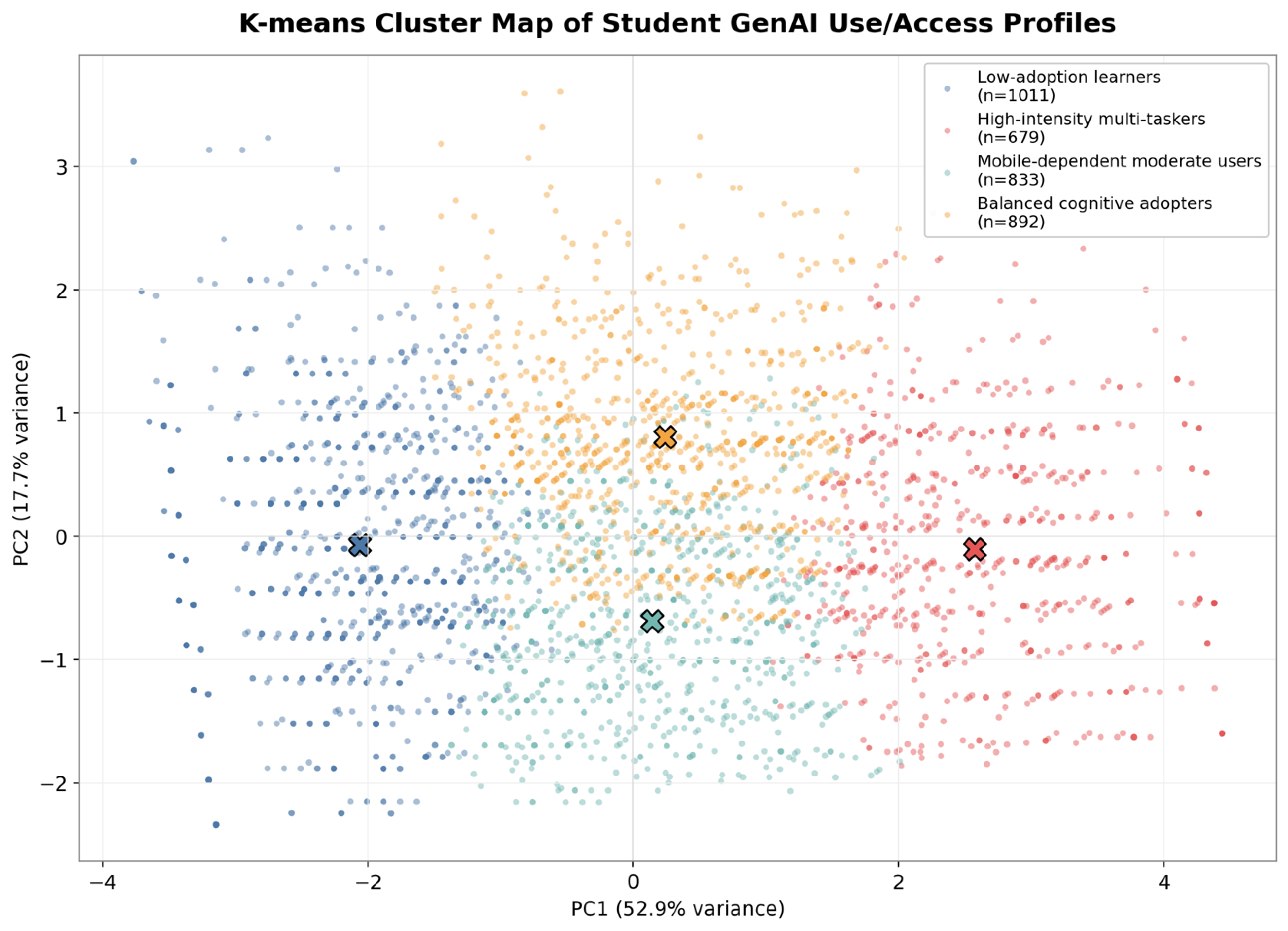
Addressing RQ2, this section examines whether students’ GenAI use and access conditions display a relatively uniform structure. K-means cluster analysis was applied to the GenAI profile dataset using the six variables of GenAI adoption breadth, adoption intensity, symbolic-cognitive use, creative-generative use, digital access, and mobile device dependence in Table 3. Alternative solutions from k = 2 to k = 7 were compared. The silhouette coefficients were 0.301 for k = 2, 0.225 for k = 3, 0.227 for k = 4, 0.219 for k = 5, 0.229 for k = 6, and 0.224 for k = 7. Although k = 2 produced the highest silhouette coefficient, it reduced the data to a broad high/low contrast. The k = 4 solution yielded modest separation while preserving interpretable distinctions among use intensity, task orientation, and access dependence. The six standardized clustering variables were also projected onto the first two principal components for visualization; the first two components together account for 70.5% of the variance, as shown in Figure 1.
The profile results add a second boundary to the age-based label. GenAI use and access conditions vary by adoption breadth, use intensity, task orientation, device access, and mobile dependence. These are not complete AI-nativeness profiles because the dataset does not include competence foundations or institutional mediation. They are narrower GenAI use/access profiles that identify how students’ reported AI practices and access conditions cluster in the available data. The table gives the profile centers, while Figure 1 shows how individual cases are distributed around them. These are not isolated natural groups but relatively concentrated regions within a continuous practice space.
Figure 1 illustrates that low-adoption learners (n = 1011) show the lowest levels of GenAI adoption breadth, adoption intensity, and both use dimensions. High-intensity multi-taskers (n = 679) reach the highest levels across all use dimensions: adoption breadth, adoption intensity, symbolic-cognitive use, and creative-generative use. Mobile-dependent moderate users (n = 833) display moderate use intensity, relatively high symbolic-cognitive use, and the highest mobile device dependence, indicating that access mode is associated with distinct GenAI practice patterns. Balanced cognitive adopters (n = 892) have relatively high adoption breadth and moderate use intensity, but the lowest mobile device dependence, suggesting a less mobile-dependent pattern of GenAI engagement.
Together, the four GenAI use/access profiles reveal interpretable differences among students in GenAI adoption breadth, use intensity, task orientation, device access, and mobile dependence. This finding indicates that “AI nativeness” cannot be reduced to age or technological epoch; it must be examined through specific configurations of competence, practice, access, and institutional mediation. In the present data, however, the clusters should be read only as exploratory use/access profiles, not as fixed learner identities or full AI-nativeness configurations.

6. Discussion

6.1. The Competence Foundations of AI Nativeness Are Not Naturally Homogeneous

The RQ1 results separate basic digital fluency from AI readiness. Basic operational skills are positively associated with readiness, but critical information literacy is the more consistent positive predictor across the two regression models. Computational problem-solving and the competence-illusion gap do not show the same stability. In practical terms, students may be comfortable with digital tools while still lacking the evaluative capacity required to judge AI-generated information, revise outputs, or recognize the limits of a generated response.
This result extends the critique of generational determinism in digital-native research. Bennett et al. [4], Helsper and Eynon [5], Kirschner and De Bruyckere [6], and Margaryan et al. [8] all caution against treating technological exposure as evidence of higher-order competence. The present analysis places that caution in the GenAI setting: familiarity with tools matters, but readiness depends more heavily on information judgment and critical evaluation. If the term “AI nativeness” is retained, it should refer to a practice-based relational framework that can be examined, not to a generation presumed to be naturally AI-ready.

6.2. AI Use Practices Exhibit Profile Differentiation

The RQ2 clustering results show a second limit of the age label. Students’ GenAI use/access patterns do not collapse into a single pattern. The four profiles differ in adoption breadth, use intensity, task orientation, digital access, and mobile device dependence. Low-adoption learners and high-intensity multi-taskers sit at opposite ends of the use-intensity spectrum, while mobile-dependent moderate users and balanced cognitive adopters show that similar levels of use can rest on different access conditions.
This matters because access and practice do not describe the same thing. Mobile-dependent moderate users, for example, are not simply less intensive versions of high-intensity users; their profile suggests a different mode of engagement characterized by greater device dependence. Conversely, balanced cognitive adopters combine relatively broad use with lower mobile dependence. These differences make the “AI native” label too coarse for educational analysis. At the same time, the four clusters are not complete practice profiles: competence foundations and institutional mediation are not measured in the same dataset. They should therefore be read as GenAI use/access profiles that motivate, but do not fully test, the broader framework.

6.3. An Empirical Re-Evaluation of the AI-Native Concept

Taken as construct-level rather than pooled population evidence, the two datasets provide empirical grounds for re-examining the AI-native concept. RQ1 shows that competence cannot be inferred from basic tool familiarity; RQ2 shows that GenAI use/access conditions cannot be inferred from youth or exposure alone. The theoretical implication is that AI nativeness should be understood as a practice-based relational framework constituted by competence foundations, GenAI use practices, access conditions, and institutional mediation. This framework keeps the useful provocation of the AI-native label while removing its age essentialism.
The present study cannot fully test that framework. No student in the current analysis is measured simultaneously on competence foundations, GenAI use practices, access conditions, and institutional mediation. Institutional mediation is theorized but not directly observed. What the study can do is identify two empirical limits of the age-based label and specify what future research would need to measure. Purpose-built studies should examine competence, actual AI practices, access conditions, institutional rules, platform affordances, teacher guidance, and learning outcomes within the same learners, ideally with longitudinal or cross-context designs and behavioral indicators such as prompt logs, assignment artifacts, or learning analytics.
This re-evaluation does not deny that young students are growing up in an AI-saturated environment. Instead, it clarifies what such an environment does and does not guarantee. Frequent exposure to GenAI does not necessarily produce critical information literacy, responsible judgment, or effective integration of AI into learning practices. Likewise, students’ AI engagement cannot be assumed to follow a uniform developmental trajectory. AI literacy education therefore needs to move beyond debates centered only on access or restriction. It should incorporate information evaluation, output revision, task-boundary judgment, ethical awareness, privacy protection, attribution norms, and differentiated support based on students’ diverse use/access conditions [14,15,17,18,19,24,25].

7. Conclusions

This study used two open student datasets to re-examine the concept of AI nativeness. The first analysis shows that basic digital operational skills alone are insufficient as a proxy for students’ AI readiness; critical information literacy is the most consistent positive predictor in the regression models. Students’ GenAI use/access conditions also form four interpretable but porous profiles that differ in breadth, intensity, task orientation, and access conditions. These findings suggest that age-based explanations alone are insufficient for understanding students’ AI-related differences.
Several limitations should be acknowledged. First, the two datasets come from different populations (European secondary students and Latin American university students), educational levels, and self-report instruments, so the results are not directly comparable as a single sample. The integration is conceptual rather than statistical. Second, the cross-sectional design prevents causal claims about how competence foundations shape GenAI use over time. Third, all measures rely on self-reported skills and use frequencies, which may diverge from actual behavior and may be subject to social desirability bias. Fourth, the cluster solution is exploratory; replication with other datasets and contexts is needed before treating the four GenAI use/access profiles as stable or transferable patterns. Fifth, institutional mediation is theorized but not directly measured in the current datasets.
The practical implication is not that schools should adopt the language of AI nativeness as a diagnostic label, but that they should not let it substitute for careful analysis. Low-adoption profiles may warrant closer attention to possible access and motivational barriers. High-intensity multi-tasking profiles may warrant greater attention to task planning, output evaluation, attribution, and boundary setting. Mobile-dependent moderate users may require mobile-compatible but critically oriented resources, while balanced cognitive adopters may offer examples of more sustainable GenAI engagement. These implications should be treated as design prompts rather than fixed learner classifications.
Future research should test the proposed practice-based relational framework with purpose-built datasets that simultaneously measure competence foundations, actual GenAI practices, access conditions, institutional mediation, and learning outcomes. Longitudinal designs could examine how AI-related competence and use practices change over time. Cross-cultural and cross-institutional studies could test whether use/access profiles vary under different policy, platform, and assessment conditions. The AI-native label should be retained, if at all, as a hypothesis or heuristic provocation rather than as a stable identity category.

Author Contributions

Conceptualization, J.P. and W.J.; methodology, W.J.; software, W.J.; validation, N.W. and L.W.; formal analysis, W.J. and L.W.; investigation, N.W.; resources, J.P.; data curation, W.J., N.W. and L.W.; writing—original draft preparation, W.J.; writing—review and editing, J.P., W.J., N.W. and L.W.; visualization, W.J. and L.W.; supervision, J.P.; project administration, W.J.; funding acquisition, J.P. and W.J. All authors have read and agreed to the published version of the manuscript.

Funding

This research was funded by the Ningbo University Talent Project (Humanities and Social Sciences), grant number ZX2026000119; the Zhejiang Provincial Federation of Humanities and Social Sciences Research Project, grant number 25NDJC163YB; the Graduate Education Quality Project of NingboTech University, grant number YJG202502.

Data Availability Statement

The data presented in this study are openly available in Zenodo at https://doi.org/10.5281/zenodo.18822871 and in figshare at https://doi.org/10.6084/m9.figshare.32687901.v1. No new primary data were created in this study.

Conflicts of Interest

The authors declare no conflict of interest.

References

  1. Wang, H.; Tian, J. From trust to dependency: How generative AI attributes and organisational support shape student use of generative AI. Educ. Inf. Technol. 2026, 31, 4303–4326. [Google Scholar] [CrossRef] [Scilit]
  2. Yi, H.; Wang, S. Educating AI-native entrepreneurs: How entrepreneurial imaginativeness shapes the translation from vision to viability in student venture creation. Int. J. Manag. Educ. 2026, 24, 101426. [Google Scholar] [CrossRef] [Scilit]
  3. Prensky, M. Digital natives, digital immigrants. Horizon 2001, 9, 1–6. [Google Scholar] [CrossRef] [Scilit]
  4. Bennett, S.; Maton, K.; Kervin, L. The ‘digital natives’ debate: A critical review of the evidence. Br. J. Educ. Technol. 2008, 39, 775–786. [Google Scholar] [CrossRef] [Scilit]
  5. Helsper, E.J.; Eynon, R. Digital natives: Where is the evidence? Br. Educ. Res. J. 2010, 36, 503–520. [Google Scholar] [CrossRef] [Scilit]
  6. Kirschner, P.A.; De Bruyckere, P. The myths of the digital native and the multitasker. Teach. Teach. Educ. 2017, 67, 135–142. [Google Scholar] [CrossRef] [Scilit]
  7. Bayne, S.; Ross, J. ‘Digital native’ and ‘digital immigrant’ discourses: A critique. In Digital Differences: Perspectives on Online Education; Bayne, S., Land, R., Eds.; Routledge: London, UK, 2011; pp. 159–169. [Google Scholar]
  8. Margaryan, A.; Littlejohn, A.; Vojt, G. Are digital natives a myth or reality? University students’ use of digital technologies. Comput. Educ. 2011, 56, 429–440. [Google Scholar] [CrossRef] [Scilit]
  9. Kennedy, G.; Judd, T.; Churchward, A.; Gray, K.; Krause, K.-L. First year students’ experiences with technology: Are they really digital natives? Australas. J. Educ. Technol. 2008, 24, 108–122. [Google Scholar] [CrossRef] [Scilit]
  10. Kennedy, G.; Judd, T.; Dalgarno, B.; Waycott, J. Beyond natives and immigrants: Exploring types of Net Generation students. J. Comput. Assist. Learn. 2010, 26, 332–343. [Google Scholar] [CrossRef] [Scilit]
  11. Hargittai, E. Digital Na(t)ives? Variation in Internet skills and uses among members of the ‘Net Generation’. Sociol. Inq. 2010, 80, 92–113. [Google Scholar] [CrossRef] [Scilit]
  12. Teo, T. An initial development and validation of a digital natives Assessment Scale (DNAS). Comput. Educ. 2013, 67, 51–57. [Google Scholar] [CrossRef] [Scilit]
  13. White, D.; Le Cornu, A. Visitors and residents: A new typology for online engagement. First Monday 2011, 16. [Google Scholar] [CrossRef] [Scilit]
  14. Ng, D.T.K.; Leung, J.K.L.; Chu, S.K.W.; Qiao, M.S. Conceptualizing AI literacy: An exploratory review. Comput. Educ. Artif. Intell. 2021, 2, 100041. [Google Scholar] [CrossRef] [Scilit]
  15. UNESCO. Guidance for Generative AI in Education and Research; UNESCO: Paris, France, 2023. [Google Scholar]
  16. Ponce Rojo, A.; Fontaines-Ruiz, T.; Sánchez Bracho, A.; Cánquiz Rincón, L. From digital natives to AI natives: Emerging competencies and media and information literacy in higher education. Educ. Sci. 2025, 15, 1134. [Google Scholar] [CrossRef] [Scilit]
  17. Crawford, K.; Calo, R. There is a blind spot in AI research. Nature 2016, 538, 311–313. [Google Scholar] [CrossRef] [Scilit] [PubMed]
  18. Selbst, A.D.; Boyd, D.; Friedler, S.A.; Venkatasubramanian, S.; Vertesi, J. Fairness and abstraction in sociotechnical systems. In Proceedings of the 2019 Conference on Fairness, Accountability, and Transparency; ACM: New York, NY, USA, 2019; pp. 59–68. [Google Scholar] [CrossRef] [Scilit]
  19. Hancock, J.T.; Naaman, M.; Levy, K. AI-mediated communication: Definition, research agenda, and ethical considerations. J. Comput.-Mediat. Commun. 2020, 25, 89–100. [Google Scholar] [CrossRef] [Scilit]
  20. Orlikowski, W.J. Sociomaterial practices: Exploring technology at work. Organ. Stud. 2007, 28, 1435–1448. [Google Scholar] [CrossRef] [Scilit]
  21. Suchman, L.A. Human-Machine Reconfigurations: Plans and Situated Actions, 2nd ed.; Cambridge University Press: Cambridge, UK, 2007. [Google Scholar]
  22. Rodriguez-Alvarez, N.; Blanch-Marsolini, A.M.; Vara-Gutierrez, S.; Gil-Garcia, H.; Calzon-Duenas, J.; Rodriguez Merino, F. The illusion of competence: Self-perceived digital literacy and AI readiness among European secondary students. arXiv 2026, arXiv:2605.26010. [Google Scholar] [CrossRef]
  23. Torres, J. Dataset: Generative AI Adoption and Academic Integrity Risk-A Student Taxonomy in Latin American Higher Education [Data Set]; Figshare: London, UK, 2026. [Google Scholar] [CrossRef]
  24. Holmes, W.; Bialik, M.; Fadel, C. Artificial Intelligence in Education: Promises and Implications for Teaching and Learning; Center for Curriculum Redesign: Boston, MA, USA, 2019. [Google Scholar]
  25. Selwyn, N. Should Robots Replace Teachers? AI and the Future of Education; Polity Press: Cambridge, UK, 2019. [Google Scholar]
Figure 1. K-means cluster map of student GenAI use/access profiles. Each point represents one student. Colors indicate K-means cluster membership. Clustering variables are GenAI adoption breadth, adoption intensity, symbolic-cognitive use, creative-generative use, digital access, and mobile device dependence. All clustering variables were standardized before K-means clustering. The retained solution uses k = 4, with a silhouette coefficient of 0.227. The two-dimensional coordinates are PCA projections; the first two principal components account for 70.5% of the variance.
Information 17 00857 g001
Table 1. Operationalization of core constructs and proxy variables.
DatasetOperational DefinitionProxy VariableConceptual Dimension
AI readiness datasetMean score of six self-rated AI readiness items (Question_32-Question_37) in the open forms dataset; higher values indicate stronger perceived readiness to use AI-related tools and practices.AI readinessOutcome variable for competence-foundation analysis
AI readiness datasetStudents’ self-rated proficiency with routine digital devices, software, and network tasks; higher scores indicate stronger basic digital operational skills.Basic digital operational skillsCompetence foundation
AI readiness datasetStudents’ self-rated ability to search, judge, evaluate, and process digital information; higher scores indicate stronger information judgment and critical processing.Critical information literacyCompetence foundation
AI readiness datasetStudents’ self-rated ability to analyze, decompose, and solve problems using computational thinking or digital tools; higher scores indicate stronger computational problem-solving.Computational problem-solvingCompetence foundation
AI readiness datasetStudents’ self-rated ability to perform relatively complex digital creation, systematic application, or advanced technology tasks; higher scores indicate stronger advanced creative and systemic application.Advanced creative/systemic skillsCompetence foundation
AI readiness datasetThe extent to which basic operational self-ratings exceed advanced creative/systemic self-ratings; larger values indicate a wider gap between surface operational fluency and higher-order skills.Basic-advanced competence gapCompetence foundation
GenAI profile datasetThe number of GenAI task types (text writing, mathematics problem-solving, programming, image generation, and music generation) in which a student reports any use; higher values indicate broader exposure to GenAI uses.GenAI adoption breadthTechnology practice
GenAI profile datasetThe mean self-reported use intensity across the five GenAI task types; higher values indicate stronger overall GenAI use.GenAI adoption intensityTechnology practice
GenAI profile datasetThe intensity of GenAI use for symbolic processing and cognitive tasks such as text, mathematics, and programming.Symbolic-cognitive useTechnology practice
GenAI profile datasetThe intensity of GenAI use for creative-generation tasks such as image and music generation.Creative-generative useTechnology practice
GenAI profile datasetThe extent to which a student has both a personal computer and a mobile data plan; higher values indicate more complete digital access.Digital device and network accessAccess condition
GenAI profile datasetStudents’ self-perceived dependence on mobile devices; higher values indicate stronger mobile dependence.Mobile device dependenceAccess condition
Theoretically proposed; not measured in the current datasetsClassroom rules, assessment norms, AI policies, disciplinary expectations, platform permissions, and teacher guidance that shape what counts as appropriate or competent AI use.Institutional mediationInstitutional mediation
Table 2. (a) AI readiness competence-dimension model (Model A). (b) Basic–advanced competence-gap model (Model B).
(a)
VIFptβPredictor
1.500.0023.200.214Basic digital operational skills
1.40<0.0015.740.372Critical information literacy
1.720.318−1.00−0.072Computational problem-solving
1.330.0162.420.153Advanced creative/systemic skills
(b)
VIFptβPredictor
1.030.282−1.08−0.062Competence-illusion gap
1.34<0.0016.570.432Critical information literacy
1.380.3111.020.068Computational problem-solving
(a) Note. Dependent variable: AI readiness. Model summary: R = 0.535, R2 = 0.287, adjusted R2 = 0.275, F(4, 238) = 23.900, p < 0.001. (b) Note. Dependent variable: AI readiness. Model summary: R = 0.479, R2 = 0.230, adjusted R2 = 0.220, F(3, 239) = 23.735, p < 0.001.
Table 3. Main student GenAI use/access profiles and access-condition description.
Mobile Device DependenceDigital AccessCreative-Generative UseSymbolic-Cognitive UseAdoption IntensityAdoption BreadthnProfile Type
5.491.220.321.841.231.711011Low-adoption learners
6.491.376.356.646.534.89679High-intensity multi-taskers
7.461.341.424.803.453.76833Mobile-dependent moderate users
4.161.162.614.073.484.46892Balanced cognitive adopters
Disclaimer/Publisher’s Note: The statements, opinions and data contained in all publications are solely those of the individual author(s) and contributor(s) and not of MDPI and/or the editor(s). MDPI and/or the editor(s) disclaim responsibility for any injury to people or property resulting from any ideas, methods, instructions or products referred to in the content.