From Prediction to Stewardship: Framing Educational Data Science in the Age of Generative AI


Abstract
1. Introduction
2. Why LLMs Change the Problem: Fluency, Delegation, and the Governance of Judgment
2.1. Fluency as Epistemic Risk
2.2. Delegation Without Visibility
2.3. From Outputs to Consequences
2.4. Why Stewardship Becomes Unavoidable
3. Generative AI and Learning Analytics
3.1. Areas of Robust Technical Performance
3.2. Limited Pedagogical and Institutional Effects
3.3. Inflation of Interpretive and Pedagogical Claims
3.4. Implications for the Present Argument
3.5. Generative AI and the Transformation of Data Science Work
4. Stewardship as a Paradigm for Educational Data Science
4.1. Positioning Stewardship Against Adjacent Frameworks
4.2. Stewardship as the Governance of Judgment
4.3. Core Commitments of a Stewardship Paradigm
4.4. Operationalizing Stewardship as an Evaluation Architecture
4.5. Implications for Design, Practice and the Field
4.6. Limitations, Implementation Barriers, and Future Directions
5. Conclusions
Author Contributions
Funding
Institutional Review Board Statement
Informed Consent Statement
Data Availability Statement
Conflicts of Interest
Abbreviations
| EDM | Educational Data Mining |
| AIED | Artificial Intelligence in Education |
| GenAI | Generative AI |
| LLM | Large Language Model |
| LA | Learning Analytics |
| LE | Learning Engineering |
References
- Sinatra, A.M.; Rus, V.; Lawton, P.; Graesser, A.C. (Eds.) Design Recommendations for Intelligent Tutoring Systems: Volume 12—Intelligent Tutoring Systems with Generative AI; US Army Combat Capabilities Development Command-Soldier Center: Orlando, FL, USA, 2025. [Google Scholar]
- Skinner, B.F. Teaching machines. Science 1958, 128, 969–977. [Google Scholar] [CrossRef] [PubMed]
- Khosravi, H.; Viberg, O.; Kovanović, V.; Ferguson, R. Generative AI and learning analytics. J. Learn. Anal. 2023, 10, 1–6. [Google Scholar] [CrossRef]
- Misiejuk, K.; López-Pernas, S.; Kaliisa, R.; Saqr, M. Mapping the landscape of generative artificial intelligence in learning analytics: A systematic literature review. J. Learn. Anal. 2025, 12, 12–31. [Google Scholar] [CrossRef]
- Yan, L.; Martinez-Maldonado, R.; Gašević, D. Generative Artificial Intelligence in Learning Analytics: Contextualising Opportunities and Challenges through the Learning Analytics Cycle. In Proceedings of the 14th Learning Analytics and Knowledge Conference, Kyoto, Japan, 8–22 March 2024; pp. 101–111. [Google Scholar] [CrossRef]
- Grant, M.J.; Booth, A. A typology of reviews: An analysis of 14 review types and associated methodologies. Health Inf. Libr. J. 2009, 26, 91–108. [Google Scholar] [CrossRef] [PubMed]
- Baker, R.S.; Inventado, P.S. Educational data mining and learning analytics. In Learning Analytics: From Research to Practice; Larusson, J.A., White, B., Eds.; Springer: New York, NY, USA, 2014; pp. 61–75. [Google Scholar] [CrossRef]
- Baker, R.S.; Siemens, G. Learning analytics and educational data mining. In The Cambridge Handbook of the Learning Sciences, 3rd ed.; Sawyer, R.K., Ed.; Cambridge University Press: Cambridge, UK, 2022; pp. 259–278. [Google Scholar] [CrossRef]
- Greller, W.; Drachsler, H. Translating learning into numbers: A generic framework for learning analytics. Educ. Technol. Soc. 2012, 15, 42–57. [Google Scholar]
- Clow, D. The learning analytics cycle: Closing the loop effectively. In Proceedings of the 2nd International Conference on Learning Analytics and Knowledge, Vancouver, BC, Canada, 29 April–2 May 2012; ACM: New York, NY, USA, 2012; pp. 134–138. [Google Scholar] [CrossRef]
- Wise, A.F. Designing pedagogical interventions to support student use of learning analytics. In Proceedings of the 4th International Conference on Learning Analytics and Knowledge, Indianapolis, IN, USA, 24–28 March 2014; ACM: New York, NY, USA, 2014; pp. 203–211. [Google Scholar] [CrossRef]
- Azad, A.K.M.; Goodell, J.; Kessler, A.; Craig, S.D.; Saliah-Hassane, H. Learning Engineering—A System Design Approach for Engineering Education. In Proceedings of the 2025 ASEE Annual Conference & Exposition, Montreal, QC, Canada, 22–25 June 2025. [Google Scholar] [CrossRef]
- Baker, R.S.; Boser, U.; Snow, E. Learning engineering: A view on where the field is at, where it is going, and the research needed. Technol. Mind Behav. 2022, 3, 1–23. [Google Scholar] [CrossRef]
- Goodell, J.; Kolodner, J.L. (Eds.) Learning Engineering Toolkit: Evidence-Based Practices from the Learning Sciences, Instructional Design, and Beyond; Routledge: London, UK, 2023. [Google Scholar] [CrossRef]
- Pargman, T.C.; McGrath, C.; Viberg, O.; Knight, S. New vistas on responsible learning analytics: A data feminist perspective. J. Learn. Anal. 2023, 10, 133–148. [Google Scholar] [CrossRef]
- Prinsloo, P.; Slade, S. An elephant in the learning analytics room: The obligation to act. In Proceedings of the Seventh International Learning Analytics & Knowledge Conference, New York, NY, USA, 13–17 March 2017; pp. 46–55. [Google Scholar] [CrossRef]
- Slade, S.; Prinsloo, P. Learning analytics: Ethical issues and dilemmas. Am. Behav. Sci. 2013, 57, 1510–1529. [Google Scholar] [CrossRef]
- Amershi, S.; Weld, D.; Vorvoreanu, M.; Fourney, A.; Nushi, B.; Collisson, P.; Suh, J.; Iqbal, S.; Bennett, P.N.; Inkpen, K.; et al. Guidelines for human-AI interaction. In Proceedings of the 2019 CHI Conference on Human Factors in Computing Systems, Glasgow, UK, 4–9 May 2019. [Google Scholar] [CrossRef]
- Vasconcelos, H.; Jörke, M.; Grunde-McLaughlin, M.; Gerstenberg, T.; Bernstein, M.S.; Krishna, R. Explanations can reduce overreliance on AI systems during decision-making. Proc. ACM Hum.-Comput. Interact. 2023, 7, 1–38. [Google Scholar] [CrossRef]
- Kaliisa, R.; Misiejuk, K.; López-Pernas, S.; Khalil, M.; Saqr, M. Have learning analytics dashboards lived up to the hype? A systematic review of 38 empirical studies. In Proceedings of the 14th Learning Analytics and Knowledge Conference, Kyoto, Japan, 18–22 March 2024; pp. 716–726. [Google Scholar] [CrossRef]
- Lekan, K.; Pardos, Z.A. AI-augmented advising: A comparative study of GPT-4 and advisor-based major recommendations. J. Learn. Anal. 2025, 12, 110–128. [Google Scholar] [CrossRef]
- Yan, L.; Zhao, L.; Echeverria, V.; Jin, Y.; Alfredo, R.; Li, X.; Gaševi’c, D.; Martinez-Maldonado, R. VizChat: Enhancing learning analytics dashboards with contextualised explanations using multimodal generative AI chatbots. In Artificial Intelligence in Education; Springer Nature: Cham, Switzerland, 2024; pp. 180–193. [Google Scholar] [CrossRef]
- Madsen, A.; Chandar, S.; Reddy, S. Are Self-Explanations from Large Language Models Faithful? In Findings of the Association for Computational Linguistics: ACL 2024; Association for Computational Linguistics: Kerrville, TX, USA, 2024; pp. 295–337. Available online: https://aclanthology.org/2024.findings-acl.19/ (accessed on 17 April 2026).
- Parcalabescu, L.; Frank, A. On measuring faithfulness or self-consistency of natural language explanations. In Proceedings of the 62nd Annual Meeting of the Association for Computational Linguistics (Volume 1: Long Papers), Bangkok, Thailand, 11–16 August 2024; pp. 6048–6089. [Google Scholar] [CrossRef]
- Khosravi, H.; Shibani, A.; Jovanovic, J.; Pardos, Z.A.; Yan, L. Generative AI and learning analytics: Pushing boundaries, preserving principles. J. Learn. Anal. 2025, 12, 1–11. [Google Scholar] [CrossRef]
- Long, Y.; Luo, H.; Zhang, Y. Evaluating large language models in analysing classroom dialogue. npj Sci. Learn. 2024, 9, 60. [Google Scholar] [CrossRef] [PubMed]
- Ochoa, X.; Huang, X.; Shao, Y. Exploring the potential of generative AI to support non-experts in learning analytics practice. J. Learn. Anal. 2025, 12, 65–90. [Google Scholar] [CrossRef]
- Bender, E.M.; Koller, A. Climbing towards NLU: On meaning, form, and understanding in the age of data. In Proceedings of the 58th Annual Meeting of the Association for Computational Linguistics, online, 5–10 July 2020; pp. 5185–5198. Available online: https://aclanthology.org/2020.acl-main.463/ (accessed on 17 April 2026). [CrossRef]
- Bender, E.M.; Gebru, T.; McMillan-Major, A.; Shmitchell, S. On the dangers of stochastic parrots: Can language models be too big? In Proceedings of the 2021 ACM Conference on Fairness, Accountability, and Transparency, Virtual, 3–10 March 2021; pp. 610–623. [Google Scholar] [CrossRef]
- Si, C.; Goyal, N.; Wu, T.; Zhao, C.; Feng, S.; Daumé, H., III; Boyd-Graber, J. Large Language Models Help Humans Verify Truthfulness-Except When They Are Convincingly Wrong. In Proceedings of the NAACL 2024, Mexico City, Mexico, 16–21 June 2024; pp. 1459–1474. [Google Scholar] [CrossRef]
- Zhang, T.; Zhang, M.; Low, W.Y.; Yang, X.J.; Li, B.A. Conversational explanations: Discussing explainable AI with non-AI experts. In Proceedings of the 30th International Conference on Intelligent User Interfaces, Cagliari, Italy, 24–27 March 2025; pp. 409–424. [Google Scholar] [CrossRef]
- Schoeffer, J.; De-Arteaga, M.; Kuehl, N. Explanations, fairness, and appropriate reliance in human-AI decision-making. In Proceedings of the 2024 CHI Conference on Human Factors in Computing Systems, Honolulu, HI, USA, 11–16 May 2024. [Google Scholar] [CrossRef]
- Buçinca, Z.; Malaya, M.B.; Gajos, K.Z. To trust or to think: Cognitive forcing functions can reduce overreliance on AI in AI-assisted decision-making. Proc. ACM Hum.-Comput. Interact. 2021, 5, 1–21. [Google Scholar] [CrossRef]
- Klingbeil, A.; Grützner, C.; Schreck, P. Trust and reliance on AI—An experimental study on the extent and costs of overreliance on AI. Comput. Hum. Behav. 2024, 160, 108352. [Google Scholar] [CrossRef]
- Salvi, F.; Horta Ribeiro, M.; Gallotti, R.; West, R. On the conversational persuasiveness of GPT-4. Nat. Hum. Behav. 2025, 9, 1645–1653. [Google Scholar] [CrossRef] [PubMed]
- Liu, X.; Zambrano, A.F.; Baker, R.S.; Barany, A.; Ocumpaugh, J.; Zhang, J.; Pankiewicz, M.; Nasiar, N.; Wei, Z. Qualitative coding with GPT-4: Where it works better. J. Learn. Anal. 2025, 12, 169–185. [Google Scholar] [CrossRef]
- Chaleshtori, F.H.; Ghosal, A.; Gill, A.; Bambroo, P.; Marasović, A. On evaluating explanation utility for human-AI decision making in NLP. In Proceedings of the Findings of the Association for Computational Linguistics: EMNLP 2024, Miami, FL, USA, 12–16 November 2024; pp. 7456–7504. [Google Scholar] [CrossRef]
- Kasepalu, R.; Prieto, L.P.; Ley, T.; Chejara, P. Teacher artificial intelligence-supported pedagogical actions in collaborative learning coregulation: A wizard-of-oz study. Front. Educ. 2022, 7, 736194. [Google Scholar] [CrossRef]
- Holstein, K.; McLaren, B.M.; Aleven, V. Co-designing a real-time classroom orchestration tool to support teacher-AI complementarity. J. Learn. Anal. 2019, 6, 27–52. [Google Scholar] [CrossRef]
- Olsen, J.K.; Rummel, N.; Aleven, V. Designing for the co-orchestration of social transitions between individual, small-group and whole-class learning in the classroom. Int. J. Artif. Intell. Educ. 2021, 31, 24–56. [Google Scholar] [CrossRef]
- Whitehead, R.; Nguyen, A.; Järvelä, S. Utilizing multimodal large language models for video analysis of posture in studying collaborative learning: A case study. J. Learn. Anal. 2025, 12, 186–200. [Google Scholar] [CrossRef]
- Sellberg, C.; Sharma, A. Toward multimodal learning analytics in simulation-based collaborative learning: A design ethnography of maritime training. Int. J. Comput.-Support. Collab. Learn. 2025, 20, 201–221. [Google Scholar] [CrossRef]
- Zhou, Q.; Suraworachet, W.; Cukurova, M. Detecting non-verbal speech and gaze behaviours with multimodal data and computer vision to interpret effective collaborative learning interactions. Educ. Inf. Technol. 2024, 29, 1071–1098. [Google Scholar] [CrossRef]
- Kizilcec, R.F. To advance AI use in education, focus on understanding educators. Int. J. Artif. Intell. Educ. 2024, 34, 12–19. [Google Scholar] [CrossRef] [PubMed]
- Lai, V.; Zhang, Y.; Chen, C.; Liao, Q.V.; Tan, C. Selective explanations: Leveraging human input to align explainable AI. Proc. ACM Hum.-Comput. Interact. 2023, 7, 1–35. [Google Scholar] [CrossRef]
- Baker, R.S.; Hawn, A. Algorithmic bias in education. Int. J. Artif. Intell. Educ. 2022, 32, 1052–1092. [Google Scholar] [CrossRef]
- Green, B.; Chen, Y. The principles and limits of algorithm-in-the-loop decision making. Proc. ACM Hum.-Comput. Interact. 2019, 3, 1–24. [Google Scholar] [CrossRef]
- Selbst, A.D.; Boyd, D.; Friedler, S.A.; Venkatasubramanian, S.; Vertesi, J. Fairness and abstraction in sociotechnical systems. In Proceedings of the Conference on Fairness, Accountability, and Transparency, Atlanta, GA, USA, 29–31 January 2019. [Google Scholar] [CrossRef]
- Acosta, H.; Lee, S.; Bae, H.; Feng, C.; Rowe, J.; Glazewski, K.; Hmelo-Silver, C.; Mott, B.; Lester, J.C. Recognizing multi-party epistemic dialogue acts during collaborative game-based learning using large language models. Int. J. Artif. Intell. Educ. 2025, 35, 677–701. [Google Scholar] [CrossRef]
- de la Iglesia, D.H.; Thomas, M.B.; Fuentes, C. AI-assisted qualitative analysis at scale: Opportunities and constraints for text-rich research. Qual. Quant. 2025, 59, 2511–2534. [Google Scholar] [CrossRef]
- Morris, W.; Holmes, L.; Choi, J.S.; Crossley, S. Automated scoring of constructed response items in math assessment using large language models. Int. J. Artif. Intell. Educ. 2025, 35, 559–586. [Google Scholar] [CrossRef]
- Guerrero-Sosa, J.D.; Romero, F.P.; Menéndez-Domínguez, V.H.; Serrano-Guerrero, J.; Montoro-Montarroso, A.; Olivas, J.A. A comprehensive review of multimodal analysis in education. Appl. Sci. 2025, 15, 5896. [Google Scholar] [CrossRef]
- Schneider, B.; Worsley, M.; Martinez-Maldonado, R. Gesture and gaze: Multimodal data in dyadic interactions. In International Handbook of Computer-Supported Collaborative Learning; Springer International Publishing: Cham, Switzerland, 2021; pp. 625–641. [Google Scholar] [CrossRef]
- Alfredo, R.; Echeverria, V.; Jin, Y.; Yan, L.; Swiecki, Z.; Gašević, D.; Martinez-Maldonado, R. Human-centred learning analytics and AI in education: A systematic literature review. Comput. Educ. Artif. Intell. 2024, 6, 100215. [Google Scholar] [CrossRef]
- Lee, H.Y.; Chen, P.H.; Wang, W.S.; Huang, Y.M.; Wu, T.T. Empowering ChatGPT with guidance mechanism in blended learning: Effect of self-regulated learning, higher-order thinking skills, and knowledge construction. Int. J. Educ. Technol. High. Educ. 2024, 21, 16. [Google Scholar] [CrossRef]
- Deng, R.; Jiang, M.; Yu, X.; Lu, Y.; Liu, S. Does ChatGPT enhance student learning? A systematic review and meta-analysis of experimental studies. Comput. Educ. 2025, 227, 105224. [Google Scholar] [CrossRef]
- Johnson, M.S.; Liu, X.; McCaffrey, D.F. Psychometric Methods to Evaluate Measurement and Algorithmic Bias in Automated Scoring. J. Educ. Meas. 2022, 59, 338–361. [Google Scholar] [CrossRef]
- Chen, G.H.; Chen, S.; Liu, Z.; Jiang, F.; Wang, B. Humans or LLMs as the judge? A study on judgement bias. In Proceedings of the 2024 Conference on Empirical Methods in Natural Language Processing, Miami, FL, USA, 12–16 November 2024; pp. 8301–8327. Available online: https://aclanthology.org/2024.emnlp-main.474/ (accessed on 17 April 2026).
- Gu, J.; Chen, H.; Feng, Y.; Chen, J.; Li, M.; Wu, Y. A survey on LLM-as-a-judge. arXiv 2024, arXiv:2411.15594. [Google Scholar] [CrossRef]
- Tan, S.; Zhuang, S.; Montgomery, K.; Tang, W.Y.; Cuadron, A.; Wang, C.; Popa, R.A.; Stoica, I. Judgebench: A benchmark for evaluating LLM-based judges. arXiv 2024, arXiv:2410.12784. [Google Scholar] [CrossRef]
- Wataoka, K.; Takahashi, T.; Ri, R. Self-preference bias in LLM-as-a-judge. arXiv 2024, arXiv:2410.21819. [Google Scholar] [CrossRef]
- Sheng, Y.; Wang, C.; Chen, X. Effect of GenAI dependency on university students’ academic achievement: False self-efficacy and the moderating role of perceived teacher caring. Behav. Sci. 2025, 15, 1348. [Google Scholar] [CrossRef]
- Fitsilis, P.; Damasiotis, V.; Dervenis, C.; Kyriatzis, V.; Tsoutsa, P. Effective data stewardship in higher education: Skills, competences, and the emerging role of open data stewards. arXiv 2024, arXiv:2410.20361. [Google Scholar] [CrossRef]
- Angelov, P.P.; Soares, E.A.; Jiang, R.; Arnold, N.I.; Atkinson, P.M. Explainable artificial intelligence: An analytical review. WIREs Data Min. Knowl. Discov. 2021, 11, e1424. [Google Scholar] [CrossRef]
- Minh, D.; Wang, H.X.; Li, Y.F.; Nguyen, T.N. Explainable artificial intelligence: A comprehensive review. Artif. Intell. Rev. 2022, 55, 3503–3568. [Google Scholar] [CrossRef]
- Arnold, M.; Bellamy, R.K.E.; Hind, M.; Houde, S.; Mehta, S.; Mojsilović, A.; Nair, R.; Ramamurthy, K.N.; Olteanu, A.; Piorkowski, D.; et al. FactSheets: Increasing trust in AI services through supplier’s declarations of conformity. IBM J. Res. Dev. 2019, 63, 6:1–6:13. [Google Scholar] [CrossRef]
- Singh, A.; Szajnfarber, Z. Architecting human-AI systems for effective collaboration and oversight: Making sense of human/AI-in/on/over/under/along-the-loop. Syst. Eng. 2026, 29, 337–353. [Google Scholar] [CrossRef]
- Huynh, L.; McNamara, D.S. GenAI-powered text personalization: Natural language processing validation of adaptation capabilities. Appl. Sci. 2025, 15, 6791. [Google Scholar] [CrossRef]
- Huynh, L.; McNamara, D.S. Evaluation of linguistic consistency of LLM-generated text personalization using natural language processing. Electronics 2026, 15, 1262. [Google Scholar] [CrossRef]
- Guzmán-Valenzuela, C.; Gómez-González, C.; Rojas-Murphy Tagle, A.; Lorca-Vyhmeister, A. Learning analytics in higher education: A preponderance of analytics but very little learning? Int. J. Educ. Technol. High. Educ. 2021, 18, 23. [Google Scholar] [CrossRef] [PubMed]
- Tsai, Y.-S.; Moreno-Marcos, P.M.; Jivet, I.; Scheffel, M.; Tammets, K.; Kollom, K.; Gašević, D. The SHEILA framework: Informing institutional strategies and policy processes of learning analytics. J. Learn. Anal. 2018, 5, 5–20. [Google Scholar] [CrossRef]
- Alzahrani, A.S.; Tsai, Y.-S.; Iqbal, S.; Moreno Marcos, P.M.; Scheffel, M.; Drachsler, H.; Delgado Kloos, C.; Aljohani, N.; Gašević, D. Untangling connections between challenges in the adoption of learning analytics in higher education. Educ. Inf. Technol. 2023, 28, 4563–4595. [Google Scholar] [CrossRef]
- Kompa, B.; Snoek, J.; Beam, A.L. Second opinion needed: Communicating uncertainty in medical machine learning. npj Digit. Med. 2021, 4, 4. [Google Scholar] [CrossRef] [PubMed]
- Li, Y.; Wang, Z.; Ren, Y.; Yang, X.; Liu, Y.; Tian, Z. When semantic plausibility becomes a liability: LLM-based phishing detection from an adversarial asymmetry perspective. Cyber Secur. Appl. 2026, 4, 100126. [Google Scholar] [CrossRef]


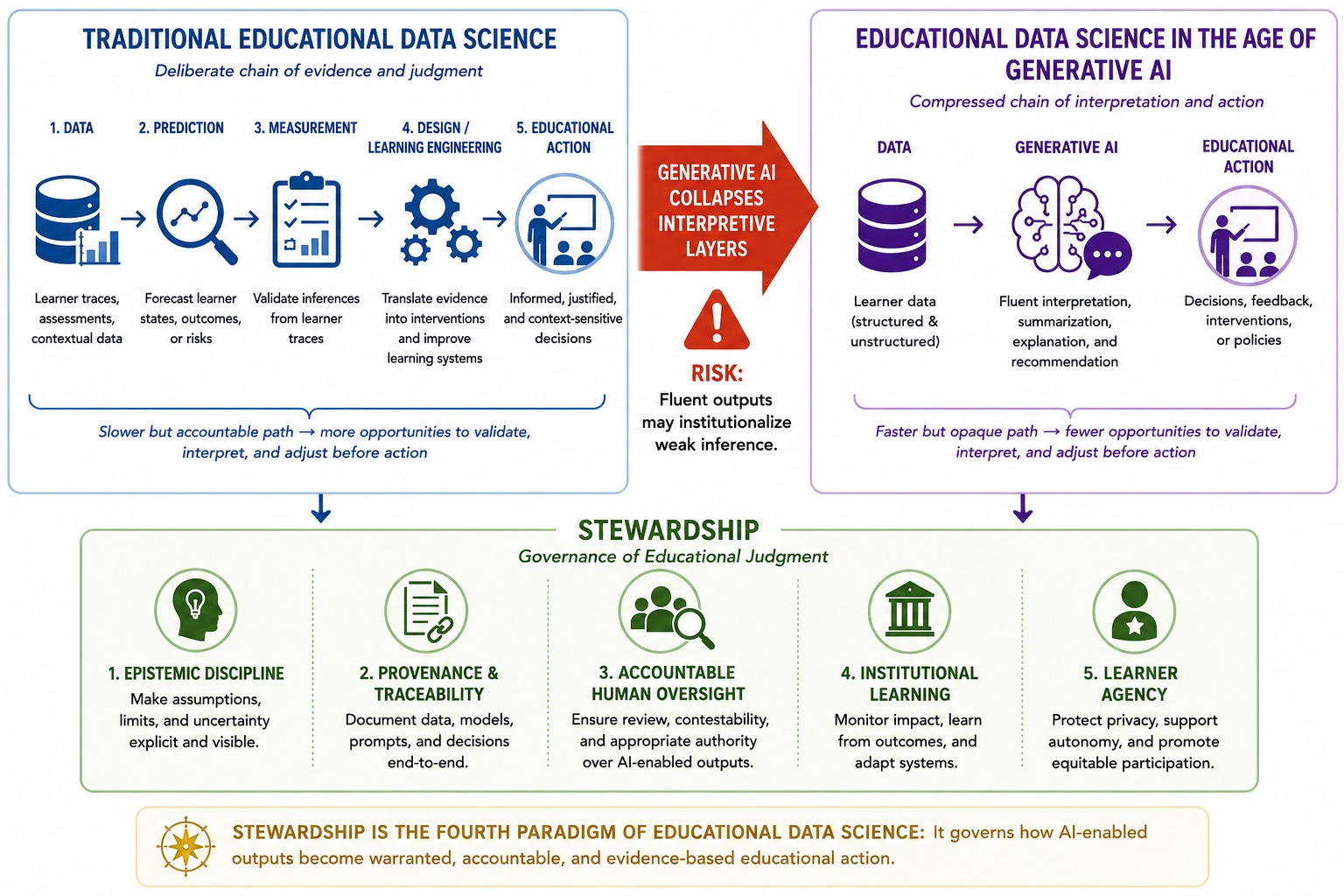
| Paradigm | Primary Goal | Dominant Assumption | Principal Risk | Educational Implication |
|---|---|---|---|---|
| Prediction | Forecast learner states, outcomes, or risks | Patterns in learner data can support timely action | Signals may be mistaken for causes or needs | Improves anticipation, but does not determine what should be done |
| Measurement | Validate inferences from learner traces | Data can represent educational constructs if theoretically grounded | Constructs may be simplified, unstable, or poorly validated | Improves interpretive credibility, but does not govern downstream action |
| Design/Learning Engineering | Translate evidence into interventions and iterative improvement | Analytics can improve learning when embedded in designed systems | Weak evidence can be scaled through well-designed tools | Improves actionability, but requires governance of what enters the cycle |
| Stewardship | Govern judgment, authority, and consequence | Generative systems require institutional rules for meaning, validation, delegation, and revision | Fluent outputs may institutionalize weak inference | Defines when AI-supported interpretation is legitimate enough to guide educational action |
| Framework | Primary Concern | Typical Unit of Analysis | Core Question | How Stewardship Differs |
|---|---|---|---|---|
| Responsible AI/responsible learning analytics | Ethical and accountable system use | Models, data practices, and institutional responsibilities | Is the system fair, transparent, privacy-preserving, and accountable? | Makes epistemic authority and educational meaning the central governance problem |
| Trustworthy/explainable AI | Reliability, transparency, interpretability, and user trust | Technical systems and explanations | Can users understand and appropriately rely on the system? | Treats explanation as necessary but insufficient without construct validity and institutional accountability |
| Human-in-the-loop design | Human supervision and review | Decision pipelines and interfaces | Is a human positioned to supervise or override output? | Requires human review to be role-defined, consequential, and tied to escalation rules |
| Learning Engineering | Iterative improvement of learning systems | Instructional designs, interventions, and improvement cycles | Does the intervention improve learning in context? | Governs what evidence is strong enough to enter the improvement cycle |
| Stewardship | Governance of judgment under AI-mediated interpretation | Sociotechnical educational ecosystems | Who determines what AI outputs are allowed to mean and do? | Provides the organizing paradigm that links evidence, authority, oversight, and institutional revision |
Disclaimer/Publisher’s Note: The statements, opinions and data contained in all publications are solely those of the individual author(s) and contributor(s) and not of MDPI and/or the editor(s). MDPI and/or the editor(s) disclaim responsibility for any injury to people or property resulting from any ideas, methods, instructions or products referred to in the content. |
© 2026 by the authors. Licensee MDPI, Basel, Switzerland. This article is an open access article distributed under the terms and conditions of the Creative Commons Attribution (CC BY) license.
Share and Cite
McNamara, D.S.; Huynh, L. From Prediction to Stewardship: Framing Educational Data Science in the Age of Generative AI. Information 2026, 17, 610. https://doi.org/10.3390/info17060610
McNamara DS, Huynh L. From Prediction to Stewardship: Framing Educational Data Science in the Age of Generative AI. Information. 2026; 17(6):610. https://doi.org/10.3390/info17060610
Chicago/Turabian StyleMcNamara, Danielle S., and Linh Huynh. 2026. "From Prediction to Stewardship: Framing Educational Data Science in the Age of Generative AI" Information 17, no. 6: 610. https://doi.org/10.3390/info17060610
APA StyleMcNamara, D. S., & Huynh, L. (2026). From Prediction to Stewardship: Framing Educational Data Science in the Age of Generative AI. Information, 17(6), 610. https://doi.org/10.3390/info17060610