Four-Stage Domain Adaptation Transfer Learning for EEG-Based Decoding of Unilateral Upper Limb Motor Imagery


Abstract
1. Introduction
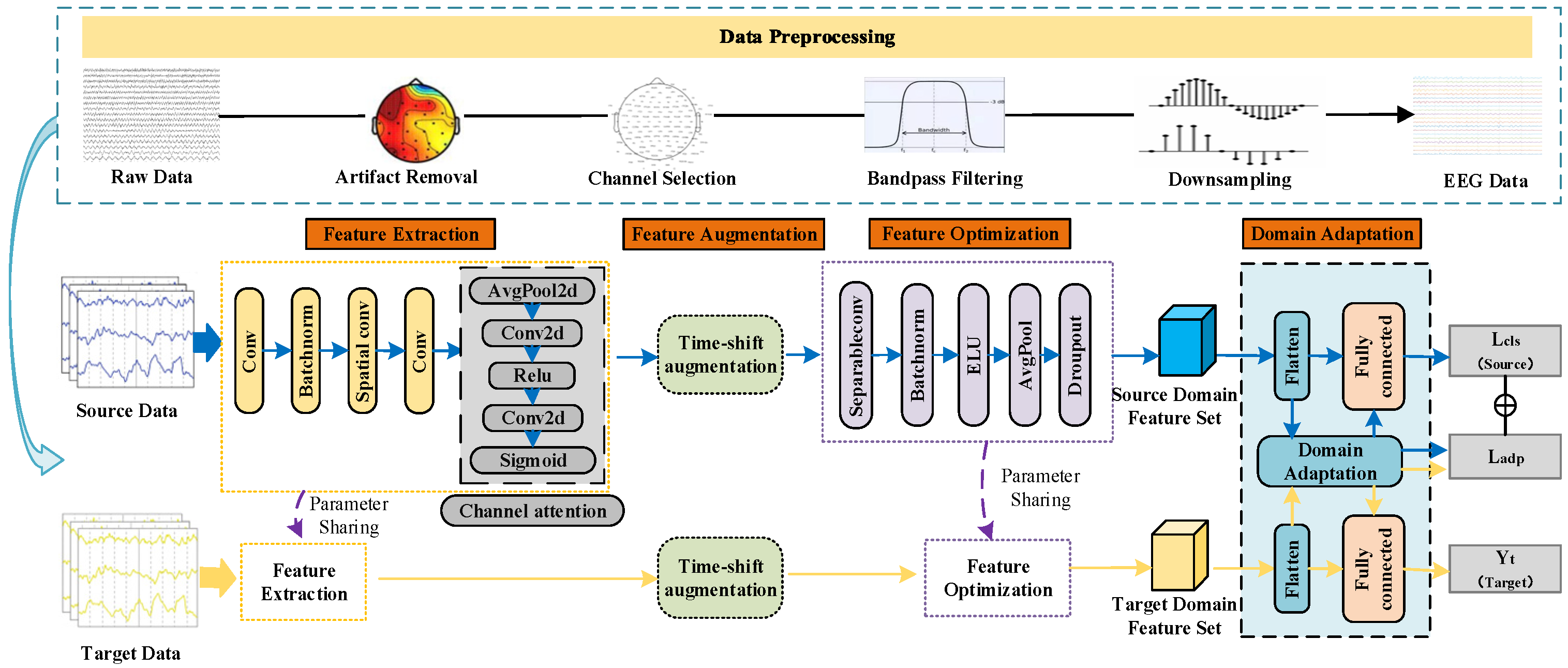
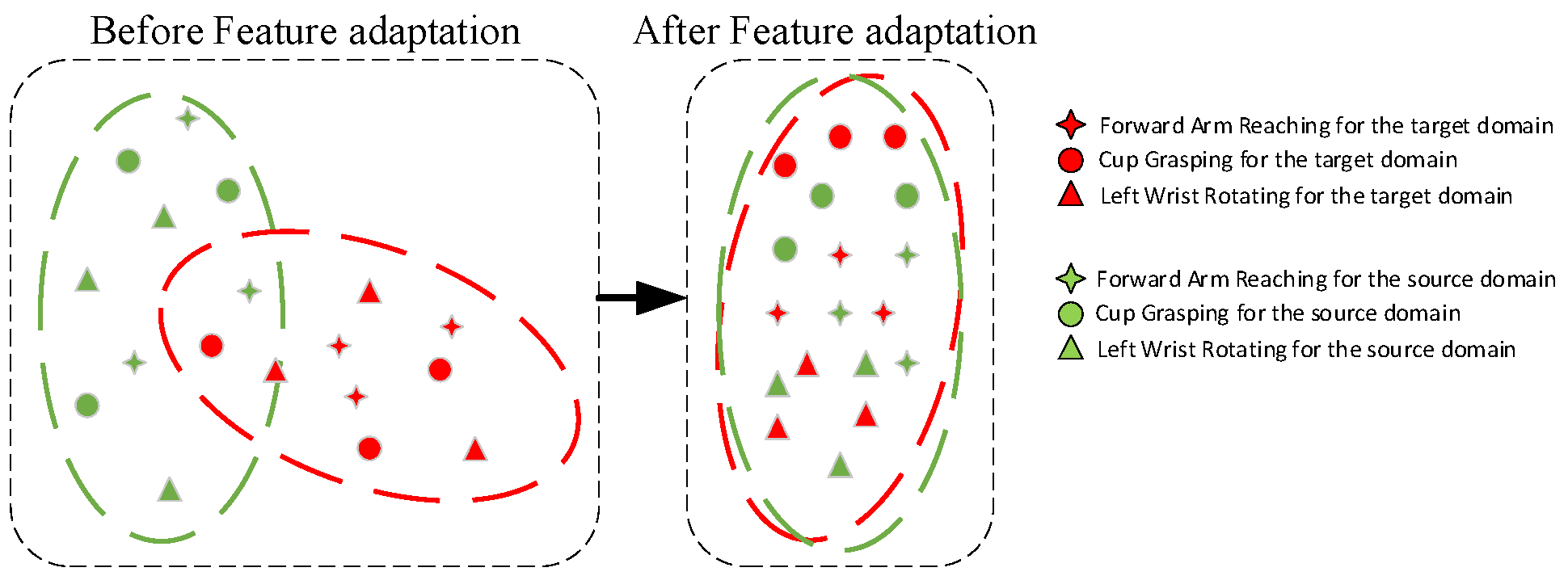
- To decode three core movements of the unilateral upper limb, including reaching, rotating, and grasping, this study proposes a four-stage domain generalization deep learning framework that integrates Feature Extraction, Feature Augmentation, Feature Optimization, and Domain Adaptation. By progressively narrowing the feature distribution discrepancy between the source and target domains, this framework can learn shared EEG representations based on imagining tasks of unilateral limb motor activity across subjects, achieving effective knowledge transfer from the source domain to the target domain.
- The Feature Extraction based on the channel attention mechanism and Feature Augmentation based on the time-shift strategy in this study precisely focus on EEG representations of key spatial motor activity and effectively expand data diversity.
- In cross-subject experiments, this method comprehensively outperforms existing classical methods and mainstream deep/transfer learning models. The research findings provide fundamental technical support for upper limb rehabilitation BCI, intelligent prosthetic control, and human–computer interaction systems, significantly reducing the user calibration costs of BCI systems and promoting the transition of motor neural decoding from laboratory research to clinical and daily life scenarios.
2. Experimental Data and Methods
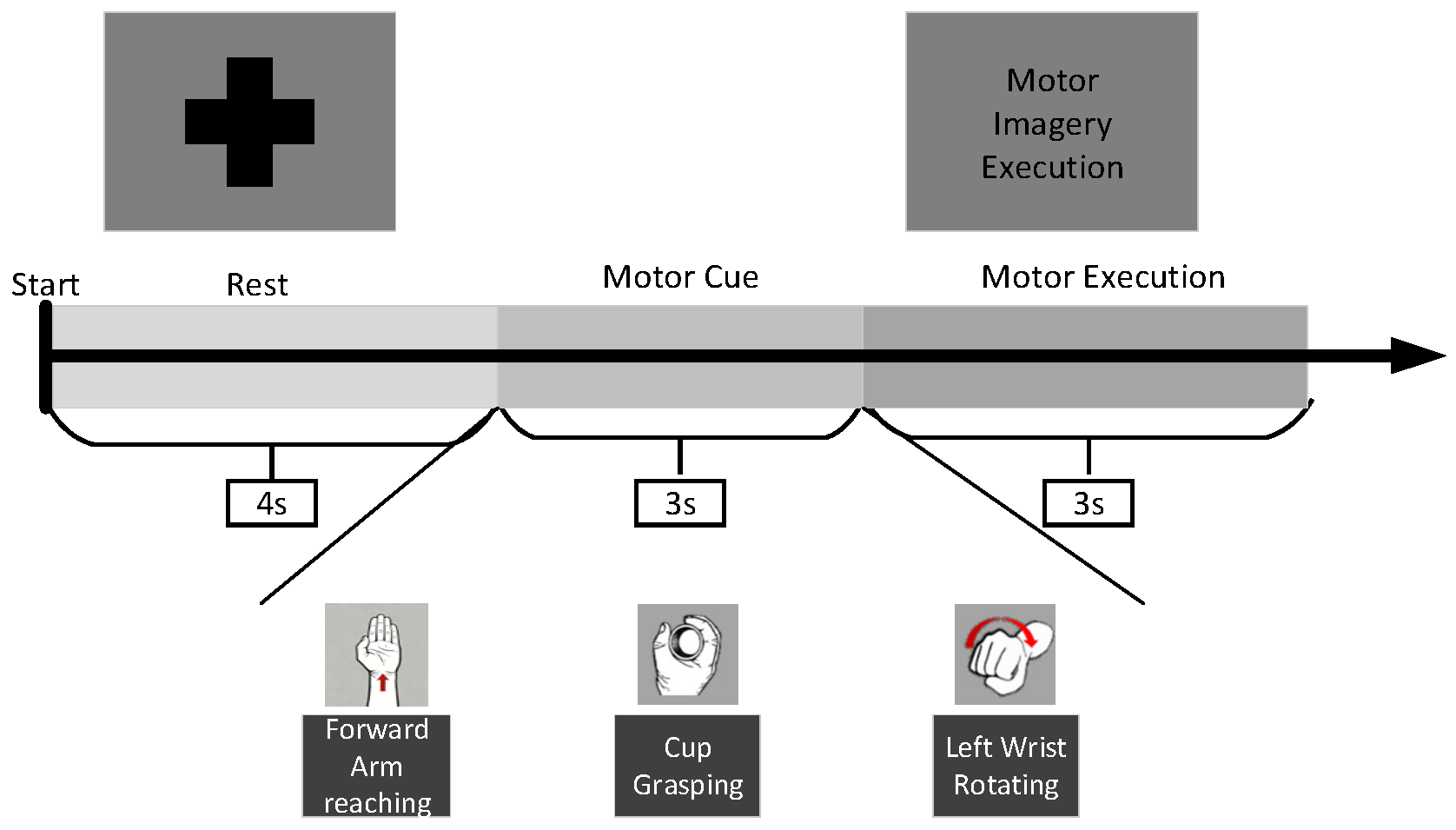
2.1. Experimental Data
2.2. Methods
2.2.1. Data Partitioning of Source and Target Domains
2.2.2. Data Preprocessing
- (1)
- Signal Denoising: This study employs Information Maximization Independent Component Analysis (Infomax-ICA) to perform signal decomposition on the EEG, facilitating the removal of artifact interference such as eye and head movements.
- (2)
- Channel Selection: Previous studies [17] have shown that when subjects execute motor tasks, the ERD and ERS phenomena observed in the sensorimotor cortex are most significant. Therefore, this study selects 20 EEG channels in the sensorimotor cortex area (FC1, FC2, FC3, FC4, FC5, FC6, C1, C2, C3, C4, C5, C6, CP1, CP2, CP3, CP4, CP5, CP6, CZ, and CPZ) for subsequent feature extraction and task analysis.
- (3)
- Band-pass Filtering and Downsampling: For the denoised EEG signals from the selected 20 channels, a zero-phase fourth-order Butterworth filter is applied for band-pass filtering (8 to 30 Hz), and the signals are downsampled to 250 Hz.
- (4)
- Data Normalization: After merging the multi-trial data for each subject, a normalization process is applied to reduce signal volatility and non-stationarity, which is formulated as follows:
2.2.3. Feature Extraction Module
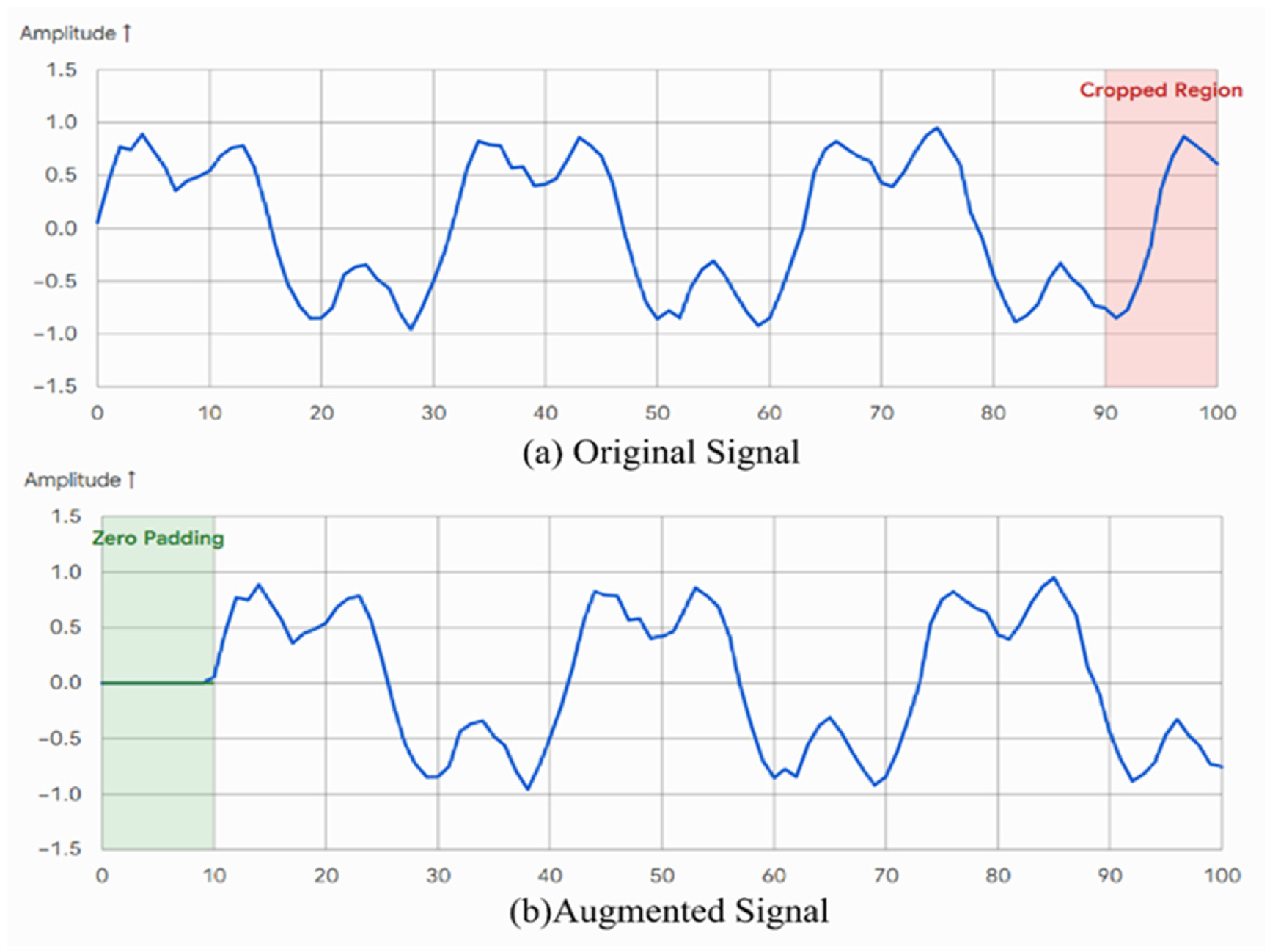
2.2.4. Feature Augmentation
2.2.5. Feature Optimization
- (1)
- Separable convolution, an efficient convolutional operation, is employed to decompose standard convolution into depthwise and pointwise convolutions. This significantly reduces the computational complexity and parameter size of the model while preserving its feature extraction capability and ensuring overall performance.
- (2)
- Batch normalization is applied to normalize the input data, ensuring a stable distribution for the input of each network layer. This helps accelerate the training process and improves the stability of the model.
- (3)
- The ELU activation function is utilized to enable the model to learn more complex feature representations. Additionally, average pooling is adopted to reduce the spatial dimensions of the feature maps, which retains the most critical feature information while decreasing the number of parameters and computational overhead.
- (4)
- Dropout is implemented to prevent overfitting by randomly dropping certain neurons in the network, thereby improving the generalization capability of the model.
2.2.6. Domain Adaptation
2.3. Comparison Methods
2.4. Evaluation Metric
- Precision
- 2.
- Accuracy
- 3.
- Recall
- 4.
- F1-score
- 5.
- Confusion Matrix
2.5. Experimental Environment and Parameter Settings
3. Results
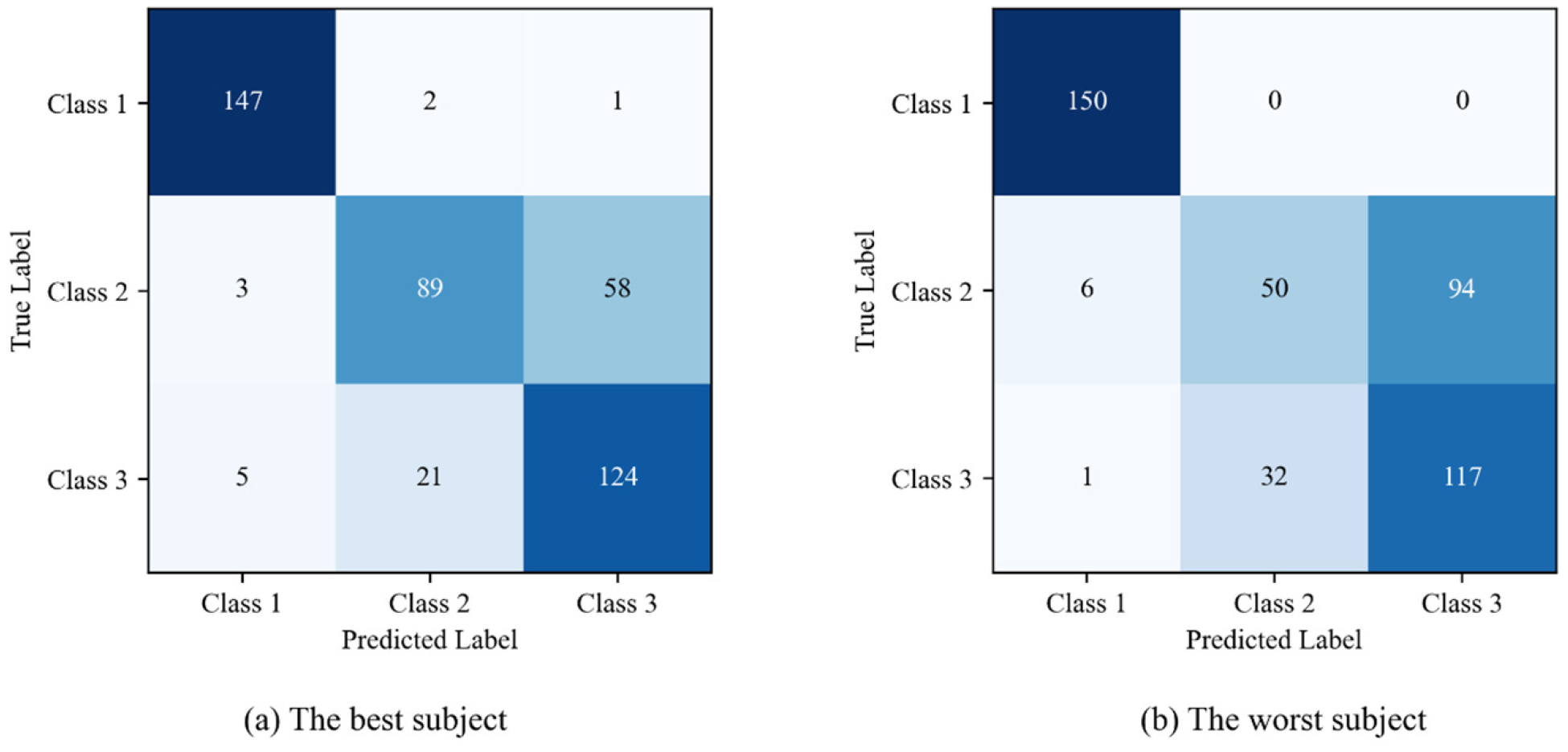
3.1. Cross-Subject Transfer Decoding Results
3.2. Comparison Results with Other Methods
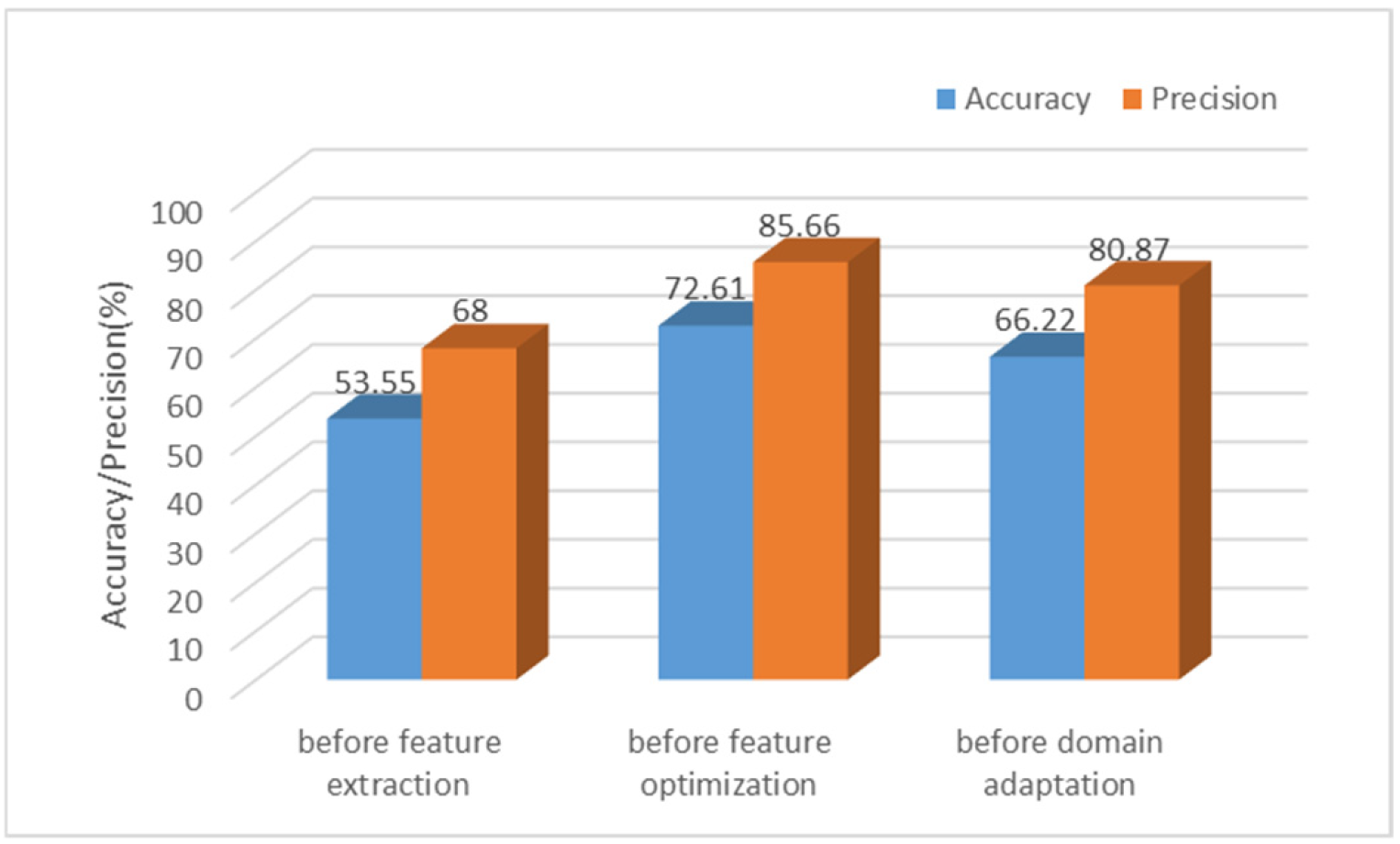
3.3. Ablation Study and Impact Analysis of Each Module
3.4. Impact of Batch Size on Decoding Accuracy
3.5. Impact of the Placement of the Feature Augmentation Module on Decoding Performance
3.6. Impact of Attention Mechanism on Decoding Performance
4. Discussion
- (1)
- Practical significance of decoding for unilateral upper limb motor imagery
- (2)
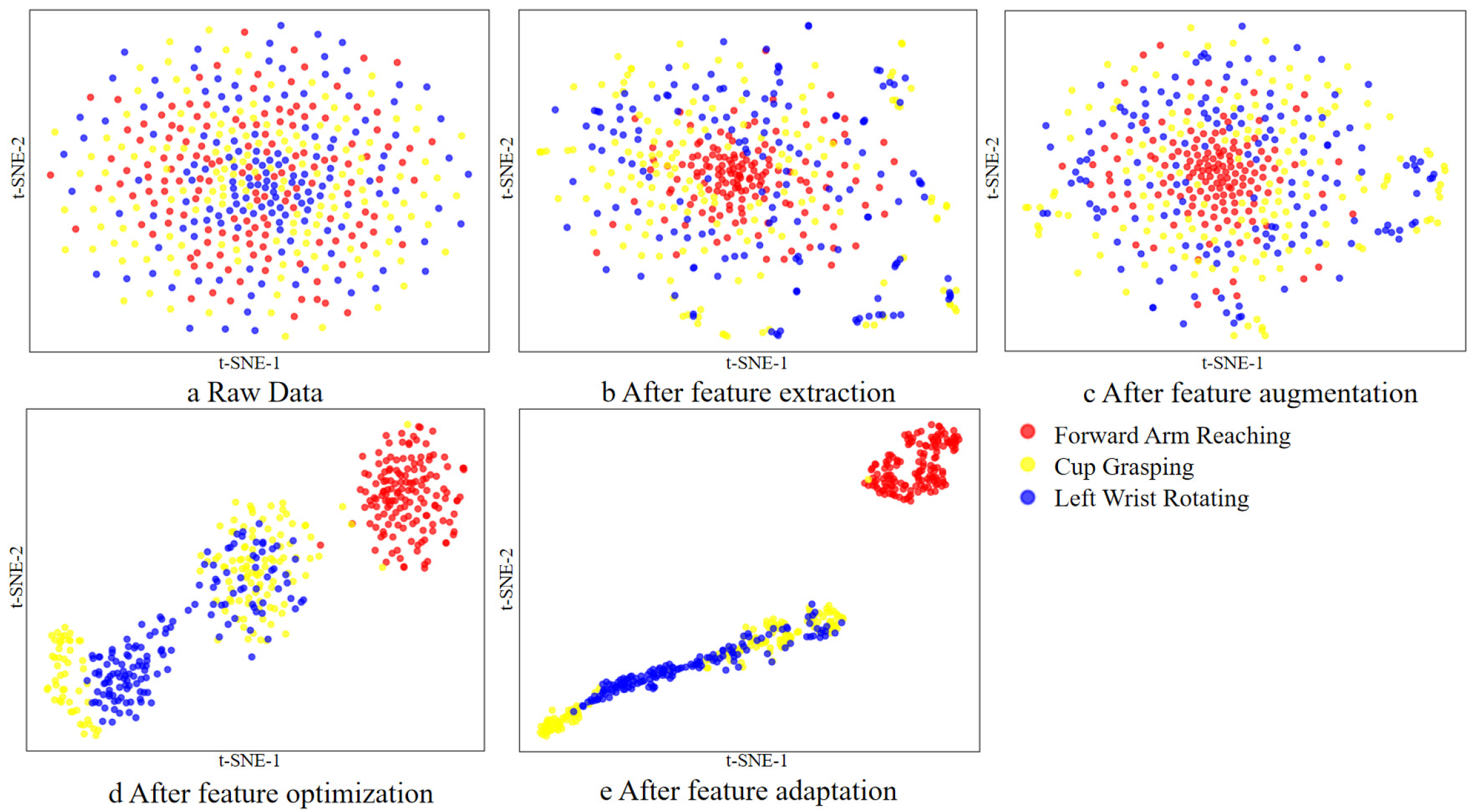
- Synergistic effect of the four-stage domain generalization framework
- (3)
- Comparative analysis with existing methods
- (4)
- Impact of batch size on decoding performance
- (5)
- This study still has certain limitations. First, this study only included 25 subjects, and the sample size and scenario complexity still need to be expanded. Second, the three-class task is relatively simple, and the fine motor actions of unilateral limbs can be extended to intention decoding of more categories. Third, the integration of physiological priors in this study is insufficient. The current model is primarily data-driven and does not fully incorporate physiological priors such as brain network connectivity and neural oscillations, leaving room for improvement in interpretability. Fourth, the current framework focuses on synchronous BCI scenarios and has not yet addressed the discrimination between motor imagery tasks and non-task-related brain activities (i.e., the idle state or asynchronous BCI). As highlighted by relevant studies addressing this challenging scenario [42,43,44], real-world BCI applications inherently require this continuous decoding capability to prevent false triggers caused by background neural activities. In future work, we plan to extend our approach to asynchronous paradigms by introducing a rest class or threshold-based rejection mechanisms, thereby bridging the gap between laboratory validations and practical real-world applications.
5. Conclusions
Author Contributions
Funding
Institutional Review Board Statement
Informed Consent Statement
Data Availability Statement
Conflicts of Interest
References
- Lakshminarayanan, K.; Ramu, V.; Shah, R.; Haque Sunny, M.S.; Madathil, D.; Brahmi, B.; Wang, I.; Fareh, R.; Rahman, M.H. Developing a tablet-based brain-computer interface and robotic prototype for upper limb rehabilitation. PeerJ Comput. Sci. 2024, 10, e2174. [Google Scholar] [CrossRef]
- Ke, Z.; Mahmoud, S.S.; Ruan, H.; Fang, Q. Design and Validation of a 3D VR-Assisted Motor Imagery System. In Proceedings of the 2025 47th Annual International Conference of the IEEE Engineering in Medicine and Biology Society (EMBC), Copenhagen, Denmark, 14–17 July 2025; pp. 1–4. [Google Scholar]
- Shi, T.; Gu, X.; Bi, H.; Lv, J.; Liu, Y.; Dai, Y.; Zou, L. A study of unilateral upper limb fine motor imagery decoding using frequency-band attention network. IEEE Access 2024, 12, 32679–32692. [Google Scholar] [CrossRef]
- Rong, F.; Yang, B.; Guan, C. Decoding multi-class motor imagery from unilateral limbs using EEG signals. IEEE Trans. Neural Syst. Rehabil. Eng. 2024, 32, 3399–3409. [Google Scholar] [CrossRef] [PubMed]
- Gao, Y.; Xie, W.; Luo, Z.; Houston, M.; Zhang, Y. Multi-domain feature analysis of MI-EEG signals using tensor train decomposition and projected gradient Non-negative Matrix Factorization. Neurocomputing 2025, 623, 129410. [Google Scholar] [CrossRef]
- Gu, L.; Jiang, J.; Han, H.; Gan, J.Q.; Wang, H. Recognition of unilateral lower limb movement based on EEG signals with ERP-PCA analysis. Neurosci. Lett. 2023, 800, 137133. [Google Scholar] [CrossRef]
- Raza, A.; Yusoff, M.Z. Deep Learning Approaches for EEG-Motor Imagery-Based BCIs: Current Models, Generalization Challenges, and Emerging Trends. IEEE Access 2025, 13, 151866–151893. [Google Scholar] [CrossRef]
- Yang, B.; Tang, J.; Guan, C.; Li, B. Motor imagery EEG recognition based on FBCSP and PCA. In Proceedings of the International Conference on Brain Inspired Cognitive Systems, Xi’an, China, 7–9 July 2018; pp. 195–205. [Google Scholar]
- Jiang, X.; Meng, L.; Chen, X.; Xu, Y.; Wu, D. CSP-Net: Common spatial pattern empowered neural networks for EEG-based motor imagery classification. Knowl. Based Syst. 2024, 305, 112668. [Google Scholar] [CrossRef]
- Cortes, C.; Vapnik, V. Support-vector networks. Mach. Learn. 1995, 20, 273–297. [Google Scholar] [CrossRef]
- Mohammady, F.; Asadi Amiri, S.; Mohammadpoory, Z. Leveraging Segmentation and Visibility Graph Analysis to Enhance Motor Imagery Classification in EEG Signals. Cogn. Comput. 2026, 18, 8. [Google Scholar] [CrossRef]
- Breiman, L. Random forests. Mach. Learn. 2001, 45, 5–32. [Google Scholar] [CrossRef]
- Schirrmeister, R.T.; Springenberg, J.T.; Fiederer, L.D.J.; Glasstetter, M.; Eggensperger, K.; Tangermann, M.; Hutter, F.; Burgard, W.; Ball, T. Deep learning with convolutional neural networks for EEG decoding and visualization. Hum. Brain Mapp. 2017, 38, 5391–5420. [Google Scholar] [CrossRef]
- Lawhern, V.J.; Solon, A.J.; Waytowich, N.R.; Gordon, S.M.; Hung, C.P.; Lance, B.J. EEGNet: A compact convolutional neural network for EEG-based brain–computer interfaces. J. Neural Eng. 2018, 15, 056013. [Google Scholar] [CrossRef] [PubMed]
- Cai, Q.; Liu, C.; Chen, A. Classification of Motor Imagery Tasks Derived from Unilateral Upper Limb based on a Weight-optimized Learning Model. J. Integr. Neurosci. 2024, 23, 106. [Google Scholar] [CrossRef]
- Zhao, X.; Zhang, H.; Zhu, G.; You, F.; Kuang, S.; Sun, L. A multi-branch 3D convolutional neural network for EEG-based motor imagery classification. IEEE Trans. Neural Syst. Rehabil. Eng. 2019, 27, 2164–2177. [Google Scholar] [CrossRef] [PubMed]
- Zhang, R.; Chen, Y.; Xu, Z.; Zhang, L.; Hu, Y.; Chen, M. Recognition of single upper limb motor imagery tasks from EEG using multi-branch fusion. Front. Neurosci. 2023, 17, 1129049. [Google Scholar] [CrossRef]
- Zhao, W.; Jiang, X.; Zhang, B.; Xiao, S.; Weng, S. CTNet: A convolutional transformer network for EEG-based motor imagery classification. Sci. Rep. 2024, 14, 20237. [Google Scholar] [CrossRef]
- Vafaei, E.; Hosseini, M. Transformers in EEG analysis: A review of architectures and applications in motor imagery, seizure, and emotion classification. Sensors 2025, 25, 1293. [Google Scholar] [CrossRef] [PubMed]
- Song, Y.; Jia, X.; Yang, L.; Xie, L. Transformer-based spatial-temporal feature learning for EEG decoding. arXiv 2021, arXiv:2106.11170. [Google Scholar]
- Roy, A.M. Adaptive transfer learning-based multiscale feature fused deep convolutional neural network for EEG MI multiclassification in brain–computer interface. Eng. Appl. Artif. Intell. 2022, 116, 105347. [Google Scholar] [CrossRef]
- Zhang, K.; Robinson, N.; Lee, S.-W.; Guan, C. Adaptive transfer learning for EEG motor imagery classification with deep convolutional neural network. Neural Netw. 2021, 136, 1–10. [Google Scholar] [CrossRef]
- Khademi, Z.; Ebrahimi, F.; Kordy, H.M. A transfer learning-based CNN and LSTM hybrid deep learning model to classify motor imagery EEG signals. Comput. Biol. Med. 2022, 143, 105288. [Google Scholar] [CrossRef] [PubMed]
- Liang, Z.; Zheng, Z.; Chen, W.; Pei, Z.; Wang, J.; Chen, J. A novel deep transfer learning framework integrating general and domain-specific features for EEG-based brain–computer interface. Biomed. Signal Process. Control 2024, 95, 106311. [Google Scholar] [CrossRef]
- Miao, M.; Fu, W.; Zeng, H.; Xu, B.; Zhang, W.; Hu, W. Meta-Learning Enhanced Multi-Source Domain Adaptation for zero-calibration motor imagery EEG decoding. J. Neurosci. Methods 2026, 431, 110742. [Google Scholar] [CrossRef]
- Chen, P.; Liu, X.; Ma, C.; Wang, H.; Yang, X.; Grebogi, C.; Gu, X.; Gao, Z. Unsupervised domain adaptation with synchronized self-training for cross-domain motor imagery recognition. IEEE J. Biomed. Health Inform. 2025, 29, 3664–3677. [Google Scholar] [CrossRef]
- Gong, Y.; Shi, K.; Niu, X.; Yang, L.; Yang, X.; Zheng, C. Multi-source Discriminant Dynamic Domain Adaptation for Cross-subject Motor Imagery EEG Recognition. IEEE J. Biomed. Health Inform. 2025, 30, 3556–3567. [Google Scholar] [CrossRef]
- Guo, S.; Wang, Y.; Liu, Y.; Zhang, X.; Tang, B. Improving cross-session motor imagery decoding performance with data augmentation and domain adaptation. Biomed. Signal Process. Control 2025, 106, 107756. [Google Scholar] [CrossRef]
- Zhu, J.; Xu, G.; Lin, Z.; Long, J.; Zhou, T.; Sheng, B.; Yang, X. Semi-Supervised Privacy-Preserving EEG-Based Motor Imagery Classification via Self and Adversarial Training. IEEE Trans. Autom. Sci. Eng. 2025, 22, 20679–20690. [Google Scholar] [CrossRef]
- Yang, B.; Ma, J.; Qiu, W.; Zhu, Y.; Meng, X. A new 2-class unilateral upper limb motor imagery tasks for stroke rehabilitation training. Med. Nov. Technol. Devices 2022, 13, 100100. [Google Scholar] [CrossRef]
- Jiang, Y.; Yin, J.; Zhao, B.; Zhang, Y.; Peng, T.; Zhuang, W.; Wang, S.; Huang, S.; Zhong, M.; Zhang, Y. Motor imagery brain-computer interface in rehabilitation of upper limb motor dysfunction after stroke. JoVE (J. Vis. Exp.) 2023, 199, e65405. [Google Scholar] [CrossRef]
- Jeong, J.-H.; Cho, J.-H.; Shim, K.-H.; Kwon, B.-H.; Lee, B.-H.; Lee, D.-Y.; Lee, D.-H.; Lee, S.-W. Multimodal signal dataset for 11 intuitive movement tasks from single upper extremity during multiple recording sessions. GigaScience 2020, 9, giaa098. [Google Scholar] [CrossRef]
- Mitra, V.; Franco, H. Time-frequency convolutional networks for robust speech recognition. In Proceedings of the 2015 IEEE Workshop on Automatic Speech Recognition and Understanding (ASRU), Scottsdale, AZ, USA, 13–17 December 2015; pp. 317–323. [Google Scholar]
- Fisher, R.A. The use of multiple measurements in taxonomic problems. Ann. Eugen. 1936, 7, 179–188. [Google Scholar] [CrossRef]
- Luo, Y.; He, X.; Ren, K. A feature extraction and classification algorithm for motor imagery EEG signals based on decision tree and CSP-SVM. In Proceedings of the Optics in Health Care and Biomedical Optics XI, Nantong, China, 10–19 October 2021; pp. 338–345. [Google Scholar]
- Alwasiti, H.; Yusoff, M.Z.; Raza, K. Motor imagery classification for brain computer interface using deep metric learning. IEEE Access 2020, 8, 109949–109963. [Google Scholar] [CrossRef]
- Toraman, S. Preictal and Interictal Recognition for Epileptic Seizure Prediction Using Pre-trained 2DCNN Models. Trait. Du. Signal 2020, 37, 1045. [Google Scholar] [CrossRef]
- Li, M.-A.; Zhang, J. A Novel Approach to MI-EEG Classification via 3D Interpolation and 3DCNN. In Proceedings of the 2023 35th Chinese Control and Decision Conference (CCDC), Yichang, China, 20–22 May 2023; pp. 3062–3066. [Google Scholar]
- Meng, Y.; Zhu, N.; Li, D.; Nan, J.; Xia, Y.; Yao, N.; Han, C. Stepwise discriminant analysis based optimal frequency band selection and ensemble learning for same limb MI recognition. Clust. Comput. 2025, 28, 197. [Google Scholar] [CrossRef]
- Lian, X.; Liu, C.; Gao, C.; Deng, Z.; Guan, W.; Gong, Y. A Multi-Branch Network for Integrating Spatial, Spectral, and Temporal Features in Motor Imagery EEG Classification. Brain Sci. 2025, 15, 877. [Google Scholar] [CrossRef] [PubMed]
- Krstinić, D.; Braović, M.; Šerić, L.; Božić-Štulić, D. Multi-label classifier performance evaluation with confusion matrix. Comput. Sci. Inf. Technol. 2020, 1, 1–14. [Google Scholar]
- Bove, S.; Giaquinto, M.; Percannella, G.; Saggese, A.; Vento, M. The Impact of Non-Task-Related Neural Activity in EEG-Based Motor Imagery Classification. In Proceedings of the 2025 IEEE International Conference on Metrology for eXtended Reality, Artificial Intelligence and Neural Engineering (MetroXRAINE), Ancona, Italy, 22–24 October 2025; pp. 1–6. [Google Scholar]
- Huang, D.; Qian, K.; Fei, D.-Y.; Jia, W.; Chen, X.; Bai, O. Electroencephalography (EEG)-based brain–computer interface (BCI): A 2-D virtual wheelchair control based on event-related desynchronization/synchronization and state control. IEEE Trans. Neural Syst. Rehabil. Eng. 2012, 20, 379–388. [Google Scholar] [CrossRef]
- Arpaia, P.; Esposito, A.; Galasso, E.; Galdieri, F.; Natalizio, A. A wearable brain-computer interface to play an endless runner game by self-paced motor imagery. J. Neural Eng. 2025, 22, 026032. [Google Scholar] [CrossRef]



| Subject | Precision (%) | Accuracy (%) | F1-Score | Recall |
|---|---|---|---|---|
| sub-01 | 88.02 | 75.78 | 0.75 | 0.76 |
| sub-02 | 86.31 | 68.00 | 0.67 | 0.68 |
| sub-03 | 87.77 | 73.33 | 0.73 | 0.73 |
| sub-04 | 88.62 | 76.44 | 0.76 | 0.76 |
| sub-05 | 90.43 | 79.33 | 0.79 | 0.79 |
| sub-06 | 88.46 | 73.33 | 0.72 | 0.73 |
| sub-07 | 83.71 | 71.33 | 0.70 | 0.71 |
| sub-08 | 87.23 | 70.67 | 0.69 | 0.71 |
| sub-09 | 84.70 | 72.00 | 0.71 | 0.72 |
| sub-10 | 90.33 | 81.33 | 0.81 | 0.81 |
| sub-11 | 83.76 | 68.89 | 0.69 | 0.69 |
| sub-12 | 87.17 | 72.89 | 0.72 | 0.73 |
| sub-13 | 83.76 | 68.89 | 0.67 | 0.69 |
| sub-14 | 85.72 | 72.44 | 0.72 | 0.72 |
| sub-15 | 84.03 | 69.78 | 0.67 | 0.70 |
| sub-16 | 81.20 | 70.89 | 0.71 | 0.71 |
| sub-17 | 81.71 | 71.33 | 0.71 | 0.71 |
| sub-18 | 88.66 | 77.33 | 0.77 | 0.77 |
| sub-19 | 87.58 | 75.33 | 0.74 | 0.75 |
| sub-20 | 80.96 | 70.00 | 0.70 | 0.70 |
| sub-21 | 89.24 | 76.89 | 0.77 | 0.77 |
| sub-22 | 83.38 | 66.00 | 0.61 | 0.66 |
| sub-23 | 79.44 | 68.89 | 0.63 | 0.69 |
| sub-24 | 86.49 | 74.67 | 0.74 | 0.75 |
| sub-25 | 82.86 | 69.56 | 0.69 | 0.70 |
| Mean/std | 85.66/3.07 | 72.61/3.75 | 0.72/0.05 | 0.73/0.04 |
| Methods | Accuracy (%) | |
|---|---|---|
| Classical Methods | RCSP + SVM * | 65.21 |
| RCSP + LDA ** | 61.06 | |
| RCSP + KNN ** | 64.87 | |
| RCSP + DT ** | 59.55 | |
| CSP ** | 53.85 | |
| FBCSP ** | 54.00 | |
| RCSP + RF * | 66.15 | |
| SWDA-RCSP * | 66.64 | |
| Deep Learning | CNN ** | 51.08 |
| TF-CNN ** | 50.24 | |
| MF-CNN ** | 57.06 | |
| ALEXNET ** | 48.75 | |
| 2DCNN ** | 56.36 | |
| EEGNET * | 69.25 | |
| DEEP CONVNET ** | 59.65 | |
| 3DCNN ** | 53.00 | |
| Transformer ** | 65.24 | |
| Transfer Learning | EEGTRANSFERNET * | 65.39 |
| MLEMSDA ** | 67.15 | |
| Ours | 72.61 |
| Feature Extraction | Feature Augmentation | Feature Optimization | Feature Adaptation | Precision (%) Mean/STD | ACC (%) Mean/STD |
|---|---|---|---|---|---|
| × | √ | √ | √ | 53.00/1.99 | 37.64/2.61 |
| √ | × | √ | √ | 84.46/2.91 | 69.96/3.09 |
| √ | √ | × | √ | 58.25/3.22 | 46.26/3.20 |
| √ | √ | √ | × | 80.87/8.86 | 65.58/8.87 |
| √ | √ | √ | √ | 85.66/3.07 | 72.61/3.75 |
| Batch Size | 16 | 32 | 64 | 108 |
|---|---|---|---|---|
| Precision | 80.50% | 83.52% | 85.66% | 82.70% |
| Accuracy | 68.00% | 72.00% | 72.61% | 71.32% |
| F1-score | 0.65 | 0.71 | 0.72 | 0.69 |
| Recall | 0.68 | 0.68 | 0.73 | 0.71 |
| Evaluation Metrics | Without Channel Attention | With Channel Attention |
|---|---|---|
| Precision | 81.18% | 85.66% |
| Accuracy | 64.67% | 72.61% |
| F1-score | 0.54 | 0.72 |
| Recall | 0.64 | 0.73 |
Disclaimer/Publisher’s Note: The statements, opinions and data contained in all publications are solely those of the individual author(s) and contributor(s) and not of MDPI and/or the editor(s). MDPI and/or the editor(s) disclaim responsibility for any injury to people or property resulting from any ideas, methods, instructions or products referred to in the content. |
© 2026 by the authors. Licensee MDPI, Basel, Switzerland. This article is an open access article distributed under the terms and conditions of the Creative Commons Attribution (CC BY) license.
Share and Cite
Nan, J.; Jin, X.; Lin, J.; Li, C.; Li, D.; Zheng, Q. Four-Stage Domain Adaptation Transfer Learning for EEG-Based Decoding of Unilateral Upper Limb Motor Imagery. Information 2026, 17, 592. https://doi.org/10.3390/info17060592
Nan J, Jin X, Lin J, Li C, Li D, Zheng Q. Four-Stage Domain Adaptation Transfer Learning for EEG-Based Decoding of Unilateral Upper Limb Motor Imagery. Information. 2026; 17(6):592. https://doi.org/10.3390/info17060592
Chicago/Turabian StyleNan, Jiaofen, Xueqi Jin, Jingjing Lin, Conghui Li, Duan Li, and Qian Zheng. 2026. "Four-Stage Domain Adaptation Transfer Learning for EEG-Based Decoding of Unilateral Upper Limb Motor Imagery" Information 17, no. 6: 592. https://doi.org/10.3390/info17060592
APA StyleNan, J., Jin, X., Lin, J., Li, C., Li, D., & Zheng, Q. (2026). Four-Stage Domain Adaptation Transfer Learning for EEG-Based Decoding of Unilateral Upper Limb Motor Imagery. Information, 17(6), 592. https://doi.org/10.3390/info17060592