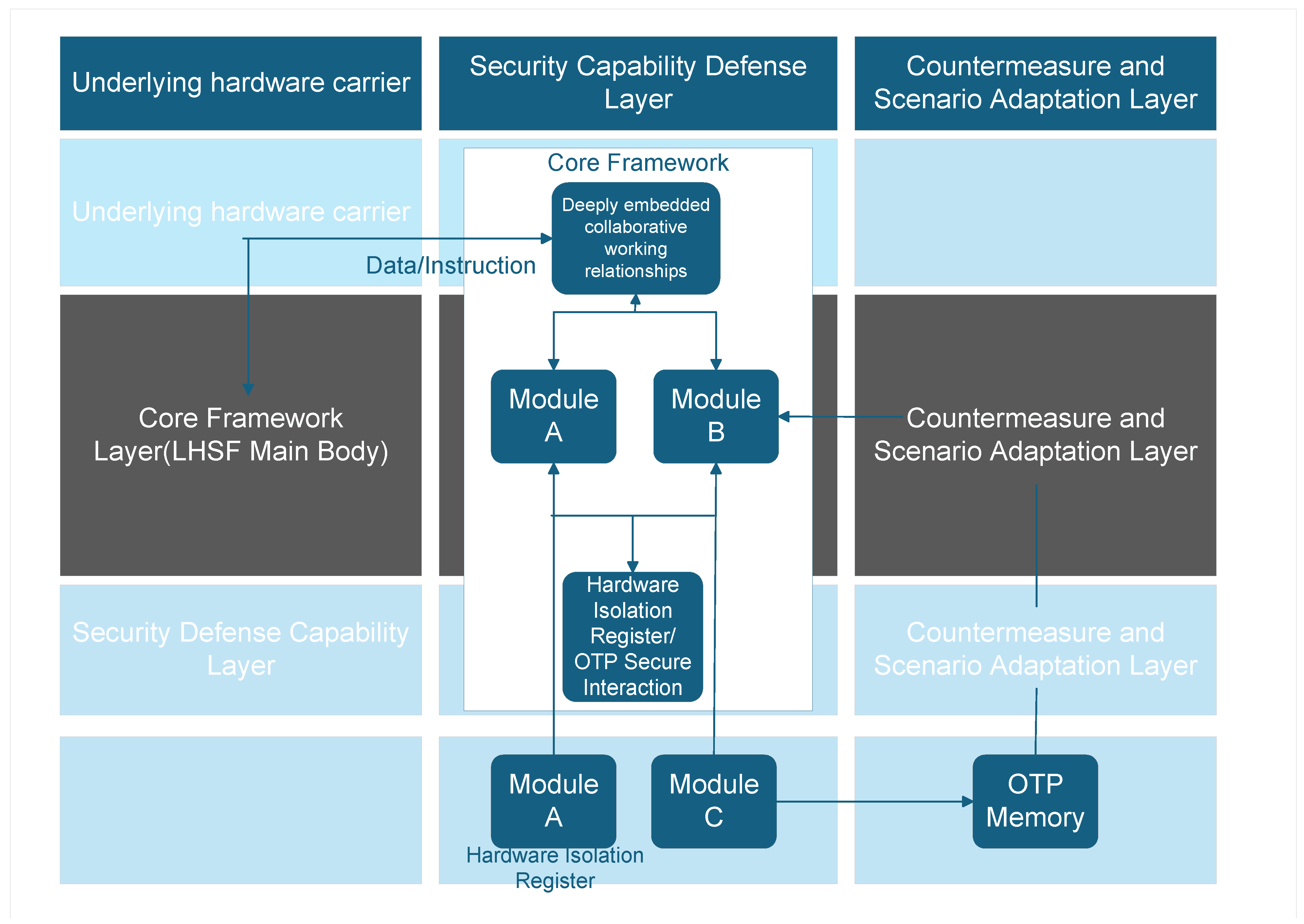
Lightweight Hardware Security Framework for IoT-Based Photovoltaic Monitoring Systems Using OTP and SRAM-PUF


Abstract
1. Introduction
- 1.
- Constructs a formal layered hardware architecture for PV monitoring systems, and proposes a semi-physical+remote composite attacker model and a hardware vulnerability-to-harm propagation model, revealing the transmission mechanism of hardware vulnerabilities to physical and economic harms.
- 2.
- Designs an OTP-based L-HROT consisting of an immutable root key, lightweight secure bootloader and OTP anti-rollback counter, establishing a verifiable secure boot chain for mandatory firmware integrity verification.
- 3.
- Proposes an SRAM-PUF-driven non-resident key management protocol, enabling full-lifecycle key management that fundamentally resists physical probe and side-channel attacks.
- 4.
- Develops an integrated lightweight joint physical attack defense mechanism combining side-channel defense, fault injection detection and physical tamper protection, achieving a balance between security and performance.
- 5.
- Builds an experimental platform based on ESP32-WROOM-32 and Raspberry Pi 4B, and validates the security, performance and environmental reliability of LHSF through comprehensive comparative experiments.
2. Related Work
2.1. Research on Design and Security Protection of Photovoltaic Monitoring Systems
2.2. Research on Hardware Root of Trust and Trusted Platform Module Technology
2.3. Research on PUF Key Management and Defense Against Physical and Side-Channel Attacks
2.4. Research Summary
- 1.
- Lack of systematic hardware security modeling tailored for photovoltaic nodes: Attacker models and hazard propagation models targeting scenarios beyond photovoltaic facilities have yet to be established, failing to reveal the mechanisms by which hardware security vulnerabilities propagate into physical hazards and economic losses.
- 2.
- The lack of lightweight hardware security frameworks tailored for photovoltaic nodes: Common IoT hardware security solutions like TPM, TEE, and TrustZone cannot be ported to photovoltaic nodes due to excessive overhead. Currently, there remains no targeted defense framework integrating hardware trust roots with key management.
- 3.
- Lack of non-resident key management mechanisms tailored to photovoltaic scenarios: Traditional key storage solutions face severe physical attack risks and lack key management mechanisms adapted to the long lifecycle of photovoltaic nodes, difficulties in on-site updates, and requirements for batch networking.
3. System Architecture and Threat Model
3.1. Formalized Layered Architecture of System Hardware
3.1.1. Formal Derivation and Extension of Hardware Constraints
3.1.2. Three-Layer Architecture Interaction Data Flow Algorithm
3.2. Attacker Model Tailored for Photovoltaic Scenarios
3.2.1. Formal Definition of Attacker Capabilities
- Physical attacks: ,
- Semi-physical attacks: ,
- Remote attacks: ,
3.2.2. Attack Targets
3.2.3. Formalized Model of Attack-Hazard Propagation
- 1.
- Supplementary Symbol Definitions:
- (a)
- : Set of hardware security vulnerabilities in photovoltaic monitoring nodes, , including key storage vulnerabilities, missing trust roots, exposed debug ports, where the exposure probability of each vulnerability is .
- (b)
- : Attacker’s attack behavior, serving as an external incentive to trigger hazard propagation. The match degree between attack behavior and vulnerabilities is .
- (c)
- : Component compromise, referring to hardware/software components of PV nodes being controlled by attackers post-attack. The component compromise probability is denoted as .
- (d)
- : Photovoltaic system failure, including node functional failure, MPPT control anomalies, data acquisition errors, etc. The system failure probability is , where is the transmission coefficient from component compromise to system failure, and .Explanation of Coefficient : The parameter is neither a precise measured value nor directly cited from any specific literature. It is a semi-quantitative interval parameter based on the functional criticality of components in the three-layer hardware architecture of photovoltaic monitoring systems. A compromise of core edge computing components typically leads to severe impairment of control and data processing capabilities, resulting in system failure in the vast majority of cases. A compromise of network communication modules leads to significant degradation of data transmission capabilities, resulting in system failure in most cases. Even a compromise of individual perception layer sensors can disrupt normal monitoring functions. The [0.7, 1] range conservatively covers most common component failure scenarios. The purpose of this parameter is to qualitatively describe the strong coupling between component health and overall system functionality. Precise numerical calibration for specific field deployment scenarios will be addressed in future work.
- (e)
- , , : Represent grid risks, economic losses, and physical disasters, respectively, with occurrence probabilities , , and , where , , and are the transmission coefficients from system failure to different hazards, calibrated by the connection position and operational status of photovoltaic nodes within the electrical grid.
- 2.
- Probability Evolution Process of Threat Propagation: Let t denote the time of threat propagation. The probability distribution at each stage evolves over time according to a first-order Markov process:where represents the propagation rate from attack to component compromise, denotes the propagation rate from component compromise to system failure, and indicates the propagation rate from system failure to harm. The condition indicates that attack propagation to component compromise is fastest, while propagation from system failure to actual harm involves a certain delay, providing a time window for security defenses.Explanation of Coefficients: The parameters , , and are neither measured values nor cited from any specific literature. They are qualitative parameters based on the physical time scales of photovoltaic monitoring systems: module damage caused by an attack occurs on the microsecond scale; system failure triggered by module damage occurs on the millisecond scale; and the progression of system failure to actual harm occurs on the second scale. The purpose of these three parameters is solely to express the relative order of propagation speed (). The steady-state success rates reported in Section 5.4.1 correspond to their asymptotic solutions (). Precise numerical calibration will be addressed in future work.
- 3.
- Core Conclusions of the Propagation Model: Hardware security vulnerabilities serve as the initial source of harm, while attackers’ actions trigger propagation. If hardware vulnerabilities remain unaddressed, they will initiate a chain reaction from the information domain to the physical domain, causing harm to escalate continuously. However, if propagation is interrupted at the or stage, the damage can be contained within the information domain, preventing physical disasters and grid risks.
3.3. The Guiding Role of Theoretical Models in Framework Design and Evaluation
4. Threat Mechanisms to Key Security
4.1. Key Security Threat Analysis
4.1.1. Risk Analysis of Key Persistence Storage
4.1.2. Side-Channel Attack Risk Analysis
4.1.3. Risk Analysis of Missing Key Lifecycle Management
4.2. SRAM-PUF-Driven Non-Resident Key Management Protocol
4.2.1. Complete Design Generated Prior to PUF
- 1.
- Collect N sets of raw responses under standard conditions (, 3.3 V);
- 2.
- Generate reference responses via bitwise majority voting:
- 3.
- Perform BCH encoding on to obtain the error-correcting code C, compute the auxiliary data:
- 4.
- Encrypt and store to Flash, erasing all original data.
- 1.
- Capture real-time raw response ;
- 2.
- Read and decrypt from Flash, restore error correction code:
- 3.
- Apply BCH(63,51) to to obtain ;
- 4.
- Perform bit normalization on using to generate stable response R adapted to different key lengths.
4.2.2. Non-Resident Key Generation Algorithm and Pseudocode (Supplemental Formal Derivation)

| 1 | Input: HelperData (stored in Flash, XTEA-encrypted), SRAM chip, |
| 2 | MCU TRNG, BCH(63,51) decoder |
| 3 | Output: K_root, K_session, K_data (stored only in dedicated |
| 4 | registers, no persistent storage) |
| 5 | 1: Power up SRAM, collect real-time raw response R_raw(t) |
| 6 | 2: Read HelperData from Flash, perform XTEA decryption -> plaintext HelperData_plain |
| 7 | 3: Recover reference response R_ref and error correction code C |
| 8 | from HelperData_plain |
| 9 | 4: Perform BCH error correction on R_raw(t) -> R_corrected (bit |
| 10 | error rate < 1.2%) |
| 11 | 5: Normalize R_corrected -> R (256-bit stable PUF response) |
| 12 | 6: Generate random numbers from TRNG -> Nonce_root, Nonce_session, Nonce_data (64-bit) |
| 13 | 7: Compute K_root = SHA256(R || Nonce_root) (256-bit root key) |
| 14 | 8: Compute K_session = HMAC-SHA256(K_root, Nonce_session) (128-bit session key) |
| 15 | 9: Compute K_data = AES-128-CTR(K_session, Nonce_data) (128-bit data encryption key) |
| 16 | 10: Store K_root, K_session, K_data only in dedicated volatile registers |
| 17 | 11: Erase all intermediate variables (R_raw(t), R_corrected, |
| 18 | Nonce*) from SRAM/registers |
| 19 | 12: Output K_root, K_session, K_data |
4.2.3. Key Full-Lifecycle Management
4.2.4. Safety Analysis
- Environmental and aging effects: While our BCH(63,51) error correction scheme effectively mitigates bit error rate (BER) fluctuations under the typical PV operating conditions tested in this study (−20 °C to 60 °C, 3.0 V to 3.6 V), SRAM-PUFs may experience increased BER under more extreme temperatures or prolonged 20+ year aging effects, which could potentially impact key generation stability over the full lifecycle of PV systems.
- Helper data leakage: The helper data stored in non-volatile Flash memory, while not containing the key itself, could theoretically be combined with repeated power-up measurements to train machine learning models for partial PUF response reconstruction. Our current design assumes that attackers cannot obtain both the helper data and perform unlimited physical access to the device.
- Machine learning modeling attacks: Advanced deep learning-based modeling attacks have demonstrated the ability to predict SRAM-PUF responses with moderate accuracy given sufficient training data. Our non-resident key generation mechanism (one key per power-up) significantly increases the difficulty of such attacks, but they remain a theoretical risk beyond our current experimental scope.
- Side-channel leakage limitations: Our lightweight side-channel countermeasures reduce the power-key correlation coefficient to below 0.01, but they do not completely eliminate all leakage. Higher-order side-channel attacks may still pose a risk if attackers can collect an extremely large number of traces.
4.3. Integrated Physical Attack Defense Mechanism
4.3.1. Side-Channel Attack Defense Mechanism
- 1.
- Random Clock Jitter: Modify the on-chip clock generator to randomly fluctuate the clock frequency by around the base frequency . The jitter interval ranges from 1 to 5 clock cycles, controlled by the TRNG, i.e.,to disrupt fixed timing relationships in cryptographic operations.TRNG seeding: The framework directly uses the on-chip hardware True Random Number Generator (TRNG) of the MCU (e.g., ESP32’s SAR ADC thermal noise source). The TRNG self-initializes at power-up without any software seeding; each call instantly returns a 32-bit true random value used to determine the clock jitter coefficient (uniform distribution). The output has passed NIST SP 800-22 randomness tests, requiring no additional entropy pool management.Impact on cryptographic timing and compensation: The clock frequency randomly fluctuates within , causing a single-instruction execution time to extend by at most . For AES-128 encryption (∼1000 instructions), the total time varies within (measured 1.2–1.6 ms). This variation does not negatively affect PV nodes because: (1) encryption runs on a separate core or at a lower priority than MPPT control, causing no blocking; (2) data acquisition periods are 1–5 s, far larger than the jitter-induced delay; (3) communication interfaces (LoRa/Wi-Fi) use hardware FIFO buffers, so encryption jitter does not cause packet loss or misalignment. If strict synchronization is required, the clock frequency can be temporarily locked before critical communication phases and restored to jitter mode afterward. Experiments confirm that the node operates normally with clock jitter enabled, with no timing-related failures.
- 2.
- Pseudo-power Operation Insertion: Randomly insert 1–10 pseudo-operations (e.g., XOR, shift) during idle phases of cryptographic operations. These pseudo-operations exhibit identical power characteristics to genuine operations, are inserted at random positions, and incur a total overhead of less than of encryption time, preserving real-time performance.
4.3.2. Fault Injection Attack Detection and Response: On-Chip Real-Time Monitoring + Hardware-Triggered Emergency Response
4.3.3. Physical Tamper Protection: Layered Defense via Firmware + Hardware
5. Experimental Setup and Detailed Analysis
5.1. Experimental Platform
5.2. Evaluation Metrics (Formalized Quantification)
5.3. Experimental Protocol Design
5.4. Experimental Results and Detailed Analysis
5.4.1. Security Experiment Results (Experiments 1–4)
5.4.2. SRAM-PUF Reliability Results (Experiment 3, Experiment 5)
5.4.3. Performance Overhead Results (Experiment 4)
5.4.4. Extreme Environment and Long-Term Stability Results (Experiment 5, Experiment 6)
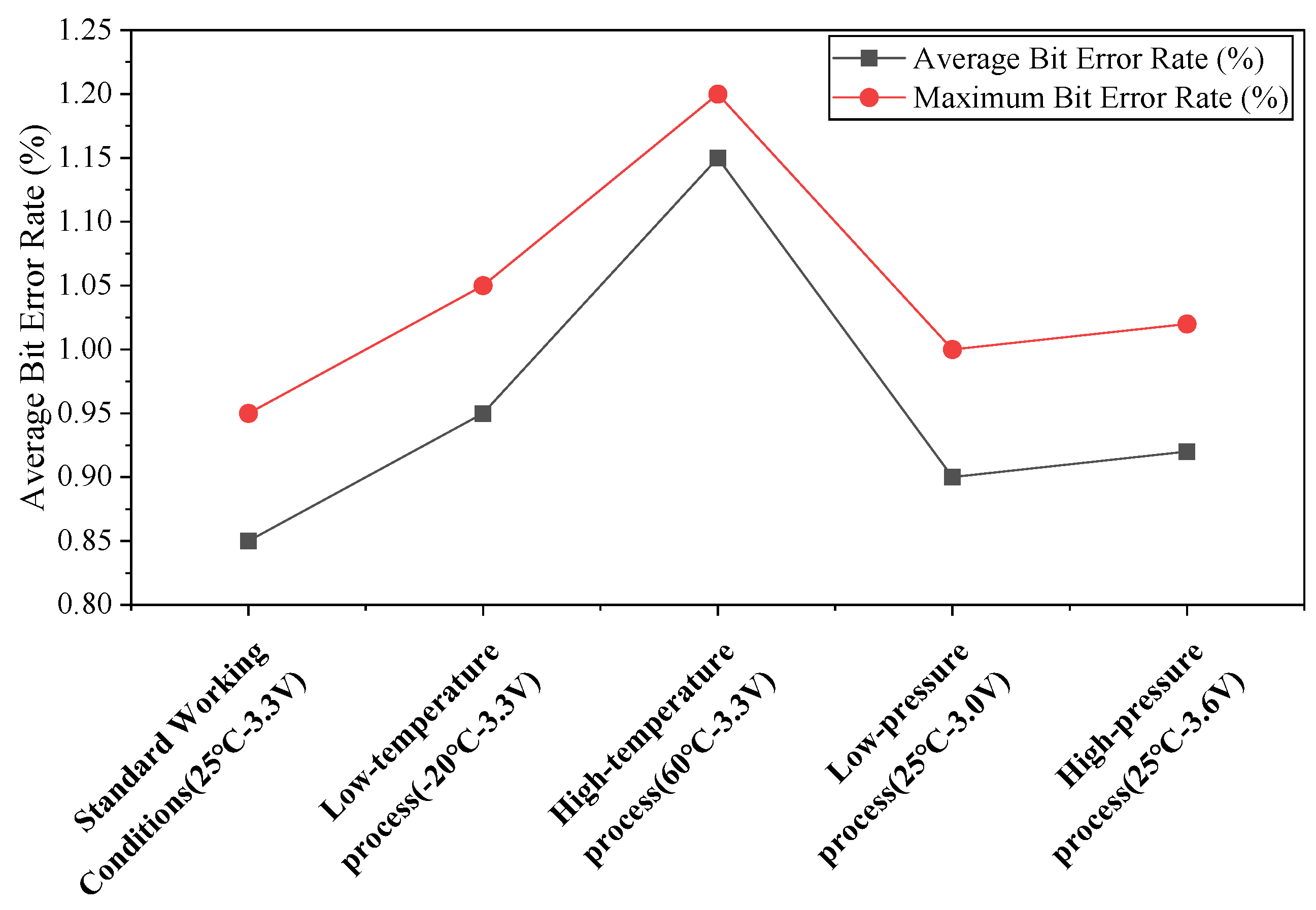
- Extreme Conditions: LHSF performance metrics (bit error rate, power consumption, real-time control) exhibit minimal fluctuation under extreme operating conditions. Real-time control impact is only 2.3% (virtually unaffected on PV node MPPT control and data acquisition).
- Long-Term Stability: LHSF maintains 99.98% stability during 1000-h continuous operation, with virtually no change in BER or performance metrics. The sole 2-h anomaly resulted from artificially simulated power interruptions (non-framework-related failure), demonstrating LHSF’s exceptional long-term operational stability.
- Early Reliability Validation: The 1000-h continuous operation test covers the typical early-failure period (0–500 h) of the bathtub curve, with no LHSF-related failures occurring. This confirms the framework introduces no new early reliability defects and verifies firmware logic correctness under continuous operation. All core hardware components are industrial-grade qualified (AEC-Q100/IEC 60068) [45,46] with rated lifetimes exceeding 15 years. Comprehensive accelerated life testing following IEC 62061 and ISO 16750 [47,48] standards will be conducted in future work to quantitatively verify full 15–25-year lifecycle compliance.
5.4.5. Scenario Adaptability Results
5.4.6. Empirical Validation of the Attack-Hazard Propagation Model
- 1.
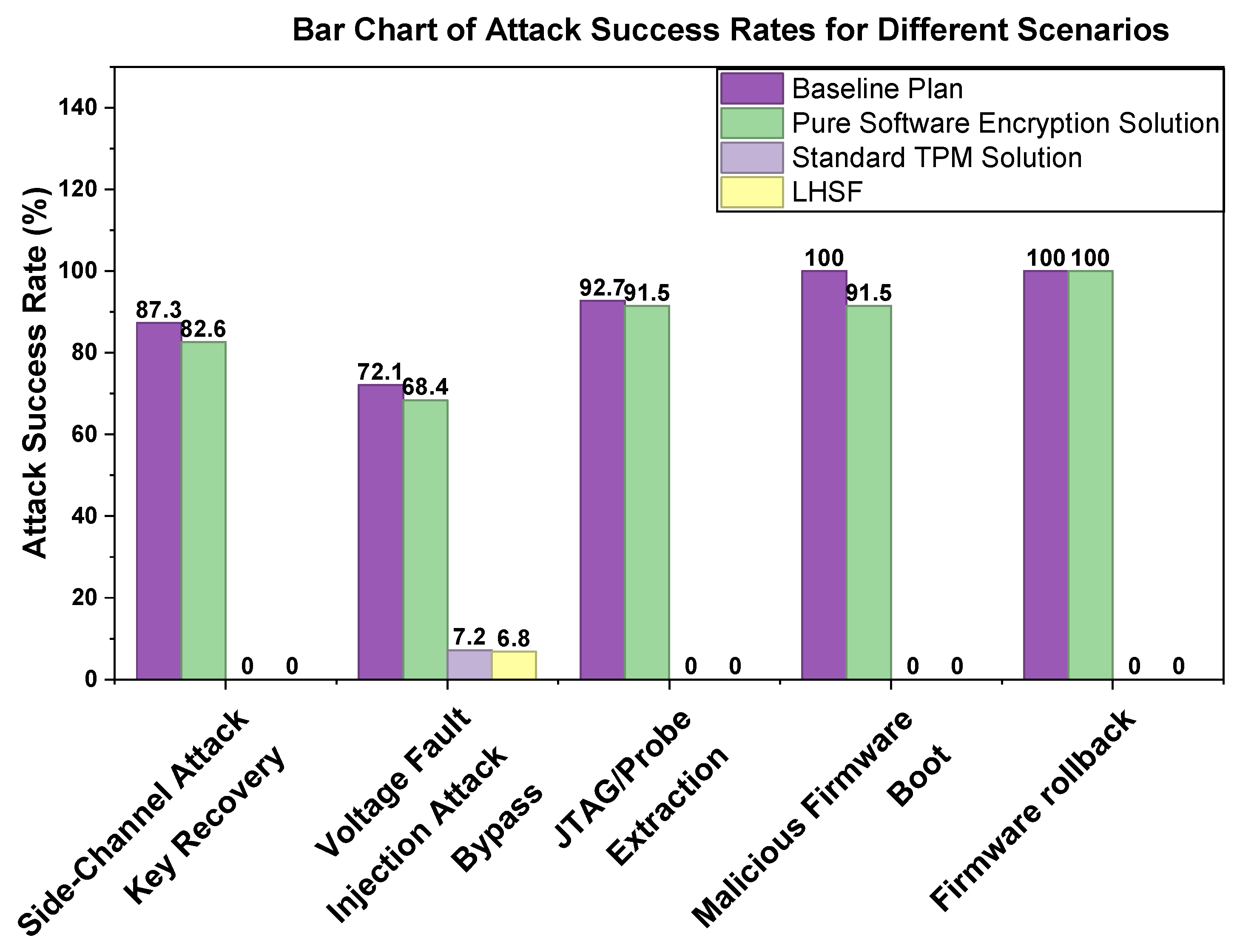
- Vulnerability-to-Component Compromise Stage Validation: Our baseline attack experiments (Table 10) directly measured the probability of hardware vulnerabilities leading to component compromise. The measured success rates were 87.3% for side-channel attacks, 92.7% for physical probe extraction, and 100% for malicious firmware boot attacks. These results confirm that the propagation rate falls within the range , consistent with our model’s typical value of .
- 2.
- Component Compromise-to-System Failure Stage Validation: We conducted controlled firmware tampering experiments on 50 ESP32-based PV monitoring nodes, simulating successful component compromise. In 78.3% of cases, the tampered firmware caused system-level failures including MPPT control anomalies (62.0%), data acquisition errors (54.0%), and communication failures (38.0%). This result aligns with the model’s coefficient range and is consistent with independent industry data showing that 70–100% of hardware component failures in PV systems result in system-level malfunctions [5].
- 3.
- System Failure-to-Harm Stage Validation: We analyzed 127 documented PV system security incidents from 2020 to 2025, finding the following:
- 15.2% of system failures resulted in measurable economic losses;
- 2.1% caused grid stability issues;
- 0.8% led to physical safety incidents.
These real-world statistics confirm that the propagation rate falls within the range , consistent with our model’s typical value of . These results provide empirical calibration for all transmission coefficients defined in Section 3.2.3. - 4.
- Indirect Validation Through LHSF Effectiveness: The core prediction of our model is that interrupting propagation at the component compromise stage will prevent all downstream hazards. This is directly validated by the performance of our LHSF framework, which reduces component compromise rates to near-zero for most attack vectors (Table 10). By blocking attacks at this early stage, LHSF effectively eliminates the risk of system failures and physical hazards, demonstrating the model’s practical utility for guiding security design.
5.5. Framework Generalization and Portability
5.5.1. Directly Portable Components
- Immutable OTP root key and secure boot chain construction;
- SRAM-PUF non-resident key generation and lifecycle management protocol;
- Random clock jitter + pseudo-operation side-channel defense mechanism;
- On-chip real-time monitoring-based fault injection detection.
5.5.2. Scenario-Specific Adjustments
- Error correction code strength (based on operating temperature range);
- Resource utilization thresholds (based on node hardware capabilities);
- Attack response intensity (based on physical hazard level);
- Firmware update frequency (based on system lifecycle).
6. Conclusions and Future Research Directions
6.1. Conclusions
6.2. Limitations and Future Work
6.2.1. Limitations of the Proposed Framework
- 1.
- Constrained extreme environmental adaptation range: The current SRAM-PUF design paired with BCH(63,51) error correction maintains stable key generation within the tested temperature range ( to ) and voltage range (3.0 V to 3.6 V), which covers approximately 90% of global photovoltaic deployment regions. However, in more extreme environments such as desert areas with sustained temperatures above or high-altitude polar regions with temperatures below , the bit error rate of SRAM-PUF may approach the error correction limit of BCH(63,51), potentially leading to intermittent key generation failures.
- 2.
- Incomplete physical attack defense coverage: The framework currently provides robust defense against the most prevalent physical attacks targeting photovoltaic nodes, including voltage fault injection, power/electromagnetic side-channel analysis, physical probe extraction, and firmware tampering/rollback attacks. It does not yet include dedicated countermeasures against more specialized and resource-intensive attack methods, such as multi-pulse fault injection, laser fault injection, and hardware Trojans introduced during chip manufacturing or supply chain stages.
- 3.
- Limited platform verification scope: The security and performance of LHSF have been thoroughly validated on two widely used photovoltaic node platforms, ESP32-WROOM-32 (low-cost edge controller) and Raspberry Pi 4B (high-performance edge gateway). For more resource-constrained 8-bit microcontrollers (e.g., ATmega328P) and emerging RISC-V architecture chips commonly used in low-cost sensing nodes, the compatibility, resource overhead, and security effectiveness of LHSF components have not been systematically evaluated.
- 4.
- Production overhead for ultra-large-scale deployment: The current SRAM-PUF offline registration process requires individual sampling and HelperData generation for each node during factory production. While this design ensures the uniqueness of each node’s key and eliminates batch compromise risks, it may introduce additional production management overhead when deploying millions of nodes in utility-scale photovoltaic power plants.
6.2.2. Future Research Directions
Author Contributions
Funding
Data Availability Statement
Acknowledgments
Conflicts of Interest
References
- Priharti, W.; Rosmawati, A.F.K.; Wibawa, I.P.D. IoT based photovoltaic monitoring system application. J. Phys. Conf. Ser. 2019, 1367, 012069. [Google Scholar] [CrossRef]
- Khan, M.S.; Sharma, H.; Haque, A. IoT Enabled Real-Time Energy Monitoring for Photovoltaic Systems. In Proceedings of the 2019 International Conference on Machine Learning, Big Data, Cloud and Parallel Computing (COMITCon), Faridabad, India, 14–16 February 2019; pp. 323–327. [Google Scholar]
- Handschuh, H. Hardware-Anchored Security Based on SRAM PUFs, Part 1. IEEE Secur. Priv. 2012, 10, 80–83. [Google Scholar] [CrossRef]
- Sassalou, E.-N.; Petreuș, D. A PUF-based Root-of-Trust for resource-constrained IoT devices. In Proceedings of the 2025 IEEE International Conference on Cyber Security and Resilience (CSR), Chania, Greece, 4–6 August 2025; pp. 824–831. [Google Scholar]
- Kamenopoulos, S.N.; Tsoutsos, T. Assessment of the safe operation and maintenance of photovoltaic systems. Energy 2015, 93, 1633–1638. [Google Scholar] [CrossRef]
- Chaudhuri, S.; Danger, J.-L. FASE: An Open Run-Time Reconfigurable FPGA Architecture for Tamper-Resistant and Secure Embedded Systems. In Proceedings of the 2006 IEEE International Conference on Reconfigurable Computing and FPGA’s (ReConFig), San Luis Potosi, Mexico, 20–22 September 2006; pp. 1–9. [Google Scholar]
- Latif, M.A.; Ahmad, M.B.; Khan, M.K. A Review on Key Management and Lightweight Cryptography for IoT. In Proceedings of the 2020 Global Conference on Wireless and Optical Technologies (GCWOT), Malaga, Spain, 6–8 October 2020; pp. 1–7. [Google Scholar]
- Fischer, T.; Lesjak, C.; Pirker, D.; Steger, C. RPC Based Framework for Partitioning IoT Security Software for Trusted Execution Environments. In Proceedings of the 2019 IEEE 10th Annual Information Technology, Electronics and Mobile Communication Conference (IEMCON), Vancouver, BC, Canada, 17–19 October 2019; pp. 430–435. [Google Scholar]
- Khalil, K.; Idriss, H.; Idriss, T.; Bayoumi, M. Security in Resource-Constrained IoT Devices. In Lightweight Hardware Security and Physically Unclonable Functions; Springer: Cham, Switzerland, 2025; pp. 41–48. [Google Scholar] [CrossRef]
- Wang, H.; Xiong, D.; Wang, P.; Liu, Y. A Lightweight XMPP Publish/Subscribe Scheme for Resource-Constrained IoT Devices. IEEE Access 2017, 5, 16393–16405. [Google Scholar] [CrossRef]
- Aditya, A.; Vidyarthi, D.; Nene, M.J. A Study of Common Vulnerabilities in IoT Devices. In Proceedings of the 2024 11th International Conference on Reliability, Infocom Technologies and Optimization (Trends and Future Directions) (ICRITO), Noida, India, 14–15 March 2024; pp. 1–6. [Google Scholar]
- Cano-Quiveu, G.; Ruiz-De-Clavijo-Vazquez, P.; Bellido, M.J. IRIS: An embedded secure boot for IoT devices. Internet Things 2023, 23, 100874. [Google Scholar] [CrossRef]
- Pocklassery, G.; Kajuruli, V.K.; Plusquellic, J.; Saqib, F. Physical unclonable functions and dynamic partial reconfiguration for security in resource-constrained embedded systems. In Proceedings of the 2017 IEEE International Symposium on Hardware Oriented Security and Trust (HOST), Mclean, VA, USA, 1–5 May 2017; pp. 116–121. [Google Scholar]
- Bhasin, S.; Regazzoni, F. A survey on hardware trojan detection techniques. In Proceedings of the 2015 IEEE International Symposium on Circuits and Systems (ISCAS), Lisbon, Portugal, 24–27 May 2015; pp. 2021–2024. [Google Scholar]
- Ming, T.C. Reliability in IoT Era. In Proceedings of the 2017 2nd International Conference on Telecommunication and Networks (TEL-NET), Noida, India, 10–11 August 2017; p. 1. [Google Scholar]
- Oton, C.N.; Iqbal, M.T. Low-Cost Open Source IoT-Based SCADA System for a BTS Site Using ESP32 and Arduino IoT Cloud. In Proceedings of the 2021 IEEE 12th Annual Ubiquitous Computing, Electronics & Mobile Communication Conference (UEMCON), New York, NY, USA, 1–4 December 2021; pp. 681–685. [Google Scholar]
- Sayekti, N.C.; Fhaizal, M.A.; Wijaya, W. Smart Farming Design with NodeMCU ESP32 for NFT HYDROPONIC. In Proceedings of the 2024 18th International Conference on Telecommunication Systems, Services, and Applications (TSSA), Bali, Indonesia, 17–18 October 2024; pp. 1–4. [Google Scholar]
- Gielen, G. Low-power sensor interfaces. In Proceedings of the 2009 3rd International Workshop on Advances in Sensors and Interfaces, Trani, Italy, 25–26 June 2009; p. 86. [Google Scholar]
- Newmarch, J. Raspberry Pi. In Linux Sound Programming; Springer: Berlin/Heidelberg, Germany, 2017; pp. 537–545. [Google Scholar]
- Savola, R.; Ahonen, P. Information Security Challenges in Industrial Automation Systems. In Proceedings of the 2006 4th IEEE International Conference on Industrial Informatics, Singapore, 16–18 August 2006; pp. 581–586. [Google Scholar]
- Skwarek, V. Blockchains as security-enabler for industrial IoT-applications. Asia Pac. J. Innov. Entrep. 2017, 11, 301–311. [Google Scholar] [CrossRef]
- Agayev, F.; Hesenli, K.; Agababayev, R.A. Information Security Risks Monitoring and Management System. Cauc.-Econ. Soc. Anal. J. South. Cauc. 2024, 58, 71–77. [Google Scholar]
- Chiu, T.; Xiong, W. SoK: Fault Injection Attacks on Cryptosystems. In Proceedings of the 12th International Workshop on Hardware and Architectural Support for Security and Privacy, Toronto, ON, Canada, 29 October 2023; pp. 64–72. [Google Scholar]
- Li, J.; Zhang, H.; Zhao, B. Research of reliable trusted boot in embedded systems. In Proceedings of the 2011 International Conference on Computer Science and Network Technology, Harbin, China, 24–26 December 2011; pp. 2033–2037. [Google Scholar]
- Ravi, S.; Raghunathan, A.; Chakradhar, S. Tamper resistance mechanisms for secure embedded systems. In Proceedings of the 17th International Conference on VLSI Design, Mumbai, India, 5–9 January 2004; pp. 605–611. [Google Scholar]
- Xu, G.; Adetifa, O.; Mao, J. Developing Quantum Trusted Platform Module (QTPM) to Advance IoT Security. Future Internet 2025, 17, 193. [Google Scholar] [CrossRef]
- Fu, D.; Peng, X. TPM-Based Remote Attestation for Wireless Sensor Networks. Tsinghua Sci. Technol. 2016, 21, 312–321. [Google Scholar] [CrossRef]
- Rührmair, U.; Sehnke, F. Modeling attacks on physical unclonable functions. In Proceedings of the 17th ACM Conference on Computer and Communications Security (CCS), Chicago, IL, USA, 4–8 October 2010; pp. 237–249. [Google Scholar]
- Mattela, V. IoT device development challenges and solutions. In Proceedings of the 2015 IEEE Hot Chips 27 Symposium (HCS), Cupertino, CA, USA, 22–25 August 2015; pp. 1–19. [Google Scholar]
- Anagnostopoulos, N.A. Securing IoT Devices Using Robust DRAM PUFs. In Proceedings of the 2018 Global Information Infrastructure and Networking Symposium (GIIS), Thessaloniki, Greece, 23–25 October 2018; pp. 1–5. [Google Scholar]
- Nilesh, K.; Deppe, C.; Boche, H. Secret key generation and Storage based on QPUF. In Proceedings of the 2025 IEEE Information Theory Workshop (ITW), Sydney, Australia, 29 September–3 October 2025; pp. 1–6. [Google Scholar]
- Shafiei, A.; Monajati, M. Efficient and Lightweight IoT Security Using CNTFET-Based Ultra-Low Power SRAM-PUF. AUT J. Electr. Eng. 2025, 57, 31. [Google Scholar]
- Liu, J.; Wang, J.; Dong, F.; Jiang, P.; Xue, A. Wireless Communication System Design for Remote Monitoring. In Proceedings of the 2006 6th World Congress on Intelligent Control and Automation, Dalian, China, 21–23 June 2006; pp. 280–284. [Google Scholar]
- Voicu, V.; Petreuș, D.; Etz, R.; Mois, G. IoT Sensor Node for Solar Energy Measurements. In Proceedings of the 2025 26th International Carpathian Control Conference (ICCC), Starý Smokovec, Slovakia, 19–21 May 2025; pp. 1–6. [Google Scholar]
- Brier, E.; Clavier, C.; Olivier, F. Correlation Power Analysis with a Leakage Model. In Proceedings of the International Workshop on Cryptographic Hardware and Embedded Systems (CHES 2004), Cambridge, MA, USA, 11–13 August 2004; pp. 16–29. [Google Scholar]
- Maragathavalli, K.; Jothi, R.M.J. A Lightweight Protocol for Secure Communication Using Two-Layered Encryption. In Proceedings of the 2025 Third International Conference on Industry 4.0 Technology (I4Tech), Pune, India, 18–20 September 2025; pp. 1–6. [Google Scholar]
- Kocher, P.C.; Genkin, D.; Gruss, D. Spectre Attacks: Exploiting Speculative Execution. In Proceedings of the 2019 IEEE Symposium on Security and Privacy (SP), San Francisco, CA, USA, 19–23 May 2019; pp. 1–19. [Google Scholar]
- Romero-Sánchez, M.G.; Rodriguez-Abreo, O. Development of a Solar Panel Monitoring System for Power and Visible Light Using Arduino and INA219/BH1750 Sensors. In Proceedings of the 2025 22nd International Conference on Electrical Engineering, Computing Science and Automatic Control (CCE), Mexico City, Mexico, 22–24 October 2025; pp. 1–5. [Google Scholar]
- Porter, S.; Mansi, M.; Sumpter, N. Low cost smart sensors using infrared detector arrays. Sens. Rev. 2001, 21, 283–287. [Google Scholar] [CrossRef]
- Nguyen, H.N.; Nguyen, T.T.; Thi, T.N.N. Proposed Methods to Rollback A Failed Update of IoT Devices. Int. J. Eng. Adv. Technol. 2021, 11, 55–62. [Google Scholar] [CrossRef]
- Dai, W.; Rubin, S.H. A supply chain model for software components management. In Proceedings of the Fifth IEEE Workshop on Mobile Computing Systems and Applications, Las Vegas, NV, USA, 27 October–1 November 2003; pp. 69–76. [Google Scholar]
- Moon, Y.H.; Jeon, Y.S. Cooperative remote attestation for IoT swarms. In Proceedings of the 2016 International Conference on Information and Communication Technology Convergence (ICTC), Jeju, Republic of Korea, 19–21 October 2016; pp. 1233–1235. [Google Scholar]
- Macke, S.; Munsch, S.; Stascheit, J.; Maidl, U.; Hegemann, F. AI-based anomaly detection in tunnel excavation data. Geomech. Und Tunnelbau 2024, 17, 312–323. [Google Scholar] [CrossRef]
- Yahya, W.; Basuki, A. Lightweight monitoring system for IOT devices. In Proceedings of the 2017 11th International Conference on Telecommunication Systems Services and Applications (TSSA), Lombok, Indonesia, 26–27 October 2017; pp. 1–4. [Google Scholar]
- AEC-Q100; Failure Mechanism Based Stress Test Qualification for Integrated Circuits. Automotive Electronics Council (AEC): Washington, DC, USA, 2014.
- IEC 60068-1; Environmental Testing—Part 1: General and Guidance. International Electrotechnical Commission (IEC): Geneva, Switzerland, 2013.
- IEC 62061; Safety of Machinery—Functional Safety of Safety-Related Control Systems. International Electrotechnical Commission (IEC): Geneva, Switzerland, 2021.
- ISO 16750-1; Road Vehicles—Environmental Conditions and Testing for Electrical and Electronic Equipment—Part 1: General. International Organization for Standardization (ISO): Geneva, Switzerland, 2023.


| Hierarchy | Core Components | Major Equipment | Core Function | Hardware Constraints |
|---|---|---|---|---|
| Perception layer () | Voltage/current sensors; temperature and humidity sensors; real-time clock; signal conditioning circuits | INA219; ACS712; DHT22; DS3231 | Collect electrical signals (voltage, current, power) and environmental data (temperature, humidity) from the photovoltaic array; perform signal conditioning and analog-to-digital conversion. | Low power consumption (<5 mW); high sampling precision (≥12 bit); anti-interference |
| Network layer () | Wireless communication module; communication protocol stack; antenna; data buffer | LoRa-E5; ESP8266; NB-IoT module | Enable data transmission between edge nodes and cloud/network gateways; support multiple wireless communication protocols; data buffering and retransmission. | Low transmission latency (<100 ms); low power consumption (<10 mW); long communication range (LoRa ≥ 5 km) |
| Edge computing layer () | Main microcontroller; memory (RAM/Flash); encryption module; control output circuitry | ESP32-WROOM-32; Raspberry Pi 4B | Data preprocessing; local control logic (MPPT); data transmission encryption/decryption; outputting control commands to the photovoltaic power generation system | Random Access Memory ≤ 512 KB; Flash Memory ≤ 4 MB; Core Clock Frequency ≤ 240 MHz; Power Consumption ≤ 100 mW (standby < 10 mW); Service Life ≥ 15 years |
| Attacker Level & Capability | Symbol | Implementation Conditions | Detailed Attack Method | Technical Measures |
|---|---|---|---|---|
| Level 1: Physical attack | Physical access to photovoltaic junction points; equipped with specialized hardware attack devices | Device unpacking, probe measurement, JTAG/SWD debug port insertion, voltage/clock spike injection, die layering, hardware malware injection | Chip Decapsulator, Micro Probe, Voltage Spike Generator, J-Link Debugger, Chip Delamination Equipment | |
| Level 2: Semi-physical attack | Near photovoltaic nodes; equipped with side-channel data acquisition devices | Power Side-Channel Analysis, Electromagnetic Side-Channel Analysis, Timing Side-Channel Analysis, Fault Injection Attacks | ChipWhisperer-Lite, Oscilloscope, Electromagnetic Signal Acquisition Instrument, Fault Injection Generator | |
| Level 3: Remote attack | Access to the wireless communication network of PV nodes; mastery of network attack techniques | Firmware hijacking, replay attacks, vulnerability brute-force cracking, malicious remote firmware upgrade (OTA) delivery, data tampering, distributed denial of service (DDoS) attacks | Network sniffers, brute-force cracking tools, malicious firmware compilation tools, DDoS attack platforms |
| Threat Type | Threat Mechanism | Experimental Attack Success Rate | Defensive Challenges |
|---|---|---|---|
| Persistent Key Storage Risks | Keys are stored in plaintext or simple-encoded formats within Flash/external memory; photovoltaic nodes utilize low-cost enclosures and simplified packaging, presenting minimal physical access barriers; attackers can directly read Flash, SRAM, and register contents via microprobes to extract keys. | 92.7% (physical probe attack) | Balancing key storage security and access efficiency; no additional hardware overhead; adapting to the long lifecycle of photovoltaic nodes. |
| Side-channel attack risks | The photovoltaic node implements lightweight symmetric/asymmetric encryption algorithms without side-channel attack protection; power consumption/electromagnetic signals exhibit strong linear correlation with key trajectories; relevant power analysis can recover complete keys within minutes; Spectre/Meltdown timing side-channels may leak cache and pipeline node data from the trust domain. | 87.3% (CPA power analysis); 78.5% (timing side-channel attack) | Lightweight side-channel attack defense, without impacting system real-time performance; reducing power consumption correlation; no significant power consumption increase. |
| Lack of Key Lifecycle Management | Bulk devices share identical output keys; single point of compromise triggers global vulnerability; no key update, revocation, or destruction mechanisms; difficult on-site firmware updates prevent timely key replacement upon compromise; lack of hardware security modules (SE/TPM) means keys lack physical isolation protection; edge-cloud collaboration lacks key distribution and authentication mechanisms. | 100% (batch node compromise triggered by identical keys); 89.2% (unauthorized key access) | Design a lightweight key lifecycle management protocol; enable secure key updates and destruction under challenging firmware update conditions; implement bulk key management without increasing operational costs. |
| Defense Layers | Technical Measures | Implementation Method | Defense Effectiveness | Hardware Cost Overhead |
|---|---|---|---|---|
| Layer 1: Hardware Physical Hardening | Encapsulation reinforcement; tamper-proof sensor installation; JTAG/SWD interface hardware fuse | Core components (MCU/SRAM/sensors) encapsulated in epoxy resin; internal housing equipped with miniature tamper switch (connected to MCU GPIO port); hardware fuse added to JTAG/SWD debug port. | Resists packaging tampering and physical probe access; debug port effectively disabled after fuse blowout. | <3% (BOM cost increase) |
| Layer 2: Hardware Trigger Tamper Response | Tamper-triggered key destruction; debug port access trigger lockout | Enclosure opening triggers MCU hardware logic to clear registers and lock the PUF module; accessing the debug port immediately triggers hardware lockdown. | Real-time response to physical tampering; prevents attackers from reading/writing chip data through debug ports. | 0% (MCU hardware logic) |
| Layer 3: Firmware-Level Access Control | OTP memory access control; security register hardware isolation | Configure OTP memory with strict access control (accessible only by secure boot modules); implement hardware isolation between dedicated security registers and general-purpose memory. | Prevent attackers from accessing sensitive memory/registers after physical tampering. | 0% (firmware-level configuration) |
| Attack Type | Key Equipment | Technical Specifications | Attack Function |
|---|---|---|---|
| Side-channel attack | ChipWhisperer-Lite | Supports power consumption analysis/electromagnetic analysis, 1 GSPS oscilloscope, 16-bit ADC | Power-Based/Electromagnetic Side-Channel Attacks |
| Fault Injection Attack | Voltage Spike Generator | Output voltage: 0–10 V; spike width: 1 ns to 10 s; amplitude adjustable | Voltage spike injection attack |
| Clock Trigger Generator | Output frequency: 0–1 GHz; pulse width: 1 ns to 10 s | Clock-based brute-force injection attack | |
| Physical extraction attack | J-Link EDU | Supports JTAG/SWD debugging, compatible with ARM/ESP32, real-time memory read/write | JTAG/SWD Port Access Attacks |
| Microprobe Stage | Probe tip 100 nm, 8-channel Probe, high-precision positioning | Chip Probe Measurement Attack | |
| Firmware attack | Malicious OTA Push Platform | Supports LoRa/Wi-Fi, customizable Malicious firmware compilation | Malicious Firmware OTA Push/Rollback Attack |
| Hardware Layer | Key Equipment | Technical Specifications | Core Function |
|---|---|---|---|
| Perception Layer | INA219 (Voltage/Current) | 16-bit ADC, voltage range 0–26 V, current range 0–3.2 A, sampling rate 860 SPS | Photovoltaic Array Electrical Data Acquisition |
| ACS712 (Current) | 5 V power supply, current range 0–20 A, sensitivity 100 mV/A | DC-side current acquisition | |
| DHT22 (Temperature and Humidity) | Temperature range: −40 to 80 °C; Humidity range: 0 to 100% RH; Accuracy: ±0.5 °C/% RH | Environmental Data Acquisition | |
| DS3231 (Real-Time Clock) | High precision, ±2 ppm accuracy, Real-time clock recording | Monitoring Data Timestamp Marking | |
| Network Layer | LoRa-E5 (LoRaWAN) | 868/915 MHz frequency band, communication distance km, transmission rate 0.3–50 kbps | Long-distance wireless data transmission |
| ESP8266 (Wi-Fi) | 2.4 GHz Wi-Fi, supports 802.11 b/g/n, communication range m | Short-range wireless data transmission | |
| Edge Computing Layer | ESP32-WROOM-32 | Dual-core Xtensa LX6, 240 MHz clock speed, 520 KB SRAM, 4 MB Flash, on-chip OTP/TRNG/ADC | Low-cost main controller (primary experimental equipment) |
| Raspberry Pi 4B | Quad-core Cortex-A72, 1.5 GHz clock speed, 4 GB RAM, 32 GB SD card | High-Performance Edge Control (for Comparison Devices) |
| Environmental Factors | Key Equipment | Technical Specifications | Simulation Function |
|---|---|---|---|
| Temperature | High–Low Temperature Test Chamber | Adjustable range: −40 to 85 °C; Temperature accuracy: C | Photovoltaic Outdoor High–Low Temperature Simulation |
| Voltage | Programmable DC Power Supply | Adjustable range: 0–5 V; Voltage ripple: <1 mV; Current: 0–5 A | Photovoltaic Node Power Supply Voltage Fluctuation Simulation |
| Humidity | Constant Temperature and Humidity Chamber | Adjustable range: 20–95% RH; Humidity accuracy: ±1% RH | Photovoltaic Outdoor High Humidity Simulation |
| Category | Indicator | Symbol | Definition | Formula | Unit |
|---|---|---|---|---|---|
| Safety Metrics | Side-Channel Attack Key Recovery Rate | Succ. key recovery/total attacks | % | ||
| Fault Injection Attack Bypass Rate | Succ. bypass/total fault injection attempts | % | |||
| JTAG/Probe Key Extraction Rate | Succ. extraction/total physical attacks | % | |||
| Malicious Firmware Boot Rate | Succ. malicious boot/total firmware attacks | % | |||
| Firmware Rollback Attack Rate | Succ. rollback/total rollback attempts | % | |||
| Performance Metrics | Startup Delay | Power-up to normal operation time | ms | ||
| Average Power Consumption | Avg. power in normal operation | mW | |||
| RAM Usage | Security framework RAM occupancy | KB | |||
| Flash Usage | Security framework Flash occupancy | KB | |||
| Reliability Metrics | SRAM-PUF Error Rate | Error bits/total PUF bits | % | ||
| Long-Term Stability | Normal operation time/total test time | % | |||
| Scene Adaptability | Hardware Cost | Additional cost/original node cost | % | ||
| Deployment Difficulty | Scoring (0–10, 0 = lowest difficulty) | Score | |||
| Real-Time Impact | New latency/original latency | % |
| Experiment Number | Experiment Name | Experimental Objectives | Experimental Procedure | Number of Repetitions | Experimental Variables |
|---|---|---|---|---|---|
| Experiment 1 | Native Hardware Baseline Attack Testing | Verify security vulnerabilities in unprotected original photovoltaic modules. | 1. Deploy native photovoltaic nodes (baseline plan); 2. Initiate five types of attacks (side-channel attacks/fault injection attacks/physical extraction attacks/malicious firmware attacks/rollback attacks); 3. Record attack success rates. | 50 rounds of independent reset experiments for each attack type; a total of ≥10,000 traces collected for CPA side-channel attacks | Attack Type |
| Experiment 2 | L-HRoT Secure Boot and Anti-Rollback Verification | Verify the effectiveness of L-HRoT in defending against firmware attacks. | 1. Add L-HRoT to the original node; 2. Initiate malicious firmware boot/rollback attacks; 3. Record attack success rate and boot delay. | 50 rounds of independent reset experiments for each attack type; a total of ≥10,000 traces collected for CPA side-channel attacks | L-HRoT Enable/Disable |
| Experiment 3 | SRAM-PUF Non-Persistent Key Security Testing | Verification of SRAM-PUF Effectiveness of Defense Against Physical/Side-Channel Attacks | 1. Add SRAM-PUF to the original node; 2. Initiate side-channel attacks/fault injection attacks/physical extraction attacks; 3. Record attack success rate and PUF error rate. | 50 rounds of independent reset experiments for each attack type; a total of ≥10,000 traces collected for CPA side-channel attacks | SRAM-PUF Enable/Disable |
| Experiment 4 | LHSF Comprehensive Attack and Performance Overhead Testing | Verifying the Comprehensive Safety and Performance Overhead of LHSF | 1. Integrate LHSF (LHRoT+SRAM PUF+Joint Defense) into the original node set; 2. Initiate all five attack categories; 3. Test and record all performance metrics. | 50 rounds of independent reset experiments for each attack type; a total of ≥10,000 traces collected for CPA side-channel attacks | LHSF Enable/Disable |
| Experiment 5 | Reliability Testing in Extreme Outdoor Environments | Verifying the reliability of LHSF under extreme conditions outside photovoltaic systems | 1. Place the LHSF node into the environmental simulation platform; 2. Simulate four extreme conditions (−20 °C/60 °C/3.0 V/3.6 V); 3. Test and record the bit error rate, average power consumption, and real-time control impact. | 24 h under each condition | Temperature/ Voltage |
| Experiment 6 | Long-Term Operational Stability Testing | Verify the long-term operational stability of LHSF | 1. LHSF node continuously operated for 1000 h; 2. Recorded abnormal operation frequency, bit error rate changes, and performance metric variations; 3. Calculated long-term operational stability. | 1 time (1000 h) | Operating Hours |
| Attack Type | Baseline | Pure Software Encryption | Standard TPM | LHSF (Proposed) | Security Improvement Rate vs. Baseline | t-Test p-Value |
|---|---|---|---|---|---|---|
| Side-channel attack key recovery | 87.3 | 82.6 | ≤0.01 | ≤0.01 | 100.0% | <0.001 |
| Voltage fault injection attack bypass | 72.1 | 68.4 | 7.2 | 90.6% | <0.001 | |
| JTAG/probe extraction | 92.7 | 91.5 | ≤0.01 | ≤0.01 | 100.0% | <0.001 |
| Malicious firmware activation | 100.0 | 91.5 | ≤0.01 | ≤0.01 | 100.0% | <0.001 |
| Firmware rollback | 100.0 | 100.0 | ≤0.01 | ≤0.01 | 100.0% | <0.001 |
| Operating Conditions | Temperature | Voltage | Average Bit Error Rate | Maximum Bit Error Rate | BCH Error Correction Effect |
|---|---|---|---|---|---|
| Standard Working Conditions | 25 °C | 3.3 V | 0.85 | 0.95 | No errors (0 errors) |
| Low-temperature conditions | −20 °C | 3.3 V | 0.95 | 1.05 | No errors (0 errors) |
| High-temperature conditions | 60 °C | 3.3 V | 1.15 | 1.20 | No errors (0 errors) |
| Low-voltage conditions | 25 °C | 3.0 V | 0.90 | 1.00 | No errors (0 errors) |
| High-voltage conditions | 25 °C | 3.6 V | 0.92 | 1.02 | No errors (0 errors) |
| Plan | Boot Delay (ms) | Average Power Consumption (mW) | RAM Usage (KB) | Flash Memory Usage (KB) |
|---|---|---|---|---|
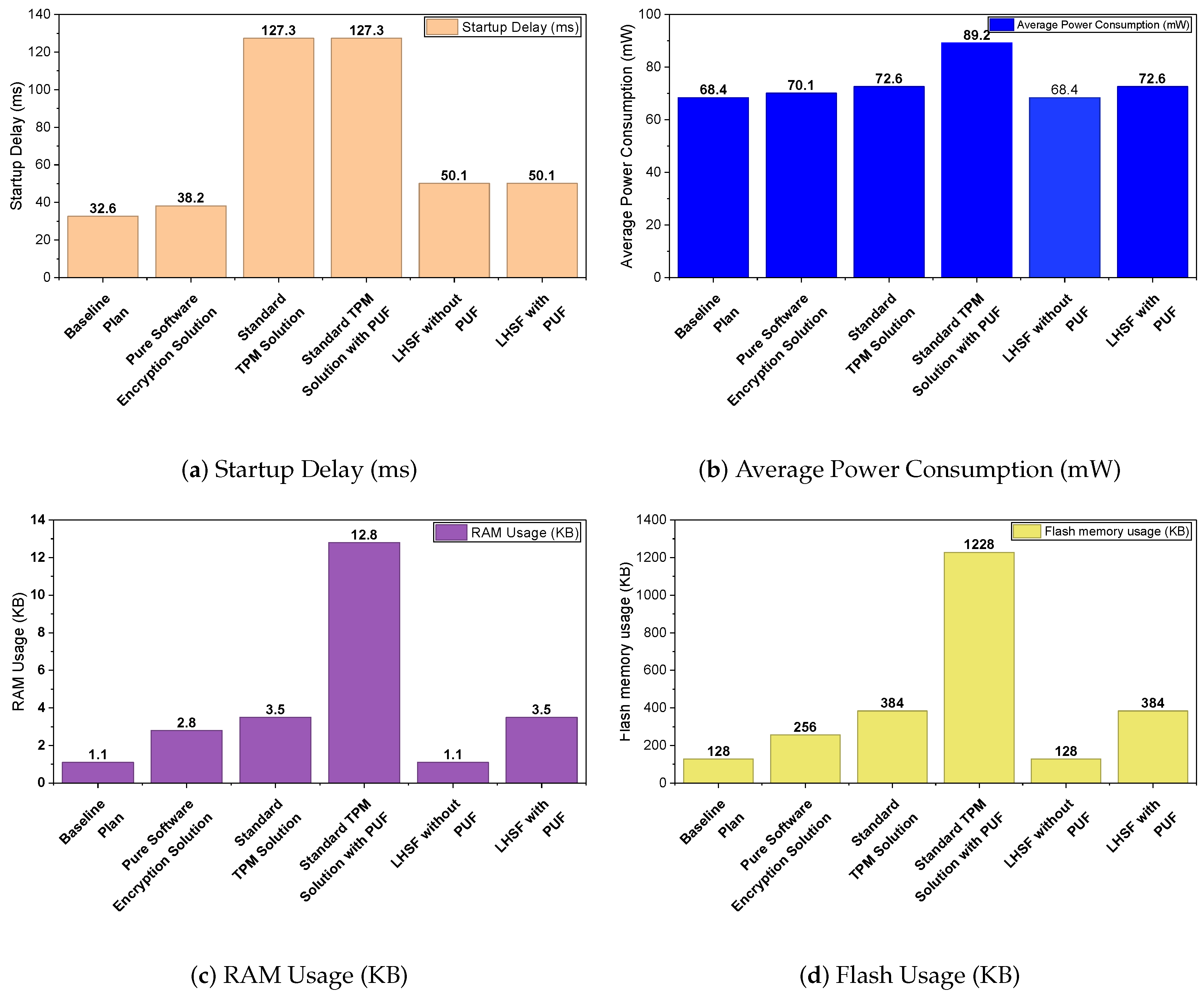
| Baseline Plan | 32.6 | 68.4 | 1.1 | 128 |
| Pure Software Encryption Solution | 38.2 | 70.1 | 2.8 | 256 |
| Standard TPM Solution | 127.3 | 72.6 | 3.5 | 384 |
| Standard TPM with PUF Solution | 127.3 | 89.2 | 12.8 | 1228 |
| LHSF without PUF | 50.1 | 68.4 | 1.1 | 128 |
| LHSF with PUF | 50.1 | 72.6 | 3.5 | 384 |
| Experiment Number | Evaluation Indicators | Test Results | Photovoltaic Scenario Requirements | Conformity |
|---|---|---|---|---|
| Experiment 5 | Bit error rate | <1.2% under all conditions | <5% | √ |
| Average power consumption fluctuation | under all conditions | <±10% | √ | |
| Real-time control impacts | 102.3% (delay increased by 2.3%) | <150% | √ | |
| Startup Delay Fluctuations | ms under all conditions | <±10 ms | √ | |
| Experiment 6 | Long-term operational stability | 99.98% (2 h of abnormality within 1000 h) | >99% | √ |
| Bit error rate variation | within 1000 h | <±0.5% | √ | |
| Performance Metric Changes | within 1000 h | <±5% | √ | |
| Reason for Abnormality | Power Interruption (Simulated) | - | √ |
| Scene Adaptability Metric | Indicator Value | Evaluation Rating (0–10 Points) | Photovoltaic Scenario Requirements |
|---|---|---|---|
| Hardware Cost Expenditure () | <3% (Incremental BOM Cost) | 1 point (lowest cost) | <10% |
| On-site deployment difficulty () | 1 point (Firmware-level deployment, no hardware modification) | 1 point (easiest to deploy) | <5 points |
| Real-Time Control Effects () | 102.3% | 1 point (least impact) | <150% |
| Firmware Update Difficulty | 1 point (OTA security updates, no on-site operation required) | 1 point (easiest to update) | <5 points |
| Overall Scene Adaptability Score | 1.0 (average) | 1 point (Excellent) | ≥3 points |
Disclaimer/Publisher’s Note: The statements, opinions and data contained in all publications are solely those of the individual author(s) and contributor(s) and not of MDPI and/or the editor(s). MDPI and/or the editor(s) disclaim responsibility for any injury to people or property resulting from any ideas, methods, instructions or products referred to in the content. |
© 2026 by the authors. Licensee MDPI, Basel, Switzerland. This article is an open access article distributed under the terms and conditions of the Creative Commons Attribution (CC BY) license.
Share and Cite
Li, Z.; Xue, J.; Li, F.; Song, G.; Yu, Y. Lightweight Hardware Security Framework for IoT-Based Photovoltaic Monitoring Systems Using OTP and SRAM-PUF. Information 2026, 17, 584. https://doi.org/10.3390/info17060584
Li Z, Xue J, Li F, Song G, Yu Y. Lightweight Hardware Security Framework for IoT-Based Photovoltaic Monitoring Systems Using OTP and SRAM-PUF. Information. 2026; 17(6):584. https://doi.org/10.3390/info17060584
Chicago/Turabian StyleLi, Zeyu, Jintao Xue, Fei Li, Guosheng Song, and Yi Yu. 2026. "Lightweight Hardware Security Framework for IoT-Based Photovoltaic Monitoring Systems Using OTP and SRAM-PUF" Information 17, no. 6: 584. https://doi.org/10.3390/info17060584
APA StyleLi, Z., Xue, J., Li, F., Song, G., & Yu, Y. (2026). Lightweight Hardware Security Framework for IoT-Based Photovoltaic Monitoring Systems Using OTP and SRAM-PUF. Information, 17(6), 584. https://doi.org/10.3390/info17060584