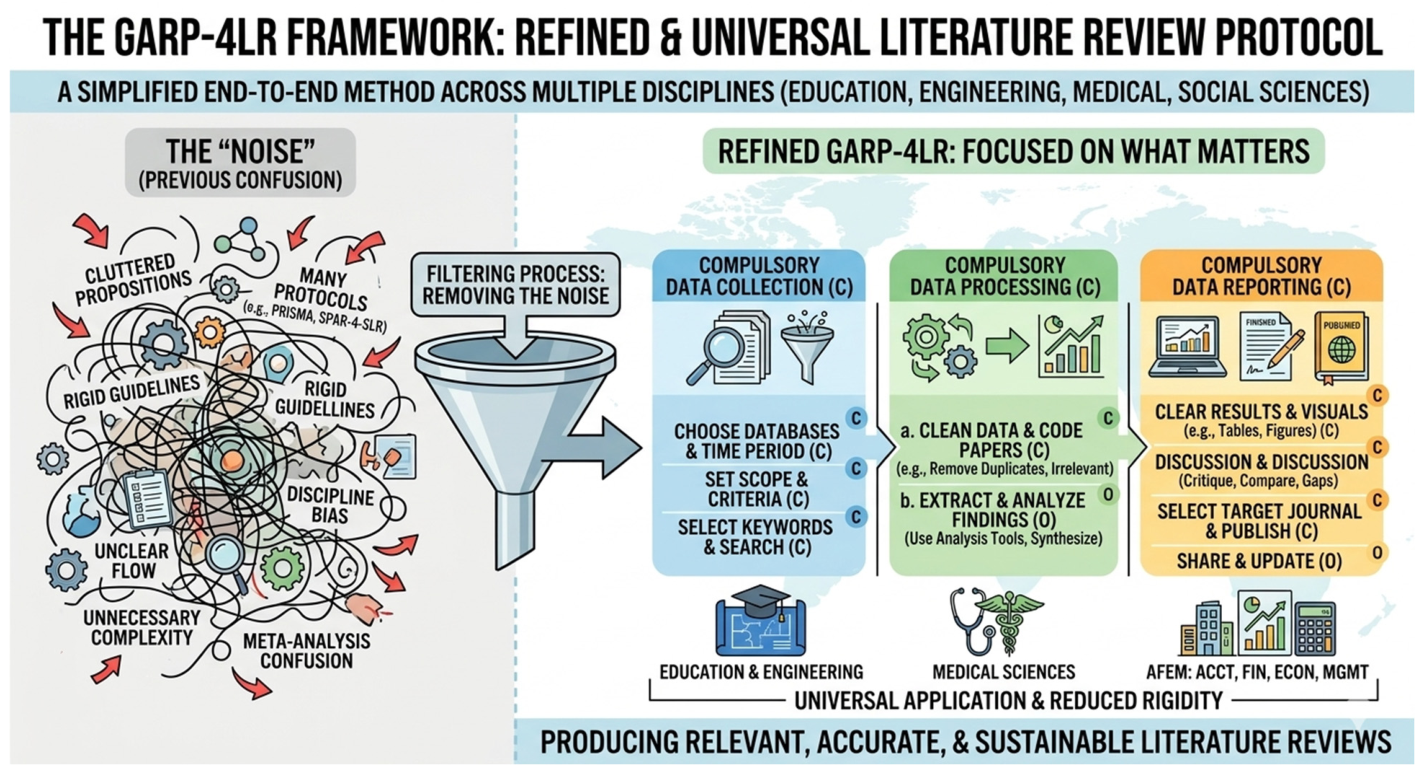
How to Write a Relevant, Accurate and Sustainable Literature Review Using a Generally Accepted Research Protocol (GARP): A Multidisciplinary Mixed Research Method



Abstract
1. Introduction
- RQ1: What is a literature review?
- RQ2: How many types of literature review are there?
- RQ3: Does it matter to write a literature review?
- RQ4: What are the challenges researchers face when writing a literature review?
- RQ5: Which type of literature review is dominant across the presently studied disciplines?
- RQ6: How to write a literature review?
2. Literature Review
2.1. Literature Review in Education and Engineering (Computer Science, Transportation, Information and Communication)
2.2. Literature Review in Accounting, Finance, Economy, and Management (AFEM)
2.3. Literature Review in Medicine (Mental Health and Healthcare)
2.4. Different Types of Approaches to Literature Review Papers
2.5. Structure of a Literature Review
2.6. Methodology and Process of a Literature Review
2.7. Relevance, Challenge and Value of a Literature Review
2.8. Publication of a Literature Review: Challenge and Recommendations
2.9. Summary of the Literature
3. Methodology
3.1. Data Collection and Sample Selection Process (Inclusion and Exclusion Criteria)
3.2. Analysis
3.2.1. Descriptive Analysis
3.2.2. Semi-Qualitative Content Analysis
4. Results and Findings
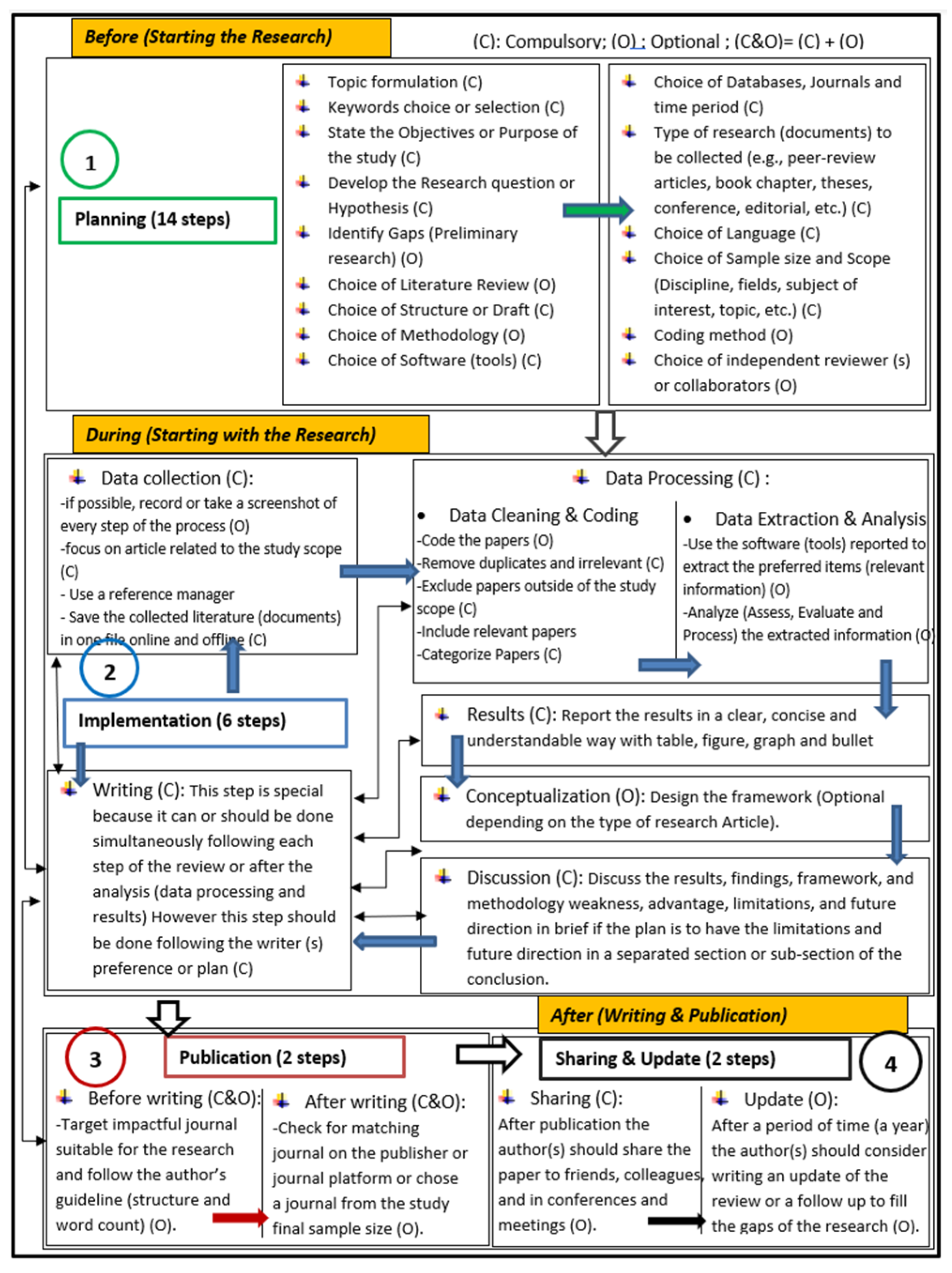
4.1. GARP for Literature Review: Research Framework and Guideline
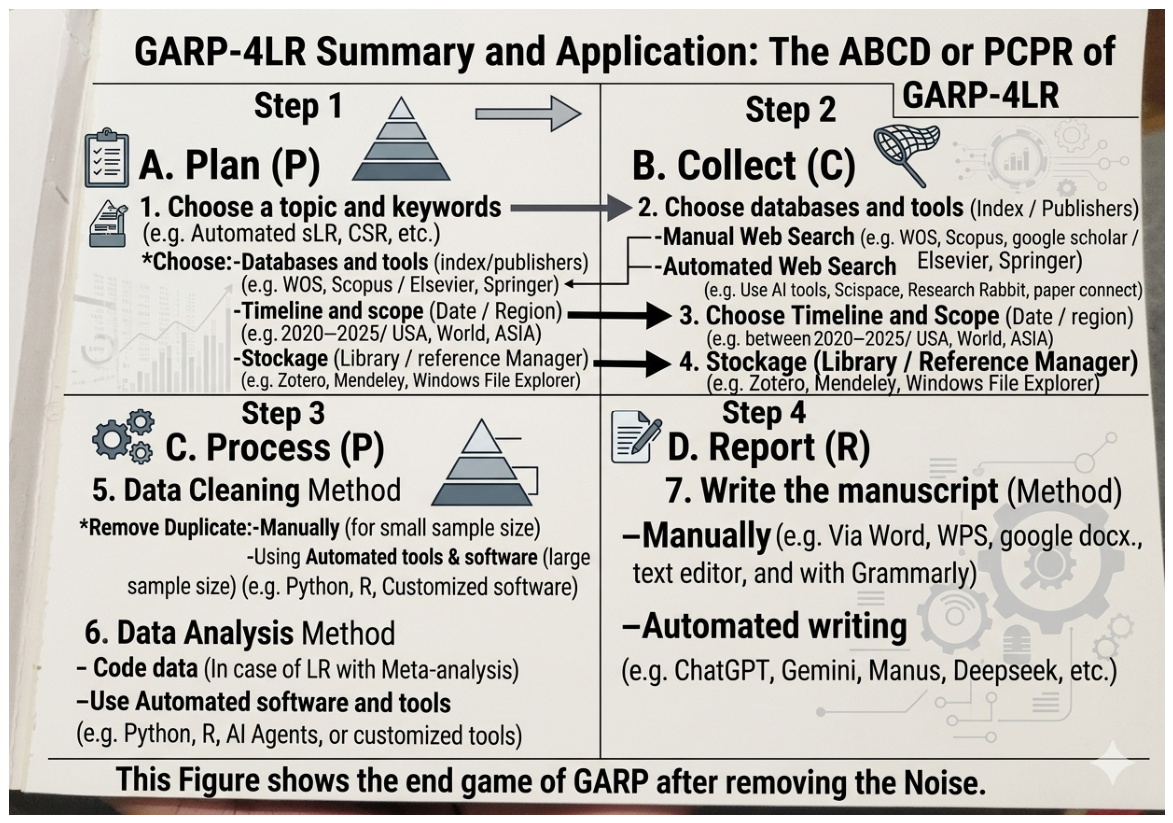
4.2. GARP-4LR Summary and Application: The ABCD/PCPR of GARP
5. Discussion
5.1. Comparison with PRISMA 2020 and SPAR 4 SLR
6. Conclusions
7. Limitations, Future Directions and Recommendations
Supplementary Materials
Author Contributions
Funding
Institutional Review Board Statement
Informed Consent Statement
Data Availability Statement
Acknowledgments
Conflicts of Interest
Abbreviations
| C | Compulsory |
| GARP-4LR | Generally Accepted Research Protocol for Literature Review |
| LR | Literature Review |
| O | Optional |
| SLR | Systematic Literature Review |
Appendix A

| Elsevier | |||||||||||
| Author(s), Pub Year, Type of Article. Sample Size Journal. | Objective | Type of Lit Review Identified | Methodology | Paper Collection Database(s) | Software Used | Lit Review Guidelines Proposed | Key Findings | Suggestions/Recommendations | Research Gaps | Limitations | Score |
| [41] (TA): Protocol. (SS): Delphi study, minimum 25 responses per round. (J): Contemporary Clinical Trials. | To describe the development process for a reporting guideline for intervention fidelity in non-drug, non-surgical trials (ReFiND). | Scoping Review (as part of the guideline development). | Six-stage guideline development process including a scoping review, a Delphi study, and a consensus meeting, following EQUATOR and ACCORD guidelines. | For the scoping review: MEDLINE, Embase, PsycINFO, CINAHL, CENTRAL, AMED. | Qualtrics, DeepL Translator, Covidence. | Yes, this paper is a protocol to develop the ReFiND reporting guideline for intervention fidelity. | Reporting of intervention fidelity in non-drug trials is inadequate, limiting transparency and reproducibility. Existing fidelity guidance documents vary and lack robust, consensus-based development methods. | The future ReFiND guideline will provide a consensus-based set of items to improve fidelity reporting. | No international, consensus-based reporting guideline for fidelity in non-drug, non-surgical interventions currently exists. | This is a protocol, so it describes planned work rather than completed research with limitations. | A+++ |
| [94] (TA): Methodological Guidance/Research Article. (SS): initial 300,000 articles, refined to ~2300, and screened them. No final number. (J): Heliyon/ | To enhance the systematic literature review (SLR) method by proposing a ‘double-stage SLR’ to reduce bias, identify gaps, and formulate research questions more effectively. | SLR of methodological and review articles. | Proposes a new framework (‘DDA in SLR’) based on a critical analysis of existing SLR approaches and the Double Diamond Design Approach. | Web of Science, Scopus, Google Scholar, Google. | CADIMA. | Yes, proposes the ‘double-stage SLR’ or ‘Double Diamond Approach (DDA) in SLR’. | Current SLR frameworks often lack guidance on quantifying literature volume for gap identification and formulating research questions, leading to potential bias. | The DDA in SLR involves two stages: (1) reviewing existing review literature to identify gaps and formulate research questions, and (2) reviewing empirical literature to answer those questions and meet review objectives. | Existing SLR methods are unclear on how to quantify literature needed to formulate research questions or develop a search strategy. | This approach requires more time and effort432. The authors’ own search was limited to a few online databases and English-language papers, and excluded books/book chapters. | A+++ |
| Emerald A | |||||||||||
| Author(s), Pub Year, Type of Article, (SS) & (J) | Objective | Type of Lit Review Identified | Methodology | Paper Collection Database(s) | Software Used | Lit Review Guidelines Proposed | Key Findings | Suggestions/Recommendations | Research Gaps | Limitations | Score |
| Virginia Bodolica, Martin Spraggon. (2018) (TA): Conceptual paper. (SS): N/A. (J): Management Decision. | To provide useful guidelines to prospective authors for generating influential literature review articles by uncovering key requirements for expanding their reach. | Discusses literature review articles in general, and mentions systematic reviews as a foundation for its proposed process. | Conceptual paper developing an end-to-end process based on the authors’ experience and a scrutiny of review papers in major management journals. | ABI/INFORM, Business Source Premier, JSTOR, Emerald, PsycINFO, ProQuest, Web of Science, and Scopus are mentioned as key databases for conducting reviews. | Not mentioned. | Proposes an end-to-end process with two phases (Writing, Publishing) and seven steps: Exploring the topic, Searching/screening, Assessment/selection, Analysis/synthesis, Structuring/drafting, Journal submission/publication, and Post-publication diffusion. | Identifies and debunks several popular misconceptions about literature reviews (e.g., they are easier to publish, good for early-career researchers). An impactful review typically has five sections: introduction, methods/framework, findings, future research, and conclusion. | Choose a topic with high growth potential. Use scientific methods of research synthesis. Select an appropriate journal by carefully checking its scope228. Be active in post-publication diffusion. | The paper addresses the need for clear guidelines on how to produce influential, rigorous, and relevant review articles, which is a complex and challenging endeavor. | The paper is conceptual and based on the authors’ experience and observations, not a systematic empirical study of review articles. | A+++ |
| Jo Tunnard. (2004) (TA): Descriptive article. (SS): Three reviews discussed; one analyzed 22 studies. (J): Journal of Integrated Care. | To describe the “RiP Approach” for producing literature reviews for social care practitioners and managers, focusing on how to write reviews that can influence practice. | Distinguishes between “systematic reviews” and “expert reviews”. The RiP approach is a type of expert review. | A descriptive account based on the author’s experience writing three literature review booklets for Research in Practice (RiP). | Mentions various databases including NCB Library Database, Caredata, British Library, NHS Centre for Reviews and Dissemination, and King’s Fund. | Not mentioned. | Describes the “RiP Approach,” which emphasizes: a specific audience (practitioners), breadth (including non-research sources), quality standards (transparency and comprehensiveness), and a clear framework (impact and interventions). | The RiP approach produces “expert reviews” useful for practitioners by being tailored to their needs, including broad information, and explicitly linking findings to practice. User feedback has been positive. | When writing for practitioners, keep the audience in mind, link findings to practice guidelines, and make references more helpful by grouping and summarizing them. Seek robust feedback before publication. | The paper implicitly points to a need for literature reviews that are specifically designed to be accessible and useful for practitioners, as opposed to purely academic or highly restrictive systematic reviews. | Feedback on the RiP reviews is anecdotal only 140. A key practical limitation is balancing comprehensiveness with a small budget. | A+++ |
| GoogleScholar | |||||||||||
| Author(s), Pub Year, Type of Article, (SS) & (J) | Objective | Type of Lit Review Identified | Methodology | Paper Collection Database(s) | Software Used | Lit Review Guidelines Proposed | Key Findings | Suggestions/Recommendations | Research Gaps | Limitations | Score |
| [85] (TA): Outcome Research Design/Conceptual Framework. (SS): heuristic example 47 articles. (J): Counseling Outcome Research and Evaluation. | To provide a framework for using discourse analysis to review literature, a process called Discourse Analysis-Based Research Synthesis (DARS). | Discourse Analysis-Based Research Synthesis (DARS)59. Also lists 17 other qualitative analysis techniques for literature reviews. | Proposes a six-stage DARS process based on Gee’s Discourse Analysis, using a heuristic example. | Not specified for the heuristic example, but involved multiple search phases, including personal communications. | Recommends Mendeley for organization and QDA Miner for analysis. | Proposes a six-stage DARS process 67. Identifies 10 myths about literature reviews to avoid. | The literature review is a critical but under-guided part of counseling research. Gee’s Discourse Analysis provides a useful theoretical framework for analyzing literature. | Counselor researchers should use DARS and other qualitative analysis approaches to improve rigor. Counselor education programs should teach these concepts. | Scant guidance exists on how to formally analyze and interpret selected literature. | Not stated, as it is a “how-to” paper. | A+++ |
| Indunil Karunarathna et al.(n.d.). (TA): Guide/Review. (SS): N/A. (J): UVA CLINICAL RESEARCH/RESEARCH METHODOLOGY/LITERATURE REVIEW. | To provide a comprehensive guide to conducting a literature review with practical steps and advice. | Traditional/narrative review, systematic literature review (SLR), mini-review vs. full review, descriptive vs. integrative review | Comprehensive method | Recommends PubMed, Google Scholar, Scopus, Web of Science, JSTOR, CINAHL, Cochrane Library, etc. | Recommends Mendeley, Zotero, or EndNote. | Proposes “10 rules for writing an effective literature review” and a 7-step process for traditional/narrative reviews | Literature reviews are crucial for synthesizing knowledge, but challenging for new researchers. SLRs are methodical and use explicit criteria to minimize bias. | Use a systematic approach with a well-defined topic. Go beyond summarizing to critically analyze literature. Organize the review logically and seek feedback. | N/A—Guide. Notes that reviews help identify gaps. | N/A | A+++ |
| Springer NatureLink | |||||||||||
| Author(s), Pub Year, Type of Article, (SS) & (J) | Objective | Type of Lit Review Identified | Methodology | Paper Collection Database(s) | Software Used | Lit Review Guidelines Proposed | Key Findings | Suggestions/Recommendations | Research Gaps | Limitations | Score |
| [33] (TA): Methodology Paper. (SS): N/A. (J): Systematic Reviews. | To describe a scoping review methodology that integrates Indigenous research methodologies with the Arksey and O’Malley framework. | Proposes a methodology for an Indigenous-informed scoping review. | A hybrid approach weaving Indigenous methodologies (e.g., Anishinaabe framework) into a Western method (Arksey & O’Malley’s scoping review framework). Guided by an advisory circle of Indigenous Knowledge Keepers. | Mentions conducting searches in electronic databases, hand-searches, and Google. | Not specified. | Yes, proposes an 8-stage model for conducting an Indigenous-informed scoping review, expanding on Arksey & O’Malley’s 5 stages. | An Indigenous approach requires meaningful Indigenous representation and perspectives throughout the research process286. Engagement and listening should be embedded throughout, not as an optional stage. | Researchers can use this 8-stage methodology to conduct reviews that are credible and useful for both Indigenous communities and academia. | Addresses the need for review methodologies that are relational, aligned with Indigenous knowledge, and led by Indigenous people. | The authors describe challenges related to the COVID-19 pandemic impacting their process. | A+++ |
| [24] (TA): Review Paper/Guideline Paper. (SS): 13 guideline papers. (J): Review of Managerial Science. | To offer an integrative review of SLR guidelines and propose a refined process model (6 steps, 14 decisions) to guide researchers. | Integrative Literature Review (of guidelines for Systematic/Structured Literature Reviews (SLR)) | Integrative literature review methodology. Coded 13 core SLR guideline papers against Durach et al.’s (2017) six steps and inductively derived 14 key decisions. | N/A (started with core articles and used citation chasing). | Recommends MAXQDA and NVivo for data extraction. | Yes, proposes a refined SLR process model with 6 steps and 14 decisions. | Existing SLR guidelines are scattered and focus on early stages (search, selection), with less guidance on later stages (synthesis, reporting). | Provides a detailed 6-step, 14-decision framework to guide the SLR process68. Recommends specific tools (e.g., MAXQDA) and approaches (e.g., concept-centric synthesis). | Lack of a comprehensive and detailed SLR process model that guides researchers through all stages, especially synthesis and reporting. | The review is integrative, not systematic, and the sample of guidelines is not exhaustive. Examples are sometimes drawn from a specific management subfield. | A+++ |
| [71] (TA): Review Article (proposing guidelines). (SS): 50 articles/documents. (J): Environmental Science and Pollution Research. | To outline a clear guideline (GuFSyADD) for developing a systematic literature review (SLR) for studies related to climate change adaptation. | Proposes guidelines for Systematic Literature Review (SLR). The paper itself is a form of literature review of methodological articles. | Three-stage literature search and screening process to identify methodological articles for developing the guideline. The search involved five databases and manual techniques. | Main: Scopus, Web of Science, Science Direct. Supporting: Google Scholar, Dimensions.ai. | Not specified. | Yes, proposes the GuFSyADD guidelines with six steps: (1) Be guided by a protocol/standard, (2) Formulate review questions, (3) Use systematic searching, (4) Appraise quality, (5) Extract and analyze data, (6) Demonstrate data. | SLR methodology guidelines for climate change adaptation studies are lacking. Established protocols like PRISMA are often tailored to medical fields and may need adaptation33. ROSES is a more suitable standard for environmental science. | Researchers should use the proposed GuFSyADD guidelines for organized, transparent, and replicable SLRs on climate change adaptation. Recommends using tools like PICOC for research questions and protocols like ROSES. | No specific methodology guideline for SLRs related to climate change adaptation existed prior to this paper. | The paper does not list its own limitations. | A+++ |
| [68] (TA): Methodology Paper. (SS): 365 articles to create 46 syntheses. (J): BMC Medical Research Methodology. | To describe the “Modular Literature Review,” a novel method to support priority-setting in health policy when many interventions are relevant. | Proposes the Modular Literature Review and compares it to systematic reviews, scoping reviews, overviews of reviews, and rapid reviews. | A modular PICOS framework was used for searching five databases. The Intervention module varied while others were constant. Employed single-reviewer screening and data extraction with quality control measures | MEDLINE, Embase, Cochrane databases (CDSR, CENTRAL), CINAHL | RefWorks, Microsoft Excel, Microsoft Word | Yes, proposes the Modular Literature Review method. | The method successfully reviewed 46 interventions within 12 months. It can address multiple research questions simultaneously while preserving systematic principles. | The method can inform research agendas by providing a multi-disciplinary landscape view and identifying gaps. | An unmet need for review methods to support priority-setting when a wide variety of interventions exist. | Single-reviewer screening and data extraction (though with quality control) due to time constraints. Exclusion of non-English articles. | A+++ |
| Chris Cooper, Andrew Booth, et al. (2018), (TA): Literature Review. (SS): 9 guidance documents and an unspecified number of supporting studies. (J): BMC Medical Research Methodology. | To determine if a shared model of the literature searching process exists across systematic review guidance documents. | A literature review of guidance documents for various types of systematic reviews. | Review of two literature types: nine purposively selected guidance documents and supporting studies identified via pearl growing, citation chasing, and a PubMed search. Key stages were identified by consensus. | PubMed (for supporting studies). | Not specified. | No, but it defines a shared 8-stage model of the literature searching process found in existing guidance. | An 8-stage model of literature searching is consistently reported in guidance documents, suggesting a shared tacit model. Key stages are comprehensive, transparent, and reproducible searches to minimize bias. | Further research is needed to determine if the same search process is suitable for all types of systematic reviews (e.g., qualitative vs. effectiveness). | The need for comprehensive searches is less certain for qualitative reviews. The concept of “when to stop searching” needs more study. | The review focused on guidance from Europe and Australia. The review of supporting studies was not a full systematic review itself. | A+++ |
| Taylor & Francis | |||||||||||
| Author(s), Pub Year, Type of Article, (SS) & (J) | Objective | Type of Lit Review Identified | Methodology | Paper Collection Database(s) | Software Used | Lit Review Guidelines Proposed | Key Findings | Suggestions/Recommendations | Research Gaps | Limitations | Score |
| [44] (TA): Research/Pedagogical Article. (SS): Not applicable. (J): Teaching of Psychology. | To present an integrated, meta-analytic model for teaching undergraduate students how to write psychological literature reviews. | Discusses literature reviews in the context of empirical reports and as standalone review articles. | Describes an instructional program for a sophomore-level research methods course. The program uses concepts from meta-analysis to teach writing skills. | Mentions Psychological Abstracts and PsycFirst as reference materials for students. | Not specified. | Proposes a meta-analytic model for teaching literature review writing. It breaks the process into 5 tasks: (1) focusing topics, (2) systematically coding information, (3) developing common measures for outcomes, (4) searching for moderator variables, and (5) evaluating research quality. | Students often struggle with writing literature reviews, failing to integrate information and instead summarizing articles sequentially384385. Meta-analysis provides a clear model for teaching because its techniques address common student problems like selecting topics, analyzing details, synthesizing findings, and evaluating articles. | This model provides specific advantages by identifying required skills, clarifying criteria for good reviews, and clarifying instructional sequences in curricula. The model integrates writing with critical thinking. | No comparable course or manual exists for instructing students to write review articles, unlike for empirical reports. Psychology instructors may lack a model to guide their writing instruction. | Some students still had weaknesses, such as reporting comparisons that were not relevant to their primary research questions. | A+++ |
| Wiley | |||||||||||
| Author(s), Pub Year, Type of Article, (SS) & (J) | Objective | Type of Lit Review Identified | Methodology | Paper Collection Database(s) | Software Used | Lit Review Guidelines Proposed | Key Findings | Suggestions/Recommendations | Research Gaps | Limitations | Score |
| [96] (TA): Technical Note/Methodological Paper. (SS): 133 SLRs examined. (J): Journal of Business Logistics. | To propose a new paradigm and guidelines for conducting systematic literature reviews (SLRs) in Supply Chain Management (SCM) that account for the field’s idiosyncrasies. | Systematic Literature Reviews (SLRs). | Critical examination of 133 SCM-related SLRs to identify challenges, combined with a synthesis of general SLR guidelines, to propose a new paradigm | For their initial review: Business Source Complete and Web of Science Core Collection. | N/A | Proposes a new 6-step paradigm for SCM SLRs focused on refining theory by analyzing studies based on an initial theoretical framework and accounting for study artifacts (e.g., unit of analysis, context) | SLRs in SCM have had limited impact due to six field-specific idiosyncrasies, such as permeable theoretical boundaries, varying units of analysis, and diverse construct operationalization. | SCM SLRs should aim to refine theory by explaining contingent causalities (“what works for whom, how, and under what circumstances”). Researchers must be aware of and mitigate potential biases. | The SCM field lacks a cumulative body of knowledge due to an absence of replication studies and a proliferation of measurement scales. | The paradigm is developed for SCM but may be useful for adjacent management disciplines. | A+++ |
| Nature Portfolio | |||||||||||
| Author(s), Pub Year, Type of Article, (SS) & (J) | Objective | Type of Lit Review Identified | Methodology | Paper Collection Database(s) | Software Used | Lit Review Guidelines Proposed | Key Findings | Suggestions/Recommendations | Research Gaps | Limitations | Score |
| N/A (Editorial. 2024). (T): Editorial (SS): N/A. (J): Nature Reviews Bioengineering (inferred). | To provide insights and guidance on how to craft a high-quality, comprehensive, and authoritative Review article. | Review articles. | N/A (provides advice). | Recommends using a range of sources, including literature databases and community-specific resources. | N/A | Proposes a step-by-step guide for writing a review, covering timeliness, finding a compelling angle, outlining, writing a critical discussion (not a list), and concluding with an outlook. | A good review should be timely, objective, balanced, and forward-thinking, synthesizing and critically evaluating research to identify new opportunities. | Aim for at least 30 relevant primary papers from the last 2–3 years. Use a narrative structure, compare and contrast findings, and employ visual elements like figures and tables to enhance clarity. Be mindful of citation diversity. | A review should identify open questions, controversies, and knowledge gaps to point toward future research directions. | This is a brief editorial from the perspective of one journal, not an exhaustive guide. | A+++ |
| Elsevier | ||||||||||||||
| Author(s), Pub Year | Journal | Type of Article | (Ob) | (TLRI) | (M) | (SS) | (DB) | (S) | (PG) | (KF) | (R) | (RG) | (L) | Score |
| Miguel Alves Pereira et al., (2025) | Socio-Economic Planning Sciences | Integrative literature review18 | Y | Y | Y | Y | Y | N | Y | Y | Y | Y | Y | A+ |
| Nadia Di Paola et al., (2025) | Technological Forecasting & Social Change | Review article | Y | Y | Y | Y | Y | N | Y | Y | Y | Y | Y | A++ |
| Gusenbauer, M., & Gauster, S.P. (2024) | Technological Forecasting & Social Change | Methodological Guidance/Methodological Review | Y | Y | Y | Y | Y | Y | Y | Y | Y | Y | Y | A+++ |
| Cantillo et al., (2024) | Aquaculture Reports | Two-step Systematic Literature Review | Y | Y | Y | Y | Y | N | N | Y | Y | Y | Y | A+++ |
| Schmidt, L., et al. (2023) | Z. Evid. Fortbild. Qual. Gesundh. wesen (ZEFQ) | Narrative Review | Y | Y | Y | Y | Y | Y | N | Y | Y | Y | Y | A+ |
| Nowell, L., et al. (2022) | Social Sciences & Humanities Open | Methodological Reflection/Regular Article | Y | Y | Y | Y | N | Y | N | Y | Y | Y | Y | A++ |
| Paul, J., & Rialp Criado, A. (2020) | International Business Review | Methodological Guidance/Review | Y | Y | Y | N | Y | Y | Y | Y | Y | Y | Y | A+++ |
| Snyder, H. (2019) | Journal of Business Research | Methodological Guidance/Overview | Y | Y | Y | N | N | N | Y | Y | Y | Y | Y | A+++ |
| Prince Kwame Senyo et al., (2019) | International Journal of Information Management | Systematic literature review | Y | Y | Y | Y | Y | Y | Y | Y | Y | Y | Y | A+++ |
| Burgers et al., (2019) | Journal of Pragmatics | Methodological Guidance/Review | Y | Y | Y | N | Y | N | Y | Y | Y | Y | Y | A+++ |
| Isabel Ruiz-Perez, Dafina Petrova. (2019) | Med Clin (Barc) | Special article/Methodological review | Y | Y | Y | N | N | N | Y | Y | Y | Y | N | A+++ |
| Heidi R. Wright. (2019) | English for Specific Purposes | Research Article/Corpus Study | Y | Y | Y | Y | N | Y | N | Y | Y | Y | Y | A+++ |
| Peter LaPlaca et al., 2017) | Industrial Marketing Management | Article with guidelines/How-to guide | Y | Y | Y | N | N | N | Y | Y | Y | N | Y | A+++ |
| Barbara Kitchenham et al., (2010) | Information and Software Technology | Tertiary study (review of reviews) | Y | Y | Y | Y | Y | Y | N | N | Y | Y | Y | A++ |
| Emerald A | ||||||||||||||
| Author(s), Pub Year | Journal | Type of Article | (Ob) | (TLRI) | (M) | (SS) | (DB) | (S) | (PG) | (KF) | (R) | (RG) | (L) | Score |
| Stefan Seuring, Stefan Gold., (2012) | Supply Chain Management: An International Journal | Literature review | Y | Y | Y | Y | Y | N | Y | Y | Y | Y | Y | A+++ |
| Jennifer Rowley, Frances Slack., (2004) | Management Research News | Guidance Article | Y | Y | Y | N | Y | N | Y | Y | Y | N | N | A+++ |
| GoogleScholar | ||||||||||||||
| Author(s), Pub Year | Journal | Type of Article | (Ob) | (TLRI) | (M) | (SS) | (DB) | (S) | (PG) | (KF) | (R) | (RG) | (L) | Score |
| Davi Nakano, Jorge Muniz Jr. (2018) | Production | Theoretical Essay/Guide98 | Y | Y | N | N | Y | Y | Y | Y | Y | Y | Y | A+++ |
| Gerry L. Koons et al., (2019) | Annals of Biomedical Engineering | Guide181 | Y | Y | N | N | Y | Y | Y | Y | Y | N | Y | A+++ |
| Christina Cantero. (2019) | San José State University Writing Center | Guide/Handout | Y | Y | N | N | N | N | Y | Y | Y | Y | N | A+++ |
| Nicole L. Stout et al., (2017) | PM&R | Systematic Review of Systematic Reviews | Y | Y | Y | Y | Y | Y | N | Y | Y | N | Y | A++ |
| Richard J. Torraco. (v) | Human Resource Development Review | Guide | Y | Y | Y | Y | Y | N | Y | Y | Y | Y | N | A+++ |
| Catherine L. Winchester. (2016) | Journal of Clinical Urology | Guide | Y | Y | N | N | Y | N | Y | Y | Y | N | Y | A++ |
| Priscilla Robinson, John Lowe. (2015) | Australian and New Zealand Journal of Public Health (ANZJPH) | Editorial/Guide | Y | Y | N | N | Y | N | Y | Y | Y | N | Y | A++ |
| Daniel Strech, Neema Sofaer. (2012) | Journal of Medical Ethics | Methodology Paper | Y | Y | N | N | Y | Y | Y | Y | Y | Y | N | A+++ |
| Lorna K Henderson et al. (2010) | Nephrology | Clinical Research/Guide | Y | Y | N | N | Y | Y | Y | Y | Y | Y | N | A+++ |
| Alison Nightingale. (2009) | Surgery | Guide | Y | Y | N | N | Y | N | Y | Y | Y | N | Y | A+++ |
| Jeffrey W. Knop (n.s) | PS: Political Science & Politics (implied) | Guide/“How to” article | Y | Y | N | N | Y | N | Y | Y | Y | Y | N | A+++ |
| Richard J. Torraco. (2005) | Human Resource Development Review | Guide | Y | Y | N | N | Y | N | Y | Y | Y | Y | Y | A+++ |
| Karen D. Kelly et al., (2001) | Annals of Emergency Medicine | Research Article | Y | Y | Y | Y | Y | Y | N | Y | Y | N | Y | A+++ |
| Franklin L. Rosenfeldt et al., (2000) | Heart, Lung and Circulation | Guide | Y | Y | N | N | Y | Y | Y | Y | Y | N | Y | A++ |
| Roy F. Baumeister and Mark R. Leary. (1997) | Review of General Psychology | Review Article/Guide | Y | Y | N | N | N | N | Y | Y | Y | Y | N | A+++ |
| Springer NatureLink | ||||||||||||||
| Author(s), Pub Year | Journal | Type of Article | (Ob) | (TLRI) | (M) | (SS) | (DB) | (S) | (PG) | (KF) | (R) | (RG) | (L) | Score |
| Andréa Aparecida da Costa Mineiro et al. (2024) | Quality & Quantity | Systematic Literature Review | Y | Y | Y | Y | Y | Y | Y | Y | Y | Y | Y | A+++ |
| Nicolás Leutwyler et al., (2024) | Knowledge and Information Systems | Review | Y | Y | Y | Y | Y | Y | Y | Y | Y | Y | Y | A++ |
| Mahfooz Ahmed et al., (2024) | Knowledge and Information Systems | Regular Paper | Y | Y | Y | Y | Y | Y | Y | Y | Y | Y | Y | A+++ |
| Øyunn Syrstad Høydal. (2024) | Minerva | Essay/Conceptual Paper | Y | Y | Y | N | N | N | Y | Y | Y | Y | N | A+++ |
| Christina Strauss. (2024) | Management Review Quarterly | Literature Review | Y | Y | Y | Y | Y | Y | Y | Y | Y | Y | Y | A++ |
| H. Carrie Chen et al., (2024) | Advances in Health Sciences Education | Q&A Column/Abstract | Y | Y | Y | N | N | N | Y | Y | Y | N | Y | A+++ |
| José de la Torre-López et al., (2023) | Computing | Regular Paper (Survey) | Y | Y | Y | Y | Y | Y | Y | Y | Y | Y | Y | A+++ |
| Thomas Olsson et al., (2022) | Requirements Engineering | Original Article | Y | Y | Y | Y | Y | Y | Y | Y | Y | Y | Y | A++ |
| Dadi Ramesh, Suresh Kumar Sanampudi. (2022) | Artificial Intelligence Review | Systematic Literature Review | Y | Y | Y | Y | Y | Y | Y | Y | Y | Y | Y | A++ |
| Julian Andrés Diaz Tautiva et al., (2022) | Management Review Quarterly | Bibliometric Analysis | Y | Y | Y | Y | Y | Y | Y | Y | Y | Y | Y | A+++ |
| Zachary Munn et al., (2018) | BMC Medical Research Methodology | Guidance Article/Debate | Y | Y | Y | N | N | N | N | Y | Y | Y | N | A+++ |
| Sarah Elaine Eaton, Katherine Crossman. (2018) | Interchange | Scoping Review | Y | Y | Y | Y | Y | N | N | Y | Y | Y | Y | A++ |
| Armen Yuri Gasparyan et al., (2011) | Rheumatology International | Review Article | Y | Y | Y | N | Y | Y | Y | Y | Y | Y | N | A+++ |
| Taylor & Francis | ||||||||||||||
| Author(s), Pub Year | Journal | Type of Article | (Ob) | (TLRI) | (M) | (SS) | (DB) | (S) | (PG) | (KF) | (R) | (RG) | (L) | Score |
| Lilian Hoffecker. (2020) | The Serials Librarian | Overview/Guidance Paper | Y | Y | Y | N | N | Y | Y | Y | Y | N | N | A+++ |
| Bill Matney. (2017) | Nordic Journal of Music Therapy | Overview/Review | Y | Y | Y | Y | N | N | N | Y | Y | Y | N | A++ |
| Bert van Wee & David Banister. (2015) | Transport Reviews | Guidance/How-to Article | Y | Y | Y | N | Y | N | Y | Y | Y | Y | N | A++ |
| Sarah Catherine Walpole et al., (2015) | Medical Teacher | BEME Systematic Review432 | Y | Y | Y | Y | Y | Y | N | Y | Y | Y | Y | A+ |
| Andrew S. Denney & Richard Tewksbury. (2013) | Journal of Criminal Justice Education | Guidance/How-to Article | Y | Y | Y | N | N | N | Y | Y | Y | N | N | A+ |
| Wiley | ||||||||||||||
| Author(s), Pub Year | Journal | Type of Article | (Ob) | (TLRI) | (M) | (SS) | (DB) | (S) | (PG) | (KF) | (R) | (RG) | (L) | Score |
| Berdanier & Lenart. (2021) | Workbook by IEEE/John Wiley & Sons, Inc. | Workbook Chapters | Y | Y | Y | N | N | Y | Y | Y | Y | Y | Y | A+ |
| Mohammad Jahanzeb Khan, Eddie Oczkowski. (2021) | International Journal of Auditing139 | Y | Y | Y | Y | Y | Y | N | N | Y | Y | Y | Y | A++ |
Appendix B
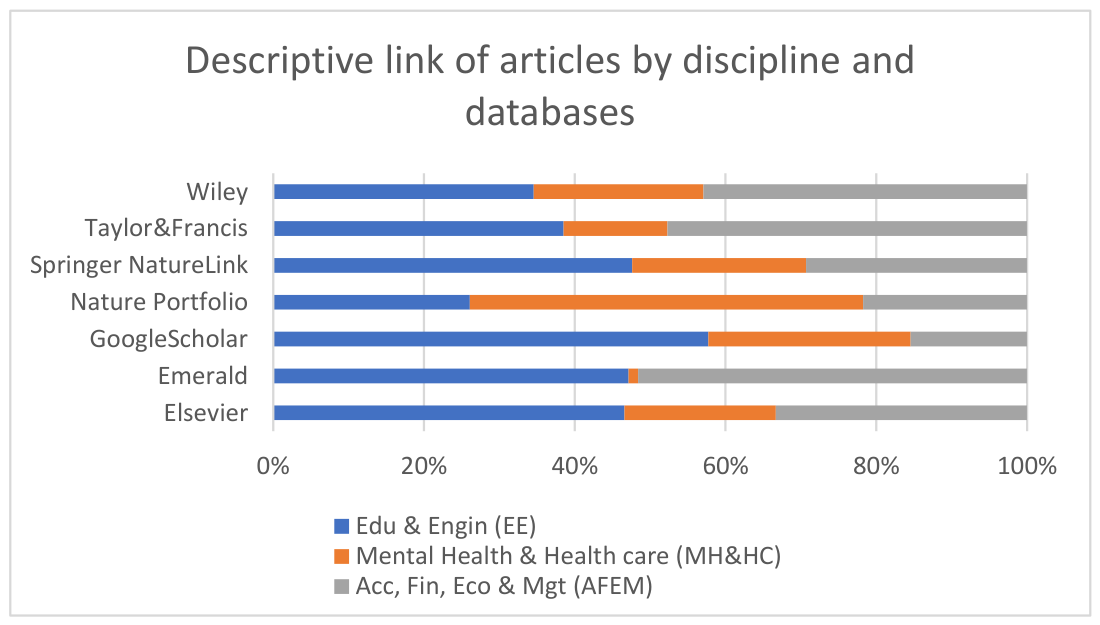
| Publishers (Database) | Elsevier | Emerald | Google Scholar | Nature Portfolio | Springer Nature Link | Taylor & Francis | Wiley | Total |
|---|---|---|---|---|---|---|---|---|
| Edu & Engin (EE) | 446 | 74 | 86 | 6 | 299 | 84 | 66 | 1061 |
| Mental Health & Health care (MH&HC) | 192 | 2 | 40 | 12 | 145 | 30 | 43 | 464 |
| Acc, Fin, Eco & Mgt (AFEM) | 319 | 81 | 23 | 5 | 184 | 104 | 82 | 798 |
| Total | 957 | 157 | 149 | 23 | 628 | 218 | 191 | 2323 |
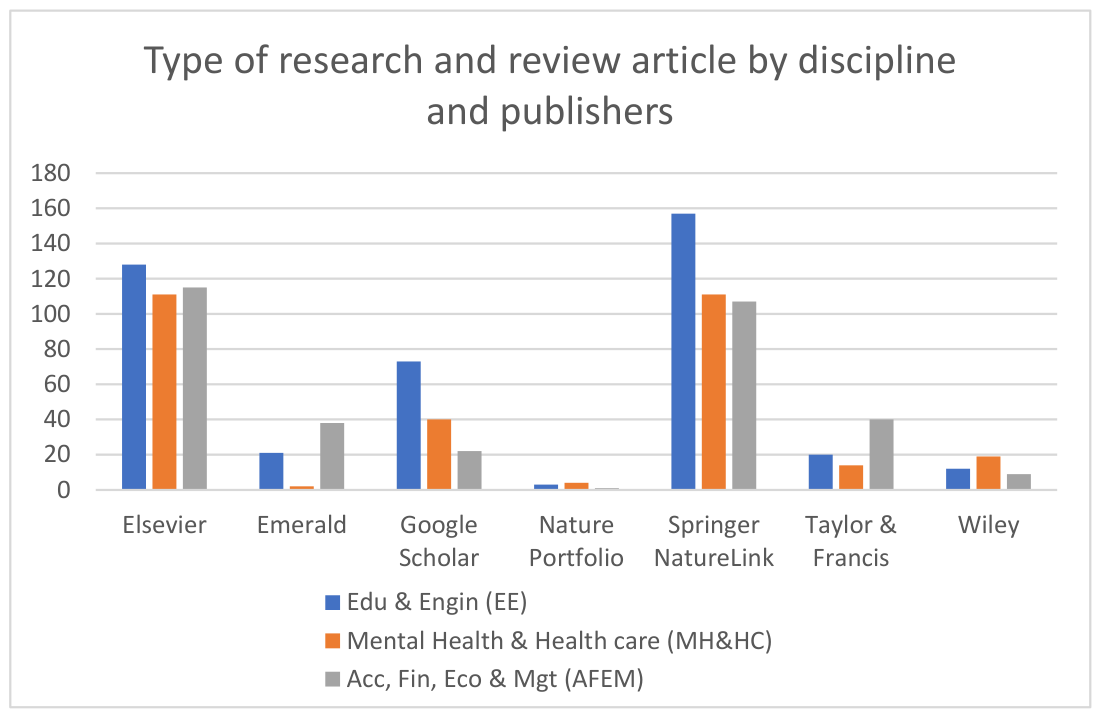
| Publishers (Database) | Elsevier | Emerald | Google Scholar | Nature Portfolio | Springer Nature Link | Taylor & Francis | Wiley | Total |
|---|---|---|---|---|---|---|---|---|
| Edu & Engin (EE) | 128 | 21 | 73 | 3 | 157 | 20 | 12 | 414 |
| Mental Health & Health care (MH&HC) | 111 | 2 | 40 | 4 | 111 | 14 | 19 | 301 |
| Acc, Fin, Eco & Mgt (AFEM) | 115 | 38 | 22 | 1 | 107 | 40 | 9 | 332 |
| Total | 354 | 61 | 135 | 8 | 375 | 74 | 40 | 1047 |
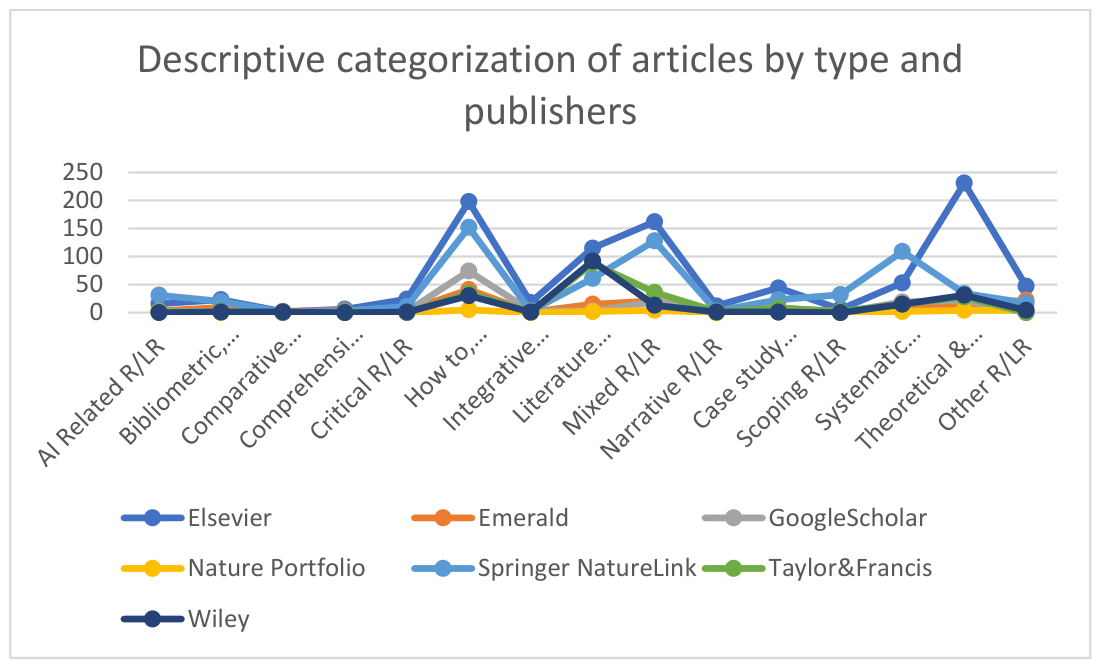
| Type of Research/Review Articles | Elsevier | Emerald | Google Scholar | Nature Portfolio | Springer Nature Link | Taylor & Francis | Wiley | Total |
|---|---|---|---|---|---|---|---|---|
| AI Related R/LR | 16 | 3 | 2 | 1 | 31 | 1 | 0 | 54 |
| Bibliometric, Brief, Mini & Rapid R/LR | 23 | 9 | 2 | 0 | 20 | 2 | 1 | 57 |
| Comparative R/LR | 2 | 2 | 0 | 0 | 1 | 0 | 1 | 6 |
| Comprehensive R/LR | 6 | 4 | 0 | 0 | 3 | 1 | 0 | 14 |
| Critical R/LR | 24 | 3 | 2 | 0 | 11 | 0 | 1 | 41 |
| How to, What, Why & Guideline R/LR | 198 | 41 | 74 | 5 | 152 | 34 | 30 | 534 |
| Integrative R/LR | 18 | 1 | 3 | 0 | 3 | 1 | 1 | 27 |
| Literature Review (LR) | 115 | 15 | 3 | 2 | 61 | 88 | 92 | 376 |
| Mixed R/LR | 162 | 21 | 19 | 4 | 128 | 36 | 13 | 383 |
| Narrative R/LR | 12 | 0 | 2 | 0 | 3 | 2 | 1 | 20 |
| Case study R/LR | 44 | 8 | 1 | 1 | 23 | 8 | 1 | 86 |
| Scoping R/LR | 6 | 2 | 0 | 0 | 32 | 2 | 0 | 42 |
| Systematic R/LR | 53 | 11 | 19 | 2 | 109 | 15 | 15 | 224 |
| Theoretical & Conceptual Framework R/LR | 231 | 15 | 22 | 4 | 34 | 28 | 31 | 365 |
| Other R/LR | 47 | 22 | 0 | 4 | 17 | 0 | 4 | 94 |
| Total | 957 | 157 | 149 | 23 | 628 | 218 | 191 | 2323 |

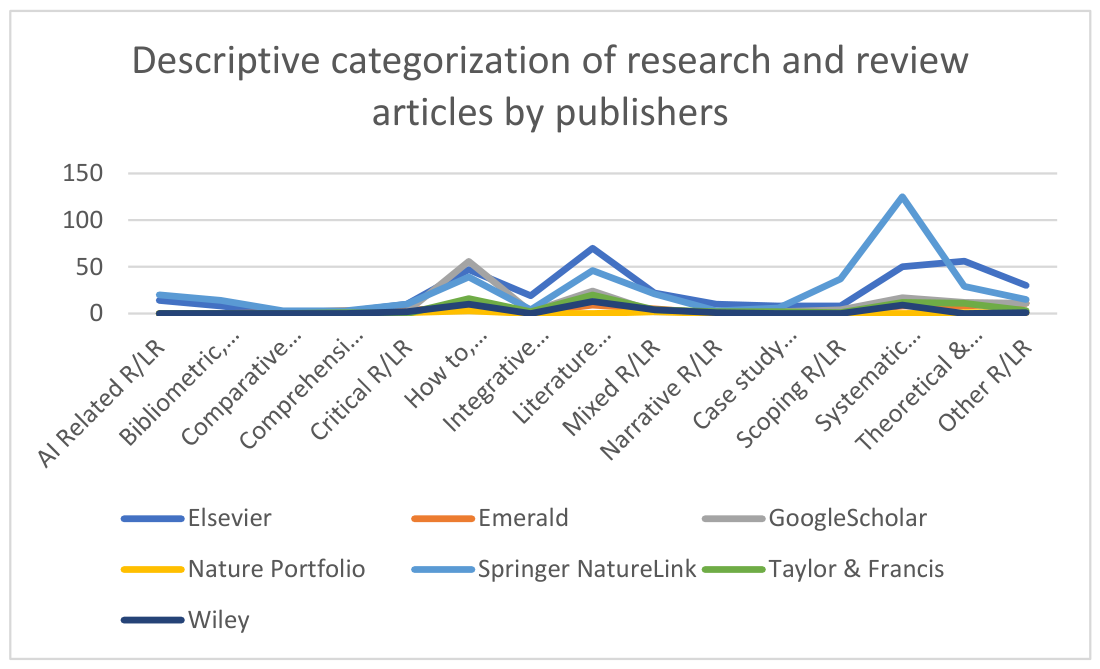
| Type of Research/Review Articles | Elsevier | Emerald | Google Scholar | Nature Portfolio | Springer Nature Link | Taylor & Francis | Wiley | Total |
|---|---|---|---|---|---|---|---|---|
| AI Related R/LR | 14 | 0 | 0 | 0 | 20 | 0 | 0 | 34 |
| Bibliometric, Brief, Mini & Rapid R/LR | 8 | 0 | 0 | 0 | 14 | 0 | 0 | 22 |
| Comparative R/LR | 0 | 1 | 0 | 0 | 3 | 0 | 0 | 4 |
| Comprehensive R/LR | 2 | 3 | 1 | 0 | 3 | 1 | 0 | 10 |
| Critical R/LR | 10 | 3 | 2 | 1 | 10 | 0 | 2 | 28 |
| How to, What, Why & Guideline R/LR | 47 | 8 | 56 | 3 | 39 | 16 | 10 | 179 |
| Integrative R/LR | 19 | 1 | 2 | 0 | 4 | 2 | 0 | 28 |
| Literature Review (LR) | 70 | 9 | 24 | 0 | 46 | 20 | 13 | 182 |
| Mixed R/LR | 22 | 5 | 2 | 2 | 21 | 4 | 4 | 60 |
| Narrative R/LR | 10 | 0 | 2 | 0 | 3 | 2 | 1 | 18 |
| Case study R/LR | 8 | 2 | 2 | 0 | 6 | 2 | 0 | 20 |
| Scoping R/LR | 8 | 2 | 4 | 0 | 37 | 1 | 0 | 52 |
| Systematic R/LR | 50 | 8 | 17 | 0 | 125 | 12 | 9 | 221 |
| Theoretical & Conceptual Framework R/LR | 56 | 8 | 12 | 1 | 29 | 11 | 0 | 117 |
| Other R/LR | 30 | 11 | 11 | 1 | 15 | 3 | 1 | 72 |
| Total | 354 | 61 | 135 | 8 | 375 | 74 | 40 | 1047 |

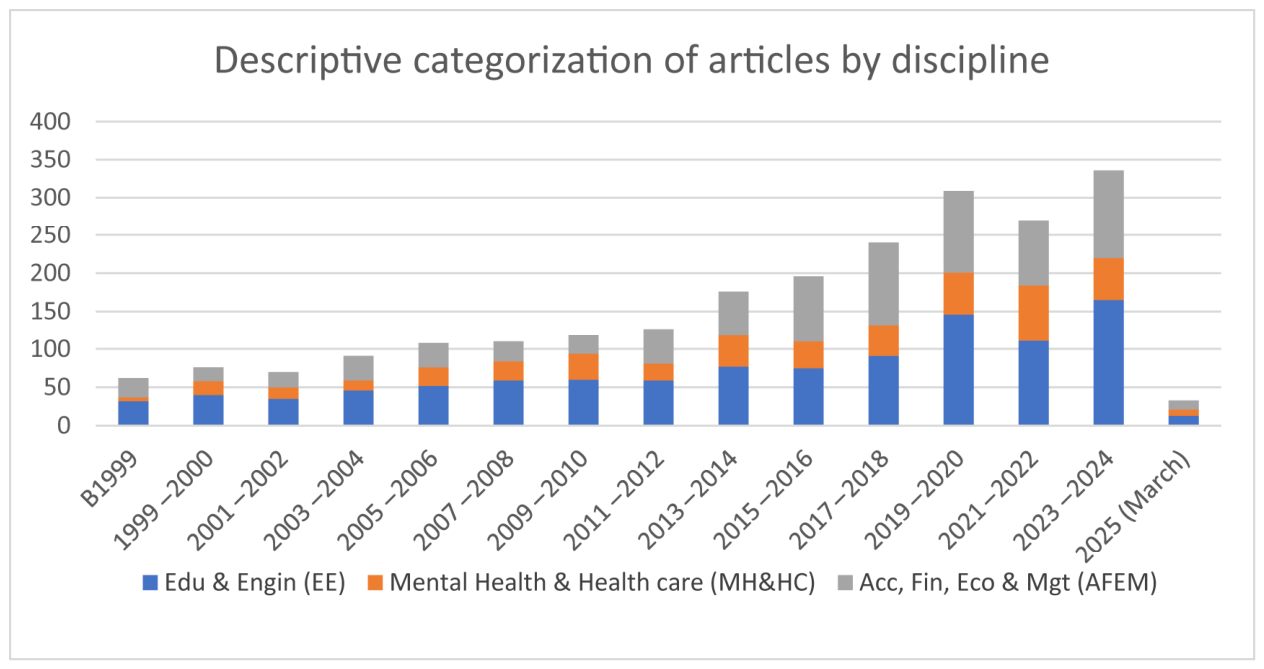
| Year/Discipline | Edu & Engin (EE) | Mental Health & Health Care (MH&HC) | Acc, Fin, Eco & Mgt (AFEM) | Total |
|---|---|---|---|---|
| B1999 | 32 | 5 | 25 | 62 |
| 1999–2000 | 40 | 18 | 18 | 76 |
| 2001–2002 | 35 | 15 | 20 | 70 |
| 2003–2004 | 46 | 13 | 32 | 91 |
| 2005–2006 | 52 | 24 | 32 | 108 |
| 2007–2008 | 59 | 25 | 26 | 110 |
| 2009–2010 | 60 | 34 | 25 | 119 |
| 2011–2012 | 59 | 22 | 46 | 127 |
| 2013–2014 | 77 | 41 | 58 | 176 |
| 2015–2016 | 75 | 35 | 86 | 196 |
| 2017–2018 | 91 | 41 | 108 | 240 |
| 2019–2020 | 146 | 55 | 108 | 309 |
| 2021–2022 | 111 | 73 | 86 | 270 |
| 2023–2024 | 165 | 55 | 116 | 336 |
| 2025 (March) | 13 | 8 | 12 | 33 |
| Total | 1061 | 464 | 798 | 2323 |

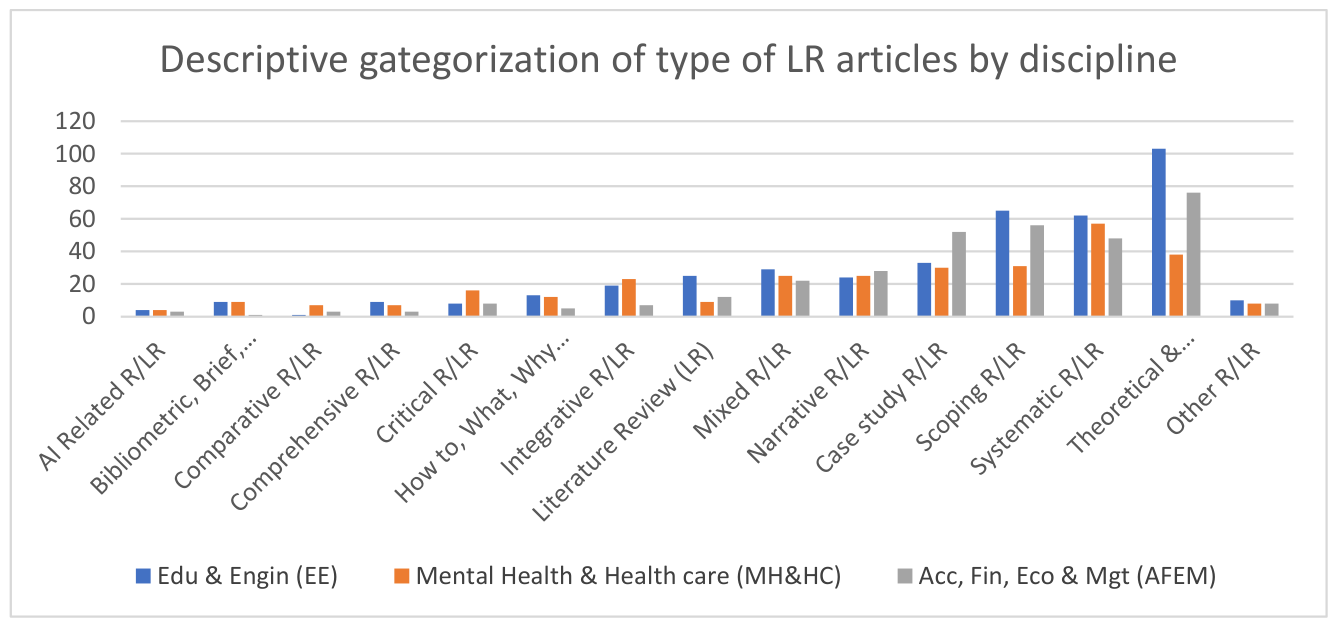
| Type of Research and Literature Review Articles/Discipline | Edu & Engin (EE) | Mental Health & Health Care (MH&HC) | Acc, Fin, Eco & Mgt (AFEM) | Total |
|---|---|---|---|---|
| AI Related R/LR | 4 | 4 | 3 | 11 |
| Bibliometric, Brief, Mini & Rapid R/LR | 9 | 9 | 1 | 19 |
| Comparative R/LR | 1 | 7 | 3 | 11 |
| Comprehensive R/LR | 9 | 7 | 3 | 19 |
| Critical R/LR | 8 | 16 | 8 | 32 |
| How to, What, Why & Guideline R/LR | 13 | 12 | 5 | 30 |
| Integrative R/LR | 19 | 23 | 7 | 49 |
| Literature Review (LR) | 25 | 9 | 12 | 46 |
| Mixed R/LR | 29 | 25 | 22 | 76 |
| Narrative R/LR | 24 | 25 | 28 | 77 |
| Case study R/LR | 33 | 30 | 52 | 115 |
| Scoping R/LR | 65 | 31 | 56 | 152 |
| Systematic R/LR | 62 | 57 | 48 | 167 |
| Theoretical & Conceptual Framework R/LR | 103 | 38 | 76 | 217 |
| Other R/LR | 10 | 8 | 8 | 26 |
| Total | 414 | 301 | 332 | 1047 |

Appendix C

| The GARP 4LR Short Focus Framework |
|---|
|
|
|
| Feature | GARP-4LR (Proposed) | PRISMA Statement | SPAR-4-SLR Protocol |
|---|---|---|---|
| Primary Scope | Multidisciplinary/Universal | Medicine and Healthcare | Business, Management, AFEM |
| Core Focus | End-to-end writing, publication, and sharing process | Reporting transparency and bias reduction | Justification of methodological decisions |
| Structure | 4 Phases, 24 Steps | 27-item checklist | 3 Stages, 14 Decisions |
| “Noise” Eliminated | Bypasses rigid statistical meta-analysis requirements for general reviews; focuses only on actionable synthesis steps | N/A (Highly rigid) | N/A (Focuses heavily on early-stage retrieval rationale) |
| Publication Phase | Explicitly included (Targeting, matching) | Not included | Briefly mentioned as a final step |
| Post-Publication | Explicitly included (Sharing, updating) | Not included | Not included |
References
- Gusenbauer, M.; Gauster, S.P. How to search for literature in systematic reviews and meta-analyses: A comprehensive step-by-step guide. Technol. Forecast. Soc. Change 2025, 212, 123833. [Google Scholar] [CrossRef]
- Kosztyán, Z.T.; Csizmadia, T.; Katona, A.I. SIMILAR—Systematic iterative multilayer literature review method. J. Informetr. 2021, 15, 101111. [Google Scholar] [CrossRef]
- Gorman, M.F. A “Metasurvey” analysis in Operations Research and Management Science: A survey of literature reviews. Surv. Oper. Res. Manag. Sci. 2016, 21, 18–28. [Google Scholar] [CrossRef]
- de Wildt, T.E.; Chappin, E.J.; van de Kaa, G.; Herder, P.M.; van de Poel, I.R. Conflicting values in the smart grid: A systematic literature review. Renew. Sustain. Energy Rev. 2018, 90, 883–891. [Google Scholar]
- Lim, W.M.; Kumar, S.; Donthu, N. How to combine and clean bibliometric data and use bibliometric tools synergistically: Guidelines using metaverse research. J. Bus. Res. 2024, 182, 114760. [Google Scholar] [CrossRef]
- Suri, H. Towards Methodologically Inclusive Research Syntheses; Routledge: London, UK, 2013. [Google Scholar]
- Braun, V.; Clarke, V. Using thematic analysis in psychology. Qual. Res. Psychol. 2006, 3, 77–101. [Google Scholar] [CrossRef]
- Hrastinski, S. What is online learner participation? A literature review. Comput. Educ. 2008, 51, 1755–1765. [Google Scholar] [CrossRef]
- Wright, K.B. Researching Internet-Based Populations: Advantages and Disadvantages of Online Survey Research, Data Collection, and Emerging Technologies. J. Comput.-Mediat. Commun. 2005, 10, JCMC1034. [Google Scholar]
- Akhigbe, T.; Zolnourian, A.; Bulters, D. Compliance of systematic reviews articles in brain arteriovenous malformation with PRISMA statement guidelines: Review of literature. J. Clin. Neurosci. 2017, 39, 45–48. [Google Scholar] [CrossRef]
- Riar, M.; Xi, N.; Korbel, J.J.; Zarnekow, R.; Hamari, J. Using augmented reality for shopping: A framework for AR induced consumer behavior, literature review and future agenda. Internet Res. 2022, 33, 242–279. [Google Scholar] [CrossRef]
- Greenhalgh, T.; Peacock, R. Effectiveness and efficiency of search methods in systematic reviews of complex evidence: Audit of primary sources. BMJ 2005, 331, 1064–1065. [Google Scholar] [CrossRef]
- Kirca, A.H.; Yaprak, A. The use of meta-analysis in international business research: Its current status and suggestions for better practice. Int. Bus. Rev. 2010, 19, 306–314. [Google Scholar] [CrossRef]
- Hrastinski, S. Asynchronous and synchronous e-learning. Educ. Q. 2008, 31, 51–55. [Google Scholar]
- Liu, S.; Zheng, P.; Bao, J. Digital Twin-based manufacturing system: A survey based on a novel reference model. J. Intell. Manuf. 2023, 35, 2517–2546. [Google Scholar] [CrossRef]
- Soltani, Z.; Navimipour, N.J. Customer relationship management mechanisms: A systematic review of the state-of-the-art literature and recommendations for future research. Comput. Hum. Behav. 2016, 61, 667–688. [Google Scholar] [CrossRef]
- Borenstein, M.; Hedges, L.V.; Higgins, J.P.; Rothstein, H.R. Introduction to Meta-Analysis; Wiley: Chichester, UK, 2009. [Google Scholar]
- Grant, M.J.; Booth, A. A typology of reviews: An analysis of 14 review types and associated methodologies. Health Inf. Libr. J. 2009, 26, 91–108. [Google Scholar] [CrossRef]
- Di Paola, N.; Chari, S.; Iannacci, F.; Kraus, S. Configurational theory in business and management research: Status quo and guidelines for the application of qualitative comparative analysis (QCA). Technol. Forecast. Soc. Change 2025, 211, 123907. [Google Scholar] [CrossRef]
- Annarelli, A.; Battistella, C.; Costantino, F.; Di Gravio, G.; Nonino, F.; Patriarca, R. New trends in product service system and servitization research: A conceptual structure emerging from three decades of literature. CIRP J. Manuf. Sci. Technol. 2021, 32, 424–436. [Google Scholar] [CrossRef]
- Franco-Santos, M.; Lucianetti, L.; Bourne, M. Contemporary performance measurement systems: A review of their consequences and a framework for research. Manag. Account. Res. 2012, 23, 79–119. [Google Scholar] [CrossRef]
- Stange, R.; Schiele, H.; Henseler, J. Advancing purchasing as a design science: Publication guidelines to shift towards more relevant purchasing research. J. Purch. Supply Manag. 2022, 28, 100750. [Google Scholar] [CrossRef]
- Yousefian, J.; Zadeh, A.H.; Franklin, R.; Vanevenhoven, J. Factors correlated with the perceived usefulness of online reviews for consumers: A meta-analysis of the moderating effects of product type. J. Retail. Consum. Serv. 2021, 61, 102554. [Google Scholar]
- Sauer, P.C.; Seuring, S. How to conduct systematic literature reviews in management research: A guide in 6 steps and 14 decisions. Rev. Manag. Sci. 2023, 17, 1411–1446. [Google Scholar] [CrossRef]
- Carroll, C.; Rick, J.; Leaviss, J.; Fishwick, D.; Booth, A. A qualitative evidence synthesis of employees’ views of workplace smoking cessation interventions. BMC Public Health 2013, 13, 1095. [Google Scholar] [CrossRef]
- Wee, B.V.; Banister, D. How to Write a Literature Review Paper? Transp. Rev. 2016, 36, 278–288. [Google Scholar] [CrossRef]
- Nowell, L.; Paolucci, A.; Dhingra, S.; Jacobsen, M.; Lorenzetti, D.L.; Lorenzetti, L.; Oddone-Paolucci, E. Interdisciplinary mixed methods systematic reviews: Reflections on methodological best practices, theoretical considerations, and practical implications across disciplines. Soc. Sci. Humanit. Open 2022, 6, 100295. [Google Scholar] [CrossRef]
- Koons, G.L.; Schenke-Layland, K.; Mikos, A.G. Literature review as a research methodology: An overview and guidelines. J. Bus. Res. 2024, 170, 114–120. [Google Scholar]
- Schmidt, L.; Sinyor, M.; Webb, R.T.; Marshall, C.; Knipe, D.; Eyles, E.C.; John, A.; Gunnell, D.; Higgins, J.P. A narrative review of recent tools and innovations toward automating living systematic reviews and evidence syntheses. Z. Evid. Fortbild. Qual. Gesundheitswesen 2023, 181, 65–75. [Google Scholar] [CrossRef]
- Rowley, J.; Slack, F. Conducting a literature review. Manag. Res. News 2004, 27, 31–39. [Google Scholar] [CrossRef]
- Burgers, C.; Brugman, B.C.; Boeynaems, A. Systematic literature reviews: Four applications for interdisciplinary research. J. Pragmat. 2019, 145, 102–109. [Google Scholar] [CrossRef]
- Carnevalli, J.A.; Miguel, P.C. Review, analysis and classification of the literature on QFD-Types of research, difficulties and benefits. Int. J. Prod. Econ. 2008, 114, 737–754. [Google Scholar] [CrossRef]
- Phillips-Beck, W.; Bukich, B.L.J.; Thiessen, K.; Lavoie, J.G.; Schultz, A.; Sanguins, J.; Beck, G.; Longclaws, B.; Shingoose, G.; Palmer, M.; et al. An Indigenous-informed scoping review study methodology: Advancing the science of scoping reviews. Syst. Rev. 2024, 13, 181. [Google Scholar] [CrossRef]
- Webster, J.; Watson, R.T. Analyzing the Past to Prepare for the Future: Writing a Literature Review. MIS Q. 2002, 26, xiii–xxiii. [Google Scholar] [CrossRef]
- Rana, N.P.; Dwivedi, Y.K.; Williams, M.D.; Weerakkody, V. Adoption of online public grievance redressal system in India: Toward developing a unified view. Comput. Hum. Behav. 2016, 59, 265–282. [Google Scholar] [CrossRef]
- Lattanzi, L.; Raffaeli, R.; Peruzzini, M.; Pellicciari, M. Digital Twin for Smart Manufacturing: A Review of Concepts Towards a Practical Industrial Implementation. Int. J. Comput. Integr. Manuf. 2021, 34, 567–597. [Google Scholar] [CrossRef]
- Tarique, I.; Schuler, R.S. Global talent management: Literature review, integrative framework, and suggestions for further research. J. World Bus. 2010, 45, 122–133. [Google Scholar] [CrossRef]
- Combs, J.P.; Onwuegbuzie, A.J.; Edgette, J.S.; Harris, K.M.; Frels, R.K. An interactive literature review process (ILRP) meta-framework for doctoral students. Int. J. Mult. Res. Approaches 2010, 4, 159–176. [Google Scholar] [CrossRef]
- Cronin, P.; Ryan, F.; Coughlan, M. Undertaking a literature review: A step-by-step approach. Br. J. Nurs. 2008, 17, 38–43. [Google Scholar] [CrossRef]
- Carroll, C. Qualitative evidence synthesis to aid healthcare decision making. BMJ 2024, 384, e074092. [Google Scholar]
- Sousa Filho, L.F.; Farlie, M.K.; Haines, T.; Borrelli, B.; Carroll, C.; Mathews, C.; Ribeiro, D.C.; Fritz, J.M.; Underwood, M.; Foster, N.E.; et al. Developing an international consensus Reporting guideline for intervention Fidelity in Non-Drug, non-surgical trials: The ReFiND protocol. Contemp. Clin. Trials 2024, 142, 107575. [Google Scholar] [CrossRef]
- Barry, E.S.; Merkebu, J.; Varpio, L. State-of-the-art (SotA) review methodology. Perspect. Med. Educ. 2022, 11, 1–7. [Google Scholar] [CrossRef]
- Vom Brocke, J.; Simons, A.; Niehaves, B.; Niehaves, B.; Riemer, K.; Plattfaut, R.; Cleven, A. Reconstructing the Giant: On the Importance of Rigour in Documenting the Literature Search Process. In Proceedings of the 17th European Conference on Information Systems, (ECIS), Verona, Italy, 8–10 June 2009; pp. 2206–2217. [Google Scholar]
- Froese, A.D.; Gantz, B.S.; Henry, A.L. Using a meta-analytic model to teach undergraduate psychology students how to write a literature review. Teach. Psychol. 1998, 25, 273–275. [Google Scholar] [CrossRef]
- Rylee, T.L.; Cavanagh, S.J. Conducting a literature review using qualitative data analysis software: A step-by-step process. Health Serv. Outcomes Res. Methodol. 2022, 22, 1–18. [Google Scholar]
- Mishra, V.; Mishra, M.P. Prisma for Review of Management Literature—Method, Merits, and Limitations—An Academic Review. Rev. Manag. Lit. 2023, 2, 125–136. [Google Scholar]
- Callahan, J.L. Writing Literature Reviews: A Reprise and Update. Hum. Resour. Dev. Rev. 2014, 13, 271–275. [Google Scholar] [CrossRef]
- Conn, V.S.; Coon Sells, T.G. Is It Time to Write a Review Article? West. J. Nurs. Res. 2014, 36, 435–439. [Google Scholar]
- Boote, D.N.; Beile, P. Scholars Before Researchers: On the Centrality of the Dissertation Literature Review in Research Preparation. Educ. Res. 2005, 34, 3–15. [Google Scholar] [CrossRef]
- Schryen, G.; Wagner, G.; Benlian, A.; Paré, G. A Knowledge Development Perspective on Literature Reviews: Validation of a new Typology in the IS Field. Commun. Assoc. Inf. Syst. 2020, 46, 134–186. [Google Scholar] [CrossRef]
- Templier, M.; Paré, G. Transparency in literature reviews: An assessment of reporting practices across review types and genres in top IS journals. Eur. J. Inf. Syst. 2018, 27, 503–550. [Google Scholar] [CrossRef]
- Paré, G.; Trudel, M.C.; Jaana, M.; Kitsiou, S. Synthesizing information systems knowledge: A typology of literature reviews. Inf. Manag. 2015, 52, 183–199. [Google Scholar] [CrossRef]
- Kraus, S.; Breier, M.; Lim, W.M.; Dabić, M.; Kumar, S.; Kanbach, D.; Mukherjee, D.; Corvello, V.; Piñeiro-Chousa, J.; Liguori, E.; et al. Literature reviews as independent studies: Guidelines for academic practice. Rev. Manag. Sci. 2022, 16, 2577–2595. [Google Scholar] [CrossRef]
- Khoo, C.S.G.; Rozaklis, L.; Hall, C. Macro-level discourse structure of literature reviews. Online Inf. Rev. 2011, 35, 1–22. [Google Scholar] [CrossRef]
- Seuring, S.; Yawar, S.A.; Land, A.; Khalid, R.U.; Sauer, P.C. The application of theory in literature reviews—Illustrated with examples from supply chain management. Int. J. Oper. Prod. Manag. 2021, 41, 1–20. [Google Scholar] [CrossRef]
- Xiao, Y.; Watson, M. Guidance on Conducting a Systematic Literature Review. J. Plan. Educ. Res. 2019, 39, 93–112. [Google Scholar] [CrossRef]
- Haddaway, N.R.; Collins, A.M.; Coughlin, D.; Kirk, S. Eight problems with literature reviews and how to fix them. Nat. Ecol. Evol. 2020, 4, 1150–1155. [Google Scholar] [CrossRef]
- Tricco, A.C.; Lillie, E.; Zarin, W.; O’Brien, K.K.; Colquhoun, H.; Levac, D.; Moher, D.; Peters, M.D.; Horsley, T.; Weeks, L.; et al. PRISMA extension for scoping reviews (PRISMA-ScR): Checklist and explanation. Ann. Intern. Med. 2018, 169, 467–473. [Google Scholar] [CrossRef]
- Booth, A.; Sutton, A.; Papaioannou, D. Systematic Approaches to a Successful Literature Review; Sage: London, UK, 2016. [Google Scholar]
- Yu, J.; Song, Y.; Karakoç, A.; Heikkilä, P.; Sirviö, J.A.; Liimatainen, H.; Panschin, S. Recent progress in cellulose nanocrystals: Sources and applications. Nanomaterials 2017, 7, 28. [Google Scholar]
- Gulotta, T.M.; Salomone, R.; Mondello, G.; Ricca, B. FLAVIA-LCT: Framework for systematic literature review to analyse vast InformAtion in life cycle thinking studies. Heliyon 2023, 9, e15547. [Google Scholar] [CrossRef]
- Buetow, S.; Lovatt, J. From insight to innovation: Harnessing artificial intelligence for dynamic literature reviews. J. Acad. Librariansh. 2024, 50, 102901. [Google Scholar] [CrossRef]
- Evans, D.; Pearson, A. Systematic reviews: Gatekeepers of nursing knowledge. J. Clin. Nurs. 2001, 10, 593–599. [Google Scholar] [CrossRef]
- Juntunen, M.; Lehenkari, M. A narrative literature review process for an academic business research thesis. Stud. High. Educ. 2021, 46, 330–342. [Google Scholar] [CrossRef]
- Randolph, J.J. A Guide to Writing the Dissertation Literature Review. Pract. Assess. Res. Eval. 2009, 14, 13. [Google Scholar]
- Moher, D.; Shamseer, L.; Clarke, M.; Ghersi, D.; Liberati, A.; Petticrew, M.; Shekelle, P.; Stewart, L.A. Preferred reporting items for systematic review and meta-analysis protocols (PRISMA-P) 2015 statement. Syst. Rev. 2015, 4, 1. [Google Scholar] [CrossRef]
- Bassey, E.; Mulligan, E.; Ojo, A. A conceptual framework for digital tax administration—A systematic review. Gov. Inf. Q. 2022, 39, 101754. [Google Scholar] [CrossRef]
- Koivu, A.M.; Hunter, P.J.; Näsänen-Gilmore, P.; Muthiani, Y.; Isojärvi, J.; Pörtfors, P.; Ashorn, U.; Ashorn, P. Modular literature review: A novel systematic search and review method to support priority setting in health policy and practice. BMC Med. Res. Methodol. 2021, 21, 268. [Google Scholar] [CrossRef]
- Diaz Tautiva, J.A.; Rifo Rivera, F.I.; Barros Celume, S.A.; Rifo Rivera, S.A. Mapping the research about organisations in the latin american context: A bibliometric analysis. Manag. Rev. Q. 2024, 74, 121–169. [Google Scholar] [CrossRef]
- Albasheer, O.; Abdelwahab, S.I.; Zaino, M.R.; Altraifi, A.A.A.; Hakami, N.; El-Amin, E.I.; Alshehri, M.M.; Alghamdi, S.M.; Alqahtani, A.S.; Alenazi, A.M.; et al. The impact of social isolation and loneliness on cardiovascular disease risk factors: A systematic review, meta-analysis, and bibliometric investigation. Sci. Rep. 2024, 14, 12871. [Google Scholar] [CrossRef]
- Mohamed Shaffril, H.A.; Samsuddin, S.F.; Samah, A.A. GuFSyADD: A guideline for developing a systematic literature review for climate change adaptation studies. Environ. Sci. Pollut. Res. 2021, 28, 44677–44692. [Google Scholar]
- Reijers, W.; Wright, D.; Brey, P.; Weber, K.; Rodrigues, R.; O’Sullivan, D.; Gordijn, B. Methods for Practising Ethics in Research and Innovation: A Literature Review, Critical Analysis and Recommendations. Sci. Eng. Ethics 2018, 24, 1437–1459. [Google Scholar] [CrossRef]
- Kritzinger, W.; Karner, M.; Traar, G.; Henjes, J.; Sihn, W. Digital Twin in manufacturing: A categorical literature review and classification. IFAC-PapersOnLine 2018, 51, 1016–1022. [Google Scholar] [CrossRef]
- Romme, A.G.L. Making a difference: Organization as design. Organ. Sci. 2003, 14, 558–573. [Google Scholar] [CrossRef]
- Bayazit, N. Investigating design: A review of forty years of design research. Des. Issues 2004, 20, 16–29. [Google Scholar] [CrossRef]
- van Aken, J.E. Management research based on the design science paradigm: The quest for field-tested and grounded technological rules. J. Manag. Stud. 2004, 41, 219–246. [Google Scholar]
- Gulati, R. Tent poles, tribalism, and boundary spanning: The rigor-relevance debate in management research. Acad. Manag. J. 2007, 50, 775–782. [Google Scholar] [CrossRef]
- Cooper, H.M. The Integrative Research Review: A Systematic Approach; Sage: Beverly Hills, CA, USA, 1985. [Google Scholar]
- Cook, D.J.; Mulrow, C.D.; Haynes, R.B. Systematic reviews: Synthesis of best evidence for clinical decisions. Ann. Intern. Med. 1997, 126, 376–380. [Google Scholar] [CrossRef]
- Gough, D.; Oliver, S.; Thomas, J. An Introduction to Systematic Reviews; Sage: London, UK, 2012. [Google Scholar]
- Booth, A. Searching for qualitative research for inclusion in systematic reviews: A structured methodological review. Syst. Rev. 2016, 5, 74. [Google Scholar] [CrossRef]
- Davies, P. The relevance of systematic reviews to educational policy and practice. Oxf. Rev. Educ. 2000, 26, 365–378. [Google Scholar] [CrossRef]
- Van Acker, J.; Wee, B.; Witlox, F. When transport geography meets social psychology: Toward a conceptual model of travel behaviour. Transp. Rev. 2010, 30, 219–240. [Google Scholar] [CrossRef]
- Denyer, D.; Tranfield, D. Producing a systematic review. In The Sage Handbook of Organizational Research Methods; Buchanan, D.A., Bryman, A., Eds.; Sage: London, UK, 2009; pp. 671–689. [Google Scholar]
- Onwuegbuzie, A.J.; Frels, R.K. Discourse analysis-based research synthesis (DARS): A framework for using discourse analysis to review literature. Couns. Outcome Res. Eval. 2014, 5, 52–63. [Google Scholar] [CrossRef]
- Choi, B.C.; Pak, A.W. Multidisciplinarity, interdisciplinarity and transdisciplinarity in health research, services, education and policy: 1. Definitions, objectives, and evidence of effectiveness. Clin. Investig. Med. 2006, 29, 351–364. [Google Scholar]
- Cooper, H.M. Scientific guidelines for conducting integrative research reviews. Rev. Educ. Res. 1982, 52, 291–302. [Google Scholar] [CrossRef]
- Kitchenham, B.; Charters, S. Guidelines for Performing Systematic Literature Reviews in Software Engineering; Technical Report EBSE 2007-001; Keele University: Keele, UK, 2007. [Google Scholar]
- Hart, C. Doing a Literature Review: Releasing the Social Science Research Imagination; Sage: London, UK, 1998. [Google Scholar]
- Rousseau, D.M.; Manning, J.; Denyer, D. Evidence-based management: Foundations, development, controversies and progress. Acad. Manag. Ann. 2008, 2, 475–515. [Google Scholar] [CrossRef]
- Okoli, C.; Schabram, K. A guide to conducting a systematic literature review of information systems research. Sprouts Work. Pap. Inf. Syst. 2010, 10, 26. [Google Scholar] [CrossRef]
- Templier, M.; Paré, G. A framework for guiding and evaluating theory development literature reviews. Technol. Forecast. Soc. Change 2015, 101, 112–124. [Google Scholar]
- Shamseer, L.; Moher, D.; Clarke, M.; Ghersi, D.; Liberati, A.; Petticrew, M.; Shekelle, P.; Stewart, L.A. Preferred reporting items for systematic review and meta-analysis protocols (PRISMA-P) 2015: Elaboration and explanation. BMJ 2015, 349, g7647. [Google Scholar] [CrossRef]
- Pandey, P.; Gupta, S.; Gupta, D. Enhancing the systematic literature review: A double-stage SLR approach. Heliyon 2024, 10, e25633. [Google Scholar] [CrossRef]
- Jalali, S.; Wohlin, C. Systematic literature studies: Database searches vs. backward snowballing. In Proceedings of the 2012 ACM-IEEE International Symposium on Empirical Software Engineering and Measurement, Lund, Sweden, 19–20 September 2012; pp. 29–38. [Google Scholar]
- Durach, C.F.; Kembro, J.; Wieland, A. A new paradigm for systematic literature reviews in supply chain management. J. Supply Chain Manag. 2017, 53, 67–85. [Google Scholar] [CrossRef]
- Tranfield, D.; Denyer, D.; Smart, P. Towards a methodology for developing evidence-informed management knowledge by means of systematic review. Br. J. Manag. 2003, 14, 207–222. [Google Scholar] [CrossRef]
- Paul, J.; Lim, W.M.; O’Cass, A.; Hao, A.W.; Bresciani, S. Scientific procedures and rationales for systematic literature reviews (SPAR-4-SLR). Int. J. Consum. Stud. 2021, 45, O1–O16. [Google Scholar] [CrossRef]
- Moher, D.; Liberati, A.; Tetzlaff, J.; Altman, D.G. Preferred reporting items for systematic reviews and meta-analyses: The PRISMA statement. PLoS Med. 2009, 6, e1000097. [Google Scholar] [CrossRef]
- Page, M.J.; McKenzie, J.E.; Bossuyt, P.M.; Boutron, I.; Hoffmann, T.C.; Mulrow, C.D.; Shamseer, L.; Tetzlaff, J.M.; Akl, E.A.; Brennan, S.E.; et al. The PRISMA 2020 statement: An updated guideline for reporting systematic reviews. BMJ 2021, 372, n71. [Google Scholar] [CrossRef]
- Aromataris, E.; Munn, Z. JBI Manual for Evidence Synthesis; JBI: Adelaide, Australia, 2020. [Google Scholar]
- Thomas, J.; Harden, A. Methods for the thematic synthesis of qualitative research in systematic reviews. BMC Med. Res. Methodol. 2008, 8, 45. [Google Scholar] [CrossRef]
- Joanna Briggs Institute. The Joanna Briggs Institute Critical Appraisal Tools for Use in JBI Systematic Reviews; JBI: Adelaide, Australia, 2017. [Google Scholar]
- Okoli, C.; Pawlowski, S.D. The Delphi method as a research tool: An example, design considerations and applications. Inf. Manag. 2004, 42, 15–29. [Google Scholar] [CrossRef]
- Fink, A. Conducting Research Literature Reviews: From the Internet to Paper, 3rd ed.; SAGE Publications: Thousand Oaks, CA, USA, 2010. [Google Scholar]
- Piggott, T.; Moja, L.; Jenei, K.; Kredo, T.; Skoetz, N.; Banzi, R.; Trapani, D.; Leong, T.; McCaul, M.; Lavis, J.N.; et al. Grading of recommendations, assessment, development and evaluations concept 7. J. Clin. Epidemiol. 2024, 166, 111054. [Google Scholar]
- Roy, S.; Chakraborti, T.; Chowdhury, A.; Chakraborti, S. Role of PKC-η in NF-κB-MT1-MMP-mediated activation of proMMP-2 by TNF-α in pulmonary artery smooth muscle cells. J. Biochem. 2013, 153, 289–302. [Google Scholar] [CrossRef]
- Schulz, K.F.; Altman, D.G.; Moher, D. CONSORT 2010 Statement: Updated guidelines for reporting parallel group randomised trials. BMJ 2010, 340, c332. [Google Scholar] [CrossRef]
- Kraft, J.M.; Paina, L.; Boydell, V.; Elnakib, S.; Sihotang, A.; Bailey, A.; Tolmie, C. Social Accountability Reporting for Research (SAR4Research) checklist: Checklist to strengthen reporting on studies on social accountability in the literature. Int. J. Equity Health 2022, 21, 121. [Google Scholar] [CrossRef]
- Muka, T.; Glisic, M.; Milic, J.; Verhoog, S.; Bohlius, J.; Bramer, W.; Chowdhury, R.; Franco, O.H. A 24-step guide on how to design, conduct, and successfully publish a systematic review and meta-analysis in medical research. Eur. J. Epidemiol. 2020, 35, 49–60. [Google Scholar] [CrossRef]
- Shi, L.; Ding, Y.; Cheng, B. Development and Application of Digital Twin Technique in Steel Structures. Appl. Sci. 2024, 14, 11685. [Google Scholar] [CrossRef]
- Richardson, W.S.; Wilson, M.C.; Nishikawa, J.; Hayward, R.S. The well-built clinical question: A key to evidence-based decisions. ACP J. Club 1995, 123, A12–A13. [Google Scholar] [CrossRef]
- Arksey, H.; O’Malley, L. Scoping studies: Towards a methodological framework. Int. J. Soc. Res. Methodol. 2005, 8, 19–32. [Google Scholar] [CrossRef]
- Higgins, J.P.; Green, S.; Ben Van Den, A. (Eds.) Cochrane Handbook for Systematic Reviews of Interventions, 2nd ed.; Wiley-Blackwell: Hoboken, NJ, USA, 2019. [Google Scholar]
- Kitchenham, B.; Brereton, O.P.; Budgen, D.; Turner, M.; Bailey, J.; Linkman, S. Systematic literature reviews in software engineering—A systematic literature review. Inf. Softw. Technol. 2009, 51, 7–15. [Google Scholar] [CrossRef]
- Ahmed, M.; Othman, R.; Noordin, M.F.; Ibrahim, A.A.; Al-Hussaini, A.I.S. Factors influencing open science participation through research data sharing and reuse among researchers: A systematic literature review. Knowl. Inf. Syst. 2025, 67, 2801–2853. [Google Scholar] [CrossRef]
- Lamé, G. Systematic Literature Reviews: An Introduction. In Proceedings of the 22nd International Conference on Engineering Design (ICED19), Delft, The Netherlands, 5–8 August 2019; pp. 1633–1642. [Google Scholar] [CrossRef]
- Pati, D.; Lorusso, L.N. How to Write a Systematic Review of the Literature. Health Environ. Res. Des. J. 2017, 10, 15–30. [Google Scholar] [CrossRef]
- Alsalami, A.I. Literature review as a key step in research processes: Case study of MA dissertations written on EFL of Saudi context. Saudi J. Lang. Stud. 2022, 2, 153–169. [Google Scholar] [CrossRef]
- Denzin, N.K.; Lincoln, Y.S. (Eds.) Grounded Theory. In The Sage Handbook of Qualitative Research; Sage: Thousand Oaks, CA, USA, 2011. [Google Scholar]
- Dhammi, I.K.; Haq, R.U. How to Write Systematic Review or Metaanalysis. Indian J. Orthop. 2018, 52, 575–577. [Google Scholar] [CrossRef]
- Wright, R.W.; Brand, R.A.; Dunn, W.; Spindler, K.P. How to write a systematic review. Clin. Orthop. Relat. Res. 2007, 455, 23–29. [Google Scholar] [CrossRef]
- Shaffril, H.A.M.; Samah, A.A.; Samsuddin, S.F. Guidelines for developing a systematic literature review for studies related to climate change adaptation. Environ. Sci. Pollut. Res. 2021, 28, 22265–22277. [Google Scholar] [CrossRef]
- Su, S.; Zhong, R.Y.; Jiang, Y. Digital Twin and Its Applications in the Construction Industry: A State-of-Art Systematic Review. Digit. Twin 2024, 2, 2501499. [Google Scholar] [CrossRef]





| Field | Discipline | Research Area/Subject |
|---|---|---|
| Applied Science (AP) | Education and Engineering (EE) | Information and Communication Technology |
| Writing | ||
| Teaching and Learning | ||
| Linguistic | ||
| Computer Science | ||
| Automation | ||
| Machine Learning | ||
| Artificial Intelligence | ||
| Transportation & construction | ||
| Others (Mathematics, TLLM) | ||
| Medical Science (MS) | Mental Health and Health Care (MH&HC) | Mental Health |
| Health care | ||
| Pandemic & chronicle Diseases | ||
| Patient care (Nursing) | ||
| Other (Pharmacy, Radiography) | ||
| Social Science and Humanities (SS&H) | Accounting, Finance, Economy and Management (AFEM) | Supply Chain & Logistics |
| Information Technology | ||
| Digital Transformation | ||
| Corporate Performance | ||
| Product/HR management | ||
| E-commerce | ||
| Innovation | ||
| Sustainability | ||
| Other (ESG, Labor, Tourism) | ||
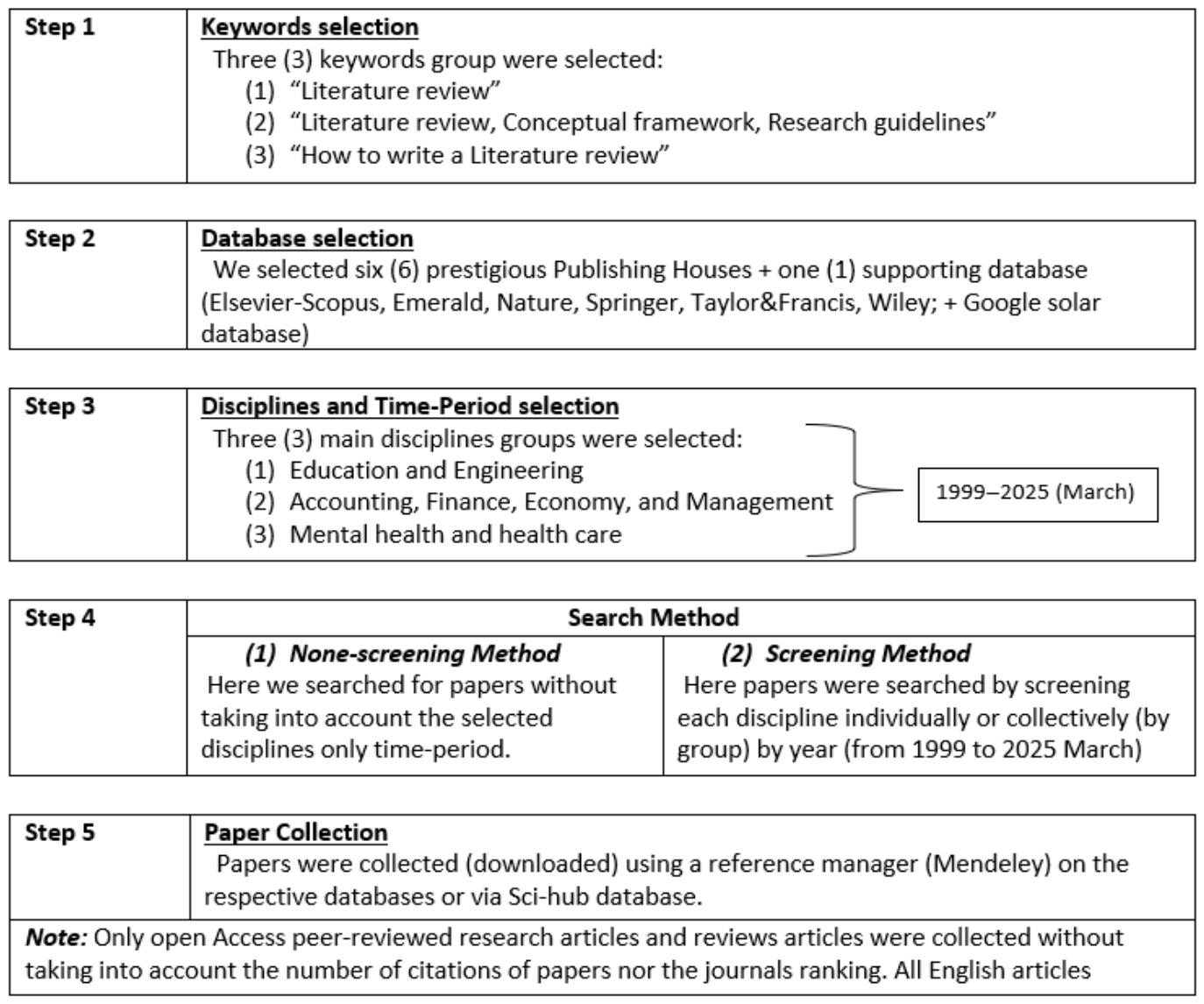
| Only peer-reviewed research articles and review articles were collected (Guideline and Practical studies) | ||
| Criteria for Papers Collection | |
|---|---|
| Step 1 |
|
| Step 2 |
|
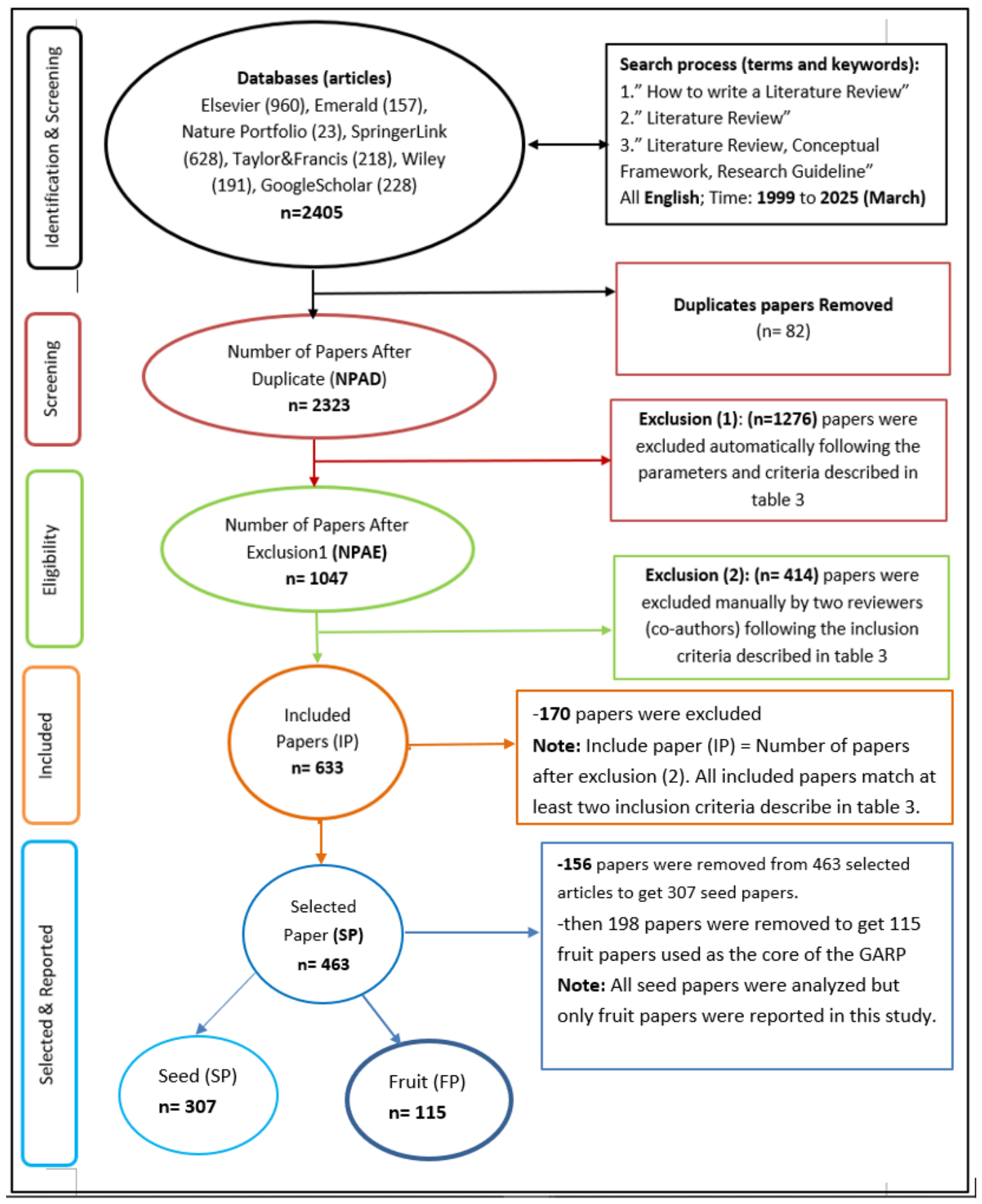
| Data Processing Parameters and Criteria (Initial Sample Size n = 2405) | Content Analysis | |
|---|---|---|
| Code | Extracted Items | |
| Exclusion Criteria (P1) All articles not related to the scope (Discipline and subject of interest) of the study were excluded (see Table 1). | (As) | Authors |
| (PY) | Publication Year | |
| (TA) | Type of Article | |
| (D) | Discipline | |
| Collection Criteria Peer-reviewed research article and review article from seven (7) databases (6 prestigious publishers and Google Scholar). All Open Access articles published in English (see Figure 1). | (J) | Journal |
| (P) | Publisher | |
| TLRI | Type of Literature Review Identified | |
| (M) | Methodology | |
| (SS) or (CA) | Sample Size or Core Articles | |
| (SU) | Software used | |
| Inclusion Criteria Articles were included by matching at least three (3) of the following parameters: (P1): Paper related to this study subject of interest is limited in Table 1. (P2): Guideline paper related to the scope of the study and/or proposing a new framework. (P3): Practical paper applying existing guideline (framework) or methodology (P4): Mixed research combining both (P2) and (P3). (P5): Paper containing at least one figure and one table (except those matching the topic of the present study). (P5): Paper with a methodology section and a clear structure. (P6): Paper listing and/or defining the different types of literature review (e.g., [2]). (P7): Paper proposing a checklist, a step-by-step guideline, or a chronological framework on how to write a literature review article (e.g., [56]). (P8): Chosen by the independent reviewer (Co-authors) and corresponding author (e.g., [26]). | (DB) | Databases Used |
| (PG) | Proposed Guideline or Framework | |
| (R) | Recommendation | |
| (RG) | Research Gaps | |
| (L) | Limitations | |
| (A, B, C) | Qualitative Score of the paper | |
| (Y) | Yes | |
| (N) | No | |
| (T) | Theory | |
| (IC) | Inclusion Criteria | |
| (SP) | Selected Paper | |
| (RP) | Reported Paper | |
| (NPAE) | Number of Paper After Duplicate | |
| (NPAE) | Number of Paper After Exclusion | |
| (IP) | Included Paper | |
| (SA) | Size of the Article | |
| (P) | Parameters | |
| (O) | Optional | |
| (C) | Compulsory | |
| (Ob) | (Objective) | |
| (KF) | Key Findings | |
| (Final Sample Size n = 115) | ||
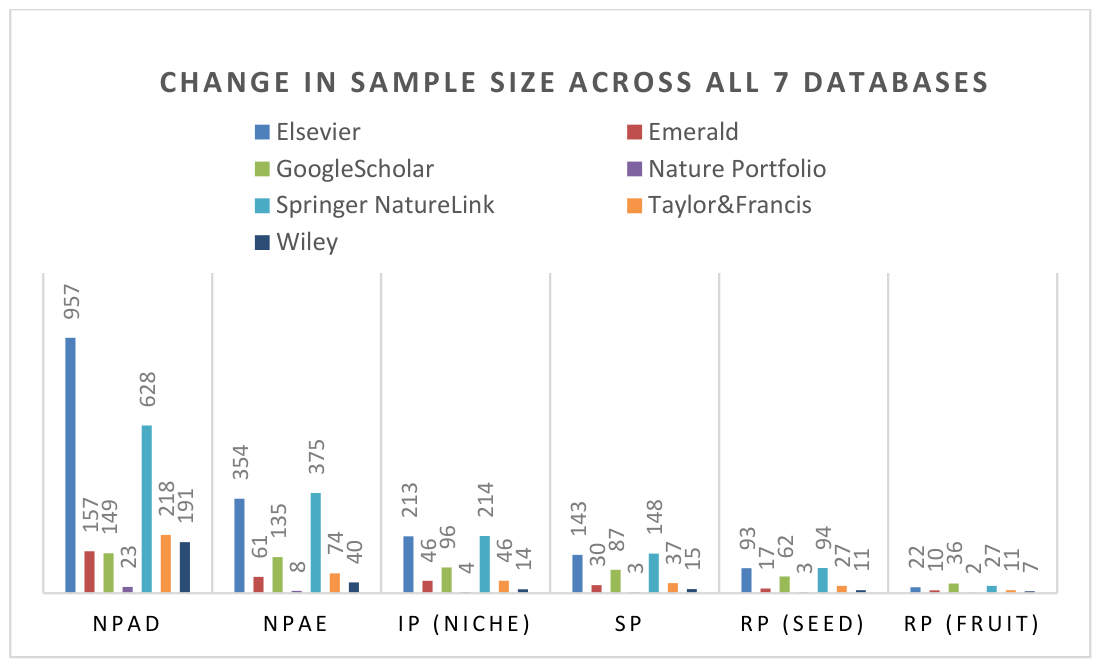
| Publishers (Databases) | NPAD | NPAE | IP (Niche) | SP | RP (Seed) | RP (Fruit) |
|---|---|---|---|---|---|---|
| Elsevier | 957 | 354 | 213 | 143 | 93 | 22 |
| Emerald | 157 | 61 | 46 | 30 | 17 | 10 |
| Google Scholar | 149 | 135 | 96 | 87 | 62 | 36 |
| Nature Portfolio | 23 | 8 | 4 | 3 | 3 | 2 |
| Springer Nature Link | 628 | 375 | 214 | 148 | 94 | 27 |
| Taylor & Francis | 218 | 74 | 46 | 37 | 27 | 11 |
| Wiley | 191 | 40 | 14 | 15 | 11 | 7 |
| Total | 2323 | 1047 | 633 | 463 | 307 | 115 |
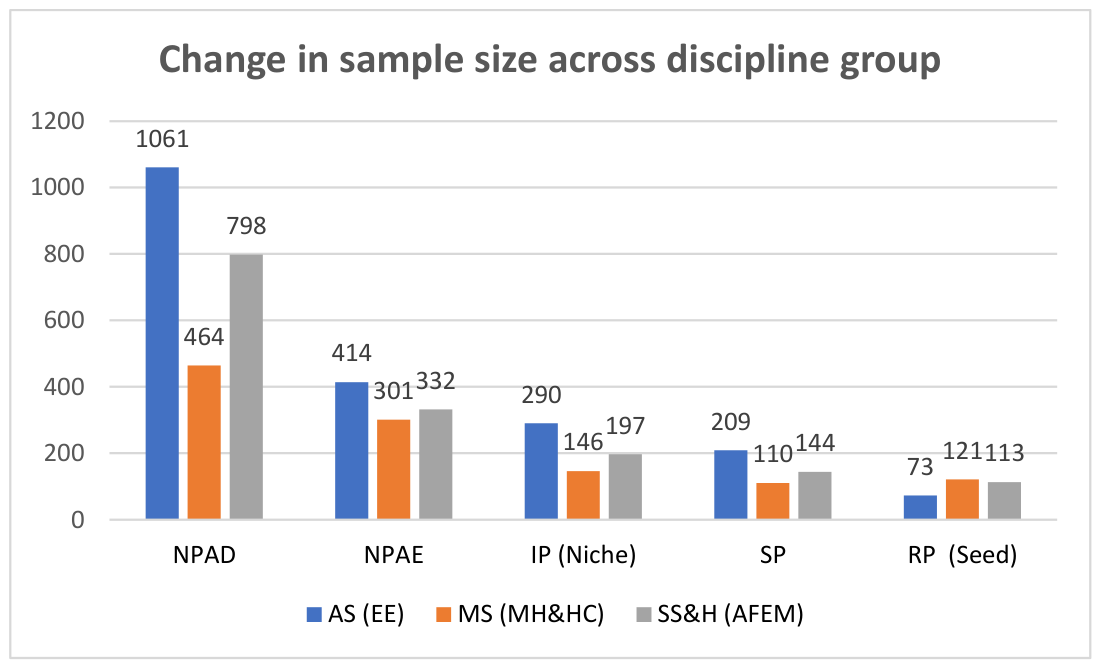
| Discipline/(SS) | NPAD | NPAE | IP (Niche) | SP | RP (Seed) |
|---|---|---|---|---|---|
| AS (EE) | 1061 | 414 | 290 | 209 | 73 |
| MS (MH&HC) | 464 | 301 | 146 | 110 | 121 |
| SS&H (AFEM) | 798 | 332 | 197 | 144 | 113 |
| Total | 2323 | 1047 | 633 | 463 | 307 |
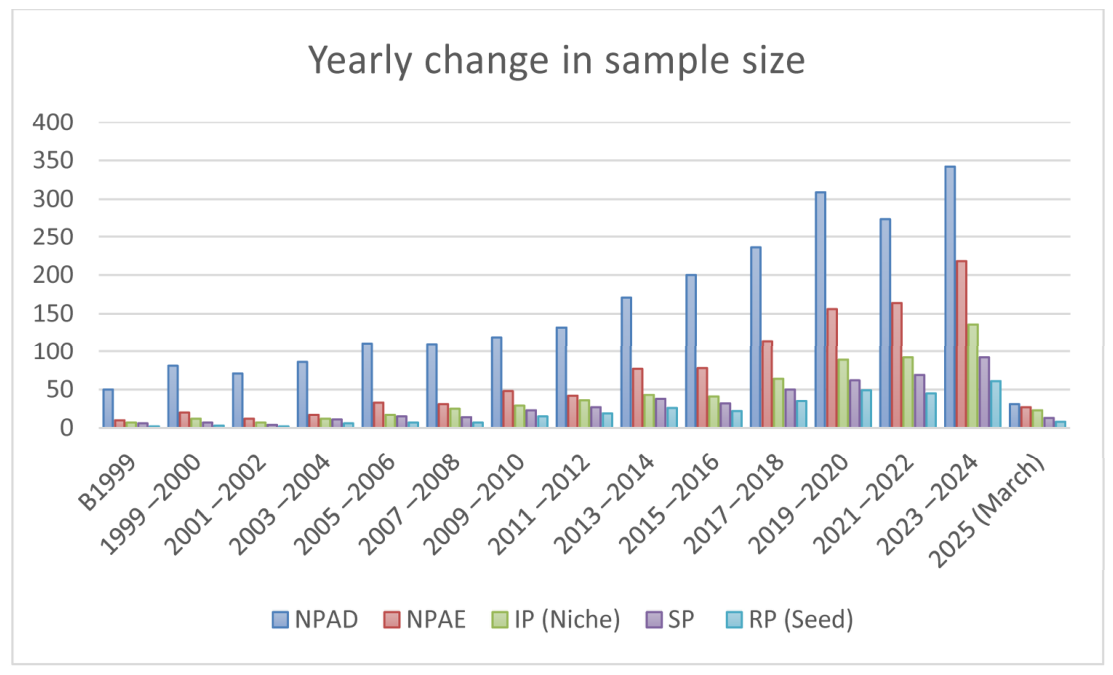
| Year | NPAD | NPAE | IP (Niche) | SP | RP (Seed) |
|---|---|---|---|---|---|
| B1999 | 50 | 10 | 7 | 6 | 2 |
| 1999–2000 | 81 | 20 | 12 | 7 | 3 |
| 2001–2002 | 71 | 12 | 7 | 4 | 2 |
| 2003–2004 | 86 | 17 | 12 | 11 | 6 |
| 2005–2006 | 111 | 33 | 17 | 15 | 7 |
| 2007–2008 | 110 | 31 | 25 | 14 | 7 |
| 2009–2010 | 119 | 48 | 29 | 23 | 15 |
| 2011–2012 | 132 | 42 | 36 | 27 | 19 |
| 2013–2014 | 171 | 77 | 43 | 38 | 26 |
| 2015–2016 | 200 | 78 | 41 | 32 | 22 |
| 2017–2018 | 236 | 114 | 64 | 50 | 35 |
| 2019–2020 | 309 | 156 | 89 | 62 | 49 |
| 2021–2022 | 274 | 164 | 92 | 69 | 45 |
| 2023–2024 | 342 | 218 | 136 | 92 | 61 |
| 2025 (March) | 31 | 27 | 23 | 13 | 8 |
| Total | 2323 | 1047 | 633 | 463 | 307 |
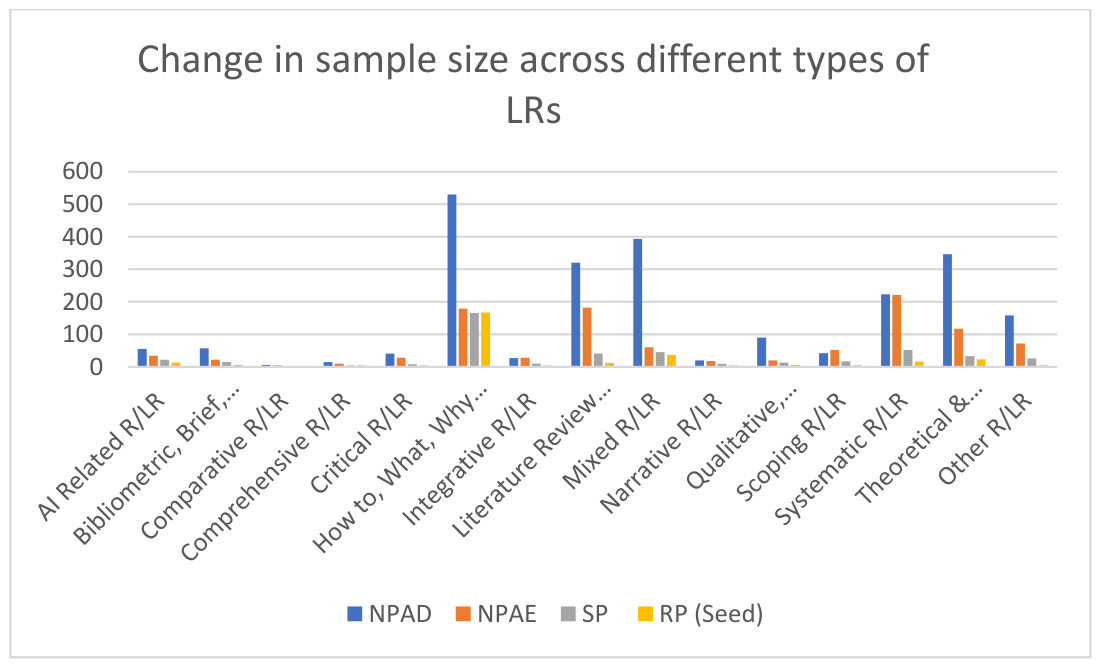
| Type of Research/Review Articles | NPAD | NPAE | SP | RP (Seed) |
|---|---|---|---|---|
| AI Related R/LR | 55 | 34 | 22 | 13 |
| Bibliometric, Brief, Mini & Rapid R/LR | 57 | 22 | 15 | 6 |
| Comparative R/LR | 6 | 4 | 2 | 1 |
| Comprehensive R/LR | 15 | 10 | 4 | 4 |
| Critical R/LR | 41 | 28 | 8 | 4 |
| How to, What, Why & Guideline R/LR | 530 | 179 | 166 | 167 |
| Integrative R/LR | 27 | 28 | 10 | 4 |
| Literature Review (LR) | 320 | 182 | 41 | 12 |
| Mixed R/LR | 393 | 60 | 45 | 37 |
| Narrative R/LR | 20 | 18 | 9 | 4 |
| Qualitative, Quantitative & Case study R/LR | 90 | 20 | 13 | 6 |
| Scoping R/LR | 42 | 52 | 17 | 5 |
| Systematic R/LR | 223 | 221 | 52 | 16 |
| Theoretical & Conceptual Framework R/LR | 346 | 117 | 33 | 23 |
| Other R/LR | 158 | 72 | 26 | 5 |
| Total | 2323 | 1047 | 463 | 307 |
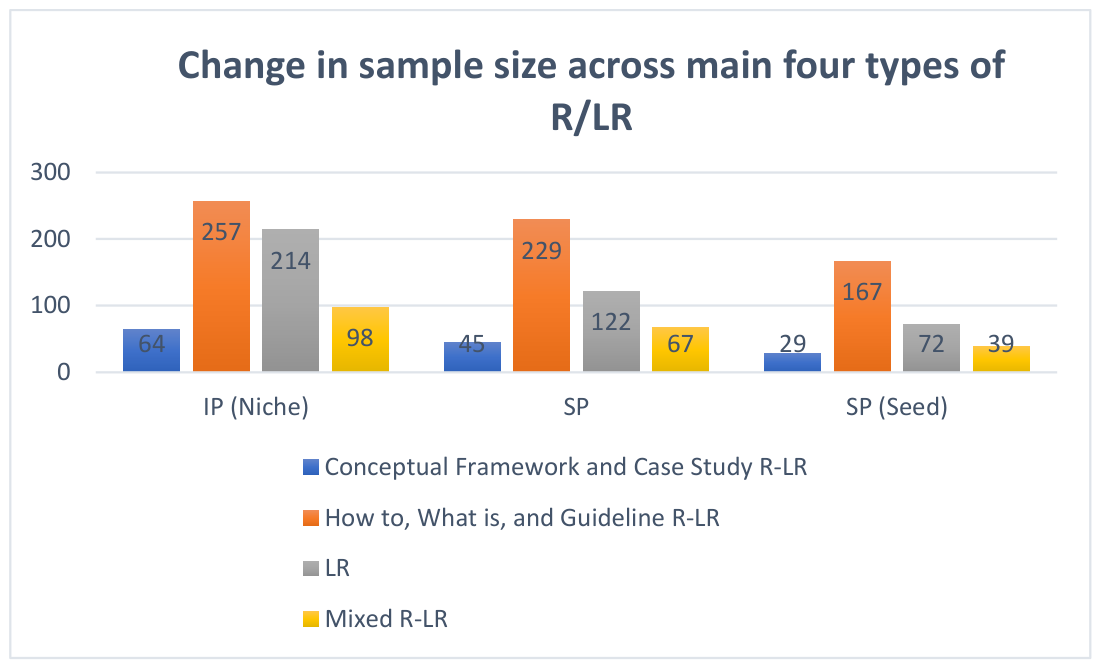
| Type of R-LR | IP (Niche) | SP | SP (Seed) |
|---|---|---|---|
| Conceptual Framework and Case Study R-LR | 64 | 45 | 29 |
| How to, What is, and Guideline R-LR | 257 | 229 | 167 |
| LR | 214 | 122 | 72 |
| Mixed R-LR | 98 | 67 | 39 |
| Total | 633 | 463 | 307 |
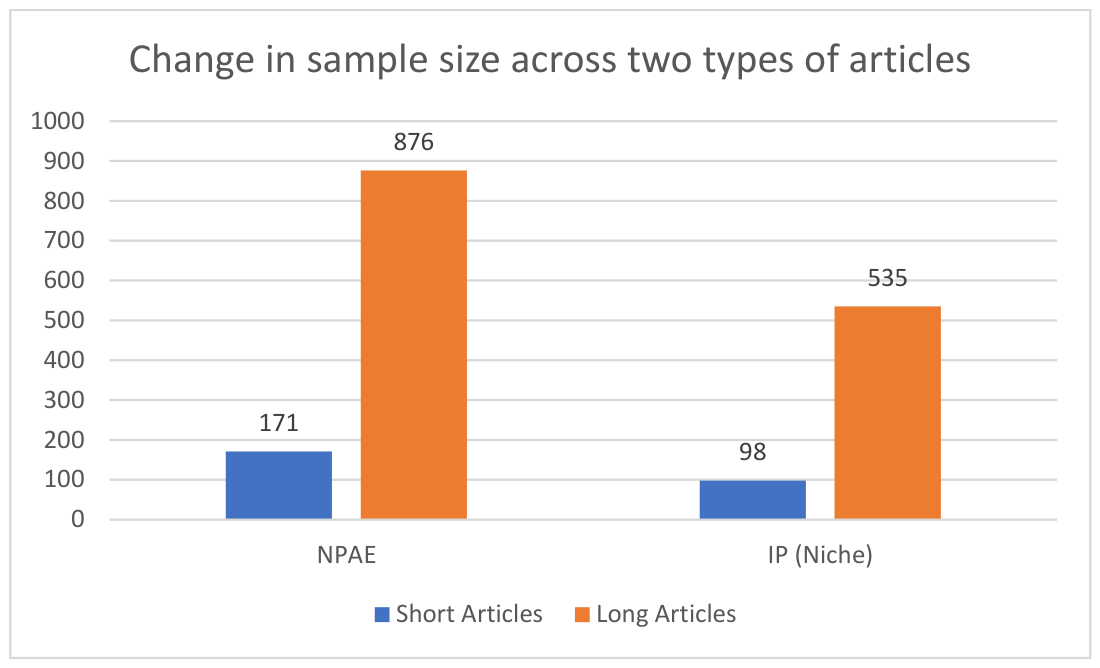
| Types of Articles | NPAE | IP (Niche) |
|---|---|---|
| Short Articles | 171 | 98 |
| Long Articles | 876 | 535 |
| Total | 1047 | 633 |
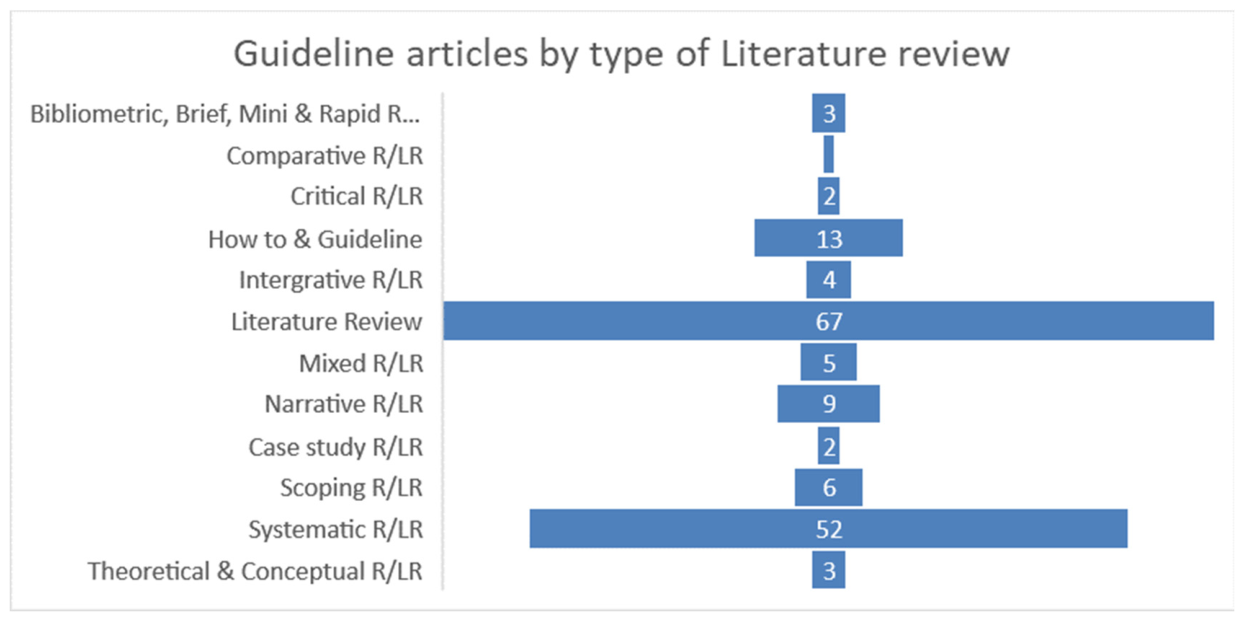
| Type of Literature Review | Bibliometric, Brief, Mini & Rapid R/LR | Comparative R/LR | Critical R/LR | How to & Guideline | Integrative R/LR | Literature Review (LR) | Mixed R/LR | Narrative R/LR | Case Study R/LR | Scoping R/LR | Systematic R/LR | Theoretical & Conceptual R/LR | Total |
|---|---|---|---|---|---|---|---|---|---|---|---|---|---|
| RP (Seed) | 3 | 1 | 2 | 13 | 4 | 67 | 5 | 9 | 2 | 6 | 52 | 3 | 167 |
| Elsevier | |||||||||||
| Author(s), Pub Year, Type of Article. Sample Size, Journal. | Objective | Type of Lit Review Identified | Methodology | Paper Collection Database(s) | Software Used | Lit Review Guidelines Proposed | Key Findings | Suggestions/Recommendations | Research Gaps | Limitations | Score |
| [2] (TA): Methodological Guidance/Research Article. (SS): The demonstration extended a prior review of 142 papers to a final set of 224 papers. (J): Journal of Informetrics | To develop a Systematic Iterative Multilayer Literature Review (SIMILAR) method that can simultaneously model the structure and evolution of a research field, using multilayer network theory. | Proposes a new type of literature review method. | Development and demonstration of the SIMILAR method, which consists of four steps: (1) Meta structure search, (2) Exploration of citation network, (3) Relevance examination, and (4) Classification. It uses multilayer network analysis. | Google Scholar (for the demonstration). | R (“igraph” package) and MuxViz. | Yes, proposes the SIMILAR (Systematic Iterative Multilayer Literature Review) method. | Existing literature review methods are either cross-sectional or longitudinal, but not both. SIMILAR allows for both by using multilayer networks. It also uses an iterative process to refine the classification of papers. | Researchers can use the SIMILAR method to refine classification rules iteratively, integrate multilayer network theory, and conduct longitudinal and cross-sectional analyses at the same time. | Current methods are unable to simultaneously model the structure and evolution of a research field. No existing methods integrate multilayer network theory into literature reviews. | The study did not investigate how starting from a different initial review (meta structure) would affect the findings. The method assumes a pre-existing meta structure to start from. | A+++ |
| [64] (M): Methodological Guidance/Framework. (SS): 58 self-identified systematic reviews on LCT. (J): Heliyon | To propose a framework (FLAVIA-LCT) for conducting systematic literature reviews (SLRs) in the Life Cycle Thinking (LCT) field to guide researchers in gathering, synthesizing, and reporting outcomes. | Discusses systematic literature reviews (SLRs). | The paper proposes a framework developed from the authors’ practical review experience, analysis of 58 existing LCT reviews, and influenced by guidelines like PRISMA and STARR-LCA. | N/A (for framework development); mentions Scopus for identifying the scale of LCT literature. | Mentions Excel, MAXQDA, NVivo for data management. | Yes, proposes the FLAVIA-LCT framework (Framework for systematic Literature review to Analyze Vast Information in Life Cycle Thinking studies). | Existing SLR guidelines (e.g., PRISMA) are not fully suitable for LCT studies. STARR-LCA for LCA studies has limitations. Many LCT reviews that claim to be systematic are not. | The FLAVIA-LCT framework is presented as a five-stage process: (1) Research problem definition, (2) Search strategy design, (3) Sample preparation, (4) Data collection and analysis, (5) Result reporting. | A specific framework for conducting SLRs in the broader LCT field (including LCC, S-LCA) is missing. | The framework’s effectiveness has not been statistically evaluated due to data heterogeneity. Applying the framework requires a good understanding of LCT standards to avoid bias. | A+++ |
| Emerald A | |||||||||||
| Author(s), Pub Year, Type of Article, (SS) & (J) | Objective | Type of Lit Review Identified | Methodology | Paper Collection Database(s) | Software Used | Lit Review Guidelines Proposed | Key Findings | Suggestions/Recommendations | Research Gaps | Limitations | Score |
| Christopher S.G. Khoo et al., (2011) (TA): Research paper. (SS): 20 articles from JASIST for analysis, plus a test sample of 30 LRs from three journals for reliability testing. (J): Online Information Review | To analyze the macro-level discourse structure of literature reviews and identify different writing styles, as part of a project to develop an automatic summarization system. | Identifies and defines two distinct styles: “descriptive literature reviews” and “integrative literature reviews”. | Content analysis of literature review sections from journal articles using a custom XML coding scheme. Inter-coder reliability was checked. | JASIST, Journal of Documentation, and Online Information Review. | Not mentioned, but an XML coding scheme was developed. | Proposes an XML coding scheme for analyzing discourse structure, with elements like topic, study, meta-critique, meta-summary, method, result, and interpretation. | Literature reviews are written in two styles: Descriptive reviews summarize individual studies with details on methods and results, have a simpler structure, and cite sequentially. Integrative reviews provide high-level critical summaries, have more reviewer commentary (meta-critique/summary), and a more complex structure. | The proposed coding scheme is useful for studying literature reviews in other fields. A good literature review should balance descriptive and integrative elements. | There are few empirical studies on how authors actually construct a literature review—how they select, organize, and present information. | Most literature reviews exist on a continuum between the two poles of descriptive and integrative. The study is based on a limited number of journals. | A+++ |
| GoogleScholar | |||||||||||
| Author(s), Pub Year, Type of Article, (SS) & (J) | Objective | Type of Lit Review Identified | Methodology | Paper Collection Database(s) | Software Used | Lit Review Guidelines Proposed | Key Findings | Suggestions/Recommendations | Research Gaps | Limitations | Scores |
| [42] (TA): Research Article/Methodology Description. (SS): 940 articles. (J): Perspectives on Medical Education | To understand and articulate the paradigmatic roots of, and methods for, conducting State-of-the-art (SotA) reviews. | State-of-the-art (SotA) review. | Method: Reviewed 940 articles labeled as SotA reviews published 2014–2021. Inductively analyzed them to articulate philosophical foundations, process steps, and markers of rigor. | PubMed. Also searched Scopus, Web of Science, and Google to find methods-related resources. | Not mentioned. | 6-Step Approach for SotA reviews: 1. Determine initial research question. 2. Determine timeframe. 3. Finalize research question to reflect timeframe. 4. Develop search strategy. 5. Analyze literature. 6. Provide a reflexivity description | Purpose: A SotA review creates a three-part argument: This is where we are now, this is how we got here, and this is where we could go next221. Ontology: SotA reviews are grounded in relativism and subjectivism. Prevalence: 98% of articles labeled “SotA review” lacked citations for how to conduct one. | Medical educators should explicitly use this form of knowledge synthesis to advance the field. | The review should posit new directions for research by questioning the soundness of historical turning points and prior decisions. | The methodology and methods of SotA reviews are poorly reported, making them appear to lack rigor. | A+++ |
| [56] (TA): Guide/Research-Based Article. (SS): 99 studies included. (J): Journal of Planning Education and Research. | To provide guidance on how to conduct a systematic literature review by surveying publications on the methodology of literature reviews. | Typology based on purpose: Describe (Narrative, Scoping, etc.), Test (Meta-analysis, Realist), Extend (Meta-ethnography, Thematic synthesis), and Critique (critical review). | The authors conducted their own systematic review of the methodology literature, searching Google Scholar, Web of Science, and EBSCOhost. | Recommends Google Scholar, Web of Science, EBSCOhost, and “gray literature”. | Recommends reference managers (EndNote, RefWorks, Zotero) and qualitative analysis software (NVivo, ATLAS.ti) | 8 Steps: 1. Formulate problem. 2. Develop and validate protocol. 3. Search literature. 4. Screen for inclusion. 5. Assess quality. 6. Extract data. 7. Analyze and synthesize data. 8. Report findings. | Literature reviews can be background for a study or a stand-alone piece. Reviews should be valid, reliable, and repeatable. The planning field lacks rigorous systematic reviews. | Start with a research question381. Choose a review type suitable for the purpose382. Develop a review protocol before starting. Document all decisions to ensure the process is transparent and repeatable. Teamwork is encouraged. | The review should identify gaps in the literature to explore and point out opportunities for future research. | A common mistake is selecting too broad a research question381. Publication bias can result from omitting “gray literature”. | A+++ |
| [47] (TA): Editorial. (SS): N/A. (TA): Human Resource Development Review (HRDR) | To refocus authors on what constitutes a good literature review by describing characteristics of rigorous reviews. | Integrative, systematic, historical, conceptual, methodological, and rapid structured literature reviews (RSLR). | N/A—Editorial. | Notes the value of “snowballing” and reverse citation tracking over just database searches. | N/A | Proposes the “Five C’s” of rigorous reviews (Concise, Clear, Critical, Convincing, Contributive)178 and the “Six Ws” for a method section (Who, When, Where, How, What, Why). | Literature reviews are important for evidence-based decisions and identifying knowledge gaps. Submitted manuscripts frequently fail to clearly articulate review methods. | Reviews should be guided by a specific question addressing a “gap”. Authors must clearly articulate their methods181 and develop a convincing argument that contributes to knowledge. | N/A—Editorial. Notes that reviews identify knowledge gaps. | N/A | A+++ |
| Springer Nature Link | |||||||||||
| Author(s), Pub Year, Type of Article, (SS) & (J) | Objective | Type of Lit Review Identified | Methodology | Paper Collection Database(s) | Software Used | Lit Review Guidelines Proposed | Key Findings | Suggestions/Recommendations | Research Gaps | Limitations | Score |
| Natan S. Rodrigues et al., (2024). (TA): Literature Review. (SS): 211 documents (2003 and 2022). (J): International Journal on Digital Libraries. | To provide a literature review of Author Name Disambiguation (AND) using a consolidated meta-analytic approach, combining quantitative techniques and bibliometric aspects. | The paper identifies itself as a literature review with a consolidated meta-analytic approach (TEMAC), contrasting it with a traditional systematic literature review. | Followed the Theory of Consolidated Meta-analytic Approach (TEMAC), which combines bibliometric laws (e.g., Bradford’s, Prince’s) with co-citation and bibliographic coupling analysis. | Web of Science (WoS) and Scopus. | VOSviewer and BiblioTools. | Proposes using the TEMAC approach, which integrates bibliometric analysis into the literature review process. | The most common AND approaches involve author grouping and clustering methods. Computer Science is the leading field, and the USA, China, Germany, and Brazil are the most prolific countries in AND research. | Future work could include more bibliographic databases and complement the meta-analytic approach with a formal systematic review. | A meta-analytical review of AND had not been conducted before, creating a foundation for future research. | The meta-analytic approach is exploratory and does not follow a strict protocol with specific research questions like an SLR100. The merging of databases was done via a custom script, as VOSviewer was limited to one at a time. | A++ |
| [45] (TA): Methodological Tool Paper. (SS): 24 manuscripts. (J): Health Services and Outcomes Research Methodology. | To describe a step-by-step process for conducting a literature review using a qualitative analysis approach with NVivo software. | Describes various types, including minor literature review, systematic quantitative review (meta-analysis), and qualitative literature review. The example is based on a scoping review. | Describes a six-step process for using QDAS in a literature review, exemplified by a parent study that used a scoping review methodology and grounded theory for analysis. | The parent study used PubMed, Cochrane, and CINAHL. | NVivo is the central focus. MaxQDA and EndNote are also mentioned. | Proposes a six-step process for conducting a literature review using qualitative data analysis software (QDAS). | Using QDAS like NVivo can enhance the rigor, transparency, reproducibility, and analytical depth of a literature review compared to manual methods. | Researchers can benefit from using QDAS to organize literature, identify themes, and visualize data, which can reveal subtle insights missed by manual methods. | There is limited research exploring the use of QDAS programs for the analytical process of literature reviews. Textbooks often lack sufficient detail on how to conduct a high-quality review. | The use of QDAS has limitations, including the cost of software and training, and a potential time investment for new users. | A+++ |
| Joan Marie Kraft et al., (2022). (TA): Methodology paper. (SS): 18 reviews (for umbrella review); 3 worked examples (for testing). (J): International Journal for Equity in Health. | To develop the Social Accountability Reporting for Research (SAR4Research) checklist to improve documentation of SA interventions. | Umbrella Review (of systematic and narrative reviews) | Multi-step process: (1) an umbrella review of 18 reviews to find reporting gaps; (2) review of existing guidelines; (3) development of a checklist based on CONSORT-SPI; (4) testing with three worked examples. | Pubmed, Google Scholar (for umbrella review) | Not specified. | Yes, proposes the SAR4Research reporting checklist. | Existing SA studies have significant reporting gaps regarding context, intervention components, and study methods. No existing guideline adequately addressed these gaps for SA interventions. | Authors should use the SAR4Research checklist to improve reporting, potentially across multiple papers or using Supplementary Materials. | The lack of a specific reporting guideline for complex social accountability interventions. | The umbrella review was not systematic. The worked examples were not representative of all SA interventions. | A+++ |
| [110] Guidelines. (SS): N/A. European Journal of Epidemiology. | To provide a 24-step guide on how to perform a methodologically sound systematic review and meta-analysis in medical research. | The paper provides a guide for conducting Systematic Reviews and Meta-Analyses. | Not a research study; it presents a comprehensive guideline based on established methodologies and expert recommendations. | Recommends searching at least Embase, MEDLINE, Web of Science, and Google Scholar. | Recommends tools like EndNote, Covidence, and Rayyan for screening, and STATA, R, RevMan for meta-analysis. | Proposes a 24-step guide for conducting and publishing a systematic review and meta-analysis, from defining the research question to final submission. Also advocates using PRISMA/MOOSE reporting standards. | The quality of published systematic reviews is highly variable. A well-conducted review is a complex process requiring a coordinated team, a clear protocol, and rigorous methods. | Researchers should establish a team with diverse expertise (including a librarian), register their protocol (e.g., in PROSPERO), and use tools like GRADE to assess evidence quality. | Notes that most existing guidelines focus on reporting or appraising reviews rather than providing efficient guidance on how to conduct them. | The paper itself does not state any limitations, as it is a set of guidelines. | A+++ |
| Christian Fisch, (2018). (TA): Editorial. (SS): N/A. (J): Management Review Quarterly. | To outline six tips to help authors improve their (systematic) literature review in business and management research. | The editorial discusses (systematic) literature reviews 388. It clarifies that their journal’s understanding of an SLR is one that follows a systematic, transparent, and reproducible process. | Not a research paper; it is an editorial providing guidance and tips based on the authors’ experience as editors. | N/A. | N/A. | Proposes six tips for writing a literature review: (1) Motivate the topic and state the research question, (2) Identify literature systematically, (3) Balance breadth and depth, (4) Focus on concepts, not studies, (5) Derive meaningful conclusions, (6) Follow a coherent structure. | Many researchers seem unfamiliar with the process and structure of systematic literature reviews, often producing mere descriptive summaries. A high-quality literature review is not a trivial endeavor and requires in-depth understanding and experience. | Authors should not just summarize literature but should synthesize and interpret knowledge, identify gaps, and outline future research avenues. A concept-centric approach is preferable to a study-centric one. | A common problem is that reviews often become descriptive annotated bibliographies rather than analytical and synthetic works of scholarship. | The editorial does not state its own limitations. | A+++ |
| Taylor & Francis | |||||||||||
| Author(s), Pub Year, Type of Article, (SS) & (J) | Objective | Type of Lit Review Identified | Methodology | Paper Collection Database(s) | Software Used | Lit Review Guidelines Proposed | Key Findings | Suggestions/Recommendations | Research Gaps | Limitations | Score |
| [64] (TA): Research Article. (SS): 125 bachelor’s theses, plus 9 supervisors & 7 student interviews and 25 feedback from other students. (J): Studies in Higher Education. | To increase understanding of the narrative literature review process by applying process theory. | Narrative and Systematic Literature Reviews 68. The article itself conducts a systematic review to define the steps of a literature review process. | Builds on developmental process theory (specifically teleology process theory). Data includes group interviews and documentary analysis of bachelor’s theses. | For its internal review, the study followed guidelines from established sources but does not list specific databases. | Webropol. | Proposes an iterative, non-structured, multi-layered process model for narrative reviews with four repeating steps (exploring, focusing, analyzing/synthesizing, writing) punctuated by written outcomes. | The narrative literature review process is not linear like a systematic review; it is iterative, socially constructed, and involves continuous writing of cumulative reports… It aligns with teleology process theory. | Supervisors and students should recognize the iterative and hermeneutic nature of the narrative review process. The role of cumulative written reports in marking progress should be emphasized. | A justified explanation of how a narrative literature review process progresses is absent from the existing literature. | The study focuses on bachelor’s students, so findings may not apply to more experienced researchers. The sample consisted of volunteers, and the authors’ role was embedded in the process. | A+++ |
| [51] (TA): Descriptive literature review. (SS): 142 LR published in top IS journals. (J): European Journal of Information Systems. | To assess the extent to which IS review articles are transparent in reporting their methodologies. | The study itself is a descriptive review. It classifies other reviews using taxonomies by Rowe (2014) and Paré et al. (2015), identifying types like narrative, descriptive, scoping, critical, meta-analysis, and theory development. | Manual search of 8 top IS journals (2000–2014). Selected reviews were classified by type and coded against 22 reporting items using directed content analysis. | Manual search of 8 specific journals (EJIS, ISJ, ISR, JAIS, JIT, JMIS, JSIS, MISQ). | Not specified. | Provides a list of 22 reporting items across 6 generic review steps that can be used as a framework for authors to improve transparency. | The majority of IS reviews show inadequate reporting of methods. Theory development and narrative reviews are the most common and least transparent types. | Authors of all review types should better document their design decisions. Journal editors could place methodological details in an appendix. Doctoral students need better training in conducting reviews. | No prior formal assessment of review reporting practices exists in the IS field. | The sample is limited to 8 journals and may not be representative of the entire IS field. The assessment is based on what was reported, not what was done. | A+++ |
| [38] (TA): Conceptual/Methodological Article. (SS): Not applicable. (J): International Journal of Multiple Research Approaches. | To present an interactive meta-framework (ILRP) that can be used by advisors to facilitate the development of literature reviews by doctoral students. | Mixed research synthesis/mixed methods literature review. | The paper proposes a conceptual meta-framework, not an empirical study. The framework is built on Vygotsky’s theory of social development, Kuhlthau’s information search process model, and Onwuegbuzie et al.’s framework for debriefing. | Not applicable. | Mentions RefWorks, NVivo 8, QDA Miner 3.2, and Excel as potential tools for students | Proposes the Interactive Literature Review Process (ILRP), a nine-stage meta-framework: (1) Exploring belief systems, (2) Initiating the process, (3) Selecting a topic, (4) Exploring literature, (5) Formulating a focus, (6) Analyzing/interpreting/integrating, (7) Closing the search, (8) Writing, (9) Evaluating. | Many dissertation literature reviews are poorly conceptualized and written, often due to inadequate instruction. The typical literature review process is a solitary event, whereas the proposed ILRP is interactive and cooperative. | Advisors and professors should use a comprehensive approach like the ILRP to guide students. The ILRP can also be used by self-directed students for self-auditing, though interaction with a mentor is optimal. | Research methods textbooks provide scant instruction on organizing the search process, focusing on a topic, or evaluating literature. | Not applicable. | A+++ |
| Wiley | |||||||||||
| Author(s), Pub Year, Type of Article, (SS) & (J) | Objective | Type of Lit Review Identified | Methodology | Paper Collection Database(s) | Software Used | Lit Review Guidelines Proposed | Key Findings | Suggestions/Recommendations | Research Gaps | Limitations | Score |
| [98] (TA): Original Article/Methodological Protocol. (SS): N/A. (J): International Journal of Consumer Studies. | To develop a rigorous and authoritative protocol, SPAR-4-SLR, to guide and justify decisions in systematic literature reviews. | Systematic literature reviews (SLRs), including domain-based, theory-based, method-based, meta-analytical, and meta-systematic reviews. | Based on the authors’ collective expertise and experience in authoring, editing, and reviewing literature reviews. | Recommends Google Scholar, WOS, or Scopus. | N/A | Proposes the SPAR-4-SLR (Scientific Procedures and Rationales for Systematic Literature Reviews) protocol, a 3-stage (Assembling, Arranging, Assessing) process with detailed rationales for each step. | SLRs are increasingly valuable, but existing guidelines often lack sufficient rationale to justify review decisions. Provides criteria for when an SLR should be written (e.g., substantial body of work exists, no recent high-quality reviews). | Researchers should use the proposed protocol for rigor and transparency, conduct reviews for the right reasons (to consolidate knowledge), and collaborate with methodological experts. | Few authoritative protocols with clear rationales for SLR decisions exist. | The protocol is newly proposed, and its effectiveness in practice is yet to be widely tested. | A+++ |
| Marco Pautasso. (2015) (TA): Book Chapter/Guideline. (SS): N/A. (J): NA, Book Chapter in A Guide to the Scientific Career. | To provide a brief guideline on how to conduct a narrative literature review based on the author’s experience and 10 simple rules. | Narrative, systematic, meta-analysis, mini-review, full review, descriptive, and integrative reviews. | Based on the author’s experience with ~30 literature reviews, feedback from peers, and established principles. | Recommends searching various databases; mentions Web of Science and Google Scholar. | Mendeley, Papers, Qiqqa, Sente, Zotero. | Proposes “Ten simple rules for writing a literature review,” covering team formation, topic definition, searching, note-taking, review type selection, structure, and dissemination. | Literature reviews are increasingly necessary and can be as innovative as primary research. Different types of reviews are appropriate for different goals. | Work in teams, define scope and exclusion criteria early, document the search process, take notes while reading, be critical, seek feedback, and disseminate the final work. | A key aim of a literature review is to identify the most pressing research gaps in a field. | The chapter focuses specifically on narrative literature reviews. | A+++ |
| Nature Portfolio | |||||||||||
| Author(s), Pub Year, Type of Article, (SS) & (J) | Objective | Type of Lit Review Identified | Methodology | Paper Collection Database(s) | Software Used | Lit Review Guidelines Proposed | Key Findings | Suggestions/Recommendations | Research Gaps | Limitations | Score |
| [57] (TA): Perspective. (SS): N/A. (J): Nature Ecology & Evolution (inferred from DOI). | To identify major pitfalls in systematic reviews, offer methodological solutions, highlight existing support, and propose interventions to improve review quality. | Systematic reviews, traditional literature reviews, meta-analyses, narrative synthesis, systematic maps. | A critical review of current practices using recent examples from conservation and environmental science to highlight common problems. | N/A | SysRev, R. | Proposes eight solutions to common review problems. Recommends following established standards like PRISMA and ROSES and guidance from bodies like CEE and Cochrane. | Identifies eight major problems, including lack of stakeholder engagement, transparency, and appropriate synthesis; finds that many reviews, even those labeled ‘systematic’, are poorly conducted. | Reviewers should use a priori protocols, engage stakeholders, use comprehensive and transparent search strategies, include grey literature, critically appraise studies, avoid vote-counting, and work in teams. | The need for better training and support to ensure rigorous review standards are implemented. | This is a perspective piece, not a systematic review quantifying the prevalence of the identified issues. | A+++ |
| Feature | GARP-4LR (This Study) | PRISMA 2020 | SPAR-4-SLR [61] |
|---|---|---|---|
| Purpose | Universal protocol for any literature review | Reporting guideline for systematic reviews/meta-analyses | Procedural protocol for systematic literature reviews |
| Discipline focus | Multidisciplinary (education, engineering, medicine, AFEM) | Primarily health sciences; extensions for other fields | Business, management, and consumer research |
| Structure | 4 phases (Plan, Implement, Publish, Share/Update) | 27-item checklist + PRISMA flow diagram | 3 stages (Assemble, Arrange, Assess) |
| Number of steps/actions | 24 steps (compulsory + optional) | 27 reporting items + 4-phase flow diagram | 14 actions within 6 sub-steps (based on 3 stages) |
| Core emphasis | Three essential tasks: data collection, data processing, data reporting | Transparent reporting of methods and results of systematic reviews | Rigorous justification of review decisions, from problem formulation to reporting |
| Flexibility | High—applicable to all review types (narrative, scoping, systematic, etc.) | Moderate—primarily for systematic reviews; adaptations needed for other types | High for systematic reviews; less guidance for non-systematic types |
| Registration/protocol requirement | Optional; encourages a priori protocol, but not mandatory | Recommends protocol registration (e.g., PROSPERO) | Recommends a pre-registered protocol |
| Meta-analysis integration | Can accommodate meta-analysis, but it is not mandatory | Strongly linked to meta-analysis where appropriate | Supports meta-analysis; provides rationales |
| Publication phase | Explicit steps for journal targeting and post-submission diffusion | Not included; assumes research is published | Implicitly covered in the Assessing stage |
| Update & sharing | Dedicated optional phase for updating and disseminating the review | Not specifically addressed | Not specifically addressed |
| Unique ‘noise’ reduction | Focuses on the “synthesis core” by eliminating non-essential procedural checkpoints | Comprehensive checklist may overwhelm newcomers | Highly detailed rationales; process can be lengthy |
Disclaimer/Publisher’s Note: The statements, opinions and data contained in all publications are solely those of the individual author(s) and contributor(s) and not of MDPI and/or the editor(s). MDPI and/or the editor(s) disclaim responsibility for any injury to people or property resulting from any ideas, methods, instructions or products referred to in the content. |
© 2026 by the authors. Licensee MDPI, Basel, Switzerland. This article is an open access article distributed under the terms and conditions of the Creative Commons Attribution (CC BY) license.
Share and Cite
Nima Ngapey, J.D.; Zhu, N.; Pea-Assounga, J.B.B. How to Write a Relevant, Accurate and Sustainable Literature Review Using a Generally Accepted Research Protocol (GARP): A Multidisciplinary Mixed Research Method. Information 2026, 17, 583. https://doi.org/10.3390/info17060583
Nima Ngapey JD, Zhu N, Pea-Assounga JBB. How to Write a Relevant, Accurate and Sustainable Literature Review Using a Generally Accepted Research Protocol (GARP): A Multidisciplinary Mixed Research Method. Information. 2026; 17(6):583. https://doi.org/10.3390/info17060583
Chicago/Turabian StyleNima Ngapey, Jonathan Dior, Naiping Zhu, and Jean Baptiste Bernard Pea-Assounga. 2026. "How to Write a Relevant, Accurate and Sustainable Literature Review Using a Generally Accepted Research Protocol (GARP): A Multidisciplinary Mixed Research Method" Information 17, no. 6: 583. https://doi.org/10.3390/info17060583
APA StyleNima Ngapey, J. D., Zhu, N., & Pea-Assounga, J. B. B. (2026). How to Write a Relevant, Accurate and Sustainable Literature Review Using a Generally Accepted Research Protocol (GARP): A Multidisciplinary Mixed Research Method. Information, 17(6), 583. https://doi.org/10.3390/info17060583