Time-Consistent Prediction in Higher Education: A Framework for Preventing Data Leakage in Longitudinal Models


Abstract
1. Introduction
Research Questions and Diagnostic Expectations
- RQ1. To what extent do recent dropout-prediction studies explicitly specify the four TCDP dimensions: prediction cutoff, temporally restricted information set, risk set, and validation hierarchy?
- RQ2. To what extent does row-wise validation in longitudinal student panels generate train–test entity overlap across prediction cutoffs, and how does this overlap affect reported AUC relative to an entity-level group split?
- RQ3. How do model class and the representational granularity of static predictors affect the empirical visibility of identity leakage?
2. Conceptual and Methodological Framework
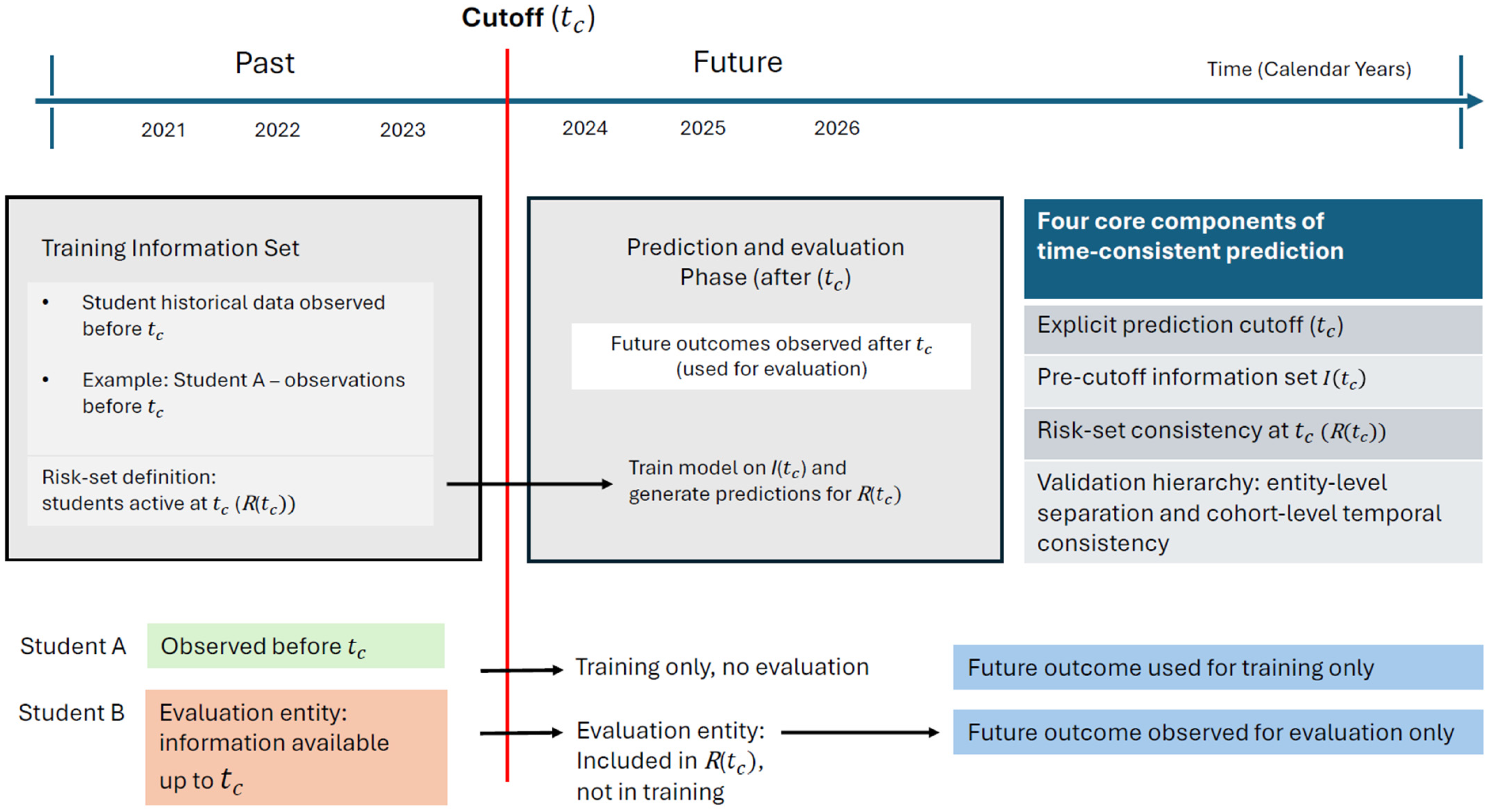
2.1. Prediction as a Temporally Formalized Task
- (i)
- Explicit Specification of the Prediction Cutoff ()
- (ii)
- Information Set ()
- (iii)
- Risk Set (R())
- (iv)
- Validation designThe validation design specifies how model performance is estimated relative to the intended prediction task. In longitudinal settings, two forms of separation are required: entity-level separation and cohort-level temporal consistency.
- (iv.a)
- Entity-Level SeparationObservations linked to the same individual must not overlap across training and test sets. In longitudinal datasets, repeated observations associated with the same entity may introduce hidden dependencies between partitions if row-wise splitting procedures are applied [17,18,19,37].Valid entity-level separation requires
- (iv.b)
- Cohort-Level Temporal Consistency
2.2. Data Leakage as Violation of Temporal and Structural Conditions
2.2.1. Temporal Leakage
2.2.2. Identity Leakage
2.2.3. Leakage and Metric Interpretation
2.3. Operational Checklist for Time-Consistent Validation
3. Methodological Patterns in Dropout Prediction: A Literature-Based Analysis
3.1. Methodological Orientations in Recent Dropout-Prediction Studies
3.2. Comparative Synthesis Across TCDP Dimensions

| Study | Cutoff | Information Set | Risk Set | Validation Strategy | Validation Hierarchy |
|---|---|---|---|---|---|
| [5] | P | P | A | 2016–2019 train; 2020 test | P |
| [41] | E | E | P | Random 80/20; SMOTE; GridSearch CV | P |
| [7] | E | E | E | 2015 entrants as test cohort; monthly models | P |
| [42] | E | E | P | Weekly models with CV/holdout; all-weeks 30% random holdout | P |
| [4] | A | A | A | 2018 train; 2019 test; 10-fold CV in training | P |
| [45] | P | P | A | Model comparison; validation details insufficient | A |
| [43] | E | E | E | Stratified 80/20 main split; temporal robustness split | P |
| [44] | E | E | P | AY108-112 train; AY112/2 features -> AY113/1 labels | P |
4. Empirical Demonstration: TCDP-Formalized Identity Leakage in Longitudinal Data with Static Predictors
4.1. Longitudinal Data Representation and Prediction Task
4.2. TCDP-Based Formalization of the Experimental Design
4.3. Validation Configurations and Reproducible Pipeline Parameters
4.4. Empirical Results
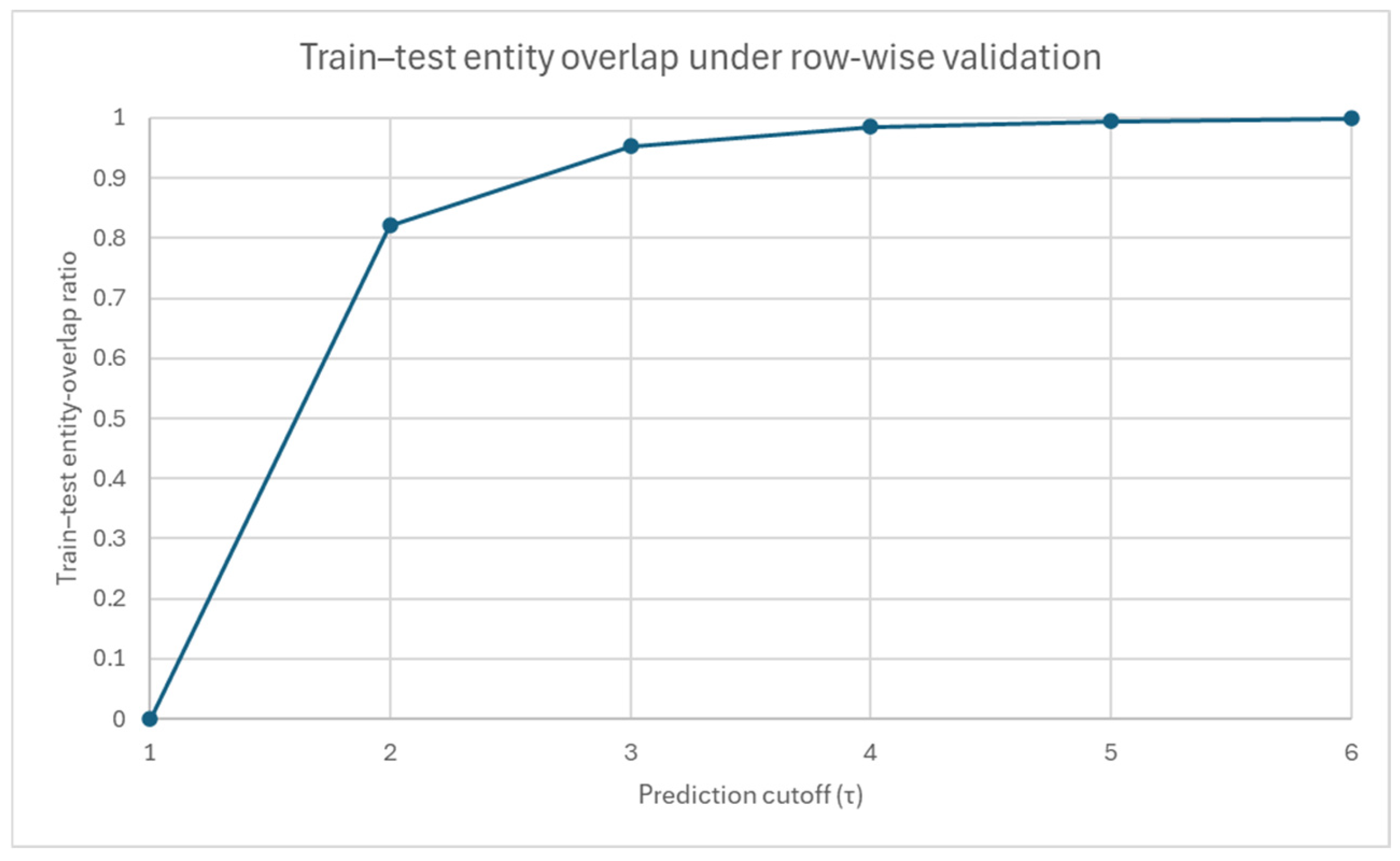
4.4.1. Cutoff-Specific Panel Size and Train–Test Entity Overlap
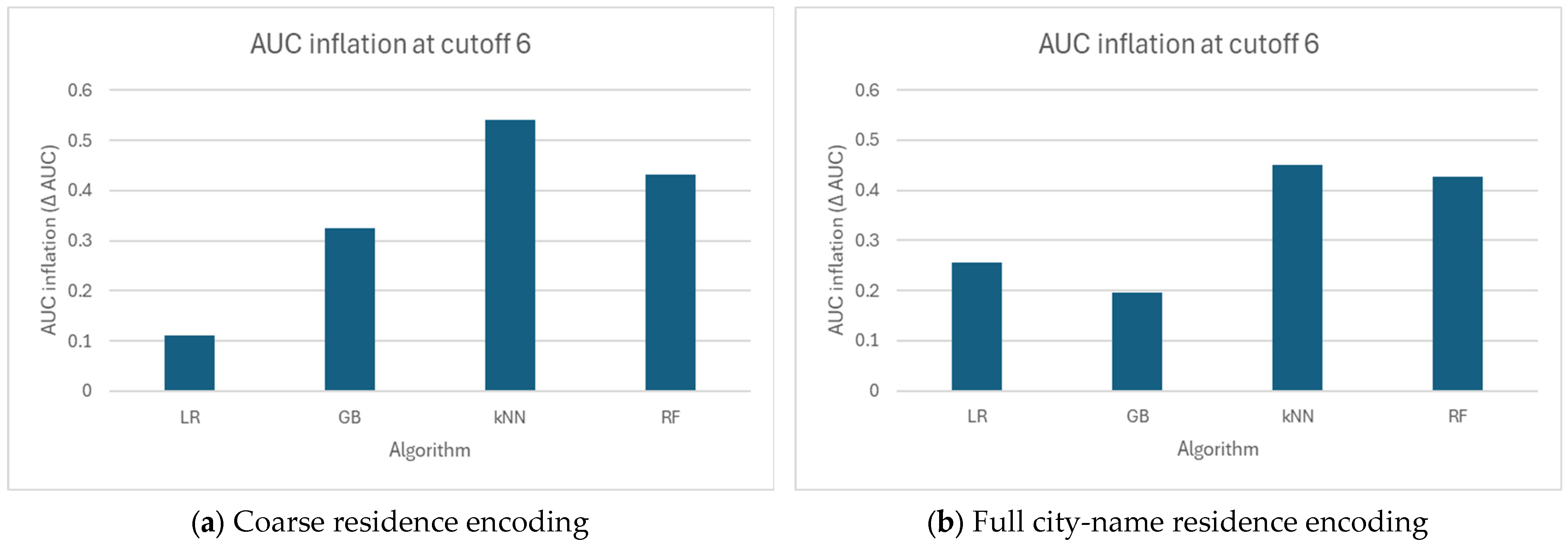
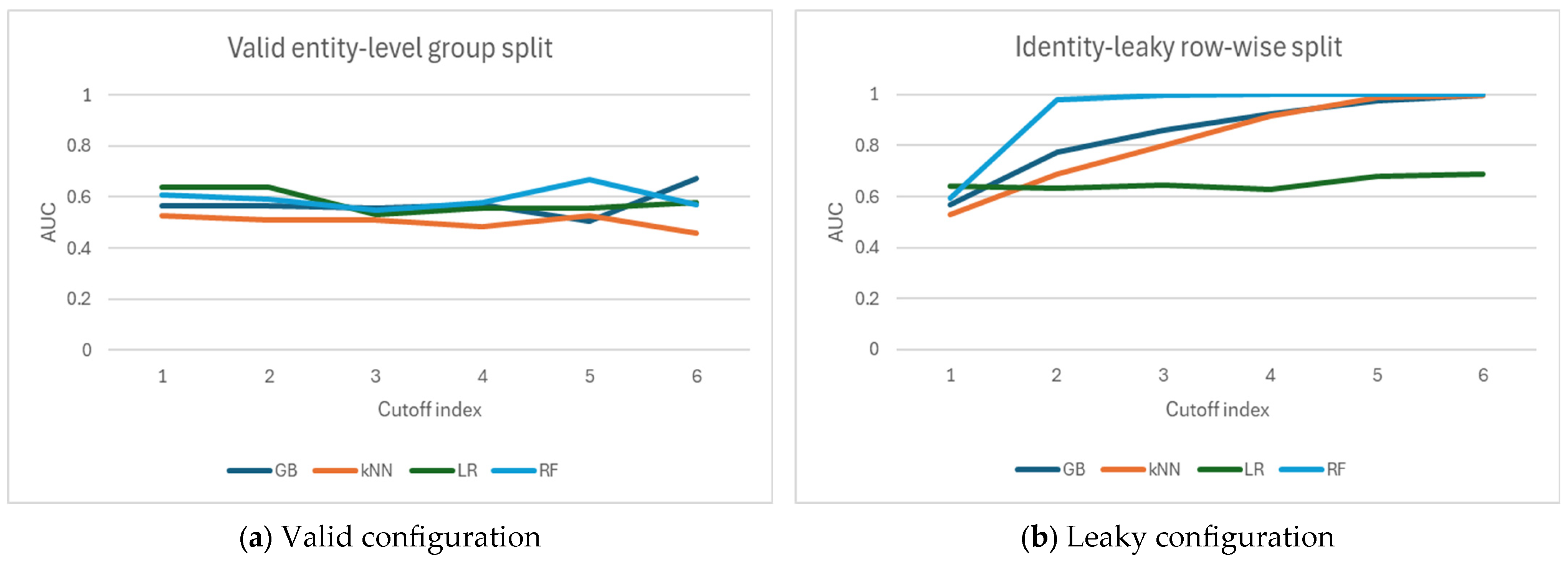
4.4.2. Coarse Two-Category Residence Encoding
4.4.3. Full City-Name Residence Encoding
4.5. TCDP Interpretation: Validation Design, Feature Granularity, and Model Class
4.6. Reproducibility and Validation Diagnostics
4.7. Transferability Beyond Higher Education
4.8. Data Availability and Reproducible Experiment Package
5. Conclusions
Funding
Institutional Review Board Statement
Informed Consent Statement
Data Availability Statement
Conflicts of Interest
References
- Bognár, L.; Fauszt, T. Factors and Conditions That Affect the Goodness of Machine Learning Models for Predicting the Success of Learning. Comput. Educ. Artif. Intell. 2022, 3, 100100. [Google Scholar] [CrossRef]
- Cho, C.H.; Yu, Y.W.; Kim, H.G. A Study on Dropout Prediction for University Students Using Machine Learning. Appl. Sci. 2023, 13, 12004. [Google Scholar] [CrossRef]
- Okoye, K.; Nganji, J.T.; Escamilla, J.; Hosseini, S. Machine Learning Model (RG-DMML) and Ensemble Algorithm for Prediction of Students’ Retention and Graduation in Education. Comput. Educ. Artif. Intell. 2024, 6, 100205. [Google Scholar] [CrossRef]
- Rabelo, A.M.; Zárate, L.E. A Model for Predicting Dropout of Higher Education Students. Data Sci. Manag. 2025, 8, 72–85. [Google Scholar] [CrossRef]
- Bouihi, B.; Bousselham, A.; Aoula, E.; Ennibras, F.; Deraoui, A. Prediction of Higher Education Student Dropout Based on Regularized Regression Models. Eng. Technol. Appl. Sci. Res. 2024, 14, 17811–17815. [Google Scholar] [CrossRef]
- Hassan, M.A.; Muse, A.H.; Nadarajah, S. Predicting Student Dropout Rates Using Supervised Machine Learning: Insights from the 2022 National Education Accessibility Survey in Somaliland. Appl. Sci. 2024, 14, 7593. [Google Scholar] [CrossRef]
- Vaarma, M.; Li, H. Predicting Student Dropouts with Machine Learning: An Empirical Study in Finnish Higher Education. Technol. Soc. 2024, 76, 102474. [Google Scholar] [CrossRef]
- Villar, A.; De Andrade, C.R.V. Supervised Machine Learning Algorithms for Predicting Student Dropout and Academic Success: A Comparative Study. Discov. Artif. Intell. 2024, 4, 2. [Google Scholar] [CrossRef]
- Ouyang, F.; Zheng, L.; Jiao, P. Artificial Intelligence in Online Higher Education: A Systematic Review of Empirical Research from 2011 to 2020. Educ. Inf. Technol. 2022, 27, 7893–7925. [Google Scholar] [CrossRef]
- Kaufman, S.; Rosset, S.; Perlich, C.; Stitelman, O. Leakage in Data Mining: Formulation, Detection, and Avoidance. ACM Trans. Knowl. Discov. Data 2012, 6, 1–21. [Google Scholar] [CrossRef]
- Kapoor, S.; Narayanan, A. Leakage and the Reproducibility Crisis in Machine-Learning-Based Science. Patterns 2023, 4, 100804. [Google Scholar] [CrossRef] [PubMed]
- Ebrahimi, A.; Luo, S.; Alzheimer’s Disease Neuroimaging Initiative. Convolutional Neural Networks for Alzheimer’s Disease Detection on MRI Images. J. Med. Imaging 2021, 8, 024503. [Google Scholar] [CrossRef] [PubMed]
- Apicella, A.; Isgrò, F.; Prevete, R. Don’t Push the Button! Exploring Data Leakage Risks in Machine Learning and Transfer Learning. Artif. Intell. Rev. 2025, 58, 339. [Google Scholar] [CrossRef]
- Chiavegatto Filho, A.; Batista, A.F.D.M.; Dos Santos, H.G. Data Leakage in Health Outcomes Prediction with Machine Learning. Comment on “Prediction of Incident Hypertension Within the Next Year: Prospective Study Using Statewide Electronic Health Records and Machine Learning”. J. Med. Internet Res. 2021, 23, e10969. [Google Scholar] [CrossRef]
- Hand, D.J. Classifier Technology and the Illusion of Progress. Statist. Sci. 2006, 21, 1–14. [Google Scholar] [CrossRef]
- Abdullah, A.; Ali, R.H.; Koutaly, R.; Khan, T.A.; Ahmad, I. Enhancing Student Retention: Predictive Machine Learning Models for Identifying and Preventing University Dropout. In Proceedings of the 2025 International Conference on Innovation in Artificial Intelligence and Internet of Things (AIIT), Jeddah, Saudi Arabia, 7 May 2025; pp. 1–6. [Google Scholar]
- Barros, B.M.; do Nascimento, H.A.D.; Guedes, R.; Monsueto, S.E. Evaluating Splitting Approaches in the Context of Student Dropout Prediction 2023. arXiv 2023, arXiv:2305.08600. [Google Scholar]
- Karbalaie, A.; Abtahi, F.; Häger, C.K. Participant-Aware Model Validation for Repeated-Measures Data: Comparative Cross-Validation Study. JMIR AI 2026, 5, e87728. [Google Scholar] [CrossRef]
- Rumala, D.J. How You Split Matters: Data Leakage and Subject Characteristics Studies in Longitudinal Brain MRI Analysis. In Clinical Image-Based Procedures, Fairness of AI in Medical Imaging, and Ethical and Philosophical Issues in Medical Imaging; Wesarg, S., Puyol Antón, E., Baxter, J.S.H., Erdt, M., Drechsler, K., Oyarzun Laura, C., Freiman, M., Chen, Y., Rekik, I., et al., Eds.; Lecture Notes in Computer Science; Springer Nature: Cham, Switzerland, 2023; Volume 14242, pp. 235–245. ISBN 978-3-031-45248-2. [Google Scholar]
- Dake, D.K.; Buabeng-Andoh, C. Using Machine Learning Techniques to Predict Learner Drop-out Rate in Higher Educational Institutions. Mob. Inf. Syst. 2022, 2022, 1–9. [Google Scholar] [CrossRef]
- Gašević, D.; Dawson, S.; Siemens, G. Let’s Not Forget: Learning Analytics Are about Learning. TechTrends 2015, 59, 64–71. [Google Scholar] [CrossRef]
- Brooks, C.; Thompson, C. Predictive Modelling in Teaching and Learning. In Handbook of Learning Analytics; Lang, C., Siemens, G., Wise, A., Gašević, D., Eds.; Society for Learning Analytics Research: Vancouver, BC, Canada, 2017; pp. 61–68. ISBN 978-0-9952408-0-3. [Google Scholar]
- Yuan, W.; Beaulieu-Jones, B.K.; Yu, K.-H.; Lipnick, S.L.; Palmer, N.; Loscalzo, J.; Cai, T.; Kohane, I.S. Temporal Bias in Case-Control Design: Preventing Reliable Predictions of the Future. Nat. Commun. 2021, 12, 1107. [Google Scholar] [CrossRef]
- Roberts, D.R.; Bahn, V.; Ciuti, S.; Boyce, M.S.; Elith, J.; Guillera-Arroita, G.; Hauenstein, S.; Lahoz-Monfort, J.J.; Schröder, B.; Thuiller, W.; et al. Cross-validation Strategies for Data with Temporal, Spatial, Hierarchical, or Phylogenetic Structure. Ecography 2017, 40, 913–929. [Google Scholar] [CrossRef]
- Arlot, S.; Celisse, A. A Survey of Cross-Validation Procedures for Model Selection. Statist. Surv. 2010, 4, 40–79. [Google Scholar] [CrossRef]
- Bergmeir, C.; Hyndman, R.J.; Koo, B. A Note on the Validity of Cross-Validation for Evaluating Autoregressive Time Series Prediction. Comput. Stat. Data Anal. 2018, 120, 70–83. [Google Scholar] [CrossRef]
- Bollen, K.A.; Brand, J.E. A General Panel Model with Random and Fixed Effects: A Structural Equations Approach. Soc. Forces 2010, 89, 1–34. [Google Scholar] [CrossRef]
- Cerqua, A.; Letta, M.; Pinto, G. On the (Mis)Use of Machine Learning with Panel Data. Oxf. Bull. Econ. Stat. 2026, 88, 506–518. [Google Scholar] [CrossRef]
- Shmueli, G. To Explain or to Predict? Statist. Sci. 2010, 25, 289–310. [Google Scholar] [CrossRef]
- Knight, S.; Buckingham Shum, S.; Littleton, K. Epistemology, Pedagogy, Assessment and Learning Analytics. In Proceedings of the Third International Conference on Learning Analytics and Knowledge, Leuven, Belgium, 8 April 2013; pp. 75–84. [Google Scholar]
- Singell, L.D.; Waddell, G.R. Modeling Retention at a Large Public University: Can at-Risk Students Be Identified Early Enough to Treat? Res. High. Educ. 2010, 51, 546–572. [Google Scholar] [CrossRef]
- Knight, S.; Friend Wise, A.; Chen, B. Time for Change: Why Learning Analytics Needs Temporal Analysis. Learn. Anal. 2017, 4, 7–17. [Google Scholar] [CrossRef]
- Sherman, E.; Gurm, H.; Balis, U.; Owens, S.; Wiens, J. Leveraging Clinical Time-Series Data for Prediction: A Cautionary Tale. AMIA Annu. Symp. Proc. Arch. 2018, 2017, 1571. [Google Scholar] [CrossRef]
- Zheng, Y.; Heagerty, P.J. Partly Conditional Survival Models for Longitudinal Data. Biometrics 2005, 61, 379–391. [Google Scholar] [CrossRef]
- Van Houwelingen, H.C. Dynamic Prediction by Landmarking in Event History Analysis. Scand. J. Stat. 2007, 34, 70–85. [Google Scholar] [CrossRef]
- Kleinbaum, D.G.; Klein, M. Survival Analysis: A Self-Learning Text; Statistics for Biology and Health; Springer: New York, NY, USA, 2012; ISBN 978-1-4419-6645-2. [Google Scholar]
- Rosenblatt, M.; Tejavibulya, L.; Jiang, R.; Noble, S.; Scheinost, D. Data Leakage Inflates Prediction Performance in Connectome-Based Machine Learning Models. Nat. Commun. 2024, 15, 1829. [Google Scholar] [CrossRef] [PubMed]
- Ramspek, C.L.; Jager, K.J.; Dekker, F.W.; Zoccali, C.; Van Diepen, M. External Validation of Prognostic Models: What, Why, How, When and Where? Clin. Kidney J. 2021, 14, 49–58. [Google Scholar] [CrossRef] [PubMed]
- De Hond, A.A.H.; Shah, V.B.; Kant, I.M.J.; Van Calster, B.; Steyerberg, E.W.; Hernandez-Boussard, T. Perspectives on Validation of Clinical Predictive Algorithms. npj Digit. Med. 2023, 6, 86. [Google Scholar] [CrossRef] [PubMed]
- Steyerberg, E.W.; Vickers, A.J.; Cook, N.R.; Gerds, T.; Gonen, M.; Obuchowski, N.; Pencina, M.J.; Kattan, M.W. Assessing the Performance of Prediction Models: A Framework for Traditional and Novel Measures. Epidemiology 2010, 21, 128–138. [Google Scholar] [CrossRef]
- Goren, O.; Cohen, L.; Rubinstein, A. Early Prediction of Student Dropout in Higher Education Using Machine Learning Models. In Proceedings of the International Educational Data Mining Society, Atlanta, GA, USA, 14–17 July 2024. [Google Scholar] [CrossRef]
- Rebelo Marcolino, M.; Reis Porto, T.; Thompsen Primo, T.; Targino, R.; Ramos, V.; Marques Queiroga, E.; Munoz, R.; Cechinel, C. Student Dropout Prediction through Machine Learning Optimization: Insights from Moodle Log Data. Sci. Rep. 2025, 15, 9840. [Google Scholar] [CrossRef]
- Kwon, J.B. A Portable, Generalizable Machine Learning Framework for Long-Term Student Dropout Prediction. IEEE Access 2026, 14, 30830–30843. [Google Scholar] [CrossRef]
- Cheng, Y.-H.; Lin, C.-E. Predicting University Student Dropout Risk Using Deep Learning and Ensemble Voting Mechanism. In Proceedings of the 8th International Conference on Knowledge Innovation and Invention, Fukuoka, Japan, 22–24 August 2025; p. 66. [Google Scholar]
- Aouarib, H.E.; Henouda, S.E.; Laallam, F.Z. Predicting Student Dropout in MOOCs Using Genetic Algorithms and XGBoost. J. Inf. Syst. Eng. Manag. 2025, 10, 1081–1092. [Google Scholar]



| Component | Designation | Validity Condition | Typical Violation |
|---|---|---|---|
| (i) Cutoff | The prediction time point is explicitly specified. | The prediction has no explicit temporal anchor. | |
| (ii) Information set | . | ||
| (iii) Risk set | , for whom the outcome has not yet occurred, are included. | Individuals with already determined outcome status are included. | |
| (iv.a) Entity-level separation | The same individual cannot appear in both training and test partitions. | Repeated observations of the same individual overlap across partitions. | |
| (iv.b) Cohort-level temporal consistency | ) | Training data precede the evaluation cohort or period. | Later cohorts or calendar periods inform earlier prediction settings. |
| entity_id | time_index | Static Predictors | Risk-Set Indicator | Target |
|---|---|---|---|---|
| 1 | 1 | feature_1 … feature_6 | feature_7 > 0 | Y1 |
| 1 | 2 | feature_1 … feature_6 | feature_7 > 0 | Y1 |
| … | … | … | … | … |
| 1 | 6 | feature_1 … feature_6 | feature_7 = 0 or > 0 | Y1 |
| 2 | 1 | feature_1 … feature_6 | feature_7 > 0 | Y2 |
| 2 | 2 | feature_1 … feature_6 | feature_7 > 0 | Y2 |
| … | … | … | … | … |
| 2 | 6 | feature_1 … feature_6 | feature_7 = 0 or > 0 | Y2 |
| Generic Variable | Interpretation in the Experiment | Model Treatment |
|---|---|---|
| entity_id | Pseudonymized student identifier | Excluded; used for grouping and overlap diagnostics |
| time_index | Semester index/cutoff coordinate | Excluded; used to construct cutoff-specific panels |
| feature_1 | Static administrative or demographic predictor | Categorical; imputed and one-hot-encoded |
| feature_2 | Birth-related Excel date feature | Converted to date-derived numeric components: year-only or year–month–day |
| feature_3 | Static administrative or demographic predictor | Categorical; imputed and one-hot encoded |
| feature_4 | Residence/city feature | Categorical; either coarse B/V coding or full city-name coding |
| feature_5 | Numeric static predictor, e.g., admission score | Numeric; median imputation |
| feature_6 | Static administrative or funding-related code | Categorical; imputed and one-hot-encoded |
| feature_7 | Activity/enrolment count used to define the risk set | Excluded from the predictor space |
| target | Binary event outcome | Prediction target |
| TCDP Element | Formal Specification | Experimental Implementation |
|---|---|---|
| Entity | i ∈ {1, …, N} | Student/entity_id |
| Time index | t ∈ {1, …, 6} | Semester/time_index |
| Prediction cutoff | τ ∈ {1, …, 6} | One model is fitted for each cutoff |
| Admissible information set | t ≤ τ | Only rows available up to the cutoff are used |
| Risk set | Rτ = {i:Ei > τ} | Students not observed to have dropped out before τ |
| Predictor representation | Static-only features; date and city representation configurable | |
| Excluded variables | entity_id, time_index, feature_7 ∉ predictors | Identifiers, cutoff coordinates, and risk-set variable are not predictors |
| Invalid validation | identity_leaky_rowwise_split/ShuffleSplit | |
| Valid validation | good_valid_entity_level_group_split/ GroupShuffleSplit | |
| Evaluation unit | AUC with entity-level interpretation; leaky branch aggregates test rows by entity |
| Component | Setting Used in the Reproducible Pipeline |
|---|---|
| Programming environment | Python/scikit-learn pipeline components |
| Input columns | entity_id, time_index, feature_1 … feature_7, target |
| Cutoffs | CUTOFF_LIST = [1,2,3,4,5,6] |
| Train–test proportion | TEST_SIZE = 0.30; approximately 70% train and 30% test |
| Random seed | RANDOM_STATE = 42 |
| Sampling | SAMPLE_ENTITIES = None; all available entities are used |
| Invalid split | ShuffleSplit(n_splits = 1, test_size = 0.30, random_state = 42) |
| Valid split | GroupShuffleSplit(n_splits = 1, test_size = 0.30, random_state = 42) with entity_id as group |
| Numeric preprocessing | SimpleImputer(strategy = median) |
| Categorical preprocessing | SimpleImputer(strategy = constant, fill_value = “__MISSING__”) + OneHotEncoder(handle_unknown = “ignore”) |
| Date handling | DATE_FEATURE_COLUMN = feature_2; DATE_FEATURE_MODE = full_date; DATE_DAYFIRST = False |
| City handling | CITY_FEATURE_MODE ∈ {coarse_residence, full_city_name}; feature_4 is encoded either as a low-cardinality residence code or as full city-name labels. |
| Output diagnostics | AUC, cutoff, algorithm, split type, panel size, rows per entity, train–test entity overlap, feature metadata |
| Algorithm | Role in the Diagnostic Comparison | Fixed Parameter Settings |
|---|---|---|
| Logistic Regression (LR) | Global linear baseline | max_iter = 1000; random_state = 42 |
| Gradient Boosting (GB) | Nonlinear tree-based ensemble | n_estimators = 100; random_state = 42 |
| Random Forest (RF) | Bagged nonlinear tree ensemble | n_estimators = 100; random_state = 42; n_jobs = 1 |
| k-nearest neighbours (kNN) | Local instance-based classifier | n_neighbours = 5 |
| Cutoff τ | At-Risk Students at τ | Cutoff-Specific Panel Rows | Test Entities | Train–Test Overlapping Students | Entity-Overlap Ratio |
|---|---|---|---|---|---|
| 1 | 1840 | 1840 | 552 | 0 | 0 |
| 2 | 1569 | 3138 | 799 | 656 | 0.821 |
| 3 | 1365 | 4095 | 901 | 859 | 0.953 |
| 4 | 1256 | 5024 | 947 | 933 | 0.985 |
| 5 | 1139 | 5695 | 934 | 929 | 0.995 |
| 6 | 1087 | 6522 | 965 | 964 | 0.999 |
| Cutoff | Valid Entity-Level Group Split | Identity-Leaky Row-Wise Split | ||||||
|---|---|---|---|---|---|---|---|---|
| GB | kNN | LR | RF | GB | kNN | LR | RF | |
| 1 | 0.567 | 0.527 | 0.640 | 0.610 | 0.567 | 0.527 | 0.640 | 0.593 |
| 2 | 0.566 | 0.510 | 0.640 | 0.592 | 0.773 | 0.686 | 0.633 | 0.980 |
| 3 | 0.559 | 0.510 | 0.532 | 0.550 | 0.858 | 0.799 | 0.645 | 0.999 |
| 4 | 0.572 | 0.484 | 0.559 | 0.579 | 0.924 | 0.917 | 0.629 | 1.000 |
| 5 | 0.505 | 0.525 | 0.558 | 0.670 | 0.976 | 0.990 | 0.679 | 1.000 |
| 6 | 0.674 | 0.458 | 0.578 | 0.569 | 0.998 | 0.998 | 0.689 | 1.000 |
| Cutoff | Valid Entity-Level Group Split | Identity-Leaky Row-Wise Split | ||||||
|---|---|---|---|---|---|---|---|---|
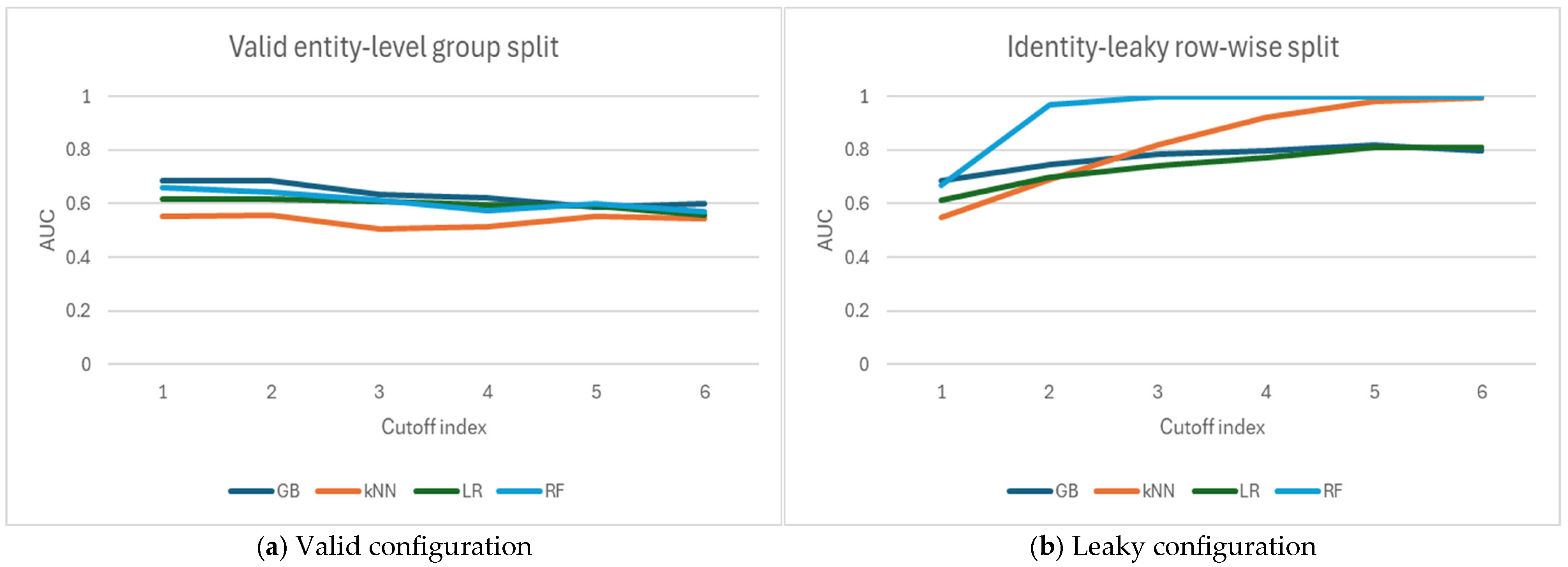
| GB | kNN | LR | RF | GB | kNN | LR | RF | |
| 1 | 0.687 | 0.551 | 0.615 | 0.658 | 0.687 | 0.549 | 0.613 | 0.668 |
| 2 | 0.688 | 0.559 | 0.616 | 0.644 | 0.746 | 0.690 | 0.698 | 0.971 |
| 3 | 0.633 | 0.506 | 0.607 | 0.612 | 0.783 | 0.821 | 0.742 | 0.998 |
| 4 | 0.620 | 0.514 | 0.594 | 0.576 | 0.797 | 0.924 | 0.772 | 0.999 |
| 5 | 0.588 | 0.553 | 0.591 | 0.598 | 0.821 | 0.983 | 0.812 | 1.000 |
| 6 | 0.601 | 0.545 | 0.556 | 0.572 | 0.798 | 0.994 | 0.812 | 1.000 |
| Residence Encoding | Algorithm | Valid AUC at Cutoff 6 | Leaky AUC at Cutoff 6 | Inflation |
|---|---|---|---|---|
| Coarse residence encoding | LR | 0.578 | 0.689 | 0.111 |
| GB | 0.674 | 0.998 | 0.324 | |
| kNN | 0.458 | 0.998 | 0.540 | |
| RF | 0.569 | 1.000 | 0.431 | |
| Full city-name residence encoding | LR | 0.556 | 0.812 | 0.256 |
| GB | 0.601 | 0.798 | 0.196 | |
| kNN | 0.545 | 0.994 | 0.450 | |
| RF | 0.572 | 1.000 | 0.428 |
Disclaimer/Publisher’s Note: The statements, opinions and data contained in all publications are solely those of the individual author(s) and contributor(s) and not of MDPI and/or the editor(s). MDPI and/or the editor(s) disclaim responsibility for any injury to people or property resulting from any ideas, methods, instructions or products referred to in the content. |
© 2026 by the author. Licensee MDPI, Basel, Switzerland. This article is an open access article distributed under the terms and conditions of the Creative Commons Attribution (CC BY) license.
Share and Cite
Fauszt, T. Time-Consistent Prediction in Higher Education: A Framework for Preventing Data Leakage in Longitudinal Models. Information 2026, 17, 581. https://doi.org/10.3390/info17060581
Fauszt T. Time-Consistent Prediction in Higher Education: A Framework for Preventing Data Leakage in Longitudinal Models. Information. 2026; 17(6):581. https://doi.org/10.3390/info17060581
Chicago/Turabian StyleFauszt, Tibor. 2026. "Time-Consistent Prediction in Higher Education: A Framework for Preventing Data Leakage in Longitudinal Models" Information 17, no. 6: 581. https://doi.org/10.3390/info17060581
APA StyleFauszt, T. (2026). Time-Consistent Prediction in Higher Education: A Framework for Preventing Data Leakage in Longitudinal Models. Information, 17(6), 581. https://doi.org/10.3390/info17060581