
An Ontology Engineering Perspective to Create a Unifying Conceptualization of the Leadership Domain

 , , and
Abstract
1. Introduction
2. Methodology
- Categories: embody a grouping of concepts sharing common characteristics.
- Subcategories: symbolize dividing a category into more specific groups of concepts.
- Instances: refers to each concept grouped into categories or subcategories.
- Relationships: denote various associations between categories, subcategories, and instances in a domain.
2.1. Expert Team Constitution
2.2. Definition of a Work Corpus
(“leadership” OR “leadership theories” OR “leadership approaches” OR “leadership models” OR “leadership styles”) AND (“taxonomy” OR “characterization” OR “ontology” OR “meta analysis”)
- a.
- Select only documents that contain the designated words from the query string in their titles, abstracts, and/or keywords.
- b.
- Exclusively consider research and review articles, book chapters, and conference articles from engineering, business, management, accounting, and social sciences.
2.3. Identification of Structural, Common, and Underlying Categories in the Leadership Domain
- Initially, it is essential to identify words to designate structural, common, and underlying categories. The chosen words are pivotal in establishing the foundational framework for a specific conceptualization [60].
- It is crucial to enhance the initial words as needed. The middle-out perspective allows the designation of new categories based on emerging information from analyzing and reviewing new documents.
2.4. Development of Clear and Detailed Definitions to Unambiguously Describe the Categories in the Leadership Domain
2.5. Identification of Subcategories and Synthesis of Information to Resolve Issues of Overlap
2.6. Creation of Taxonomic Classification for the Set of Categories, Subcategories, and Instances in the Leadership Domain
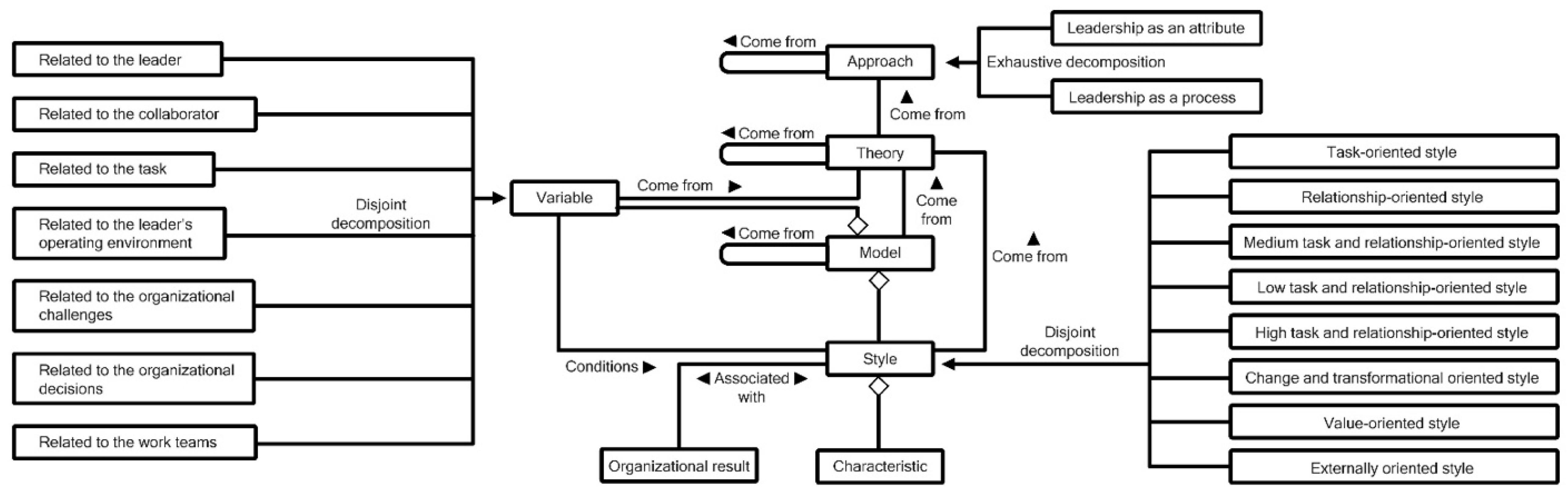
- Disjoint decomposition where subcategories lack common instances.
- Exhaustive decomposition where subcategories can share common in stances.
2.7. Representation of the Structural, Common, and Underlying Elements in the Leadership Domain
2.8. Validation of the Unifying Conceptualization of the Leadership Domain
2.8.1. Assessment of Experts’ Competence
2.8.2. Submit the Unifying Proposal for Evaluation by the Expert Criteria
3. Results and Discussion
3.1. Results of Building the Unifying Conceptualization for the Leadership Domain
3.2. Validation Results in the Unifying Conceptualization of the Leadership Domain Using the Experts’ Criteria Methodology
4. Conclusions
Supplementary Materials
Author Contributions
Funding
Institutional Review Board Statement
Informed Consent Statement
Data Availability Statement
Conflicts of Interest
References
- Ðordevic, A.; Klochkov, Y.; Arsovski, S.; Stefanovic, N.; Shamina, L.; Pavlovic, A. The impact of ICT support and the EFQM criteria on sustainable business excellence in higher education institutions. Sustainability 2021, 13, 7523. [Google Scholar] [CrossRef]
- Kragt, D.; Day, D.V. Predicting Leadership Competency Development and Promotion Among High-Potential Executives: The Role of Leader Identity. Front. Psychol. 2020, 11, 1816. [Google Scholar] [CrossRef] [PubMed]
- Abrell-Vogel, C.; Rowold, J. Leaders’ commitment to change and their effectiveness in change—A multilevel investigation. J. Organ. Change Manag. 2014, 27, 900–921. [Google Scholar] [CrossRef]
- Brasier, A.R.; Casey, S.L.; Hatfield, P.; Kelly, P.W.; Sweeney, W.A.; Schweizer, M.; Liu, B.; Burnside, E.S. A leadership model supporting maturation of high-performance translational teams. J. Clin. Transl. Sci. 2023, 7, e171. [Google Scholar] [CrossRef]
- Murphy, J.; Elliott, S.N.; Goldring, E.; Porter, A.C. Leadership for learning: A research-based model and taxonomy of behaviors. Sch. Leadersh. Manag. 2007, 27, 179–201. [Google Scholar] [CrossRef]
- Pfeffer, J. The Ambiguity of Leadership. Acad. Manag. Rev. 1977, 2, 104–112. [Google Scholar] [CrossRef]
- Harms, P.D.; Credé, M.; Tynan, M.; Leon, M.; Jeung, W. Leadership and stress: A meta-analytic review. Leadersh. Q. 2017, 28, 178–194. [Google Scholar] [CrossRef]
- Siangchokyoo, N.; Klinger, R.L.; Campion, E.D. Follower transformation as the linchpin of transformational leadership theory: A systematic review and future research agenda. Leadersh. Q. 2020, 31, 101341. [Google Scholar] [CrossRef]
- Banks, G.C.; Gooty, J.; Ross, R.L.; Williams, C.E.; Harrington, N.T. Construct redundancy in leader behaviors: A review and agenda for the future. Leadersh. Q. 2018, 29, 236–251. [Google Scholar] [CrossRef]
- Edwards, G.; Bolden, R. Why is collective leadership so elusive? Leadership 2023, 19, 167–182. [Google Scholar] [CrossRef]
- Eva, N.; Howard, J.L.; Liden, R.C.; Morin, A.J.S.; Schwarz, G. An Inconvenient Truth: A Comprehensive Examination of the Added Value (or Lack Thereof) of Leadership Measures. J. Manag. Stud. 2025, 62, 3072–3117. [Google Scholar] [CrossRef]
- Randel, A.E.; Galvin, B.M.; Shore, L.M.; Ehrhart, K.H.; Chung, B.G.; Dean, M.A.; Kedharnath, U. Inclusive leadership: Realizing positive outcomes through belongingness and being valued for uniqueness. Hum. Resour. Manag. Rev. 2018, 28, 190–203. [Google Scholar] [CrossRef]
- Schmidt, F. Detecting and Correcting the Lies That Data Tell. Perspect. Psychol. Sci. 2010, 5, 233–242. [Google Scholar] [CrossRef]
- Anderson, M.H.; Sun, P.Y.T. Re-Envisioning a Hierarchy of Leadership Behaviours Using Insights from the Psychological Literature on Personality Traits. J. Manag. Stud. 2024, 61, 1165–1191. [Google Scholar] [CrossRef]
- Mendenhall, M.E.; Reiche, B.S.; Bird, A.; Osland, J.S. Defining the ‘global’ in global leadership. J. World Bus. 2012, 47, 493–503. [Google Scholar] [CrossRef]
- Van Knippenberg, D.; Sitkin, S.B. A critical assessment of charismatic—Transformational leadership research: Back to the drawing board? Acad. Manag. Ann. 2013, 7, 1–60. [Google Scholar] [CrossRef]
- Ladkin, D.; Patrick, C.B. Whiteness in leadership theorizing: A critical analysis of race in Bass’ trans-formational leadership theory. Leadership 2022, 18, 205–223. [Google Scholar] [CrossRef]
- Mbindyo, M.; O’connor, R.J.; Nandedkar, A. Linking Transformational Leadership Theory to the Practice of Academic Advising—A Conceptual Paper. J. High. Educ. Theory Pract. 2021, 21, 172–182. [Google Scholar] [CrossRef]
- Effendi, Y.R.; Bafadal, I.; Degeng, N.S.; Arifin, I. The principal’s transformational leadership approach based on local wisdom in strengthening the character of students. Malays. Online J. Educ. Manag. 2020, 8, 24–42. [Google Scholar] [CrossRef]
- Hartono, S.B.; Hajar, I.; Ristianawati, Y.; Budiarto, A. ISFA-As Intervening Financial Literacy and Culture Towards Organisational Financial Performance: A Transformational Leadership Approach. Int. J. Innov. Creat. Change 2019, 8, 47–66. Available online: www.ijicc.net (accessed on 11 May 2026).
- Tabassi, A.A.; Roufechaei, K.M.; Abu Bakar, A.H.; Yusof, N. Linking Team Condition and Team Performance: A Transformational Leadership Approach. Proj. Manag. J. 2017, 48, 22–38. Available online: www.pmi.org/PMJ (accessed on 11 May 2026). [CrossRef]
- Yukl, G. An evaluation of conceptual weaknesses in transformational and charismatic leadership theories. Leadersh. Q. 1999, 10, 285–305. [Google Scholar] [CrossRef]
- Derue, D.S.; Nahrgang, J.D.; Wellman, N.; Humphrey, S.E. Trait and behavioral theories of leadership: An integration and Meta-Analytic test of their relative validity. Pers. Psychol. 2011, 64, 7–52. [Google Scholar] [CrossRef]
- Shaffer, J.A.; DeGesst, D.; Li, A. Tackling the problem of construct proliferation: A guide to assessing the discriminant validity of conceptually related constructs. Organ. Res. Methods 2016, 19, 80–110. [Google Scholar] [CrossRef]
- Stogdill, R.; Coons, A.E. Leadership behavior: Its description and measurement. Adm. Sci. Q. 1958, 3, 271–273. [Google Scholar] [CrossRef]
- French, J.R.P.; Raven, B. The bases of social power. In Studies in Social Power; Cartwright, D., Ed.; Research Center for Group Dynamics, Institute for Social Research, University of Michigan: Ann Arbor, MI, USA, 1959; pp. 150–167. [Google Scholar]
- Blake, R.; Mounton, J. The Managerial Grid: Key Orientations for Achieving Production Through People; Gulf Publishing Company: Houston, TX, USA, 1964; Available online: https://books.google.com.co/books?id=GfXsAAAAMAAJ (accessed on 25 May 2026).
- Legood, A.; van der Werff, L.; Lee, A.; Den Hartog, D. A meta-analysis of the role of trust in the leadership-performance relationship. Eur. J. Work Organ. Psychol. 2021, 30, 1–22. [Google Scholar] [CrossRef]
- Yukl, G. Managerial Leadership: A Review of Theory and Research. J. Manag. 1989, 15, 251–289. [Google Scholar] [CrossRef]
- Behrendt, P.; Matz, S.; Göritz, A.S. An integrative model of leadership behavior. Leadersh. Q. 2016, 1, 229–244. [Google Scholar] [CrossRef]
- Bengtsson, P.; Ledin, K.; Ärlemalm, T. What do they do? A taxonomy of team leader interventions in various meeting scenarios. In Advances in Intelligent Systems and Computing; Springer: Berlin/Heidelberg, Germany, 2019; pp. 399–404. [Google Scholar] [CrossRef]
- McCarthy, P.; Sammon, D.; Alhassan, I. Digital Transformation Leadership Characteristics: A Literature Analysis. J. Decis. Syst. 2021, 1, 79–109. [Google Scholar] [CrossRef]
- Rowold, J.; Borgmann, L.; Diebig, M. A Towel of Babel?—Interrelations and structure of leadership con-structs. Leadersh. Organ. Dev. J. 2015, 36, 137–160. [Google Scholar] [CrossRef]
- Mackenzie, K.D.; Barnes, F.B. The unstated consensus of leadership approaches. Int. J. Organ. Anal. 2008, 15, 92–118. [Google Scholar] [CrossRef]
- Parker, S.H.; Yule, S.; Flin, R.; Mckinley, A. Development of a taxonomy for surgeons’ intraoperative leadership. In Proceedings of the Human Factors and Ergonomics Society Annual Meeting; SAGE Publications: Los Angeles, CA, USA, 2011; Volume 55, pp. 695–699. [Google Scholar] [CrossRef]
- Follmer, K.B.; Neely, B.H.; Jones, K.S.; Hunter, S.T. To Lead Is to Err: The Mediating Role of Attribution in the Relationship Between Leader Error and Leader Ratings. J. Leadersh. Organ. Stud. 2018, 26, 18–31. [Google Scholar] [CrossRef]
- Prieto, L. Leadership multiplicities before and during the post-truth era. Adm. Sci. 2019, 9, 1. [Google Scholar] [CrossRef]
- Arici, H.E.; Uysal, M. Leadership, green innovation, and green creativity: Systematic review. Serv. Ind. J. 2021, 1, 280–320. [Google Scholar] [CrossRef]
- Van Wart, M. Lessons from leadership Theory and the Contemporary challenges of leaders. Public Adm. Rev. 2013, 73, 553–565. [Google Scholar] [CrossRef]
- Markham, S.E. Leadership, levels of analysis, and déjà vu: Modest proposals for taxonomy and cladistics coupled with replication and visualization. Leadersh. Q. 2010, 21, 1121–1143. [Google Scholar] [CrossRef]
- Dinh, J.E.; Lord, R.G.; Gardner, W.L.; Meuser, J.D.; Liden, R.C.; Hu, J. Leadership theory and research in the new millennium: Current theoretical trends and changing perspectives. Leadersh. Q. 2014, 25, 36–62. [Google Scholar] [CrossRef]
- Ramaprasad, A.; Syn, T. Ontological Meta-Analysis and Synthesis. Commun. Assoc. Inf. Syst. 2013, 37, 7. [Google Scholar] [CrossRef]
- Dogac, A.; Laleci, G.; Kabak, Y.; Cingil, I. Exploiting Web Service Semantics: Taxonomies vs. Ontologies. IEEE Data Eng. Bull. 2002, 25, 10–16. [Google Scholar]
- Machado, L.M.O.; Martínez-Ávila, D.; Almeida, M.B.; Borges, M.M. Towards a moderate realist foundation for ontological knowledge organization systems: The question of the naturalness of classifications. J. Inf. Sci. 2025, 51, 969–986. [Google Scholar] [CrossRef]
- Fonseca, F.; Martin, J. Learning the differences between ontologies and conceptual schemas through ontology-driven information systems. J. Assoc. Inf. Syst. 2007, 8, 4. [Google Scholar] [CrossRef]
- Gómez-Pérez, A.; Fernández-Lopez, M.; Corcho, O. Ontological Engineering with Examples from the Areas of Knowledge Management, e-Commerce and the Semantic Web, 1st ed.; Springer: London, UK, 2004. [Google Scholar] [CrossRef]
- Baião, F.; Santoro, F.M.; Iendrike, H.; Cappelli, C.; Lopes, M.; Nunes, V.T.; Dumont, A.P. Towards a data integrations approach based on business process models and Domain ontologies. In Proceedings of the Tenth International Conference on Enterprise Information Systems—ISAS; SciTePress: Setúbal, Portugal, 2008; pp. 338–342. [Google Scholar] [CrossRef]
- Barrera, M.; Núñez, H.; Ramos, E. Ingeniería Ontológica, Lecturas en Ciencias de la Computación; Escuela de Computación Facultad de Ciencias, Universidad Central de Venezuela: Caracas, Venezuela, 2012. [Google Scholar]
- Ramos, E.; Núñez, H.; Casañas, R. Esquema para evaluar ontologías únicas para un dominio de conocimiento. Enlace 2009, 6, 57–71. [Google Scholar]
- Pinto, H.S.; Martins, J.P. Ontologies: How Can They Be Built? Knowl. Inf. Syst. 2004, 6, 441–464. [Google Scholar] [CrossRef]
- Fox, M.; Barbuceanu, M.; Gruninger, M. An Organisation Ontology for Enterprise Modelling: Preliminary Concepts for Linking Structure and Behaviour. Comput. Ind. 1995, 29, 123–134. [Google Scholar] [CrossRef]
- Corréa, D. Representing Organizational Structures in Enterprise Architecture: An Ontology-Based Approach; Universidade Federal Do Espírito Santo: Vitória, Brazil, 2015. [Google Scholar]
- Costa, J.; Roma, G.; Matos, P.; Ferreira, Â.; Pereira, M.J.V. Systematic review of ontologies in the energy domain to enable knowledge representation in local electricity markets. Energy Inform. 2026, 9, 35. [Google Scholar] [CrossRef]
- Wei, D.; Alias, B.S.; Abdul Wahab, J.L.B. Content validation and content validity index calculation for teacher innovativeness instrument among Henan private universities in China. Commun. Appl. Nonlinear Anal. 2025, 32, 175–187. [Google Scholar] [CrossRef]
- Triandini, E.; Kristyanto, M.A.; Rishika, R.V.; Rawung, F. A Systematic Literature Review of The Role of Ontology in Modeling Knowledge in Software Development Processes. IPTEK J. Technol. Sci. 2021, 32, 159–176. [Google Scholar] [CrossRef]
- Hsieh, H.F.; Shannon, S.E. Three Approaches to Qualitative Content Analysis. Qual. Health Res. 2005, 15, 1277–1288. [Google Scholar] [CrossRef]
- Budd, R.W.; Thorp, R.K.; Donohew, L. Content Analysis of Communications; Macmillan: New York, NY, USA, 1967; Available online: https://books.google.com.co/books?id=dWpbAAAAMAAJ (accessed on 11 May 2026).
- Mctavish, D.G.; Pirro, E.B. Contextual Content Analysis. Qual. Quant. 1990, 24, 245–265. [Google Scholar] [CrossRef]
- Tesch, R. Qualitative Research: Analysis Types and Software Tools; Routledge: London, UK, 1990. [Google Scholar] [CrossRef]
- Velardi, P.; Navigli, R.; Cucchiarelli, A.; Neri, F. Evaluation of OntoLearn, a Methodology for Automatic Learning of Domain Ontologies; IOS Press: Roma, Italy, 2003; Available online: http://wwwusers.di.uniroma1.it/~navigli/pubs/IOS-FAIA.pdf (accessed on 14 May 2026).
- Schmuller, J. Aprendiendo UML en 24 Horas; Prentice Hall: Hoboken, NJ, USA, 2000; Available online: https://books.google.com.mx/books?id=O3pjPQAACAAJ (accessed on 6 May 2026).
- Romero, N. Propuesta de Extensión de UML para Proceso de Conceptualización De Requisitos. Arch. Rev. Latinoam. Ing. Softw. 2016, 4, 59–72. [Google Scholar] [CrossRef][Green Version]
- Campistrous, P.; Rizo, C. El Criterio de Expertos Como Método en la Investigación Educativa; Instituto Superior de Cultura Física Manuel Fajardo: La Habana, Cuba, 2006; pp. 1–31. [Google Scholar]
- Argyriadis, A.; Patelarou, E.; Paoullis, P.; Patelarou, A.; Dimitrakopoulos, I.; Zisi, V.; Northway, R.; Gourni, M.; Asimakopoulou, E.; Katsarou, D.; et al. Self-assessment of health professionals’ cultural competence: Knowledge, skills, and mental health concepts for optimal health care. Int. J. Environ. Res. Public Health 2022, 19, 11282. [Google Scholar] [CrossRef]
- Anderson, D.; Ackerman, L. Beyond Change Management: Advanced Strategies for Today’s Transformational Leaders; John Wiley and Sons: San Francisco, CA, USA, 2002; Available online: https://books.google.com.co/books?id=92JzhSPrEsUC (accessed on 29 May 2026).
- Yukl, G.; Taber, T.; Gordon, A. A Hierarchical Taxonomy of Leadership Behavior: Integrating a Half Century of Behavior Research. J. Leadersh. Organ. Stud. 2002, 9, 15–32. [Google Scholar] [CrossRef]
- Yukl, G. Effective Leadership Behavior: What We Know and What Questions need more attention. Acad. Manag. Perspect. 2012, 26, 66–85. [Google Scholar] [CrossRef]
- Gilstrap, D.L. A Complex Systems Framework for Research on Leadership and Organizational Dynamics in Academic Libraries; Elsevier: Amsterdam, The Netherlands, 2009; pp. 57–77. Available online: https://www.scopus.com/inward/record.uri?eid=2-s2.0-68149132165&partnerID=40&md5=73926ccc6c4385b2db22fc0315514c90 (accessed on 30 April 2026).
- Vega, M.F. Los Comportamientos Del Liderazgo Y SU Relación Con El Desarrollo de Los Modelos de Gestion; Universidad del Rosario: Bogotá, Colombia, 2014. [Google Scholar]
- Drath, W.H.; Mccauley, C.D.; Palus, C.J.; Van Velsor, E.; Connor, P.M.G.O.; Mcguire, J.B. Direction, alignment, commitment: Toward a more integrative ontology of leadership. Leadersh. Q. 2008, 19, 635–653. [Google Scholar] [CrossRef]
- Eva, N.; Robin, M.; Sendjaya, S.; van Dierendonck, D.; Liden, R.C. Servant Leadership: A systematic review and call for future research. Leadersh. Q. 2019, 30, 111–132. [Google Scholar] [CrossRef]
- Walumbwa, F.O.; Avolio, B.J.; Gardner, W.L.; Wernsing, T.S.; Peterson, S.J. Authentic leadership: Development and validation of a theory-based measure. J. Manag. 2008, 34, 89–126. [Google Scholar] [CrossRef]
- Ng, T.W.H.; Feldman, D.C. Ethical leadership: Meta-analytic evidence of criterion-related and incremental validity. J. Appl. Psychol. 2015, 100, 948–965. [Google Scholar] [CrossRef]
- Kalshoven, K.; Den Hartog, D.N.; De Hoogh, A.H.B. Ethical leadership at work questionnaire (ELW): Development and validation of a multidimensional measure. Leadersh. Q. 2011, 22, 51–69. [Google Scholar] [CrossRef]
- Daft, R. The Leadership Experience, 6th ed.; Cengage Learning: Boston, MA, USA, 2014. [Google Scholar]
- Luthans, F.; Avolio, B. Authentic Leadership Development. In EBSCO: eBook Collection (EBSCOhost); Tel Aviv University: Tel Aviv, Israel, 2019; Volume 1, pp. 241–271. [Google Scholar]
- Sweeney, P.J.; Fry, L.W. Character development through spiritual leadership. Consult. Psychol. J. Pract. Res. 2012, 64, 89–107. [Google Scholar] [CrossRef]
- Oc, B. Contextual leadership: A systematic review of how contextual factors shape leadership and its outcomes. Leadersh. Q. 2018, 29, 218–235. [Google Scholar] [CrossRef]
- Fleischman, E.A.; Quaintance, M.K. Taxonomies of Human Performance: The Description of Human Tasks; Academic Press: Orlando, FL, USA, 1984. [Google Scholar]
- Messick, S. Validity. In Educational Measurement, 3rd ed.; Linn, R.L., Ed.; American Council on Education: New York, NY, USA; Macmillan: New York, NY, USA, 1989. [Google Scholar]
- Vilalta, J. UML Guía Visual. ¿Cómo Crear Formas de Vida Organizativa? Vitalta Consultores: Lima, Peru, 2001; Volume 1, Available online: www.vico.org (accessed on 1 April 2026).
- Zaccaro, S.J. The Nature of Executive Leadership: A conceptual and Empirical Analysis of Success; American Psychological Association: Washington, DC, USA, 2001. [Google Scholar]
- Wu, T.C.; Chen, C.H.; Li, C.C. A correlation among safety leadership, safety climate and safety performance. J. Loss Prev. Process Ind. 2008, 21, 307–318. [Google Scholar] [CrossRef]
- Solow, D.; Szmerekovsky, J.G. Setting leadership goals and getting those goals accomplished: Insights from a mathematical model. Comput. Math. Organ. Theory 2014, 20, 36–51. [Google Scholar] [CrossRef]
- Ding, X.; Li, Q.; Zhang, H.; Sheng, Z.; Wang, Z. Linking transformational leadership and work outcomes in temporary organizations: A social identity approach. Int. J. Proj. Manag. 2017, 35, 543–556. [Google Scholar] [CrossRef]



| No | Institution | Country | Professional Qualification, Scientific, or Academic Degree | Academic Degree | Years of Professional Experience | Years of Research Experience |
|---|---|---|---|---|---|---|
| 1 | Universidad de Valencia | Spain | Doctor | Psychology | 25 | 25 |
| 2 | Universidad de Valencia | Spain | Magister | EMJMD in WOP-P | 1 | 3 |
| 3 | Universidad de Valencia | Spain | Doctor | Doctor in Organizational Psychology | 50 | 15 |
| 4 | Universidad de Valencia | Spain | Doctor | Psychology | 36 | 35 |
| 5 | Universidad de Valencia | Spain | Magister | Master’s degree in Psychology—Pursuing a Doctorate in Human Resources Psychology | 18 | 15 |
| 6 | Center for Leadership and Management—CLG | Colombia | Magister | Master’s degree in Human Geography | 16 | 10 |
| 7 | Universidad Tecnológica de Pereira | Colombia | Doctor | Doctor of Management Sciences | 28 | 25 |
| 8 | Universidad Nacional de Colombia | Colombia | Doctor | Industrial Engineer, Doctor of Engineering: Industry and Organizations | 28 | 20 |
| 9 | Center for Leadership and Management—CLG | Colombia | Professional | International Business Management—Facilitator in Leadership & Management | 3 | 1 |
| 10 | Universidad Tecnológica de Pereira | Colombia | Magister | Master’s degree in Human and Organizational Development Management | 40 | 20 |
| 11 | Universidad de Puerto Rico | Puerto Rico | Doctor | Doctor of Education—Coordinator of the Leadership Program at the Universidad de Puerto Rico’s Educational Organizations | 35 | 35 |
| 12 | Center for Leadership and Management—CLG | Colombia | Magister | Master of Public Administration—Facilitator in Leadership and Management | 15 | 6 |
| Category | Definition |
|---|---|
| Approach | General perspective to analyze and explain the leadership domain. |
| Theory | Specific speculative knowledge or hypotheses to propose explanations within the leadership domain. |
| Model | Set of styles and variables to facilitate the theory abstraction. |
| Style | Concept to encompass the leader’s way of acting or being. |
| Variable | Concept with different meanings inside a specific context. |
| Characteristic | A quality that distinguishes and differentiates a leader. A characteristic confers a leader’s unique personality, style, manner, and behavior. |
| Organizational result | Effect and consequence inside an organizational environment. |
| Category | Subcategory | Definition |
|---|---|---|
| Approach | Leadership as an attribute | Approach to explain leadership as an “attribute” that a gifted individual acquires or learns to influence others. |
| Leadership as a process | Approach to explain leadership as a “process” with a collaborative and emergent structure arising from group interaction [65]. |
| Category | Subcategory | Definition |
|---|---|---|
| Variable | Variables related to the leader | Variables about the leader’s qualities. |
| Variables related to the collaborator | Variables about the collaborator’s qualities. | |
| Variables related to the task | Variables about the task’s characteristics. | |
| Variables related to the leader’s operating environment | Variables related to the characteristics of the environment in which a leader operates. | |
| Variables related to the organizational challenges | Variable related to the characteristics of organization’s challenges. | |
| Variables related to the organizational decisions | Variables related to the characteristics of organization’s decisions. | |
| Variables related to the work teams | Variables related to the characteristics of the work teams in organizations. |
| Category | Subcategory | Definition |
|---|---|---|
| Style | Task-oriented style | Leadership styles that combines ways of acting or being to achieve objectives, organization, structure, planning, control, monitoring of operations and problem-solving [66,67,68,69]. |
| Relationship-oriented style | Leadership styles that combines ways of acting or being to recognize human needs, respect collaborator’s feelings, support their work, improve the level of leader-member social-emotional interaction, and enhance impersonal [66,67,68,69,70]. | |
| Medium task and relationship-oriented style | Leadership styles that combines ways of acting or being with a moderate orientation toward the tasks and relations. | |
| Low task and relationship-oriented style | Leadership styles that combines ways of acting or being with a minimal orientation toward the tasks and relations. | |
| High task and relationship-oriented style | Leadership styles that combines ways of acting or being with a high orientation toward tasks and relations. | |
| Change and transformational oriented style | Leadership styles that combines ways of acting or being to promote change, innovation, experimentation, learning, risk-taking, positive transformation of followers, organizational adaptability, and creative problem-solving. | |
| Value-oriented style | Leadership styles that combines ways of acting or being to promote moral and altruistic behavior within the organization, value development, service to others, authentic relationships, and ethical growth. | |
| Externally oriented style | Leadership styles that combines ways of acting or being to create interpersonal contacts, connection networks, and supportive relationships with people external to the organization. |
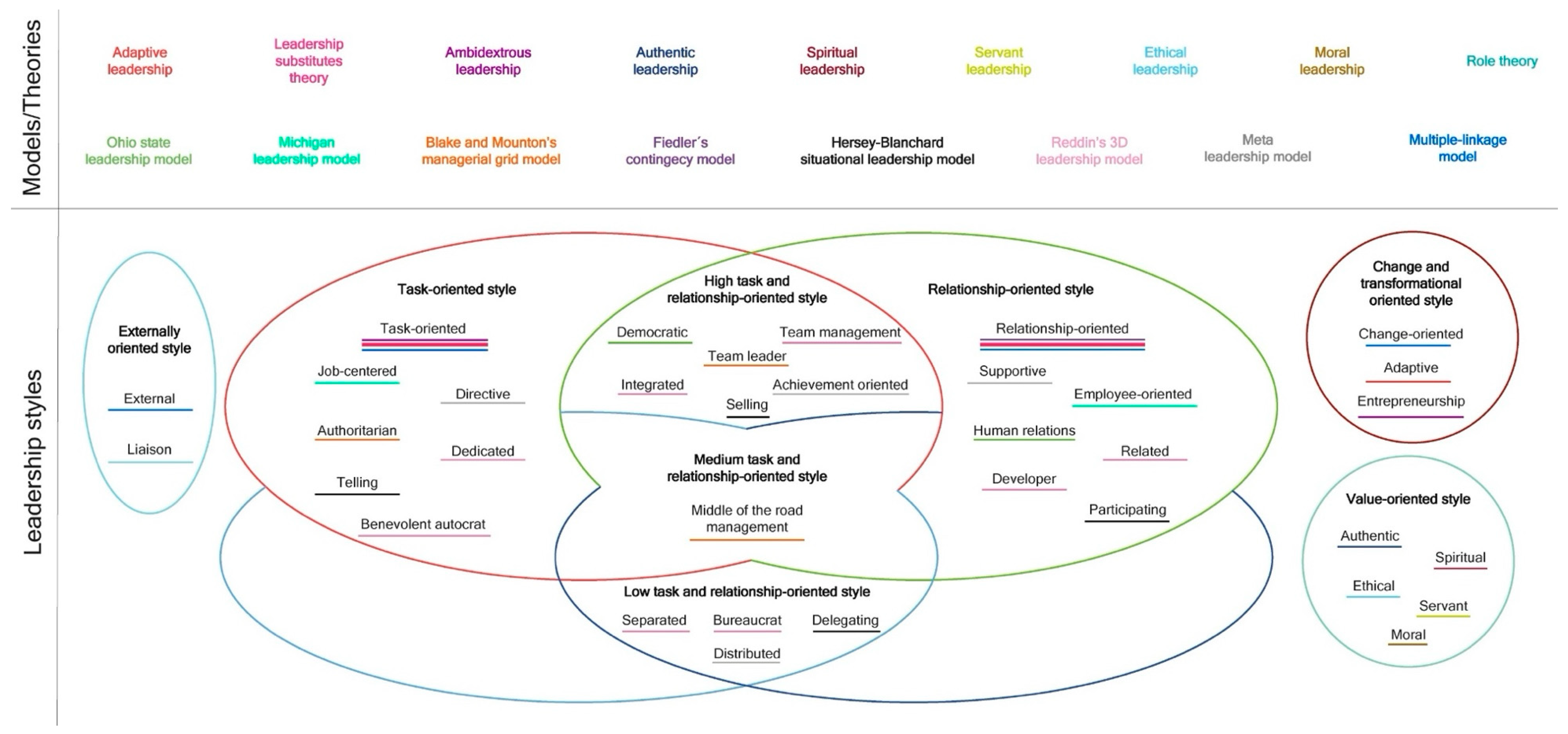
| Instance | Overlapping Leadership Styles Synthesized into General Instances | Leader Characteristics Shared by Overlapping Styles | Organizational Results Shared by Overlapping Styles |
|---|---|---|---|
| Task-oriented style level II |
|
|
|
| Relationship-oriented style level II |
|
|
|
| Medium task and relationship-oriented style level I |
|
|
|
| Low task and relationship-oriented style level I |
|
|
|
| High task and relationship-oriented style level I |
|
|
|
| Change and transformational oriented style level I |
|
|
|
| Value-oriented style level I |
|
|
|
| Externally oriented style level I |
|
|
|
| Category | Subcategory | Instance |
|---|---|---|
| Approach | Leadership as an attribute. |
|
| Leadership as a process. |
| |
| Theory |
| |
| Model |
| |
| Style | Task-oriented style. |
|
| Relationship-oriented style. |
| |
| Medium task and relationship-oriented style. |
| |
| Low task and relationship-oriented style. |
| |
| High task and relationship-oriented style. |
| |
| Change and transformational oriented style. |
| |
| Value-oriented style. |
| |
| Externally oriented style |
| |
| Variable | Variables related to the leader. |
|
| Variables related to the collaborator. |
| |
| Variables related to the task. |
| |
| Variables related to the leader’s operating environment. |
| |
| Variables related to the organizational challenges. |
| |
| Variables related to the organizational decisions. |
| |
| Variables related to the work teams. |
| |
| Characteristic |
| |
| Organizational result |
|
| Expert | Argumentation Coefficient () | Knowledge Coefficient () | Competence Coefficient () | Rating |
|---|---|---|---|---|
| 1 | 0.8 | 0.9 | 0.85 | High |
| 2 | 0.8 | 0.3 | 0.55 | Medium |
| 3 | 0.8 | 0.7 | 0.75 | Medium |
| 4 | 1 | 0.8 | 0.9 | High |
| 5 | 0.9 | 0.4 | 0.65 | Medium |
| 6 | 0.9 | 0.7 | 0.8 | High |
| 7 | 0.9 | 0.8 | 0.85 | High |
| 8 | 0.8 | 0.7 | 0.75 | Medium |
| 9 | 0.9 | 0.7 | 0.8 | High |
| 10 | 0.8 | 0.8 | 0.8 | High |
| 11 | 0.9 | 1 | 0.95 | High |
| 12 | 0.9 | 0.7 | 0.8 | High |
| Indicator | SA | A | N | SD | D | TOTAL |
|---|---|---|---|---|---|---|
| Descriptive clarity | 6 | 4 | 2 | 0 | 0 | 12 |
| Objective correspondence | 11 | 1 | 0 | 0 | 0 | 12 |
| Relevance | 7 | 3 | 2 | 0 | 0 | 12 |
| Viability | 4 | 6 | 2 | 0 | 0 | 12 |
| Coherence | 7 | 4 | 1 | 0 | 0 | 12 |
| Indicator | SA | A | N | SD | D |
|---|---|---|---|---|---|
| Descriptive clarity | 6 | 10 | 12 | 12 | 12 |
| Objective correspondence | 11 | 12 | 12 | 12 | 12 |
| Relevance | 7 | 10 | 12 | 12 | 12 |
| Viability | 4 | 10 | 12 | 12 | 12 |
| Coherence | 7 | 11 | 12 | 12 | 12 |
| Indicator | SA | A | N | SD |
|---|---|---|---|---|
| Descriptive clarity | 0.5000 | 0.8333 | 1.0000 | 1.0000 |
| Objective correspondence | 0.9167 | 1.0000 | 1.0000 | 1.0000 |
| Relevance | 0.5833 | 0.8333 | 1.0000 | 1.0000 |
| Viability | 0.3333 | 0.8333 | 1.0000 | 1.0000 |
| Coherence | 0.5833 | 0.9167 | 1.0000 | 1.0000 |
| Indicator | Strongly Agree | Agree | Neutral | Somewhat Disagree | Sum | Average | N-Average |
|---|---|---|---|---|---|---|---|
| Descriptive clarity | 0 | 0.97 | 3.49 | 3.49 | 7.95 | 1.99 | −0.23 |
| Objective correspondence | 1.38 | 3.49 | 3.49 | 3.49 | 11.85 | 2.96 | −1.20 |
| Relevance | 0.21 | 0.98 | 3.49 | 3.49 | 8.17 | 2.04 | −0.28 |
| Viability | −0.43 | 0.97 | 3.49 | 3.49 | 7.52 | 1.88 | −0.12 |
| Coherence | 0.21 | 1.38 | 3.49 | 3.49 | 8.57 | 2.14 | −0.38 |
| Sum | 1.37 | 7.79 | 17.45 | 17.45 | 44.06 | ||
| Cut-off points | 0.27 | 1.56 | 3.49 | 3.49 | |||
| Intervals | <0.27 | 0.27–1.83 | 1.83–5.32 | 5.32–8.81 |
Disclaimer/Publisher’s Note: The statements, opinions and data contained in all publications are solely those of the individual author(s) and contributor(s) and not of MDPI and/or the editor(s). MDPI and/or the editor(s) disclaim responsibility for any injury to people or property resulting from any ideas, methods, instructions or products referred to in the content. |
© 2026 by the authors. Licensee MDPI, Basel, Switzerland. This article is an open access article distributed under the terms and conditions of the Creative Commons Attribution (CC BY) license.
Share and Cite
Zuluaga-Ramirez, C.M.; Gómez-Suta, M.; Chavarro-Porras, J.C.; Estrada-Mejía, S.; Soto-Mejía, J. An Ontology Engineering Perspective to Create a Unifying Conceptualization of the Leadership Domain. Information 2026, 17, 559. https://doi.org/10.3390/info17060559
Zuluaga-Ramirez CM, Gómez-Suta M, Chavarro-Porras JC, Estrada-Mejía S, Soto-Mejía J. An Ontology Engineering Perspective to Create a Unifying Conceptualization of the Leadership Domain. Information. 2026; 17(6):559. https://doi.org/10.3390/info17060559
Chicago/Turabian StyleZuluaga-Ramirez, Carlos Mauricio, Manuela Gómez-Suta, Julio Cesar Chavarro-Porras, Sandra Estrada-Mejía, and José Soto-Mejía. 2026. "An Ontology Engineering Perspective to Create a Unifying Conceptualization of the Leadership Domain" Information 17, no. 6: 559. https://doi.org/10.3390/info17060559
APA StyleZuluaga-Ramirez, C. M., Gómez-Suta, M., Chavarro-Porras, J. C., Estrada-Mejía, S., & Soto-Mejía, J. (2026). An Ontology Engineering Perspective to Create a Unifying Conceptualization of the Leadership Domain. Information, 17(6), 559. https://doi.org/10.3390/info17060559