Exploratory Research of Integrating Large Language Models and Grounded Theory: Scientific and Technological Intelligence Case Study


Abstract
1. Introduction
2. Related Work
3. Materials and Methods
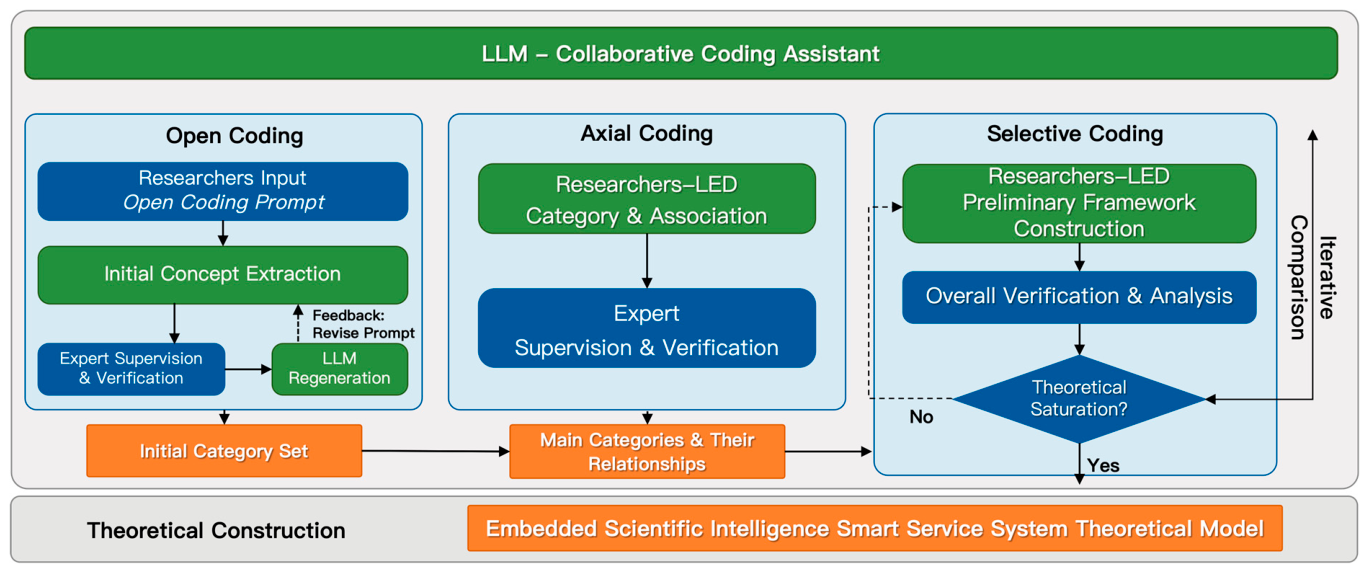
3.1. LLM-Assisted Collaborative Research Framework Grounded in Grounded Theory
3.2. Grounded Theory
3.2.1. Human–Machine Collaborative Coding Process
3.2.2. Bias Control and Coding Reliability Assurance
3.3. Data Sources
4. Results
4.1. Open Coding
4.2. Axial Coding
4.3. Selective Coding and Theoretical Saturation Test
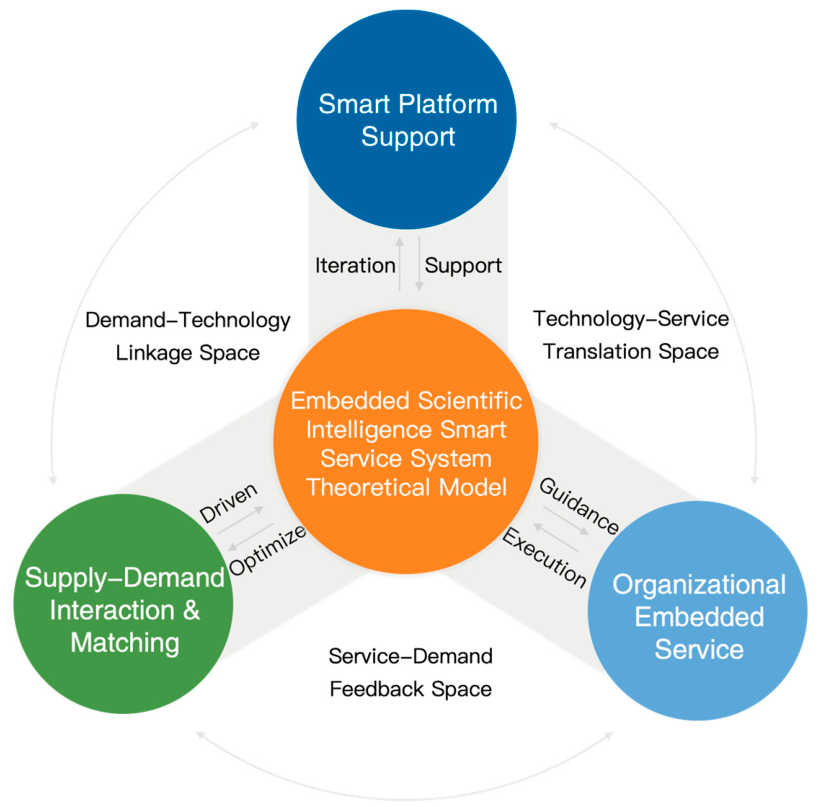
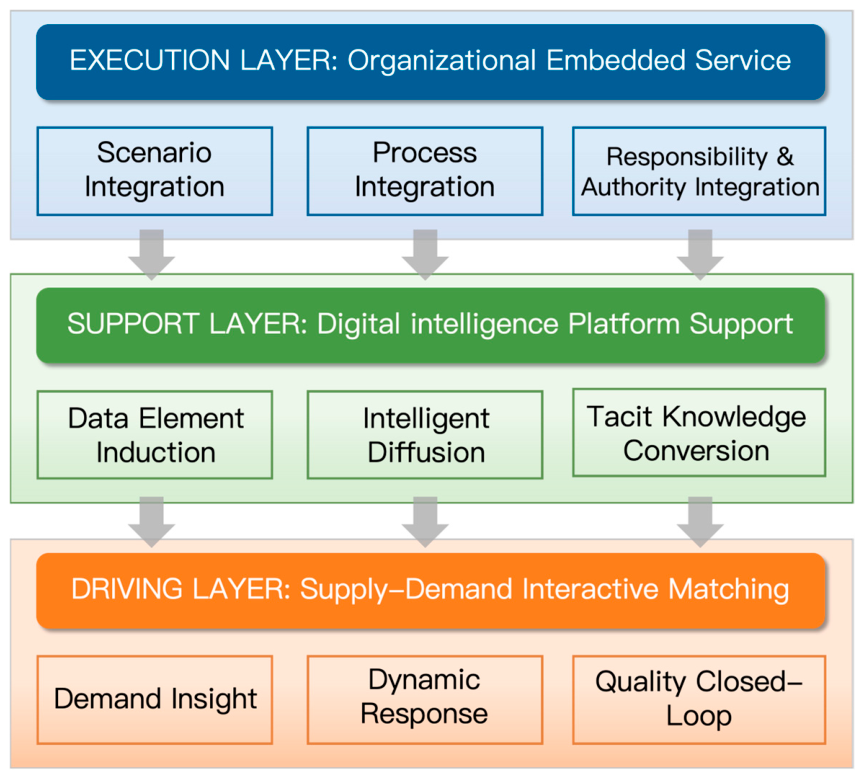
5. Embedded STI Intelligent Service System (E-STI-ISS)
5.1. Supply–Demand Interactive Matching
5.1.1. Demand Insight
5.1.2. Dynamic Response
5.1.3. Quality Closed-Loop
5.2. Organizational Embedded Service
5.2.1. Scenario Embedding
5.2.2. Process Embedding
5.2.3. Responsibility and Authority Embedding
5.3. Digital-Intelligent Platform Support
5.3.1. Data Element Induction
5.3.2. Intelligent Technology Penetration
5.3.3. Tacit Knowledge Transformation
6. Conclusions
6.1. Theoretical Implications
6.2. Practical Implications
6.3. Limitations
6.4. Future Research Directions
Author Contributions
Funding
Institutional Review Board Statement
Informed Consent Statement
Data Availability Statement
Conflicts of Interest
Abbreviations
| STI | Scientific and Technology Intelligence |
| LLMs | Large Language Models |
| AI | Artificial Intelligence |
References
- Liao, W.; Huang, M.; Ma, P. Extracting Knowledge Entities from Sci-Tech Intelligence Resources Based on BiLSTM and Conditional Random Field: Special Section on Computational Intelligence and Big Data for Scientific and Technological Resources and Services. IEICE Trans. Inf. Syst. 2021, E104D, 1214–1221. [Google Scholar] [CrossRef]
- Tang, Q.; Wu, B.; Dai, C. Study on Collecting and Analyzing Scientific and Technological Intelligence Based on the Multi-Modal BERT-KG Model. J. Phys. Conf. Ser. 2025, 3055, 012024. [Google Scholar] [CrossRef]
- Li, X.; Li, Z.; Zhao, K. Chinese Large Language Models Evaluation in the Field of Scientific and Technical Information. Proc. Assoc. Inf. Sci. Technol. 2025, 62, 396–405. [Google Scholar] [CrossRef]
- Liu, B. Analysis of the Optimization Path of Library and Information Service Mode under the Background of Big Data. J. Nat. Sci. Educ. 2025, 2, 23–27. [Google Scholar] [CrossRef]
- Ren, H.; Xu, W.; Chen, Y. Design and Implementation of MCG Information Service System Based on an Efficient and Scalable Architecture. Chin. J. Med. Instrum. 2025, 49, 674–680. [Google Scholar]
- Coulthart, S. Disruptive technologies and intelligence services: A framework for adoption in the digital age. Intell. Natl. Secur. 2025, 40, 1059–1072. [Google Scholar] [CrossRef]
- Fernández, D.M.A.; Real, D.C. Measuring Trust in Intelligence Services: A Conceptual Framework and Exploratory Study. Democr. Secur. 2026, 22, 80–108. [Google Scholar] [CrossRef]
- Hou, J.; Yang, X.; Song, H. The Impact of Scientific and Technological Information Resource Utilization on Breakthrough Innovation in Enterprises: The Moderating Role of Strategic Aggressiveness. Systems 2024, 12, 248. [Google Scholar] [CrossRef]
- Glaser, B.G.; Strauss, A.L. The Discovery of Grounded Theory: Strategies for Qualitative Research; Aldine Transaction: Chicago, IL, USA, 1967. [Google Scholar]
- Corbin, J.; Strauss, A. Grounded theory research: Procedures, canons, and evaluative criteria. Qual. Sociol. 1990, 19, 418–427. [Google Scholar]
- Paoli, S.D. Performing an Inductive Thematic Analysis of Semi-Structured Interviews with a Large Language Model: An Exploration and Provocation on the Limits of the Approach. Soc. Sci. Comput. Rev. 2024, 42, 997–1019. [Google Scholar] [CrossRef]
- Zhou, Y.; Yuan, Y.; Huang, K. Can ChatGPT Perform a Grounded Theory Approach to Do Risk Analysis? An Empirical Study. J. Manag. Inf. Syst. 2024, 41, 982–1015. [Google Scholar] [CrossRef]
- Cooper, R.; Chenail, R.J.; Fleming, S. A Grounded Theory of Inductive Qualitative Research Education: Results of a Meta-Data-Analysis. Qual. Rep. 2012, 17, 26. [Google Scholar] [CrossRef]
- Lee, M.; Choi, J. School Counselors’ Experiences and Growth in Responding to Cyberbullying among Middle School Students. Korean J. Hum. Dev. 2024, 31, 151–162. [Google Scholar] [CrossRef]
- Li, Y.; Wang, X.; Zhu, J. Risk Factors Identification of Unsafe Acts in Deep Coal Mine Workers Based on Grounded Theory and HFACS. Front. Public Health 2022, 10, 852612. [Google Scholar]
- Feng, Z.G. Innovation Value Chain-based Information Service System Reconstruction. J. Hunan Inst. Eng. Soc. Sci. Ed. 2009, 19, 114–117+123. [Google Scholar]
- Eickhoff, M. The Information Value of Unstructured Analyst Opinions. Ph.D. Thesis, Georg-August-Universität Göttingen, Göttingen, Germany, 2017. [Google Scholar]
- Yoo, D.K.; Roh, J.J. Value Chain Creation in Business Analytics. J. Glob. Inf. Manag. 2021, 29, 131–147. [Google Scholar] [CrossRef]
- Tavoletti, E.; Kazemargi, N.; Cerruti, C. Business model innovation and digital transformation in global management consulting firms. Eur. J. Innov. Manag. 2022, 25, 612–636. [Google Scholar]
- Takanen, T. The Changing Role of the CIO: Is CIO an IT Expert or a Business Executive; Aalto University: Espoo, Finland, 2008. [Google Scholar]
- Peng, G.; Lacagnina, C.; Ivánová, I. International Community Guidelines for Sharing and Reusing Quality Information of Individual Earth Science Datasets; OSF: Charlottesville, VA, USA, 2021. [Google Scholar]
- Hussain, A.; Ahmad, P. Adoption of Smart Technologies in University Libraries of Pakistan: A Qualitative Review. Libr. Philos. Pract. 2021, 6055. Available online: https://digitalcommons.unl.edu/libphilprac/6055 (accessed on 4 May 2026).



| No. | Core Question |
|---|---|
| 1 | How do you understand the embedded STI system, especially in comparison with traditional intelligence service models? |
| 2 | What do you consider to be an effective collaboration model between intelligence professionals and business units? |
| 3 | How do you think we should identify and translate business department needs into intelligence services? What challenges might be encountered in this process? |
| 4 | In the embedded STI system, how does knowledge flow and be shared? What impact do you think this knowledge flow has on decision support? |
| 5 | In your opinion, how important is it to establish an effective feedback mechanism during intelligence services? How does feedback information influence the optimization of subsequent services? |
| 6 | What are your expectations and suggestions for the future development of the embedded STI system? How can innovation be carried out in the context of technological advancement? |
| Initial Concept Categories | Conceptualization | Corresponding Raw Statement (Illustrative Example) |
|---|---|---|
| Demand insight | Demand foresight and prediction | “We need to proactively predict user intelligence needs, such as target market policies and consumer preferences.” |
| In-depth demand deconstruction | “Through one-on-one interviews with business managers, we explore potential technical intelligence requirements.” | |
| Implicit demand analysis | “We identify cutting-edge technical intelligence needs by reviewing R&D plans.” | |
| Demand hierarchy configuration | “Prioritize intelligence needs by urgency: competitive intelligence first, new market information later.” | |
| Dynamic response | Instantaneous response reach | “In case of emergencies, hold ad hoc meetings to quickly obtain targeted intelligence.” |
| Agile intelligence transmission | “We set up real-time communication groups for competitor dynamics to release emergency intelligence instantly.” | |
| Real-time interactive support | “Before sales negotiations, we provide competitor price intelligence and share daily market updates.” | |
| Precision time-effect compression | “Adjust information collection workflows to accelerate delivery speed and meet tight deadlines.” | |
| Quality closed-loop | Closed-loop quality management | “If business feedback indicates insufficient depth, we trigger further investigations.” |
| Value evaluation closed-loop | “We quantify the timeliness and accuracy of intelligence in a closed-loop improvement cycle.” | |
| Service effectiveness release | “Reduce the time users spend filtering intelligence to improve decision-making efficiency.” | |
| Resource effectiveness evaluation | “Optimize input-output ratios based on feedback data and reallocate resources to high-demand areas.” | |
| Scenario embedding | Multi-dimensional scenario analysis | “Map intelligence needs across all supply chain stages, from supplier selection to contract execution.” |
| Scenario immersive insight | “By accompanying sales teams on client visits, we discover key product function concerns.” | |
| Customized intelligence products | “Design mobile-friendly intelligence reports for users who frequently access information on the go.” | |
| Scenario-based intelligence push | “Deliver marketing campaign reports to the marketing team and technical application cases to the R&D team.” | |
| Process embedding | In-depth service integration | “Embed intelligence services deeply into users’ daily workflows and decision-making processes.” |
| Dynamic process coupling | “Intelligence services run throughout the entire project lifecycle, from initiation to execution.” | |
| Precision node positioning | “Anchor intelligence support at key stages of marketing, including strategy, execution, and evaluation.” | |
| Responsibility and authority embedding | Co-construction of trust and responsibility | “Hold regular feedback meetings to align goals and build mutual trust between teams.” |
| Clear role division | “Business units clarify objectives; intelligence teams develop collection plans and convert knowledge.” | |
| Flexible standard interaction | “Establish norms for intelligence exchange while offering modular service components.” | |
| Dynamic balance of rights and responsibilities | “Define clear data sharing rights and responsibilities between different enterprises.” |
| Main Categories | Initial Concept Categories | Core Connotation |
|---|---|---|
| Supply–demand interactive matching | Demand insight | A systematic framework for identifying explicit and implicit intelligence needs, dynamically tracking changes, and prioritizing resource allocation. |
| Dynamic response | Real-time adjustment of service strategies based on environmental changes, ensuring the timeliness and accuracy of intelligence delivery. | |
| Quality closed-loop | A feedback-driven mechanism to continuously evaluate and improve service quality, quantifying the impact of intelligence on business decisions. | |
| Organizational embedded service | Scenario embedding | Designing tailored intelligence products and delivery strategies for specific business contexts to increase relevance and effectiveness. |
| Process embedding | Integrating intelligence support directly into key workflow steps to ensure timely, context-aware decision support. | |
| Responsibility and authority embedding | Embedding intelligence services into organizational decision chains by clarifying roles, rights, and responsibilities for a responsive service system. | |
| Digital-intelligent platform support | Data element induction | Aggregating multi-source data and performing governance tasks (cleaning, classification) while ensuring data security. |
| Intelligent technology penetration | Leveraging AI and big data to automate collection and enhance analysis efficiency and accuracy. | |
| Tacit knowledge transformation | Converting employees’ tacit experience into shared organizational knowledge, driving its application and iteration in business scenarios. |
Disclaimer/Publisher’s Note: The statements, opinions and data contained in all publications are solely those of the individual author(s) and contributor(s) and not of MDPI and/or the editor(s). MDPI and/or the editor(s) disclaim responsibility for any injury to people or property resulting from any ideas, methods, instructions or products referred to in the content. |
© 2026 by the authors. Licensee MDPI, Basel, Switzerland. This article is an open access article distributed under the terms and conditions of the Creative Commons Attribution (CC BY) license.
Share and Cite
Chen, Y.; Wang, Y.; Xu, H.; Wang, A. Exploratory Research of Integrating Large Language Models and Grounded Theory: Scientific and Technological Intelligence Case Study. Information 2026, 17, 470. https://doi.org/10.3390/info17050470
Chen Y, Wang Y, Xu H, Wang A. Exploratory Research of Integrating Large Language Models and Grounded Theory: Scientific and Technological Intelligence Case Study. Information. 2026; 17(5):470. https://doi.org/10.3390/info17050470
Chicago/Turabian StyleChen, Yi, Yang Wang, Hao Xu, and Anning Wang. 2026. "Exploratory Research of Integrating Large Language Models and Grounded Theory: Scientific and Technological Intelligence Case Study" Information 17, no. 5: 470. https://doi.org/10.3390/info17050470
APA StyleChen, Y., Wang, Y., Xu, H., & Wang, A. (2026). Exploratory Research of Integrating Large Language Models and Grounded Theory: Scientific and Technological Intelligence Case Study. Information, 17(5), 470. https://doi.org/10.3390/info17050470