Early Mild Cognitive Impairment Diagnosis via Resting-State fMRI Brain Networks Using a Region-Specific Hierarchical Fusion Graph Neural Network

Abstract
1. Introduction
2. Method
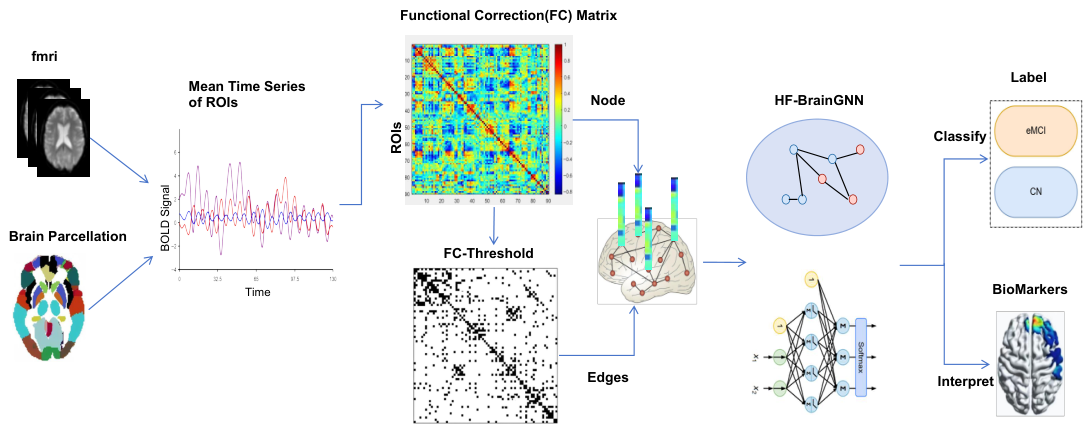
2.1. Brain Network Construction
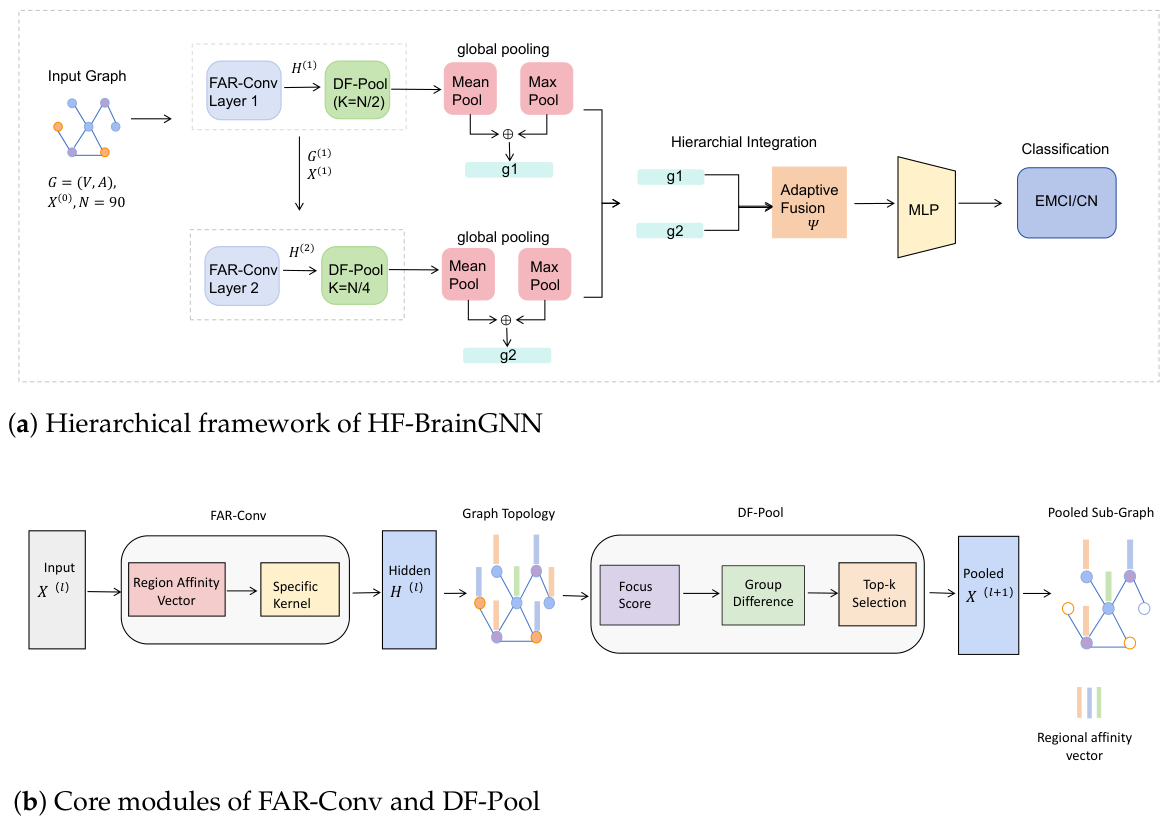
2.2. Overview of the HF-BrainGNN Method
2.3. Functional Affinity Region Convolutional Layer
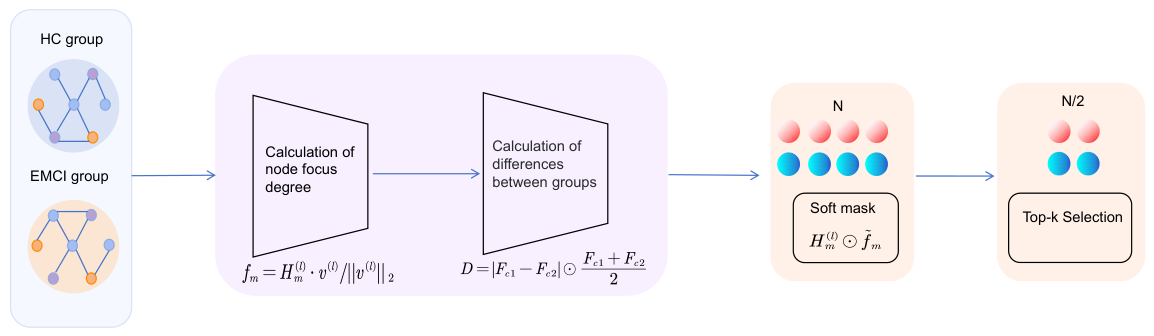
2.4. Differential Focus Pooling
2.5. Hierarchical Integration Classification
2.6. Loss Function Design
2.6.1. Classification Loss
2.6.2. Focus Separation Loss
2.6.3. Consistency Regularization Loss
2.6.4. Total Loss
3. Experiments and Results
3.1. Datasets
3.2. Experimental Setup
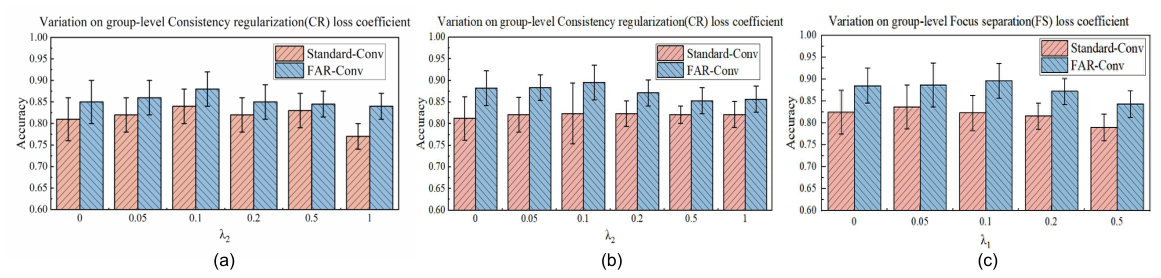
3.3. Hyperparameter Discussion and Ablation Study
3.3.1. Hyperparameter Settings
3.3.2. Ablation Study
3.4. Comparison with Baseline Methods
3.5. Interpretability of HF-BrainGNN
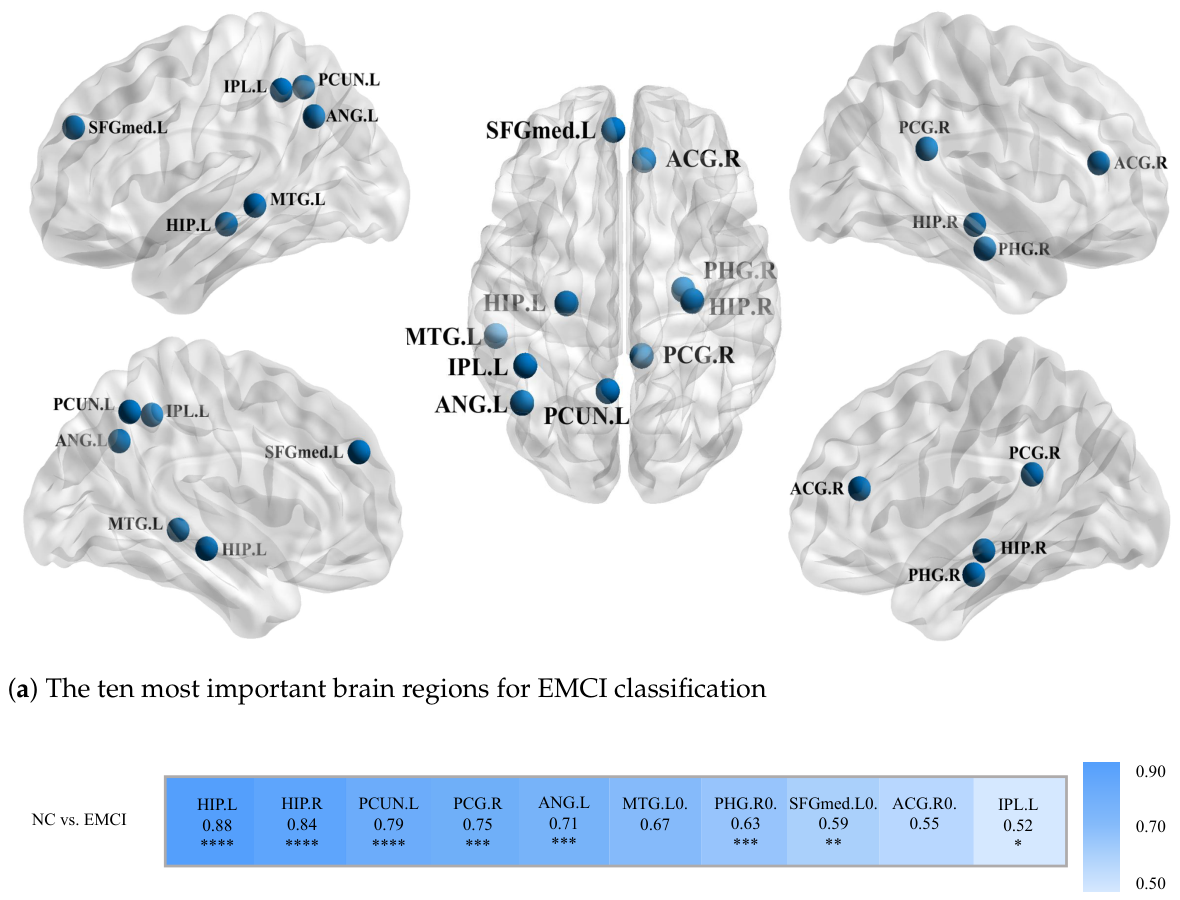
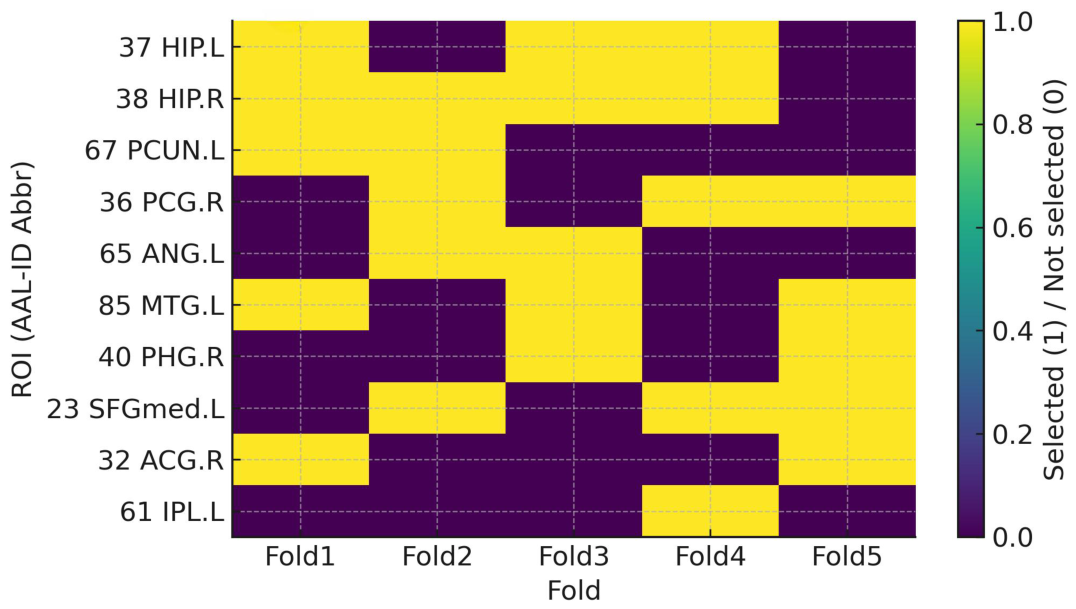
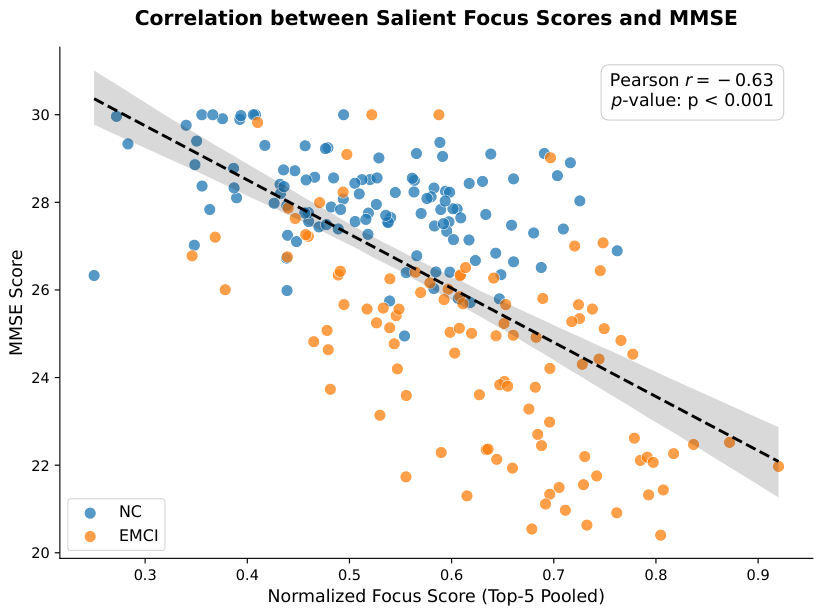
3.5.1. Biomarker Detection
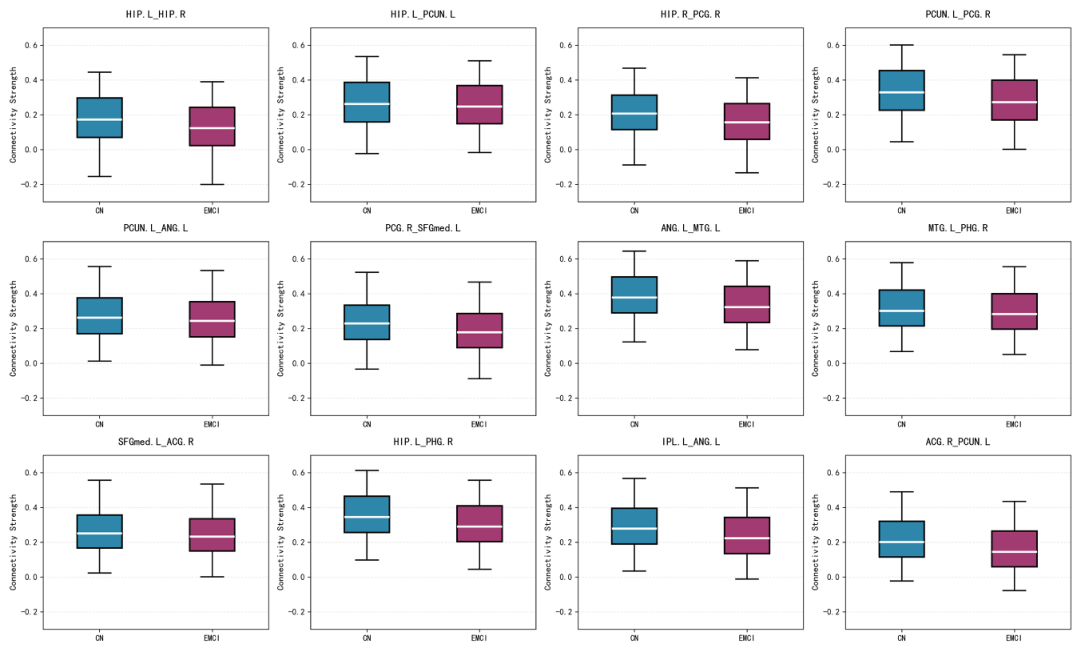
3.5.2. Functional Connectivity Analysis of Core Brain Regions
4. Discussion
5. Conclusions
Author Contributions
Funding
Institutional Review Board Statement
Informed Consent Statement
Data Availability Statement
Acknowledgments
Conflicts of Interest
References
- World Health Organization. A Blueprint for Dementia Research; World Health Organization: Geneva, Switzerland, 2022. [Google Scholar]
- Petersen, R.C.; Roberts, R.O.; Knopman, D.S.; Boeve, B.F.; Geda, Y.E.; Ivnik, R.J.; Smith, G.E.; Jack, C.R. Mild cognitive impairment: Ten years later. Arch. Neurol. 2009, 66, 1447–1455. [Google Scholar] [CrossRef] [PubMed]
- Livingston, G.; Huntley, J.; Liu, K.Y.; Costafreda, S.G.; Selbæk, G.; Alladi, S.; Ames, D.; Banerjee, S.; Burns, A.; Brayne, C.; et al. Dementia prevention, intervention, and care: 2024 report of the Lancet standing Commission. Lancet 2024, 404, 572–628. [Google Scholar] [CrossRef] [PubMed]
- Jack, C.R., Jr.; Andrews, J.S.; Beach, T.G.; Buracchio, T.; Dunn, B.; Graf, A.; Hansson, O.; Ho, C.; Jagust, W.; McDade, E.; et al. Revised criteria for diagnosis and staging of Alzheimer’s disease: Alzheimer’s Association Workgroup. Alzheimer’s Dement. 2024, 20, 5143–5169. [Google Scholar] [CrossRef]
- Sun, L.; Zhao, T.; Liang, X.; Xia, M.; Li, Q.; Liao, X.; Gong, G.; Wang, Q.; Pang, C.; Yu, Q.; et al. Human lifespan changes in the brain’s functional connectome. Nat. Neurosci. 2025, 28, 891–901. [Google Scholar] [CrossRef]
- de Vos, F.; Koini, M.; Schouten, T.M.; Seiler, S.; van der Grond, J.; Lechner, A.; Schmidt, R.; de Rooij, M.; Rombouts, S.A. A comprehensive analysis of resting state fMRI measures to classify individual patients with Alzheimer’s disease. Neuroimage 2018, 167, 62–72. [Google Scholar] [CrossRef]
- Du, Y.; Fang, S.; He, X.; Calhoun, V.D. A survey of brain functional network extraction methods using fMRI data. Trends Neurosci. 2024, 47, 608–621. [Google Scholar] [CrossRef]
- Wang, J.; Zuo, X.; He, Y. Graph-based network analysis of resting-state functional MRI. Front. Syst. Neurosci. 2010, 4, 1419. [Google Scholar] [CrossRef]
- Hallquist, M.N.; Hillary, F.G. Graph theory approaches to functional network organization in brain disorders: A critique for a brave new small-world. Netw. Neurosci. 2018, 3, 1–26. [Google Scholar] [CrossRef]
- Zhang, T.; Liao, Q.; Zhang, D.; Zhang, C.; Yan, J.; Ngetich, R.; Zhang, J.; Jin, Z.; Li, L. Predicting MCI to AD conversation using integrated sMRI and rs-fMRI: Machine learning and graph theory approach. Front. Aging Neurosci. 2021, 13, 688926. [Google Scholar] [CrossRef]
- Addison, P.S. The Illustrated Wavelet Transform Handbook: Introductory Theory and Applications in Science, Engineering, Medicine and Finance; CRC Press: Boca Raton, FL, USA, 2017. [Google Scholar]
- Tijms, B.M.; Wink, A.M.; De Haan, W.; van der Flier, W.M.; Stam, C.J.; Scheltens, P.; Barkhof, F. Alzheimer’s disease: Connecting findings from graph theoretical studies of brain networks. Neurobiol. Aging 2013, 34, 2023–2036. [Google Scholar] [CrossRef] [PubMed]
- Farahani, F.V.; Karwowski, W.; Lighthall, N.R. Application of graph theory for identifying connectivity patterns in human brain networks: A systematic review. Front. Neurosci. 2019, 13, 585. [Google Scholar] [CrossRef] [PubMed]
- Wu, Z.; Pan, S.; Chen, F.; Long, G.; Zhang, C.; Yu, P.S. A comprehensive survey on graph neural networks. IEEE Trans. Neural Netw. Learn. Syst. 2020, 32, 4–24. [Google Scholar] [CrossRef]
- Parisot, S.; Ktena, S.I.; Ferrante, E.; Lee, M.; Guerrero, R.; Glocker, B.; Rueckert, D. Disease prediction using graph convolutional networks: Application to autism spectrum disorder and Alzheimer’s disease. Med. Image Anal. 2018, 48, 117–130. [Google Scholar] [CrossRef]
- Li, X.; Zhou, Y.; Dvornek, N.; Zhang, M.; Gao, S.; Zhuang, J.; Scheinost, D.; Staib, L.H.; Ventola, P.; Duncan, J.S. ngnn: Interpretable brain graph neural network for fmri analysis. Med. Image Anal. 2021, 74, 102233. [Google Scholar] [CrossRef]
- Shehzad, A.; Zhang, D.; Yu, S.; Abid, S.; Xia, F. Dynamic Graph Transformer for Brain Disorder Diagnosis. IEEE J. Biomed. Health Inform. 2025, 29, 4388–4400. [Google Scholar] [CrossRef]
- Bi, X.a.; Zhou, W.; Li, L.; Xing, Z. Detecting risk gene and pathogenic brain region in EMCI using a novel GERF algorithm based on brain imaging and genetic data. IEEE J. Biomed. Health Inform. 2021, 25, 3019–3028. [Google Scholar] [CrossRef]
- Long, Z.; Huang, J.; Li, B.; Li, Z.; Li, Z.; Chen, H.; Jing, B. A comparative atlas-based recognition of mild cognitive impairment with voxel-based morphometry. Front. Neurosci. 2018, 12, 916. [Google Scholar] [CrossRef] [PubMed]
- Gallo, S.; El-Gazzar, A.; Zhutovsky, P.; Thomas, R.M.; Javaheripour, N.; Li, M.; Bartova, L.; Bathula, D.; Dannlowski, U.; Davey, C.; et al. Functional connectivity signatures of major depressive disorder: Machine learning analysis of two multicenter neuroimaging studies. Mol. Psychiatry 2023, 28, 3013–3022. [Google Scholar] [CrossRef]
- Bressler, S.L.; Menon, V. Large-scale brain networks in cognition: Emerging methods and principles. Trends Cogn. Sci. 2010, 14, 277–290. [Google Scholar] [CrossRef]
- Wang, Y.; Sun, Y.; Liu, Z.; Sarma, S.E.; Bronstein, M.M.; Solomon, J.M. Dynamic graph cnn for learning on point clouds. ACM Trans. Graph. (TOG) 2019, 38, 1–12. [Google Scholar] [CrossRef]
- Seeley, W.W.; Crawford, R.K.; Zhou, J.; Miller, B.L.; Greicius, M.D. Neurodegenerative diseases target large-scale human brain networks. Neuron 2009, 62, 42–52. [Google Scholar] [CrossRef] [PubMed]
- Ying, Z.; You, J.; Morris, C.; Ren, X.; Hamilton, W.; Leskovec, J. Hierarchical graph representation learning with differentiable pooling. Adv. Neural Inf. Process. Syst. 2018, 31, 4800–4810. [Google Scholar] [CrossRef]
- Gao, H.; Ji, S. Graph u-nets. In Proceedings of the International Conference on Machine Learning, PMLR, Long Beach, CA, USA, 9–15 June 2019; pp. 2083–2092. [Google Scholar]
- Abbas, M.; Matta, J.; Le, T.; Bensmail, H.; Obafemi-Ajayi, T.; Honavar, V.; EL-Manzalawy, Y. Biomarker discovery in inflammatory bowel diseases using network-based feature selection. PLoS ONE 2019, 14, e0225382. [Google Scholar] [CrossRef]
- Wang, Z.; Xu, Y.; Peng, D.; Gao, J.; Lu, F. Brain functional activity-based classification of autism spectrum disorder using an attention-based graph neural network combined with gene expression. Cereb. Cortex 2023, 33, 6407–6419. [Google Scholar] [CrossRef] [PubMed]
- Xu, Y.; Wang, J.; Guang, M.; Yan, C.; Jiang, C. Multistructure graph classification method with attention-based pooling. IEEE Trans. Comput. Soc. Syst. 2022, 10, 602–613. [Google Scholar] [CrossRef]
- Ranjan, E.; Sanyal, S.; Talukdar, P. Asap: Adaptive structure aware pooling for learning hierarchical graph representations. In Proceedings of the AAAI Conference on Artificial Intelligence, New York, NY, USA, 7–12 February 2020; Volume 34, pp. 5470–5477. [Google Scholar]
- Bianchi, F.M.; Grattarola, D.; Alippi, C. Spectral clustering with graph neural networks for graph pooling. In Proceedings of the International Conference on Machine Learning, PMLR, Virtual, 13–18 July 2020; pp. 874–883. [Google Scholar]
- Chu, Y.; Wang, G.; Cao, L.; Qiao, L.; Liu, M. Multi-scale graph representation learning for autism identification with functional MRI. Front. Neuroinformatics 2022, 15, 802305. [Google Scholar] [CrossRef]
- Ji, J.; Yao, Y. A novel CNN framework to extract multi-level modular features for the classification of brain networks. Appl. Intell. 2022, 52, 6835–6852. [Google Scholar] [CrossRef]
- Zhang, J.; Guo, Y.; Zhou, L.; Wang, L.; Wu, W.; Shen, D. Constructing hierarchical attentive functional brain networks for early AD diagnosis. Med. Image Anal. 2024, 94, 103137. [Google Scholar] [CrossRef]
- Goodfellow, I.; Bengio, Y.; Courville, A. Deep Learning; MIT Press: Cambridge, MA, USA, 2016. [Google Scholar]
- Shaheen, H.; Melnik, R. Brain network dynamics and multiscale modelling of neurodegenerative disorders: A Review. IEEE Access 2025, 13, 33074–33100. [Google Scholar] [CrossRef]
- Peitz, S.; Hotegni, S.S. Multi-objective deep learning: Taxonomy and survey of the state of the art. Mach. Learn. Appl. 2025, 21, 100700. [Google Scholar] [CrossRef]
- Wang, J.; Wang, X.; Xia, M.; Liao, X.; Evans, A.; He, Y. GRETNA: A graph theoretical network analysis toolbox for imaging connectomics. Front. Hum. Neurosci. 2015, 9, 386. [Google Scholar] [PubMed]
- Murphy, K.; Birn, R.M.; Handwerker, D.A.; Jones, T.B.; Bandettini, P.A. The impact of global signal regression on resting state correlations: Are anti-correlated networks introduced? Neuroimage 2009, 44, 893–905. [Google Scholar] [CrossRef] [PubMed]
- Friedman, J. The elements of statistical learning: Data mining, inference, and prediction. J. Am. Stat. Assoc. 2009, 99, 567. [Google Scholar]
- Chandra, M.A.; Bedi, S. Survey on SVM and their application in image classification. Int. J. Inf. Technol. 2021, 13, 1–11. [Google Scholar] [CrossRef]
- Genuer, R.; Poggi, J.M. Random forests. In Random Forests with R; Springer: Berlin/Heidelberg, Germany, 2020; pp. 33–55. [Google Scholar]
- Rumelhart, D.E.; Hinton, G.E.; Williams, R.J. Learning representations by back-propagating errors. Nature 1986, 323, 533–536. [Google Scholar] [CrossRef]
- Mittal, S. A survey on modeling and improving reliability of DNN algorithms and accelerators. J. Syst. Archit. 2020, 104, 101689. [Google Scholar] [CrossRef]
- Kipf, T. Semi-supervised classification with graph convolutional networks. arXiv 2016, arXiv:1609.02907. [Google Scholar]
- Veličković, P.; Cucurull, G.; Casanova, A.; Romero, A.; Lio, P.; Bengio, Y. Graph attention networks. arXiv 2017, arXiv:1710.10903. [Google Scholar]
- Shang, C.; Liu, Q.; Tong, Q.; Sun, J.; Song, M.; Bi, J. Multi-view spectral graph convolution with consistent edge attention for molecular modeling. Neurocomputing 2021, 445, 12–25. [Google Scholar] [CrossRef]
- Parisot, S.; Ktena, S.I.; Ferrante, E.; Lee, M.; Moreno, R.G.; Glocker, B.; Rueckert, D. Spectral graph convolutions for population-based disease prediction. In Proceedings of the International Conference on Medical Image Computing and Computer-Assisted Intervention, Quebec City, QC, Canada, 10–14 September 2017; Springer: Berlin/Heidelberg, Germany, 2017; pp. 177–185. [Google Scholar]
- Jiang, H.; Cao, P.; Xu, M.; Yang, J.; Zaiane, O. Hi-GCN: A hierarchical graph convolution network for graph embedding learning of brain network and brain disorders prediction. Comput. Biol. Med. 2020, 127, 104096. [Google Scholar] [CrossRef]
- Sorg, C.; Riedl, V.; Muhlau, M.; Calhoun, V.D.; Eichele, T.; Läer, L.; Drzezga, A.; Förstl, H.; Kurz, A.; Zimmer, C.; et al. Selective changes of resting-state networks in individuals at risk for Alzheimer’s disease. Proc. Natl. Acad. Sci. USA 2007, 104, 18760–18765. [Google Scholar] [CrossRef]
- Greicius, M.D.; Srivastava, G.; Reiss, A.L.; Menon, V. Default-mode network activity distinguishes Alzheimer’s disease from healthy aging: Evidence from functional MRI. Proc. Natl. Acad. Sci. USA 2004, 101, 4637–4642. [Google Scholar] [CrossRef] [PubMed]
- Buckner, R.L.; Andrews-Hanna, J.R.; Schacter, D.L. The brain’s default network: Anatomy, function, and relevance to disease. Ann. N. Y. Acad. Sci. 2008, 1124, 1–38. [Google Scholar] [CrossRef]
- Dickerson, B.C.; Sperling, R.A. Functional abnormalities of the medial temporal lobe memory system in mild cognitive impairment and Alzheimer’s disease: Insights from functional MRI studies. Neuropsychologia 2008, 46, 1624–1635. [Google Scholar] [CrossRef]
- Jones, D.; Machulda, M.; Vemuri, P.; McDade, E.; Zeng, G.; Senjem, M.; Gunter, J.; Przybelski, S.; Avula, R.; Knopman, D.; et al. Age-related changes in the default mode network are more advanced in Alzheimer disease. Neurology 2011, 77, 1524–1531. [Google Scholar] [CrossRef] [PubMed]
- Celone, K.A.; Calhoun, V.D.; Dickerson, B.C.; Atri, A.; Chua, E.F.; Miller, S.L.; DePeau, K.; Rentz, D.M.; Selkoe, D.J.; Blacker, D.; et al. Alterations in memory networks in mild cognitive impairment and Alzheimer’s disease: An independent component analysis. J. Neurosci. 2006, 26, 10222–10231. [Google Scholar] [CrossRef] [PubMed]
- Wang, L.; Zang, Y.; He, Y.; Liang, M.; Zhang, X.; Tian, L.; Wu, T.; Jiang, T.; Li, K. Changes in hippocampal connectivity in the early stages of Alzheimer’s disease: Evidence from resting state fMRI. Neuroimage 2006, 31, 496–504. [Google Scholar] [CrossRef]



| Notation | Description |
|---|---|
| N | Number of brain regions (nodes) |
| i-th node (brain region) in the graph | |
| Neighbor set of node at the l-th layer | |
| A | Adjacency matrix, |
| Node feature matrix | |
| Feature representation of node at the l-th layer | |
| Hidden feature representation output by FAR-Conv at the l-th layer | |
| Graph convolution kernel of node at the l-th layer | |
| Graph convolution kernel of neighbors of node | |
| Regional affinity vector of node | |
| Edge weight enhancement factor based on regional affinity | |
| Set of brain regions in the K-th functional network | |
| 3D coordinates of brain region | |
| Centroid coordinates of network K | |
| Node focus score at the l-th layer | |
| Normalized node focus score | |
| Hyperparameters of the loss function |
| Characteristic | EMCI () | CN () |
|---|---|---|
| Age | ||
| Gender (M/F) | 56/48 | 60/54 |
| Education (years) | ||
| MMSE Score |
| Method | Acc (%) | Sen (%) | Spe (%) | AUC | F1 (%) |
|---|---|---|---|---|---|
| Ridge Classifier [39] | |||||
| SVM [40] | |||||
| Random Forest [41] | |||||
| DNN [43] | |||||
| GCN [44] | |||||
| GAT [45] | |||||
| BrainGNN [16] | |||||
| MVS-GCN [46] | |||||
| PopulationGCN [47] | |||||
| Hi-GCN [48] | |||||
| HF-BrainGNN (Ours) |
| Rank | AAL Abbreviation | AAL-ID | Differential Score | Functional Network |
|---|---|---|---|---|
| 1 | HIP.L | 37 | 0.88 | Hippocampal Memory System |
| 2 | HIP.R | 38 | 0.84 | Hippocampal Memory System |
| 3 | PCUN.L | 67 | 0.79 | Default Mode Network |
| 4 | PCG.R | 36 | 0.75 | Default Mode Network |
| 5 | ANG.L | 65 | 0.71 | Semantic Network |
| 6 | MTG.L | 85 | 0.67 | Semantic Network |
| 7 | PHG.R | 40 | 0.63 | Hippocampal Memory System |
| 8 | SFGmed.L | 23 | 0.59 | Executive Control Network |
| 9 | ACG.R | 32 | 0.55 | Salience Network |
| 10 | IPL.L | 61 | 0.52 | Attention Network |
Disclaimer/Publisher’s Note: The statements, opinions and data contained in all publications are solely those of the individual author(s) and contributor(s) and not of MDPI and/or the editor(s). MDPI and/or the editor(s) disclaim responsibility for any injury to people or property resulting from any ideas, methods, instructions or products referred to in the content. |
© 2026 by the authors. Licensee MDPI, Basel, Switzerland. This article is an open access article distributed under the terms and conditions of the Creative Commons Attribution (CC BY) license.
Share and Cite
Chen, Z.; Song, M.; Wu, N. Early Mild Cognitive Impairment Diagnosis via Resting-State fMRI Brain Networks Using a Region-Specific Hierarchical Fusion Graph Neural Network. Information 2026, 17, 461. https://doi.org/10.3390/info17050461
Chen Z, Song M, Wu N. Early Mild Cognitive Impairment Diagnosis via Resting-State fMRI Brain Networks Using a Region-Specific Hierarchical Fusion Graph Neural Network. Information. 2026; 17(5):461. https://doi.org/10.3390/info17050461
Chicago/Turabian StyleChen, Zhiang, Miao Song, and Ningge Wu. 2026. "Early Mild Cognitive Impairment Diagnosis via Resting-State fMRI Brain Networks Using a Region-Specific Hierarchical Fusion Graph Neural Network" Information 17, no. 5: 461. https://doi.org/10.3390/info17050461
APA StyleChen, Z., Song, M., & Wu, N. (2026). Early Mild Cognitive Impairment Diagnosis via Resting-State fMRI Brain Networks Using a Region-Specific Hierarchical Fusion Graph Neural Network. Information, 17(5), 461. https://doi.org/10.3390/info17050461