Article

Formal Semantics of Governance History Validity in Encrypted Storage

by
Jesús F. Rodríguez-Aragón
1,2,*,
Carolina Zato
3 and
Fernando De la Prieta
3
1
School of Engineering and Technology (ESIT), International University of La Rioja (UNIR), 26006 Logroño, Spain
2
Department of Computer Science and Automation, University of Salamanca, 37008 Salamanca, Spain
3
BISITE Research Group, University of Salamanca, 37008 Salamanca, Spain
*
Author to whom correspondence should be addressed.
Information 2026, 17(5), 447; https://doi.org/10.3390/info17050447
Submission received: 23 March 2026 / Revised: 29 April 2026 / Accepted: 2 May 2026 / Published: 6 May 2026
(This article belongs to the Section Information Theory and Methodology)

Abstract

Encrypted storage systems increasingly rely on governance mechanisms such as delegation, revocation, key updates, and policy evolution. While existing approaches provide strong guarantees for access enforcement, integrity, and transparency, they do not address a fundamental question: under which conditions can an observed sequence of governance events be accepted as a semantically valid evolution of authorization state? This work introduces a formal semantic framework for governance validity based on observable evidence. Governance is modeled as an admissibility-constrained state transition system in which events are accepted only if they satisfy explicit authorization, reference, temporal, revocation, and evidence conditions. The framework defines valid governance histories as sequences of admissible events; characterizes the conditions for deterministic state reconstruction; and establishes invariants capturing correctness properties such as revocation soundness, policy-constrained evolution, evidence completeness, non-equivocation, and temporal coherence. It also defines event-specific evidence obligations that support independent verification. The proposed approach is architecture-independent and does not prescribe specific enforcement or logging mechanisms, focusing instead on the semantic conditions required for accepting governance histories as valid from observable evidence. In addition, the framework can be instantiated as an independent verification layer that operates over observable governance traces without requiring access to internal system states.

1. Introduction

Encrypted storage systems have evolved from passive repositories into active infrastructures that enforce access control policies through cryptographic mechanisms. Modern approaches integrate techniques such as attribute-based encryption, proxy re-encryption, and policy-driven key distribution to ensure that only authorized entities can access protected data. In parallel, systems based on verifiable logs and transparency infrastructures have been proposed to provide externally auditable views of system evolution, particularly in the context of key transparency and distributed trust [1]. However, beyond enforcing access restrictions, these systems must also support governance: the ability to define, modify, revoke, and audit authorization decisions over time.
Governance in encrypted environments introduces a fundamental challenge. Authorization is no longer a static property, but a dynamic process involving sequences of events such as delegations, revocations, policy updates, and evidence disclosures. These events may be distributed, partially observable, and produced by heterogeneous components. As a result, the correctness of governance cannot be determined solely by inspecting individual operations but must instead be evaluated over entire histories of events.
Recent research has addressed different aspects of this problem. Cryptographic enforcement mechanisms ensure that unauthorized access is prevented. Transparency logs and verifiable data structures provide integrity, consistency, and non-equivocation guarantees over recorded events, particularly in key transparency and auditable systems. Access control models and policy logics define formal authorization semantics [2]. In parallel, formal verification frameworks and state-transition models have been used to reason about system correctness and distributed computation [3]. However, these approaches focus primarily on enforcement, integrity, policy specification, or system correctness, rather than on the semantic interpretation and acceptance of governance histories.
This distinction gives rise to a fundamental question: given an observable sequence of governance-relevant events, under which conditions can this sequence be accepted as a valid evolution of authorization state? In other words, when can a governance history be considered semantically correct based solely on observable evidence?
Despite extensive work on access control, transparency, and verifiable systems, an essential question remains unresolved: there is still no formal criterion that determines when an observed sequence of governance events should be accepted as a semantically valid history based solely on observable evidence, even in the presence of formally specified policies or verified state transitions [4]. Existing approaches provide mechanisms for policy enforcement, event integrity, or history exposure, but they do not define an explicit acceptance semantics that allows independent observers to decide whether a governance history is semantically valid as an evolution of authorization state.
This missing acceptance criterion is the central gap addressed in this work. The contribution of the article is therefore not the design of a new encrypted storage architecture, nor the proposal of a new enforcement mechanism, but the introduction of a formal semantic framework for governance validity. In particular, the framework defines when observable governance histories can be accepted as valid through admissibility conditions, reconstruction semantics, invariant preservation, and evidence obligations.
This perspective is intentionally orthogonal to architecture-centric proposals for verifiable governance in encrypted storage. System-level approaches address how governance-relevant events are generated, exposed, logged, or enforced within a concrete design. By contrast, the present work addresses a different problem: under which semantic conditions an observed history can be accepted as valid, independently of the architecture or implementation mechanisms that produced it. The framework is therefore purely semantic: it does not prescribe how governance events are generated, enforced, propagated, or logged in practice but instead characterizes the conditions required for their valid interpretation once they become observable.
The proposed framework can be directly instantiated as an independent verification layer that operates over observable governance traces, without requiring access to internal system state.
This work makes the following contributions:
  • Formalization of governance validity. We introduce a formal semantic model in which governance is represented as an admissibility-constrained state transition system over observable event histories.
  • Admissibility and reconstruction. We define admissibility predicates and state reconstruction semantics that determine how governance state evolves from observable events.
  • Global correctness conditions. We establish invariants that characterize valid governance histories and ensure consistency, causality, and revocation correctness.
  • Evidence-based verification. We introduce formal evidence obligations that allow independent verifiers to assess whether events can be accepted as valid.
  • Acceptance semantics for governance histories. We define an explicit decision framework that allows independent verifiers to determine when an observed history can be accepted as semantically valid based solely on observable evidence.
To situate this problem within existing research, the following section reviews the main approaches to governance in encrypted and distributed systems and highlights the absence of a formal acceptance semantics for governance histories.

2. Related Work

The problem of governing access to protected data in encrypted and distributed systems has been studied across multiple research directions, including cryptographic enforcement, access control semantics, transparency infrastructures, and verifiable computation. While these approaches address key aspects of governance, they do not define a formal acceptance criterion for determining when an observed sequence of governance events constitutes a semantically valid history.

2.1. Cryptographic Enforcement and Access Control

Encrypted storage systems rely on cryptographic mechanisms to enforce confidentiality and access control, including early cloud storage protection models [5], encrypted query processing systems such as CryptDB [6], and Oblivious RAM constructions [7]. More expressive authorization mechanisms are provided by attribute-based encryption [8,9] and proxy re-encryption [10,11]. These approaches provide strong guarantees for access enforcement but do not define when a sequence of governance-relevant operations constitutes a semantically valid evolution of authorization state from an external observer’s perspective.
Formal access control models such as Role-Based Access Control (RBAC) [12] and Attribute-Based Access Control (ABAC) [13] define how authorization policies are specified and evaluated. However, they typically assume a trusted policy evaluation mechanism and do not address how governance state can be reconstructed or validated from externally observable evidence. In particular, they lack a semantics of history validity that can be evaluated independently of a trusted enforcement point.
Verifiable computation and auditable systems enable independent validation of computation results and system behavior [14,15,16]. However, these approaches focus on verifying individual computations or system executions and do not define a global acceptance semantics over evolving governance histories.
A key limitation across these approaches is that they operate either at the level of enforcement or policy specification, but do not provide a unified semantic interpretation of governance evolution. In particular, while access control models define authorization conditions and verifiable systems ensure correctness of individual computations, neither approach addresses how sequences of governance-relevant events can be validated as coherent and semantically admissible histories from an external observer’s perspective.

2.2. Transparency Logs, Verifiable Data Structures, and Decentralized Governance

Transparency mechanisms based on append-only logs and cryptographic commitments enable external verification of system behavior through inclusion and consistency proofs [17,18,19]. These ideas have been extended to key transparency systems [1,20,21,22], scalable log infrastructures such as Trillian [23], and auditable data structures including zero-knowledge sets [24]. While these approaches ensure integrity, consistency, and non-equivocation of recorded events, they do not define how such events should be interpreted as state transitions, nor do they provide a decision criterion for accepting a governance history as semantically valid.
Blockchain-based systems provide decentralized infrastructures for recording governance operations with strong guarantees of immutability and availability [25,26]. However, the presence of a transaction in a ledger does not guarantee that it corresponds to an admissible or semantically valid state transition under a formal governance model.

2.3. Formal Verification and State Transition Models

Formal methods and verification frameworks provide rigorous tools for specifying and reasoning about system behavior. Languages and frameworks such as TLA+, Alloy, and Coq have been widely used to model distributed systems and verify correctness properties, including safety, liveness, and consistency guarantees. Similarly, blockchain systems define formal state transition semantics, where global state evolves deterministically based on sequences of transactions under protocol-defined rules [3].
In parallel, policy logic systems such as SecPAL and Datalog-based authorization frameworks provide formal semantics for expressing and evaluating access control decisions [2]. These approaches offer strong foundations for reasoning about authorization and system behavior.
However, these approaches typically assume a fully specified and trusted system model, and therefore do not directly provide a mechanism for validating whether a partially observed sequence of governance events constitutes a semantically valid history.

2.4. Positioning of This Work

Existing approaches provide mechanisms for enforcing access control, exposing governance events, or verifying integrity and consistency properties. However, they differ significantly in their treatment of semantics and validation.
Cryptographic enforcement mechanisms ensure that only authorized operations can be executed, but do not define how sequences of operations should be interpreted as valid governance histories. Transparency logs guarantee integrity, consistency, and non-equivocation, but treat events as append-only records without specifying their semantic admissibility as state transitions. Formal verification frameworks and blockchain state transition systems define correctness relative to a predefined system model, but do not address the problem of validating externally observed histories in the presence of partial observability and evidence-based reconstruction.
In particular, none of these approaches defines a semantic acceptance criterion that allows independent observers to determine whether an observed sequence of governance events constitutes a valid evolution of authorization state based solely on observable evidence. As a result, the question of whether a governance history should be accepted as valid from an external perspective remains unresolved.
This work addresses this gap by introducing a formal semantic framework based on admissibility, state reconstruction, invariants, and evidence obligations. Rather than focusing on how governance mechanisms are implemented, it defines the conditions under which governance behavior—once observed—can be accepted as semantically valid by independent verifiers.
This distinction can be understood along several dimensions, including enforcement, integrity, observability, and semantic validation. Table 1 summarizes these differences across representative approaches. While existing solutions address one or more of these dimensions, none provides an explicit acceptance semantics for governance histories. The proposed framework complements existing mechanisms by introducing a semantic validation layer that operates over observable histories and enables independent verification of their correctness. This comparative view highlights that existing approaches focus on individual dimensions of governance correctness, while the proposed framework integrates these aspects into a unified semantic validation perspective.
This positioning clarifies that the contribution of this work lies not in proposing new enforcement or logging mechanisms, but in defining the semantic conditions under which governance histories—once observed—can be accepted as valid. This perspective complements existing approaches by introducing a validation layer that operates independently of system implementation details.
This distinction is structural rather than merely descriptive: existing approaches provide guarantees related to enforcement, integrity, or execution correctness, but they do not define a formal acceptance criterion for governance histories under partial observability and evidence-based reconstruction. The proposed framework introduces this missing semantic layer, enabling independent validation of governance evolution.

2.5. Relationship to Architecture-Centric Governance Proposals

Beyond the general research directions discussed above, it is important to distinguish the present work from architecture-centric governance proposals. Such approaches specify how governance events are generated, enforced, logged, or made externally verifiable within a concrete system design.
By contrast, this work does not define a concrete governance architecture. Instead, it focuses on the semantic conditions under which an observed governance history can be accepted as valid, independently of the mechanisms that produced it. This distinction reflects a fundamental difference in objective: system-level approaches address how governance is realized, whereas the present work addresses when governance behavior can be accepted as semantically correct based on observable evidence.

3. Governance Validity Conditions

A formal model of governance validity must specify not only how governance state evolves, but also under which conditions an observed governance event is admissible and can be incorporated into a valid history. This requirement is essential for distinguishing between merely recorded events and semantically valid governance transitions.
In this framework, validity of governance histories depends on event-level admissibility. A governance event is admissible only if the following conditions hold:
  • Authorization validity. A governance event must be issued by an actor authorized to perform the corresponding governance operation under the currently active policy state.
  • Reference validity. Each event must refer to well-defined governance objects, such as users, resources, keys, or policies, that exist in the current or derivable governance state.
  • Temporal coherence. The event must be consistent with the verifiable ordering of governance history. Events that contradict the observable temporal evolution of the log cannot be accepted as valid.
  • Revocation compatibility. A governance event must not reactivate or preserve access rights that have been invalidated by prior revocation constraints unless a subsequent explicit authorization event exists.
  • Evidence sufficiency. An event can only be accepted if it is accompanied by the minimal set of verifiable artifacts required to validate its authenticity, inclusion, ordering, and governance relevance.
These conditions define the local admissibility constraints that determine whether an event can induce a valid governance transition. The formal model introduced in the next section builds on these conditions by defining governance state, typed events, and state transition semantics.

4. Formal Governance Model

This section defines a formal model for governance validity over observable event histories. The model does not merely record governance events, but assigns them a precise semantic meaning in terms of state evolution, admissibility, and correctness-preserving reconstruction.
For readability, the formal development separates core semantic definitions from their intuitive interpretation. At a high level, the model represents governance evolution as a sequence of admissible transitions, where each event is accepted only if it satisfies authorization, consistency, temporal, and evidence conditions relative to the reconstructed state.
The model is intentionally architecture-agnostic. It does not assume any specific encrypted storage platform, logging infrastructure, transparency mechanism, or key-management design. Observable events and evidence artifacts are treated here as abstract semantic inputs to validation, not as elements tied to a particular implementation proposal.

4.1. Notation Summary

Table 2 summarizes the main symbols used throughout the formal model.
This table is intended to improve readability and provide a consistent reference for the formal notation used throughout the paper.

4.2. Governance Universe

Let the governance layer operate over the following sets:
  • U—the set of principals or users;
  • O—the set of governed objects or encrypted resources;
  • K—the set of cryptographic keys;
  • P—the set of governance policies;
  • E—the set of governance events;
  • V —the set of verifiable evidence artifacts.
These sets define the domain over which governance operations are interpreted.

4.3. Governance State

The governance state at time t is defined in Equation (1) as
G t = ( A t , P t , K t , R t , M t )
where:
  • A t U × O is the access-assignment relation;
  • P t is the active policy state;
  • K t is the key state associated with governed objects;
  • R t U × O is the revocation constraint set;
  • M t is the verification metadata required for governance interpretation, including log commitments, accepted evidence bindings, and freshness anchors.
The initial state G 0 is assumed to be a trusted baseline agreed upon by verifiers.
The inclusion of M t is important because governance correctness is not determined exclusively by authorization relations but also by the verification metadata required to justify the semantic interpretation of governance history. This metadata is modeled abstractly and is not intended to correspond to any particular implementation structure.
At a high level, the governance state captures not only who is authorized to access which resources, but also the contextual and evidential information required to interpret those authorizations as part of a coherent and verifiable governance history.

4.4. Typed Governance Events

A governance event is represented as the typed tuple shown in Equation (2):
e = ( τ , ι , s , o , ρ , μ , η )
where:
  • τ denotes the event type;
  • ι U denotes the issuer of the event;
  • s U { } denotes the subject affected by the event;
  • o O P K denotes the governed object or policy target;
  • ρ denotes an optional policy reference or authorization basis;
  • μ denotes the event metadata, including ordering information;
  • η V denotes the evidence bundle associated with the event.
Typical event types include:
τ { grant , revoke , rotate , policy _ update , onboard } .
This representation makes explicit that a governance event is not only an action record but a typed and evidence-carrying semantic object.

4.5. Event Admissibility

Definition 1 (Event Admissibility).
Let G t be a governance state and let e E be a governance event. The admissibility predicate is defined as
Adm ( G t , e ) { true , false } .
An event e is admissible in state G t if and only if
Adm ( G t , e ) = true ,
which holds if and only if the following conditions are satisfied:
  • the issuer ι is authorized under P t ;
  • the referenced objects exist and are well-defined in G t ;
  • the event is temporally coherent with the observed governance history;
  • the event does not violate prior revocation constraints in R t ;
  • the associated evidence bundle η satisfies the minimal evidence obligations required by the event type.
Intuitively, admissibility captures whether an observed event can be semantically accepted as part of a valid governance history, given the current reconstructed state and the available evidence. In this sense, it acts as the fundamental acceptance criterion linking observable events to governance evolution.

4.6. Transition Semantics

Governance evolution is defined through the partial transition function in Equation (3):
δ : G × E G
The corresponding admissibility-conditioned state evolution is defined in Equation (4):
G t + 1 = δ ( G t , e t ) , if Adm ( G t , e t ) = true , undefined , otherwise .
This formulation makes governance evolution explicitly conditional on admissibility: only admissible events induce well-defined state transitions.
This can be understood as follows: governance evolution is not driven by the mere presence of events, but by their semantic acceptability. Only events that satisfy all validity conditions are allowed to contribute to the evolution of the governance state.
The intended effects of representative event classes are as follows:
  • grant: updates A t by introducing a new authorization relation, provided that no active revocation constraint forbids it;
  • revoke: updates R t and removes the corresponding authorization from A t ;
  • rotate: updates K t and invalidates superseded key relationships;
  • policy_update: updates P t subject to policy evolution constraints;
  • onboard: extends the set of valid subjects or governance participants.

4.7. Valid Governance Histories

Definition 2 (Valid Governance History).
Let G 0 be an initial governance state and let
L = ( e 1 , e 2 , , e n )
be a sequence of governance events. The sequence L in Equation (5) is a valid governance history from G 0 if and only if there exists a sequence of states
G 0 , G 1 , , G n
such that for every i { 1 , , n } ,
Adm ( G i 1 , e i ) = true and G i = δ ( G i 1 , e i ) .
In essence, a valid governance history is one in which every observed event can be consistently interpreted as a legitimate step in the evolution of authorization state, rather than as an isolated or contradictory operation.
Theorem 1 (Deterministic Reconstruction of Valid Governance Histories).
Let G 0 be an initial governance state and let L = ( e 1 , , e n ) be a valid governance history. Assume that:
  • the admissibility predicate Adm is deterministic;
  • the transition function δ is deterministic on admissible inputs.
Then the reconstructed state G n obtained by iteratively applying δ over L is unique.
Proof. 
Since L is a valid governance history, for each i { 1 , , n } we have Adm ( G i 1 , e i ) = true and G i = δ ( G i 1 , e i ) is defined.
We prove by induction on i that each state G i is uniquely determined.
Base case: G 0 is fixed by assumption.
Inductive step: assume G i 1 is uniquely determined. Since Adm is deterministic, the admissibility of e i in G i 1 is uniquely determined. Since δ is deterministic on admissible inputs, the successor state G i = δ ( G i 1 , e i ) is uniquely determined.
By induction, the entire sequence ( G 0 , , G n ) is uniquely determined, and therefore G n is unique.    □
Theorem 1 establishes that governance reconstruction is well-defined for valid governance histories.

4.8. Illustrative Example of Governance State Reconstruction

Consider an initial governance state
G 0 = ( A 0 , P 0 , K 0 , R 0 , M 0 )
such that principal u a is authorized under policy state P 0 to grant and revoke access to object o 1 , and no revocation constraint is initially active for subject u b . Assume also that the trusted evidence basis recorded in M 0 is valid.
Consider the following observed governance event sequence:
L = ( e 1 , e 2 )
where
e 1 = ( grant , u a , u b , o 1 , ρ 1 , μ 1 , η 1 )
and
e 2 = ( revoke , u a , u b , o 1 , ρ 2 , μ 2 , η 2 ) .
Assume that both events satisfy the corresponding admissibility conditions. In particular, u a is authorized to issue both events, the object reference o 1 is well defined in the reconstructed state, the ordering metadata in μ 1 and μ 2 is temporally coherent, and the evidence bundles satisfy the obligation pattern expressed in Equation (9), namely
η 1 Ω ( grant ) and η 2 Ω ( revoke ) .
where Ω ( τ ) denotes the evidence obligation associated with event type τ , as defined in Section 6.2.
By admissibility, the first event yields
G 1 = δ ( G 0 , e 1 ) ,
where the access relation ( u b , o 1 ) is introduced into A 1 . The second event then yields
G 2 = δ ( G 1 , e 2 ) ,
where the access relation is removed from A 2 and the corresponding revocation constraint is recorded in R 2 .
Now consider a third observed event
e 3 = ( grant , u a , u b , o 1 , ρ 3 , μ 3 , η 3 )
presented after e 2 but without any intervening admissible re-authorization condition capable of overriding the revocation constraint in R 2 . In that case,
Adm ( G 2 , e 3 ) = false
because accepting e 3 would violate revocation compatibility. Therefore, the transition
δ ( G 2 , e 3 )
is undefined, and the extended history ( e 1 , e 2 , e 3 ) is not a valid governance history.
This example illustrates the admissibility-driven nature of governance state reconstruction. First, governance state is reconstructed through admissible transitions rather than by log presence alone. Second, evidence sufficiency and temporal coherence are necessary for event acceptance. Third, revocation soundness is enforced at the semantic level independently of log inclusion: once a valid revocation has been incorporated into reconstructed state, a subsequent grant cannot be accepted unless the model’s admissibility conditions explicitly allow re-authorization. These observations naturally lead to the question of global correctness: beyond individual admissible transitions, under which conditions does the reconstructed governance evolution remain semantically consistent as a whole?

4.9. Concrete Verification Trace over an Observable Log

To make the validation process fully explicit, we now describe how a verifier processes a concrete observable log step by step, including the evaluation of evidence and admissibility conditions.
Assume the verifier receives the following serialized event log:
  • e1:
      type: grant
      issuer: ua
      subject: ub
      object: o1
      metadata: seq = 100, root = H1
      evidence:
        signature: sig_ua(e1)
        inclusion_proof: proof(e1, H1)
        consistency_proof: proof(H0 -> H1)
  • e2:
      type: revoke
      issuer: ua
      subject: ub
      object: o1
      metadata: seq = 101, root = H2
      evidence:
        signature: sig_ua(e2)
        inclusion_proof: proof(e2, H2)
        consistency_proof: proof(H1 -> H2)
  • e3:
      type: grant
      issuer: ua
      subject: ub
      object: o1
      metadata: seq = 102, root = H3
      evidence:
        signature: sig_ua(e3)
        inclusion_proof: proof(e3, H3)
        consistency_proof: proof(H2 -> H3)
The verifier processes this log as follows.
Step 1: Process e 1 .
  • Verify signature: Verify ( p k u a , e 1 , s i g u a ) = true
  • Verify inclusion: e 1 H 1
  • Verify continuity: H 0 H 1
  • Evaluate admissibility: Adm ( G 0 , e 1 ) = true
State update:
G 1 = δ ( G 0 , e 1 ) , A 1 = A 0 { ( u b , o 1 ) }
Step 2: Process e 2 .
  • Verify signature: Verify ( p k u a , e 2 , s i g u a ) = true
  • Verify inclusion: e 2 H 2
  • Verify continuity: H 1 H 2
  • Evaluate admissibility: Adm ( G 1 , e 2 ) = true
State update:
G 2 = δ ( G 1 , e 2 ) , ( u b , o 1 ) A 2 , ( u b , o 1 ) R 2
Step 3: Process e 3 .
  • Verify signature: Verify ( p k u a , e 3 , s i g u a ) = true
  • Verify inclusion: e 3 H 3
  • Verify continuity: H 2 H 3
  • Evaluate admissibility:
    Adm ( G 2 , e 3 ) = false
Rejection reason:
  • Revocation constraint ( u b , o 1 ) R 2 is active
  • No admissible re-authorization condition exists
Therefore, the verifier rejects the history at step 3.
This execution trace illustrates that validation is not a conceptual interpretation but an operational procedure over concrete event representations. Each decision is derived from verifiable artifacts (signatures, inclusion proofs, and consistency proofs) and from the evaluation of admissibility conditions over the reconstructed state.
In particular, the rejection of e 3 does not depend on implicit trust assumptions or external enforcement mechanisms. It follows directly from the combination of observable evidence and the semantic constraints imposed by the model.
This trace can be directly implemented in a verifier that processes log entries and cryptographic proofs, without requiring access to internal system state.

5. Governance Invariants

The formal model introduced in the previous section defines when governance events are admissible and how governance state evolves through valid transitions. We now define the global invariants that characterize correct governance evolution.
The following invariants are defined over valid governance histories rather than isolated events. While admissibility enforces event-level validity, invariants characterize the structural correctness of reconstructed governance state evolution. Together, they specify the conditions under which reconstructed governance states can be accepted as semantically correct and independently verifiable.

5.1. State Validity

Definition 3 (State Validity).
A governance state G t = ( A t , P t , K t , R t , M t ) is valid if and only if it is reachable from an initial state G 0 through a valid governance history and all of its components are mutually consistent with the admissibility constraints of the model.
This notion ensures that correctness is attached to semantically justified states rather than to arbitrary intermediate configurations.

5.2. Invariant I: Deterministic Reconstruction

Definition 4 (Deterministic Reconstruction).
Deterministic reconstruction holds if and only if any two verifiers processing the same valid governance history from the same initial state reconstruct the same governance state.
This invariant rules out semantic ambiguity in the interpretation of governance history.

5.3. Invariant II: Revocation Soundness

Definition 5 (Revocation Soundness).
Revocation soundness holds if and only if a valid revocation event removes subject u’s access to object o and prevents it from reappearing in subsequent valid states. Such access can only be restored through a later admissible re-authorization event.
This invariant captures the irreversibility of revocation in the absence of explicit subsequent authorization.

5.4. Invariant III: Policy-Constrained Evolution

Definition 6 (Policy-Constrained Evolution).
Policy-constrained evolution holds if and only if every admissible governance transition is authorized by the active policy state in force at the point where the transition is applied.
This invariant links event admissibility to policy semantics and prevents governance evolution from drifting outside the active authorization framework.

5.5. Invariant IV: Evidence Completeness

Definition 7 (Evidence Completeness).
Evidence completeness holds if and only if every accepted transition in a valid governance history is supported by an evidence bundle sufficient to justify authenticity, inclusion, ordering, and governance relevance.
This invariant distinguishes semantically accepted governance evolution from merely observed event traces.

5.6. Invariant V: Non-Equivocation of Valid Histories

Definition 8 (Non-Equivocation).
Non-equivocation holds if and only if no two incompatible valid governance histories can be accepted by honest verifiers under a shared trusted log continuity basis. In other words, a single continuity basis cannot justify multiple conflicting valid histories.
This invariant expresses the impossibility of maintaining two divergent but simultaneously acceptable governance histories under the same verifiable continuity assumptions.

5.7. Invariant VI: Temporal Coherence

Definition 9 (Temporal Coherence).
Temporal coherence holds if and only if no valid governance history contains an event whose acceptance would contradict the verifiable ordering information required by the evidence model.
This invariant prevents stale, replayed, or retroactively inconsistent governance events from being integrated into accepted state.
Proposition 1 (Invariant Preservation by Admissible Transitions).
Let G t be a valid governance state satisfying Invariants I–VI, and let e t be an event such that
Adm ( G t , e t ) = true and G t + 1 = δ ( G t , e t )
is defined.
Assume that the admissibility predicate enforces all event-local conditions associated with authorization validity, reference validity, temporal coherence, revocation compatibility, and evidence sufficiency.
Then G t + 1 also satisfies Invariants I–VI.
This result ensures that once a governance history is accepted as valid, all subsequent admissible extensions preserve its correctness, preventing the introduction of inconsistencies through future events.
Proof. 
We show that each invariant is preserved under admissible transitions.
Deterministic reconstruction (Invariant I) is preserved because δ is applied to a uniquely determined predecessor state and admissibility is deterministic.
Revocation soundness (Invariant II) is preserved because admissibility enforces revocation compatibility, preventing the reintroduction of revoked access relations without explicit re-authorization.
Policy-constrained evolution (Invariant III) is preserved because admissibility requires that the issuer is authorized under the active policy state P t .
Evidence completeness (Invariant IV) is preserved because admissibility requires that the evidence bundle satisfies the obligation η Ω ( τ ) .
Non-equivocation (Invariant V) is preserved because transitions are defined only over histories consistent with the trusted log continuity basis encoded in M t .
Temporal coherence (Invariant VI) is preserved because admissibility requires consistency with the verifiable ordering of governance history.
Therefore, G t + 1 satisfies Invariants I–VI.    □
Theorem 2 (Invariant Satisfaction of Valid Histories).
Let L = ( e 1 , , e n ) be a valid governance history from an initial state G 0 , and let
G 0 , G 1 , , G n
be the corresponding reconstructed states.
Then every state G i satisfies Invariants I–VI.
Proof. 
By Definition 2, each event e i is admissible in G i 1 and induces a well-defined transition to G i .
The base state G 0 is assumed to be a valid initial governance state. The result then follows by induction on i using Proposition 1.    □
These invariants characterize governance correctness at the level of semantically valid state evolution, rather than at the level of event integrity alone. As illustrated in Section 4.8, this distinction is operationally relevant: an observed event may be present in the log and still fail to induce a valid transition if its acceptance would violate the admissibility conditions or the reconstructed governance state.

6. Governance Evidence Model and Verification Obligations

The formal semantics developed in this work requires not only that governance-relevant events be observable, but also that they be accompanied by sufficient evidence to justify their acceptance. This section defines the evidence model that supports admissibility checks, state reconstruction, and independent verification.
In this context, observable evidence refers to any verifiable artifact made available to the verifier at the time of validation. The model does not assume global visibility but only that the available evidence satisfies the obligations required for admissibility checks.
In particular, the invariants defined in the previous section implicitly rely on the availability of verifiable evidence that justifies each accepted transition.
In this article, evidence is treated as a semantic requirement for acceptance rather than as a component of a particular system architecture. The purpose of the evidence model is therefore not to prescribe how evidence must be generated in practice, but to characterize the minimal verification conditions under which an observed event can be incorporated into a valid governance history.
In addition to individual evidence artifacts, the model assumes the existence of a continuity reference that allows verifiers to relate observed events to a consistent log evolution.
Definition 10 (Trusted Log Continuity Basis).
A trusted log continuity basis is a set of cryptographic commitments and verification anchors that allow a verifier to validate inclusion, ordering, and consistency of observed events with respect to a single append-only log evolution.
This basis is assumed to be externally verifiable and internally consistent, and constitutes the reference against which continuity evidence is evaluated during validation.

6.1. Evidence Types

Let V denote the universe of evidence artifacts. The evidence model consists of the following classes:
  • Authenticity evidence, such as digital signatures over governance payloads;
  • Acknowledgement evidence, such as signed receipts linking accepted events to governance log states;
  • Inclusion evidence, such as cryptographic proofs that an event is committed in the log;
  • Continuity evidence, such as consistency proofs connecting successive trusted log states;
  • Ordering evidence, such as timestamps, monotonic counters, or commitment anchors that support temporal coherence.
Each class corresponds to a distinct verification objective and serves a different role in validation.

6.2. Evidence Obligations

For each event type τ , the model defines the evidence obligation function in Equation (8):
Ω ( τ ) P ( V )
This function specifies the minimal evidence bundle required for an event of type τ to be admissible.
An event is evidence-complete if its associated evidence bundle η satisfies the obligation induced by its type, as formalized in Equation (9):
η Ω ( τ ) .
These obligations are not tied to a specific system design, but represent minimal conditions required to support independent verification under standard cryptographic assumptions.
Representative obligations include:
  • grant: authenticity + inclusion + continuity evidence;
  • revoke: authenticity + inclusion + continuity + ordering evidence;
  • rotate: authenticity + inclusion + continuity evidence;
  • policy_update: authenticity + inclusion + continuity + ordering evidence.
Event types associated with stronger governance impact require correspondingly stronger evidence obligations for admissibility.

6.3. Evidence-to-Property Mapping

The purpose of explicit evidence obligations is to make verification guarantees traceable. The mapping between evidence classes and governance properties is summarized conceptually as follows:
  • authenticity evidence supports issuer legitimacy;
  • inclusion evidence supports event existence in accepted history;
  • continuity evidence supports append-only log evolution;
  • ordering evidence supports temporal coherence;
  • acknowledgement evidence supports accountability and accepted-state linkage.
This mapping clarifies that governance correctness depends on the combined sufficiency of multiple evidence classes rather than on any single artifact in isolation.

6.4. Verification Obligations of the Client

Let a verifier observe a governance event
e = ( τ , ι , s , o , ρ , μ , η )
while holding reconstructed governance state G t . Client-side verification proceeds in two layers.
First, the verifier checks that the event is well formed and that its associated evidence can be validated relative to the trusted log basis. This includes syntactic well-formedness, validation of the relevant evidence obligations, and verification of inclusion and continuity artifacts.
Second, the verifier evaluates whether the event is admissible in the reconstructed state, that is, whether
Adm ( G t , e ) = true .
If admissibility holds, the verifier applies the transition function and checks that the successor state is well defined. Accordingly, client-side verification corresponds to a local instance of the decision procedure later formalized for auditors.

6.5. Acceptance Semantics

Event acceptance by a verifier is defined in semantic terms through the admissibility predicate.
Operationally, a verifier first checks that the event and its associated evidence are well formed and verifiable relative to the trusted log basis. This includes syntactic well-formedness, validation of the relevant evidence obligations, and verification of inclusion and continuity artifacts.
Semantic acceptance then holds if and only if
Adm ( G t , e ) = true .
Accordingly, admissibility captures the semantic condition for acceptance, while preliminary artifact validation provides the basis on which admissibility can be evaluated.
Theorem 3 (Soundness of Evidence-Based Reconstruction).
Let L = ( e 1 , , e n ) be a sequence of governance events processed from an initial state G 0 by a verifier that:
  • validates that each event and its associated evidence are well formed and verifiable relative to a trusted log continuity basis;
  • enforces the admissibility predicate Adm ;
  • applies the transition function δ to admissible events.
Assume that:
  • the trusted log continuity basis is valid;
  • the admissibility predicate Adm is correctly enforced;
  • admissible transitions preserve governance invariants.
If all events in L are accepted, then the reconstructed state G n is a valid governance state in the sense of Definition 3.
Proof. 
By assumption, each event e i is processed only after its associated evidence has been validated relative to the trusted log basis. Semantic acceptance requires that Adm ( G i 1 , e i ) = true , and therefore, each transition G i = δ ( G i 1 , e i ) is well defined.
By Definition 1, admissibility ensures that all required conditions—including authorization validity, reference validity, temporal coherence, revocation compatibility, and evidence sufficiency—are satisfied at each step.
Since the trusted log continuity basis is valid, the reconstructed history is consistent with a single append-only evolution and does not arise from a forked or truncated log.
By assumption, admissible transitions preserve governance invariants. Therefore, by induction on i, each reconstructed state G i is valid. In particular, G n is reachable from G 0 through a valid governance history and satisfies all invariants.
Hence, G n is a valid governance state in the sense of Definition 3.    □

7. Semantic Failure Modes

The evidence model introduced in the previous section supports acceptance decisions over observable governance histories. In the formal setting developed in this work, adversarial behavior is not treated as an external collection of operational threat scenarios, but as a class of deviations from valid histories.
Accordingly, this section characterizes representative failure modes as manipulations that induce event sequences which cannot be extended to valid governance histories under the admissibility predicate and evidence model. The goal is not merely to enumerate examples but to show that their detectability follows directly from the semantic structure of the model.

7.1. Adversarial Model

Definition 11 (Governance Manipulation).
A governance manipulation is any deviation from a valid governance history that results in a sequence of observable events which cannot be extended to a valid governance history under the admissibility predicate Adm and the evidence model defined in Section 6.
This definition reframes adversarial behavior in semantic rather than operational terms. Under the proposed model, an attack is considered successful only if a manipulated event sequence can still be accepted as a valid governance history.
We consider an adversary capable of manipulating the observable representation of governance evolution. The adversary may attempt to suppress governance events; present incompatible event views to different observers, reuse stale histories; or provide incomplete, inconsistent, or selectively disclosed evidence artifacts.
The adversary is assumed to have the following capabilities:
  • modifying or suppressing governance events before they are observed by clients;
  • presenting different governance log views to different observers;
  • attempting to reuse outdated governance states;
  • withholding, fragmenting, or selectively disclosing governance evidence.
However, the adversary is assumed to be unable to break standard cryptographic primitives such as digital signatures or hash functions. Clients are also assumed to perform verification procedures as defined in the governance evidence model.
Under this adversarial model, the central objective is to ensure that manipulations of governance history are semantically detectable by independent observers.
This adversarial model is consistent with those commonly adopted in transparency-based verification settings, where the observable history may be manipulated but standard cryptographic primitives remain sound. While more complex scenarios such as partial compromise, delayed disclosure, or collusion are possible, the model captures the minimal assumptions under which semantic detectability can be studied.

7.2. Semantic Detection Result

Definition 12 (Governance Manipulation Classes).
Let L be an observed sequence of governance events.
We define the following representative classes of governance manipulation:
  • hidden revocation, where revocation events are suppressed;
  • history forking, where incompatible event sequences are presented to different observers;
  • log rollback, where a truncated history is presented as current;
  • selective policy disclosure, where policy updates are inconsistently revealed.
Each such class is understood as a representative instance of governance manipulation in the sense of Definition 11 because it induces an observed sequence that cannot be extended to a valid governance history.
Theorem 4 (Semantic Detectability of Governance Manipulation Classes).
Let L be an observed sequence of governance events with associated evidence artifacts, and let verifiers process it from an initial governance state G 0 while enforcing the admissibility predicate Adm and the evidence model of Section 6.
Assume that the admissibility predicate is correctly enforced and that evidence verification is sound and that the available evidence is complete with respect to the defined obligations.
Then the following statements hold:
1.
(Acceptance Equivalence) L is accepted by a verifier if and only if L is a valid governance history from G 0 .
2.
(Sound Rejection) If L belongs to one of the governance manipulation classes of Definition 12, then there exists a minimal index i such that
Adm ( G i 1 , e i ) = false ,
and the verifier rejects L at step i.
Proof. 
(1) By Definition 2 and Equation (6), a sequence is a valid governance history from G 0 if and only if all events are admissible and induce well-defined transitions.
(2) By Definition 12, each listed attack class induces an observed sequence that cannot be extended to a valid governance history. By Definition 2, this implies that there exists an index i for which Adm ( G i 1 , e i ) = false . Since acceptance requires admissibility, the verifier rejects L at step i.    □
Corollary 1 (Detectability of Hidden Revocation).
Any hidden revocation attack produces a sequence that violates revocation soundness and evidence completeness, and is therefore rejected by any verifier.
Proof. 
Suppressing a revocation event prevents correct updates to R t and violates Definition 5. The resulting sequence also lacks the required evidence-supported transition, conflicting with Definition 7. Hence it cannot be extended to a valid governance history and is rejected by Theorem 4.    □
Corollary 2 (Detectability of History Forking).
Any governance history forking attack is rejected by at least one honest verifier.
Proof. 
Forking induces incompatible histories under a shared continuity basis, violating non-equivocation (Definition 8). At least one branch cannot be extended to a valid governance history and is rejected by Theorem 4.    □
Corollary 3 (Detectability of Log Rollback).
Any rollback attack is rejected by verifiers maintaining a consistent trusted continuity basis.
Proof. 
Rollback produces a history inconsistent with previously validated continuity evidence, violating temporal coherence (Definition 9). The sequence is therefore invalid and rejected by Theorem 4.    □
Corollary 4 (Detectability of Selective Policy Disclosure).
Selective disclosure of policy updates is rejected by verifiers.
Proof. 
Inconsistent policy visibility violates policy-constrained evolution (Definition 6) and may induce divergent reconstructed states, contradicting non-equivocation. The resulting sequence is not a valid governance history and is rejected by Theorem 4.    □
Remark 1 (Attacks as Violations of Validity).
Theorem 4 shows that attack detection is not an additional mechanism layered on top of the governance model. Rather, it is a direct consequence of the semantic definition of validity: adversarial behavior is detectable because it induces sequences that fail admissibility and therefore cannot be extended to valid governance histories.

8. Auditing as History Validation

The semantic model introduced in previous sections supports acceptance decisions over observable governance histories. Beyond event-by-event verification, it also supports independent auditing of governance evolution over time.
This section formalizes auditing as history validation by defining how an external observer reconstructs governance state and determines whether an evidence-supported event sequence is valid. The goal is to characterize auditing as a semantic decision process that does not require access to hidden internal state.
Definition 13 (Auditor as a Decision Procedure).
An auditor is a deterministic decision procedure, whose operational realization is given in Algorithm 1, that, given an initial governance state G 0 and an observed sequence of governance events with associated evidence artifacts,
L = ( e 1 , , e n ) ,
processes each event e i by first checking that the event and its associated evidence are well formed and verifiable relative to the trusted log basis, then determining whether Adm ( G i 1 , e i ) = true and, if so, computing the successor state
G i = δ ( G i 1 , e i ) .
The auditor accepts the sequence L precisely when all events are accepted and the resulting reconstructed history is a valid governance history. Otherwise, the auditor rejects L at the first step for which preliminary artifact validation fails, admissibility fails, or the transition is undefined.
Algorithm 1 Validation of an Evidence-Supported Governance History
Require: 
Initial governance state G 0 , observed event history L = ( e 1 , , e n )
Ensure: 
Accept/reject decision and reconstructed state if accepted
  1:
G G 0
  2:
for  i = 1 to n do
  3:
   Let e i = ( τ , ι , s , o , ρ , μ , η )
  4:
   if  e i is not well formed or its associated evidence cannot be validated relative to the trusted log basis then
  5:
     return reject
  6:
   end if
  7:
   if  Adm ( G , e i ) = false  then
  8:
     return reject
  9:
   end if
10:
   if  δ ( G , e i ) is undefined then
11:
     return reject
12:
   end if
13:
    G δ ( G , e i )
14:
end for
15:
return accept, G
This procedure can be directly implemented as a standalone verification component that processes externally observable governance traces. In practice, such a verifier operates as a stateless or incrementally stateful service that consumes event streams and associated evidence, and produces acceptance or rejection decisions together with reconstructed governance state.

8.1. Auditing Objectives

An auditing procedure for governance histories must satisfy several objectives.
First, it must reconstruct governance evolution from the same observable events and evidence available to other verifiers, without relying on privileged internal state.
Second, it must determine whether reconstructed histories preserve the invariants defined in Section 5. In particular, it must be able to detect failures of revocation soundness, policy-constrained evolution, temporal coherence, and non-equivocation.
Third, it must provide a basis for independent validation using only observable artifacts, so that acceptance or rejection depends on explicit semantic conditions rather than on trust in the party that exposed the history.
These objectives define auditing as a semantic validation problem over evidence-supported histories.

8.2. Algorithmic History Validation

The history-validation process performed by the auditor can be expressed as a deterministic decision procedure over evidence-supported event sequences. Rather than relying on structural inspection of logs alone, validation requires a distinction between preliminary artifact validation and semantic acceptance relative to the reconstructed governance state.
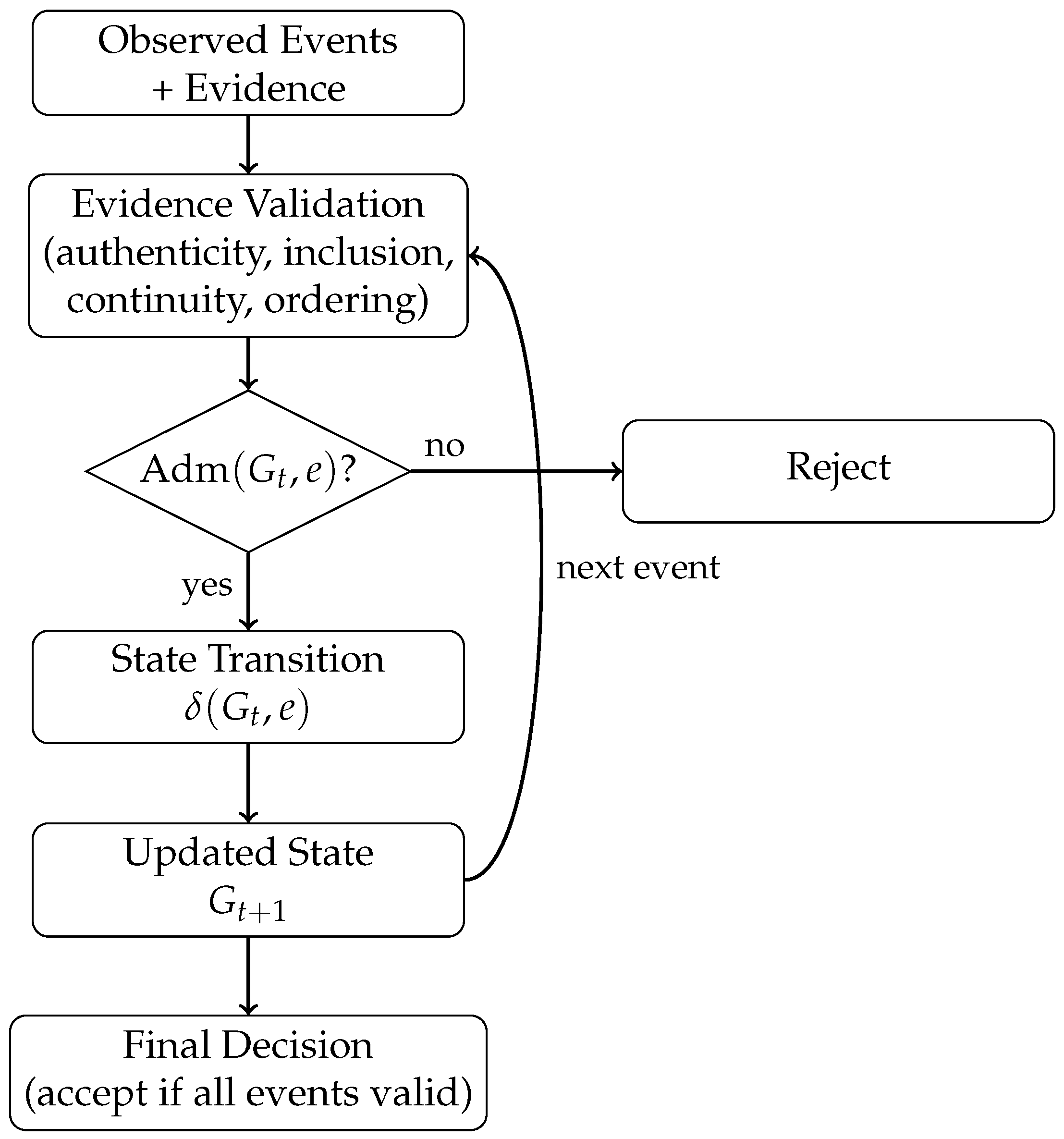
The overall validation process can be interpreted as an iterative pipeline in which observed events and their associated evidence are first verified, then evaluated for admissibility, and, if accepted, incorporated into the reconstructed governance state through admissible transitions. Figure 1 illustrates this workflow.
Algorithm 1 summarizes the validation procedure used to determine whether an observed governance history is acceptable under the admissibility-constrained transition model.
Algorithm 1 corresponds directly to the auditor defined in Definition 13. In particular, each iteration of the algorithm implements one step of the admissibility-constrained transition process. The preliminary validation step checks that the event and its associated artifacts are well formed and verifiable relative to the trusted log basis, thereby providing the conditions required to evaluate admissibility in a sound manner.
The semantic acceptance decision itself is determined by the predicate Adm , while state evolution is defined by the transition function δ . In this way, the algorithm separates artifact validation from semantic acceptance without introducing an additional layer of correctness conditions beyond those already captured by the formal model.
From an implementation perspective, Algorithm 1 can be executed over serialized event streams, log APIs, or audit exports, without requiring access to internal system components. The algorithm therefore defines a concrete execution model for independent verification over observable data.
The correctness of this procedure follows directly from the definitions of admissibility and valid governance histories, together with Proposition 2, which establishes the equivalence between rejection and the presence of a governance violation. Accordingly, the algorithm rejects exactly those histories that cannot be extended to valid governance histories under the formal model.
More generally, Algorithm 1 is consistent with the guarantees established in Theorem 5. Under the stated assumptions on evidence verification, admissibility enforcement, and log continuity, acceptance by the algorithm implies that the processed sequence is a valid governance history and that the reconstructed state is semantically valid. Conversely, any governance manipulation induces a failure of admissibility or evidence verification at some step, leading to rejection.
This correspondence shows that the semantic notion of validity introduced in this work is not only declarative but also algorithmically checkable. The auditor therefore acts as a recognizer for the language of valid governance histories, with Algorithm 1 providing its concrete decision procedure.

8.3. Invariant Verification

After reconstructing the observable history, the auditor may inspect the reconstructed governance state in light of the invariants defined in Section 5. This step does not introduce an additional acceptance criterion beyond admissibility and well-defined transition semantics. Rather, it provides a global interpretation of the correctness guarantees already ensured by valid reconstruction.
Let G t denote the reconstructed governance state after processing events ( e 1 , , e t ) . By Proposition 1 and Theorem 2, if reconstruction proceeds through admissible transitions, the resulting states satisfy the governance invariants.
Accordingly, invariant verification can be understood as an explicit audit-level interpretation of deterministic reconstruction, revocation soundness, policy-constrained evolution, temporal coherence, and non-equivocation over the accepted history.
This perspective is useful because it makes the semantic consequences of acceptance directly inspectable by an external observer, even though invariant satisfaction is already entailed by the formal properties of the model.

8.4. Detection of Governance Violations

Definition 14 (Governance Violation).
Let L = ( e 1 , , e n ) be an observed sequence of governance events. A governance violation occurs if and only if L is not a valid governance history in the sense of Definition 2.
Proposition 2 (Auditor Correctness for Violation Detection).
Let L = ( e 1 , , e n ) be a sequence of governance events processed by an auditor as defined in Definition 13.
Then L contains a governance violation if and only if the auditor rejects L.
Proof. 
(⇒) If L contains a governance violation, then by Definition 14 it is not a valid governance history. By Definition 2 and Equation (6), there exists an index i such that either Adm ( G i 1 , e i ) = false or the transition δ ( G i 1 , e i ) is undefined. Therefore, the auditor rejects L at step i.
(⇐) If the auditor rejects L at some step i, then either admissibility fails or the transition is undefined. In either case, the conditions of Definition 2 and Equation (6) are violated, and therefore L is not a valid governance history. Hence, L contains a governance violation.    □
Remark 2 (Auditor as a Recognizer of Valid Histories).
Proposition 2 admits the following interpretation. The auditing procedure induces a decision problem over event sequences, where the language of accepted sequences coincides exactly with the set of valid governance histories.
Equivalently, the auditor acts as a recognizer for the language of valid histories defined by the admissibility-constrained transition system.
The auditing framework characterizes governance violations in semantic terms, by determining whether an observed event sequence can be accepted as a valid governance history under the formal model.
The following result operationalizes, in auditing terms, the semantic detection guarantees established in Section 7.
Theorem 5 (Soundness of Verifiable Auditing).
Let L = ( e 1 , , e n ) be a sequence of governance events together with associated evidence artifacts, and let an auditor in the sense of Definition 13 reconstruct a sequence of states
G 0 , G 1 , , G n
by iteratively applying the transition function δ under the admissibility predicate Adm .
Assume that:
  • all evidence artifacts are verified according to the obligations defined in Section 6;
  • the admissibility predicate Adm is correctly enforced;
  • the trusted log continuity basis is valid.
Then the following hold:
  • if the auditor accepts all events in L, then L is a valid governance history and G n is a valid governance state;
  • if L contains a governance manipulation, then the auditor rejects L.
Proof. 
If the auditor accepts all events in L, then by Definition 13 each event satisfies Adm ( G i 1 , e i ) = true and each successor state G i = δ ( G i 1 , e i ) is well-defined.
Therefore, by Definition 2, the sequence L is a valid governance history.
Since the trusted log continuity basis is valid and the admissibility predicate is correctly enforced, Theorem 3 implies that the reconstructed final state G n is a valid governance state.
Conversely, if L contains a governance manipulation, then by Definition 11 it cannot be extended to a valid governance history. By Proposition 2, the auditor must therefore reject L at some step of the reconstruction procedure.
Hence, the auditing procedure is sound.    □
Remark 3 (Auditing as Semantic Validation).
The auditing framework validates more than the integrity of recorded events. Its function is to determine whether an observed evidence-supported event sequence can be accepted as a valid governance history under the admissibility-constrained transition system.
Accordingly, successful auditing establishes semantic correctness of reconstructed governance evolution, whereas failed auditing identifies precisely the point at which validity breaks down.

9. Illustrative Application Scenario

This section presents an adversarial scenario illustrating how the proposed framework detects inconsistencies in governance histories under fork attacks. While Section 4.8 introduces the formal semantics of admissibility and state reconstruction in an abstract setting, the purpose of this section is to show how an external auditor applies these conditions to observable event sequences and associated evidence in the presence of adversarial manipulation.
Although the framework is intentionally theoretical and implementation-agnostic, this scenario also provides a qualitative validation of its practical interpretability. In particular, it shows how the model can be instantiated over a realistic class of externally auditable encrypted storage settings in which governance events, ordering metadata, and continuity evidence are exposed to independent verifiers.

9.1. Scenario Description: Forked Governance Histories

Consider an encrypted cloud storage system in which governance events such as grants, revocations, and key rotations are recorded in an append-only log and exposed together with verifiable evidence artifacts. This setting is representative of real-world architectures that combine encrypted object access, external auditability, and log-based consistency guarantees. Let the initial governance state be
G 0 = ( A 0 , P 0 , K 0 , R 0 , M 0 ) ,
where administrator u a is authorized to manage access to object o 1 .
Assume also that k 0 K 0 is the active cryptographic key associated with object o 1 in the initial governance state.
At an abstract level, this scenario is consistent with practical environments in which authorization changes and key-management operations are externally observable through signed events, append-only log commitments, and consistency proofs. The framework does not depend on a specific platform, but the scenario reflects the kind of evidence structures that real auditable systems may expose.
While the framework is not instantiated over a specific platform, the modeled components correspond to mechanisms already present in real systems, such as append-only transparency logs, cryptographic commitments, and externally verifiable evidence structures. This supports the practical interpretability of the model without constraining it to a particular implementation.
An adversarial storage provider attempts to present two different governance histories to two independent auditors, A 1 and A 2 , by exploiting a fork in the observable log. The two sequences are:
L 1 = ( e 1 , e 2 , e 3 ) , L 2 = ( e 1 , e 2 )
The events are defined as follows:
e 1 = ( grant , u a , u b , o 1 , ρ 1 , μ 1 , η 1 ) ,
e 2 = ( revoke , u a , u b , o 1 , ρ 2 , μ 2 , η 2 ) ,
e 2 = ( rotate , u a , , k 0 , ρ 2 , μ 2 , η 2 ) ,
e 3 = ( grant , u a , u b , o 1 , ρ 3 , μ 3 , η 3 ) .
In history L 1 , user u b is granted access, then revoked, and is later the target of a new grant event. In history L 2 , the revocation event is omitted and replaced by a key rotation event. The adversary provides locally consistent evidence for each sequence, attempting to make both histories appear valid when evaluated independently.

9.2. Auditor Validation and Detection

Auditor A 1 processes history L 1 following the validation procedure defined in Section 8.
Step 1: Processing e 1 . The evidence bundle η 1 is validated, and
Adm ( G 0 , e 1 ) = true .
The state evolves to G 1 = δ ( G 0 , e 1 ) , where ( u b , o 1 ) is added to the access relation.
Step 2: Processing e 2 . The revocation event is validated and accepted. The state evolves to
G 2 = δ ( G 1 , e 2 ) ,
where access is removed and the corresponding revocation constraint is recorded.
Step 3: Processing e 3 . The auditor evaluates
Adm ( G 2 , e 3 ) = false
Since the prior revocation remains active and no admissible re-authorization condition is present, admissibility fails. The transition is undefined, and A 1 rejects L 1 .
Auditor A 2 processes history L 2 .
Step 1: Processing e 1 . As before, the event is accepted and the state evolves to G 1 .
Step 2: Processing e 2 . The rotation event appears locally admissible with respect to authorization and reference conditions, and the state evolves provisionally to
G 2 = δ ( G 1 , e 2 ) .
At this point, the sequence L 2 appears locally admissible when evaluated in isolation. However, the auditor must also validate the continuity evidence contained in η 2 .
The key observation is that governance validity is defined with respect to a single append-only log evolution. Therefore, the continuity evidence associated with each event must be consistent with a unique, non-forking history.
Suppose that the consistency proof included in η 2 cannot be reconciled with the log commitments observed in L 1 . In particular, the two sequences L 1 and L 2 cannot both originate from the same append-only log without violating cryptographic consistency guarantees. This situation corresponds to a fork in the observable history.
Importantly, detection of this inconsistency does not require a single auditor to observe both histories simultaneously. Instead, it follows from the fact that the continuity evidence associated with each sequence cannot be jointly satisfied under a single append-only log. As a result, inconsistency emerges either when an auditor compares multiple observed log views or when previously validated continuity information cannot be extended consistently.
This violates the non-equivocation invariant. Consequently, the auditor determines that the observed continuity basis cannot justify both histories simultaneously, and at least one of them must be rejected as invalid.
This illustrates an important point about the model’s justification structure: rejection does not rely on informal suspicion about adversarial behavior, but on explicit incompatibility between the observed evidence and the semantic conditions required for history acceptance. In this sense, manipulation detection follows from the combined enforcement of admissibility, continuity validation, and invariant preservation rather than from an auxiliary heuristic criterion.

9.3. Observable Log Inconsistency Under Forking

To make the adversarial scenario fully tangible, we now illustrate how the fork manifests at the level of observable log artifacts and verifiable evidence.
Assume that the governance log is implemented as an append-only Merkle tree, where each committed state is represented by a root hash. The two auditors receive the following log views:
Auditor A 1 view:
  • seq = 100  e1  root = H1
    seq = 101  e2  root = H2
    seq = 102  e3  root = H3
with consistency proofs:
H 0 H 1 H 2 H 3
Auditor A 2 view:
  • seq = 100  e1   root = H1
    seq = 101  e2’  root = H2’
with consistency proofs:
H 0 H 1 H 2
Both views are locally consistent: each sequence forms a valid append-only extension from H 0 , and all inclusion and consistency proofs verify correctly when evaluated in isolation.
However, the conflict appears when comparing the two views at the same sequence position. In particular:
H 2 H 2
This implies that two different log states are associated with the same prefix ( e 1 ) and the same sequence index, which violates the append-only consistency guarantees of the log.
From the perspective of the evidence model, this inconsistency cannot be resolved:
  • The continuity evidence for H 2 requires that the log evolved through e 2 .
  • The continuity evidence for H 2 requires that the log evolved through e 2 .
  • Both cannot be simultaneously valid under a single append-only log.
As a result, at least one of the two histories must be rejected.
This inconsistency is not detected through informal reasoning, but through explicit verification of cryptographic commitments and consistency proofs. Any auditor that obtains both views, or that maintains previously validated log commitments, will detect that the continuity evidence cannot be jointly satisfied.
Therefore, the fork attack becomes observable as a concrete mismatch in verifiable log state, rather than as an abstract semantic inconsistency.
This illustrates that the non-equivocation invariant is enforced not only at the level of semantic interpretation, but also through concrete inconsistencies in the observable evidence structures exposed by the system.
From an implementation perspective, the structures shown above correspond directly to the inputs processed by a verifier implementing Algorithm 1. Each log entry (e.g., e 1 , e 2 , e 2 ) is accompanied by verifiable artifacts such as signatures, inclusion proofs, and consistency proofs, which can be checked independently of any internal system state.
In this setting, validation reduces to a sequence of concrete operations: verifying cryptographic proofs, checking log consistency, and evaluating admissibility conditions over the reconstructed state. As a result, the detection of the fork does not rely on abstract reasoning alone, but on the inability to reconcile the provided cryptographic evidence within a single append-only log evolution.
This shows that the proposed semantics can be directly instantiated as an operational verification procedure over observable log data, making the framework applicable to real-world systems that expose verifiable governance traces.
This behavior is directly aligned with practical transparency systems, where fork detection reduces to the impossibility of reconciling multiple valid consistency proofs for the same log prefix.

9.4. Relation to Semantic Detectability

This scenario illustrates the semantic detection guarantees established in Theorem 4. In particular, the observed sequences correspond to governance manipulation classes in the sense of Definition 12.
For history L 1 , rejection follows directly from a failure of admissibility at event e 3 , consistent with the sound rejection property. For history L 2 , local admissibility holds, but the sequence cannot be extended to a valid governance history due to inconsistency in the continuity evidence under a single append-only log evolution. This corresponds to a violation of the non-equivocation invariant and therefore to a failure of global validity.
These outcomes illustrate the acceptance equivalence property: a sequence is accepted if and only if it is a valid governance history. Both forked views induce sequences that cannot be extended to valid histories and are therefore rejected by the auditing procedure.
The example shows that adversarial manipulation does not require breaking cryptographic primitives. Instead, it produces observable inconsistencies that violate admissibility conditions or invariant preservation, and are therefore detectable through the semantic validation process defined by the model.
More broadly, the scenario is intended to show that the proposed semantics remains meaningful under realistic conditions of partial observability, externally supplied evidence, and adversarial interference with log views. While the model abstracts from implementation details, its validation logic is consistent with the operational constraints of real auditable systems in which observers must reason from available evidence rather than from privileged internal state.

10. Discussion

The framework developed in this work shifts the study of governance from implementation-oriented descriptions to semantic validity conditions over observable histories. At the same time, this semantic perspective is intended to remain compatible with real-world auditable environments in which governance decisions, evidence artifacts, and log continuity information are externally exposed and independently checked. Rather than focusing on how governance actions are produced, transmitted, or stored, the approach defines the conditions under which an observed sequence of events can be interpreted as a valid evolution of authorization state.
This shift of focus is essential for distinguishing the present contribution from architecture-level proposals. A system design may specify how governance is realized operationally, whereas the framework introduced here specifies how governance histories are to be interpreted and validated once they are observed. The contribution is therefore not a new encrypted storage architecture, but a semantic layer that can be used to evaluate whether the governance behavior exposed by any such architecture is semantically acceptable.
While the framework is described as architecture-agnostic, it assumes the existence of observable governance events and associated verifiable evidence, which may be provided by different underlying system designs.
This distinction clarifies the difference between event integrity and semantic correctness. Integrity-oriented mechanisms may ensure that events are authentic, included, and consistently ordered, yet still leave open the question of whether those events correspond to admissible state transitions. By introducing explicit admissibility conditions and invariant-based validation, the proposed model offers a formal framework for distinguishing between observable event traces and valid governance evolution.
A central implication of this perspective is that verification becomes an acceptance problem over histories. An observed event is not accepted solely because it is well formed or cryptographically committed, but because it satisfies the semantic conditions required for admissibility in the reconstructed state. Likewise, a history is not considered correct merely because it is structurally consistent, but because it can be interpreted as a sequence of admissible transitions that preserves the invariants defined by the model.
It is important to distinguish the notion of validation adopted in this work from empirical or experimental validation. The objective of the proposed framework is not to evaluate system performance or implementation behavior, but to establish formal conditions under which governance histories can be accepted as semantically valid. Accordingly, validation is provided through formal analysis, invariant preservation, and adversarial reasoning over observable event sequences, rather than through implementation-specific experimentation. This distinction is consistent with established approaches in formal methods and security semantics, where correctness is derived analytically from the model rather than empirically measured.
The assumption that admissibility is correctly enforced should be understood as a modeling assumption, reflecting the existence of a verifier that faithfully implements the defined semantic conditions, rather than a guarantee provided by the underlying system.
The introduction of explicit evidence obligations also clarifies the role of observable artifacts in validation. Rather than treating evidence as auxiliary support for an operational mechanism, the framework defines the minimal conditions under which evidence is sufficient to justify event acceptance. This yields a direct relationship between evidence sufficiency and semantic validity, allowing correctness claims to be stated independently of any particular implementation design.
Another consequence concerns the interpretation of adversarial behavior. By defining manipulations as deviations from valid histories, the framework unifies detection and validation within a single semantic account. Under this formulation, detectability is not an external property provided by an additional monitoring layer, but a consequence of the fact that manipulated histories fail admissibility or violate invariant preservation. This perspective is illustrated in Section 9, where forked histories are shown to induce observable inconsistencies that cannot be extended to valid governance histories under the admissibility-constrained model.
From an auditing perspective, the framework supports a principled understanding of validation as a decision problem over observable histories. Auditors do not merely inspect isolated artifacts; they determine whether an evidence-supported sequence belongs to the class of valid histories defined by the model. This yields a more precise notion of auditing as semantic recognition rather than procedural inspection. This perspective is particularly relevant in environments where governance must be externally verifiable, such as encrypted cloud storage platforms, transparency systems, or decentralized infrastructures.
This interpretation is also consistent with real-world validation conditions. In practice, external observers typically do not have access to hidden internal state and must reason from signed events, log commitments, ordering metadata, and continuity evidence. The framework is designed precisely for that setting: it does not assume privileged observability, but rather formalizes when the available evidence is sufficient to justify acceptance or rejection of a governance history.
Several limitations of the present framework remain. First, the model focuses on the semantic conditions required for validity and does not address how those conditions are guaranteed during event production. Second, the framework assumes that sufficient evidence is available to support admissibility checks; incomplete or delayed evidence may limit the ability to validate histories in practice. Third, the model abstracts away from efficiency considerations associated with long histories and repeated validation.
These limitations motivate a more detailed discussion of practical aspects related to complexity, scalability, and deployment in real-world settings, which are examined in the following subsections.

10.1. Complexity and Scalability Considerations

The validation process defined in this framework can be modeled as a sequential reconstruction over an event history L = ( e 1 , , e n ) , where each step consists of evaluating the admissibility predicate Adm ( G t , e ) and, if satisfied, applying the transition function δ . This process corresponds directly to the iterative procedure described in Algorithm 1, where each iteration performs one admissibility check followed by a state transition.
From a computational perspective, the total validation cost can be expressed as:
T ( n ) = i = 1 n C adm ( e i , G i 1 ) + C δ ( e i , G i 1 )
where C adm denotes the cost of admissibility evaluation and C δ the cost of state transition. In particular, Equation (12) provides an upper bound for the execution cost of Algorithm 1.
The dominant component is typically C adm , which can be decomposed into several sub-costs:
  • Policy evaluation cost C P : depends on the complexity of evaluating authorization conditions under P t . For rule-based or logic-based policies (e.g., Datalog-like), this may range from linear to polynomial in the size of the policy state.
  • Evidence verification cost C V : includes signature verification, inclusion proofs (e.g., Merkle proofs), and continuity checks. In typical constructions, inclusion and consistency proofs can be verified in O ( log n ) time, while signature verification is constant per event under standard assumptions.
  • Temporal and ordering validation C T : depends on the structure of ordering metadata. If ordering is supported by monotonic counters or hash-linked structures, validation is O ( 1 ) or O ( log n ) .
  • Revocation constraint checking C R : requires verifying that no conflicting revocation exists in R t . With appropriate indexing (e.g., hash-based sets), this can be performed in O ( 1 ) expected time.
Accordingly, the amortized per-event validation cost can be approximated as:
C adm = C P + C V + C T + C R
and the total validation complexity becomes:
T ( n ) = O n · ( C P + C V + C T + C R )
In typical deployments where evidence verification dominates, and assuming logarithmic proof verification, this yields an overall complexity of:
T ( n ) = O ( n log n )
This complexity characterization matches the operational behavior of Algorithm 1, whose execution requires one admissibility evaluation and one transition per event, and is therefore linear in the length of the history up to the cost of the underlying verification procedures.
Scalability challenges arise in scenarios with large n or high event throughput. Several optimization strategies can be applied without altering the semantic model:
  • Incremental validation: maintaining cached intermediate states G t to avoid recomputation from G 0 .
  • State checkpointing: periodically materializing trusted states to allow validation to restart from a recent checkpoint instead of the full history.
  • Parallel evidence verification: verifying independent evidence artifacts (e.g., signatures or inclusion proofs) concurrently, reducing wall-clock latency.
  • Selective revalidation: rechecking only affected portions of the history when new events are appended, assuming immutability of prior validated segments.
Importantly, the sequential dependency induced by δ limits full parallelization of state reconstruction, as each transition depends on the previously reconstructed state. However, significant parallelism remains available at the level of evidence validation and auxiliary checks.
The framework itself remains agnostic to implementation choices, but this decomposition clarifies that scalability depends primarily on the efficiency of policy evaluation and cryptographic verification, rather than on the abstract semantics of admissibility or state transition.
This also supports the practical viability of the framework as a validation layer: under standard assumptions about indexed policy state and logarithmic proof verification, the main computational costs arise from well-understood operations already present in auditable cryptographic systems.

10.2. Practical Cost Estimation

To complement the asymptotic analysis, we provide a concrete estimation of the operational cost of validation under realistic assumptions.
Consider a typical deployment where each governance event includes:
  • one digital signature verification,
  • one inclusion proof in an append-only log (e.g., Merkle proof),
  • one consistency proof for log continuity,
  • constant-time policy and revocation checks.
Under standard cryptographic implementations, these operations are efficient and widely supported in existing systems. In particular:
  • signature verification is a constant-time operation per event under standard assumptions;
  • inclusion proof verification requires O ( log n ) hash operations;
  • consistency proof verification also requires O ( log n ) hash operations.
Assuming n = 10 6 events, log n 20 , so each event requires only a small number of hash operations in addition to a constant number of cryptographic checks.
Therefore, the per-event validation cost is dominated by a bounded number of efficient cryptographic operations, and full validation of large histories remains computationally feasible in practical settings.
This estimation shows that the proposed validation model is not only theoretically sound but also compatible with the performance characteristics of existing auditable systems.
In operational terms, this implies that a verifier can process governance logs in a streaming fashion, validating each event upon arrival or re-validating historical segments on demand. This supports deployment models in which validation runs continuously as part of an auditing pipeline or as an independent verification service.

10.3. Practical Deployment Considerations

While the proposed framework defines the semantic conditions for governance validation, its practical deployment depends on the characteristics of the underlying system and the availability of observable evidence. At the same time, these deployment considerations help clarify that the model is not detached from practice: its assumptions are aligned with the kinds of constraints faced by real systems that aim to support external auditability, evidence-based validation, and governance traceability. Several factors may influence its applicability in real-world environments.
First, the framework assumes that governance-relevant events are exposed together with sufficient evidence to support admissibility checking. In practice, systems may exhibit partial observability, delayed evidence disclosure, or incomplete logging, which can limit the ability of external verifiers to reconstruct valid histories.
Second, the verification of evidence artifacts may introduce computational and communication overhead, particularly in systems where inclusion proofs, signatures, or consistency guarantees must be validated for each event. This overhead may impact performance in large-scale or high-frequency environments.
Third, integration with existing systems requires the definition of interfaces through which governance events and their associated evidence can be externally observed. In systems not originally designed for verifiable governance, retrofitting such capabilities may require additional instrumentation or architectural adjustments.
Finally, the framework operates under the assumption that the underlying cryptographic primitives are secure and that a trusted log continuity basis can be established. In adversarial or partially compromised environments, ensuring these assumptions may require additional trust bootstrapping mechanisms.
These considerations highlight that, while the framework is applicable across a wide range of systems, its effectiveness depends on the availability, quality, and verifiability of governance evidence, as well as on the ability to integrate validation procedures within existing infrastructures.
Accordingly, realistic application of the framework is strongest in environments where governance-relevant actions already leave externally checkable traces, such as auditable encrypted storage services, transparency-backed key management systems, and distributed infrastructures with verifiable log evolution.
These limitations suggest several directions for future work. One direction involves connecting semantic validity conditions with mechanisms that constrain event production so that inadmissible histories cannot arise undetected. Another concerns the development of efficient techniques for validating long histories under realistic resource constraints. A further line of research involves automated procedures capable of continuously evaluating admissibility and invariant preservation over evolving histories.
By formalizing governance as a problem of semantic validity and acceptance, this work provides a foundation for reasoning about correctness through explicit conditions over observable histories, independently of how those histories are generated.
In practice, the applicability of the framework ultimately depends on the availability of sufficiently expressive logging and evidence mechanisms in real systems.
Importantly, the framework does not assume that governance validity is enforced at the time events are generated. Instead, it defines the conditions under which validity can be established retrospectively from observable evidence, which is a fundamentally different objective from system design. This reinforces the role of the framework as a complementary validation layer that operates independently of system design, enabling consistent, architecture-agnostic, and verifiable interpretation of governance behavior across heterogeneous environments.

11. Conclusions

This work introduces a formal semantic framework for reasoning about the validity of governance histories. The framework defines governance in terms of admissible events, state reconstruction, invariant preservation, and explicit evidence obligations, thereby characterizing the conditions under which an observed event sequence can be accepted as a valid governance history and, therefore, as a correct evolution of authorization state.
A key contribution of this work is the distinction between observable events and valid governance evolution. Existing approaches can establish integrity and consistency properties of recorded events, but they do not by themselves define when those events induce semantically valid state transitions. By introducing admissibility conditions and invariant-based validation, the proposed model provides a formal basis for interpreting governance behavior as a well-defined semantic process.
The framework also clarifies the role of evidence in validation. By defining event-specific evidence obligations, it establishes the minimal conditions under which events can be accepted and states can be reconstructed. This enables independent observers to evaluate governance histories from observable artifacts alone, without relying on implicit trust assumptions.
In addition, the formulation of auditing as a decision procedure over histories provides a unified view of verification, reconstruction, and validation. Under this perspective, governance correctness corresponds to membership in the class of valid governance histories defined by the model, while deviations from correctness appear as failures of admissibility or invariant preservation.
Although the contribution is theoretical, the reconstruction example, adversarial application scenario, and deployment discussion show that the framework is not purely abstract in its implications. Rather, it provides a semantically precise way to reason about governance validity in classes of real systems where events and evidence can be externally observed and independently validated.
Future work may extend this framework by connecting semantic validity conditions with event-generation constraints, by developing scalable validation techniques for long histories, and by exploring automated methods for continuous verification of governance properties.
This contribution should be understood as distinct from architecture-centric research on encrypted storage governance. Whereas system-level approaches explain how governance mechanisms can be built, the present work explains under which formal conditions the resulting observable histories can be accepted as semantically valid.
This positioning also clarifies the intended scope of validation in the present work. The contribution is not to provide empirical evaluation or system-level benchmarking, but to establish formally grounded conditions under which governance histories can be accepted or rejected based on observable evidence. In this sense, the notion of validation adopted here is analytical and semantics-driven, aligning with approaches in formal methods where correctness is derived from model properties rather than from implementation-specific experimentation.
By establishing a formal notion of governance validity over observable histories, this work provides a formal basis for reasoning about correctness, verification, and auditability as semantic properties.


Author Contributions

Conceptualization, J.F.R.-A., C.Z. and F.D.l.P.; methodology, J.F.R.-A. and C.Z.; formal analysis, J.F.R.-A.; investigation, J.F.R.-A. and C.Z.; validation, C.Z. and F.D.l.P.; writing—original draft preparation, J.F.R.-A.; writing—review and editing, J.F.R.-A., C.Z. and F.D.l.P.; supervision, C.Z. and F.D.l.P. All authors have read and agreed to the published version of the manuscript.

Funding

This research was partially supported by the NEOTEC program (CDTI, Spain) of the Spanish Ministry of Science and Innovation, under the Iberbox project (grant number SNEO-20201266).

Institutional Review Board Statement

Not applicable.

Informed Consent Statement

Not applicable.

Data Availability Statement

No new data were created or analyzed in this study.

Acknowledgments

The authors acknowledge the Iberbox project for motivating the broader study of verifiable governance and evidence-based validation.

Conflicts of Interest

The authors declare no conflicts of interest. The funders had no role in the design of the study; in the collection, analyses, or interpretation of data; in the writing of the manuscript; or in the decision to publish the results.

Abbreviations

The following abbreviations are used in this manuscript:
ABACAttribute-Based Access Control
CDTICentro para el Desarrollo Tecnológico y la Innovación
RBACRole-Based Access Control

References

  1. Len, J.; Chase, M.; Ghosh, E.; Laine, K.; Cruz Moreno, R. OPTIKS: An Optimized Key Transparency System. In Proceedings of the 33rd USENIX Security Symposium; ACM: New York, NY, USA, 2024; pp. 4355–4372. [Google Scholar]
  2. Becker, M.Y.; Fournet, C.; Gordon, A.D. SecPAL: Design and semantics of a decentralized authorization language. J. Comput. Secur. 2010, 18, 619–665. [Google Scholar] [CrossRef]
  3. Yang, Z.; Dai, M.; Guo, J. Formal Modeling and Verification of Smart Contracts with Spin. Electronics 2022, 11, 3091. [Google Scholar] [CrossRef]
  4. Freitas Peixoto, D.C.; Machado Mendizabal, O. A Practical TLA+ Library for Designing and Verifying Distributed Systems. In Dependable and Secure Computing; Communications in Computer and Information Science; Springer: Berlin/Heidelberg, Germany, 2026. [Google Scholar]
  5. Kamara, S.; Lauter, K. Cryptographic Cloud Storage. In Financial Cryptography and Data Security; Lecture Notes in Computer Science; Springer: Berlin/Heidelberg, Germany, 2010; Volume 6054, pp. 136–149. [Google Scholar] [CrossRef]
  6. Popa, R.A.; Redfield, C.M.S.; Zeldovich, N.; Balakrishnan, H. CryptDB: Protecting Confidentiality with Encrypted Query Processing. In SOSP ’11: Proceedings of the Twenty-Third ACM Symposium on Operating Systems Principles; ACM: New York, NY, USA, 2011; pp. 85–100. [Google Scholar] [CrossRef]
  7. Stefanov, E.; van Dijk, M.; Shi, E.; Fletcher, C.W.; Ren, L.; Yu, X.; Devadas, S. Path ORAM: An Extremely Simple Oblivious RAM Protocol. In CCS ’13: Proceedings of the 2013 ACM SIGSAC Conference on Computer & Communications Security; ACM: New York, NY, USA, 2013; pp. 299–310. [Google Scholar] [CrossRef]
  8. Bethencourt, J.; Sahai, A.; Waters, B. Ciphertext-Policy Attribute-Based Encryption. In 2007 IEEE Symposium on Security and Privacy (SP ’07); IEEE: Piscataway, NJ, USA, 2007; pp. 321–334. [Google Scholar] [CrossRef]
  9. Yan, L.; Wang, G.; Yin, T.; Liu, P.; Feng, H.; Zhang, W.; Hu, H.; Pan, F. Attribute-Based Searchable Encryption: A Survey. Electronics 2024, 13, 1621. [Google Scholar] [CrossRef]
  10. Green, M.; Ateniese, G. Identity-Based Proxy Re-Encryption. In Applied Cryptography and Network Security; Lecture Notes in Computer Science; Springer: Berlin/Heidelberg, Germany, 2007; Volume 4521, pp. 288–306. [Google Scholar] [CrossRef]
  11. Mhiri, S.; Egio, A.; Compastié, M.; Cosio, P. Proxy Re-Encryption for Enhanced Data Security in Healthcare: A Practical Implementation. In ARES ’24: Proceedings of the 19th International Conference on Availability, Reliability and Security; Association for Computing Machinery: New York, NY, USA, 2024; pp. 1–11. [Google Scholar] [CrossRef]
  12. Sandhu, R.S.; Coyne, E.J.; Feinstein, H.L.; Youman, C.E. Role-Based Access Control Models. Computer 1996, 29, 38–47. [Google Scholar] [CrossRef]
  13. Hu, V.C.; Ferraiolo, D.; Kuhn, R.; Schnitzer, A.; Sandlin, K.; Miller, R.; Scarfone, K. Guide to Attribute-Based Access Control (ABAC); Technical Report; NIST: Gaithersburg, MD, USA, 2014. [Google Scholar] [CrossRef]
  14. Parno, B.; Howell, J.; Gentry, C.; Raykova, M. Pinocchio: Nearly Practical Verifiable Computation. In 2013 IEEE Symposium on Security and Privacy; IEEE: Piscataway, NJ, USA, 2013; pp. 238–252. [Google Scholar] [CrossRef]
  15. Ben-Sasson, E.; Bentov, I.; Horesh, Y.; Riabzev, M. Scalable Zero Knowledge with No Trusted Setup. In Advances in Cryptology—CRYPTO 2019; Lecture Notes in Computer Science; Springer: Berlin/Heidelberg, Germany, 2019; Volume 11694, pp. 701–732. [Google Scholar] [CrossRef]
  16. Wilcox-O’Hearn, Z.; Warner, B. Tahoe: The Least-Authority Filesystem. In StorageSS ’08: Proceedings of the 4th ACM International Workshop on Storage Security and Survivability; ACM: New York, NY, USA, 2008; pp. 21–26. [Google Scholar] [CrossRef]
  17. Merkle, R.C. A Digital Signature Based on a Conventional Encryption Function. In Advances in Cryptology—CRYPTO ’87; Lecture Notes in Computer Science; Springer: Berlin/Heidelberg, Germany, 1988; Volume 293, pp. 369–378. [Google Scholar]
  18. Crosby, S.A.; Wallach, D.S. Efficient Data Structures for Tamper-Evident Logging. In USENIX Security Symposium; USENIX: Berkeley, CA, USA, 2009. [Google Scholar]
  19. Laurie, B.; Langley, A.; Kasper, E. Certificate Transparency; Technical Report; RFC Editor: Marina del Rey, CA, USA, 2013. [Google Scholar] [CrossRef]
  20. Melara, M.S.; Blankstein, A.; Bonneau, J.; Felten, E.W.; Freedman, M.J. CONIKS: Bringing Key Transparency to End Users. In 24th USENIX Security Symposium; USENIX: Berkeley, CA, USA, 2015; pp. 383–398. [Google Scholar]
  21. Chase, M.; Meiklejohn, S. Transparency Overlays and Applications. In CCS ’16: Proceedings of the 2016 ACM SIGSAC Conference on Computer and Communications Security; ACM: New York, NY, USA, 2016; pp. 168–179. [Google Scholar]
  22. Malvai, H.; Kokoris-Kogias, L.; Sonnino, A.; Ghosh, E.; Oztürk, E.; Lewi, K.; Lawlor, S. Parakeet: Practical Key Transparency for End-to-End Encrypted Messaging. In Proceedings of the Network and Distributed System Security Symposium, San Diego, CA, USA, 27 February–3 March 2023. [Google Scholar]
  23. Google. Trillian: A Transparent, Highly Scalable and Cryptographically Verifiable Data Store. 2017. Available online: https://github.com/google/trillian (accessed on 1 March 2026).
  24. Chen, B.; Dodis, Y.; Ghosh, E.; Goldin, E.; Kesavan, B.; Marcedone, A.; Mou, M.E. Rotatable Zero Knowledge Sets: Post Compromise Secure Auditable Dictionaries. In Advances in Cryptology—ASIACRYPT 2022; Lecture Notes in Computer Science; Springer: Berlin/Heidelberg, Germany, 2023; Volume 13792, pp. 547–580. [Google Scholar] [CrossRef]
  25. Zyskind, G.; Nathan, O.; Pentland, A. Decentralizing Privacy: Using Blockchain to Protect Personal Data. In 2015 IEEE Security and Privacy Workshops; IEEE: Piscataway, NJ, USA, 2015; pp. 180–184. [Google Scholar] [CrossRef]
  26. Abdulrahman, E.; Alshehri, S.; Cherif, A. Blockchain-Based Access Control for IoT: A Survey. In 2021 IEEE Asia-Pacific Conference on Computer Science and Data Engineering (CSDE); IEEE: Piscataway, NJ, USA, 2021; pp. 1–6. [Google Scholar] [CrossRef]
Figure 1. Admissibility-based validation workflow for governance history reconstruction.
Information 17 00447 g001
Table 1. Comparison of representative approaches and the proposed framework.
ApproachFocusGuaranteesLimitationsAcceptance Semantics
Cryptographic EnforcementAccess control enforcementConfidentiality, authorizationNo history semanticsNo
Transparency LogsEvent integrityConsistency, non-equivocationNo state interpretationNo
Formal VerificationSystem correctnessSafety, livenessRequires full system modelNo
Blockchain SemanticsState transition executionDeterministic execution, immutabilityNo external validation semanticsNo
Proposed FrameworkGovernance history validationSemantic correctness, auditabilityRequires observable evidenceYes
Table 2. Summary of notation used in the formal framework.
SymbolDescription
G t Governance state at step t
eGovernance event
L = ( e 1 , , e n ) Observed sequence of governance events (history)
USet of principals or users
OSet of governed objects or encrypted resources
KSet of cryptographic keys
PSet of governance policies
ESet of governance events
V Set of verifiable evidence artifacts
τ Event type
ι Event issuer
sSubject affected by the event
oObject, key, or policy target referenced by the event
ρ Policy reference or authorization basis
μ Event metadata, including ordering information
η Evidence bundle associated with the event
Adm ( G t , e ) Admissibility predicate for event e in state G t
δ ( G t , e ) State transition function
Ω ( τ ) Evidence obligation associated with event type τ
Disclaimer/Publisher’s Note: The statements, opinions and data contained in all publications are solely those of the individual author(s) and contributor(s) and not of MDPI and/or the editor(s). MDPI and/or the editor(s) disclaim responsibility for any injury to people or property resulting from any ideas, methods, instructions or products referred to in the content.