1. Introduction
Customer experience (CX) has evolved significantly over the past century, reflecting major shifts in creating, delivering, and interpreting value. During the early industrial era, firms competed primarily on the functional superiority of their products such as durability, efficiency, and reliability. As products became increasingly commoditized in the late 1990s, firms focused on service quality and customer care. This shift marked the transition from product-centric to service-dominant logic, in which value is understood as being co-created through interactions, relationships, and contextual factors rather than being embedded solely within goods [
1]. Foundational theories such as expectancy disconfirmation and SERVQUAL have reinforced this shift by offering structured ways to compare perceived service performance to customer expectations [
2,
3]. Maximizing customer satisfaction has been a central managerial objective for decades.
By the late 20th century, scholars began to question whether satisfaction alone captured the richness of consumption. Holbrook and Hirschman argue that consumers are emotional and symbolic beings seeking meaning, pleasure, and experiential value, not simply rational problem solvers [
4]. Pine and Gilmore expanded this perspective by framing “experience” as a distinct economic offering, urging firms to stage memorable encounters capable of creating lasting impressions [
5,
6]. This experiential turn reshaped marketing thought and set the stage for a deeper exploration of how customers perceive and evaluate their interactions with brands.
The digital revolution has significantly accelerated this change. As the Internet, mobile devices, and social platforms proliferated, the customer journey evolved into a dynamic, always-on ecosystem characterized by nonlinear interactions across multiple touchpoints, including apps, websites, social content, influencer reviews, and user-generated communities [
7,
8]. In this environment, e-commerce has matured into intelligent commerce, in which artificial intelligence (AI), machine learning (ML), and big data personalize, automate, and orchestrate large portions of the customer experience [
9,
10,
11]. Recommendation engines, behavioral prediction models, adaptive interfaces, and conversational agents now autonomously and continuously interact with customers, shaping not only the transactional process but also the emotional and cognitive dimensions of the experience. The scale of this transformation is substantial: AI underpins virtually every stage of the online shopping journey, from personalized product discovery and dynamic pricing to intelligent chatbot interactions and automated post-purchase support [
12]. Consumers are no longer passive recipients of a standardized shopping environment; they are active participants in an algorithmically curated experience ecosystem in which their data, preferences, behavior, and decisions are continuously collected, interpreted, and acted upon [
13]. Studying CX on any major e-commerce platform today is inherently a study of AI-mediated experience, even when respondents evaluate their overall platform experience rather than isolating specific AI-generated interactions.
Despite these advancements, research has struggled to keep up with the realities of AI-enabled commerce. Many studies continue to examine isolated components, such as trust, usability, personalization, and engagement, resulting in fragmented insights that do not fully explain how holistic CX is formed within algorithmically mediated platforms [
14,
15]. Persistent tensions, such as the personalization–privacy paradox, further complicate the landscape as customers navigate the trade-offs between relevance and perceived intrusiveness [
16]. Simultaneously, engagement research underscores the rise of customers as active participants rather than passive recipients of digital interactions [
17]. Collectively, these trends highlight a critical gap: existing CX frameworks, developed primarily for human-delivered or omnichannel environments, do not adequately capture how experiences emerge within intelligent AI-driven e-commerce ecosystems.
The evolution of digital experience research illustrates the need for updated theorization. Early studies emphasized trust and security as essential for online adoption [
18], alongside user autonomy and ease of control, to reduce technological anxiety [
15]. As digital platforms become more social and participatory, engagement has emerged as a determinant of emotional and behavioral involvement [
17,
19]. With advancements in AI and big data, personalization has become a central driver of relevance, convenience, and value [
20,
21], even as concerns regarding fairness, data use, and surveillance have grown [
16,
22]. The theoretical foundations that underpin these four constructs are equally distinct. Trust is grounded in commitment-trust theory [
23], which positions it as the foundational condition for sustained consumer-firm relationships, a condition newly complicated by the opacity of algorithmic systems that consumers interact with but cannot inspect [
24,
25]. Autonomy draws on self-determination theory [
26], which treats autonomous self-regulation as a basic psychological need whose satisfaction or frustration directly shapes the quality of any experience and empirical evidence confirms that perceived autonomy is a significant predictor of positive attitudes toward AI systems across multiple national contexts [
27]. Personalization is anchored in privacy calculus theory [
28], which frames consumer behavior as a cost-benefit evaluation between the value of tailored content and the risks of data disclosure and a calculus that intensifies considerably as AI systems incorporate emotional and contextual signals beyond the scope of initial data disclosure expectations [
29]. Customer engagement draws on consumer engagement theory [
17].
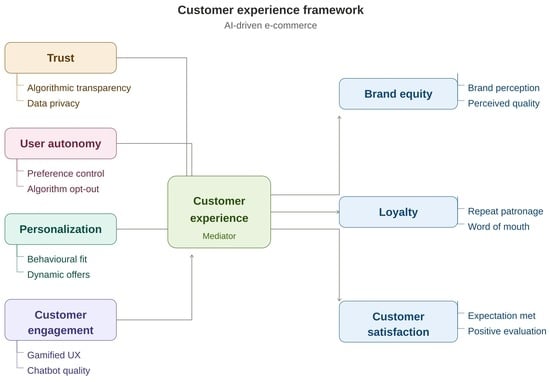
The selection of exactly four dimensions—Trust, Autonomy, Personalization, and Engagement—is grounded in a specific theoretical logic. AI-driven e-commerce introduces three qualitatively distinctive psychological dynamics that traditional CX frameworks do not adequately address. First, algorithmic opacity: the platform makes consequential decisions through processes the customer cannot inspect, creating a need to trust systems whose reasoning is invisible. Second, the surveillance-relevance trade-off: every customer interaction is continuously monitored, interpreted, and acted upon. Third, automated agency substitution: the platform curates choices and predict needs in ways that can feel either empowering or constraining. Trust addresses the first dynamic [
23,
30,
31]. Personalization addresses the second [
20,
28,
32]. Autonomy addresses the third [
27,
33]. Engagement addresses the hedonic and relational richness that AI-enabled interactivity uniquely affords [
17,
34]. Each dimension is grounded in an independent theoretical tradition: commitment-trust theory [
23,
30] for Trust; self-determination theory [
26] for Autonomy; privacy calculus theory [
28] for Personalization; consumer engagement theory [
17] for Engagement. These selections are further corroborated by prior systematic synthesis [
35] and the CEMF measurement framework [
36], which confirm the practical measurability of each dimension. Compared to existing frameworks, TAM [
37] explains adoption decisions but not ongoing AI-driven CX; EXQ [
38] was built for human-delivered service encounters that do not translate to continuous algorithmic orchestration. Four adjacent constructs were excluded on principled grounds. Algorithmic transparency is the mechanism through which Trust is built, a sub-component rather than a co-equal dimension. Perceived risk is the psychological state that Trust mitigates. Usability is a platform hygiene threshold whose absence creates friction but whose presence alone does not generate experiential value. Service quality operates at the functional delivery layer rather than the experiential layer. Together, these four dimensions encapsulate both the psychological needs of customers—safety, agency, relevance, and emotional connection—and the machine affordances of AI-enabled platforms, offering a coherent socio-technical foundation for modern CX.
1.2. The Core Digital Drivers (TAPE) and Hypotheses
Trust: The first driver, trust, is foundational to all commercial relationships but is magnified in the impersonal environment of e-commerce [
39,
40]. It is the willingness of a customer to be vulnerable to the actions of a vendor based on their belief in their integrity and ability [
39]. Within intelligent e-commerce, this now includes algorithmic trust, the belief that AI systems powering the experience are secure, reliable, and fair [
31]. Recent studies have confirmed that the perceived reliability and transparency of AI are critical for building consumer trust [
41]. A high level of trust reduces perceived risk and fosters a sense of psychological safety, which is a prerequisite for a positive experience [
42].
H1. Trust, as a key driver of customer experience, has a significant positive reflective association with overall CX in intelligent e-commerce.
User autonomy: The second driver, user autonomy, is rooted in self-determination theory [
33] and refers to the feeling of control and choice that a user has over their shopping journey. It is manifested through features that enhance perceived control, such as powerful search filters and transparent control over personal data [
15]. The CEMF suggests that this can be partly measured using metrics such as the customer effort score (CES) to quantify the ease of task completion [
43]. Providing strong user autonomy reduces feelings of frustration and enhances a user’s sense of competence, contributing to a more positive and empowering experience [
44].
H2. User Autonomy, as a key driver of customer experience, has a significant positive reflective association with overall CX in intelligent e-commerce.
Personalization: The third driver, personalization, is a hallmark of intelligent e-commerce and involves algorithmic tailoring of content and recommendations [
21]. Effective personalization can substantially enhance CX by increasing relevance and reducing cognitive load [
20]. Recent studies have confirmed that AI-driven personalization has been associated with significant effects on consumer purchase decisions. However, when personalization becomes too invasive, it can trigger the “personalization-privacy paradox,” where customers feel that their privacy is violated [
16,
22]. When executed thoughtfully, it is a powerful driver of positive experiences.
H3. Personalization, as a key driver of customer experience, has a significant positive reflective association with overall CX in intelligent e-commerce.
Customer Engagement: The final driver, customer engagement, reflects a customer’s active, voluntary, and emotionally invested participation in a brand [
17]. In e-commerce, engagement is fostered by creating rich and interactive environments through user-generated content, social features, and compelling storytelling [
19]. This active involvement can enrich a utilitarian shopping task with hedonic qualities, strengthening customers’ emotional bonds with the brand [
45,
46]. The CEMF suggests monitoring engagement through metrics such as session duration, repeat visits, and sentiment analysis of user-generated content [
36].
H4. Customer Engagement, as a key driver of customer experience, has a significant positive reflective association with overall CX in intelligent e-commerce.
4. Discussion
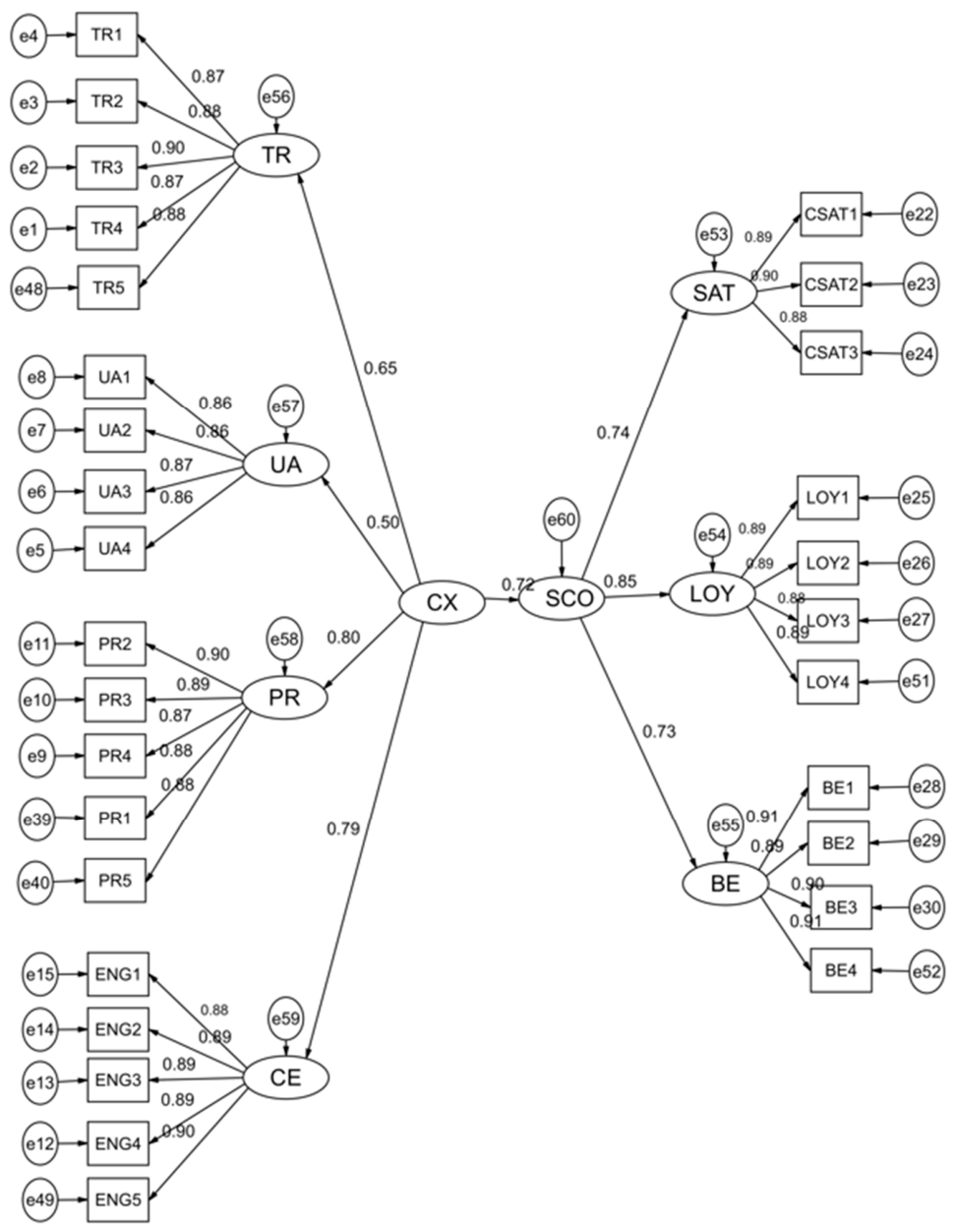
This study aimed to understand how four AI-driven features—trust, user autonomy, personalization, and customer engagement—shape customer experience in e-commerce and are associated with outcomes such as satisfaction, loyalty, and brand equity. The findings present a clear and consistent pattern: customers do not respond directly to AI features. Instead, they respond to the experience that these features help to create. Customer experience (CX) is the central conduit that translates the design of AI-enabled platforms into meaningful customer outcomes. All four TAPE drivers demonstrated strong and positive effects on CX, indicating that AI design influences customers both functionally and emotionally. Personalization and engagement demonstrated the strongest effects (λ = 0.803 and λ = 0.788, respectively), suggesting that customers value not only the accuracy of AI but also the feeling of relevance and participation it generates. Trust and user autonomy are also important contributors (λ = 0.646 and λ = 0.497, respectively), reinforcing the idea that customers must feel secure and in control when interacting with AI systems. Together, these findings indicate that experiential value in AI-enabled commerce emerges from a combination of cognitive assurance and emotional involvement, a pattern consistent with experiential theories of consumption that distinguish between the functional and hedonic dimensions of customer value [
4,
64].
The next key insight is that CX strongly shapes customers’ overall evaluations of the platform, influencing satisfaction (β = 0.740), loyalty (β = 0.848), and brand equity (β = 0.731). The strength of these relationships underscores that experience is the real currency of AI-enabled e-commerce. Even advanced algorithms matter little unless they create a customer journey that feels intuitive, supportive, or engaging principle that applies with particular force when AI, rather than a human service agent, is responsible for managing the interaction [
43]. Results are consistent with CX functioning as the central experiential pathway [
52,
61]. This finding explains why even modest improvements in personalization or engagement quality can produce disproportionately large downstream effects on loyalty and brand equity: when experience is the mediating bridge, strengthening the bridge amplifies every upstream signal that crosses it. Overall, this study contributes to a deeper understanding of how AI influences customer behavior by showing that AI’s impact is psychologically grounded rather than purely functional. By revealing that AI design works through experiential pathways, the findings encourage researchers and practitioners alike to view AI not simply as a technical tool but as an experience-shaping mechanism embedded in the customer journey consistent with Becker and Jaakkola’s call to anchor CX research in the customer’s direct phenomenological perspective [
14].
4.2. Managerial Implications
The findings of this study offer several actionable insights for managers, platform designers, and decision-makers aiming to enhance the customer experience in AI-enabled e-commerce environments. First, the strong influence of Trust on CX underscores the importance of transparency and responsible AI communication. Customers must feel confident that automated decisions, such as recommendations, pricing, or product prioritization are fair, accurate, and ethically grounded [
31,
41]. Managers should therefore invest in visible trust-building mechanisms, including transparent recommendation rationales, clear data-use policies, and explainable AI interfaces [
25,
44]. Enhancing trust also directly reduces the perceived risk that customers associate with AI-mediated transactions [
42], increasing their willingness to engage with intelligent features and disclose the behavioral data that makes personalization possible. Second, the significance of user autonomy suggests that customers value a sense of control in an automated environment; AI should guide users, not constrain them. This principle is well-grounded in self-determination theory [
33], which identifies autonomy as a fundamental need whose satisfaction is a prerequisite for intrinsic motivation and well-being. Firms can foster autonomy through adjustable personalization settings, alternative navigation pathways, clear opt-in mechanisms, and opportunities to override automated decisions [
21,
27]. Interfaces that balance automation with genuine agency allow customers to feel empowered rather than manipulated [
16], substantially enhancing the experiential quality of the journey and, through it, loyalty and brand equity. Third, the strong impact of personalization on CX indicates that tailored relevance is now a baseline expectation rather than a differentiating luxury in digital commerce. Managers should continuously refine recommendation engines, behavioral analytics, and adaptive interfaces to ensure that the content is timely, individualized, and contextually meaningful [
10,
29]. Simultaneously, personalization strategies must not cross privacy boundaries; the privacy calculus theory [
28] reminds us that customers are always weighing the value of a personalized experience against the perceived cost of data disclosure. Ethical personalization grounded in data transparency, user consent, and proportionate data use is therefore essential for sustaining the trust that makes deep personalization possible [
22].
The following platform-specific examples illustrate how each TAPE dimension manifests in current AI-enabled e-commerce practice: Trust: Amazon’s ‘Why was I shown this?’ transparency feature and A-to-Z Guarantee directly instantiate the Trust measurement items—algorithmic fairness, recommendation rationale, and data protection assurance. Autonomy: Amazon’s preference Center enables customers to adjust personalization settings, opt out of interest-based recommendations, manage browsing history, and configure notification preferences—directly instantiating the Autonomy driver items measuring perceived control and the ability to override automated decisions without sacrificing platform functionality. Personalization: Amazon’s AI-powered recommendation engine dynamically tailors the homepage, product detail pages, and promotional offers to individual behavioral signals in real time—corresponding to the Personalization driver items measuring real-time adaptivity, contextual tailoring, and the feeling of being uniquely understood as an individual customer. Engagement: Amazon’s review community, loyalty points system, and Prime Day gamification mechanics deepen affective investment across the purchase journey, corresponding to Engagement items measuring cognitive absorption, emotional arousal, and active participation.
Fourth, the importance of customer engagement highlights the need for platforms to design interactive, emotionally resonant, and immersive experiences. Features such as conversational AI agents, dynamic product visualizations, gamified micro-interactions, and community-driven content have all been shown to increase cognitive and emotional involvement [
9,
60]. These features deepen the investment customers make in the platform, and as this study demonstrates, it is precisely that depth of investment that generates stronger loyalty and brand attachment over time. Finally, the full mediation findings carry a practical message that goes beyond individual features: technological capabilities generate strategic value only when they combine to create a coherent, seamless, and enjoyable experience [
7]. Managers should therefore resist the temptation to optimize individual AI features in isolation. Instead, they should adopt a holistic CX design philosophy in which intelligent components interact consistently and reinforce one another across every stage of the customer journey from discovery and evaluation through to purchase and post-purchase support [
8]. This systemic perspective ensures that the platform feels intuitive, trustworthy, and customer-centric, ultimately driving the satisfaction, loyalty, and brand equity [
2,
47,
53], that translate AI investment into sustained competitive advantage.
4.3. Limitations and Future Research Directions
Although this study offers several important contributions to the understanding of customer experience in AI-enabled e-commerce, it has some limitations. These limitations provide meaningful opportunities for future research to deepen, extend, and refine the insights obtained in this study. Trust and Engagement items are framed at the general platform level; Personalization and Autonomy items reference AI-specific features more directly. Following Puntoni et al. [
16], and Becker and Jaakkola [
14], the measurement is grounded in customers’ subjective experiential perceptions rather than technical AI awareness, a phenomenologically valid approach whose boundary conditions should be examined in future research using AI-specific scales. Common method bias: A formal Common Latent Factor (CLF) test confirmed that CMV accounts for only 1.71% of total item variance [
62], well below the 25% threshold considered problematic, providing empirical evidence that common method variance does not critically threaten the substantive findings. Nevertheless, future research employing longitudinal or multi-source designs would further strengthen causal inference.
Demographic boundary conditions: Geographic concentration (Northeast 47.2%, West 28.5%), age skew (18–29 is the largest group at 33.5%), and high-income concentration (56.1% above $100k) may limit generalizability to younger, lower-income, or non-US consumer populations. The distinction between the three levels of claims should be maintained: (1) statistical significance, confirmed by path coefficients; (2) substantive importance, indicated by effect sizes; and (3) causal inference, requiring longitudinal or experimental designs. The survey instrument did not capture education level or online shopping frequency, which limits subgroup comparisons on these dimensions; future research should include these variables to enable broader generalizability assessments across consumer literacy and platform engagement levels.
The study did not employ AI-feature-specific screening or item-level AI attribution; respondents evaluated their overall platform experience rather than isolating specific AI-generated interactions. This phenomenological approach, grounded in Puntoni et al. [
16] and Becker and Jaakkola [
14], is theoretically appropriate for holistic CX research and reflects the practical reality that AI features are now pervasive across all mainstream e-commerce platforms [
12,
13]. However, the findings should be interpreted as evidence of CX in AI-mediated environments rather than as direct evidence of reactions to specific AI features. Future research should examine feature-specific effects using observational or experimental designs that expose respondents to controlled AI-feature variations.
This study relied on cross-sectional survey data, which limits the ability to infer causality between TAPE drivers, customer experience, and downstream outcomes. Although structural equation modeling provides strong evidence of directional relationships, longitudinal or experimental designs would allow future studies to examine how experiences and perceptions evolve over time, particularly as customers interact repeatedly with AI-driven features or as platforms update their algorithms. Experimental approaches that directly manipulate the level of personalization offered or the degree of autonomy afforded on a controlled platform would allow causal claims to be made with greater precision. Tracking customers over multiple touchpoints can provide richer insights into the dynamic nature of experience formation in intelligent environments.
This study is based on the self-reported perceptions of e-commerce users within a single national context. Although the sample is diverse and sufficiently large, perceptions of AI, autonomy, and trust may vary across demographic groups, cultural contexts, and platforms. Future research could explore cross-cultural comparisons alongside platform-specific analyses (e.g., marketplaces vs. direct-to-consumer platforms) and industry-based variations (e.g., retail, travel, and digital services). The purchase context is another boundary worth examining: whether a consumer is shopping with a specific goal in mind or simply browsing may moderate how TAPE drivers shape the overall experience. This would help to determine the generalizability of the TAPE framework across different digital ecosystems.
Finally, this study examined AI-enabled customer experience at the user perception level. As AI capabilities continue to evolve, future research may benefit from integrating objective behavioral data, such as clickstream patterns, browsing histories, recommendation acceptance rates, or chatbot interaction logs, alongside subjective perceptions. Combining subjective perceptions with behavioral metrics, possibly through multi-method designs, would offer a richer, more holistic view of how AI-driven systems shape customer journeys. In summary, these limitations highlight productive directions for future research aimed at capturing the evolving dynamics of intelligent commerce. As AI becomes more pervasive and deeply embedded in consumer environments, continued exploration will be crucial for building a more comprehensive understanding of experience creation, digital trust, and customer-platform relationships.