Review

Autonomous Supply Chains: Integrating Artificial Intelligence, Digital Twins, and Predictive Analytics for Intelligent Decision Systems


1
School of Accounting and Business Administration, Western Illinois University, Macomb, IL 61455, USA
2
School of Business, Quincy University, Quincy, IL 62301, USA
3
Hutton School of Business, University of the Cumberlands, 6984 College Station Drive, Williamsburg, KY 40769, USA
*
Author to whom correspondence should be addressed.
Information 2026, 17(4), 371; https://doi.org/10.3390/info17040371
Submission received: 28 March 2026 / Revised: 10 April 2026 / Accepted: 12 April 2026 / Published: 15 April 2026

Abstract

Autonomous supply chains (ASC) are the next generation of digitally empowered logistics and operations systems that can make adaptive, data-driven, and intelligent decisions. Innovations in artificial intelligence (AI), digital twins (DT), and predictive analytics (PA) are transforming traditional supply chains into integrated and interactive networks to detect disruptions, simulate the future, and automatically modify operational decisions. This paper reviews the ASC mechanism and summarizes the increasing literature on the technologies and analytical capabilities available to support intelligent supply chain decision systems. A structured literature review was conducted using Scopus, Web of Science, and Google Scholar, resulting in 52 relevant studies after screening and eligibility assessment. The paper discusses the recent advances in AI-based forecasting, simulation environments using digital twins, data integration using the Internet of Things (IoT), and predictive analytics. These technologies can help an organization gain real-time visibility of the supply chain networks. They improve the precision of demand forecasting, optimize inventory and production planning, and dynamically coordinate logistics operations. Digital twins allow the development of virtual models of supply chain ecosystems, which could be used to test scenarios, analyze risks, and plan strategies. These capabilities combined can be used to create predictive and self-adaptive supply networks capable of being responsive to uncertainty and market volatility. Besides examining the technological foundations, the paper also tracks key challenges related to the move towards autonomous supply chains, such as data governance, system interoperability, cybersecurity risks, algorithm transparency, and the necessity of successful human-AI collaboration in decision-making. The synthesis leads to a multi-layered framework that integrates data acquisition, analytics, simulation, and execution for autonomous decision-making in supply chains. Future research directions in relation to resilient supply networks, intelligent automation, and adaptive supply chain ecosystems are also provided in the study. Through integrating existing information on the new forms of intelligent technology and how it can be incorporated into the supply chain systems, this review contributes to the literature on next-generation supply chains. It will also offer information to both researchers and practitioners aiming at designing autonomous as well as data-driven supply networks.

1. Introduction

The concept of autonomous supply chains (SC) is gaining increasing attention as companies pursue higher levels of efficiency, responsiveness and intelligence. In the next discussion, the introduction provides the major ideas and reasons for this transformation.

1.1. Background and Motivation

Over the past two decades, global supply chains have undergone significant transformation driven by globalization, increased demand volatility, and rapid digitalization. Autonomous supply chain systems (ASC) are understood as systems with increasing levels of automation supported by artificial intelligence (AI), machine learning (ML) and digital technologies, rather than fully human-independent operations. These changes have led to more complex, interconnected, and data-intensive supply networks, while recent disruptions have further shifted the focus toward resilience, visibility, and adaptability [1,2], which are no longer linear or functionally oriented and fragmented but are highly interconnected within data-driven networks [3]. The growing complexity of global operations, along with increasing uncertainty related to disruptions like pandemics, geopolitical conflicts [1], and climate-related events, has exposed the weaknesses of the traditional management methods in supply chains [2]. Such difficulties have increased the utilization of digital technologies to support visibility, responsiveness, and resilience in supply networks. In this regard, the development of autonomous supply chains is a paradigm shift in supply chain management (SCM) [4]. The ASC uses modern technologies, such as AI, digital twins, big data and predictive analytics, to allow self-monitoring, adaptive decision-making, and real-time operational optimization [3,5]. Contrary to traditional systems, which are overly human-centric operations and dependent on pre-existing plans, autonomous systems can operate by continuously monitoring the environment. They retrieve vast quantities of information and make decisions with limited human effort. Recent developments in AI analytics have seen remarkable improvements in demand forecasting, inventory optimization, and logistics coordination, enabling organizations to shift to a more proactive and predictive operational model [5,6]. Meanwhile, digital twins allow the construction of virtual models of real supply chain systems, which can conduct scenario analysis, risk assessment, and strategic planning in dynamic settings [7]. Moreover, IoT technologies have boosted real-time data collection, which has provided end-to-end visibility in supply chain networks [8].

1.2. Problem Statement and Research Gap

Although the development of digital technologies in SCM is rather fast, the shift to highly autonomous supply chains is still conceptually incomplete and practically limited. The current literature has discussed in depth individual technological aspects, which include AI, digital twins, and predictive analytics. However, it has focused primarily on independent facilitators as opposed to interdependent components of a system [9]. It is quite challenging to develop integrated models that would support real-time, adaptive, and autonomous decision-making at the supply chain networks due to this fragmented vision. There is a lack of architectural integrity between data acquisition and analytical processing, simulation environments and execution mechanisms. Even though AI-based models have simplified the process of forecasting and optimization, they typically do not have the capacity to interact with real-time data sources under the simulation tools [10]. Similarly, DT technologies provide high functionality when conducting scenario analysis and visualizations of the system; however, their combination with predictive analytics and operational decision systems is still in its initial phase [1]. This separation creates a gap between analytic knowledge and operational decision-making. Consequently, the ASC systems remain limited in practice. Most real-world implementations operate with varying degrees of human oversight and hybrid decision-making structures. However, recent advancements in AI, ML, and robotics have enabled increasingly autonomous capabilities in areas such as demand forecasting, inventory management, and logistics execution.
Another major issue that has been raised by the increased adoption of data-intensive technologies is the challenge of data governance, quality, and standardization [11]. Similarly, autonomous systems rely on constant flows of quality information provided by IoT devices, enterprise systems, as well as external environments. Non-conformities in data formats, data ownership and inadequate data sharing among supply chain partners, however, impede the creation of unified decision systems. The dependability and scalability of ASC are dubious without strong data governance structures. System interoperability represents a critical challenge because ASC systems depend on the seamless integration of heterogeneous technologies, platforms, and data sources across organizational boundaries. Differences in system architectures, data standards, and communication protocols can limit real-time information exchange and reduce the effectiveness of coordinated decision-making [12]. The supply chains are associated with a variety of stakeholders working on nonhomogeneous platforms and then integrating with technically challenging AI models, digital twins, and analytics tools seamlessly. Lack of standardized protocols and interfaces limit the possibility of developing synchronized and responsive supply chain ecosystems.
Besides the technical issues, other essential barriers to adoption include cybersecurity risks and algorithmic transparency. With the rise of digitization and the interconnection of supply chains, they face a higher risk of cyber threats that can affect supply chain operations and steal sensitive data [13]. Simultaneously, most AI-based decision systems act as black boxes, which makes them questionable in terms of explainability and accountability, and lowers trust in automated decisions [14]. These concerns are especially relevant in complex supply chain operations with high stakes because the choices made may have major financial and social impacts. Furthermore, the shift to self-directed supply chains requires a redefinition of human–AI cooperation. Although automation may be more efficient and more responsive, human control is still necessary to make strategic decisions, address ethical issues, and rule systems. The absence of clear structures on how to merge and unite the use of human expertise and AI-based systems brings ambiguity in adoption and implementation within organizations [15].
In general, existing literature has failed to provide adequate coverage on the development of holistic and adaptive supply chain architectures that combine sensing, prediction, simulation, and execution into one single system. The majority of research is aimed at enhancing particular functions, e.g., forecasting or the optimization of logistics, and not at investigating the interaction between these functions in an autonomous ecosystem. This loophole highlights the necessity of a multi-layered and dynamic conceptualization of autonomous supply chains. Hence, a number of research gaps are filled in this research. First, integrated frameworks to efficiently relate artificial intelligence, digital twins and predictive analytics into a system do not exist. Second, the existing research provides little insight into the interaction between real-time data, simulation models and decision-making systems in dynamic supply chain conditions. Third, the critical issues have not received enough attention, including data governance, interoperability, and cybersecurity challenges affecting the performance and reliability of the system. Fourth, a lack of coordinated strategies that constitute and facilitate successful human and AI cooperation in autonomous working environments is evident. Holistic and comprehensive models are required to assist supply chains to be more adaptive, resilient, and responsive to uncertainty and disruption. In contrast to the existing research carried out on individual technologies, this research creates an integrated framework, linking AI, DT, and predictive analytics within a single autonomous supply chain architecture. In this context, autonomy is conceptualized as a continuum of capabilities rather than absolute full autonomy, reflecting the hybrid nature of real-world implementations. These research gaps are addressed by clarifying the conceptual framework, which allows intelligent design, self-regulation, and resilient supply network systems. In contrast to prior studies that primarily examine individual technologies or provide descriptive overviews of digital supply chains, this study adopts a structured synthesis approach to integrating multiple technological layers into a unified architectural perspective. This enables a clearer understanding of how interactions among these components contribute to system-level autonomy and adaptive decision-making.

1.3. Research Objectives

To address these gaps, this study aims to:
  • Systematically search the current literature on the topic of AI, digital twins, and predictive analytics in supply chain management;
  • Examine how these technologies can be used to facilitate intelligent and autonomous decision systems;
  • Establish a combined conceptual framework of autonomous supply chain architecture;
  • Identify significant issues, challenges, and possibilities of research in developing autonomous supply chains.

1.4. Contributions of the Study

This research adds to the body of knowledge in the following ways:
First, it provides an in-depth insight into advanced technologies that make autonomous supply chain systems possible.
Second, it incorporates previous research streams with an existing coherent conceptual framework that emphasizes the relationships among AI-based analytics, DT simulations, and predictive decision-making processes.
Third, the research explores key challenges and gaps and provides direction for future research concerning resilient, adaptive, and intelligent supply chain ecosystems.
The review helps to further enhance the existing knowledge on autonomous supply chain architectures by both aiding the subject study and providing managerial insight into how organizations could design data-driven, responsive, and self-optimizing supply networks. This study contributes by developing a mechanism-based framework that integrates data, analytics, digital twins, and execution layers into a closed-loop adaptive system. Unlike prior studies that primarily provide descriptive or fragmented perspectives, this research explains how these components interact to enable intelligent, responsive, and increasingly autonomous supply chain decision-making. In doing so, the study bridges conceptual development with emerging empirical evidence to strengthen both theoretical and practical relevance.

1.5. Limitations of the Study

There are a number of limitations of this study that should be noted. To begin with, the study is founded on the systematic review of the available literature and lacks empirical support for the suggested framework. Second, the high pace of technological development of such tools as artificial intelligence (AI) and digital twins (DT) can influence the long-term applicability of certain findings. Third, the paper is based on the chosen academic and industry sources, which can create selection bias and restrict the discussion of new practices.

2. Research Methodology

In order to have a systematic and transparent review process, the research paper has a structured approach to the identification, selection, and analysis of the relevant literature on autonomous supply chains and other associated technologies. In the research, the search strategy, selection criteria, and analytical method are provided in the following subsections.

2.1. Research Design

The research adopts a structured literature review methodology [16,17] to identify, evaluate, and synthesize current research on autonomous supply chains (ASC) and enabling technologies in a systematic and transparent manner. This approach ensures clarity, consistency, and methodological rigor in synthesizing existing knowledge [18]. Peer-reviewed journal articles, conference proceedings, and selected industry reports were identified using defined keywords related to artificial intelligence, digital twins, predictive analytics, and supply chain automation. The selection process was guided by predefined inclusion and exclusion criteria, and studies were screened for relevance and conceptual alignment with the research objectives. The aim is to develop a holistic understanding of how these technologies jointly enable intelligent and responsive supply chain systems. Compared to purely narrative reviews, this approach provides greater transparency in source selection and supports the identification of emerging themes, technological trends, and research gaps that inform both academic and practical contributions.

2.2. Data Sources and Search Strategy

A structured literature review was conducted using Scopus and Web of Science as the primary sources of peer-reviewed literature. Google Scholar was included to complement these databases by capturing additional studies, including recent publications and interdisciplinary work that may not yet be fully indexed. All retrieved articles were subjected to the same screening and inclusion criteria to ensure consistency and quality across sources. This selection of databases is due to the fact that it has a broad index of peer-reviewed journals in the field of supply chain, operations research, and information systems. The search strategy involved a combination of multiple keywords and Boolean operators to identify relevant studies in terms of technology and operation. The search terms included autonomous supply chain, artificial intelligence in logistics, digital twins supply chain, predictive analytics, and intelligent logistics systems. These words were iteratively refined until the relevancy and coverage were increased. Search was done in an iterative manner and narrowed down as the process went on to make sure that the search was comprehensive and the selected studies were relevant. As an example, one of the exemplary search strings was:
autonomous supply chain AND (artificial intelligence OR digital twins OR predictive analytics).
This search was done in an iterative fashion and this ensured the breadth and depth of the search for relevant literature.

2.3. Inclusion and Exclusion Criteria

In order to have consistency and academic rigor, inclusion and exclusion criteria were distinctly applied in the selection process [17,19]. Peer-reviewed journal articles and conference papers that were published in the years 2010–2025, which are recent developments in digital supply chain technologies, were reviewed. The number of studies considered was limited to studies published in the English language and studies pertinent to supply chains, logistics, or operations management. These criteria were used throughout all of the identified studies to make them objective and comparable. The selection of these studies was done using exclusion criteria, i.e., non-academic literature, not applicable to supply chain applications, likelihood of repetition in databases, or just not relevant enough in terms of techniques or concepts. The process of this type of filtering was applied to ensure that the final dataset contained only high-quality and contextually relevant studies.

2.4. Screening and Selection Process

The screening was done in two phases (title/abstract and full-text review) [16,20]. Disagreements in the selection of studies were sorted out by discussions among the authors to maintain consistency. The initial number of articles was obtained through large-scale searches through databases, and duplicates were removed. The chosen articles were also filtered according to relevance, methodological rigor, and their value to the adoption of digital technologies in supply chains. Titles and abstracts were then filtered out to eliminate those studies that were not within the scope of the research. This step ensured that only studies which aligned with the research objectives were retained for detailed evaluation. The rest of the articles were subjected to full text review, wherein all the studies were reviewed on the basis of their relevance, methodological rigor and contribution to the field. This filtering step ensured that only high-quality and contextually suitable studies were used in the final analysis. The general process of selection, as well as the quantities of articles that were retained at various stages, are presented in Table 1.
The initial database search, as presented in Table 1, provided a wide range of studies, as autonomous supply chains and technologies continue to gain popularity. The title and abstract screening were used to considerably narrow the data set since it was necessary to exclude any records that did not correspond to the research topic. The following full-text analysis was made to ensure that the rest of the articles were up to needed standards of relevance, methodological rigor, and contribution to the field. The last group of chosen articles is narrow and quality literature, i.e., the literature that constitutes the basis of the thematic analysis in this paper. This methodical process of filtering makes the review more reliable and valid as the results obtained are supported by established and relevant studies [16,20]. Research papers were filtered out based on duplication, lack of methodological clarity, or lack of direct relation to the scope of autonomous supply chains. An analysis and classification of the chosen studies was then performed based on the sphere of technology, sphere of application, and contribution to the supply chain intelligence.

2.5. Data Extraction and Classification

Upon the selection process, pertinent data were collected systematically [16,17,18,19] in each study and were compared, contrasted, and uniformly synthesized. The extracted information was in the form of details on the authors, date of publication, the research topic, the area of technology, the methodology, and the key conclusions. The process allowed for the development of a clear and organized dataset to support the SCM analysis. Based on this information, the literature was divided into three broad categories: AI, DT, and PA. This categorization enabled a logical model to examine the input of every technology to the creation of supply chain autonomy. It also helped to illustrate the interdependence of these spheres, assisting in identifying the primary relationships, overlaps, and dependencies that impacted the development of intelligent and adaptive supply chain systems.

2.6. Analytical Approach

The study uses a thematic method of analysis to synthesize findings from the selected literature [19]. To enhance analytical rigor, the thematic analysis was conducted through a structured multi-stage coding process. First, open coding was used to identify recurring concepts across the selected studies, including data integration, predictive capability, simulation, and autonomous execution. These initial codes were then grouped into higher-level categories through axial coding, capturing relationships among sensing, analytics, digital twin modeling, and decision execution layers. Finally, selective coding was applied to synthesize these categories into overarching themes representing key dimensions of autonomous supply chain systems.
To enhance transparency, a brief example of the coding process is provided. For instance, several studies highlighted capabilities such as real-time data integration, predictive analytics, and scenario simulation. These issues are discussed in detail in the later sections (Section 7.6 and Section 8) of the article, where their implications for implementation are further examined. During open coding, these elements were identified as distinct concepts. Through axial coding, they were grouped into broader analytical categories, including data layer, analytics layer, and simulation layer. Finally, through selective coding, these categories were integrated into the proposed multi-layer framework, reflecting how different system components interact to support autonomous decision-making. To ensure consistency, coding was guided by predefined analytical dimensions derived from the literature, including data flow, decision autonomy, system integration, and feedback mechanisms. Patterns were identified through iterative comparison across studies, allowing themes to emerge inductively while remaining grounded in existing theoretical constructs. The synthesis focused on identifying not only common elements but also the interactions among these elements that enable adaptive and self-correcting system behavior.
The final synthesis integrates these themes into a coherent framework that captures both the structural architecture and the dynamic feedback processes underlying autonomous supply chains, enabling a shift from descriptive aggregation to explanatory understanding. In addition, the configuration of thematic trends was based on both the frequency of occurrence across the reviewed studies and their conceptual relevance to autonomous supply chain development. Themes were retained when they appeared consistently across multiple sources or when they represented theoretically significant mechanisms within the system architecture. This ensured that the final thematic structure reflects both empirical prominence in the literature and theoretical importance.

2.7. Overview of Key Literature

To conduct a systematic review of the studies, the selected literature was divided and classified according to technological orientation, major sphere, and major contributions to autonomous supply chain development. According to the review, the individual technologies have been extensively studied, but integrated frameworks remain limited. Table 2 provides an overview of representative works in AI, DT, and PA, demonstrating the respective contributions to the development of supply chain intelligence and autonomy.
As shown in Table 2, the ASC literature is spread over various technology areas; each stream presents distinct capabilities to the system at large. AI studies emphasize predictive and decision-making functions, whereas studies on digital twins discuss simulation and scenario analysis focus on resilience and risk management. Likewise, predictive analytics studies indicate the significance of insights based on data in enhancing operational performance and precision of forecasts. Combined, these studies depict that ASCs do not depend on a particular technology but a combination of complementary capabilities across several fields.

2.8. Methodological Contribution

The research approach utilized in the study adds to the literature by offering an integrative and systematic review of the emerging technologies in the supply chain. The integration of a systematic searching strategy and thematic synthesis [17,18,19] provides the study with a broad overview of the development of autonomous supply chains. The categorization and evaluation of literature in various technological areas also allows for the establishment of a single conceptual framework that covers the gaps in the literature. All these methodological steps will give a rigorous basis to the analysis below and justify the creation of the proposed conceptual framework.

3. Conceptual Foundations of Autonomous Supply Chains

The ASCs are constructed based on a set of fundamental concepts that define the functioning of the systems, their adaptability, and their decision-making processes. Below are the main concepts that characterize these foundations.

3.1. Definition and Core Characteristics

ASC represents a paradigm in which sensing, analysis, decision-making, and execution are closely linked to allow self-adaptive and data-driven operations. Unlike conventional frameworks with periodic planning and human-oriented control, ASCs use continuous data streams and smart algorithms to forecast, make decisions and take actions with low latency and low levels of manual interference [1,5]. ASC may be described as a cyber-physical decision system that continuously combines real-time information (IoT and enterprise systems), sophisticated analytics (AI/ML), and simulation features (digital twins) to generate predictive and prescriptive actions on planning and execution levels [3,8]. In this definition, it is not just automation, but also closed-loop control in which the results are used as feedback [21] to update the models and make better decisions in the future. The key features include:
  • End-to-end visibility: Tracking of materials, assets and flows throughout nodes continuously with the use of IoT-enabled data integration [3];
  • Predictive and prescriptive intelligence: Forecasting, optimization, and recommendation engines assisting in making proactive decisions [9,10];
  • Self-adaptation and dynamism control: Plan (inventory, routing, production) reconfiguration in real-time in the face of uncertainty [6,22];
  • Decentralized and coordinated decision-making: Local control at nodes, synchronized at the system level by common data and policies [12];
  • Closed-loop learning: Continuous improvement through feedback, model retraining, and scenario testing in virtual environments [1,8].
These characteristics transform the supply chains to become more of an anticipatory orchestration instead of reactive control to enhance resilience, service levels, and cost performance during volatility [2,6,21].

3.2. Evolution of Supply Chain Intelligence

The trajectory to autonomous supply chains may be viewed as having four stages:
  • Descriptive (transactional) systems: ERP-enabled visibility with retrospective reporting;
  • Predictive systems: Machine learning and data science improve risk anticipation and prediction [9,23];
  • Prescriptive systems: Decision analytics and optimization suggest actions to be taken within constraints [10];
  • Autonomous systems: Integrated sensing–analysis–execution loops enable self-adjusting operations [5].
This development reflects a shift from responsive decision making toward proactive and ultimately self adaptive supply chain systems. Industry 4.0 tools of the IoT, cloud computing, advanced analytics, and cyber-physical systems [24] have increased this transformation, enabling real-time data and computations that are scalable to be obtained [12]. The COVID-19 crisis also demonstrated the shortcomings of the traditional perspective on planning and the need to have dynamic, resilient, and digitally integrated supply networks [2]. This development extends beyond technological implementation and reflects broader organizational and process transformations required to support autonomous supply chain systems. It includes transformations in companies and governance, including information sharing across departments, consistent interfaces and new roles in AI-based environments and managing human oversight [15]. Co-evolved technology, processes and decision rights thus provide a result in autonomy.

3.3. Theoretical Foundations

Autonomous supply chains have a foundation based on several theoretical views:
  • Systems theory: Supply chains are nonlinear complex adaptive systems: interdependent, feedback-based, and non-linearly diffusive in the network [7]. Real-time control and feedback improve the responsiveness of the system by being autonomous.
  • Cyber-physical systems (CPS): Integrated physical operations and digital models to support monitoring, control, and optimization during the lifecycle [8]. CPS combines data streams, analytics and actuation.
  • Decision theory and AI: Probabilistic reasoning, learning and optimization can support decisions in unknown environments; AI can apply these methods in complex environments at scale [9,10].
  • Resilience theory: Focuses on robustness, recovery, and adaptability in light of disruptions; digital twins and predictive analytics improve resilience by empowering scenario analysis and fast reconfiguration [1,6].
These foundations describe the sense (data), thinking (analytics), simulation (digital twins), and action (execution systems) of ASC in a unified architecture.

3.4. Literature Synthesis of Enabling Technologies

Literature on autonomous supply chains is scattered across multiple research streams on AI, DT, predictive analysis, and data integration based on IoT-based processes. Table 3 integrates exemplary, highly cited research that informs the conceptual base as a whole.
To complement the conceptual and review-based studies in Table 3, Table 4 summarizes recent empirical evidence on technologies enabling autonomous supply chains.
These recent empirical studies provide stronger practice-based support for the role of AI, DT, blockchain, IoT, and analytics in improving supply chain coordination, resilience, visibility, and decision-making. Together, the synthesis demonstrates that data-driven decision-making is largely supported by AI and PA. It also highlights that simulation and resilience planning are supported by digital twin technologies. Simultaneously, IoT supports the real-time visibility and connectivity of the system, which is the basis of integrated ASC performance. Regardless of these developments, the literature remains disjointed, underscoring the need for a unified framework that integrates these technologies to enable coordinated adaptive outcomes. The empirical findings summarized in Table 4 also provide support for the proposed closed-loop mechanism. For example, studies highlighting real-time data integration and predictive analytics correspond to the sensing and prediction stages, although simulation and decision-support capabilities align with the simulation and decision layers of the framework. These findings further reinforce the proposed relationships by demonstrating how the interaction of these capabilities contributes to adaptive and autonomous supply chain behavior.

3.5. Integrated Conceptual View

The literature synthesis shows that there is a multi-layered structure of autonomous supply chains:
Data Layer: Data sources are continuous and high-frequency inputs of IoT devices, enterprise systems, and external data sources [3];
Analytics Layer: AI/ML models make predictions, identify abnormalities, and recommend interventions [9,10,52];
Simulation Layer: Digital twins can be used to test scenarios, evaluate risks, and test policies prior to execution [1,8];
Decision and Execution Layer: This layer performs decision-making and execution actions, such as routing and replenishment, with feedback loops to facilitate learning [6].
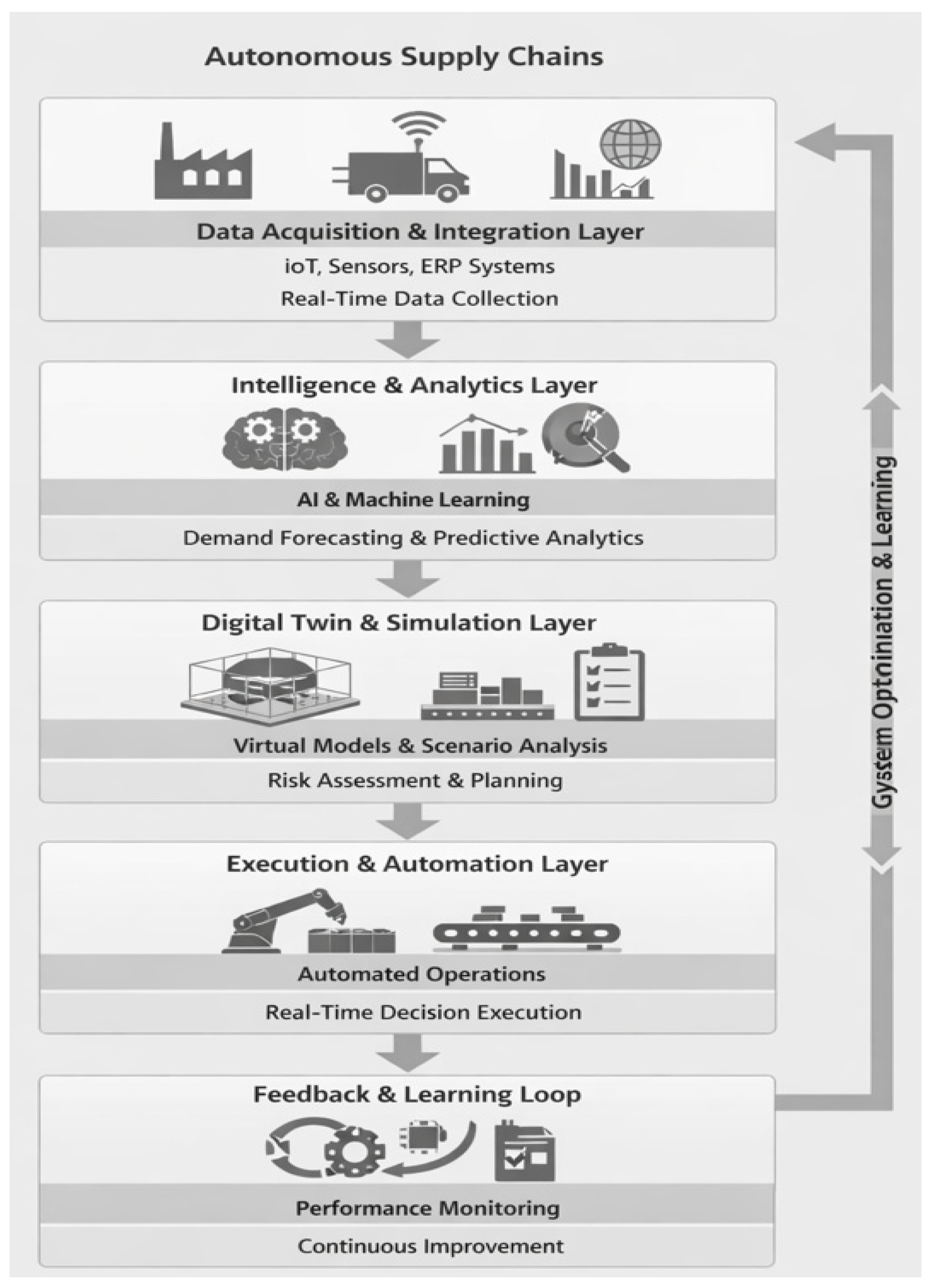
These layers are mutually supportive and help to facilitate continuous adaptive decision-making. Tight coupling across layers is the innovation of autonomy, which creates a closed-loop system: Sense → Predict → Simulate → Decide → Execute → Learn. This loop decreases the delay between insight and action and improves robustness under uncertain conditions. Beyond structural integration, this study contributes by conceptualizing the autonomous supply chain as a closed-loop adaptive decision system. Unlike prior frameworks that treat data, analytics, and simulation as loosely coupled components, this research explicitly defines the causal relationships between layers. The data layer enables real-time sensing, which feeds into the analytics layer for prediction and anomaly detection. These predictions are then evaluated in the simulation layer through digital twins, which generate decision alternatives under uncertainty. The execution layer operationalizes these decisions and feeds performance outcomes back into the system, enabling continuous learning. This recursive feedback structure positions the autonomous supply chain as a self-reinforcing adaptive system grounded in systems theory and cyber-physical integration. The theoretical contribution lies in explaining how integration enables not only efficiency gains but also dynamic capability development through learning, adaptation, and real-time reconfiguration.
Based on this structure, the study proposes the following conceptual relationships:
  • Proposition 1: Higher levels of integration between data, analytics, and simulation layers improves the speed and accuracy of operational decision-making in supply chains.
  • Proposition 2: The presence of a closed-loop feedback mechanism enhances the adaptive capability of supply chains under uncertainty.
  • Proposition 3: The coupling of digital twins with predictive analytics significantly improves scenario evaluation and risk mitigation effectiveness.
  • Proposition 4: Autonomous execution systems supported by AI reduce response time and increase system resilience during disruptions.
Although prior digital supply chain and cyber-physical system frameworks have emphasized the integration of data, analytics, and execution layers, their primary focus remains on architectural configuration rather than system behavior. In contrast, this study introduces a mechanism-based perspective that explains how autonomous capability is generated through dynamic interactions across system components. Specifically, the proposed framework conceptualizes the supply chain as a closed-loop adaptive system, where autonomy emerges from continuous cycles of sensing, prediction, simulation, decision-making, execution, and learning. This shifts the focus from static system design to ongoing adaptation and self-correction driven by recursive feedback mechanisms. From a theoretical standpoint, this perspective aligns with dynamic capabilities theory and information-processing theory, where sensing, learning, and reconfiguration enable adaptive performance under uncertainty. By integrating these perspectives, the framework provides a causal and process-oriented explanation of how autonomous supply chains evolve, rather than simply describing their structural components. Importantly, the propositions are not intended to introduce isolated or counterintuitive relationships, but to formalize how interactions across system layers collectively generate adaptive capability. The theoretical contribution lies in explaining these relationships as part of a dynamic, feedback-driven system, rather than as independent effects.

3.6. Research Gap and Implications

Existing frameworks emphasize integration; however, they provide a limited explanation of how feedback-driven interactions translate into adaptive and autonomous system behavior. Prior studies have developed integrated frameworks for digital supply chains and cyber-physical systems; these frameworks primarily emphasize structural integration rather than explicitly explaining the dynamic interactions and feedback mechanisms required for autonomous decision-making. Building on this literature, three key gaps remain:
  • Integration gap: Existing literature has examined technologies such as AI, digital twins, and predictive analytics, which are typically treated as separate or loosely connected components [5,11]. Existing research focuses on individual capabilities rather than explaining how these technologies interact within a unified system. As a result, there is limited theoretical understanding of how integration enables autonomous, closed-loop decision-making in supply chains. Current frameworks do not clearly specify the causal relationships and feedback mechanisms that govern interactions among sensing, prediction, simulation, and execution. Without such an explanation, integration remains a structural concept rather than a functional or dynamic one. This study addresses this gap by proposing a theoretically grounded architecture that captures both the interdependencies and the feedback-driven behavior of autonomous supply chain systems.
  • Interoperability gap: Non-standardized interfaces of heterogeneous systems among partners limit coordinated autonomy [12];
  • Governance gap: Challenges related to data quality, cybersecurity, and explainability hamper scalable adoption and trust [11,13,14].
To fill these gaps, the architectural standards, data governance models, and human-AI collaborative frameworks must be balanced between automation and supervision [15]. These concepts are the foundations on which the technologies and system integration described below can be understood. To enrich conceptual foundations, the following section discusses the role of AI in the supply chain. Developed on this conceptual basis, the latter sections discuss enabling cutting-edge technologies, which facilitate autonomous supply chain development. This study builds on existing digital supply chain and cyber-physical systems literature but extends it by shifting the focus from structural integration to dynamic interaction and system-level learning. In doing so, it provides a more explicit explanation of how autonomous supply chains emerge and operate under conditions of uncertainty. However, existing studies acknowledge the importance of integrating digital technologies but provide limited insight into how these components interact to produce adaptive and autonomous behavior. This study addresses this gap by developing a mechanism-based explanation of feedback-driven learning and system evolution, thereby extending the literature beyond structural integration toward a process-level understanding of autonomy.
The applicability of the proposed framework is particularly relevant in supply chain environments characterized by high levels of digital integration, data availability, and environmental uncertainty. In such contexts, the ability to process information, adapt decisions in real time, and continuously learn from system feedback becomes critical. Conversely, in low digital-maturity environments or highly stable operational settings, the mechanisms described in this framework may be less pronounced, thereby defining the boundary conditions of the study.

4. Artificial Intelligence in Supply Chains

Modern supply chains are characterized by AI as a major driver of change. It allows for the analysis of large datasets, discovers patterns, and facilitates faster and more timely decision-making. The following describes the key applications and uses of AI in this regard.

4.1. Role of Artificial Intelligence in Supply Chain Transformation

The main enabler of intelligent and autonomous supply chains has been AI, which makes decisions based on data that are adaptive and scalable. In contrast to conventional analytical tools, AI systems can learn from both past and current data, detect complicated trends, and constantly update their prediction and prescriptive capabilities [9,10]. In the context of supply chains, AI transforms the rigid and reactive processes into dynamic and proactive ones [38], and it is possible to predict disruption and optimize resource distribution, as well as react to changes in real-time. The capabilities are particularly critical and useful in the ambiguous environment where the demand is uncertain, supply is fluctuating, and global interdependencies exist [2,5]. AI functions serve as the intelligence layer within ASC architectures, enabling the integration of data inputs from IoT systems with decision-making and execution processes. Through this integration, AI supports continuous learning by analyzing real-time data, feedback, and performance outcomes, allowing supply chains to adapt dynamically to changing environments and operational conditions.

4.2. Core AI Techniques and Their Applications

AI in supply chain management is a collection of computational methods to facilitate forecasting, optimization, and decision automation.
  • Machine Learning and Deep Learning: The most common models of ML are applied to optimize the demand forecasting, inventory planning and risk detection [53]. These models use historical data and other external factors to generate accurate predictions and reveal the underlying trends [21]. Deep learning methods, such as neural networks, expand these possibilities by modeling nonlinear relationships and processing large-scale data, such as point-of-sale data and sensor-generated data [22].
  • Reinforcement Learning: Reinforcement learning (RL) helps supply chain systems to learn the best decision policy by repeatedly interacting with the environment [41]. The use of RL has been in dynamic inventory control, transportation routing, and production scheduling. It enables systems to adjust decisions according to real-time feedback and changing conditions [41].
  • Natural Language Processing and Cognitive Analytics: Natural language processing (NLP) methods enable the processing of unstructured information [54,55], such as customer reviews, news articles and social media messages. Such insights can enhance demand sensing, risk identification and market intelligence and can increase supply chain responsiveness [27].
Therefore, these AI methods can help the supply chain transition from rule-based systems to adaptive, learning-based decision frameworks.

4.3. AI-Driven Forecasting and Demand Planning

Demand forecasting is a critical operation in the supply chain that directly depends on the inventory level, the production planning, and the distribution strategies. Conventional forecasting tools rely on linear models and past averages, which are often ineffective in capturing complex demand patterns and external factors. AI-powered forecasting models use real-time information [56], external data, and sophisticated algorithms to enhance the accuracy and responsiveness of the prediction [9]. As an illustration, ML models have the ability to combine weather forecasts, economic trends and consumer trends to produce more accurate forecasts. Better forecasting abilities lead to:
  • Lower cost in inventory due to improved supply–demand fit.
  • Improved levels of service through reduction in stockouts.
  • Efficiency in production by means of efficient capacity utilization.
These improvements enhance both operational efficiency and responsiveness across the supply chain. Additionally, AI allows a shift from traditional forecasting to the demand sensing mode, where data streams in real-time are used to update predictions and assist in making the right decisions dynamically [28].

4.4. Intelligent Decision Systems and Autonomous Control

AI technologies will help design smart decision systems that will assist with independent supply chain activities. Such systems combine predictive models, optimization programs, and real-time data feeds to produce and implement decisions without the need to involve human operators on an ongoing basis. In practice, AI-driven decision systems enable dynamic pricing and demand shaping, support autonomous inventory replenishment, optimize logistics operations through real-time routing, and facilitate adaptive production scheduling. These systems work using closed-loop control systems, in which decisions are continuously refined based on system feedback on performance and environmental changes [6]. This is necessary for self-adaptive supply chains which are able to react well to disruptions and uncertainties.

4.5. Integration of AI Within Supply Chain Architecture

AI in supply chains is most effective when integrated into larger digital infrastructures. In particular, IoT systems provide real-time operational data that supports continuous monitoring and responsiveness [3,57,58]. Digital twins enable the simulation of supply chain scenarios, allowing organizations to evaluate alternative decisions before implementation [1]. In addition, enterprise systems such as ERP and APS translate analytical outputs into executable operational plans, ensuring coordination across planning and execution layers [59]. This integration creates a multi-layered structure whereby there is an interconnection between data, analytics, simulation, and execution [60]. The decision machine is AI, which transforms raw data into working insights and system-wide responses. This form of integration is vital in aiding end-to-end supply chain visibility and synchronization that are autonomous operations requirements.

4.6. Challenges and Limitations of AI in Supply Chains

Even though AI is a transformative industry with immense potential in the supply chain, there are several challenges associated with the use of AI in the supply chain:
  • Data dependency: AI models require massive and quality data in the form of structured data [11].
  • Model interpretability: The majority of AI systems lack transparency; hence, it is difficult to explain the decisions [14].
  • Integration complexity: The process of aligning AI with the existing systems and cross-organizational platforms is challenging to complete in a technical sense [12].
  • Cybersecurity risks: The increased connectivity means increased exposure of the supply chain to cyber threats [13].
  • Organizational readiness: New skills, cultural changes, and trust in automated systems are required in order to be implemented successfully [15].
These issues need to be dealt with to scale AI applications and make them dependable within the framework of a real supply chain environment. AI is central to enabling autonomous supply chains through the delivery of the analytical and decision-making capabilities needed by self-regulating systems. Current studies demonstrate the effectiveness of AI in enhancing certain supply chain functions, technologies integration, and processes. Specifically, such technologies have great prospects when it comes to improving the adaptability and resilience of the system. Thus, AI improves efficiency, responsiveness, and decision quality in supply chain operations, supporting more advanced integrated systems.

5. Digital Twins Technology in Supply Chains

Digital twin technology can be used to create virtual versions of physical supply chain systems [61,62], where real-time monitoring, simulation, and analysis can be done. These features aid in enhanced transparency and decision-making. In the supply chains, the most critical points and uses of digital twins are described in the following discussions.

5.1. Concept and Architecture of Digital Twins

Digital twins have become a key facilitator of intelligent and autonomous supply chains, offering a virtual model of the physical systems that develop in real-time. A digital twin combines both physical asset, process, and environmental data with simulation and analysis models to provide continuous monitoring, prediction, and optimization [8,29]. This creates a continuously updated virtual representation. Digital twins are not applied to a single asset, but to a network of assets, such as suppliers, production systems, distribution channels, and logistics activities. This is a network-level representation used to enable organizations to simulate complex interactions, risk assessment, and decision outcome evaluation before implementation [1]. A digital twin architecture typically consists of three interconnected components that enable synchronized physical and virtual operations. The physical layer includes supply chain resources and operational elements such as machines, sensors, and cyber-physical systems [53,55,63]. The digital layer comprises virtual models that represent system behavior and structure, integrating technologies such as artificial intelligence, digital twins, analytics, and simulation environments [56,64,65,66,67]. The data integration layer supports real-time communication between physical and digital systems, ensuring continuous data exchange and system synchronization [68,69,70,71]. These elements are linked with continuous feedback loops, which allow the synchronization of the physical system and its digital version. The real-time decision support and autonomous system control are based on this architecture.

5.2. Applications of Digital Twins in Supply Chains

DT technology has been demonstrated to have a wide range of uses in supply chain functions, particularly in an uncertain and complex environment.
  • Scenario Simulation and Decision Support: DT helps organizations simulate scenarios like demand fluctuations, supply disruptions, and transportation delays [72,73,74]. Decision-makers can find the optimal course of action and minimize risks by simulating different scenarios in a computerized environment before they occur [29].
  • Risk Management and Resilience: DT has one of the most notable uses in improving supply chain resilience [75,76,77]. Digital twins enable companies to simulate the spread of disruptions, the vulnerability of a system, and recovery plans. This is especially useful with large-scale disruptions, e.g., pandemics or geopolitical situations [1,6].
  • Operational Optimization: Digital twins support the real-time optimization of supply chain operations, including production planning and scheduling, inventory management and transportation and logistics coordination [78,79,80,81,82]. DT allows real-time model updates using current data and enhances efficiency and responsiveness [82,83].

5.3. Integration with Artificial Intelligence and Predictive Analytics

Digital twins become more effective when integrated with AI and predictive analytics. AI models provide predictive insights, and digital twins offer a simulation environment to test and validate these predictions [4,19,84]. This integration allows a closed-loop decision-making process where data is gathered from the physical system. AI models produce recommendations and predictions, digital twins are simulated to test possible results, and the best decisions are put in place within the physical system. This integration enables the supply chains to shift from traditional planning to dynamic and smart operations with decisions being constantly improved through real-time feedback and simulation outcomes [5,29].

5.4. Digital Twins for Real-Time Visibility and Coordination

Digital twins help increase visibility since they offer a common perspective of activities at all nodes [30,31,37]. Such visibility allows for greater coordination between supply chain partners, enhancing synchronization and removing inefficiencies. Key benefits include the end-to-end transparency of supply chain networks, better relationships between suppliers, manufacturers, and distributors, and quick reaction to disruptions through real-time monitoring. Digital twins can be used to create a holistic perception of the system dynamics [85], which is core to autonomous decision-making due to the integration of data across various sources. This also reduces information gaps across the supply chain.

5.5. Challenges and Limitations of Digital Twins Implementation

Digital twins have a high potential of improving the visibility of supply chains and decision-making, but there are a number of challenges that prevent their application in practice. A key limitation is the high cost to develop and maintain the necessary data infrastructure and simulation models. Moreover, the process of cross-linking data between heterogeneous systems and various stakeholders is complex and is especially hard in fragmented supply chain setups. The validation and accuracy of a model are also issues to handle, particularly in dynamic and uncertain cases, where the behavior of a system keeps on changing. Moreover, scalability is a problem with the expansion of digital twin applications to extensive and complicated supply networks. Another significant constraint is cybersecurity threats, as a network of systems exposes them to the risk of data leakage and business interruptions [13]. The solution to these challenges is to enhance standardized data structures, ensure better interoperability among systems and to come up with secure and reliable data sharing solutions. Digital twins are also essential in facilitating autonomous supply chains by offering a simulation and validation layer in the system architecture. Whereas AI can predict and make decisions, digital twins enable organizations to make decisions virtually and then implement them. It aids the reduction in uncertainty, increased resilience, and risk-informed decision-making, which is a critical requirement of autonomous systems in complex and volatile environments. Smart, responsive, and self-regulating supply chain systems are based on the integration of DT and AI with predictive analytics. Therefore, DT technology can improve usability, simulation capabilities and system insight to support more integrated data-driven supply chain processes.

6. Predictive Analytics and Data Integration in Supply Chains

Predictive analytics focuses on future-based predictions utilizing historical and real-time data. Predictive analytics and data fusion have become inseparable parts of the contemporary supply chains [5,34]. Such capabilities allow organizations to generate data-led insights, enhance operational visibility and make decision-making more informed and responsive. The key areas involved have been noted in the following subsections.

6.1. Role of Predictive Analytics in Intelligent Supply Chains

Predictive analytics has a key role to play in changing conventional supply chains into intelligent and anticipatory supply chains [28,53]. PA helps organizations to predict the future, detect upcoming risks, and make proactive decisions based on historical data, real-time input, and the use of advanced statistical and ML models [9,10]. Within the ASC framework, predictive analytics go beyond forecasting to make real-time decisions, where system states are dynamically updated. This will be critical in responding to variability in demand, supply disruptions and operational uncertainties in the complex world of supply networks [2]. PA is also useful in several vital areas of the supply chain, which include demand forecasting and demand sensing, inventory planning, optimization and replenishment, risk prediction and disruption management, and capacity and production planning. Such capabilities are the analytical foundation of ASC that enable systems to predict and react to changes before they can affect performance.

6.2. IoT-Enabled Data Integration and Real-Time Visibility

The quality and availability of data are vital to predictive analytics. The adoption of IoT technologies has greatly improved data gathering, where real-time tracking of the supply chain activities is made possible [57,58]. IoT devices (sensors, RFID tags, GPS systems, etc.) produce continuous data streams concerning inventory levels and location tracking, transportation conditions and delivery status, as well as equipment performance and production processes. This real-time data will help in having an end-to-end visibility of the supply chain networks to reduce the information asymmetry and enhance coordination among the stakeholders. In addition, IoT-enabled data integration allows decisions to be made automatically depending on the real-time circumstances. This will be necessary in order to have autonomous operations.

6.3. Advanced Analytics: From Prediction to Prescription

Predictive analytics focuses on efficient forecasting, and advanced analytics extends to prescriptive decision-making, recommending the best actions based on predicted outcomes [86,87]. PA includes optimization models (e.g., linear programming, heuristics), simulation techniques, and AI-driven decision-making models. This combination enables organizations to consider various decision options and settle on the most efficient plan of action within the constraints. For instance, in logistics operations, predictive models are able to forecast delays, whereas prescriptive analytics advise alternative routes or modes of transport to reduce the impact of disruption. The shift from predictive to prescriptive analytics is one of the key transitions needed to achieve completely autonomous systems, where the decisions are both informed and automatically implemented.

6.4. Data Architecture and Integration Challenges

Although there are advantages to predictive analytics and IoT integration, several challenges still persist in the development of effective data-driven supply chain systems.
  • Data Heterogeneity and Integration: Supply chains involve multiple stakeholders using different systems and data formats. The challenge of bringing these heterogeneous data sources together into a single platform is still a major challenge [3].
  • Data Quality and Governance: The reliability of predictive models depends on the quality of input data. The problems of missing data, inconsistencies, and standardization may decrease the model accuracy and reliability of decisions [11].
  • Scalability and Infrastructure: Large-scale processing of real-time data will need scalable computing infrastructure, e.g., cloud and edge computing systems. Scalability is a major point of concern to ensure the performance and reliability of the system [19,88].
  • Security and Privacy: Due to the increased number of devices that are connected and the sharing of data, data security and privacy are becoming a matter of concern, especially in global supply chain networks [13].
Addressing these issues is essential for enabling robust and scalable predictive analytics systems in autonomous supply chains.

6.5. Integration with AI and Digital Twins

Predictive analytics is not an independent technology but is tightly connected to AI and digital twins technologies in autonomous supply chain architectures [4,28].
  • AI supports predictive models by enhancing intelligent/adaptive learning, more accurate forecasting, data-driven decisions and pattern recognition [37].
  • Digital twins: DT offer prediction simulation environments to test outcomes and assess the outcomes of a decision [23,57].
  • IoT guarantees an uninterrupted data stream, which allows for receiving real-time updates and the responsiveness of the system [8].
Such integration establishes a closed-loop system in which data, analytics, and simulation are constantly exchanged to assist in making intelligent decisions [1]. This system helps to act as a dynamic ecosystem with a sense-changing capacity, anticipate results, and make the best decisions quickly [9]. The data and intelligence foundation of ASC consists of predictive analytics and data integration. Although AI offers sophisticated learning opportunities and DT can simulate and validate, predictive analytics can make sure that the decisions are based on valid and timely information. Nevertheless, these technologies can be fully utilized only in the case of their implementation into a single system architecture. Through this, predictive analytics and data integration assist better decision-making, visibility, and support more responsive supply chain operations.

7. Integrated Framework for Autonomous Supply Chain Architecture

The integrated framework integrates the major concepts and technologies mentioned above into a single framework. It demonstrates the interplay between various elements in facilitating the autonomous supply chain activities. Unlike prior frameworks that emphasize structural integration, this study conceptualizes autonomy as an emergent system capability driven by continuous interaction, feedback, and learning across interconnected layers. The subsequent discussions present the key aspects of this framework.

7.1. Need for an Integrated Architecture

While existing literature has identified the individual roles of AI, digital twins, and predictive analytics in supply chain systems [3,5], limited attention has been given to the mechanisms through which these technologies interact to enable autonomous decision-making. This study advances the literature by proposing a multi-layer architecture grounded in systems theory and cyber-physical integration, where each layer performs a distinct but interdependent function within a closed-loop system. The framework explains how sensing, prediction, simulation, and execution are dynamically linked to enable continuous adaptation and learning, thereby extending beyond descriptive integration toward a theory-driven representation of autonomous supply chains.

7.2. Proposed Multi-Layer Autonomous Supply Chain Architecture

In accordance with the synthesis of the available literature, this paper suggests a multi-layer architecture of ASC comprising four interdependent layers:
  • Data Layer (Sensing and Integration): This layer collects and integrates data across several sources, including IoT devices (sensors, RFID, GPS), enterprise systems (ERP, WMS, TMS), and external data sources such as market trends, weather, and geopolitical events. The data layer provides transparency and real-time data availability to form the basis for more complex processes [3,8].
  • Intelligence Layer (Analytics and AI): The intelligence layer processes data using machine learning and deep learning models, predictive and prescriptive analytics, and optimization algorithms. With the help of this layer, forecasts, insights, and recommended actions will be generated, and proactive decisions will be possible. The AI will continue to improve its accuracy and flexibility, as they continue learning new data [4,37].
  • Simulation Layer (Digital Twins): The simulation layer entails the application of digital twins technology to generate virtual supply chain systems. Key functions include scenario testing along with supply chain risk analysis, evaluation of substitute decisions like plan A and plan B, and system performance simulation in uncertainty. The layer is used as a validation environment whereby decisions are initially tested, then implemented, thus reducing risk and improving reliability [1,57].
  • Decision and Execution Layer (Autonomous Control): This layer takes in an interpretation of insights and validated decisions attached to operational actions, including inventory replenishment, production scheduling, and logistics routing and coordination. The physical elements of the supply chain are also interfered with by the implementation systems. Such influence leads to a continually monitored closed-loop feedback system for gaining the optimum results [84].

7.3. Closed-Loop Decision-Making Mechanism

One of the primary features of ASC is that it implements a closed-loop decision-making process and includes the incorporation of all architectural layers:
  • Sense: This is real-time data gathered on physical systems.
  • Analyze: AI and analytics generate predictions and insights
  • Simulate: Digital twins evaluate potential outcomes
  • Decide: Best/Optimal decisions are selected
  • Execute: Actions are implemented in the physical system
  • Learn: Feedback updates models and advances future decisions
This self-perpetuating cycle allows supply chains to be engaged as adaptive and self-enhancing systems, able to react to disruptions and changing situations.

7.4. Interoperability and System Integration

The success of the proposed architecture relies on an effectively integrated system and stakeholders, where data formats and protocols, including interoperability [3], are standardized, scalable data processing through cloud and edge computing infrastructure is ensured [8], and integration via APIs enables connection across different systems and platforms [9]. Multi-tier supply chains require interoperability to coordinate the activities of suppliers, manufacturers, and distributors.

7.5. Human–AI Collaboration in Autonomous Systems

Although the degree of automation is on the rise, human intervention is essential in autonomous supply chains. The given framework focuses on a human-in-the-loop approach in which routine data-intensive decisions are processed by AI systems, while humans offer strategic control and moral judgment. This partnership can improve the trust, responsibility, and efficiency of the system, considering the issues connected to the transparency of the algorithms and the possibility to explain decisions [14,15].

7.6. Implications of the Proposed Framework

The key contribution of this study is not the identification of system components, but the explanation of how their interaction generates adaptive, self-correcting behavior over time. The proposed architecture has a number of significant implications, which are mentioned below.
  • Theoretical Implications: This study contributes beyond confirming that integration, data governance, and interoperability matter. Its primary contribution is to explain how autonomous supply chain capability emerges through the interaction of sensing, analytics, simulation, execution, and feedback. In particular, the framework conceptualizes autonomy not as a static result of technology adoption but as an emergent property of a closed-loop system in which real-time data, predictive intelligence, digital twin evaluation, and automated execution continuously reinforce one another. This process view advances existing literature by shifting attention from structural integration alone to dynamic interaction, adaptive learning, and self-correcting system behavior. The framework is therefore theoretically meaningful because it explains the mechanism through which autonomous supply chains evolve under uncertainty rather than merely listing enabling technologies.
  • Managerial Implications: From a managerial perspective, the framework suggests that firms should not treat artificial intelligence, digital twins, and predictive analytics as isolated digital investments. The real value comes from designing these technologies as an interconnected decision system with continuous feedback across operational layers. This means managers should prioritize architecture, sequencing, and cross-functional coordination, not only technology acquisition. A practical implication is that organizations should build capability in stages: first by strengthening data visibility and integration, then connecting predictive models with simulation environments, and finally linking validated decisions to execution systems. This staged logic offers a more actionable pathway to autonomy than generic calls for digital transformation because it clarifies where adaptive capability is created and how it can be scaled.
Although integration, visibility, and coordination are well-established concepts in the supply chain literature, prior studies have primarily treated these elements as enabling conditions for improved performance. In contrast, this study advances the literature by explaining how these elements interact dynamically through feedback loops to generate adaptive and autonomous system behavior. Rather than viewing these capabilities in isolation, the proposed framework conceptualizes them as interdependent components of a continuous learning process, thereby providing a more comprehensive explanation of how autonomy emerges in digitally enabled supply chains.
The novelty of the framework lies in conceptualizing the autonomous supply chain not merely as an integrated digital system, but as an adaptive learning system whose performance emerges from the continuous interaction of technological layers. This interaction constitutes a feedback-driven process in which sensing, prediction, simulation, and execution are recursively linked through learning mechanisms. As a result, autonomous capability is not embedded in individual technologies, but is generated through system-level adaptation, continuous learning, and real-time reconfiguration under conditions of uncertainty. This perspective shifts the focus from static system integration to dynamic capability development, providing a theoretically grounded explanation of how autonomous supply chains evolve and operate. The framework is particularly suited for data-intensive, highly dynamic supply chain environments, where continuous adaptation and real-time decision-making are essential. Despite these contributions, practical challenges related to data governance, cybersecurity, interoperability, and organizational readiness remain critical considerations for implementation and represent important avenues for future research.

8. Operational Architecture and System Implementation of Autonomous Supply Chains

At the operational level, organizations formulate fluid connectivity of data among supply chain nodes via internal integration and external data sources. These are enterprise systems, warehouse systems, IoT sensors, and market-based input (demand signals or transportation data). For example, Walmart integrates point-of-sale data with supplier information systems to enable real-time replenishment decisions and improve inventory synchronization across the network [89]. Similarly, Amazon utilizes advanced scanning, tracking and warehouse automation systems to monitor inventory movement within fulfillment centers and support data-driven operational decisions [90]. These examples illustrate how integrated data and analytics layers enhance visibility and enable timely and informed decision-making across supply chain processes. Beyond descriptive summaries, prior empirical studies provide evidence of measurable performance improvements associated with these technologies. For example, studies on AI-enabled analytics report improvements in forecast accuracy and operational efficiency, while digital twin applications have been shown to enhance system visibility, predictive maintenance, and planning precision [91]. Similarly, IoT-enabled systems contribute to real-time tracking and coordination, reducing delays and improving responsiveness. However, the findings also highlight limitations, including data integration challenges, high implementation costs, and organizational readiness constraints, which may limit the scalability of these technologies. These results suggest that while technological capabilities are advancing, their effectiveness depends on complementary organizational and data infrastructure conditions.

8.1. Decision Intelligence and Predictive Engine

Operationally, firms integrate AI and predictive analytics into decision-making processes to enhance planning and control over supply chain operations [4]. These models are applied to forecast demand, identify patterns, and recommend interventions based on large volumes of data [28]. For example, Amazon applies predictive analytics and machine learning models to position inventory closer to anticipated demand, thereby reducing delivery lead times and improving service responsiveness. Similarly, Walmart integrates point-of-sale data with supplier systems and uses forecasting models to dynamically adjust replenishment cycles in response to fluctuations in customer demand. Beyond retail applications, similar patterns are observed in logistics and industrial contexts. For instance, DHL employs AI-driven systems to dynamically reroute shipments in real-time based on traffic conditions, weather disruptions, and network constraints, thereby improving delivery reliability and operational efficiency. In manufacturing and industrial supply chains, firms such as Schneider Electric utilize advanced analytics and digital technologies to continuously rebalance inventory across regions in response to demand variability and supply disruptions. These examples illustrate that autonomous and semi-autonomous capabilities are being implemented across diverse supply chain environments, extending beyond isolated use cases.
These cases, widely documented in both academic and industry literature, illustrate how leading organizations are implementing AI-enabled decision systems to support increasingly autonomous and responsive supply chain operations. These applications demonstrate how predictive capabilities enhance operational efficiency and responsiveness. At the same time, these examples reflect high levels of operational automation, although decision authority often remains partially supervised. Data in such systems can be processed in near real-time to support decision-making, optimization, and adaptive responses across key supply chain processes, including inventory control, routing, and disruption management. However, the effectiveness of these capabilities depends on data quality, system integration, and governance structures. Autonomous supply chains, therefore, utilize AI to support decision-making across multiple levels, including inventory planning, route optimization, and supplier coordination. While AI is increasingly capable of handling routine, high-volume operational decisions, and higher-level strategic decisions typically remain supported by human oversight and organizational control mechanisms.

8.2. Virtual Modeling and Scenario Evaluation Environment

Organizations operationalize digital twins by deploying simulation tools to evaluate and assess the scenario before implementing them in real life [23]. These virtual models replicate supply chain operations and enable firms to experiment with various situations without interfering with the real operations [57]. For example, Siemens applies digital twin technology to model manufacturing and supply chain operations, enabling simulation-based planning, monitoring, and process optimization. Such applications have been shown to improve planning accuracy, system visibility, and decision-making in complex production environments [92]. Logistics companies also use simulation tools to evaluate routing strategies in the face of changing conditions, such as demand volatility and disruptions. This layer assists risk assessment and aids organizations in predicting the effect of changes prior to implementation. This helps to minimize uncertainty and enhance the integrity of operational decisions.

8.3. Autonomous Execution and Process Control

During the execution stage, analytical insights are converted into real-time operational activities throughout the activities across the supply chain. Automation is becoming an influential tool in organizations to make adjustments in inventory quantities, manufacturing cycles, and transportation without involving human resources [84]. An automated replenishment system in a retail environment can respond to changes in demand by adjusting order quantities and timing, while logistics systems can support the rerouting of shipments in response to disruptions. In practice, these responses depend on data availability, system integration, and predefined decision rules, rather than fully independent autonomous action. This layer allows quicker responsiveness and optimizes the functioning and effectiveness by lessening the delays in the execution of decisions. Strategic control is still crucial since it is controlled by humans, whereas automatic decisions are made. Consequently, the supply chains will be more resilient and responsive to the changing conditions.

8.4. Adaptive Feedback and Continuous Learning Mechanism

Operational systems are continually learning from the results of executions through the feedback of performance information into model analysis [37]. This builds a loop system in which decisions are optimized with regard to actual outcomes and changing conditions. As an illustration, the routing algorithms can be improved using the delivery performance data and the predictive models can be tightened by the demand forecast errors. In the long run, the process will make decision-making more accurate and effective. Systems are also dynamic and help organizations avoid rigid and fixed or predetermined plans. This lifelong learning ability is a key to ASC’s long-term sustainability and efficiency.

8.5. Feedback and Continuous Learning Loop

The primary characteristic of autonomous supply chains is the existence of a closed-loop feedback system [1]. Results of actions taken are constantly measured and returned into the system to enhance subsequent predictions and actions. This feedback loop supports lifelong learning and model improvement, adaptive decision-making, and system resilience and responsiveness. The supply chain becomes a self-enhancing system through the learning process that can effectively react to changing environments.

8.6. Integrated Architecture Overview

The framework emphasizes the interrelation of technological elements in achieving supply chain autonomy. To further explain the proposed architecture, the main parts of the system are arranged in the form of separate functional layers. All layers contribute to converting raw data into smart, actionable decisions, as well as enhancing the overall independence of the system. This representation shows the interaction of various technologies and processes in a single architecture. A detailed overview of these layers is demonstrated in Table 5, which summarizes the associated technologies, main functions, and the role of each layer in the autonomous supply chain.
The architecture in Table 5 reflects the logical development of the data acquisition to continuous learning, as the data-driven insights lead to ASC of supply chain decision-making. The architecture reflects a cyber-physical and data-driven supply chain system with integrating sensing, analytics, simulation, and execution capabilities [1]. The data acquisition layer provides real-time visibility, and the intelligence layer converts this data into predictive insights that can be used to make proactive decisions. The digital twins-based simulation layer minimizes uncertainty as it supports scenario analysis and risk assessment before the implementation. The execution layer interprets these insights in automated actions to make the system’s behavior quick and responsive. Lastly, the feedback loop completes the system as it allows continuous learning and adaptation, which is critical for the resilience and improvement of the system in the long term. The combination of these layers shows that the supply chain autonomy cannot be attained by isolated technologies but requires their integration into a constantly evolving system. This multi-layered design gives the conceptual basis to the dynamic interactions of Figure 1, which demonstrates a more integrated and process-oriented view of the information flow and decisions between these components.
Figure 1 presents a multi-layer conceptual model of information and decision-making flow. The model starts with the data acquisition layer and integration, wherein real-time data are obtained on IoT devices, enterprise systems, and external sources. This information creates an intelligence and analytics layer, which is then converted into actionable information using AI and predictive analytics. The raw data is converted into actionable insights by forecasting, optimization, and anomaly detection. The digital twins and simulation layer are used as a virtual world to analyze alternative situations and determine possible threats prior to decision implementation. The layer enhances decision reliability because it allows organizations to test strategies under a controlled environment. Validated decisions are then converted into operational actions by the execution and automation layer, which allow real-time changes in inventory, production planning, and logistics coordination. Another critical characteristic of the model is the feedback and learning loop, according to which all layers are interconnected, and the system constantly improves. Results of implemented decisions are fed into the system, and through this models change and become better over time. The resulting closed-loop nature of supply chains allows them to become self-regulating, adaptive systems that are able to effectively react to uncertainty and disruption. The figure is a supplement of the tabular representation because it offers a dynamic view of how the technological components interact in an integrated architecture to facilitate the concept of ASC as a continuous, data-driven, and intelligent system. This form of integration identifies that the supply chain autonomy is achieved through the ongoing communication between the sensing, analysis, simulation and execution layers rather than technological adoption, whose adoption exists in isolation.

8.7. Operational Contribution of the Framework

The conceptual framework provides a high-level, systematic, diagrammatic portrayal of autonomous supply chain systems, which directly links these capabilities with operational change. Whereas the preceding research deals with individual technologies, this framework incorporates a combination of several elements into a single architecture, which facilitates intelligent, responsive and adaptive functions. Operation-wise, it aids in the redesign of the basic processes which include demand planning, inventory control, supplier coordination and distribution. The hierarchical nature will be used to direct organizations through reactive processes to data-driven and real-time decision-making to enhance visibility, responsiveness, and efficiency. To illustrate, in a mid-sized manufacturing company, predictive analytics can be implemented with both ERP and supplier systems, enabling the inventory to be dynamic according to demand and supplier risk. This decreases the stockouts and surplus inventory and enhances the degree of service. The framework also offers a base on which future empirical studies can be carried out, as it provides a framework that can be tested and improved in various contexts. Overall, it shows how integrated technologies enable coordinated and scalable supply chain operations with increasing levels of autonomy, which in practice are often implemented through hybrid configurations that combine automated decision-making with human oversight. What is theoretically distinctive here is that the framework links operational redesign to a closed-loop learning logic rather than to one-time integration. The contribution is not simply that integrated technologies improve supply chain performance, which is already well established, but that their coordinated interaction generates adaptive ability through continuous sensing, prediction, simulation, execution, and learning. This reframes autonomy as a dynamic organizational competence rather than a collection of digital tools.
To further strengthen the explanatory power of the framework, the relationships among its components can be articulated through a set of causal mechanisms. Precisely, the framework suggests that increased data integration and real-time visibility enhance predictive accuracy, as well as increase the effectiveness of digital twin-based simulation and scenario evaluation. The outputs of these simulations guide execution decisions, which are continuously refined through feedback loops connecting operational outcomes back to the data layer. Building on these relationships, several propositions can be derived. First, higher levels of data integration and visibility are positively associated with improved predictive decision accuracy. Second, the integration of predictive analytics with digital twin environments enhances the quality of scenario evaluation and decision validation. Third, the presence of closed-loop feedback between execution systems and data layers increases the system’s ability to adapt to disruptions and demand variability. Together, these relationships position autonomous supply chains as adaptive learning systems rather than static technological configurations.

9. Challenges and Barriers to Autonomous Supply Chains

Although autonomous supply chains have potential, there are a number of challenges that constrain their use. The technological, organizational and operational considerations are the hurdles to such challenges. The major barriers are described below.

9.1. Overview of Implementation Challenges

The implementation process is still complicated and difficult due to countless micro and macro factors. The process of shifting the traditional or digitally enabled supply chains to a highly autonomous system needs not only technological development but also organizational, structural, and governance change. According to the existing literature, the obstacles to autonomous supply chain implementation are complex and multi-dimensional as they entail technical constraints, data-related challenges, security considerations, and human aspects [11,12]. All such challenges need to be tackled in one way or another so that the implementation and scalability of autonomous systems are achieved successfully.

9.2. Data Governance and Quality Issues

Data governance is one of the most significant issues of ASC. Autonomous systems are dependent on large amounts of real-time information provided by various sources such as IoT devices, enterprise systems, and external data streams. Nevertheless, there are a number of problems, including a lack of system standardization and data inconsistency, incomplete or inaccurate data which diminishes the reliability of the model, and issues related to data sharing and ownership between supply chain partners. The quality of data has a direct influence on the performance of AI models and predictive analytics, and thus, results in suboptimal or unreliable decisions [11]. Thus, strong data governance systems are needed to guarantee the accuracy, integrity, and availability of data.

9.3. System Interoperability and Integration Complexity

The ASC involves a smooth combination of various technologies, such as AI, digital twins, IoT systems, and enterprise platforms. Nevertheless, the interoperability amongst these systems is still a major challenge. The supply chain networks are normally associated with various organizations employing heterogeneous systems, such that there are problems of integration between platforms and technologies, an absence of standard communication protocols, and a high cost of implementation and maintenance. These problems inhibit the formation of coherent and coordinated supply chain systems, which are needed in autonomous operations [12].

9.4. Cybersecurity and Data Privacy Risks

Supply chains are vulnerable to cybersecurity threats due to the enhanced use of digital technologies and connected systems. Cyberattacks are especially susceptible to autonomous systems, which rely on continuous data exchange and real-time decision-making. Potential risks include unauthorized access to confidential information, supply chain disruption, and the manipulation of decision-making systems. To secure cybersecurity, it is necessary to introduce enhanced security measures, encryption, and real-time monitoring systems [13]. Also, companies need to consider data privacy issues, especially in situations where data is shared in global supply networks.

9.5. Algorithm Transparency and Ethical Considerations

The decision systems that are driven by AI are usually black-box models that cannot be easily interpreted to understand how decisions are made. This transparency creates concern on decision-making accountability, bias in AI algorithms, and trust in automated systems. Explainable AI (XAI) methods seek to resolve such problems by enhancing the explainability of models and giving insights into decision rationale [14]. Nonetheless, the issue of full transparency without compromising the model performance is still a challenge. Also, ethical issues are present in ASC, especially when it comes to making decisions regarding resource distribution, the choice of supplier, and risk management.

9.6. Human–AI Collaboration and Organizational Readiness

The autonomous supply chains need major adjustments in the organizational structures and work capabilities. Even though automation has the potential to increase efficiency, human intervention is still required in strategic decision-making, system management and control, and dealing with extraordinary and complicated events. Businesses need to come up with human-AI partnership structures that are moderating between automation and human knowledge [15]. This involves employee training, role redefining, and uplifting the culture that supports digital transformation.

9.7. Scalability and Implementation Barriers

The autonomous supply chain systems that have been piloted to date and moved to full implementation pose further challenges, including high initial costs of technology and infrastructure, difficulty in scaling across global supply networks, and organizational resistance to change. Most organizations find it hard to go beyond single use cases and the net effect of autonomous technologies is suppressed.

9.8. Amalgamation of Challenges

The difficulties observed in this section reveal that transitioning to autonomous supply chains is not only a technological matter but a system-wide change in terms of data, technology, processes, and people. Key insights include that data is the key and governance is the neck; there is a strong need for integration although interoperability is low, automation is strong yet human control is required, and trust and adoption revolve around security and ethics. To overcome these issues, there is a need to have organization, industry, and regulatory authorities work together. Knowledge of these challenges will offer a base to be used in determining future research opportunities. The major directions of future research on ASC are resilience, intelligent automation, and adaptive supply chain ecosystems.

10. Managerial Recommendations and Implementation Roadmap

The transition towards autonomous supply chains should be led by management and must have a logical course of implementation. Primary recommendations and a roadmap for organizations are presented below.

10.1. Translating Autonomous Supply Chain Concepts into Practice

The paper has talked about the conceptual and technological foundation of ASC; this should be a developed and gradual process. The organizations need to align the technological capabilities and operation strategies, data infrastructure and organization preparation to make successful transitions to autonomous systems.

10.2. Strategic Recommendations for Industry Adoption

The shift to autonomous supply chains cannot be achieved through the mere adoption of technology but must be strategized as the process needed to align data, analytics, systems, and organizational capabilities. To approach the autonomous supply chain systems successfully and to manage the complexity and risk, the following recommendations identify key areas that firms should focus on.
  • Develop a Robust Data Foundation: To get working and efficient autonomous supply chain systems, a powerful data foundation is required. To achieve quality data inputs in AI and analytics systems, organizations are advised to have an effective data governance framework that includes data ownership, data quality, data standardization policies, and more [11]. Moreover, investments in real-time data infrastructure play a more crucial role, especially by integrating IoT and cloud-based solutions into managing the supply chain that ensures uninterrupted data collection and integration among supply chain nodes [3,28]. These features make sure that the decision-making process is backed by reliable and relevant data.
  • Integrate Advanced Analytics and AI Capabilities: To harness autonomous supply chain potential to the fullest, organizations need to incorporate advanced analytics and AI into their decision-making processes. Applications that produce high impact, which may include demand forecasting, inventory optimization, and logistics planning, are the areas where firms should focus on AI-enabled applications because they can create operational value immediately [9,10]. Meanwhile, scalable and modular AI models should be designed, which can be scaled to various functions of the supply chain as the needs of the organization evolve. The methodology helps with the flexibility, scalability, and integration of systems in the long term.
  • Implement Digital Twin Systems for Simulation and Planning: Digital twin systems implementation should be provided in a step-by-step and controlled manner to minimize complexity and risk. Organizations are advised to start with pilot projects in given parts of the supply chain and build up to the wider network-based applications as a result of the successful performance [1]. Simulation-based planning with the help of digital twins can provide firms with the opportunity to test disruption scenarios and evaluate alternative strategies, as well as assess the possible effect of the decisions before implementation. This increases the risk management capabilities and increases the credibility of the operational planning.
  • Ensure System Integration and Interoperability: Successful autonomous supply implementation is only possible through the tight integration of different systems and stakeholders. The use of interfaces and application programming interfaces that are standardized should be embraced in organizations, allowing the effective exchange of data and the coordination of supply chain partners [12]. Moreover, it is necessary to guarantee cross-platform connectivity to provide communication between enterprise systems, IoT gadgets, analytics tools, and simulation tools. Interoperability like this minimizes the fragmentation of the system and increases the overall efficiency.
  • Strengthen Cybersecurity and Risk Management: Cybersecurity is becoming a major issue as supply chains grow more networked and digitized. To protect the data and integrity of systems, organizations should have advanced security measures, including encryption, constant surveillance, and access controls [13]. Moreover, cybersecurity considerations are to be incorporated in the general supply chain design and operational strategies so that risks are dealt with in advance. An integrated strategy to cybersecurity helps to build resilience in the system and safeguards against possible disruptions.
  • Foster Human–AI Collaboration: Even with the increased level of automation within the supply chain, human participation is still necessary in autonomous supply chains. Companies must reinvent the workforce functions and concentrate on strategic decision-making, exception management, and system controls, instead of daily operational chores [15]. Simultaneously, training and skills development should be invested in so that employees can have the ability to communicate effectively with AI-driven systems. This balanced solution will ensure that human knowledge supplements technological solutions.
  • Adopt a Phased Implementation Approach: A staged implementation strategy is essential to ASC transformation complexity. Organizations are advised to start with pilot projects, expand successful projects and keep on improving systems based on performance feedback. Linking the activities of digital transformation to the general strategy of the business makes sure that the value of technological investments will be measurable. This systematic process allows organizations to develop capabilities over time with the least amount of risk and the highest benefits in the long term.

10.3. Phased Implementation Approach for Autonomous Supply Chains

The transition to an autonomous supply chain can be structured into three key steps, namely foundation, integration and autonomy. In order to achieve this shift to the ASC, a systematic implementation plan is required. The process is subdivided into three progressive stages, which are foundation, integration and autonomy. Each step is a continuation of the other in terms of the increasingly improved technological capacity, data application and decision-making level. Table 6 shows the major areas of focus, activities, and anticipated results of every step of this transformation.
As indicated in Table 6, the development of the initial infrastructure to complete autonomy demonstrates a gradual transition between data visibility and an intelligent and self-adjusting process. The base stage focuses on the creation of digital infrastructure and the control of data. The integration phase expands the analytic potential and connectedness of systems and allows them to make better forecasts and provide decision support. Lastly, the autonomy stage is about real-time decision-making and autonomous execution and results in adaptive and self-regulating supply chain systems. This gradual process gives organizations a viable channel to build and expand autonomous supply chain capabilities in a systematic way.

10.4. Key Success Factors

The implementation of autonomous supply chains requires a variety of key factors to be successful, including intelligent systems based on the quality and availability of data, the integration and interoperability of technology across supply chain networks, leadership and organizational preparedness, lifelong learning and system adjustment, and the transparency and governance of AI systems. This part will transform the conceptual framework into a stepwise roadmap to industry adoption with a focus on a gradual and integrated strategy. Through harmonizing the data, technology, and organizational potential, companies may gradually switch to autonomous supply chain systems. These recommendations offer a systematic roadmap for an organization to slowly evolve out of the traditional supply chain systems to autonomous and intelligent operations. It does not require sacrificing technological consideration, investment, organizational preparedness, and risk management.

11. Limitations and Future Research

Despite the contributions of this study, several limitations should be acknowledged. First, the study is based on a structured literature review, which depends on the scope of selected databases, keywords, and inclusion and exclusion criteria, and may not capture all relevant studies. Second, although the review integrates both conceptual and empirical insights, the analysis is constrained by the availability and heterogeneity of empirical evidence across different technologies and application contexts. Third, the proposed framework is conceptual in nature and needs further empirical validation, which limits its immediate generalizability. Fourth, the rapid evolution of technologies such as artificial intelligence, digital twins, and predictive analytics may outpace the coverage of the reviewed literature. These limitations provide directions for future research. In particular, empirical validation of the proposed framework across different industries and contexts is needed. Longitudinal studies examining the evolution of autonomous supply chain capabilities, as well as deeper investigations into organizational readiness, data governance, and system integration challenges, would further strengthen understanding in this field.
With the further development of autonomous supply chains, some areas need to be re-searched. The subsequent research directions can be used to contribute to both theoretical knowledge and practice.

11.1. Advancing Autonomous Supply Chain Research

Autonomous supply chains open up a broad spectrum of research opportunities beyond the existing uses of technology. Although the current literature has examined the concept of AI, DT, and predictive analytics separately, future studies should be interested in integrated, adaptive, and scalable supply chains. The following discussions are a summary of the focal research directions that can be used to further develop ASC both in theory and practice.

11.2. Resilient and Adaptive Supply Chain Systems

Future studies should be aimed at creating not only autonomous but also resilient and adaptive supply chains. Although digital technologies enhance responsiveness, minimal insight is made into how autonomous systems can sustain performance during extreme disruptions. Key research areas include disruption propagation and recovery in autonomous systems, creation of real-time adaptive control mechanisms to respond to uncertainty and incorporating resilience measures into autonomous decision-making systems. These initiatives will help in creating supply chains that will be able to sustain stability in environments that are volatile [1,6].

11.3. Autonomous Decision Governance and Explainability

With the growing automation of supply chains, it is essential to have accountability and governance in the decision-making process. Future studies ought to include supply chain decision explainable AI (XAI) models, ethical and transparent decision-making structures, and mechanisms for auditing and validating autonomous decisions. Clearly understandable systems will be developed and will lead to increased trust and more adoption of autonomous supply chain technologies [14].

11.4. Integration of Emerging Technologies

There is a high likelihood that the subsequent generation of autonomous supply chains will include other technologies on top of AI, DT, and IoT. Further studies are needed to examine real-time data processing and low-latency decision-making through edge computing, secure and transparent data sharing using blockchain technology, and 5G and new communication systems to enhance connectivity. To develop scalable and efficient autonomous supply chains, it is imperative to understand the nature of interaction and integration of these technologies with the existing systems.

11.5. Human–AI Collaboration and Organizational Transformation

Even though one of the main characteristics of an autonomous supply chain is automation, a human factor is still necessary. Future studies are to examine effective human AI collaboration models in decision-making, the effects of automation on the functions and structure of the workplace, and change management strategies and skills development. Such research will assist organizations in striking a balance between automation and human knowledge, which will guarantee successful system implementation [15].

11.6. Sustainability and Autonomous Supply Chains

Sustainability has become a key consideration in contemporary supply chains, and future studies should be able to investigate how autonomous systems can be used to facilitate the environmental and resource efficiency goals. Specifically, ASC can reduce the emissions of carbon due to the use of more efficient logistics and manufacturing processes. They are also able to increase the use of resources by minimizing wastage as well as enhancing distribution of resources within the network. Moreover, the systems can facilitate the shift toward circular economy structures by allowing improved tracking, reusing, and recycling of goods and materials. Sustainability should be built into ASC decision-making processes, as it can enhance both environmental and economic performance. It is a fundamental element in the future design of supply chains.

11.7. Data Ecosystems and Interoperability Standards

Standardization of data ecosystems is a vital research area in the future, especially in facilitating an efficient integration of the intricate supply chain networks. Among the main challenges is setting the standards of data-sharing and protocols that enable communication between the various systems and stakeholders to be consistent and reliable. Moreover, multi-organizational data ecosystem governance models must be designed, which can solve data ownership, access, and security challenges. The other key domain is related to the creation of interoperability models that would support integration with various technologies, such as AI systems, IoT platforms, and DT environments. These issues need to be addressed to scale ASC across industries and regions and coordinate the system performance [12].

11.8. Toward Highly Autonomous Supply Chain Ecosystems

The future of the autonomous supply chain is long-term development of fully self-organizing and self-optimizing ecosystems, which require little human intervention to operate. To realize this vision, additional studies on the models of decentralized decision-making are needed, such as the use of multi-agent systems that can provide the ability to coordinate supply chain participants in a decentralized manner. Moreover, it is necessary to investigate ways of engaging in self-managed coordination between interdependent supply chain networks in order to enhance responsiveness and adaptability. It will be crucial to integrate real-time data, advanced analytics, and execution systems to facilitate continuous and coordinated decision-making. Innovations in these spheres will bring supply chains to the level of semi-autonomous and intelligent ecosystems that will be able to work in a dynamic environment. The study will assist in coming up with the next generation of supply chain ecosystems that are intelligent, adaptive, and resilient. Future studies on ASC must be based not on monolithic technological advancement but rather on interdisciplinary and integrated solutions. The researchers can be useful in enhancing the creation of autonomous yet robust, transparent, and socially responsible supply chain systems by dealing with the challenges associated with resilience, governance, integration, and sustainability.

12. Conclusions

This paper has discussed the new phenomenon of autonomous supply chains and provided a detailed synthesis of the technologies and analysis capacity that support intelligent and responsive supply chain systems. Through a review of functions of AI, DT, and predictive analytics, the paper shows how these technologies work together to turn traditional supply chains into data-driven, interconnected and self-regulating networks. ASC cannot be characterized by a single technology but by the combination of several layers, including real-time data acquisition, sophisticated analytics, simulation environments, and automated execution systems. AI supports predictive and prescriptive decision-making, digital twins facilitate simulation and validation, and predictive analytics can be used to make accurate, timely decisions. These components combined create a closed-loop system that has the capability to sense, analyze, simulate, and react to dynamic conditions. The research contributes to the body of literature in the form of suggesting a multi-layer conceptual framework that combines data, intelligence, simulation, and execution into one architecture. It also provides key implementation issues like data governance, interoperability, cybersecurity threats, and effective human and AI collaboration. In practical terms, the study provides an implementation pathway that is organized, which focuses on a step-by-step process of data preparation to achieve complete autonomy of the system. Autonomous supply chains are a profound change in the design and management of organizations in a complex and uncertain environment. They cannot be adopted successfully through technological progress alone, but also need strategic alignment, organizational preparedness, and the capacity to govern. This research also contributes by providing a comprehensive viewpoint that connects across research streams that were previously disjointed. The framework also offers grounds on which future empirical validation in a dynamic supply chain setting can be done. The proposed framework should be empirically tested across different industries and supply chain contexts in future research. Further research would examine industry-specific implementation models, the place of explainable and ethical AI, and how sustainability considerations can be integrated into autonomous supply chain systems.

Author Contributions

Conceptualization, M.S., H.Z., T.N. and M.N.S.; methodology, M.S. and H.Z.; software, M.S.; validation, M.S. and H.Z.; writing—original draft preparation, M.S., T.N. and M.N.S.; writing—review and editing, M.S., H.Z., T.N. and M.N.S. All authors have read and agreed to the published version of the manuscript.

Funding

This research received no external funding.

Institutional Review Board Statement

Not applicable.

Informed Consent Statement

Not applicable.

Data Availability Statement

No new data were created or analyzed in this study.

Conflicts of Interest

The authors declare no conflicts of interest.

References

  1. Ivanov, D.; Dolgui, A. A digital supply chain twin for managing the disruption risks and resilience in the era of Industry 4.0. Prod. Plan. Control 2021, 32, 775–788. [Google Scholar] [CrossRef]
  2. Queiroz, M.M.; Ivanov, D.; Dolgui, A.; Wamba, S.F. Impacts of epidemic outbreaks on supply chains: Mapping a research agenda amid the COVID-19 pandemic through a structured literature review. Ann. Oper. Res. 2022, 319, 1159–1174. [Google Scholar] [CrossRef]
  3. Kache, F.; Seuring, S. Challenges and opportunities of digital information at the intersection of big data analytics and supply chain management. Int. J. Oper. Prod. Manag. 2017, 37, 10–36. [Google Scholar] [CrossRef]
  4. Baryannis, G.; Validi, S.; Dani, S.; Antoniou, G. Supply chain risk management and artificial intelligence: State of the art and future research directions. Int. J. Prod. Res. 2019, 57, 2179–2202. [Google Scholar] [CrossRef]
  5. Choi, T.M.; Wallace, S.W.; Wang, Y. Big data analytics in operations management. Prod. Oper. Manag. 2018, 27, 1868–1883. [Google Scholar] [CrossRef]
  6. Brinch, M. Understanding the value of big data in supply chain management and its business processes: Towards a conceptual framework. Int. J. Oper. Prod. Manag. 2018, 38, 1589–1614. [Google Scholar] [CrossRef]
  7. Tao, F.; Qi, Q.; Liu, A.; Kusiak, A. Data-driven smart manufacturing. J. Manuf. Syst. 2018, 48, 157–169. [Google Scholar] [CrossRef]
  8. Ben-Daya, M.; Hassini, E.; Bahroun, Z. Internet of things and supply chain management: A literature review. Int. J. Prod. Res. 2019, 57, 4719–4742. [Google Scholar] [CrossRef]
  9. Frederico, G.F.; Garza-Reyes, J.A.; Kumar, V.; Kumar, A. Supply chain 4.0: Concepts, maturity and research agenda. Supply Chain Manag. 2020, 25, 262–282. [Google Scholar] [CrossRef]
  10. Dolgui, A.; Ivanov, D.; Sokolov, B. Ripple effect in the supply chain: An analysis and recent literature. Int. J. Prod. Res. 2018, 56, 414–430. [Google Scholar] [CrossRef]
  11. Cai, L.; Zhu, Y. The challenges of data quality and data quality assessment in the big data era. Data Sci. J. 2015, 14, 2. [Google Scholar] [CrossRef]
  12. Xu, X.; Xu, L.D.; Li, L. Industry 4.0: State of the art and future trends. Int. J. Prod. Res. 2018, 56, 2941–2962. [Google Scholar] [CrossRef]
  13. Boyes, H.; Hallaq, B.; Cunningham, J.; Watson, T. The industrial internet of things (IIoT): An analysis framework. Comput. Ind. 2018, 101, 1–12. [Google Scholar] [CrossRef]
  14. Rai, A. Explainable AI: From black box to glass box. J. Acad. Mark. Sci. 2020, 48, 137–141. [Google Scholar] [CrossRef]
  15. Jarrahi, M.H. Artificial intelligence and the future of work: Human-AI collaboration. Bus. Horiz. 2018, 61, 577–586. [Google Scholar] [CrossRef]
  16. Wang, X.; Disney, S.M. The bullwhip effect: Progress, trends and directions. Eur. J. Oper. Res. 2016, 250, 691–701. [Google Scholar] [CrossRef]
  17. Tsertsvadze, A.; Chen, Y.F.; Moher, D.; Sutcliffe, P.; McCarthy, N. How to conduct systematic reviews more expeditiously? Syst. Rev. 2015, 4, 160. [Google Scholar] [CrossRef]
  18. Tranfield, D.; Denyer, D.; Smart, P. Towards a methodology for developing evidence-informed management knowledge by means of systematic review. Br. J. Manag. 2003, 14, 207–222. [Google Scholar] [CrossRef]
  19. Kashem, M.A.; Shamsuddoha, M.; Nasir, T.; Chowdhury, A.A. Supply chain disruption versus optimization: A review on artificial intelligence and blockchain. Knowledge 2023, 3, 80–96. [Google Scholar] [CrossRef]
  20. Snyder, H. Literature review as a research methodology: An overview and guidelines. J. Bus. Res. 2019, 104, 333–339. [Google Scholar] [CrossRef]
  21. Page, M.J.; McKenzie, J.E.; Bossuyt, P.M.; Boutron, I.; Hoffmann, T.C.; Mulrow, C.D.; Shamseer, L.; Tetzlaff, J.M.; Akl, E.A.; Brennan, S.E.; et al. The PRISMA 2020 statement: An updated guideline for reporting systematic reviews. BMJ 2021, 372, n71. [Google Scholar] [CrossRef]
  22. Tukamuhabwa, B.R.; Stevenson, M.; Busby, J.; Zorzini, M. Supply chain resilience: Definition, review and theoretical foundations for further study. Int. J. Prod. Res. 2015, 53, 5592–5623. [Google Scholar] [CrossRef]
  23. Tao, F.; Zhang, H.; Liu, A.; Nee, A.Y.C. Digital twin in industry: State-of-the-art. IEEE Trans. Ind. Inform. 2019, 15, 2405–2415. [Google Scholar] [CrossRef]
  24. Xu, X.; Lu, Y.; Vogel-Heuser, B.; Wang, L. Industry 4.0 and Industry 5.0—Inception, conception and perception. J. Manuf. Syst. 2021, 61, 530–535. [Google Scholar] [CrossRef]
  25. Nikolopoulos, K.; Punia, S.; Schäfers, A.; Tsinopoulos, C.; Vasilakis, C. Forecasting and planning during a pandemic: COVID-19 growth rates and supply chain disruptions. Eur. J. Oper. Res. 2021, 290, 99–115. [Google Scholar] [CrossRef] [PubMed]
  26. Queiroz, M.M.; Pereira, S.C.F.; Telles, R.; Machado, M.C. Industry 4.0 and digital supply chain capabilities: A framework for understanding digitalisation challenges and opportunities. Benchmarking 2021, 28, 1761–1782. [Google Scholar] [CrossRef]
  27. Fuller, A.; Fan, Z.; Day, C.; Barlow, C. Digital twin: Enabling technologies, challenges, and open research. IEEE Access 2020, 8, 108952–108971. [Google Scholar] [CrossRef]
  28. Aamer, A.; Yani, L.E.; Priyatna, I.A. Data analytics in the supply chain management: Review of machine learning applications in demand forecasting. Oper. Supply Chain Manag. 2020, 14, 1–13. [Google Scholar] [CrossRef]
  29. Shamsuddoha, M.; Khan, E.A.; Chowdhury, M.M.H.; Nasir, T. Revolutionizing supply chains: Unleashing the power of AI-driven intelligent automation and real-time information flow. Information 2025, 16, 26. [Google Scholar] [CrossRef]
  30. Negri, E.; Fumagalli, L.; Macchi, M. A review of the roles of digital twins in CPS. Procedia Manuf. 2017, 11, 939–948. [Google Scholar] [CrossRef]
  31. Kritzinger, W.; Karner, M.; Traar, G.; Henjes, J.; Sihn, W. Digital twin in manufacturing: A categorical literature review. IFAC-Pap. 2018, 51, 1016–1022. [Google Scholar] [CrossRef]
  32. Shamsuddoha, M.; Kashem, M.A.; Nasir, T.; Hossain, A.I. Quantum computing applications in supply chain information and optimization: Future scenarios and opportunities. Information 2025, 16, 693. [Google Scholar] [CrossRef]
  33. Wamba, S.F.; Gunasekaran, A.; Akter, S.; Ren, S.J.-F.; Dubey, R.; Childe, S.J. Big data analytics and firm performance. J. Bus. Res. 2017, 70, 356–365. [Google Scholar] [CrossRef]
  34. Arunachalam, D.; Kumar, N.; Kawalek, J.P. Understanding big data analytics capabilities in supply chain management: Unravelling the issues, challenges and implications for practice. Transp. Res. Part E Logist. Transp. Rev. 2018, 114, 416–436. [Google Scholar] [CrossRef]
  35. Wang, G.; Gunasekaran, A.; Ngai, E.W.T.; Papadopoulos, T. Big data analytics in logistics and supply chain management. Int. J. Prod. Econ. 2016, 176, 98–110. [Google Scholar] [CrossRef]
  36. Min, H. Artificial intelligence in supply chain management: Theory and applications. Int. J. Logist. Res. Appl. 2010, 13, 13–39. [Google Scholar] [CrossRef]
  37. Toorajipour, R.; Sohrabpour, V.; Nazarpour, A.; Oghazi, P.; Fischl, M. Artificial intelligence in supply chain management: A systematic literature review. J. Bus. Res. 2021, 122, 502–517. [Google Scholar] [CrossRef]
  38. Rahman, M.K.; Shamsuddoha, M. AI contribution for developing green visibility and integration toward sustainability performance in supply chain. J. Enterp. Inf. Manag. 2025, 1–39. [Google Scholar] [CrossRef]
  39. LeCun, Y.; Bengio, Y.; Hinton, G. Deep learning. Nature 2015, 521, 436–444. [Google Scholar] [CrossRef]
  40. Minaee, S.; Kalchbrenner, N.; Cambria, E.; Nikzad, N.; Chenaghlu, M.; Gao, J. Deep learning-based text classification: A comprehensive review. ACM Comput. Surv. 2021, 54, 62. [Google Scholar] [CrossRef]
  41. Sutton, R.S.; Barto, A.G. Reinforcement Learning: An Introduction, 2nd ed.; MIT Press: Cambridge, MA, USA, 2018. [Google Scholar]
  42. Cannas, V.G.; Ciano, M.P.; Saltalamacchia, M.; Secchi, R. Artificial intelligence in supply chain and operations management: A multiple case study research. Int. J. Prod. Res. 2024, 62, 3333–3360. [Google Scholar] [CrossRef]
  43. Li, L.; Liu, Y.; Jin, Y.; Cheng, T.C.E.; Zhang, Q. Generative AI-enabled supply chain management: The critical role of coordination and dynamism. Int. J. Prod. Econ. 2024, 277, 109388. [Google Scholar] [CrossRef]
  44. Tiwari, M.; Bryde, D.J.; Stavropoulou, F.; Dubey, R.; Kumari, S.; Foropon, C. Modelling supply chain visibility, digital technologies, environmental dynamism and healthcare supply chain resilience: An organisation information processing theory perspective. Transp. Res. Part E Logist. Transp. Rev. 2024, 188, 103613. [Google Scholar] [CrossRef]
  45. Kumar, R.R.; Raj, A. Big data adoption and performance: Mediating mechanisms of innovation, supply chain integration and resilience. Supply Chain Manag. 2025, 30, 67–85. [Google Scholar] [CrossRef]
  46. Mohaghar, A.; Ghasemi, R.; Taghipour, M. An empirical study on technology adoption and supply chain optimization using structural modeling. Supply Chain Anal. 2026, 13, 100181. [Google Scholar] [CrossRef]
  47. Ivanov, D.; Gusikhin, O. Supply chain digital twin design and implementation at scale: A case study at the Ford Motor Company and generalizations. Omega 2026, 139, 103447. [Google Scholar] [CrossRef]
  48. Cho, Y.S.; Jung, E.; Hong, P.C. The impact of blockchain technology on lean supply chain management: Cross-validation through big data analytics and empirical studies of U.S. companies. Systems 2025, 14, 3. [Google Scholar] [CrossRef]
  49. Xue, Y.; Yates, N.; Ghadge, A. Influence of IoT implementation on supply chain performance: Role of information integration and decision-making uncertainty. Supply Chain Manag. 2026; ahead of print.
  50. Guo, J.; Jia, F.; Chen, L. How generative AI adoption affects supply chain resilience: An operations and supply chain management perspective. Technol. Forecast. Soc. Change 2026, 224, 124446. [Google Scholar] [CrossRef]
  51. Zhang, J.; Zhang, Q. Artificial intelligence and supply chain stabilization. Financ. Res. Lett. 2026, 89, 109322. [Google Scholar] [CrossRef]
  52. Carbonneau, R.; Laframboise, K.; Vahidov, R. Application of machine learning techniques for supply chain demand forecasting. Eur. J. Oper. Res. 2008, 184, 1140–1154. [Google Scholar] [CrossRef]
  53. Frank, A.G.; Dalenogare, L.S.; Ayala, N.F. Industry 4.0 technologies: Implementation patterns in manufacturing companies. Int. J. Prod. Econ. 2019, 210, 15–26. [Google Scholar] [CrossRef]
  54. Bagheri, A.; Giachanou, A.; Mosteiro, P.; Verberne, S. Natural language processing and text mining (turning unstructured data into structured). In Clinical Applications of Artificial Intelligence in Real-World Data; Springer: Cham, Switzerland, 2023; pp. 69–93. [Google Scholar] [CrossRef]
  55. Dolgui, A.; Ivanov, D. Exploring supply chain structural dynamics: New disruptive technologies and resilience. Int. J. Prod. Res. 2020, 58, 2904–2915. [Google Scholar] [CrossRef]
  56. Helo, P.; Hao, Y. Artificial intelligence in operations management and supply chain management: An exploratory case study. Prod. Plan. Control 2022, 33, 1573–1590. [Google Scholar] [CrossRef]
  57. Atzori, L.; Iera, A.; Morabito, G. The Internet of Things: A survey. Comput. Netw. 2010, 54, 2787–2805. [Google Scholar] [CrossRef]
  58. Lee, I.; Lee, K. The Internet of Things (IoT): Applications, investments, and challenges for enterprises. Bus. Horiz. 2015, 58, 431–440. [Google Scholar] [CrossRef]
  59. Krenczyk, D.; Jagodzinski, M. ERP, APS and simulation systems integration to support production planning and scheduling. In Proceedings of the 10th International Conference on Soft Computing Models in Industrial and Environmental Applications, Zakopane, Poland, 27–29 May 2015; Springer: Cham, Switzerland, 2015; pp. 451–461. [Google Scholar]
  60. Sanders, N.R. How to use big data to drive your supply chain. Calif. Manag. Rev. 2016, 58, 26–48. [Google Scholar] [CrossRef]
  61. Barricelli, B.R.; Casiraghi, E.; Fogli, D. A survey on digital twin: Definitions, characteristics, applications, and design implications. IEEE Access 2019, 7, 167653–167671. [Google Scholar] [CrossRef]
  62. Uhlemann, T.H.J.; Lehmann, C.; Steinhilper, R. The digital twin: Realizing the cyber-physical production system for Industry 4.0. Procedia CIRP 2017, 61, 335–340. [Google Scholar] [CrossRef]
  63. Lee, J.; Bagheri, B.; Kao, H.A. A cyber-physical systems architecture for Industry 4.0-based manufacturing systems. Manuf. Lett. 2015, 3, 18–23. [Google Scholar] [CrossRef]
  64. Leng, J.; Ruan, G.; Jiang, P.; Xu, K.; Liu, Q.; Zhou, X.; Liu, C. Digital twin-driven smart manufacturing: Connotation, reference model, applications and research issues. Robot. Comput.-Integr. Manuf. 2021, 61, 101837. [Google Scholar] [CrossRef]
  65. Rasheed, A.; San, O.; Kvamsdal, T. Digital twin: Values, challenges and enablers from a modeling perspective. IEEE Access 2020, 8, 21980–22012. [Google Scholar] [CrossRef]
  66. Jones, D.; Snider, C.; Nassehi, A.; Yon, J.; Hicks, B. Characterising the digital twin: A systematic literature review. CIRP J. Manuf. Sci. Technol. 2020, 29, 36–52. [Google Scholar] [CrossRef]
  67. Beta, K.; Nagaraj, S.S.; Weerasinghe, T.D.B. The role of artificial intelligence on supply chain resilience. J. Enterp. Inf. Manag. 2025, 38, 950–973. [Google Scholar] [CrossRef]
  68. Queiroz, M.M.; Wamba, S.F. Blockchain adoption challenges in supply chain: An empirical investigation of the main drivers in India and the USA. Int. J. Inf. Manag. 2019, 46, 70–82. [Google Scholar] [CrossRef]
  69. Agrawal, P.; Narain, R.; Ullah, I. Analysis of barriers in implementation of digital transformation of supply chain using interpretive structural modelling approach. J. Manuf. Technol. Manag. 2020, 31, 297–317. [Google Scholar] [CrossRef]
  70. Shao, X.-F.; Liu, W.; Li, Y.; Chaudhry, H.R.; Yue, X.-G. Multistage implementation framework for smart supply chain management under Industry 4.0. Technol. Forecast. Soc. Change 2021, 162, 120354. [Google Scholar] [CrossRef]
  71. Hofmann, E.; Sternberg, H.; Chen, H.; Pflaum, A.; Prockl, G. Supply chain management and Industry 4.0: Conducting research in the digital age. Int. J. Phys. Distrib. Logist. Manag. 2019, 49, 945–955. [Google Scholar] [CrossRef]
  72. Hofmann, E.; Rüsch, M. Industry 4.0 and the current status as well as future prospects on logistics. Comput. Ind. 2017, 89, 23–34. [Google Scholar] [CrossRef]
  73. Zhong, R.Y.; Xu, X.; Klotz, E.; Newman, S.T. Intelligent manufacturing in the context of Industry 4.0. Engineering 2017, 3, 616–630. [Google Scholar] [CrossRef]
  74. Kashem, M.A.; Shamsuddoha, M.; Nasir, T. Smart manufacturing: A review toward the improvement of supply chain efficiency, productivity, and sustainability. In Management of Disruptive Supply Chains; Springer: Cham, Switzerland, 2023; pp. 21–44. [Google Scholar] [CrossRef]
  75. Christopher, M.; Holweg, M. Supply chain 2.0 revisited: A framework for managing volatility-induced risk in the supply chain. Int. J. Phys. Distrib. Logist. Manag. 2017, 47, 2–17. [Google Scholar] [CrossRef]
  76. Pettit, T.J.; Fiksel, J.; Croxton, K.L. Ensuring supply chain resilience: Development of a conceptual framework. J. Bus. Logist. 2010, 31, 1–21. [Google Scholar] [CrossRef]
  77. Tseng, M.-L.; Tan, R.R.; Chiu, A.S.F.; Chien, C.-F.; Kuo, T.C. Circular economy meets Industry 4.0: Can big data drive industrial symbiosis? Resour. Conserv. Recycl. 2018, 131, 146–147. [Google Scholar] [CrossRef]
  78. Kashem, M.A.; Shamsuddoha, M.; Nasir, T. Digitalization in sustainable transportation operations: A systematic review of AI, IoT, and blockchain applications for future mobility. Future Transp. 2025, 5, 157. [Google Scholar] [CrossRef]
  79. Shamsuddoha, M.; Kashem, M.A.; Nasir, T. Revolutionizing supply chain management: A bibliometric analysis of Industry 4.0 and 5.0. In Management of Disruptive Supply Chains; Springer: Cham, Switzerland, 2023; pp. 45–68. [Google Scholar] [CrossRef]
  80. Adeniran, I.A.; Efunniyi, C.P.; Osundare, O.S.; Abhulimen, A.O. Optimizing logistics and supply chain management through advanced analytics: Insights from industries. Eng. Sci. Technol. J. 2024, 5, 2691–3280. [Google Scholar] [CrossRef]
  81. Brandenburg, M.; Govindan, K.; Sarkis, J.; Seuring, S. Quantitative models for sustainable supply chain management: Developments and directions. Eur. J. Oper. Res. 2014, 233, 299–312. [Google Scholar] [CrossRef]
  82. Bag, S.; Gupta, S.; Kumar, S.; Sivarajah, U. Role of technological dimensions of green supply chain management practices on firm performance. J. Enterp. Inf. Manag. 2021, 34, 1–27. [Google Scholar] [CrossRef]
  83. Bai, C.; Sarkis, J. Integrating sustainability into supplier selection with grey system and rough set methodologies. Int. J. Prod. Econ. 2010, 124, 252–264. [Google Scholar] [CrossRef]
  84. Schoenherr, T.; Speier-Pero, C. Data science, predictive analytics, and big data in supply chain management: Current state and future potential. J. Bus. Logist. 2015, 36, 120–132. [Google Scholar] [CrossRef]
  85. Gejo-García, J.; Reschke, J.; Gallego-García, S.; García-García, M. Development of a system dynamics simulation for assessing manufacturing systems based on the digital twin concept. Appl. Sci. 2022, 12, 2095. [Google Scholar] [CrossRef]
  86. Waller, M.A.; Fawcett, S.E. Data science, predictive analytics, and big data: A revolution that will transform supply chain design and management. J. Bus. Logist. 2013, 34, 77–84. [Google Scholar] [CrossRef]
  87. Ghasemaghaei, M. Does data analytics use improve firm decision making quality? The role of knowledge sharing and data analytics competency. Decis. Support Syst. 2019, 120, 14–24. [Google Scholar] [CrossRef]
  88. Marjani, M.; Nasaruddin, F.; Gani, A.; Karim, A.; Hashem, I.A.T.; Siddiqa, A.; Yaqoob, I. Big IoT data analytics: Architecture, opportunities, and open research challenges. IEEE Access 2017, 5, 5247–5261. [Google Scholar] [CrossRef]
  89. Walmart. Walmart’s U.S. Supply Chain Playbook Goes Global—And It’s Reinventing Retail at Scale. Walmart Corporate, 2025. Available online: https://corporate.walmart.com/news/2025/07/17/walmarts-us-supply-chain-playbook-goes-global-and-its-reinventing-retail-at-scale (accessed on 7 April 2026).
  90. Amazon. Amazon Robotics: How Robots Help Power Fulfillment Centers. About Amazon, 2024. Available online: https://www.aboutamazon.com/news/operations/amazon-robotics-robots-fulfillment-center (accessed on 7 April 2026).
  91. Sarkar, S. AI-Enabled Digital Twin Framework for Predictive Maintenance and Energy Optimization in Industrial Systems. ASRC Procedia Glob. Perspect. Sci. Scholarsh. 2025, 1, 1359–1389. [Google Scholar] [CrossRef]
  92. Stadtfeld, G.M.; Lienemann, R.; Gruchmann, T. An analysis of digital twin technologies enhancing supply chain viability: Empirical evidence from multiple cases. Prod. Plan. Control 2025, 36, 1792–1808. [Google Scholar] [CrossRef]
Figure 1. Conceptual architecture of autonomous supply chain systems.
Information 17 00371 g001
Table 1. Study Selection Process.
StageDescriptionNo. of Articles
Initial IdentificationArticles retrieved from databases using a keyword search320
Duplicate RemovalRemoval of repeated records across databases250
Title and Abstract ScreeningPreliminary filtering based on relevance140
Full-Text AssessmentDetailed evaluation of selected studies85
Final InclusionArticles included in the review52
Table 2. Summary of Key Literature.
Focus AreaTechnology DomainKey ContributionRef.
Supply chain resilienceDigital twinsDeveloped simulation-based models for disruption management[2,6,9,14]
Big data analyticsPredictive analyticsDemonstrated impact of analytics on supply chain performance[3,7,11,15]
AI adoption in logisticsArtificial intelligenceExamined the role of AI in supply chain digital transformation[1,5,8,12,16]
Digital twins systemsDigital twinsProposed framework for digital twins-enabled manufacturing[2,4,9,13]
Demand forecastingAI and machine learningImproved forecasting accuracy using machine learning models[3,5,10,11]
Sustainability and AIArtificial intelligenceLinked AI capabilities with sustainable supply chain practices[1,8,12,16,18]
Table 3. Key conceptual and empirical literature on technologies enabling autonomous supply chains.
SectionFocus AreaMethodologyKey ContributionRef.
Artificial IntelligencePredictive analytics and forecasting in SCMConceptualEstablished data-driven decision-making and predictive analytics foundations[9,25]
Digital TwinsDigital supply chain twinConceptualProposed DT for disruption management and resilience[1,23,26,27]
Digital TwinsData-driven smart manufacturingReviewIntroduced digital twins architectures for cyber-physical systems[8,28,29,30,31]
DigitalizationIndustry 4.0 in SCMReviewFramed digitalization pathways toward intelligent supply chains[5,24,30,32]
Artificial IntelligenceBig data analytics in OMReviewDemonstrated AI’s role in forecasting and operational efficiency[10,33,34,35]
Artificial IntelligenceBig data in SCMConceptualIdentified integration challenges and opportunities of analytics in SCM[11,36,37,38]
IoT and IntegrationIoT in SCMReviewHighlighted IoT for real-time visibility and connectivity[3,13]
Disruption and RiskPandemic impacts on SCMReviewMapped digital technologies for disruption management[1,2,19,25]
Resilience ModelingEpidemic impacts modelingConceptualDeveloped models for disruption propagation and recovery[6,22]
Deep LearningLarge-scale data modelingReviewProvided a foundational framework for deep learning architectures for data-driven pattern recognition and predictive modeling[39,40]
Reinforcement learningReinforcement learning and sequential decision-makingConceptualEstablished reinforcement learning framework for learning optimal policies through interaction, enabling adaptive and autonomous decision-making systems[40,41]
Table 4. Recent empirical evidence on technologies enabling autonomous supply chains.
Empirical ThemeShort Evidence SummaryRef.
AI adoption and supply chain performanceMultiple case and firm-level studies show that AI improves coordination, decision quality, and supply chain performance under dynamic conditions. [42,43]
Digital technologies, visibility, and resilienceEmpirical studies show that digital technologies, visibility, and big data capabilities strengthen resilience, integration, and organizational performance. [44,45]
Digital transformation and digital twin implementationCase-based and survey-based evidence shows that Industry 4.0 adoption and digital twins support coordination, optimization, and scalable implementation in supply chains. [46,47]
Blockchain and IoT-enabled integrationEmpirical evidence indicates that blockchain and IoT improve information integration, transparency, lean practices, and supply chain performance. [48,49]
Generative AI and adaptive resilienceRecent empirical studies show that generative AI and AI deployment enhance supply chain coordination, resilience, and stabilization. [50,51]
Table 5. Components of Autonomous Supply Chain Architecture.
LayerKey TechnologiesPrimary FunctionContribution to Autonomy
Data AcquisitionIoT, sensors, ERP systemsData collection and integrationEnables real-time visibility
Intelligence LayerAI, machine learningData analysis and predictionSupports proactive decision-making
Simulation LayerDigital twinsScenario modeling and testingReduces uncertainty and risk
Execution LayerAutomation systemsOperational implementationEnables rapid response
Feedback LoopLearning algorithmsContinuous improvementEnhances system adaptability
Table 6. Implementation Roadmap for Autonomous Supply Chains.
PhaseKey FocusActionsExpected OutcomesSupporting Ref.
Phase 1: FoundationData and digital infrastructureEstablish data governance, deploy IoT, and integrate ERP systemsImproved visibility and data availability[3,11]
Phase 2: IntegrationAnalytics and system connectivityImplement AI models, integrate platforms, and develop digital twinsEnhanced forecasting and decision support[1,9,10]
Phase 3: AutonomyClosed-loop decision systemsEnable real-time decision-making, automate execution, and continuous learningFully adaptive and self-regulating supply chains[5,6]
Disclaimer/Publisher’s Note: The statements, opinions and data contained in all publications are solely those of the individual author(s) and contributor(s) and not of MDPI and/or the editor(s). MDPI and/or the editor(s) disclaim responsibility for any injury to people or property resulting from any ideas, methods, instructions or products referred to in the content.