

Participatory Digital Traceability Systems for Information Governance: Design and Real-World Deployment in Urban Afforestation Programs

 , , , ,
Abstract
1. Introduction
- 1.
- To develop a four-component methodological framework integrating unique digital identifiers, geospatial registration, multi-stage validation, and structured citizen participation.
- 2.
- To implement an operational monitoring system covering the full cycle from distribution to longitudinal follow-up.
- 3.
- To assess technical and operational feasibility through real-world campaign deployment.
- 4.
- To analyze the influence of institutional engagement strategies on sustained citizen participation.
2. Related Work

| Country/Program | Approximate Scale | Reported Traceability Limitation | Refs. |
|---|---|---|---|
| Chile (CONAF— Siembra por Chile) | 20.4 million/year | Distribution records rely primarily on manual processes without standardized individual-level post-donation monitoring | [14] |
| United States (multiple initiatives) | ∼31.4 million/year (target) | Fragmented programs across organizations, lacking unified tree-level traceability and longitudinal verification systems | [11,30] |
| China (Beijing 2012–2015 Project) | 13 million/year (average) | Large-scale governmental planting initiative without structured citizen-based survival monitoring mechanisms | [13] |
| European Union (Forest Strategy 2030) | 330–375 million/year (estimated) | Continental planting targets without standardized survival verification or individual traceability framework | [12] |
| United Kingdom (England 2024–2025) | 10.4 million/year | Decentralized reporting across local authorities without integrated national traceability systems | [31] |
3. Methodology
3.1. Conceptual Framework
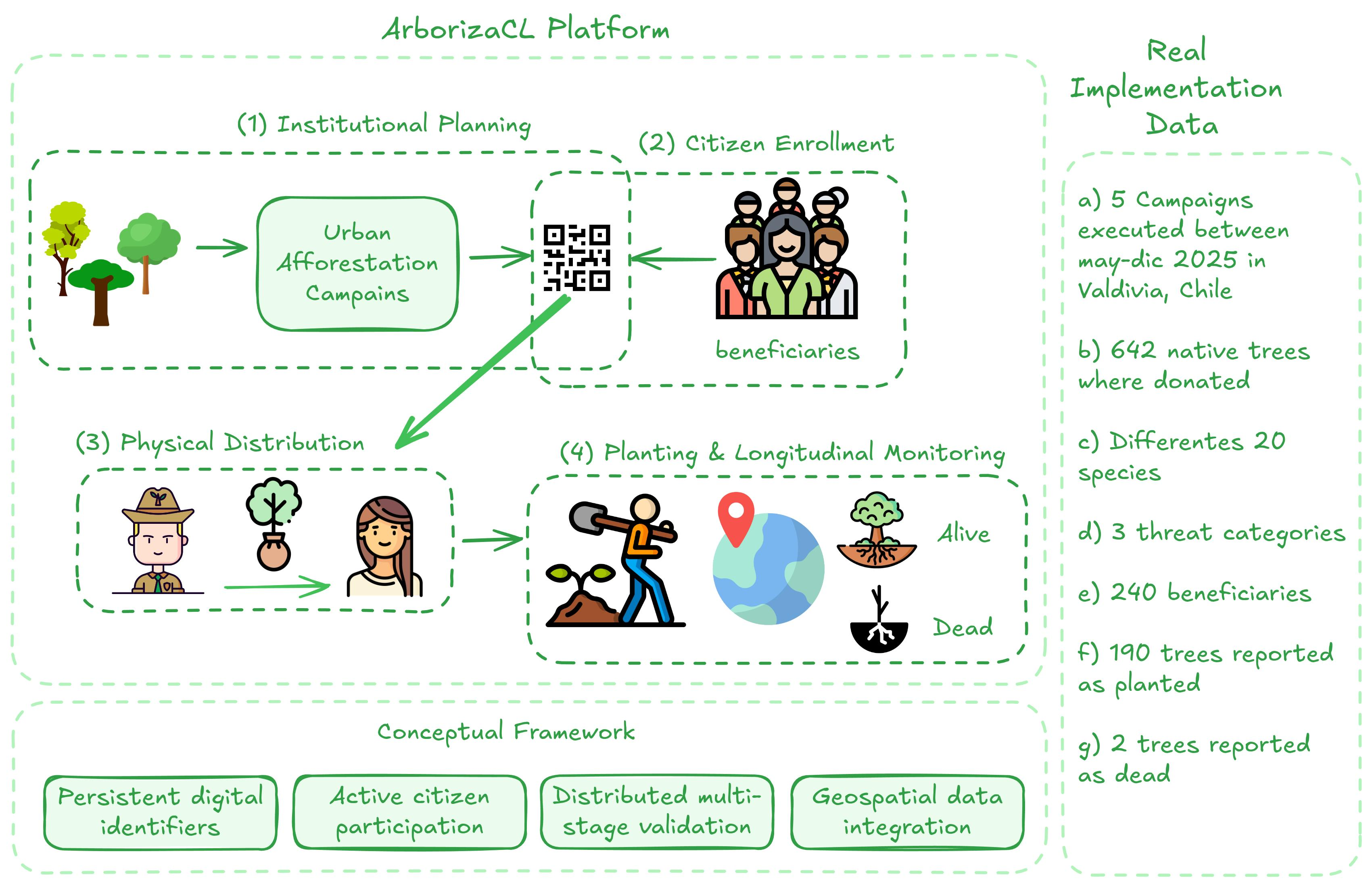
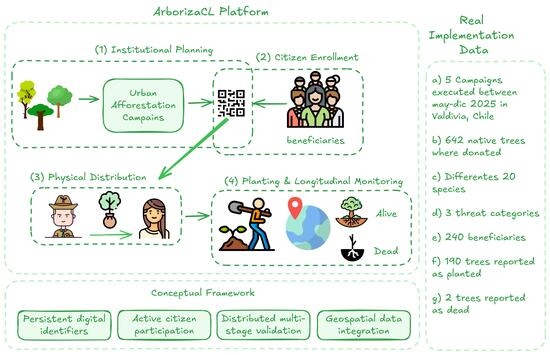
- Traceability: The capacity to track each individual tree from donation to planting through persistent unique identifiers linked to beneficiaries and georeferenced locations.
- Longitudinal monitoring: Periodic post-planting reporting of survival and condition over time.
- Verification: Assessment of whether system functionalities operate as specified.
- Validation: Evaluation of whether the system meets user and institutional requirements.
- 1.
- Persistent digital identifiers for tree-level traceability.
- 2.
- Active citizen participation through accessible digital interfaces.
- 3.
- Distributed multi-stage validation across the afforestation workflow.
- 4.
- Geospatial data integration to enable spatial analysis and monitoring.
3.2. Study Design
3.3. Platform Implementation
3.4. System Verification and Validation
3.5. Data Collection and Monitoring Strategies
4. Results
4.1. Study Area
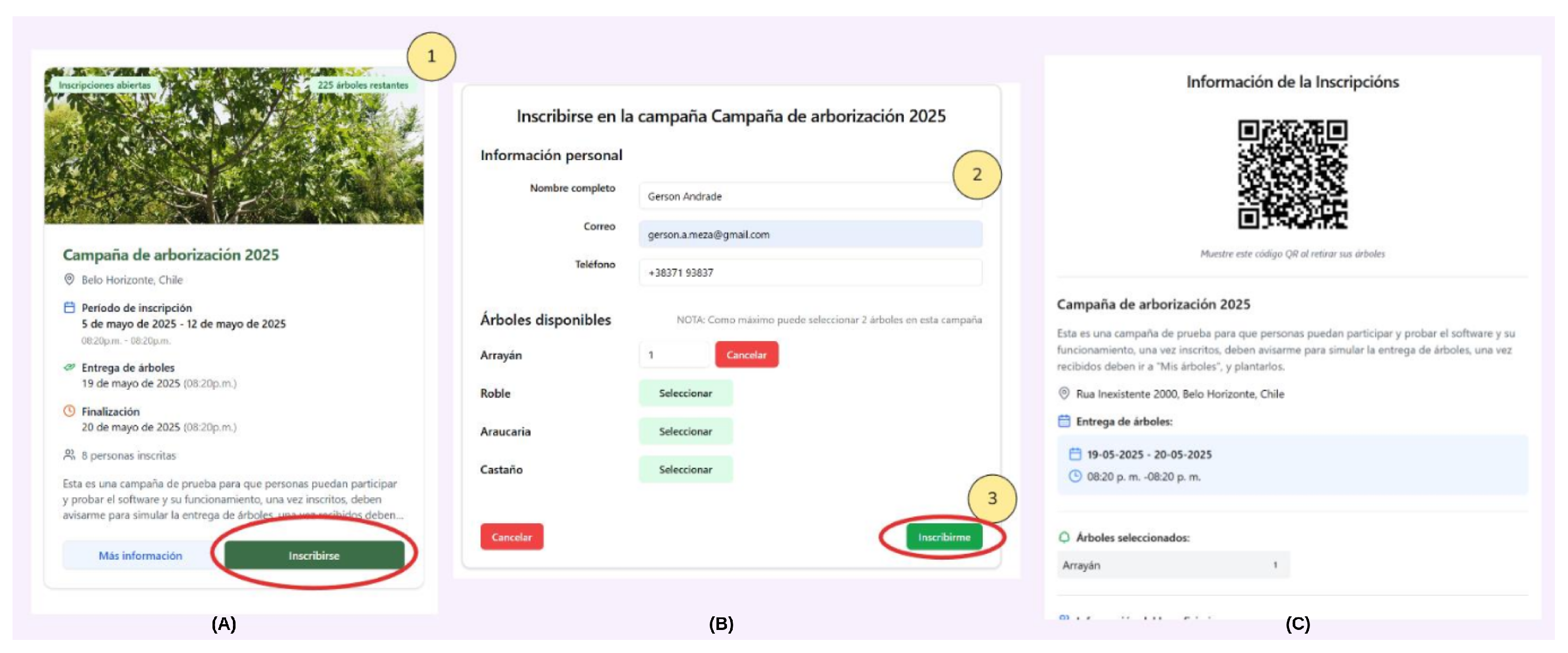
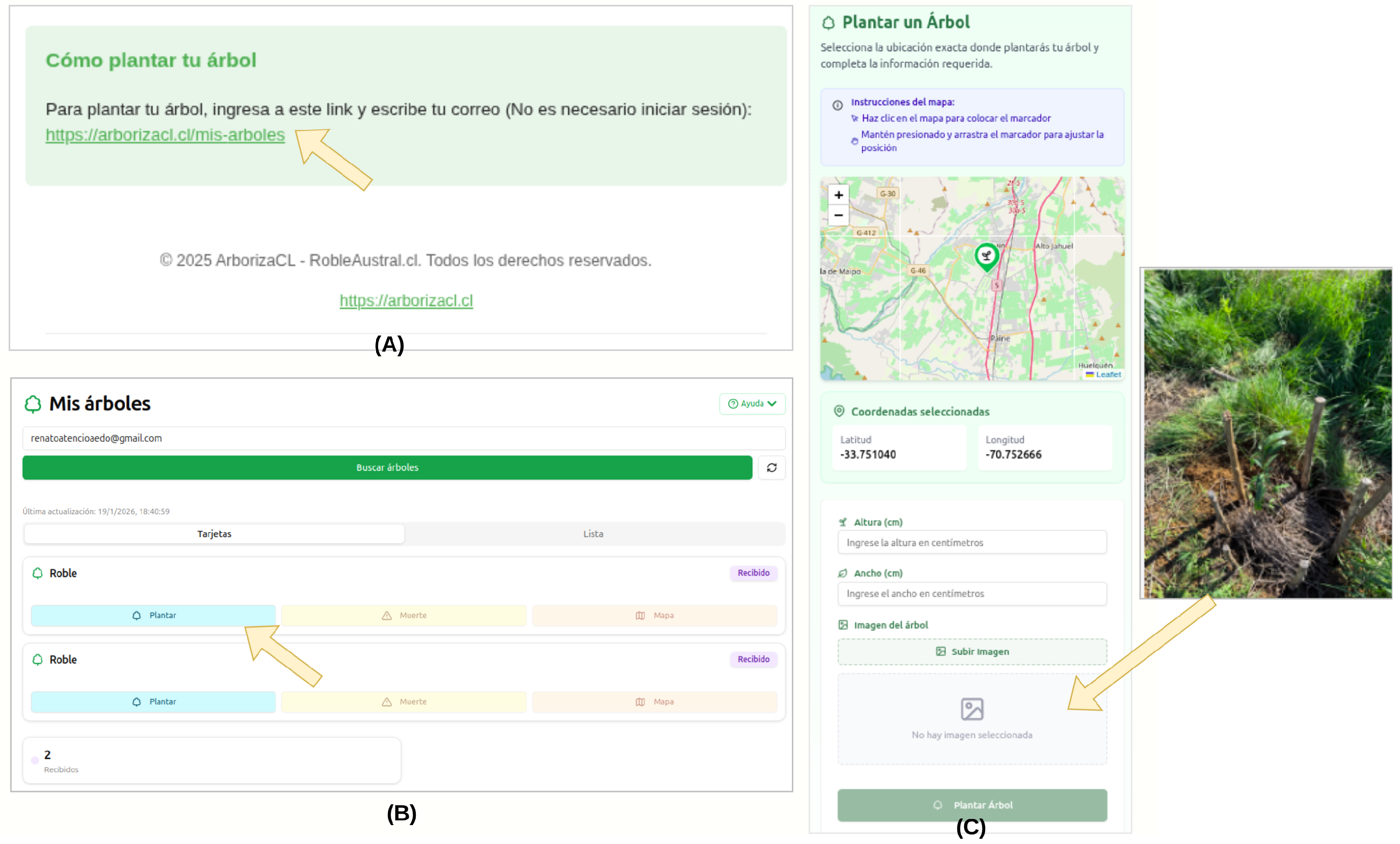
4.2. System Deployment and Operational Workflow
4.3. Species Distribution
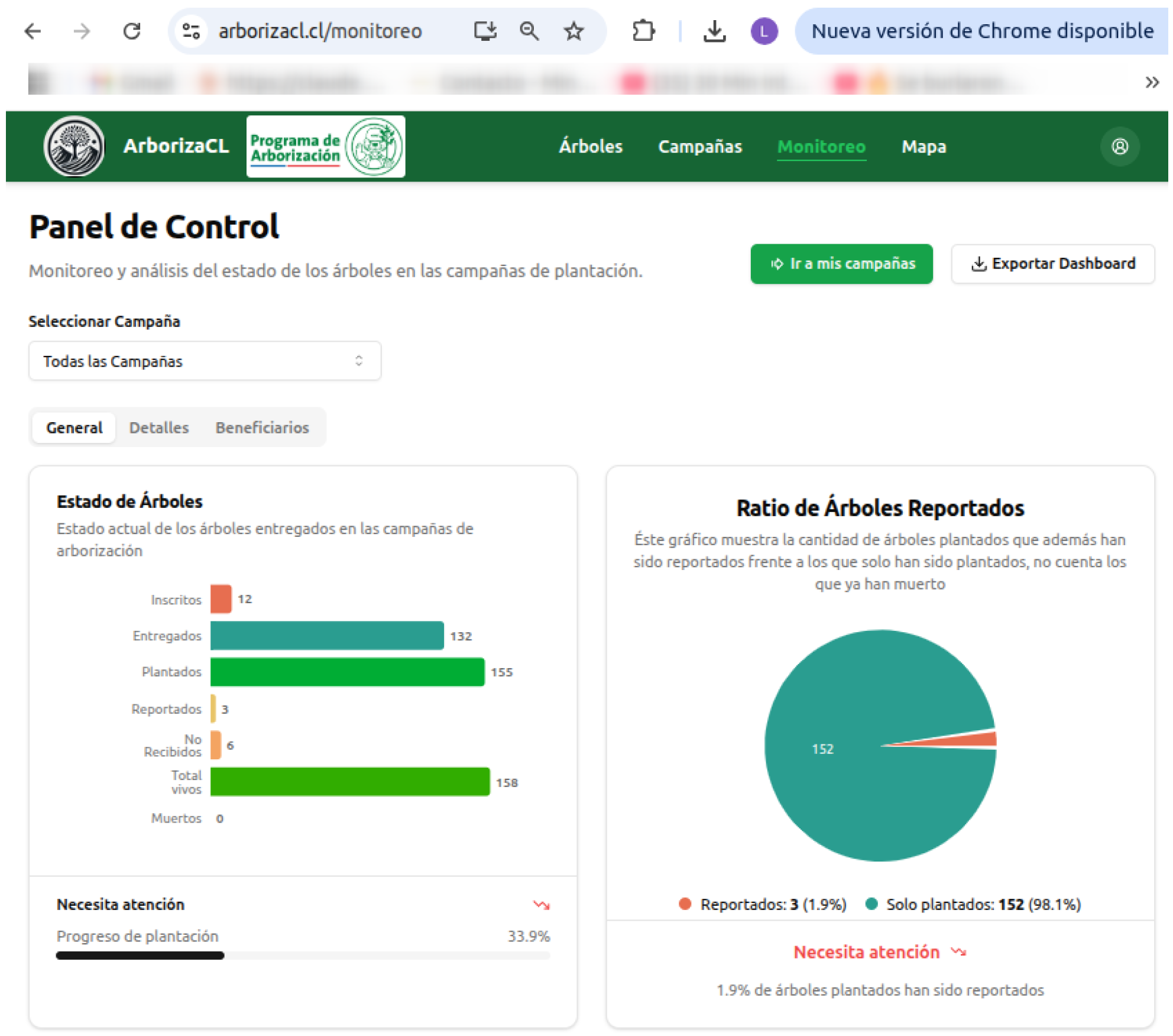
4.4. Campaign Participation Metrics
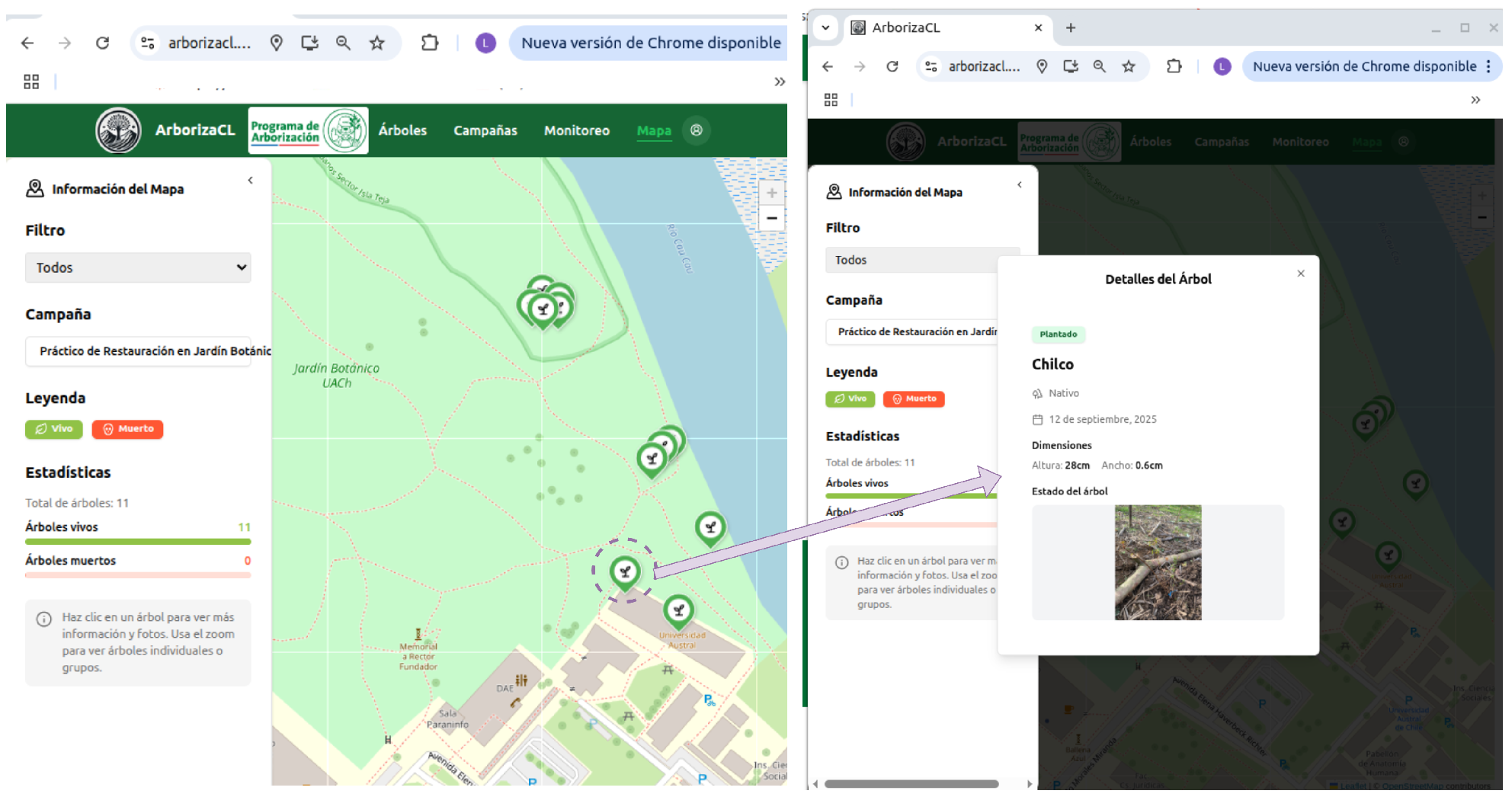
4.5. Spatial Distribution and Territorial Classification
| Algorithm 1 Urban–Peri-urban–Rural Territorial Classification Algorithm |
|
5. Discussion
5.1. Digital Traceability and Citizen Engagement
5.2. Spatial and Conservation Implications
5.3. Governance and Policy Implications
5.4. Limitations
5.5. Future Work: Automating Institutional Support
6. Conclusions
- Ethical Considerations and Data Governance
Author Contributions
Funding
Institutional Review Board Statement
Informed Consent Statement
Data Availability Statement
Acknowledgments
Conflicts of Interest
References
- IPCC. Climate Change 2021: The Physical Science Basis. Contribution of Working Group I to the Sixth Assessment Report of the Intergovernmental Panel on Climate Change; Cambridge University Press: Cambridge, UK, 2021. [Google Scholar] [CrossRef]
- Singh, V. Global Warming and Climate Change. In Textbook of Environment and Ecology; Springer: Singapore, 2024. [Google Scholar] [CrossRef]
- Kole, A.; Ellison, J.C. Local government climate change mitigation and adaptation ranking assessment. Int. J. Glob. Warm. 2018, 16, 461–484. [Google Scholar] [CrossRef]
- Gillner, S.; Vogt, J.; Tharang, A.; Dettmann, S.; Roloff, A. Role of street trees in mitigating effects of heat and drought at highly sealed urban sites. Landsc. Urban Plan. 2015, 143, 33–42. [Google Scholar] [CrossRef]
- De Montis, A.; Ledda, A.; Serra, V.; Manunta, A.; Calia, G. Urban Green Spaces and Climate Changes: Assessing Ecosystem Services for the Municipality of Sassari (Italy). Land 2025, 14, 1308. [Google Scholar] [CrossRef]
- Nowak, D.J.; Crane, D.E.; Stevens, J.C. Air pollution removal by urban trees and shrubs in the United States. Urban For. Urban Green. 2008, 4, 115–123. [Google Scholar] [CrossRef]
- Livesley, S.J.; McPherson, E.G.; Calfapietra, C. The Urban Forest and Ecosystem Services: Impacts on Urban Water, Heat, and Pollution Cycles at the Tree, Street, and City Scale. J. Environ. Qual. 2016, 45, 119–124. [Google Scholar] [CrossRef] [PubMed]
- Liang, D.; Huang, G. Influence of Urban Tree Traits on Their Ecosystem Services: A Literature Review. Land 2023, 12, 1699. [Google Scholar] [CrossRef]
- Hintural, W.P.; Jeon, H.J.; Kim, S.Y.; Go, S.; Park, B.B. Quantifying Regulating Ecosystem Services of Urban Trees: A Case Study of a Green Space at Chungnam National University Using i-Tree Eco. Forests 2024, 15, 1446. [Google Scholar] [CrossRef]
- Senado de la República de Chile. Informe de Evaluación del Programa de Arborización de CONAF 2024; Senado de la República de Chile: Valparaíso, Chile, 2024. [Google Scholar]
- Nowak, D.J.; American Forests. Climate Change and Urban Forests: How Many Urban Trees Do We Need? American Forests: Washington, DC, USA, 2021; Available online: https://www.americanforests.org/tools-research-reports-and-guides/research-reports/climate-change-urban-forests/ (accessed on 27 March 2026).
- European Commission. New EU Forest Strategy for 2030; Communication COM(2021) 572 final; European Commission: Brussels, Belgium, 2021. Available online: https://eur-lex.europa.eu/legal-content/EN/TXT/?uri=celex:52021DC0572 (accessed on 27 March 2026).
- Yao, N.; Konijnendijk van den Bosch, C.C.; Yang, J.; Devisscher, T.; Wirtz, Z.; Jia, L.; Duan, J.; Ma, L. Beijing’s 50 million new urban trees: Strategic governance for large-scale urban afforestation. Urban For. Urban Green. 2019, 44, 126392. [Google Scholar] [CrossRef]
- Corporación Nacional Forestal (CONAF). Programa Siembra por Chile: Estadísticas de Distribución 2024; Technical report; CONAF: Santiago, Chile, 2024. [Google Scholar]
- Instituto Forestal (INFOR). Directorio de la Industria Forestal Primaria de Chile 2023; INFOR, Área de Información y Economía Forestal: Santiago, Chile, 2023; Available online: https://wef.infor.cl/index.php/publicaciones/boletines-estadisticos/directorio-industria-forestal (accessed on 27 March 2026).
- Bibri, S.E.; Krogstie, J. Smart sustainable cities of the future: An extensive interdisciplinary literature review. Sustain. Cities Soc. 2017, 31, 183–212. [Google Scholar] [CrossRef]
- Kitchin, R. The real-time city? Big data and smart urbanism. GeoJournal 2014, 79, 1–14. [Google Scholar] [CrossRef]
- Almulhim, A.I.; Yigitcanlar, T. Understanding Smart Governance of Sustainable Cities: A Review and Multidimensional Framework. Smart Cities 2025, 8, 113. [Google Scholar] [CrossRef]
- Tomor, Z.; Przeybilovicz, E.; Leleux, C. Smart governance in institutional context: An in-depth analysis of Glasgow, Utrecht, and Curitiba. Cities 2021, 114, 103195. [Google Scholar] [CrossRef]
- Hollands, R.G. Will the real smart city please stand up? Intelligent, progressive or entrepreneurial? City 2008, 12, 303–320. [Google Scholar] [CrossRef]
- Gabrys, J. Programming environments: Environmentality and citizen sensing in the smart city. Environ. Plan. D Soc. Space 2014, 32, 30–48. [Google Scholar] [CrossRef]
- van Doorn, N.S.; Roman, L.A.; McPherson, E.G.; Scharenbroch, B.C.; Henning, J.G.; Östberg, J.P.A.; Mueller, L.S.; Koeser, A.K.; Mills, J.R.; Hallet, R.A.; et al. Urban tree monitoring: Applications and considerations for urban tree health. Arboric. Urban For. 2020, 46, 235–254. [Google Scholar]
- CONAF. Catastro de los Recursos Vegetacionales Nativos de Chile; CONAF: Santiago, Chile, 2021; Available online: https://sit.conaf.cl/varios/Catastros_Recursos_Vegetacionales_Nativos_de_Chile_Nov2021.pdf (accessed on 27 March 2026).
- Bosona, T.; Gebresenbet, G. Food traceability as an integral part of logistics management in food and agricultural supply chain. Food Control 2013, 33, 32–48. [Google Scholar] [CrossRef]
- Callaghan, C.T.; Poore, A.G.B.; Mesaglio, T.; Moles, A.T.; Nakagawa, S.; Roberts, C.; Rowley, J.J.L.; Vergés, A.; Wilshire, J.H.; Cornwell, W.K. Three frontiers for the future of biodiversity research using citizen science data. BioScience 2021, 71, 55–63. [Google Scholar] [CrossRef]
- Sullivan, B.L.; Aycrigg, J.L.; Barry, J.H.; Bonney, R.E.; Bruns, N.; Cooper, C.B.; Damoulas, T.; Dhondt, A.A.; Dietterich, T.; Farnsworth, A.; et al. The eBird enterprise: An integrated approach to development and application of citizen science. Biol. Conserv. 2014, 169, 31–40. [Google Scholar] [CrossRef]
- Sharma, G.; Morgenroth, J.; Richards, D.R.; Ye, N. Advancing urban forest and ecosystem service assessment through the integration of remote sensing and i-Tree Eco: A systematic review. Urban For. Urban Green. 2025, 95, 128659. [Google Scholar] [CrossRef]
- CONAF. Oficina Virtual de CONAF; CONAF: Santiago, Chile, 2025; Available online: https://oficinavirtual.conaf.cl/login/index.php (accessed on 27 March 2026).
- SEIA. Sistema de Evaluación de Impacto Ambiental. Available online: https://www.conaf.cl/tramites/sistema-de-evaluacion-de-impacto-ambiental/ (accessed on 27 March 2026).
- Arbor Day Foundation. Arbor Day Foundation Plants, Distributes a Record 1.7 Million Urban Trees in 2023; Press Release, March 2024; Arbor Day Foundation: Lincoln, NE, USA, 2024; Available online: https://www.arborday.org/news/arbor-day-foundation-plants-distributes-record-17-million-urban-trees-2023 (accessed on 27 March 2026).
- Forestry Commission. Key Performance Indicators Report 2024–2025; Forestry Commission: Bristol, UK, 2024. Available online: https://assets.publishing.service.gov.uk/media/685c093b89ba18761d97612a/FC-Key-Performance-Indicators-Report-2024-25.pdf (accessed on 27 March 2026).
- Bastardo, R.; Pavão, J.; Rocha, N.P. Crowdsourcing Technologies to Promote Citizens’ Participation in Smart Cities: A Scoping Review. Procedia Comput. Sci. 2023, 219, 303–311. [Google Scholar] [CrossRef]
- Koedel, U.; Dietrich, P.; Herrmann, T.; Liang, C.; Ritter, O.; Roettenbacher, J.; Schuetze, F.M.; Schuetze, S.V.; Thoboell, J.C.; Schuetze, C. Enhancing citizen science impact in environmental monitoring: Targeted engagement strategies with stakeholder groups. Front. Environ. Sci. 2024, 12, 1375675. [Google Scholar] [CrossRef]
- Meijer, A.; Grimmelikhuijsen, S. Digital platforms and citizen participation: A systematic review of the literature. Gov. Inf. Q. 2020, 37, 101–117. [Google Scholar] [CrossRef]
- Ferguson, S.; Jäger, N.; Pärn, E. Digital engagement and citizen participation in smart cities: A systematic review. Sustain. Cities Soc. 2021, 68, 102766. [Google Scholar] [CrossRef]
- Meijer, A.; Hitters, E.; Hoppe, T. Smart Governance Toolbox: A Systematic Literature Review. Smart Cities 2023, 6, 878–896. [Google Scholar] [CrossRef]
- Olsen, P.; Borit, M. How to define traceability. Trends Food Sci. Technol. 2012, 29, 142–150. [Google Scholar] [CrossRef]
- Goodchild, M.F. Citizens as sensors: The world of volunteered geography. GeoJournal 2007, 69, 211–221. [Google Scholar] [CrossRef]
- See, L.; Mooney, P.; Foody, G.; Bastin, L.; Comber, A.; Estima, J.; Fritz, S.; Kerle, N.; Jiang, B.; Laakso, M.; et al. Crowdsourcing, citizen science or volunteered geographic information? The current state of crowdsourced geographic information. ISPRS Int. J. Geo-Inf. 2016, 5, 55. [Google Scholar] [CrossRef]
- Robson, C. Real World Research: A Resource for Users of Social Research Methods in Applied Settings, 3rd ed.; Wiley-Blackwell: Chichester, UK, 2011. [Google Scholar]
- Gerring, J. Case Study Research: Principles and Practices; Cambridge University Press: Cambridge, UK, 2007. [Google Scholar]
- North, D. Introducing Behavior-Driven Development. Available online: https://dannorth.net/introducing-bdd/ (accessed on 27 March 2026).
- Brooke, J. SUS: A “Quick and Dirty” Usability Scale. In Usability Evaluation in Industry; Jordan, P.W., Thomas, B., Weerdmeester, B.A., McClelland, I.L., Eds.; Taylor & Francis: London, UK, 1996; pp. 189–194. [Google Scholar]
- Peel, M.C.; Finlayson, B.L.; McMahon, T.A. Updated world map of the Köppen-Geiger climate classification. Hydrol. Earth Syst. Sci. 2007, 11, 1633–1644. [Google Scholar] [CrossRef]
- IUCN. The IUCN Red List of Threatened Species. Available online: https://www.iucnredlist.org/ (accessed on 27 March 2026).
- Cattaneo, A.; Nelson, A.; McMenomy, T. Global mapping of urban–rural catchment areas reveals unequal access to services. Proc. Natl. Acad. Sci. USA 2021, 118, e2011990118. [Google Scholar] [CrossRef]
- Angel, S.; Parent, J.; Civco, D.L.; Blei, A.M.; Potere, D. The dimensions of global urban expansion: Estimates and projections for all countries, 2000–2050. Prog. Plan. 2011, 75, 53–107. [Google Scholar] [CrossRef]
- Thaler, R.H.; Sunstein, C.R. Nudge: Improving Decisions About Health, Wealth, and Happiness; Yale University Press: New Haven, CT, USA, 2008. [Google Scholar]
- Deterding, S.; Dixon, D.; Khaled, R.; Nacke, L. From Game Design Elements to Gamefulness: Defining “Gamification”. In Proceedings of the 15th International Academic MindTrek Conference: Envisioning Future Media Environments, Tampere, Finland, 28–30 September 2011; pp. 9–15. [Google Scholar] [CrossRef]
- Khatri, V.; Brown, C.V. Designing Data Governance. Commun. ACM 2010, 53, 148–152. [Google Scholar] [CrossRef]
- Kosmala, M.; Wiggins, A.; Swanson, A.; Simmons, B. Assessing data quality in citizen science. Front. Ecol. Environ. 2016, 14, 551–560. [Google Scholar] [CrossRef]





| Platform | Individual Traceability | Citizen Participation | GPS Geolocation | Longitudinal Monitoring | Local Context | Campaign Management |
|---|---|---|---|---|---|---|
| International Platforms | ||||||
| i-Tree Suite (USDA, USA) | No (inventory-based) | Passive (visualization) | No (manual) | Limited (static) | No (USA species/climate) | No (analytical) |
| TreeMap (Azavea, USA) | Limited (aggregated) | Passive (visualization) | Yes (map-based) | Limited (no reporting) | No (USA species/climate) | No (inventory) |
| iNaturalist (Global) | No (species observation) | Active (citizen science) | Yes (automatic) | Limited (observation history) | No (biodiversity focus) | No (not campaign-oriented) |
| GlobalTree Portal (Global) | No (population-level) | No (institutional) | Partial (regional) | Yes (conservation-oriented) | No (global species) | No (conservation) |
| National Initiatives | ||||||
| CRVN (CONAF, Chile) | No (landscape-scale) | No (governmental) | Yes (regional) | No (static inventory) | Yes (native flora) | No (territorial) |
| CONAF Virtual Office (Chile) | No (regulatory) | No (permitting) | No (procedural) | No (compliance-focused) | Yes (national regulation) | No (commercial forestry) |
| Proposed Solution | ||||||
| Proposed system (this study) | Yes (unique QR) | Active (mobile PWA) | Yes (automatic) | Yes (periodic reports) | Yes (native species) | Yes (community-based) |
| Common Name | Scientific Name | Count | IUCN Conservation Status |
|---|---|---|---|
| Arrayán | Luma apiculata | 171 | Least Concern (LC) |
| Olivillo | Aextoxicon punctatum | 101 | Least Concern (LC) |
| Canelo | Drimys winteri | 40 | Least Concern (LC) |
| Roble | Nothofagus obliqua | 36 | Least Concern (LC) |
| Mañío de hojas largas | Podocarpus salignus | 35 | Vulnerable (VU) |
| Maitén | Maytenus boaria | 35 | Least Concern (LC) |
| Chilco | Fuchsia magellanica | 20 | Least Concern (LC) |
| Quillay | Quillaja saponaria | 18 | Least Concern (LC) |
| Murta | Ugni molinae | 15 | Data Deficient (DD) |
| Huevil | Vestia foetida | 10 | Least Concern (LC) |
| Matico | Buddleja globosa | 9 | Least Concern (LC) |
| Chaquihue | Crinodendron hookerianum | 6 | Least Concern (LC) |
| Pelú | Sophora cassioides | 5 | Least Concern (LC) |
| Mañío | Podocarpus nubigenus | 5 | Near Threatened (NT) |
| Araucaria | Araucaria araucana | 5 | Endangered (EN) |
| Chupón | Greigia sphacelata | 5 | Least Concern (LC) |
| Meli | Amomyrtus meli | 2 | Least Concern (LC) |
| Calafate | Berberis microphylla | 1 | Data Deficient (DD) |
| Calle-calle | Libertia chilensis | 1 | Least Concern (LC) |
| Corcolén | Azara petiolaris | 1 | Least Concern (LC) |
| Not identified | — | 121 | — |
| Total | 642 |
| Metric | Value | Percentage |
|---|---|---|
| Total trees distributed | 642 | 100% |
| Identified to species level | 521 | 81.2% |
| Not identified | 121 | 18.8% |
| Native species identified | 20 | — |
| Threatened species (VU, EN, NT) | 3 | 15% of species |
| Individuals of threatened species | 45 | 7.0% of total |
| Campaign | Period | Inst. | Trees | Spp. | Part. | Rep. |
|---|---|---|---|---|---|---|
| UACh Triestamental | May–Jun 2025 | UACh | 284 | 5 | 150 | 32 |
| Edible Forest Arboretum | Jun 2025 | CONAF | 63 | 9 | 38 | 33 |
| Miraflores Wetland Initiative | Aug 2025 | CONAF | 80 | 2 | 19 | 36 |
| Alto Las Lomas (Máfil) | Aug 2025 | CONAF | 140 | 4 | 25 | 78 |
| Botanical Garden Workshop | Aug–Sep 2025 | CONAF | 75 | 6 | 8 | 11 |
| Total | May–Sep 2025 | — | 642 | 20 * | 240 | 190 |
| Campaign | Inst. | Strategy | Trees | Part. | Rep. | Rate (%) |
|---|---|---|---|---|---|---|
| Alto Las Lomas (Máfil) | CONAF | Active | 140 | 25 | 78 | 55.7 |
| Edible Forest Arboretum | CONAF | Active | 63 | 38 | 33 | 52.4 |
| Miraflores Wetland Initiative * | CONAF | Semi-sup. * | 80 | 19 | 36 | 45.0 |
| Botanical Garden Workshop | CONAF | Passive | 75 | 8 | 11 | 14.7 |
| UACh Triestamental | UACh | Passive | 284 | 150 | 32 | 11.3 |
| Total | — | Mixed | 642 | 240 | 190 | 29.6 |
Disclaimer/Publisher’s Note: The statements, opinions and data contained in all publications are solely those of the individual author(s) and contributor(s) and not of MDPI and/or the editor(s). MDPI and/or the editor(s) disclaim responsibility for any injury to people or property resulting from any ideas, methods, instructions or products referred to in the content. |
© 2026 by the authors. Licensee MDPI, Basel, Switzerland. This article is an open access article distributed under the terms and conditions of the Creative Commons Attribution (CC BY) license.
Share and Cite
Veas-Castillo, L.; Andrade, G.; Lazo, C.; Letelier, T.; Díaz, I.; Alacid, M.; Hermosilla, M. Participatory Digital Traceability Systems for Information Governance: Design and Real-World Deployment in Urban Afforestation Programs. Information 2026, 17, 348. https://doi.org/10.3390/info17040348
Veas-Castillo L, Andrade G, Lazo C, Letelier T, Díaz I, Alacid M, Hermosilla M. Participatory Digital Traceability Systems for Information Governance: Design and Real-World Deployment in Urban Afforestation Programs. Information. 2026; 17(4):348. https://doi.org/10.3390/info17040348
Chicago/Turabian StyleVeas-Castillo, Luis, Gerson Andrade, Christian Lazo, Tania Letelier, Iván Díaz, Mónica Alacid, and María Hermosilla. 2026. "Participatory Digital Traceability Systems for Information Governance: Design and Real-World Deployment in Urban Afforestation Programs" Information 17, no. 4: 348. https://doi.org/10.3390/info17040348
APA StyleVeas-Castillo, L., Andrade, G., Lazo, C., Letelier, T., Díaz, I., Alacid, M., & Hermosilla, M. (2026). Participatory Digital Traceability Systems for Information Governance: Design and Real-World Deployment in Urban Afforestation Programs. Information, 17(4), 348. https://doi.org/10.3390/info17040348