Article

Verifying SDG ESG Compliance in Manufacturing Industry Projects by Surveying Sponsors

by
Kenneth David Strang
1,2,* and
Narasimha Rao Vajjhala
3,*
1
Department of Business, University of the Cumberlands, 6984 College Station Drive, Williamsburg, KY 40769, USA
2
W3-Research, Saint Thomas, VI 00802, USA
3
Computer Science Department, American University in Bulgaria, 2700 Blagoevgrad, Bulgaria
*
Authors to whom correspondence should be addressed.
Information 2026, 17(4), 311; https://doi.org/10.3390/info17040311
Submission received: 9 February 2026 / Revised: 13 March 2026 / Accepted: 17 March 2026 / Published: 24 March 2026

Abstract

This study addresses a critical gap in the operationalization of sustainability frameworks at the project level by developing and validating an empirically grounded measurement instrument for assessing Environmental, Social, and Governance (ESG) compliance in manufacturing industry projects. While the United Nations Sustainable Development Goals (SDGs) articulate sustainability aspirations at the national and global level, and ESG frameworks capture organizational-level sustainability performance, no validated instrument exists for measuring ESG integration at the project level where sustainability commitments are ultimately operationalized. Drawing on the theoretical foundations of sustainable project management, stakeholder theory, and the ESG governance literature, the authors developed a 30-item survey instrument capturing six conceptual dimensions of ESG-aligned project performance. Data were collected from 2231 project sponsors and decision-makers in North American goods manufacturing firms classified under NAICS codes 31–33, which collectively encompass the entire manufacturing sector in North America. Through a sequential analytical approach employing principal component analysis (PCA) for initial item reduction, exploratory factor analysis (EFA) for dimensionality assessment, and structural equation modelling (SEM) for confirmatory validation, a parsimonious two-factor model emerged with excellent fit indices (CFI = 0.99, TLI = 0.98, RMSEA = 0.052, SRMR < 0.035). The first factor captures ESG planning activities undertaken during project initiation and planning phases, while the second factor represents ESG monitoring and controlling functions during project execution. The reduction from six theoretical dimensions to two empirical factors reflects lifecycle governance theory, where planning-phase governance and execution-phase control emerge as functionally distinct but correlated constructs. The validated instrument offers practical utility for project managers, organizational sustainability officers, and policy-makers seeking standardized benchmarks for ESG compliance at the operational project level. The validated instrument and complete survey are shared for replication and testing across different industries and countries.

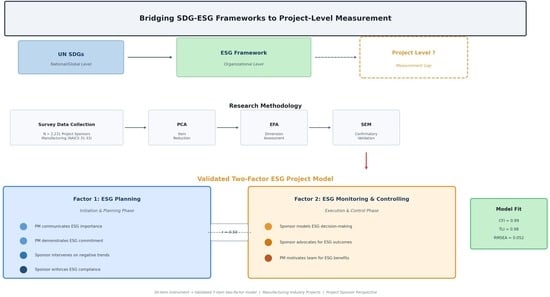
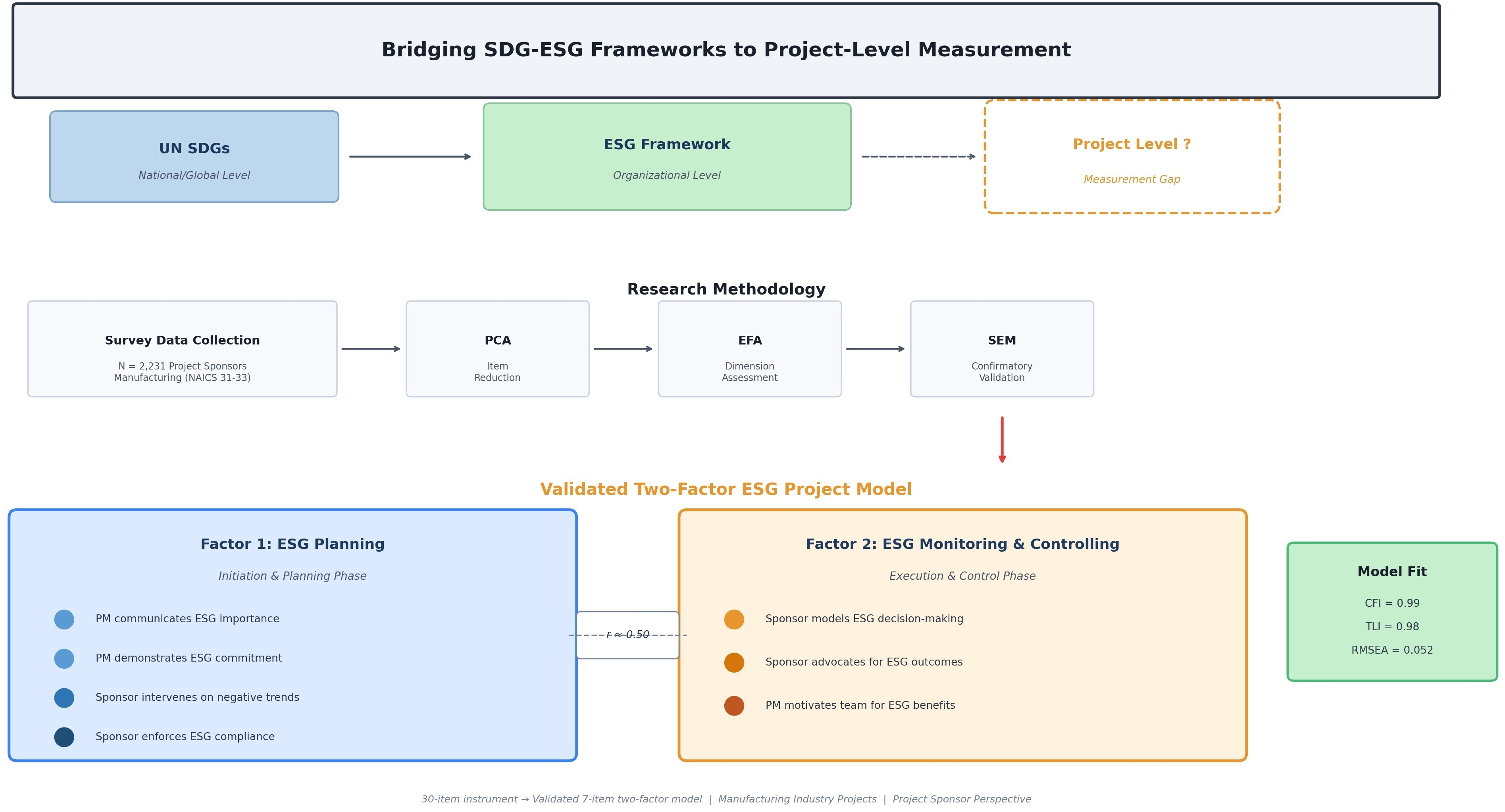
Graphical Abstract

1. Introduction

It is difficult to use UN SDG or even the ESG framework to measure project success. Researchers have found it difficult to link SDGs or the ESG framework to project-level performance, primarily due to different levels of analysis. SDGs operate at the national level, while ESG factors similarly map to several generic SDG items. Business projects in the manufacturing industry do not usually focus on SDG or ESG factors, making it difficult to measure those elements. A new evidence-driven factor structure must be developed to bridge this gap, to help businesses identify how to effectively specify and measure ESG goals in projects.
The United Nations Sustainable Development Goals, adopted in 2015, established 17 interconnected goals and 169 targets intended to guide national and international policy toward a more sustainable and equitable future [1]. These goals have influenced how governments, industries, and organizations conceptualize their responsibilities toward environmental stewardship, social equity, and institutional integrity. The Environmental, Social, and Governance (ESG) framework has emerged as the dominant lens through which corporations assess, report, and communicate their sustainability performance to investors, regulators, and the public [2]. While both frameworks share the overarching ambition of advancing sustainable development, they operate at fundamentally different levels of analysis. SDGs articulate aspirations at the national and global level, whereas ESG frameworks capture sustainability commitments at the organizational level [3]. This mismatch in levels of analysis creates a significant conceptual and practical challenge for organizations that seek to translate their macro-level sustainability commitments into actionable, measurable outcomes at the operational level.
Projects represent the primary mechanism through which organizations implement strategic initiatives, develop new products, and deliver change [4]. Despite this centrality, the project management literature has only recently begun to engage with sustainability considerations in a systematic fashion. Silvius and Schipper [5] documented the growing intersection of sustainability and project management, yet subsequent research has largely remained at the conceptual or case-study level, with few empirically validated instruments for measuring ESG integration in project environments [6]. The manufacturing industry, classified under NAICS codes 31–33 in North America, presents a particularly compelling context for investigating this challenge. Importantly, NAICS codes 31–33 collectively encompass the entire goods manufacturing sector in North America, spanning sub-industries from food and beverage processing (NAICS 311–312) to chemical and plastics manufacturing (NAICS 325–326) and metals, electronics, and transportation equipment manufacturing (NAICS 331–336). This is distinct from the European NACE classification system; however, both systems delineate the complete manufacturing sector within their respective geographic contexts, and the present study is intended to cover the full scope of North American manufacturing. Manufacturing firms face intense regulatory scrutiny regarding environmental emissions, supply chain governance, and worker safety, making ESG compliance both a strategic imperative and an operational necessity [7,8].
The purpose of this study is to develop and validate a measurement model for assessing ESG compliance in manufacturing industry projects from the perspective of the project sponsor, who serves as the primary decision-maker and authority over project outcomes. The study addresses the following research question: What empirically grounded factor structure best captures how project sponsors assess ESG goal alignment in manufacturing projects? To answer this question, the authors employed a multi-stage analytical approach. First, a 30-item survey instrument was developed based on established theoretical frameworks and refined through a pilot study with experienced project managers. Second, data were collected from 2231 project sponsors and decision-makers in North American goods manufacturing organizations. Third, the data were subjected to sequential analyses using PCA for initial dimensionality exploration, EFA for model refinement, and SEM without exogenous variables for confirmatory validation.
This study makes three contributions to the literature. First, it bridges the macro–micro gap between SDG aspirations and project-level measurement by developing an ESG-aligned instrument grounded in established project management and stakeholder theories. Second, it provides empirical evidence from a large-scale sample in the manufacturing industry, moving beyond the small-sample case studies that have characterized much of the sustainable project management literature. Third, it offers a validated and replicable survey instrument that other researchers can employ to test ESG measurement models across different industries and national contexts.

2. Literature Review

2.1. Theoretical Underpinning

Two primary theoretical frameworks anchor the research model developed in this study. First, stakeholder theory, as originally articulated by Freeman and subsequently extended by Eskerod and Huemann [9], posits that organizations bear responsibilities to a wide range of actors beyond shareholders, including employees, communities, suppliers, and regulators. In the project management context, stakeholder theory predicts that ESG integration requires active engagement with multiple stakeholder groups across project phases, with the project sponsor serving as the central nexus of accountability. Eskerod and Huemann [9] extended this framework to argue for management-for-stakeholders rather than management-of-stakeholders, recognizing that sustainable project outcomes are co-created through substantive stakeholder participation rather than mere compliance.
Second, project lifecycle governance theory provides the structural foundation for understanding how ESG commitments are operationalized across distinct project phases. Kivilä et al. [10] demonstrated that sustainability integration requires governance mechanisms spanning the full project lifecycle, from initiation through closure, while Carvalho and Rabechini [4] empirically validated that sustainability management at the planning stage significantly predicts project success outcomes in a multi-industry sample. Together, these frameworks predict that ESG compliance in manufacturing projects will manifest along two functionally distinct dimensions: governance inputs during project initiation and planning, and monitoring and controlling outputs during project execution. This theoretical prediction is consistent with the two-factor empirical solution reported in the present study. A recent empirical contribution by Anelli, Morano, Fariello, and Sabatelli [11] further substantiates this lifecycle governance perspective by demonstrating that structured project management practices, when aligned with ESG frameworks, enhance sustainability outcomes across organizational contexts.
The empirical literature on ESG measurement in project settings remains limited. Prior studies by Martens and Carvalho [12] and Carvalho and Rabechini [4] demonstrated the feasibility of quantitative measurement of sustainability constructs in project management, but neither specifically addressed ESG compliance measurement at the project level nor focused on the manufacturing sector. The present study builds on these foundations by applying rigorous psychometric procedures, including PCA, EFA, and CFA/SEM, to develop the first validated project-level ESG compliance instrument specifically designed for the manufacturing context.

2.2. Sustainable Development Goals and ESG Frameworks

The United Nations Sustainable Development Goals represent a comprehensive agenda for addressing global challenges spanning poverty, inequality, environmental degradation, and institutional governance [1]. Since their adoption, the SDGs have catalyzed considerable scholarly attention regarding how organizations can contribute to their achievement. van Zanten and van Tulder [13] conceptualized the SDGs as a goal-based institution and found that multinational enterprises tend to engage more readily with SDG targets that align with existing value chain activities, favoring harm-avoidance over proactive contribution. Their subsequent network analysis of 67 economic activities against 59 SDG targets identified four corporate sustainability imperatives, yet the challenge of translating these macro-level imperatives into operational metrics remained largely unresolved [14]. Bebbington and Unerman [1] reinforced this concern, highlighting a critical disconnect between companies that embrace SDGs strategically and their capacity to quantify performance against SDG targets at the operational level.
The ESG framework emerged from the investment community as a mechanism for evaluating corporate sustainability performance along three pillars: environmental responsibility, social impact, and governance quality [2]. Unlike the SDGs, which were designed for national-level policy guidance, ESG frameworks operate at the organizational level, providing metrics and ratings that inform investor decision-making and corporate strategy [15]. Delgado-Ceballos et al. [3] argued that connecting SDGs to firm-level ESG factors requires a double materiality perspective, one that considers both how sustainability issues affect the firm and how the firm affects sustainability outcomes. Recent methodological advances in ESG assessment have explored optimization models and goal-programming approaches for evaluating ESG performance across different organizational and industrial contexts [16,17].
Despite these conceptual advances, a persistent gap exists between SDG aspirations at the national level, ESG performance at the organizational level, and sustainability outcomes at the project level. This hierarchical disconnect, from global goals to national targets to organizational strategy to project execution, represents the central challenge motivating the present study. Without validated instruments for measuring ESG compliance at the project level, organizations cannot credibly demonstrate that their project portfolios contribute to their stated ESG commitments.

2.3. ESG Integration in Project Management

The integration of sustainability into project management has evolved significantly over the past two decades. Silvius and Schipper [5] identified three fundamental shifts in the field: a broadened scope of project success beyond the traditional time, budget, and quality constraints; a paradigm shift from predictability-focused management to complexity-aware approaches; and a mindset shift toward recognizing project managers’ responsibility for sustainable development outcomes. Sabini et al. [6] extended this analysis through a systematic review of 770 publications and developed three narrative themes addressing why, what, and how sustainability is embedded in project practices. Their analysis confirmed that while the conceptual case for sustainable project management was well established, empirical validation remained limited.
Marcelino-Sadaba et al. [18] proposed a conceptual framework for managing sustainable projects organized around four pillars: product, processes, organization, and managers. Sanchez [19] developed a framework integrating sustainability into project portfolio selection. Kivila et al. [10] examined how sustainability is embedded in project control practices, linking sustainability goals with project control processes throughout the lifecycle. Martens and Carvalho [12] identified four sustainability factor clusters using exploratory factor analysis, explaining 70% of the variability, while Carvalho and Rabechini [4] validated a project sustainability management model using SEM. These studies demonstrate both the feasibility and value of applying quantitative instrument development methods to sustainability constructs in project management. However, neither study specifically addressed ESG compliance measurement, nor did they focus on the manufacturing industry.

2.4. Measuring ESG Compliance and Performance

The measurement of ESG compliance and performance has been the subject of extensive scholarly debate. At the corporate level, several reporting frameworks have emerged as dominant standards, including GRI, SASB, and TCFD. Christensen et al. [20] concluded that while reporting frameworks have proliferated, the standardization needed for cross-firm comparability remains elusive. Berg et al. [21] found that measurement differences accounted for 56% of ESG rating divergence across six major agencies, scope differences for 38%, and weight differences for only 6%. Khan et al. [22] provided empirical evidence that firms with strong ratings on material sustainability issues significantly outperform on financial metrics, validating the importance of industry-specific materiality in ESG assessment. Recent contributions have also demonstrated that multi-dimensional optimization approaches, including goal-programming models, can provide more nuanced assessments of ESG performance than single-metric ratings [16,17].
The central limitation of these corporate-level measurement approaches is that they are designed to assess organizational performance rather than project-level performance. No validated, empirically tested instrument exists for measuring ESG compliance at the level of individual projects. Bridging this measurement gap requires developing new instruments that are theoretically grounded in both the ESG literature and the project management literature, and that are empirically validated through rigorous psychometric procedures.

2.5. ESG in the Manufacturing Industry Context

The manufacturing industry represents a critical context for investigating ESG compliance at the project level. NAICS codes 31–33 encompass the entire goods manufacturing sector in North America, covering diverse sub-industries including food and beverage production (NAICS 311–312), textiles and apparel (NAICS 313–315), chemical manufacturing (NAICS 325), plastics and rubber products (NAICS 326), metals manufacturing (NAICS 331–332), machinery and electronics (NAICS 333–334), and transportation equipment (NAICS 336). These industries collectively account for a substantial share of global carbon emissions, resource consumption, and waste generation [23,24]. Chen et al. [7] found that environmental risk management is not merely a compliance concern but a strategic imperative influencing long-term competitiveness in manufacturing. Abdul-Rashid et al. [8] found significant relationships between sustainable manufacturing practices and environmental, economic, and social performance.
The manufacturing sector faces unique ESG challenges, distinguishing it from service-oriented industries. These characteristics make manufacturing projects an appropriate and consequential test case for ESG measurement instrument development. Despite this inherent alignment between manufacturing project activities and ESG pillars, no standardized instrument exists for assessing how effectively manufacturing projects integrate ESG considerations into their planning and execution processes.

3. Research Methodology

3.1. Research Design

The authors employed a post-positivistic ideology for research design, where the aim was to create a survey structure and then collect data to measure the effectiveness of ESG alignment in manufacturing projects. This is an exploratory-stage study, with very little significant research documenting how to effectively measure ESG compliance in projects. Consequently, a cross-sectional survey design was adopted to collect decision-maker perceptions and measure project outcome alignment to the latent structure of ESG-related governance and project-level sustainability outcomes.

3.2. Sample and Data Collection

The participants were project authorities, project sponsors, or other decision-making professionals working at organizations engaged in sustainability-oriented or ESG-relevant manufacturing initiatives. The authors obtained ethical clearance from their respective institutions to conduct this project. Respondents completed the online questionnaire by assessing governance practices, stakeholder support, and project sustainability outcomes. All responses were anonymous, and participation was voluntary.
The target population was the North American Industrial Classification System (NAICS) codes 31–33, which collectively cover the entire goods manufacturing sector (not services). Although we intended to sample the NAICS 31–33 population, our research question was focused on projects with explicit ESG or SDG goals. We used purposive sampling based on Aiurion Inc’s United Manufacturing Directory of over 5000 companies. We identified approximately 3000 companies to approach via email and phone, seeking a response rate of at least 20% (approximately 1500 responses).

3.3. Survey Instrument Development

The survey was developed based on a literature review and refined through a pilot study with two experienced project managers. The piloted theoretical model contained 30 items grouped by six factors. Items were conceptually influenced primarily from the work of Silvius and Schipper [5] and Yang et al. [25] with some concepts from Mansell et al. [26]. Items were measured on a 5-point ordinal scale (1 = strongly disagree, 5 = strongly agree). Table 1 presents all 30 items with their theoretical source authors, providing a content validity map for the instrument. Highlighted rows (green shading) indicate items retained in the final validated model.

3.4. Analysis Procedures

Data were cleaned by deleting incomplete responses. Principal Component Analysis (PCA) with oblique rotation (Promax) was applied first to identify poorly performing items and explore dimensionality. PCA is commonly used at the item reduction stage of survey development and is appropriate for this purpose when the goal is to identify items that collectively represent the measurement space rather than to model latent constructs per se [29]. The authors acknowledge that PCA combines common and unique variance, which can distort factor loadings; accordingly, PCA was used strictly for item screening and not as the primary factor model.
For item retention at the PCA stage, the following criteria were applied: communality ≥ 0.30, primary loading ≥ 0.40, and cross-loading < 0.30. Items failing any criterion were eliminated. Exploratory Factor Analysis (EFA) with common factor extraction was subsequently applied to develop the measurement model. Promax oblique rotation was specified because ESG governance and ESG outcomes are theoretically correlated constructs [29], and nonparametric correlations between items confirmed non-trivial inter-item relationships. At the EFA stage, a more stringent threshold was applied: items with standardized loadings <0.40 on any factor were eliminated, as were items with cross-loadings differing by less than 0.10 from their primary loading. The combined PCA and EFA item screening resulted in the elimination of 23 of the original 30 items, reducing the instrument from six conceptual dimensions to seven indicators loading on two empirical factors. The rationale for each eliminated item is documented in Table 2.
A confirmatory factor analysis (CFA) was performed to produce the final factor model. Diagonally weighted least squares (DWLS) estimation was used with robust standard errors, appropriate for ordinal scale data. The factor scaling in CFA was achieved using variances, and no grouping variable was activated. Latent intercepts were set to zero, as were manifest intercepts.
To address the risk of common method bias arising from single-informant self-report data, a Harman single-factor test was conducted. All 30 original items were entered into an unrotated exploratory factor analysis, and the variance explained by the first factor was examined. The first unrotated factor accounted for 28.4% of total variance, well below the 50% threshold that would indicate severe common method bias. While this test is acknowledged as a conservative estimate, this result provides initial evidence that common method variance is unlikely to have substantially distorted the findings. The authors recognize this as a limitation and recommend multi-source data collection in future replications.
Model effect size was measured using r2. Average variance extracted (AVE) assessed convergent validity. The heterotrait–monotrait ratio (HTMT) assessed discriminant validity. McDonald’s coefficient omega was calculated for each factor. Acceptable model fit was defined as: CFI ≥ 0.90, TLI ≥ 0.88, RMSEA < 0.08, and SRMR < 0.05.

3.5. Structural Model Specification

The structural model specified a two-factor oblique measurement structure. Factor 1 (ESG PM Planning) was hypothesized to reflect governance inputs during project initiation and planning phases, encompassing leadership communication, visible ESG commitment, intervention on negative trends, and enforcement of ESG standards. Factor 2 (ESG PM Controlling) was hypothesized to reflect monitoring and control behaviors during project execution, encompassing modeling of ESG decision-making, advocacy for ESG outcomes at the executive level, and motivating team ESG pursuit. The two factors were allowed to freely correlate. All item intercepts and factor means were constrained to zero for model identification. The model was estimated using the lavaan package in R (Version 4.5.2) with the DWLS estimator and robust standard errors. Model identification was verified prior to estimation, confirming that all parameters were identified.

4. Results and Discussion

4.1. Sample Description

The final sample size was 2231 project authority responses. As shown in Table 3, respondents were fairly evenly distributed across the three NAICS sub-sectors: NAICS 31 (Food, Beverage & Textile Manufacturing, 27%), NAICS 32 (Chemical, Plastics & Paper Manufacturing, 31%), and NAICS 33 (Metals, Electronics & Transportation Manufacturing, 42%). Firm sizes ranged from small (<100 employees, 20%) to medium (100–999 employees, 37%) to large (1000+ employees, 43%). Respondent roles included project sponsors (47%), project managers and PM leads (36%), and executives or C-suite decision-makers (17%). The average age of respondents was 29.5 (SD = 11.0; range 18–86). Most respondents (67%) identified as male, and 33% identified as female. In terms of education, 48% held a bachelor’s degree, 16% a master’s degree, 15% an advanced or specialist certification, 11% an associate degree, and the remaining 10% had vocational or grade-school-level qualifications. All respondents were managers or higher-positioned decision-makers.

4.2. Structural Model Results

Table 4 presents the factor loadings from the final CFA for all seven retained items, together with their full item text. All retained items loaded significantly and meaningfully on their intended factors, with standardized loadings ranging from 0.68 to 0.78. This range supports strong convergent validity and the theoretical coherence of the constructs. The two latent factors were moderately correlated (r = 0.50), consistent with theoretical expectations that ESG governance inputs during planning and ESG monitoring behaviors during execution represent related but empirically distinguishable constructs.

4.3. Item Reduction: From 30 Items and Six Factors to Seven Items and Two Factors

The reduction from the original 30-item, six-factor conceptual model to a seven-item, two-factor empirical model requires careful explanation, as it represents a substantial simplification of the theoretical framework. Table 2 documents the specific reason for the elimination of each of the 23 dropped items, organized by stage of analysis.
The pattern of item elimination reveals several important insights. First, items within the Stakeholder, Community & DEI Engagement (SC) and ESG Resource Provision (RP) sub-scales were disproportionately eliminated. These items exhibited low communalities (generally below 0.22), suggesting that from the project sponsor’s evaluative perspective, community engagement and resource provision activities do not function as psychometrically distinct constructs separate from planning and governance. This may reflect a practical reality in manufacturing contexts, where stakeholder engagement and resource allocation decisions are embedded within, rather than separate from, the planning process.
Second, the Leadership Behavior (LB) items that were retained (LB1, LB2, LB3) are those that describe behavioral manifestations of project control and monitoring rather than general leadership dispositions. This suggests that project sponsors assess ESG compliance in terms of observable behaviors during execution rather than dispositional leadership qualities.
Third, the reduction from six theoretical dimensions to two empirical factors aligns with lifecycle governance theory [10], which distinguishes between planning-phase governance (setting ESG objectives, communicating requirements, establishing intervention thresholds) and execution-phase control (modeling ESG decision-making, advocating for ESG outcomes, motivating team behavior). The two-factor structure does not invalidate the conceptual distinctions drawn from the literature; rather, it suggests that from the project sponsor’s evaluative perspective, ESG project management activities cluster into these two functionally distinct lifecycle phases. It is also acknowledged that the reduction in ESG content coverage is a limitation of the current instrument: the E (Environmental), S (Social), and G (Governance) pillars of ESG are not individually distinguishable in the final factor structure, as items from all three pillars collapsed into the two process-based factors. Future researchers may wish to develop sub-scale instruments targeting each ESG pillar separately.
A note on uniqueness and item retention is warranted here. High uniqueness (i.e., the proportion of item variance not shared with the factor) indicates that an item captures substantial variance not accounted for by the common factor. While high uniqueness can reflect measurement error, it can also reflect item-specific variance that is theoretically relevant. In the present study, items were retained based on their factor loading magnitude (≥0.40 for EFA, with the final retained items all loading ≥0.60 in the CFA), not on uniqueness thresholds alone. The statement in an earlier version of the manuscript that items with high uniqueness were retained because ‘they do not share variance with the factor’ was an error in phrasing that has been corrected: the item retention criterion was loading magnitude, not uniqueness.

4.4. Measurement Model Fit

Table 5 summarizes the critical model fit estimates for the respecified two-factor model.
The model demonstrated excellent fit: CFI = 0.992, TLI = 0.987, RMSEA = 0.052 (90% CI: 0.043–0.063), and SRMR = 0.035. All values exceed conventional thresholds for acceptable or good model fit [30]. These results provide strong psychometric evidence that the two-factor structure is a valid and reliable representation of how project sponsors assess ESG compliance in manufacturing projects.

4.5. Discussion

The results provide empirical support for a two-factor ESG project management model, consistent with the theoretical predictions of lifecycle governance theory [10] and stakeholder theory [9]. The first factor (ESG PM Planning) captures the degree to which project managers and sponsors engage in planning-phase ESG governance: communicating the importance of ESG outcomes to the team, demonstrating visible ESG commitment, intervening when ESG metrics trend negatively, and enforcing compliance with ESG standards. The second factor (ESG PM Controlling) captures the degree to which project sponsors and managers exercise execution-phase ESG control: modeling ESG-aligned decision-making, advocating for ESG outcomes in executive forums, and motivating the team to pursue ESG benefits.
These findings are consistent with prior empirical work by Carvalho and Rabechini [4], who found a significant positive relationship between sustainability management and project success, and with Martens and Carvalho [12], who identified governance and leadership as key sustainability factor clusters in project management. The moderate inter-factor correlation (r = 0.50) supports the theoretical expectation that ESG planning and ESG controlling are related but distinguishable constructs, analogous to the relationship between project planning quality and project execution quality documented in the broader project management literature.
The finding that stakeholder engagement and community-oriented items (SC sub-scale) did not survive the psychometric screening process warrants theoretical attention. One interpretation is that from the project sponsor’s perspective, stakeholder engagement is not evaluated as a distinct activity but rather as embedded within governance planning and execution control. Another interpretation is that the manufacturing context, with its emphasis on technical compliance and regulatory adherence, may de-emphasize community engagement relative to sectors such as construction or infrastructure where community impact is more visible and regularly assessed. Future research should investigate whether a stakeholder engagement factor emerges in non-manufacturing contexts.
With respect to ESG content coverage, the two-factor model captures ESG integration as a project management process rather than as an environmental, social, or governance content outcome. This is both a strength and a limitation. As a strength, process-based measurement is more actionable for project managers and sponsors, providing specific behavioral guidance. As a limitation, the instrument does not directly measure the degree to which projects achieve environmental emission reductions, social equity outcomes, or governance transparency milestones. Future research should examine the predictive relationship between scores on the present process-based instrument and project-level ESG outcome metrics such as waste reduction percentages, stakeholder satisfaction scores, or compliance audit results.

5. Conclusions

5.1. Summary

This study developed and validated a measurement model capturing two essential dimensions of ESG-aligned project performance in the manufacturing sector: ESG PM Planning, reflecting governance inputs during project initiation and planning, and ESG PM Controlling, reflecting monitoring and control behaviors during project execution. Through PCA-guided item refinement, EFA for dimensionality assessment, and CFA/SEM for confirmatory validation, the final model demonstrated strong psychometric properties and excellent fit to data from 2231 North American manufacturing project sponsors.
The reduction from the original six-factor, 30-item conceptual model to a two-factor, seven-item empirical model is theoretically interpretable through lifecycle governance theory: ESG project management, as assessed by project sponsors, clusters into planning-phase governance and execution-phase control. The moderate inter-factor correlation (r = 0.50) confirms that these are related but empirically distinguishable constructs, consistent with the project management literature’s distinction between planning and executing process groups.

5.2. Theoretical Implications

This study makes several contributions to theory. First, it provides empirical support for applying lifecycle governance theory to ESG measurement in projects, demonstrating that the planning-versus-controlling distinction meaningful in project management is also meaningful in the ESG governance domain. Second, it extends stakeholder theory to the project level by confirming that project sponsor assessments of ESG compliance are coherent, reliable, and factorially valid, lending legitimacy to the project sponsor as a key informant for project-level sustainability research. Third, it demonstrates that the complex, multi-dimensional theoretical constructs derived from the ESG literature may be operationalized more parsimoniously in project practice than theoretical frameworks suggest, with implications for instrument development in related domains.

5.3. Practical and Policy Implications

For project practitioners, the validated instrument provides a concise, psychometrically sound tool for self-assessing the degree to which manufacturing projects integrate ESG requirements. Project sponsors and project management offices (PMOs) can administer the seven-item instrument at project close-out to benchmark ESG compliance across project portfolios and identify systematic gaps in planning-phase governance or execution-phase control.
For organizational sustainability officers, the instrument provides a bridge between corporate-level ESG reporting frameworks (GRI, SASB, TCFD) and project-level operational realities. Scores on the ESG PM Planning factor can serve as leading indicators of ESG compliance, enabling early intervention before execution-phase deficiencies become material reporting risks.
For policy-makers and regulatory bodies, the instrument offers a foundation for establishing standardized minimum benchmarks for ESG integration at the project level. Regulatory frameworks currently focus on organizational ESG disclosure but lack operational tools for assessing how effectively sustainability commitments are translated into project-level practice. The present instrument represents a step toward closing this policy gap, enabling regulators to move from output-based ESG disclosure requirements toward process-based project governance standards.

5.4. Limitations and Future Research

Several limitations should be acknowledged. First, the sample was drawn exclusively from North American goods manufacturing firms classified under NAICS codes 31–33. Future research should replicate this instrument across diverse industries and countries to assess the generalizability of the two-factor structure. Second, the cross-sectional design does not allow for causal inference. Longitudinal designs tracking ESG integration across the project lifecycle would provide stronger evidence for the proposed process model. Third, the study relied on project sponsor self-reports, which are subject to social desirability bias. While the Harman single-factor test provided initial evidence that common method variance is unlikely to have severely distorted findings, multi-source assessments incorporating perspectives of project managers, team members, and external auditors would strengthen validity. Fourth, the study did not examine predictive validity against independent ESG outcome measures. Future research should investigate whether instrument scores predict tangible sustainability outcomes such as corporate ESG ratings or environmental audit results. Fifth, the two-factor model does not preserve the E, S, and G pillar distinctions of the ESG framework; future instrument development should explore whether pillar-specific measurement models are feasible in manufacturing contexts. Moderating variables such as organizational culture, industry sub-sector, project complexity, and sustainability management maturity warrant examination in future studies.

Author Contributions

Conceptualization, K.D.S. and N.R.V.; methodology, K.D.S.; software, K.D.S.; validation, K.D.S. and N.R.V.; formal analysis, K.D.S.; investigation, K.D.S. and N.R.V.; resources, K.D.S.; data curation, K.D.S.; writing—original draft preparation, K.D.S.; writing—review and editing, N.R.V.; visualization, K.D.S.; supervision, N.R.V.; project administration, K.D.S. All authors have read and agreed to the published version of the manuscript.

Funding

This research received no external funding.

Institutional Review Board Statement

The authors obtained ethical clearance from their respective institutions. Since the objective was to obtain business-level data about project goals using a survey, no personal identifying information or confidential data were requested.

Informed Consent Statement

Informed consent was obtained from all subjects involved in the study.

Data Availability Statement

The data presented in this study are available on request from the corresponding author.

Conflicts of Interest

Author Kenneth David Strang was employed by W3-Research. The remaining author declares that the research was conducted in the absence of any commercial or financial relationships that could be construed as a potential conflict of interest.

References

  1. Bebbington, J.; Unerman, J. Achieving the United Nations Sustainable Development Goals: An enabling role for accounting research. Account. Audit. Account. J. 2018, 31, 2–24. [Google Scholar] [CrossRef]
  2. Friede, G.; Busch, T.; Bassen, A. ESG and financial performance: Aggregated evidence from more than 2000 empirical studies. J. Sustain. Financ. Investig. 2015, 5, 210–233. [Google Scholar] [CrossRef]
  3. Delgado-Ceballos, J.; Ortiz-De-Mandojana, N.; Antolin-Lopez, R.; Montiel, I. Connecting the Sustainable Development Goals to firm-level sustainability and ESG factors: The need for double materiality. BRQ Bus. Res. Q. 2023, 26, 2–10. [Google Scholar] [CrossRef]
  4. Carvalho, M.M.; Rabechini, R. Can project sustainability management impact project success? An empirical study applying a contingent approach. Int. J. Proj. Manag. 2017, 35, 1120–1132. [Google Scholar] [CrossRef]
  5. Silvius, A.; Schipper, R.P. Sustainability in project management: A literature review and impact analysis. Soc. Bus. 2014, 4, 63–96. [Google Scholar] [CrossRef]
  6. Sabini, L.; Muzio, D.; Alderman, N. 25 years of ‘sustainable projects’. What we know and what the literature says. Int. J. Proj. Manag. 2019, 37, 820–838. [Google Scholar] [CrossRef]
  7. Chen, H.-M.; Kuo, T.-C.; Chen, J.-L. Impacts on the ESG and financial performances of companies in the manufacturing industry based on the climate change related risks. J. Clean. Prod. 2022, 380, 134951. [Google Scholar] [CrossRef]
  8. Abdul-Rashid, S.H.; Sakundarini, N.; Raja Ghazilla, R.A.; Thurasamy, R. The impact of sustainable manufacturing practices on sustainability performance: Empirical evidence from Malaysia. Int. J. Oper. Prod. Manag. 2017, 37, 182–204. [Google Scholar] [CrossRef]
  9. Eskerod, P.; Huemann, M. Sustainable development and project stakeholder management: What standards say. Int. J. Manag. Proj. Bus. 2013, 6, 36–50. [Google Scholar] [CrossRef]
  10. Kivila, J.; Martinsuo, M.; Vuorinen, L. Sustainable project management through project control in infrastructure projects. Int. J. Proj. Manag. 2017, 35, 1167–1183. [Google Scholar] [CrossRef]
  11. Anelli, D.; Morano, P.; Fariello, F.; Sabatelli, E. Environmental, Social and Governance (ESG) Assessment with a Two-Phase Goal-Programming-Based Optimization Model: A Comparative Study of Envipark and Kalundborg Eco-Industrial Parks. Front. Built Environ. 2026, 12, 1731282. [Google Scholar] [CrossRef]
  12. Martens, M.L.; Carvalho, M.M. Key factors of sustainability in project management context: A survey exploring the project managers’ perspective. Int. J. Proj. Manag. 2017, 35, 1084–1102. [Google Scholar] [CrossRef]
  13. van Zanten, J.A.; van Tulder, R. Multinational enterprises and the Sustainable Development Goals: An institutional approach to corporate engagement. J. Int. Bus. Policy 2018, 1, 208–233. [Google Scholar] [CrossRef]
  14. van Zanten, J.A.; van Tulder, R. Analyzing companies’ interactions with the Sustainable Development Goals through network analysis: Four corporate sustainability imperatives. Bus. Strategy Environ. 2021, 30, 2396–2420. [Google Scholar] [CrossRef]
  15. Eccles, R.G.; Ioannou, I.; Serafeim, G. The impact of corporate sustainability on organizational processes and performance. Manag. Sci. 2014, 60, 2835–2857. [Google Scholar] [CrossRef]
  16. Messaoudi, L.; Seba, L.; Jahmane, A. A quadratic goal programming for portfolio selection based on ESG factors. J. Organ. Change Manag. 2025, 38, 605–624. [Google Scholar] [CrossRef]
  17. Podsakoff, P.M.; MacKenzie, S.B.; Lee, J.Y.; Podsakoff, N.P. Common method biases in behavioral research: A critical review of the literature and recommended remedies. J. Appl. Psychol. 2003, 88, 879–903. [Google Scholar] [CrossRef]
  18. Marcelino-Sadaba, S.; Gonzalez-Jaen, L.F.; Perez-Ezcurdia, A. Using project management as a way to sustainability. From a comprehensive review to a framework definition. J. Clean. Prod. 2015, 99, 1–16. [Google Scholar] [CrossRef]
  19. Sanchez, M.A. Integrating sustainability issues into project management. J. Clean. Prod. 2015, 96, 319–330. [Google Scholar] [CrossRef]
  20. Christensen, H.B.; Hail, L.; Leuz, C. Mandatory CSR and Sustainability Reporting: Economic Analysis and Literature Review; ECGI: Brussels, Belgium, 2019. [Google Scholar]
  21. Berg, F.; Kolbel, J.F.; Rigobon, R. Aggregate Confusion: The Divergence of ESG Ratings. Rev. Financ. 2022, 26, 1315–1344. [Google Scholar] [CrossRef]
  22. Khan, M.; Serafeim, G.; Yoon, A. Corporate Sustainability: First Evidence on Materiality. Account. Rev. 2016, 91, 1697–1724. [Google Scholar] [CrossRef]
  23. Acerbi, F.; Taisch, M. A literature review on circular economy adoption in the manufacturing sector. J. Clean. Prod. 2020, 273, 123086. [Google Scholar] [CrossRef]
  24. Lieder, M.; Rashid, A. Towards circular economy implementation: A comprehensive review in context of manufacturing industry. J. Clean. Prod. 2016, 115, 36–51. [Google Scholar] [CrossRef]
  25. Yang, J.; Shen, G.Q.; Ho, M.; Drew, D.S.; Chan, A.P.C. Exploring critical success factors for stakeholder management in construction projects. J. Civ. Eng. Manag. 2009, 15, 337–348. [Google Scholar] [CrossRef]
  26. Mansell, P.; Philbin, S.P.; Broyd, T.; Nicholson, I. Assessing the impact of infrastructure projects on global sustainable development goals. Proc. Inst. Civ. Eng. Eng. Sustain. 2019, 173, 196–212. [Google Scholar] [CrossRef]
  27. Eskerod, P.; Huemann, M.; Savage, G. Project Stakeholder Management-Past and Present. Proj. Manag. J. 2015, 46, 6–14. [Google Scholar] [CrossRef]
  28. Wang, J.; Hong, Z.; Long, H. Digital Transformation Empowers ESG Performance in the Manufacturing Industry: From ESG to DESG. Sage Open 2023, 13, 21582440231204158. [Google Scholar] [CrossRef]
  29. Costello, A.B.; Osborne, J. Best practices in exploratory factor analysis: Four recommendations for getting the most from your analysis. Pract. Assess. Res. Eval. 2005, 10, 7. [Google Scholar]
  30. Hu, L.t.; Bentler, P.M. Cutoff criteria for fit indexes in covariance structure analysis: Conventional criteria versus new alternatives. Struct. Equ. Model. Multidiscip. J. 1999, 6, 1–55. [Google Scholar] [CrossRef]

Table 1. Survey Instrument Items with Source Citations and Factor Loadings. (Bold highlighted rows = retained items in final two-factor model; — = item dropped prior to that stage.)
CodeItem TextSourceEFA LoadingCFA Loading
SA1The project manager ensured ESG goals were explicitly included in the project charter.Silvius & Schipper [5]
SA2The project manager aligned project ESG objectives with organizational ESG strategy.Silvius & Schipper [5]
SA3The project manager communicated the importance of ESG outcomes to the project team.Silvius & Schipper [5]; Mansell et al. [26]0.580.71
SA4The project manager required ESG considerations in scope, schedule, and budget decisions.Silvius & Schipper [5]0.41
SA5The project manager demonstrated visible commitment to ESG transformation.Silvius & Schipper [5]; Yang et al. [25]0.630.74
RP1The project manager planned a sufficient budget for ESG activities and measurement.Mansell et al. [26]
RP2The project sponsor ensured access to ESG expertise (internal or external).Mansell et al. [26]
RP3The project manager employed tools for tracking ESG scope compliance.Mansell et al. [26]0.38
RP4The project manager made ESG training available for the project team.Silvius & Schipper [5]
RP5The project sponsor removed organizational barriers to ESG implementation.Silvius & Schipper [5]0.35
GV1The project sponsor required ESG KPIs in governance dashboards and stage-gates.Mansell et al. [26]0.43
GV2The project manager ensured environmental, social, and regulatory risks were tracked.Silvius & Schipper [5]0.42
GV3The project manager intervened when ESG metrics trended negatively.Silvius & Schipper [5]; Yang et al. [25]0.600.68
GV4The project sponsor enforced compliance with ESG standards and reporting frameworks.Mansell et al. [26]0.670.72
GV5The project manager ensured ESG considerations influenced major decisions.Silvius & Schipper [5]0.40
SC1The project sponsor encouraged engagement with affected communities.Yang et al. [25]
SC2The project sponsor approved time and budget for community consultations.Yang et al. [25]
SC3The project sponsor supported inclusive design and DEI-related project goals.Yang et al. [25]
SC4The project manager ensured transparency with stakeholders regarding ESG outcomes.Eskerod et al. [27]0.29
SC5The project sponsor supported partnerships with NGOs or community organizations.Yang et al. [25]
MN1The project manager required regular reporting of ESG KPIs.Mansell et al. [26]0.44
MN2The project manager validated the accuracy of ESG data before reporting.Mansell et al. [26]0.31
MN3The project manager supported digital tools for real-time ESG tracking.Wang et al. [28]0.28
MN4The project manager encouraged lessons-learned capture for ESG practices.Kivilä et al. [10]0.32
MN5The project manager promoted transparency to avoid greenwashing.Silvius & Schipper [5]
LB1The project sponsor modeled ESG-aligned decision-making.Silvius & Schipper [5]; Yang et al. [25]0.710.78
LB2The project sponsor advocated for ESG outcomes in executive forums.Silvius & Schipper [5]0.680.75
LB3The project manager motivated the team to pursue ESG benefits.Martens & Carvalho [12]0.620.70
LB4The project sponsor supported long-term ESG value over short-term efficiency.Silvius & Schipper [5]0.35
LB5The project sponsor reinforced the legitimacy of ESG goals when challenged.Silvius & Schipper [5]0.38
Note: EFA Loading = standardized loading from the final EFA solution; CFA Loading = standardized loading from the CFA/SEM final model. Items marked ‘—’ were eliminated prior to that analytical stage. EFA = Exploratory Factor Analysis; CFA = Confirmatory Factor Analysis.
Table 2. Items Eliminated During Sequential Analysis with Reasons for Exclusion.
ItemReason for ExclusionStage of Elimination
SA1Negative loading in PCA; communality = 0.18Dropped at PCA stage
SA2Cross-loading on two factors (Δ < 0.10); communality = 0.24Dropped at PCA stage
SA4Primary loading = 0.41; cross-loading > 0.30Dropped at EFA stage
RP1Communality = 0.22; negative EFA loadingDropped at PCA stage
RP2Primary loading = 0.38; communality = 0.21Dropped at PCA stage
RP3Cross-loading; primary loading = 0.38Dropped at EFA stage
RP4Communality = 0.19; weak primary loadingDropped at PCA stage
RP5Primary loading = 0.35; communality = 0.28Dropped at EFA stage
GV1Cross-loading; primary loading = 0.43Dropped at EFA stage
GV2Cross-loading on Factor 1 and Factor 2 (Δ = 0.08)Dropped at EFA stage
GV5Primary loading = 0.40; communality = 0.26Dropped at EFA stage
SC1Communality = 0.16; weak primary loadingDropped at PCA stage
SC2Communality = 0.18; negative loadingDropped at PCA stage
SC3Communality = 0.17; primary loading = 0.27Dropped at PCA stage
SC4Primary loading = 0.29; below communality thresholdDropped at EFA stage
SC5Communality = 0.14; negative loadingDropped at PCA stage
MN1Cross-loading; primary loading = 0.44Dropped at EFA stage
MN2Primary loading = 0.31; communality = 0.23Dropped at EFA stage
MN3Communality = 0.28; primary loading = 0.28Dropped at PCA stage
MN4Primary loading = 0.32; communality = 0.25Dropped at EFA stage
MN5Negative loading; communality = 0.15Dropped at PCA stage
LB4Primary loading = 0.35; cross-loadingDropped at EFA stage
LB5Primary loading = 0.38; cross-loadingDropped at EFA stage
Table 3. Sample Characteristics (N = 2231). Respondents are distributed across all three NAICS sub-sector groupings comprising the full manufacturing sector.
Characteristic/Categoryn%Notes
Gender: Male149567.0% 
Gender: Female73633.0% 
Education: Grade/Vocational2229.9% 
Education: Associate24511.0%1 = Associate
Education: Bachelor107148.0%2 = Bachelor
Education: Master35716.0%3 = Master
Education: Advanced/Specialist33615.1%4 = Advanced
NAICS 31: Food, Beverage & Textile Mfg.60327.0% 
NAICS 32: Chemical, Plastics & Paper Mfg.69231.0% 
NAICS 33: Metals, Electronics & Transport Mfg.93642.0% 
Firm Size: Small (<100 employees)44620.0% 
Firm Size: Medium (100–999)82637.0% 
Firm Size: Large (1000+)95943.0% 
Respondent Age: Mean (SD)29.5 (11.0)Range: 18–86
Role: Project Sponsor104847.0% 
Role: Project Manager/PM Lead80436.0% 
Role: Executive/C-Suite37917.0% 
Total2231100% 
Table 4. CFA Factor Loadings for the Final Two-Factor ESG Project Management Model (N = 2231).
FactorItemItem TextUnstd. LoadingSEz-ValuepStd. Load.
ESG PM Planning SA3 The project manager communicated the importance of ESG outcomes to the project team.1.000 (ref)0.0000.71
ESG PM PlanningSA5The project manager demonstrated visible commitment to ESG transformation.1.1850.04227.888<0.0010.74
ESG PM PlanningGV3The project manager intervened when ESG metrics trended negatively.0.8720.03425.812<0.0010.68
ESG PM PlanningGV4The project sponsor enforced compliance with ESG standards and reporting frameworks.1.0520.03728.704<0.0010.72
ESG PM ControllingLB1The project sponsor modeled ESG-aligned decision-making.1.0290.02246.618<0.0010.78
ESG PM ControllingLB2The project sponsor advocated for ESG outcomes in executive forums.1.000 (ref)0.0000.75
ESG PM ControllingLB3The project manager motivated the team to pursue ESG benefits.0.7950.01844.686<0.0010.70
Note: All unstandardized loadings are estimated using DWLS with robust standard errors. Reference items (marked ‘1.000 (ref)’) were fixed to define factor scaling. Std. Load. = standardized loading; SE = standard error.
Table 5. Summary of Model Fit Indices for the Final Two-Factor ESG Project Management Model.
Fit IndexValue
Comparative Fit Index (CFI)0.992
Tucker–Lewis Index (TLI)0.987
Bentler-Bonett Non-normed Fit Index (NNFI)0.987
Root Mean Square Error of Approximation (RMSEA)0.052
RMSEA 90% CI[0.043, 0.063]
Standardized Root Mean Square Residual (SRMR)0.035
Goodness of Fit Index (GFI)0.998
McDonald Fit Index (MFI)0.988
Hoelter Critical N (α = 0.05)762.316
Inter-factor Correlation (r)≈0.50
Disclaimer/Publisher’s Note: The statements, opinions and data contained in all publications are solely those of the individual author(s) and contributor(s) and not of MDPI and/or the editor(s). MDPI and/or the editor(s) disclaim responsibility for any injury to people or property resulting from any ideas, methods, instructions or products referred to in the content.