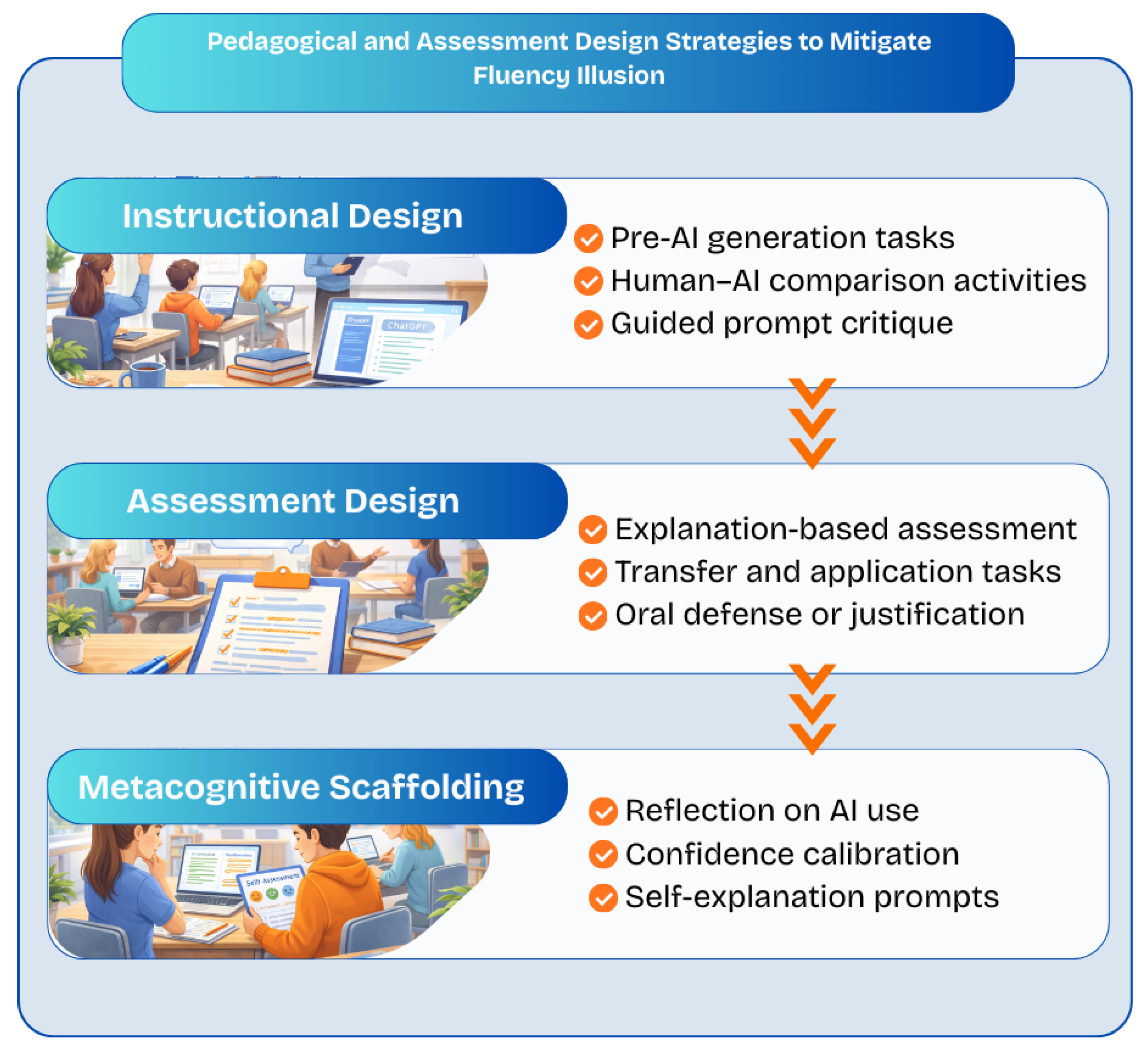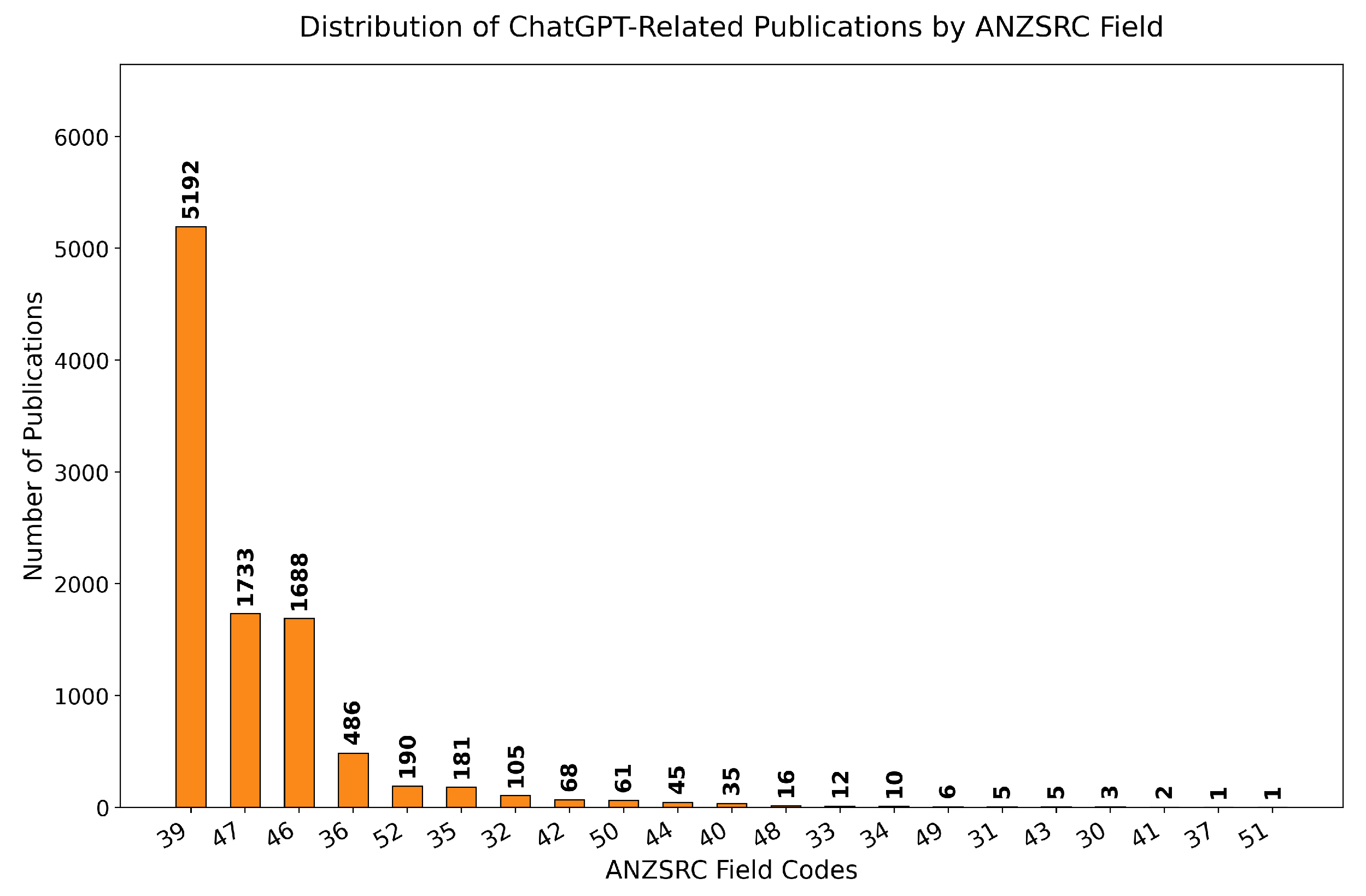

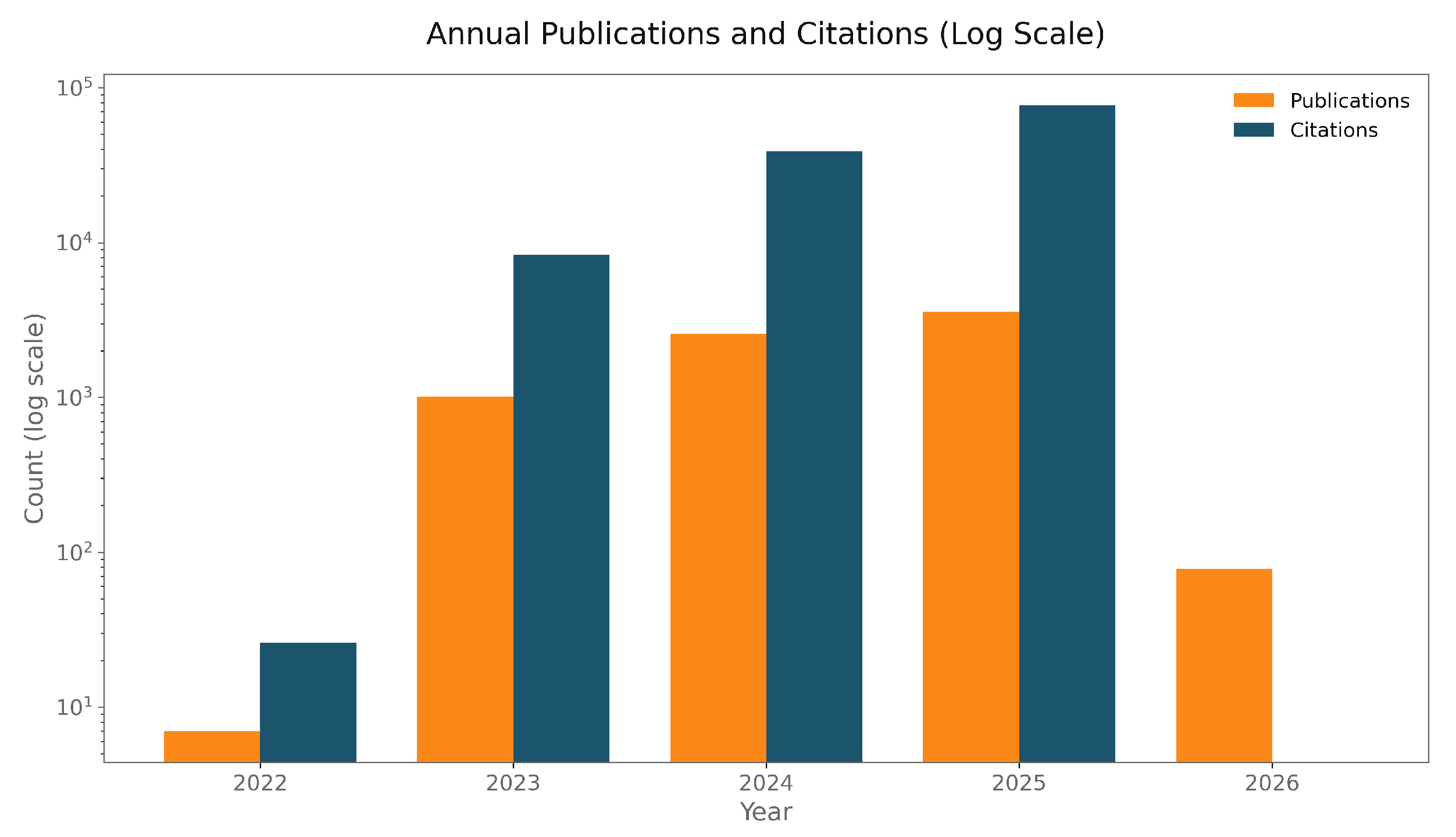
Fluency Illusion: A Review on Influence of ChatGPT in Classroom Settings

Abstract
1. Introduction
2. Methodology
2.1. Search Strategy
2.2. Inclusion and Exclusion Criteria
2.3. Screening and Selection Process
2.4. Data Extraction and Synthesis
2.5. Scope and Limitations
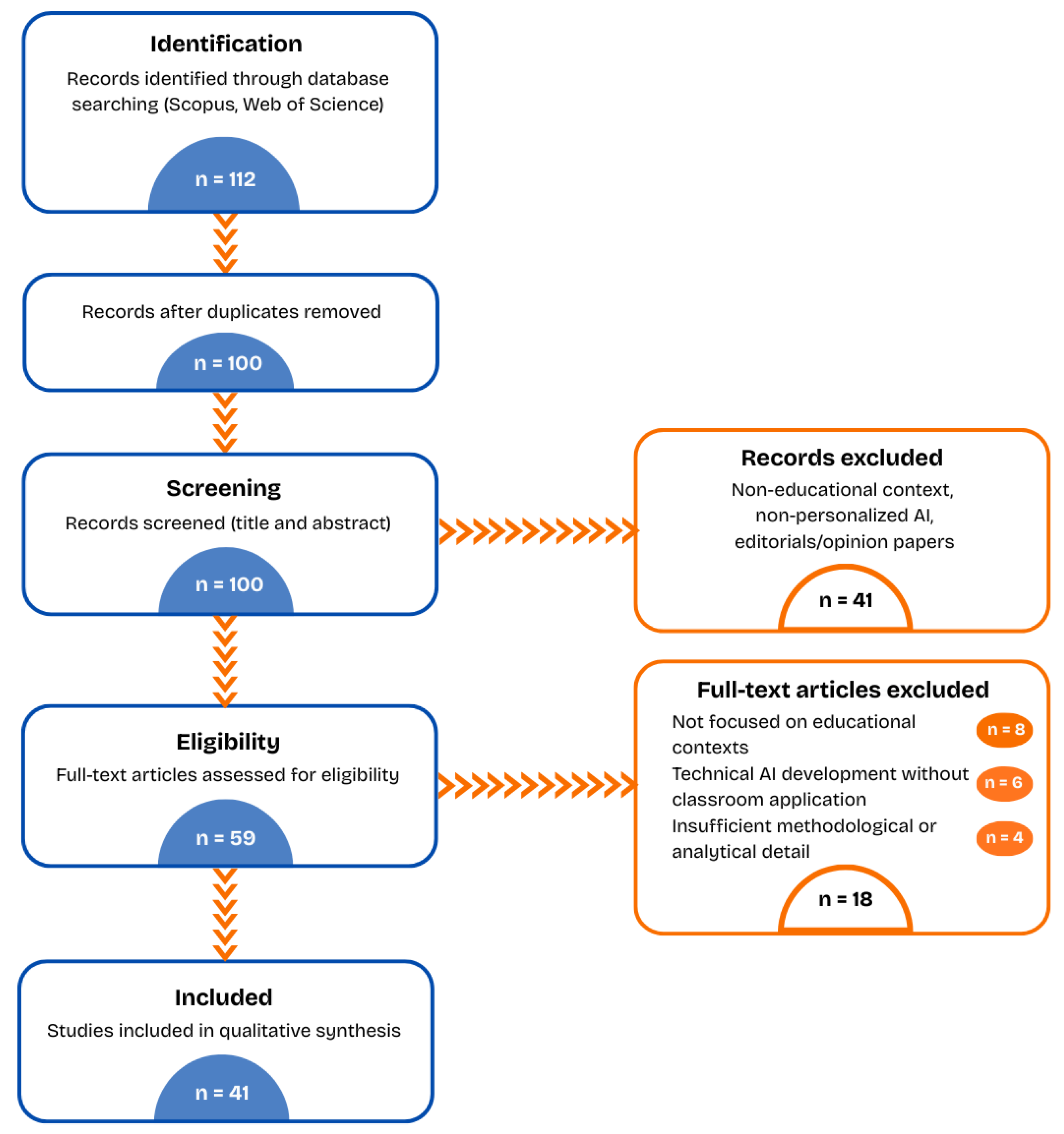
2.6. Study Selection Overview
3. Theoretical Foundations of Fluency Illusion
3.1. Processing Fluency and Judgments of Understanding
3.2. Metacognitive Monitoring and Judgments of Learning
3.3. Distinguishing Fluency Illusion from Related Metacognitive Illusions
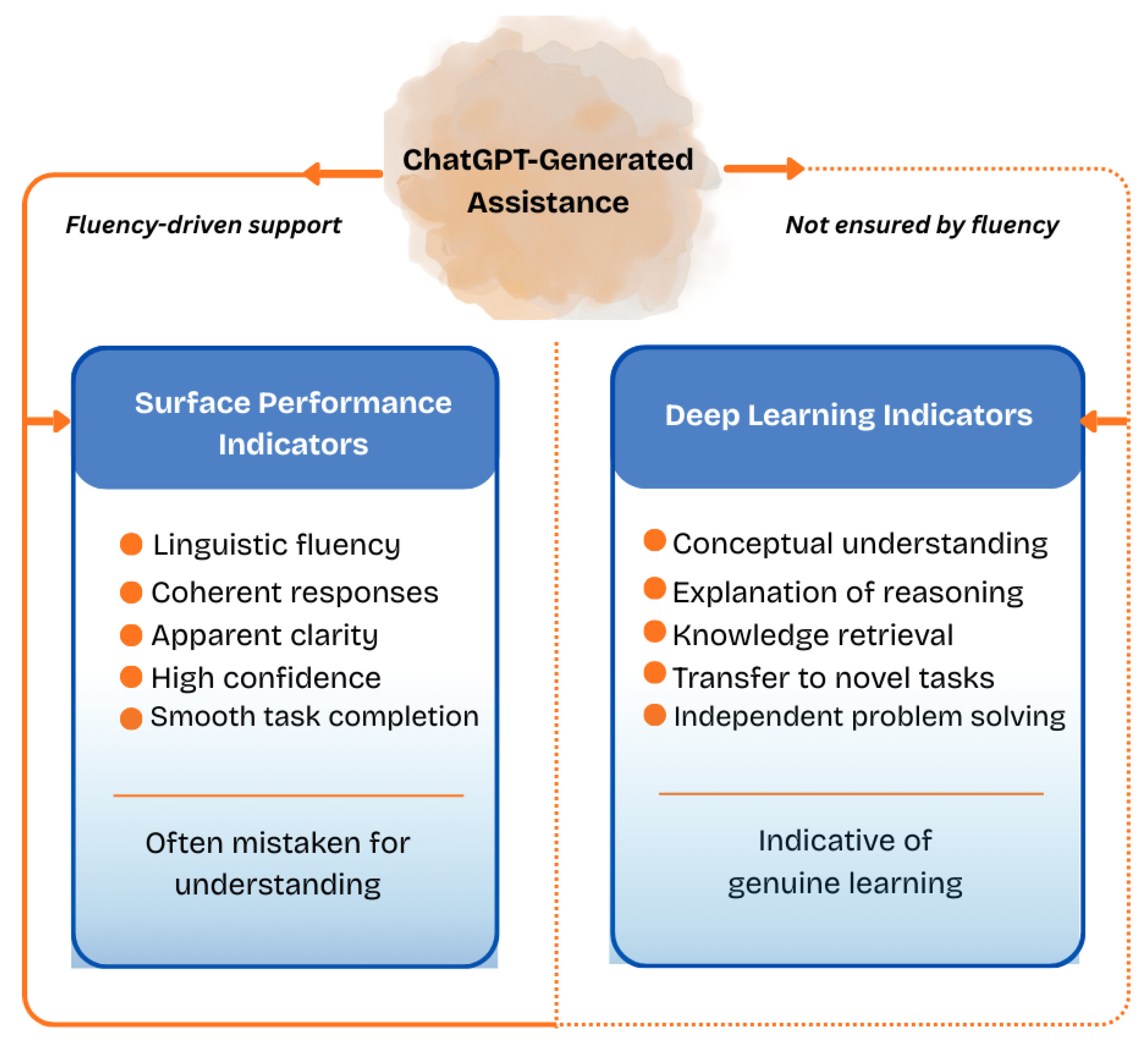
3.4. Surface Coherence and Deep Learning
4. ChatGPT in Classroom Settings: What the Literature Shows
4.1. ChatGPT in Writing and Language Learning
4.2. Problem-Solving and STEM Support
4.3. Feedback and Tutoring Functions
4.4. Assessment and Academic Integrity
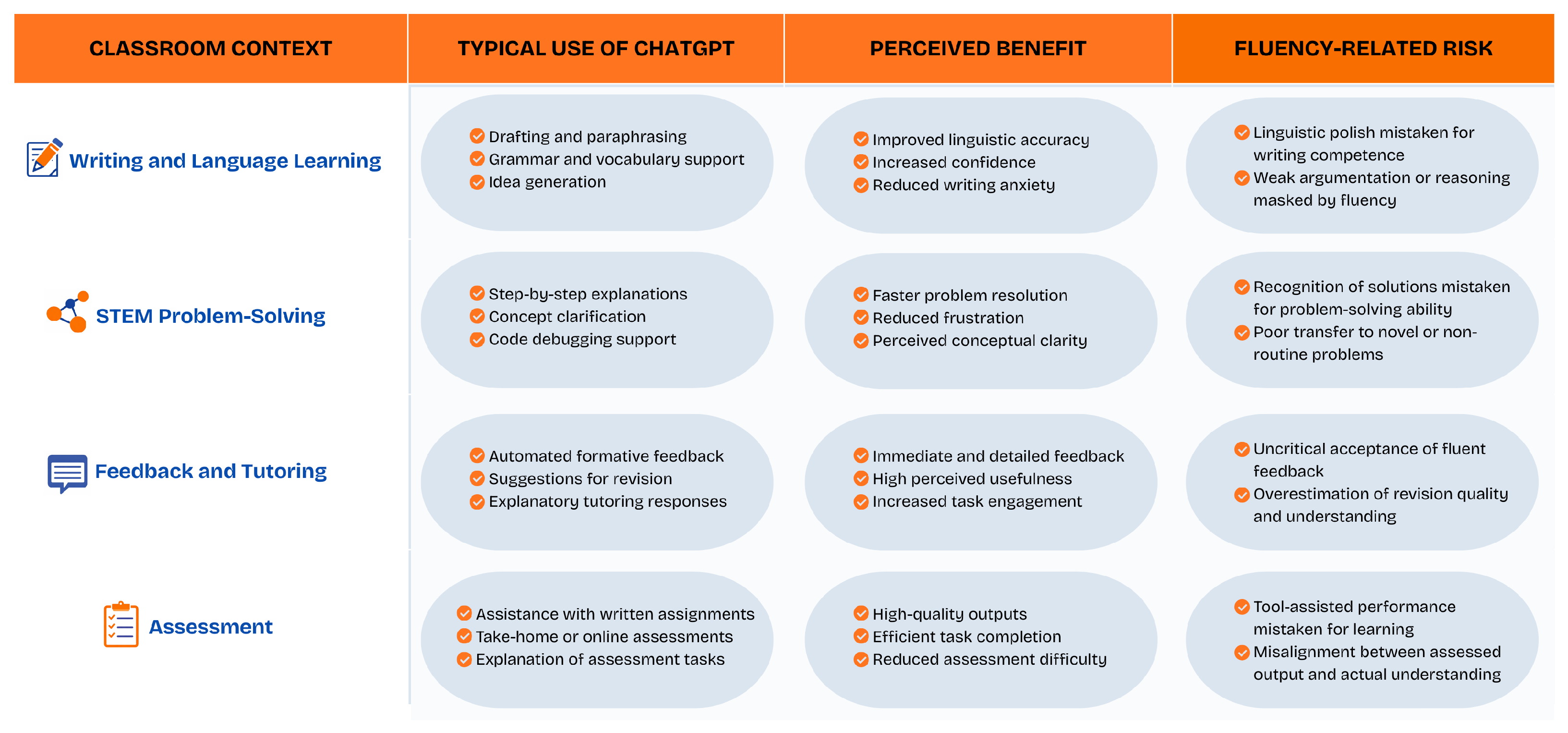
4.5. Integrative Perspective
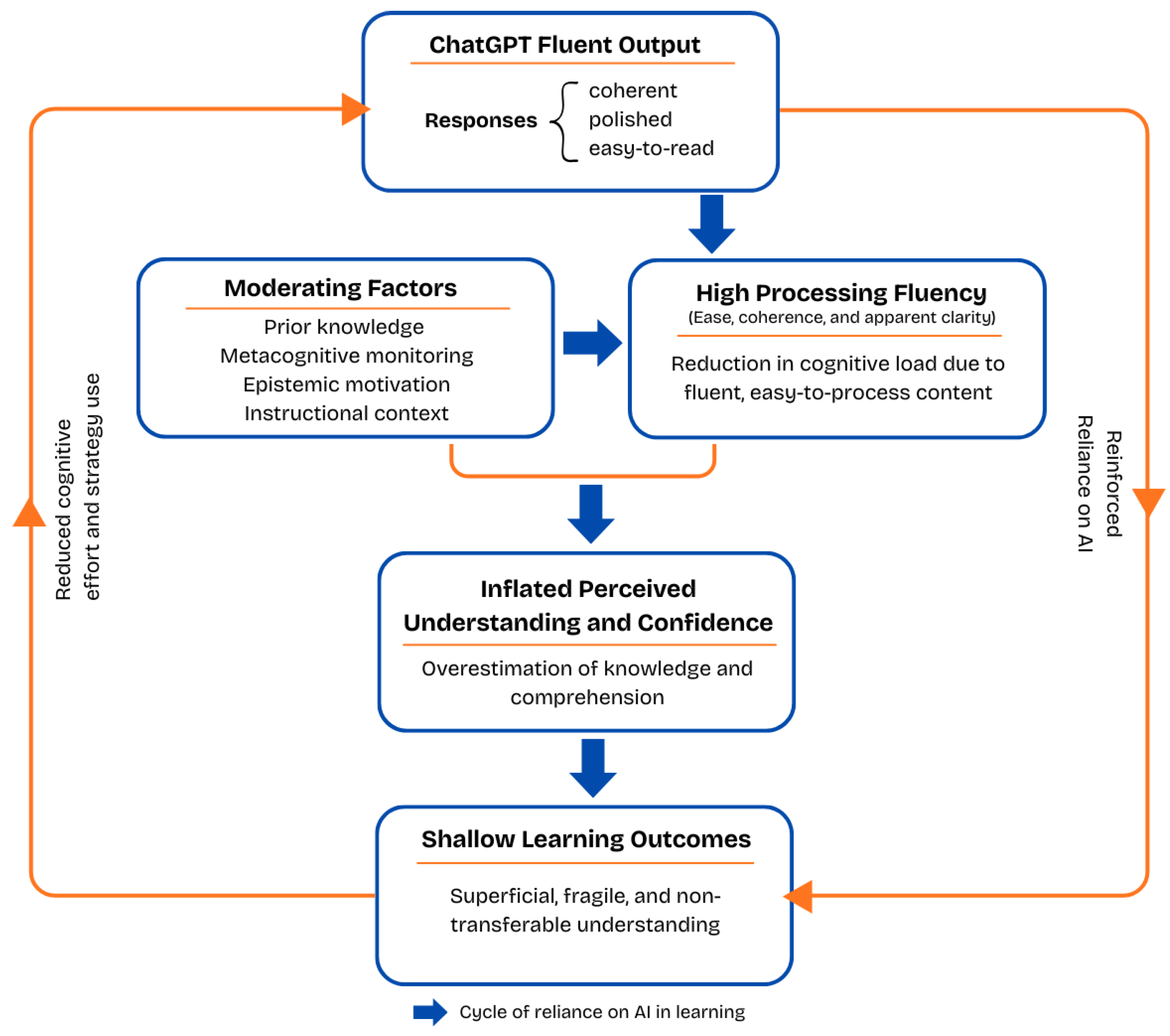
5. Conceptualizing Fluency Illusion in AI-Mediated Learning
6. Pedagogical and Assessment Implications
6.1. Managing the Risk of Over-Reliance
6.2. Rethinking Feedback Practices
6.3. Designing Assessments to Counter Fluency Illusion
6.4. Supporting Metacognitive Scaffolding
6.5. Implications for Instructional Culture
6.6. Implementation Considerations Across Instructional Contexts
7. Gaps and Future Research Directions
7.1. Moving Beyond Short-Term and Cross-Sectional Designs
7.2. Reducing Overreliance on Self-Reported Learning
7.3. Examining Metacognition as a Central Variable
7.4. Advancing Classroom-Level and Ecologically Valid Research
7.5. Toward Theory-Driven and Cumulative Research
8. Descriptive Bibliometric Overview
9. Conclusions
Author Contributions
Funding
Institutional Review Board Statement
Informed Consent Statement
Data Availability Statement
Conflicts of Interest
References
- Alqahtani, T.; Badreldin, H.A.; Alrashed, M.; Alshaya, A.I.; Alghamdi, S.S.; Saleh, K.B.; Alowais, S.A.; Alshaya, O.A.; Rahman, I.; Al Yami, M.S.; et al. The emergent role of artificial intelligence, natural learning processing, and large language models in higher education and research. Res. Soc. Adm. Pharm. 2023, 19, 1236–1242. [Google Scholar] [CrossRef]
- Emara, I.F. A linguistic comparison between ChatGPT-generated and nonnative student-generated short story adaptations: A stylometric approach. Smart Learn. Environ. 2025, 12, 36. [Google Scholar] [CrossRef]
- Meyer, J.G.; Urbanowicz, R.J.; Martin, P.C.N.; O’Connor, K.; Li, R.; Peng, P.-C.; Bright, T.J.; Tatonetti, N.; Won, K.J.; Gonzalez-Hernandez, G.; et al. ChatGPT and large language models in academia: Opportunities and challenges. BioData Min. 2023, 16, 20. [Google Scholar] [CrossRef]
- Mekheimer, M. Generative AI-assisted feedback and EFL writing: A study on proficiency, revision frequency and writing quality. Discov. Educ. 2025, 4, 170. [Google Scholar] [CrossRef]
- Anthonio, T. Linguistically-Informed Modelling of Potentials for Misunderstanding. Ph.D. Thesis, Universität Stuttgart, Stuttgart, Germany, 2024. [Google Scholar]
- Lee, S.; Song, K.-S. Teachers’ and students’ perceptions of AI-generated concept explanations: Implications for integrating generative AI in computer science education. Comput. Educ. Artif. Intell. 2024, 7, 100283. [Google Scholar] [CrossRef]
- Heersmink, R.; de Rooij, B.; Vázquez, M.J.C.; Colombo, M. A phenomenology and epistemology of large language models: Transparency, trust, and trustworthiness. Ethics Inf. Technol. 2024, 26, 41. [Google Scholar] [CrossRef]
- Metzger, M.J.; Flanagin, A.J. Credibility and trust of information in online environments: The use of cognitive heuristics. J. Pragmat. 2013, 59, 210–220. [Google Scholar] [CrossRef]
- Lee, H.-Y.; Huang, Y.-M.; Wu, T.-T. ChatGPT in Education: A Systematic Review of Current Landscape, Limitations and Future Directions Through General System Theory Lens. Eur. J. Educ. 2025, 60, e70262. [Google Scholar] [CrossRef]
- Punar Özçelik, N.; Ekşi, G.Y. Cultivating writing skills: The role of ChatGPT as a learning assistant—A case study. Smart Learn. Environ. 2024, 11, 10. [Google Scholar] [CrossRef]
- Wang, C. Exploring students’ generative AI-assisted writing processes: Perceptions and experiences from native and nonnative English speakers. Technol. Knowl. Learn. 2025, 30, 1825–1846. [Google Scholar] [CrossRef]
- Khampusaen, D. The Impact of ChatGPT on Academic Writing Skills and Knowledge: An Investigation of Its Use in Argumentative Essays. Learn. J. Lang. Educ. Acquis. Res. Netw. 2025, 18, 963–988. [Google Scholar]
- Zhang, M.; Osman, K. Exploring the Implementation and Challenges of the ChatGPT in STEM Higher Education: A Systematic Literature Review. In 2024 Yearbook Emerging Technologies in Learning; Springer: Berlin/Heidelberg, Germany, 2025; pp. 3–22. [Google Scholar]
- Zhai, C.; Wibowo, S.; Li, L.D. The effects of over-reliance on AI dialogue systems on students’ cognitive abilities: A systematic review. Smart Learn. Environ. 2024, 11, 28. [Google Scholar] [CrossRef]
- Polozov, A. The deep illusion: A critical analysis of DeepSeek and the limits of large language models. AI Ethics 2025, 5, 5587–5596. [Google Scholar] [CrossRef]
- Ou, A.W.; Stöhr, C.; Malmström, H. Academic communication with AI-powered language tools in higher education: From a post-humanist perspective. System 2024, 121, 103225. [Google Scholar] [CrossRef]
- Reber, R.; Greifeneder, R. Processing fluency in education: How metacognitive feelings shape learning, belief formation, and affect. Educ. Psychol. 2017, 52, 84–103. [Google Scholar] [CrossRef]
- Unkelbach, C.; Greifeneder, R. A general model of fluency effects in judgment and decision making. In The Experience of Thinking; Psychology Press: Hove, UK, 2013; pp. 11–32. [Google Scholar]
- Finn, B.; Tauber, S.K. When confidence is not a signal of knowing: How students’ experiences and beliefs about processing fluency can lead to miscalibrated confidence. Educ. Psychol. Rev. 2015, 27, 567–586. [Google Scholar] [CrossRef]
- Sobel, D.M.; Kushnir, T. Knowledge matters: How children evaluate the reliability of testimony as a process of rational inference. Psychol. Rev. 2013, 120, 779. [Google Scholar] [CrossRef] [PubMed]
- Hacker, D.J.; Dunlosky, J.; Graesser, A.C. (Eds.) Handbook of Metacognition in Education; Routledge: New York, NY, USA, 2009. [Google Scholar]
- Koriat, A. Monitoring one’s own knowledge during study: A cue-utilization approach to judgments of learning. J. Exp. Psychol. Gen. 1997, 126, 349. [Google Scholar] [CrossRef]
- Dunlosky, J.; Metcalfe, J. Metacognition; Sage Publications: Thousand Oaks, CA, USA, 2008. [Google Scholar]
- Rozenblit, L.; Keil, F. The misunderstood limits of folk science: An illusion of explanatory depth. Cogn. Sci. 2002, 26, 521–562. [Google Scholar] [CrossRef] [PubMed]
- Dinsmore, D.L.; Alexander, P.A. A critical discussion of deep and surface processing: What it means, how it is measured, the role of context, and model specification. Educ. Psychol. Rev. 2012, 24, 499–567. [Google Scholar] [CrossRef]
- Sweller, J. Cognitive load during problem solving: Effects on learning. Cogn. Sci. 1988, 12, 257–285. [Google Scholar] [CrossRef]
- Sweller, J.; Van Merriënboer, J.J.; Paas, F. Cognitive architecture and instructional design: 20 years later. Educ. Psychol. Rev. 2019, 31, 261–292. [Google Scholar] [CrossRef]
- Bjork, E.L.; Bjork, R.A. Making things hard on yourself, but in a good way: Creating desirable difficulties to enhance learning. In Psychology and the Real World: Essays Illustrating Fundamental Contributions to Society; Worth Publishers: New York, NY, USA, 2011; Volume 2, pp. 56–64. [Google Scholar]
- Wagner, M. Adaptive Educational Strategies for Creative Fields in the Era of Generative AI: A Framework for Navigating Technological Uncertainty. In ICERI2024 Proceedings; IATED: Valencia, Spain, 2024; pp. 3068–3075. [Google Scholar]
- Kolhatin, A.O. From automation to augmentation: A human-centered framework for generative AI in adaptive educational content creation. In CEUR Workshop Proceedings; CEUR-WS.org: Aachen, Germany, 2025; Volume 4060, pp. 143–195. [Google Scholar]
- Grifoni, B.E.; Ferrario, R. The bewitching AI: The Illusion of Communication with Large Language Models. Philos. Technol. 2025, 38, 61. [Google Scholar] [CrossRef]
- Abdelhalim, S.M.; Alsehibany, R. Integrating ChatGPT for vocabulary learning and retention: A classroom-based study of Saudi EFL learners. Lang. Learn. Technol. 2025, 29, 1–24. [Google Scholar] [CrossRef]
- Murayama, K.; Blake, A.B.; Kerr, T.; Castel, A.D. When enough is not enough: Information overload and metacognitive decisions to stop studying information. J. Exp. Psychol. Learn. Mem. Cogn. 2016, 42, 914. [Google Scholar] [CrossRef]
- Albadarin, Y.; Saqr, M.; Pope, N.; Tukiainen, M. A systematic literature review of empirical research on ChatGPT in education. Discov. Educ. 2024, 3, 60. [Google Scholar] [CrossRef]
- Li, Y. Usability of ChatGPT in Second Language Acquisition: Capabilities, Effectiveness, Applications, Challenges, and Solutions. Stud. Appl. Linguist. TESOL 2024, 24, 24–37. [Google Scholar] [CrossRef]
- Reza, M.; Thomas-Mitchell, J.; Dushniku, P.; Laundry, N.; Williams, J.J.; Kuzminykh, A. Co-writing with ai, on human terms: Aligning research with user demands across the writing process. Proc. ACM Hum.-Comput. Interact. 2025, 9, CSCW385. [Google Scholar] [CrossRef]
- Baron, N.S. Who Wrote This?: How AI and the Lure of Efficiency Threaten Human Writing; Stanford University Press: Redwood City, CA, USA, 2023. [Google Scholar]
- Jiang, F.K.; Hyland, K. Metadiscursive nouns in academic argument: ChatGPT vs student practices. J. Engl. Acad. Purp. 2025, 75, 101514. [Google Scholar] [CrossRef]
- Ismail, H.Y.S. Cohesion and coherence in essays generated by chatgpt: A comparative analysis to university students’ writing. CDELT Occas. Pap. Dev. Engl. Educ. 2023, 83, 143–165. [Google Scholar] [CrossRef]
- Ngu, B.H.; Phan, H.P. Instructional approach and acquisition of mathematical proficiency: Theoretical insights from learning by comparison and cognitive load theory. Asian J. Math. Educ. 2024, 3, 357–379. [Google Scholar] [CrossRef]
- Graefen, B.; Fazal, N. From Chat bots to Virtual Tutors: An Overview of Chat GPT’s Role in the Future of Education. Arch. Pharm. Pract. 2024, 15, 43–52. [Google Scholar] [CrossRef]
- Cavalcanti, A.P.; Barbosa, A.; Carvalho, R.; Freitas, F.; Tsai, Y.S.; Gašević, D.; Mello, R.F. Automatic feedback in online learning environments: A systematic literature review. Comput. Educ. Artif. Intell. 2021, 2, 100027. [Google Scholar] [CrossRef]
- Mulenga, R.; Shilongo, H. Academic integrity in higher education: Understanding and addressing plagiarism. Acta Pedagog. Asiana 2024, 3, 30–43. [Google Scholar] [CrossRef]
- Kasneci, E.; Seßler, K.; Küchemann, S.; Bannert, M.; Dementieva, D.; Fischer, F.; Gasser, U.; Groh, G.; Günnemann, S.; Hüllermeier, E.; et al. ChatGPT for good? On opportunities and challenges of large language models for education. Learn. Individ. Differ. 2023, 103, 102274. [Google Scholar] [CrossRef]
- Holmes, W.; Miao, F. Guidance for Generative AI in Education and Research; Unesco Publishing: Paris, France, 2023. [Google Scholar]
- Jo, H. From concerns to benefits: A comprehensive study of ChatGPT usage in education. Int. J. Educ. Technol. High. Educ. 2024, 21, 35. [Google Scholar] [CrossRef]
- Blankenship, R. Pedagogical models and generative AI fluency: A three-tiered empirical framework approach. In Exploring New Horizons: Generative Artificial Intelligence and Teacher Education; Association for the Advancement of Computing in Education: Waynesville, NC, USA, 2024; p. 39. [Google Scholar]
- Turo, S.; Collin, F.; Brouillet, D. When the sense of fluency triggers an attentional bias. Q. J. Exp. Psychol. 2023, 76, 350–360. [Google Scholar] [CrossRef] [PubMed]
- Parks, C.M.; Toth, J.P. Fluency, familiarity, aging, and the illusion of truth. Aging Neuropsychol. Cogn. 2006, 13, 225–253. [Google Scholar] [CrossRef] [PubMed]
- Namaziandost, E.; Rezai, A. Artificial intelligence in open and distributed learning: Does it facilitate or hinder teaching and learning? Int. Rev. Res. Open Distrib. Learn. 2024, 25, i–vii. [Google Scholar] [CrossRef]
- Cianferoni, F. AI in Higher Education: From Literature to a Course-Anchored Chatbot. Ph.D. Thesis, Politecnico di Torino, Torino, Italy, 2025. [Google Scholar]
- Gkintoni, E.; Antonopoulou, H.; Sortwell, A.; Halkiopoulos, C. Challenging cognitive load theory: The role of educational neuroscience and artificial intelligence in redefining learning efficacy. Brain Sci. 2025, 15, 203. [Google Scholar] [CrossRef]
- Levin, I.; Marom, M.; Kojukhov, A. Rethinking AI in Education: Highlighting the Metacognitive Challenge. BRAIN Broad Res. Artif. Intell. Neurosci. 2025, 16, 250–263. [Google Scholar] [CrossRef]
- Alshahrani, K.; Qureshi, R.J. Review the prospects and obstacles of AI-enhanced learning environments: The role of ChatGPT in education. Int. J. Mod. Educ. Comput. Sci. 2024, 16, 71–86. [Google Scholar] [CrossRef]
- Lundberg, S. ChatGPT vs. Teacher Feedback Provision: An Investigation on the Efficacy of ChatGPT Feedback Provision on Written Production Across Proficiency Levels; Stockholm University: Stockholm, Sweden, 2024. [Google Scholar]
- Parsons, P. Promoting representational fluency for cognitive bias mitigation in information visualization. In Cognitive Biases in Visualizations; Springer International Publishing: Cham, Switzerland, 2018; pp. 137–147. [Google Scholar]
- Topolinski, S. The sources of fluency: Identifying the underlying mechanisms of fluency effects. In The Experience of Thinking; Psychology Press: Hove, UK, 2013; pp. 33–49. [Google Scholar]
- Schwartz, B.L.; Jemstedt, A. The role of fluency and dysfluency in metacognitive experiences. In Trends and Prospects in Metacognition Research Across the Life Span: A Tribute to Anastasia Efklides; Springer International Publishing: Cham, Switzerland, 2021; pp. 25–40. [Google Scholar]
- Jang, H.; Kim, S.; So, H.-J. Technology-based scaffolding for ill-structured problem-solving: A systematic review and emerging directions with AI. Learn. Res. Pract. 2025, 1–24. [Google Scholar] [CrossRef]
- Watts, N.; Galvin, C. Aligning Professional Identity with Institutional Culture: The Role of Educators’ Digital Fluency in Harnessing the Potential of Online and Technology Enhanced Learning. In Proceedings of the 2019 ICDE World Conference on Online Learning; Brown, M., Nic Giolla Mhichíl, M., Beirne, E., Costello, E., Eds.; Dublin City University: Dublin, Ireland, 2020; Volume 1. [Google Scholar]
- Baskara, F.X.R. ChatGPT and Critical Digital Pedagogy: Examining the Potential and Challenges for Educational Practice. Proceeding Int. Conf. Inov. Sci. Technol. Educ. Child. Health 2024, 4, 57–73. [Google Scholar]
- Almulla, M.A. Investigating influencing factors of learning satisfaction in AI ChatGPT for research: University students perspective. Heliyon 2024, 10, e32220. [Google Scholar] [CrossRef]
- Christensen, R.; Knezek, G. Self-report measures and findings for information technology attitudes and competencies. In International Handbook of Information Technology in Primary and Secondary Education; Springer: Boston, MA, USA, 2008; pp. 349–365. [Google Scholar]
- Dimensions. Bibliometric Analysis Portal. Available online: https://app.dimensions.ai/discover/publication (accessed on 15 January 2026).




| Research Gap | Rationale/Implications | Suggested Research Approaches |
|---|---|---|
| Lack of longitudinal studies | Short-term studies cannot capture the development of fluency illusion or long-term learning outcomes | Longitudinal designs tracking metacognitive calibration, cognitive strategies, and dependence on AI across semesters |
| Overreliance on self-reported learning | Self-reports may reflect perceived understanding shaped by fluent AI output rather than actual learning | Triangulate with performance-based assessments, error detection tasks, and delayed transfer measures |
| Limited attention to metacognition | Few studies measure how students monitor and regulate their learning with AI | Incorporate explicit metacognitive measures such as confidence calibration, reflective prompts, and think-aloud protocols |
| Need for classroom-level observational research | Controlled studies may not capture interactional and contextual factors affecting AI use | Mixed-methods approaches combining observation, artifact analysis, and instructor interviews in authentic classroom settings |
| Theory-driven integration | Many studies lack a unifying framework to interpret findings | Use fluency illusion as an organizing construct to connect cognitive, metacognitive, and educational research |
| Type of AI Use | Typical Student Activity | Immediate Benefit | Potential Learning Risk |
|---|---|---|---|
| Linguistic support | Grammar correction, paraphrasing, vocabulary suggestions | Improved language fluency and readability | Surface-level improvement may be mistaken for stronger writing competence [10,39] |
| Partial assistance | Brainstorming ideas, outlining arguments, revising drafts | Faster idea generation and clearer structure | Students may rely on AI for organization without strengthening reasoning [11,36] |
| Substantial drafting support | AI generates paragraphs or sections based on prompts | Faster completion and more polished text | Reduced engagement in constructing arguments independently [11,12] |
| Full authorship substitution | AI generates most or all of the final text | High-quality surface output with minimal effort | Limited development of writing, reasoning, and conceptual understanding [12,37] |
| Category | Description |
|---|---|
| Database | Dimensions [64] |
| Search fields | Title and abstract |
| Core keywords | (“ChatGPT” OR “generative AI” OR “large language model”) AND (education OR learning OR classroom) |
| Publication years | 2022–2025 |
| Publication type | Articles |
| Language | English |
| Fields of Research | 39 Education (3901 Curriculum and Pedagogy; 3902 Education Policy, Sociology and Philosophy; |
| 3903 Education Systems; 3904 Specialist Studies in Education); | |
| 47 Language, Communication and Culture (4701 Communication and Media Studies; | |
| 4703 Language Studies; 4704 Linguistics; 4705 Literary Studies); | |
| 36 Creative Arts and Writing (3602 Creative and Professional Writing); | |
| 52 Psychology (5201 Applied and Developmental Psychology; | |
| 5204 Cognitive and Computational Psychology); | |
| 46 Information and Computing Sciences (4601 Applied Computing; | |
| 4608 Human-Centred Computing; 4609 Information Systems) | |
| Date of data retrieval | 15 January 2026 |
Disclaimer/Publisher’s Note: The statements, opinions and data contained in all publications are solely those of the individual author(s) and contributor(s) and not of MDPI and/or the editor(s). MDPI and/or the editor(s) disclaim responsibility for any injury to people or property resulting from any ideas, methods, instructions or products referred to in the content. |
© 2026 by the authors. Licensee MDPI, Basel, Switzerland. This article is an open access article distributed under the terms and conditions of the Creative Commons Attribution (CC BY) license.
Share and Cite
Kumar, S.; Mikayelyan, A.; Vorfolomeyeva, O. Fluency Illusion: A Review on Influence of ChatGPT in Classroom Settings. Information 2026, 17, 299. https://doi.org/10.3390/info17030299
Kumar S, Mikayelyan A, Vorfolomeyeva O. Fluency Illusion: A Review on Influence of ChatGPT in Classroom Settings. Information. 2026; 17(3):299. https://doi.org/10.3390/info17030299
Chicago/Turabian StyleKumar, Sachin, Anna Mikayelyan, and Olga Vorfolomeyeva. 2026. "Fluency Illusion: A Review on Influence of ChatGPT in Classroom Settings" Information 17, no. 3: 299. https://doi.org/10.3390/info17030299
APA StyleKumar, S., Mikayelyan, A., & Vorfolomeyeva, O. (2026). Fluency Illusion: A Review on Influence of ChatGPT in Classroom Settings. Information, 17(3), 299. https://doi.org/10.3390/info17030299