
Review

The Evolution of Visualization Technologies in Healthcare: A Bibliometric Analysis of Studies Published from 1994 to 2025


School of Design, Jiangnan University, No. 1800 Lihu Avenue, Wuxi 214122, China
*
Author to whom correspondence should be addressed.
Information 2026, 17(3), 281; https://doi.org/10.3390/info17030281
Submission received: 30 December 2025 / Revised: 2 March 2026 / Accepted: 5 March 2026 / Published: 11 March 2026
(This article belongs to the Special Issue Medical Data Visualization)

Abstract

Healthcare visualization has become a crucial approach for interpreting complex medical data, supporting informed clinical decision-making, and enhancing public health management. However, existing reviews tend to focus on specific technologies or application scenarios, offering limited insight into the field’s overall knowledge structure, developmental trajectory, and interdisciplinary integration. To address this gap, this study systematically reviews 1121 publications from 1994 to 2025 indexed in the Web of Science Core Collection. By combining bibliometric analysis with qualitative assessment, it maps the field’s evolution and underlying research paradigms. The findings reveal a clear shift from early innovation in technical tools toward the realization of clinical value, giving rise to an integrated research system that connects technology, data, clinical practice, and public health. Recent research has progressed beyond initial explorations of medical imaging, standalone devices, and isolated techniques, moving instead toward core domains such as immersive medical visualization, medical data visualization and analytics, health information systems and decision support, AI-assisted epidemic prediction and diagnosis, and integrated IoT-based healthcare frameworks. Looking ahead, an assessment of future trends suggests that, among other directions, the deep integration of explainable artificial intelligence (XAI) with visualization analysis, the development of IoT-driven real-time interactive systems, and the extension of visualization-enabled services from clinical applications toward inclusive population-level health coverage represent core driving forces for the future development of this field. These insights offer strategic guidance for future research, inform the design principles of next-generation visualization systems, and provide new models of interdisciplinary collaboration. The results also offer evidence-based support for health resource planning, technological innovation, and policy formulation.

1. Introduction

Healthcare is a social and collective service product [1] that primarily relies on coordinated cross-sectoral policy systems [2], including public health systems [3], health insurance schemes [4], and integrated primary care networks [5], to maintain or improve the physical, mental, and social well-being of stakeholders [6,7]. Within this context, visualization technologies enhance the capacity of multiple stakeholders to articulate service needs and support precision in evaluation [8], prediction [9], and decision-making [10] related to healthcare service effectiveness [11], clinical outcomes [12], and equity in resource allocation [13]. These technologies further enable the real-time integration and dynamic presentation of heterogeneous, multisource health data [14], even in complex healthcare scenarios [15], such as personalized treatment planning for patients with multiple comorbidities [16], modeling the transmission dynamics of emerging infectious diseases [17], and resilient allocation of medical resources based on regional demographic characteristics [18].
Information access asymmetry remains a major source of tension in doctor–patient relationships within healthcare settings [19]. The increasing volume and fragmentation of data impose substantial cognitive burdens on healthcare professionals [20,21], while patients’ limited comprehension and acceptance of medical information often contribute to suboptimal treatment outcomes [22]. Visualization technologies address these challenges by transforming complex data into intuitive visual representations that help users clarify relevant informational contexts [23] and make latent or hard-to-detect features more perceptible [24]. As a versatile medium in healthcare, visualization supports real-time, multi-window collaboration [25,26]. It enables the rapid integration of diverse information streams into clinical image-reading interfaces, such as physiological indicators from electrocardiogram systems [27], clinical data from infrared thermal imaging devices [28], and imaging outputs from CT and MRI scans [29].
Moreover, visualization technologies facilitate information transparency by enabling the real-time presentation of vital sign data [30], diagnostic results [31], treatment plans [32,33], and medication guidance [34] on interfaces accessible to healthcare professionals, patients, and family members. Dynamic demonstrations of disease progression supported by virtual reality or augmented reality technologies further enhance patients’ understanding of clinical conditions and treatment effects [35], thereby improving doctor–patient communication. Efficient visual data presentation also reduces redundant tasks and alleviates clinicians’ workload, helping to prevent missed opportunities for timely intervention caused by data overload, processing delays, or interpretive difficulties [36]. By transforming raw inputs—such as medical images and biochemical test results—into dynamic graphical models using color or waveform representations [37], visualization supports self-monitoring and personalized health management, ultimately improving patient adherence to treatment [38]. Consequently, the application and study of healthcare visualization extend beyond a single discipline, requiring interdisciplinary collaboration across medicine, computer science, engineering, and design [39,40].
Although the interdisciplinary value and application advantages of healthcare visualization technologies have been increasingly recognized, existing literature reviews remain limited in their ability to capture the field’s overall development trajectory and cross-disciplinary integration. As a result, the evolutionary pathways of healthcare visualization remain insufficiently understood. Most prior reviews focus on isolated technological domains, such as medical imaging [41] or biosignal visualization [42], reflecting only partial aspects of the field and failing to represent its broader application landscape or recent methodological advances. For example, Nguyen and Voznak [43] examined visualization within the context of smart healthcare in the metaverse but lacked a systematic and multidisciplinary analytical framework. Tan et al. [44] conducted a more focused investigation using systematic review methods, concentrating on common data domains such as electronic health records, sensor data, and public health data; however, their work provided limited insight into the visualization of high-dimensional health data and its future development trends. Similarly, Abudiyab and Alanazi [45] analyzed studies published between 2018 and 2021, a restricted timeframe that excluded emerging directions such as digital twins [46], metaverse-based healthcare collaboration [43], and blockchain-supported medical data visualization [47]. Collectively, these limitations hinder existing research from revealing the evolutionary and convergent dynamics of healthcare visualization technologies [48], constraining analyses of their sustainability and adaptability [49], and limiting deeper exploration of interdisciplinary collaboration potential [50].
Against this background, the present study aims to conduct a comprehensive examination of visualization technologies within the healthcare domain. By synthesizing existing applications and employing three bibliometric analysis tools—CiteSpace (6.4.R1), VOSviewer (1.6.20), and Bibliometrix (R version 4.4.2)—this study integrates visualization, qualitative, and quantitative analyses to investigate how visualization approaches enhance healthcare functionality and effectiveness from multiple perspectives. Understanding both the current state and future trajectories of visualization applications in healthcare is essential. Accordingly, this study evaluates key characteristics of healthcare visualization research, constructs knowledge maps through methods such as keyword co-occurrence analysis, and identifies major thematic patterns within the field. Furthermore, by tracing the evolution of the healthcare visualization knowledge system over time, this study seeks to anticipate future research directions.

2. Materials and Methods

2.1. Research Process

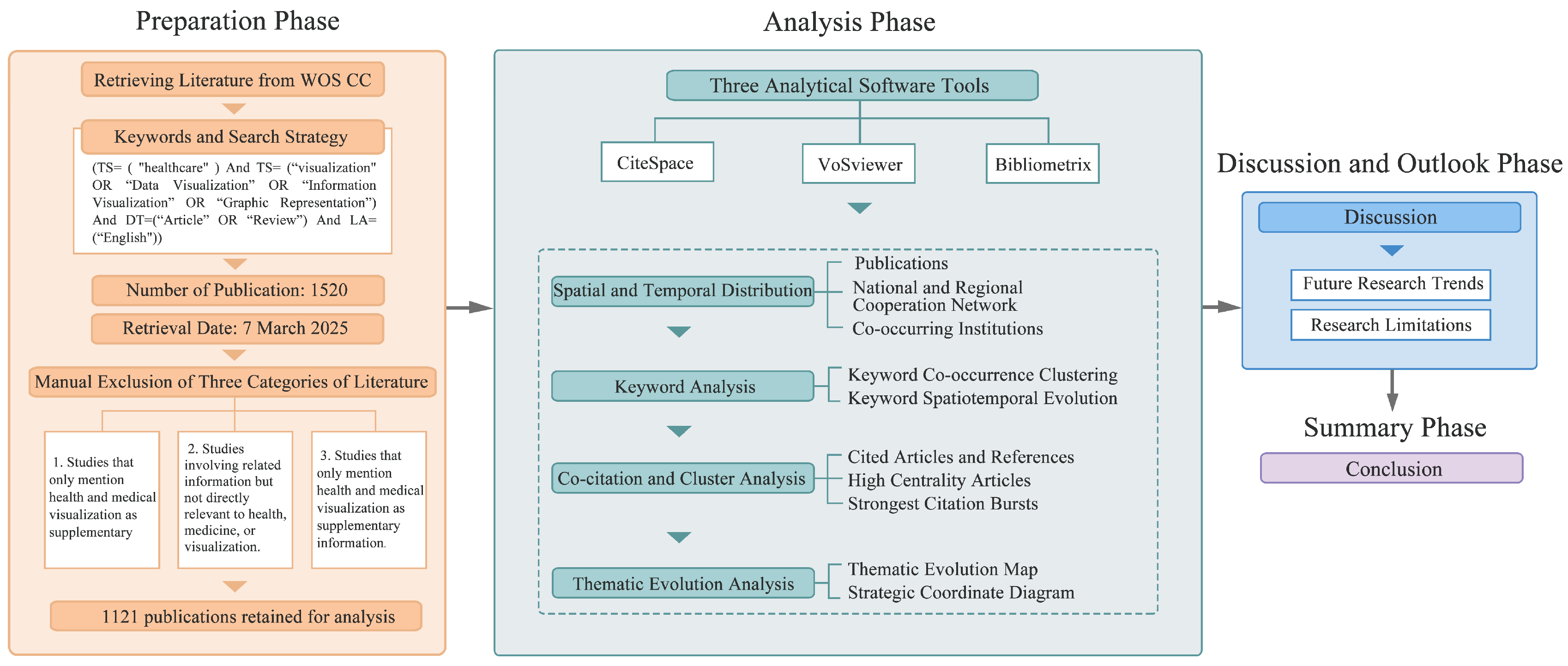
This study adopts a structured bibliometric analysis framework comprising four sequential phases.
(1)
Preparation phase: A thematic literature database was constructed through systematic retrieval and rigorous screening to support subsequent quantitative analysis.
(2)
Analysis phase: Multiple bibliometric tools—CiteSpace, VOSviewer, and Bibliometrix—were jointly employed to analyze the retrieved literature. The analysis focused on spatial and temporal distribution (publications, national and regional collaboration networks, and co-occurring institutions), keyword analysis (keyword co-occurrence clustering and spatiotemporal evolution), co-citation and cluster analysis (cited articles and references, high centrality analysis, and strongest citation bursts), and thematic evolution analysis (thematic evolution map and strategic diagram analysis).
(3)
Discussion and outlook phase: Based on the analytical results, emerging research trends were identified, and the methodological limitations of the present study were critically examined.
(4)
Summary phase: Core findings were synthesized to derive academic implications and to inform future directions in healthcare visualization research.

2.2. Data Sources

A systematic and transparent data collection strategy was employed to ensure the comprehensiveness and scientific rigor of the bibliometric dataset. Literature retrieval was conducted using the Web of Science Core Collection (WoSCC), a database widely acknowledged for its high-quality and standardized citation records [51]. Prior bibliometric studies by Ye et al. [52], Mansoori [53], and Chen and Shin [54] have demonstrated the reliability and feasibility of WoSCC as a primary data source. Moreover, the bibliographic formats provided by WoSCC are fully compatible with major bibliometric software packages, facilitating efficient data processing and analysis [55]. To improve retrieval precision and thematic relevance, carefully selected keywords were used to delimit the search scope [56]. Specifically, keywords were applied within subject fields to optimize retrieval accuracy further. The complete search query was formulated as follows:
TS = (“healthcare”) AND TS = (“visualization” OR “data visualization” OR “information visualization” OR “graphic representation”) AND DT = (“Article” OR “Review”) AND LA = (“English”).
Previous studies indicate that journal articles and review papers carry greater academic influence than conference proceedings in bibliometric analyses [56]; therefore, they were included as scope-defining criteria. Following retrieval, a multi-stage screening process was conducted. An initial dataset of 1520 records was obtained and subsequently reviewed to ensure compliance with the selection criteria. To more accurately assess topical relevance, key information from each article was examined through content reading, leading to the exclusion of three categories of literature:
(1)
studies in which healthcare visualization was mentioned only as ancillary background information;
(2)
studies containing relevant methodological elements but lacking a direct focus on either healthcare or visualization;
(3)
retracted publications or records with significant data formatting errors.
After screening, a final corpus of 1121 articles was retained for bibliometric analysis (Figure 1).

2.3. Research Methodology

Bibliometric analysis is a quantitative research approach that systematically processes large-scale bibliographic data—such as publication outputs, citation relationships, keyword frequencies, and thematic distributions—to uncover the knowledge structure, developmental trajectories, and scholarly influence within a research domain. This method provides a robust analytical basis for identifying research frontiers, knowledge gaps, and emerging topics, thereby supporting evidence-based academic inquiry [57]. In this study, CiteSpace, VOSviewer, and Bibliometrix were employed as the primary analytical tools. CiteSpace and VOSviewer are widely used visualization platforms for bibliometric analysis and scientific knowledge mapping [58]. Leveraging citation and co-occurrence data from databases such as WoSCC, these tools enable the exploration of knowledge structures, research hotspots, and evolutionary patterns within a given field, thereby assisting scholars in tracing disciplinary development and identifying emerging research directions [59]. Bibliometrix is an R-based bibliometric toolkit for analyzing and visualizing scientific publication data. Its interactive web interface, Biblioshiny, facilitates intuitive visualization and in-depth analysis of science mapping data [60]. Supported by the open-source R ecosystem, it offers high flexibility and reproducibility, allowing researchers to customize analytical workflows and refine results as needed [61]. The graphical user interface strikes a balance between usability and analytical depth, making it suitable for both novice users and experienced bibliometric researchers [62].

3. Results

3.1. Spatial and Temporal Distribution

3.1.1. Publication

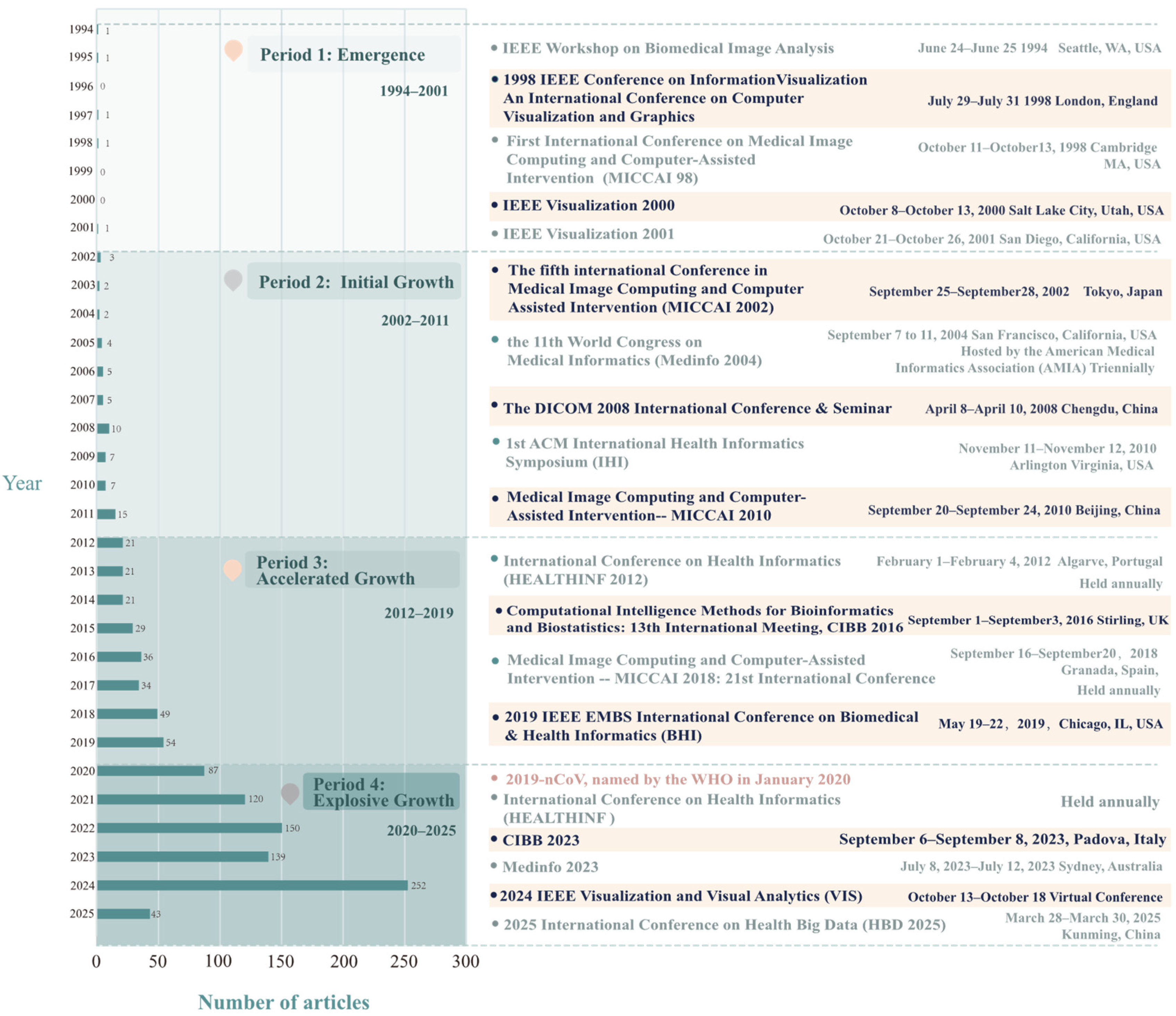
An analysis of literature retrieved from the WoSCC database indicates that research on healthcare visualization from 1994 to 2025 can be broadly categorized into four developmental periods based on publication volume and thematic characteristics (Figure 2).
  • Period 1: Emergence (1994–2001)
During this initial stage, the annual number of publications directly addressing healthcare visualization was extremely limited, with no more than one publication per year in most cases, reflecting a fragmented and exploratory research landscape. This period represents the formative phase of the field, during which foundational concepts and technical approaches had not yet coalesced into a stable research paradigm. Academic workshops and conferences played a critical role in stimulating early discourse on biomedical visualization technologies. For example, the 1994 IEEE Workshop on Biomedical Image Analysis focused on advances in biomedical image processing and their clinical applications, emphasizing computer-aided image interpretation, diagnostic imaging, and medical informatics. Two-dimensional and three-dimensional visualization techniques based on tomographic imaging modalities, such as CT and MRI, were frequently discussed [63,64]. These techniques enhanced clinicians’ understanding of anatomical structures, supported the identification of pathological regions, and improved the precision of surgical planning [64,65], thereby establishing a theoretical and technical foundation for later developments in intelligent medical image analysis.
A key milestone during this period was the First International Conference on Medical Image Computing and Computer-Assisted Intervention (MICCAI 1998), held at the Massachusetts Institute of Technology. The conference emerged from the integration of three previously independent venues—Computer Vision, Visualization, and Robotics in Medicine (CVRMed), Visualization in Biomedical Computing (VBC), and Medical Robotics and Computer-Assisted Surgery (MRCAS)—into a unified academic platform [66]. It attracted scholars from computer science, medicine, and engineering worldwide and covered topics such as three-dimensional reconstruction, image segmentation, medical image registration, and surgical simulation [67]. Since its inception, MICCAI has evolved into a leading annual international conference in healthcare visualization [68], exerting sustained academic influence on medical image computing and computer-assisted intervention research [69].
  • Period 2: Initial Growth (2002–2011)
During this stage, publication output remained relatively modest but exhibited a gradual and fluctuating upward trend. In several years, annual publication counts increased from single digits to double digits, indicating emerging scholarly interest while still reflecting limited overall research attention. As the academic influence of MICCAI continued to expand, new research topics within medical visualization began to take shape. For instance, MICCAI 2002 featured extensive discussions on robotic applications in medical visualization, including human–machine interface design integrating robotic systems with endoscopic devices [70], three-dimensional localization techniques [71], the role of robotics in image-guided surgery [72], and robotic-assisted remote microsurgery in deep and confined anatomical spaces [73].
During this period, researchers also initiated early explorations of machine learning techniques and their integration into healthcare applications. These efforts, although preliminary, served as critical precursors to the intelligent transformation of medical visualization in the following decade. In parallel, the First ACM International Health Informatics Symposium (IHI 2010) highlighted the growing importance of information visualization for electronic health records, drawing attention to visualization-driven approaches for supporting clinical decision-making [74,75]. This event further consolidated the interdisciplinary research foundation linking computer science, health informatics, and visualization.
  • Period 3: Accelerated Growth (2012–2019)
This phase was characterized by a sustained increase in annual publication output, consistently reaching double-digit levels and signaling the transition of the field into a period of rapid development. High-profile international conferences—including the International Conference on Health Informatics (HEALTHINF), IEEE International Conference on Biomedical and Health Informatics (BHI), MICCAI, and the IMIA World Congress on Medical and Health Informatics (MedInfo)—were held regularly, significantly expanding the global visibility of healthcare visualization research. The increasing prominence of these venues underscores the mutually reinforcing relationship between healthcare needs and advances in visualization technologies.
Healthcare emerged as a critical application domain for visualization, spanning areas such as optical and histological analysis, surgical planning, procedural simulation, and clinical workflow optimization [76]. These application demands, in turn, stimulated methodological innovations, including real-time augmented reality techniques for surgical video visualization [77]. For example, by computing depth buffers for relevant anatomical structures and integrating Monte Carlo ray tracing (MCRT), complex deep anatomical geometries can be rendered using continuous clipping surfaces, ensuring unobstructed visualization of target regions [78].
Concurrently, intelligent algorithms became increasingly embedded in medical visualization research. As exemplified by the 2019 IEEE EMBS International Conference on Biomedical and Health Informatics (BHI), deep learning techniques gained substantial traction in medical and health-related applications [79]. Generative Adversarial Networks (GANs) [80] and Convolutional Neural Networks (CNNs) [81,82] demonstrated notable advantages in medical image processing and analysis. The maturation of intelligent technologies facilitated iterative advancements in visualization methods, driving healthcare research toward broader paradigms such as smart healthcare and data-intensive medicine.
  • Period 4: Rapid Expansion (2020–Present)
The most recent period exhibits a pronounced surge in publication volume. Despite short-term fluctuations, annual outputs generally exceeded 100 articles, reaching a peak of 252 publications in 2024. This growth reflects the alignment of healthcare visualization research with major global challenges and technological transformations. Variations in publication trends during this period can be attributed to factors such as global public health emergencies, accelerated technological breakthroughs, and increased societal awareness of proactive health management.
In January 2020, the World Health Organization officially designated the novel coronavirus as 2019-nCoV [83]. The subsequent global spread of COVID-19 triggered an unprecedented expansion of healthcare-related research, accompanied by a sharp rise in visualization-focused studies. For example, researchers revisited visual communication strategies in public health to better represent risk disparities across different ethnic and community groups, particularly marginalized populations [84]. More recently, IEEE VIS 2024 showcased emerging visualization paradigms, including real-time visualization of computer-based digital twins [85]. The increasing maturity of intelligent computing technologies and their capacity to manage large-scale, complex datasets have driven transformative changes in healthcare visualization, particularly in intelligent medical imaging [86,87].
Beyond clinical and institutional settings, visualization techniques have also been increasingly applied in everyday health contexts, reflecting a shift toward preventive and participatory healthcare models. Examples include the visualization of fitness and physiological data collected from wearable devices such as smartwatches, enabling individuals to engage more actively in personal health management [88,89].

3.1.2. National and Regional Collaboration Networks

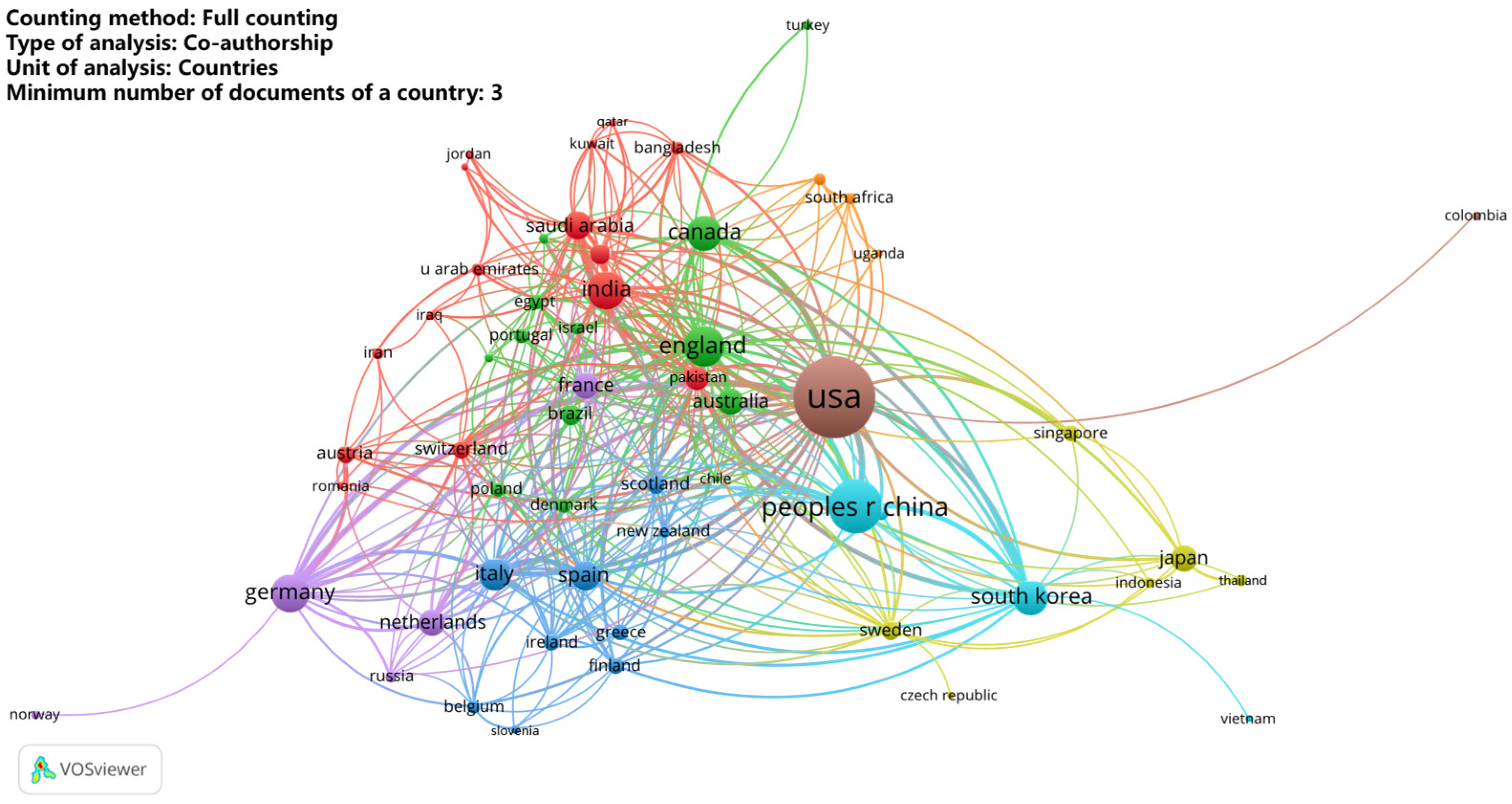
Figure 3 depicts the international collaboration network among countries and regions in the field of healthcare visualization. Each node represents a country or region with three or more publications. Node size is proportional to publication volume, while edge thickness indicates the strength of collaborative ties between entities [90]. Node colors correspond to distinct collaboration clusters identified through network analysis [91]. Table 1 summarizes the top 10 countries and regions ranked separately by Documents, Citations, and Total Link Strength.
The Documents indicator reflects the scale of a country’s or region’s research output and its level of participation in international scholarly collaboration. Joint examination of Figure 3 and Table 1 shows that the United States occupies the most prominent position in the network, with 345 documents, indicating a clear quantitative advantage. It maintains extensive collaborative relationships with major research contributors such as the People’s Republic of China, Canada, and Germany, positioning it as the central hub of the global collaboration network. The People’s Republic of China ranks second with 152 documents, followed by England (84), Germany (77), and India (76), forming the second tier of high-output contributors.
Citations represent the cumulative academic recognition of a country’s or region’s research output. The United States again ranks first, with 5765 citations, substantially exceeding all other participants. It is followed by the People’s Republic of China (855), England (494), Germany (368), and Japan (364). The strong correspondence between the rankings of Documents and Citations suggests that countries with higher publication volumes tend to exert greater academic influence, although notable differences in citation performance remain.
Total Link Strength captures the intensity of collaborative relationships between countries and regions. The United States maintains the highest total link strength (174), reaffirming its central coordinating role in international collaboration. England (84) and the People’s Republic of China (76) follow, indicating strong and sustained collaborative engagement within the global research network.
Relying on a single indicator may introduce bias in assessing national or regional research performance. A high number of documents may include publications with limited impact, while citation counts may be influenced by accumulated historical contributions or short-term research trends. Similarly, Total Link Strength reflects collaboration intensity but does not directly capture research quality. To address these limitations, citations per document were calculated as a supplementary metric, as presented in Table 2. This indicator integrates productivity and impact, providing a more balanced assessment of research influence.
Qatar exhibits an exceptionally high citations-per-document ratio (173.67), despite having only three publications and 521 citations. New Zealand and Uganda follow, with 107.71 and 79.67 citations per document, respectively. Although the United States ranks first in both Documents and Citations, its citations-per-document value of 37.60 places it fourth overall, indicating that its influence derives primarily from large-scale output and extensive collaboration rather than exceptionally high average citation performance.
Overall, the United States demonstrates comprehensive leadership in healthcare visualization research in terms of output volume, academic influence, and international collaboration intensity. The People’s Republic of China shows strong publication capacity but comparatively lower average citation impact, suggesting potential for enhancing collaborative depth and research influence. European countries such as Germany, France, the Netherlands, Italy, and Belgium form a closely connected regional collaboration network characterized by stable and intensive partnerships. Meanwhile, countries including Qatar, India, Saudi Arabia, and Pakistan are emerging as increasingly visible contributors to the field. Additionally, countries within the orange cluster, such as Uganda and South Africa, exhibit notable international collaborative influence, often driven by specialized research addressing specific health and medical challenges.

3.1.3. Co-Occurring Institutions

Table 3 presents the leading institutions ranked separately by Documents, Citations, and Total Link Strength. Multiple institutions share identical rankings in both document counts and total link strength, reflecting comparable levels of productivity and network engagement.
Harvard Medical School ranks first in terms of research output, with 20 documents and a total link strength of 23, indicating its prominent role in publication activity and institutional collaboration within healthcare visualization research. The University of California, San Francisco follows in second place with 11 documents. University College London (UCL), the Technical University of Munich, and King Saud University jointly rank third, each contributing 10 publications.
In terms of Citations, Harvard University occupies a dominant position, accumulating 5765 citations, which substantially exceeds those of all other institutions. The University of California, Berkeley ranks second with 855 citations, followed by the Technical University of Munich (494), the University of North Carolina at Chapel Hill (368), and King Saud University (364). These rankings highlight substantial variation in academic influence among institutions with comparable publication volumes.
Regarding Total Link Strength, Harvard Medical School again demonstrates the strongest collaborative capacity, ranking first with a total link strength of 23. Massachusetts General Hospital (16) and Brigham and Women’s Hospital (15) follow, reflecting their extensive engagement in cross-institutional research collaboration. A group of institutions—including the University of California, Berkeley, the Massachusetts Institute of Technology (MIT), Johns Hopkins University, the University of California, San Francisco, and University College London (UCL)—share fourth place with a total link strength of 7, indicating similar levels of collaborative connectivity.
To provide a more balanced assessment of institutional impact, citations per document were calculated using the average citations per document ratio, as reported in Table 4.
Harvard University leads by a substantial margin, with an average of 1153 citations per paper, indicating exceptionally high academic visibility and influence. The University of California, Berkeley ranks second with 171 citations per document, followed by the University of North Carolina at Chapel Hill (73.60), the University of Edinburgh (56.80), and the Technical University of Munich (49.40). These institutions exhibit strong citation performance, suggesting that research influence in this field is not solely dependent on the scale of output. Notably, several institutions enter the top ten rankings despite producing relatively few publications, achieving high average citation rates that reflect the specialized focus and high reference value of their research.
Overall, a core group of Western research institutions—represented by Harvard Medical School, Harvard University, and the Technical University of Munich—exerts substantial academic influence in healthcare visualization. In parallel, major clinical institutions such as Massachusetts General Hospital and Brigham and Women’s Hospital, though not universities, play critical roles in collaborative research networks, underscoring the importance of integrating clinical and academic efforts. Collectively, these findings suggest that institutional prominence in healthcare visualization research is closely associated with the combined effects of sustained research output and dense collaborative engagement.

3.2. Keyword Analysis

3.2.1. Keyword Co-Occurrence Clustering

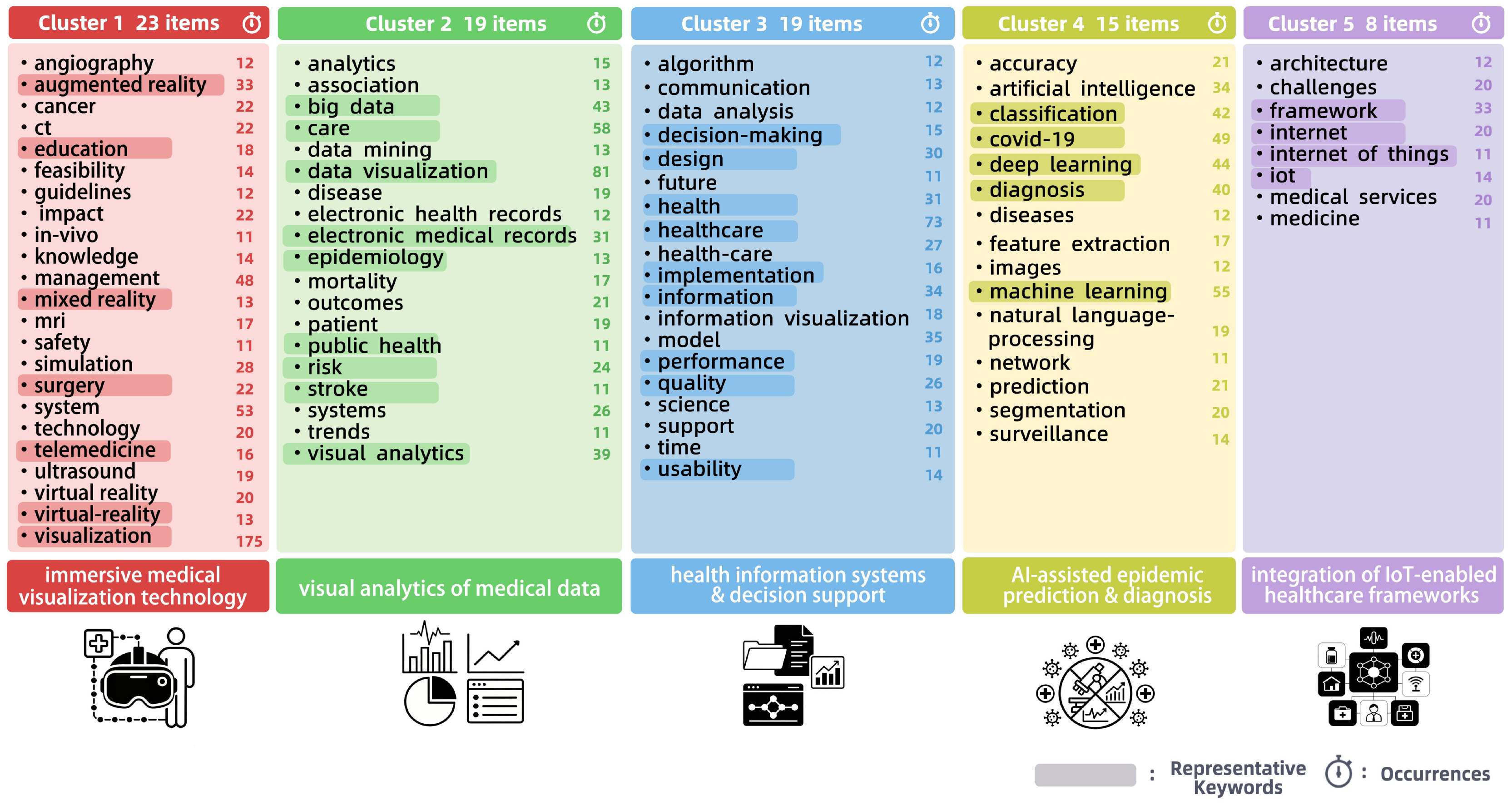
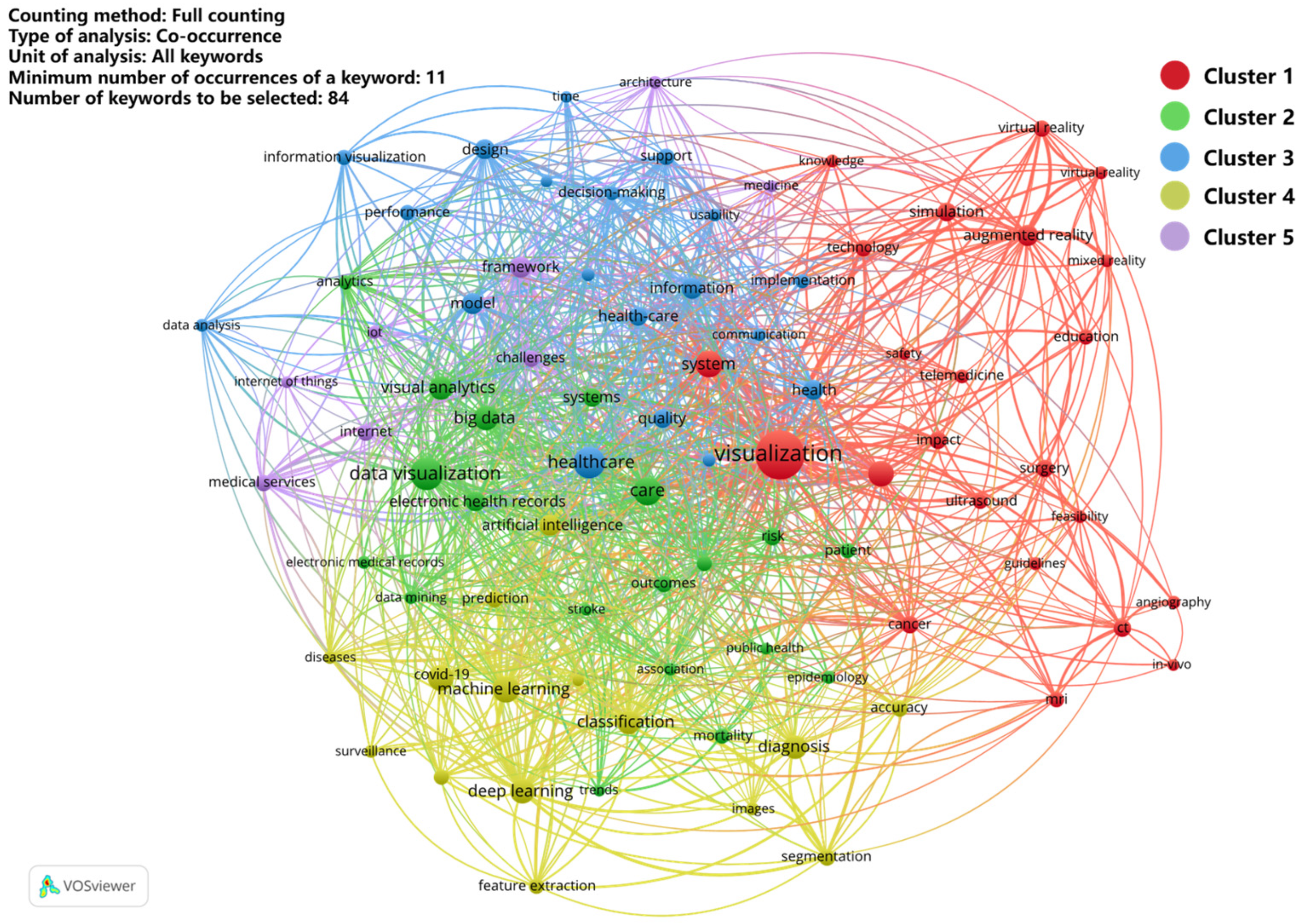
Figure 4 presents the keyword co-occurrence clustering map generated using VOSviewer. A five-cluster solution was adopted to provide a comprehensive overview of the thematic structure of the field. From an initial set of 6050 keywords, 84 high-frequency keywords meeting the threshold of ≥11 occurrences were selected for co-occurrence analysis. These keywords were grouped into five distinct thematic clusters, with node size indicating keyword frequency and color denoting cluster membership [92] (Figure 4). The selected threshold effectively excludes low-frequency terms, enabling the identification of core concepts with substantial academic influence and yielding clearly differentiated thematic structures. The clusters are presented in descending order according to the number of keywords they contain.
Based on the VOSviewer output, Figure 5 systematically organizes the 84 selected keywords distributed across the five clusters. Representative keywords are highlighted in bold, and the frequency of occurrence is indicated in parentheses following each term. Although VOSviewer automatically assigns colors to distinguish clusters based on co-occurrence relationships, it does not generate descriptive labels for the clusters.
To interpret the thematic content of each cluster, three domain experts were invited to independently review the complete set of keywords within each cluster, taking into account their frequency distribution and structural positions within the network. Discrepancies in thematic interpretation were resolved through iterative discussion until consensus was reached regarding cluster naming.
The first cluster (red, 23 keywords) is centered on “visualization” as the largest node. Its co-occurrence network prominently includes immersive visualization technologies such as “virtual reality,” “mixed reality,” and “augmented reality.” These terms frequently co-occur with application-oriented keywords, including “telemedicine,” “surgery,” and “education,” indicating a research focus on immersive visualization as an enabling technology in clinical practice, remote medical services, and medical training.
The second cluster (green, 19 keywords) is centered on “data visualization,” “big data,” “care,” and “visual analytics.” Closely associated terms include “electronic health records,” “epidemiology,” “risk,” “public health,” and “stroke.” This cluster reflects research priorities related to extracting interpretable patterns from large-scale medical datasets through visualization techniques, with particular emphasis on public health surveillance, epidemiological analysis, and data-driven clinical care.
The third cluster (blue, 19 keywords) highlights the role of visualization in healthcare information systems and decision support. Core nodes include “healthcare,” “health,” “information,” “design,” and “implementation.” These are linked to evaluative and operational terms such as “performance,” “usability,” “decision-making,” and “quality,” forming a coherent structure that connects system development, interface design, and user-centered evaluation. This cluster underscores the importance of visualization as an integral component of healthcare information system design and implementation.
The fourth cluster (yellow, 15 keywords) is characterized by prominent nodes such as “deep learning,” “machine learning,” “COVID-19,” “classification,” and “diagnosis,” which together form a dense co-occurrence network. This cluster primarily represents research on artificial intelligence–driven diagnostic and classification applications, with a noticeable concentration during the COVID-19 pandemic. It highlights the growing role of visualization in supporting model interpretation, epidemic analysis, and public health emergency response.
The fifth cluster (purple, 8 keywords) is structured around “framework” as the central hub. It exhibits strong co-occurrence relationships with communication and networking terms, including “internet,” “internet of things,” and “IoT,” and is further linked to “healthcare services.” This cluster emphasizes IoT-centered architectural approaches, focusing on the integration of sensing technologies, data acquisition, and multimodal visualization systems to support healthcare service delivery. It reflects the foundational role of IoT infrastructures in enabling intelligent, connected, and service-oriented healthcare systems.
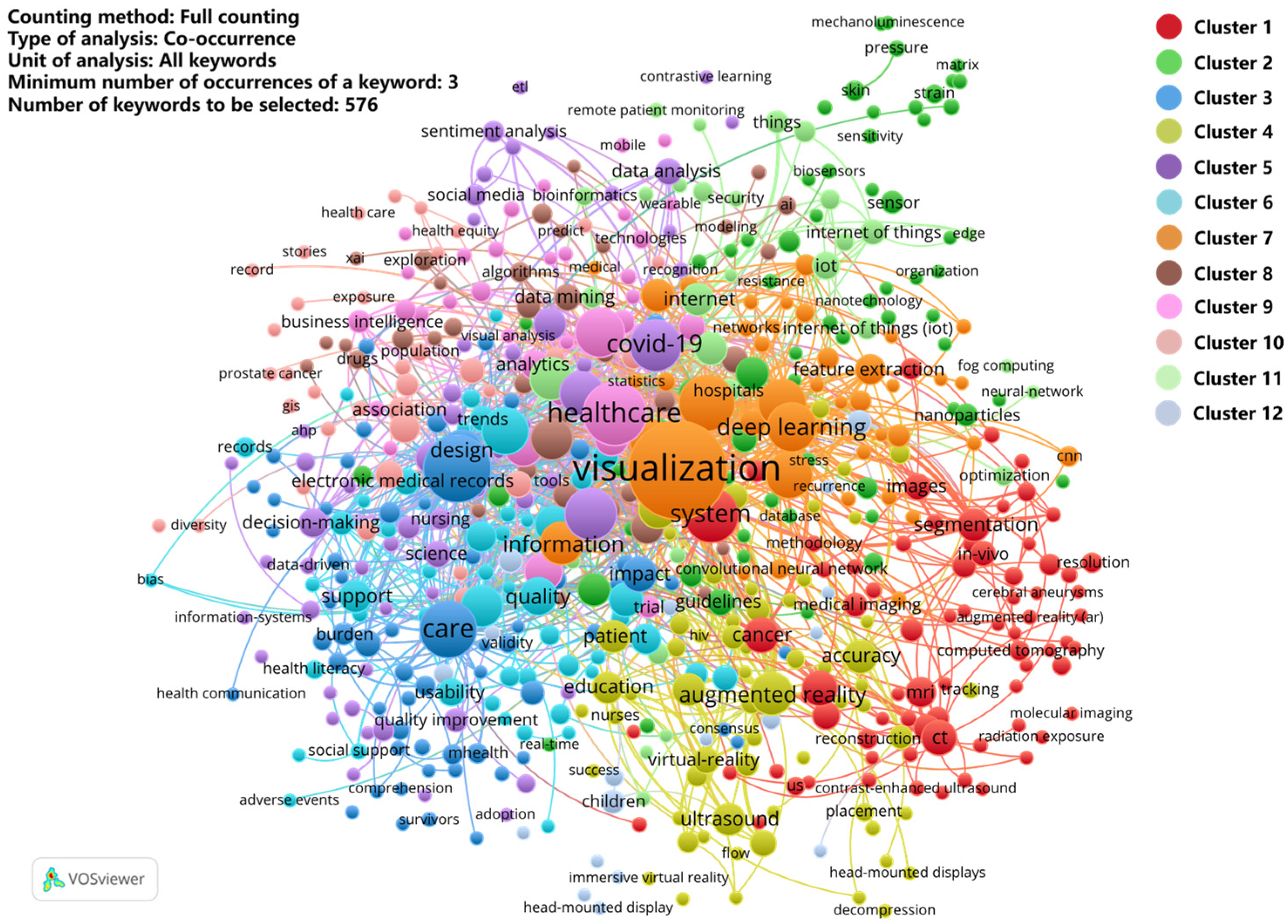
Given that clustering outcomes may vary substantially depending on the number of clusters specified, a sensitivity analysis was conducted to assess the robustness of the keyword co-occurrence structure to different clustering resolutions. Building upon the initial five-cluster solution, the same dataset was reanalyzed using a twelve-cluster solution. A minimum frequency threshold of three occurrences was applied, resulting in 576 co-occurring keywords meeting the inclusion criterion. This procedure generated twelve distinct thematic clusters, with each cluster represented by a different color (Figure 6), thereby providing a more fine-grained delineation of the field’s thematic structure.
Table 5 summarizes the twelve thematic clusters, including their designated labels, defining characteristics, representative keywords, and the number of publications associated with each cluster. From an overall structural perspective, the clusters exhibit relatively clear thematic boundaries across methodological approaches, application contexts, and research objects. At the same time, they maintain conceptual correspondence with the original five-cluster solution, laying the foundation for subsequent multi-level structural analysis and trend identification.
From an overall structural perspective, the twelve-cluster solution does not alter the original five thematic domains; rather, it reveals internal sub-structural differentiation within each major cluster.
The original cluster “Immersive Medical Visualization Technology” is further subdivided into thematic modules such as augmented reality, medical image reconstruction, and segmentation, indicating increasing methodological refinement and application-specific technical development.
The former “Visual Analytics of Medical Data” cluster differentiates into subthemes including data mining, algorithms, and business intelligence, suggesting that data-driven research has evolved into multiple parallel methodological trajectories.
The “Health Information Systems and Decision Support” cluster, under higher-resolution clustering, manifests as a system–user–quality configuration centered on themes such as quality, usability, and health equity, thereby emphasizing the managerial and practice-oriented dimensions of healthcare service delivery.
The “AI-assisted Epidemic Prediction and Diagnosis” cluster is further decomposed into algorithm-focused subgroups, including deep learning and convolutional neural networks, while retaining public health–related themes such as COVID-19, reflecting increasing methodological specialization within epidemic analytics.
Similarly, the “Integration of IoT-enabled Healthcare Frameworks” cluster expands into distinct technological nodes, including sensors, biosensors, and Internet of Things (IoT) infrastructures, demonstrating structural elaboration across the sensing and data transmission layers.
Overall, the five-cluster solution provides a macro-level overview of the field’s thematic structure, whereas the twelve-cluster solution uncovers finer-grained differentiation in methodological pathways and application contexts. The two clustering resolutions exhibit strong thematic consistency in terms of domain attribution, while forming a hierarchical relationship characterized by an overarching framework and internally differentiated submodules. This sensitivity analysis indicates that the identified thematic structure is robust, while higher clustering resolution enables the detection of more nuanced patterns of knowledge evolution.

3.2.2. Keyword Spatiotemporal Evolution

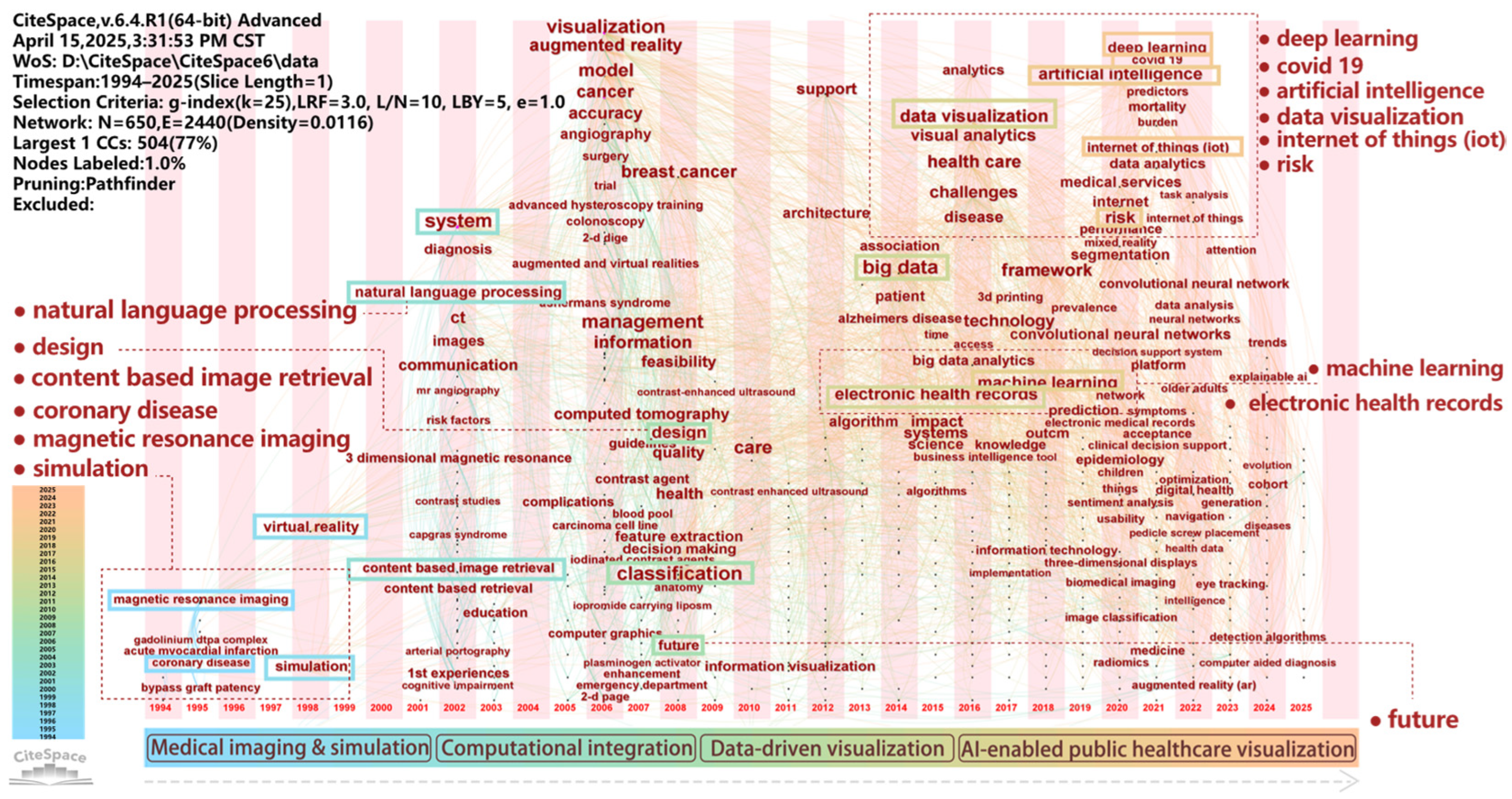
Spatiotemporal analysis of keywords provides a macro-level perspective on the developmental trajectory of healthcare visualization research. Figure 7 presents the keyword spatiotemporal evolution map generated using CiteSpace. In this visualization, the color gradient transitions from cool to warm tones, representing the progression from earlier to more recent periods. The size of each keyword node corresponds to its frequency of occurrence, while keywords enclosed within a rectangular frame denote high-impact terms that were particularly prominent during specific time intervals.
Table 6 summarizes the developmental phases identified from the temporal analysis, specifying corresponding periods, milestone years, representative high-frequency keywords, and thematic orientations. The spatiotemporal distribution reveals four major evolutionary phases: Medical Imaging & Simulation, Computational Integration, Data-Driven Visualization, and AI-Enabled Public Healthcare Visualization.
The results indicate that beginning in 1995, keywords such as “magnetic resonance imaging” and “coronary disease” emerged, laying the foundation for research in medical imaging visualization. In 1998, concepts including “virtual reality” and “simulation” entered the field, reflecting early efforts to integrate immersive and modeling technologies into medical applications.
From 2002 onward, the number of keywords increased markedly. Terms such as “system,” “natural language processing,” and “content-based image retrieval” appeared sequentially, signaling the growing integration of computational technologies into healthcare visualization research. Between 2006 and 2008, keyword frequency reached a stage-specific peak. Research topics during this period expanded to encompass cancer, management, classification, and design, demonstrating the field’s increasingly interdisciplinary orientation.
After 2011, keywords such as “data visualization,” “big data,” and “electronic health records” gradually gained prominence, indicating a shift toward data-driven medical information visualization. Since 2018, there has been a substantial increase in terms including “machine learning,” “deep learning,” “artificial intelligence,” and “Internet of Things,” highlighting the deepening integration between healthcare visualization and artificial intelligence technologies. Notably, during the COVID-19 pandemic (2020–2021), keywords such as “COVID-19” and “risk” exhibited a marked surge, underscoring the critical role of healthcare visualization in public health risk assessment and emergency response.
Overall, the field has evolved from an initial technology-oriented focus on medical imaging and simulation to an emphasis on medical information management and service design, and has progressively developed into a research paradigm centered on artificial intelligence, big data, and public health decision support.

3.3. Co-Citation and Cluster Analysis

This study employed CiteSpace to conduct co-citation clustering analysis on relevant literature from 1994 to 2025, though the temporal slicing parameter was not fixed at a one-year interval [93]. To enhance cluster stability and reduce the influence of short-term annual fluctuations on the identification of key nodes, a longer temporal slice (Slice Length = 2) was adopted when constructing co-citation clusters, thereby improving clustering robustness and interpretability [94,95,96]. In contrast, a finer temporal resolution (Slice Length = 1) was applied when identifying highly central articles and detecting the strongest citation bursts. This configuration improves temporal sensitivity and enables more precise identification of specific years in which citation activity exhibits abrupt increases, facilitating the detection of emerging research hotspots and critical turning-point publications [96,97].

3.3.1. Cited Articles and References

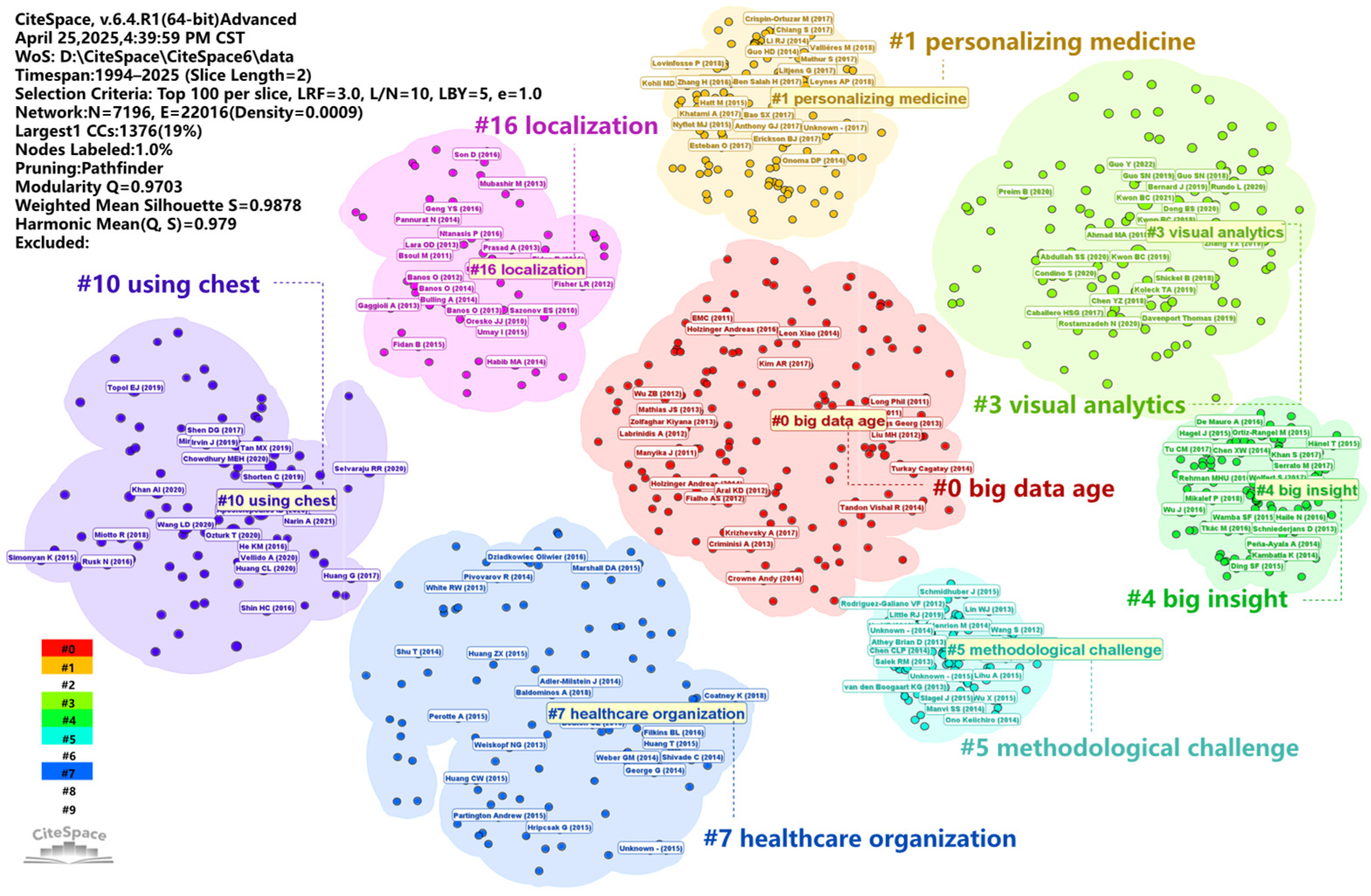
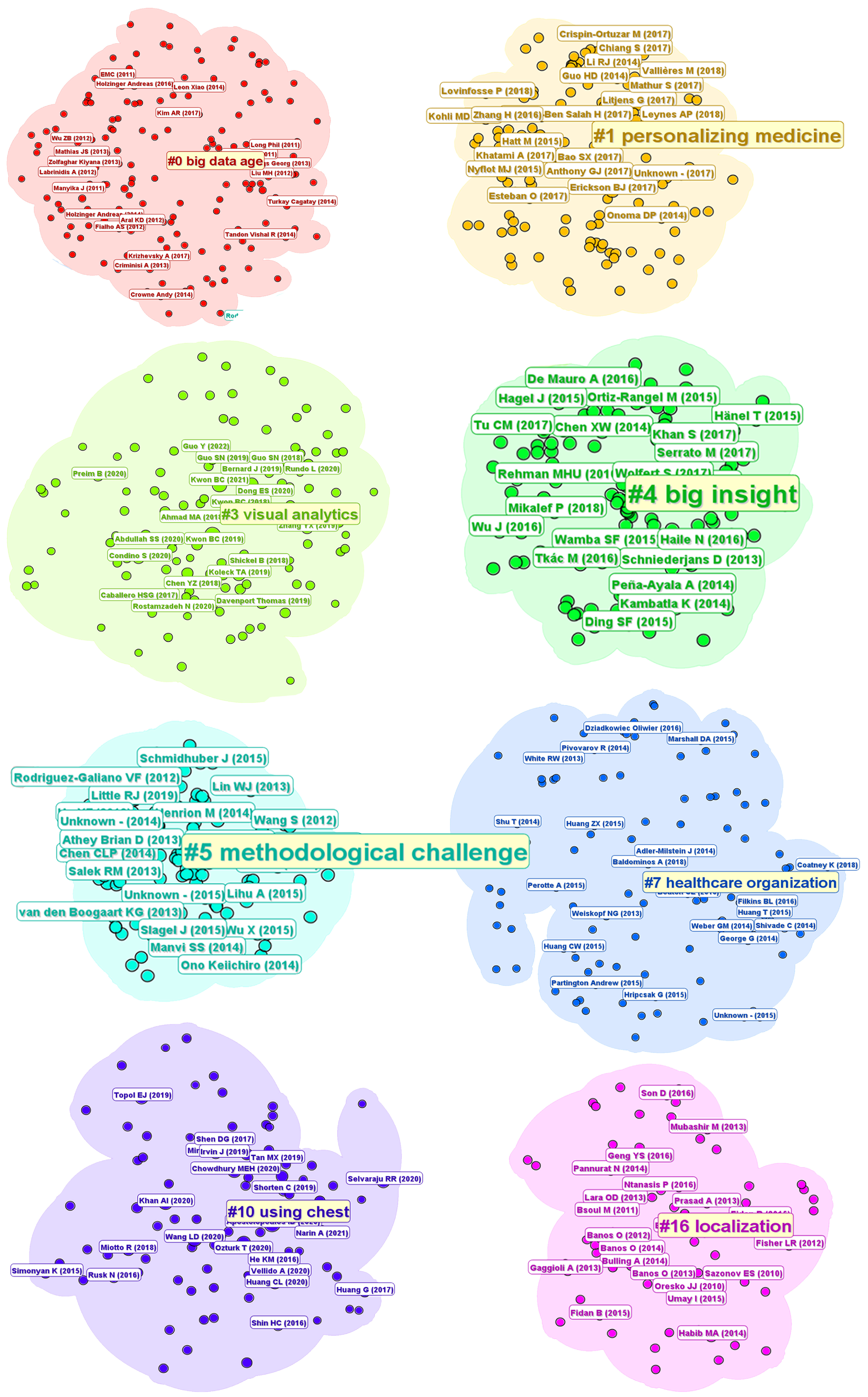
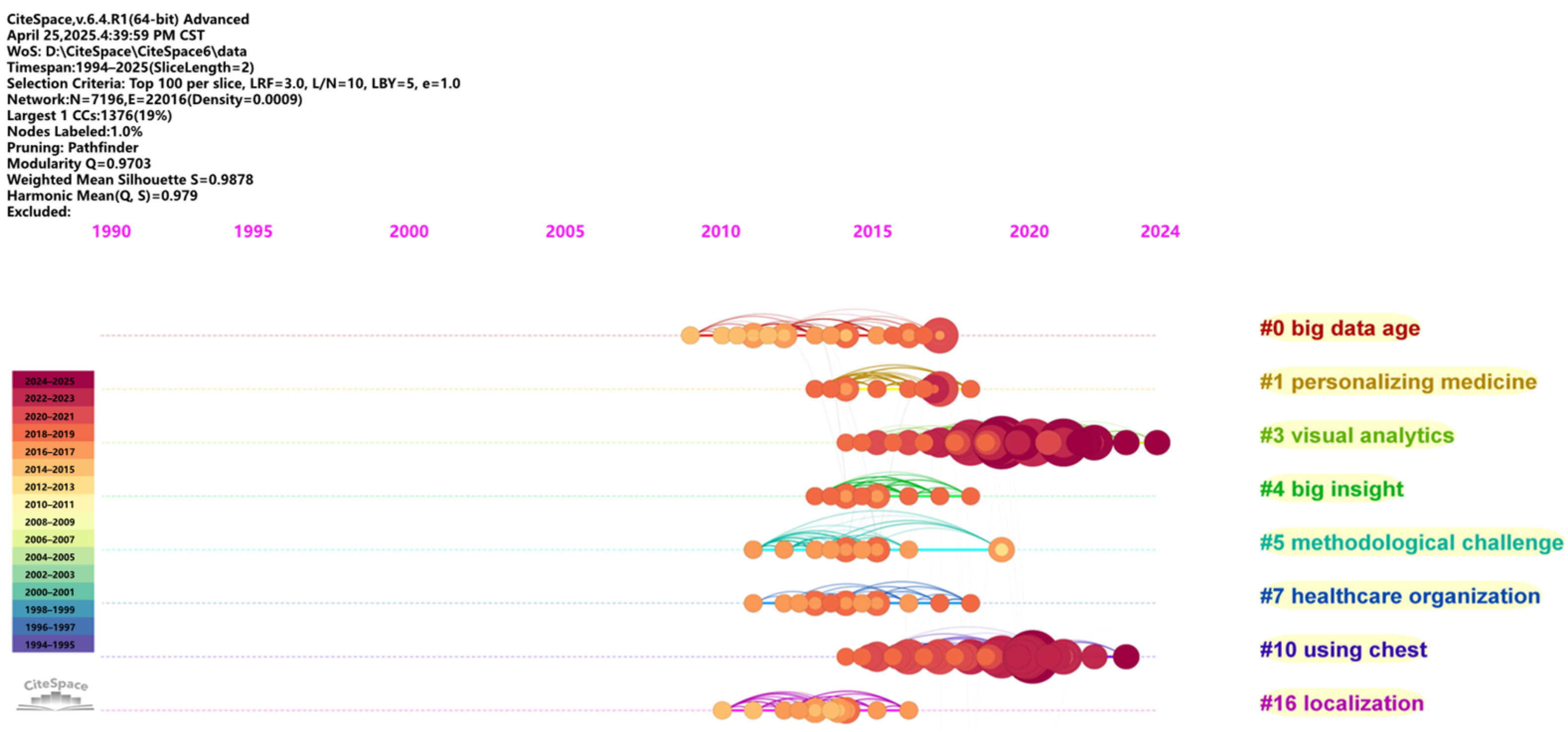
The co-citation clustering analysis of cited references identified eight distinct thematic clusters (Figure 8). The resulting network exhibits a modularity value of Q = 0.9703 and a weighted mean silhouette value of S = 0.9878, indicating a well-structured, highly cohesive, and reliable clustering outcome. Figure 9 provides a detailed view of each cluster.
Table 7 presents the detailed information of the identified clusters. In this study, the selection criterion was set to “Top 100 per slice.” Cluster labels were extracted using the LLR algorithm, and the cluster names were automatically generated by CiteSpace (6.4.R1). The final cluster configuration was based on the software-recommended output and subsequently validated through independent review and assessment by three domain experts to ensure interpretative accuracy and conceptual coherence.
When ranked by cluster size, the most influential thematic groups are big data age (Cluster #0), personalizing medicine (Cluster #1), visual analytics (Cluster #3), big insight (Cluster #4), and methodological challenge (Cluster #5).
Figure 10 illustrates the temporal evolution of these citation clusters, with larger nodes representing higher citation frequencies. An examination of the average publication years of cluster formation indicates that visual analytics (Cluster #3) and using chest (Cluster #10) correspond to relatively recent research themes. In contrast, earlier clusters, such as big data age (Cluster #0) and localization (Cluster #16), emerged at earlier stages and gradually converged with other dominant research directions over time. This temporal distribution highlights the progressive expansion and thematic integration of healthcare visualization research, providing a structured perspective on its dynamic knowledge evolution.
To further elucidate the intellectual structure of the field, this study conducted an in-depth analysis of the three most influential clusters identified through co-citation analysis. For each cluster, representative publications were examined through a systematic review of their titles and abstracts, guided by citation relationships within the cluster network [98]. This procedure aimed to clarify the core research themes, methodological orientations, and principal contributions characterizing each cluster, thereby revealing the underlying connections among different research directions within healthcare visualization. Table 8, Table 9 and Table 10 present the most frequently cited representative publications within Clusters #0, #1, and #3, respectively.
Cluster #0 has a profound influence within the domain of healthcare visualization. This cluster primarily characterizes the integration of data mining paradigms—particularly artificial intelligence–driven approaches such as deep learning [99], interactive machine learning [100], interactive visualization [101], and human–computer collaboration [102]—as central technological pathways for addressing the challenges posed by large-scale, high-dimensional, and heterogeneous healthcare data, including computational complexity and limited processing efficiency [103,104]. These developments underscore the growing significance of computational health informatics in contemporary healthcare systems [103].
Recent advances in convolutional neural networks have substantially accelerated automated image recognition and visual-assisted diagnosis in medical imaging workflows [99]. High-dimensional analytical techniques based on localized visual features further enhance diagnostic accuracy by improving regional sensitivity and enabling more refined image segmentation, thereby supporting earlier disease detection and clinical intervention [105]. In scenarios involving rare conditions or abnormal clinical patterns, interactive learning frameworks that integrate algorithmic inference with expert human judgment offer a promising direction for developing interpretable and trustworthy medical decision-support systems, particularly for assisting judgments in rare diseases and emergencies [100]. In parallel, visualization systems augmented with big data processing capabilities contribute to improved efficiency in healthcare management, including medical education [106], cost control, resource allocation, clinical workflow optimization, and patient behavior modeling [107].
Table 8. Important citation and cited literature for Cluster #0.
Cluster #0 Big Data Age
Cited ReferenceCiting Articles
FreqAuthor (Year)GCSAuthor (Year)
4Krizhevsky A, Sutskever I,
Hinton G E [99] (2017)
121Fang R, Pouyanfar S, Yang Y et al. [103] (2016)
2Liu M, Zhang D, Shen D et al. [105] (2012)31Vaitsis C, Nilsson G, Zary N [106] (2014)
2Manyika J, Chui M, Brown B, Bughin J, Dobbs R, Roxburgh C et al. [107] (2011)15Ko I, Chang H [108] (2018)
Cluster #1 centers on visualization-driven technologies for personalized medicine and their multidisciplinary applications across clinical domains such as neurology, ophthalmology, pulmonology, cardiology, and related fields [109]. Research within this cluster commonly integrates machine learning techniques with conventional medical imaging modalities, including CT and MRI, to support the detection and classification of conditions such as polyps, encephalopathies, and various cancers [110]. In addition, the application of convolutional neural networks, residual networks, and transfer learning to the analysis of SR-microCT images has been shown to substantially improve classification accuracy in assessing the mechanical states of bone tissue [111].
The convergence of hybrid imaging techniques, multimodal molecular imaging, and large-scale medical data infrastructures [112] enables complementary integration of heterogeneous data sources, thereby enhancing diagnostic efficiency and precision [113,114]. Such integration also improves data consistency across repeated examinations for individual patients [115], facilitating more accurate personalized diagnosis, disease staging, and prognostic evaluation within an evidence-based medicine framework [115].
Table 9. Important citation and cited literature for Cluster #1.
Cluster #1 Personalizing Medicine
Cited ReferenceCiting Articles
FreqAuthor (Year)GCSAuthor (Year)
4Litjens G, Kooi T, Bejnordi B E et al. [109] (2017)32Shen S C, Fernández M P, Tozzi G et al. [111] (2021)
3Erickson B J, Korfiatis P, Akkus Z et al. [110] (2017)23Papp L, Spielvogel C P, Rausch I et al. [112] (2018)
Cluster #3 focuses on the healthcare domain, where the rapid adoption of intelligent systems has generated an increasing demand for visual analytics to enhance model interpretability. Improving transparency and explainability is essential for strengthening clinical trust, increasing model usability, and supporting real-world deployment, particularly in high-stakes clinical decision-making contexts, where opaque “black-box” models are not fully accepted [116,117]. Visual analytics has emerged as a critical methodological approach for addressing these challenges by externalizing model behavior through interactive visual representations.
By enabling clinicians and other non-technical stakeholders to explore model inputs, inference processes, and prediction outcomes via intuitive graphical interfaces, visual analytics facilitates deeper understanding and informed decision-making [117,118,119,120], with extensive applications in electronic health record analysis [116]. Moreover, visual analytics bridges cognitive gaps among data features, clinical context, and model outputs by employing multidimensional and temporally structured representations of textual information [121] and event sequences [122,123]. These capabilities have demonstrated particular effectiveness in tasks such as medical history segmentation [124], disease progression analysis, disease state summarization, and the exploration of chronic disease trajectories, including diabetes management [125]. Beyond interpretability, visualization-based analysis also supports the identification of model risks, vulnerabilities, and potential attack surfaces [118], thereby contributing to enhanced robustness and security of intelligent healthcare systems [126].
Table 10. Important citation and cited literature for Cluster #3.
Cluster #3 Visual Analytics
Cited ReferenceCiting Articles
FreqAuthor (Year)GCSAuthor (Year)
10Kwon B C, Choi M J, Kim J T et al. [116] (2018)45Ma Y, Xie T, Li J et al. [118] (2019)
8Kwon B C, Anand V, Severson K A et al. [125] (2020)23Cheng F, Liu D, Du F et al. [119] (2021)
8Dong E, Du H, Gardner L [127] (2020)19Ooge J, Stiglic G, Verbert K. [117] (2022)
7Guo S, Xu K, Zhao R et al. [122] (2017)16Dey S, Chakraborty P, Kwon B C et al. [126] (2022)
7Bernard J, Sessler D, Kohlhammer J et al. [124] (2018)14AlSaad R, Malluhi Q, Janahi I et al. [120] (2019)

3.3.2. High Centrality Analysis

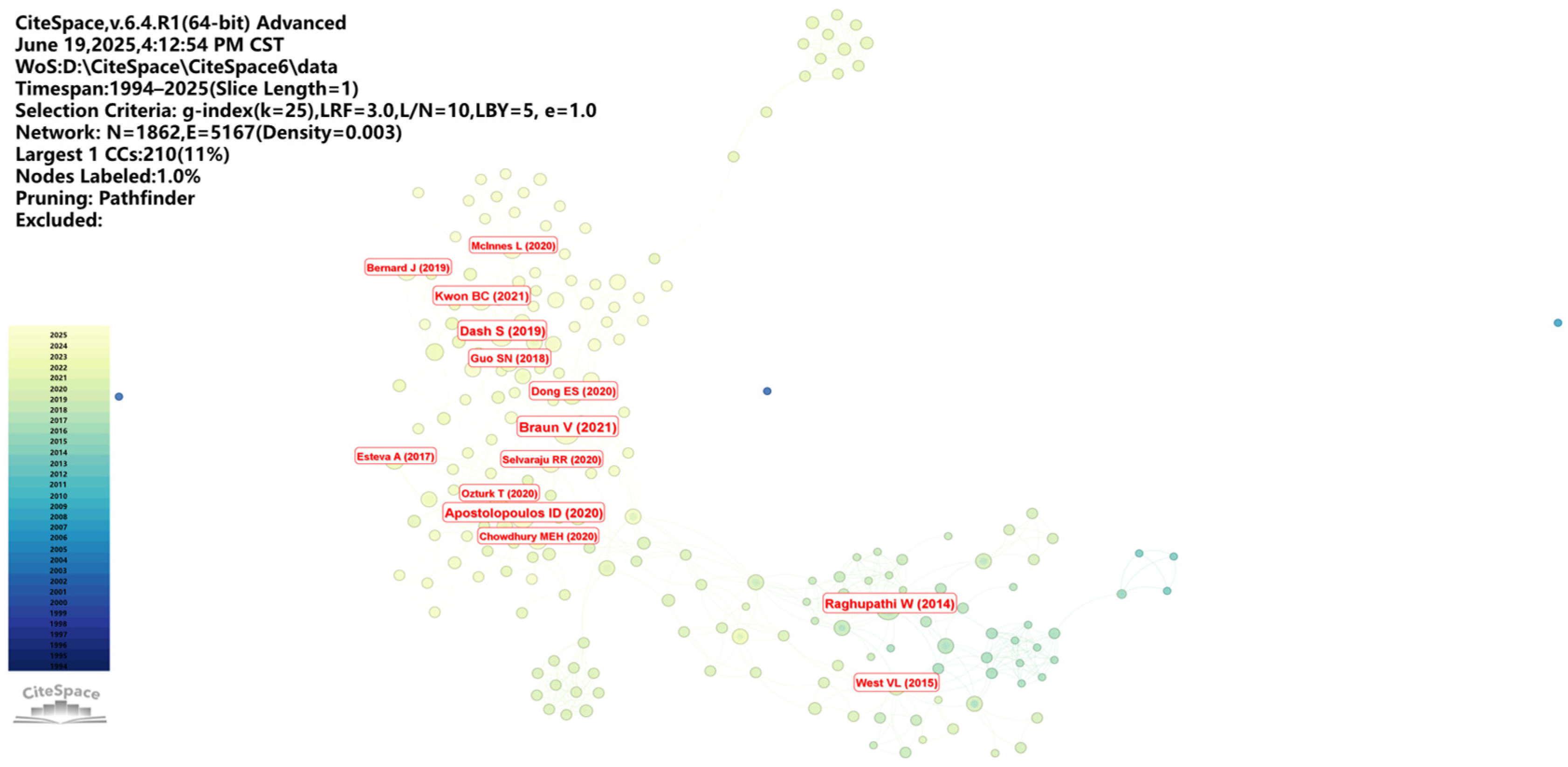
This section examines highly centralized articles within the field of healthcare visualization (Table 11, Figure 11). Centrality is a key indicator for evaluating the structural importance of a publication within a citation network, as it reflects a study’s connective capacity, hierarchical positioning, and bridging relationships across research domains [128]. Articles with high centrality function as knowledge hubs, linking otherwise weakly connected research clusters.
By identifying these “bridge-type” publications, centrality analysis helps reveal intellectual turning points and foundational theoretical contributions relevant to the evolution of the field. Such literature often facilitates knowledge transfer across disciplinary boundaries, enabling the integration of methods, concepts, and applications from heterogeneous research traditions. Consequently, highly centralized articles provide critical insights into the structural logic of interdisciplinary research and illuminate latent connections among diverse strands of healthcare visualization studies [52,129].
Table 11. Detailed explanation of the articles with the highest centrality ranking.
YearCentralityAuthorSource
20200.01Apostolopoulos I D, Mpesiana T A [130]Physical and engineering sciences in medicine
20180.01Rajkomar A, Oren E, Chen K et al. [131]NPJ digital medicine
20170.01Shen D, Wu G, Suk H I [132]Annual review of biomedical engineering
20140.01Raghupathi W, Raghupathi V [133]Health information science and systems

3.3.3. Strongest Citation Bursts

Emergent literature characterized by strong citation bursts reflects periods of rapid growth in academic attention and plays a pivotal role in identifying active or emerging research hotspots, as well as in anticipating future developmental trajectories of the field [98]. Focusing on articles exhibiting recent citation bursts and their emergence periods helps elucidate the dynamic evolution of research hotspots and assess their longevity.
Figure 12 presents the strongest citation bursts identified from 1994 to the present. The results indicate that review articles and case studies constitute a substantial proportion of burst-dominant literature. Review articles typically provide systematic syntheses of conceptual frameworks, methodological paradigms, and research trends within specific subdomains, thereby shaping subsequent scholarly inquiry. In contrast, case studies offer context-rich and practice-oriented perspectives by grounding research themes in concrete application scenarios, contributing to a more intuitive understanding of how healthcare visualization methods are implemented in real-world settings.

3.4. Thematic Evolution Analysis

3.4.1. Thematic Evolution Map

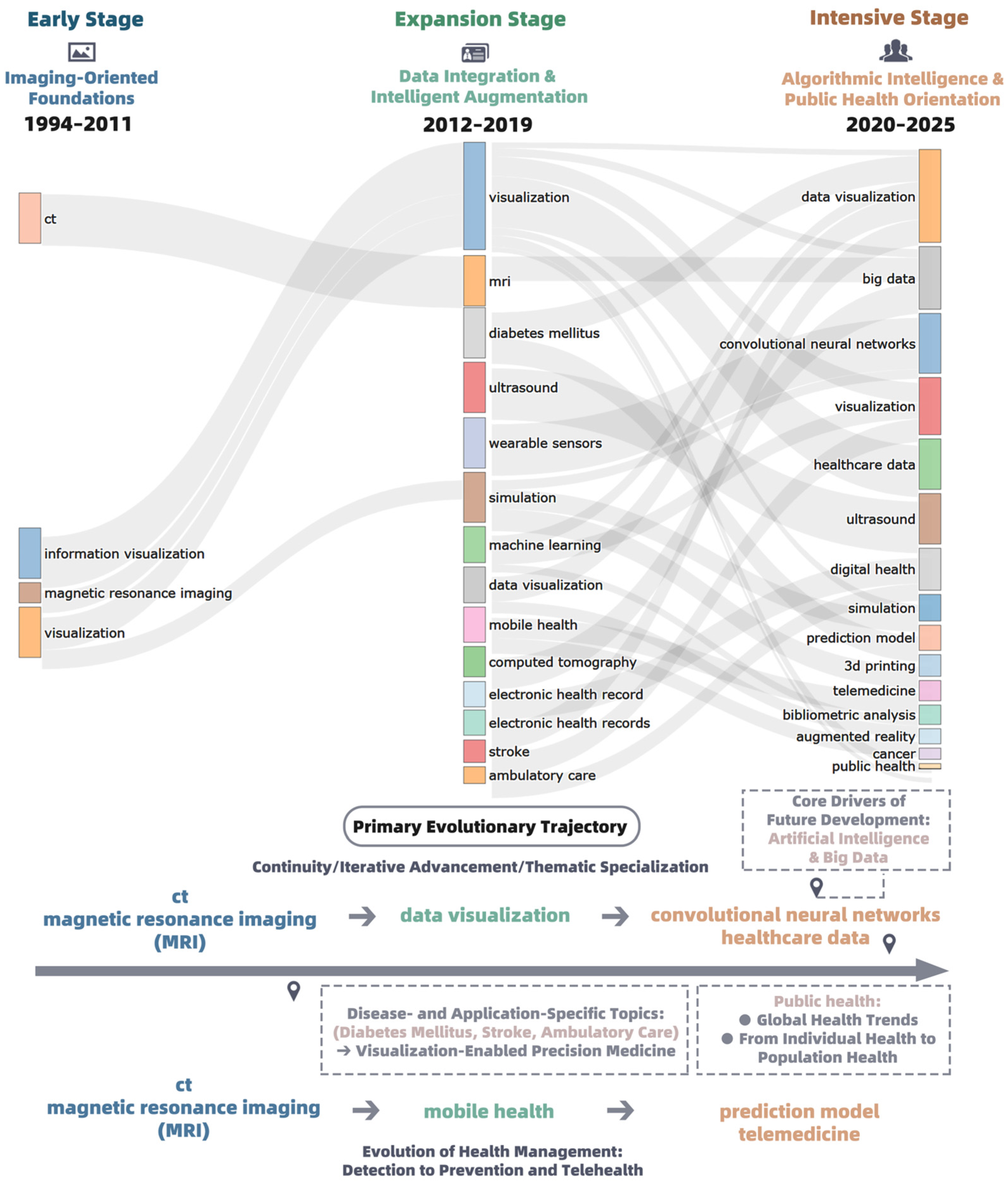
Figure 13 presents a Sankey diagram illustrating the origins, continuities, and transformations of research themes in healthcare visualization across different time periods. The figure further provides an analytical interpretation of key stages, major thematic transitions, and pivotal nodes within the evolutionary trajectory.
Building upon Figure 13, Table 12 offers a structured synthesis of the developmental process by systematically organizing information on stages, periods, core themes, emerging themes, and research orientation.
Owing to the limited annual publication volume during the emergence period (Period 1), this phase could not be independently identified with sufficient robustness within the bibliometric system. Accordingly, Period 1 was merged with the initial growth period (Period 2), forming an early time slice spanning 1994–2011. The accelerated growth period (Period 3, 2012–2019) constitutes the mid-stage time slice, while the explosive growth period (Period 4, 2020–2025) represents the recent-stage time slice.
In the early stage (1994–2011), research themes were relatively limited and focused primarily on foundational medical imaging technologies, including “information visualization,” “CT,” and “magnetic resonance imaging (MRI).” The research emphasis centered on image acquisition and visual representation within relatively narrow application contexts, reflecting a predominantly technology- and device-driven orientation.
During the expansion stage, the thematic scope expanded substantially. While foundational themes such as MRI and visualization persisted, new topics—including “machine learning,” “mobile health,” and “electronic health records (EHR)”—emerged, indicating the integration of artificial intelligence and mobile technologies into healthcare visualization. Concurrently, disease- and context-specific themes such as “diabetes mellitus” and “ambulatory care” signaled a shift toward data-driven and personalized health management.
In the intensive stage (2020–2025), themes have become further refined. “Data visualization” remains central, while “convolutional neural networks,” “prediction model,” and “telemedicine” have grown rapidly, reflecting the deep integration of artificial intelligence with clinical practice. Broader societal topics, including “public health,” have also gained prominence.
Overall, the thematic evolution follows a clear trajectory: from a device-oriented phase represented by CT, to a data integration phase characterized by “data visualization” and EHR, and subsequently to an intelligent and predictive healthcare phase exemplified by “convolutional neural networks” and “prediction model.” This progression demonstrates that healthcare visualization has evolved from a disease detection tool into an integrated system supporting prediction, prevention, and remote care. Artificial intelligence and big data have become the central drivers of current and future development. The increasing emphasis on diabetes mellitus highlights the contribution of visualization technologies to precision medicine, while the rise of public health reflects a shift from individual-level care toward population-level health governance.

3.4.2. Strategic Coordinate Diagram

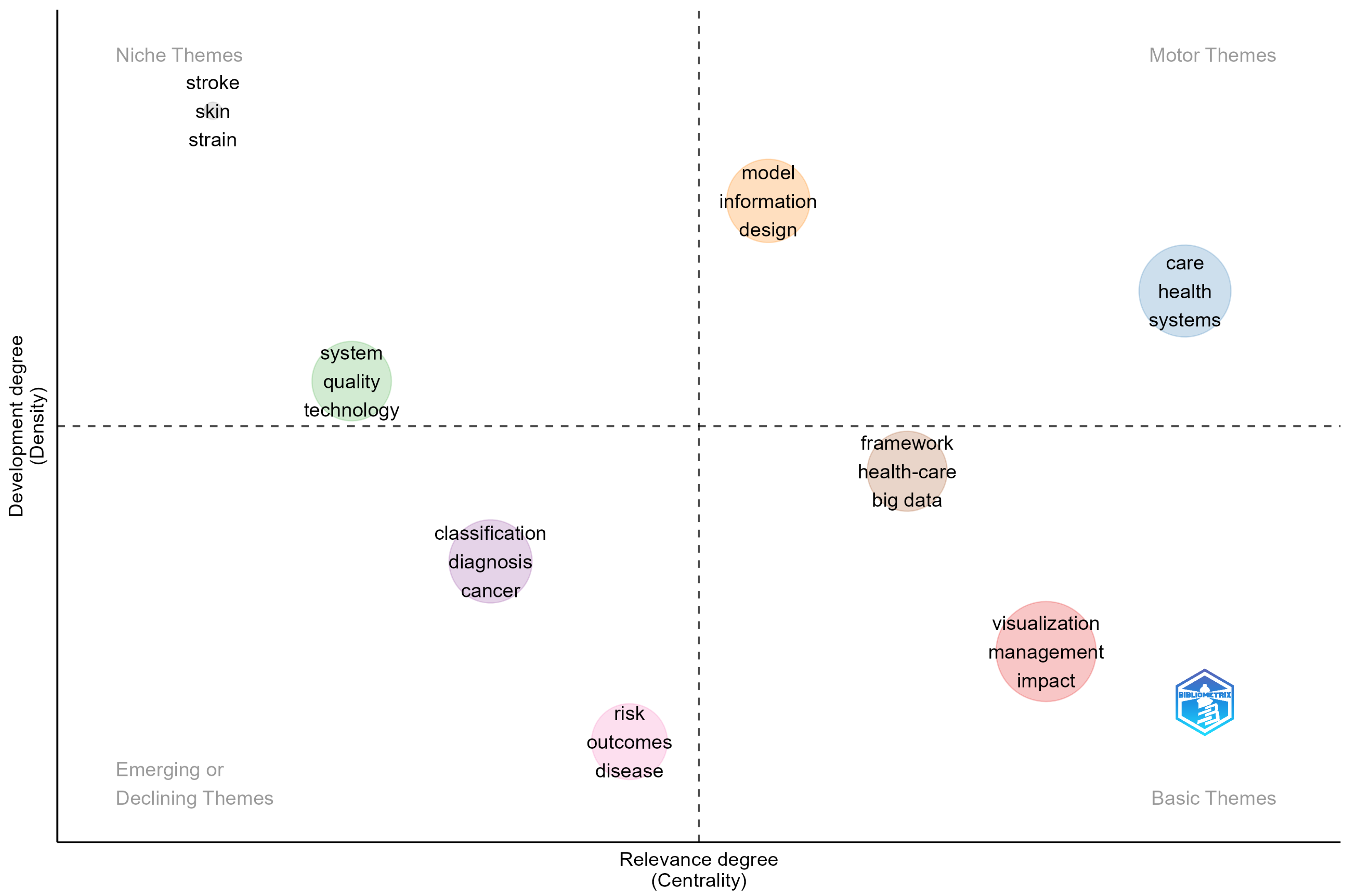
Figure 14 presents a strategic coordinate diagram of healthcare visualization research generated using Bibliometrix based on the bibliometric dataset. The map visualizes the relative positioning of thematic clusters according to their degree of relevance (Centrality) and degree of development (Density). The horizontal axis (Relevance degree/Centrality) reflects the extent to which a theme is connected to other themes within the research field; higher centrality indicates greater structural importance. The vertical axis (Development degree/Density) represents the internal cohesion and maturity of a theme; higher density denotes a more developed and well-established research domain.
Based on the distribution across the four quadrants, the thematic map can be interpreted as follows. The upper-right quadrant (Motor Themes) contains themes characterized by both high centrality and high density, indicating well-developed research directions that also play a central role in structuring the field. The upper-left quadrant (Niche Themes) represents highly developed yet weakly connected themes, reflecting specialized research areas that exhibit limited interaction with other thematic domains. The lower-left quadrant (Emerging or Declining Themes) includes themes with low centrality and low density, which may represent either newly emerging topics or areas experiencing declining research attention. The lower-right quadrant (Basic Themes) encompasses themes with high centrality but relatively low density, reflecting foundational research areas that are widely connected but remain conceptually or methodologically underdeveloped.
As shown in Figure 11, the strategic diagram reveals the current development structure of visualization-driven themes in healthcare. In the motor theme quadrant, clusters such as “model, information, design” and “care, health, systems” occupy central positions, indicating rapidly evolving core research directions that integrate visualization methods with healthcare systems and service-oriented design. In contrast, the niche theme quadrant includes clusters such as “stroke, skin, strain,” which represent specialized disease-oriented research areas that remain weakly connected to mainstream themes and exhibit limited cross-thematic integration. The cluster “system, quality, technology” suggests the progressive maturation of healthcare technologies and system-level optimization research.
Within the emerging or declining theme quadrant, clusters such as “classification, diagnosis, cancer” suggest a relative reduction in research emphasis on traditional diagnostic paradigms, while “risk, outcomes, disease” may indicate emerging concerns that are gaining scholarly attention but have not yet achieved thematic consolidation. In the basic theme quadrant, “framework, healthcare, big data” reflects an expanding interdisciplinary foundation within healthcare informatics, whereas “visualization, management, impact” represents a mature set of technical and managerial themes that are extensively applied across studies. As foundational themes, data visualization and healthcare management tools provide essential methodological support and form a stable cornerstone for ongoing research in healthcare visualization.

4. Results Analysis

4.1. Spatial and Temporal Distribution

From 1994 to 2025, research on healthcare visualization exhibits a sustained upward trajectory. Over time, the volume of keywords has increased, research topics have become progressively specialized, and early foundational terms have expanded and evolved through systematic associations with newly emerging concepts. As illustrated by the keyword spatiotemporal evolution map (Figure 7), early research hotspots—primarily centered on medical imaging-based diagnostic technologies and instructional systems—have gradually transitioned toward data-driven and intelligent paradigms.
This evolution reflects a fundamental shift in research orientation: from equipment-centered and disease-specific visualization grounded in traditional medical imaging principles toward approaches emphasizing artificial intelligence, data integration, and service-oriented healthcare systems. In particular, following the COVID-19 pandemic, intelligent healthcare solutions and explainable artificial intelligence have emerged as prominent research foci, underscoring growing demands for interpretability, scalability, and real-world applicability in high-stakes clinical contexts.
Analysis of international collaboration patterns further indicates that the United States, the People’s Republic of China, and England collectively occupy leading positions in terms of collaboration scale, scholarly visibility, and cooperative intensity. Meanwhile, countries such as Qatar, although relatively new entrants to this research domain, have demonstrated notable influence within specific thematic areas, highlighting the increasingly diversified geographic distribution of academic contributions. At the institutional level, U.S.-based research entities—including Harvard Medical School and Harvard University—exert substantial academic influence, while clinical institutions such as Massachusetts General Hospital emphasize the critical role of integrating research innovation with clinical practice.
Overall, the evolving collaborative networks among countries, institutions, and scholars facilitate knowledge exchange and technological diffusion, thereby reinforcing the collective advancement of healthcare visualization research across disciplinary and geographic boundaries.

4.2. Co-Word Analysis

Based on co-word clustering results, this study first identifies five macro-level thematic categories within healthcare visualization research: immersive medical visualization technology, visual analytics of medical data, health information systems and decision support, AI-assisted epidemic prediction and diagnosis, and integration of IoT-enabled healthcare frameworks. Together, these categories reflect the technological evolution, application expansion, and systemic integration trends shaping this field.

4.2.1. Immersive Medical Visualization Technology

First, continuous iterative upgrades in conventional visualization technologies and medical equipment have driven the steady expansion of healthcare application scenarios [44]. Advances in immersive visualization have extended physical healthcare environments into hybrid and virtual spaces, enabling a broad range of clinical and educational applications [134]. Representative examples include multimodal data collaboration in augmented reality (AR)–assisted remote emergency consultations [135], real-time AR-based vascular navigation in neurosurgical procedures [136], and virtual reality (VR) bronchoscopy simulation systems for clinical training [137].
By integrating anatomical and pathological information derived from medical imaging modalities such as angiography, computed tomography (CT), magnetic resonance imaging (MRI), and ultrasound [138], immersive visualization supports precise surgical planning and navigation [139], as well as real-time intelligent decision-making during operative procedures [140]. It further facilitates the assessment of procedural safety and technical feasibility [141]. In medical education, immersive visualization enhances knowledge transfer efficiency through high-fidelity simulation and multimodal interaction [142,143], thereby promoting innovation in personalized and competency-based training models.

4.2.2. Visual Analytics of Medical Data

Visual analytics represents a core technological pathway for transforming large-scale health and medical data into interpretable and actionable knowledge. By leveraging data sources such as Electronic Medical Records (EMR) and Electronic Health Records (EHR), combined with high-dimensional feature mining and deep learning–driven pattern recognition, visual analytics supports refined and personalized clinical decision-making [144]. This approach is particularly suited to diseases characterized by acute risk onset and long-term progression, such as stroke [145]. It enables early warning during acute phases [146] and supports recurrence risk prediction through time-series analysis during chronic stages, thereby forming an intelligent closed-loop management framework across the disease lifecycle [147].
The scope of data visualization applications has expanded from single-disease analyses—such as coronary heart disease and lung cancer—to interdisciplinary risk assessment addressing multi-disease interactions, including cardiovascular–cerebrovascular comorbidities and tumor–metabolic syndrome associations [16]. In public health contexts, big data visualization supports epidemiological studies of infectious diseases such as influenza and COVID-19, as well as regional stratified healthcare policy development [148]. Through spatiotemporal population-level analysis, visualization research is evolving from static cross-sectional descriptions toward dynamic and predictive health monitoring paradigms [149].

4.2.3. Health Information Systems and Decision Support

Data processing constitutes the foundational core of health and medical information visualization systems. Grounded in information science and data engineering, intelligent medical decision support systems integrate multi-source data inputs [150], including EHRs, medical imaging, genomic data, and real-time physiological signals from sensors [151]. Through structured analysis and algorithmic modeling, these systems generate computational representations for disease risk prediction and clinical pathway optimization. Supported by modern communication and networking technologies, they enable cross-platform data exchange and functional system integration [152].
System design follows principles of human factors engineering, while implementation is guided by evidence-based medicine to improve clinical care quality and health outcomes at both individual and community levels [153]. System effectiveness is assessed using multidimensional evaluation criteria, including algorithmic performance, human–computer interaction quality, interface usability, real-time responsiveness, and data throughput efficiency [154,155].
Within this context, explainable artificial intelligence (XAI) establishes a critical link between accurate image segmentation and semantic interpretation, highlighting the necessity of collaborative decision-making between AI systems and medical experts, as well as adherence to medical ethical standards [156,157]. In parallel, digital twin technologies support closed-loop development from digital modeling and anatomical reconstruction to real-time feedback [46,158], enabling new forms of hybrid interactive diagnostic systems [159]. XAI-driven approaches address challenges related to medical data heterogeneity and limited clinical interpretability [160], and are expected to shape the future trajectory of precision and personalized medicine, including phenomics-based disease classification, integrated preoperative planning and intraoperative navigation [161], and individualized medication recommendations [162].

4.2.4. AI-Assisted Epidemic Prediction and Diagnosis

Artificial intelligence technologies, particularly deep learning models, have established end-to-end decision-support paradigms for COVID-19 diagnosis, treatment, and public health intervention [163]. These paradigms integrate medical imaging data—such as chest CT and X-ray images—with epidemiological investigation data as primary inputs [164]. Using convolutional neural networks and related architectures, multi-source feature extraction and lesion segmentation are performed to quantify pulmonary infection extent and spatiotemporal distribution. Classification models then enable automated disease diagnosis and severity stratification [165].
Multimodal temporal predictive models assess individual patient risk for disease progression while incorporating Geographic Information System (GIS) data to forecast community-level transmission dynamics and critical care resource demand, thereby providing evidence to inform public health resource allocation and deployment [166]. Natural language processing techniques further extract key information from clinical narratives and public health reports, complementing radiological and epidemiological evidence. These methods facilitate real-time monitoring of public sentiment and identification of information gaps [167], enabling analytical insights to be translated into public health practice [168] and improving diagnostic accuracy and situational awareness.
Collectively, these studies demonstrate that deep learning–based methods have been integrated across the full spectrum from clinical diagnosis and treatment to pandemic monitoring and control. Beyond emergency response [169], these frameworks establish scalable intelligent analysis models that span both clinical and population levels, offering an empirical foundation for early warning, precise intervention, and resource optimization in future emerging infectious disease scenarios.

4.2.5. Integration of IoT-Enabled Healthcare Frameworks

IoT-enabled visualization support systems have advanced medical visualization from static information display toward dynamic, interactive, intelligent decision-making environments [170]. Through ubiquitous sensing technologies—such as sensor networks and electronic skin [171]—combined with edge and cloud computing infrastructures [172], these systems support real-time, clinically intuitive visualization of laboratory data, medication records, and continuous physiological signals from wearable devices [173]. This IoT-driven architecture enables real-time rendering and multidimensional interaction with large-scale healthcare datasets [174].
In chronic disease management, such systems support dynamic monitoring of blood glucose trajectories, tracking of blood pressure trends, and real-time remote health management [175]. In emergency settings, they support rapid analysis of neuroimaging data and early warning for sudden cardiac death risk [176]. In surgical contexts, IoT-enabled visualization supports three-dimensional tumor reconstruction and vascular navigation for minimally invasive procedures [177,178].
Despite these advances, several challenges remain. Heterogeneity in data formats, temporal resolution, sampling frequency, and semantic annotation across laboratory results, imaging data, wearable signals, and clinical text complicates cross-platform integration and unified modeling [179]. Real-time visualization places stringent demands on low latency and balanced computational workloads [180]. Delays in rendering or interaction, as well as imbalanced allocation of computational resources, can directly compromise diagnostic efficiency and the reliability of clinical decision-making [181]. Ethical considerations, including the protection of sensitive patient information, remain critical [182], and clinical interfaces must align with healthcare professionals’ cognitive workflows to prevent misinterpretation [183].
To address these challenges, an integrated IoT-enabled medical visualization framework should be established [174], incorporating edge-computing architectures for real-time data streaming [184], access control mechanisms compliant with security standards [185], and visualization design principles grounded in human factors engineering [186]. Such an integrated approach is essential for ensuring the safe, effective, and sustainable deployment of IoT-enabled visualization systems in real-world healthcare environments.

4.2.6. Sensitivity Analysis of the Correspondence Between the Five Clusters and the Twelve Clusters

To assess the stability of the thematic structure under different clustering granularities, a correspondence matrix linking the five macro-themes and the twelve refined clusters was constructed (Table 13). To ensure interpretative validity, three domain experts independently reviewed the keywords within each cluster and conducted cross-validation by integrating node frequency and the visualization network structure. Consensus regarding the correspondence between the five- and twelve-cluster configurations was reached through joint deliberation.
The results indicate that increasing the number of clusters to twelve did not alter the macro-level structure of the field. Rather, it generated finer functional differentiation and technical pathway segmentation within the original five thematic framework. This pattern reflects a hierarchical characteristic of stable macro-themes, differentiated meso-level structures, and deepened micro-level technological development.
Immersive Medical Visualization Technology (Clusters 1, 4, 12)
Within the twelve-cluster structure, immersive technologies are differentiated into a foundational imaging layer, an immersive application layer, and a specialized clinical layer. Cluster 1 centers on medical imaging and visual reconstruction, representing the technical basis of image acquisition and spatial representation. Cluster 4 emphasizes extended reality and medical education applications, while Cluster 12 reflects scenario- and population-specific clinical specializations. This differentiation indicates a transition from technology demonstration to professionalization and clinical integration.
Visual Analytics of Medical Data (Clusters 3, 8, 9)
At higher resolution, data visualization bifurcates into three subdomains: “Visualization Design in Nursing Contexts”, “AI-assisted healthcare data analytics and decision-making” and “data analytics and business intelligence–oriented visualization methods.” Cluster 3 focuses on nursing service delivery and patient-centered experience. Cluster 8 focuses on AI algorithms and analytical methodologies, whereas Cluster 9 relates more closely to business intelligence and healthcare decision-making. This structure suggests that data visualization has expanded from pattern recognition to organizational and societal decision contexts.
Health Information Systems and Decision Support (Clusters 6, 10)
The original information systems theme further differentiates into clinical practice and governance levels. Cluster 6 concentrates on nursing quality, disease management, and clinical decision support systems, while Cluster 10 extends to health equity, policy evaluation, and population health management. This configuration reinforces the vertical extension from clinical operations to public governance.
AI-Assisted Epidemic Prediction and Diagnosis (Clusters 5, 7)
Within the refined structure, AI-related themes follow a dual pathway. Cluster 7 centers on deep learning and imaging-based diagnosis, emphasizing individual-level intelligent identification. Cluster 5 focuses on COVID-19, public opinion analysis, and epidemic trend modeling, highlighting population-level prediction and response. Together, they form an integrated technological chain linking individual diagnosis and population forecasting.
Integration of IoT-Enabled Healthcare Frameworks (Clusters 2, 11)
The Internet of Things theme further separates into sensing and architectural layers. Cluster 2 focuses on sensors, wearable devices, and biosignal acquisition, whereas Cluster 11 emphasizes IoT frameworks, remote monitoring, and system integration. This differentiation reflects a complete technological pathway from data acquisition to platform integration and remote application.
Overall, compared with the original five clusters, the twelve-cluster configuration does not alter the five core thematic domains of health and medical visualization but substantially enhances structural resolution. The five-cluster framework captures the macro-level structure of the field, whereas the twelve clusters reveal finer technological pathways and application dimensions. Field evolution has occurred not through the emergence of entirely new themes but through progressive internal refinement. The strong convergence between the two levels of analysis indicates thematic robustness and increasingly integrated boundaries. Such stability suggests the consolidation of methodological paradigms and a transition from single-technology orientation toward multi-level collaborative integration.

4.3. Co-Citation and Cluster Analysis

4.3.1. Cluster Analysis

Technologies for Healthcare Visualization
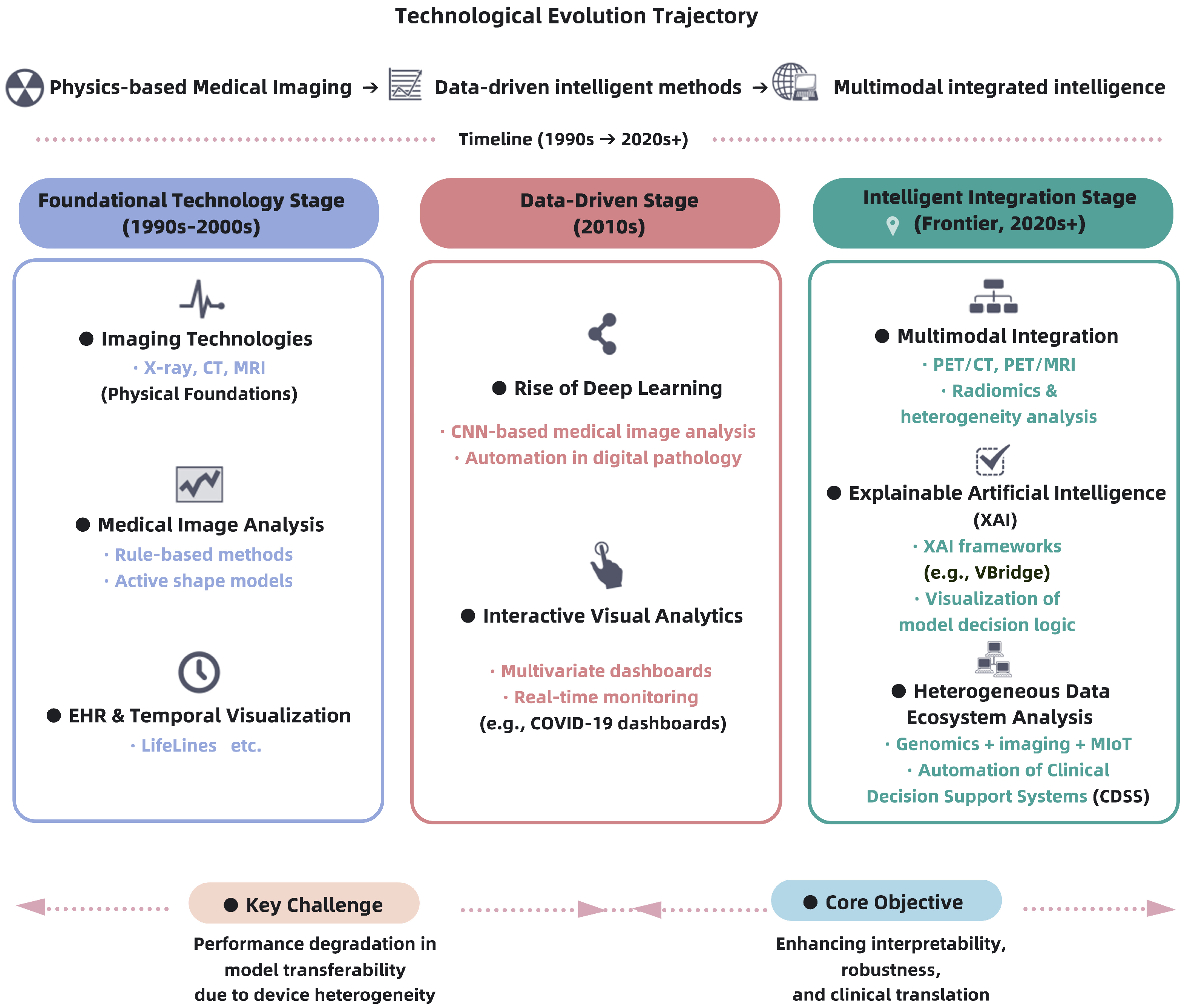
Figure 15 systematically depicts the developmental trajectory of health and medical visualization technologies along the axes of temporal evolution and paradigm transition. It illustrates the progression from foundational imaging and rule-based analysis to data-driven deep learning, and ultimately to the intelligent integration of multimodal data and explainable artificial intelligence.
The figure further identifies key challenges, including reduced model transferability caused by device heterogeneity, and highlights strategic objectives such as enhancing transparency and robustness to strengthen clinical applicability.
(1)
Research Foundation
Imaging technologies, including X-ray and computed tomography (CT), constitute the physical foundation of modern healthcare visualization by transforming non-intuitive physiological information into interpretable visual representations through processes of data acquisition, reconstruction, and display [187]. Early medical image analysis predominantly relied on rule-based approaches [188], such as tumor boundary delineation using edge detection and region-growing algorithms [189,190], as well as cardiac structure recognition supported by geometric fitting and shape modeling techniques [191]. Although effective for narrowly defined tasks, these methods exhibited limited robustness when confronted with noise, image artifacts, or multimodal data integration [192]. To address these limitations, active shape models and atlas-based methods were subsequently introduced, particularly for applications such as brain image registration [193]. In parallel, pattern recognition approaches combining feature extraction with supervised classifiers were applied to lung cancer [194] and breast cancer screening [195], thereby laying the technical foundation for modern computer-aided diagnosis.
The emergence of deep convolutional neural networks, exemplified by SuperVision [99] and AlexNet [109], marked a paradigm shift in medical image analysis. With advances in computational capacity and the availability of large-scale medical imaging datasets, deep learning—especially convolutional neural networks (CNNs)—has progressively become the dominant methodological approach in this domain [196]. In digital pathology, deep learning models are increasingly adopted for automated detection of cancerous regions in whole-slide images, substantially improving the efficiency of pathological diagnosis workflows [197]. Nevertheless, empirical studies have demonstrated that variability across imaging centers can undermine model generalizability. Differences in imaging equipment, scanner configurations, sample preparation procedures, and acquisition parameters [198] introduce systematic variations in visual characteristics such as color distribution, luminance, and image sharpness in whole-slide images (WSIs) [199], thereby posing challenges for model reliability and large-scale clinical deployment.
Beyond imaging, electronic health records (EHRs) and the visualization of longitudinal health data represent another critical technological foundation for healthcare visualization research [200]. Early systems, such as LifeLines, enabled timeline-based visualization of individual patient histories [124]. Subsequent studies introduced abstraction, segmentation, and aggregation strategies to support the overview and comparison of large-scale patient event sequences. Techniques such as EventThread were developed for cohort analysis and phase discovery, facilitating clinical research, cohort-level comparison, and decision communication [122]. More recent dashboard-based visualization systems integrate multivariate attributes across thousands of patients and have demonstrated effectiveness in long-term follow-up studies, such as prostate cancer monitoring, by enabling comparative analyses of prostate-specific antigen (PSA) levels and recurrence patterns [124]. Moreover, the interactive nature of web-based dashboards has enabled public health agencies to monitor epidemiological trends in near real time—achieving update cycles as short as 15 min during the COVID-19 pandemic—thereby supporting cross-regional coordination in disease prevention and control [127].
In recent years, visualization systems that tightly integrate machine learning models have further enhanced interpretability and clinical usability. For example, RetainVis combines interpretable recurrent neural networks with interactive visualization to elucidate the contributions of temporal features in EHR-based prediction tasks and to support expert validation [116]. Similarly, DPVis integrates parameters from Hidden Markov Models (HMMs) with interactive visual interfaces to explore disease progression trajectories and subgroup differences in chronic conditions such as diabetes and chronic obstructive pulmonary disease [125]. Collectively, these developments indicate that the technological foundation of healthcare visualization has evolved from traditional image processing toward deep learning–driven, interactive analytical systems, thereby accelerating translation into clinical practice [164].
(2)
Cutting-Edge Research Areas
Recent research increasingly highlights the central role of hybrid imaging and large-scale data analytics in advancing healthcare visualization [112]. By integrating morphological and functional imaging modalities, hybrid imaging techniques provide complementary anatomical and metabolic information within a single examination. When supported by high-performance computing and distributed cloud infrastructures, multimodal imaging approaches—such as PET/CT and PET/MRI—are particularly effective for the diagnosis and assessment of cancer and cardiovascular diseases. Their application in in vivo radiomics enables comprehensive characterization of tumor and lesion heterogeneity, offering critical support for precision diagnosis and personalized treatment strategies [112,201].
Concurrently, the rapid adoption of explainable artificial intelligence (XAI) has helped to alleviate growing concerns regarding the opacity of deep learning models in clinical contexts [126]. In response to the widespread deployment of deep learning in medical imaging and EHR analysis, researchers have proposed analytical frameworks that integrate feature importance visualization, contextual decomposition, and human–machine interaction [117]. Visualization systems such as Vbridge and RetainVis enhance model transparency and clinical acceptance by visually linking predictive outcomes to raw clinical features, thereby revealing underlying decision logic through feature relationships and temporal contribution patterns [119].
With the continued advancement of the Medical Internet of Things (MIoT), heterogeneous data sources—including genomics, histopathology, real-time physiological monitoring, and hybrid imaging—are increasingly interconnected, forming a complex and dynamic healthcare data ecosystem [112,202]. Supported by machine learning techniques and high-performance computing platforms, the integrated analysis of these diverse data modalities not only improves predictive performance but also expedites the development and deployment of automated Clinical Decision Support Systems (CDSS) [203].
The Value of Healthcare Visualization
Figure 16 presents a hierarchical framework illustrating the multidimensional value generated by healthcare visualization at the micro-, meso-, and macro-levels. It demonstrates the progression from enabling precision diagnosis and treatment at the individual level to supporting population-level analysis and public health communication, and ultimately to driving systemic transformation within healthcare systems and society.
Through this framework, the study envisions the development of a more proactive, equitable, efficient, and outcome-oriented healthcare ecosystem.
(1)
Research Foundation
In clinical research and practice, the fundamental value of healthcare visualization lies in improving diagnostic accuracy, therapeutic efficiency, and clinical decision precision. By transforming high-dimensional and multimodal medical data into interpretable visual representations, healthcare visualization enables clinicians to rapidly identify critical risk factors and latent patterns. For example, visual analyses of cardiovascular disease elucidate interactions among variables such as blood pressure, cholesterol levels, and lifestyle factors across diverse populations, thereby directly supporting personalized intervention strategies and evidence-based clinical decision-making [204]. In addition, visualization facilitates comparative analysis of patients’ longitudinal disease trajectories and treatment responses, allowing clinicians to prioritize diagnostic and therapeutic actions within time-constrained clinical settings [124]. Visualization of disease progression pathways—such as Parkinson’s disease modeled using Hidden Markov Models (HMMs)—allows physicians to intuitively observe state transitions, stratify patient subgroups, and compare evolutionary patterns across cohorts, thereby supporting hypothesis generation and clinical validation [205].
Within public health and population health management, healthcare visualization demonstrates dual value in surveillance and risk communication. Epidemic monitoring systems employ dynamic spatial maps and temporal trend visualizations to detect early transmission patterns of infectious diseases, thereby assisting policymakers in designing targeted intervention strategies [206]. During the COVID-19 pandemic, interactive web-based dashboards provided near real-time updates on confirmed cases, mortality, and recovery rates at global and regional scales, enabling timely visualization of epidemic diffusion. By integrating predictive modeling to identify high-risk areas, these systems enhanced the efficiency and precision of healthcare resource allocation [127]. Beyond policy support, such visualization tools also improved public comprehension of health risks, strengthening risk awareness and behavioral responsiveness during public health emergencies [207].
The value of healthcare visualization in doctor–patient communication and medical knowledge dissemination has become increasingly evident. Interactive visualization systems can translate complex genomic and molecular data into patient-accessible representations, such as genetic pathway maps, thereby facilitating patient engagement and shared decision-making processes [208].
Moreover, collaborative multi-view visualization approaches address the limitations of single-chart representations by enabling clinicians to compare multiple patient cohorts across several dimensions while simultaneously examining longitudinal changes at the individual level. This approach supports both macro-level trend identification and micro-level case analysis [209]. For instance, in a prostate cancer postoperative visualization study, researchers iteratively developed a static dashboard through nine design cycles, integrating 15 key clinical attributes. The resulting dashboard segmented disease progression into fine-grained stages and represented heterogeneous data types through coordinated small multiples [124]. By integrating fragmented medical records into a coherent clinical overview, such visualization systems enable clinicians to transition from passive data inspection toward proactive pattern recognition, trajectory prediction, and adaptive care management [210,211].
(2)
Cutting-Edge Research Areas
The value of healthcare visualization has extended beyond data representation to actively reshaping clinical workflows and supporting complex medical decision-making processes [13]. This shift is exemplified by systems such as VBridge, which integrates machine learning-derived features, interpretability mechanisms, and patient timeline context into unified visual interfaces. Such integration enables clinicians to incorporate reference benchmarks and individualized disease trajectories directly into diagnostic and therapeutic decision processes [119]. In parallel, predictive models trained on electronic health records (EHRs) are increasingly applied to forecast clinical outcomes, including hospital length of stay and readmission risk, thereby informing proactive care planning [212].
Emerging intelligent healthcare paradigms further expand the societal value of healthcare visualization. The “pocket doctor” model, supported by advanced artificial intelligence systems such as Med-PaLM 2, integrates real-time physiological and behavioral data from wearable and mobile devices. When combined with visualization techniques, this model enables personalized health monitoring and intervention recommendations [112,213,214]. Such systems enhance individual health self-management capabilities while also redefining traditional doctor–patient relationships, promoting a transition from reactive treatment toward participatory and collaborative healthcare management [215].
At a broader societal level, the impact of healthcare visualization increasingly depends on its capacity to facilitate data sharing and multicenter collaboration. The practical translation of visualization research outcomes is closely tied to the establishment of data standardization frameworks and open-access infrastructures [216,217]. For example, the adoption of EANM imaging standards provides a technical foundation for cross-institutional data comparability and supports the integration of evidence-based findings into clinical guidelines, thereby enhancing the long-term public health value of visualization-driven insights [112]. Consequently, a multidimensional value framework is emerging, extending from individual health empowerment to equitable population-level decision-making and collaborative knowledge sharing across institutions [218].
These trends indicate that future high-impact research in healthcare visualization will increasingly adopt interdisciplinary approaches, integrating clinical medicine, data science, human–computer interaction, and ethical governance. Such research must be validated through real-world pilot studies and cross-sector collaboration to ensure methodological robustness and sustainable societal impact [219].

4.3.2. High Centrality Analysis

Despite strict parameter control and standardized network construction, the co-citation analysis reveals an overall low level of betweenness centrality across the network, with the maximum value reaching only 0.01. This structural characteristic indicates that the current co-citation network in healthcare visualization has not yet formed clearly dominant nodes that function as centralized “knowledge hubs.” Instead, the intellectual structure of the field currently consists of multiple relatively independent knowledge communities, and a core body of literature capable of effectively integrating different subfields has yet to emerge. The production and diffusion of new knowledge, therefore, rely on several localized core contributions rather than on a unifying canonical reference, reflecting the field’s pluralistic and exploratory development trajectory.
Among the publications with relatively higher centrality, Apostolopoulos and Mpesiana [130] demonstrated high-accuracy chest X-ray image classification using transfer learning techniques. Their results provide a robust technical basis for disease feature extraction and visualization, empirically validating the clinical applicability of deep learning–assisted radiographic analysis, particularly in the context of COVID-19 diagnosis. Rajkomar A et al. [131] employed deep learning models based on comprehensive electronic health records formatted according to the FHIR standard to achieve high-precision predictions of multiple clinical events. The structured outputs generated by these predictions support risk-oriented visualization and demonstrate that neural networks can identify clinically salient information in electronic health records, thereby providing a technical basis for visualization-based explanations that trace predictive outcomes to underlying data features.
Shen D et al. [132] reviewed deep learning advancements in tasks like image segmentation and lesion detection, whose outputs form core components of medical imaging visualization. They highlighted how deep learning enhances the accuracy of visualizing disease diagnosis and prognosis. Raghupathi W and Raghupathi V [133] established visualization’s central role in analytical frameworks, positioning it as a key output theme for healthcare big data applications. They highlighted that the characteristics of healthcare big data necessitate developing novel visualization tools to address challenges in authenticating and presenting massive datasets.
Collectively, these high-centrality studies do not converge around a single methodological paradigm but instead represent complementary technical and conceptual contributions. Their distributed influence further corroborates the absence of a dominant integrative hub in the co-citation network, reinforcing the observation that healthcare visualization research is currently characterized by methodological diversity and decentralized knowledge accumulation.

4.3.3. Strongest Citation Bursts

The five most influential breakthrough citations in healthcare visualization predominantly emerged during the third and fourth developmental phases of the field, corresponding to periods of accelerated and explosive growth. Raghupathi W and Raghupathi V [133] proposed a comprehensive analytical and visualization framework for healthcare big data, systematically elucidating its role in enhancing clinical decision-making efficiency and health service performance. Similarly, Dash S et al. [220] provided a structured review of healthcare big data sources, analytical challenges, computational methods, and visualization techniques, emphasizing the importance of data integration, algorithmic intelligence, and visual analytics in supporting personalized medicine and real-time health monitoring. Collectively, these theory-oriented and review-based contributions offer a robust theoretical baseline and methodological orientation for healthcare visualization research.
From a methodological perspective, Braun V and Clarke V [221] advanced the field by formally articulating the principles of Reflexive Thematic Analysis, addressing prevalent misapplications and conceptual ambiguities associated with thematic analysis in qualitative research. Their work established a more theoretically grounded and methodologically coherent framework for data interpretation and visual coding in health-related studies, thereby strengthening the rigor and interpretability of qualitative visualization research. Such methodological innovations reflect the field’s increasing emphasis on analytical transparency and epistemological clarity.
At the application level, Dong E, Du H, and Gardner L [127] developed a web-based, interactive, real-time visualization dashboard for tracking the global spread of COVID-19. This system provided a transparent, scalable, and responsive visualization solution during a major public health emergency, substantially enhancing the practical relevance and societal impact of healthcare visualization research. In parallel, Kwon B. C., Anand V., Severson K. A. et al. [125] introduced the DPVis system, which integrates Hidden Markov Models (HMMs) with interactive visualization techniques to support the exploration of chronic disease progression pathways. By enabling clinicians to visually interpret complex model outputs, this approach significantly improved the interpretability and clinical applicability of disease progression modeling, effectively bridging the gap between computational inference and expert judgment.
Taken together, the distribution and characteristics of these breakthrough studies reveal a tripartite research trajectory in healthcare visualization, in which theoretical frameworks, methodological innovations, and applied systems evolve in parallel and reinforce one another. This “theory–method–application” paradigm not only reflects the internal maturation of the field but also provides a structured reference framework for positioning and categorizing future high-impact visualization research.

4.4. Theme Evolution Analysis

The thematic evolution map (Figure 13) illustrates the temporal development of healthcare visualization research. In the initial phase, the limited number of themes indicates that technologies, equipment, and tools in this domain were largely in exploratory and validation stages. The analysis identifies two primary evolutionary trajectories.
The first trajectory originates from topics such as “magnetic resonance imaging,” with “visualization” acting as a mediating theme, and progressively shifts toward medical resources and application paradigms, including “healthcare data” and “telemedicine.” This trajectory reflects a transition from static medical data representation to dynamic, intelligent, and interactive visualization. The research focus extends beyond supporting clinical diagnosis to integrating big data with convolutional neural networks (CNNs), thereby enabling immersive approaches for personalized disease progression monitoring and medical decision support.
The second trajectory evolves from single-point technologies, such as “wearable sensors” and “mobile health,” toward broader public health and digital health ecosystems. This progression indicates an expansion of research scope from individual-level disease monitoring to population-level disease prevention and health management. Visualization-based applications for early cancer screening, infectious disease surveillance, and chronic disease prediction have emerged as prominent recent themes, reflecting a shift from isolated diagnostic assistance toward full lifecycle health management.
Concurrently, several derivative themes emerged between 2020 and 2025, including “3D printing,” “augmented reality,” and “bibliometric analysis.” This pattern indicates that healthcare visualization research has moved beyond the development of isolated tools and is increasingly integrated with multiple emerging technologies. Such convergence signals a paradigm shift in the field, from early imaging-centered approaches toward a comprehensive research framework integrating technology, data, clinical practice, and public health.
Overall, each developmental stage has generated new research directions through the inheritance and transformation of existing themes. In particular, during the most recent phase, the convergence of “big data” and “digital health” has driven healthcare visualization beyond tool-oriented innovation toward addressing systemic, policy-related, and societal challenges. This transition marks a critical stage in the field’s evolution, characterized by strengthened interdisciplinary integration and an expanding orientation toward population-wide health needs.

5. Discussion

This study delineates four major developmental stages in healthcare visualization, charting its progression from early technological exploration to the current phase characterized by intelligent, multi-scenario integrated applications. Since 2020, annual publication output in this field has increased sharply, indicating that healthcare visualization has become a research area with substantial academic momentum and application potential. This growth has been driven by global health challenges alongside rapid technological innovation. The application scope of visualization technologies has expanded from early medical image reconstruction and surgical planning to include public health communication, real-time augmented reality, digital twins, and everyday health monitoring [43], reflecting a shift from specialized medical interventions toward proactive, life-cycle-oriented health management [222].
This evolutionary trajectory underscores the defining feature of multidisciplinary convergence. The deep integration of computer science, medical imaging, robotics, and artificial intelligence has continuously propelled advancements in precision, real-time performance, and interactivity within healthcare visualization systems [223,224,225]. At the same time, international academic conferences, such as MICCAI and IEEE VIS, have played a critical role in promoting global scholarly exchange and consolidating research directions. Countries including the United States, China, the United Kingdom, and Qatar have exhibited particularly strong influence within this domain.
The rapid advancement of healthcare visualization not only reflects the intrinsic technological value of visualization in addressing complex medical problems but also responds to the growing societal demand for transparent health information and intelligent healthcare services. Together, these factors position healthcare visualization as a foundational component in the future development of smart healthcare systems, providing essential support for more responsive, informed, and integrated health service delivery [226].

5.1. Future Research Trends

Building upon the preceding analysis of thematic evolution and technological pathway differentiation, this study integrates key research directions across clustering levels to construct a future research framework for healthcare visualization (Figure 17). Centered on “Future Trends in Healthcare Visualization,” the framework synthesizes emerging frontiers and potential trajectories from the perspectives of technological advancement, system integration, and application deepening.
Specifically, five major trends are identified:
  • Immersive and intelligent interaction
  • Explainable clinical integration
  • IoT-enabled near real-time heterogeneous data platforms
  • Multimodal and standardized data ecosystems
  • Decision-driven public health
These trends are not isolated; rather, they form cross-level synergies across technological innovation, data integration, and clinical application. Collectively, they indicate a strategic shift from technology-oriented exploration toward system-level integration and precision-oriented implementation.
Healthcare visualization has evolved from single-technology applications into a comprehensive research field integrating multiple technologies [44]. Early studies primarily relied on basic medical imaging equipment and elementary visualization techniques, which were insufficient to fully represent the complex structures and dynamic characteristics of health data [227]. With the integration of interdisciplinary approaches such as artificial intelligence, immersive interaction, and multimodal perception, both the analytical depth and expressive capacity of health data visualization have been substantially enhanced [228]. Given its demonstrated potential to improve healthcare quality, optimize resource allocation, and enhance patient engagement, data-driven and AI-assisted visualization has emerged as the central developmental direction of this field [229]. At the same time, technological evolution has expanded application boundaries beyond disease diagnosis to encompass health management, medical education, and public health response. Despite these advances, persistent challenges remain, including data heterogeneity, model interpretability, system usability, and ethical governance [219,226]. As the field continues to mature, several key directions are expected to drive future breakthroughs.
First, the deep integration of artificial intelligence and machine learning is expected to fundamentally reshape how health data is interpreted and utilized, with immersive visualization technologies achieving broader and deeper clinical adoption [230]. The fusion of immersive visualization and intelligent interaction enables the discovery of latent patterns within high-dimensional medical data, addressing existing diagnostic limitations while empowering next-generation visualization systems. This integration offers new pathways to overcome critical bottlenecks in precision medicine [231]. In particular, real-time multimodal image registration based on deep learning models will support mixed-reality surgical navigation systems with submillimeter-level localization accuracy [232]. Furthermore, analysis of tactile feedback from fiber-optic sensing gloves [233] and functional near-infrared spectroscopy (fNIRS) signals for brain activity monitoring [234] will facilitate the anticipation and correction of surgeons’ operational intentions, especially in neurosurgical contexts [235].
Second, to address the persistent trust deficit and “black-box” challenges associated with clinical deployment of medical AI models, future research will increasingly emphasize the integrated development of explainable artificial intelligence (XAI) and visualization-based analysis [236,237]. This direction will promote the construction of XAI-driven interactive machine learning frameworks [238] and visualization-based explanation systems for electronic health records [239]. In this context, explainable recurrent neural network (RNN) models and interactive visualization tools for chronic diseases such as diabetes can be developed [116]. By intuitively visualizing changes in indicators such as HbA1c [240], disease state transitions—for example, from insulin resistance to nephropathy—can be revealed [241], alongside explicit annotations of predictive weights and decision thresholds for key variables. In medical imaging, visualization bridge techniques can synchronously present lesion segmentation results with radiological features such as spiculation and lobulation in chest CT diagnosis [242]. Integrating these visual cues with semantic descriptions from clinical guidelines, together with decision-consistency evaluations, can further enhance diagnostic confidence and reliability.
Third, driven by rapid advances in medical Internet of Things (IoT) technologies, future efforts should prioritize the development of visualization platforms capable of near-real-time rendering and interaction with large-scale heterogeneous data streams [174]. In chronic disease management, dashboards integrating continuous glucose monitoring data and wearable physiological signals enable dynamic tracking of glucose trajectories and collaborative analysis of blood pressure trends, while reducing rendering latency through edge computing [243]. In intensive care unit (ICU) monitoring scenarios, lightweight models deployed at edge nodes can perform parallel processing of multimodal physiological signals—including arterial blood pressure waveforms, heart rate, and respiratory variability—across multiple patients [244], enabling near-real-time alerts for conditions such as septic shock. When integrated into central monitoring station interfaces and visualized in relation to bed layouts, these alerts support rapid situational awareness among clinical staff. This platform architecture mitigates information overload and decision latency by combining longitudinal trends from out-of-hospital monitoring with cross-sectional insights from in-hospital acute events, providing a unified data-driven foundation for precision decision-making across the continuum of care—from chronic disease prevention to acute emergency intervention [245].
Fourth, sustained progress in healthcare visualization depends on deep interdisciplinary integration, with a central priority being the establishment of standardized data ecosystems to address fundamental challenges in multimodal data fusion and system interoperability [246]. To achieve cross-standard interoperability, unified semantic mapping rules encompassing multi-source data—such as DICOM imaging, FHIR-based medical records, and OpenEHR clinical models—need to be established [247]. For example, joint visualization platforms integrating PET/CT imaging and genomic data can support three-dimensional quantitative analysis of tumor heterogeneity through combined radiomics feature extraction and gene variant mapping [248]. Drawing inspiration from multispectral imaging systems, cuboid imaging datasets can be constructed to synchronously analyze histopathological sections, proteomics data, and clinical outcomes, with each pixel encoding comprehensive spectral feature information [249]. However, the clinical applicability of such platforms must be validated through cross-institutional comparative studies that assess model generalizability and transferability across different equipment vendors and scanning parameters [250]. Beyond data integration, consistency at the visualization level also requires attention [251]. Standardized color management and display calibration protocols are necessary to minimize visual bias caused by device and parameter variability, ensuring that clinical decisions are not influenced by non-biological factors [252].
Finally, the quality of public health emergency response increasingly relies on the deep integration and intelligent visualization of multi-source data [253]. Inclusive and equitable visualization services for universal health are expected to evolve from static information presentation toward decision-oriented applications [254]. Interactive visualization systems such as DPVis, combined with Hidden Markov Models, can reveal representative disease progression pathways for chronic conditions, including diabetes and chronic obstructive pulmonary disease [125,255]. These approaches enable visual comparison of progression trajectories across patient subgroups, providing evidence-based support for stratified management and early intervention. In resource-limited settings, lightweight visualization tools based on progressive web applications can facilitate offline inference and result visualization for multi-disease risk screening under low-bandwidth conditions [256]. In infectious disease control, real-time visualization dashboards for COVID-19 and similar outbreaks can be further optimized, with the integration of geographic information system (GIS) data and hospital bed capacity enabling comprehensive prediction of community-level transmission dynamics and critical care demand [257,258]. Furthermore, predictive visualization dashboards with spatial resolutions of 1 km × 1 km and temporal accuracy of seven days can be developed for infectious diseases such as dengue fever, offering high-precision early warning capabilities that provide critical lead time for global public health emergency response [257].

5.2. Research Limitations

This study has several limitations that should be considered when interpreting the findings. First, given the requirements of bibliometric analysis for data completeness and consistency, the Web of Science Core Collection (WOSCC) was selected as the sole data source, yielding a dataset of 1121 publications. WOSCC provides standardized and structured bibliographic records, is widely used in scientometric research, and ensures compatibility with analytical tools such as CiteSpace, VOSviewer, and Bibliometrix, thereby supporting methodological consistency.
However, reliance on a single database may limit sample coverage [52]. To mitigate this constraint, additional literature from conferences, publishers, and other databases—including PubMed, Scopus, and BMC—was consulted during contextual development and research interpretation, particularly to strengthen clinical and bioinformatics relevance. Future studies may integrate multiple databases to expand coverage and enhance the robustness of conclusions.
In addition, only English-language publications were included, potentially limiting the global representativeness of the results, particularly for research conducted in non-English-speaking regions and developing contexts. Owing to periodic delays in database indexing and literature updates, the literature retrieval for this study was finalized on 7 March 2025, to ensure the consistency and reliability of the analytical outcomes. Although this introduces a modest temporal lag, the relative stability of the research domain mitigates its influence on the overall conclusions. With respect to future research considerations, this study has examined the identified trends in light of overall developments in the field and recent literature, and has further extended their forward-looking significance.
Second, with respect to methodology, although multiple thematic clusters were identified through bibliometric analysis, constraints related to scope and focus necessitated prioritizing core clusters for in-depth examination [98]. As a result, the potential contributions of non-core clusters were not comprehensively explored, nor were the findings cross-validated using alternative clustering algorithms.
Finally, while the combined use of three bibliometric analysis tools improved the objectivity and reproducibility of the analytical process to a certain extent, their predefined analytical frameworks and automated procedures remain inherently limited. For example, the identification of thematic evolution pathways still requires manual interpretation, which inevitably introduces a degree of subjectivity [52]. Future research should incorporate more intelligent and integrated analytical pipelines to further enhance the completeness, robustness, and efficiency of large-scale literature analysis.

6. Conclusions

This study employed bibliometric methods and integrated three analytical tools—CiteSpace, VOSviewer, and Bibliometrix—to systematically examine the evolution of healthcare visualization research from 1994 to 2025. The findings provide robust empirical evidence to support future scholarly inquiry and strategic planning in this field, while also contributing to its sustained development and innovation. Collectively, these results establish a theoretical foundation for subsequent research and offer practical reference value for policy formulation and decision-making, thereby promoting the advancement of healthcare visualization technologies and their broader contribution to human well-being.
The evolution of healthcare visualization can be delineated into four distinct developmental phases. The latter two phases are characterized by a marked growth in publication volume, reflecting increased academic attention and expanding influence in recent years. These phases also reveal the emergence of leading countries, institutions, and collaborative networks aligned with specific research themes. Core research domains in healthcare visualization include immersive medical visualization technologies, visual analytics of medical data, health information systems and decision support, AI-assisted epidemic prediction and diagnosis, and the integration of IoT-enabled healthcare frameworks. With continuous technological advancement and theoretical deepening, healthcare visualization has transitioned from isolated, single-technology applications to a comprehensive interdisciplinary field integrating artificial intelligence, immersive interaction, and multimodal perception. In particular, the deep integration of artificial intelligence and machine learning has fundamentally reshaped the interpretation and utilization of health data and will remain a central driver of future healthcare visualization system development.
Citation burst analysis reveals the progressive trajectory of healthcare visualization research, spanning theoretical frameworks, methodological innovations, and applied practices. This progression underscores the growing relevance and practical value of visualization technologies in big data analytics, personalized medicine, real-time health monitoring, and pandemic response. The thematic evolution diagram further demonstrates a clear shift from early emphases on medical imaging and foundational techniques toward a cross-disciplinary paradigm deeply intertwined with artificial intelligence, big data, and precision medicine. This pattern is structurally reinforced by the strategic coordinate diagram, which indicates that the field has not only formed highly mature core themes—such as information modeling and design methodologies—but has also diversified into a broad range of research directions, extending from conventional diagnostic applications to emerging areas including disease risk prediction.
Taken together, these analytical results elucidate the intrinsic coherence between the dynamic evolutionary trajectory and the relatively stable knowledge structure of healthcare visualization, examined from both diachronic and synchronic perspectives. Despite its rapid advancement, the field continues to face persistent challenges, including data silos, inconsistent annotation standards, and limited model generalization, which constrain the full exploitation of existing infrastructural and algorithmic capabilities. Future development should therefore prioritize the construction of integrated design systems that synergistically combine multiple technologies, particularly visualization environments capable of real-time multimodal data fusion, high-dimensional dynamic representation, and immersive interaction. Such efforts are expected to further advance collaborative clinical decision-making and accelerate the practical realization of precision medicine.

Author Contributions

Conceptualization, F.C. and R.D.; methodology, C.Y. and R.D.; software, F.C.; visualization, F.C.; formal analysis, F.C., C.Y. and R.D.; investigation, F.C., C.Y. and R.D.; resources, C.Y. and R.D.; data curation, F.C.; writing—original draft preparation, F.C.; writing—review and editing, F.C., C.Y. and R.D.; supervision, C.Y. and R.D.; funding acquisition, C.Y. All authors have read and agreed to the published version of the manuscript.

Funding

This research was funded by the 2024 Universities’ Philosophy and Social Science Research in Jiangsu Province, grant number 2024SJYB0653.

Institutional Review Board Statement

Not applicable.

Informed Consent Statement

Not applicable.

Data Availability Statement

No new data were created or analyzed in this study. All publications included in the bibliometric analysis of this study were retrieved from the Web of Science Core Collection (WOSCC), which is a publicly accessible database, with the retrieval date of 7 March 2025.

Acknowledgments

This research did not receive any help from authors other than those listed.

Conflicts of Interest

The authors declare no conflicts of interest.

Abbreviations

The following abbreviations are used in this manuscript:
CTComputed Tomography
MRIMagnetic Resonance Imaging
WoSCCWeb of Science Core Collection
MICCAIMedical Image Computing and Computer-Assisted Intervention
CVRMedComputer Vision, Visualization, and Robotics in Medicine
VBCVisualization in Biomedical Computing
MRCASMedical Robotics and Computer-Assisted Surgery
IHIInternational Health Informatics Symposium
HEALTHINFInternational Conference on Health Informatics
BHIInternational Conference on Biomedical and Health Informatics
IMIAInternational Medical Informatics Association
MedInfoWorld Congress on Medical and Health Informatics
MCRTMonte Carlo Ray Tracing
GANGenerative Adversarial Network
CNNConvolutional Neural Network
COVID-19Coronavirus Disease 2019
IEEE VISIEEE Visualization Conference
UCLUniversity College London
MITMassachusetts Institute of Technology
Internet of ThingsIoT
ResNetResidual Network
SR-microCTSynchrotron Radiation micro-Computed Tomography
AIArtificial Intelligence
ARAugmented Reality
EMRElectronic Medical Records
EHRElectronic Health Records
XAIExplainable Artificial Intelligence
GISGeographic Information System
WISWhole Slide Imaging
PSAProstate-Specific Antigen
HMMHidden Markov Model
PETPositron Emission Tomography
MlotMedical Internet of Things
CDSSClinical Decision Support Systems
EANMEuropean Association of Nuclear Medicine
FHIRFast Healthcare Interoperability Resources
fNIRSFunctional Near-Infrared Spectroscopy
HbA1cHemoglobin A1c
ICUIntensive Care Unit
DICOMDigital Imaging and Communications in Medicine

References

  1. Lameire, N.; Joffe, P.; Wiedemann, M. Healthcare Systems—An International Review: An Overview. Nephrol. Dial. Transplant. 1999, 14, 3–9. [Google Scholar] [CrossRef]
  2. World Health Organization (WHO). Primary Health Care. Available online: https://www.who.int/health-topics/primary-health-care (accessed on 12 January 2025).
  3. Korshever, N.G.; Sidelnikov, S.A. Intersectoral Cooperation in the Sphere of Public Health Care: Ways of Optimization. Russ. Open Med. J. 2017, 6, 308. [Google Scholar] [CrossRef]
  4. Reungjui, S.; Anunnatsiri, S.; Limwattananon, C.; Thavornpitak, Y.; Pukdeesamai, P.; Mairiang, P. Health Insurance System and Healthcare Provision: Nationwide Hospital Admission Data 2010. J. Med. Assoc. Thai. 2012, 95, S240–S253. [Google Scholar]
  5. Tiruneh, G.T.; Fesseha, N.; Ayehu, T.; Chitashvili, T.; Argaw, M.D.; Shiferaw, B.B.; Teferi, M.; Semahegn, A.; Bogale, B.; Kifle, Y. Networks of Care for Optimizing Primary Health Care Service Delivery in Ethiopia: Enhancing Relational Linkages and Care Coordination. PLoS ONE 2025, 20, e0314807. [Google Scholar] [CrossRef]
  6. Donabedian, A. The Definition of Quality and Approaches to Its Assessment. In Explorations in Quality Assessment and Monitoring; Health Administration Press: Ann Arbor, MI, USA, 1980. [Google Scholar]
  7. Mohammad Mosadeghrad, A. Healthcare Service Quality: Towards a Broad Definition. Int. J. Health Care Qual. Assur. 2013, 26, 203–219. [Google Scholar] [CrossRef]
  8. Craft, M.; Dobrenz, B.; Dornbush, E.; Hunter, M.; Morris, J.; Stone, M.; Barnes, L.E. An Assessment of Visualization Tools for Patient Monitoring and Medical Decision Making. In Proceedings of the 2015 Systems and Information Engineering Design Symposium (SIEDS 2015), Charlottesville, VA, USA, 24 April 2015. [Google Scholar]
  9. Osuala, R.; Arandjelović, O. Visualization of Patient Specific Disease Risk Prediction. In Proceedings of the 2017 IEEE EMBS International Conference on Biomedical & Health Informatics (BHI 2017), Orlando, FL, USA, 16–19 February 2017; pp. 241–244. [Google Scholar]
  10. Linhares, C.D.; Lima, D.M.; Ponciano, J.R.; Olivatto, M.M.; Gutierrez, M.A.; Poco, J.; Traina, C.; Traina, A.J. Clinicalpath: A Visualization Tool to Improve the Evaluation of Electronic Health Records in Clinical Decision-Making. IEEE Trans. Vis. Comput. Graph. 2022, 29, 4031–4046. [Google Scholar] [CrossRef]
  11. Zudilova-Seinstra, E.; Yang, N.; Axner, L.; Wibisono, A.; Vasunin, D. Service-Oriented Visualization Applied to Medical Data Analysis. Serv. Oriented Comput. Appl. 2008, 2, 187–201. [Google Scholar] [CrossRef][Green Version]
  12. Albers, E.A.; Fraterman, I.; Walraven, I.; Wilthagen, E.; Schagen, S.B.; van der Ploeg, I.M.; Wouters, M.W.; van de Poll-Franse, L.V.; de Ligt, K.M. Visualization Formats of Patient-Reported Outcome Measures in Clinical Practice: A Systematic Review About Preferences and Interpretation Accuracy. J. Patient Rep. Outcomes 2022, 6, 18. [Google Scholar] [CrossRef] [PubMed]
  13. Ilyas, S.A.; Ilyas, A.A. Harnessing the Power of Data Visualization Strategies in Healthcare Management. In Innovative Research: Uniting Multidisciplinary Insights; Redshine Publication: Bengaluru, India, 2024; pp. 93–104. [Google Scholar]
  14. Zhou, Y.; He, H.; Rong, J.; Cheng, Y.; Li, Y.; Zhong, W.; Jiang, F. Visual Analysis and Exploration of COVID-19 Based on Multi-Source Heterogeneous Data. In Proceedings of the 2020 International Conferences on Internet of Things (iThings) and IEEE Green Computing and Communications (GreenCom) and IEEE Cyber, Physical and Social Computing (CPSCom) and IEEE Smart Data (SmartData) and IEEE Congress on Cybermatics (Cybermatics), Rhodes Island, Greece, 2–6 November 2020; pp. 62–69. [Google Scholar]
  15. Martin-Gomez, A.; Merkl, F.; Winkler, A.; Heiliger, C.; Eck, U.; Karcz, K.; Navab, N. A Closer Look at Dynamic Medical Visualization Techniques. In Proceedings of the 2023 IEEE International Symposium on Mixed and Augmented Reality (ISMAR), Sydney, Australia, 16–20 October 2023; pp. 99–108. [Google Scholar]
  16. Hossain, M.Z.; Khan, M.M.; Islam, R.; Nahar, K.; Kabir, M.F. Formulation of a Multi-Disease Comorbidity Prediction Framework: A Data-Driven Case Analysis on of Diabetes, Hypertension, and Cardiovascular Risk Trajectories. J. Comput. Sci. Technol. Stud. 2023, 5, 161–182. [Google Scholar] [CrossRef]
  17. Carroll, L.N.; Au, A.P.; Detwiler, L.T.; Fu, T.-C.; Painter, I.S.; Abernethy, N.F. Visualization and Analytics Tools for Infectious Disease Epidemiology: A Systematic Review. J. Biomed. Inform. 2014, 51, 287–298. [Google Scholar] [CrossRef] [PubMed]
  18. Chishtie, J.; Bielska, I.A.; Barrera, A.; Marchand, J.-S.; Imran, M.; Tirmizi, S.F.A.; Turcotte, L.A.; Munce, S.; Shepherd, J.; Senthinathan, A. Interactive Visualization Applications in Population Health and Health Services Research: Systematic Scoping Review. J. Med. Internet Res. 2022, 24, e27534. [Google Scholar] [CrossRef]
  19. Jiang, M.-M.; Wu, Z.-Y.; Tu, A.-X. Research on the Cooperative Governance Path of Multiple Stakeholders in Doctor–Patient Disputes Under the Environment of Information Asymmetry. Int. J. Environ. Res. Public Health 2023, 20, 1597. [Google Scholar] [CrossRef]
  20. Glasberg, A.L.; Norberg, A.; Söderberg, A. Sources of Burnout Among Healthcare Employees as Perceived by Managers. J. Adv. Nurs. 2007, 60, 10–19. [Google Scholar] [CrossRef] [PubMed]
  21. Nugus, P.; Holdgate, A.; Fry, M.; Forero, R.; McCarthy, S.; Braithwaite, J. Work Pressure and Patient Flow Management in the Emergency Department: Findings From an Ethnographic Study. Acad. Emerg. Med. 2011, 18, 1045–1052. [Google Scholar] [CrossRef]
  22. Lukoschek, P.; Fazzari, M.; Marantz, P. Patient and Physician Factors Predict Patients’ Comprehension of Health Information. Patient Educ. Couns. 2003, 50, 201–210. [Google Scholar] [CrossRef] [PubMed]
  23. Einsfeld, K.; Ebert, A.; Wölle, J. Modified Virtual Reality for Intuitive Semantic Information Visualization. In Proceedings of the 2008 12th International Conference Information Visualisation, London, UK, 8–11 July 2008; pp. 515–520. [Google Scholar]
  24. Gegenfurtner, A.; Seppänen, M. Transfer of expertise: An Eye Tracking and Think Aloud Study Using Dynamic Medical Visualizations. Comput. Educ. 2013, 63, 393–403. [Google Scholar] [CrossRef]
  25. Kunert, A.; Weissker, T.; Froehlich, B.; Kulik, A. Multi-Window 3d Interaction for Collaborative Virtual Reality. IEEE Trans. Vis. Comput. Graph. 2019, 26, 3271–3284. [Google Scholar] [CrossRef]
  26. Manovich, L. What is visualization? Visual Stud. 2010, 26, 36–49. [Google Scholar] [CrossRef]
  27. Reyna, M.A.; Weigle, J.; Koscova, Z.; Campbell, K.; Shivashankara, K.K.; Saghafi, S.; Nikookar, S.; Motie-Shirazi, M.; Kiarashi, Y.; Seyedi, S. ECG-Image-Database: A Dataset of ECG Images with Real-World Imaging and Scanning Artifacts; A Foundation for Computerized ECG Image Digitization and Analysis. arXiv 2024, arXiv:2409.16612. [Google Scholar]
  28. Faust, O.; Acharya, U.R.; Ng, E.; Hong, T.J.; Yu, W. Application of Infrared Thermography in Computer Aided Diagnosis. Infrared Phys. Technol. 2014, 66, 160–175. [Google Scholar] [CrossRef] [PubMed]
  29. McAuliffe, M.J.; Lalonde, F.M.; McGarry, D.; Gandler, W.; Csaky, K.; Trus, B.L. Medical Image Processing, Analysis and Visualization in Clinical Research. In Proceedings of the 14th IEEE Symposium on Computer-Based Medical Systems, CBMS 2001, Bethesda, MD, USA, 26–27 July 2001; pp. 381–386. [Google Scholar]
  30. Yang, S.; Galvagno, S.; Badjatia, N.; Stein, D.; Teeter, W.; Scalea, T.; Shackelford, S.; Fang, R.; Miller, C.; Hu, P. A Novel Continuous Real-Time Vital Signs Viewer for Intensive Care Units: Design and Evaluation Study. JMIR Human Factors 2024, 11, e46030. [Google Scholar] [CrossRef] [PubMed]
  31. Borkin, M.; Gajos, K.; Peters, A.; Mitsouras, D.; Melchionna, S.; Rybicki, F.; Feldman, C.; Pfister, H. Evaluation of Artery Visualizations for Heart Disease Diagnosis. IEEE Trans. Vis. Comput. Graph. 2011, 17, 2479–2488. [Google Scholar] [CrossRef] [PubMed]
  32. Ma, H.; Sun, X.; Lawson, G.; Wang, Q.; Zhang, Y. Visualising Emotion in Support of Patient-Physician Communication: An empirical study. Behav. Inf. Technol. 2023, 42, 1782–1800. [Google Scholar] [CrossRef]
  33. Ma, H.; Yuan, X.; Sun, X.; Lawson, G.; Wang, Q. Seeing Your Stories: Visualization for Narrative Medicine. Health Data Sci. 2024, 4, 0103. [Google Scholar] [CrossRef]
  34. Nie, Q.; Morrow, D.G.; Azevedo, R.F.; Rogers, W.A. Developing Feedback Visualizations to Support Older Adults’ Medication Adherence. Hum. Factors Healthc. 2024, 5, 100076. [Google Scholar] [CrossRef]
  35. Hsieh, M.-C.; Lee, J.-J. Preliminary Study of VR and AR Applications in Medical and Healthcare Education. J. Nurs. Health Stud. 2018, 3, 1. [Google Scholar] [CrossRef]
  36. Khairat, S.S.; Dukkipati, A.; Lauria, H.A.; Bice, T.; Travers, D.; Carson, S.S. The Impact of Visualization Dashboards on Quality of Care and Clinician Satisfaction: Integrative Literature Review. JMIR Hum. Factors 2018, 5, e9328. [Google Scholar] [CrossRef]
  37. Dellinger, R.P.; Parrillo, J.E.; Kushnir, A.; Rossi, M.; Kushnir, I. Dynamic Visualization of Lung Sounds with a Vibration Response Device: A Case Series. Respiration 2008, 75, 60–72. [Google Scholar] [CrossRef]
  38. Williams, R. Illness Visualization and Therapeutic Adherence. J. Fam. Pract. 1989, 28, 185–192. [Google Scholar]
  39. Preim, B.; Bartz, D. Visualization in Medicine: Theory, Algorithms, and Applications; Elsevier: Amsterdam, The Netherlands, 2007. [Google Scholar]
  40. Rezaei, N.; Saghazadeh, A. Introduction on Integrated Science: Multidisciplinarity and Interdisciplinarity in Health. In Multidisciplinarity and Interdisciplinarity in Health; Springer: Berlin/Heidelberg, Germany, 2022; pp. 1–40. [Google Scholar]
  41. JohnsonChris, R. A review of three-dimensional medical image visualization. Health Data Sci. 2022, 2022, 9840519. [Google Scholar]
  42. Rajeswari, J.; Jagannath, M. Advances in Biomedical Signal and Image Processing—A Systematic Review. Inform. Med. Unlocked 2017, 8, 13–19. [Google Scholar] [CrossRef]
  43. Nguyen, H.-S.; Voznak, M. A Bibliometric Analysis of Technology in Digital Health: Exploring Health Metaverse and Visualizing Emerging Healthcare Management Trends. IEEE Access 2024, 12, 23887–23913. [Google Scholar] [CrossRef]
  44. Tan, X.; Suo, X.; Li, W.; Bi, L.; Yao, F. Data Visualization in Healthcare and Medicine: A Survey. Vis. Comput. 2025, 41, 3037–3058. [Google Scholar] [CrossRef]
  45. Abudiyab, N.A.; Alanazi, A.T. Visualization Techniques in Healthcare Applications: A Narrative Review. Cureus 2022, 14, e31355. [Google Scholar] [CrossRef] [PubMed]
  46. Zhao, F.; Wu, Y.; Hu, M.; Chang, C.-W.; Liu, R.; Qiu, R.; Yang, X. Current Progress of Digital Twin Construction Using Medical Imaging. arXiv 2024, arXiv:2411.08173. [Google Scholar] [CrossRef] [PubMed]
  47. Ahmed, I.; Chehri, A.; Jeon, G. Artificial Intelligence and Blockchain Enabled Smart Healthcare System for Monitoring and Detection of COVID-19 in Biomedical Images. IEEE/ACM Trans. Comput. Biol. Bioinform. 2023, 21, 814–822. [Google Scholar] [CrossRef] [PubMed]
  48. Zhou, Y.; Dong, F.; Kong, D.; Liu, Y. Unfolding the Convergence Process of Scientific Knowledge for the Early Identification of Emerging Technologies. Technol. Forecast. Soc. Change 2019, 144, 205–220. [Google Scholar] [CrossRef]
  49. Zahid, A.; Poulsen, J.K.; Sharma, R.; Wingreen, S.C. A Systematic Review of Emerging Information Technologies for Sustainable Data-Centric Health-Care. Int. J. Med. Inform. 2021, 149, 104420. [Google Scholar] [CrossRef]
  50. Zhou, Y.; Li, Z.; Li, Y. Interdisciplinary Collaboration Between Nursing and Engineering in Health Care: A Scoping Review. Int. J. Nurs. Stud. 2021, 117, 103900. [Google Scholar] [CrossRef]
  51. Pranckutė, R. Web of Science (WoS) and Scopus: The Titans of Bibliographic Information in Today’s Academic World. Publications 2021, 9, 12. [Google Scholar] [CrossRef]
  52. Ye, X.; Chen, Y.; Peng, L.; Yang, X.; Bai, Y. Application of Spectroscopy Technique in Cultural Heritage: Systematic Review and Bibliometric Analysis. Npj Herit. Sci. 2025, 13, 169. [Google Scholar] [CrossRef]
  53. Mansoori, P. 50 Years of Iranian Clinical, Biomedical, and Public Health Research: A Bibliometric Analysis of the Web of Science Core Collection (1965–2014). J. Glob. Health 2018, 8, 020701. [Google Scholar] [CrossRef] [PubMed]
  54. Chen, B.; Shin, S. Bibliometric Analysis on Research Trend of Accidental Falls in Older Adults by Using Citespace—Focused on Web of Science Core Collection (2010–2020). Int. J. Environ. Res. Public Health 2021, 18, 1663. [Google Scholar] [CrossRef] [PubMed]
  55. Shen, Z.; Ji, W.; Yu, S.; Cheng, G.; Yuan, Q.; Han, Z.; Liu, H.; Yang, T. Mapping the Knowledge of Traffic Collision Reconstruction: A scientometric Analysis in CiteSpace, VOSviewer, and SciMAT. Sci. Justice 2023, 63, 19–37. [Google Scholar] [CrossRef]
  56. Gusenbauer, M.; Haddaway, N.R. Which Academic Search Systems are Suitable for Systematic Reviews or Meta-Analyses? Evaluating Retrieval Qualities of Google Scholar, PubMed, and 26 other resources. Res. Synth. Methods 2020, 11, 181–217. [Google Scholar] [CrossRef]
  57. Donthu, N.; Kumar, S.; Mukherjee, D.; Pandey, N.; Lim, W.M. How to Conduct a Bibliometric Analysis: An Overview and Guidelines. J. Bus. Res. 2021, 133, 285–296. [Google Scholar] [CrossRef]
  58. Pan, X.; Yan, E.; Cui, M.; Hua, W. Examining the Usage, Citation, and Diffusion Patterns of Bibliometric Mapping Software: A Comparative Study of Three tools. J. Informetr. 2018, 12, 481–493. [Google Scholar] [CrossRef]
  59. Ye, C. Bibliometrical Analysis of International Big data Research: Based on Citespace and Vosviewer. In Proceedings of the 2018 14th International Conference on Natural Computation, Fuzzy Systems and Knowledge Discovery (ICNC-FSKD), Huangshan, China, 28–30 July 2018; pp. 927–932. [Google Scholar]
  60. Ghorbani, B.D. Bibliometrix: Science Mapping Analysis with R Biblioshiny Based on Web of Science in Applied Linguistics. In A Scientometrics Research Perspective in Applied Linguistics; Springer: Berlin/Heidelberg, Germany, 2024; pp. 197–234. [Google Scholar]
  61. Aria, M.; Cuccurullo, C. Bibliometrix: An R-Tool for Comprehensive Science Mapping Analysis. J. Informetr. 2017, 11, 959–975. [Google Scholar] [CrossRef]
  62. Kemeç, A.; Altınay, A.T. Sustainable Energy Research Trend: A Bibliometric Analysis Using VOSviewer, RStudio Bibliometrix, and Citespace Software Tools. Sustainability 2023, 15, 3618. [Google Scholar] [CrossRef]
  63. Young, A.A.; Kraitchman, D.L.; Axel, L. Deformable Models for Tagged MR Images: Reconstruction of Two-and Three-Dimensional Heart Wall Motion. In Proceedings of the IEEE Workshop on Biomedical Image Analysis, Seattle, WA, USA, 24–25 June 1994; pp. 317–323. [Google Scholar]
  64. Toriwaki, J.-I. Study of Computer Diagnosis of X-ray and CT Images in Japan—A Brief Survey. In Proceedings of the IEEE Workshop on Biomedical Image Analysis, Seattle, WA, USA, 24–25 June 1994; pp. 155–164. [Google Scholar]
  65. Kanazawa, K.; Niki, N.; Satoh, H.; Ohmatsu, H.; Moriyama, N. Computer Assisted Diagnosis of Lung Cancer Using Helical X-ray CT. In Proceedings of the IEEE Workshop on Biomedical Image Analysis, Seattle, WA, USA, 24–25 June 1994; pp. 261–267. [Google Scholar]
  66. Duncan, J.S.; Ayache, N. Medical Image Analysis: Progress over Two Decades and the Challenges Ahead. IEEE Trans. Pattern Anal. Mach. Intell. 2000, 22, 85–106. [Google Scholar] [CrossRef]
  67. Wells, W.M.; Colchester, A.; Delp, S. Medical Image Computing and Computer-Assisted Intervention-MICCAI’98. In Proceedings of the First International Conference, Cambridge, MA, USA, 11–13 October 1998; Springer: Berlin/Heidelberg, Germany, 2006. [Google Scholar]
  68. Kiryati, N.; Landau, Y. Dataset Growth in Medical Image Analysis Research. J. Imaging 2021, 7, 155. [Google Scholar] [CrossRef]
  69. Heller, N.; Rickman, J.; Weight, C.; Papanikolopoulos, N. The Role of Publicly Available Data in Miccai Papers from 2014 to 2018. In Proceedings of the Large-Scale Annotation of Biomedical Data and Expert Label Synthesis and Hardware Aware Learning for Medical Imaging and Computer Assisted Intervention: International Workshops, LABELS 2019, HAL-MICCAI 2019, and CuRIOUS 2019, Held in Conjunction with MICCAI 2019, Shenzhen, China, 13–17 October 2019; Proceedings 4. pp. 70–77. [Google Scholar]
  70. Nishikawa, A.; Negoro, D.; Kakutani, H.; Miyazaki, F.; Sekimoto, M.; Yasui, M.; Takiguchi, S.; Monden, M. Using an Endoscopic Solo Surgery Simulator for Quantitative Evaluation of Human-Machine Interface in Robotic Camera Positioning Systems. In Proceedings of the Medical Image Computing and Computer-Assisted Intervention—MICCAI 2002: 5th International Conference, Tokyo, Japan, 25–28 September 2002; Proceedings, Part I 5. pp. 1–8. [Google Scholar]
  71. Krupa, A.; de Mathelin, M.; Doignon, C.; Gangloff, J.; Morel, G.; Soler, L.; Leroy, J.; Marescaux, J. Automatic 3-d Positioning of Surgical Instruments During Robotized Laparoscopic Surgery Using Automatic Visual Feedback. In Proceedings of the Medical Image Computing and Computer-Assisted Intervention—MICCAI 2002: 5th International Conference, Tokyo, Japan, 25–28 September 2002; Proceedings, Part I 5. pp. 9–16. [Google Scholar]
  72. Fichtinger, G.; Krieger, A.; Susil, R.C.; Tanacs, A.; Whitcomb, L.L.; Atalar, E. Transrectal Prostate Biopsy Inside Closed MRI Scanner with Remote Actuation, Under Real-Time Image Guidance. In Proceedings of the Medical Image Computing and Computer-Assisted Intervention—MICCAI 2002: 5th International Conference, Tokyo, Japan, 25–28 September 2002; Proceedings, Part I 5. pp. 91–98. [Google Scholar]
  73. Ikuta, K.; Sasaki, K.; Yamamoto, K.; Shimada, T. Remote Microsurgery System for Deep and Narrow Space-Development of New Surgical Procedure and Micro-Robotic Tool. In Proceedings of the Medical Image Computing and Computer-Assisted Intervention—MICCAI 2002: 5th International Conference, Tokyo, Japan, 25–28 September 2002; Proceedings, Part I 5. pp. 163–172. [Google Scholar]
  74. Wang, T.D.; Wongsuphasawat, K.; Plaisant, C.; Shneiderman, B. Visual Information Seeking in Multiple Electronic Health Records: Design Recommendations and a Process Model. In Proceedings of the 1st ACM International Health Informatics Symposium, Arlington, VA, USA, 11–12 November 2010; pp. 46–55. [Google Scholar]
  75. Rajwan, Y.G.; Kim, G.R. Medical Information Visualization Conceptual Model for Patient-Physician Health Communication. In Proceedings of the 1st ACM International Health Informatics Symposium, Arlington, VA, USA, 11–12 November 2010; pp. 512–516. [Google Scholar]
  76. Frangi, A.F.; Schnabel, J.A.; Davatzikos, C.; Alberola-López, C.; Fichtinger, G. Medical Image Computing and Computer Assisted Intervention–MICCAI 2018. In Proceedings of the 21st International Conference, Granada, Spain, 16–20 September 2018; Proceedings, Part IV.; Springer: Berlin/Heidelberg, Germany, 2018; Volume 11073. [Google Scholar]
  77. Hussain, R.; Lalande, A.; Marroquin, R.; Girum, K.B.; Guigou, C.; Grayeli, A.B. Real-Time Augmented Reality for Ear Surgery. In Proceedings of the Medical Image Computing and Computer Assisted Intervention–MICCAI 2018: 21st International Conference, Granada, Spain, 16–20 September 2018; Proceedings, Part IV 11. pp. 324–331. [Google Scholar]
  78. Ajani, B.; Bharadwaj, A.; Krishnan, K. Volumetric Clipping Surface: Un-Occluded Visualization of Structures Preserving Depth Cues Into Surrounding Organs. In Proceedings of the International Conference on Medical Image Computing and Computer-Assisted Intervention, Granada, Spain, 16–20 September 2018; pp. 291–298. [Google Scholar]
  79. Shrivastava, A.; Kant, K.; Sengupta, S.; Kang, S.-J.; Khan, M.; Ali, S.A.; Moore, S.R.; Amadi, B.C.; Kelly, P.; Brown, D.E. Deep Learning for Visual Recognition of Environmental Enteropathy and Celiac Disease. In Proceedings of the 2019 IEEE EMBS International Conference on Biomedical & Health Informatics (BHI), Chicago, IL, USA, 19–22 May 2019. [Google Scholar]
  80. Fahimi, F.; Zhang, Z.; Goh, W.B.; Ang, K.K.; Guan, C. Towards EEG Generation Using GANs for BCI Applications. In Proceedings of the 2019 IEEE EMBS International Conference on Biomedical & Health Informatics (BHI), Chicago, IL, USA, 19–22 May 2019. [Google Scholar]
  81. Yang, T.; Phua, K.S.; Yu, J.; Selvaratnam, T.; Toh, V.; Ng, W.H.; Ang, K.K.; So, R.Q. Image-Based Motor Imagery EEG Classification Using Convolutional Neural Network. In Proceedings of the 2019 IEEE EMBS International Conference on Biomedical & Health Informatics (BHI), Chicago, IL, USA, 19–22 May 2019. [Google Scholar]
  82. Chua, S.; Tao, Y.; So, R.Q. Improved Decoding of Eeg-Based Motor Imagery Using Convolutional Neural Network and Data Space Adaptation. In Proceedings of the 2019 IEEE EMBS International Conference on Biomedical & Health Informatics (BHI), Chicago, IL, USA, 19–22 May 2019. [Google Scholar]
  83. Naserghandi, A.; Allameh, S.F.; Saffarpour, R. All About COVID-19 in Brief. New Microbes New Infect. 2020, 35, 100678. [Google Scholar] [CrossRef]
  84. Holder, E.; Padilla, L.M. “Must Be a Tuesday”: Affect, Attribution, and Geographic Variability in Equity-Oriented Visualizations of Population Health Disparities. In Proceedings of the 2024 IEEE Visualization and Visual Analytics (VIS), St. Pete Beach, FL, USA, 13–18 October 2024; pp. 66–70. [Google Scholar]
  85. Maiterth, M.; Brewer, W.; De Wet, D.; Greenwood, S.; Kumar, V.; Hines, J.; Bouknight, S.; Wang, Z.; Dykes, T.; Wang, F. Visualizing an Exascale Data Center Digital Twin: Considerations, challenges and opportunities. In Proceedings of the 2024 IEEE Visualization and Visual Analytics (VIS), St. Pete Beach, FL, USA, 13–18 October 2024; pp. 21–25. [Google Scholar]
  86. Razzak, M.I.; Naz, S.; Zaib, A. Deep Learning for Medical Image Processing: Overview, Challenges and the Future. In Classification in BioApps: Automation of Decision Making; Springer: Cham, Switzerland, 2017; pp. 323–350. [Google Scholar]
  87. Panayides, A.S.; Amini, A.; Filipovic, N.D.; Sharma, A.; Tsaftaris, S.A.; Young, A.; Foran, D.; Do, N.; Golemati, S.; Kurc, T. AI in Medical Imaging Informatics: Current Challenges and Future Directions. IEEE J. Biomed. Health Inform. 2020, 24, 1837–1857. [Google Scholar] [CrossRef]
  88. Kashanj, S.; Wang, X.; Perin, C. Visualizations on Smart Watches While Running: It Actually Helps! In Proceedings of the 2024 IEEE Visualization and Visual Analytics (VIS), St. Pete Beach, FL, USA, 13–18 October 2024; pp. 41–45. [Google Scholar]
  89. Grioui, F.; Blascheck, T.; Yao, L.; Isenberg, P. Micro Visualizations on a Smartwatch: Assessing Reading Performance While Walking. In Proceedings of the 2024 IEEE Visualization and Visual Analytics (VIS), St. Pete Beach, FL, USA, 13–18 October 2024; pp. 46–50. [Google Scholar]
  90. Song, C.; Chen, K.; Jin, Y.; Chen, L.; Huang, Z. Visual Analysis of Research Hotspots and Trends in Traditional Chinese Medicine for Depression in the 21st Century: A Bibliometric Study Based on Citespace and VOSviewer. Heliyon 2025, 11, e39785. [Google Scholar] [CrossRef]
  91. Cao, H.; Ou, H.; Ju, W.; Pan, M.; Xue, H.; Zhu, F. Visual Analysis of International Environmental Security Management Research (1997–2021) Based on VOSviewer and CiteSpace. Int. J. Environ. Res. Public Health 2023, 20, 2601. [Google Scholar] [CrossRef] [PubMed]
  92. Al Husaeni, D.N.; Nandiyanto, A.B.D.; Maryanti, R. Bibliometric Analysis of Special Needs Education Keyword Using VOSviewer Indexed by Google Scholar. Indones. J. Community Spec. Needs Educ. 2023, 3, 1–10. [Google Scholar] [CrossRef]
  93. Huang, S.; Li, S.; Wu, M.; Wang, C.; Yang, D. A Scientometric Analysis of Research Trends and Knowledge Structure on the Climate Effects of Irrigation Between 1993 and 2022. Agronomy 2023, 13, 2482. [Google Scholar] [CrossRef]
  94. Chen, C. CiteSpace II: Detecting and Visualizing Emerging Trends and Transient Patterns in Scientific Literature. J. Am. Soc. Inf. Sci. Technol. 2006, 57, 359–377. [Google Scholar] [CrossRef]
  95. Chen, C.; Hu, Z.; Liu, S.; Tseng, H. Emerging Trends in Regenerative Medicine: A Scientometric Analysis in CiteSpace. Expert. Opin. Biol. Ther. 2012, 12, 593–608. [Google Scholar] [CrossRef]
  96. Chen, C. Predictive Effects of Structural Variation on Citation Counts. J. Am. Soc. Inf. Sci. Technol. 2012, 63, 431–449. [Google Scholar] [CrossRef]
  97. Jia, G.-L.; Ma, R.-G.; Hu, Z.-H. Review of Urban Transportation Network Design Problems Based on CiteSpace. Math. Probl. Eng. 2019, 2019, 5735702. [Google Scholar] [CrossRef]
  98. Wu, J.; Ye, X.; Cui, H. Recycled Materials in Construction: Trends, Status, and Future of Research. Sustainability 2025, 17, 2636. [Google Scholar] [CrossRef]
  99. Krizhevsky, A.; Sutskever, I.; Hinton, G.E. ImageNet Classification with Deep Convolutional Neural Networks. Commun. ACM 2017, 60, 84–90. [Google Scholar] [CrossRef]
  100. Holzinger, A. Interactive Machine Learning for Health Informatics: When Do We Need the Human-in-the-Loop? Brain Inform. 2016, 3, 119–131. [Google Scholar] [CrossRef]
  101. Ko, I.; Chang, H. Interactive Visualization of Healthcare Data Using Tableau. Healthc. Inform. Res. 2017, 23, 349–354. [Google Scholar] [CrossRef] [PubMed]
  102. Turkay, C.; Jeanquartier, F.; Holzinger, A.; Hauser, H. On Computationally-Enhanced Visual Analysis of Heterogeneous Data and its Application in Biomedical Informatics. In Interactive Knowledge Discovery and Data Mining in Biomedical Informatics: State-of-the-Art and Future Challenges; Springer: Berlin/Heidelberg, Germany, 2014; pp. 117–140. [Google Scholar]
  103. Fang, R.; Pouyanfar, S.; Yang, Y.; Chen, S.-C.; Iyengar, S. Computational Health Informatics in the Big data Age: A Survey. ACM Comput. Surv. (CSUR) 2016, 49, 1–36. [Google Scholar] [CrossRef]
  104. Holzinger, A.; Jurisica, I. Knowledge Discovery and Data Mining in Biomedical Informatics: The Future is in Integrative, Interactive Machine Learning Solutions. In Interactive Knowledge Discovery and Data Mining in Biomedical Informatics: State-of-the-Art and Future Challenges; Springer: Heidelberg/Berlin, Germany, 2014; pp. 1–18. [Google Scholar]
  105. Liu, M.; Zhang, D.; Shen, D.; Initiative, A.S.D.N. Ensemble Sparse Classification of Alzheimer’s Disease. NeuroImage 2012, 60, 1106–1116. [Google Scholar] [CrossRef]
  106. Vaitsis, C.; Nilsson, G.; Zary, N. Visual Analytics in Healthcare Education: Exploring Novel Ways to Analyze and Represent Big data in Undergraduate Medical Education. PeerJ 2014, 2, e683. [Google Scholar] [CrossRef] [PubMed]
  107. Manyika, J.; Chui, M.; Brown, B.; Bughin, J.; Dobbs, R.; Roxburgh, C.; Hung Byers, A. Big Data: The Next Frontier for Innovation, Competition, and Productivity; McKinsey Global Institute: Washington, DC, USA, 2011. [Google Scholar]
  108. Ko, I.; Chang, H. Interactive Data Visualization Based on Conventional Statistical Findings for Antihypertensive Prescriptions Using National Health Insurance Claims Data. Int. J. Med. Inform. 2018, 116, 1–8. [Google Scholar] [CrossRef]
  109. Litjens, G.; Kooi, T.; Bejnordi, B.E.; Setio, A.A.A.; Ciompi, F.; Ghafoorian, M.; Van Der Laak, J.A.; Van Ginneken, B.; Sánchez, C.I. A Survey on Deep Learning in Medical Image Analysis. Med. Image Anal. 2017, 42, 60–88. [Google Scholar] [CrossRef]
  110. Erickson, B.J.; Korfiatis, P.; Akkus, Z.; Kline, T.L. Machine Learning for Medical Imaging. Radiographics 2017, 37, 505–515. [Google Scholar] [CrossRef] [PubMed]
  111. Shen, S.C.-y.; Fernández, M.P.; Tozzi, G.; Buehler, M.J. Deep Learning Approach to Assess Damage Mechanics of Bone Tissue. J. Mech. Behav. Biomed. Mater. 2021, 123, 104761. [Google Scholar] [CrossRef] [PubMed]
  112. Papp, L.; Spielvogel, C.P.; Rausch, I.; Hacker, M.; Beyer, T. Personalizing Medicine Through Hybrid Imaging and Medical Big Data Analysis. Front. Phys. 2018, 6, 51. [Google Scholar] [CrossRef]
  113. Li, R.; Zhang, W.; Suk, H.-I.; Wang, L.; Li, J.; Shen, D.; Ji, S. Deep Learning Based Imaging Data Completion for Improved Brain Disease Diagnosis. In Proceedings of the Medical Image Computing and Computer-Assisted Intervention–MICCAI 2014: 17th International Conference, Boston, MA, USA, 14–18 September 2014; Proceedings, Part III 17. pp. 305–312. [Google Scholar]
  114. Schaefer, A.; Kim, Y.J.; Kremp, S.; Mai, S.; Fleckenstein, J.; Bohnenberger, H.; Schäfers, H.-J.; Kuhnigk, J.-M.; Bohle, R.M.; Rübe, C. PET-Based Delineation of Tumour Volumes in Lung Cancer: Comparison with Pathological Findings. Eur. J. Nucl. Med. Mol. Imaging 2013, 40, 1233–1244. [Google Scholar] [CrossRef] [PubMed]
  115. Boellaard, R.; Delgado-Bolton, R.; Oyen, W.J.; Giammarile, F.; Tatsch, K.; Eschner, W.; Verzijlbergen, F.J.; Barrington, S.F.; Pike, L.C.; Weber, W.A. FDG PET/CT: EANM Procedure Guidelines for Tumour Imaging: Version 2.0. Eur. J. Nucl. Med. Mol. Imaging 2015, 42, 328–354. [Google Scholar] [CrossRef] [PubMed]
  116. Kwon, B.C.; Choi, M.-J.; Kim, J.T.; Choi, E.; Kim, Y.B.; Kwon, S.; Sun, J.; Choo, J. Retainvis: Visual Analytics with Interpretable and Interactive Recurrent Neural Networks on Electronic Medical Records. IEEE Trans. Vis. Comput. Graph. 2018, 25, 299–309. [Google Scholar] [CrossRef]
  117. Ooge, J.; Stiglic, G.; Verbert, K. Explaining Artificial Intelligence with Visual Analytics in Healthcare. Wiley Interdiscip. Rev. Data Min. Knowl. Discov. 2022, 12, e1427. [Google Scholar] [CrossRef]
  118. Ma, Y.; Xie, T.; Li, J.; Maciejewski, R. Explaining Vulnerabilities to Adversarial Machine Learning through Visual Analytics. IEEE Trans. Vis. Comput. Graph. 2019, 26, 1075–1085. [Google Scholar] [CrossRef]
  119. Cheng, F.; Liu, D.; Du, F.; Lin, Y.; Zytek, A.; Li, H.; Qu, H.; Veeramachaneni, K. Vbridge: Connecting the Dots between Features and Data to Explain Healthcare Models. IEEE Trans. Vis. Comput. Graph. 2021, 28, 378–388. [Google Scholar] [CrossRef]
  120. AlSaad, R.; Malluhi, Q.; Janahi, I.; Boughorbel, S. Interpreting Patient-Specific risk Prediction Using Contextual Decomposition of BiLSTMs: Application to Children with Asthma. BMC Med. Inform. Decis. Mak. 2019, 19, 214. [Google Scholar] [CrossRef]
  121. Zhang, Y.; Chanana, K.; Dunne, C. IDMVis: Temporal Event Sequence Visualization for Type 1 Diabetes Treatment Decision Support. IEEE Trans. Vis. Comput. Graph. 2018, 25, 512–522. [Google Scholar] [CrossRef]
  122. Guo, S.; Xu, K.; Zhao, R.; Gotz, D.; Zha, H.; Cao, N. Eventthread: Visual Summarization and Stage Analysis of Event Sequence Data. IEEE Trans. Vis. Comput. Graph. 2017, 24, 56–65. [Google Scholar] [CrossRef] [PubMed]
  123. Guo, S.; Jin, Z.; Gotz, D.; Du, F.; Zha, H.; Cao, N. Visual Progression Analysis of Event Sequence Data. IEEE Trans. Vis. Comput. Graph. 2018, 25, 417–426. [Google Scholar] [CrossRef] [PubMed]
  124. Bernard, J.; Sessler, D.; Kohlhammer, J.; Ruddle, R.A. Using Dashboard Networks to Visualize Multiple Patient Histories: A Design Study on Post-Operative Prostate cancer. IEEE Trans. Vis. Comput. Graph. 2018, 25, 1615–1628. [Google Scholar] [CrossRef]
  125. Kwon, B.C.; Anand, V.; Severson, K.A.; Ghosh, S.; Sun, Z.; Frohnert, B.I.; Lundgren, M.; Ng, K. DPVis: Visual Analytics with Hidden Markov Models for Disease Progression Pathways. IEEE Trans. Vis. Comput. Graph. 2020, 27, 3685–3700. [Google Scholar] [CrossRef] [PubMed]
  126. Dey, S.; Chakraborty, P.; Kwon, B.C.; Dhurandhar, A.; Ghalwash, M.; Saiz, F.J.S.; Ng, K.; Sow, D.; Varshney, K.R.; Meyer, P. Human-Centered Explainability for Life Sciences, Healthcare, and Medical Informatics. Patterns 2022, 3, 100493. [Google Scholar] [CrossRef]
  127. Dong, E.; Du, H.; Gardner, L. An Interactive Web-Based Dashboard to Track COVID-19 in Real Time. Lancet Infect. Dis. 2020, 20, 533–534. [Google Scholar] [CrossRef]
  128. Saetnan, E.R.; Kipling, R.P. Evaluating a European Knowledge Hub on Climate Change in Agriculture: Are We Building a Better Connected Community? Scientometrics 2016, 109, 1057–1074. [Google Scholar] [CrossRef][Green Version]
  129. Baggio, J.A.; Brown, K.; Hellebrandt, D. Boundary Object or Bridging Concept? A Citation Network Analysis of Resilience. Ecol. Soc. 2015, 20, 2. [Google Scholar] [CrossRef]
  130. Apostolopoulos, I.D.; Mpesiana, T.A. COVID-19: Automatic Detection From X-Ray Images Utilizing Transfer Learning with Convolutional Neural Networks. Phys. Eng. Sci. Med. 2020, 43, 635–640. [Google Scholar] [CrossRef]
  131. Rajkomar, A.; Oren, E.; Chen, K.; Dai, A.M.; Hajaj, N.; Hardt, M.; Liu, P.J.; Liu, X.; Marcus, J.; Sun, M. Scalable and Accurate Deep Learning with Electronic Health Records. NPJ Digit. Med. 2018, 1, 18. [Google Scholar] [CrossRef]
  132. Shen, D.; Wu, G.; Suk, H.-I. Deep Learning in Medical Image Analysis. Annu. Rev. Biomed. Eng. 2017, 19, 221–248. [Google Scholar] [CrossRef]
  133. Raghupathi, W.; Raghupathi, V. Big data Analytics in Healthcare: Promise and Potential. Health Inf. Sci. Syst. 2014, 2, 3. [Google Scholar] [CrossRef]
  134. Viglialoro, R.M.; Condino, S.; Turini, G.; Carbone, M.; Ferrari, V.; Gesi, M. Augmented Reality, Mixed Reality, and Hybrid Approach in Healthcare Simulation: A Systematic Review. Appl. Sci. 2021, 11, 2338. [Google Scholar] [CrossRef]
  135. Wisotzky, E.L.; Rosenthal, J.-C.; Eisert, P.; Hilsmann, A.; Schmid, F.; Bauer, M.; Schneider, A.; Uecker, F.C. Interactive and Multimodal-Based Augmented Reality for Remote Assistance Using a Digital Surgical Microscope. In Proceedings of the 2019 IEEE Conference on Virtual Reality and 3D User Interfaces (VR), Osaka, Japan, 23–27 March 2019; pp. 1477–1484. [Google Scholar]
  136. Liu, T.; Tai, Y.; Zhao, C.; Wei, L.; Zhang, J.; Pan, J.; Shi, J. Augmented Reality in Neurosurgical Navigation: A Survey. Int. J. Med. Robot. Comput. Assist. Surg. 2020, 16, e2160. [Google Scholar] [CrossRef] [PubMed]
  137. Colt, H.G.; Crawford, S.W.; Galbraith, O., III. Virtual Reality Bronchoscopy Simulation: A Revolution in Procedural Training. Chest 2001, 120, 1333–1339. [Google Scholar] [CrossRef] [PubMed]
  138. Pires, F.; Costa, C.; Dias, P. On the Use of Virtual Reality for Medical Imaging Visualization. J. Digit. Imaging 2021, 34, 1034–1048. [Google Scholar] [CrossRef] [PubMed]
  139. Lin, Z.; Lei, C.; Yang, L. Modern Image-Guided Surgery: A Narrative Review of Medical Image Processing and Visualization. Sensors 2023, 23, 9872. [Google Scholar] [CrossRef] [PubMed]
  140. Isikay, I.; Cekic, E.; Baylarov, B.; Tunc, O.; Hanalioglu, S. Narrative Review of Patient-Specific 3D Visualization and Reality Technologies in Skull Base Neurosurgery: Enhancements in Surgical Training, Planning, and Navigation. Front. Surg. 2024, 11, 1427844. [Google Scholar] [CrossRef]
  141. Mazur, L.; Butler, L.; Mitchell, C.; Lashani, S.; Buchanan, S.; Fenison, C.; Adapa, K.; Tan, X.; An, S.; Ra, J. Effect of Immersive Virtual Reality Teamwork Training on Safety Behaviors During Surgical Cases: Nonrandomized Intervention Versus Controlled Pilot Study. JMIR Med. Educ. 2025, 11, e66186. [Google Scholar] [CrossRef]
  142. Tai, Y.; Wei, L.; Xiao, M.; Zhou, H.; Li, Q.; Shi, J.; Nahavandi, S. A High-Immersive Medical Training Platform Using Direct Intraoperative Data. IEEE Access 2018, 6, 69438–69452. [Google Scholar] [CrossRef]
  143. Fastelli, F. Multimodal Collaborative Interactions for Medical Training in Virtual Reality. Master’s Thesis, Université Paris-Saclay, Paris, France, 2021. [Google Scholar]
  144. Jiang, H. Enhancing Clinical Decision Support Systems through Hospital Information System Integration and Machine Learning in a Context of the Emergency Department. Doctoral Thesis, The University of Waikato, Hamilton, New Zealand, 2024. [Google Scholar]
  145. Woodfield, R.; Grant, I.; Group, U.B.S.O.; Follow-Up, U.B.; Group, O.W.; Sudlow, C.L. Accuracy of Electronic Health Record Data for Identifying Stroke Cases in Large-Scale Epidemiological Studies: A Systematic Review from the UK Biobank Stroke Outcomes Group. PLoS ONE 2015, 10, e0140533. [Google Scholar] [CrossRef]
  146. Gumustop, S.; Gallo-Bernal, S.; McPeake, F.; Briggs, D.; Gee, M.S.; Pianykh, O.S. Predicting Health Crises from Early Warning Signs in Patient Medical Records. Sci. Rep. 2022, 12, 19267. [Google Scholar] [CrossRef]
  147. Perotte, A.; Ranganath, R.; Hirsch, J.S.; Blei, D.; Elhadad, N. Risk Prediction for Chronic Kidney Disease Progression Using Heterogeneous Electronic Health Record Data and Time Series Analysis. J. Am. Med. Inform. Assoc. 2015, 22, 872–880. [Google Scholar] [CrossRef] [PubMed]
  148. Tenali, N.; Babu, G.R.M. A Systematic Literature Review and Future Perspectives for Handling Big data Analytics in COVID-19 Diagnosis. New Gener. Comput. 2023, 41, 243–280. [Google Scholar] [CrossRef] [PubMed]
  149. Post, L.A.; Issa, T.Z.; Boctor, M.J.; Moss, C.B.; Murphy, R.L.; Ison, M.G.; Achenbach, C.J.; Resnick, D.; Singh, L.N.; White, J. Dynamic Public Health Surveillance to Track and Mitigate the US COVID-19 Epidemic: Longitudinal Trend Analysis Study. J. Med. Internet Res. 2020, 22, e24286. [Google Scholar] [CrossRef] [PubMed]
  150. Liu, Y.; Li, X.; Yu, D.; Xu, Y. Medical Information Management System Based on Multi-Source Heterogeneous Big data. Comput. Methods Biomech. Biomed. Eng. Imaging Vis. 2024, 12, 2389816. [Google Scholar] [CrossRef]
  151. Hu, S.; Liang, Y.; Huang, Z. Multi-Source Data Interpretation for Field Scale Precision Management in Healthcare Industry. J. Commer. Biotechnol. 2022, 27, 99–104. [Google Scholar] [CrossRef]
  152. Chitrakar, P. Cross-Platform Engineering and Enterprise Integration in Healthcare Information Systems: A Comprehensive Review. Int. J. Sci. Res. Comput. Sci. Eng. Inf. Technol. 2025, 11, 3319–3330. [Google Scholar] [CrossRef]
  153. Cesario, S.K. Designing Health Care Environments: Part I. Basic Concepts, Principles, and Issues Related to Evidence-Based Design. J. Contin. Educ. Nurs. 2009, 40, 280–288. [Google Scholar] [CrossRef]
  154. Azadi, A.; García-Peñalvo, F.J. Optimizing Clinical Decision Support System Functionality by Leveraging Specific Human-Computer Interaction Elements: Insights from a Systematic Review. JMIR Hum. Factors 2025, 12, e69333. [Google Scholar] [CrossRef] [PubMed]
  155. Liu, X.; Iftikhar, N.; Xie, X. Survey of Real-Time Processing Systems for Big data. In Proceedings of the 18th International Database Engineering & Applications Symposium, Porto, Portugal, 7–9 July 2014; pp. 356–361. [Google Scholar]
  156. Teng, Z.; Li, L.; Xin, Z.; Xiang, D.; Huang, J.; Zhou, H.; Shi, F.; Zhu, W.; Cai, J.; Peng, T. A Literature Review of Artificial Intelligence (AI) for Medical Image Segmentation: From AI and Explainable AI to Trustworthy AI. Quant. Imaging Med. Surg. 2024, 14, 9620. [Google Scholar] [CrossRef]
  157. Rane, N.; Choudhary, S.; Rane, J. Explainable Artificial Intelligence (Xai) in Healthcare: Interpretable Models for Clinical Decision Support. Synth. Charact. Process. New Mater. Innov. Appl. 2024, 1, 1–12. [Google Scholar] [CrossRef]
  158. Eftimie, R.; Mavrodin, A.; Bordas, S.P. From Digital Control to Digital Twins in Medicine: A Brief Review and Future Perspectives. Adv. Appl. Mech. 2023, 56, 323–368. [Google Scholar]
  159. Vallée, A. Digital Twin for Healthcare Systems. Front. Digit. Health 2023, 5, 1253050. [Google Scholar] [CrossRef]
  160. Hossain, M.I.; Zamzmi, G.; Mouton, P.R.; Salekin, M.S.; Sun, Y.; Goldgof, D. Explainable AI for Medical Data: Current Methods, Limitations, and Future Directions. ACM Comput. Surv. 2025, 57, 148. [Google Scholar] [CrossRef]
  161. Gordon, L.; Grantcharov, T.; Rudzicz, F. Explainable Artificial intelligence for Safe Intraoperative Decision Support. JAMA Surg. 2019, 154, 1064–1065. [Google Scholar] [CrossRef]
  162. Saraswat, D.; Bhattacharya, P.; Verma, A.; Prasad, V.K.; Tanwar, S.; Sharma, G.; Bokoro, P.N.; Sharma, R. Explainable AI for Healthcare 5.0: Opportunities and Challenges. IEEE Access 2022, 10, 84486–84517. [Google Scholar] [CrossRef]
  163. El-Rashidy, N.; El-Sappagh, S.; Islam, S.R.; El-Bakry, H.M.; Abdelrazek, S. End-to-End Deep Learning Framework for Coronavirus (COVID-19) Detection and Monitoring. Electronics 2020, 9, 1439. [Google Scholar] [CrossRef]
  164. Li, M.; Jiang, Y.; Zhang, Y.; Zhu, H. Medical Image Analysis Using Deep Learning Algorithms. Front. Public Health 2023, 11, 1273253. [Google Scholar] [CrossRef] [PubMed]
  165. Zhao, A.; Wu, H.; Chen, M.; Wang, N. A Multi-Level Feature Attention Network for COVID-19 Detection Based on Multi-Source Medical Images. Multimed. Tools Appl. 2024, 83, 70419–70450. [Google Scholar] [CrossRef]
  166. Busari, M.; Bolanle, T. Integrating Social Determinants into Predictive Models for US Public Health Forecasting. In Proceedings of the 6th International Conference of Health, Science and Technology (ICOHETECH), Surakarta, Indonesia, 25 September 2025. [Google Scholar]
  167. Yang, Y.; Zhang, Y.; Zhang, X.; Cao, Y.; Zhang, J. Spatial Evolution Patterns of Public Panic on Chinese Social Networks Amidst the COVID-19 Pandemic. Int. J. Disaster Risk Reduct. 2022, 70, 102762. [Google Scholar] [CrossRef] [PubMed]
  168. Polisena, J.; Andellini, M.; Salerno, P.; Borsci, S.; Pecchia, L.; Iadanza, E. Case Studies on the Use of Sentiment Analysis to Assess the Effectiveness and Safety of Health Technologies: A Scoping Review. IEEE Access 2021, 9, 66043–66051. [Google Scholar] [CrossRef]
  169. Weston, D.; Ip, A.; Amlôt, R. Examining the Application of Behaviour Change Theories in the Context of Infectious Disease Outbreaks and Emergency Response: A Review of Reviews. BMC Public Health 2020, 20, 1483. [Google Scholar] [CrossRef] [PubMed]
  170. Singh, B.; Kaunert, C.; Vig, K.; Gautam, B.K. Wearable Sensors Assimilated With Internet of Things (IoT) for Advancing Medical Imaging and Digital Healthcare: Real-Time Scenario. In Inclusivity and Accessibility in Digital Health; IGI Global: Hershey, PA, USA, 2024; pp. 275–297. [Google Scholar]
  171. Ray, P.P.; Dash, D.; Kumar, N. Sensors for Internet of Medical Things: State-of-the-Art, Security and Privacy Issues, Challenges And Future Directions. Comput. Commun. 2020, 160, 111–131. [Google Scholar] [CrossRef]
  172. Sun, L.; Jiang, X.; Ren, H.; Guo, Y. Edge-Cloud Computing and Artificial Intelligence in Internet of Medical Things: Architecture, Technology and Application. IEEE Access 2020, 8, 101079–101092. [Google Scholar] [CrossRef]
  173. Taherdoost, H. Wearable Healthcare and Continuous Vital Sign Monitoring with IoT Integration. Comput. Mater. Contin. 2024, 81, 79–104. [Google Scholar] [CrossRef]
  174. Xu, G.; Lan, Y.; Zhou, W.; Huang, C.; Li, W.; Zhang, W.; Zhang, G.; Ng, E.Y.K.; Cheng, Y.; Peng, Y. An IoT-Based Framework of Webvr Visualization for Medical Big data in Connected Health. IEEE Access 2019, 7, 173866–173874. [Google Scholar] [CrossRef]
  175. Ejiba, P.; Unuode, E.; Ohazurike, O. Data Visualization in Diabetes Self-Management: Empowering Patients with Actionable Insights. Iconic Res. Eng. J. 2024, 8, 10–19. [Google Scholar]
  176. Islam, M.A.U.H.; Kotty, S.V.N.S.R.K. Visualization Tool for Detection of Early Health Risks Using IoT Data. Master’s Thesis, Luleå University of Technology, Luleå, Sweden, 2025. [Google Scholar]
  177. Wang, D.; Ma, D.; Wong, M.L.; Wáng, Y.X.J. Recent Advances in Surgical Planning & Navigation for Tumor Biopsy and Resection. Quant. Imaging Med. Surg. 2015, 5, 640. [Google Scholar]
  178. Mulita, F.; Verras, G.-I.; Anagnostopoulos, C.-N.; Kotis, K. A Smarter Health Through the Internet of Surgical Things. Sensors 2022, 22, 4577. [Google Scholar] [CrossRef]
  179. Ahmed, A.; Xi, R.; Hou, M.; Shah, S.A.; Hameed, S. Harnessing Big data Analytics for Healthcare: A Comprehensive Review of Frameworks, Implications, Applications, and Impacts. IEEE Access 2023, 11, 112891–112928. [Google Scholar] [CrossRef]
  180. Joselli, M.; Zamith, M.; Clua, E.; Leal-Toledo, R.; Montenegro, A.; Valente, L.; Feijó, B.; Pagliosa, P. An Architeture with Automatic Load Balancing for Real-Time Simulation and Visualization Systems. JCIS-J. Comput. Interdiscip. Sci. 2010, 1, 207–224. [Google Scholar]
  181. Gou, H.; Zhang, G.; Medeiros, E.P.; Jagatheesaperumal, S.K.; de Albuquerque, V.H.C. A Cognitive Medical Decision Support System for IoT-Based Human-Computer Interface in Pervasive Computing Environment. Cogn. Comput. 2024, 16, 2471–2486. [Google Scholar] [CrossRef]
  182. Zhang, Y.; Fan, S.; Hui, H.; Zhang, N.; Li, J.; Liao, L.; Ke, C.; Zhang, D.; Su, S.; Song, Z. Privacy Protection for Open Sharing of Psychiatric and Behavioral Research Data: Ethical Considerations and Recommendations. Alpha Psychiatry 2025, 26, 38759. [Google Scholar] [CrossRef]
  183. Patel, V.L.; Kushniruk, A.W. Interface Design for Health Care Environments: The Role of Cognitive Science. In Proceedings of the AMIA Symposium, Lake Buena Vista, FL, USA, 7–11 November 1998; p. 29. [Google Scholar]
  184. Amin, S.U.; Hossain, M.S. Edge Intelligence and Internet of Things in Healthcare: A survey. IEEE Access 2020, 9, 45–59. [Google Scholar] [CrossRef]
  185. Ardagna, C.A.; Di Vimercati, S.D.C.; Foresti, S.; Grandison, T.W.; Jajodia, S.; Samarati, P. Access Control for Smarter Healthcare Using Policy Spaces. Comput. Secur. 2010, 29, 848–858. [Google Scholar] [CrossRef]
  186. Benda, N.C.; Blumenthal, H.J.; Hettinger, A.Z.; Hoffman, D.J.; LaVergne, D.T.; Franklin, E.S.; Roth, E.M.; Perry, S.J.; Bisantz, A.M. Human Factors Design in the Clinical Environment: Development and Assessment of an Interface for Visualizing Emergency Medicine Clinician Workload. IISE Trans. Occup. Ergon. Hum. Factors 2018, 6, 225–237. [Google Scholar] [CrossRef]
  187. Kasrai, R. On the Perception of Transparency: Psychophysics and Applications to Medical Image Visualisation. Ph.D. Thesis, McGill University, Montreal, QC, Canada, 2002. [Google Scholar]
  188. Wu, P.; He, X.; Dai, W.; Zhou, J.; Shang, Y.; Fan, Y.; Hu, T. A Review on Research and Application of Al-based Image Analysis in the field of Computer Vision. IEEE Access 2025, 13, 76684–76702. [Google Scholar] [CrossRef]
  189. Li, H.; Thorstad, W.L.; Biehl, K.J.; Laforest, R.; Su, Y.; Shoghi, K.I.; Donnelly, E.D.; Low, D.A.; Lu, W. A Novel PET Tumor Delineation Method Based on Adaptive Region-Growing and Dual-Front Active Contours. Med. Phys. 2008, 35, 3711–3721. [Google Scholar] [CrossRef]
  190. Sharma, P.; Diwakar, M.; Choudhary, S. Application of Edge Detection for Brain Tumor Detection. Int. J. Comput. Appl. 2012, 58, 21–25. [Google Scholar] [CrossRef]
  191. Bruse, J.L.; McLeod, K.; Biglino, G.; Ntsinjana, H.N.; Capelli, C.; Hsia, T.-Y.; Sermesant, M.; Pennec, X.; Taylor, A.M.; Schievano, S. A Statistical Shape Modelling Framework to Extract 3D Shape Biomarkers from Medical Imaging Data: Assessing Arch Morphology of Repaired Coarctation of the Aorta. BMC Med. Imaging 2016, 16, 40. [Google Scholar] [CrossRef] [PubMed]
  192. Nikolic, M.; Tuba, E.; Tuba, M. Edge Detection in Medical Ultrasound Images Using Adjusted Canny Edge Detection Algorithm. In Proceedings of the 2016 24th Telecommunications Forum (TELFOR), Belgrade, Serbia, 22–23 November 2016; pp. 1–4. [Google Scholar]
  193. Duay, V.; Bresson, X.; Castro, J.S.; Pollo, C.; Cuadra, M.B.; Thiran, J.-P. An Active Contour-Based Atlas Registration Model applied to Automatic Subthalamic Nucleus Targeting on MRI: Method and Validation. In Proceedings of the International Conference on Medical Image Computing and Computer-Assisted Intervention, New York City, NY, USA, 6–10 September 2008; pp. 980–988. [Google Scholar]
  194. Karthiga, B.; Rekha, M. Feature Extraction and I-NB Classification of CT Images for Early Lung cancer detection. Mater. Today Proc. 2020, 33, 3334–3341. [Google Scholar] [CrossRef]
  195. Fusco, R.; Sansone, M.; Filice, S.; Carone, G.; Amato, D.M.; Sansone, C.; Petrillo, A. Pattern Recognition Approaches for Breast Cancer DCE-MRI Classification: A Systematic Review. J. Med. Biol. Eng. 2016, 36, 449–459. [Google Scholar] [CrossRef]
  196. Yamashita, R.; Nishio, M.; Do, R.K.G.; Togashi, K. Convolutional Neural Networks: An Overview and Application in Radiology. Insights Into Imaging 2018, 9, 611–629. [Google Scholar] [CrossRef]
  197. Liu, F.; Wang, Z.; Li, B.; Wang, D.; Liu, M.; Gou, F.; Wu, J. Enhanced Digital Pathology Image Recognition via Multi-Attention Mechanisms: The MACC-Net Approach. Sci. Rep. 2025, 15, 31269. [Google Scholar] [CrossRef]
  198. Scheuermann, J.S.; Saffer, J.R.; Karp, J.S.; Levering, A.M.; Siegel, B.A. Qualification of PET Scanners for use in Multicenter Cancer Clinical Trials: The American College of Radiology Imaging Network experience. J. Nucl. Med. 2009, 50, 1187–1193. [Google Scholar] [CrossRef] [PubMed]
  199. Brixtel, R.; Bougleux, S.; Lézoray, O.; Caillot, Y.; Lemoine, B.; Fontaine, M.; Nebati, D.; Renouf, A. Whole Slide Image Quality in Digital Pathology: Review and perspectives. IEEE Access 2022, 10, 131005–131035. [Google Scholar] [CrossRef]
  200. Guo, Y.; Guo, S.; Jin, Z.; Kaul, S.; Gotz, D.; Cao, N. Survey on Visual Analysis of Event Sequence Data. IEEE Trans. Vis. Comput. Graph. 2021, 28, 5091–5112. [Google Scholar] [CrossRef]
  201. Kumar, A. Deep Learning for Multi-Modal Medical Imaging Fusion: ENHANCING Diagnostic Accuracy in Complex Disease Detection. Int. J. Eng. Technol. Res. Manag. 2022, 6, 183. [Google Scholar]
  202. Ianculescu, M.; Constantin, V.-Ș.; Gușatu, A.-M.; Petrache, M.-C.; Mihăescu, A.-G.; Bica, O.; Alexandru, A. Enhancing Connected Health Ecosystems Through IoT-Enabled Monitoring Technologies: A Case Study of the Monit4healthy System. Sensors 2025, 25, 2292. [Google Scholar] [CrossRef]
  203. Huang, M.; Han, H.; Wang, H.; Li, L.; Zhang, Y.; Bhatti, U.A. A Clinical Decision Support Framework for Heterogeneous Data Sources. IEEE J. Biomed. Health Inform. 2018, 22, 1824–1833. [Google Scholar] [CrossRef] [PubMed]
  204. Bonner, C.; Fajardo, M.A.; Doust, J.; McCaffery, K.; Trevena, L. Implementing Cardiovascular Disease Prevention Guidelines to Translate Evidence-Based Medicine and Shared Decision Making into General Practice: Theory-Based Intervention Development, Qualitative Piloting and Quantitative Feasibility. Implement. Sci. 2019, 14, 86. [Google Scholar] [CrossRef] [PubMed]
  205. Severson, K.A.; Chahine, L.M.; Smolensky, L.; Ng, K.; Hu, J.; Ghosh, S. Personalized Input-Output Hidden Markov Models for Disease Progression Modeling. In Proceedings of the Machine Learning for Healthcare Conference, Online, 7–8 August 2020; pp. 309–330. [Google Scholar]
  206. Kamel Boulos, M.N.; Geraghty, E.M. Geographical Tracking and Mapping of Coronavirus Disease COVID-19/Severe Acute Respiratory Syndrome Coronavirus 2 (SARS-CoV-2) Epidemic and Associated Events Around the World: How 21st Century GIS Technologies are Supporting the Global Fight Against Outbreaks and Epidemics; Springer: Berlin/Heidelberg, Germany, 2020; Volume 19, pp. 1–12. [Google Scholar]
  207. Zhao, L.; Ye, W. Visualization as Infrastructure: China’s Data Visualization Politics during COVID-19 and Their Implications for Public Health Emergencies. Convergence 2022, 28, 13–34. [Google Scholar] [CrossRef]
  208. Schroeder, M.P.; Gonzalez-Perez, A.; Lopez-Bigas, N. Visualizing Multidimensional Cancer Genomics Data. Genome Med. 2013, 5, 9. [Google Scholar] [CrossRef]
  209. Scheer, J.; Volkert, A.; Brich, N.; Weinert, L.; Santhanam, N.; Krone, M.; Ganslandt, T.; Boeker, M.; Nagel, T. Visualization Techniques of Time-Oriented Data for the Comparison of Single Patients with Multiple Patients or Cohorts: Scoping Review. J. Med. Internet Res. 2022, 24, e38041. [Google Scholar] [CrossRef]
  210. Sultanum, N.B. Text-Centric Visual Approaches to Support Clinical Overview of Medical Text. Ph.D. Thesis, University of Toronto, Toronto, ON, Canada, 2022. [Google Scholar]
  211. Lin, H.; Xu, C.; Qin, J. Taming Vision-Language Models for Medical Image Analysis: A Comprehensive Review. arXiv 2025, arXiv:2506.18378. [Google Scholar] [CrossRef]
  212. Mahmoudi, E.; Kamdar, N.; Kim, N.; Gonzales, G.; Singh, K.; Waljee, A.K. Use of Electronic Medical Records in Development and Validation of Risk Prediction Models of Hospital Readmission: Systematic Review. BMJ 2020, 369, m958. [Google Scholar] [CrossRef]
  213. Daungsupawong, H.; Wiwanitkit, V. Ways to Make Artificial Intelligence Work for Healthcare Professionals: Correspondence. Antimicrob. Steward. Healthc. Epidemiol. 2024, 4, e95. [Google Scholar] [CrossRef]
  214. Veluru, S.R.; Marella, V.C.; Erukude, S.T. Transforming Medicine with Intelligence: How Ai is Reshaping the Role of Doctors and the Future of Clinical Practice. Indian J. Comput. Sci. Eng. 2025, 16, 27–42. [Google Scholar] [CrossRef]
  215. Falkner, S. The AI Doctor: Artificial Intelligence in Medical Diagnosis and Treatment. J. AIML Data Sci. Robot. 2025, 1, 1–7. [Google Scholar]
  216. Ritoré, Á.; Jiménez, C.M.; González, J.L.; Rejón-Parrilla, J.C.; Hervás, P.; Toro, E.; Parra-Calderón, C.L.; Celi, L.A.; Túnez, I.; Armengol de la Hoz, M.Á. The Role of Open Access Data in Democratizing Healthcare AI: A Pathway to Research Enhancement, Patient Well-Being and Treatment Equity in Andalusia, Spain. PLoS Digit. Health 2024, 3, e0000599. [Google Scholar] [CrossRef]
  217. Doel, T.; Shakir, D.I.; Pratt, R.; Aertsen, M.; Moggridge, J.; Bellon, E.; David, A.L.; Deprest, J.; Vercauteren, T.; Ourselin, S. GIFT-Cloud: A Data Sharing and Collaboration Platform for Medical Imaging Research. Comput. Methods Programs Biomed. 2017, 139, 181–190. [Google Scholar] [CrossRef]
  218. Huang, B.; Kouril, M.; Chen, C.; Daraiseh, N.M.; Ferraro, K.; Mannion, M.L.; Brunner, H.I.; Lovell, D.J.; Morgan, E.M. Digital Health Technology to Support Patient-Centered Shared Decision Making at Point of Care for Juvenile Idiopathic Arthritis. Front. Pediatr. 2024, 12, 1457538. [Google Scholar] [CrossRef]
  219. Mishra, R.; Satpathy, R.; Pati, B. Interpretable AI in Medical Imaging: Enhancing Diagnostic Accuracy through Human-Computer Interaction. J. Artif. Intell. Syst. 2024, 6, 96–111. [Google Scholar] [CrossRef]
  220. Dash, S.; Shakyawar, S.K.; Sharma, M.; Kaushik, S. Big data in Healthcare: Management, Analysis and Future Prospects. J. Big Data 2019, 6, 54. [Google Scholar] [CrossRef]
  221. Braun, V.; Clarke, V. One size fits all? What Counts as Quality Practice in (Reflexive) Thematic Analysis? Qual. Res. Psychol. 2021, 18, 328–352. [Google Scholar] [CrossRef]
  222. He, T.; Cui, W.; Feng, Y.; Li, X.; Yu, G. Digital Health Integration for Noncommunicable Diseases: Comprehensive Process Mapping for Full-Life-Cycle Management. J. Evid. Based Med. 2024, 17, 26–36. [Google Scholar] [CrossRef] [PubMed]
  223. Minopoulos, G.M.; Memos, V.A.; Stergiou, K.D.; Stergiou, C.L.; Psannis, K.E. A Medical Image Visualization Technique Assisted with AI-Based Haptic Feedback for Robotic Surgery and Healthcare. Appl. Sci. 2023, 13, 3592. [Google Scholar] [CrossRef]
  224. Komolafe, T.E.; Monkam, P.; Komolafe, B.F.; Wang, N. Modern Technologies in Healthcare: AI, Computer Vision, Robotics; CRC Press: Boca Raton, FL, USA, 2025. [Google Scholar]
  225. Ranschaert, E.R.; Morozov, S.; Algra, P.R. Artificial Intelligence in Medical Imaging: Opportunities, Applications and Risks; Springer: Berlin/Heidelberg, Germany, 2019. [Google Scholar]
  226. Vellido, A. The Importance of Interpretability and Visualization in Machine Learning for Applications in Medicine and Health Care. Neural Comput. Appl. 2020, 32, 18069–18083. [Google Scholar] [CrossRef]
  227. Gu, D.; Li, J.; Li, X.; Liang, C. Visualizing the Knowledge Structure and Evolution of Big data Research in Healthcare Informatics. Int. J. Med. Inform. 2017, 98, 22–32. [Google Scholar] [CrossRef]
  228. Zhang, Q.; Eagleson, R.; Peters, T.M. Volume Visualization: A Technical Overview with a Focus on Medical Applications. J. Digit. Imaging 2011, 24, 640–664. [Google Scholar] [CrossRef]
  229. Gou, F.; Liu, J.; Xiao, C.; Wu, J. Research on Artificial-Intelligence-Assisted Medicine: A Survey on Medical Artificial Intelligence. Diagnostics 2024, 14, 1472. [Google Scholar] [CrossRef] [PubMed]
  230. Qu, Z.; Lau, C.W.; Catchpoole, D.R.; Simoff, S.; Nguyen, Q.V. Intelligent and Immersive Visual Analytics of Health Data. In Advanced Computational Intelligence in Healthcare-7: Biomedical Informatics; Springer: Berlin/Heidelberg, Germany, 2020; pp. 29–44. [Google Scholar]
  231. Qu, Z. Using Machine Learning to Support Better and Intelligent Visualisation for Genomic Data. Master’s Thesis, Western Sydney University, Sydney, Australia, 2019. [Google Scholar]
  232. Yang, Y.; Leuze, C.; Hargreaves, B.; Daniel, B.; Baik, F. EasyREG: Easy Depth-Based Markerless Registration and Tracking using Augmented Reality Device for Surgical Guidance. arXiv 2025, arXiv:2504.09498. [Google Scholar]
  233. Thai, M.T.; Davies, J.; Nguyen, C.C.; Phan, P.T.; Hoang, T.T.; Ji, A.; Zhu, K.; Sharma, B.; Nicotra, E.; Vo-Doan, T.T. Soft Wearable Haptic Display and Flexible 3d Force Sensor for Teleoperated Surgical Systems. Adv. Sens. Res. 2024, 3, 2300105. [Google Scholar] [CrossRef]
  234. Goble, M.; Caddick, V.; Patel, R.; Modi, H.; Darzi, A.; Orihuela-Espina, F.; Leff, D.R. Optical Neuroimaging and Neurostimulation in Surgical Training and Assessment: A State-of-the-Art Review. Front. Neuroergonom. 2023, 4, 1142182. [Google Scholar] [CrossRef]
  235. Salvadores Fernandez, C. Sensorised Surgical Gloves with a Potential to Enable Safer Interventions and Surgical Training. Ph.D. Thesis, UCL (University College London), London, UK, 2023. [Google Scholar]
  236. Chattopadhyay, S.; Barman, S.; Lakshmi, D. The Role of Explainable AI for Healthcare 5.0: Best Practices, Challenges, and Opportunities. In Edge AI for Industry 5.0 and Healthcare 5.0 Applications; Auerbach Publications: Boca Raton, FL, USA, 2025; pp. 45–80. [Google Scholar]
  237. Afrihyiav, E.; Chianumba, E.C.; Forkuo, A.Y.; Omotayo, O.; Akomolafe, O.O.; Mustapha, A.Y. Explainable AI in Healthcare: Visualizing Black-Box Models for Better Decision-Making. Int. J. Multidiscip. Res. Growth Eval. 2022, 3, 1113–1125. [Google Scholar]
  238. Alghamdi, S.; Mehmood, R.; Alqurashi, F.; Alzahrani, A. Paving the Roadmap for XAI and IML in Healthcare: Data-Driven Discoveries and the FIXAIH Framework. IEEE Access 2025, 13, 174393–174427. [Google Scholar] [CrossRef]
  239. Gotz, D.; Wang, F.; Perer, A. A Methodology for Interactive Mining and Visual Analysis of Clinical Event Patterns Using Electronic Health Record Data. J. Biomed. Inform. 2014, 48, 148–159. [Google Scholar] [CrossRef]
  240. Hinz, E.; Borland, D.; Shah, H.; West, V.L.; Hammond, W.E. Temporal Visualization of Diabetes Mellitus via Hemoglobin a1c Levels. In Proceedings of the 2014 Workshop on Visual Analytics in Healthcare (VAHC 2014), Washington, DC, USA, 15 November 2014. [Google Scholar]
  241. Mesquita, F.G.F. Risk Assessment for Progression of Diabetic Nephropathy Based on Patient History Analysis. Master’s Thesis, Instituto Superior de Engenharia de Coimbra, Instituto Politécnico de Coimbra, Coimbra, Portugal, 2023. [Google Scholar]
  242. Wen, Y.; Wu, W.; Liufu, Y.; Pan, X.; Zhang, Y.; Qi, S.; Guan, Y. Differentiation of Granulomatous Nodules with Lobulation and Spiculation Signs from Solid Lung Adenocarcinomas Using a CT Deep Learning Model. BMC Cancer 2024, 24, 875. [Google Scholar] [CrossRef]
  243. Zhu, T.; Kuang, L.; Daniels, J.; Herrero, P.; Li, K.; Georgiou, P. IoMT-Enabled Real-Time Blood Glucose Prediction with Deep Learning and Edge Computing. IEEE Internet Things J. 2022, 10, 3706–3719. [Google Scholar] [CrossRef]
  244. Kanduri, A.; Shahhosseini, S.; Naeini, E.K.; Alikhani, H.; Liljeberg, P.; Dutt, N.; Rahmani, A.M. Edge-Centric Optimization of Multi-Modal ml-Driven Ehealth Applications. In Embedded Machine Learning for Cyber-Physical, IoT, and Edge Computing: Use Cases and Emerging Challenges; Springer: Berlin/Heidelberg, Germany, 2023; pp. 95–125. [Google Scholar]
  245. Li, F.; Wang, S.; Gao, Z.; Qing, M.; Pan, S.; Liu, Y.; Hu, C. Harnessing Artificial Intelligence in Sepsis Care: Advances in Early Detection, Personalized Treatment, and Real-Time Monitoring. Front. Med. 2025, 11, 1510792. [Google Scholar] [CrossRef]
  246. Chaabene, S.; Boudaya, A.; Bouaziz, B.; Chaari, L. An Overview of Methods and Techniques in Multimodal Data Fusion with Application to Healthcare. Int. J. Data Sci. Anal. 2025, 20, 3093–3117. [Google Scholar] [CrossRef]
  247. Amanna, A. Exploring Algorithmic Learning Frameworks that Enhance Patient Outcome Forecasting, Treatment Personalization, and Healthcare Process Automation Across Global Medical Infrastructures. GSC Biol. Pharm. Sci. 2023, 25, 210–225. [Google Scholar] [CrossRef]
  248. Patkulkar, P.A.; Subbalakshmi, A.R.; Jolly, M.K.; Sinharay, S. Mapping spatiotemporal Heterogeneity in Tumor Profiles by Integrating High-Throughput Imaging and Omics Analysis. ACS Omega 2023, 8, 6126–6138. [Google Scholar] [CrossRef]
  249. Ortega, S.; Halicek, M.; Fabelo, H.; Callico, G.M.; Fei, B. Hyperspectral and Multispectral Imaging in Digital and Computational Pathology: A Systematic Review. Biomed. Opt. Express 2020, 11, 3195–3233. [Google Scholar] [CrossRef]
  250. Berkley, A.; Saueressig, C.; Shukla, U.; Chowdhury, I.; Munoz-Gauna, A.; Shehu, O.; Singh, R.; Munbodh, R. Clinical Capability of Modern Brain Tumor Segmentation Models. Med. Phys. 2023, 50, 4943–4959. [Google Scholar] [CrossRef] [PubMed]
  251. Cammarano, M.; Dong, X.; Chan, B.; Klingner, J.; Talbot, J.; Halevy, A.; Hanrahan, P. Visualization of Heterogeneous Data. IEEE Trans. Vis. Comput. Graph. 2007, 13, 1200–1207. [Google Scholar] [CrossRef] [PubMed]
  252. Prevot, E.; Häring, D.A.; Gaetano, L.; Shinohara, R.T.; Holmes, C.C.; Nichols, T.E.; Ganjgahi, H. BARTharm: MRI Harmonization Using Image Quality Metrics and Bayesian Non-parametric. bioRxiv 2025, bioRxiv:2025.2006.2004.657792. [CrossRef]
  253. Li, X. Multi-source Data Fusion Analysis in Risk Assessment of Public Health Emergencies Based on the TOPSIS Method and Hierarchical Filtering. Int. J. High Speed Electron. Syst. 2025, 2540545. [Google Scholar] [CrossRef]
  254. Osamika, D.; Adelusi, B.S.; Kelvin-Agwu, M.T.C.; Mustapha, A.Y.; Forkuo, A.Y.; Ikhalea, N. A Review of Data Visualization Tools and Techniques in Public Health: Enhancing Decision-Making Through Analytics. World Sci. News 2025, 203, 401–438. [Google Scholar]
  255. Kwon, B.C.; Anand, V.; Severson, K.A.; Ghosh, S.; Sun, Z.; Frohnert, B.I.; Lundgren, M.; Ng, K. DPVis: Visual Exploration of Disease Progression Pathways. arXiv 2019, arXiv:1904.11652. [Google Scholar]
  256. Lachiri, I. Designing Resilient Systems for Low-Connectivity Environments: A Comparative Study of Progressive Web Applications and Distributed Systems. Master’s Thesis, KTH School of Electrical Engineering and Computer Science, Stockholm, Sweden, 2025. [Google Scholar]
  257. Lan, Y. A Web-Based Geographic Framework to Detect and Visualize Space-Time Clusters of Infectious Diseases. Ph.D. Thesis, The University of North Carolina at Charlotte, Charlotte, NC, USA, 2022. [Google Scholar]
  258. Okoye, S.C. Harnessing Digital Epidemiology and AI Surveillance to Combat Emerging Infectious Disease Outbreaks Globally. Int. J. Res. Publ. Rev. 2025, 6, 273–298. [Google Scholar] [CrossRef]
Figure 1. Overall framework of research.
Information 17 00281 g001
Figure 2. Publication volume analysis.
Information 17 00281 g002
Figure 3. Country and Region Cooperation Map.
Information 17 00281 g003
Figure 4. Keyword Cluster Analysis generated by VOSviewer (5 clusters).
Information 17 00281 g004
Figure 5. Representative keywords and frequency analysis across 5 clusters.
Information 17 00281 g005
Figure 6. Keyword Cluster Analysis generated by VOSviewer (12 clusters).
Information 17 00281 g006
Figure 7. Keyword spatiotemporal evolution map.
Information 17 00281 g007
Figure 8. Clustering of literature co-citation.
Information 17 00281 g008
Figure 9. Detailed view of document co-citation clusters.
Information 17 00281 g009
Figure 10. Timeline of co-citation clusters.
Information 17 00281 g010
Figure 11. Betweenness centrality map.
Information 17 00281 g011
Figure 12. Top 5 references with the strongest citation bursts (sorted by the beginning year of burst).
Information 17 00281 g012
Figure 13. Thematic evolution map.
Information 17 00281 g013
Figure 14. Strategic coordinate diagram.
Information 17 00281 g014
Figure 15. Developmental trajectory of healthcare visualization technologies.
Information 17 00281 g015
Figure 16. Multidimensional Value Framework for Healthcare Visualization.
Information 17 00281 g016
Figure 17. Conceptual framework of future development trends in healthcare visualization.
Information 17 00281 g017
Table 1. Top 10 Countries (Regions) for Each Indicator: Documents, Citations, and Total Link Strength.
RankCountry
or
Region
DocumentsRankCountry
or
Region
CitationsRankCountry
or
Region
Total Link
Strength
1USA3451USA57651USA174
2People’s Republic of China1522People’s Republic of China8552England122
3England843England4943People’s Republic of China76
4Germany774Germany3684Germany72
5India765Japan3645South Korea65
6Canada666South Korea2846Italy61
7South Korea627India2837Saudi Arabia61
8Italy568Pakistan2468Spain59
9Spain469Canada2449Pakistan55
10Saudi Arabia4210New Zealand22710India51
Table 2. Top 10 Countries (Regions) by Average Citation/Document.
RankCountry
or
Region
Average Citation/DocumentsDocumentsCitations
1Qatar173.673521
2New Zealand107.717754
3Uganda79.673239
4USA37.6034512,973
5Japan37.57351315
6Scotland37.2218670
7South Africa36.758294
8Malaysia33.1021695
9Singapore30.6213398
10Pakistan29.0330871
Table 3. Top 10 Institutions for Each Indicator: Documents, Citations, and Total Link Strength.
RankCountry
or
Region
DocumentsRankCountry
or
Region
CitationsRankCountry
or
Region
Total Link
Strength
1Harvard Medical School201Harvard University57651Harvard Medical School23
2University of California, San Francisco112University of California, Berkeley8552Massachusetts General Hospital16
3University College London (UCL)103Technical University of Munich4943Brigham and Women’s Hospital15
3Technical University of Munich104University of North Carolina at Chapel Hill3684University of California, Berkeley7
3King Saud University105King Saud University3644Massachusetts Institute of Technology (MIT)7
4Massachusetts General Hospital96University of Edinburgh2844Johns Hopkins University7
4Brigham and Women’s Hospital97University of Utah2834University of California, San Francisco7
4University of Pennsylvania98Northwestern University2464University College London (UCL)7
4Stanford University99University of Arizona2445University of Pennsylvania6
4Taipei Medical University910University of Maryland, College Park2275University of Toronto6
4University of Michigan911University of Wisconsin–Madison2185National Taiwan University6
4Columbia University912Duke University1926Taipei Medical University5
4University of Wisconsin–Madison913University of California, Los Angeles (UCLA)1856Stanford University5
4Chinese Academy of Sciences914Harvard Medical School1836University of Oxford5
4Vellore Institute of Technology915University of Pennsylvania182
Table 4. Top 10 Institutions by Average Citation/Document.
RankInstitutionAverage Citation/PublicationDocumentsCitations
1Harvard University1153.0055765
2University of California, Berkeley171.005855
3University of North Carolina73.605368
4University of Edinburgh56.805284
5Technical University of Munich49.4010494
6Northwestern University49.205246
7University of Utah40.437283
8Duke University38.405192
9King Saud University36.4010364
10University of Colorado33.005165
Table 5. Overview of the twelve thematic clusters and their defining characteristics.
ClusterThemeDescription Representative Keywords
Cluster 1
(75 items)
Medical Imaging and Visualization SystemsApplication of image processing and visualization technologies in clinical diagnosis.augmented reality(ar), ct, mri, segmentation, system
Cluster 2
(66 items)
Intelligent Sensing and Biosensor-Driven Medical MonitoringApplication of biosensing and monitoring technologies in disease management.sensor, skin,
biosensors, guidelines
Cluster 3
(63 items)
Visualization Design in Nursing ContextsService and design approaches centered on nursing care, mHealth, and patient burden assessment.care, design, burden, mhealth, impact
Cluster 4
(61 items)
Extended Reality for Education and TrainingApplication of immersive technologies in medical training and simulation.augmented reality, education, accuracy, patient, tracking
Cluster 5
(59 items)
Social Media–Based Public Health Response and Service InsightsUtilizing social media–based semantic and sentiment analysis to capture public attitudes and service feedback, supporting public health response and healthcare quality improvementCOVID-19, sentiment analysis, social media, quality improvement, twitter
Cluster 6
(52 items)
Nursing Quality and Acute/Chronic Disease ManagementEnhancing nursing quality through clinical data visualization and risk support, facilitating management of acute and chronic conditions.quality, electronic medical records, visual analytics, support, risk, chronic illness
Cluster 7
(42 items)
AI-Assisted Medical Imaging DiagnosisApplication of artificial intelligence techniques to support medical image analysis and diagnostic decision-making.visualization, deep learning, machine learning, cnn, diagnosis
Cluster 8
(36 items)
AI-Assisted Healthcare Data Analytics and Decision-MakingUse of AI algorithms and data analytics to support healthcare analysis and decision-making.data mining, algorithms, clustering, decision-making
Cluster 9
(36 items)
Data Analytics and Business Intelligence–Oriented Visualization MethodsVisualization techniques oriented toward data analytics and decision insights.healthcare, big data, business intelligence
Cluster 10
(35 items)
Health Equity and AccessibilityResearch addressing healthcare accessibility and broader socio-structural determinants.Association, accessibility, health equity, population,
public health
Cluster 11
(33 items)
Internet of Things and TelemedicineTelemedicine and continuous health monitoring supported by IoT-based architectures.iot, internet of things, framework, remote patient monitoring
Cluster 12
(18 items)
Specialized Healthcare, Targeted Population Assessment, and Imaging SystemsEmphasis on imaging standardization and assessment of specific diseases or population groups.children, breast cancer, head-mounted display
Table 6. Analysis of Research Stages and Keyword Characteristics.
StagePeriodMilestonesKeywordsFeatures
Exploration1995–20001995, 1998MRI, coronary diseaseMedical imaging & simulation
Expansion2001–20082002, 2006,
2008
VR, simulation, system, NLPComputational integration
Data-Driven2009–20172011data visualization, big data, EHR Data-driven visualization
Intelligent Integration2018–Present2018,
2020, 2021
Machine learning, AI, IoT, risk, COVID-19Al-enabled public healthcare visualization
Table 7. Co-citation clustering result details.
Cluster IDSizeSilhouetteMean (Year)Label
01710.9932013big data age
11540.9982015personalizing medicine
31350.9812019visual analytics
41280.9922015big insight
51150.9782013methodological challenge
710812014healthcare organization
10980.9472018using chest
16790.9922013localization
Table 12. Structured summary of thematic evolution across developmental stages.
StagePeriodCore ThemesEmerging ThemesResearch Orientation
Early Stage1994–2011information visualization, visualization, CT, magnetic resonance imaging
  • Imaging-centered
  • Technology-driven
Expansion Stage2012–2019visualization; MRI(Basic Themes)
  • machine learning; wearable sensors; mobile health; electronic health records;
  • diabetes mellitus, stroke, ambulatory care (Disease-specific topics)
  • Data integration
  • Intelligent augmentation
  • Personalized healthcare
Intensive Stage2020–2025data visualization(Continuity theme)
  • big data, convolutional neural networks, digital health
  • prediction models, telemedicine
  • public health
  • AI-enabled implementation
  • Predictive
  • Population-level health
Table 13. Structural Correspondence Between Macro-Themes and Refined Clusters in Healthcare Visualization Research.
Five Macro-ThemesCorresponding Refined ClustersStructural Interpretation
Immersive Medical Visualization TechnologyCluster 1,
Cluster 4,
Cluster 12
All three clusters center on visualization-based imaging technologies. Cluster 1 represents the foundational system layer; Cluster 4 emphasizes immersive training applications; Cluster 12 extends to specialized and context-specific implementations.
Logic: Foundational imaging systems → immersive extension → specialized deepening.
Visual Analytics of Medical DataCluster 3,
Cluster 8,
Cluster 9
These clusters focus on data analytics and visualization methodologies. Cluster 3 focuses on nursing service delivery and patient-centered experience. Cluster 8 highlights AI-enabled decision support, while Cluster 9 emphasizes business intelligence and managerial insights.
Logic: Nursing service design →data-driven analytics → decision-oriented visualization.
Health Information Systems and Decision SupportCluster 6,
Cluster 10
These clusters address healthcare optimization and decision outcomes supported by information systems. Cluster 6 concentrates on clinical nursing and disease management, whereas Cluster 10 focuses on policy-level considerations and health equity.
Logic: Information systems → clinical decision layer → public governance layer.
AI-assisted Epidemic Prediction and DiagnosisCluster 7,
Cluster 5
Both clusters are driven by AI and data analytics. Cluster 7 focuses on AI-assisted medical image diagnosis, while Cluster 5 captures public health trend analysis and epidemic response.
Logic: AI for individual diagnosis → AI for population-level prediction.
Integration of IoT-enabled Healthcare FrameworksCluster 2,
Cluster 11
Together, these clusters form the technological chain of IoT-enabled healthcare. Cluster 2 represents the sensing and biosignal acquisition layer, whereas Cluster 11 corresponds to system architecture and telemedicine integration.
Logic: IoT sensing layer → system integration → remote application.
Disclaimer/Publisher’s Note: The statements, opinions and data contained in all publications are solely those of the individual author(s) and contributor(s) and not of MDPI and/or the editor(s). MDPI and/or the editor(s) disclaim responsibility for any injury to people or property resulting from any ideas, methods, instructions or products referred to in the content.