Article

Reusable Cognitive Digital Twins as a Foundational Paradigm for Intelligent Digital Ecosystems

Engineering Faculty, Transport and Telecommunication Institute, Lauvas 2, LV-1019 Riga, Latvia
Information 2026, 17(3), 255; https://doi.org/10.3390/info17030255
Submission received: 10 January 2026 / Revised: 1 March 2026 / Accepted: 3 March 2026 / Published: 4 March 2026

Abstract

Digital twins are increasingly used to support monitoring, prediction, and decision-making in complex cyber–physical systems; however, most existing digital twin implementations remain domain-specific, model-centric, and weakly integrated with human expertise. The aim of this study is to examine how digital twins can be designed as reusable cognitive architectures capable of consistent reasoning, semantic interpretation, and human-centered decision support across heterogeneous application domains. To achieve this aim, the paper proposes the reusable cognitive digital twin (RCDT) paradigm, which combines a reusable architectural core containing structural, behavioral, functional, and cognitive invariants with a cognitive orchestration layer implementing four coordinated reasoning modalities: structural, generative, analytical, and operational. The methodology is architectural and conceptual, supported by formal operator-based modeling and illustrated through two contrasting case studies—a safety-critical aviation system and a large-scale smart city environment. The results demonstrate that the same reusable cognitive modules and evaluation indices can be instantiated across both domains, enabling explicit management of semantic consistency, scenario adequacy, and decision confidence, as well as systematic integration of human expertise. These findings indicate that RCDTs provide a transferable and interpretable cognitive foundation for intelligent digital ecosystems, extending traditional digital twin capabilities beyond domain-bound and purely data-driven approaches.

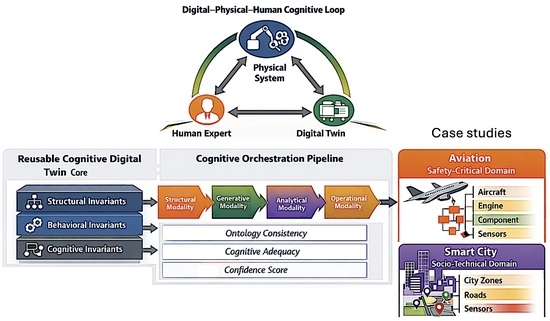
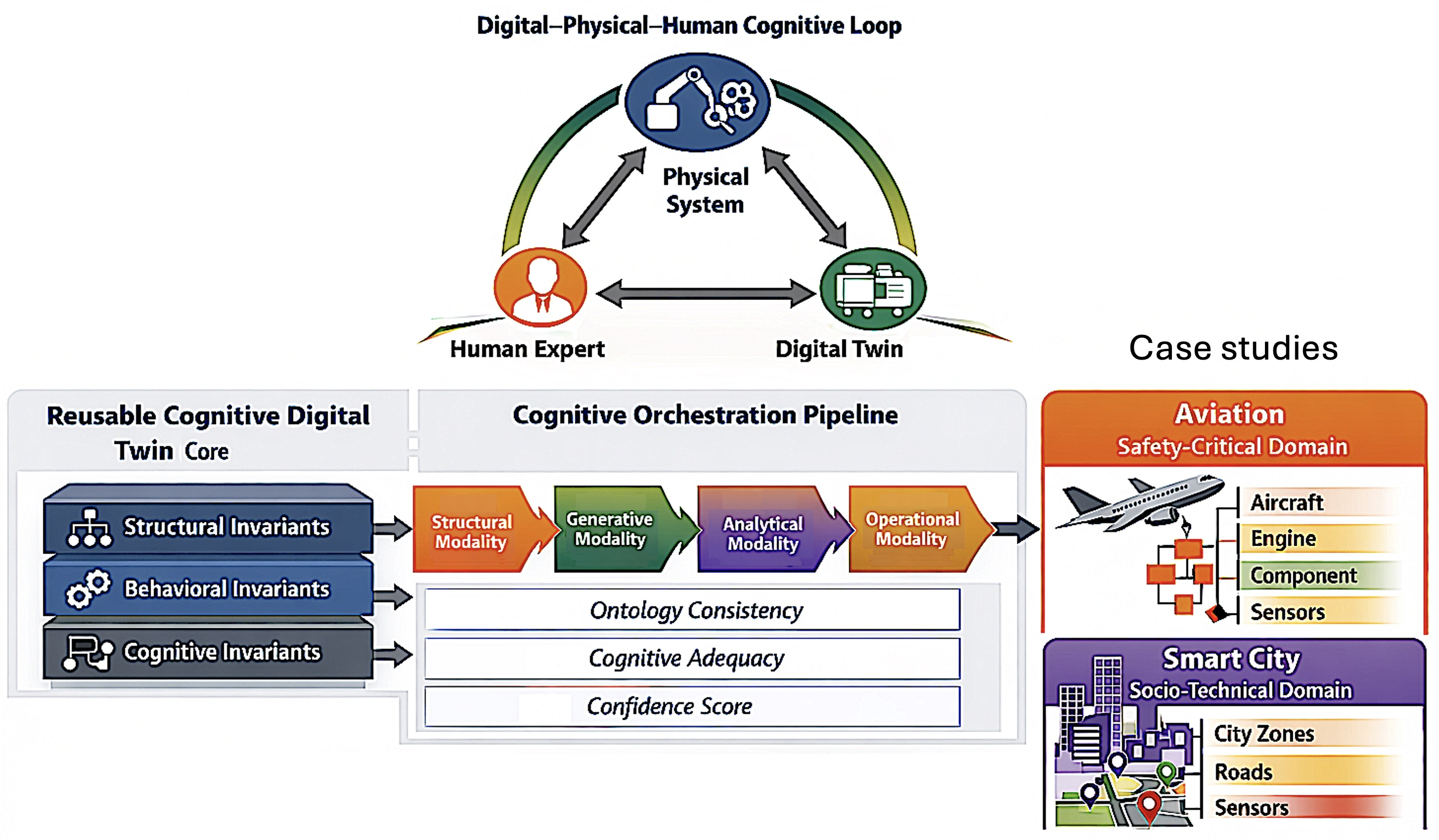
Graphical Abstract

1. Introduction

The rapid evolution of cyber–physical systems, artificial intelligence, and large-scale digital infrastructures has fundamentally reshaped the expectations placed on digital twin (DT) technologies. Traditionally, digital twins have been conceptualized as virtual replicas of physical assets, primarily focused on data integration, state estimation, and simulation [1]. While effective for monitoring and prediction tasks, these first-generation digital twins remain structurally rigid, domain-specific, and dependent on predefined models. They lack intrinsic reasoning capabilities, cannot generalize across domains, and are not designed to adapt as their physical or operational contexts evolve. As systems grow in complexity the limitations of such static representations become increasingly evident.
In parallel, the emergence of intelligent digital ecosystems has revealed a pressing need for digital twins that are not merely descriptive but cognitive, adaptive, and reusable [2]. In this work, intelligent digital ecosystems are understood as interconnected socio-technical systems composed of heterogeneous digital, physical, and human actors that jointly sense, interpret, reason about, and act upon their environment through coordinated data exchange and decision-making processes. Unlike conventional digital platforms or cyber–physical systems, intelligent digital ecosystems emphasize adaptive cognition, semantic interoperability, and continuous co-evolution of system components driven by both data and human knowledge. Such ecosystems integrate multiple digital twins, analytical services, and human decision-makers into a distributed cognitive environment capable of learning, scenario generation, and coordinated action across organizational and domain boundaries [2]. Contemporary systems interact dynamically with heterogeneous components, uncertain environments, and human decision-makers. Therefore, digital twins must participate as active cognitive agents capable of interpreting context, generating scenarios, evaluating risks, orchestrating decisions, and learning from experience. This shift signals a broader conceptual transition: from viewing digital twins as isolated analytical tools to conceiving them as embedded participants in distributed cognitive ecosystems.
A fundamental challenge in this transformation is that existing DT frameworks are architecturally tied to predefined models and domain-specific structures. They cannot be efficiently reused across systems, nor can they incorporate human-centric knowledge that is essential for sustaining long-term semantic and operational relevance. Engineers, operators, and domain experts contribute contextual insights, structural refinements, ontological corrections, and latent knowledge that no sensor or automated pipeline can provide. Yet current DT architectures treat human input as external annotation rather than as an integral cognitive element. Bridging this gap requires a new conceptual framework in which human cognition, digital cognition, and physical sensing form a unified triad.
The purpose of this study is to examine how reusable cognitive digital twins can be designed as domain-independent cognitive architectures that support interpretation, prediction, evaluation, and human-centered decision-making within intelligent digital ecosystems. To address this purpose, the paper proposes the reusable cognitive digital twin (RCDT) as a foundational paradigm for next-generation intelligent digital ecosystems. An RCDT is a digital twin augmented with a reusable architectural core and a cognitively articulated reasoning layer, enabling systematic instantiation across domains and dynamic adaptation during operation. The reusable core consolidates structural, functional, behavioral, and semantic invariants that generalize across systems, while the cognitive orchestration layer coordinates multimodal reasoning processes, including structural interpretation, generative modeling, analytical evaluation, and operational decision-making. Together, these layers allow digital twins to continuously interpret and refine their understanding of a system as new data, new insights, and new configurations emerge.
A central component of the paradigm is the digital–physical–human interaction framework, which positions the human expert as a first-class cognitive agent within the loop. Unlike classical DT frameworks that rely solely on sensor data, the RCDT paradigm integrates human-derived knowledge such as structural updates, contextual interpretations, semantic augmentations and corrective judgments, directly into the cognitive and reusable cores. This integration is critical for domains such as, for example, aviation, where deep maintenance reveals hidden structural information, and smart cities, where urban planners, operators, and policymakers continuously modify infrastructure and operational logic. The resulting triad (human–RCDT–physical system) enables continuous semantic and cognitive evolution, enhancing the relevance, interpretability, and long-term validity of digital twin representations.
Beyond conceptual novelty, the paper also formalizes the cognitive architecture of RCDTs and demonstrates the paradigm’s domain transferability using two contrasting case studies: aircraft maintenance and smart city mobility management. These studies illustrate how the reusable core and cognitive orchestration layer can be instantiated to produce context-adaptive cognitive behavior while preserving architectural consistency across domains.
The concept of the digital twin has evolved from simple virtual representations of physical assets toward more intelligent, adaptive, and interconnected system models.
Early and widely adopted digital twin frameworks focus on high-fidelity virtual replicas tightly coupled to physical systems through sensor data and simulation models [1,2,3]. These approaches emphasize monitoring, state estimation, and prediction, often relying on physics-based models, data-driven regression, or hybrid techniques. While effective for asset-specific analysis, such digital twins are typically designed for a single domain or even a single asset class, resulting in limited transferability and reuse.
A key limitation of conventional digital twins is their lack of explicit reasoning capability. Interpretation, validation, and decision-making are usually performed by external analytics tools or human operators, leaving the digital twin itself as a passive computational construct. As systems evolve structurally or operationally, these twins require substantial manual reengineering, which restricts their long-term adaptability and scalability.
To overcome the rigidity of traditional approaches, recent studies have introduced cognitive or intelligent digital twins that incorporate machine learning, probabilistic reasoning, or adaptive control mechanisms [4,5,6,7]. These twins can learn from data, update internal models, and improve predictive accuracy over time. In many cases, intelligence is realized through embedded learning algorithms that adjust parameters or select models dynamically.
Despite these advances, cognition in such systems is typically implicit and algorithm specific. Reasoning processes are embedded within models rather than articulated as a structured cognitive architecture [8]. This often results in limited interpretability and weak generalization across domains. Moreover, intelligence is usually tightly coupled to domain-specific data representations, constraining the reuse of cognitive mechanisms beyond the original application context [2].
Another important research direction emphasizes the role of human expertise in digital twin operation. Human-in-the-loop digital twins allow experts to validate outputs, adjust parameters, or intervene in decision-making processes, which is particularly important in safety-critical domains such as aviation, healthcare, and energy systems [9,10].
While these approaches acknowledge the importance of human knowledge, human involvement is generally treated as external supervision rather than as an integral part of the digital twin’s internal cognition. Human inputs are often incorporated through manual configuration, annotations, or dashboards, without formal mechanisms for integrating semantic insights into the twin’s ontological or reasoning structures. As a result, human knowledge does not systematically contribute to the long-term cognitive evolution or reusability of the digital twin.
Several works have proposed modular or platform-based digital twin architectures aimed at improving scalability, interoperability, and lifecycle management [11,12,13]. These platforms typically leverage standardized interfaces, microservices, and cloud-native technologies to enable rapid development and deployment of digital twins across multiple assets or systems.
However, reusability in these architectures is primarily realized at the software and infrastructure levels. While data pipelines, visualization components, and simulation services may be reused, domain knowledge, reasoning logic, and semantic interpretation remain largely bespoke. Consequently, these approaches do not address the deeper challenge of cognitive reusability, such as, the reuse of structural, behavioral, and reasoning invariants across heterogeneous domains.
In 2016, Grieves and Vickers introduced the concept of DT aggregation [3], defining terms including a DT prototype (DTP), a DT instance (DTI), a DT aggregate (DTA), and a DT environment (DTE). A DTP describes a physical entity in sufficient detail that the entity can be manufactured based on the information contained in the DTP. A DTI denotes a specific implementation of a DTP, associated with a particular physical entity and continuously gathering information about this entity throughout its life cycle. The DTA consolidates all DTIs belonging to a particular classification to generate a larger and more thorough dataset regarding the functioning of a category of physical entities. Lastly, the DTE functions as a comprehensive interdisciplinary physics application platform that utilizes the DT for various objectives, including the prediction of future system performance. Brangiu et al. [14,15] utilized aggregation to gather, analyze, and condense information from numerous DT to support a control application. Karanjkar et al. [16] consolidated historical information (captured within DT) to manage substantial volumes of historical data. In a similar manner, Pan et al. [17] applied hierarchical data format data compression to consolidate substantial quantities of heterogeneous information, offering a more thorough and unified data representation. Lutze [18] utilized personal DT to store patient medical information. Moreover, group DT and system DT, which are collections of personal DT arranged according to criteria, are used for training machine learning algorithms. Whereas personal DT hold all pertinent medical information of a patient, group and system DT exclusively collect the information required for the specific algorithm, thus omitting particulars such as the patient’s identity to preserve privacy and anonymity.
Additionally, frameworks for DT aggregations have been suggested. Villalonga et al. [19] suggested a hierarchical aggregation methodology, in which local DT concentrated on tracking and diagnosing the condition of assets, while global DT concentrated on decision-making activities. Ciavotta et al. [20] presented a framework wherein information from different DT is structured into layers. These layers are then consolidated into various collections customized to the user’s requirements and desired granularity. Lastly, Redelinghuys et al. [21] suggested a six-layer framework for DT with aggregation termed SLADTA (six-layer architecture for DT with aggregation), which represents an enhancement of the SLADT framework that enables multiple DT to consolidate information for a system-wide view.
The utilization of semantic web technologies in the creation, administration, and modeling of DT has expanded in recent years. Particularly, guidance has been suggested regarding how to incorporate ontologies and their benefits for DT [22]. The ontologies of the DT are employed to enhance the visualization and comprehension of the DT information [23] and characterize the architecture model of a DT [24]. In the literature, numerous investigations have been performed regarding the characterization of an architecture model of a DT, which represents the objective of DT ontology. Charles Steinmetz et al. [24] investigated the expansion of IoT-Lite ontology [25] by incorporating classes pertaining to the virtual component of the three-dimensional model, which allows external applications and systems to engage with the virtual dimension via a designated protocol. Building upon this methodology, Sumit Singh et al. [26] developed an ontology created to capture domain expertise and maintain the semantic consistency of asset functionalities and core properties during their operational lifespan within the virtual component. In addition, Meijers developed the digital twin’s definition language [27], which employs an RDF metamodel to depict DT virtual component metadata within their proprietary tools.
Despite the rapid evolution of digital twin research, several fundamental gaps remain unresolved in the current literature. Existing DT frameworks predominantly focus on asset-specific modeling, data synchronization, and simulation-driven prediction, resulting in architectures that are tightly bound to domains, system configurations, or physical assets [28,29,30,31,32,33]. Even recent advances in cognitive or intelligent digital twins largely embed intelligence implicitly within machine learning models or domain-specific algorithms, rather than articulating cognition as a structured, reusable, and interpretable process. Consequently, these approaches exhibit limited transferability across domains and provide weak support for systematic reuse beyond software components or data pipelines.
A second major gap concerns the treatment of human expertise. While human-in-the-loop digital twins acknowledge the importance of expert oversight, human knowledge is typically incorporated as external supervision, manual annotation, or post hoc validation. There is a lack of formal mechanisms that integrate human semantic insight, structural corrections, and contextual judgment directly into the internal cognitive and reusable structures of the digital twin. As a result, current DTs struggle to maintain long-term semantic relevance as systems evolve, particularly in domains where critical knowledge emerges through inspection, planning, policy decisions, or operational experience rather than through sensors alone.
A third unresolved issue relates to reusability at the cognitive level. Although modular and platform-based DT architectures improve scalability and deployment efficiency, reusability is usually limited to infrastructure, interfaces, or services. The reuse of structural, behavioral, and reasoning invariants has not been systematically addressed. This prevents digital twins from functioning as transferable cognitive entities capable of operating consistently across heterogeneous application domains.
This paper addresses these gaps by introducing the reusable cognitive digital twin as a foundational paradigm for intelligent digital ecosystems. The central contribution is a novel architectural separation between a reusable core, which encapsulates domain-independent structural, behavioral, and cognitive invariants, and a cognitive orchestration layer, which implements cognition as an explicit operator-based pipeline comprising structural, generative, analytical, and operational modalities. This formulation enables cognition to be reusable, interpretable, and systematically instantiated across domains.
A key conceptual contribution is the digital–physical–human interaction framework, which formalizes the human expert as a first-class cognitive agent within the digital twin system. Human knowledge is integrated through well-defined ontological and meta-cognitive update operators, allowing expert insight to modify both the reusable core and the active cognitive state of the twin. This enables continuous semantic and cognitive evolution, addressing the limitations of static or purely data-driven DT models.
The paper further contributes a domain-independent set of cognitive evaluation indices, including ontology consistency, cognitive adequacy, and confidence, which provide interpretable measures of reasoning quality and support transparent human–digital collaboration. These indices preserve semantic meaning across domains while allowing domain-specific instantiation.
The proposed paradigm is validated through two contrasting case studies: a safety-critical aviation system and a large-scale smart city environment. Despite profound differences in structure, scale, and operational context, both case studies instantiate the same reusable modules and cognitive pipeline, demonstrating cross-domain reusability at the cognitive and semantic levels rather than merely at the software level.
The remainder of the paper is structured as follows. Section 2 presents the methodological foundations of the RCDT paradigm, including core design principles, the reusable module architecture, mathematical formulations of the cognitive modalities, cognitive evaluation indices, and the digital–physical–human interaction framework. Section 3 reports the results of the two case studies, illustrating how the same cognitive architecture operates in aviation and smart city domains. Section 4 discusses the implications of these results, interpreting cross-domain findings, identifying limitations, and outlining directions for future research. Section 5 concludes the paper by summarizing the main contributions and situating the RCDT paradigm within the broader landscape of intelligent digital ecosystems.

2. Materials and Methods

2.1. Materials

This section presents the methodological structure of the proposed reusable cognitive digital twin paradigm. Due to the conceptual–architectural nature of the study, materials and methods are presented as an integrated framework rather than as a procedural or experimental pipeline. For clarity, the section distinguishes between:
  • the conceptual and knowledge-based materials that constitute the reusable cognitive substrate of the RCDT, and
  • the architectural and operator-based methods through which these materials are composed, instantiated, and executed.
In contrast to experimental studies relying on physical testbeds or datasets, the present work adopts a conceptual–architectural methodology supported by formal modeling, operator-based reasoning, and cross-domain instantiation. Accordingly, the materials of the study are not physical artifacts or datasets, but conceptual and knowledge-based elements. They include reusable digital twin modules, ontological structures, cognitive operators, and human expert knowledge inputs that together define the cognitive substrate of the RCDT.
The materials employed in this study include:
  • a library of reusable digital twin modules capturing structural, functional, behavioral, and cognitive invariants.
  • domain ontologies defining entities, relations, and semantic constraints.
  • cognitive operators implementing structural, generative, analytical, and operational reasoning modalities.
  • human expert knowledge in the form of semantic refinements, structural corrections, and contextual judgments.
  • domain-specific data streams and parameters used for instantiating RCDTs in aviation and smart city contexts.
These materials collectively form the reusable and instantiable substrate on which the proposed cognitive digital twin methodology is built.
The methods adopted in this study follow a structured architectural progression from design principles to operational instantiation. Rather than defining a fixed algorithmic pipeline, the methods specify how reusable cognitive materials are composed, specialized, and coordinated through operator-based reasoning. First, foundational design principles for human-augmented cognition and reusability are established (Section 2.2.2). These principles are then formalized into conceptual and mathematical foundations defining ontologies, cognitive states, and operator-based reasoning (Section 2.2.3). Next, the reusable digital twin module architecture is introduced (Section 2.2.4), specifying how invariant knowledge structures are selected and specialized for a given domain. This is followed by the formal definition of cognitive modalities and their composition into a unified cognitive pipeline (Section 2.2.5). Instantiation of the reusable cognitive digital twin is described in Section 2.2.6. Finally, the digital–physical–human interaction framework is described (Section 2.2.7), explaining how data, human knowledge, and digital reasoning interact during RCDT operation.
Together, these components define a coherent methodological workflow that enables systematic construction, execution, and evolution of reusable cognitive digital twins across heterogeneous application domains. An overall architectural view of the proposed method is provided by the cognitive digital twin platform representation and the digital–physical–human interaction framework introduced later in this section. These architectural figures serve as high-level structural representations of the method, illustrating how reusable modules, cognitive modalities, and interaction channels are organized and coordinated, rather than depicting a procedural block diagram.

2.2. Methods

This section describes the methodological framework used to construct, instantiate, and operate the reusable cognitive digital twin. The previous section defined the reusable knowledge substrate including invariant RDT modules, ontological structures, cognitive operators, human knowledge inputs and domain data streams. The present section formalizes how these elements are composed into a coherent cognitive system.

2.2.1. Overall Methodological Architecture

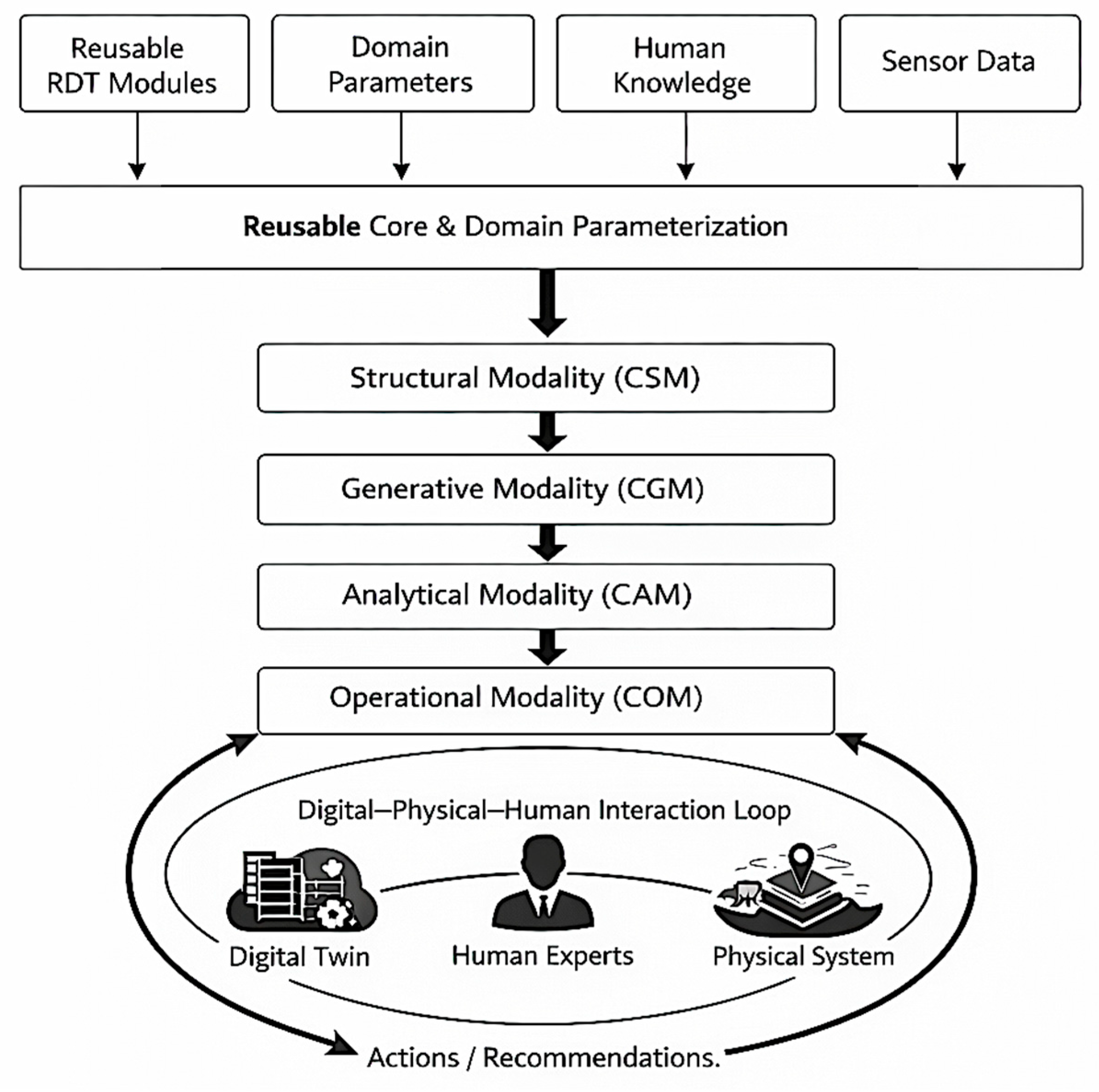
To clarify the methodological structure of the reusable cognitive digital twin paradigm, Figure 1 presents the overall execution workflow of the RCDT pipeline.
The workflow begins with four foundational input categories: reusable RDT modules, domain parameters, human knowledge contributions, and sensor data streams. These inputs are integrated within the reusable core and domain parameterization stage, where invariant templates are selected and specialized for the target domain.
Subsequently, cognitive processing unfolds through four coordinated modalities:
  • the cognitive structural modality (CSM), which interprets raw data and expert input within the active ontology to construct a semantically structured system state.
  • the cognitive generative modality (CGM), which synthesizes admissible future scenarios and counterfactual evolutions.
  • the cognitive analytical modality (CAM), which evaluates semantic consistency, cognitive adequacy, and uncertainty using domain-invariant indices.
  • the cognitive operational modality (COM), which transforms analytical insights into actions, recommendations, or internal model updates.
The pipeline is embedded within a digital–physical–human interaction loop, ensuring continuous feedback between the digital twin, human experts, and the physical system. This triadic structure enables semantic refinement, cognitive evolution, and adaptive operational control.

2.2.2. Human-Augmented Reusability and Cognition in DT: A Foundational Perspective

The reusable cognitive digital twin paradigm is grounded in a small set of core design principles that distinguish it from conventional, cognitive, and platform-oriented digital twin approaches. These principles define not only the architectural structure of the RCDT, but also its epistemological stance toward cognition, reusability, and human–machine interaction. Together, they provide the conceptual foundation for the formal models introduced in the remainder of this section.
The four principles formulated in this section are proposed as part of the author’s conceptual synthesis rather than as a direct reformulation of existing frameworks. They emerge from a critical reflection on recurring structural, cognitive, and organizational limitations encountered in the design and deployment of contemporary digital twins across multiple application domains. The principles are intended to make explicit a set of design assumptions that are often treated implicitly in practice, particularly with respect to cognition, reusability, and human involvement. As such, they serve as normative architectural guidelines that motivate the reusable cognitive digital twin paradigm and provide an internal rationale for the methodological developments introduced in the subsequent sections.
  • Principle 1. Cognition as Explicit Operator Orchestration
In the RCDT paradigm, cognition is not embedded implicitly within individual simulation models or machine learning components. Instead, it is expressed explicitly as an orchestration of cognitive operators corresponding to structural, generative, analytical, and operational modalities. Each modality performs a well-defined transformation over the cognitive state of the twin, and complex reasoning emerges through their composition. This operator-centric formulation enables interpretability, modularity, and systematic reasoning across domains, in contrast to monolithic or opaque cognitive implementations.
  • Principle 2. Reusability as a Cognitive and Semantic Property
Reusability in RCDTs extends beyond software components or data pipelines. The reusable core encapsulates structural, behavioral, functional, and cognitive invariants that represent domain-independent knowledge patterns. These invariants are instantiated, specialized, and refined through formal operators, allowing digital twins to be constructed as disciplined specializations of a shared cognitive foundation. Importantly, reusability is not static: it evolves as new structural insights and reasoning patterns are accumulated through operational experience and expert interaction.
  • Principle 3. Humans as First-Class Cognitive Agents
Unlike classical digital twin frameworks that treat humans as external supervisors or end-users, the RCDT explicitly incorporates human experts as first-class cognitive agents within the system. Human knowledge, such as semantic interpretations, structural corrections, contextual judgments, and policy decisions, is formally integrated into both the reusable core and the active cognitive state of the twin. This principle enables continuous semantic alignment with real-world practices and ensures that the digital twin remains interpretable, trustworthy, and contextually valid over time.
  • Principle 4. Domain Instantiation through Controlled Specialization
An RCDT is not engineered from scratch for each application domain. Instead, domain-specific digital twins are instantiated through a controlled specialization process that binds reusable cognitive and structural templates to domain parameters, physical data streams, and human expertise. This principle guarantees architectural consistency across domains while allowing sufficient flexibility to capture domain-specific constraints, behaviors, and operational objectives. As a result, cross-domain transferability becomes a structural property of the paradigm rather than an afterthought.
Together, these principles establish the RCDT as a paradigm shift from asset-centric, model-driven digital twins toward reusable, cognitively orchestrated, and human-integrated digital entities. The formal conceptual and mathematical framework presented in the following subsections directly reflects these principles and operationalizes them within a unified cognitive digital twin architecture.
The RCDT paradigm departs fundamentally from previous generations of digital twins by treating human experts not merely as overseers or annotators, but as intrinsic cognitive contributors whose knowledge modifies both the reusable and cognitive layers of the system. This integration brings digital twins closer to a holistic cognitive construct in which physical data, human knowledge, and computational reasoning form a unified triadic interaction.
Unlike sensor-generated data D , which primarily captures measurable physical states, humans contribute:
  • contextual knowledge,
  • latent structural information,
  • updates to system hierarchies,
  • semantic refinements of ontologies.
We denote human-generated contributions as:
K H = { k 1 , k 2 , , k m }
representing structural corrections, ontological refinements, expert insights, diagnostics and annotations.
The RCDT incorporates these updates through a structural update operator:
Δ O = U H ( O , K H )
where O is the active ontology of the twin, and U H is a human-driven update operator modifying structural invariants and semantic models. Thus, reusability is not static but becomes a human-augmented, continuously evolving structure.
Humans also influence the cognitive processes within the digital twin. Let the cognitive state of the RCDT be defined as a tuple of modality sub-states.
Ψ ( t ) = ( ψ S , ψ G , ψ A , ψ C )
The modalities represented by operators S —structural modality, G —generative modality, A —analytical modality, C —operational modality and their composition M : = ( S , G , A , C ) updates Ψ .
A human agent provides meta-cognitive adjustments:
Ψ = M H ( Ψ , K H )
where Ψ is the current cognitive state of the digital twin (models, beliefs, active constraints, policies, and contextual variables the twin uses to reason and act); Ψ is the rate of change in the cognitive state; M H is the human-induced update operator (a mapping that converts the current state and human knowledge into a change direction for Ψ ) which can encode, for example, ontology edits, policy adjustments, threshold updates, or structural corrections provided by experts.
Operator M H modifies structural reasoning assumptions S , generative scenario constraints G , interpretative thresholds or validation criteria A and operational decision rules C .
This formalizes human–machine cognitive co-evolution, where the RCDT continuously adjusts its reasoning through human-provided insights.
The interaction between human, physical system, and digital twin can be modeled as a triadic mapping:
( P , D , K H ) I T
where the interaction operator I includes:
  • physical–digital interaction with sensing/actuation I P D by preprocesses sensor/actuation channels (routing, unit/clock alignment, quality flags).
  • human–digital interaction with human input I H D by gates and structures human input (role/permission check, schema validation, confidence weights, conflict resolution), producing safe edits.
  • human–physical Interaction with direct ops I H P by capturing direct interventions/observations outside the twin (maintenance actions, incident reports) so the twin can reconcile state.
The digital–physical–human interaction structure is formally embedded within the methodological workflow of the RCDT. Rather than treating it as an isolated architectural abstraction, the interaction loop is integrated into the overall execution pipeline, as illustrated in the lower part of Figure 1. This representation emphasizes that human, digital, and physical components are not peripheral additions but constitutive elements of the cognitive orchestration process.
The reusable core R evolves over time via human contributions:
R ( t + 1 ) = R ( t ) Δ O ( t )
where R ( t + 1 ) denotes the updated reusable core, reflecting accumulated knowledge after incorporating new expert contributions, denotes a controlled composition operator, which integrates new invariant elements into the reusable core while preserving internal consistency, traceability, and compatibility with existing modules, Δ O ( t ) denotes a human-supplied structural knowledge increment at time t , expressed in terms of reusable ontological fragments, invariant templates, or generalized reasoning patterns extracted from expert interaction, inspection results, or operational experience.
This is a fully novel aspect of the paradigm:
  • reusability is not pre-defined,
  • it is co-created by experts,
  • it accumulates knowledge across domains.
Similarly, cognitive orchestration evolves according to
Ω ( t + 1 ) = Ω ( t ) M H [ Ψ t ]
where
  • Ω ( t ) denotes the active ontology of the RCDT at time t , representing the current semantic structure of entities, relations, and constraints used for cognitive reasoning.
  • Ω ( t + 1 ) denotes the updated ontology after incorporating new knowledge at the next cognitive update step.
  • denotes a controlled ontology composition operator, which applies validated semantic updates while preserving ontological consistency and reusable invariants (e.g., conflict resolution, versioning, constraint checking).
  • Ψ ( t ) denotes the triadic interaction state at time t , capturing the combined effects of physical–digital, human–digital, and human–physical interactions within the digital–physical–human system.
  • M H [ · ] denotes a human-driven meta-cognitive update operator, which extracts, filters, and formalizes human feedback embedded in Ψ ( t ) into admissible semantic modifications. This operator encodes expert judgments, contextual interpretations, structural corrections, and policy updates supplied by human agents.
Under this formulation, human feedback is not treated as external annotation but as a learning signal for the cognitive machinery of the RCDT, enabling systematic evolution of the ontology and, consequently, of the digital twin’s reasoning capabilities over time.
The design principles outlined in Section 2.1 establish the normative and architectural intent of the reusable cognitive digital twin paradigm, defining how cognition, reusability, and human participation are conceptualized at a high level. However, to operationalize these principles in a rigorous and transferable manner, they must be grounded in a formal conceptual structure. Section 2.2 therefore translates the design principles into a coherent set of conceptual and mathematical foundations, introducing the core abstractions, ontological constructs, and operator-based representations that enable systematic reasoning, instantiation, and cross-domain reuse within the RCDT framework.

2.2.3. Conceptual Foundations

The reusable cognitive digital twin paradigm builds on the observation that most complex systems, whether physical, socio-technical, or cyber–physical, share common structural, behavioral, and cognitive patterns. Traditional digital twins are typically developed independently for each system, resulting in fragmented architectures, duplicated modeling efforts, and limited interoperability. In contrast, the RCDT treats digital twin construction as a generalizable cognitive process, grounded in reusable knowledge structures and operator-based reasoning. This section introduces the conceptual elements underpinning this paradigm and establishes the mathematical vocabulary used throughout the remainder of the paper.
Let P ( t ) denote the physical system and its observable state at time t .
The digital twin does not represent P ( t ) directly but through a structured semantic abstraction:
X ( t ) X ,
where X is the space of structured representations permitted by the system ontology O .
The ontology is defined as:
O = ( V , E , λ ) ,
where V is the set of entities (components, subsystems, assets, sensors), E is the set of relations (structural, functional, spatial, causal), λ assigns semantic labels.
Ontologies allow the digital twin to interpret sensor data and human input in a structured and meaningful way. This is the basis for semantic interpretability, a central element of cognitive reasoning.
Unlike classical digital twins, which rely almost exclusively on sensor data, the RCDT incorporates human knowledge as a first-class cognitive input with the K H ( t ) as the human knowledge state at time t , including domain insights, expert judgments, maintenance findings, planning decisions, or contextual information unavailable to sensors.
Human contributions update both the ontology and the reasoning process:
O ( t + 1 ) = O ( t ) Δ O H ( t ) ,
Ψ ( t + 1 ) = Ψ ( t ) Δ Ψ H ( t ) ,
where Ψ ( t ) is the cognitive state of the digital twin.
Incorporating K H ensures that the twin remains aligned with real contexts, not only with measurable phenomena.
The RCDT does not use a single monolithic model. Instead, it separates cognition into four cross-domain reasoning modalities (structural, generative, analytical, operational), each represented by cognitive pipeline operator:
M : = ( S , G , A , C )
These modalities transform system data and knowledge into actionable intelligence: S interprets and organizes data into structured states, G generates predictive or counterfactual scenarios, A evaluates coherence, risk, and adequacy, C produces decisions, recommendations, or model updates.
Together, they form the cognitive pipeline:
Ψ ( t + 1 ) = C A G S [ D ( t ) , K H ( t ) , O , Θ d ] .
This decomposition highlights that cognition in the RCDT emerges from operator composition rather than domain-specific models.
The RCDT builds digital twins from a reusable core:
R = { r 1 , r 2 , , r n } ,
where each module represents a structural, functional, behavioral, or cognitive invariant. These modules encode hierarchical decomposition, flow relations, degradation behavior, anomaly reasoning, and scenario generation which are patterns common across domains.
A domain-specific twin is instantiated by selecting and customizing a subset of these invariants:
T d = Φ ( R , Θ d , K H , D ) ,
producing a twin that is tailored to system-level specifics but grounded in reusable abstractions.
The operator Φ integrates reusable structural templates, reusable behavioral patterns, cognitive reasoning templates, domain parameters Θ d , human knowledge K H , sensor data D ( t ) .
This unified formulation ensures architectural consistency across domains while supporting domain-specific adaptation.
A central departure from classical digital twin architectures is the explicit treatment of the digital twin as part of a triadic cognitive system coupled by the operator K :
Σ   =   K P ,   H ,   T d
where Σ denotes the closed-loop system, the physical system P supplies observable data, the human cognitive agent,   H supplies semantic and contextual knowledge, the digital twin T d synthesizes interpretation, prediction, evaluation, and action.
Operator K is the triadic coupling operator.
K : =   (   I P D , I H D , I P H   ) ,
which implements the physical–digital, human–digital and human–physical channels.
These interactions form the triadic loop:
P ( t ) D ( t ) T d P ( t + 1 ) H ( t + 1 )
with reciprocal human-to-digital and human-to-physical influences.
This structure establishes the RCDT as a hybrid cognitive system, not just a data-driven model.
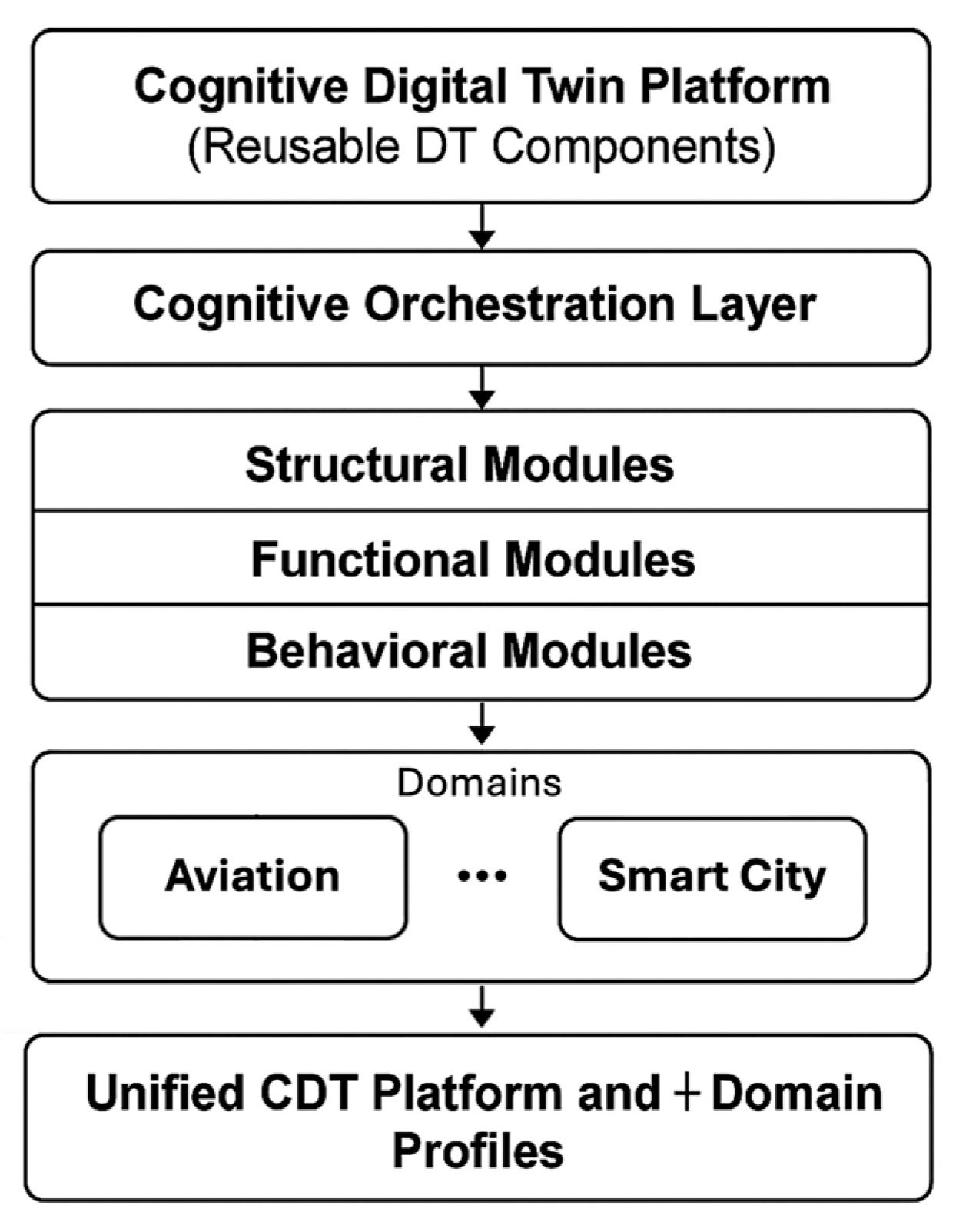
Figure 2 presents the structural organization of the unified cognitive digital twin platform and its domain profiles. In contrast to the methodological pipeline illustrated in Figure 1, which describes the execution logic of the RCDT, Figure 2 focuses on the architectural composition of reusable components and their deployment across heterogeneous domains.
Figure 2 depicts a layered organization in which a domain-agnostic reusable platform provides invariant structural, functional, behavioral, and cognitive modules. These modules are coordinated by a cognitive orchestration layer and subsequently specialized through domain profiles (e.g., aviation, smart city), yielding domain-specific RCDT instances while preserving architectural consistency.
Figure 2 depicts the end-to-end organization of the reusable cognitive digital twin. A common cognitive digital twin platform provides domain-agnostic, reusable DT components that are composed by a Cognitive Orchestration Layer implementing the operator pipeline M = C A G S and handling interaction channels I = ( I P D , I H D , I P H ) . Beneath it, Structural, Functional, and Behavioral module families expose invariant templates and reasoning assets consumed by the pipeline. These assets are specialized via domain profiles Θ d (e.g., Aviation, …, Smart City), where selection/refinement R d = ( R , Θ d ) ,   R d = R d Δ R H produces the domain instance T d . The vertical flow therefore reads: reusable platform → orchestration → module families → domain profiles → unified multi-domain deployment, ensuring reuse with disciplined domain specialization under one governance and runtime.

2.2.4. RDT Module Architecture

The architecture of the reusable digital twin defines the foundational layer of the RCDT paradigm. It provides a structured set of domain-independent structural, behavioral, functional, and cognitive modules that can be adapted and instantiated for a wide range of application areas. In contrast to traditional digital twins, whose models are usually constructed independently for each asset or domain, the RDT approach treats digital twin development as a composition and refinement of reusable building blocks.
The reusable core R consists of a library of invariant modules:
R = { r 1 , r 2 , , r n } ,
each encoding a stable pattern of knowledge that applies across multiple domains. These modules are grouped into four categories:
  • Structural invariants (e.g., hierarchical templates, ontological schemas).
  • Functional invariants (e.g., canonical process models or interaction rules).
  • Behavioral invariants (e.g., reusable dynamic patterns such as flow, load, or degradation).
  • Cognitive invariants (e.g., operator templates for interpretation, prediction, evaluation, and decision-making).
The invariants encapsulated in the reusable core are abstracted through a comparative, cross-domain analysis of recurring system patterns rather than derived from a single application context. Structural invariants capture domain-independent organizational principles such as hierarchical decomposition, part–whole relations, and interface compatibility, which appear consistently in systems as diverse as aircraft architectures and urban infrastructure networks. Behavioral invariants abstract recurrent dynamic patterns, including degradation, load propagation, congestion, or failure escalation, by identifying common state-transition structures and admissible trajectories shared across domains. Functional invariants generalize canonical process relations, constraints, and balance conditions (e.g., flow conservation, capacity limits, or redundancy rules), while cognitive invariants formalize reusable reasoning patterns such as interpretation, scenario generation, consistency checking, and decision orchestration.
The evolution of these invariants is driven by controlled human–digital interaction during RCDT operation. When domain experts introduce new structural insights, semantic refinements, or validated reasoning patterns, such as a previously unmodeled maintenance dependency in aviation or a new traffic control logic in a smart city. These contributions are first instantiated locally within a domain-specific RCDT. After validation, selected elements are abstracted into invariant templates and integrated back into the reusable core through consistency-preserving composition operators. In this way, the reusable core evolves incrementally, accumulating cross-domain knowledge while maintaining architectural coherence and avoiding domain-specific overfitting.
What makes these modules “invariant” is that they express generalizable system knowledge, not tied to a specific physical object. For example, hierarchical decomposition is relevant to an aircraft, a power grid, or a smart city; similarly, reasoning patterns such as anomaly detection, scenario generation, or model adequacy assessment recur across domains.
A key step in building a domain-specific twin is selecting the appropriate subset of reusable modules. This selection depends on domain parameters Θ d , which may include physical constraints, system topology, component types, regulatory requirements, or operational characteristics.
Mathematically, selection is expressed as:
R d = σ ( R , Θ d ) ,
where σ identifies which invariants are relevant for the target system.
This refined set R d functions as the domain-tailored reusable core.
Human input can further refine or correct the reusable core during instantiation:
R d = R d Δ R H ,
where Δ R H represents expert-provided insights, overlooked structural details, or domain-specific adaptations. In practice, this means that reusable structures are not rigid; they are meant to evolve through expert interaction.
A central role of structural RDT modules is to define the ontology of the digital twin as the set of entities, relations, and semantics that describe the system. If we view the ontology as a labeled graph:
O = ( V , E , λ ) ,
where V denotes the set of vertices, representing system entities such as components, subsystems, assets, services, or abstract concepts relevant to the modeled domain; E V × V denotes the set of edges, representing relations between entities, including structural, functional, causal, spatial, or hierarchical relationships; λ denotes a labeling function that assigns semantic annotations to vertices and edges, such as types, attributes, constraints, or contextual meanings.
Each structural module r i contributes a fragment Γ ( r i ) to this graph. The domain-specific ontology emerges as the union:
O d = i R d Γ ( r i ) .
This formal expression captures a simple idea: the RDT architecture provides semantic building blocks, and the instantiation process assembles them into a domain-appropriate structure. Human refinements Δ O H allow the ontology to grow and adapt when new components are introduced or when system understanding evolves.
We use a unified notion of invariant templates to keep the twin portable across domains while safeguarding physics, behavior, and semantics. Three reusable sets are maintained:
  • functional invariants capture algebraic constraints on admissible operating points (e.g., conservation/balance, capacity limits, interface/unit compatibility, redundancy coverage).
  • behavioral invariants capture admissible trajectories and event orderings over time (e.g., timing bounds, sequencing, fail-over/hysteresis, safety/liveness).
  • cognitive invariants capture epistemic/semantic coherence among models, beliefs, and the domain ontology (e.g., ontology consistency, type/unit unification, causal/structural admissibility, prior–posterior compatibility, policy form constraints).
At instantiation, each set is selected from the reusable core by domain parameters and then refined by expert edits, yielding domain-specific functional, behavioral, and cognitive rule sets. At run time, these rules are compiled into reasoning templates: functional rules become algebraic checkers that produce residuals r F ( t ) as distance to feasibility; behavioral rules become lightweight run-time monitors that produce temporal robustness scores ρ B ( t ) ; cognitive rules become ontology/model consistency tests that produce semantic consistency scores κ C ( t ) .
The pipeline uses them uniformly: S enforces basic sanity (units/topology) and seeds state; G generates scenarios filtered by invariant admissibility; A evaluates r F , ρ B , κ C and aggregates adequacy/consistency indices; C restricts actions to invariant-admissible sets and emits explanations that reference violated rules and margins.
This single mechanism ensures that decisions remain physically plausible, behaviorally safe, and semantically coherent, while the same templates are reused across different domains.
Once relevant reusable modules have been selected and refined, the digital twin for domain d is instantiated as:
T d = Φ ( R d , Θ d , K H , D ) .
This process constructs the domain ontology O d , structural reasoning mechanisms, generative models, analytical evaluation criteria, operational decision rules.
The instantiation operator Φ effectively binds reusable cognitive and structural templates to real system data and human expertise, producing a coherent cognitive digital twin.
A unique feature of the RCDT paradigm is that the reusable core itself is not static. Human insights derived during twin operation may feed back into the core:
R ( t + 1 ) = R ( t ) Δ R H ( t ) ,
allowing future twins to benefit from accumulated knowledge. Over time, this mechanism transforms the RDT library into a knowledge-growing repository, enabling more sophisticated and accurate twin instantiations in subsequent domains.
To summarize how reusable modules feed the cognitive pipeline across levels of capability, Table 1 presents a matrix that maps RDT module families (rows: Structural, Functional, Behavioral) to cognitive digital twin levels (in columns). The matrix makes explicit what becomes reusable at each level ranging from structural/ontology templates (CDT-0) to cognitive simulation (CDT-1), cognitive analysis (CDT-2) and real-time orchestration and task allocation in cognitive orchestrated system (CDT-3).

2.2.5. Mathematical Formulation of Cognitive Modalities

The cognitive behavior of an RCDT emerges from structural, generative, analytical, and operational interconnected reasoning processes implemented as operators within the cognitive orchestration layer. These modalities formalize how the RCDT interprets data, predicts system evolution, evaluates risks and consistency, and orchestrates actions. While mathematical expressions clarify the internal structure of these processes, they complement rather than replace conceptual explanation.
  • Structural Modality
The structural modality is responsible for mapping sensor data and human knowledge into a structured representation of the system’s state. This includes identifying relevant components, updating ontology elements, and aligning observed behavior with expected structural patterns defined by the reusable core.
Given sensor data D ( t ) , human-provided knowledge K H ( t ) , and the domain ontology O , the structural interpretation process may be represented abstractly as:
S : ( D ( t ) , K H ( t ) , O ) X ( t )
Here, X ( t ) denotes the structured state of the system.
Mathematically, this operator expresses that the RCDT does not simply read data; it interprets it within a semantic and ontological context—something classical digital twins do not attempt.
2.
Generative Modality
The generative modality synthesizes what the system might do next. It produces forecasts, hypothetical scenarios, and counterfactual outcomes reflecting changes in environment, system configuration, or operating conditions.
A general generative function may be written as:
G : ( X ( t ) , Θ d ) X ^ ( t + 1 t + k )
where Θ d represents domain parameters (e.g., physical limits, operational constraints).
This operator can encompass:
  • forward simulations,
  • degradation and failure propagation scenarios,
  • environmental what-if scenarios (e.g., storms, traffic surges),
  • alternative system configurations.
The mathematical form emphasizes that CGM is not a single model, but a family of generative mechanisms derived from reusable behavioral invariants.
3.
Analytical Modality
The analytical modality assesses the quality, plausibility, and implications of both observed and generated system states. It integrates anomaly detection, model validation, consistency checking, and risk assessment.
The analytical modality is defined as a mapping.
A : [ x ( t ) , s ^ ( t ) , Ω ] R m ,
where the output of the analytical operator is the diagnostic vector
m ( t ) = A ( x ( t ) , s ^ ( t ) , Ω ) .
The vector m ( t ) is explicitly composed of domain-invariant cognitive evaluation indices and optional domain-specific measures:
m ( t ) = O C I ( t ) C A I ( t ) C S I ( t ) r ( t )
r ( t ) R m 3
where O C I ( t ) denotes the ontology consistency index, C A I ( t ) the cognitive adequacy index, C S I ( t ) the confidence score index, r t represents additional domain-specific indicators such as risk, severity, or priority measures and m denotes the dimensionality of the analytical output vector, consisting of three domain-invariant cognitive indices (OCI, CAI, CSI) and m 3 optional domain-specific indicators.
This formulation makes explicit that cognitive evaluation in the RCDT paradigm is performed through a structured vector of interpretable indices, while preserving extensibility across application domains.
To support interpretable, comparable, and domain-independent evaluation of cognitive reasoning in RCDT, the analytical modality C A produces a compact set of evaluation indices. These indices quantify semantic consistency, cognitive adequacy, and confidence of the digital twin’s internal reasoning processes. Importantly, the indices are defined at an abstract level and can be instantiated using domain-specific metrics without altering their semantic meaning or role within the cognitive pipeline.
The indices are computed as part of the analytical output vector.
m ( t ) = C A [ s ^ ( t ) , Y ( t ) , Ω ] ,
and are subsequently consumed by the operational modality C O to support decision-making, orchestration, and explanation.
(a)
Ontology Consistency Index
The ontology consistency index measures the internal semantic and structural coherence of the digital twin’s ontology and structured system state. It evaluates whether the current ontology Ω and the interpreted state s ^ ( t ) satisfy a set of admissibility constraints derived from reusable structural and semantic invariants.
Let C Ω = { c i } denote a set of ontology constraints, such as type consistency, part–whole relationships, unit compatibility, and causal admissibility. The OCI is defined as
O C I ( t ) = 1 1 C Ω i I [ c i ( Ω , s ^ ( t ) ) = violated ]
where I [ · ] is an indicator function.
OCI values close to one indicate high semantic coherence, while lower values signal structural inconsistencies or outdated semantic assumptions that may require human-driven ontology refinement.
(b)
Cognitive Adequacy Index
The cognitive adequacy index evaluates how well the generative reasoning of the digital twin explains or anticipates observed system behavior. Rather than measuring raw prediction accuracy, CAI captures the adequacy of cognitive reasoning by assessing whether at least one cognitively admissible scenario aligns with the observed structured state.
Let Y ( t ) = { y k ( t ) } denote the set of scenarios generated by the generative modality C G . The CAI is defined as
CAI ( t ) = max s i m [ s ^ t , y k t ] y k Y t  
where s i m ( · , · ) denotes a domain-specific similarity or adequacy measure.
A high CAI indicates that the digital twin’s generative cognition remains aligned with observed reality, while a low CAI suggests model inadequacy, missing scenarios, or the need for cognitive refinement.
(c)
Confidence Score Index
The confidence score index quantifies the reliability of the digital twin’s cognitive outputs by accounting for uncertainty, data quality, and scenario dispersion. CSI reflects how much trust can be placed in analytical conclusions and operational recommendations at a given time.
Let σ k ( t ) denote uncertainty estimates associated with scenario y k ( t ) , and let q ( t ) denote a data quality factor capturing sensor coverage, freshness, and consistency. The CSI is defined as
C S I ( t ) = q ( t ) · max [ 1 σ k t ] y k Y t
Low CSI values indicate that recommendations should be treated conservatively or supplemented with additional human input, whereas high values support confident operational action.
Together, OCI, CAI, and CSI form a domain-independent diagnostic vector.
m ( t ) = [ O C I ( t ) , C A I ( t ) , C S I ( t ) ]
which enables the RCDT to assess the coherence, adequacy, and reliability of its own cognition. While the numerical realization of each index may vary across application domains, their semantic interpretation and role within the cognitive pipeline remain invariant, ensuring consistent evaluation across heterogeneous systems.
(d)
Thresholds, Performance Boundaries, and Sensitivity of Cognitive Indices
While the ontology consistency index, cognitive adequacy index, and confidence score index are defined in a domain-independent manner, their practical use requires the specification of indicative threshold ranges that guide interpretation and decision-making. These thresholds are not fixed constants but context-sensitive performance boundaries that reflect domain criticality, operational risk, and acceptable uncertainty levels.
For the ontology consistency index, OCI values close to one indicate high semantic coherence between the active ontology and the interpreted system state. In practice, OCI values below a domain-dependent lower bound (e.g., OCI < 0.8 in safety-critical systems) signal structural or semantic misalignment that may compromise interpretability and therefore require human-guided ontology refinement. Sensitivity analysis shows that small, localized inconsistencies typically reduce OCI gradually, whereas structural violations affecting multiple constraints produce sharper degradation, making OCI particularly sensitive to systemic semantic errors rather than noise.
The cognitive adequacy index reflects whether the generative modality produces at least one cognitively admissible scenario that explains the observed system behavior. CAI values near one indicate strong explanatory alignment, while persistently low CAI values suggest missing scenarios, invalid assumptions, or outdated models. From a sensitivity perspective, CAI is robust to minor measurement noise but sensitive to structural model incompleteness: introducing or removing a single high-impact scenario can significantly alter CAI, which is an intended property that highlights gaps in generative cognition rather than numerical instability.
The confidence score index modulates operational behavior based on uncertainty and data quality. High CSI values support automated or proactive operational actions, whereas low CSI values enforce conservative strategies and increased reliance on human judgment. Unlike OCI and CAI, CSI is intentionally sensitive to uncertainty dispersion and data degradation. Sensitivity analysis indicates that CSI responds smoothly to increasing variance or reduced data quality, allowing gradual transitions between autonomous and human-centered decision regimes rather than abrupt switching.
Importantly, the three indices are designed to be interpreted jointly rather than in isolation. For example, a high CAI combined with low CSI indicates adequate explanatory power but insufficient confidence for aggressive action, whereas a reduced OCI with high CAI highlights semantic misalignment despite strong generative performance. These combined performance boundaries enable nuanced, context-aware regulation of cognitive behavior without reliance on a single threshold or aggregate score.
4.
Operational Modality
The operational modality transforms analytical insight into action: updating internal models, recommending operational decisions, or orchestrating other models within the platform.
Formally:
C : ( A ( t ) , X ( t ) ) U ( t )
where U ( t ) represents an action or decision.
This action may change the maintenance schedule, trigger a safety alert, adjust a simulation model, refine the ontology, recommend corrective actions to a human operator.
COM closes the cognitive loop, ensuring the RCDT not only interprets and evaluates but acts.
The four modalities operate not as separate mechanisms, but as a coordinated pipeline:
Ψ ( t + 1 ) = C A G S [ D ( t ) , K H ( t ) , O , Θ d ]
This composition underscores hierarchical reasoning, feedback integration, interpretation → prediction → evaluation → action and makes the RCDT fundamentally different from a classical digital twin, which lacks such cognitive orchestration.
Because RCDTs evolve through learning and human interaction, their cognitive state is dynamic:
Ψ ( t + 1 ) = Ψ ( t ) Δ Ψ ( t )
where Δ Ψ ( t ) arises from new data, new scenarios, analytical insights, or human updates, denotes a cognitive refinement operation.
This expression is not intended as a strict update rule but as a mathematical shorthand capturing the idea that RCDTs continuously improve themselves, accumulating structural, generative, analytical, and operational refinements.
While the four cognitive modalities (structural, generative, analytical, and operational) are defined separately for clarity, in a real RCDT deployment they are executed as an integrated cognitive pipeline governed by a coordination and scheduling mechanism. The pipeline operates as an event-driven and time-aware process in which updates may be triggered by incoming sensor data, human knowledge contributions, or internal model state changes. Structural cognition is executed first to ensure semantic and ontological consistency of the system state; generative cognition is then activated conditionally, for example, when prediction, scenario exploration, or hypothesis expansion is required. Analytical cognition evaluates both observed and generated states using domain-invariant cognitive indices, and operational cognition translates validated analytical outcomes into actions, recommendations, or internal model updates.
From an execution perspective, the pipeline supports both synchronous and asynchronous operation. Structural interpretation and analytical evaluation are typically synchronized with data acquisition cycles, while generative reasoning may be scheduled opportunistically or on demand, depending on computational cost and decision urgency. The operational modality acts as a control point that enforces timing constraints, prioritizes tasks, and regulates feedback to both the physical system and human operators. This coordination ensures that cognitive reasoning remains consistent, responsive, and computationally tractable in real-time or near-real-time environments.

2.2.6. Instantiation of the Reusable Cognitive Digital Twin

Instantiating a RCDT involves assembling structural, behavioral, semantic, and cognitive components into a unified system representation tailored to a specific domain. Unlike conventional digital twins that are engineered for a single asset, the RCDT derives much of its architecture from a reusable core and organizes its reasoning through the cognitive orchestration layer. The instantiation process transforms reusable modules, domain configuration parameters, human knowledge, and physical data streams into a fully functional cognitive twin.
The instantiation of an RCDT draws from four foundational sources:
  • Reusable core (RDT modules) R . A library of reusable invariant modules defining structural templates, behavioral primitives, ontologies, and cognitive schemas.
  • Domain parameters Θ d . Domain-specific settings that contextualize reusable modules, e.g., aircraft type, city topology, operational constraints.
  • Human knowledge contributions K H . Expert interpretation, structural refinements, semantic corrections, and contextual insights unavailable from sensors.
  • Physical data streams D ( t ) . Real-time or historical sensor data from the physical system.
Together, these components define the instantiation space:
I = ( R , Θ d , K H , D )
The goal of instantiation is to compute:
T d = Φ ( I )
where T d is the fully constructed domain-specific RCDT.
Before detailing the individual steps, it is important to clarify the overall logic of the RCDT instantiation process. The construction of a domain-specific cognitive digital twin is not performed as a monolithic modeling activity, but as a structured sequence of operations that progressively bind reusable invariants to domain parameters, data streams, and human knowledge. Each step refines the cognitive representation while preserving consistency with the reusable core and the Digital–Physical–Human interaction framework. The following steps describe this instantiation workflow, from the selection and specialization of reusable modules to the formation of an operational cognitive digital twin instance.
  • Step 1. Selection and Specialization of Reusable Modules
The first step is determining which reusable modules are relevant for the domain.
R d = σ ( R , Θ d )
where the selection operator σ filters and specializes modules based on domain requirements.
For example:
  • in aviation: structural hierarchies include airframesubsystemcomponent,
  • in smart cities: hierarchies include zonesinfrastructureassetssensors.
Human knowledge contributes corrections or extensions:
R d = R d Δ R H
ensuring the reusable modules stay aligned with real-world understanding.
  • Step 2. Ontology Construction
Reusable structural modules generate the system’s ontology:
O d = i R d Γ ( r i )
where Γ ( r i ) maps a module into ontological structures (entities, relations, constraints).
At this stage, the result is a semantic skeleton of the system. Human refinements:
O d ( t + 1 ) = O d ( t ) Δ O ( t )
allow the ontology to evolve alongside expert insight.
  • Step 3. Linking Data and Structure
Sensor data must be mapped onto ontological entities and relations. This corresponds to initializing the structural modality:
X ( t ) = S ( D ( t ) , K H , O d )
yielding the structured system state.
Conceptually, this step transforms raw measurements into semantically meaningful representations.
  • Step 4. Constructing the Generative, Analytical, and Operational Models
The reusable behavioral and cognitive modules define the initial operator set:
( G , A , C ) = Ψ 0 ( R d )
where Ψ 0 extracts relevant schemas and instantiates them with structural knowledge O d , domain parameters Θ d , expert constraints K H .
These operators then trigger:
  • generative modeling and forecasting,
  • analytical evaluation of consistency, risk, and plausibility,
  • operational decision-making and model orchestration.
  • Step 5. Construction of the Full Cognitive Pipeline
Once all operators are defined, the RCDT is ready to execute the cognitive pipeline:
Ψ ( t + 1 ) = C A G S ( D ( t ) , K H ( t ) , O d , Θ d )
This establishes the RCDT as an active cognitive system.
  • Step 6. Formation of the Digital–Physical–Human Loop
The instantiated RCDT forms a triadic interaction loop:
  • Physical to RCDT (sensing)
D ( t ) = f sync ( P ( t ) )
  • Human to RCDT (knowledge update)
Δ O = U H ( O d , K H )
  • RCDT to Physical/Human (actions and insights)
C ( T d ) { P ( t ) ( operational   influence ) H ( t ) ( decision   support )
The presence of the human cognitive agent ensures that the RCDT remains relevant even when the physical system undergoes restructuring, unexpected anomalies, or semantic shifts.

2.2.7. Digital–Physical–Human Interaction Framework

The reusable cognitive digital twin operates within a triadic interaction loop linking the physical system, the human cognitive agent, and the digital twin itself.
This section formalizes this relationship and highlights its conceptual novelty: cognition in RCDTs arises not only from data-driven computation but from the interplay between physical measurements, human knowledge, and reusable cognitive structures.
Classical digital twins depend almost exclusively on the digital–physical loop. In contrast, RCDTs introduce the human expert as a third, equally essential actor transforming the loop into a coherent digital–physical–human system capable of semantic growth, reasoning, and interpretability.
  • Physical-to-Digital Interaction: Sensor and Process Data
The first component of the triad is the traditional mapping from the physical system to the digital representation. Let P ( t ) denote the physical system’s state at time t , D ( t ) denote the data stream collected from sensors. The data synchronization function is:
D ( t ) = f sync ( P ( t ) )
Here, f sync implicitly includes preprocessing, feature extraction, timestamp alignment, and semantic annotation steps.
Conceptually, this link provides observability, grounding the RCDT in measurable aspects of the real system. Mathematically, it establishes the input on which the structural modality operates:
X ( t ) = S ( D ( t ) , K H ( t ) , O d )
2.
Human-to-Digital Interaction: Cognitive and Semantic Contribution
Humans interact with the RCDT by supplying semantic interpretations, structural refinements, and contextual knowledge that are not observable from sensors. Let K H ( t ) represent human knowledge at time t . This knowledge affects both the ontology and cognitive operators:
(a)
Ontological updates
O d ( t + 1 ) = O d ( t ) Δ O H ( t )
where Δ O H ( t ) is a human-derived correction or refinement.
Examples include:
  • identifying a hidden mechanical degradation mechanism in an aircraft.
  • adding a new city district or infrastructure element in a smart city.
  • modifying the semantics of a sensor or its relationships.
(b)
Meta-cognitive updates
Humans may revise analytical thresholds, scenario constraints, or model selection strategies:
Ψ ( t + 1 ) = Ψ ( t ) Δ Ψ H ( t )
This capability ensures interpretability, accountability, and domain relevance, distinguishing RCDTs from fully automated ML-driven twins.
3.
Digital-to-Physical Interaction: Operational Influence
The operational modality generates decisions or actions that influence the physical system:
U ( t ) = C [ A t , X t ]
Examples:
  • recommending maintenance tasks in aviation.
  • adjusting signal timings or mobility flows in smart cities.
  • optimizing energy consumption or service schedules.
Thus:
U ( t ) P ( t + 1 )
closing the loop between digital cognition and physical behavior.
4.
Digital-to-Human Interaction: Explanations and Decision Support
The digital twin also communicates reasoning, predictions, and interpretations to human operators. This is essential for:
  • trust and acceptance,
  • joint cognitive reasoning,
  • safety-critical decision-making.
We denote this communication channel as:
E ( t ) = explain ( A ( t ) , G ( t ) , C ( t ) )
E ( t ) H ( t + 1 )
Human understanding improves through digital reasoning, and future human contributions become more precise as a result.
5.
Human-to-Physical Interaction: Direct Intervention
Humans may also act directly on the physical system:
K H ( t ) P ( t + 1 )
Typical examples include:
  • physical inspection or repair,
  • city infrastructure modification,
  • sensor network reconfiguration.
In RCDT terms, this transforms into:
  • new structural insights,
  • altered ontological structures,
  • updated behavioral models.
6.
The Triadic Interaction Structure
Combining the relationships above yields the triadic structure:
( P ,   H ) T d
with three bidirectional channels:
  • Physical–Digital—data and operational actions
  • Human–Digital—semantic and cognitive updates
  • Human–Physical—interventions and experiential insights
This structure forms a closed cognitive loop in which:
  • physical observations produce structured knowledge,
  • human insights produce semantic corrections,
  • digital reasoning generates predictive and operational intelligence.
This triadic framework introduces three key innovations:
  • Integration of human cognition as a first-class input. Classical digital twins treat human input as documentation or manual annotation. RCDTs incorporate it into both structural reasoning and cognitive evolution.
  • Reusability enriched by human augmentation. Human updates refine the reusable core, improving all future instantiations.
  • Cognitive evolution enabled by interaction. The cognitive state evolves not only from data but from:
Δ Ψ ( t ) = Δ Ψ data + Δ Ψ human + Δ Ψ platform
This yields a continuously improving, knowledge-growing digital twin.

3. Results

This section demonstrates how the reusable cognitive digital twin paradigm can be instantiated and applied in two distinct domains: aviation and smart cities. For each case study, the results are structured implicitly along the same cognitive sub-modules introduced in Section 2, namely the structural, generative, analytical and operational modalities. The two case studies therefore do not introduce different methods but illustrate how the same reusable cognitive sub-modules manifest under different domain conditions. These domains differ significantly in structure, operational context, and data modalities, making them suitable for validating the cross-domain reusability and cognitive adaptability encoded in the reusable core R and orchestration layer Ω .
The objective of this section is not to provide an exhaustive simulation study, but conceptually and mathematically illustrate how the structural, generative, analytical, and operational cognitive modalities manifest in real application contexts. By applying the same cognitive pipeline:
Ψ = C A G S
to two structurally and behaviorally different systems, we demonstrate:
  • Reusability. RDT modules (structural templates, behavioral primitives, ontological fragments) support instantiation across heterogeneous domains.
  • Cognitive transferability. The four cognitive modalities retain consistent meaning and internal structure across domains.
  • Human integration. Domain experts in both aviation and smart city contexts contribute essential corrections, semantic updates, and interpretative knowledge.
  • Scalability. The cognitive digital twin platform (CDTP) supports instantiation and orchestration across small-scale (aircraft subsystems) and large-scale (urban infrastructure) systems.
Each subsection applies the four cognitive modalities (CSM, CGM, CAM, COM) to its respective domain.

3.1. Aviation Case Study

Aviation represents a highly structured and safety-critical application domain in which digital twins must support diagnostics, maintenance planning, operational decision-making, and long-term lifecycle management under strict regulatory constraints. Aircraft systems are characterized by deep hierarchical organization, heterogeneous sensor data streams, and a strong reliance on expert knowledge acquired through inspection, maintenance, and operational experience. These characteristics make aviation a suitable first validation case for the RCDT paradigm, as they require both cognitively rich reasoning and continuous human–digital interaction.
In this case study, an RCDT instance T d is instantiated for an aircraft system by binding the reusable core R to aviation-specific domain parameters θ avi , sensor data streams d ( t ) , and expert knowledge h ( t ) via the instantiation operator Γ . The resulting digital twin operates within the digital–physical–human triadic system ( P , H , T d ) , coupled by the interaction operator Ψ .

3.1.1. Structural Modality: Instantiation

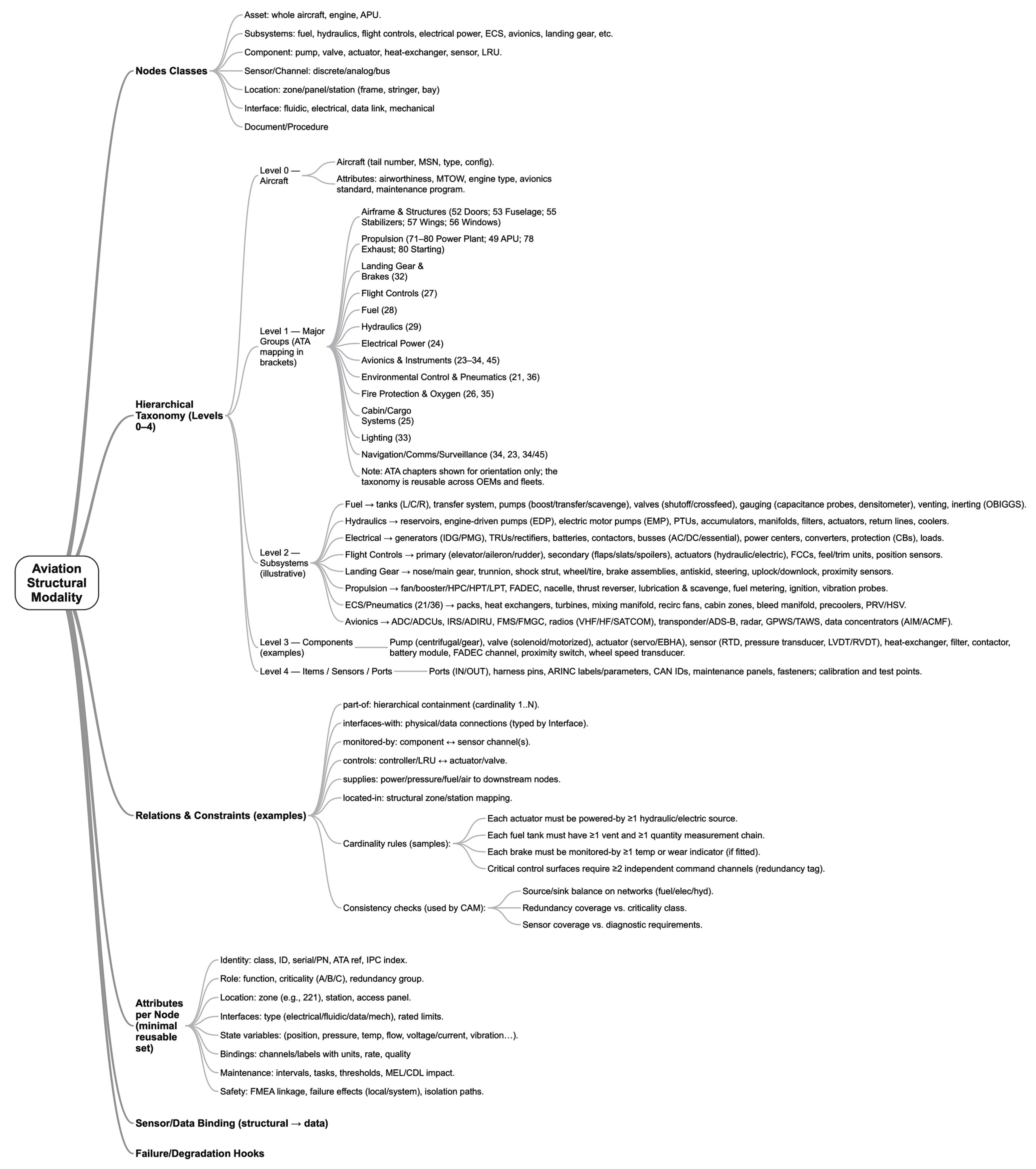
The structural modality establishes the semantic foundation of the aviation RCDT by mapping heterogeneous sensor data and expert inputs into a structured aircraft state representation aligned with the aviation ontology O a v i . This ontology captures hierarchical relationships between aircraft, subsystems, components, and sensors, as well as admissible physical units, operating ranges, and structural constraints.
Raw measurements, such as temperatures, vibrations, and pressures, are interpreted within this ontological context to produce a structured state x t that is semantically meaningful and suitable for higher-level reasoning. Human expertise plays a central role at this stage: maintenance findings, inspection reports, and configuration changes introduce structural refinements that are not directly observable through sensors. These human-derived updates modify both the active ontology and the reusable core through controlled semantic update operators, ensuring that the digital twin remains aligned with the evolving physical system.
The result of this stage is a semantically grounded and cognitively interpretable representation of the aircraft system that serves as the input to the generative, analytical, and operational modalities.
The hierarchical organization of the aviation ontology and its role in the structural modality are illustrated in Figure 3. The figure depicts the semantic mapping from aircraft-level entities to subsystems, components, and sensors, forming the backbone of structural interpretation. Human inputs, such as maintenance findings or configuration updates, act directly on this hierarchy by refining component relations and semantic attributes, thereby ensuring that the structured state remains aligned with the evolving physical system.

3.1.2. Generative, Analytical, and Operational Modalities

  • Generative Modality
Based on the structured state x t , the generative modality synthesizes admissible future scenarios describing potential system evolution. In the aviation context, these scenarios include component degradation trajectories, abnormal operating regimes, and failure propagation paths, all constrained by reusable behavioral invariants and aviation-specific operational limits. Rather than relying on a single predictive model, the RCDT explores a set of cognitively admissible scenarios reflecting alternative assumptions about load history, environmental conditions, and maintenance actions.
2.
Analytical Modality
The analytical modality evaluates both the observed structured state and the generated scenarios using domain-invariant cognitive evaluation indices. These indices assess semantic consistency, explanatory adequacy, and uncertainty without collapsing these aspects into a single performance metric. As a result, the RCDT can distinguish between semantic misalignment, model inadequacy, and limited decision confidence—an essential capability in safety-critical environments.
3.
Operational Modality
The operational modality consumes the outputs of analytical reasoning to generate recommendations and actions. In the aviation case, these actions may include prioritization of maintenance tasks, adjustment of inspection intervals, refinement of predictive models, or escalation to human experts. All operational decisions are constrained by structural, behavioral, and regulatory invariants embedded in the reusable core, ensuring compliance with safety requirements and established procedures.
Together, these modalities form a closed cognitive pipeline that enables the aviation RCDT to interpret system state, explore plausible futures, evaluate risks and coherence, and support informed operational decisions.

3.1.3. Illustrative Computational Evaluation Using OCI, CAI, and CSI

To demonstrate how cognitive evaluation is instantiated numerically within the aviation RCDT, this subsection presents a worked computational example using the ontology consistency index, cognitive adequacy index, and confidence score index defined in Section 2.2.3. Unlike the preceding qualitative description, this example explicitly specifies input assumptions, intermediate quantities, and resulting index values.
The example considers an aircraft engine monitoring scenario involving recent maintenance actions and multiple admissible degradation hypotheses. Ontological constraints, generative scenarios, and uncertainty characteristics are translated into numerical indicators that quantify semantic alignment, explanatory sufficiency, and decision confidence. The resulting values illustrate how partial semantic inconsistency, high model adequacy, and moderate predictive uncertainty can coexist within the same operational context.
A detailed specification of the inputs, intermediate computations, and resulting OCI, CAI, and CSI values is provided in Table 2.
  • Ontology consistency index O C I
The aviation ontology for the engine monitoring subsystem enforces five active admissibility constraints covering semantic typing, structural attachment, physical units, admissible operating ranges, and sensor–component association. Following a maintenance action, the installed temperature sensor reports measurements in degrees Fahrenheit, while the ontology specifies degrees Celsius. All other constraints remain satisfied.
The ontology consistency index is therefore computed as the fraction of satisfied constraints, yielding O C I   =   0.80 . This value indicates a localized semantic inconsistency rather than structural failure and triggers ontology refinement or unit harmonization through human–digital interaction rather than immediate operational action.
2.
Cognitive adequacy index C A I
The generative modality produces three explicitly defined degradation scenarios for the same engine component:
  • σ 1 —baseline degradation assuming nominal thermal load and standard duty cycle.
  • σ 2 —accelerated degradation under elevated exhaust gas temperature and intermittent overload.
  • σ 3 —maintenance-informed scenario incorporating recent inspection findings indicating partial mitigation of thermal stress.
Each scenario generates a predicted structured state x ^ t ( σ i ) , including temperature trends, vibration indicators, and degradation markers. Scenario adequacy is evaluated using a normalized similarity measure between observed and predicted structured states:
s i m ( x t , x ^ t ) = 1 x t x ^ t x t + ε ,
where the norm aggregates deviations across normalized physical and semantic features, and ε prevents numerical instability.
Applying this measure yields similarity scores of 0.62, 0.89, and 0.94 for σ 1 , σ 2 , σ 3 , respectively. Consequently, the cognitive adequacy index is C A I   =   0.94 , indicating that at least one cognitively admissible scenario explains the observed behavior with high fidelity, and no expansion of the scenario space is currently required.
3.
Confidence score index CSI
Although the generative explanation is adequate, the predicted remaining useful life (RUL) values across scenarios exhibit dispersion. For the three scenarios, the RUL estimates are 14,200 h, 12,800 h, and 9600 h, which are representative of realistic aviation component lifetimes.
The mean RUL is 12,200 h, with a standard deviation of 1880 h, yielding a coefficient of variation CV = 0.154. Combined with a data quality factor q t = 0.90 , reflecting sensor coverage and data consistency, the confidence score index is computed as:
C S I = q t · e x p ( 3 · C V ) 0.57 .
This intermediate CSI value reflects moderate uncertainty in quantitative lifetime prediction despite semantic consistency and cognitive adequacy. In the operational modality, such a CSI level leads to conservative decision-making, including reduced inspection intervals or increased reliance on expert judgment.
This worked aviation example demonstrates that OCI, CAI, and CSI originate from distinct but complementary sources: semantic consistency of the ontology, adequacy of generative cognitive models, and uncertainty of quantitative predictions. Their joint evaluation enables the RCDT to distinguish between semantic issues, modeling sufficiency, and confidence limitations, supporting transparent and risk-aware decision-making in safety-critical aviation environments.

3.2. Smart City Case Study

Smart cities represent complex socio-technical systems composed of transportation networks, utilities, mobility flows, digital infrastructure, and human activity. These systems are dynamic, spatially distributed, and heavily influenced by external and human-driven factors, making them a complementary testbed to aviation.
Below, we again apply the four cognitive modalities.
Smart cities represent large-scale, open, and continuously evolving socio-technical systems composed of transportation networks, energy infrastructures, public services, digital platforms, and human activity. In contrast to aviation systems, which are highly standardized and tightly regulated, urban systems exhibit spatial heterogeneity, dynamic topology, policy-driven change, and strong coupling between technical infrastructure and human behavior. These characteristics make smart cities a suitable second validation case for the RCDT paradigm, as they challenge reusability, semantic adaptability, and cognitive scalability under conditions of uncertainty and structural variability.
In this case study, an RCDT instance T d is instantiated for an urban environment by binding the same reusable core R to smart-city-specific domain parameters θ city , heterogeneous data streams d ( t ) and human knowledge h ( t ) via the instantiation operator Γ . Despite the fundamental differences between aircraft and cities, the resulting digital twin operates within the same digital–physical–human triadic system ( P , H , T d ) , coupled by the interaction operator Ψ . This architectural invariance enables a direct assessment of cross-domain transferability at the cognitive level.

3.2.1. Structural Modality: Instantiation

The structural modality establishes the semantic foundation of the smart city RCDT by organizing heterogeneous urban data into a coherent, ontology-driven representation of the city state. The smart city ontology O s c captures spatial entities such as zones, road segments, and intersections; infrastructural elements including sensors, signals, and services; and their functional and spatial relationships.
Raw data streams, including traffic flows, travel times, public transport states, and incident reports, are mapped onto this ontological structure to produce a structured urban state x t . Human knowledge plays a particularly prominent role in this process, as many structural changes, such as temporary road closures, infrastructure upgrades, or policy interventions, originate outside automated sensing pipelines and must be incorporated through expert input.
The hierarchical and spatial organization of the smart city ontology and its role in structural interpretation are illustrated in Figure 4. The figure depicts the semantic mapping from city zones to infrastructure elements, assets, and sensors, providing the structural backbone that enables heterogeneous data to be interpreted consistently across multiple spatial and functional layers. This structural grounding is essential for ensuring that subsequent generative and analytical reasoning remains semantically coherent in a continuously evolving urban environment.

3.2.2. Generative, Analytical, and Operational Modalities

  • Generative Modality
Based on the structured urban state x t , the generative modality synthesizes admissible future scenarios describing possible system evolution under varying conditions. In the smart city context, these scenarios include traffic congestion propagation, redistribution of mobility demand, adaptive routing responses, and the impact of policy or control interventions such as signal retiming or public transport prioritization. Scenario generation relies on reusable behavioral invariants instantiated for the urban domain, rather than on a single monolithic simulation model, allowing the RCDT to explore alternative futures across multiple spatial and temporal scales.
2.
Analytical Modality
The analytical modality evaluates observed states and generated scenarios using the same domain-invariant cognitive evaluation indices introduced in Section 2.2.3. These indices assess semantic consistency of the urban ontology, adequacy of generative explanations, and uncertainty associated with predictions. By separating these dimensions, the RCDT avoids conflating explanatory power with decision confidence, a distinction that is particularly important in open, human-driven environments.
3.
Operational Modality
The operational modality transforms analytical outcomes into actions and recommendations that influence urban operation and planning. In the smart city case, such actions may include advisory routing recommendations, incremental signal timing adjustments, deployment of temporary traffic control measures, or policy-level suggestions for planners. All operational outputs are constrained by structural, behavioral, and policy invariants embedded in the reusable core, ensuring feasibility and social acceptability. Human decision-makers remain integral to the loop, receiving explanatory feedback and providing corrective input that further refines the cognitive state of the twin.
Together, these modalities form a closed cognitive pipeline that enables adaptive, interpretable, and human-aligned reasoning in a complex urban ecosystem.

3.2.3. Illustrative Computational Evaluation Using OCI, CAI, and CSI

To demonstrate numerical instantiation of cognitive evaluation in an open socio-technical environment, this subsection presents a worked computational example using the ontology consistency index, cognitive adequacy index, and confidence score index for the smart city case study. In contrast to the qualitative discussion above, the example explicitly specifies structured inputs, scenario definitions, intermediate quantities, and resulting index values.
The example considers an urban mobility management situation involving temporary infrastructure reconfiguration and emerging congestion patterns. Ontological constraints, generative mobility scenarios, and uncertainty characteristics related to human behavior and sensing limitations are translated into quantitative indicators that capture semantic alignment, explanatory adequacy, and decision confidence. The resulting values illustrate how high cognitive adequacy can coexist with moderate semantic misalignment and low confidence in quantitative forecasts.
A detailed specification of the inputs, intermediate computations, and resulting OCI, CAI, and CSI values is provided in Table 3. The interpretation of these indices demonstrates how the RCDT balances explanatory power with caution, enforcing conservative operational strategies when uncertainty remains high while maintaining semantic and cognitive coherence.
  • Ontology consistency index O C I
The smart city ontology encodes spatial, infrastructural, and service-level constraints linking urban zones, road segments, sensors, and mobility services. In the considered situation, a temporary road reconfiguration has been implemented following construction work, but one traffic sensor remains semantically associated with its previous zone.
Out of six active ontological constraints, five remain satisfied, resulting in an ontology consistency index of O C I     0.83 . This value indicates partial semantic misalignment rather than systemic inconsistency. Within the RCDT framework, such a reduction in OCI prompts human-guided semantic updates, for example, reassignment of sensor–zone relations or correction of spatial metadata, rather than immediate operational disruption.
2.
Cognitive adequacy index C A I
The generative modality produces three explicitly defined urban mobility scenarios in response to observed congestion patterns:
  • σ 1 —baseline traffic redistribution assuming nominal commuter behavior and no policy intervention.
  • σ 2 —adaptive routing scenario reflecting short-term driver response to congestion alerts.
  • σ 3 —policy-informed scenario incorporating temporary traffic signal retiming and public transport prioritization.
Each scenario yields a predicted structured urban state x ^ t ( σ i ) , including normalized traffic flows, average travel times, and congestion indicators across key corridors. Scenario adequacy is evaluated using a normalized similarity measure:
s i m ( x t , x ^ t ) = 1 x t x ^ t x t + ε ,
where the norm aggregates deviations across normalized spatial and mobility features.
The resulting similarity scores are 0.71, 0.92, and 0.97 for σ 1 , σ 2 , σ 3 , respectively. The cognitive adequacy index is therefore C A I   =   0.97 , indicating that the observed urban dynamics are well explained by at least one cognitively admissible scenario. No immediate restructuring of the generative model set is required.
3.
Confidence score index C S I
Despite high cognitive adequacy, uncertainty remains substantial due to variability in human behavior and partial observability of urban mobility patterns. Across the three scenarios, predicted average travel time increases are 8%, 14%, and 25%, reflecting differing assumptions about driver compliance and modal shifts.
The mean predicted increase is 15.7%, with a standard deviation of 7.0%, yielding a coefficient of variation C V   =   0.446 . Combined with a data quality factor q t = 0.75 , reflecting incomplete sensor coverage and reporting delays, the confidence score index is computed as:
C S I = q t · e x p ( 2 · C V ) 0.31 .
This low-to-moderate CSI value reflects limited confidence in quantitative forecasts despite strong semantic alignment and scenario adequacy. Consequently, the operational modality prioritizes cautious interventions, such as incremental signal timing adjustments, advisory routing recommendations, and increased monitoring, rather than aggressive policy enforcement.
This smart city example illustrates how OCI, CAI, and CSI capture distinct dimensions of cognitive evaluation in an open, human-driven environment. OCI reflects semantic alignment of spatial and infrastructural representations, CAI assesses the adequacy of mobility scenarios in explaining observed dynamics, and CSI quantifies uncertainty arising from behavioral variability and sensing limitations. Their combined interpretation enables the RCDT to balance explanatory power with caution, supporting transparent and adaptive decision-making in complex urban ecosystems.

4. Discussion

4.1. Interpretation of Findings Across Domains

The aviation and smart city case studies provide complementary evidence that the reusable cognitive digital twin paradigm supports cognitively consistent reasoning across fundamentally different system classes. Despite profound differences in structural rigidity, operational governance, and uncertainty sources, both domains instantiate the same reusable core and operate through an identical cognitive pipeline composed of structural, generative, analytical, and operational modalities. The explicit numerical instantiations of OCI, CAI, and CSI confirm that cognition in the RCDT paradigm is not domain-bound but emerges from reusable operator orchestration.
A central result of the aviation case study is the clear functional separation between semantic integrity, explanatory adequacy, and decision confidence. The ontology consistency index reveals localized semantic inconsistencies introduced by maintenance actions, such as sensor replacement or configuration changes, without conflating them with structural correctness or system health. At the same time, a high cognitive adequacy index demonstrates that the generative models remain sufficient to explain observed behavior, even when partial semantic misalignment is present. The confidence score index further modulates operational behavior by accounting for dispersion in quantitative lifetime predictions and data quality limitations. This separation allows the RCDT to distinguish between issues that require semantic correction, model refinement, or conservative operational response—capabilities that are typically entangled in conventional digital twin implementations.
In contrast, the smart city case study exhibits a distinct cognitive profile shaped by openness, spatial dynamics, and human-driven variability. Moderate ontology consistency values arise from evolving infrastructure, temporary reconfiguration, and delayed semantic updates, reflecting the inherent fluidity of urban environments. At the same time, the generative modality achieves high cognitive adequacy by producing policy-informed and behavior-aware mobility scenarios that closely align with observed dynamics. However, confidence scores remain comparatively low due to substantial behavioral uncertainty and incomplete observability. This combination of high CAI and low CSI illustrates a defining characteristic of socio-technical systems: strong explanatory power does not necessarily translate into high-confidence quantitative forecasts.
Importantly, the numerical examples demonstrate that OCI, CAI, and CSI preserve their semantic meaning and functional role across both domains, despite being instantiated from fundamentally different data types, constraints, and uncertainty structures. In both aviation and smart city contexts, reduced OCI consistently signals the need for semantic or ontological refinement; reduced CAI would indicate inadequacy of the cognitive models or scenario space; and reduced CSI enforces conservative operational strategies and increased reliance on human judgment. This invariance confirms that cognitive evaluation in the RCDT paradigm operates at an architectural level rather than being tied to domain-specific performance metrics.
Another key observation concerns the role of the structural modality as a cognitive anchor. In both domains, ontological structure provides the semantic foundation upon which generative, analytical, and operational reasoning are built. Human expertise plays a critical role in maintaining and evolving this foundation, particularly when structural changes are not immediately observable through sensors. The worked examples show that semantic inconsistencies can be detected and isolated without destabilizing higher-level reasoning, enabling controlled cognitive evolution rather than cascading model failure.
The joint interpretation of the two case studies further highlights the value of explicitly separating explanatory adequacy from operational confidence. Traditional digital twins often equate predictive accuracy with decision readiness, implicitly if good models imply trustworthy actions. The RCDT paradigm challenges this assumption by introducing CSI as an independent regulator of operational behavior. As demonstrated in the smart city case, even highly adequate cognitive explanations may warrant cautious intervention when uncertainty remains high. Conversely, in the aviation case, moderate uncertainty can be tolerated within a tightly constrained operational envelope. This distinction is essential for human-aligned decision support in safety-critical and policy-sensitive environments.
Taken together, these findings indicate that the reusable cognitive digital twin paradigm enables cross-domain cognitive transfer at a level deeper than software reuse or data interoperability. What is transferred is a structured cognitive logic that systematically separates interpretation, explanation, and confidence regulation into coordinated but independent processes. This separation allows RCDTs to adapt their behavior to the epistemic characteristics of each domain while preserving architectural consistency, interpretability, and human-centered control. As a result, RCDTs function not merely as advanced models but as hybrid cognitive entities capable of supporting robust, transparent, and context-aware decision-making across heterogeneous intelligent digital ecosystems.

4.2. Comparison of RCDT with Traditional Digital Twin Approaches

While the computational examples presented in Section 3 are intentionally illustrative rather than experimental, it is important to position the reusable cognitive digital twin paradigm relative to conventional digital twin approaches. Traditional DT implementations are typically evaluated through domain-specific performance metrics such as prediction accuracy, simulation fidelity, or computational efficiency. These criteria are appropriate when the primary contribution is a new model, algorithm, or data-driven prediction method.
In contrast, the contribution of the RCDT paradigm is architectural and cognitive rather than algorithmic. The RCDT does not replace existing predictive or simulation models; instead, it provides a reusable cognitive framework within which such models can be interpreted, evaluated, and orchestrated. Consequently, direct numerical comparison of prediction accuracy between RCDT and traditional DTs would be methodologically misleading, as RCDT operates at a different level of abstraction.
The key advantages of the RCDT paradigm emerge in dimensions that are not explicitly addressed by conventional DT performance metrics.
First, RCDT introduces explicit semantic consistency management through ontology-driven reasoning and the ontology consistency index. In traditional DTs, semantic inconsistencies, such as outdated system structures or misaligned data interpretations, are typically detected implicitly or through manual intervention, whereas RCDT makes semantic coherence an explicit, measurable property of the digital twin.
Second, RCDT separates explanatory adequacy from predictive accuracy through the cognitive adequacy index. Classical DT evaluations often assume that prediction accuracy alone reflects model quality. In contrast, RCDT explicitly evaluates whether observed system behavior is explainable by at least one cognitively admissible scenario, even when multiple alternative futures exist. This distinction is particularly important in safety-critical and socio-technical systems, where correct interpretation and explanation may be more critical than numerical precision.
Third, RCDT introduces explicit regulation of decision confidence via the confidence score index. Traditional DTs typically propagate uncertainty indirectly through model variance or confidence intervals, without directly linking uncertainty to decision orchestration. In the RCDT paradigm, uncertainty and data quality explicitly modulate operational behavior, enabling conservative or human-centered decision strategies when confidence is limited.
Fourth, the RCDT paradigm enables cognitive reusability across domains. While traditional DT frameworks are largely domain-bound, RCDT supports reuse of structural, behavioral, and cognitive invariants across heterogeneous systems. This capability was demonstrated in Section 3 through the aviation and smart city case studies, where the same cognitive modalities and evaluation indices were instantiated despite profound differences in system structure, scale, and uncertainty.
From this comparative perspective, the advantages of RCDT are not expressed primarily through improved numerical prediction performance, but through enhanced semantic consistency, interpretability, confidence-aware decision support, and cross-domain transferability. These properties define a complementary evaluation space in which RCDT extends the scope of digital twin technology beyond traditional model-centric paradigms.
To further clarify the distinction between traditional digital twins and the proposed RCDT paradigm, Table 4 summarizes their differences across key architectural and cognitive dimensions.

4.3. Limitations and Future Research Directions

Despite the conceptual and architectural contributions of the reusable cognitive digital twin paradigm, several limitations remain that define clear directions for future research. Importantly, these limitations are not shortcomings of the paradigm itself but rather reflect open challenges inherent to the development of cognitively enriched, human-integrated digital ecosystems.
A primary limitation concerns the effort required to construct and maintain domain ontologies. Although the reusable core provides structural and semantic templates, domain-specific instantiation and evolution still rely heavily on expert involvement. In the short term, this limitation can be mitigated by introducing semi-automated ontology refinement mechanisms, such as rule-based consistency checking, ontology diffing, and template-driven ontology extension. Longer-term research should investigate hybrid approaches combining ontology learning from data with human validation to reduce manual overhead while preserving semantic correctness.
The cognitive orchestration layer, particularly the generative and analytical modalities, may incur nontrivial computational costs when applied to large-scale or time-critical systems. In the short term, practical deployment can be improved through selective activation of cognitive modalities, adaptive scheduling based on urgency and confidence levels, and lightweight surrogate models for scenario generation. Future research should focus on distributed cognitive orchestration, edge–cloud partitioning, and formal complexity control mechanisms to ensure scalability in real-time environments.
While the RCDT paradigm formally integrates human experts as first-class cognitive agents, the reliability, consistency, and potential bias of human-provided knowledge are not explicitly modeled. As an immediate improvement, structured validation workflows—such as confidence weighting, provenance tracking, and conflict resolution rules—can be incorporated to regulate human inputs. In the longer term, research is needed to develop meta-cognitive models that characterize human expertise, uncertainty, and trustworthiness, drawing on cognitive systems engineering and explainable AI.
The adaptive and human-augmented nature of RCDTs complicates traditional verification and certification processes, particularly in regulated domains such as aviation or energy. In the short term, this challenge can be addressed by restricting adaptive behavior to certified envelopes and by maintaining traceable logs of ontological and cognitive updates. Future research should aim to establish certification frameworks for cognitive digital twins, integrating formal verification, semantic consistency guarantees, and human-in-the-loop accountability mechanisms.
The present work focuses on individual RCDTs, whereas real-world intelligent digital ecosystems will likely involve networks of interacting cognitive twins. In the near term, this limitation can be addressed by defining interface standards and minimal coordination protocols between RCDTs. Future research should investigate distributed cognition, federated ontologies, and conflict resolution strategies for multi-twin ecosystems, enabling collective reasoning across organizational and domain boundaries.
These limitations outline a structured research agenda rather than fundamental barriers. The proposed short-term improvements provide practical pathways for incremental adoption, while longer-term directions point toward the maturation of RCDTs as a foundation for large-scale, trustworthy, and cognitively integrated digital ecosystems.

4.4. Theoretical Implications

The RCDT paradigm has several significant implications for the theory of digital twins, cognition, and cyber–physical systems.
First, the results suggest that digital twins can be conceptualized not merely as models but as cognitive entities capable of interpretation, prediction, evaluation, and action. This shifts the theoretical foundation of digital twin research away from static modeling and toward operator-based cognitive architectures. The RCDT, represented as an evolving operator system Ψ : X U , embodies this shift by treating cognition as a compositional mapping rather than a fixed algorithmic procedure.
Second, the explicit inclusion of human cognition introduces a principled framework for hybrid reasoning, where digital and human cognitive processes interact within the same semantic space. This establishes the RCDT as a model of hybrid intelligence, with the Digital–Physical–Human loop serving as a formal mechanism for co-evolution. Such a view opens connections to cognitive science, epistemology, and human–AI collaboration research, extending the scope of digital twin theory.
Third, the reusable core R introduces a form of domain-general knowledge representation, reminiscent of universal schemas in cognitive architectures or category-theoretic abstractions in mathematics. This suggests that RCDTs may serve as a foundation for a more generalized theory of cognitive digital ecosystems, where reasoning structures and semantic templates are portable across domains, systems, and contexts.
Finally, the cross-domain results point toward the emergence of ecosystem-level cognition, where multiple interacting RCDTs share knowledge, coordinate reasoning, and jointly influence physical or socio-technical systems. Such networks of cognitive twins could give rise to new forms of distributed intelligence, with potential applications in multi-aircraft fleet management, interconnected urban infrastructure, and autonomous multi-agent planning.

5. Conclusions

This paper introduced the reusable cognitive digital twin as a foundational paradigm for next-generation intelligent digital ecosystems. Unlike traditional digital twins, which are typically domain-specific, model-centric, and limited to reflecting physical system behavior, the RCDT embodies a domain-general cognitive architecture grounded in reusability, semantic interpretability, and human–machine co-evolution. Central to the paradigm is the distinction between the reusable core, which captures structural, behavioral, and cognitive invariants across domains, and the cognitive orchestration layer, which implements a four-part cognitive pipeline comprising structural, generative, analytical, and operational modalities. Together, these components provide a systematic, operator-based approach to constructing digital twins capable of reasoning, adapting, and evolving in response to new data, human insights, and changing environmental conditions.
A key conceptual advancement presented in the paper is the digital–physical–human interaction framework, which extends the conventional digital–physical loop to include the human cognitive agent as an integral source of semantic, structural, and contextual knowledge. Human contributions, expressed formally through ontological and cognitive updates, ensure that the twin remains interpretable, adaptable, and aligned with real-world operational contexts. This triadic interaction establishes a hybrid cognitive system in which digital reasoning and human insight jointly shape the evolution of the twin’s internal state.
The instantiation of the RCDT paradigm in two contrasting domains, aviation and smart cities, demonstrated its applicability to both structurally constrained, safety-critical systems and large-scale, dynamic socio-technical environments. Despite the substantial differences between these domains, the same reusable modules and cognitive modalities applied consistently, illustrating the paradigm’s cross-domain generality. The structural modality aligned heterogeneous data with ontological models; the generative modality produced predictive and counterfactual scenarios; the analytical modality evaluated consistency, adequacy, and risk; and the operational modality transformed insights into actionable guidance for humans or control systems. These experiments confirm that the RCDT architecture supports robust reasoning workflows regardless of domain complexity, physical scale, or data characteristics.
At the same time, the study revealed several challenges that guide future research. The construction and evolution of ontologies remain heavily dependent on expert knowledge, suggesting the need for semi-automated or learning-based approaches to semantic modeling. Computational demands pose constraints on real-time operation, particularly in highly dynamic environments such as urban mobility. Modeling the uncertainty and variability inherent in human cognitive contributions remains an open problem requiring deeper integration of cognitive science and explainable AI. Furthermore, the certification of cognitive digital twins in safety-critical industries raises important questions about verification, traceability, and robustness.
Despite these challenges, the RCDT paradigm establishes a strong theoretical and architectural foundation for the development of intelligent, hybrid, and reusable cognitive systems. Its operator-based formulation promotes interpretability; its modular structure ensures scalability; and its integration of human and machine cognition provides a path toward richer and more resilient digital representations. Looking forward, the paradigm opens promising avenues for multi-twin ecosystems, distributed cognition, and large-scale digital infrastructures that can learn, adapt, and coordinate in ways that transcend traditional digital twin boundaries.
The results presented here indicate that RCDTs are not merely an incremental extension of digital twin technology, but a conceptual step toward a comprehensive framework for cognitive digital ecosystems. As digital systems become increasingly interconnected and autonomous, the RCDT paradigm offers a principled and extensible foundation for understanding, designing, and governing the next generation of intelligent cyber–physical environments.

Funding

This research received no external funding.

Institutional Review Board Statement

Not applicable.

Informed Consent Statement

Not applicable.

Data Availability Statement

The original contributions presented in the study are included in the article; further inquiries can be directed to the corresponding author.

Conflicts of Interest

The author declares no conflicts of interest.

References

  1. Tang, Y.; Li, L.; Liu, X. State-of-the-Art Development of Complex Systems and Their Simulation Methods. Complex Syst. Model. Simul. 2021, 1, 271–290. [Google Scholar] [CrossRef]
  2. Alford, J. Intelligent Digital Ecosystems: How Rethinking Technology Will Expand Your Mind and Change Your World; Tellwell Talent: Victoria, BC, Canada, 2023. [Google Scholar]
  3. Wu, H.; Ji, P.; Ma, H.; Xing, L. A Comprehensive Review of Digital Twin from the Perspective of Total Process: Data, Models, Networks and Applications. Sensors 2023, 23, 8306. [Google Scholar] [CrossRef]
  4. Cho, Y.; Noh, S.D. Design and Implementation of Digital Twin Factory Synchronized in Real-Time Using MQTT. Machines 2024, 12, 759. [Google Scholar] [CrossRef]
  5. Kritzinger, W.; Karner, M.; Traar, G.; Henjes, J.; Sihn, W. Digital Twin in Manufacturing: A Categorical Literature Review and Classification. IFAC-PapersOnLine 2018, 51, 1016–1022. [Google Scholar] [CrossRef]
  6. Lu, Y.; Liu, C.; Wang, K.I.-K.; Huang, H.; Xu, X. Digital Twin-Driven Smart Manufacturing: Connotation, Reference Model, Applications and Research Issues. Robot. Comput.-Integr. Manuf. 2020, 61, 101837. [Google Scholar] [CrossRef]
  7. Tao, F.; Sui, F.; Liu, A.; Qi, Q.; Zhang, M.; Song, B.; Guo, Z.; Lu, S.C.-Y. Digital Twin-Driven Product Design Framework. Int. J. Prod. Res. 2019, 57, 3935–3953. [Google Scholar] [CrossRef]
  8. Eirinakis, P.; Lounis, S.; Plitsos, S.; Arampatzis, G.; Kalaboukas, K.; Kenda, K.; Lu, J.; Rožanec, J.M.; Stojanovic, N. Cognitive Digital Twins for Resilience in Production: A Conceptual Framework. Information 2022, 13, 33. [Google Scholar] [CrossRef]
  9. Fuller, A.; Fan, Z.; Day, C.; Barlow, C. Digital Twin: Enabling Technologies, Challenges and Open Research. IEEE Access 2020, 8, 108952–108971. [Google Scholar] [CrossRef]
  10. West, T.D.; Blackburn, M. Is Digital Thread/Digital Twin Affordable? A Systemic Assessment of the Cost of DoD’s Latest Manhattan Project. Procedia Comput. Sci. 2017, 114, 47–56. [Google Scholar] [CrossRef]
  11. Singh, M.; Fuenmayor, E.; Hinchy, E.P.; Qiao, Y.; Murray, N.; Devine, D. Digital Twin: Origin to Future. Appl. Syst. Innov. 2021, 4, 36. [Google Scholar] [CrossRef]
  12. Madni, A.M.; Madni, C.C.; Lucero, S.D. Leveraging Digital Twin Technology in Model-Based Systems Engineering. Systems 2019, 7, 7. [Google Scholar] [CrossRef]
  13. Trauer, J.; Schweigert-Recksiek, S.; Engel, C.; Spreitzer, K.; Zimmermann, M. What Is a Digital Twin? Definitions and Insights from an Industrial Case Study in Technical Product Development. Proc. Des. Soc. Des. Conf. 2020, 1, 757–766. [Google Scholar] [CrossRef]
  14. Liu, X.; Jiang, D.; Tao, B.; Xiang, F.; Jiang, G.; Sun, Y.; Kong, J.; Li, G. A Systematic Review of Digital Twin about Physical Entities, Virtual Models, Twin Data, and Applications. Adv. Eng. Inform. 2023, 55, 101876. [Google Scholar] [CrossRef]
  15. Karabulut, M.F.; Jung, A.; Pulvermacher, K.; Diedrich, C. Ontologies in Digital Twins: Systematic Literature Review and Meta-Analysis. Future Gener. Comput. Syst. 2024, 153, 271–293. [Google Scholar] [CrossRef]
  16. Su, C.; Tang, X.; Han, Y.; Wang, T.; Jiang, D. Cognitive Digital Twin in Manufacturing Process: Integrating the Knowledge Graph for Enhanced Human-Centric Industry 5.0. Int. J. Prod. Res. 2024, 1–22. [Google Scholar] [CrossRef]
  17. Zheng, X.; Lu, J.; Kiritsis, D. The Emergence of Cognitive Digital Twin: Vision, Challenges and Opportunities. Int. J. Prod. Res. 2022, 60, 7610–7632. [Google Scholar] [CrossRef]
  18. D’Amico, R.D.; Erkoyuncu, J.A.; Addepalli, S.; Penver, S. Cognitive Digital Twin: An Approach to Improve the Maintenance Management. CIRP J. Manuf. Sci. Technol. 2022, 38, 613–630. [Google Scholar] [CrossRef]
  19. Li, J.; Yang, Z.; Zhang, X.; Jian, W.; Dimitris, K. Exploring the Concept of Cognitive Digital Twin from Model-Based Systems Engineering Perspective. Int. J. Adv. Manuf. Technol. 2022, 121, 5835–5854. [Google Scholar] [CrossRef]
  20. Banerjee, A.; Dalal, R.; Mittal, S.; Joshi, K.P. Generating Digital Twin Models Using Knowledge Graphs for Industrial Production Lines. In Proceedings of the WebSci ’17; ACM: New York, NY, USA, 2017. [Google Scholar] [CrossRef]
  21. Hogan, A.; Blomqvist, E.; Cochez, M.; d’Amato, C.; de Melo, G.; Gutierrez, C.; Kirrane, S.; Gayo, J.E.L.; Navigli, R.; Neumaier, S.; et al. Knowledge Graphs. ACM Comput. Surv. 2021, 54, 71. [Google Scholar] [CrossRef]
  22. Tiddi, I.; Schlobach, S. Knowledge Graphs as Tools for Explainable Machine Learning: A Survey. Artif. Intell. 2022, 302, 103627. [Google Scholar] [CrossRef]
  23. Croatti, A.; Gabellini, M.; Montagna, S.; Ricci, A. On the Integration of Agents and Digital Twins in Healthcare. J. Med. Syst. 2020, 44, 161. [Google Scholar] [CrossRef] [PubMed]
  24. El Saddik, A. Digital Twins: The Convergence of Multimedia Technologies. IEEE Multimed. 2018, 25, 87–92. [Google Scholar] [CrossRef]
  25. Major, P.; Li, G.; Hildre, H.P.; Zhang, H. The Use of a Data-Driven Digital Twin of a Smart City: A Case Study of Ålesund, Norway. IEEE Instrum. Meas. Mag. 2021, 24, 39–49. [Google Scholar] [CrossRef]
  26. Kalyani, Y.; Collier, R. The Role of Multi-Agents in Digital Twin Implementation: Short Survey. ACM Comput. Surv. 2025, 57, 72. [Google Scholar] [CrossRef]
  27. Oakes, B.; Gomes, C.; Kamburjan, E.; Abbiati, G.; Bas, E.E.; Engelsgaard, S. Towards Ontological Service-Driven Engineering of Digital Twins. In Proceedings of the ACM/IEEE 27th International Conference on Model Driven Engineering Languages and Systems (MODELS Companion ’24), Linz, Austria, 22–27 September 2024; pp. 464–469. [Google Scholar] [CrossRef]
  28. OECD. Handbook on Constructing Composite Indicators: Methodology and User Guide; OECD Publishing: Paris, France, 2008. [Google Scholar] [CrossRef]
  29. Saltelli, A. Composite Indicators between Analysis and Advocacy. Soc. Indic. Res. 2007, 81, 65–77. [Google Scholar] [CrossRef]
  30. Mitchell, M. Complexity: A Guided Tour; Oxford University Press: New York, NY, USA, 2009. [Google Scholar] [CrossRef]
  31. Holling, C.S. Resilience and Stability of Ecological Systems. Annu. Rev. Ecol. Syst. 1973, 4, 1–23. [Google Scholar] [CrossRef]
  32. Vernon, D. Artificial Cognitive Systems: A Primer; MIT Press: Cambridge, MA, USA, 2024. [Google Scholar]
  33. Sterman, J.D. Business Dynamics: Systems Thinking and Modeling for a Complex World; Irwin/McGraw-Hill: Boston, MA, USA, 2000. [Google Scholar]
Figure 1. Overall methodological block diagram of the RCDT pipeline.
Information 17 00255 g001
Figure 2. Unified cognitive digital twin platform with domain profiles.
Information 17 00255 g002
Figure 3. Aviation structural modality hierarchy (APU—Auxiliary Power Unit; ECS—Environmental Control System; LRU—Line Replaceable Unit; MSN—Manufacturer Serial Number; MTOW—Maximum Take-Off Weight; ATA—Air Transport Association chapter; OEM—Original Equipment Manufacturer; OBIGGS—On-Board Inert Gas Generation System; AC—Alternating Current; DC—Direct Current; FCC—Flight Control Computer; YHC—Yaw Hydraulic Computer; HPT—High-Pressure Turbine; LPT—Low-Pressure Turbine; FADEC—Full Authority Digital Engine Control; IDG—Integrated Drive Generator; PMG—Permanent Magnet Generator; ADC—Air Data Computer; ADCU—Air Data Concentrator Unit; IRS—Inertial Reference System; ADIRU—Air Data Inertial Reference Unit; FMS—Flight Management System; FMGS—Flight Management and Guidance System; VHF—Very High Frequency communication; HF—High Frequency communication; SATCOM—Satellite Communication; ADS-B—Automatic Dependent Surveillance–Broadcast; GPWS—Ground Proximity Warning System; TAWS—Terrain Awareness and Warning System; PRV—Pressure Regulating Valve; HSV—High-Speed Valve; AIM—Aircraft Interface Module; LVDT—Linear Variable Differential Transformer; RVDT—Rotary Variable Differential Transformer; IN/OUT—signal input/output; ARINC—Aeronautical Radio, Incorporated data standards; CAN IDs—Controller Area Network identifiers; ID—Identifier; PN—Part Number; IPC—Illustrated Parts Catalog; MEL—Minimum Equipment List; CDL—Configuration Deviation List; FMEA—Failure Modes and Effects Analysis).
Information 17 00255 g003
Figure 4. Smart city structural modality (UAV—Unmanned Aerial Vehicle; GPS—Global Positioning System; EV—Electric Vehicle; PM2.5/PM10—particulate matter with aerodynamic diameter ≤2.5 μm/≤10 μm; NO2—nitrogen dioxide; O3—ozone; AQ—Air Quality; SCADA—Supervisory Control and Data Acquisition; PLC—Programmable Logic Controller; API—Application Programming Interface; RF—Radio Frequency; SOP—Standard Operating Procedure; DER—Distributed Energy Resources; LPWAN—Low-Power Wide-Area Network; 4G/5G—fourth/fifth generation mobile networks; Wi-Fi—Wireless Fidelity; CCTV—Closed-Circuit Television; VMS—Variable Message Sign; AVL—Automatic Vehicle Location; TX-kVA—transformer apparent power rating (kilovolt-ampere); AC/DC—alternating current/direct current; kW—kilowatt; kVA/kW—apparent/active power; PV—photovoltaic; PRV—Pressure Regulating Valve; RU/DU/CU—Radio Unit/Distributed Unit/Central Unit; OLT/ONT—Optical Line Terminal/Optical Network Terminal; PTZ—Pan–Tilt–Zoom camera; ANPR—Automatic Number Plate Recognition; PM—particulate matter (generic); MQTT/AMQP—Message Queuing Telemetry Transport/Advanced Message Queuing Protocol; RTU—Remote Terminal Unit; CAM—camera module; ID—identifier; SLA—Service Level Agreement; RSRP/RSRQ—Reference Signal Received Power/Reference Signal Received Quality; CGM/CAM—cognitive generative modality/cognitive analytical modality).
Information 17 00255 g004
Table 1. Matrix representation of reusable digital twin modules across CDT instruments.
Module FamiliesCDT-0. Cognitive ArchitectureCDT-1. Cognitive SimulationCDT-2. Cognitive AnalysisCDT-3. Cognitive Orchestrated System
Structural modulesOntology and component templatesStructural models as simulation objectsStructural consistency & mappingStructural model selection and reconfiguration
Functional modulesReusable function blocks, process templatesReusable workflows and algorithm kernelsReusable analytical functions and KPIsReal-time switching and task allocation
Behavioral modulesBehavioral rules in architectureScenario and state machine templatesReusable risk/trajectory patternsAdaptive orchestration of behavioral logic
Table 2. Illustrative computation of cognitive evaluation indices in the aviation case.
IndexExplicit InputsIntermediate ComputationResult
OCI5 ontology constraints: (i) sensor type, (ii) part–whole relation, (iii) unit admissibility, (iv) value bounds, (v) sensor–component mapping4 of 5 constraints satisfied (unit mismatch after sensor replacement)OCI = 4/5 = 0.80
CAIObserved structured state x t ; three degradation scenarios σ 1 , σ 2 , σ 3 Similarity scores: 0.62, 0.89, 0.94 (defined below)CAI = max(sim) = 0.94
CSIScenario RUL estimates (hours): {14,200, 12,800, 9600}; data quality factor q t = 0.90 Mean = 12,200 h; std. dev. = 1880 h; CV = 0.154; penalty e 3 · C V = 0.63 CSI ≈ 0.57
Table 3. Illustrative computation of cognitive evaluation indices in the smart city case.
IndexExplicit InputsIntermediate ComputationResult
OCIUrban ontology constraints: (i) zone–sensor mapping, (ii) road–zone association, (iii) service–infrastructure linkage, (iv) spatial consistency, (v) data stream assignment (6 constraints total)5 of 6 constraints satisfied (outdated sensor–zone association detected)OCI = 5/6 ≈ 0.83
CAIObserved traffic state x t ; three mobility scenarios σ 1 , σ 2 , σ 3 Similarity scores: 0.71, 0.92, 0.97 (defined below)CAI = max(sim) = 0.97
CSIScenario travel time increase estimates (%): {8, 14, 25}; data quality factor q t = 0.75 Mean = 15.7%; std. dev. = 7.0%; CV = 0.446; penalty e 2 · C V = 0.41 CSI ≈ 0.31
Table 4. Comparative perspective between traditional digital twins and the RCDT paradigm.
DimensionTraditional Digital TwinsReusable Cognitive Digital Twins
Primary focusAsset-specific modeling and predictionDomain-independent cognitive architecture
Evaluation criteriaPrediction accuracy, simulation fidelitySemantic consistency (OCI), cognitive adequacy (CAI), confidence regulation (CSI)
Treatment of semanticsImplicit or externally managedExplicit ontology-driven reasoning
Human knowledge integrationExternal supervision or annotationFirst-class cognitive input within the twin
Decision supportModel-driven, accuracy-orientedConfidence-aware, human-centered orchestration
Cross-domain reuseLimited, domain-boundArchitectural and cognitive reuse across domains
Handling uncertaintyImplicit (model variance, confidence intervals)Explicit modulation of decisions via CSI
Evolution over lifecycleManual redesign or retrainingIncremental evolution of reusable cognitive invariants
Disclaimer/Publisher’s Note: The statements, opinions and data contained in all publications are solely those of the individual author(s) and contributor(s) and not of MDPI and/or the editor(s). MDPI and/or the editor(s) disclaim responsibility for any injury to people or property resulting from any ideas, methods, instructions or products referred to in the content.