Article

Generative AI Recommendations for Environmental Sustainability: A Hybrid SEM–ANN Analysis of Gen Z Users in the Philippines


by
Victor James C. Escolano
1,*,
Yann-Mey Yee
1,
Wei-Jung Shiang
1,*,
Alexander A. Hernandez
2 and
Do Van Nang
3
1
Department of Industrial and Systems Engineering, Chung Yuan Christian University, Taoyuan City 320314, Taiwan
2
College of Computer Studies and Multimedia Arts, FEU Institute of Technology, Manila City 1015, Philippines
3
Faculty of Electronics Technology, Industrial University of Ho Chi Minh City, Ho Chi Minh City 700000, Vietnam
*
Authors to whom correspondence should be addressed.
Information 2026, 17(2), 203; https://doi.org/10.3390/info17020203
Submission received: 28 January 2026 / Revised: 12 February 2026 / Accepted: 13 February 2026 / Published: 15 February 2026
(This article belongs to the Special Issue Artificial Intelligence Technologies for Sustainable Development)

Abstract

Generative AI offers promising potential to promote environmental sustainability through personalized recommendations that influence individual behavior. This study examines the factors influencing the adoption and actual use of generative AI recommendations for environmental sustainability among Gen Z users in the Philippines by integrating the Theory of Planned Behavior (TPB) and the Technology–Environmental, Economic, and Social Sustainability Theory (T-EESST) with key generative AI attributes, together with trust and perceived risk. Survey data were collected from 531 Gen Z users in higher education institutions in the National Capital Region (NCR), Philippines, and analyzed using a hybrid SEM and ANN approach. Results from SEM indicate that key AI attributes, namely perceived anthropomorphism, perceived intelligence, and perceived animacy, significantly influenced users’ attitude towards generative AI recommendations. Attitude, perceived behavioral control, and trust emerged as significant predictors of behavioral intention, which have an eventual positive relation to actual use and environmental sustainability outcomes. In contrast, subjective norms and perceived risk did not significantly affect behavioral intention, which may suggest that Gen Z users’ engagement with generative AI for environmental sustainability is primarily driven by internal evaluations, perceived capability, and trust rather than social pressure or risk concerns. Complementing these findings, the ANN analysis identified perceived behavioral control, attitude, and trust as the most important factors, reinforcing the robustness of the SEM results. Overall, this study integrates existing sustainability and technology-adoption literature by demonstrating how generative AI recommendations can support environmental sustainability among Gen Z users by combining behavioral theory, sustainability theory, and AI attributes through a hybrid SEM–ANN approach in the context of a developing country.

1. Introduction

Generative artificial intelligence (AI) has opened a new era of human–machine interaction, which has a profound impact on various aspects of society globally. As a subfield of artificial intelligence, generative AI leverages deep learning techniques to generate different forms of content, such as text, images, and recommendations [1]. Further, it holds enormous potential for enhancing human capabilities by training on large datasets [2]. Consequently, generative AI has gained immense popularity through tools such as Copilot, Gemini, and ChatGPT, which have become part of daily digital activities among users.
Recent industry reports indicate that the global artificial intelligence market will surpass 1.3 trillion USD by 2032 [3]. Thus, generative AI has emerged as one of the most widely utilized AI technologies, as businesses are deploying it for process automation, customer support improvement, and generation of valuable content [4]. Evidently, it now has a range of applications across different sectors, such as education, healthcare, finance, and even software development.
Among different user groups, Gen Z has emerged as one of the most active users and early adopters of generative AI due to its benefits such as enhancing productivity and offering personalized learning [5]. As digital natives, Gen Z users are also characterized by their strong environmental awareness. In the Philippines, approximately 52% of Gen Z individuals actively use generative AI tools, positioning them at the forefront of AI adoption in the country [6]. This intersection of technological familiarity and environmental consciousness has attracted the attention of researchers worldwide, particularly with regard to the potential role of generative AI in supporting environmentally sustainable behaviors. Prior studies show that generative AI may contribute to the achievement of the United Nations Sustainable Development Goals (UN SDGs) because it supports global progress [7]. In view of this, generative AI offers unique capabilities in delivering personalized recommendations, which can drive and encourage sustainable behaviors.
Despite this promising potential, several important research gaps remain. First, existing studies on generative AI primarily focus on its technical performance, but often overlook psychological and environmental sustainability dimensions, as well as trust and risk-related factors that influence adoption, particularly among Gen Z users. Second, prior research rarely integrates behavioral theory with specific perceptions of artificial intelligence to explain environmental sustainability intentions using both explanatory and predictive analytical approaches. Third, while interest in generative AI is rapidly expanding, its empirical application to environmental sustainability remains underexplored, especially within the context of developing countries.
In view of these research gaps, this study proposes an integrative research framework that combines the Theory of Planned Behavior (TPB) with the Technology–Environmental, Economic, and Social Sustainability Theory (T-EESST), while incorporating key AI attributes, trust, and perceived risk factors. This study aims to examine the factors influencing the adoption and actual use of generative AI recommendations for environmentally sustainable practices among Gen Z users in the Philippines. This study employs a hybrid approach: structural equation modeling (SEM) and artificial neural networks (ANNs) to provide both explanatory and predictive insights into the sustainable adoption behavior of generative AI. This contributes by offering a contextual and integrative understanding of the relationships between key AI attributes and behavioral factors that shape environmental sustainability outcomes among Gen Z users in the context of a developing country.
The rest of the paper is structured as follows: Section 2 reviews the related literature, identifies key research gaps, and develops the theoretical framework and hypotheses. Section 3 explains the methodology, including the questionnaire, participants, and data analysis procedures. Section 4 provides the results of the SEM and ANN analyses, while Section 5 discusses the findings. Section 6 outlines the theoretical and practical implications. Section 7 concludes with a summary of the key findings and Section 8 discusses limitations and future research directions.

2. Literature Review

2.1. Generative AI Recommendations for Environmental Sustainability

Generative AI recommendations have emerged as a transformative tool in diverse fields, which also demonstrate strong potential in promoting sustainable behavior. As a technology based on deep learning architectures that is trained on large datasets and guided by user prompts, generative AI can generate human-like outputs [8]. In recent years, generative AI has served as a valuable tool in sectors such as education, healthcare, business, and entertainment due to its capability to offer innovative solutions. Despite its broad application, empirical research examining its role in encouraging environmentally sustainable behavior at the individual level remains limited.
Existing studies on environmental sustainability have relied on traditional behavioral frameworks to explain pro-environmental decision-making, often overlooking the role of advanced AI technologies. Conversely, research on generative AI has focused on technical performance, ethical challenges, and technology adoption. Although prior research has explored sustainability behavior and AI adoption independently, empirical evidence explaining how perceived attributes of generative AI influence environmental sustainability behavior intention remains scarce.
Given its distinct capabilities, generative AI can be used to simulate and optimize processes and identify sustainability-related patterns in large datasets. First, it can deliver eco-friendly suggestions that align with the users’ consumption preferences through sustainability metrics and green product recommendations [9]. Second, its recommendations could contribute to pressing environmental issues which encompass climate change information, water conservation, and sustainable energy practices [10]. Additionally, this tool could be used to reduce the carbon footprint of business enterprises and guide business owners in making informed decisions [11]. Third, generative AI could also be employed to promote sustainable agriculture through precision farming and waste reduction [12]. Finally, this tool could also be utilized to reshape traditional practices and improve recycling habits while supporting the circular economy [13].
Nevertheless, understanding users’ perception of generative AI recommendations as well as its translation into environmental sustainability behavior is interesting to explore and understand.

2.2. Theoretical Foundation

This study combines TPB with key AI attributes, namely perceived anthropomorphism, perceived intelligence, and perceived animacy. To enhance the theoretical contribution of the proposed model, perceived risk and trust factors are also included, as these factors remain underexplored in the context of generative AI for sustainability. Moreover, the model is integrated with the T-EESST framework to further understand the influence of generative AI recommendations on environmental sustainability among Gen Z users in the Philippines.
As a well-established model in explaining human behavior, TPB underscores the importance of attitude, subjective norms, perceived behavioral control, and behavioral intention, which eventually lead to actual use [14]. Although TPB provides insights into the motivational aspects of humans, it does not cover technology or sustainability aspects. In this regard, TPB is integrated with T-EESST to capture a more comprehensive view of the relationships between technology adoption and sustainable development [15].
Although T-EESST encompasses environmental, social, and economic dimensions of sustainability, this study deliberately focuses on the environmental dimension to align with its primary objective, which aims to examine the role of generative AI recommendations in influencing environmentally sustainable behavior. Given the increasing use of AI systems to support eco-friendly consumption and environmental decision-making, prioritizing the environmental dimension allows for a more focused investigation. The exclusion of social and economic dimensions is acknowledged as a limitation of this study and is included in the list of limitations and directions for future research.
Importantly, neither TPB nor T-EESST alone sufficiently captures the unique characteristics of generative AI, which play a critical role in shaping user trust, perceived risk, and behavioral intention. Therefore, key AI attributes are incorporated into the model, which previous research has found to have a great influence on the perceptions and adoption decisions among users [16]. Additionally, trust and perceived risk are explicitly included, as the effectiveness of generative AI recommendations as a driver of sustainable behavior depends heavily on users’ trust in this platform [17].
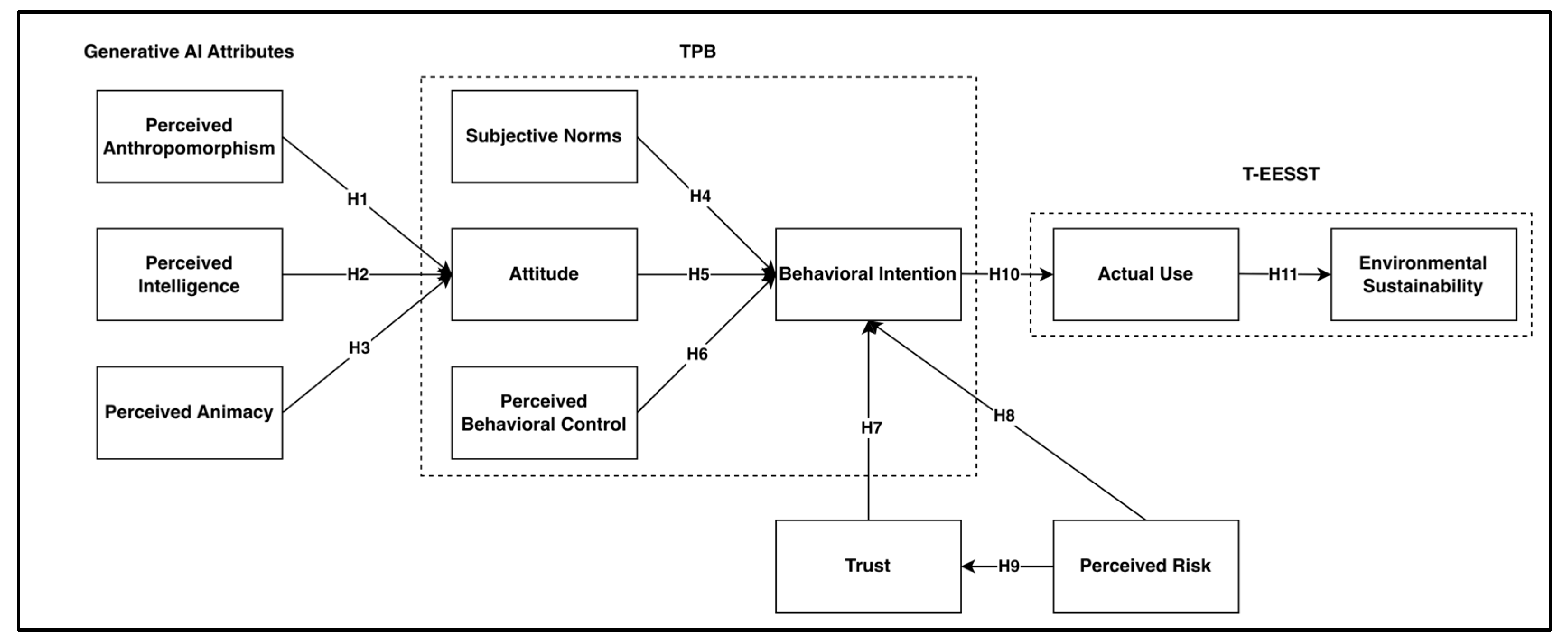
Taken together, TPB provides the behavioral decision-making structure, T-EESST contextualizes technology use within environmental sustainability objectives, and key AI attributes capture the distinct characteristics of generative AI. This theoretical foundation offers a more comprehensive explanation of how the drivers of human behavior and key AI technology factors could shape environmentally sustainable decision-making behaviors among Gen Z users. The research framework is shown in Figure 1.

2.3. Hypothesis Development

2.3.1. Generative AI Attributes

The perceived attributes of artificial intelligence are pivotal in shaping users’ attitude toward emerging technologies. These generative AI attributes entail perceived anthropomorphism, perceived intelligence, and perceived animacy, all of which influence how users cognitively and affectively evaluate AI systems.
In this study, perceived anthropomorphism is the degree to which users assign human-like traits, emotions, and intentions to environmental technologies [18], such as smart meters, AI-driven energy assistants, or eco-friendly robots. In environmental sustainability, this relates to perceptions of friendliness, expressiveness, or intentionality in conservation-focused systems. Perceived intelligence is the extent to which individuals believe that a technology demonstrates cognitive abilities such as learning, reasoning, and problem-solving [19]. In environmental sustainability, this applies to AI-driven systems for energy optimization, smart grids, or automated sustainability advisors, and is assessed based on their ability to provide effective, adaptive, and insightful recommendations. Perceived animacy refers to the extent to which a system appears lifelike, with qualities such as responsiveness or self-initiated actions [20]. In environmental sustainability, animacy describes how users perceive smart energy devices, interactive sustainability applications, or bio-inspired technologies as exhibiting lifelike behaviors that enhance engagement and promote pro-environmental behavior.
Previous studies have confirmed the importance of AI attributes in influencing user attitude toward sustainability. For instance, a recent study highlighted their role in strengthening social responsibility with non-profit organizations [21], while another described their influence on the adoption of financial literacy and economic sustainability [22]. However, direct evidence of the influence of generative AI attributes on environmental sustainability remains limited. It is notable that when these attributes co-exist and align with user needs, individuals form positive attitudes that support adoption. Based on these, the study proposes:
H1. 
Perceived anthropomorphism has a significant positive influence on attitude.
H2. 
Perceived intelligence has a significant positive influence on attitude.
H3. 
Perceived animacy has a significant positive influence on attitude.

2.3.2. Subjective Norms

Subjective norms refer to the extent to which people perceive social pressure to perform or avoid a particular behavior, often based on significant peer judgment. These are the perceived opinions of important peers such as close friends, family, and relatives. Previous studies highlight that these norms positively influence both the intention and actual use of generative AI, particularly when societal and community beliefs support its role in fostering the learning process in education, especially for younger user groups [23]. Other studies have demonstrated the significance of subjective norms on entrepreneurial intention towards chatbot use [24], and even on the decisions and choices made by university lecturers and students regarding whether to use generative AI tools [25]. When peers or close friends share positive experiences with emerging technologies, individuals tend to adopt and continue using them. In this study, the circle of friends of Gen Z holds a significant influence on their sustainable behaviors encouraged by generative AI recommendations. Hence, this study asserts that:
H4. 
Subjective norms have a significant positive influence on behavioral intention to use generative AI recommendations.

2.3.3. Attitude

In many technology adoption studies, attitude holds a key role in shaping the intention and actual use of individuals. Within information systems, attitude refers to the favorable or unfavorable evaluation of a specific behavior [26]. In the context of this research, it reflects the beliefs, perspectives, and opinions of Gen Z participants towards generative AI within the premise of environmental sustainability. Previous studies have shown that Gen Z has positive attitudes toward emerging technologies such as smartphones, telehealth, and wearable devices [27]. In environmental sustainability, when individuals learn that generative AI is useful and beneficial, they tend to develop a favorable attitude, especially when it provides recommendations for green products and services. As a result, this strengthens their intention to use generative AI for environmental sustainability. Thus, this study posits that:
H5. 
Attitude has a significant positive influence on behavioral intention to use generative AI recommendations.

2.3.4. Perceived Behavioral Control

Perceived behavioral control is individuals’ perception of the ease or difficulty of performing a specific behavior, which reflects both past experiences and expected barriers [28]. This also encompasses their confidence in exerting their effort to achieve desired outcomes. Previous studies have shown its significant influence in shaping user intention, such as in educational settings, where it has a positive effect on students’ intention to adopt online learning tools [29] and promote the use of educational technologies [30]. This study describes perceived behavioral control as Gen Z’s confidence in their technical skills, access to resources, and support systems that enable them to adopt and use generative AI for sustainable practices. Thus, when they feel empowered and well-equipped, they tend to embrace generative AI recommendations for environmental sustainability. Based on these, it can be hypothesized that:
H6. 
Perceived behavioral control has a significant positive influence on behavioral intention to use generative AI recommendations.

2.3.5. Trust

In information systems, trust is the willingness of users to rely on another party based on its perceived reliability and integrity [31]. In this study, this refers to the belief that generative AI is secure in providing recommendations which could foster sustainable behavior and actions among its users. Earlier research has shown that younger users like Gen Z and millennials tend to trust the suggestions and recommendations of generative AI if these align with their personal values [32]. Moreover, Gen Z has a positive view of generative AI’s ability to deepen their understanding of environmental issues and fostering sustainable behavior. In this regard, when Gen Z perceives generative AI as a trustworthy tool, they will consider its recommendations, which will eventually lead to sustainable practices for the environment. Thus, this study proposes that:
H7. 
Trust has a significant positive influence on behavioral intention to use generative AI recommendations.

2.3.6. Perceived Risk

Perceived risk entails the potential threats of using generative AI in relation to personal security and privacy, which may influence users’ decision-making [33]. In this study, it reflects individuals’ concerns about possible negative outcomes of generative AI, including biased outputs, inaccurate sustainability recommendations, and vulnerabilities in data security and privacy [34]. Prior research suggests that perceived risk has a strong influence on trust, but evidence of its direct effect on behavioral intention remains limited. Despite these concerns, Gen Z is becoming increasingly reliant on AI technologies in day-to-day activities and this generation still demonstrates an intention to use generative AI, particularly when its recommendations are deemed useful for supporting sustainable behavior and environmental action. Hence, this study asserts the following hypotheses:
H8. 
Perceived risk has a significant negative influence on behavioral intention to use generative AI recommendations.
H9. 
Perceived risk has a significant negative influence on trust.

2.3.7. Behavioral Intention

Behavioral intention reflects an individual’s relative strength of commitment to perform a specific behavior [35]. Established literature on human behavior emphasizes that intention typically precedes action through a series of rational decision-making processes. Prior studies have shown that behavioral intention positively influences actual use and use behavior, such as in ridesharing technologies that promote environmentally sustainable practices [36]. More recently, it has been found that when generative AI provides actionable and relevant recommendations, individuals form positive intentions that translate to actual use of the technology. Considering these, this study hypothesized that:
H10. 
Behavioral intention has a significant positive influence on the actual use of generative AI recommendations.

2.3.8. Actual Use

Actual use refers to the stage at which individuals actively engage with a technology. Prior research shows that actual use positively impacts social, economic, and environmental sustainability at the individual level [15,37], particularly in emerging technologies such as green computing, sustainable transportation, resource management, waste reduction, and green energy. When generative AI recommendations translate into actual use, they can encourage more efficient and resource-conscious practices, resulting in favorable outcomes for environmental sustainability. Hence, this study asserts that:
H11. 
Actual use of generative AI recommendations has a significant positive influence on environmental sustainability.

2.3.9. Environmental Sustainability

As a pillar of sustainable development, environmental sustainability refers to the interaction between humans and the environment in ways that enhance quality of life without degrading natural resources. It is recognized as a central objective of the United Nations Sustainable Development Goals (UN-SDGs) [38]. In this study, environmental sustainability reflects the extent to which generative AI recommendations influence behaviors that reduce harmful actions, lower consumption of non-renewable resources, and minimize pollution risk. In contemporary society, generative AI has demonstrated potential to support these goals. For instance, advanced AI technologies can reduce energy waste, improve efficiency, or even support a transition to a circular economy [39]. As a result, these AI-driven solutions can significantly influence the green behavior of individuals, thereby contributing to environmental sustainability.

3. Methodology

3.1. Questionnaire

The questionnaire was thoughtfully developed. It comprises two sections: (1) demographic information of the respondents and (2) measurement items corresponding to the constructs in the proposed research model. To ensure measurement reliability and validity, all measurement items were adapted and modified from well-established studies. In total, there were 33 measurement items that were used to assess perceptions and behavioral responses related to generative AI recommendations for environmental sustainability. All measurement items were measured using a 7-point Likert scale, ranging from 1 (strongly disagree) to 7 (strongly agree). The full list of constructs, items, and corresponding sources is presented in Table 1.
As regards the eligibility of the target participants, a screening question was explicitly stated at the beginning of the questionnaire. Prior to full deployment, a pilot test was administered to 30 Gen Z respondents, which was then followed by short interviews to assess their understanding of the items and to gather their feedback. Moreover, the questionnaire was reviewed by experts in technology management and information systems to solicit suggestions and recommendations. The finalized questionnaire was refined and deployed using Google Forms.

3.2. Participants

The present study employed a non-probability sampling approach because of the unavailability of a suitable sampling frame and inherent challenges associated with achieving unbiased population selection [40]. Specifically, purposive sampling was adopted to recruit Gen Z respondents from various higher education institutions in the National Capital Region (NCR) in the Philippines. Gen Z was selected as the focus of the study because this cohort represents a key group of early adopters and frequent users of generative AI. Moreover, prior studies have highlighted their heightened social awareness and active engagement in environmental advocacies in both developed and developing nations [41]. These characteristics make Gen Z a suitable population for examining the role of generative AI recommendations in shaping environmentally sustainable behaviors.
As part of the inclusion criteria, participants were required to have at least six months of prior experience using generative AI tools, either for education, research purposes, or even for personal use. This criterion ensured that respondents possessed sufficient familiarity with generative AI to meaningfully evaluate AI-generated recommendations related to environmental sustainability.
A total of 531 valid responses were obtained. The demographic profile indicates that 52.92% of the respondents were male, 43.69% female, and 3.39% preferred not to disclose their gender. Most participants were undergraduate students (92.28%), while 7.72% were postgraduate students. Additionally, all participants were aged 18 and older at the time of data collection. As regards employment status, the majority of the Gen Z users were students as they are considered early adopters and frequent users of generative AI. In terms of the frequency of generative AI use, 20.34% reported daily use, 55.37% used the tools weekly, 13.75% were monthly users, and 10.54% had used them several times a year.

3.3. Data Gathering and Analysis

The participants of the study digitally signed the consent form and data privacy statement at the beginning of the questionnaire to confirm their willingness to take part in the study. The survey was deployed on various social media platforms and emails to increase reach. To ensure completeness and maintain a high response rate, survey responses were continuously monitored throughout the four-week collection period. After the collection period, 531 valid responses were obtained, which exceeded the recommended sample size for PLS-SEM. Prior literature suggests a minimum sample size of 200 [42], while the 10 times rule recommends an optimal sample size of 330 following the number of items * 10, given that this study has 33 items. Hence, the collected sample is deemed adequate for statistical analysis.
After the data-gathering period, responses were coded and organized using Microsoft Excel before being analyzed using SmartPLS 4.0 for SEM and SPSS Statistics v31 for ANN analysis. To mitigate the threat of common method bias (CMB), several strategies were applied [43]. As initially mentioned, this study employed purposive sampling to ensure that the Gen Z users satisfied the inclusion criteria explicitly stated in the questionnaire. Moreover, the variance inflation factor (VIF) values were examined based on the guidelines from previous studies [44]. All VIF values were less than 3.3; this indicates that CMB is unlikely to pose a significant threat to the validity of the findings.

3.4. Structural Equation Modeling

SEM was employed to examine the interrelated relationships within complex models through a confirmatory approach and hypothesis testing. As a second-generation multivariate method, it is suitable for evaluating significant relationships between constructs with multiple indicators [45]. In this study, partial least squares structural equation modeling (PLS-SEM) was employed due to its suitability for complex models, as was the case in this study with 11 constructs. This method allows simultaneous estimation of relationships and robust handling of non-normal distributions. Moreover, this method explains variance among constructs and follows a two-step procedure: (1) analysis of the measurement model and (2) evaluation of the structural model. First, the measurement model ensures constructs’ internal consistency reliability, convergent validity, and discriminant validity. Second, the structural model assesses the relationships between the latent variables, which offers insights into the hypothesized paths as well as their significance. In this step, the path coefficients (β-value), coefficient of determination (r2), effect sizes (f2), and predictive relevance (Q2) were evaluated to examine the explanatory power of the model. Moreover, the bootstrapping technique was used to determine the statistical significance of the path coefficients.

3.5. Artificial Neural Network

Inspired by the human brain, ANN has emerged as a robust predictive model that achieves enhanced accuracy through continuous learning and iterative training [46]. It is extensively applied to analyze and predict human behavior across diverse fields. In this study, a two-stage SEM-ANN approach was adopted to leverage the strengths of both methods. First, SEM was used to identify significant linear associations among constructs. Subsequently, only the significant predictors were used as inputs for ANN, which can model complex, non-linear relationships that SEM alone cannot capture [47,48]. During ANN training, the model underwent repeated cycles of data input, weight and bias adjustments based on prediction errors, and refinement to minimize error and enhance predictive performance.
The integration of the explanatory capacity of SEM with the predictive strength of ANN yields deeper and more reliable insights. In the context of exploring generative AI recommendations for environmental sustainability, user decision-making is likely influenced by non-linear combinations of psychological and key AI attributes in which this hybrid SEM-ANN approach could offer a more comprehensive understanding.

4. Results

4.1. Measurement Model Analysis

The measurement model was evaluated to establish the validity and reliability of the constructs, as summarized in Table 1. Internal consistency reliability was assessed using Cronbach’s alpha (CA) and Composite Reliability (CR), following the acceptable threshold of 0.70 for exploratory research [49]. Accordingly, all constructs exceeded this threshold, with CA values ranging from 0.710 to 0.913 and CR values from 0.838 to 0.945, thereby confirming strong reliability of the measurement items. Furthermore, convergent validity was examined through factor loadings (FLs) and average variance extracted (AVE). Following the 0.708 minimum benchmark for FL [50], all indicators exceeded this value, with the lowest loading recorded at 0.724. Likewise, all AVE values surpassed the minimum threshold of 0.50, with the smallest value at 0.633 [51], thereby affirming convergent validity across all the constructs.
Table 1. Measurement model analysis results.
ConstructCodeItemsSourceFLAVECACR
Perceived
Anthropomorphism (PA)
PA1Generative AI tools are natural, and don’t feel fake about them.[20,52,53]0.8510.6620.7460.854
PA2Generative AI tools are human-like and don’t feel like machines.0.860
PA3Generative AI tools are conscious of their actions.0.724
Perceived
Intelligence (PI)
PI1Generative AI tools are competent.0.8120.6330.7100.838
PI2Generative AI tools are knowledgeable.0.817
PI3Generative AI tools exhibit responsibility.0.757
Perceived Animacy (PN)PN1Generative AI tools exhibit kindness.0.8150.6480.7270.846
PN2Generative AI tools are interactive.0.733
PN3Generative AI tools are friendly.0.861
Subjective Norms (SN)SN1Most people who are important to me think I should use generative AI recommendations for environmental sustainability.[54,55]0.8620.7720.8530.910
SN2People in my organization (school, university, company) want to use generative AI recommendations for environmental sustainability.0.873
SN3Most people who are important to me think generative AI recommendations for environmental sustainability are a good thing.0.900
Attitude (AT)AT1I have a generally favorable attitude towards using generative AI recommendations for environmental sustainability.[54,56]0.8990.8450.9080.942
AT2Using generative AI recommendations for environmental sustainability is a good idea.0.933
AT3Overall, using generative AI recommendations is beneficial for environmental sustainability.0.924
Perceived
Behavioral Control (PB)
PB1I have control over using generative AI recommendations for environmental sustainability.0.8730.7760.8560.912
PB2I have the necessary knowledge to use generative AI recommendations for environmental sustainability efficiently.0.884
PB3I am confident that if I want, I can use generative AI recommendations for environmental sustainability.0.886
Trust (TR)TR1Generative AI recommendations for environmental sustainability are believable.[57]0.9010.8340.9010.938
TR2Generative AI recommendations for environmental sustainability are credible.0.910
TR3Generative AI recommendations for environmental sustainability are trustworthy.0.929
Perceived Risk (PR)PR1I am concerned about my privacy when using generative AI for recommendations for environmental sustainability.[58,59]0.8580.6660.7580.857
PR2Using generative AI for recommendations for environmental sustainability may cause me discomfort.0.808
PR3I am concerned that generative AI recommendations for environmental sustainability may be unreliable.0.782
Behavioral Intention (BI)BI1I am willing to use generative AI recommendations for environmental sustainability to aid my decision-making.[60,61]0.9010.8300.8980.936
BI2I am willing to let generative AI recommendations for environmental sustainability assist me in making choices.0.928
BI3I am willing to use generative AI as a tool to suggest environmentally sustainable options.0.903
Actual Use (AU)AU1I use generative AI recommendations for environmental sustainability frequently.[55,56]0.9190.8510.9130.945
AU2I spend a lot of time of using generative AI recommendations for environmental sustainability0.928
AU3I exert considerable effort toward using generative AI recommendations for environmental sustainability.0.921
Environmental
Sustainability (ES)
ES1Generative AI recommendations encourage environmentally friendly practices such as efficient resource management and reduced energy consumption.[15]0.9040.8310.8980.936
ES2Generative AI recommendations increase the consumption of eco-friendly materials and foster recycling practices.0.915
ES3Generative AI recommendations promote environmental conservation through the use of renewable energy and sustainable transportation systems.0.915
To assess the discriminant validity of the constructs, both the Fornell–Larcker criterion and the Heterotrait–Monotrait (HTMT) correlation ratio were evaluated. Notably, the square root of each construct’s AVE exceeded the corresponding inter-construct correlations, thereby fulfilling the Fornell–Larcker criterion [62], as presented in Table 2.
In addition, the HTMT results presented in Table 3 were all below the recommended threshold value of 0.85 [63]. The results provide further evidence of adequate discriminant validity among the constructs.

4.2. Model Fit

The overall model fit was assessed using model fit indices appropriate for PLS-SEM, as summarized in Table 4. The standardized root mean square residual (SRMR) for the estimated model was 0.059, which is below the recommended cutoff value of 0.08 [64], indicating an acceptable model fit.
Additionally, model misspecification was further assessed using the unweighted least squares discrepancy (d_ULS = 0.690) and the geodesic discrepancy (d_G = 0.537), and both values are below the conservative threshold of 1.00. Moreover, the normed fit index (NFI) value is 0.723, which is below the recommended threshold of 0.80 [64]. In general, these results indicate that the proposed model demonstrates acceptable overall fit, which makes it suitable for structural analysis.

4.3. Structural Model Analysis

Prior to evaluating the structural model, it is imperative to verify the absence of multicollinearity. Accordingly, all VIF values ranged from 1.000 to 3.196, remaining below the conservative threshold of 5.0, indicating that multicollinearity is not a concern. The explanatory power of the model was evaluated using r2. The results indicate that the structural model explains 55.9% of the variance in BI, 43.0% in AT, 38.1% in AU, 28.7% in ES, and 7.5% in TR. Further, all Q2 values for the endogenous constructs through blindfolding exceeded 0 (BI = 0.453; AT = 0.356; AU = 0.322; ES = 0.235; and TR = 0.061). This indicates that the model has significant predictive relevance. Additionally, the effect size (f2) analysis further supports the structural model results, where values of 0.02, 0.15, and 0.35 represent small, medium, and large effects, respectively [65]. AT to BI (f2 = 0.121) demonstrated medium effect size while BI to AU (f2 = 0.617) and AU to ES (f2 = 0.402) exhibited large effect sizes. On the contrary, non-significant relationships such as SN and PR to BI exhibit negligible effect sizes, further supporting the robustness of the hypothesis testing.
Moreover, the standardized path coefficients with the corresponding β-values, t-values, and p-values were determined by employing bootstrapping technique with 5000 resamples to evaluate the relationships of the latent variables in the structural model [65]. Accordingly, the majority of the hypothesized relationships were supported, except for the influence of SN and PR on BI. Table 5 presents the structural model analysis results.

4.4. ANN Analysis

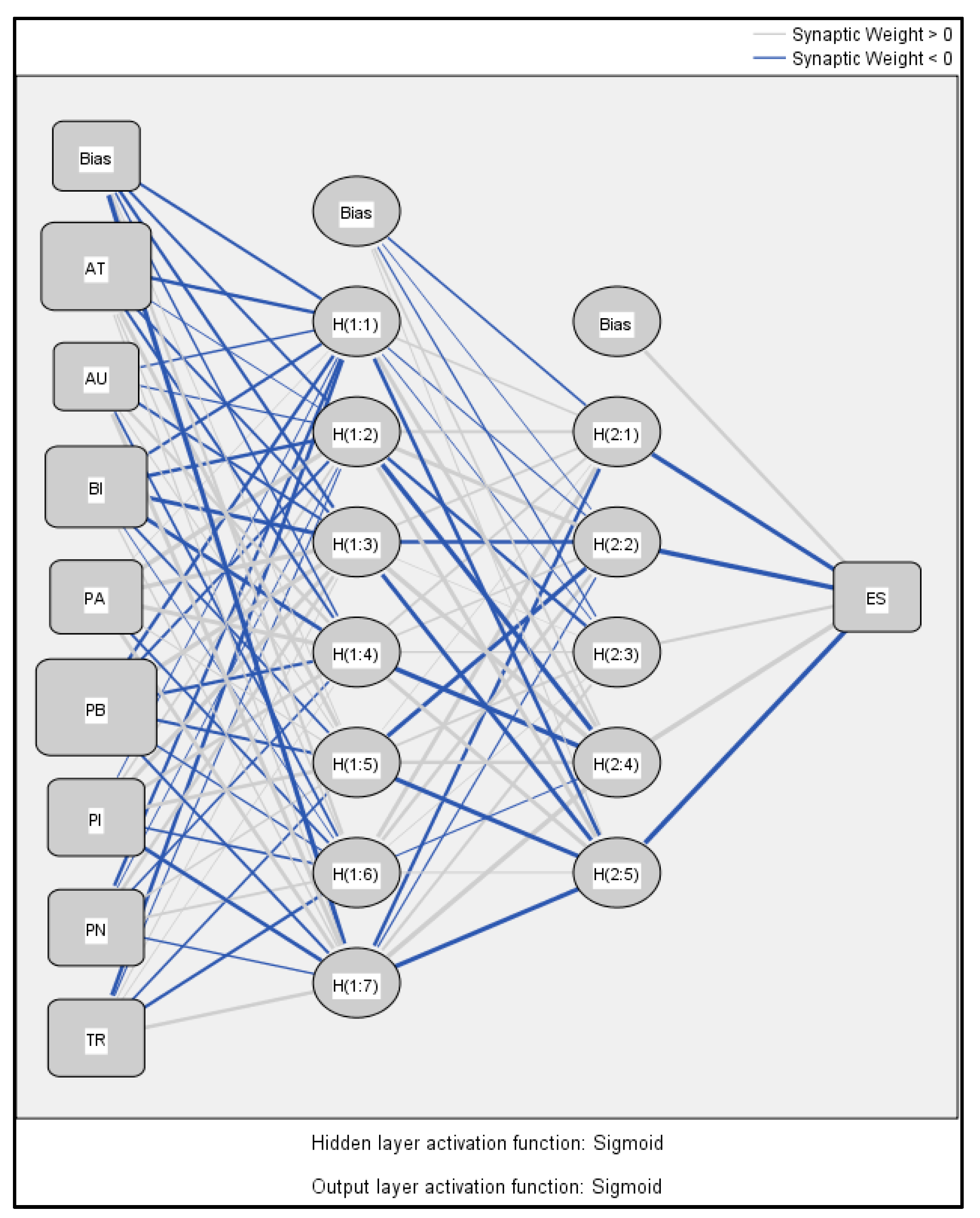
The significant predictors identified through SEM were used as input neurons for the subsequent ANN analysis, as illustrated in Figure 2. This hybrid approach is well established in prior behavioral and technology adoption studies. This approach complements SEM, which cannot capture non-linear relationships or accommodate non-compensatory effects. Further, ANN can learn complex linear and non-linear relationships and assess the relative importance of input variables [66].
The ANN architecture comprised an input layer, two hidden layers, and an output layer. Consistent with prior SEM-ANN studies, two hidden layers were employed to allow the model to capture higher-order non-linear interactions among psychological and key AI attributes without imposing linear assumptions [67,68]. The utilization of two hidden layers does not imply excessive model complexity but rather enables incremental abstraction of relationships while maintaining generalizability when combined with cross-validation. A sigmoid activation function was applied to both hidden and output neurons, as it is widely used in behavioral prediction studies involving normalized Likert-scale data and supports stable convergence during training. Input and output variables were normalized to the (0, 1) range to optimize model performance. Additionally, a ten-fold cross-validation technique was implemented to mitigate the risk of overfitting, where 90% of the data were used for training and 10% for testing across ten iterations.
Model performance was examined using the root mean square of error (RMSE), where smaller values indicate stronger predictive capability, as suggested by earlier research [69]. The values obtained during both the training and testing phases, together with their mean and standard deviation, are presented in Table 6. The results show that the average RMSE values for training and testing were 0.085 and 0.079, respectively, and these values were indicative of stable learning behavior and minimal overfitting. Moreover, the mean RMSE values of the model are relatively low, which demonstrates strong predictive performance.
To further interpret the predictive strength of the ANN, a sensitivity analysis was conducted to estimate the relative importance of each input neuron [52]. This analysis provides more in-depth insights into how variations in each predictor influence the output, without implying causal strength.
As shown in Table 7, PB emerged as the most important factor that predicted ES, followed by AT, BI, TR, and PN. On the contrary, AU, PA, and PI had the least normalized importance scores. Notably, the high normalized importance score for PB is its relative ranking within the ANN model, and not an absolute magnitude effect. Sensitivity analysis reflects the contribution of predictors under non-linear relationships and does not imply deterministic influence [70,71]. Previous SEM-ANN studies reported similar patterns of high normalized importance values and do not indicate model overfitting when supported by cross-validation and stable RMSE values. Overall, ANN complements SEM findings, which highlight the importance of PB in shaping the intention to use generative AI recommendations for environmental sustainability.

5. Discussion

Personalized recommendations from generative AI have shown promising applications across various fields; however, its role in supporting and strengthening environmental sustainability is yet to be empirically explored at the individual level. This study aimed to explain the factors influencing the intention and actual use of generative AI recommendations for environmental sustainability among Gen Z users in the NCR in the Philippines. To achieve this objective, an integrative model was developed based on TPB and T-EESST, with key generative AI attributes (perceived anthropomorphism, perceived intelligence, and perceived animacy) along with trust and perceived risk-related factors. The model was analyzed through a hybrid SEM-ANN approach, which highlighted the role of technological attributes and psychological factors and their influence on environmental sustainability outcomes.
With respect to the key attributes of AI, the results confirmed that perceived anthropomorphism, perceived intelligence, and perceived animacy significantly shaped the attitude of Gen Z users toward generative AI recommendations. Perceived anthropomorphism demonstrated a significant positive effect on attitude. This finding is consistent with previous studies, which highlight that when AI systems exhibit human-like characteristics, users tend to perceive them as trustworthy and more relatable, which increases acceptance [72,73]. The conversational responses of generative AI can bridge the psychological barrier of this human–machine interaction, which allows it to become an agent of sustainable actions for Gen Z users. For instance, a conversational AI that provides eco-friendly shopping suggestions in a relatable manner, like plant-based recipes and subsequent information about one’s carbon footprint, may foster stronger engagement in sustainable consumption. Hence, these features allow Gen Z users to view generative AI as a companion rather than a technical tool.
Perceived intelligence also has a significant influence on attitude, which could be attributed to the problem-solving capabilities and reasoning of generative AI being similar to that of humans. Earlier research demonstrates that intelligent systems influence users’ confidence in engaging with them due to their accurate and personalized recommendations [74,75]. For example, generative AI that analyzes purchase history and generates weekly green shopping lists coupled with locally sourced options demonstrates intelligence in the context of sustainability. Therefore, this highlights that the intelligent features of generative AI could guide Gen Z users towards sustainable practices.
Similarly, perceived animacy also had a significant positive influence on attitude. Previous studies show that the responsiveness and adaptiveness of generative AI increased perceived engagement and social presence [72,76]. Moreover, AI that appears animated and responsive creates a sense of interaction among Gen Z users. In sustainability-related applications, a voice-based generative AI assistant that responds with expressive tones about energy consumption can increase engagement among users. These animated interactions make generative AI an engaging and enjoyable tool in sustainable living.
As regards TPB dimensions, both attitude and perceived behavioral control positively influenced behavioral intention. Based on the SEM results, attitude has the most significant effect on behavioral intention. This finding underscores the favorable perception of Gen Z users that generative AI is beneficial in contributing to their sustainable practices. This also aligns with previous studies that indicate the pivotal role of attitude in shaping technology adoption [77], particularly in influencing sustainable behavior. For example, when generative AI offers suggestions that could contribute to optimizing electricity usage and shifting to energy-efficient appliances, Gen Z users develop a positive attitude to follow such recommendations.
Perceived behavioral control also showed a significant positive effect on behavioral intention, which emphasizes Gen Z users’ confidence in their ability to use generative AI, which contributes significantly to their willingness to adopt it. This is consistent with previous studies which stress that individuals are more likely to engage in sustainable practices and consumption [78] based on ease of use, availability of resources, and personal capability. For example, a generative AI that simplifies eco-friendly decision-making, like reducing food waste, can empower Gen Z users to feel capable of making environmentally responsible choices. Importantly, ANN results further revealed that perceived behavioral control was the most important factor affecting the use of generative AI recommendations for environmental sustainability among Gen Z users. Hence, this validates that behavioral control strengthens intention by reducing complexity and fostering a sense of competence in applying solutions suggested by generative AI.
Unlike previous technology adoption studies, which found that subjective norms such as smart home systems and mobile applications had a significant influence on behavioral intention [79], this study noted no significant relationship between these two in the context of generative AI. Prior research on Filipino youth suggests a growing emphasis on personal efficacy and independent decision-making in digital environments [80], which may reduce their reliance on social validation when adopting emerging technologies, including generative AI. Aside from their early and continuous exposure to new technologies, Gen Z users also exhibit growing awareness of environmental issues and a stronger awareness of sustainable practices. Thus, subjective norms may exert less influence on behavioral intention when generative AI is used to support personal decision-making and environmentally responsible behavior. This finding suggests that Gen Z users are driven by their personal motivations and environmental awareness rather than social pressures when engaging with generative AI for sustainability-related activities. Consequently, Gen Z users may adopt AI-generated travel itineraries that use sustainable transportation (e.g., biking, carpooling) without the need for encouragement from their peers.
Trust had a significant positive influence on behavioral intention. This is consistent with the findings of previous research, which shows that trust has a critical influence on users’ intention to use generative AI, especially when the system is reliable, transparent, and aligns with their personal goals [81]. This means that when generative AI provides credible sustainability advice, Gen Z users tend to adopt its recommendations. As such, if generative AI could provide information on carbon footprint related to daily consumption, Gen Z users would be likely to trust the data sources and algorithms. Thus, this would reduce their uncertainty regarding using generative AI as a tool to achieve sustainable outcomes.
Interestingly, perceived risk and behavioral intention had an insignificant relationship, which contradicts recent findings concerning data privacy or misuse of potential information that may negatively influence generative AI adoption [82]. Although generative AI recommendations are perceived to have certain risks, Gen Z users may continue to engage with these systems due to their perceived advantages and benefits. Additionally, a recent study in the Philippines indicated that Gen Z users are extensively exposed to various social media platforms and AI systems, which may attenuate their perception of risk [80]. For example, the recommendations generated for green fashion may still be considered by Gen Z despite awareness of potential risks of sharing their personal data and information.
On the contrary, perceived risk demonstrated a significant negative relationship with trust, which is consistent with existing literature [83,84]. This indicates that concerns related to data privacy, algorithmic bias, and reliability undermine trust in generative AI systems. Even among Gen Z, awareness of potential AI risks remains a critical barrier to trust formation. Within the Philippine context, although prior studies report a generally positive outlook toward AI technologies among Gen Z users [6], trust in generative AI recommendations for environmental sustainability remains contingent upon effective risk management. This underscores the importance of transparent system design, ethical data governance, and explainable AI mechanisms to mitigate perceived risks and sustain user trust.
Further, this study also noted a significant relationship between behavioral intention and actual use, which validates the findings of earlier studies on cognition and behavior in adopting emerging technologies [85], such as generative AI. This shows that when Gen Z users develop positive intentions to use generative AI, this has an eventual effect on their actual use. Additionally, this indicates that generative AI could provide engaging sustainability recommendations which users can apply in their daily lives. In this case, when Gen Z users intend to select renewable energy providers, their behavioral intention determines whether they will act on the recommendations of generative AI.
Finally, this study validated the significant influence of actual use of generative AI recommendations on environmental sustainability among Gen Z users. This shows the transformative potential of using generative AI to promote sustainable behavior for environmental conservation [86]. This also highlights the role of generative AI in contributing to broader sustainability goals, particularly the UN SDGs such as SDG 12 (Responsible Consumption and Production), SDG 13 (Climate Action), and SDG 7 (Affordable and Clean Energy).

6. Implications

This study offers several theoretical, practical, and societal implications regarding the use of generative AI recommendations for environmental sustainability among Generation Z users, particularly within the context of a developing country like the Philippines.
From a theoretical perspective, this study contributes to the literature by integrating TPB with T-EESST and key generative AI attributes along with trust and perceived risk. This integration provides a wider view of both behavioral, technological, and environmental factors that influence sustainable behavior. By incorporating perceived anthropomorphism, perceived intelligence, and perceived animacy, the framework captures AI-specific perceptions that are not explicitly addressed in traditional behavioral models. The findings indicate that these attributes indirectly influence environmental sustainability outcomes through attitude formation, which enriches the explanatory scope of TPB in relation to generative AI and environmental sustainability. Moreover, the inclusion of trust and perceived risk advances our understanding of psychological dimensions regarding generative AI adoption. The results suggest that trust and risk may co-exist in emerging AI contexts, especially among Gen Z users. Additionally, the hybrid SEM-ANN approach strengthens theoretical interpretation, which illustrates the non-linear interaction of TPB constructs within the framework. This integrative approach provides a robust framework for examining AI-supported sustainability behavior.
From a practical and technical standpoint, our findings provide actionable insights for developers and designers of generative AI, which could improve its adoption by embedding natural language processing for conversational engagement, adaptive learning algorithms for personalized sustainability insights, and interactive visualizations that provide more tangible environmental feedback (e.g., carbon footprint visualization). These design elements could transform generative AI from being merely a recommender system into a partner for sustainable decision-making. Moreover, trust emerged as a critical determinant of behavioral intention, which underscores the importance of transparency in generative AI to build user confidence. This implies that AI engineers and system architects should prioritize explainable AI features and ensure ethical data handling. These design considerations are essential for Gen Z users, who value both personalization and environmental responsibility in their technology use.
At the societal level, our findings suggest that generative AI has the potential to support environmentally sustainable behavior and contribute to the achievement of UN SDGs and environmental goals. Generative AI recommendations may encourage eco-friendly consumption, household energy conservation, waste reduction, and green mobility adoption. In the Philippine context, generative AI can serve as a complementary tool to existing environmental initiatives. The insignificant influence of subjective norms and perceived risk may indicate that generative AI use for environmental context is more personally motivated and value-driven, especially among Gen Z users. Policymakers and educators may therefore consider integrating generative AI into environmental awareness campaigns while strengthening sustainability education programs that emphasize individual empowerment and informed decision-making.

7. Conclusions

Generative AI holds significant potential for supporting environmental sustainability through personalized recommendations that could influence individual behavior. This study examined the factors shaping the adoption and actual use of generative AI recommendations for environmental sustainability among Gen Z users in the Philippines using a hybrid SEM and ANN approach. Based on the integrated TPB and T-EESST, this study provides empirical evidence on the influence of psychological, technological, and trust-related factors in shaping sustainability-related generative AI adoption. The SEM results demonstrate that key generative AI attributes (perceived anthropomorphism, perceived intelligence, and perceived animacy) significantly influenced users’ attitudes toward generative AI recommendations. In turn, attitude and perceived behavioral control emerged as strong predictors of behavioral intention, highlighting the importance of favorable evaluations and perceived capability in shaping generative AI use for environmental sustainability. Trust also demonstrated a significant role in strengthening behavioral intention, which reinforces its importance in AI-driven decision-making contexts. Behavioral intention subsequently exerted a strong influence on actual use, which in turn positively affected environmental sustainability outcomes.
Furthermore, the ANN analysis complemented the SEM findings by identifying the relative predictive determinants under non-linear conditions. While ANN does not provide causal inference, its predictive ranking reinforced the importance of perceived behavioral control, attitude, and trust in predicting generative AI use for environmental sustainability. This confirms that combining ANN with SEM enhances predictive insight while maintaining theory-driven explanations, particularly in complex behavioral contexts where linear assumptions may be insufficient.
Several hypothesized relationships did not emerge as significant, particularly the significant influence of subjective norms and perceived risk on behavioral intention. These findings suggest that generative AI use for environmental sustainability among Gen Z users may be shaped more by internal evaluations, perceived capability, and trust than by external social pressure or perceived risk concerns. These results underscore the contextual nature of AI adoption and highlight the importance of cautious interpretation when examining traditional behavioral models to emerging AI-driven sustainability applications.
In general, this study offers empirical evidence of the role of generative AI as an enabler of environmentally sustainable behavior at the individual level. Through the integration of behavioral theory, sustainability theory, and key generative AI attributes analyzed using a hybrid SEM–ANN approach, this study advances our understanding of how generative AI recommendations can support sustainability goals in the context of a developing country.

8. Limitations and Future Directions

Despite its contributions, this study has several limitations that should be acknowledged when interpreting the findings. First, the study focuses on Gen Z users, which inherently limits the generalizability of the findings to other generational cohorts. Gen Z was deliberately selected because of their high digital literacy, frequent interaction with generative AI, and heightened environmental awareness, particularly within the Philippine context. While this focus is theoretically justified and aligns with the study’s objectives, the study should not be extended to other age groups. Future research may conduct comparative or multi-group analyses involving Gen Alpha, millennials, Gen X, and baby boomers to examine varying generational perceptions and behavioral patterns toward generative AI for environmental sustainability.
Second, the sample in this study are primarily Gen Z students residing in the NCR in the Philippines, which may not fully capture the perspectives of users from rural or less technologically developed regions of the country. Recognizing this limitation, the findings are interpreted within an urban context. Future studies could adopt probability sampling across multiple regions or conduct cross-country analysis with other developing nations to gain broader and more diverse perspectives.
Third, while this study integrated TPB with key generative AI attributes alongside trust and perceived risk, the scope of the study was delimited to the environmental dimension of sustainability of the T-EESST framework. Future research may develop a more holistic framework that covers all three dimensions of sustainability or explores additional AI-related constructs.
Fourth, the study was conducted to capture respondents’ perceptions and behaviors at a single point in time. While this approach may seem appropriate for theory testing and model validation, it limits the ability to infer behavioral changes over time, particularly given the rapid evolution of generative AI technologies. Longitudinal studies or experimental designs are therefore recommended to examine dynamic changes in trust, risk perception, and sustainability behavior as users gain prolonged exposure to generative AI.
Fifth, although the hybrid SEM–ANN approach enhances both explanatory and predictive insights, ANN results are inherently non-causal and serve only as a complementary validation of SEM findings. In response to methodological concerns, causal interpretations were deliberately grounded in SEM path estimates, while ANN was used solely to assess predictive importance and non-linear effects. Future research may explore alternative machine learning techniques or larger sample sizes to further strengthen predictive modeling.
Finally, this study relies on self-reported measures of actual use and environmental sustainability behavior, which may be subject to common method bias or social desirability effects. While procedural remedies and robustness checks were applied during analysis, future studies could incorporate objective behavioral data, system usage logs, or mixed-methods approaches to further validate self-reported outcomes.

Author Contributions

Conceptualization, V.J.C.E. and A.A.H.; methodology, V.J.C.E., Y.-M.Y., and W.-J.S.; software, V.J.C.E. and D.V.N.; validation, Y.-M.Y., W.-J.S., and A.A.H.; formal analysis, V.J.C.E.; investigation, V.J.C.E.; resources, D.V.N.; data curation, V.J.C.E. and A.A.H.; writing—original draft preparation, V.J.C.E.; writing—review and editing, Y.-M.Y., W.-J.S., and A.A.H.; visualization, V.J.C.E. and D.V.N.; supervision, Y.-M.Y. and W.-J.S.; project administration, V.J.C.E., Y.-M.Y., and W.-J.S.; funding acquisition, W.-J.S. All authors have read and agreed to the published version of the manuscript.

Funding

This research received no external funding.

Institutional Review Board Statement

Although the institution does not maintain a formal ethics review board, this study adhered to widely accepted ethical research standards consistent with national guidelines for minimal-risk studies. The National Ethical Guidelines for Health and Health-Related Research (NEGHHR) issued by the Philippine Health Research Ethics Board (PHREB) under Republic Act No. 10532 (Philippine National Health Research System Act of 2013) specify that research involving anonymous survey procedures with consenting adults and posing no more than minimal risk may be exempted from formal ethics review (NEGHHR 2017; updated 2022). This study meets these criteria, as it involved voluntary participation, electronic informed consent, anonymity, confidentiality, and the right to withdraw at any time without consequence. Moreover, all participants included in the final analytical sample were aged 18 years or older. No personally identifiable or sensitive information was collected. Accordingly, all procedures adhered to recognized ethical standards for research involving human participants.

Informed Consent Statement

Informed consent was obtained from all participants involved in the study.

Data Availability Statement

Data are available upon request to the corresponding authors.

Conflicts of Interest

The authors declare no conflicts of interest.

References

  1. Balasubramaniam, S.; Chirchi, V.; Kadry, S.; Agoramoorthy, M.; Gururama, S.P.; Satheesh, K.K.; Sivakumar, T.A. The Road Ahead: Emerging Trends, Unresolved Issues, and Concluding Remarks in Generative AI—A Comprehensive Review. Int. J. Intell. Syst. 2024, 2024, 4013195. [Google Scholar] [CrossRef]
  2. Nah, F.F.; Zheng, R.; Cai, J.; Siau, K.; Chen, L. Generative AI and ChatGPT: Applications, Challenges, and AI-Human Collaboration. J. Inf. Technol. Case Appl. Res. 2023, 25, 277–304. [Google Scholar] [CrossRef]
  3. Bloomberg, L.P. Generative AI to Become a $1.3 Trillion Market by 2032, Research Finds. Bloomberg. 2023. Available online: https://www.bloomberg.com/company/press/generative-ai-to-become-a-1-3-trillion-market-by-2032-research-finds/ (accessed on 29 August 2025).
  4. Salminen, M.; Mauladhika, B.F. AI Statistics and Trends: New Research for 2025. Hostinger, 7 February 2025. Available online: https://www.hostinger.com/tutorials/ai-statistics (accessed on 29 August 2025).
  5. Peng, Y. Seeds of Energy Intelligence: Attitudes and Energy Behaviour of Chinese Digital Native Generation Z College Students in Sustainable Development. In IOP Conference Series: Earth and Environmental Science; IOP Publishing: Bristol, UK, 2024; Volume 1402, p. 012006. [Google Scholar] [CrossRef]
  6. Truelogic Marketing. AI Adoption in the Philippines. Truelogic DX Blog, 11 June 2024. Available online: https://www.truelogic.com.ph/blog/truelogic-episode-105-recap-adoption-of-ai-in-the-philippines/ (accessed on 29 August 2025).
  7. United Nations. Artificial Intelligence (AI). Global Issues, United Nations. Available online: https://www.un.org/en/global-issues/artificial-intelligence (accessed on 29 August 2025).
  8. Bengesi, S.; El-Sayed, H.; Sarker, M.K.; Houkpati, Y.; Irungu, J.; Oladunni, T. Advancements in Generative AI: A Comprehensive Review of GANs, GPT, Autoencoders, Diffusion Model, and Transformers. IEEE Access 2024, 12, 69812–69837. [Google Scholar] [CrossRef]
  9. Foroughi, B.; Naghmeh-Abbaspour, B.; Wen, J.; Ghobakhloo, M.; Al-Emran, M.; Al-Sharafi, M.A. Determinants of Generative AI in Promoting Green Purchasing Behavior: A Hybrid Partial Least Squares–Artificial Neural Network Approach. Bus. Strat. Environ. 2025, 34, 4072–4094. [Google Scholar] [CrossRef]
  10. Kan, Y. AI for Environmental Sustainability: Advances, Challenges, and Future Directions. Int. J. Artif. Intell. Sci. 2025, 1, 1. [Google Scholar] [CrossRef]
  11. Wang, S.; Zhang, H. Leveraging Generative Artificial Intelligence for Sustainable Business Model Innovation in Production Systems. Int. J. Prod. Res. 2025, 63, 6732–6757. [Google Scholar] [CrossRef]
  12. Suganthi, S.U.; Prinslin, L.; Selvi, R.; Prabha, R. Generative AI in Agri: Sustainability in Smart Precision Farming Yield Prediction Mapping System Based on GIS Using Deep Learning and GPS. Procedia Comput. Sci. 2025, 252, 365–380. [Google Scholar] [CrossRef]
  13. Akhtar, P.; Ghouri, A.M.; Ashraf, A.; Lim, J.J.; Khan, N.R.; Ma, S. Smart Product Platforming Powered by AI and Generative AI: Personalization for the Circular Economy. Int. J. Prod. Econ. 2024, 273, 109283. [Google Scholar] [CrossRef]
  14. Bosnjak, M.; Ajzen, I.; Schmidt, P. The Theory of Planned Behavior: Selected Recent Advances and Applications. Eur. J. Psychol. 2020, 16, 352–356. [Google Scholar] [CrossRef]
  15. Al-Emran, M. Beyond Technology Acceptance: Development and Evaluation of Technology-Environmental, Economic, and Social Sustainability Theory. Technol. Soc. 2023, 75, 102383. [Google Scholar] [CrossRef]
  16. Balakrishnan, J.; Abed, S.S.; Jones, P. The Role of Meta-UTAUT Factors, Perceived Anthropomorphism, Perceived Intelligence, and Social Self-Efficacy in Chatbot-Based Services. Technol. Forecast. Soc. Change 2022, 180, 121692. [Google Scholar] [CrossRef]
  17. Cao, Z.; Peng, L. An Empirical Study of Factors Influencing Usage Intention for Generative Artificial Intelligence Products: A Case Study of China. J. Inf. Sci. 2024, 51, 1513–1528. [Google Scholar] [CrossRef]
  18. Williams, M.O.; Whitmarsh, L.; Mac Giolla Chríost, D.M.G. The Association between Anthropomorphism of Nature and Pro-Environmental Variables: A Systematic Review. Biol. Conserv. 2021, 255, 109022. [Google Scholar] [CrossRef]
  19. Agarwal, P.; Swami, S.; Malhotra, S.K. Artificial Intelligence Adoption in the Post COVID-19 New-Normal and Role of Smart Technologies in Transforming Business: A Review. J. Sci. Technol. Policy Manag. 2024, 15, 506–529. [Google Scholar] [CrossRef]
  20. Priya, B.; Sharma, V. Exploring Users’ Adoption Intentions of Intelligent Virtual Assistants in Financial Services: An Anthropomorphic Perspective and Socio-Psychological Perspectives. Comput. Hum. Behav. 2023, 148, 107912. [Google Scholar] [CrossRef]
  21. Albanna, H.; Alalwan, A.A.; Al-Emran, M. An Integrated Model for Using Social Media Applications in Non-Profit Organizations. Int. J. Inf. Manag. 2022, 63, 102452. [Google Scholar] [CrossRef]
  22. Tandon, N.; Bansal, D. Empowering Financial Access: A Generative AI Perspective. In Generative AI in FinTech: Revolutionizing Finance Through Intelligent Algorithms; Springer Nature: Cham, Switzerland, 2025; pp. 309–323. [Google Scholar]
  23. Wang, C.; Wang, H.; Li, Y.; Dai, J.; Gu, X.; Yu, T. Factors Influencing University Students’ Behavioral Intention to Use Generative Artificial Intelligence: Integrating the Theory of Planned Behavior and AI Literacy. Int. J. Hum. Comput. Interact. 2024, 41, 6649–6671. [Google Scholar] [CrossRef]
  24. Lin, X. Exploring the Impact of AI Chatbots on Students’ Entrepreneurial Intentions: An Empirical Study Using TPB and TAM. In Proceedings of the 2024 International Conference on Digital Society and Artificial Intelligence; Association for Computing Machinery: New York, NY, USA, 2024; pp. 404–414. [Google Scholar] [CrossRef]
  25. Ivanov, S.; Soliman, M.; Tuomi, A.; Alkathiri, N.A.; Al-Alawi, A.N. Drivers of Generative AI Adoption in Higher Education through the Lens of the Theory of Planned Behaviour. Technol. Soc. 2024, 77, 102521. [Google Scholar] [CrossRef]
  26. Park, J.; Woo, S.E. Who Likes Artificial Intelligence? Personality Predictors of Attitudes toward Artificial Intelligence. J. Psychol. 2022, 156, 68–94. [Google Scholar] [CrossRef] [PubMed]
  27. Nayak, B.; Bhattacharyya, S.S.; Kumar, S.; Jumnani, R.K. Exploring the Factors Influencing Adoption of Health-Care Wearables Among Generation Z Consumers in India. J. Inf. Commun. Ethics Soc. 2022, 20, 150–174. [Google Scholar] [CrossRef]
  28. FakhrHosseini, S.; Chan, K.; Lee, C.; Jeon, M.; Son, H.; Rudnik, J.; Coughlin, J. User Adoption of Intelligent Environments: A Review of Technology Adoption Models, Challenges, and Prospects. Int. J. Hum. Comput. Interact. 2024, 40, 986–998. [Google Scholar] [CrossRef]
  29. Hamad, F.; Shehata, A.; Al Hosni, N. Predictors of Blended Learning Adoption in Higher Education Institutions in Oman: Theory of Planned Behavior. Int. J. Educ. Technol. High. Educ. 2024, 21, 13. [Google Scholar] [CrossRef]
  30. Sungur-Gül, K.; Ateş, H. Understanding Pre-Service Teachers’ Mobile Learning Readiness Using Theory of Planned Behavior. Educ. Technol. Soc. 2021, 24, 44–57. [Google Scholar]
  31. Mai, X.T.; Nguyen, T. Trust in Generative Artificial Intelligence: A Systematic Literature Review. In Trust in Generative Artificial Intelligence; Routledge: Oxfordshire, UK, 2025; pp. 12–24. [Google Scholar]
  32. Silalahi, A.D.K. Can Generative Artificial Intelligence Drive Sustainable Behavior? A Consumer-Adoption Model for AI-Driven Sustainability Recommendations. Technol. Soc. 2025, 83, 102995. [Google Scholar] [CrossRef]
  33. Shrivastava, P. Understanding Acceptance and Resistance Toward Generative AI Technologies: A Multi-Theoretical Framework Integrating Functional, Risk, and Sociolegal Factors. Front. Artif. Intell. 2025, 8, 1565927. [Google Scholar] [CrossRef] [PubMed]
  34. Golda, A.; Mekonen, K.; Pandey, A.; Singh, A.; Hassija, V.; Chamola, V.; Sikdar, B. Privacy and Security Concerns in Generative AI: A Comprehensive Survey. IEEE Access 2024, 12, 48126–48144. [Google Scholar] [CrossRef]
  35. Wu, Q.; Tian, J.; Liu, Z. Exploring the usage behavior of generative artificial intelligence: A case study of ChatGPT with insights into the moderating effects of habit and personal innovativeness. Curr. Psychol. 2025, 44, 8190–8203. [Google Scholar] [CrossRef]
  36. Wang, Y.; Wang, S.; Wang, J.; Wei, J.; Wang, C. An Empirical Study of Consumers’ Intention to Use Ride-Sharing Services: Using an Extended Technology Acceptance Model. Transportation 2020, 47, 397–415. [Google Scholar] [CrossRef]
  37. Ajzen, I. The Theory of Planned Behavior: Frequently Asked Questions. Hum. Behav. Emerg. Technol. 2020, 2, 314–324. [Google Scholar] [CrossRef]
  38. United Nations. Transforming our World: The 2030 Agenda for Sustainable Development. UN Sustainable Development. Available online: https://sdgs.un.org/2030agenda (accessed on 29 August 2025).
  39. Jose, R.; Panigrahi, S.K.; Patil, R.A.; Fernando, Y.; Ramakrishna, S. Artificial intelligence-driven circular economy as a key enabler for sustainable energy management. Mater. Circ. Econ. 2020, 2, 8. [Google Scholar] [CrossRef]
  40. Schreuder, H.T.; Gregoire, T.G.; Weyer, J.P. For what applications can probability and non-probability sampling be used? Environ. Monit. Assess. 2001, 66, 281–291. [Google Scholar] [CrossRef]
  41. Confetto, M.G.; Covucci, C.; Addeo, F.; Normando, M. Sustainability advocacy antecedents: How social media content influences sustainable behaviours among Generation Z. J. Consum. Mark. 2023, 40, 758–774. [Google Scholar] [CrossRef]
  42. Vaithilingam, S.; Ong, C.S.; Moisescu, O.I.; Nair, M.S. Robustness Checks in PLS-SEM: A Review of Recent Practices and Recommendations for Future Applications in Business Research. J. Bus. Res. 2024, 173, 114465. [Google Scholar] [CrossRef]
  43. Zhang, W.; Yuan, G.; Xue, R.; Han, Y.; Taylor, J.E. Mitigating Common Method Bias in Construction Engineering and Management Research. J. Constr. Eng. Manag. 2022, 148, 04022089. [Google Scholar] [CrossRef]
  44. Berbekova, A.; Kock, F.; Assaf, A.G.; Josiassen, A. Understanding and Employing Formative Constructs: Conceptualization, Operationalization, and Threats of Misspecification. J. Hosp. Tour. Res. 2024, 49, 946–960. [Google Scholar] [CrossRef]
  45. Hair, J.F.; Hult, G.T.M.; Ringle, C.M.; Sarstedt, M.; Danks, N.P.; Ray, S. An introduction to structural equation modeling. In Partial Least Squares Structural Equation Modeling (PLS-SEM) Using R; Classroom Companion: Business; Springer: Cham, Switzerland, 2021; pp. 1–29. [Google Scholar] [CrossRef]
  46. Mariñas, K.A.; Saflor, C.S.; Alvarado, P.; Uminga, J.M.; Verde, N.A. Assessing the Importance of Variables from a Revised Technology Acceptance Model for the Use of ChatGPT by University Students. Comput. Educ.: Artif. Intell. 2025, 9, 100435. [Google Scholar] [CrossRef]
  47. Akgül, Y.; Uymaz, A.O. Facebook/Meta usage in higher education: A deep learning-based dual-stage SEM-ANN analysis. Educ. Inf. Technol. 2022, 27, 9821–9855. [Google Scholar] [CrossRef]
  48. Sharma, S.K.; Gaur, A.; Saddikuti, V.; Rastogi, A. Structural equation model (SEM)-neural network (NN) model for predicting quality determinants of e-learning management systems. Behav. Inf. Technol. 2017, 36, 1053–1066. [Google Scholar] [CrossRef]
  49. Hair, J.F.; Hult, G.T.M.; Ringle, C.M.; Sarstedt, M.; Danks, N.P.; Ray, S. Evaluation of formative measurement models. In Partial Least Squares Structural Equation Modeling (PLS-SEM) Using R: A Workbook; Springer: Cham, Switzerland, 2021; pp. 91–113. [Google Scholar]
  50. Hair, J.F.; Risher, J.J.; Sarstedt, M.; Ringle, C.M. When to Use and How to Report the Results of PLS-SEM. Eur. Bus. Rev. 2019, 31, 2–24. [Google Scholar] [CrossRef]
  51. Henseler, J.; Ringle, C.M.; Sarstedt, M. A New Criterion for Assessing Discriminant Validity in Variance-Based Structural Equation Modeling. J. Acad. Mark. Sci. 2015, 43, 115–135. [Google Scholar] [CrossRef]
  52. Al-Emran, M.; Abu-Hijleh, B.; Alsewari, A.A. Exploring the effect of generative AI on social sustainability through integrating AI attributes, TPB, and T-EESST: A deep learning-based hybrid SEM-ANN approach. IEEE Trans. Eng. Manag. 2024, 71, 14512–14524. [Google Scholar] [CrossRef]
  53. Bartneck, C.; Kulić, D.; Croft, E.; Zoghbi, S. Measurement instruments for the anthropomorphism, animacy, likeability, perceived intelligence, and perceived safety of robots. Int. J. Soc. Robot. 2009, 1, 71–81. [Google Scholar] [CrossRef]
  54. Ajzen, I. The Theory of Planned Behavior. Organ. Behav. Hum. Decis. Process. 1991, 50, 179–211. [Google Scholar] [CrossRef]
  55. Al-Qaysi, N.; Al-Emran, M.; Al-Sharafi, M.A.; Iranmanesh, M.; Ahmad, A.; Mahmoud, M.A. Determinants of ChatGPT use and its impact on learning performance: An integrated model of BRT and TPB. Int. J. Hum. Comput. Interact. 2025, 41, 5462–5474. [Google Scholar] [CrossRef]
  56. Davis, F.D.; Bagozzi, R.P.; Warshaw, P.R. User Acceptance of Computer Technology: A Comparison of Two Theoretical Models. Manag. Sci. 1989, 35, 982–1003. [Google Scholar] [CrossRef]
  57. Baek, T.H.; Kim, M. Is ChatGPT Scary Good? How User Motivations Affect Creepiness and Trust in Generative Artificial Intelligence. Telemat. Inform. 2023, 83, 102030. [Google Scholar] [CrossRef]
  58. Han, H.; Kim, S.; Hailu, T.B.; Al-Ansi, A.; Loureiro, S.M.C.; Kim, J.J. Determinants of Approach Behavior for ChatGPT and Their Configurational Influence in the Hospitality and Tourism Sector: A Cumulative Prospect Theory. Int. J. Contemp. Hosp. Manag. 2024. [Google Scholar] [CrossRef]
  59. Barari, M.; Casper Ferm, L.E.; Quach, S.; Thaichon, P.; Ngo, L. The Dark Side of Artificial Intelligence in Marketing: Meta-Analytic Review. Mark. Intell. Plan. 2024, 42, 1234–1256. [Google Scholar] [CrossRef]
  60. Chen, Q.; Yin, C.; Gong, Y. Would an AI chatbot persuade you: An empirical answer from the elaboration likelihood model. Inf. Technol. People 2025, 38, 937–962. [Google Scholar] [CrossRef]
  61. Davis, F.D. Perceived Usefulness, Perceived Ease of Use, and User Acceptance of Information Technology. MIS Q. 1989, 13, 319–340. [Google Scholar] [CrossRef]
  62. Yusoff, A.S.M.; Peng, F.S.; Abd Razak, F.Z.; Mustafa, W.A. Discriminant Validity Assessment of Religious Teacher Acceptance: The Use of HTMT Criterion. J. Phys. Conf. Ser. 2020, 1529, 042045. [Google Scholar] [CrossRef]
  63. Leong, L.Y.; Hew, T.S.; Ooi, K.B.; Tan, G.W.H.; Koohang, A. An SEM-ANN approach: Guidelines in information systems research. J. Comput. Inf. Syst. 2025, 65, 706–737. [Google Scholar] [CrossRef]
  64. Hu, L.T.; Bentler, P.M. Cutoff Criteria for Fit Indexes in Covariance Structure Analysis: Conventional Criteria versus New Alternatives. Struct. Equ. Model. Multidiscip. J. 1999, 6, 1–55. [Google Scholar] [CrossRef]
  65. Hair, J.F. A Primer on Partial Least Squares Structural Equation Modeling (PLS-SEM); Sage Publications: Thousand Oaks, CA, USA, 2014. [Google Scholar]
  66. Kalinić, Z.; Marinković, V.; Kalinić, L.; Liébana-Cabanillas, F. Neural Network Modeling of Consumer Satisfaction in Mobile Commerce: An Empirical Analysis. Expert Syst. Appl. 2021, 175, 114803. [Google Scholar] [CrossRef]
  67. Al-Sharafi, M.A.; Al-Emran, M.; Iranmanesh, M.; Al-Qaysi, N.; Iahad, N.A.; Arpaci, I. Understanding the impact of knowledge management factors on the sustainable use of AI-based chatbots for educational purposes using a hybrid SEM-ANN approach. Interact. Learn. Environ. 2023, 31, 7491–7510. [Google Scholar] [CrossRef]
  68. Abbasi, G.A.; Tiew, L.Y.; Tang, J.; Goh, Y.-N.; Thurasamy, R. The Adoption of Cryptocurrency as a Disruptive Force: Deep Learning-Based Dual Stage Structural Equation Modelling and Artificial Neural Network Analysis. PLoS ONE 2021, 16, e0247582. [Google Scholar] [CrossRef] [PubMed]
  69. Shahzad, M.F.; Xu, S.; An, X.; Zahid, H.; Asif, M. Learning and Teaching in the Era of Generative Artificial Intelligence Technologies: An In-Depth Exploration Using Multi-Analytical SEM-ANN Approach. Eur. J. Educ. 2025, 60, e70050. [Google Scholar] [CrossRef]
  70. Al-Qaysi, N.; Al-Emran, M.; Al-Sharafi, M.A.; Yaseen, Z.M.; Mahmoud, M.A.; Ahmad, A. Generative AI and educational sustainability: Examining the role of knowledge management factors and AI attributes using a deep learning-based hybrid SEM–ANN approach. Comput. Stand. Interfaces 2025, 93, 103964. [Google Scholar] [CrossRef]
  71. Wang, G.; Tan, G.W.H.; Yuan, Y.; Ooi, K.-B.; Dwivedi, Y.K. Revisiting TAM2 in behavioral targeting advertising: A deep learning-based dual-stage SEM–ANN analysis. Technol. Forecast. Soc. Change 2022, 175, 121345. [Google Scholar] [CrossRef]
  72. Blut, M.; Wang, C.; Wünderlich, N.V.; Brock, C. Understanding Anthropomorphism in Service Provision: A Meta-Analysis of Physical Robots, Chatbots, and Other AI. J. Acad. Mark. Sci. 2021, 49, 632–658. [Google Scholar] [CrossRef]
  73. Sardianos, C.; Varlamis, I.; Chronis, C.; Dimitrakopoulos, G.; Alsalemi, A.; Himeur, Y.; Bensaali, F.; Amira, A. The Emergence of Explainability of Intelligent Systems: Delivering Explainable and Personalized Recommendations for Energy Efficiency. Int. J. Intell. Syst. 2021, 36, 656–680. [Google Scholar] [CrossRef]
  74. Aw, E.C.X.; Tan, G.W.H.; Cham, T.H.; Raman, R.; Ooi, K.B. Alexa, What’s on My Shopping List? Transforming Customer Experience with Digital Voice Assistants. Technol. Forecast. Soc. Change 2022, 180, 121711. [Google Scholar] [CrossRef]
  75. Li, Y.; Wang, S.; Li, Z. Animating arousal and engagement: Empirical insights into AI-enhanced robotic performances and consumer reactions. J. Hosp. Tour. Technol. 2024, 15, 737–768. [Google Scholar] [CrossRef]
  76. Minh, T.C.; Quynh, N.N.T. Factors Affecting Sustainable Consumption Behavior: Roles of Pandemics and Perceived Consumer Effectiveness. Clean. Responsible Consum. 2024, 12, 100158. [Google Scholar] [CrossRef]
  77. Hernandez, A.A.; Escolano, V.J.C.; Syukur, M.; Lagman, A.; Calderon, R.A.; Adao, R.T. Predicting the Factors to Artificial Intelligence in Peer-to-Peer Energy Sharing Service Adoption Intention: A Structural Equation Model Assessment. In Proceedings of the 2024 9th International Conference on Business and Industrial Research (ICBIR), Bangkok, Thailand, 23–24 May 2024; pp. 841–846. [Google Scholar] [CrossRef]
  78. Leung, L.; Cheung, M. The effects of technology readiness, risks, and benefits on smart home technology adoption: Extending the Theory of Planned Behavior model. Media Asia 2025, 52, 80–101. [Google Scholar] [CrossRef]
  79. Qatawneh, N.; Aljaafreh, A.; Hmoud Al-Laymoun, O.; Aladaileh, R. Critical success factors influencing the behavioral intention to adopt smart home technologies. IEEE Access 2024, 12, 132996–133007. [Google Scholar] [CrossRef]
  80. Jabar, M.; Chiong-Javier, E.; Pradubmook Sherer, P. Qualitative ethical technology assessment of artificial intelligence (AI) and the internet of things (IoT) among filipino Gen Z members: Implications for ethics education in higher learning institutions. Asia Pac. J. Educ. 2025, 45, 1344–1358. [Google Scholar] [CrossRef]
  81. Wu, Q.; Li, J. Journalists’ Technological Trust and Willingness to Use Generative AI: A Perspective Based on Risk Perception Theory. In Proceedings of the 2024 5th International Conference on Intelligent Computing and Human-Computer Interaction (ICHCI), Nanchang, China, 27–29 September 2024; pp. 526–530. [Google Scholar] [CrossRef]
  82. Acikgoz, F.; Perez-Vega, R.; Okumus, F.; Stylos, N. Consumer engagement with AI-powered voice assistants: A behavioral reasoning perspective. Psychol. Mark. 2023, 40, 2226–2243. [Google Scholar] [CrossRef]
  83. Cicek, M.; Gursoy, D.; Lu, L. Adverse impacts of revealing the presence of “Artificial Intelligence (AI)” technology in product and service descriptions on purchase intentions: The mediating role of emotional trust and the moderating role of perceived risk. J. Hosp. Mark. Manag. 2025, 34, 1–23. [Google Scholar] [CrossRef]
  84. Xiong, Y.; Shi, Y.; Pu, Q.; Liu, N. More trust or more risk? User acceptance of artificial intelligence virtual assistant. Hum. Factors Ergon. Manuf. Serv. Ind. 2024, 34, 190–205. [Google Scholar] [CrossRef]
  85. Cabero-Almenara, J.; Palacios-Rodríguez, A.; Rojas Guzmán, H.d.l.Á.; Fernández-Scagliusi, V. Prediction of the Use of Generative Artificial Intelligence Through ChatGPT Among Costa Rican University Students: A PLS Model Based on UTAUT2. Appl. Sci. 2025, 15, 3363. [Google Scholar] [CrossRef]
  86. Shafik, W. Generative Artificial Intelligence for Social Good and Sustainable Development. In Generative AI: Disruptive Technologies for Innovative Applications; Wiley: Hoboken, NJ, USA, 2025; pp. 153–185. [Google Scholar] [CrossRef]
Figure 1. Research framework.
Information 17 00203 g001
Figure 2. ANN model.
Information 17 00203 g002
Table 2. Fornell–Larcker criterion analysis.
ATAUBIESPAPBPIPNPRSNTR
AT0.919
AU0.5740.923
BI0.7130.6180.911
ES0.6780.5350.6360.911
PA0.4700.5490.4430.3890.814
PB0.7430.5070.6240.6820.4010.881
PI0.5920.5010.5430.5230.5260.5450.796
PN0.5760.4620.5250.5500.4410.5450.6890.805
PR0.2810.3280.2580.3030.2290.3870.2330.2190.816
SN0.7130.6620.5880.5730.5900.5930.5680.5370.2800.878
TR0.6890.6220.6360.6280.5570.6520.6280.5920.2740.6450.913
Table 3. HTMT correlation ratio.
ATAUBIESPAPBPIPNPRSNTR
AT
AU0.630
BI0.7890.681
ES0.7500.5900.707
PA0.5620.6590.5300.470
PB0.8400.5730.7090.7760.499
PI0.7370.6260.6770.6560.7350.699
PN0.7050.5620.6420.6760.5980.6910.847
PR0.3160.3940.3020.3480.3110.4660.3010.273
SN0.8040.7500.6660.6490.7390.6890.7300.6710.345
TR0.7580.6860.7020.6950.6800.7400.7850.7220.3150.735
Table 4. Model fit index.
IndexSaturated ModelEstimated Model
SRMR0.0560.059
d_ULS0.6390.690
d_G0.4040.537
Chi-square2627.6733615.890
NFI0.7980.723
Table 5. Structural model analysis results.
HypothesisPathβ-Valuet-Valuep-ValueResultVIFf2r2Q2
H1PA → AT0.1874.0100.000Supported1.4060.0440.4300.356
H2PI → AT0.2925.2450.000Supported2.1570.069
H3PN → AT0.2935.0810.000Supported1.9350.078
H4SN → BI0.0741.5330.125Not Supported2.2590.0060.5590.453
H5AT → BI0.4135.3110.000Supported3.1960.121
H6PB → BI0.1272.0740.038Supported2.6070.014
H7TR → BI0.2163.2040.001Supported2.2510.047
H8PR → BI−0.0130.3410.733Not Supported1.1850.000
H9PR → TR−0.2744.4950.000Supported1.0000.0810.0750.061
H10BI → AU0.61815.1620.000Supported1.0000.6170.3810.322
H11AU → ES0.53512.4560.000Supported1.0000.4020.2870.235
Table 6. RMSE values of ANN model.
Neural NetworkTraining (90% of Data Sample)Testing (10% of Data Sample)
Number of SamplesSSERMSENumber of SamplesSSERMSE
14662.7670.077650.3810.077
24733.4120.085580.2450.065
34773.0320.080540.1760.057
44724.2360.095590.3940.082
54803.2060.082510.3400.082
64723.1750.082590.4600.088
74773.1620.081540.3490.080
84813.2980.083500.3320.081
94673.4980.087640.4700.086
104794.4360.096520.4870.097
Mean0.085Mean0.079
Std Dev0.006Std Dev0.011
Table 7. Sensitivity analysis with normalized importance.
Neural NetworkPAPIPNATPBTRBIAU
10.1040.1170.1160.1530.1820.1130.1300.085
20.0320.0420.1220.1870.2350.1710.1280.082
30.0560.0640.1210.1460.2040.1130.1760.120
40.0950.0410.1150.1950.2690.0250.2010.060
50.0430.0500.0930.2330.2600.1380.1290.071
60.1890.0460.1090.1890.2710.0960.1160.098
70.0330.0510.0940.1960.2490.1470.1530.076
80.0290.0460.1170.2260.2590.1300.1540.039
90.0200.0230.1050.1470.2900.1780.1950.042
100.0660.0910.0130.2200.2830.0440.1500.133
Average Relative Importance0.0670.0570.1010.1890.2500.1160.1530.081
Normalized Importance27.69%26.47%47.79%69.10%100.00%49.83%62.36%33.83%
Ranking78521436
Disclaimer/Publisher’s Note: The statements, opinions and data contained in all publications are solely those of the individual author(s) and contributor(s) and not of MDPI and/or the editor(s). MDPI and/or the editor(s) disclaim responsibility for any injury to people or property resulting from any ideas, methods, instructions or products referred to in the content.