


Operationalising AI Governance in Public Administration: An Integrated Regulatory and Risk Management Framework


Abstract
1. Introduction
- RQ1:
- Where do the selected regulatory and governance instruments converge, diverge, or leave operational gaps?
- RQ2:
- How can their requirements be integrated into a lifecycle-based governance framework for public organisations, and can that integration be traced back to its sources?
- RQ3:
- How does the integrated framework apply to representative public-sector algorithmic decision scenarios?
2. Legislative, Regulatory, and Governance Frameworks
2.1. The EU Artificial Intelligence Act
2.2. GDPR and Automated Decision-Making
2.3. Directive (EU) 2016/680 and Law-Enforcement Processing
2.4. OECD AI Principles and the Council of Europe Framework Convention
2.5. NIST AI Risk Management Framework
2.6. Management-System Standards and Index-Based Assessment
3. Materials and Methods
3.1. Research Design
3.2. Source Corpus, Versions, and Selection Criteria
3.3. Unit of Analysis and Extraction Rules
- Extraction rule E1: A provision was extracted where it addressed at least one of the eleven governance themes used for the comparison (risk classification, accountability, human oversight, transparency and explainability, impact assessment, data governance, fairness and fundamental rights, robustness and security, contestability, monitoring, and organisational capacity). These eleven dimensions served as the extraction-relevance screen rather than as the final coding categories. During the subsequent coding step, overlapping dimensions were refined into the ten preliminary themes defined in Section 3.6.
- Extraction rule E2: A provision was extracted only where it was addressed to a provider, deployer, controller, processor, competent authority, or equivalent organisational actor; provisions addressed exclusively to Member States, the Commission, notified bodies, standardisation bodies, or supervisory authorities were excluded unless they generated a corresponding organisational duty, in which case that duty rather than the institutional provision was recorded.
- Extraction rule E3: Provisions establishing procedural, institutional, or enforcement machinery without an organisational compliance duty were excluded.
- Extraction rule E4: Where a single article contains duties belonging to different themes, each duty was extracted as a separate record, so that the mapping is one-to-one rather than one-to-many at the level of the record.
3.4. Coding Procedure and Verification
3.5. Normative Status Classification
- Binding: The control gives effect to a legal obligation that applies directly to the actor concerned, subject only to its own operative terms. Example: the prohibition of specified AI practices under Article 5 AI Act.
- Conditionally binding: The control gives effect to a legal obligation whose application depends on a classification decision, risk threshold, national transposition, or future application date. This includes the FRIA under Article 27 where its conditions apply. All Directive (EU) 2016/680 controls are classified as conditionally binding because their content is determined by national transposing law.
- Voluntary: The control derives from a non-binding instrument and creates no legal obligation. All OECD- and NIST-derived controls are classified as voluntary.
- Author-proposed: The control is proposed by the authors as good practice and is not derived from a coded provision. Such controls may support compliance but do not themselves constitute evidence of legal compliance.
3.6. Framework Development and Consolidation Rules
- Rule R1 (shared governance objective): The themes serve the same substantive governance objective.
- Rule R2 (lifecycle co-location): The themes become operationally relevant at substantially the same lifecycle stages.
- Rule R3 (shared responsibility and evidence): The themes involve substantially overlapping responsible actors and implementation evidence.
- Rule R4 (legal non-equivalence): Consolidation is organisational only and does not imply that underlying legal requirements are equivalent, interchangeable, or discharged by a single act.
3.7. Scenario-Based Application
4. Results
4.1. RQ1: Comparative Regulatory and Governance Mapping
4.2. RQ2: Integrated Public-Sector AI Governance Framework
4.2.1. The Seven Governance Pillars
4.2.2. The Eight-Stage Governance Lifecycle
- Problem Definition, Necessity and Suitability Assessment;
- Legal and Risk Classification;
- Procurement or Development;
- Data Governance and Preparation;
- Impact Assessment;
- Testing, Pilot Deployment, and Approval;
- Decision Operation, Administrative Reasoning, and Citizen Safeguards;
- Monitoring, Incident Response, and Decommissioning.
4.2.3. Pillar–Lifecycle Integration
4.2.4. From Regulatory Requirements to Operational Controls
4.2.5. Cross-Cutting Monitoring–Assurance–Feedback Loop
4.2.6. Governance Roles and Responsibility Allocation
4.3. RQ3: End-to-End Application to Public-Sector Decision Scenarios
4.3.1. Scenario 1: Social-Benefit Eligibility
System Specification (Protocol Step P1)
Stage-by-Stage Traversal and Governance Artefacts (Protocol Steps P2–P3)
Where the Framework Did Not Determine an Answer (Protocol Step P4)
4.3.2. Scenario 2: AI-Supported Student Assessment
4.3.3. Comparative Analysis of the Application Scenarios
5. Discussion
5.1. Relationship to Management-System Standards and Index-Based Assessment
5.2. Implications
5.3. Limitations and Future Work
6. Conclusions
Author Contributions
Funding
Institutional Review Board Statement
Informed Consent Statement
Data Availability Statement
Acknowledgments
Conflicts of Interest
Appendix A

| ID | Source | Provision | Duty/Principle (Close Paraphrase) | Normative Status | Governance Objective | Preliminary Theme | Integrated Pillar(s) | Lifecycle Stage(s) | Primary Responsible Actor | Proposed Operational Control | Expected Implementation Evidence | Rationale for Mapping |
|---|---|---|---|---|---|---|---|---|---|---|---|---|
| AIA-001 | AI Act | Art. 4 | Providers and deployers take measures to ensure a sufficient level of AI literacy among staff dealing with operation and use. | B | Organisatio-nal competence to operate AI responsibly | Organisatio-nal capacity and competence | P6 | 3, 6 | Leadership; AI governance function | Role-based AI literacy programme covering system limitations and override authority | Training curriculum; attendance and competence records by role | Applicable since 2 February 2025 and not deferred by Reg. 2026/1744; addressed to deployers, hence organisational rather than technical. |
| AIA-002 | AI Act | Art. 5 | Prohibition of specified AI practices, including social scoring by or on behalf of public authorities. | B | Boundary of legitimate automation | Legal authority and enforceability | P1 | 1, 2 | Legal function | Prohibited-practice screening completed before any development or procurement decision | Screening record with reasoned conclusion | Applies irrespective of classification; screening must precede Stage 2 because a prohibited use cannot be remediated by later controls. |
| AIA-003 | AI Act | Art. 6(1) | High-risk classification where the system is a safety component of, or is itself, a product covered by Annex I harmonisation legislation subject to third-party conformity assessment. | C | Determination of applicable regime | Risk classification and lifecycle management | P2 | 2 | Legal function | Classification determination recorded with reasons | Classification record | Conditional on product scope; obligations apply from 2 August 2028 per Reg. 2026/1744. |
| AIA-004 | AI Act | Art. 6(2) | High-risk classification for systems falling within the Annex III use cases. | C | Determination of applicable regime | Risk classification and lifecycle management | P2 | 2 | Legal function | Annex III mapping recorded against the specific point and sub-point | Classification record identifying the Annex III point relied upon | Principal route for public administration; obligations apply from 2 December 2027. |
| AIA-005 | AI Act | Art. 6(3) | Derogation where the system poses no significant risk of harm, including by not materially influencing the outcome, and meets one of four conditions; never available where the system performs profiling of natural persons. | C | Proportionate scoping of the high-risk regime | Risk classification and lifecycle management | P2 | 2 | Legal function | Derogation assessment addressing each of the four conditions and the profiling carve-out separately | Reasoned derogation assessment | Coded separately from Art. 6(2) because the conditions and the absolute carve-out generate a distinct assessment duty. |
| AIA-006 | AI Act | Art. 6(4) | Provider relying on Art. 6(3) documents its assessment before placing on the market or putting into service; registration obligations are retained. | C | Auditability of a claimed exemption | Risk classification and lifecycle management | P2 | 2 | Provider; authority where it acts as provider | Retention of the provider’s Art. 6(4) documentation as a procurement deliverable | Provider assessment document; EU database registration confirmation | Reg. 2026/1744 deleted only Annex VIII Section B points 7 and 9 and expressly retained registration after an Art. 6(3) assessment. |
| AIA-007 | AI Act | Art. 9 | Establishment, implementation, documentation and maintenance of a continuous, iterative risk-management system across the lifecycle. | C | Continuous risk management | Risk classification and lifecycle management | P2 | 2–8 | AI governance function | Risk register maintained across the lifecycle with defined review triggers | Risk register; review records | Iterative by its terms, hence mapped to all stages from classification onward rather than to a single stage. |
| AIA-008 | AI Act | Art. 10 | Training, validation and testing data subject to data-governance and management practices appropriate to the intended purpose. | C | Quality of the evidential basis | Data governance and privacy | P3 | 4 | Technical team; provider | Data documentation covering provenance, preparation, assumptions, and examination for bias | Data documentation; bias examination record | Addressed primarily to providers; the deployer’s corresponding duty is Art. 26(4), coded separately. |
| AIA-009 | AI Act | Art. 11 and Annex IV | Technical documentation drawn up before placing on the market and kept up to date. | C | Auditability of the system | Risk classification and lifecycle management | P2, P6 | 3, 6 | Provider; procurement | Contractual requirement to supply and maintain Annex IV documentation | Documentation package; version history | Coded to procurement because for a deploying authority the duty is discharged through contract. |
| AIA-010 | AI Act | Art. 12 | Automatic recording of events (logs) over the lifetime of the system. | C | Traceability of operation | Monitoring and assurance | P3, P7 | 6, 8 | Provider; technical team | Logging specification validated at acceptance testing | Log schema; acceptance test evidence | Distinguished from Art. 26(6), which places the retention duty on the deployer. |
| AIA-011 | AI Act | Art. 13 | Providers design high-risk systems so that operation is sufficiently transparent to enable deployers to interpret and use the output appropriately, accompanied by instructions for use. | C | Provider-to-deployer transparency | Transparency and explainability | P4, P6 | 3, 6 | Provider; procurement | Procurement condition requiring instructions for use and interpretability sufficient for the intended oversight role | Instructions for use; acceptance record confirming sufficiency | CORRECTION: Art. 13 concerns information to deployers, not notices to affected persons. Duties owed to individuals are coded at Arts. 26(11), 50, 85 and 86. |
| AIA-012 | AI Act | Art. 14 | High-risk systems designed and developed so that they can be effectively overseen by natural persons, including measures addressing automation bias. | C | Design for effective oversight | Human oversight | P5 | 3, 6 | Provider; technical team | Oversight requirements specified at procurement and verified at acceptance testing | Oversight design specification; acceptance test evidence | Design-side duty; the organisational counterpart is Art. 26(2). |
| AIA-013 | AI Act | Art. 15 | Appropriate levels of accuracy, robustness and cybersecurity, consistent throughout the lifecycle. | C | Technical reliability | Robustness and security | P3 | 6, 8 | Technical team; information security | Acceptance thresholds for accuracy and robustness; security testing before approval | Test reports; penetration test results | Mapped to Stage 6 for verification and Stage 8 for maintenance over time. |
| AIA-014 | AI Act | Art. 25 | Distributors, importers, deployers or third parties are considered providers where they put a system into service under their own name or make a substantial modification. | C | Correct attribution of statutory role | Accountability and organisational roles | P1, P5 | 2, 3, 8 | Legal function | Role reassessment triggered by any model modification or rebranding | Classification record entry; change-control record | Critical for public authorities that fine-tune or rebrand procured systems; coded to Stage 8 because the trigger recurs. |
| AIA-015 | AI Act | Art. 26(1) | Deployers take appropriate technical and organisational measures to ensure use in accordance with the instructions for use. | C | Use within the validated envelope | Accountability and organisational roles | P5, P6 | 6, 7 | Operational owner | Operating procedure aligned to the instructions for use; deviation escalation route | Operating procedure; deviation log | Primary deployer duty; anchors the operational procedures of Stage 7. |
| AIA-016 | AI Act | Art. 26(2) | Deployers assign human oversight to natural persons with the necessary competence, training and authority, and provide the necessary support. | C | Meaningful human control | Human oversight; accountability and organisational roles | P5, P6 | 6, 7 | Leadership; operational owner | Named designation of oversight personnel with recorded training and delegated authority to override | Designation record; training record; delegation of authority | Converts oversight from a system property into an organisational allocation; principal justification for consolidating oversight with accountability into P5. |
| AIA-017 | AI Act | Art. 26(4) | Deployers ensure input data are relevant and sufficiently representative in view of the intended purpose, to the extent they exercise control over input data. | C | Quality of inputs under deployer control | Data governance and privacy | P3 | 4, 8 | Data owner; technical team | Input-data quality and representativeness checks on the data the authority controls | Input-data control record; representativeness assessment | Distinguished from Art. 10, which addresses the provider’s training data. |
| AIA-018 | AI Act | Art. 26(5) | Deployers monitor operation, inform the provider and relevant authorities where a risk is identified, and report serious incidents. | C | Post-deployment risk detection | Monitoring and assurance | P7 | 8 | AI governance function; operational owner | Monitoring plan with defined escalation and notification routes and timescales | Monitoring reports; incident register; notification records | Directly supports the closure of the monitoring-to-action loop identified as an operational gap. |
| AIA-019 | AI Act | Art. 26(6) | Deployers keep automatically generated logs for a period appropriate to the intended purpose and of at least six months, subject to applicable law. | C | Evidential retention | Monitoring and assurance | P7 | 8 | Operational owner; information security | Log retention schedule reconciled with data-protection retention limits | Retention schedule; retention audit | Coded separately from Art. 12 because the duty holder and the action differ. |
| AIA-020 | AI Act | Art. 26(7) | Before putting a high-risk system into service at the workplace, deployers who are employers inform workers’ representatives and affected workers. | C | Workforce information | Transparency and explainability; organisational capacity and competence | P4, P6 | 6 | Leadership; HR function | Consultation and information step included in the deployment authorisation checklist | Consultation record | Relevant where officials themselves are the affected workers; frequently omitted from public-sector frameworks. |
| AIA-021 | AI Act | Art. 26(9) | Deployers use the information provided under Art. 13 to comply with their obligation to carry out a DPIA where applicable. | C | Coordination of assessments | Risk classification and lifecycle management | P2 | 5 | DPO (advisory); AI governance function | DPIA drawing expressly on the provider documentation supplied under Art. 13 | DPIA referencing the provider documentation | Establishes the statutory link between provider documentation and the deployer’s DPIA. |
| AIA-022 | AI Act | Art. 26(11) | Deployers of Annex III high-risk systems that make or assist in making decisions concerning natural persons inform those persons that they are subject to the use of such a system. | C | Notice to affected persons | Transparency and explainability | P4 | 7 | Operational owner; public officials | Standard notice issued at the point of application and repeated with the decision | Notice text and version; issuance record | This, not Art. 13, is the deployer’s notice duty towards individuals. |
| AIA-023 | AI Act | Art. 27(1)–(2) | Deployers that are bodies governed by public law, or private entities providing public services, carry out a FRIA before first use, covering processes, period and frequency of use, categories of persons affected, specific risks of harm, human-oversight measures, and measures where risks materialise. | C | Ex ante fundamental-rights assessment | Risk classification and lifecycle management | P2 | 5 | AI governance function | FRIA conducted to the Art. 27(1) element list, cross-referencing the DPIA where elements are already met | FRIA record | Scope excludes Annex III point 2; Reg. 2026/1744 expressly permits cross-reference to the DPIA. |
| AIA-024 | AI Act | Art. 27(3) | Deployers notify the market surveillance authority of the results of the FRIA, submitting the completed template. | C | External accountability for the assessment | Risk classification and lifecycle management; monitoring and assurance | P2, P7 | 5 | AI governance function; Legal | Notification step included in the Stage 5 exit criteria | Notification record and acknowledgement | Frequently omitted; makes the FRIA an externally facing instrument rather than an internal document. |
| AIA-025 | AI Act | Art. 49(1)–(2) | Provider registration in the EU database, including registration following an Art. 6(3) assessment. | C | Public transparency of deployed systems | Legal authority and enforceability | P1, P2 | 2, 6 | Provider; procurement | Verification of provider registration as a procurement acceptance condition | Registration confirmation from the provider | Retained by Reg. 2026/1744. |
| AIA-026 | AI Act | Art. 49(3) | Deployers that are public authorities, Union institutions, bodies, offices or agencies, or persons acting on their behalf, register themselves, select the system, and register its use in the EU database before putting into service or using an Annex III high-risk system, except a system listed in Annex III point 2. | C | Public transparency of public-sector use | Legal authority and enforceability | P1, P2 | 2, 6 | AI governance function; Legal | Registration of use completed before deployment authorisation is granted | EU database registration confirmation | Public-sector specific and independent of provider registration; omitted from most existing crosswalks. |
| AIA-027 | AI Act | Art. 50 | Transparency obligations for specified system types, including interaction disclosure and marking of synthetic content. | C | System-type transparency | Transparency and explainability | P4 | 6, 7 | Operational owner | Disclosure and content-marking configuration verified at acceptance | Configuration record; sample outputs | Applies irrespective of high-risk status; applicable from 2 August 2026 subject to the Art. 111(4) transitional for Art. 50(2). |
| AIA-028 | AI Act | Art. 72 | Providers establish and document a post-market monitoring system proportionate to the nature of the technologies and risks. | C | Post-market surveillance | Monitoring and assurance | P7 | 8 | Provider; AI governance function | Contractual right to receive post-market monitoring outputs relevant to the deployment | Provider monitoring reports | Provider duty; coded because the deployer must contract for access to its outputs. |
| AIA-029 | AI Act | Art. 85 | Any natural or legal person may lodge a complaint with the relevant market surveillance authority. | B | External remedy | Contestability and feedback | P4 | 7, 8 | Legal function | Complaint route stated in the notice and in the decision | Notice text; complaint register | Applies generally rather than conditionally on classification. |
| AIA-030 | AI Act | Art. 86 | Affected persons subject to a decision taken on the basis of the output of an Annex III high-risk system (other than point 2) producing legal effects or similarly significantly affecting health, safety or fundamental rights have the right to obtain from the deployer clear and meaningful explanations of the role of the system in the decision procedure and the main elements of the decision. | C | Individual explanation | Transparency and explainability; contestability and feedback | P4 | 7 | Public officials; operational owner | Reason template stating the role of the system and the factors operating in the individual case | Reasoned decision; explanation issued on request with response time | Principal legal anchor for P4; absent from the earlier crosswalk. Consolidates transparency with contestability because the explanation exists to enable challenge. |
| AIA-031 | AI Act | Art. 99(1), (3)–(5) | Three-tier administrative fines: up to EUR 35M or 7% (Art. 5 breaches); EUR 15M or 3% (other obligations); EUR 7.5M or 1% (incorrect information). Member States determine the extent to which fines apply to public authorities. | B | Enforcement exposure | Legal authority and enforceability | P1 | 2 | Legal function | Enforcement exposure recorded in the classification record by reference to national law | Classification record entry | CORRECTION: the regime is three-tier, not single-tier, and its application to public bodies is set nationally under Art. 99(1). |
| AIA-032 | AI Act | Art. 100 | Fines on Union institutions, bodies, offices and agencies imposed by the EDPS, up to EUR 1.5M and EUR 750,000. | B | Enforcement exposure (Union bodies) | Legal authority and enforceability | P1 | 2 | Legal function | Applicable only where the deployer is a Union body | Classification record entry | Coded for completeness; not applicable to national or municipal authorities. |
| AIA-033 | AI Act | Art. 111(1) | AI systems that are components of the Annex X large-scale IT systems placed on the market or put into service before 2 August 2027 are brought into compliance by 31 December 2030. | B | Transitional governance of legacy systems | Risk classification and lifecycle management | P2 | 2, 8 | Legal function; AI governance function | Legacy inventory identifying Annex X components and their compliance path | Legacy system inventory; compliance plan | Directly relevant to migration, asylum and border authorities; omitted from the earlier analysis. |
| AIA-034 | AI Act | Art. 111(2) | The Regulation applies to operators of other pre-existing high-risk systems only on significant change in design; providers and deployers of high-risk systems intended for use by public authorities must comply by 2 August 2030. | B | Transitional governance of legacy systems | Risk classification and lifecycle management | P2 | 2, 8 | AI governance function | Monitored position on significant change, with interim safeguards under P4 and P5 maintained throughout | Legacy classification record; change-control log | Public-sector specific longstop retained by Reg. 2026/1744, which replaced the fixed cut-off with one tied to Art. 113. |
| AIA-035 | AI Act | Art. 113 (as amended) | Application dates: Sections 1–3 of Chapter III apply from 2 December 2027 (Art. 6(2)/Annex III) and 2 August 2028 (Art. 6(1)/Annex I). | B | Temporal scope of obligations | Legal authority and enforceability | P1, P2 | 2 | Legal function | Applicable-date statement recorded for every conditionally binding control | Classification record entry | Basis for the C classification of Chapter III controls throughout the matrix. |
| GDPR-036 | GDPR | Art. 5 | Principles relating to processing: lawfulness, fairness and transparency, purpose limitation, minimisation, accuracy, storage limitation, integrity and confidentiality, accountability. | B | Lawful and fair processing | Ethical foundations; data governance and privacy | P1, P3 | 1, 4 | Controller; DPO (advisory) | Processing design tested against each principle and documented | Processing record; DPIA section | Accountability under Art. 5(2) underpins the evidence orientation of the whole framework. |
| GDPR-037 | GDPR | Art. 6 | Lawfulness of processing; for public authorities typically Art. 6(1)(e) with a basis in Union or Member State law. | B | Legal basis | Legal authority and enforceability | P1 | 2, 4 | Legal function; controller | Legal basis identified and recorded, with the national provision cited | Classification record; processing record | Coded to Stage 2 for determination and Stage 4 for implementation. |
| GDPR-038 | GDPR | Art. 9 | Prohibition on processing special categories of personal data subject to specified conditions. | C | Heightened protection | Data governance and privacy | P3 | 2, 4 | DPO (advisory); Legal | Condition identified where special-category data are processed; additional safeguards recorded | DPIA section; safeguards record | Conditional on the data actually processed; frequently engaged in benefit and health-adjacent use cases. |
| GDPR-039 | GDPR | Arts. 13–14 | Information to be provided to data subjects, including the existence of automated decision-making and meaningful information about the logic involved. | B | Ex ante transparency | Transparency and explainability | P4 | 7 | Controller; operational owner | Privacy notice covering the AI element, issued at collection | Notice text and version | Distinguished from Art. 26(11) AI Act, which is a separate and cumulative duty. |
| GDPR-040 | GDPR | Art. 15(1)(h) | Right of access to information on the existence of automated decision-making, including profiling, referred to in Art. 22(1) and (4), including meaningful information about the logic involved and the significance and envisaged consequences of such processing. | C | Individual explanation | Transparency and explainability | P4 | 7 | Controller; public officials | Where Art. 22(1) or (4) is engaged, provide meaningful information concerning the procedure and principles applied in the automated processing in an intelligible form. | Explanation issued; response time | Conditionally applicable in the context of automated decision-making referred to in Art. 22(1) and (4). Dun & Bradstreet (C-203/22) clarifies that meaningful information must enable the data subject to understand and challenge the automated decision, without requiring disclosure of the algorithm itself. |
| GDPR-041 | GDPR | Art. 22 | Right not to be subject to a decision based solely on automated processing producing legal or similarly significant effects, subject to exceptions and safeguards including human intervention, expression of view, and contestation. | C | Safeguards for automated decisions | Human oversight; contestability and feedback | P4, P5 | 2, 7 | Controller; public officials | Design ensuring substantive human involvement, with the assumption monitored rather than assumed | Override log; reconsideration records | Conditional on the decision being solely automated. SCHUFA (C-634/21) extends Art. 22(1) to upstream scoring drawn on strongly by a third party. |
| GDPR-042 | GDPR | Art. 24 and Art. 32 | Controller implements appropriate technical and organisational measures, including security of processing. | B | Organisational and technical assurance | Data governance and privacy | P3, P6 | 4, 6 | Information security; controller | Security control set mapped to the system and tested before approval | Security assessment; test evidence | Provides the GDPR-side anchor for the security element of P3. |
| GDPR-043 | GDPR | Art. 25 | Data protection by design and by default. | B | Preventive design | Data governance and privacy | P3 | 3, 4 | Technical team; DPO (advisory) | Design requirements derived from the DPIA and embedded in the procurement specification | Requirements specification; design record | Coded to Stage 3 because for a procuring authority the design lever is contractual. |
| GDPR-044 | GDPR | Art. 30 | Records of processing activities. | B | Auditability of processing | Monitoring and assurance | P7 | 4, 8 | Controller; DPO (advisory) | Processing record maintained and reconciled with the AI system inventory | Record of processing activities | Reconciliation with the AI inventory is author-proposed; the record itself is binding. |
| GDPR-045 | GDPR | Art. 35 | DPIA where processing is likely to result in a high risk, in particular for systematic and extensive automated evaluation producing legal or similarly significant effects. | C | Ex ante risk assessment | Risk classification and lifecycle management | P2 | 5 | Controller; DPO (advisory) | DPIA performed before processing, sequenced ahead of the FRIA | DPIA record | Conditional on the risk threshold. Distinct from the FRIA in object and in risk addressed; see the coordination table in the manuscript. |
| GDPR-046 | GDPR | Art. 36 | Prior consultation of the supervisory authority where the DPIA indicates high residual risk. | C | External check on residual risk | Risk classification and lifecycle management | P2 | 5 | DPO (advisory); Legal | Consultation trigger defined in the residual-risk acceptance procedure | Consultation record | Coded because residual-risk acceptance at Stage 6 must test this trigger. |
| GDPR-047 | GDPR | Art. 38(3) | The DPO receives no instructions regarding the exercise of tasks, is not dismissed or penalised for performing them, and reports to the highest management level. | B | Independence of the monitoring function | Accountability and organisational roles | P5, P6 | Cross-cutting | Leadership | DPO recorded as Consulted and never Accountable in the RACI; dissent recorded and retained | RACI; dissent record | CORRECTION: the DPO must not be merged with general legal or compliance responsibility. Constrains the responsibility model throughout. |
| GDPR-048 | GDPR | Art. 39(1)(c) | The DPO provides advice on the DPIA and monitors its performance. | B | Advisory role in impact assessment | Risk classification and lifecycle management; accountability and organisational roles | P2, P5 | 5 | DPO | DPO advises on but does not own the DPIA; ownership rests with the controller function | DPIA record showing DPO advice and any dissent | Clarifies that DPO involvement does not transfer accountability. |
| GDPR-049 | GDPR | Art. 77 | Right to lodge a complaint with a supervisory authority. | B | External remedy | Contestability and feedback | P4 | 7, 8 | Legal function | Supervisory authority route stated in the notice and decision | Notice text; complaint register | Cumulative with Art. 85 AI Act; both routes must be stated. |
| GDPR-050 | GDPR | Art. 83(4) –(5), (7) | Two-tier administrative fines up to EUR 10M/2% and EUR 20M/4%; Member States may determine whether and to what extent fines apply to public authorities. | B | Enforcement exposure | Legal authority and enforceability | P1 | 2 | Legal function | Exposure recorded by reference to national law | Classification record entry | CORRECTION: two tiers, not one, and application to public bodies is set nationally. |
| LED-051 | Dir. (EU) 2016/680 | Art. 4 | Principles relating to processing for law-enforcement purposes. | C | Lawful processing in the law-enforcement context | Ethical foundations; data governance and privacy | P1, P3 | 2, 4 | Competent authority; DPO | Confirmation of which regime applies before design decisions are fixed | Regime determination in the classification record | Conditionally binding because content is set by national transposing law. |
| LED-052 | Dir. (EU) 2016/680 | Art. 11(1) | Decisions based solely on automated processing producing an adverse legal effect or significantly affecting the data subject are prohibited unless authorised by law providing appropriate safeguards including at least the right to obtain human intervention. | C | Safeguards for automated decisions | Human oversight; contestability and feedback | P4, P5 | 2, 7 | Competent authority; Legal | Verification of a national legal authorisation and of the safeguards it requires, before deployment | Legal basis analysis; oversight procedure | Stricter default than Art. 22 GDPR: prohibition unless authorised, rather than a right subject to exceptions. |
| LED-053 | Dir. (EU) 2016/680 | Art. 11(3) | Profiling that results in discrimination against natural persons on the basis of special categories of personal data is prohibited. | C | Non-discrimination | Ethical foundations | P1, P3 | 4, 5, 8 | Competent authority; DPO | Disparity testing against special-category proxies at acceptance and in monitoring | Disparity test results | An outright prohibition rather than a balancing test; drives the disparity indicator in P1/P3. |
| LED-054 | Dir. (EU) 2016/680 | Art. 25 | Logging of collection, alteration, consultation, disclosure, combination and erasure in automated processing systems. | C | Traceability of operation | Monitoring and assurance | P3, P7 | 4, 8 | Information security; operational owner | Logging specification meeting both Art. 25 LED and Art. 26(6) AI Act | Log schema; retention schedule | Interacts directly with AI Act log retention; a single reconciled schedule is required. |
| LED-055 | Dir. (EU) 2016/680 | Art. 27 | Data protection impact assessment where processing is likely to result in a high risk. | C | Ex ante risk assessment | Risk classification and lifecycle management | P2 | 5 | Competent authority; DPO | LED impact assessment sequenced with the FRIA in the same way as a GDPR DPIA | Impact assessment record | Functionally parallel to Art. 35 GDPR but under a distinct legal basis. |
| LED-056 | Dir. (EU) 2016/680 | Arts. 52–54 | Right to lodge a complaint with a supervisory authority and to an effective judicial remedy. | C | External remedy | Contestability and feedback | P4 | 7, 8 | Legal function | Remedy routes stated in the decision, subject to any lawful restriction | Decision template; complaint register | Restrictions under Art. 15 LED may lawfully limit information; must be recorded and justified, not applied by default. |
| OECD-057 | OECD AI Principles | 1.1 Inclusive growth, sustainable development and well-being | AI actors proactively pursue beneficial outcomes for people and planet. | V | Public value orientation | Ethical foundations | P1 | 1 | Leadership | Expected public value stated and revisited at reassessment | Statement of expected public value | Voluntary; supports but does not establish the necessity justification. |
| OECD-058 | OECD AI Principles | 1.2 Human rights and democratic values, including fairness and privacy | AI actors respect the rule of law, human rights and democratic values throughout the lifecycle. | V | Rights orientation | Ethical foundations | P1 | 1, 5 | AI governance function | Rights considerations carried into the FRIA element list | FRIA record | Voluntary; the binding counterpart is Art. 27 AI Act. |
| OECD-059 | OECD AI Principles | 1.3 Transparency and explainability | AI actors commit to transparency and responsible disclosure, providing meaningful information appropriate to the context. | V | Transparency | Transparency and explainability | P4 | 6, 7 | Operational owner | Context-appropriate disclosure design tested with affected users at pilot | Notice and reason templates; pilot feedback | Voluntary; corresponding binding or conditionally binding transparency and explanation requirements may arise under Art. 86 AI Act and Art. 15(1)(h) GDPR, subject to their respective conditions of application. |
| OECD-060 | OECD AI Principles | 1.4 Robustness, security and safety | AI systems are robust, secure and safe throughout their lifecycle, with traceability of datasets, processes and decisions. | V | Technical reliability and traceability | Data governance and privacy | P3 | 4, 6, 8 | Technical team; information security | Traceability of datasets, processes and decisions maintained as a governance record | Data lineage documentation; decision log | Voluntary; overlaps Arts. 12 and 15 AI Act. |
| OECD-061 | OECD AI Principles | 1.5 Accountability | AI actors are accountable for the proper functioning of AI systems and for respect of the principles, based on their roles and context. | V | Accountability | Accountability and organisational roles | P5 | Cross-cutting | Leadership | Named accountability for each governance activity | RACI; decision-rights allocation | Voluntary; the framework’s decision-rights table is author-proposed and goes beyond it. |
| NIST-062 | NIST AI RMF 1.0 | GOVERN 1 | Policies, processes, procedures and practices across the organisation related to the mapping, measuring and managing of AI risks are in place, transparent and implemented effectively. | V | Governance structure | Organisational capacity and competence | P6 | Cross-cutting | Leadership; AI governance function | Documented AI governance policy and standing governance function | Policy document; terms of reference | Voluntary; corresponds to the management-system layer also addressed by ISO/IEC 42001. |
| NIST-063 | NIST AI RMF 1.0 | GOVERN 2 | Accountability structures are in place so that the appropriate teams and individuals are empowered, responsible and trained. | V | Accountability and competence | Accountability and organisational roles; organisational capacity and competence | P5, P6 | 3, 6 | Leadership | Role definitions with training and delegated authority | Designation and training records | Voluntary counterpart to the binding Art. 26(2) AI Act duty. |
| NIST-064 | NIST AI RMF 1.0 | GOVERN 6 | Policies and procedures address AI risks associated with third-party software and data. | V | Supplier governance | Organisational capacity and competence | P6 | 3, 8 | Procurement; operational owner | Supplier governance clauses and periodic supplier performance review | Contract clause register; supplier review records | Voluntary; directly supports the procurement controls of Stage 3. |
| NIST-065 | NIST AI RMF 1.0 | MAP 1 | Context is established and understood, including intended purpose, setting, and expectations. | V | Context establishment | Risk classification and lifecycle management | P1, P2 | 1 | AI governance function | Context statement forming part of the suitability assessment | Suitability assessment record | Voluntary; aligns with Stage 1. |
| NIST-066 | NIST AI RMF 1.0 | MAP 3 | AI capabilities, targeted usage, goals and expected benefits and costs are understood. | V | Benefit and cost articulation | Ethical foundations; risk classification and lifecycle management | P1, P2 | 1 | Leadership | Benefit and cost articulation, including consideration of non-AI alternatives | Necessity and proportionality record | Voluntary; the non-AI alternative comparison is author-proposed. |
| NIST-067 | NIST AI RMF 1.0 | MAP 5 | Impacts to individuals, groups, communities, organisations and society are characterised. | V | Impact characterisation | Risk classification and lifecycle management | P2 | 5 | AI governance function | Affected-group analysis feeding the FRIA | FRIA record; stakeholder input record | Voluntary; complements the binding element list of Art. 27(1). |
| NIST-068 | NIST AI RMF 1.0 | MEASURE 2 | AI systems are evaluated for trustworthy characteristics, including validity, reliability, safety, security, privacy, fairness and explainability. | V | Evaluation | Monitoring and assurance | P3, P7 | 6, 8 | Technical team | Acceptance test battery covering each trustworthiness characteristic | Test reports | Voluntary; provides the operational structure for the Stage 6 acceptance criteria. |
| NIST-069 | NIST AI RMF 1.0 | MEASURE 3 | Mechanisms for tracking identified AI risks over time are in place. | V | Risk tracking | Monitoring and assurance | P7 | 8 | AI governance function | Indicator set linked to the risk register, with defined review triggers | Monitoring reports; risk register updates | Voluntary; the review-trigger design is author-proposed. |
| NIST-070 | NIST AI RMF 1.0 | MEASURE 4 | Feedback about efficacy of measurement is gathered and assessed. | V | Measurement validity | Monitoring and feedback | P7 | 8 | AI governance function; internal audit | Periodic review of whether the indicators detect the risks they were chosen for | Indicator review record | Voluntary; addresses the risk that monitoring measures the wrong thing. |
| NIST-071 | NIST AI RMF 1.0 | MANAGE 2 | Strategies to maximise AI benefits and minimise negative impacts are planned, prepared, implemented, documented and informed by input from relevant AI actors. | V | Risk treatment | Risk classification and lifecycle management; monitoring and assurance | P2, P7 | 5, 8 | AI governance function | Documented treatment plan linked to each register entry | Risk register; treatment records | Voluntary; overlaps the Art. 9 AI Act risk-management system. |
| NIST-072 | NIST AI RMF 1.0 | MANAGE 4 | Post-deployment monitoring plans are implemented, including mechanisms for appeal and override, decommissioning, incident response, recovery and change management. | V | Post-deployment management | Monitoring and assurance; contestability and feedback | P7 | 8 | Operational owner; AI governance function | Monitoring plan incorporating appeal, override, decommissioning and change management | Monitoring plan; decommissioning triggers | Voluntary; the most directly operational of the coded NIST subcategories and the closest analogue to Stage 8. |
| AUTH-073 | Authors | – | Documented comparison of non-AI and less-automated alternatives, with reasons for the option chosen. | A | Necessity and proportionality | Ethical foundations | P1 | 1 | Leadership | Necessity and proportionality record | Necessity record with alternatives considered | Not derived from any coded provision. Supports but does not evidence compliance with any legal duty. |
| AUTH-074 | Authors | – | Definition of decision types reserved for human judgement without system input. | A | Preservation of contextual judgement | Human oversight | P5 | 1, 3, 7 | Operational owner; practitioners | Reserved-decision list embedded as a functional requirement | Reserved-decision list; system configuration record | Author-proposed. Responds to evidence on automation bias and selective adherence rather than to a legal requirement. |
| AUTH-075 | Authors | – | Explicit allocation of decision rights: residual-risk acceptance, deployment authorisation, suspension, and verification of corrective action. | A | Decision authority | Accountability and organisational roles | P5 | 5, 6, 7, 8 | Leadership; internal audit | Decision-rights table adopted as organisational policy | Decision-rights allocation; acceptance and approval records | Author-proposed. No coded instrument assigns these rights; separating suspension from approval is a design choice. |
| AUTH-076 | Authors | – | Monitoring indicators paired with review triggers rather than performance targets. | A | Detection of governance failure | Monitoring and assurance | P7 | 8 | AI governance function | Indicator and trigger set instantiated per system against a pre-deployment baseline | Monitoring plan; baseline record | Author-proposed. Design adopted from the instrument-versus-effectiveness separation used in index-based governance assessment. |
| AUTH-077 | Authors | – | Override-rate floor as a suspension trigger for the assumption that human review remains substantive. | A | Prevention of formal-only oversight | Human oversight | P5 | 8 | AI governance function; operational owner | Override floor set against pilot baseline, with suspension on sustained breach | Override log; quarterly oversight review | Author-proposed. Converts a legal question (whether Art. 22 GDPR is engaged) into a monitored governance assumption; it is not a legal opinion. |
| AUTH-078 | Authors | – | Contract clause register mapping each clause to the provision it gives effect to. | A | Procurement traceability | Organisational capacity and competence | P6 | 3 | Procurement; Legal | Clause-to-provision mapping maintained through the contract lifecycle | Contract clause register | Author-proposed. Makes it verifiable that procurement actually secured the conditions the deployer needs. |
| Element | Rule/Definition | Notes |
|---|---|---|
| A2.1 Extraction rules | ||
| Unit of analysis | The governance-relevant provision: the smallest self-contained textual element imposing or recommending an identifiable obligation, safeguard, principle or control addressed to an organisational actor. | AI Act/GDPR/LED: article paragraph, or sub-point where a paragraph enumerates distinct duties. OECD: principle or sub-principle. NIST: subcategory within a core function. |
| E1 Thematic relevance | Extract where the provision addresses at least one of the eleven comparison themes. | Themes: risk classification; accountability; human oversight; transparency and explainability; impact assessment; data governance; fairness and fundamental rights; robustness and security; contestability; monitoring; organisational capacity. |
| E2 Addressee | Extract only where addressed to a provider, deployer, controller, processor, competent authority or equivalent organisational actor. | Provisions addressed solely to Member States, the Commission, notified bodies, standardisation bodies or supervisory authorities are excluded unless they generate a corresponding organisational duty, in which case that duty is recorded instead. |
| E3 Machinery | Exclude provisions establishing procedural, institutional or enforcement machinery without an organisational compliance duty. | Enforcement provisions are coded only where they determine the exposure an authority must record (Arts. 99, 100 AI Act; Art. 83 GDPR). |
| E4 One duty per record | Where one article contains duties belonging to different themes, extract each duty as a separate record. | Ensures the mapping is one-to-one at record level; e.g., Art. 26 AI Act yields separate records for paragraphs 1, 2, 4, 5, 6, 7, 9 and 11. |
| Recitals | Not coded; used only to interpret the corresponding operative provision. | |
| Case law | Not coded as independent provisions; recorded as interpretive sources against the provision they construe. | C-634/21 SCHUFA (Art. 22 GDPR); C-203/22 Dun & Bradstreet (Art. 15(1)(h) GDPR); C-817/19 Ligue des droits humains (automated processing by public authorities). |
| A2.2 Field definitions | ||
| Source | Instrument from which the record derives. | Six values: AI Act; GDPR; Dir. (EU) 2016/680; OECD AI Principles; NIST AI RMF 1.0; Authors. |
| Provision | Article, paragraph, principle or subcategory identifier. | ‘–’ where the record is author-proposed. |
| Duty/principle | Close paraphrase of the duty, not a verbatim quotation. | Paraphrase used throughout to avoid reproducing protected text; the identifier permits verification against the source. |
| Normative status | B/C/V/A, per the rules in A2.5 of Table A2. | Assigned before pillar and stage, so that status does not depend on placement. |
| Governance objective | The substantive end the provision serves, stated independently of its wording. | The field on which cross-instrument comparison is made, since terminology differs. |
| Preliminary theme | One or more of the ten controlled theme labels produced by the first analytical step: ethical foundations; legal authority and enforceability; transparency and explainability; human oversight; accountability and organisational roles; data governance and privacy; risk classification and lifecycle management; monitoring and assurance; contestability and feedback; organisational capacity and competence. | Where a record maps to more than one preliminary theme, each assigned theme retains its exact controlled label and multiple assignments are separated by semicolons. |
| Integrated pillar | P1–P7 after consolidation. | Multiple pillars recorded where the duty genuinely operates across them; multi-pillar assignment rate is one of the sensitivity measures in Table A4. |
| Lifecycle stage(s) | Stage or stages at which the duty becomes operationally relevant. | ‘Cross-cutting’ where the duty applies continuously rather than at identifiable points. |
| Responsible actor | Internal organisational function that performs or coordinates the resulting activity. | Statutory role is recorded separately in the manuscript role-mapping table; this field is organisational. |
| Proposed control | The organisational action through which the duty is discharged. | Where the control goes beyond what the provision requires, that increment is recorded as a separate author-proposed record. |
| Expected evidence | Artefact by which performance of the control can be demonstrated and reviewed. | Must be an artefact that would exist independently of the audit, not a statement produced for it. |
| Rationale | Reason for the mapping, including any correction to an earlier reading. | Corrections are flagged with ‘CORRECTION:’ so that changes between versions are traceable. |
| A2.3 Verification procedure and outcome | ||
| Initial coding | Performed by the first and second authors across the complete set of 78 records (72 instrument-derived records and six author-proposed controls). | Extraction and coding applied rules E1–E4 and the field definitions in A2.2 of Table A2. |
| Verification subset | 26 records (33% of the corpus), stratified to include records from every instrument, author-proposed controls, and every preliminary theme. The subset is listed in Table A3 | Verification record. Reviewed by the third and fourth authors against the codebook. |
| Fields assessed | Preliminary theme and principal lifecycle stage, being the two fields most exposed to interpretive discretion. | |
| Form of verification | Consensus review, not blind parallel coding. The third and fourth authors reviewed the first and second authors’ assignments against the codebook and the source provisions, rather than coding the subset independently without sight of those assignments. | This is a limitation of the procedure and is stated as such in Section 3.4 and Section 5.3 of the manuscript. |
| Agreement statistic | Not computed. Because verification took the form of consensus review rather than blind parallel coding, the data required for a percentage-agreement or Cohen’s kappa calculation were not generated. | No statistic is reported. A larger blind independently coded sample would allow one to be computed; this is identified as future work. |
| Disagreements and resolutions | None. The joint review session confirmed the assignment for all 26 records in the verification subset; no record required reassignment on either field. | Recorded per record in Table A3. Because verification took the form of consensus review, reviewers saw the initial assignment; a nil result is therefore weaker evidence of reliability than it would be under blind parallel coding. |
| Rule amendments | None required. No disagreement arose that would have prompted a change to a coding rule, so no re-checking of the full corpus against an amended rule was necessary. | Stated explicitly rather than left blank, so that the absence of amendments is legible as a result. |
| A2.4 Consolidation rules | ||
| R1 Shared governance objective | The themes serve the same substantive objective, such that a control implementing one would ordinarily be evaluated against the other. | Necessary condition. |
| R2 Lifecycle co-location | The themes become operationally relevant at substantially the same stages. | Necessary condition; prevents consolidation from concealing a difference in timing. |
| R3 Shared responsibility and evidence | The themes involve substantially overlapping responsible actors and produce overlapping evidence. | Necessary condition; prevents consolidation that would generate duplicate records rather than distinct action. |
| R4 Legal non-equivalence | Consolidation groups themes organisationally and never implies that the underlying legal requirements are equivalent, interchangeable, or discharged by a single act. | Constraint on every consolidation, not a condition for it. |
| Decision rule | Consolidate only where R1, R2 and R3 are all satisfied. Failure of any one is sufficient to retain the themes separately. | |
| A2.5 Normative status assignment rules | ||
| B Binding | Gives effect to a legal obligation applying directly to the actor, subject only to its own conditions of application. | Example: Art. 5 AI Act prohibition of specified AI practices. |
| C Conditionally binding | Application depends on a classification decision, risk threshold, national transposition choice, or an application date not yet reached. | All LED-derived controls are C because content is set by national transposing law. All Chapter III AI Act controls are C pending 2 December 2027/2 August 2028. |
| V Voluntary | Derives from a non-binding instrument; creates no legal obligation. | All OECD and NIST records. |
| A Author-proposed | Not derived from any coded provision. May support compliance but does not constitute evidence of it. | Recorded with source ‘Authors’ and provision ‘–’ so that author-proposed content is separable by filter. |
| A2.6 Consolidations considered and rejected | ||
| Risk classification + monitoring | Rejected. | R1 satisfied (both concern risk over time) but R2 fails: classification is fixed at Stage 2 and revisited on change, whereas monitoring is continuous from Stage 8. Consolidating would have concealed the distinction between a determination and an ongoing activity. |
| Data governance + risk classification | Rejected. | R3 fails: the responsible actors differ (data owner and technical team versus legal function) and the evidence does not overlap (data documentation versus classification record). |
| Organisational capacity + accountability | Rejected. | R1 fails: capacity concerns whether the organisation is able to act, accountability concerns who answers for the action. Merging would have placed accountability in a pillar concerned with capability rather than authority; tested as Alternative B in Table A4. |
| Transparency + human oversight | Rejected. | R3 fails: oversight is evidenced by intervention and override records, transparency by notices and reasons. Both are discharged by the same official but through different artefacts. |
| Contestability + monitoring/feedback | Rejected. | R2 partially satisfied but R1 fails: contestability is a right of the individual exercised at the point of decision, whereas feedback is an organisational learning mechanism. Retained as a link between P4 and P7 rather than as a consolidation. |
| ID | Source | Provision | Duty/Principle (Close Paraphrase) | Preliminary Theme as Verified | Principal Lifecycle Stage as Verified | Outcome of Verification |
|---|---|---|---|---|---|---|
| AIA-014 | AI Act | Art. 25 | Distributors, importers, deployers or third parties are considered providers where they put a system into service under their own name or make a substantial modification. | Accountability and organisational roles | 2 | Confirmed—no change |
| AIA-029 | AI Act | Art. 85 | Any natural or legal person may lodge a complaint with the relevant market surveillance authority. | Contestability and feedback | 7 | Confirmed—no change |
| AIA-008 | AI Act | Art. 10 | Training, validation and testing data subject to data-governance and management practices appropriate to the intended purpose. | Data governance and privacy | 4 | Confirmed—no change |
| AIA-012 | AI Act | Art. 14 | High-risk systems designed and developed so that they can be effectively overseen by natural persons, including measures addressing automation bias. | Human oversight | 3 | Confirmed—no change |
| AIA-002 | AI Act | Art. 5 | Prohibition of specified AI practices, including social scoring by or on behalf of public authorities. | Legal authority and enforceability | 1 | Confirmed—no change |
| AIA-010 | AI Act | Art. 12 | Automatic recording of events (logs) over the lifetime of the system. | Monitoring and assurance | 6 | Confirmed—no change |
| AIA-001 | AI Act | Art. 4 | Providers and deployers take measures to ensure a sufficient level of AI literacy among staff dealing with operation and use. | Organisational capacity and competence | 3 | Confirmed—no change |
| AIA-021 | AI Act | Art. 26(9) | Deployers use the information provided under Art. 13 to comply with their obligation to carry out a DPIA where applicable. | Risk classification and lifecycle management | 5 | Confirmed—no change |
| AIA-003 | AI Act | Art. 6(1) | High-risk classification where the system is a safety component of, or is itself, a product covered by Annex I harmonisation legislation subject to third-party conformity assessment | Risk classification and lifecycle management | 2 | Confirmed—no change |
| AIA-013 | AI Act | Art. 15 | Appropriate levels of accuracy, robustness and cybersecurity, consistent throughout the lifecycle. | Data governance and privacy | 6 | Confirmed—no change |
| AIA-020 | AI Act | Art. 26(7) | Before putting a high-risk system into service at the workplace, deployers who are employers inform workers’ representatives and affected workers. | Transparency and explainability; organisational capacity and competence | 6 | Confirmed—no change |
| AIA-011 | AI Act | Art. 13 | Providers design high-risk systems so that operation is sufficiently transparent to enable deployers to interpret and use the output appropriately, accompanied by instructions for | Transparency and explainability | 3 | Confirmed—no change |
| AUTH-075 | Authors | – | Explicit allocation of decision rights: residual-risk acceptance, deployment authorisation, suspension, and verification of corrective action. | Accountability and organisational roles | 5 | Confirmed—no change |
| AUTH-073 | Authors | – | Documented comparison of non-AI and less-automated alternatives, with reasons for the option chosen. | Ethical foundations | 1 | Confirmed—no change |
| AUTH-074 | Authors | – | Definition of decision types reserved for human judgement without system input. | Human oversight | 1 | Confirmed—no change |
| AUTH-076 | Authors | – | Monitoring indicators paired with review triggers rather than performance targets. | Monitoring and assurance | 8 | Confirmed—no change |
| AUTH-078 | Authors | – | Contract clause register mapping each clause to the provision it gives effect to. | Organisational capacity and competence | 3 | Confirmed—no change |
| LED-056 | Dir. (EU) 2016/680 | Arts. 52–54 | Right to lodge a complaint with a supervisory authority and to an effective judicial remedy. | Contestability and feedback | 7 | Confirmed—no change |
| LED-051 | Dir. (EU) 2016/680 | Art. 4 | Principles relating to processing for law-enforcement purposes. | Ethical foundations; data governance and privacy | 2 | Confirmed—no change |
| LED-053 | Dir. (EU) 2016/680 | Art. 11(3) | Profiling that results in discrimination against natural persons on the basis of special categories of personal data is prohibited. | Ethical foundations | 4 | Confirmed—no change |
| LED-052 | Dir. (EU) 2016/680 | Art. 11(1) | Decisions based solely on automated processing producing an adverse legal effect or significantly affecting the data subject are prohibited unless authorised by law providing appro | Human oversight; contestability and feedback | 2 | Confirmed—no change |
| LED-054 | Dir. (EU) 2016/680 | Art. 25 | Logging of collection, alteration, consultation, disclosure, combination and erasure in automated processing systems. | Monitoring and assurance | 4 | Confirmed—no change |
| LED-055 | Dir. (EU) 2016/680 | Art. 27 | Data protection impact assessment where processing is likely to result in a high risk. | Risk classification and lifecycle management | 5 | Confirmed—no change |
| GDPR-047 | GDPR | Art. 38(3) | The DPO receives no instructions regarding the exercise of tasks, is not dismissed or penalised for performing them, and reports to the highest management level. | Accountability and organisational roles | Cross-cutting | Confirmed—no change |
| OECD-059 | OECD AI Principles | 1.3 Transparency and explainability | AI actors commit to transparency and responsible disclosure, providing meaningful information appropriate to the context. | Transparency and explainability | 6 | Confirmed—no change |
| NIST-062 | NIST AI RMF 1.0 | GOVERN 1 | Policies, processes, procedures and practices across the organisation related to the mapping, measuring and managing of AI risks are in place, transparent and implemented effectively. | Organisational capacity and competence | Cross-cutting | Confirmed—no change |
| Measure | Seven-Pillar Structure (Adopted) | Alternative A (Nine Pillars) | Alternative B (Seven Pillars, Different Content) | Interpretation |
|---|---|---|---|---|
| Structure | P1 Legal/ethical/public value; P2 Risk and lifecycle; P3 Data/privacy/security/robustness; P4 Transparency/reasoning/contestability; P5 Human oversight/accountability; P6 Capacity/procurement/ competence; P7 Monitoring/assurance/improvement | As adopted, but transparency, contestability, human oversight and accountability separated into four distinct pillars | As adopted, but data governance separated from security and robustness; accountability merged into organisational capacity and human oversight placed with transparency and contestability | |
| M1 Records requiring assignment to more than one pillar | 32.1% | 33.3% | 25.6% | Alternative A leaves overlap essentially unchanged (one additional record) despite adding two pillars. Alternative B lowers it, but does so by merging distinctions rather than by resolving overlap. |
| M2 Mean distinct pillars activated per lifecycle stage | 5.38 | 6.12 | 5.25 | Alternative A activates more pillars at each stage without extending coverage, diluting the stage-to-pillar mapping. Alternative B is close to the adopted structure. |
| M3 Controls sharing implementation evidence across a pillar boundary | 11.5% | 11.5% | 14.1% | Alternative B raises evidence fragmentation: separating lawful basis from data-quality controls places duties evidenced by the same documentation in different pillars. |
| Coverage: requirements captured | All 78 records mapped | All 78 records mapped | All 78 records mapped | INVARIANT. No grouping changes which requirements the framework covers. |
| Coverage: lifecycle stage attribution | Unchanged | Unchanged | Unchanged | INVARIANT. Stage attribution derives from the provision trigger point, not the pillar partition. |
| Coverage: responsible actor | Unchanged | Unchanged | Unchanged | INVARIANT. Actor attribution derives from the addressee of the duty. |
| Qualitative assessment | Adopted. Neither alternative dominates on all three measures; the adopted structure is retained because it holds M1 and M2 close to their minimum while keeping evidence fragmentation (M3) lowest and preserving the legal distinction between oversight and accountability. | Rejected. Adds two pillars for no measurable reduction in overlap and raises the number of pillars activated per stage. | Rejected. Improves M1 but raises M3, and places accountability in a pillar concerned with capability rather than authority. | |
| Computation note | M1, M2 and M3 were computed from the 78 records in Table A1 (Appendix A). The adopted structure uses the recorded Integrated pillar assignment; the alternatives are transformations of that assignment, with the side of each split determined by the record’s preliminary theme. M1 counts records whose pillar set has more than one member. M2 averages, over lifecycle stages 1–8, the number of distinct pillars activated by at least one record attributed to that stage. M3 counts records sharing at least one expected-evidence item with a record whose pillar set is disjoint from its own. |
| ID | Risk | Pillar | Lifecycle Stage Identified | Mitigation | Owner | Residual Position | Residual Accepted by | Monitoring Indicator | Review Trigger |
|---|---|---|---|---|---|---|---|---|---|
| R1 | Stale income data for self-employed applicants produces systematically low eligibility recommendations | P3 | 4 | Suppress recommendation where the income record is older than two quarters; route to manual verification | Data owner | Accepted; residual processing delay in a subset of cases | Senior responsible owner | Suppression rate; verification queue length | Suppression rate above the level assumed at acceptance, or queue length exceeding the statutory determination period |
| R2 | Caseworker review degenerates into confirmation, converting the decision into one based solely on automated processing and engaging Art. 22 GDPR | P5 | 5 | Reserved case types excluded from recommendation; mandatory override justification; confidence indicator hidden for reserved types; quarterly review of override patterns | Operational owner | Accepted subject to indicator; suspension trigger defined | Senior responsible owner | Override rate; variation across officials and case types | Override rate below the defined floor for two consecutive quarters without an accepted explanation |
| R3 | Under-representation of informal tenancy arrangements produces disparate refusal rates | P1, P3 | 4 | Representativeness assessment by tenure type; disparity testing at acceptance and quarterly thereafter | Technical team | NOT accepted at acceptance stage; deployment conditional on disparity within the FRIA band | Deployment blocked until met | Refusal-rate disparity by tenure and nationality | Disparity outside the FRIA band in any quarter |
| R4 | Explanations describe the model rather than the individual decision, failing the Dun & Bradstreet standard | P4 | 5 | Reason template stating the factors that operated in the individual case and the caseworker’s own reasoning; template tested with the advocacy organisation at pilot | Legal function | Accepted after pilot revision | Senior responsible owner | Requests for clarification; proportion of appeals citing unclear reasons | Sustained rise in clarification requests or in appeals citing unclear reasons relative to pilot baseline |
| R5 | Vendor model update alters system behaviour without notice | P6, P7 | 3 | Contractual change-control notice; re-testing before any update enters production; version log | Procurement | Accepted | Senior responsible owner | Unnotified version changes detected; drift measures after update | Any unnotified version change; drift beyond the range validated at acceptance |
| R6 | Health data processed for the disability supplement without a confirmed Art. 9 condition | P1, P3 | 2 | Art. 9 condition identified and recorded before processing; additional access restriction on the supplement pathway | DPO (advisory); Legal | Accepted with additional safeguards | Senior responsible owner | Access-log review for supplement pathway | Any access outside the authorised role set |
| R7 | Authority becomes a provider under Art. 25 through fine-tuning or rebranding without recognising the change of statutory role | P1, P5 | 3 | No-fine-tuning condition recorded in the specification; role reassessment triggered by any model modification | Legal function | Accepted | Senior responsible owner | Change-control log entries involving model modification | Any model modification, rebranding, or substantial change in intended purpose |
| R8 | FRIA results not notified to the market surveillance authority under Art. 27(3) | P2, P7 | 5 | Notification made an exit criterion for Stage 5; acknowledgement retained | AI governance function | Not accepted; mandatory | n/a – mandatory | Stage 5 exit checklist completion | Stage 6 authorisation cannot proceed without the notification record |
| R9 | Log retention schedule under Art. 26(6) conflicts with the data-protection retention limit | P3, P7 | 4 | Single reconciled retention schedule agreed between DPO and information security before deployment | Information security | Accepted | Senior responsible owner | Retention audit | Any retention audit exception |
| R10 | Oversight personnel exercise review without current training or recorded authority under Art. 26(2) | P5, P6 | 6 | Named designation with recorded training and delegated authority; access contingent on current training | Leadership | Not accepted; mandatory precondition to deployment | n/a – mandatory | Proportion of active oversight personnel with current training | Any official exercising oversight without current training |
References
- Restrepo-Amariles, D. Algorithmic decision systems: Automation and machine learning in the public administration. In The Cambridge Handbook of the Law of Algorithms (2020); Cambridge University Press: Cambridge, UK, 2020. [Google Scholar]
- Castelluccia, C.; Le Métayer, D. Understanding Algorithmic Decision-Making: Opportunities and Challenges; EPRS (European Parliamentary Research Service): Brussels, Belgium, 2019. [Google Scholar]
- Chandra, Y.; Feng, N. Algorithms for a new season? Mapping a decade of research on the artificial intelligence-driven digital transformation of public administration. Public Manag. Rev. 2026, 28, 620–654. [Google Scholar] [CrossRef] [Scilit]
- McGregor, L.; Murray, D.; Ng, V. International human rights law as a framework for algorithmic accountability. Int. Comp. Law Q. 2019, 68, 309–343. [Google Scholar] [CrossRef] [Scilit]
- Završnik, A. Algorithmic justice: Algorithms and big data in criminal justice settings. Eur. J. Criminol. 2021, 18, 623–642. [Google Scholar] [CrossRef] [Scilit]
- Green, B.; Chen, Y. The principles and limits of algorithm-in-the-loop decision making. Proc. ACM Hum.-Comput. Interact. 2019, 3, 50. [Google Scholar] [CrossRef] [Scilit]
- Goddard, K.; Roudsari, A.; Wyatt, J.C. Automation bias: A systematic review of frequency, effect mediators, and mitigators. J. Am. Med. Inform. Assoc. 2012, 19, 121–127. [Google Scholar] [CrossRef] [Scilit]
- Alon-Barkat, S.; Busuioc, M. Human–AI Interactions in Public Sector Decision Making: “Automation Bias” and “Selective Adherence” to Algorithmic Advice. J. Public Adm. Res. Theory 2023, 33, 153–169. [Google Scholar] [CrossRef] [Scilit]
- Newman, D.T.; Fast, N.J.; Harmon, D.J. When eliminating bias isn’t fair: Algorithmic reductionism and procedural justice in human resource decisions. Organ. Behav. Hum. Decis. Process. 2020, 160, 149–167. [Google Scholar] [CrossRef] [Scilit]
- Akgun, S.; Greenhow, C. Artificial intelligence in education: Addressing ethical challenges in K-12 settings. AI Ethics 2022, 2, 431–440. [Google Scholar] [CrossRef] [Scilit]
- Zlatkin-Troitschanskaia, O.; Schlax, J.; Jitomirski, J.; Happ, R.; Kühling-Thees, C.; Brückner, S.; Pant, H.A. Ethics and Fairness in Assessing Learning Outcomes in Higher Education. High. Educ. Policy 2019, 32, 537–556. [Google Scholar] [CrossRef] [Scilit]
- Levantis, N.; Sgora, A. Algorithmic Decision Making in Education: Challenges and Opportunities. In Proceedings of the 2024 IEEE Global Engineering Education Conference (EDUCON), Kos Island, Greece, 8–11 May 2024; IEEE: Piscataway, NJ, USA, 2024; pp. 1–7. [Google Scholar] [CrossRef] [Scilit]
- European Parliament and Council of the European Union. Regulation (EU) 2026/1744 of the European Parliament and of the Council of 8 July 2026 amending Regulations (EU) 2024/1689, (EU) 2018/1139 and (EU) 2023/1230 as regards the simplification of the implementation of harmonised rules on artificial intelligence (Digital Omnibus on AI) (Text with EEA relevance). Off. J. Eur. Union 2026, L 2026/1744, 1–41. Available online: https://eur-lex.europa.eu/eli/reg/2026/1744/oj (accessed on 13 August 2026).
- European Parliament and Council of the European Union. Directive (EU) 2016/680 of the European Parliament and of the Council of 27 April 2016 on the protection of natural persons with regard to the processing of personal data by competent authorities for the purposes of the prevention, investigation, detection or prosecution of criminal offences or the execution of criminal penalties, and on the free movement of such data, and repealing Council Framework Decision 2008/977/JHA. Off. J. Eur. Union 2016, L 119, 89–131. Available online: https://eur-lex.europa.eu/eli/dir/2016/680/oj (accessed on 20 August 2026).
- Zhu, X. Public administration with, of, and through AI: Toward a new paradigm in the era of intelligence. J. Chin. Gov. 2026, 11, 30–57. [Google Scholar] [CrossRef] [Scilit]
- Jobin, A.; Ienca, M.; Vayena, E. The global landscape of AI ethics guidelines. Nat. Mach. Intell. 2019, 1, 389–399. [Google Scholar] [CrossRef] [Scilit]
- Floridi, L.; Cowls, J.; Beltrametti, M.; Chatila, R.; Chazerand, P.; Dignum, V.; Luetge, C.; Madelin, R.; Pagallo, U.; Rossi, F.; et al. AI4People—An Ethical Framework for a Good AI Society: Opportunities, Risks, Principles, and Recommendations. Minds Mach. 2018, 28, 689–707. [Google Scholar] [CrossRef] [Scilit]
- Alon-Barkat, S.; Busuioc, M.; Schwoerer, K.; Weißmüller, K.S. Algorithmic discrimination in public service provision: Understanding citizens’ attribution of responsibility for human versus algorithmic discriminatory outcomes. J. Public Adm. Res. Theory 2025, 35, 469–488. [Google Scholar] [CrossRef] [Scilit]
- Tsarouhas, P.; Grigoriadis, K. A socio-technical framework for AI trust in public administration. Transform. Gov. People Process Policy 2026, 20, 485–506. [Google Scholar] [CrossRef] [Scilit]
- Mišić, J.; van Est, R.; Kool, L. Good governance of public sector AI: A combined value framework for good order and a good society. AI Ethics 2025, 5, 4875–4889. [Google Scholar] [CrossRef] [Scilit]
- Kim, E. Institutionalizing predictive AI in public administration: Algorithmic governance and the case of a wildfire forecasting system. Policy Internet 2026, 18, e70029. [Google Scholar] [CrossRef] [Scilit]
- Babšek, M.; Murko, E.; Aristovnik, A. Organisational AI readiness for public administration: A comprehensive review and framework for conceptual modelling. Int. J. Econ. Bus. Adm. 2025, 13, 24–47. [Google Scholar] [CrossRef] [Scilit]
- Riccio, G. Generative artificial intelligence in public administration: An integrated framework for regulatory compliance, ethical governance, and digital transformation. In Proceedings of the 5th National Conference on Artificial Intelligence, Xi’an, China, 16–17 August 2025. [Google Scholar]
- De Carvalho, L.L.; Buchbinder, F.; Da Hora, D.A.B.; Ferreira, V.B.; De Carvalho, D.M. Social participation as an ethical criterion for AI governance in public administration. AI Ethics 2026, 6, 177. [Google Scholar] [CrossRef] [Scilit]
- De Almeida, P.G.R.; dos Santos Júnior, C.D. Artificial intelligence governance: Understanding how public organizations implement it. Gov. Inf. Q. 2025, 42, 102003. [Google Scholar] [CrossRef] [Scilit]
- Batool, A.; Zowghi, D.; Bano, M. AI governance: A systematic literature review. AI Ethics 2025, 5, 3265–3279. [Google Scholar] [CrossRef] [Scilit]
- Maslej, N.; Sajadieh, S.; Fattorini, L.; Perrault, R.; Gil, Y.; Parli, V.; Santarlasci, L.; Pava, J.; Altman, R.; Brynjolfsson, E.; et al. Artificial Intelligence Index Report 2026; Technical Report; Stanford University, Institute for Human-Centered Artificial Intelligence (HAI): Stanford, CA, USA, 2026. [Google Scholar]
- Zeng, Y.; Lu, E.; Guo, X.; Huangfu, C.; Xie, J.; Chen, Y.; Wang, Z.; Liang, D.; Cao, G.; Wang, J.; et al. AI Governance InternationaL Evaluation Index (AGILE Index) 2025. arXiv 2025, arXiv:2507.11546. [Google Scholar]
- European Parliament and Council of the European Union. Regulation (EU) 2024/1689 of the European Parliament and of the Council of 13 June 2024 laying down harmonised rules on artificial intelligence and amending Regulations (EC) No 300/2008, (EU) No 167/2013, (EU) No 168/2013, (EU) 2018/858, (EU) 2018/1139 and (EU) 2019/2144 and Directives 2014/90/EU, (EU) 2016/797 and (EU) 2020/1828 (Artificial Intelligence Act) (Text with EEA relevance). Off. J. Eur. Union 2024, L 2024/1689, 1–144. Available online: https://eur-lex.europa.eu/eli/reg/2024/1689/oj (accessed on 11 July 2026).
- European Parliament and Council of the European Union. Regulation (EU) 2016/679 of the European Parliament and of the Council of 27 April 2016 on the protection of natural persons with regard to the processing of personal data and on the free movement of such data, and repealing Directive 95/46/EC (General Data Protection Regulation) (Text with EEA relevance). Off. J. Eur. Union 2016, L 119, 1–88. Available online: https://eur-lex.europa.eu/eli/reg/2016/679/oj (accessed on 14 July 2026).
- European Data Protection Board. Automated Decision-Making and Profiling. Guidelines Originally Adopted by the Article 29 Data Protection Working Party and Endorsed by the EDPB. 2018. Available online: https://www.edpb.europa.eu/documents/guideline/automated-decision-making-and-profiling_en (accessed on 14 July 2026).
- Court of Justice of the European Union. Judgment of the Court (First Chamber) of 7 December 2023, OQ v Land Hessen (SCHUFA Holding AG Joined), Case C-634/21. ECLI:EU:C:2023:957. 2023. Available online: https://curia.europa.eu/juris/liste.jsf?num=C-634/21 (accessed on 20 August 2026).
- Court of Justice of the European Union. Judgment of the Court (First Chamber) of 27 February 2025, CK v Magistrat der Stadt Wien (Dun & Bradstreet Austria GmbH Joined), Case C-203/22. ECLI:EU:C:2025:117. 2025. Available online: https://curia.europa.eu/juris/liste.jsf?num=C-203/22 (accessed on 20 August 2026).
- Court of Justice of the European Union. Judgment of the Court (Grand Chamber) of 21 June 2022, Ligue des Droits Humains ASBL v Conseil des Ministres, Case C-817/19. ECLI:EU:C:2022:491. 2022. Available online: https://curia.europa.eu/juris/liste.jsf?num=C-817/19 (accessed on 20 August 2026).
- Organisation for Economic Co-operation and Development. OECD AI Principles. OECD.AI Policy Observatory. Available online: https://oecd.ai/en/ai-principles (accessed on 12 July 2026).
- Council of Europe. Framework Convention on Artificial Intelligence and Human Rights, Democracy and the Rule of Law (CETS No. 225). Opened for Signature on 5 September 2024. 2024. Available online: https://rm.coe.int/1680afae3c (accessed on 12 July 2026).
- Tabassi, E. Artificial Intelligence Risk Management Framework (AI RMF 1.0); Technical Report NIST AI 100-1; National Institute of Standards and Technology: Gaithersburg, MD, USA, 2023. [Google Scholar] [CrossRef] [Scilit]
- ISO/IEC 42001:2023; Information Technology-Artificial Intelligence-Management System. International Organization for Standardization: Geneva, Switzerland, 2023.
- Hsieh, H.F.; Shannon, S.E. Three Approaches to Qualitative Content Analysis. Qual. Health Res. 2005, 15, 1277–1288. [Google Scholar] [CrossRef] [Scilit] [PubMed]
- Elo, S.; Kyngäs, H. The qualitative content analysis process. J. Adv. Nurs. 2008, 62, 107–115. [Google Scholar] [CrossRef] [Scilit]
- Tanveer, R. AI Governance Frameworks: ISO/IEC 42001, NIST AI RMF, and the EU AI Act. SSRN 2026. [Google Scholar] [CrossRef] [Scilit]
- Gutiérrez, J.D.; Muñoz-Cadena, S. Algorithmic Transparency in the Public Sector: A State-of-the-Art Report of Algorithmic Transparency Instruments; Technical Report; Global Partnership on Artificial Intelligence (GPAI): Paris, France, 2024. [Google Scholar]
- Roehl, U.; Crompvoets, J. Inside algorithmic bureaucracy: Disentangling automated decision-making and good administration. Public Policy Adm. 2025, 40, 322–350. [Google Scholar] [CrossRef] [Scilit]
- Muis, I.; Straatman, J.; Kamphorst, B. Responsible AI innovation in the public sector: Lessons from and recommendations for facilitating Fundamental Rights and Algorithms Impact Assessments. J. Responsible Technol. 2025, 22, 100118. [Google Scholar] [CrossRef] [Scilit]
- European Center for Non-Profit Law; Danish Institute for Human Rights. A Guide to Fundamental Rights Impact Assessments Under the EU Artificial Intelligence (AI) Act; Report; European Center for Not-for-Profit Law (ECNL): Hague, The Netherlands; Danish Institute for Human Rights (DIHR): Copenhagen, Denmark, 2025. [Google Scholar]
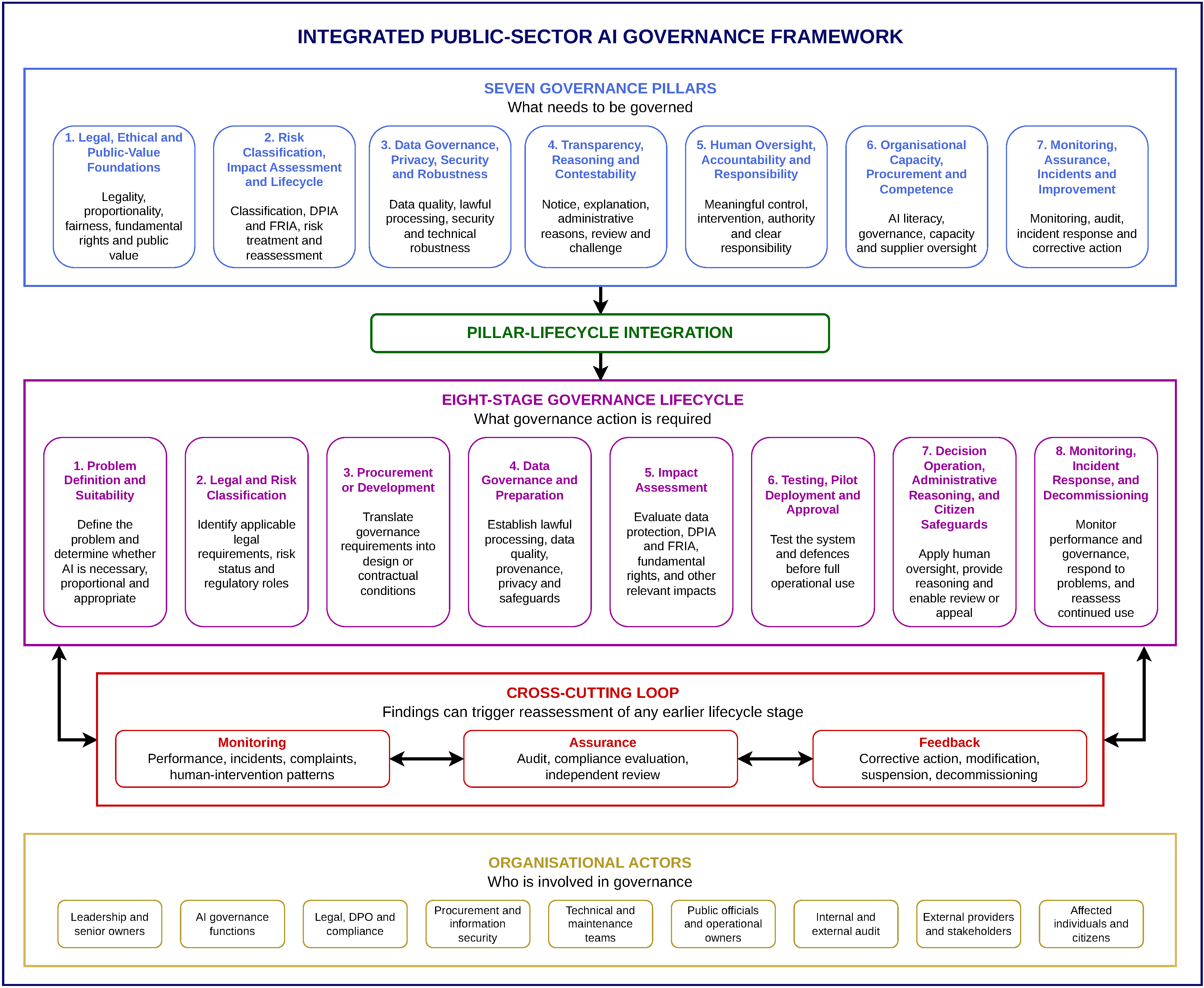
| Framework/Study | Core Approach | C1: Instruments Operationalised | C2: Lifecycle | C3: Actors | C4: Evidence | C5: Norm. Status | C6: Auditable Deriv. |
|---|---|---|---|---|---|---|---|
| Mišić et al. (2025) [20] | Seven public values: responsiveness, effectiveness, procedural justice, resilience, counterbalance, wellbeing, and social justice | None explicitly | No | Partial | No | No | No |
| Tsarouhas and Grigoriadis (2026) [19] | Transparency, XAI, participatory governance, and digital literacy as determinants of public trust | Referenced, not mapped | Partial | Partial | No | No | No |
| Babšek et al. (2025) [22] | Organisational readiness: processes, technology, people, services, infrastructure, strategy, citizens, and open government | Compliance treated as a readiness condition | No | Partial | Partial | No | Partial |
| Kim (2026) [21] | Regulative, normative, and cognitive conditions for institutionalisation, including SOPs, leadership, training, and accountability | None explicitly | No | Partial | No | No | Partial |
| Riccio (2025) [23] | Strategic governance, risk assessment, cybersecurity, training, and human oversight for Generative AI | AI Act, GDPR, NIST AI RMF, ISO/IEC 42001 | Partial | Yes | Partial | No | No |
| de Almeida and dos Santos Júnior (2025) [25] | Empirically grounded governance processes, organisational standards, training, and management of outsourced development | Not centred on EU regulatory integration | Partial | Yes | Partial | No | Yes |
| Stanford HAI AI Index [27] | Jurisdiction- and firm-level indicators of responsible-AI practice, policy activity, and incidents | Descriptive; not operationalised | No | No | No | No | Yes |
| AGILE Index 2025 [28] | National governance scored across four pillars, 17 dimensions, and 43 indicators covering 40 countries | Descriptive; not operationalised | No | No | No | No | Yes |
| Proposed Framework | Seven governance pillars × eight lifecycle stages linked to actors, controls, evidence, and review points | AI Act, GDPR, Directive (EU) 2016/680, OECD AI Principles, and NIST AI RMF | Yes | Yes | Yes | Yes | Yes |
| Source | Identifier | Version Used | Normative Status for EU Public Authorities | Consulted |
|---|---|---|---|---|
| EU AI Act | Regulation (EU) 2024/1689; CELEX 32024R1689 | Consolidated text as amended by Regulation (EU) 2026/1744 | Binding; phased application (Arts. 113, 111) | 20 August 2026 |
| Digital Omnibus on AI | Regulation (EU) 2026/1744; CELEX 32026R1744 | OJ, 24 July 2026; in force 27 July 2026 | Binding amending regulation | 20 August 2026 |
| GDPR | Regulation (EU) 2016/679; CELEX 32016R0679 | Consolidated text | Binding | 20 August 2026 |
| Law Enforcement Directive | Directive (EU) 2016/680; CELEX 32016L0680 | Consolidated text | Binding on Member States; effect via national transposition | 20 August 2026 |
| OECD AI Principles | OECD/LEGAL/0449 | As revised, 2024 | Non-binding Council Recommendation | 20 August 2026 |
| NIST AI RMF | NIST AI 100-1 | Version 1.0, January 2023 | Voluntary; no legal effect in the EU | 20 August 2026 |
| EDPB guidance | Guidance on automated decision-making and profiling; DPIA guidance | – | Interpretive guidance only; not coded as a source of obligation | 20 August 2026 |
| CJEU case law | C-634/21 SCHUFA; C-203/22 Dun & Bradstreet; C-817/19 Ligue des droits humains | – | Interpretive source only; not coded as a source of obligation | 20 August 2026 |
| CoE Framework Convention | CETS No. 225 | – | Excluded from the coded corpus; supplementary human-rights reference | 20 August 2026 |
| Dimension | EU AI Act | GDPR | Dir. (EU) 2016/680 | OECD AI Principles | NIST AI RMF 1.0 |
|---|---|---|---|---|---|
| Legal Status & Enforceability | Binding EU Regulation; public-sector penalties depend partly on Member State law (Art. 99) | Binding EU Regulation; fines for public authorities depend on Member State law (Art. 83(7)) | Binding on Member States; effect through national transposition | Non-binding OECD Council Recommendation | Voluntary framework; no legal effect in the EU |
| Defined Roles | Provider, deployer, importer, distributor, authorised representative | Controller, processor, DPO | Competent authority as controller, processor, DPO | AI actors | Organisational and lifecycle roles |
| Risk Conceptualisation | Risk differentiated by system and intended use | Risk to rights and freedoms from personal-data processing | Risk to rights and freedoms in law-enforcement processing | Societal, ethical, and human-rights impacts | Continuous socio-technical risk and trustworthiness |
| Assessment Triggers | High-risk classification (Art. 6); FRIA where applicable (Art. 27) | High-risk processing; DPIA (Art. 35) | DPIA (Art. 27); prior consultation (Art. 28) | Voluntary adoption and policy endorsement | Map and Measure functions |
| Human Oversight | Design for effective oversight (Art. 14); competent assigned person (Art. 26(2)) | Human intervention under Art. 22(3) | Safeguards including human intervention (Art. 11) | Human-centred values, agency, and oversight | Human roles across the core functions |
| Information to Deployers | Transparency and instructions for use (Art. 13); technical documentation | Processor arrangements and records | Processor arrangements and records | Openness and traceability | Documentation and transparency practices |
| Information and Explanation to Affected Persons | Notice (Art. 26(11)); explanation (Art. 86); system-specific transparency (Art. 50) | Information about logic (Arts. 13–15); contestation safeguards (Art. 22) | Information rights (Arts. 12–15); Art. 11 safeguards | Explainability and understandable information | Explainability as a trustworthiness characteristic |
| Registration and Record-Keeping | Registration (Art. 49); logging (Arts. 12, 26(6)) | Records of processing (Art. 30) | Records and logging (Arts. 24–25) | Traceability of data, processes, and decisions | Govern and Manage documentation practices |
| Application to Legacy Public-Sector Systems | Transitional arrangements under Art. 111 | Applies without transitional relief | Applies through applicable national law | Not applicable | Not applicable |
| Operational Gap | Unresolved Issue | Framework Element |
|---|---|---|
| Sequencing of DPIA and FRIA | Neither instrument specifies sequencing, reconciliation of residual-risk decisions, or responsibility for resolving divergence. | Stage 5; DPIA–FRIA coordination table (Section 4.3.1) |
| Translating Oversight into Intervention | The AI Act requires effective oversight but does not specify intervention thresholds, override procedures, or supporting records. | Pillar 5; Stage 7; oversight procedure and override log |
| Allocation between Authority and Provider | Regulatory roles do not determine internal responsibilities or which activities may be contractually delegated. | Statutory–organisational role mapping and RACI tables (Section 4.2.6) |
| Operationalising the Explanation Standard | The applicable provisions define the function of explanation but not its form, timing, or integration into the administrative decision [42]. | Pillar 4; explanation and appeal workflow (Section 4.3.1) |
| Closing the Monitoring Loop | Monitoring and incident reporting are required, but corrective-action triggers and verification are not fully specified. | Pillar 7; monitoring indicators and review triggers (Section 4.2.5) |
| Governing Legacy Systems | The transitional regime does not specify interim governance, while other applicable legal obligations continue. | Stage 2 classification record; Stage 8 reassessment triggers |
| Determining Decision Authority | The instruments do not specify who internally accepts residual risk, authorises or suspends deployment, or verifies corrective action. | Decision-rights allocation (Section 4.2.6) |
| Preliminary Governance Theme(s) | Integrated Governance Pillar | Basis for Consolidation | Rule(s) |
|---|---|---|---|
| Ethical foundations + legal authority and enforceability | 1. Legal, Ethical, and Public-Value Foundations | Shared focus on the legitimacy, legality, proportionality, fairness, fundamental rights, and public value of AI use. | R1, R2, R3 |
| Risk classification and lifecycle management | 2. Risk Classification, Impact Assessment, and Lifecycle Governance | Covers classification, ex ante assessment, risk treatment, and lifecycle reassessment; retained as a single theme. | — |
| Data governance and privacy | 3. Data Governance, Privacy, Security, and Robustness | Shared requirements for data quality, lawful processing, privacy, security, and reliability, supported by overlapping evidence. | — |
| Transparency and explainability + contestability and feedback | 4. Transparency, Explainability, Administrative Reasoning, and Contestability | Explanation supports the ability of affected individuals to understand and challenge consequential decisions. | R1, R2, R3 |
| Human oversight + accountability and organisational roles | 5. Human Oversight, Accountability, and Responsibility | Effective oversight depends on clearly assigned competence, authority, and responsibility. | R1, R2, R3 |
| Organisational capacity and competence | 6. Organisational Capacity, Procurement, and AI Competence | Covers organisational capability, AI literacy, coordination, and governance of externally supplied systems; retained as a single theme. | — |
| Monitoring and assurance | 7. Monitoring, Assurance, Incident Management, and Continuous Improvement | Monitoring findings support corrective action, learning, and reassessment throughout the lifecycle. | — |
| Preliminary Theme(s) | Integrated Pillar | Basis for Consolidation | Rules |
|---|---|---|---|
| Ethical foundations + legal authority and enforceability | 1. Legal, Ethical, and Public-Value Foundations | Genuine consolidation; shared legitimacy, rights, and public-value objectives. | R1–R3 |
| Risk classification and lifecycle management | 2. Risk Classification, Impact Assessment, and Lifecycle Governance | Expanded operational scope of the retained theme; determines applicable assessments and controls across the system lifecycle. | — |
| Data governance and privacy | 3. Data Governance, Privacy, Security, and Robustness | Expanded operational scope of the retained theme; data governance requires data quality, privacy, security, reliability requirements and robustness safeguards. | — |
| Transparency and explainability + contestability and feedback | 4. Transparency, Explainability, Administrative Reasoning, and Contestability | Genuine consolidation; explanation supports understanding and contestation. | R1–R3 |
| Human oversight + accountability and organisational roles | 5. Human Oversight, Accountability, and Responsibility | Genuine consolidation; oversight requires assigned authority and responsibility. | R1–R3 |
| Organisational capacity and competence | 6. Organisational Capacity, Procurement, and AI Competence | Expanded operational scope of the retained theme; organisational capability requires competent personnel, adequate resources, and effective provider management on AI procurement and competence. | — |
| Monitoring and assurance | 7. Monitoring, Assurance, Incident Management, and Continuous Improvement | Expanded operational scope of the retained theme; monitoring supports incident detection, corrective action, reassessment, and organisational learning for continuous improvement. | — |
| Source | Provision | Governance Issue | Norm. Status | Preliminary Theme(s) | Pillar(s) | Stage(s) |
|---|---|---|---|---|---|---|
| AI Act | Art. 5 | Prohibited practices | (binding) | Legal authority and enforceability | P1 | 1–2 |
| AI Act | Art. 4 | AI literacy of staff | (binding) | Organisational capacity and competence | P6 | 3, 6 |
| AI Act | Art. 6(1)–(2) | High-risk classification | (conditionally binding) | Risk classification and lifecycle management | P2 | 2 |
| AI Act | Art. 6(3)–(4) | Derogation conditions, profiling carve-out, documentation | (conditionally binding) | Risk classification and lifecycle management | P2 | 2 |
| AI Act | Art. 9 | Risk-management system | (conditionally binding) | Risk classification and lifecycle management | P2 | 2–8 |
| AI Act | Art. 13 | Provider-to-deployer transparency; instructions for use | (conditionally binding) | Transparency and explainability | P4, P6 | 3, 6 |
| AI Act | Art. 14 | Human oversight by design | (conditionally binding) | Human oversight | P5 | 3, 6 |
| AI Act | Art. 26(2) | Assignment of oversight to a competent, trained, authorised person | (conditionally binding) | Human oversight; accountability and organisational roles | P5, P6 | 6–7 |
| AI Act | Art. 26(5)–(6) | Operational monitoring; incident notification; log retention | (conditionally binding) | Monitoring and assurance | P7 | 8 |
| AI Act | Art. 26(11) | Notice to persons subject to a high-risk system | (conditionally binding) | Transparency and explainability | P4 | 7 |
| AI Act | Art. 27 | FRIA | (conditionally binding) | Risk classification and lifecycle management | P2 | 5 |
| AI Act | Art. 27(3) | Notification of FRIA results to market surveillance authority | (conditionally binding) | Risk classification and lifecycle management; monitoring and assurance | P2, P7 | 5 |
| AI Act | Art. 49(3) | Registration of use by public-authority deployers | (conditionally binding) | Legal authority and enforceability | P1, P2 | 2, 6 |
| AI Act | Art. 85 | Right to lodge a complaint with a market surveillance authority | (binding) | Contestability and feedback | P4 | 7–8 |
| AI Act | Art. 86 | Right to explanation of individual decision-making | (conditionally binding) | Transparency and explainability; contestability and feedback | P4 | 7 |
| AI Act | Art. 111(2) | Transitional compliance deadline for public-authority systems | (binding) | Risk classification and lifecycle management | P2 | 2, 8 |
| GDPR | Art. 22 | Safeguards for solely automated decisions | (conditionally binding) | Human oversight; contestability and feedback | P4, P5 | 7 |
| GDPR | Art. 15(1)(h) | Meaningful information about the logic involved | (conditionally binding) | Transparency and explainability | P4 | 7 |
| GDPR | Art. 35 | DPIA | (conditionally binding) | Risk classification and lifecycle management | P2 | 5 |
| GDPR | Art. 38(3) | Independence of the DPO | (binding) | Accountability and organisational roles | P5, P6 | Cross-cutting |
| Dir. 2016/680 | Art. 11 | Solely automated adverse decisions; discriminatory profiling prohibition | (conditionally binding) | Human oversight; contestability and feedback; ethical foundations | P1, P5 | 2, 7 |
| Dir. 2016/680 | Art. 25 | Logging in automated processing systems | (conditionally binding) | Monitoring and assurance | P3, P7 | 4, 8 |
| Dir. 2016/680 | Art. 27 | Data protection impact assessment | (conditionally binding) | Risk classification and lifecycle management | P2 | 5 |
| OECD | Transparency & explainability | Transparency | (voluntary) | Transparency and explainability | P4 | Several |
| NIST | Govern | Roles/accountability | (voluntary) | Accountability and organisational roles; organisational capacity and competence | P5, P6 | Cross-cutting |
| NIST | Map | Context and affected stakeholders | (voluntary) | Risk classification and lifecycle management | P1, P2 | 1–2 |
| NIST | Measure/Manage | Monitoring and risk treatment | (voluntary) | Monitoring and assurance | P7 | 6–8 |
| Authors | — | Necessity and non-AI alternative justification record | (author-proposed) | Ethical foundations | P1 | 1 |
| Authors | — | Indicator review triggers and decommissioning thresholds | (author-proposed) | Monitoring and assurance | P7 | 8 |
| Pillar | Monitoring Indicator | Review Trigger | Governance Implication |
|---|---|---|---|
| P1 Legal, ethical and public-value foundations | Systems with a current necessity and proportionality justification | Missing or outdated justification; change of purpose | Use extending beyond the authorised purpose |
| P2 Risk classification, impact assessment and lifecycle | Time since classification and impact-assessment review | Material change or expiry of the review interval | Risk assumptions no longer valid |
| P3 Data governance, privacy, security and robustness | Data quality, drift, representativeness, and security incidents | Material drift, data breach, or representativeness gap | Reduced reliability of the basis for decisions |
| P4 Transparency, explainability, administrative reasoning and contestability | Explanation, reconsideration, complaint, and appeal patterns | Sustained increase in clarification requests or upheld challenges | Explanations or review routes may be ineffective |
| P5 Human oversight, accountability and responsibility | Acceptance and override rates; recorded justifications | Near-zero overrides or unexplained variation across officials or cases | Possible automation bias or ineffective oversight |
| P6 Organisational capacity, procurement and AI competence | Current staff training and provider response times | Expired training or provider response beyond the contractual period | Insufficient capacity to exercise effective oversight |
| P7 Monitoring, assurance, incident management and continuous improvement | Time to corrective action and proportion of findings closed | Overdue corrective action or recurrence of a closed finding | Monitoring not leading to effective corrective action |
| Statutory Role | Source | Internal Functions That Typically Discharge It | Constraint on Internal Reallocation |
|---|---|---|---|
| Deployer | AI Act Arts. 3(4), 26, 27, 49(3), 86 | Leadership (accountable); operational owner; public officials (oversight under Art. 26(2)); AI governance function (coordination) | Determined by use under own authority; cannot be transferred to the provider by contract. |
| Provider | AI Act Arts. 3(3), 16, Chapter III | Technical team; AI governance function; Legal | May be assumed involuntarily under Art. 25 where the authority puts a system into service under its own name or substantially modifies it. |
| Controller | GDPR Arts. 4(7), 24, 35 | Leadership (accountable); data owner; DPO (advisory only) | Determined by who decides purposes and means; the DPO cannot be the controller. |
| Processor/joint controller | GDPR Arts. 26, 28 | Procurement; Legal; Information security | Arrangement must reflect the factual allocation, not the label used in the contract. |
| Competent authority | Dir. (EU) 2016/680 Arts. 3(7), 11, 25, 27 | Operational owner; DPO; Legal | Applies by virtue of law-enforcement purpose; safeguards set by national transposing law. |
| Data Protection Officer | GDPR Arts. 37–39, esp. Art. 38(3) | DPO, as an independent advisory and monitoring function | Must not receive instructions on the exercise of tasks, must not be dismissed or penalised for performing them, reports to the highest management level, and must not hold a role that determines purposes and means; the DPO advises on the DPIA but does not own it. |
| External provider/ supplier | Contract; AI Act Arts. 16, 25 | Managed by procurement and the operational owner; performance monitored by internal audit | Outsourcing technical activity does not transfer responsibility for the administrative use of the system. |
| Decision | Holder | Conditions and Evidence | Stage |
|---|---|---|---|
| Acceptance of residual risk | Senior responsible owner in leadership; cannot be delegated to the technical team or the provider | Written acceptance identifying each residual risk, its mitigation, the reason for acceptance, and the monitoring indicator attached to it; DPO and Legal consulted, neither accountable. | 5–6 |
| Authorisation of deployment | Leadership, on the recommendation of the AI governance function | Approval record confirming that acceptance criteria are met, oversight personnel are trained and authorised under Art. 26(2), registration under Art. 49(3) is complete, and residual risks are accepted. | 6 |
| Suspension of an operating system | Operational owner and, independently, the AI governance function or DPO acting on a data-protection or fundamental-rights concern | Documented suspension decision with reasons; either holder may act alone; reversal requires the deployment-authorisation route. | 7–8 |
| Verification of corrective action | Internal audit, or an assurance function independent of the function that implemented the action | Closure record evidencing that the action was implemented and that the indicator that triggered it has returned within range. | 8 |
| Lifecycle Stage | Leadership | AI Gov. Func. | Legal | DPO | Procurement | Info. Sec. | Tech. Team | Oper. Owner | Int. Audit | Ext. Provider |
|---|---|---|---|---|---|---|---|---|---|---|
| 1. Problem Definition & Suitability | A/R | C | C | C | I | I | I | C | I | – |
| 2. Legal & Risk Classification | A | C | R | C | I | I | I | C | I | I |
| 3. Procurement/Development | A | C | C | C | R | C | R | C | I | R |
| 4. Data Governance & Preparation | A | I | C | C | I | C | R | R | I | C |
| 5. Impact Assessment (DPIA/FRIA) | A | R | C | C | I | C | C | C | I | C |
| 6. Testing, Pilot & Approval | A | C | C | C | I | C | R | R | C | C |
| 7. Decision Operation & Safeguards | A | I | C | I | I | I | C | A/R | I | I |
| 8. Monitoring & Decommissioning | A | R | C | C | C | C | C | R | C | C |
| Field | Entry |
|---|---|
| Intended purpose | Decision support for means-tested housing-allowance eligibility; recommendation plus verification flag. |
| Statutory roles | Authority: deployer and controller. Vendor: provider and processor. |
| AI Act classification | Annex III, point 5(a); high-risk under Article 6(2). |
| Article 6(3) derogation | Unavailable because the system performs profiling and materially influences decision-making. |
| Transitional position | Chapter III Sections 1–3 apply from 2 December 2027; Articles 4 and 5 already apply. |
| GDPR position | Public-interest processing under Article 6(1)(e), with the relevant national legal basis under Article 6(3); Article 22 is not engaged as designed because every recommendation undergoes substantive human review and the final decision is not based solely on automated processing. Consequently, Article 15(1)(h) is not relied upon as an applicable explanation right in this scenario. |
| Directive (EU) 2016/680 | Not applicable because the processing is not for law-enforcement purposes. |
| Assessments required | DPIA under Article 35 GDPR and FRIA under Article 27 AI Act, with notification under Article 27(3). |
| Registration | Provider registration under Article 49(1); authority registration of use under Article 49(3), since the system falls under Annex III point 5(a) and not the point 2 exception. |
| Accountable internal role | Director of Social Services as senior responsible owner; Legal function prepares the record. |
| Element | DPIA | FRIA |
|---|---|---|
| Focus | Risks arising from personal-data processing | Fundamental-rights impacts of deploying the high-risk system |
| Sequence | Performed first to establish data flows and processing risks | Cross-references the DPIA and addresses additional fundamental-rights impacts |
| External step | Prior consultation where Article 36 GDPR applies | Notification under Article 27(3) AI Act |
| Residual risk | Differences are documented and resolved by the senior responsible owner without compromising DPO independence | |
| Review | Reassessment follows material changes or relevant monitoring triggers |
| Category | Criterion or Trigger |
|---|---|
| Performance and disparity | Agreement with parallel manual determination must meet the pilot baseline, and refusal-rate disparities must remain within the band defined in the FRIA. |
| Explanation | The reason template must identify the factors that operated in the individual case and be validated during the pilot. |
| Oversight and logging | Designated caseworkers must be trained and authorised; override functionality and justification fields must operate correctly; relevant logs must be retained. |
| Decommissioning | Suspension or withdrawal is triggered by persistent oversight failure, unresolved disparity, loss of legal basis, an unvalidated model update, or a finding that the system no longer serves the public value identified at Stage 1. |
| Step | Action | Evidence |
|---|---|---|
| 1 | Notice of AI-supported assessment under Article 26(11) AI Act and Articles 13–14 GDPR | Notice text and version |
| 2 | Reasoned administrative decision stating the relevant factors, the role of the system, and the caseworker’s own reasoning | Reasoned decision in the case file |
| 3 | Request for explanation under Article 86 AI Act | Explanation issued and response time |
| 4 | Internal reconsideration by a different caseworker, with the opportunity to submit further information | Reconsideration record and outcome |
| 5 | Administrative appeal under applicable national law | Appeal record and outcome |
| 6 | Regulatory complaint under Article 85 AI Act or Article 77 GDPR | Complaint register and regulator correspondence |
| 7 | Feedback from upheld challenges and clarification requests into governance review | Periodic contestability report |
| Governance Dimension | Scenario 1: Social-Benefit Eligibility | Scenario 2: AI-Supported Student Assessment |
|---|---|---|
| AI Act classification | Annex III point 5(a); high-risk under Art. 6(2). Art. 6(3) unavailable: profiling carve-out and material influence on the outcome. | Annex III point 3; high-risk status depends on the specific sub-point and configuration, and the availability of Art. 6(3) must be assessed rather than assumed. |
| Applicable dates | Chapter III from 2 December 2027; Arts. 4 and 5 already applicable. | Chapter III from 2 December 2027; Arts. 4 and 5 already applicable. |
| Impact assessments | DPIA where the Art. 35 threshold is met; FRIA under Art. 27 with notification under Art. 27(3). | DPIA where the Art. 35 threshold is met; FRIA under Art. 27 where the institution is a body governed by public law or provides a public service. |
| Human oversight focus | Ability to question or override the recommendation and consider applicant-provided or contextual information. | Preservation of professional academic judgement and consideration of contextual student circumstances. |
| Contestability and safeguards | Notice (Art. 26(11)); explanation (Art. 86); reconsideration; administrative appeal; complaint under Art. 85. | Notice (Art. 26(11)); explanation (Art. 86); academic review, complaint, or grievance procedures under institutional regulations. |
| Participation/ feedback | Input from social-service practitioners and affected groups during suitability and impact assessment; stakeholder review where recurring concerns arise. | Input from academic staff and, where appropriate, affected students during pilot evaluation; structured feedback after deployment. |
| Binding governance constraint | Legal effect on access to a statutory entitlement; drives disparity testing, reason quality, and appeal accessibility. | Preservation of professional judgement; drives reserved-decision definition and oversight design. |
| Monitoring indicators | Recurring errors, human interventions, complaints and appeals, disparities in outcomes across groups, continued suitability. | Staff acceptance and override patterns, student complaints and appeals, disparities in outcomes, structured student feedback, continued support for the educational purpose. |
Disclaimer/Publisher’s Note: The statements, opinions and data contained in all publications are solely those of the individual author(s) and contributor(s) and not of MDPI and/or the editor(s). MDPI and/or the editor(s) disclaim responsibility for any injury to people or property resulting from any ideas, methods, instructions or products referred to in the content. |
© 2026 by the authors. Licensee MDPI, Basel, Switzerland. This article is an open access article distributed under the terms and conditions of the Creative Commons Attribution (CC BY) license.
Share and Cite
Levantis, N.; Sgora, A.; Tsipis, A.; Polykalas, S. Operationalising AI Governance in Public Administration: An Integrated Regulatory and Risk Management Framework. Information 2026, 17, 962. https://doi.org/10.3390/info17100962
Levantis N, Sgora A, Tsipis A, Polykalas S. Operationalising AI Governance in Public Administration: An Integrated Regulatory and Risk Management Framework. Information. 2026; 17(10):962. https://doi.org/10.3390/info17100962
Chicago/Turabian StyleLevantis, Nikolaos, Aggeliki Sgora, Athanasios Tsipis, and Spyros Polykalas. 2026. "Operationalising AI Governance in Public Administration: An Integrated Regulatory and Risk Management Framework" Information 17, no. 10: 962. https://doi.org/10.3390/info17100962
APA StyleLevantis, N., Sgora, A., Tsipis, A., & Polykalas, S. (2026). Operationalising AI Governance in Public Administration: An Integrated Regulatory and Risk Management Framework. Information, 17(10), 962. https://doi.org/10.3390/info17100962