Article

RFSCMOEA: A Dual-Population Cooperative Evolutionary Algorithm with Relaxed Feasibility Selection


1
School of Information and Electrical Engineering, Heilongjiang Bayi Agricultural University, Daqing 163000, China
2
School of Information Engineering, Sanming University, Sanming 365004, China
3
School of Mathematical Sciences, Harbin Normal University, Harbin 150080, China
4
School of Mathematics and Statistics, Changchun University of Technology, Changchun 130012, China
5
School of Mechanical and Electrical Engineering, Sanming University, Sanming 365004, China
*
Authors to whom correspondence should be addressed.
These authors contributed equally to this work.
Information 2026, 17(1), 36; https://doi.org/10.3390/info17010036
Submission received: 28 November 2025 / Revised: 24 December 2025 / Accepted: 30 December 2025 / Published: 3 January 2026

Abstract

Achieving a dynamic equilibrium among feasibility, convergence, and diversity remains a fundamental challenge in Constrained Multi-objective Optimization Problems (CMOPs). To address the limitations of conventional methods in handling complex constraints and resource allocation, this paper proposes a Dual-Population Cooperative Evolutionary Algorithm based on Relaxed Feasibility Selection and Shrinking Contribution Resource Allocation (RFSCMOEA). First, a relaxed feasibility selection strategy is designed with a dynamically shrinking threshold, allowing near-feasible solutions to survive in early stages to enhance boundary exploration. Second, a dual-criterion environmental selection mechanism integrates non-dominated sorting with k-nearest neighbor density estimation to prevent premature convergence and ensure solution uniformity. Furthermore, a dynamic resource allocation model optimizes computational configuration by adjusting offspring generation ratios based on the real-time evolutionary contribution of each population. Extensive experiments on 47 benchmark functions and 12 real-world engineering problems demonstrate that RFSCMOEA significantly outperforms eight state-of-the-art algorithms in Feasibility Rate, Inverted Generational Distance, and Hypervolume.

1. Introduction

In the realm of intelligent computing, Evolutionary Algorithms (EAs) have emerged as a cornerstone for addressing Constrained Optimization Problems (COPs), owing to their inherent population-based search mechanisms and adaptability. Concurrently, with the deepening investigation into Multi-Objective Optimization Problems (MOPs), EAs have found extensive application in solving such complex tasks [1]. Nevertheless, Constrained Multi-objective Optimization Problems (CMOPs) continue to present significant challenges due to their intricate structural characteristics. Generally, the Pareto Front (PF) of a CMOP comprises the Unconstrained Pareto Front (UPF) and the Constrained Pareto Front (CPF). The complex distribution resulting from this intersection imposes stringent requirements on algorithm design. Within continuous decision spaces, conventional EAs typically approximate the PF by maintaining population diversity. However, when constraints fragment the feasible region into disjoint sub-regions, specific segments of the PF may be confined within narrow feasible corridors. This phenomenon demands more robust diversity maintenance mechanisms. Furthermore, the presence of extensive infeasible regions can obstruct population evolution, increasing the susceptibility to local optima and thereby degrading convergence performance. To mitigate these issues, researchers have developed various Constraint Handling Techniques (CHTs), such as the model based on adaptive acquisition functions proposed in [2]. This method utilizes an adaptive acquisition function to select unobserved data for evaluation by the true objective function. By dynamically tuning the parameter α via a cosine function, it effectively balances the weight between uncertainty and the predicted mean fitness, thereby efficiently guiding population evolution and significantly enhancing adaptability and precision in complex environments [3]. Despite these advances, traditional CHTs may still struggle to maintain an equilibrium between convergence and diversity when applied to CMOPs with highly complex constraint structures. This indicates that effectively solving CMOPs necessitates adaptive constraint handling frameworks that incorporate specific problem characteristics while simultaneously balancing feasibility, convergence, and diversity. To this end, recent studies have introduced multi-strategy cooperative mechanisms based on knowledge transfer. By fusing domain prior knowledge with dynamic feedback, these approaches aim to enhance algorithmic robustness in complex constrained environments.
To acquire high-quality solution sets, researchers have developed numerous Constrained Multi-objective Optimization Algorithms (CMOAs) designed to address the challenges inherent in CMOPs. Strategies utilizing dual-population or multi-stage cooperative evolution have proven particularly prominent in existing literature, as evidenced by [4,5,6,7]. Typically, these methods employ multiple populations for information sharing and collaboration. Specifically, the first population primarily executes search and evolutionary processes within the feasible space to drive solutions toward the true Pareto Front. Meanwhile, the second population explores the infeasible region to identify potential isolated feasible sub-regions, thereby maintaining population diversity and enhancing the overall quality of the solution set. However, dual-population frameworks often suffer from excessive computational resource consumption during practical implementation. Particularly, when substantial resources are disproportionately allocated to searching the UPF, the algorithm frequently struggles to effectively approximate the CPF. This misalignment leads to an imbalance between resource utilization and convergence performance, resulting in significant performance conflicts. Consequently, incorporating a rational resource allocation mechanism is crucial for optimizing the search efficiency of dual-population models and enhancing overall algorithmic performance.
To address the aforementioned challenges and enhance optimization performance, this paper adopts a dual-population cooperative evolutionary framework and proposes a Dual-population Constrained Multi-objective Optimization Algorithm based on Relaxed Feasibility Selection (RFSCMOEA). For the environmental selection of the main population, the classical Constrained Dominance Principle (CDP) is employed to prioritize the retention of feasible solutions, thereby ensuring the acquisition of a feasible solution set upon the completion of evolution. Concurrently, to further augment the main population’s performance in terms of convergence accuracy and solution diversity, an auxiliary population is introduced as an external guide during the search process, facilitating a more balanced and efficient evolution for the main population in subsequent iterations. Consequently, this paper proposes a model integrating relaxed feasibility selection specifically for the auxiliary population. As the evolutionary process advances, a constraint threshold is progressively tightened to screen for eligible individuals; in instances where the number of acceptable solutions is insufficient, the selection is supplemented based on the degree of constraint violation. Subsequently, non-dominated sorting is performed on the candidate set to establish a hierarchy of solution quality. Simultaneously, a k-Nearest Neighbor (k-NN) distance estimation is conducted on the normalized objective space distribution to quantify the diversity contribution of each individual. Ultimately, the non-dominated rank and diversity metrics are jointly utilized for ranking, ensuring that the retained solutions maintain a balance between convergence and distribution, thereby constituting the next generation of the auxiliary population. To further enhance computational resource efficiency, this paper incorporates Euclidean distance to transform the average shift between the centroids of the parent and offspring populations into a relative contribution ratio. This approach not only secures convergence but also optimizes resource allocation, adaptively balancing the search weight and diversity of the populations throughout the evolutionary process. The main contributions of this paper are summarized as follows:
  • A novel environmental selection strategy combining relaxed feasibility selection with dual-criterion sorting is proposed to simultaneously enhance the feasibility, convergence, and diversity of the solution set. This model first constructs a relaxed feasibility threshold that dynamically shrinks during evolution, effectively retaining “near-feasible” solutions by quantifying constraint violations to help the population traverse infeasible barriers. Meanwhile, by integrating non-dominated sorting with a k-nearest neighbor density estimation mechanism, it prioritizes the retention of individuals in sparse regions—ensuring global convergence trends while preventing premature convergence—thereby establishing an adaptive balance between exploration and exploitation along complex constraint boundaries.
  • A dynamic resource allocation mechanism based on shrinking contribution is designed to address the computational configuration challenges in cooperative evolution. By measuring the Euclidean distance shift between parent and offspring populations in the objective space, this mechanism quantifies the effective evolutionary contribution of populations in real-time (where a smaller shift indicates higher potential convergence value). Based on this evaluation coefficient, the algorithm dynamically adjusts the offspring generation ratio, automatically tilting computational resources toward the population demonstrating superior evolutionary performance, thus significantly reducing ineffective resource consumption while guaranteeing search quality.
  • Comprehensive experiments involving 47 benchmark functions and 12 real-world engineering problems compare the proposed method against seven state-of-the-art CMOEAs. The results demonstrate that RFSCMOEA achieves the most balanced and superior performance across key metrics.
The structure of this article is organized as follows: The literature review is described in Section 2. Section 3 introduces the algorithm in detail. Section 4 provides the experimental settings. Section 5 presents the experimental results and analysis. Section 6 concludes this article and outlines future research directions.

2. Related Work

In recent years, CMOPs have garnered significant attention within the academic community. As research in this field has advanced, early monolithic solution frameworks have gradually evolved into a diverse array of specialized paradigms designed to better navigate the intricate trade-offs between feasibility maintenance, solution set diversity, and convergence. Broadly, existing methodologies can be categorized into stepwise approximation, multi-stage, and dual-population cooperative strategies. In the subsequent subsections, we systematically review these representative models to elucidate their core mechanisms and distinct application scenarios.

2.1. Constatin Multi-Objective Optimization Problems

In practical engineering and scientific applications, CMOPs are ubiquitous, appearing frequently in domains such as computational communications [8], aerodynamic shape design [9], and applied energy systems [10]. These tasks necessitate the simultaneous optimization of multiple conflicting objectives subject to various constraints, a requirement that significantly escalates computational complexity. Driven by rapid advancements in intelligent computation techniques, research on CMOPs has evolved into a comprehensive and systematic discipline [11].
Without loss of generality, a CMOP can be mathematically formulated as follows:
min x F ( x ) = f 1 ( x ) , f 2 ( x ) , , f M ( x ) T s . t . g i ( x ) 0 , i = 1 , , p h j ( x ) = 0 , j = p + 1 , , L x Ω R D
where F ( x ) represents the objective vector consisting of M conflicting functions to be optimized. The decision vector x resides in a D-dimensional decision space Ω . The problem is bounded by L constraints, comprising p inequality constraints g i ( x ) and L p equality constraints h j ( x ) . These constraints collectively define the feasible region within the decision space.
To quantify the feasibility of a candidate solution, the Constraint Violation (CV) is defined as the cumulative sum of all constraint violations:
C V ( x ) = i = 1 L C i ( x )
where the violation value C i ( x ) for the i-th constraint is computed as:
C i ( x ) = max 0 , g i ( x ) , 1 i p max 0 , h i ( x ) δ , p + 1 i L
where, δ is a small positive tolerance parameter introduced to accommodate numerical precision limitations inherent in equality constraints. A solution x is deemed feasible if and only if C V ( x ) = 0 ; otherwise, it is considered infeasible.

2.2. Approaches for Stepwise Approximation of the CPF

The fundamental premise of this category is to guide the population to gradually approximate the global CPF during the evolutionary process without explicitly constructing an UPF. Drawing inspiration from the feasibility-first strategy prevalent in constrained single-objective optimization, these approaches generally manage the competitive relationship between feasibility and objective values to drive the population toward the feasible region.
In 2015, Li et al. proposed the BiGE algorithm [12], which transforms high-dimensional multi-objective optimization problems into a bi-objective framework based on diversity and proximity. Individual performance is evaluated through two dimensions: proximity estimation, derived from the sum of objective values, and crowding estimation, utilizing niche techniques and resource sharing to measure local density. By performing non-dominated sorting within this bi-objective space, BiGE prioritizes individuals exhibiting superior convergence and distribution, thereby ensuring the overall quality of the solution set. Subsequently, Jiao et al. introduced MOEA/D-2WA [13], which partitions weight vectors into fixed feasible weights and adaptive infeasible weights. The former maintains a fixed distribution to ensure the uniformity of the final Pareto front, while the latter gradually shrinks in alignment with a decaying dynamic constraint boundary parameter ε . This mechanism enables the utilization of highly convergent infeasible solutions to traverse constraint barriers in the early stages, while focusing on fine-grained search within the feasible region in later stages. Furthermore, by treating the degree of constraint violation as a dynamic ( m + 1 ) -th objective, the algorithm achieves a smooth transition from obstacle traversal to refinement without requiring external archives. A representative work in this domain is the MOEA/D-ACDP method proposed by Fan et al. [14], which integrates the decomposition-based multi-objective evolutionary algorithm (MOEA/D) with the CDP. Under CDP, feasible solutions strictly dominate infeasible ones, while infeasible solutions are ranked based on their constraint violations. Similar indicator-based strategies have been adapted for CMOPs, such as HypEFR [15], and basic integrations of decomposition with CDP are explored in MOEA/D-CDP [16]. Although CDP effectively guarantees feasibility, its strict prioritization of constraints often drives the population to converge prematurely to local feasible regions, diminishing global search capability. To mitigate these limitations and enhance early-stage exploration, the NSGA-II-ToR (two-rank sorting) method [17] dynamically balances the importance of objectives and constraints. By gradually reducing the weight of objective functions, it allows the algorithm to retain infeasible solutions with potential optimization value during the initial phases. Addressing similar issues, Yu et al. [18] proposed a dynamic preference adjustment strategy that emphasizes objective functions in early iterations to maintain sufficient exploration, before progressively strengthening feasibility constraints to promote convergence. In summary, while these methods achieve stepwise approximation of the feasible region, the prevalent prioritization of feasibility in their sorting mechanisms frequently leads to premature convergence and a loss of diversity, highlighting the need for more robust constraint-handling frameworks.

2.3. Multi-Stage Optimization Methods

Multi-stage optimization methods address the dual challenges of convergence and diversity in CMOPs by exploiting the spatial relationship between the UPF and the CPF. Typically, these frameworks decompose the optimization process into distinct phases: an initial stage focusing on exploring the UPF to ensure broad search space coverage, followed by a subsequent stage dedicated to approximating the CPF to guide the population toward the global optimal feasible set.
In 2023, Sun et al. [7] proposed a multi-stage evolutionary algorithm (C3M) that dynamically manages constraint priorities. Initially, the problem is treated as unconstrained to gather landscape information. Subsequently, in an intermediate stage, constraints are incrementally reintroduced based on their priority order; this prevents abrupt escalations in search difficulty and mitigates premature convergence to local feasible regions. In the final stage, all constraints are integrated into a unified framework to refine solution quality within the feasible boundaries. Concurrently, Fan et al. [6] introduced the Push-Pull Search (PPS) framework, which operates on a clear two-stage logic. The Push phase conducts a free search without constraints to maximize diversity. Upon transitioning to the Pull phase, the algorithm utilizes an enhanced ε -constraint method to adaptively adjust the feasibility threshold, effectively guiding infeasible individuals from the first phase back toward the feasible region and the non-dominated front. More recently, Li et al. [19] proposed MSEFAS, which features a sophisticated early-stage structure containing two adaptively switchable sub-stages: one injects high-quality infeasible solutions (those with slight violations but superior objective values) to approach feasible boundaries, while the other accelerates CPF approximation through rigorous environmental selection. In the later evolutionary stages, a parent-offspring contribution comparison mechanism is employed to manage population updates dynamically. Furthermore, Lin et al. [20] developed the CMF-MOBO framework, which progresses through three distinct phases: constructing a pseudo-constraint violation function for feasible region discovery, utilizing weighted multi-fidelity expected hypervolume improvement for potential assessment, and finally employing a weighted lower confidence bound strategy for precise boundary refinement. Similar multi-stage strategies have been explored in algorithms such as CLBKR [21], CMOES [22], and CCEA [23]. Despite the efficacy of multi-stage optimization methods in balancing convergence, diversity, and feasibility, they encounter several intrinsic limitations. First, determining robust triggering conditions for stage transitioning is non-trivial; inappropriate timing can lead to either premature strategy shifts or protracted convergence. Second, the rational allocation of computational resources across distinct stages presents a critical challenge; static or rigid allocation schemes often result in resource wastage or insufficiency during pivotal evolutionary phases. Finally, an inherent trade-off persists regarding the search focus: excessive exploration of the UPF in early stages may impede population convergence, whereas a disproportionate emphasis on diversity in later stages can detract from overall search efficiency.

2.4. Dual-Population Optimization Methods

The fundamental premise of dual-population optimization methods is to leverage the synergistic co-evolution of two distinct populations to achieve a dynamic equilibrium between the constraint space and the objective space. Typically, one population concentrates on exploiting the feasible region to ensure solution feasibility, while the other explores the infeasible region to identify potential candidates that, despite violating constraints, exhibit superior objective performance.
Several frameworks have been proposed to implement this cooperative strategy. Huang et al. [24] introduced the Enhanced Auxiliary Population Search (EAPS), which employs an independently evolving auxiliary population to provide diversity and convergence information under unconstrained conditions. By utilizing a decomposition-based aggregation method to guide convergence, EAPS effectively prevents the auxiliary population from becoming trapped in local optima. Similarly, TCT-CMOEA [25] integrates penalty functions with the CDP to enhance diversity and preserve promising infeasible solutions. Moving beyond simple auxiliary mechanisms, Liu et al. [4] proposed the BiCo framework, comprising a main population and an archive population. The main population is updated using a CDP-based NSGA-II variant to drive the search toward the feasible region, while the archive population utilizes an angle-based selection model to explore the infeasible region, thereby facilitating the discovery of disconnected feasible areas. Furthermore, Zhao et al. [26] developed PSCMO, which incorporates a population state discrimination model. By monitoring the distance relationship between the main and auxiliary populations, PSCMO dynamically adjusts its selection strategies—ranging from Euclidean distance to cosine similarity—to adaptively guide the evolutionary process across different stages. In a similar vein, cDPEA [27] adopts distinct strategies for handling infeasible solutions: the auxiliary population utilizes an adaptive penalty function to guide potentially high-quality infeasible solutions, while the main population employs a feasibility-centric strategy to approximate the CPF. However, the simultaneous evolution strategy inherent in dual-population models often incurs substantial computational costs. A prime example is the Coevolutionary Constrained Multi-objective Optimization (CCMO) framework proposed by Tian et al. [28], which maintains two independent populations to approximate the CPF and the UPF, respectively. Although offspring are shared during environmental selection, the second population continues to search for the UPF throughout the entire evolutionary process. This results in significant resource consumption, particularly when the UPF is distant from the CPF, rendering the search largely ineffective. Consequently, such inefficient resource allocation can severely hinder the algorithm’s overall convergence performance. Therefore, the primary challenge facing this class of models lies in the rational allocation of computational resources to minimize waste while maximizing optimization efficiency.
Besides the three main optimization methods mentioned above, numerous constraint handling techniques have been proposed in the research of constrained multi-objective optimization. In 2010, Takahama et al. proposed the ε ADE algorithm [29], which introduces an adaptive ε -level control mechanism to coordinate the trade-off between objective function optimization and constraint violation minimization by dynamically adjusting the ε value. This mechanism adaptively updates the ε level based on the constraint violation distribution of individuals in the population, eliminating the need for manual setting of the ε parameter when facing feasible regions of different sizes and shapes. However, this adaptive ε control strategy has low adjustment sensitivity when dealing with discrete constraint problems, easily causing the search process to stagnate in local feasible regions. In July 2025, Hu et al. proposed the PFRL algorithm [30], which designs a constraint priority discrimination mechanism based on correlation distance (CD). This mechanism sorts individuals based on the distance between their constraint violations and the unified constraint penalty function (UCPF), prioritizing the exploration of low-cost sub-CPFs and gradually merging multiple CPFs, thereby significantly alleviating the search difficulty caused by complex constraint superposition and reducing computational overhead. However, this method does not explicitly consider the potential dependencies or conflicts between constraints, which may lead to errors in constraint priority judgment, causing the search direction to deviate from the optimal CPF. Therefore, traditional constraint handling techniques are mostly static or experience-driven, which to some extent limits their adaptability in complex or irregular feasible domains. For dynamic resource allocation problems, Yu et al. proposed the CCTPEA algorithm [31], which constructs a dynamic competition mechanism to evaluate the contribution of two auxiliary populations to the evolution of the main population and adaptively allocates computational resources accordingly, allowing the population with higher contributions to obtain more evolutionary opportunities, thereby reducing ineffective computational overhead and adapting to the relationship between CPF and UPF in different problems. However, this method is sensitive to the accuracy of resource contribution evaluation; once the evaluation is biased, it may lead to an imbalance in resource allocation, thus affecting the overall optimization performance. In addition to CCTPEA, recent studies have investigated alternative “contribution signals” for resource allocation and search-effort redirection under coevolutionary or multi-population frameworks. For example, BPRRA [32] derives its resource allocation rate from the archival update process, i.e., it records how many offspring generated by each population are finally retained in the archive under diversity-aware environmental selection, and then biases subsequent computational resources toward the population that contributes more archive-surviving offspring. Similarly, CLIA [33] leverages constraint-landscape knowledge to guide the evolutionary process: an auxiliary population evolving without constraints is used to estimate the size of feasible regions, and based on the learned feasibility landscape, the algorithm further activates a dedicated evolving stage where a dynamic resource allocation mechanism is employed to adapt search effort under large-feasible-region scenarios. From another perspective, the CG-based framework [34] performs an implicit form of resource reallocation by decomposing complex constraints into multiple subproblems with simpler constraint subsets and wider feasible regions. Meanwhile, hypervolume-improvement-driven strategies are also common in dynamic allocation, but they can become insensitive when the population is locally refining solutions or exploring infeasible regions without immediate hypervolume expansion. This motivates using a spatial shift signal to provide a more responsive and stage-agnostic indication of “evolutionary momentum” in the dual-population setting. Therefore, traditional constraint handling techniques are mostly static or experience-driven, which to some extent limits their adaptability in complex or irregular feasible domains. To overcome these shortcomings, this paper proposes a new RFSCMOEA framework. This framework introduces a dynamic resource allocation mechanism based on contraction contribution, which can adaptively balance the computational resource input among different populations, effectively reducing resource waste while ensuring search efficiency, thereby improving the overall performance and robustness of the algorithm in complex CMOPs.

3. Proposed Algorithm

3.1. Algorithm Framework

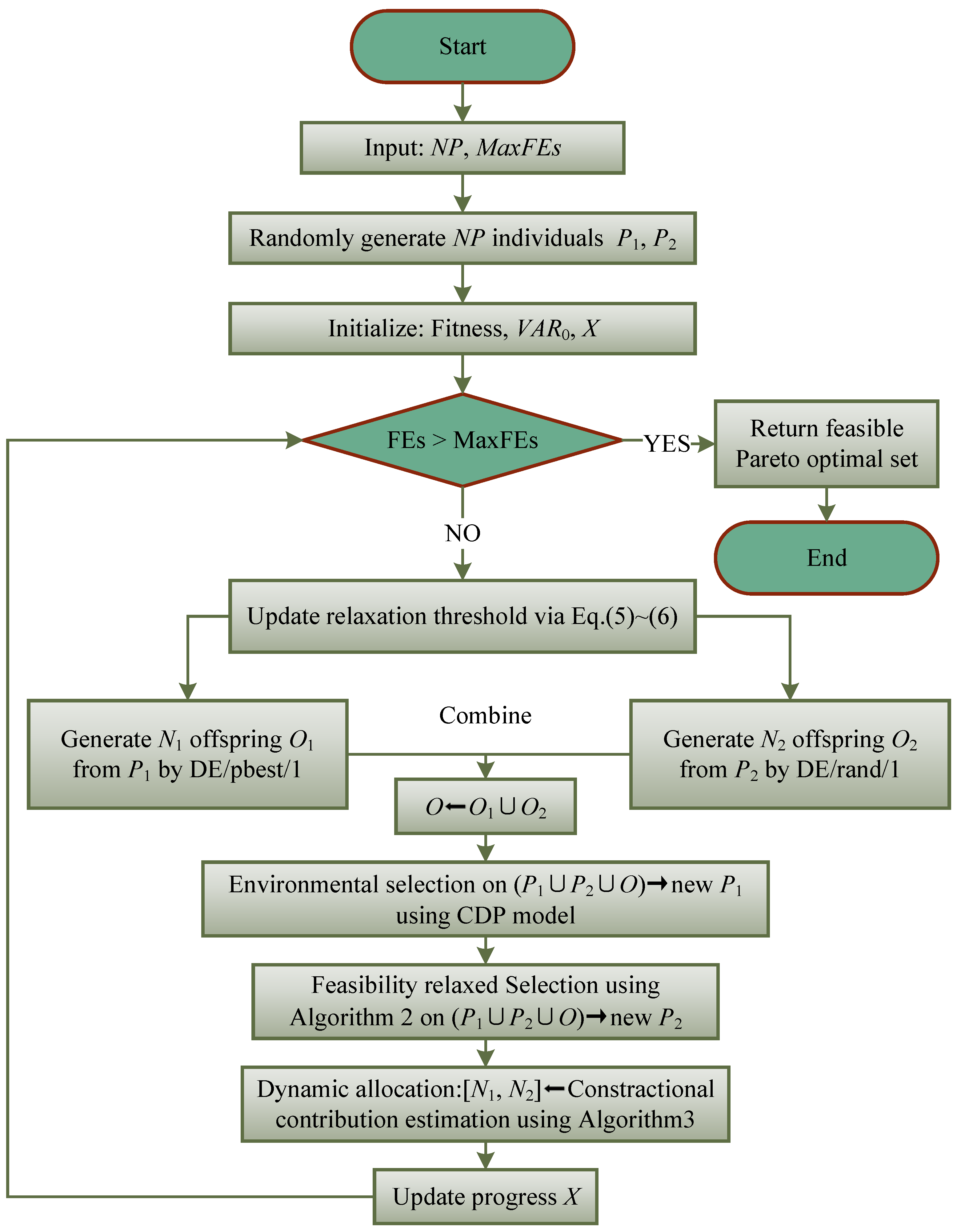
RFSCMOEA is proposed in this paper establishes a dual-population cooperative evolutionary framework designed for CMOPs. The primary objective is to effectively balance convergence, diversity, and feasibility through a division of labor. This framework comprises two core evolutionary distinct pathways: the main population P 1 and the auxiliary population P 2 . The main population focuses on searching for high-quality feasible solutions, employing hybrid Differential Evolution strategies (such as DE/current-to-best/1 and DE/rand/1) to reinforce convergence performance while maintaining diversity. Conversely, the auxiliary population is dedicated to exploring infeasible regions. By incorporating a relaxed feasibility selection model—integrated with non-dominated sorting and nearest-neighbor distance metrics—it excavates potentially promising solutions while mitigating the negative impacts of the infeasible domain. To further enhance search efficiency, the algorithm innovatively introduces a dynamic resource allocation mechanism based on Euclidean distance. By quantifying the relative positional shift between parents and offspring in the objective space (defined as evolutionary contribution), this mechanism adaptively regulates the computational resource ratio between the two populations, ensuring that the population exhibiting higher contribution is allocated more opportunities for offspring generation. The procedure of RFSCMOEA is outlined in Algorithm 1, and the flowchart is illustrated in Figure 1.
The detailed execution flow of the algorithm is summarized as follows: First, key parameters, including the dual populations and the initial constraint violation scale, are initialized. Upon entering the evolutionary loop, the algorithm dynamically updates the constraint relaxation threshold, V A R , based on evolutionary progress. Subsequently, it drives the main and auxiliary populations to generate offspring using convergence-guided operators (e.g., DE/pbest/1) and stochastic exploration operators (e.g., DE/rand/1), respectively. Following reproduction, differentiated environmental selection is performed: the main population is updated strictly adhering to the feasibility-first principle, whereas the auxiliary population executes relaxed feasibility screening within the combined solution set. In cases where feasible solutions are scarce, individuals are supplemented based on their constraint violation degree to ensure population coverage and diversity. At the conclusion of each generation, the algorithm utilizes the convergence contribution estimate to dynamically allocate the offspring size ( N 1 and N 2 ) for the next generation and updates the evolutionary state. This cycle repeats until the termination conditions are met, ultimately outputting the feasible Pareto optimal solution set.
Algorithm 1 The Evolutionary Process of RFSCMOEA
  • Require: Population size N P , maximal evaluations M a x F E s , problem definition P r o b l e m
  • Ensure: The feasible Pareto optimal solutions
1:
P 1 Randomly generate N P individuals (Main task population)
2:
P 2 Randomly generate N P individuals (Auxiliary population)
3:
Evaluate P 1 and P 2
4:
Initialize fitness values and compute initial constraint violation scale V A R 0
5:
Set evolution progress X 0
6:
while termination conditions are not satisfied do
7:
      Update relaxation threshold V A R : using Equation (5)
8:
      Generate N 1 offspring O 1 from P 1 using DE/pbest/1 strategy
9:
      Generate N 2 offspring O 2 from P 2 using DE/rand/1 strategy
10:
    Combine all offspring: O O 1 O 2
11:
     P 1 Perform environmental selection on ( P 1 P 2 O ) using Main_task_EnvironmentalSelection
12:
     P 2 Perform Feasibility-Relaxed Selection in Algorithm 2 on ( P 2 O P 1 )
13:
     [ N 1 , N 2 ] Dynamically allocate offspring numbers using Contractional contribution estimation (Algorithm 3)
14:
    Update progress variable: X X + 1 M a x F E s / N P
15:
end while
Algorithm 2 An Auxiliary Environment Selection Model Based on Feasibility-Relaxed Selection
  • Require:  P 2 , O, A, N P , and V A R
  • Ensure:  P 2
1:
U P 2 O A ;
2:
Evaluate all individuals in U with respect to objectives and constraints;
3:
Normalize objective values and constraint violations;
4:
Identify feasible individuals U f and infeasible individuals U i n f ;
5:
for each individual x U i n f  do
6:
      Compute its relaxed constraint violation based on V A R ;
7:
end for
8:
M 1 individuals satisfying the relaxed feasibility condition;
9:
M 2 U M 1 ;
10:
if  | M 1 | = 0  then
11:
     P 2 CDP ( M 2 ) ;
12:
else if  | M 1 | < N P  then
13:
    Sort M 2 in ascending order according to relaxed constraint violation;
14:
     M a d d select the first ( N P | M 1 | ) individuals from sorted M 2 ;
15:
     M 1 M 1 M a d d ;
16:
    Perform diversity maintenance on M 1 using k-NN distance and non-dominated sorting;
17:
     P 2 M 1 ;
18:
else if  | M 1 | > N P  then
19:
    Sorted_ M 1 non_dominated_sorting ( f ( M 1 ) , g ( M 1 ) ) ;
20:
     P 2 the first N P individuals of Sorted_ M 1 ;
21:
else
22:
     P 2 M 1 ;
23:
end if
24:
Update archive;
Algorithm 3 Contractional Contribution-Based Dynamic Offspring Allocation
  • Require: Parent populations P 1 , P 2 , Offspring populations O 1 , O 2 , total offspring budget B
  • Ensure: Allocated offspring numbers N 1 , N 2 and contribution info
1:
if B is not provided then
2:
     B | P 1 | + | P 2 |
3:
end if
4:
Compute mean Euclidean distance between P 1 and mean of O 1 : d 1
5:
Compute mean Euclidean distance between P 2 and mean of O 2 : d 2
6:
Compute contribution scores: Equation (10)
7:
Allocate offspring:
8:
    N 1 Equation (11)
9:
    N 2 B N 1
10:
i n f o [ μ 1 , μ 2 ]
11:
return  N 1 , N 2 , i n f o

3.2. Relaxed Feasibility Selection Model

To facilitate a progressive evolution in the auxiliary population—transitioning from the exploration of infeasible regions to the approximation of the true feasible Pareto Front—this study introduces a dynamic selection model based on relaxed feasibility.
To prevent the population from becoming trapped in local infeasible regions due to stringent feasibility screening in the early stages, a dynamic relaxation threshold is constructed based on the normalized evolutionary progress X [ 0 , 1 ] . This threshold is defined as follows:
r = ( 1 X ) 2
V A R = C V min + r · ( C V max C V min )
where C V min and C V max represent the minimum and maximum constraint violation values in the current population, respectively. As the evolutionary progress X increases, the relaxation threshold V A R gradually shrinks from a larger value toward C V min . This mechanism achieves a smooth transition from “loose” to “strict” feasibility: allowing the survival of certain infeasible solutions in the early phase to enhance exploration, while enforcing stricter constraints in the middle and late phases to guide the population toward the true feasible Pareto Front.
The screening process operates as follows: First, a set of relaxed feasible solutions, denoted as M 1 , is identified such that for all x M 1 , C V ( x ) V A R . If the size of this set satisfies | M 1 | < N P (where N P is the population size), the remaining individuals M 2 = P M 1 are sorted in ascending order of their constraint violation C V ( x ) . A supplementary set M add is then formed by selecting the top ( N P | M 1 | ) individuals from the sorted M 2 , and the set M 1 is updated as M 1 M 1 M add .
Subsequently, non-dominated sorting is performed on the candidate set to determine the Pareto rank of each individual. Solution x a is said to dominate x b (denoted as x a x b ) if x a is not worse than x b in all objectives and strictly better in at least one. To facilitate uniform density estimation, the objective vectors are normalized:
z i = F ( x i ) F min F max F min , x i P c a n d
where F min and F max denote the minimum and maximum values along each objective dimension in the current set.
To maintain diversity within the objective space, the algorithm introduces a sparsity metric based on neighborhood distance. Specifically, a KD-tree data structure is utilized to index the normalized objective vector set Z = { z 1 , z 2 , , z N } , enabling efficient nearest-neighbor search. For any individual z i Z (assuming | Z | > 1 ), the nearest neighbor index is identified as:
nn ( i ) = arg min j i z i z j 2
Consequently, the Euclidean distance between individual i and its nearest neighbor is calculated:
d i = z i z nn ( i ) 2 = k = 1 M ( z i , k z nn ( i ) , k ) 2
where M is the number of objectives. This distance d i quantifies the local sparsity around individual i; a larger d i indicates a sparser region. This search process is achieved with a time complexity of O ( N log N ) . In the special case where only one individual exists, the distance is set to infinity.
Finally, the environmental selection prioritizes individuals based on a hierarchical criterion: ( FrontNo , d i ) . That is, individuals are first ranked by their non-dominated level (lower is better); within the same level, individuals with a larger nearest-neighbor distance d i are preferred. This strategy effectively eliminates crowded solutions and promotes a uniform distribution along the Pareto Front. Through this integration of relaxed feasibility control and density-based maintenance, the auxiliary population balances the exploration of potential high-quality infeasible solutions in the early stage with the convergence to the feasible boundary in the late stage.

3.3. Dynamic Resource Allocation Based on Shrinking Contribution

To facilitate the adaptive allocation of evolutionary resources during the dual-population cooperative process, this study devises a dynamic offspring allocation mechanism based on the concept of “shrinking contribution” (see Algorithm 3). This mechanism aims to assign varying numbers of offspring to the main ( P 1 ) and auxiliary ( P 2 ) populations based on their relative contributions to search space exploration and convergence at the current evolutionary stage.
Specifically, let O 1 and O 2 denote the offspring populations corresponding to P 1 and P 2 , respectively. A total computational resource budget, B, is introduced to cap the total number of offspring generated across both tasks. If the parameter B is not explicitly predefined, it is automatically determined by the summation of the current sizes of the dual populations to ensure resource consistency:
B =   | P 1 | + | P 2 |
where | P i | represents the number of individuals in population P i . This budget B serves as the upper limit for new individual generation in the current iteration, directly influencing the competitive and cooperative resource dynamics between the main and auxiliary tasks.
In each evolutionary generation, we first calculate the Euclidean distances, d 1 and d 2 , between the centroid vectors of the parent populations ( P 1 , P 2 ) and their respective offspring populations ( O 1 , O 2 ) in the objective space. Generally, for two n-dimensional vectors a = ( a 1 , a 2 , , a n ) and b = ( b 1 , b 2 , , b n ) , the distance is defined as d ( a , b ) = i = 1 n ( a i b i ) 2 . A smaller distance indicates that the offspring are clustered spatially closer to their parents, suggesting a stronger convergence trend (“shrinking” movement) for that population in the current phase. Conversely, a larger distance implies a tendency toward maintaining diversity or exploring disparate regions. We note that a small centroid shift may also be caused by stagnation rather than productive fine-tuning. Therefore, the shrinking-distance signal is interpreted within the dual-population cooperative framework instead of being used as an isolated indicator of “goodness”. In particular, the auxiliary population P 2 is designed to maintain exploration pressure through relaxed-feasibility evolution and density-aware selection, which preserves sparse regions and discourages premature collapse of diversity. This sustained diversity in P 2 provides alternative search directions and candidate solutions that can be injected into the cooperative process, alleviating the risk of reinforcing a locally stagnant P 1 .
Based on this characteristic, the shift distances d 1 and d 2 are transformed into corresponding contribution scores μ 1 and μ 2 using an inverse mapping:
μ 1 = 1 1 + d 1 , μ 2 = 1 1 + d 2
This transformation converts the average shift distance d into a “contribution” metric, where a decrease in d results in a higher μ , thereby establishing a positive correlation between convergence behavior and the contribution score. Intuitively, this favors allocating more resources to the population exhibiting a stronger “shrinking” tendency; meanwhile, the algorithm relies on the auxiliary task’s diversity maintenance to ensure that exploration does not vanish when the main population becomes locally stationary. Even when P 1 shows small shifts, P 2 continues to generate offspring spanning diverse regions, so the cooperative search retains mobility and can escape from locally trapped modes.
Subsequently, the total computational budget B is distributed between the two populations according to the relative ratio of their contribution scores μ 1 and μ 2 , determining the offspring sizes N 1 and N 2 for the next generation:
N 1 = round B · μ 1 μ 1 + μ 2 , N 2 = B N 1
Importantly, the allocation is recalculated at every generation and is coupled with the cooperative evolution operators and environmental selection. If P 1 is truly stagnant, its offspring tend to be highly similar and are less likely to introduce meaningful new search directions, whereas the diversity-preserving evolution of P 2 can still produce novel candidates. Through the dual-population cooperation, these diverse candidates serve as a continuing source of exploration pressure, preventing the algorithm from being dominated by a “stopped-moving” population.
This resource allocation strategy possesses inherent adaptivity. When μ 1 > μ 2 , the main population demonstrates a higher contribution in the current stage; consequently, the algorithm sets N 1 > N 2 , granting it a larger share of resources. Conversely, if μ 2 > μ 1 , the auxiliary population exhibits superior performance—potentially in effective local exploration or diversity maintenance—resulting in an increased allocation proportion. By dynamically adjusting resources based on these real-time relative contributions, the algorithm continuously optimizes the balance between exploration and exploitation, thereby enhancing overall optimization performance. In this sense, P 1 primarily focuses on exploitation, while P 2 acts as a diversity-preserving “safety valve” that keeps exploring and supplies alternative directions to counteract the potential stagnation implied by a small centroid shift.

3.4. Evolutionary Operators

Prior research [5,35] indicates that distinct Differential Evolution (DE) operators exhibit specific search biases in multi-objective optimization. Specifically, the DE/current-to-best/1 operator demonstrates strong convergence guidance, accelerating the population toward high-quality regions, whereas DE/rand/1 effectively maintains population diversity, preventing premature convergence to local optima. Aligning with the functional division inherent in the dual-population cooperative strategy—where the main population P 1 prioritizes convergence and the auxiliary population P 2 focuses on diversity—this study assigns DE/current-to-best/1 to P 1 to generate offspring O 1 , and DE/rand/1 to P 2 to generate offspring O 2 . The formulations of these operators are as follows:
DE / current - to - best / 1 : O 1 = P r 1 + F · ( P b e s t P r 1 ) + ( P r 2 P r 3 )
DE / rand / 1 : O 2 = P r 1 + F · ( P r 2 P r 3 )
In the specific implementation of the DE/current-to-best/1 operator, the vectors P r 1 and P r 3 are randomly selected from the auxiliary population P 2 to enhance perturbation, while P r 2 is selected from the main population P 1 to ensure the transmission of convergence information. P b e s t represents an individual selected from the top 10% of P 1 , ranked according to the CDP, thereby providing effective guidance toward feasibility and optimality.
Conversely, for the DE/rand/1 operator, P r 1 and P r 2 are randomly drawn from P 2 to promote diversity, while P r 3 is selected from P 1 . This cross-population selection facilitates a moderate transfer of convergence information, preventing the auxiliary population from diverging completely from feasible or convergent regions.
The number of offspring generated, N 1 and N 2 , is determined by the dynamic resource allocation mechanism described previously. Furthermore, consistent with the parameter settings in [35], the scaling factor F is selected from { 0.6 , 0.8 , 1.0 } and the crossover probability C R from { 0.1 , 0.2 , 1.0 } , ensuring a robust balance between exploration and exploitation. Following the differential operations, polynomial mutation is applied to the offspring to enhance local search capability; as this process follows standard protocols described in [35], further elaboration is omitted.

3.5. Complexity Analysis

The computational complexity of RFSCMOEA is primarily determined by three core components: the basic evolutionary operators, the relaxed feasibility selection model, and the dynamic resource allocation mechanism. The relaxed feasibility selection model involves constraint handling, non-dominated sorting, and density estimation via k-nearest neighbor search. Specifically, calculating the constraint violations requires O ( N · L ) operations. The non-dominated sorting constitutes the primary computational bottleneck, with a worst-case time complexity of O ( M · N 2 ) . The objective normalization and the KD-tree-based nearest neighbor search are performed with complexities of O ( M · N ) and O ( N log N ) , respectively. The dynamic resource allocation mechanism optimizes the offspring distribution by computing the Euclidean distances between the centroids of the parent and offspring populations. This process involves a complexity of O ( N · M ) , which is computationally negligible compared to the sorting procedure. The basic differential evolution and polynomial mutation operators scale linearly with the decision space, requiring O ( N · D ) . Consequently, the overall computational complexity of RFSCMOEA per generation can be summarized as: O total O ( M · N 2 ) + O ( N · D ) . Given that N, M, and D are typically constants defined by the problem scale, the complexity of RFSCMOEA remains consistent with standard constrained multi-objective evolutionary algorithms (such as NSGA-II), ensuring its applicability to computationally expensive problems.

4. Experimental Setup

4.1. Comparative Algorithms and Parameters

To systematically assess the performance of RFSCMOEA, we benchmark it against eight state-of-the-art constrained multi-objective evolutionary algorithms: PPS [6], MOEA/D-2WA [13], BiCo [4], A-NSGA-III [36], APSEA [37], MSCMO [38], CMODE-FTR [39], and θ -DEA-CPBI [40]. For a fair comparison, the specific parameter settings for all competitor algorithms are strictly configured in accordance with their respective original publications. These parameters are shown in Table 1.
The experimental design involves 30 independent runs for each algorithm on every test instance. To maintain consistency, the population size is set to 100, and the maximum number of function evaluations is fixed at 10 5 . All simulations are conducted using the PlatEMO platform [41].

4.2. Test Problems and Performance Metrics

To systematically evaluate the comprehensive capabilities of RFSCMOEA in balancing feasibility, diversity, and convergence, this study employs a diverse set of benchmark suites, including MW [42], CF [43], DASCMOP [44], and LIRCMOP [45]. These suites comprise 14, 10, 9, and 14 test functions, respectively, offering a wide range of constraint types and landscape complexities. Furthermore, to validate the algorithm’s robustness and applicability in addressing complex practical challenges, we include 12 real-world engineering problems selected from the RWMOP suite [46]. Detailed specifications of these engineering problems are provided in Table 2.
For the quantitative assessment of performance, three standard metrics are utilized: Inverted Generational Distance (IGD) [47], Hypervolume (HV) [48], and Feasible Solution Ratio (FSR) [49]. The IGD metric calculates the average distance between the individuals in the obtained solution set and the true Pareto Front; a lower IGD value indicates superior convergence accuracy and coverage. The HV metric measures the volume of the hypercube bounded by the solution set and a reference point in the objective space, where a larger value signifies a better comprehensive performance in terms of both convergence and diversity. Finally, the FSR quantifies the proportion of feasible solutions within the final population, with higher values reflecting the algorithm’s effectiveness in satisfying constraints and maintaining feasibility throughout the optimization process.

5. Experimental Analysis

Table 3 and Table 4 present the statistical results for the IGD and HV metrics obtained across four benchmark suites and 12 real-world engineering problems. To assess pairwise performance differences, the Wilcoxon rank-sum test at a 0.05 significance level is employed. In the reported tables, the symbols ‘+’, ‘−’, and ‘=’ indicate that the comparative method performs significantly better than, significantly worse than, or statistically similarly to the proposed algorithm, respectively. For instances where feasible solutions were not consistently obtained across all independent runs, the IGD and HV values are recorded as NaN, and the FSR is provided in parentheses. The boldfaced text in the table indicates the optimal solution among the comparative algorithms.

5.1. Comparison on CF Test Set

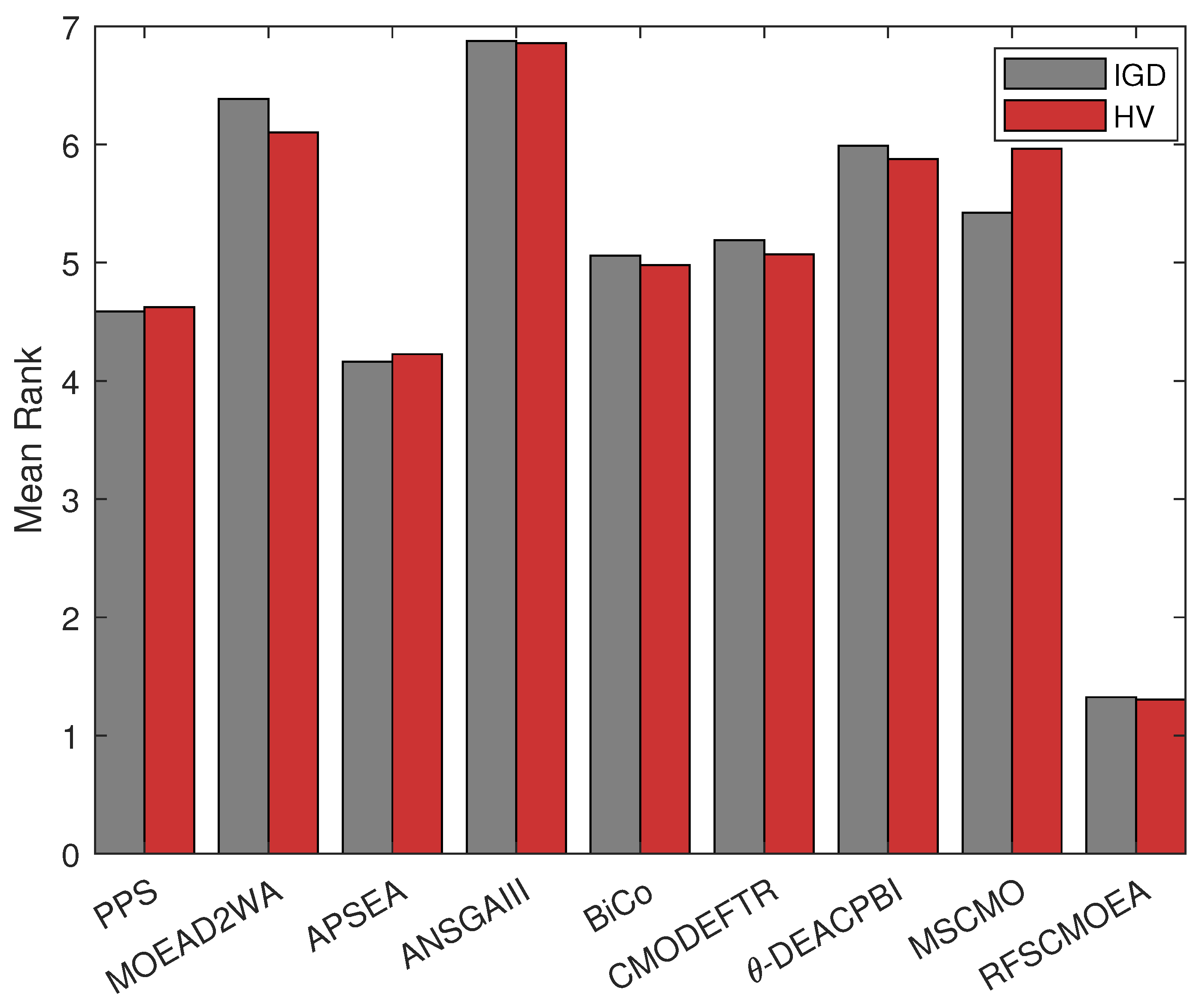
The CF test suite is particularly informative for diagnosing an algorithm’s constraint-handling behavior, because its feasible regions are often fragmented, narrow, or highly irregular, and the conflict between objectives and constraints is intentionally amplified. These characteristics make CF problems a stress test for any mechanism that claims to balance convergence, diversity, and feasibility under complex constraints. The results in Table 3 and Table 4 indicate that RFSCMOEA is consistently better aligned with these requirements. RFSCMOEA achieves the best IGD and HV on eight functions (CF1 and CF3–CF9), suggesting that its search process can simultaneously maintain feasibility progress and diversity across difficult feasible structures. This advantage is closely related to the algorithm’s key design—its relaxed feasibility selection strategy—which prevents the search from being overly conservative while still enforcing a directed pressure toward feasibility. As a consequence, RFSCMOEA can explore effectively around the feasibility boundary and refine convergence toward the CPF without collapsing diversity, which is exactly the failure mode that often appears on CF landscapes. In contrast, the compared algorithms tend to show strengths only under specific constraint patterns, reflecting weaker robustness across heterogeneous CF difficulties. For example, PPS achieves the best performance only on CF2, and APSEA is optimal on CF10 and competitive on CF8 in IGD, but their advantages do not generalize across the suite. Similarly, MOEAD2WA and MSCMO obtain sub-optimal HV on CF9 and CF8, respectively, yet do not dominate on any single function. This “isolated wins” pattern implies that their constraint-handling or selection pressure is more sensitive to the particular feasible geometry of each CF instance. The Friedman mean-rank results in Figure 2 further support this observation: RFSCMOEA ranks first on both IGD and HV, indicating a statistically consistent dominance rather than sporadic improvements. Overall, although RFSCMOEA is not the best on a few isolated cases, its broad superiority on most CF functions demonstrates stronger comprehensive competitiveness. More importantly, the consistency of these gains suggests that the proposed relaxed feasibility selection contributes not merely to better objective convergence, but to a more stable balance among convergence, diversity, and feasibility across diverse and challenging constraint environments—precisely the capability targeted by the algorithm’s design.

5.2. Comparison on DAS-CMOP Test Set

The DAS-CMOP test suite is particularly suitable for analyzing an algorithm’s robustness under controllable constraint difficulty, because its parameterization can independently or jointly adjust feasible-region size, constraint strength, objective-conflict level, and landscape structure. The statistical results in Table 3 and Table 4 support that RFSCMOEA is well aligned with these requirements. RFSCMOEA achieves the best IGD and HV on six instances (DASCMOP1, DASCMOP3–DASCMOP6, and DASCMOP9), and remains near-optimal on DASCMOP7 and DASCMOP8, indicating a stable balance between convergence and diversity across varying constraint difficulties. In contrast, the compared algorithms show more scenario-dependent behavior. For example, CMODEFTR attains the lowest IGD only on DASCMOP2 while APSEA and θ -DEA-CPBI achieve the best HV on DASCMOP7 and DASCMOP8, respectively, but perform noticeably worse on more challenging instances such as DASCMOP1, DASCMOP3, and DASCMOP6. This pattern suggests that their constraint-handling and selection pressures are less robust to the difficulty shift encoded by DAS-CMOP, leading to limited generalization across instances. Feasibility maintenance further highlights the difference in robustness. Only RFSCMOEA, PPS, and CMODEFTR achieve full feasibility coverage across all instances, consistently generating feasible solutions, whereas several algorithms fail on part of the suite. Notably, MSCMO produces NaN results on multiple instances, implying that it fails to locate feasible solutions under stronger constraints, which reveals a structural weakness in handling difficult feasibility landscapes. The Friedman mean-rank results in Figure 2 further corroborate the overall conclusion: RFSCMOEA ranks first, with a clear advantage in IGD, while other relatively robust methods such as PPS and CMODEFTR remain significantly behind. Overall, RFSCMOEA demonstrates the strongest comprehensive performance on the DAS-CMOP suite. Beyond obtaining the largest number of best results, its consistent feasibility coverage and stable IGD/HV behavior across difficulty-controlled instances indicate that the proposed relaxed feasibility selection provides a reliable mechanism for maintaining the convergence–diversity–feasibility balance under high-difficulty constrained scenarios.

5.3. Comparison on LIR-CMOP Test Set

The LIR-CMOP test suite is designed to stress-test constrained multi-objective optimizers under irregular feasible regions and complex constraint interactions. Unlike benchmarks with relatively regular or continuous feasible domains, LIR-CMOP deliberately constructs discontinuous, fragmented, and highly irregular feasible regions, where feasible solutions may become dispersed or even isolated in both decision and objective spaces. Such structures significantly increase the difficulty of locating feasible solutions from random initialization and maintaining a diverse feasible set once feasibility is reached. The Wilcoxon signed-rank test results in Table 3 and Table 4 confirm that RFSCMOEA achieves a statistically consistent advantage. It outperforms the comparative algorithms far more frequently than it is outperformed. Although PPS and CMODEFTR are competitive with RFSCMOEA on HV for a few instances, RFSCMOEA maintains a clear lead on IGD, indicating more reliable convergence behavior under irregular feasibility landscapes. RFSCMOEA attains the best IGD values on 11 functions, including LIRCMOP1–LIRCMOP4 and LIRCMOP7–LIRCMOP13, whereas CMODEFTR and PPS are optimal only on LIRCMOP6 and LIRCMOP5, respectively. For HV, RFSCMOEA leads on seven problems, including LIRCMOP3, LIRCMOP4, and LIRCMOP9–LIRCMOP13, while CMODEFTR and PPS obtain the best results only on limited subsets. This isolated-wins pattern suggests that the competing methods are more sensitive to particular feasible geometries and thus less robust across diverse irregular cases. A-NSGA-III performs competitively only on a few instances and lags behind on most LIR-CMOP problems. Under extremely small or discontinuous feasible domains, selection mechanisms based primarily on dominance ranking may struggle to simultaneously maintain diversity and preserve sufficient convergence pressure, which can cause the search to drift or stagnate. The feasibility acquisition results provide further evidence of robustness. RFSCMOEA consistently generates feasible solutions across all 14 functions, indicating strong stability in feasibility maintenance under highly irregular constraint scenarios.

5.4. Comparison on MW Test Set

The MW test suite emphasizes multimodality, strong constraint coupling, and highly non-convex feasible-region structures. Its constraints may induce many locally infeasible basins in the decision space, which increases the difficulty of discovering feasible solutions and maintaining feasibility while approaching the constrained Pareto front. Therefore, MW problems are highly discriminative for assessing an algorithm’s ability to escape locally infeasible regions and to balance feasibility maintenance, convergence accuracy, and diversity preservation under complex constraints. The results in Table 3 show that RFSCMOEA achieves strong and consistent convergence performance on the MW suite. It obtains the best IGD values on ten functions, including MW1, MW2, MW4–MW6, MW8–MW10, MW12, and MW13. The remaining best results are achieved by APSEA on MW11 and MSCMO on MW7 and MW14, which indicates that these competitors exhibit advantages on specific instances but do not generalize as consistently as RFSCMOEA across heterogeneous MW landscapes. The diversity results in Table 4 further support the above observation. RFSCMOEA achieves the best HV values on eleven functions and remains competitive on the remaining instances such as MW2, MW7, and MW11, suggesting that it can preserve a well-spread set of feasible solutions while improving convergence. The comparative algorithms also exhibit markedly different feasibility robustness on MW. In particular, MOEA/D-2WA, A-NSGA-III, and BiCo return ‘NaN’ on 5–6 functions, which indicates that no feasible solutions are obtained on those instances and the optimization becomes ineffective for the corresponding cases. This phenomenon is consistent with the fact that, under MW’s tightly coupled constraints and irregular feasible regions, a purely random initialization may place most individuals far away from the feasible boundary, and the subsequent variation operators may fail to generate feasible offspring within a limited budget. Moreover, once the search is attracted into locally infeasible basins, insufficient feasibility-guided selection pressure and non-adaptive variation may lead to repeated exploration in invalid regions and persistent failure to recover feasibility. In contrast, RFSCMOEA consistently outputs feasible solutions across all 14 functions without any NaN values, demonstrating stronger feasibility acquisition and maintenance under extremely complex constrained scenarios. Overall, the MW results indicate that RFSCMOEA provides a more stable balance among feasibility maintenance, convergence accuracy, and diversity preservation. Meanwhile, several comparative methods show either instance-specific strengths or severe feasibility defects on MW, which explains their consistently inferior overall performance on this suite.

5.5. Comparison on RWMOP Test Set

According to the statistical data presented in Table 3, RFSCMOEA demonstrates exceptional convergence accuracy when addressing Real-World Multi-Objective Problems (RWMOP). Specifically, it achieves the optimal IGD values on seven test instances: RWMOP1, RWMOP3, RWMOP5, RWMOP8–RWMOP10, and RWMOP12. In comparison, the competitor algorithms exhibit competitiveness only on isolated problems; for instance, A-NSGA-III and PPS achieve the lowest IGD solely on RWMOP4. Regarding diversity metrics (Table 4), the advantage of RFSCMOEA is even more pronounced, as it secures the best HV values on a total of 10 test functions: RWMOP1, RWMOP3–RWMOP5, and RWMOP7–RWMOP12. Although BiCo performs best on RWMOP2 and θ -DEA-CPBI achieves the optimal HV on RWMOP12, their overall victory counts are far fewer than those of RFSCMOEA. Notably, BiCo and θ -DEA-CPBI fail to obtain the optimal IGD on any test function. This shortfall may be attributed to a lack of effective balance between exploration and exploitation in the objective space, which hinders their ability to simultaneously satisfy convergence and diversity requirements. In summary, RFSCMOEA captures the vast majority of the best IGD and HV results. While some comparative algorithms demonstrate optimization capabilities on specific engineering problems, the aggregate results from Table 3 and Table 4 confirm that the performance superiority of RFSCMOEA over all competitors is statistically significant. These outcomes fully demonstrate that RFSCMOEA possesses strong competitiveness and robustness—across convergence, diversity, and feasibility dimensions—when facing RWMOPs characterized by complex constraints. The final statistics regarding the number of optimal solutions further attest to the balanced and superior comprehensive performance of RFSCMOEA in solving CMOPs.

5.6. Convergence Behavior Analysis

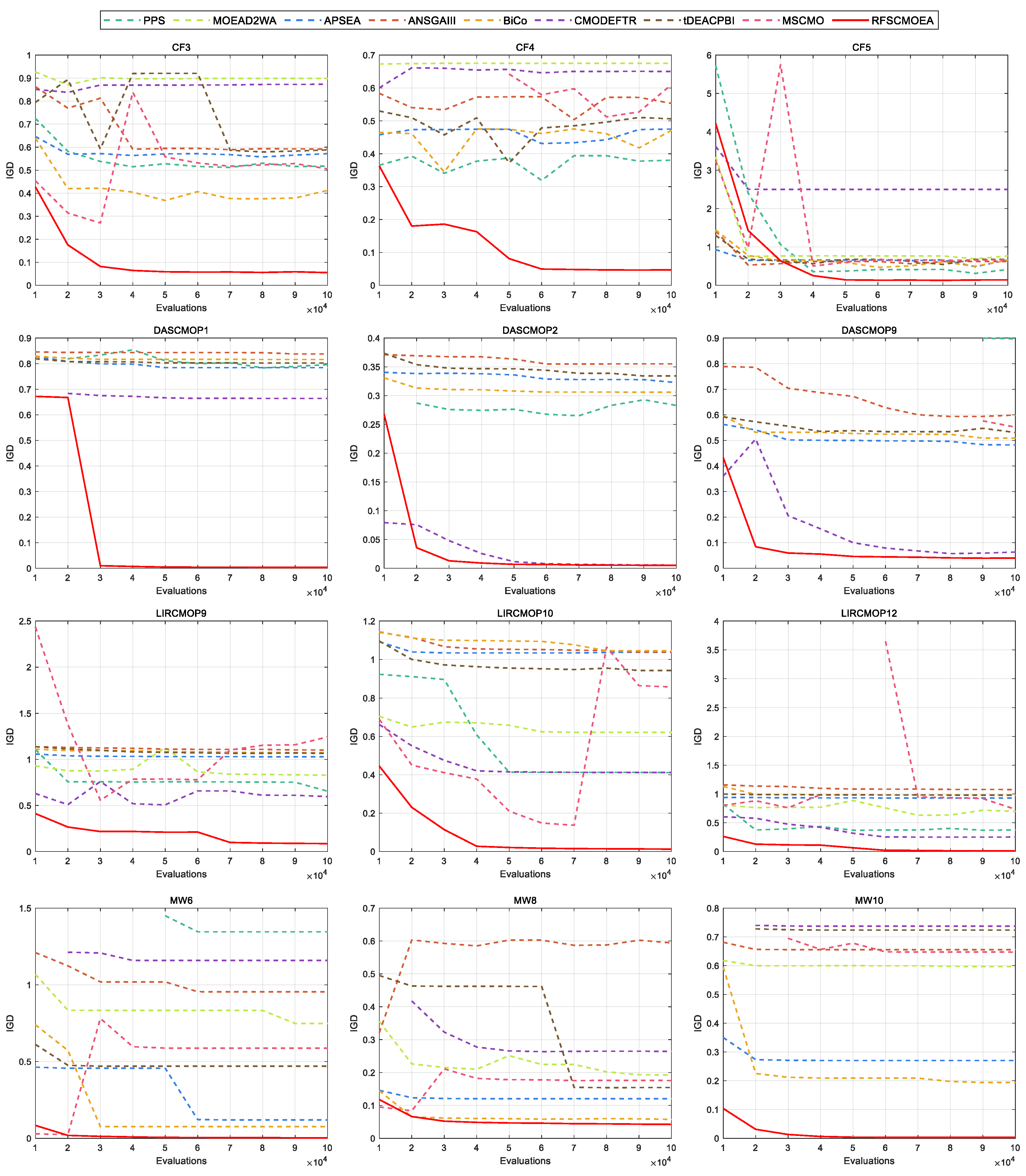
Figure 3 illustrates the evolutionary trajectories of the IGD metric (calculated based on feasible solutions) for RFSCMOEA and eight comparative algorithms over 100,000 evaluations. Observing the general trends, RFSCMOEA exhibits superior convergence efficiency and robustness, regardless of the topological characteristics of the feasible regions. Specifically, on test problems characterized by highly complex constraint structures, such as CF3, CF4, and CF5, the convergence curves of RFSCMOEA consistently maintain the lowest levels and exhibit the steepest descent. This performance is primarily attributed to the efficient cross-population information transfer strategy, which enables the algorithm to synergistically leverage information from multiple search areas to rapidly approximate the CPF. Similarly, in DASCMOP1, DASCMOP2, and DASCMOP9, which feature complex distributions in the objective space, RFSCMOEA maintains a leading convergence speed, corroborating its strong adaptability to diverse types of CMOPs. Regarding test functions where the CPF consists of multiple discontinuous segments (e.g., LIRCMOP9, LIRCMOP10, LIRCMOP12, MW6, and MW10), RFSCMOEA benefits from its robust solution distribution maintenance and global search capabilities. It rapidly covers the complete CPF in the early evolutionary stages, resulting in an IGD descent rate significantly faster than that of other algorithms, allowing it to quickly stabilize at minimal levels. It is worth noting that although the IGD value of RFSCMOEA is slightly higher than some competitors during the initial phase (approximately the first 30,000 evaluations) on MW8, it swiftly escapes local optima and surpasses the others as evolution progresses, eventually converging to the true Pareto Front. This phenomenon fully demonstrates the algorithm’s powerful capability to break out of local traps and locate the global optimum in the later stages. In terms of the trade-off between feasibility and convergence efficiency, algorithms such as MOEA/D-2WA and A-NSGA-III—while capable of generating feasible solutions in certain scenarios—exhibit slow descent rates and suffer from long-term stagnation in high IGD ranges, performing significantly worse than RFSCMOEA. Meanwhile, PPS and APSEA display severe volatility and a lack of stability across multiple problems. In conclusion, whether facing narrow, wide, or disjoint CPF structures, RFSCMOEA maintains a rapid and smooth convergence trend throughout the evaluation process, demonstrating optimal comprehensive convergence performance.

5.7. Diversity Analysis

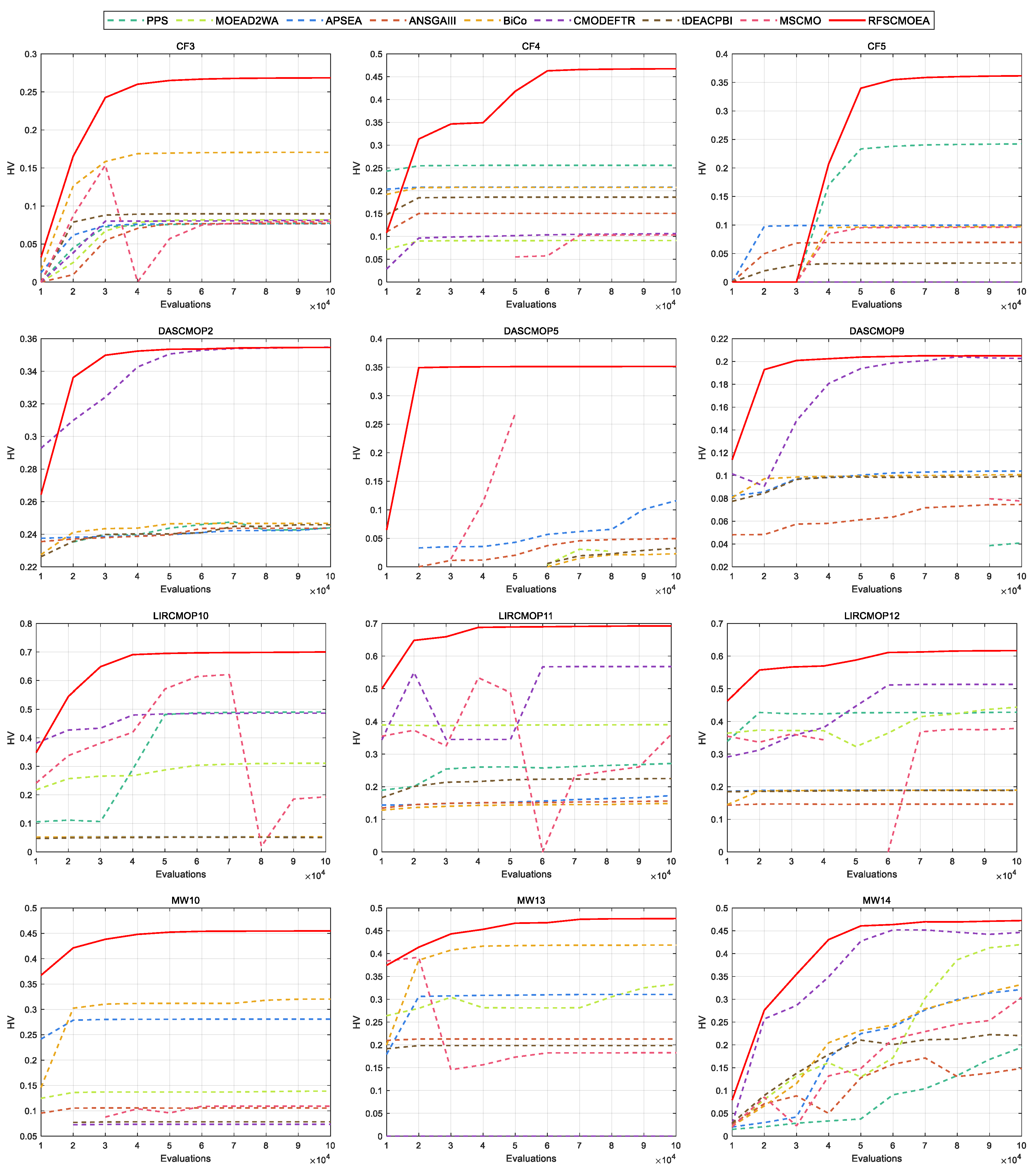
Figure 4 further illustrates the evolutionary trajectories of the HV metric over 100,000 evaluations, intuitively reflecting the dynamic characteristics of population diversity throughout the optimization process. The trajectories indicate that RFSCMOEA establishes a significant diversity advantage in the early evolutionary stages (approximately the first 20,000 evaluations). Particularly on problems such as CF3, CF5, DASCMOP2, and DASCMOP9, the HV curve of RFSCMOEA consistently occupies the highest position with the steepest ascending slope, suggesting a continuous and rapid expansion of the solution set’s coverage in the objective space. For difficult scenarios characterized by complex objective space distributions (e.g., LIRCMOP10, LIRCMOP12) or discontinuous multi-segment CPFs (e.g., MW6, MW14), the HV curves of comparative algorithms often plateau prematurely or exhibit violent oscillations, indicating stagnation in local optima. In contrast, RFSCMOEA maintains a steady upward trend, ultimately securing a solution set with superior uniformity and breadth. This advantage is primarily attributed to RFSCMOEA’s efficient population diversity maintenance mechanism, which adaptively regulates the exploration and exploitation of the objective space, effectively preventing premature convergence and ensuring rapid coverage of the entire Constrained Pareto Front. For problems such as CF2, MW2, and the RWMOP series, the HV curve of RFSCMOEA reaches a stable high-value level by the mid-evolutionary stage (approximately 50,000 evaluations), with final metrics far exceeding those of the competitors. This corroborates its dual advantage in both convergence speed and final solution quality. Conversely, MOEA/D-2WA and APSEA not only exhibit lower overall levels but also show distinct oscillations in certain tests, reflecting instability in solution distribution under complex constraints. Overall, RFSCMOEA demonstrates optimal diversity evolution trends across different types of test functions, forming a strong synergy with its convergence performance, and significantly outperforming all comparative algorithms.
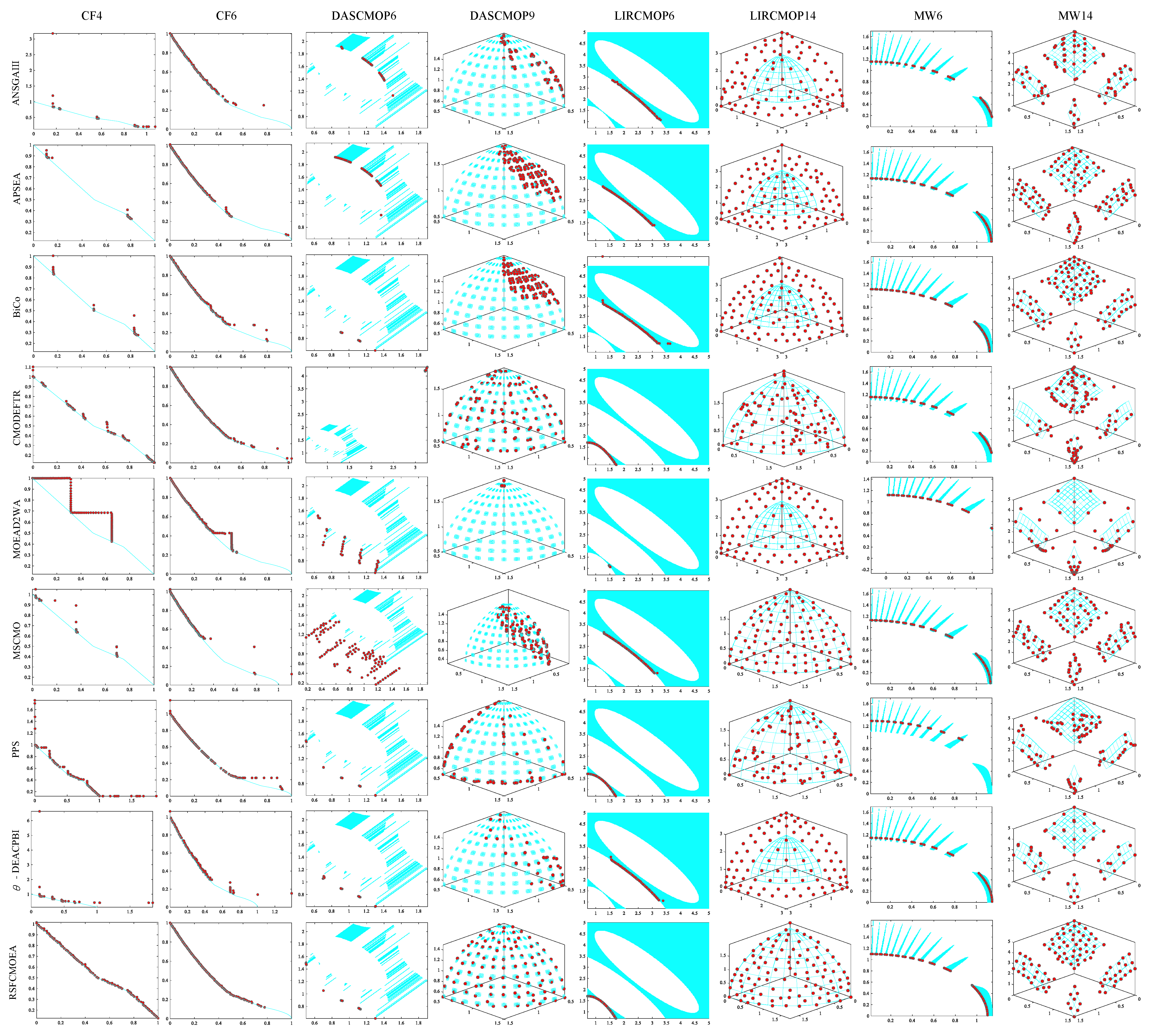
Figure 5 visually presents the final population distributions of RFSCMOEA and various comparative algorithms on representative test functions, including DASCMOP6, DASCMOP9, CF4, CF6, LIRCMOP6, LIRCMOP14, MW6, and MW14 (with population size N P = 100 and maximum evaluations M a x F E s = 100 , 000 ). The visualization clearly reveals that RFSCMOEA exhibits exceptional diversity maintenance across the vast majority of test scenarios, with individuals covering the entire feasible Pareto Front uniformly and broadly. This superior distribution characteristic is largely due to the relaxed feasibility selection mechanism, which effectively balances convergence pressure with population exploration behaviors, thereby preventing the algorithm from becoming trapped in local feasible regions. In contrast, BiCo shows distinct signs of premature convergence on multiple test problems, with populations highly clustered in local areas and failing to extend across the entire front. Although A-NSGA-III maintains a certain degree of breadth on some problems, its uniformity and coverage on complex discontinuous fronts (e.g., LIRCMOP14 and MW6) are significantly weaker than those of RFSCMOEA. Regarding the CF4 function, the populations of CMODEFTR and MOEA/D-2WA display significant band-like dense clustering, resulting in severe coverage gaps on the Pareto Front, whereas RFSCMOEA successfully achieves uniform diffusion across key regions. Furthermore, in DASCMOP6 and LIRCMOP6, MSCMO and θ -DEA-CPBI expose defects related to local aggregation, which limits their diversity performance. While PPS manages to explore parts of the front on MW14, its overall distribution remains sparse, likely because its fitness adjustment strategy fails to adequately address global exploration requirements for such problems. In summary, RFSCMOEA maintains a uniform and comprehensive population distribution across various test functions with distinct geometric features, confirming its significant advantage in diversity preservation.

5.8. Statistical Analysis

Table 5 and Table 6 summarize the results of the Wilcoxon signed-rank test comparing RFSCMOEA against the eight state-of-the-art algorithms across both IGD and HV metrics. The statistical data reveal that in all pairwise comparisons, the sum of positive ranks ( R + ) for RFSCMOEA is significantly higher than the sum of negative ranks ( R ). Furthermore, the computed p-values are consistently far below the significance level of 0.05 . These results provide strong statistical evidence confirming the significant superiority of RFSCMOEA in terms of both convergence quality and solution set distribution. Notably, when compared against advanced algorithms such as A-NSGA-III and BiCo, RFSCMOEA not only demonstrates an overwhelming dominance in R + values but also yields p-values as low as the 10 10 magnitude. This further underscores the method’s exceptional performance and robustness when addressing complex constrained problems. In addition to convergence and diversity, computational efficiency is a critical metric for evaluating algorithmic performance. Table 7 reports the average running time of 30 independent runs for all compared algorithms across the four benchmark suites. The results demonstrate that RFSCMOEA achieves the lowest computational cost on all test suites, exhibiting a clear speed advantage. Specifically, on the CF and DASCMOP suites, RFSCMOEA is approximately 1.3∼4 times faster than competitors such as PPS and MOEA/D-2WA. Even compared to efficient algorithms like CMODE-FTR and BiCo, RFSCMOEA maintains a leading position, particularly on the LIRCMOP suite, where it requires only 7.3672 s on average. This high efficiency is primarily attributed to the proposed dual-population mechanism, where the dynamic resource allocation strategy effectively reduces ineffective searches, and the relaxed feasibility selection avoids computationally expensive operations often found in complex constraint-handling techniques. Consequently, RFSCMOEA achieves a superior balance between optimization performance and time complexity. In conclusion, the statistical analysis fully corroborates that RFSCMOEA exhibits a systematic performance lead over existing representative algorithms, delivering not only superior solution quality in terms of IGD and HV but also exceptional computational efficiency.

5.9. Ablation Studies

As presented in Table 8 and Table 9, the complete RFSCMOEA consistently outperforms all six ablation variants across both IGD and HV metrics. Specifically, RFSCMOEA achieves superior convergence and diversity on the majority of test problems. Furthermore, the corresponding p-values from the Wilcoxon signed-rank test are consistently well below 0.001, confirming that the performance improvements of the complete algorithm over each variant are statistically significant at the 0.05 level.
A detailed analysis of these variants elucidates the specific contributions of each module. The noticeable performance degradation in RFSCMOEA-A, RFSCMOEA-B, and RFSCMOEA-C—where the auxiliary population’s environmental selection is replaced by the traditional ε -constraint model, strict feasibility separation, and the CDP model, respectively—clearly demonstrates the effectiveness of the proposed relaxed feasibility strategy. These results indicate that the weak-feasibility screening mechanism, together with the environmental selection based on non-dominated sorting and neighborhood sparsity, is crucial for jointly achieving feasibility preservation, boundary exploration, and diversity maintenance. In contrast, conventional constraint-handling techniques tend to prematurely eliminate near-feasible solutions with high optimization potential, thereby hindering the progressive approximation of the constrained Pareto front. For RFSCMOEA-D, in which the population sizes are fixed to a constant N P , the algorithm loses the ability to adaptively allocate computational resources across different evolutionary stages. Its inferior performance highlights that the proposed dynamic offspring allocation strategy based on shrinking contribution can effectively quantify the effective evolutionary contribution of each population. By biasing computational resources toward the more productive population, this mechanism enhances global search efficiency and minimizes ineffective computational overhead. Furthermore, RFSCMOEA-F, which substitutes the Euclidean shift distance with hypervolume improvement ( Δ HV) for resource allocation, also exhibits statistically inferior performance compared to the proposed framework. This outcome suggests that the Euclidean shift distance offers a more robust metric for quantifying evolutionary momentum in this dual-population context. While Δ HV effectively measures diversity and convergence in the objective space, it may become insensitive when the population is refining solutions locally or exploring infeasible regions without immediate hypervolume expansion. Consequently, relying solely on Δ HV can lead to stagnated resource distribution strategies, whereas the Euclidean shift captures continuous population movement, ensuring a more responsive and steady allocation of computational effort. Similarly, the reduced performance of RFSCMOEA-E, where cross-population differential crossover is eliminated, underscores the importance of information exchange. Restricting the DE/current-to-best/1 and DE/rand/1 operators to their respective populations prevents the sufficient coupling of convergence information from the main population with the exploration capability of the auxiliary population, resulting in a decline in both convergence and diversity.
In summary, the ablation results demonstrate that the relaxed feasibility selection model, the hierarchical constraint handling of weak/infeasible solutions, the dynamic resource allocation based on shrinking contribution, and the cross-population operators constitute the integral structural units of RFSCMOEA. The removal or alteration of any single mechanism compromises the algorithm’s comprehensive advantages, thereby confirming the necessity and effectiveness of the proposed holistic framework.

5.10. Discussion of Performance Limitation

Although RFSCMOEA performs exceptionally well across various benchmark problems, ranking first in IGD and HV metrics in most scenarios and demonstrating statistical significance through the Wilcoxon Signed Rank Test, it still reveals limitations of its existing framework in specific problems such as CF10, DASCMOP2, and LIRCMOP14, providing direction for future improvements. In CF10, RFSCMOEA failed to obtain an efficient feasible solution, consistent with most comparative algorithms. This problem exhibits extremely complex constraint couplings and discontinuous Pareto fronts, making it difficult for the algorithm to overcome constraint barriers, and the population evolution gets stuck in a region of no feasible solutions. In LIRCMOP14, RFSCMOEA ranked only second in IGD, and its HV metric was on par with MSCMO, failing to maintain its leading advantage in other LIRCMOP subproblems. It is speculated that this problem’s objective function gradient conflicts and local optimum traps cause an imbalance in the algorithm’s population update mechanism between exploring the global optimum and utilizing local advantages, and the auxiliary search fails to effectively avoid misleading constraint boundaries. These findings suggest two key directions for improvement: first, design an adaptive constraint handling mechanism to dynamically adjust the search strategy for different types of constraint problems, thereby improving the ability to discover feasible solutions in complex constraint scenarios; second, optimize the population diversity maintenance strategy by introducing search direction guidance based on problem characteristics to avoid premature convergence in non-convex or discontinuous frontier regions.

6. Conclusions

This paper proposes a RFSCMOEA to address the fundamental challenge of balancing feasibility, convergence, and diversity in CMOPs. The proposed framework is distinguished by three core innovations. First, a relaxed feasibility threshold model is constructed to dynamically distinguish between “near-feasible” and “infeasible” solutions. By quantifying constraint violations and adaptively supplementing the population, this mechanism significantly enhances survivability in narrow or discontinuous feasible regions. Second, a dual-criterion environmental selection strategy—integrating non-dominated sorting with nearest-neighbor density estimation—is introduced. This strategy prioritizes preserving individuals in sparse regions to prevent premature convergence while increasing the likelihood of overall convergence of the algorithm. Finally, a dynamic resource allocation mechanism based on shrinking contribution is designed. By quantifying the real-time evolutionary contribution via the Euclidean distance shift between parent and offspring populations, this mechanism dynamically optimizes the computational resource distribution, thereby fostering efficient collaboration between the dual populations. Extensive experiments on four benchmark suites and 12 real-world engineering problems demonstrate that RFSCMOEA exhibits superior comprehensive performance in terms of convergence accuracy, solution set distribution, and feasibility maintenance.
Despite the demonstrated superiority of RFSCMOEA across the majority of test tasks, limitations persist when addressing problems with extreme characteristics. A comprehensive assessment reveals that for functions with extreme geometric features, such as LIRCMOP7 and MW8, although the algorithm’s IGD and HV metrics surpass those of most comparative methods, a gap remains in approaching the theoretical optima. Furthermore, in certain real-world engineering problems with rigorously tight constraints, the diversity of the solution set is slightly inferior to that of specific competitive algorithms. This suggests that the current cooperative mechanism may exhibit an excessive bias toward feasibility convergence when navigating high-dimensional complex constraints or extremely narrow feasible regions, potentially sacrificing the breadth of the Pareto Front. Consequently, future research will focus on developing more adaptive constraint-handling techniques and diversity maintenance mechanisms to mitigate over-convergence, further enhancing the algorithm’s robustness and universality in extreme constrained environments. The code can be downloaded from https://github.com/YongchaoLucky/FRSCMOEA.git (accessed on 29 December 2025).

Author Contributions

Conceptualization, Y.L.(Yongchao Li) and X.L.; methodology, Y.L. (Yongchao Li) and Q.S.; software, X.L. and S.C.; validation, H.J., Y.L. (Yongchao Li), X.L. and S.C.; formal analysis, X.L. and Y.L. (Yongchao Li); investigation, Y.L. (Yongchao Li) and Q.S.; resources, Y.L. (Yongchao Li) and H.J.; data curation, X.L. and S.C.; writing—original draft preparation, Y.L. (Yaqiao Li); writing—review and editing, Y.L. (Yaqiao Li), Q.S., S.C. and H.J.; visualization, H.J. and X.L.; supervision, H.J.; project administration, H.J.; funding acquisition, H.J. All authors have read and agreed to the published version of the manuscript.

Funding

This research was funded by Natural Science Foundation of Fujian Province (2025J011049).

Data Availability Statement

The data presented in this study are available on request from the corresponding authors.

Acknowledgments

The authors would like to thank the support of Fujian Key Lab of AgricultureIOT Application, IOT Application Engineering Research Center of Fujian Province Colleges and Universities.

Conflicts of Interest

The authors declare no conflicts of interest.

References

  1. Zhao, S.; Hao, X.; Chen, L.; Yu, T.; Li, X.; Liu, W. Two-stage bidirectional coevolutionary algorithm for constrained multi-objective optimization. Swarm Evol. Comput. 2025, 92, 101784. [Google Scholar] [CrossRef]
  2. Wang, X.; Jin, Y.; Schmitt, S.; Olhofer, M. An adaptive Bayesian approach to surrogate-assisted evolutionary multi-objective optimization. Inf. Sci. 2020, 519, 317–331. [Google Scholar] [CrossRef]
  3. Hao, L.; Peng, W.; Liu, J.; Zhang, W.; Li, Y.; Qin, K. Competition-based two-stage evolutionary algorithm for constrained multi-objective optimization. Math. Comput. Simul. 2025, 230, 207–226. [Google Scholar] [CrossRef]
  4. Liu, Z.Z.; Wang, Y. Handling Constrained Multiobjective Optimization Problems with Constraints in Both the Decision and Objective Spaces. IEEE Trans. Evol. Comput. 2019, 23, 870–884. [Google Scholar] [CrossRef]
  5. Qiao, K.; Yu, K.; Qu, B.; Liang, J.; Song, H.; Yue, C.; Lin, H.; Tan, K.C. Dynamic Auxiliary Task-Based Evolutionary Multitasking for Constrained Multiobjective Optimization. IEEE Trans. Evol. Comput. 2023, 27, 642–656. [Google Scholar] [CrossRef]
  6. Fan, Z.; Li, W.; Cai, X.; Li, H.; Wei, C.; Zhang, Q.; Deb, K.; Goodman, E. Push and pull search for solving constrained multi-objective optimization problems. Swarm Evol. Comput. 2019, 44, 665–679. [Google Scholar] [CrossRef]
  7. Sun, R.; Zou, J.; Liu, Y.; Yang, S.; Zheng, J. A Multistage Algorithm for Solving Multiobjective Optimization Problems with Multiconstraints. IEEE Trans. Evol. Comput. 2023, 27, 1207–1219. [Google Scholar] [CrossRef]
  8. Barry-Straume, J.; Sarshar, A.; Popov, A.A.; Sandu, A. Physics-informed neural networks for PDE-constrained optimization and control. Commun. Appl. Math. Comput. 2025, 1–24. [Google Scholar] [CrossRef]
  9. Zheng, B.; Moni, A.; Yao, W.; Xu, M. Manifold Learning for Aerodynamic Shape Design Optimization. Aerospace 2025, 12, 258. [Google Scholar] [CrossRef]
  10. Wang, J.; Ren, Y.; Shi, W.; Collu, M.; Venugopal, V.; Li, X. Multi-objective optimization design for a 15 MW semisubmersible floating offshore wind turbine using evolutionary algorithm. Appl. Energy 2025, 377, 124533. [Google Scholar] [CrossRef]
  11. Wang, F.; Sun, J.; Gan, X.; Gong, D.; Wang, G.; Guo, Y. A Dynamic Interval Multi-Objective Evolutionary Algorithm Based on Multi-Task Learning and Inverse Mapping. IEEE Trans. Evol. Comput. 2025, 29, 1619–1633. [Google Scholar] [CrossRef]
  12. Li, M.; Yang, S.; Liu, X. Bi-goal evolution for many-objective optimization problems. Artif. Intell. 2015, 228, 45–65. [Google Scholar] [CrossRef]
  13. Jiao, R.; Zeng, S.; Li, C.; Ong, Y.S. Two-type weight adjustments in MOEA/D for highly constrained many-objective optimization. Inf. Sci. 2021, 578, 592–614. [Google Scholar] [CrossRef]
  14. Fan, Z.; Fang, Y.; Li, W.; Cai, X.; Wei, C.; Goodman, E. MOEA/D with angle-based constrained dominance principle for constrained multi-objective optimization problems. Appl. Soft Comput. 2019, 74, 621–633. [Google Scholar] [CrossRef]
  15. Liu, Z.Z.; Wang, Y.; Wang, B.C. Indicator-Based Constrained Multiobjective Evolutionary Algorithms. IEEE Trans. Syst. Man, Cybern. Syst. 2021, 51, 5414–5426. [Google Scholar] [CrossRef]
  16. Zhou, J.; Zhang, Y.; Wang, J.; Suganthan, P.N. Localized Constrained-Domination Principle for Constrained Multiobjective Optimization. IEEE Trans. Syst. Man Cybern. Syst. 2024, 54, 1376–1387. [Google Scholar] [CrossRef]
  17. Ma, Z.; Wang, Y.; Song, W. A New Fitness Function With Two Rankings for Evolutionary Constrained Multiobjective Optimization. IEEE Trans. Syst. Man-Cybern.-Syst. 2021, 51, 5005–5016. [Google Scholar] [CrossRef]
  18. Ma, X.; Yu, Y.; Li, X.; Qi, Y.; Zhu, Z. A Survey of Weight Vector Adjustment Methods for Decomposition-Based Multiobjective Evolutionary Algorithms. IEEE Trans. Evol. Comput. 2020, 24, 634–649. [Google Scholar] [CrossRef]
  19. Li, H.; Jin, Y.; Cheng, R. Adaptive multi-stage evolutionary search for constrained multi-objective optimization. Complex Intell. Syst. 2024, 10, 7711–7740. [Google Scholar] [CrossRef]
  20. Lin, Q.; Hu, J.; Zhou, Q.; Shu, L.; Zhang, A. A Multi-Fidelity Bayesian Optimization Approach for Constrained Multi-Objective Optimization Problems. J. Mech. Des. 2024, 146, 071702. [Google Scholar] [CrossRef]
  21. Ma, Y.; Shen, B.; Pan, A. Constrained evolutionary optimization based on dynamic knowledge transfer. Expert Syst. Appl. 2024, 240, 122450. [Google Scholar] [CrossRef]
  22. Zhang, K.; Xu, Z.; Yen, G.G.; Zhang, L. Two-Stage Multiobjective Evolution Strategy for Constrained Multiobjective Optimization. IEEE Trans. Evol. Comput. 2024, 28, 17–31. [Google Scholar] [CrossRef]
  23. Ming, F.; Gong, W.; Jin, Y. Even Search in a Promising Region for Constrained Multi-Objective Optimization. IEEE/CAA J. Autom. Sin. 2024, 11, 474–486. [Google Scholar] [CrossRef]
  24. Huang, W.; Zou, J.; Tang, H.; Zheng, J.; Yu, F. Enhanced auxiliary population search for diversity improvement of constrained multiobjective coevolutionary optimization. Swarm Evol. Comput. 2023, 83, 101404. [Google Scholar] [CrossRef]
  25. Zhang, J.; Cao, J.; Zhao, F.; Chen, Z. Two cooperative constraint handling techniques with an external archive for constrained multi-objective optimization. Memetic Comput. 2024, 16, 115–137. [Google Scholar] [CrossRef]
  26. Zhao, S.; Jia, H.; Li, Y.; Shi, Q. A Constrained Multi-Objective Optimization Algorithm with a Population State Discrimination Model. Mathematics 2025, 13, 688. [Google Scholar] [CrossRef]
  27. Ming, M.; Trivedi, A.; Wang, R.; Srinivasan, D.; Zhang, T. A dual-population-based evolutionary algorithm for constrained multiobjective optimization. IEEE Trans. Evol. Comput. 2021, 25, 739–753. [Google Scholar] [CrossRef]
  28. Tian, Y.; Zhang, T.; Xiao, J.; Zhang, X.; Jin, Y. A Coevolutionary Framework for Constrained Multiobjective Optimization Problems. IEEE Trans. Evol. Comput. 2021, 25, 102–116. [Google Scholar] [CrossRef]
  29. Takahama, T.; Sakai, S. Efficient constrained optimization by the ϵ constrained adaptive differential evolution. In Proceedings of the IEEE Congress on Evolutionary Computation, Barcelona, Spain, 18–23 July 2010; pp. 1–8. [Google Scholar] [CrossRef]
  30. Hu, Y.; Qu, Y.; Li, W.; Huang, Y. A Pareto Front searching algorithm based on reinforcement learning for constrained multiobjective optimization. Inf. Sci. 2025, 705, 121985. [Google Scholar] [CrossRef]
  31. Yu, K.; Duan, L.; Liang, J.; Qiao, K.; Qu, B.; Sui, Q.; Ren, X. A cooperation and competition-based tri-population evolutionary algorithm for constrained multi-objective optimization. Appl. Soft Comput. 2025, 183, 113658. [Google Scholar] [CrossRef]
  32. Qu, Y.; Hu, Y.; Li, W.; Huang, Y. Promising boundaries explore and resource allocation evolutionary algorithm for constrained multiobjective optimization. Swarm Evol. Comput. 2025, 92, 101819. [Google Scholar] [CrossRef]
  33. Ma, Y.; Shen, B.; Pan, A.; Xue, J. Constraint landscape knowledge assisted constrained multiobjective optimization. Swarm Evol. Comput. 2024, 90, 101685. [Google Scholar] [CrossRef]
  34. Xu, B.; Zheng, Y.; Li, W.; Gao, X.; Gong, D.; He, J.; Fan, Z. Handling Multiobjective Optimization Problems With Complex Constraints: A Constraints Grouping-Based Approach. IEEE Trans. Syst. Man Cybern. Syst. 2025, 55, 3866–3880. [Google Scholar] [CrossRef]
  35. Qiao, K.; Liang, J.; Yu, K.; Yue, C.; Lin, H.; Zhang, D.; Qu, B. Evolutionary Constrained Multiobjective Optimization: Scalable High-Dimensional Constraint Benchmarks and Algorithm. IEEE Trans. Evol. Comput. 2024, 28, 965–979. [Google Scholar] [CrossRef]
  36. Deb, K.; Jain, H. An Evolutionary Many-Objective Optimization Algorithm Using Reference-Point-Based Nondominated Sorting Approach, Part I: Solving Problems With Box Constraints. IEEE Trans. Evol. Comput. 2014, 18, 577–601. [Google Scholar] [CrossRef]
  37. Tian, Y.; Wang, R.; Zhang, Y.; Zhang, X. Adaptive population sizing for multi-population based constrained multi-objective optimization. Neurocomputing 2025, 621, 129296. [Google Scholar] [CrossRef]
  38. Ma, H.; Wei, H.; Tian, Y.; Cheng, R.; Zhang, X. A multi-stage evolutionary algorithm for multi-objective optimization with complex constraints. Inf. Sci. 2021, 560, 68–91. [Google Scholar] [CrossRef]
  39. Zeng, Z.; Zhang, X.; Hong, Z. A constrained multiobjective differential evolution algorithm based on the fusion of two rankings. Inf. Sci. 2023, 647, 119572. [Google Scholar] [CrossRef]
  40. Ming, F.; Gong, W.; Wang, L.; Gao, L. A Constraint-Handling Technique for Decomposition-Based Constrained Many-Objective Evolutionary Algorithms. IEEE Trans. Syst. Man Cybern. Syst. 2023, 53, 7783–7793. [Google Scholar] [CrossRef]
  41. Tian, Y.; Cheng, R.; Zhang, X.; Jin, Y. PlatEMO: A MATLAB Platform for Evolutionary Multi-Objective Optimization. IEEE Comput. Intell. Mag. 2017, 12, 73–87. [Google Scholar] [CrossRef]
  42. Ma, Z.; Wang, Y. Evolutionary Constrained Multiobjective Optimization: Test Suite Construction and Performance Comparisons. IEEE Trans. Evol. Comput. 2019, 23, 972–986. [Google Scholar] [CrossRef]
  43. Zhang, Q.; Zhou, A.; Zhao, S.; Suganthan, P.; Liu, W.; Tiwari, S. Multiobjective optimization Test Instances for the CEC 2009 Special Session and Competition. Mech. Eng. 2008, 264, 1–30. [Google Scholar]
  44. Fan, Z.; Li, W.; Cai, X.; Li, H.; Wei, C.; Zhang, Q.; Deb, K.; Goodman, E. Difficulty Adjustable and Scalable Constrained Multiobjective Test Problem Toolkit. Evol. Comput. 2020, 28, 339–378. [Google Scholar] [CrossRef] [PubMed]
  45. Fan, Z.; Li, W.; Cai, X.; Huang, H.; Fang, Y.; You, Y.; Mo, J.; Wei, C.; Goodman, E. An improved epsilon constraint-handling method in MOEA/D for CMOPs with large infeasible regions. Soft Comput. 2019, 23, 12491–12510. [Google Scholar] [CrossRef]
  46. Kumar, A.; Wu, G.; Ali, M.Z.; Luo, Q.; Mallipeddi, R.; Suganthan, P.N.; Das, S. A Benchmark-Suite of real-World constrained multi-objective optimization problems and some baseline results. Swarm Evol. Comput. 2021, 67, 100961. [Google Scholar] [CrossRef]
  47. Ma, L.; Huang, M.; Yang, S.; Wang, R.; Wang, X. An Adaptive Localized Decision Variable Analysis Approach to Large-Scale Multiobjective and Many-Objective Optimization. IEEE Trans. Cybern. 2022, 52, 6684–6696. [Google Scholar] [CrossRef]
  48. Zitzler, E.; Thiele, L. Multiobjective evolutionary algorithms: A comparative case study and the Strength Pareto approach. IEEE Trans. Evol. Comput. 1999, 3, 257–271. [Google Scholar] [CrossRef]
  49. Yang, Y.; Liu, J.; Tan, S.; Wang, H. A multi-objective differential evolutionary algorithm for constrained multi-objective optimization problems with low feasible ratio. Appl. Soft Comput. 2019, 80, 42–56. [Google Scholar] [CrossRef]
Figure 1. Flow chart of RFSCMOEA.
Information 17 00036 g001
Figure 2. Mean Rank.
Information 17 00036 g002
Figure 3. IGD convergence graph.
Information 17 00036 g003
Figure 4. HV convergence graph.
Information 17 00036 g004
Figure 5. Population distribution of 9 algorithms under 8 different functions.
Information 17 00036 g005
Table 1. Detailed information on Parameter settings.
AlgorithmParameter Settings
PPS ϵ = 1 × 10 3 , N = 300, τ [ 0 , 1 ]
MOEAD2WA c p = 4, θ = 5
APSEA α = 0.01, β = 0.05, F = 0.5
ANSGAIII δ = 0.9
BiCo ϵ = 10 4
CMODEFTR γ [ 0 , 0.5 ] , C R = 0.1
θ -DEACPBI η = 1 − fr, d 3 ( x ) , θ = 5
MSCMO τ = 0.01, g = 100
Table 2. Detailed information on real-world problems.
NameProblemMD
RWMOP1Pressure Vessel Design24
RWMOP2Vibrating Platform Design25
RWMOP3Two Bar Truss Design23
RWMOP4Welded Beam Design24
RWMOP5Speed Reducer Design27
RWMOP6Gear Train Design24
RWMOP7Car Side Impact Design37
RWMOP8Simply Supported I-beam Design24
RWMOP9Multiple Disk Clutch Brake Design25
RWMOP10Spring Design23
RWMOP11Cantilever Beam Design22
RWMOP12Front Rail Design23
Table 3. Statistical results of IGD.
PPSMOEAD2WAAPSEAANSGAIIIBiCoCMODEFTR θ -DEACPBIMSCMORFSCMOEA
CF1 1.64 × 10 3
( 9.48 × 10 4 ) +
5.86 × 10 2
( 1.24 × 10 2 ) +
2.89 × 10 2
( 3.94 × 10 3 ) +
3.77 × 10 2
( 4.21 × 10 3 ) +
3.40 × 10 2
( 3.34 × 10 3 ) +
2.56 × 10 3
( 5.41 × 10 4 ) +
4.89 × 10 2
( 4.92 × 10 3 ) +
2.36 × 10 2
( 2.48 × 10 3 ) +
1 . 16 × 10 3
( 7 . 65 × 10 5 )
CF2 1 . 68 × 10 2
( 8 . 62 × 10 3 ) −
2.02 × 10 1
( 9.77 × 10 2 ) +
9.63 × 10 2
( 2.63 × 10 2 ) +
1.09 × 10 1
( 2.72 × 10 2 ) +
1.10 × 10 1
( 3.06 × 10 2 ) +
3.65 × 10 2
( 9.84 × 10 3 ) +
8.95 × 10 2
( 3.10 × 10 2 ) +
1.01 × 10 1
( 2.48 × 10 2 ) +
2.68 × 10 2
( 2.78 × 10 3 )
CF3 3.09 × 10 1
( 1.10 × 10 1 ) +
4.76 × 10 1
( 2.87 × 10 1 ) +
2.43 × 10 1
( 1.20 × 10 1 ) +
2.22 × 10 1
( 1.30 × 10 1 ) +
2.00 × 10 1
( 7.70 × 10 2 ) +
2.35 × 10 1
( 2.27 × 10 1 ) +
2.13 × 10 1
( 1.05 × 10 1 ) +
2.49 × 10 1
( 1.08 × 10 1 ) +
7 . 62 × 10 2
( 1 . 36 × 10 2 )
CF4 2.63 × 10 1
( 5.91 × 10 2 ) +
4.23 × 10 1
( 1.43 × 10 1 ) +
2.17 × 10 1
( 8.70 × 10 2 ) +
2.46 × 10 1
( 1.32 × 10 1 ) +
2.24 × 10 1
( 9.49 × 10 2 ) +
2.16 × 10 1
( 1.73 × 10 1 ) +
2.03 × 10 1
( 8.90 × 10 2 ) +
2.27 × 10 1
( 1.18 × 10 1 ) +
7 . 66 × 10 2
( 1 . 01 × 10 2 )
CF5 3.18 × 10 1
( 5.85 × 10 2 ) +
5.00 × 10 1
( 1.23 × 10 1 ) +
4.24 × 10 1
( 1.26 × 10 1 ) +
4.74 × 10 1
( 8.03 × 10 2 ) +
4.33 × 10 1
( 9.15 × 10 2 ) +
1.10
( 5.71 × 10 1 ) +
5.04 × 10 1
( 9.79 × 10 2 ) +
4.05 × 10 1
( 1.21 × 10 1 ) +
2 . 55 × 10 1
( 5 . 00 × 10 2 )
CF6 1.83 × 10 1
( 3.79 × 10 2 ) +
4.06 × 10 1
( 9.85 × 10 2 ) +
2.71 × 10 1
( 1.11 × 10 1 ) +
2.90 × 10 1
( 1.08 × 10 1 ) +
3.22 × 10 1
( 1.07 × 10 1 ) +
1.83 × 10 1
( 1.05 × 10 1 ) +
2.86 × 10 1
( 1.12 × 10 1 ) +
2.69 × 10 1
( 1.21 × 10 1 ) +
7 . 31 × 10 2
( 1 . 95 × 10 2 )
CF7 3.19 × 10 1
( 4.90 × 10 2 ) +
4.58 × 10 1
( 1.48 × 10 1 ) +
4.19 × 10 1
( 1.36 × 10 1 ) +
4.54 × 10 1
( 1.11 × 10 1 ) +
4.17 × 10 1
( 1.15 × 10 1 ) +
1.29
( 6.57 × 10 1 ) +
3.99 × 10 1
( 1.02 × 10 1 ) +
3.80 × 10 1
( 1.03 × 10 1 ) +
1 . 02 × 10 1
( 7 . 83 × 10 3 )
CF8 3.12 × 10 1
( 3.47 × 10 2 ) +
NaN
(93.33%) +
4.41 × 10 1
( 9.84 × 10 2 ) +
NaN
(0.00%) +
NaN
(0.00%) +
NaN
(0.00%) +
NaN
(0.00%) +
6.62 × 10 1
( 4.14 × 10 1 ) +
2 . 86 × 10 1
( 3 . 88 × 10 2 )
CF9 1.77 × 10 1
( 3.66 × 10 2 ) +
1.63 × 10 1
( 1.88 × 10 2 ) +
1.67 × 10 1
( 3.28 × 10 2 ) +
5.72 × 10 1
( 2.77 × 10 1 ) +
2.66 × 10 1
( 2.50 × 10 1 ) +
1.99 × 10 1
( 4.97 × 10 2 ) +
2.77 × 10 1
( 3.02 × 10 1 ) +
1.75 × 10 1
( 3.65 × 10 2 ) +
1 . 35 × 10 1
( 8 . 88 × 10 3 )
CF10 5.30 × 10 1
( 8.29 × 10 2 ) −
NaN
(73.33%) −
3 . 84 × 10 1
( 5 . 42 × 10 2 ) −
NaN
(0.00%) =
NaN
(0.00%) =
NaN
(0.00%) =
NaN
(0.00%) =
NaN
(48.23%) −
NaN
(0.00%)
+/−/=8/2/09/1/09/1/09/0/19/0/19/0/19/0/19/1/0 
DASCMOP1 4.95 × 10 2
( 1.30 × 10 1 ) +
7.79 × 10 1
( 5.50 × 10 2 ) +
7.24 × 10 1
( 3.36 × 10 2 ) +
7.53 × 10 1
( 3.55 × 10 2 ) +
7.35 × 10 1
( 3.10 × 10 2 ) +
1.36 × 10 1
( 2.68 × 10 1 ) +
7.45 × 10 1
( 3.33 × 10 2 ) +
NaN
(67.43%) +
4 . 19 × 10 3
( 4 . 96 × 10 4 )
DASCMOP2 5.18 × 10 3
( 1.60 × 10 4 ) =
2.69 × 10 1
( 2.52 × 10 2 ) +
2.53 × 10 1
( 2.85 × 10 2 ) +
2.75 × 10 1
( 3.24 × 10 2 ) +
2.49 × 10 1
( 1.42 × 10 2 ) +
5 . 10 × 10 3
( 1 . 37 × 10 4 ) −
2.57 × 10 1
( 2.89 × 10 2 ) +
NaN
(87.20%) +
5.18 × 10 3
( 9.45 × 10 5 )
DASCMOP3 2.76 × 10 1
( 1.25 × 10 1 ) +
2.93 × 10 1
( 5.64 × 10 2 ) +
3.40 × 10 1
( 3.21 × 10 2 ) +
3.57 × 10 1
( 4.50 × 10 2 ) +
3.37 × 10 1
( 5.66 × 10 2 ) +
3.41 × 10 2
( 7.76 × 10 2 ) +
3.58 × 10 1
( 3.48 × 10 2 ) +
NaN
(83.53%) +
1 . 72 × 10 2
( 3 . 28 × 10 3 )
DASCMOP4 2.77 × 10 1
( 1.44 × 10 1 ) +
1.16 × 10 1
( 1.87 × 10 1 ) +
1.70 × 10 2
( 5.80 × 10 2 ) −
3.34 × 10 1
( 7.64 × 10 2 ) +
NaN
(0.00%) +
NaN
(0.00%) +
6.21 × 10 2
( 1.16 × 10 1 ) +
1.29 × 10 2
( 1.43 × 10 2 ) +
1 . 34 × 10 3
( 8 . 36 × 10 5 )
DASCMOP5 2.10 × 10 1
( 2.65 × 10 1 ) +
3.13 × 10 2
( 5.53 × 10 2 ) +
2.83 × 10 2
( 9.47 × 10 2 ) =
NaN
(73.33%) +
2.50 × 10 2
( 8.83 × 10 2 ) +
NaN
(3.33%) +
NaN
(86.67%) +
1.05 × 10 2
( 1.17 × 10 2 ) +
2 . 86 × 10 3
( 6 . 21 × 10 5 )
DASCMOP6 4.85 × 10 1
( 3.79 × 10 1 ) +
1.28 × 10 1
( 1.06 × 10 1 ) +
3.17 × 10 1
( 2.07 × 10 1 ) +
NaN
(73.33%) +
1.22 × 10 1
( 1.40 × 10 1 ) +
NaN
(0.00%) +
NaN
(87.30%) +
NaN
(64.27%) +
1 . 52 × 10 2
( 3 . 28 × 10 3 )
DASCMOP7 2.40 × 10 1
( 2.22 × 10 1 ) +
8.58 × 10 2
( 6.90 × 10 3 ) +
3.07 × 10 2
( 7.28 × 10 4 ) +
4.04 × 10 2
( 2.66 × 10 3 ) +
3.21 × 10 2
( 1.19 × 10 3 ) +
NaN
(3.33%) +
3.64 × 10 2
( 4.18 × 10 3 ) +
1.03 × 10 1
( 3.78 × 10 2 ) +
2 . 99 × 10 2
( 5 . 99 × 10 4 )
DASCMOP8 1.97 × 10 1
( 1.65 × 10 1 ) +
2.95 × 10 1
( 2.83 × 10 1 ) +
3.99 × 10 2
( 6.55 × 10 4 ) +
8.14 × 10 2
( 1.12 × 10 1 ) +
4.12 × 10 2
( 1.88 × 10 3 ) +
NaN
(3.33%) +
5.22 × 10 2
( 2.98 × 10 2 ) +
1.12 × 10 1
( 3.69 × 10 2 ) +
3 . 84 × 10 2
( 7 . 92 × 10 4 )
DASCMOP9 1.88 × 10 1
( 1.36 × 10 1 ) +
NaN
(32.05%) +
3.56 × 10 1
( 5.74 × 10 2 ) +
4.38 × 10 1
( 6.35 × 10 2 ) +
3.68 × 10 1
( 4.94 × 10 2 ) +
5.65 × 10 2
( 2.81 × 10 3 ) +
4.31 × 10 1
( 7.35 × 10 2 ) +
2.97 × 10 1
( 6.85 × 10 2 ) +
4 . 19 × 10 2
( 1 . 77 × 10 3 )
+/−/=8/0/19/0/07/1/19/0/09/0/08/1/09/0/09/0/0 
LIRCMOP1 3.82 × 10 2
( 2.96 × 10 2 ) =
2.30 × 10 1
( 1.70 × 10 2 ) +
2.78 × 10 1
( 4.99 × 10 2 ) +
2.98 × 10 1
( 3.19 × 10 2 ) +
2.13 × 10 1
( 1.89 × 10 2 ) +
4.29 × 10 2
( 1.88 × 10 2 ) +
2.87 × 10 1
( 2.20 × 10 2 ) +
NaN
(83.33%) +
2 . 58 × 10 2
( 2 . 24 × 10 3 )
LIRCMOP2 3.94 × 10 2
( 4.27 × 10 2 ) =
2.07 × 10 1
( 1.59 × 10 2 ) +
2.54 × 10 1
( 2.38 × 10 2 ) +
2.62 × 10 1
( 2.68 × 10 2 ) +
1.81 × 10 1
( 2.38 × 10 2 ) +
3.07 × 10 2
( 2.71 × 10 2 ) −
2.45 × 10 1
( 2.33 × 10 2 ) +
NaN
(82.00%) +
2 . 36 × 10 2
( 1 . 89 × 10 3 )
LIRCMOP3 7.27 × 10 2
( 6.82 × 10 2 ) +
2.53 × 10 1
( 3.57 × 10 2 ) +
2.95 × 10 1
( 3.97 × 10 2 ) +
3.13 × 10 1
( 3.65 × 10 2 ) +
2.13 × 10 1
( 2.74 × 10 2 ) +
3.03 × 10 2
( 1.40 × 10 2 ) +
2.84 × 10 1
( 3.62 × 10 2 ) +
NaN
(63.40%) +
1 . 35 × 10 2
( 3 . 54 × 10 3 )
LIRCMOP4 5.75 × 10 2
( 6.18 × 10 2 ) +
2.49 × 10 1
( 2.79 × 10 2 ) +
2.77 × 10 1
( 3.30 × 10 2 ) +
2.84 × 10 1
( 2.97 × 10 2 ) +
2.10 × 10 1
( 3.25 × 10 2 ) +
7.29 × 10 2
( 9.48 × 10 2 ) +
2.79 × 10 1
( 3.08 × 10 2 ) +
NaN
(70.13%) +
1 . 38 × 10 2
( 2 . 15 × 10 3 )
LIRCMOP5 7 . 91 × 10 3
( 1 . 09 × 10 3 ) −
3.72 × 10 1
( 4.49 × 10 2 ) +
1.18
( 1.71 × 10 1 ) +
1.23
( 5.23 × 10 3 ) +
1.22
( 5.09 × 10 3 ) +
1.35 × 10 2
( 4.97 × 10 3 ) +
1.22
( 5.63 × 10 3 ) +
4.85 × 10 1
( 3.77 × 10 1 ) +
1.01 × 10 2
( 7.70 × 10 4 )
LIRCMOP6 8 . 03 × 10 3
( 1 . 43 × 10 3 ) −
4.55 × 10 1
( 7.04 × 10 2 ) +
1.29
( 2.25 × 10 1 ) +
1.35
( 3.68 × 10 4 ) +
1.35
( 1.60 × 10 4 ) +
1.01 × 10 2
( 1.75 × 10 3 ) −
1.35
( 5.06 × 10 4 ) +
6.89 × 10 1
( 4.82 × 10 1 ) +
1.08 × 10 2
( 9.13 × 10 4 )
LIRCMOP7 1.23 × 10 1
( 3.74 × 10 2 ) +
1.54 × 10 1
( 2.26 × 10 2 ) +
1.25 × 10 1
( 3.87 × 10 2 ) +
7.11 × 10 1
( 7.53 × 10 1 ) +
8.03 × 10 1
( 7.82 × 10 1 ) +
2.47 × 10 2
( 3.14 × 10 2 ) =
6.11 × 10 1
( 7.14 × 10 1 ) +
NaN
(66.07%) +
8 . 88 × 10 3
( 3 . 62 × 10 4 )
LIRCMOP8 1.96 × 10 1
( 7.52 × 10 2 ) +
2.75 × 10 1
( 2.81 × 10 2 ) +
1.71 × 10 1
( 5.00 × 10 2 ) +
1.26
( 6.56 × 10 1 ) +
1.16
( 7.01 × 10 1 ) +
1.50 × 10 2
( 2.07 × 10 2 ) =
1.22
( 6.75 × 10 1 ) +
NaN
(68.73%) +
8 . 58 × 10 3
( 2 . 48 × 10 4 )
LIRCMOP9 3.76 × 10 1
( 1.66 × 10 2 ) +
6.35 × 10 1
( 1.24 × 10 1 ) +
8.28 × 10 1
( 1.55 × 10 1 ) +
9.99 × 10 1
( 6.87 × 10 2 ) +
1.02
( 5.47 × 10 2 ) +
3.60 × 10 1
( 1.29 × 10 1 ) +
9.55 × 10 1
( 1.05 × 10 1 ) +
6.47 × 10 1
( 2.62 × 10 1 ) +
8 . 85 × 10 2
( 1 . 65 × 10 3 )
LIRCMOP10 2.40 × 10 1
( 1.11 × 10 1 ) +
3.47 × 10 1
( 1.03 × 10 1 ) +
7.49 × 10 1
( 2.43 × 10 1 ) +
9.37 × 10 1
( 7.70 × 10 2 ) +
9.65 × 10 1
( 6.02 × 10 2 ) +
6.61 × 10 2
( 7.70 × 10 2 ) =
8.37 × 10 1
( 6.64 × 10 2 ) +
2.49 × 10 1
( 1.61 × 10 1 ) +
1 . 53 × 10 2
( 1 . 12 × 10 3 )
LIRCMOP11 3.40 × 10 1
( 1.84 × 10 1 ) +
6.00 × 10 1
( 1.66 × 10 1 ) +
6.30 × 10 1
( 1.63 × 10 1 ) +
8.08 × 10 1
( 1.08 × 10 1 ) +
6.69 × 10 1
( 2.10 × 10 1 ) +
9.17 × 10 2
( 1.03 × 10 1 ) +
7.39 × 10 1
( 6.27 × 10 2 ) +
1.89 × 10 1
( 1.27 × 10 1 ) +
5 . 19 × 10 3
( 4 . 39 × 10 4 )
LIRCMOP12 1.98 × 10 1
( 8.27 × 10 2 ) +
4.37 × 10 1
( 1.51 × 10 1 ) +
4.20 × 10 1
( 1.66 × 10 1 ) +
8.42 × 10 1
( 1.54 × 10 1 ) +
6.59 × 10 1
( 2.20 × 10 1 ) +
1.34 × 10 1
( 4.96 × 10 2 ) +
7.56 × 10 1
( 1.81 × 10 1 ) +
4.49 × 10 1
( 1.77 × 10 1 ) +
1 . 08 × 10 2
( 1 . 59 × 10 3 )
LIRCMOP13 1.30 × 10 1
( 4.89 × 10 3 ) +
1.31
( 6.09 × 10 4 ) +
1.32
( 1.49 × 10 3 ) +
1.31
( 3.23 × 10 3 ) +
1.32
( 1.96 × 10 3 ) +
1.21 × 10 1
( 3.78 × 10 3 ) +
1.30
( 4.74 × 10 4 ) +
9.28 × 10 2
( 9.43 × 10 4 ) +
9 . 24 × 10 2
( 1 . 06 × 10 3 )
LIRCMOP14 1.18 × 10 1
( 3.39 × 10 3 ) +
1.26
( 4.98 × 10 4 ) +
1.27
( 1.56 × 10 3 ) +
1.27
( 3.44 × 10 3 ) +
1.28
( 2.65 × 10 3 ) +
1.16 × 10 1
( 3.60 × 10 3 ) +
1.26
( 4.36 × 10 4 ) +
9 . 51 × 10 2
( 9 . 45 × 10 4 ) −
9.59 × 10 2
( 9.22 × 10 4 )
+/−/=10/2/214/0/014/0/014/0/014/0/09/2/314/0/013/1/0 
MW1NaN
(NaN%) +
NaN
(26.67%) +
NaN
(30.00%) +
NaN
(3.33%) +
NaN
(60.00%) +
NaN
(20.00%) +
NaN
(10.00%) +
NaN
(0.00%) +
1 . 63 × 10 3
( 1 . 54 × 10 5 )
MW2NaN
(NaN%) +
4.72 × 10 2
( 3.53 × 10 2 ) +
3.81 × 10 2
( 2.11 × 10 2 ) +
6.94 × 10 2
( 6.61 × 10 2 ) +
2.63 × 10 2
( 4.98 × 10 3 ) +
NaN
(83.33%) +
4.53 × 10 2
( 3.34 × 10 2 ) +
5.14 × 10 2
( 4.33 × 10 2 ) +
3 . 93 × 10 3
( 5 . 75 × 10 5 )
MW3 8.75 × 10 3
( 1.55 × 10 3 ) +
7.00 × 10 3
( 6.59 × 10 4 ) +
6.30 × 10 3
( 1.08 × 10 3 ) +
2.21 × 10 1
( 3.63 × 10 1 ) +
7.26 × 10 3
( 1.28 × 10 3 ) +
5.78 × 10 3
( 3.53 × 10 4 ) =
1.04 × 10 1
( 2.77 × 10 1 ) +
6.67 × 10 3
( 6.85 × 10 4 ) +
5 . 69 × 10 3
( 2 . 04 × 10 4 )
MW4 1.49 × 10 1
( 1.27 × 10 1 ) +
NaN
(16.67%) +
NaN
(40.00%) +
NaN
(16.81%) +
NaN
(30.00%) +
NaN
(40.00%) +
NaN
(33.33%) +
NaN
(36.67%) +
4 . 15 × 10 2
( 3 . 75 × 10 4 )
MW5 3.24 × 10 1
( 3.22 × 10 1 ) +
NaN
(36.67%) +
NaN
(36.67%) +
NaN
(26.70%) +
NaN
(90.00%) +
NaN
(10.00%) +
NaN
(40.00%) +
NaN
(27.17%) +
6 . 91 × 10 4
( 1 . 29 × 10 4 )
MW6 9.13 × 10 1
( 2.62 × 10 1 ) +
6.93 × 10 2
( 1.16 × 10 1 ) +
5.61 × 10 2
( 8.39 × 10 2 ) +
2.33 × 10 1
( 2.13 × 10 1 ) +
2.74 × 10 2
( 9.18 × 10 3 ) +
5.59 × 10 1
( 1.86 × 10 1 ) +
1.65 × 10 1
( 1.93 × 10 1 ) +
1.42 × 10 1
( 1.86 × 10 1 ) +
2 . 71 × 10 3
( 2 . 38 × 10 5 )
MW7 6.91 × 10 3
( 9.37 × 10 4 ) +
5.84 × 10 3
( 4.84 × 10 4 ) +
5.75 × 10 3
( 7.18 × 10 4 ) =
1.71 × 10 1
( 2.16 × 10 1 ) +
6.98 × 10 3
( 7.66 × 10 4 ) +
8.72 × 10 3
( 2.06 × 10 3 ) +
8.27 × 10 2
( 1.68 × 10 1 ) +
5.82 × 10 3
( 7.31 × 10 4 ) =
5 . 55 × 10 3
( 5 . 06 × 10 4 )
MW8NaN
(NaN%) +
7.18 × 10 2
( 2.90 × 10 2 ) +
6.51 × 10 2
( 2.47 × 10 2 ) +
1.80 × 10 1
( 1.83 × 10 1 ) +
4.87 × 10 2
( 3.42 × 10 3 ) +
NaN
(73.33%) +
7.13 × 10 2
( 2.10 × 10 2 ) +
6.62 × 10 2
( 2.86 × 10 2 ) +
4 . 31 × 10 2
( 4 . 84 × 10 4 )
MW9 6.42 × 10 1
( 2.47 × 10 1 ) +
NaN
(50.00%) +
NaN
(70.00%) +
NaN
(33.33%) +
NaN
(83.33%) +
NaN
(16.67%) +
NaN
(36.67%) +
NaN
(73.33%) +
4 . 64 × 10 3
( 2 . 24 × 10 4 )
MW10NaN
(NaN%) +
1.22 × 10 1
( 1.14 × 10 1 ) +
NaN
(93.33%) +
NaN
(86.67%) +
7.51 × 10 2
( 3.60 × 10 2 ) +
NaN
(13.33%) +
NaN
(93.33%) +
NaN
(86.67%) +
3 . 33 × 10 3
( 2 . 63 × 10 5 )
MW11 7.36 × 10 3
( 3.62 × 10 4 ) +
1.03 × 10 1
( 2.38 × 10 1 ) +
5 . 97 × 10 3
( 1 . 14 × 10 4 ) −
6.34 × 10 1
( 2.12 × 10 1 ) +
1.81 × 10 2
( 6.57 × 10 2 ) =
NaN
(93.33%) +
6.52 × 10 1
( 1.74 × 10 1 ) +
6.14 × 10 3
( 1.79 × 10 4 ) =
6.19 × 10 3
( 1.50 × 10 4 )
MW12 4.70 × 10 1
( 3.96 × 10 1 ) +
NaN
(60.43%) +
NaN
(86.67%) +
NaN
(43.33%) +
NaN
(96.67%) +
NaN
(43.33%) +
NaN
(46.67%) +
NaN
(63.37%) +
4 . 69 × 10 3
( 7 . 44 × 10 5 )
MW131.35
( 7.34 × 10 1 ) +
1.66 × 10 1
( 4.18 × 10 2 ) +
1.34 × 10 1
( 3.72 × 10 2 ) +
4.22 × 10 1
( 4.28 × 10 1 ) +
9.40 × 10 2
( 2.62 × 10 2 ) +
NaN
(96.67%) +
3.78 × 10 1
( 4.44 × 10 1 ) +
1.63 × 10 1
( 1.15 × 10 1 ) +
1 . 04 × 10 2
( 1 . 23 × 10 4 )
MW14 5.36 × 10 1
( 1.14 × 10 1 ) +
2.11 × 10 1
( 8.82 × 10 3 ) +
1.40 × 10 1
( 7.09 × 10 2 ) +
3.39 × 10 1
( 1.97 × 10 1 ) +
1.79 × 10 1
( 9.78 × 10 2 ) +
1.36 × 10 1
( 1.44 × 10 2 ) +
2.45 × 10 1
( 1.29 × 10 1 ) +
2.23 × 10 1
( 1.25 × 10 1 ) +
9 . 68 × 10 2
( 9 . 66 × 10 4 )
+/−/=14/0/014/0/012/1/114/0/013/0/113/0/114/0/012/0/2 
RWMOP1 3.63 × 10 5
( 2.89 × 10 3 ) +
5.69 × 10 7
( 3.13 × 10 3 ) +
3.60 × 10 5
( 0.00 ) +
3.60 × 10 5
( 4.33 × 10 2 ) =
3.60 × 10 5
( 7.69 × 10 2 ) +
3.60 × 10 5
( 6.67 × 10 1 ) +
3.60 × 10 5
( 6.71 × 10 2 ) +
3.60 × 10 5
( 5.20 × 10 2 ) +
3 . 60 × 10 5
( 2 . 84 × 10 1 )
RWMOP2 9.17 × 10 1
( 1.60 × 10 1 ) +
9.73 × 10 1
( 3.87 ) +
9.14 × 10 1
( 5.00 × 10 2 ) +
8.11 × 10 1
( 2.38 × 10 1 ) +
9.14 × 10 1
( 2.07 × 10 1 ) +
9.15 × 10 1
( 2.27 × 10 3 ) +
8.65 × 10 1
( 1.47 × 10 1 ) +
9.29 × 10 1
( 8.19 ) +
7 . 34 × 10 1
( 2 . 73 × 10 1 )
RWMOP3 6.08 × 10 4
( 8.96 × 10 3 ) +
9.83 × 10 4
( 3.91 × 10 2 ) +
3.67 × 10 1
( 5.55 × 10 1 ) +
2.79 × 10 2
( 2.69 × 10 2 ) +
1.66 × 10 2
( 1.48 × 10 2 ) +
1.74 × 10 3
( 9.97 × 10 2 ) +
3.93 × 10 2
( 5.71 × 10 2 ) +
6.16 × 10 1
( 3.96 × 10 1 ) +
2 . 65 × 10 1
( 5 . 39 × 10 1 )
RWMOP4 5.82 × 10 1
( 2.92 × 10 1 ) −
3.51 × 10 1
( 1.01 × 10 3 ) +
1.37
( 1.41 × 10 3 ) +
1.31
( 4.57 × 10 2 ) −
1.37
( 3.74 × 10 3 ) +
1.37
( 1.73 × 10 3 ) +
1.34
( 2.40 × 10 2 ) =
1.37
( 3.32 × 10 3 ) +
1 . 35
( 1 . 25 × 10 2 )
RWMOP5 1.15 × 10 3
( 5.30 × 10 2 ) +
2.88 × 10 3
( 3.51 ) +
6.05 × 10 2
( 4.81 × 10 3 ) +
2.87 × 10 3
( 2.68 ) +
6.06 × 10 2
( 2.04 × 10 1 ) +
6.06 × 10 2
( 1.23 × 10 1 ) +
1.32 × 10 3
( 7.81 × 10 2 ) +
2.92 × 10 3
( 3.58 × 10 1 ) +
6 . 05 × 10 2
( 9 . 65 × 10 2 )
RWMOP6 1.54 × 10 1
( 1.05 × 10 1 ) +
1.55 × 10 1
( 1.23 × 10 2 ) +
1.55 × 10 1
( 2.65 × 10 2 ) +
1.54 × 10 1
( 6.57 × 10 2 ) +
1.55 × 10 1
( 3.64 × 10 2 ) +
1.55 × 10 1
( 1.81 × 10 2 ) +
1.52 × 10 1
( 4.16 × 10 1 ) +
1.55 × 10 1
( 3.23 × 10 2 ) +
1 . 13 × 10 1
( 4 . 08 )
RWMOP7 2.13
( 1.36 × 10 15 ) +
5.94 × 10 1
( 1.09 × 10 1 ) +
2.13
( 1.69 × 10 2 ) +
2.13
( 6.83 × 10 7 ) +
2.22
( 1.54 × 10 1 ) +
2.13
( 1.36 × 10 15 ) +
2.13
( 2.59 × 10 7 ) +
2.16
( 9.90 × 10 2 ) +
2 . 11
( 4 . 70 × 10 2 )
RWMOP8 1.94 × 10 1
( 1.02 × 10 1 ) +
3.11 × 10 2
( 1.07 × 10 4 ) +
3.08
( 5.99 × 10 1 ) +
5.16
( 1.73 ) +
3.25
( 6.47 × 10 1 ) +
6.33
( 2.87 ) +
3.77
( 5.98 × 10 1 ) +
2.87
( 1.05 ) +
1 . 62
( 2 . 11 )
RWMOP9 4.87 × 10 2
( 6.59 × 10 2 ) +
1.16
( 8.24 × 10 10 ) +
1.21 × 10 2
( 3.53 × 10 18 ) +
2.03 × 10 1
( 1.44 × 10 1 ) +
1.21 × 10 2
( 3.53 × 10 18 ) +
1.21 × 10 2
( 3.53 × 10 18 ) +
1.21 × 10 2
( 4.56 × 10 8 ) +
1.21 × 10 2
( 3.53 × 10 18 ) +
1 . 21 × 10 2
( 1 . 68 × 10 11 )
RWMOP10 1.04 × 10 4
( 2.34 × 10 3 ) +
1.31 × 10 5
( 1.15 ) +
1.03 × 10 3
( 1.78 × 10 3 ) +
4.27 × 10 3
( 3.23 × 10 3 ) +
1.91 × 10 3
( 1.83 × 10 3 ) +
4.06 × 10 2
( 1.00 × 10 2 ) +
2.93 × 10 3
( 2.92 × 10 3 ) +
4.99 × 10 4
( 2.73 × 10 4 ) +
5 . 18 × 10 1
( 5 . 24 × 10 1 )
RWMOP11 2.06 × 10 3
( 3.17 × 10 4 ) =
2.62
( 1.33 × 10 7 ) +
2 . 00 × 10 3
( 1 . 32 × 10 18 ) =
2.73 × 10 2
( 7.80 × 10 2 ) +
2.00 × 10 3
( 1.32 × 10 18 ) =
2.00 × 10 3
( 1.32 × 10 18 ) =
2.00 × 10 3
( 5.60 × 10 7 ) +
2.00 × 10 3
( 1.32 × 10 18 ) =
2.00 × 10 3
( 3.26 × 10 10 )
RWMOP12 9.46 × 10 2
( 6.15 × 10 6 ) +
9.46 × 10 2
( 7.74 × 10 8 ) +
9.46 × 10 2
( 1.50 × 10 5 ) +
9.46 × 10 2
( 1.17 × 10 5 ) +
9.46 × 10 2
( 6.97 × 10 6 ) +
9.46 × 10 2
( 6.09 × 10 6 ) +
9.46 × 10 2
( 1.26 × 10 7 ) +
9.46 × 10 2
( 1.18 × 10 5 ) +
9 . 44 × 10 2
( 1 . 58 × 10 4 )
+/−/=10/1/112/0/011/0/110/1/111/0/111/0/111/0/111/0/1
Table 4. Statistical results of HV.
PPSMOEAD2WAAPSEAANSGAIIIBiCoCMODEFTR θ -DEACPBIMSCMORFSCMOEA
CF1 5.64 × 10 1
( 1.16 × 10 3 ) +
5.02 × 10 1
( 8.44 × 10 3 ) +
5.29 × 10 1
( 4.90 × 10 3 ) +
5.19 × 10 1
( 5.08 × 10 3 ) +
5.23 × 10 1
( 4.15 × 10 3 ) +
5.63 × 10 1
( 6.59 × 10 4 ) +
5.05 × 10 1
( 5.90 × 10 3 ) +
5.36 × 10 1
( 3.12 × 10 3 ) +
5 . 65 × 10 1
( 9 . 42 × 10 5 )
CF2 6 . 54 × 10 1
( 1 . 84 × 10 2 ) −
4.76 × 10 1
( 6.39 × 10 2 ) +
5.60 × 10 1
( 2.63 × 10 2 ) +
5.40 × 10 1
( 3.07 × 10 2 ) +
5.39 × 10 1
( 3.15 × 10 2 ) +
6.28 × 10 1
( 1.32 × 10 2 ) +
5.55 × 10 1
( 3.76 × 10 2 ) +
5.50 × 10 1
( 3.12 × 10 2 ) +
6.41 × 10 1
( 6.15 × 10 3 )
CF3 1.68 × 10 1
( 4.46 × 10 2 ) +
1.45 × 10 1
( 6.66 × 10 2 ) +
2.03 × 10 1
( 5.04 × 10 2 ) +
2.15 × 10 1
( 4.98 × 10 2 ) +
2.19 × 10 1
( 3.27 × 10 2 ) +
2.21 × 10 1
( 8.70 × 10 2 ) +
2.12 × 10 1
( 4.71 × 10 2 ) +
2.03 × 10 1
( 5.06 × 10 2 ) +
2 . 86 × 10 1
( 1 . 28 × 10 2 )
CF4 2.83 × 10 1
( 3.93 × 10 2 ) +
2.16 × 10 1
( 8.05 × 10 2 ) +
3.27 × 10 1
( 5.54 × 10 2 ) +
3.15 × 10 1
( 8.34 × 10 2 ) +
3.21 × 10 1
( 5.64 × 10 2 ) +
3.31 × 10 1
( 1.07 × 10 1 ) +
3.33 × 10 1
( 5.06 × 10 2 ) +
3.14 × 10 1
( 7.61 × 10 2 ) +
4 . 26 × 10 1
( 1 . 49 × 10 2 )
CF5 2.76 × 10 1
( 1.85 × 10 2 ) +
1.86 × 10 1
( 6.98 × 10 2 ) +
2.17 × 10 1
( 6.56 × 10 2 ) +
1.84 × 10 1
( 5.89 × 10 2 ) +
1.99 × 10 1
( 6.01 × 10 2 ) +
2.07 × 10 2
( 5.24 × 10 2 ) +
1.77 × 10 1
( 6.03 × 10 2 ) +
2.22 × 10 1
( 6.39 × 10 2 ) +
3 . 00 × 10 1
( 2 . 49 × 10 2 )
CF6 5.13 × 10 1
( 3.94 × 10 2 ) +
3.93 × 10 1
( 5.90 × 10 2 ) +
4.79 × 10 1
( 7.70 × 10 2 ) +
4.64 × 10 1
( 6.88 × 10 2 ) +
4.47 × 10 1
( 7.23 × 10 2 ) +
5.56 × 10 1
( 6.55 × 10 2 ) +
4.57 × 10 1
( 7.35 × 10 2 ) +
4.60 × 10 1
( 1.03 × 10 1 ) +
6 . 12 × 10 1
( 7 . 42 × 10 3 )
CF7 3.87 × 10 1
( 4.78 × 10 2 ) +
3.09 × 10 1
( 9.30 × 10 2 ) +
3.45 × 10 1
( 9.29 × 10 2 ) +
3.26 × 10 1
( 9.56 × 10 2 ) +
3.39 × 10 1
( 8.97 × 10 2 ) +
1.21 × 10 2
( 3.00 × 10 2 ) +
3.53 × 10 1
( 8.55 × 10 2 ) +
3.24 × 10 1
( 1.03 × 10 1 ) +
5 . 63 × 10 1
( 5 . 62 × 10 3 )
CF8 1.75 × 10 1
( 3.00 × 10 2 ) +
NaN
(93.33%) +
1.41 × 10 1
( 3.40 × 10 2 ) +
NaN
(0.00%) +
NaN
(0.00%) +
NaN
(0.00%) +
NaN
(0.00%) +
9.48 × 10 2
( 7.69 × 10 2 ) +
1 . 89 × 10 1
( 2 . 09 × 10 2 )
CF9 2.86 × 10 1
( 4.32 × 10 2 ) +
2.95 × 10 1
( 1.39 × 10 2 ) +
2.95 × 10 1
( 3.49 × 10 2 ) +
1.72 × 10 1
( 6.45 × 10 2 ) +
2.75 × 10 1
( 7.95 × 10 2 ) +
2.72 × 10 1
( 5.24 × 10 2 ) +
2.84 × 10 1
( 8.84 × 10 2 ) +
2.79 × 10 1
( 3.82 × 10 2 ) +
3 . 57 × 10 1
( 1 . 23 × 10 2 )
CF10 4.58 × 10 2
( 2.34 × 10 2 ) −
NaN
(73.33%) −
1 . 05 × 10 1
( 2 . 36 × 10 2 ) −
NaN
(0.00%) =
NaN
(0.00%) =
NaN
(0.00%) =
NaN
(0.00%) =
NaN
(48.23%) −
NaN
(0.00%)
+/−/=8/2/09/1/09/1/09/0/19/0/19/0/19/0/19/1/0 
DASCMOP1 2.01 × 10 1
( 2.77 × 10 2 ) +
6.16 × 10 3
( 1.63 × 10 2 ) +
1.02 × 10 2
( 1.19 × 10 2 ) +
4.62 × 10 3
( 5.59 × 10 3 ) +
6.85 × 10 3
( 5.17 × 10 3 ) +
1.84 × 10 1
( 5.60 × 10 2 ) +
5.66 × 10 3
( 5.15 × 10 3 ) +
NaN
(67.43%) +
2 . 12 × 10 1
( 4 . 10 × 10 4 )
DASCMOP2 3 . 55 × 10 1
( 8 . 16 × 10 5 ) −
2.53 × 10 1
( 2.81 × 10 3 ) +
2.52 × 10 1
( 5.39 × 10 3 ) +
2.46 × 10 1
( 7.21 × 10 3 ) +
2.51 × 10 1
( 4.07 × 10 3 ) +
3.55 × 10 1
( 1.09 × 10 4 ) −
2.48 × 10 1
( 4.73 × 10 3 ) +
NaN
(87.20%) +
3.55 × 10 1
( 1.11 × 10 4 )
DASCMOP3 2.31 × 10 1
( 4.01 × 10 2 ) +
2.14 × 10 1
( 3.70 × 10 3 ) +
2.12 × 10 1
( 1.13 × 10 2 ) +
2.11 × 10 1
( 1.13 × 10 2 ) +
2.10 × 10 1
( 3.36 × 10 3 ) +
3.08 × 10 1
( 1.89 × 10 2 ) −
2.08 × 10 1
( 3.01 × 10 4 ) +
NaN
(83.53%) +
3 . 12 × 10 1
( 3 . 84 × 10 4 )
DASCMOP4 1.12 × 10 1
( 5.59 × 10 2 ) +
1.74 × 10 1
( 3.81 × 10 2 ) +
1.99 × 10 1
( 1.59 × 10 2 ) −
7.22 × 10 2
( 2.76 × 10 2 ) +
NaN
(0.00%) +
NaN
(0.00%) +
1.74 × 10 1
( 4.60 × 10 2 ) +
1.96 × 10 1
( 9.52 × 10 3 ) +
2 . 04 × 10 1
( 1 . 35 × 10 4 )
DASCMOP5 2.40 × 10 1
( 1.34 × 10 1 ) +
3.40 × 10 1
( 1.62 × 10 2 ) +
3.35 × 10 1
( 5.89 × 10 2 ) =
NaN
(73.33%) +
3.38 × 10 1
( 5.24 × 10 2 ) +
NaN
(3.33%) +
NaN
(86.67%) +
3.46 × 10 1
( 7.18 × 10 3 ) +
3 . 51 × 10 1
( 9 . 43 × 10 5 )
DASCMOP6 1.30 × 10 1
( 1.41 × 10 1 ) +
2.72 × 10 1
( 2.65 × 10 2 ) +
1.52 × 10 1
( 1.06 × 10 1 ) +
NaN
(73.33%) +
2.61 × 10 1
( 7.52 × 10 2 ) +
NaN
(0.00%) +
NaN
(87.30%) +
NaN
(64.27%) +
3 . 12 × 10 1
( 1 . 53 × 10 4 )
DASCMOP7 1.97 × 10 1
( 8.48 × 10 2 ) +
2.73 × 10 1
( 5.32 × 10 3 ) +
2 . 89 × 10 1
( 3 . 53 × 10 4 ) −
2.84 × 10 1
( 2.29 × 10 3 ) +
2.87 × 10 1
( 9.40 × 10 4 ) +
NaN
(3.33%) +
2.87 × 10 1
( 1.89 × 10 3 ) −
2.56 × 10 1
( 1.97 × 10 2 ) +
2.88 × 10 1
( 3.07 × 10 4 )
DASCMOP8 1.53 × 10 1
( 5.77 × 10 2 ) +
1.50 × 10 1
( 6.41 × 10 2 ) +
2 . 08 × 10 1
( 4 . 00 × 10 4 ) −
1.99 × 10 1
( 1.91 × 10 2 ) +
2.06 × 10 1
( 1.18 × 10 3 ) +
NaN
(3.33%) +
2.05 × 10 1
( 8.96 × 10 3 ) =
1.78 × 10 1
( 1.39 × 10 2 ) +
2.07 × 10 1
( 4.25 × 10 4 )
DASCMOP9 1.66 × 10 1
( 3.36 × 10 2 ) +
NaN
(32.05%) +
1.30 × 10 1
( 1.08 × 10 2 ) +
1.15 × 10 1
( 1.12 × 10 2 ) +
1.24 × 10 1
( 8.11 × 10 3 ) +
2.03 × 10 1
( 8.29 × 10 4 ) +
1.18 × 10 1
( 1.08 × 10 2 ) +
1.30 × 10 1
( 1.43 × 10 2 ) +
2 . 05 × 10 1
( 2 . 76 × 10 4 )
+/−/=8/1/09/0/05/3/19/0/09/0/07/2/07/1/19/0/0 
LIRCMOP1 2.23 × 10 1
( 1.63 × 10 2 ) =
1.32 × 10 1
( 8.54 × 10 3 ) +
1.21 × 10 1
( 1.62 × 10 2 ) +
1.13 × 10 1
( 1.07 × 10 2 ) +
1.40 × 10 1
( 7.42 × 10 3 ) +
2.21 × 10 1
( 9.10 × 10 3 ) +
1.16 × 10 1
( 7.59 × 10 3 ) +
NaN
(83.33%) +
2 . 29 × 10 1
( 1 . 26 × 10 3 )
LIRCMOP2 3.44 × 10 1
( 2.13 × 10 2 ) =
2.64 × 10 1
( 6.54 × 10 3 ) +
2.33 × 10 1
( 1.35 × 10 2 ) +
2.28 × 10 1
( 1.61 × 10 2 ) +
2.61 × 10 1
( 1.08 × 10 2 ) +
3.49 × 10 1
( 8.62 × 10 3 ) −
2.33 × 10 1
( 1.38 × 10 2 ) +
NaN
(82.00%) +
3 . 50 × 10 1
( 8 . 69 × 10 4 )
LIRCMOP3 1.78 × 10 1
( 2.71 × 10 2 ) +
1.13 × 10 1
( 1.23 × 10 2 ) +
1.06 × 10 1
( 1.19 × 10 2 ) +
9.82 × 10 2
( 1.10 × 10 2 ) +
1.27 × 10 1
( 8.77 × 10 3 ) +
1.97 × 10 1
( 5.89 × 10 3 ) +
1.07 × 10 1
( 9.19 × 10 3 ) +
NaN
(63.40%) +
2 . 02 × 10 1
( 6 . 49 × 10 4 )
LIRCMOP4 2.92 × 10 1
( 2.59 × 10 2 ) =
2.14 × 10 1
( 1.40 × 10 2 ) +
2.00 × 10 1
( 1.34 × 10 2 ) +
1.94 × 10 1
( 1.53 × 10 2 ) +
2.25 × 10 1
( 1.52 × 10 2 ) +
2.86 × 10 1
( 4.11 × 10 2 ) +
1.96 × 10 1
( 1.26 × 10 2 ) +
NaN
(70.13%) +
3 . 08 × 10 1
( 8 . 97 × 10 4 )
LIRCMOP5 2 . 91 × 10 1
( 8 . 57 × 10 4 ) −
1.32 × 10 1
( 1.84 × 10 2 ) +
5.46 × 10 3
( 2.99 × 10 2 ) +
0.00 × 10 0
( 0.00 × 10 0 ) +
0.00 × 10 0
( 0.00 × 10 0 ) +
2.87 × 10 1
( 2.56 × 10 3 ) +
0.00 × 10 0
( 0.00 × 10 0 ) +
1.24 × 10 1
( 6.68 × 10 2 ) +
2.89 × 10 1
( 5.17 × 10 4 )
LIRCMOP6 1 . 96 × 10 1
( 6 . 45 × 10 4 ) −
9.13 × 10 2
( 3.12 × 10 3 ) +
6.41 × 10 3
( 2.44 × 10 2 ) +
0.00 × 10 0
( 0.00 × 10 0 ) +
0.00 × 10 0
( 0.00 × 10 0 ) +
1.95 × 10 1
( 5.12 × 10 4 ) −
0.00 × 10 0
( 0.00 × 10 0 ) +
7.12 × 10 2
( 5.29 × 10 2 ) +
1.95 × 10 1
( 2.31 × 10 4 )
LIRCMOP7 2.47 × 10 1
( 1.34 × 10 2 ) +
2.40 × 10 1
( 7.21 × 10 3 ) +
2.47 × 10 1
( 1.17 × 10 2 ) +
1.52 × 10 1
( 1.18 × 10 1 ) +
1.39 × 10 1
( 1.23 × 10 1 ) +
2.87 × 10 1
( 1.35 × 10 2 ) −
1.67 × 10 1
( 1.12 × 10 1 ) +
NaN
(66.07%) +
2 . 93 × 10 1
( 2 . 42 × 10 4 )
LIRCMOP8 2.33 × 10 1
( 1.41 × 10 2 ) +
2.17 × 10 1
( 1.90 × 10 3 ) +
2.38 × 10 1
( 1.15 × 10 2 ) +
6.37 × 10 2
( 9.91 × 10 2 ) +
7.95 × 10 2
( 1.07 × 10 1 ) +
2.91 × 10 1
( 8.94 × 10 3 ) −
6.94 × 10 2
( 1.01 × 10 1 ) +
NaN
(68.73%) +
2 . 93 × 10 1
( 1 . 79 × 10 4 )
LIRCMOP9 4.44 × 10 1
( 1.92 × 10 2 ) +
3.28 × 10 1
( 4.93 × 10 2 ) +
2.07 × 10 1
( 8.40 × 10 2 ) +
1.05 × 10 1
( 2.35 × 10 2 ) +
1.10 × 10 1
( 3.28 × 10 2 ) +
4.00 × 10 1
( 4.46 × 10 2 ) +
1.18 × 10 1
( 4.29 × 10 2 ) +
3.23 × 10 1
( 1.01 × 10 1 ) +
5 . 37 × 10 1
( 1 . 44 × 10 3 )
LIRCMOP10 5.90 × 10 1
( 6.19 × 10 2 ) +
4.74 × 10 1
( 6.87 × 10 2 ) +
1.97 × 10 1
( 1.87 × 10 1 ) +
7.58 × 10 2
( 3.25 × 10 2 ) +
7.06 × 10 2
( 2.57 × 10 2 ) +
6.79 × 10 1
( 3.52 × 10 2 ) =
1.12 × 10 1
( 3.50 × 10 2 ) +
5.37 × 10 1
( 1.37 × 10 1 ) +
6 . 99 × 10 1
( 5 . 19 × 10 4 )
LIRCMOP11 4.69 × 10 1
( 1.35 × 10 1 ) +
4.60 × 10 1
( 6.78 × 10 2 ) +
3.06 × 10 1
( 1.10 × 10 1 ) +
2.08 × 10 1
( 6.41 × 10 2 ) +
2.92 × 10 1
( 1.10 × 10 1 ) +
6.46 × 10 1
( 5.79 × 10 2 ) +
2.33 × 10 1
( 4.34 × 10 2 ) +
5.82 × 10 1
( 9.36 × 10 2 ) +
6 . 92 × 10 1
( 3 . 39 × 10 4 )
LIRCMOP12 5.24 × 10 1
( 4.35 × 10 2 ) +
4.98 × 10 1
( 4.39 × 10 2 ) +
4.38 × 10 1
( 7.13 × 10 2 ) +
2.51 × 10 1
( 8.47 × 10 2 ) +
3.35 × 10 1
( 1.17 × 10 1 ) +
5.58 × 10 1
( 2.55 × 10 2 ) +
2.59 × 10 1
( 8.71 × 10 2 ) +
4.58 × 10 1
( 5.37 × 10 2 ) +
6 . 17 × 10 1
( 5 . 70 × 10 4 )
LIRCMOP13 5.11 × 10 1
( 5.81 × 10 3 ) +
4.33 × 10 4
( 2.08 × 10 5 ) +
1.74 × 10 4
( 1.32 × 10 4 ) +
3.02 × 10 4
( 1.54 × 10 4 ) +
7.87 × 10 5
( 1.07 × 10 4 ) +
5.19 × 10 1
( 3.87 × 10 3 ) +
4.41 × 10 4
( 1.18 × 10 5 ) +
5.55 × 10 1
( 1.36 × 10 3 ) +
5 . 59 × 10 1
( 1 . 16 × 10 3 )
LIRCMOP14 5.29 × 10 1
( 5.29 × 10 3 ) +
9.69 × 10 4
( 3.83 × 10 5 ) +
5.10 × 10 4
( 2.81 × 10 4 ) +
6.76 × 10 4
( 3.18 × 10 4 ) +
4.98 × 10 4
( 3.32 × 10 4 ) +
5.33 × 10 1
( 2.56 × 10 3 ) +
9.84 × 10 4
( 2.28 × 10 5 ) +
5 . 54 × 10 1
( 1 . 25 × 10 3 ) =
5.54 × 10 1
( 9.46 × 10 4 )
+/−/=9/2/314/0/014/0/014/0/014/0/09/4/114/0/013/0/1 
MW1NaN
(NaN%) +
NaN
(26.67%) +
NaN
(30.00%) +
NaN
(3.33%) +
NaN
(60.00%) +
NaN
(20.00%) +
NaN
(10.00%) +
NaN
(0.00%) +
4 . 90 × 10 1
( 9 . 94 × 10 5 )
MW2NaN
(NaN%) +
5.15 × 10 1
( 4.48 × 10 2 ) +
5.28 × 10 1
( 2.88 × 10 2 ) +
4.88 × 10 1
( 7.55 × 10 2 ) +
5.44 × 10 1
( 7.33 × 10 3 ) +
NaN
(83.33%) +
5.18 × 10 1
( 4.36 × 10 2 ) +
5.11 × 10 1
( 5.37 × 10 2 ) +
5 . 82 × 10 1
( 8 . 12 × 10 5 )
MW3 5.37 × 10 1
( 2.55 × 10 3 ) +
5.42 × 10 1
( 1.06 × 10 3 ) +
5.41 × 10 1
( 1.85 × 10 3 ) +
4.10 × 10 1
( 2.17 × 10 1 ) +
5.39 × 10 1
( 2.02 × 10 3 ) +
5 . 44 × 10 1
( 6 . 11 × 10 4 ) −
4.83 × 10 1
( 1.65 × 10 1 ) =
5.41 × 10 1
( 1.13 × 10 3 ) +
5.42 × 10 1
( 3.81 × 10 4 )
MW4 6.68 × 10 1
( 1.33 × 10 1 ) +
NaN
(16.67%) +
NaN
(40.00%) +
NaN
(16.81%) +
NaN
(30.00%) +
NaN
(40.00%) +
NaN
(33.33%) +
NaN
(36.67%) +
8 . 40 × 10 1
( 8 . 24 × 10 4 )
MW5 1.85 × 10 1
( 9.56 × 10 2 ) +
NaN
(36.67%) +
NaN
(36.67%) +
NaN
(26.70%) +
NaN
(90.00%) +
NaN
(10.00%) +
NaN
(40.00%) +
NaN
(27.17%) +
3 . 24 × 10 1
( 9 . 92 × 10 5 )
MW6 2.09 × 10 2
( 4.72 × 10 2 ) +
2.69 × 10 1
( 4.27 × 10 2 ) +
2.72 × 10 1
( 3.35 × 10 2 ) +
2.17 × 10 1
( 6.50 × 10 2 ) +
2.93 × 10 1
( 1.25 × 10 2 ) +
9.69 × 10 2
( 5.33 × 10 2 ) +
2.45 × 10 1
( 5.56 × 10 2 ) +
2.35 × 10 1
( 6.42 × 10 2 ) +
3 . 28 × 10 1
( 8 . 53 × 10 5 )
MW7 4.09 × 10 1
( 1.54 × 10 3 ) +
4.10 × 10 1
( 7.11 × 10 4 ) +
4.09 × 10 1
( 1.37 × 10 3 ) +
3.47 × 10 1
( 8.01 × 10 2 ) +
4.07 × 10 1
( 1.62 × 10 3 ) +
4 . 12 × 10 1
( 3 . 16 × 10 4 ) −
3.80 × 10 1
( 6.25 × 10 2 ) +
4.09 × 10 1
( 1.48 × 10 3 ) +
4.10 × 10 1
( 4.07 × 10 4 )
MW8NaN
(NaN%) +
4.78 × 10 1
( 5.70 × 10 2 ) +
4.85 × 10 1
( 4.81 × 10 2 ) +
4.01 × 10 1
( 1.06 × 10 1 ) +
5.26 × 10 1
( 1.11 × 10 2 ) +
NaN
(73.33%) +
4.82 × 10 1
( 2.99 × 10 2 ) +
4.83 × 10 1
( 5.34 × 10 2 ) +
5 . 49 × 10 1
( 2 . 82 × 10 3 )
MW9 4.47 × 10 2
( 1.26 × 10 1 ) +
NaN
(50.00%) +
NaN
(70.00%) +
NaN
(33.33%) +
NaN
(83.33%) +
NaN
(16.67%) +
NaN
(36.67%) +
NaN
(73.33%) +
3 . 99 × 10 1
( 9 . 27 × 10 4 )
MW10NaN
(NaN%) +
3.64 × 10 1
( 5.93 × 10 2 ) +
NaN
(93.33%) +
NaN
(86.67%) +
3.91 × 10 1
( 2.32 × 10 2 ) +
NaN
(13.33%) +
NaN
(93.33%) +
NaN
(86.67%) +
4 . 55 × 10 1
( 8 . 24 × 10 5 )
MW11 4.47 × 10 1
( 1.89 × 10 4 ) +
4.20 × 10 1
( 5.94 × 10 2 ) +
4 . 48 × 10 1
( 1 . 85 × 10 4 ) −
2.89 × 10 1
( 5.31 × 10 2 ) +
4.44 × 10 1
( 2.26 × 10 2 ) −
NaN
(93.33%) +
2.84 × 10 1
( 4.40 × 10 2 ) +
4.47 × 10 1
( 2.50 × 10 4 ) =
4.48 × 10 1
( 1.49 × 10 4 )
MW12 2.12 × 10 1
( 3.17 × 10 1 ) +
NaN
(60.43%) +
NaN
(86.67%) +
NaN
(43.33%) +
NaN
(96.67%) +
NaN
(43.33%) +
NaN
(46.67%) +
NaN
(63.37%) +
6 . 05 × 10 1
( 1 . 42 × 10 4 )
MW13 9.24 × 10 2
( 1.08 × 10 1 ) +
4.00 × 10 1
( 3.10 × 10 2 ) +
4.05 × 10 1
( 2.66 × 10 2 ) +
3.35 × 10 1
( 7.85 × 10 2 ) +
4.34 × 10 1
( 1.60 × 10 2 ) +
NaN
(96.67%) +
3.62 × 10 1
( 8.20 × 10 2 ) +
3.90 × 10 1
( 6.84 × 10 2 ) +
4 . 77 × 10 1
( 1 . 21 × 10 4 )
MW14 2.88 × 10 1
( 5.14 × 10 2 ) +
4.36 × 10 1
( 5.90 × 10 3 ) +
4.56 × 10 1
( 2.49 × 10 2 ) +
3.66 × 10 1
( 1.00 × 10 1 ) +
4.39 × 10 1
( 3.52 × 10 2 ) +
4.48 × 10 1
( 6.09 × 10 3 ) +
4.19 × 10 1
( 5.50 × 10 2 ) +
4.27 × 10 1
( 4.56 × 10 2 ) +
4 . 72 × 10 1
( 1 . 85 × 10 3 )
+/−/=14/0/014/0/013/1/014/0/013/1/012/2/013/0/113/0/1 
RWMOP1 5.80 × 10 1
( 6.84 × 10 3 ) +
1.08 × 10 1
( 4.64 × 10 5 ) +
6.07 × 10 1
( 2.54 × 10 4 ) +
6.07 × 10 1
( 9.21 × 10 4 ) +
6.09 × 10 1
( 9.73 × 10 5 ) +
6.07 × 10 1
( 1.90 × 10 4 ) +
6.10 × 10 1
( 2.86 × 10 4 ) +
6.06 × 10 1
( 2.20 × 10 4 ) +
6 . 10 × 10 1
( 1 . 11 × 10 4 )
RWMOP2 3.93 × 10 1
( 3.95 × 10 4 ) +
3.74 × 10 1
( 1.04 × 10 2 ) +
3.93 × 10 1
( 1.37 × 10 4 ) +
3.04 × 10 1
( 1.61 × 10 1 ) +
3.93 × 10 1
( 5.49 × 10 4 ) +
3.93 × 10 1
( 7.15 × 10 6 ) +
3.41 × 10 1
( 1.36 × 10 1 ) +
3.80 × 10 1
( 7.17 × 10 2 ) +
3 . 93 × 10 1
( 1 . 18 × 10 5 )
RWMOP3 8.67 × 10 1
( 6.58 × 10 3 ) +
8.95 × 10 2
( 1.20 × 10 5 ) +
8.99 × 10 1
( 3.40 × 10 4 ) +
8.93 × 10 1
( 2.37 × 10 4 ) +
8.99 × 10 1
( 4.62 × 10 4 ) +
9.02 × 10 1
( 1.35 × 10 4 ) +
9.00 × 10 1
( 3.06 × 10 4 ) +
8.99 × 10 1
( 4.48 × 10 4 ) +
9 . 03 × 10 1
( 6 . 86 × 10 5 )
RWMOP4 8.53 × 10 1
( 5.88 × 10 4 ) +
8.68 × 10 2
( 5.47 × 10 4 ) +
8.56 × 10 1
( 4.14 × 10 3 ) +
8.54 × 10 1
( 3.39 × 10 3 ) +
8.58 × 10 1
( 1.75 × 10 3 ) +
8.44 × 10 1
( 5.23 × 10 3 ) +
8.51 × 10 1
( 6.06 × 10 3 ) +
6.96 × 10 1
( 2.94 × 10 1 ) +
8 . 64 × 10 1
( 8 . 64 × 10 5 )
RWMOP5 2.77 × 10 1
( 8.29 × 10 5 ) +
2.71 × 10 1
( 2.90 × 10 3 ) +
2.77 × 10 1
( 3.22 × 10 5 ) +
2.73 × 10 1
( 2.28 × 10 3 ) +
2.77 × 10 1
( 1.03 × 10 5 ) +
2.71 × 10 1
( 5.50 × 10 3 ) +
2.77 × 10 1
( 1.35 × 10 4 ) +
1.72 × 10 1
( 3.76 × 10 2 ) +
2 . 77 × 10 1
( 1 . 10 × 10 5 )
RWMOP6 4.84 × 10 1
( 3.75 × 10 5 ) +
4.81 × 10 1
( 8.06 × 10 4 ) +
4.85 × 10 1
( 4.28 × 10 5 ) +
4.83 × 10 1
( 6.71 × 10 4 ) +
4.85 × 10 1
( 2.56 × 10 5 ) +
4.84 × 10 1
( 4.29 × 10 5 ) +
4.85 × 10 1
( 1.59 × 10 4 ) −
4.84 × 10 1
( 3.02 × 10 5 ) +
4 . 85 × 10 1
( 3 . 33 × 10 5 )
RWMOP7 2.33 × 10 2
( 2.74 × 10 4 ) +
7.17 × 10 3
( 1.34 × 10 4 ) +
2.60 × 10 2
( 2.96 × 10 5 ) +
2.54 × 10 2
( 1.47 × 10 4 ) +
2.61 × 10 2
( 1.51 × 10 5 ) +
2.57 × 10 2
( 7.36 × 10 5 ) +
2.27 × 10 2
( 2.66 × 10 4 ) +
2.45 × 10 2
( 4.22 × 10 4 ) +
2 . 62 × 10 2
( 1 . 74 × 10 5 )
RWMOP8 5.38 × 10 1
( 2.88 × 10 3 ) +
6.69 × 10 2
( 1.46 × 10 3 ) +
5.54 × 10 1
( 2.54 × 10 3 ) +
5.61 × 10 1
( 5.26 × 10 4 ) +
5.56 × 10 1
( 9.22 × 10 4 ) +
5.58 × 10 1
( 1.32 × 10 4 ) +
5.59 × 10 1
( 4.10 × 10 4 ) +
5.47 × 10 1
( 4.04 × 10 3 ) +
5 . 62 × 10 1
( 1 . 03 × 10 4 )
RWMOP9 5.73 × 10 1
( 8.11 × 10 3 ) +
7.70 × 10 2
( 5.71 × 10 10 ) +
6.15 × 10 1
( 6.92 × 10 4 ) +
6.16 × 10 1
( 1.18 × 10 3 ) +
6.17 × 10 1
( 5.24 × 10 4 ) +
3.52 × 10 1
( 1.03 × 10 4 ) +
6.17 × 10 1
( 6.21 × 10 4 ) +
6.16 × 10 1
( 7.99 × 10 4 ) +
6 . 19 × 10 1
( 7 . 97 × 10 5 )
RWMOP10 5.39 × 10 1
( 6.78 × 10 4 ) +
6.60 × 10 2
( 2.13 × 10 5 ) +
5.43 × 10 1
( 1.69 × 10 4 ) +
5.42 × 10 1
( 3.18 × 10 4 ) +
5.43 × 10 1
( 1.55 × 10 4 ) +
5.43 × 10 1
( 4.70 × 10 5 ) +
5.43 × 10 1
( 2.91 × 10 4 ) +
2.76 × 10 1
( 6.48 × 10 2 ) +
5 . 44 × 10 1
( 3 . 29 × 10 5 )
RWMOP11 7.64 × 10 1
( 1.16 × 10 4 ) +
7.91 × 10 2
( 4.77 × 10 7 ) +
7.62 × 10 1
( 1.47 × 10 4 ) +
7.63 × 10 1
( 1.01 × 10 4 ) +
7.63 × 10 1
( 8.25 × 10 5 ) +
7.63 × 10 1
( 9.42 × 10 5 ) +
7.63 × 10 1
( 1.14 × 10 4 ) +
7.62 × 10 1
( 2.28 × 10 4 ) +
7 . 64 × 10 1
( 1 . 76 × 10 5 )
RWMOP12 4.05 × 10 2
( 1.16 × 10 5 ) +
4.03 × 10 2
( 2.54 × 10 5 ) +
4.05 × 10 2
( 1.35 × 10 6 ) +
4.03 × 10 2
( 8.96 × 10 5 ) +
4.05 × 10 2
( 1.37 × 10 6 ) +
4.05 × 10 2
( 2.91 × 10 6 ) +
4 . 05 × 10 2
( 3 . 90 × 10 7 ) −
4.05 × 10 2
( 1.38 × 10 6 ) +
4.05 × 10 2
( 1.56 × 10 6 )
+/−/=12/0/012/0/012/0/012/0/012/0/012/0/010/2/012/0/0
Table 5. Wilcoxon signed rank test of IGD.
RFSCMOEA vs. R + R p-ValueSignificance ( α = 0.05 )
PPS15411705.6799 × 10 8 YES
MOEAD2WA1758122.2651 × 10 11 YES
APSEA1632217.9861 × 10 11 YES
ANSGAIII1645665.0219 × 10 10 YES
BiCo1542546.6622 × 10 10 YES
CMODEFTR14781181.4889 × 10 8 YES
θ -DEACPBI1613402.1199 × 10 10 YES
MSCMO1632217.9861 × 10 11 YES
Table 6. Wilcoxon signed rank test of HV.
RFSCMOEA vs. R + R p-ValueSignificance ( α = 0.05 )
PPS16661041.9176 × 10 9 YES
MOEAD2WA1714562.0068 × 10 10 YES
APSEA1678921.1362 × 10 9 YES
ANSGAIII171101.7996 × 10 11 YES
BiCo170562.4614 × 10 11 YES
CMODEFTR1621901.5816 × 10 9 YES
θ -DEACPBI1684277.2444 × 10 11 YES
MSCMO1734367.5452 × 10 11 YES
Table 7. The average running time of 30 independent repeated experiments (s).
CFDASCMOPLIRCMOPMW
PPS46.219531.250018.361415.4074
MOEAD2WA41.529433.078018.016015.0826
APSEA14.297219.968811.737211.7555
ANSGAIII26.430384.984916.733611.0107
BiCo27.725319.888610.190512.2064
CMODEFTR17.863524.43309.14618.7298
θ -DEACPBI26.0543107.249512.757322.9835
MSCMO13.508737.882747.682830.0722
RFSCMOEA10.018513.76897.36728.0217
Table 8. Description of Ablation Variants.
AlgorithmDescription
RFSCMOEA-AReplaces the environmental selection of the auxiliary population with the ε -constraint model.
RFSCMOEA-BReplaces the environmental selection of the auxiliary population with a strict separation of feasible and infeasible solutions (rather than weak-feasible).
RFSCMOEA-CReplaces the environmental selection of the auxiliary population with the CDP model.
RFSCMOEA-DFixes the population sizes to a constant NP (removes dynamic resource allocation).
RFSCMOEA-ERemoves cross-population interaction: DE/current-to-best/1 selects only from P 1 , and DE/rand/1 selects only from P 2 .
RFSCMOEA-FIn this algorithm, Δ HV is used to replace the shift distances (d) in Dynamic Resource Allocation Based on Shrinking Contribution.
Table 9. Statistical Results of Ablation Experiments.
RFSCMOEA vs.IGD ( + / / )p-ValueHV ( + / / )p-Value
RFSCMOEA-A40/5/20.00020141/4/20.000164
RFSCMOEA-B42/3/20.00001543/2/20.000058
RFSCMOEA-C43/2/20.00060244/1/20.000389
RFSCMOEA-D45/1/10.00013746/0/10.000527
RFSCMOEA-E44/2/10.00004245/1/10.000001
RFSCMOEA-F43/1/30.00002144/1/20.000000
Disclaimer/Publisher’s Note: The statements, opinions and data contained in all publications are solely those of the individual author(s) and contributor(s) and not of MDPI and/or the editor(s). MDPI and/or the editor(s) disclaim responsibility for any injury to people or property resulting from any ideas, methods, instructions or products referred to in the content.