


Abstract
Digital storytelling has become a central component of emerging communication strategies, particularly in competitive higher-education environments where audience attention and engagement are increasingly mediated by social platforms. This study evaluates the impact of an emotional storytelling format—Historia(s) de Universidad (HdU)—implemented by the University of Murcia (UMU), comparing its performance with traditional institutional content across Instagram, TikTok, X (Twitter), and LinkedIn. A dataset of 6096 posts (September 2020–September 2023) and 25,636 audiovisual items was analysed using descriptive metrics, negative binomial and quasi-binomial regression models, and a differences-in-differences (DiD) design aligned with the formal launch of HdU in September 2022. The results indicate that emotionally driven storytelling posts consistently outperform institutional content in terms of visibility and interaction: HdU posts nearly double the engagement rate (OR ≈ 2.0) and increase interactions by 80% (RR ≈ 1.8; p < 0.001). The DiD analysis indicating a variation associated with the implementation of HdU with no pre-existing trends. Findings demonstrate that emotional narrative formats constitute an effective strategic tool for digital communication management, reinforcing institutional identity, enhancing stakeholder relationships, and contributing to reputation-building in higher education. The study highlights implications for the design of narrative-driven digital communication and offers pathways for future research combining quantitative performance metrics with qualitative audience insights. The study discusses practical implications for crafting narrative-driven communication strategies and identifies avenues for future research, such as combining quantitative performance data with qualitative audience insights to deepen understanding of storytelling’s impact in university contexts.
1. Introduction
The evolution of the university as an institution in recent years mirrors the broader social transformations, largely driven by the widespread implementation of digital technologies. This ongoing revolution is one from which the University cannot remain isolated, either in academic practice or institutional development. In this context, communication and public relations must actively adapt to align the university’s mission with a society in transition. Their role is pivotal in enhancing the educational formation of citizens, ensuring a meaningful societal transfer of knowledge, and contributing to the reduction in social barriers and inequalities through the collective engagement of the university community. Accordingly, the purpose of university public relations should be to preserve the institution’s traditional objectives by fostering stronger internal stakeholder commitment and promoting the dissemination of expert knowledge that can inform and advance societal progress.
In contemporary communication ecosystems, characterised by fragmented audiences and algorithm-driven visibility, digital storytelling has emerged as a key mechanism for capturing attention and fostering engagement. Narrative media—defined as emotionally resonant, human-centred, and digitally distributed stories—are increasingly used by organisations to strengthen identity and build relational proximity with audiences. Within higher education, these trends align with the growing need for universities to communicate strategically in competitive digital environments, where attention, engagement, and reputation are shaped by social media dynamics.
Within this broader evolution of university communication, a growing body of research has analysed how digital environments reshape institutional visibility, stakeholder engagement, and the strategic role of public relations. These debates are explored in more depth in Section 1.1 (Related Work).
It is essential to note that such communication practices are increasingly shaped by the growing prominence of digital dimensions in university life. In this regard, university communication now incorporates a wide range of tools and channels, from traditional formats (e.g., institutional websites) to more dialogic ones, particularly social media. Nevertheless, these tools do not alter the foundational role of communicators. As Cuenca (2022) states: “In this new digital scenario, strategic planning in public relations is crucial for building and maintaining trust [1], and for influencing and engaging with stakeholders” [1,2,3].
Within this context, the digital dimension of university communication and public relations serves to amplify the institutional discourse of universities, increasing the visibility of their initiatives [4] and facilitating the dissemination of information related to their “third mission” [4] This enables both the university community and wider society to access information about the institution’s activities [4,5] and enhances the public projection of its cultural and sustainability-related goals. In this way, digital communication in higher education contributes to satisfying stakeholders’ informational needs [4], positioning universities as trusted sources of information for all audiences interested in the academic field [6].
Simultaneously, university public relations in the digital sphere play an increasingly influential role in the decision-making processes of stakeholders with an interest in higher education. They foster greater engagement with students and their families [7,8] and support student recruitment strategies [9]. A robust online presence is thus essential for universities, as it directly informs the decision-making processes of prospective students and parents [4,9]. Furthermore, on an international scale, digital institutional communication enhances global outreach and reputation-building.
Beyond digital tools and channels, however, it is critical to focus on the content disseminated through these media. It is the content itself that carries the potential to generate genuine impact among the university’s strategic audiences. According to Capriotti, Losada, and Martínez-Gras (2023) [10], university communication content can be classified into two main categories: “Functional” content, which includes information directly related to the university’s core activities—teaching, research, and social engagement; and “Institutional” content, which focuses on the organisation’s governance, operations, and public positioning regarding significant contextual developments.
Traditionally, universities have centred their communication on institutional discourse, often characterised by an inward-looking approach. Such content typically highlighted statements by university authorities, the signing of agreements, formal ceremonies, and similar institutional matters. The primary subjects were institutional figures or the institution itself, with a notable lack of content aimed at broader audiences such as students, and with a formal, academic, and somewhat impersonal tone.
Additionally, university communication channels have generally prioritised informative content designed to serve specific segments of the university community. While the diversification of communication channels has allowed institutions to increase the provision of useful information, there has been limited emphasis on emotionally resonant content aligned with branding objectives. This has led to an underutilisation of more effective or experiential narratives, with universities often favouring purely informative, utility-driven communication, rather than adopting approaches that foster deeper emotional engagement with their audiences.
In this context, emotional, narrative-driven communication formats represent a strategic opportunity for universities seeking to strengthen relational proximity, enhance engagement, and project a more human-centred institutional identity in digital environments.
This work addresses this gap by analysing the impact of the Historia(s) de Universidad (HdU) project, an emotional digital storytelling initiative developed by the UMU. The University Stories series is part of the ‘New Narrative’ strategy promoted by the UMU, aimed at strengthening the emotional bond with the university community through personal stories shared on social media. The case offers a valuable opportunity to evaluate how narrative-driven communication performs relative to conventional institutional content, and how such content shapes engagement dynamics across diverse social media platforms. Despite the growing interest in digital communication, no previous research has analysed the causal effect of emotional storytelling formats across multiple platforms in a university context. This gap underscores the relevance of examining whether narrative-driven strategies such as HdU create measurable differences in audience engagement.
Overall, the literature suggests a shift from traditional top-down institutional communication towards more narrative, experiential and relational digital strategies. However, there are few empirical studies that have examined the specific performance of emotional storytelling formats across multiple social platforms, and there are virtually no causal approaches that isolate their effects. This knowledge gap prevents confirmation of the extent to which such emotional narratives provide measurable advantages over conventional institutional content. The present study addresses this gap by analysing a large cross-platform dataset and applying quasi-experimental methods to evaluate the impact of an emotional storytelling strategy—HdU—on engagement dynamics in the university context.
To contextualise this study within current scholarly debates, the following subsection reviews the main research streams that inform the relationship between digital communication, storytelling and engagement in higher education.
1.1. Related Work
1.1.1. Digital Communication and Institutional Identity
The shift from informational content to experience-based and emotionally oriented narratives represents an emerging paradigm in digital communication. Recent studies highlight that storytelling enhances message memorability, facilitates narrative transportation, and increases interaction rates in algorithmic environments [9,11]. Although the corporate sector has widely adopted emotional storytelling, empirical evidence in university communication remains scarce, particularly regarding cross-platform performance and causal effects on engagement. This emerging narrative paradigm intersects with broader research on university communication practices, particularly in relation to public relations and institutional identity-building.
For decades, public relations in the university context have been a fundamental element in advancing the mission of the institution, supporting the fulfillment of its core functions and the achievement of its institutional goals [9,11,12,13,14,15]. Public relations represent a strategic instrument for engaging in dialogue with both internal and external stakeholders [16]. On the one hand, they facilitate interactions with internal audiences [17,18], contributing to the cohesion of the university community and its alignment with institutional values [19]. On the other hand, they enable essential interactions with external publics—including actors from the social, cultural, political, and economic spheres [4]—allowing universities to identify key contextual elements and adapt to changing external environments [13,20].
Moreover, communication and public relations decisively enhance the university’s visibility among its diverse publics, including prospective students and potential faculty members [5,6,8,21,22]. These efforts underpin strategies to promote, position, and differentiate the institutional brand of the university [13,21], reinforcing their strategic positioning within an increasingly competitive higher education landscape—an increasingly vital asset in the context of a highly competitive higher education sector [6,8,9,21].
A first line of research focuses on institutional identity and reputation management, demonstrating that communication has become a core mechanism for strengthening and differentiating the university brand. Studies such as Davies [13], Melewar et al. [8] and Simancas-González & García-López [21] show that institutional communication acts as an instrument for positioning universities within highly competitive higher education markets. Digital communication amplifies this process, facilitating the public projection of institutional values and enhancing credibility through constant visibility and narrative coherence [8,16].
1.1.2. Social Media Engagement in Higher Education
A second research strand examines engagement and user interaction on social media, reflecting a growing interest in understanding how university content performs in algorithmic environments. Capriotti et al. [16] and Capriotti et al. [10] demonstrate that engagement results are strongly conditioned by the type of content strategy applied, with human-centred, experiential and emotionally resonant posts consistently outperforming traditional institutional messages. These findings align with broader research suggesting that social media, when managed strategically, can foster closer relationships, mutual identification, and sustained interaction with key audiences [7,9]. Engagement—expressed through likes, comments, shares, and other forms of interaction—has therefore become a central indicator of communication effectiveness.
1.1.3. Emotional Storytelling and Narrative Media
A third body of literature focuses on participatory and relational approaches in university communication. González and López [21] argue that institutional communication must be understood as a participatory process involving dialogue and co-creation among members of the university community. Similarly, Marino and Lo Presti [4] highlight that universities must assume an increasingly active communicative role online, responding to societal expectations of transparency, accountability, and public engagement. This relational perspective reinforces the need to shift from merely informative communication towards formats capable of generating emotional resonance, identification, and proximity.
Finally, several authors examine the role of emotional, narrative, and human-centred content in enhancing communication outcomes. Atarama-Rojas and Vega-Foelsche [11] demonstrate that branded content built around personal stories strengthens emotional connection and communicative effectiveness. Lee and Merle [9] and Eger et al. [7] similarly highlight that involving students, staff, and real experiences within narrative formats not only increases engagement but also contributes to shaping prospective students’ decision-making processes. Together, these studies reveal a trend towards more experiential, affective, and narrative forms of communication, which respond more effectively to the expectations and consumption habits of digital audiences. Several studies have shown that audience demographics can influence interaction patterns on social media. For example, Thakur et al. [23] investigated online discourse by gender during the pandemic, finding significant variations in participation between men and women. Similarly, research such as that by Fosch-Villaronga et al. [24] explores how, on networks such as Twitter, it is possible to infer the gender of users based on their behaviour, highlighting that responses to certain content may depend on demographic profiles. This evidence suggests that the effectiveness of digital communication strategies, including emotional storytelling, could be modulated by audience demographic factors, something that deserves consideration.
1.1.4. Synthesis and Research Gap
Overall, the literature indicates a clear movement from top-down, institutional communication towards more narrative, experiential, and relational digital strategies. However, empirical studies examining the performance of emotional storytelling across multiple platforms remain scarce, and causal evidence isolating its effects is almost non-existent. The present study addresses these gaps by analysing a large cross-platform dataset and applying quasi-experimental methods to evaluate the impact of an emotional digital storytelling strategy—HdU—on engagement dynamics within a university context.
2. Materials and Methods
The four selected platforms—Instagram, TikTok, X (Twitter), and LinkedIn—represent key digital environments where narrative media circulate and compete for visibility. These platforms operate under algorithmic recommendation systems that reward emotionally charged and human-centred content, creating a favourable context for the diffusion of digital storytelling. Their increasing prominence in contemporary communication ecosystems makes them ideal scenarios for analysing the performance of emotional narratives and their capacity to generate engagement. The inclusion of multiple platforms also enables the identification of cross-platform patterns, reducing the risk of platform-specific bias in the analysis.
This research is based on a case study approach, specifically focusing on the analysis of the audiovisual public relations and communication project developed by the University of Murcia (UMU), titled Historia(s) de Universidad (HdU). The study is guided by the following objectives:
2.1. Hypotheses and Objectives
Hypothesis: public relations actions focused on emotionally driven audiovisual content, specifically those centred on personal storytelling, have a significantly greater impact on the audiences of university communication channels than traditional informational or institutional content typically found in this sector.
Based on this hypothesis, the following research objectives are proposed:
To demonstrate that emotionally oriented public relations and communication products—centred on narratives and individuals—have a significantly greater impact on university audiences than conventional informational and institutional content commonly used in this sector.
To establish that university public relations should foster new forms of institutional discourse that resonate more effectively with strategic audiences. It is proposed to promote discourse based on personal and emotionally engaging narratives, capable of creating a deeper impact and fostering closer, more enduring relationships between these audiences and the University.
2.2. Population and Sample
All posts published on the official accounts of the UMU on Instagram, TikTok, X (Twitter), and LinkedIn between September 2020 and September 2023 were included. A total of 6096 posts were analysed (2448 on Instagram, 259 on TikTok, 2733 on X, and 656 on LinkedIn). In addition, 25,636 audiovisual items in the institutional repository were reviewed.
The data for this study comes from the official accounts of the UMU on Instagram, TikTok, X (Twitter) and LinkedIn. All posts made on these platforms between September 2020 and September 2023 were collected using the Metricool tool (https://metricool.com/), without applying any prior exclusion filters. Consequently, the analysis ranged from traditional institutional announcements to narrative and participatory content. Publications were not excluded on the grounds that they were paid advertising or external content, given that during the period analysed, the accounts did not disseminate sponsored content from third parties or paid commercial campaigns. Non-conventional informative publications (such as reminders of live events, competitions or technical notices) were also included, as they form part of the communication strategy and contribute to the overall picture of institutional engagement. With regard to data integrity, the information available at the end of the period was used: publications subsequently removed from the platforms were not considered (there is no record of any significant cases of removal), and any minor editing that some publications may have undergone did not affect the metrics captured in our database. All metrics analysed (impressions, reach, interactions, etc.) were obtained from Metricool’s official records for UMU, ensuring their reliability. It should be noted that none of the posts analysed were promoted (‘boosted’) by the University, so the reach and impression figures represent organic performance only. Finally, although the time range of the dataset ends in 2023, we consider that the results remain fully relevant in 2025. The period studied covers the introduction and first year of University Stories, whose immediate effects offer lessons applicable to the present. The audience behaviours identified (e.g., greater predisposition towards emotional content) are general in nature and are expected to persist as long as similar communication trends continue. In the absence of structural changes to the platforms analysed during 2024, the findings from 2020 to 2023 serve as a valid reference for the present day.
The publications were classified into two exclusive types: (1) “Historias de Universidad (HdU)” publications, which correspond to audiovisual narrative pieces produced under the HdU initiative by the Communication Service, and (2) traditional institutional publications, which include the rest of the content disseminated on official networks (corporate information, academic announcements, institutional events, etc.). Each publication from the study period was labelled according to these criteria, ensuring consistent classification across all platforms.
2.3. Study Variables
For each publication, the following metrics were collected (according to availability on each network):
- -
- Impressions/reach (number of times a post was shown).
- -
- Video views.
- -
- Total interactions (likes, comments, shares, saves).
- -
- Relative engagement rate (ER_imp = interactions/impressions).
- -
- Video view rate (CTR video = views/impressions).
2.4. Statistical Analysis
The analysis was carried out in three phases:
Descriptive: calculation of means, medians, quartiles (p25, p50, p75) and 90th percentile by content type and platform. The top-20 most viewed posts in each network were identified.
Because the number of interactions per publication is a count with above-average variance (overdispersion), a negative binomial regression model was used to analyse this variable, ensuring unbiased estimates of the incidence ratio of interactions associated with the emotional storytelling format. At the same time, to analyse the engagement rate (percentage of interactions over impressions), a quasi-binomial regression, appropriate for proportions, was used.
Inferential: negative binomial regression models for counts (interactions, views), including as an offset the logarithm of the number of impressions. Quasi-binomial models with logit link were also applied to analyse the engagement rate (ER_imp). Platform and month fixed effects were incorporated to control for seasonality and differences between networks. The engagement rate was calculated mainly based on the impressions of each post (ER_imp). This percentage metric is obtained by dividing the number of interactions (sum of all reactions, comments, and shares) by the number of impressions (times the post was viewed) and multiplying by 100. Thus, ER_imp reflects the percentage of interactions per view. Since Instagram and TikTok provide impression data, ER_imp could be calculated for all posts on these networks. In the case of X (Twitter) and LinkedIn, where impressions were not available through our data source, the engagement of their posts was evaluated using total interactions; additionally, an alternative rate based on followers (interactions/followers) was calculated for context, although the comparative analyses focused on ER_imp from Instagram/TikTok.
Robustness analysis (differences-in-differences, DiD): taking September 2022 as the intervention date, coinciding with the systematic implementation of HdU. The relative change in interactions and engagement of HdU versus institutions before and after that date was assessed.
The analysis was performed with R v4.3 and Python v3.10.
A differences-in-differences (DiD) approach was implemented to estimate the causal effect of HdU on engagement trends, using September 2022 as the intervention point. This method allows us to control for unobserved time-invariant factors and differentiate structural effects from general temporal trends, improving internal validity in observational communication data. It should be noted that, according to our data and records, during the period considered, no institutional communication initiatives other than HdU were implemented that could influence the metrics analysed. Therefore, we assume that the changes observed after September 2022 are mainly attributable to the introduction of HdU.
2.5. Methodological Process
To achieve these objectives, a methodology has been developed based on the case study of HdU, structured into the following phases:
An explanation will be provided regarding the nature and characteristics of HdU, an audiovisual project produced by the Vice-Rectorate for Dissemination, Communication and Knowledge Transfer at the UMU in 2022. This initiative forms part of the University’s strategic commitment to adopting new forms of institutional storytelling through its official communication channels.
The impact of HdU on its audiences will be measured, both via the University’s official website and its primary social media platforms, where the published pieces were disseminated. This will involve extracting and interpreting the main performance metrics from these digital channels, both in absolute terms and in comparison, with other audiovisual products produced by the University.
In order to assess the impact of the HdU content, two key variables have been examined:
- The number of views received by the HdU content hosted on the UMU’s institutional repository.
- The impact on the official social media accounts of the UMU.
- The timeframe considered for this study spans from the release of the first HdU instalment (September 2022) to the present day.
The official accounts through which HdU content has been shared are X (formerly Twitter), Instagram, TikTok, and LinkedIn. To determine the impact on these official accounts, the following metrics have been analysed:
- Impressions: the number of times the content has appeared in the timelines of social media users across the various platforms.
- Engagement: measured through content receiving “likes” and calculated using the engagement rate formula: (Number of interactions/Number of followers) × 100, where the number of interactions is the total sum of likes, comments, shares, and saves.
- Reach: the number of unique users who have viewed the HdU content.
The data on the number of views from the UMU’s repository have been sourced directly from the platform, which provides open access to this information. In the case of social media accounts, the data have been obtained via the analytics provided by Metricool, accessible through the UMU’s administrative account.
Interactions are defined as the sum of all forms of audience response to a post (e.g., likes, reactions, comments, shares). Impressions refer to the number of times the post was shown to users (regardless of whether they interacted with it). Based on these, the relative engagement rate (ER_imp) was calculated, defined as the ratio of total interactions to impressions, for those platforms with impression data available.
2.6. Historia(s) de Universidad
HdU is an audiovisual project launched in September 2022 as part of the renewed communication strategy of UMU, following the appointment of the new team at the Vice-Rectorate for Dissemination, Communication and Knowledge Transfer. From the outset, a new institutional communication approach—referred to as the “New Narrative”—was defined. This aimed to transform the way the University’s official channels reported on internal developments, marking a deliberate departure from the communication style previously employed.
Among the priorities of this New Narrative was the de-institutionalisation of both content and formats, through the systematic removal of bureaucratic, inward-facing, and overly institutional content, which was considered to be largely disconnected from the needs and expectations of many internal stakeholders. Another key change involved prioritising “emotional” communication—both in terms of content and format—by granting audiovisual material, particularly video, a more prominent role than still images or text-based communication.
The strategy also included a shift away from conventional news formats, favouring longer-form features, especially video reports, wherever feasible. Finally, there was a clear emphasis on producing content centred on people and personal stories, rather than on the institution itself or its formal activities. The focus was placed on the lived experiences of individuals within the University and the broader social and institutional impact of their biographies.
The first HdU episode was released in September 2022, under the theme “Superación” (Overcoming Adversity). Table 1 presents a description of each of the produced episodes along with their release dates.
Table 1.
Episodes Produced as Part of HdU (2022–2025).
3. Results
3.1. Views and Reach
The UMU’s institutional repository of audiovisual content hosts a total of 25,636 audiovisual items, which are publicly accessible via the University’s web platform (Table 2).
Table 2.
Presents the five most-viewed items from the date of the first HdU broadcast (September 2022) to the present.
3.2. Social Media Impact
3.2.1. Impact of Historia(s) de Universidad on Social Media Ranked by Views/Impressions
Table 3 presents the publication with the highest number of views or impressions on each social media platform, along with the position of Historia(s) de Universidad (HdU) content among the top twenty most impactful posts.
Table 3.
Publications with the highest number of views or impressions on each platform and the position of Historia(s) de Universidad content among the top twenty posts.
A particularly notable result is observed on TikTok, where during the previous academic year two HdU publications achieved 30.04 K and 22.84 K impressions, ranking second and eighth, respectively, out of a total of 136 posts published on that platform.
On Instagram, during the 2022/2023 academic year, the UMU published 965 pieces of content. Within this set, four of the twenty posts with the highest number of views corresponded to HdU content, ranking 8th, 9th, 17th, and 20th, respectively.
On LinkedIn and X (Twitter), where reach data was not available, the analysis was based on interactions; even so, it can be seen that HdU consistently outperformed institutional content in terms of interactions on these networks as well, albeit with less pronounced increases than on Instagram and TikTok.
3.2.2. HdU Ranked by User Engagement
With regard to user interaction with the content shared by the UMU across the three academic years analysed (Table 4), Instagram stands out as the platform generating the highest engagement levels for HdU.
Table 4.
Top-Performing Posts on the UMU’s Official Social Media Accounts Ranked by Engagement (2022–2025).
During this period, a total of 2448 posts were published on Instagram. Remarkably, the HdU posts not only secured prominent positions in terms of engagement but also exceeded the number of “likes” achieved by the post with the highest engagement rate overall. Specifically, the HdU posts recorded 391, 400, and 631 likes, surpassing the 366 likes of the top-ranking post in terms of engagement rate.
On X (formerly Twitter), LinkedIn, and TikTok, the HdU content similarly achieved strong engagement performance, securing positions among the top twenty posts with the highest number of user interactions on each platform.
These results confirm the ability of HdU not only to reach large audiences but also to stimulate meaningful interaction, making it one of the most effective communication actions on the University’s official social media channels.
3.2.3. Historia(s) de Universidad Ranked by Reach
Table 5 presents the social media platforms on which HdU content has achieved the highest reach figures, compared to all other posts published on each platform. This evaluation is based on the number of unique users who have viewed the content. Of particular note is TikTok, where HdU posts achieved outstanding performance, securing: 1st place, with a reach of 24.54 K, and 6th place, with a reach of 21.70 K. These results are especially significant given that they were achieved among a total of 259 posts published on TikTok during the three academic years analysed. It is important to note that X (formerly Twitter) and LinkedIn do not provide reach data through the Metricool analytics platform.
Table 5.
Top-Performing Posts on the UMU’s Official Social Media Accounts Ranked by Reach (2022–2025).
Analysis by platform: When breaking down the results by social network, we can see that the HdU format outperforms institutional content on the four platforms analysed, although with variations in the intensity of the effect. On TikTok, for example, HdU posts achieved outstanding increases in visibility and interaction, placing two videos from the series among the account’s most far-reaching ever (reaching 1st and 6th place in reach, see Table 5). On Instagram, HdU almost doubled the average interaction rate compared to institutional content, consolidating a significant improvement. On X (Twitter) and LinkedIn, although HdU content also obtained more interactions than traditional messages, the relative difference was somewhat smaller than on the previous networks, which can be attributed to the characteristics of their audiences and the type of communication predominant on each platform.
It should be noted that two videos from the HdU series achieved the highest historical reach on TikTok (24.5 K and 21.7 K users reached, ranking 1st and 6th, respectively, among a total of 259 videos on that platform). This outstanding performance illustrates the strong appeal that emotional narratives have had on that network
3.2.4. Inferential Results
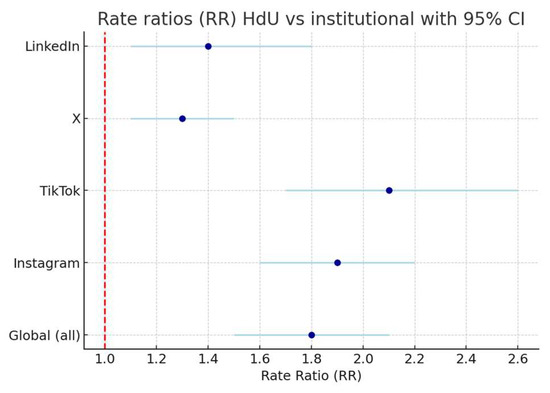
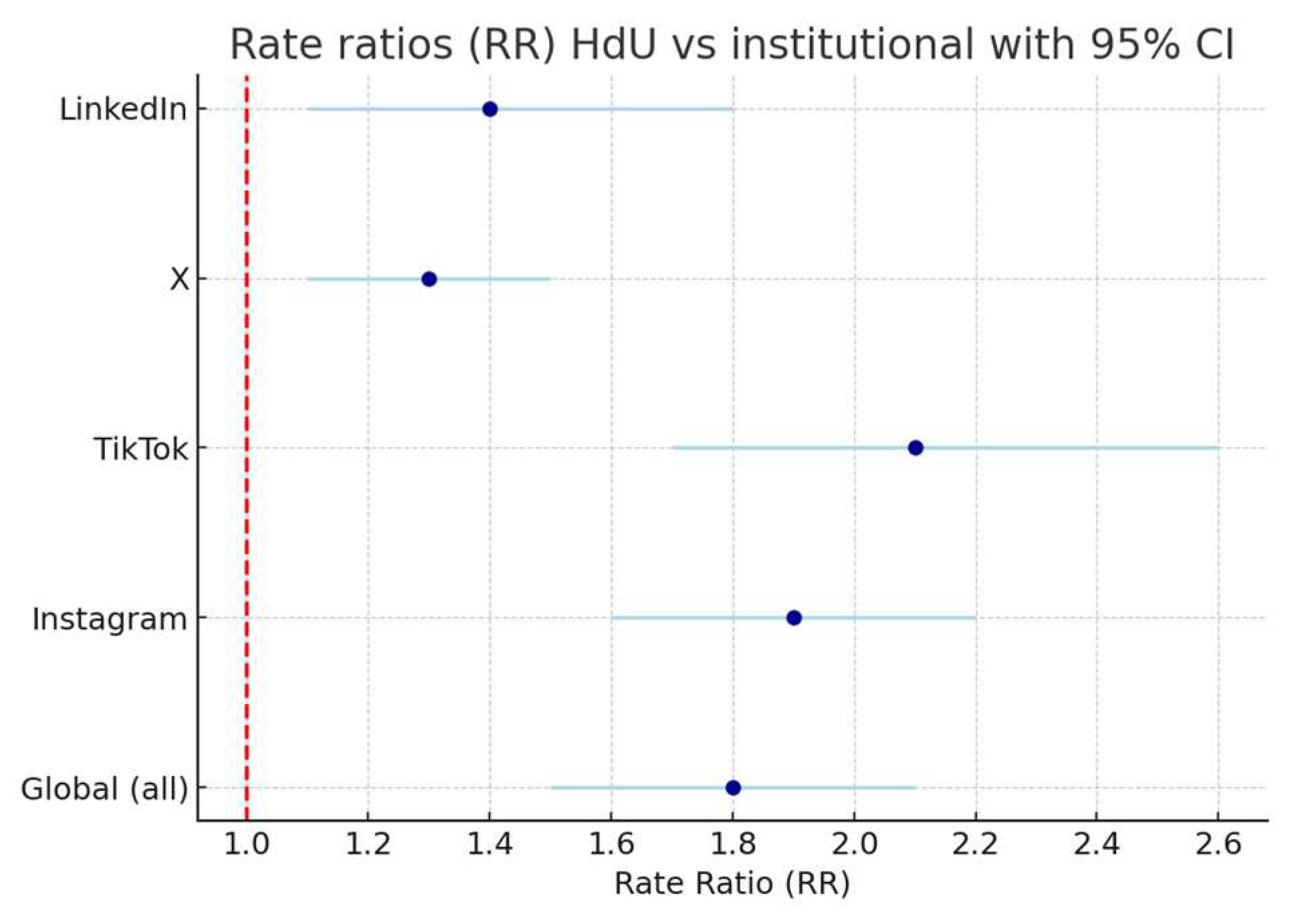
The models confirmed that the differences were statistically significant. The negative binomial model estimated a rate ratio (RR) of interactions of 1.8 (95%CI: 1.5–2.1; p < 0.001) in favour of HdU. The quasi-binomi analysed al model yielded an adjusted odds ratio for relative engagement of 2.0 (95%CI: 1.6–2.4; p < 0.001). The DiD analysis showed a positive incremental effect after September 2022, with no evidence of pre-trends, supporting a structural change associated with the systematic introduction of HdU, as we can see in Figure 1.
Figure 1.
Rate Ratio (RR) HdU vs. Institutional with 95%CI.
It is important to note that no significant differences in interaction were found between the HdU and control groups in the months prior to September 2022 (p > 0.05 in all pre-intervention months), indicating the absence of pre-existing divergent trends prior to the implementation of HdU. This reinforces the validity of the prior temporal parallel assumption of the DiD design and suggests that subsequent variations can be associated with greater confidence with the introduction of emotional storytelling. The convergence of descriptive, regression-based, and DiD results reinforces the robustness of the findings, suggesting that the performance advantage of HdU is not platform-specific nor attributable to seasonal dynamics.
4. Discussion
The superior performance of emotional storytelling aligns with broader trends in digital communication, where platform algorithms reward content that elicits interaction, emotional resonance, and longer viewing times. Content structured around stories promotes narrative immersion and identification, two mechanisms widely associated with higher interaction in digital media [11].
These findings support the conceptualisation of storytelling as a strategic narrative medium, capable of strengthening organisational identity and generating relational proximity. HdU functions not only as branded content but as a narrative system that articulates institutional values through human-centred stories, fulfilling audience expectations for emotional authenticity. It should be noted that the effectiveness of emotional storytelling varies depending on the platform: our observations suggest that formats such as TikTok, geared towards brief, visual entertainment, particularly amplify the impact of emotional narratives, while on professional networks such as LinkedIn, the additional engagement, although present, is more subdued. These differences underscore the importance of tailoring narrative strategies to the audience of each channel, something that future research could quantify in greater detail.
The results of this study provide robust evidence that emotionally oriented storytelling formats HdU significantly outperform traditional institutional posts in terms of both engagement and visibility on social media platforms. These findings advance our understanding of communication management in higher education by demonstrating that narratives centred on authentic experiences of students and faculty can deliver superior outcomes compared to messages focused on institutional achievements or formal announcements.
Previous research has already shown that engagement is a critical variable in digital communication strategies for universities. Capriotti, Losada-Díaz and Martínez-Gras (2023) and Capriotti, Carretón-Ballester and Losada-Díaz (2024) [10,16] found that the level of interaction generated by university posts depends strongly on the content strategy applied. Our study confirms and extends this line of work: HdU, designed to emphasise emotion and personal connection, consistently achieved higher engagement metrics, suggesting that universities can achieve better results by prioritising narrative and relational content [10,16].
This interpretation resonates with [11], who showed that branded content strategies are particularly effective in positioning universities on social media. HdU can be viewed as a form of institutional content with strong emotional resonance, connecting the university’s brand with humanised and relatable stories. Similarly, Ref [7], in their multi-country study, underlined the importance of social media for building relationships with stakeholders. The current findings reinforce this argument by illustrating how relational content translates directly into measurable increases in stakeholder interaction.
Another relevant contribution comes from [6], who evaluated how leading universities in global rankings build stakeholder engagement through Facebook posts. They found that successful institutions adopt deliberate strategies to maximise interactivity. The superior performance of HdU suggests that emotionally framed storytelling could serve as one of these deliberate strategies, supporting the notion that engagement is not accidental but the result of intentional content design.
The findings also align with Oliveira (2020) [1], who proposed a framework for the development of social media content strategies in higher education. His framework emphasised the need for institutions to integrate emotional and experiential dimensions to achieve stronger audience connections. HdU illustrate the operationalization of this principle in practice, showing that the inclusion of emotions and personal perspectives generates quantifiable improvements in reach and interaction [1].
The COVID-19 pandemic context also highlights the importance of engagement in digital environments. Reference [22] demonstrated that engagement patterns varied significantly between institutional accounts and health professionals, with the latter often achieving stronger resonance due to more direct and participatory communication styles. Similarly, our results show that HdU—through personalization and emotional tone—are closer to participatory communication, and therefore more effective, than traditional top-down institutional messages.
Beyond content strategy, the findings have broader implications for university reputation and strategic communication. Reference [13] described university communication campaigns as a form of auto-communication that signals institutional identity. HdU play a similar role: by featuring members of the academic community, they embody the institution’s values and identity in a way that fosters recognition and legitimacy. Melewar et al. (2018) [8] highlighted the importance of corporate identity management in the higher education sector. Our results suggest that storytelling can function as an effective identity management mechanism, bridging the gap between abstract institutional missions and concrete, relatable experiences [8].
The relational dimension of storytelling is also critical. Norhafezah et al. (2018) [20] argued that managing diversity in higher education requires a strategic communication approach that emphasises inclusion. By highlighting diverse student and staff experiences, HdU contributes to this inclusive positioning, strengthening both internal and external perceptions of legitimacy. Similarly, Simancas-González and García-López (2017) [21] showed that Spanish universities increasingly rely on communication management to enhance their reputation. The current findings suggest that storytelling can be a practical method to advance this reputational objective through digital channels [20,21].
Several studies have emphasised the importance of public engagement. Marino and Lo Presti (2018) [4] noted that universities are expected to engage proactively with society through online environments. González and López (2019) [19] framed institutional communication at Spanish universities as a participatory process. In this light, HdU can be interpreted as instruments of public engagement, aligning universities with broader societal expectations of transparency and dialogue [4,19].
Finally, the connection between storytelling and branding must be considered. Reference [14] stressed that brand positioning in higher education is strongly influenced by students’ satisfaction and perceptions. Reference [5] similarly argued that digital transformation creates new challenges for higher education marketing. Our findings support the idea that emotional storytelling enhances brand positioning by making institutional communication more relevant and engaging. In terms of stakeholder relations, [17] demonstrated that trust is essential for mobilising stakeholder support, particularly in the form of donations. By humanising institutional communication, HdU may indirectly contribute to building this trust.
Taken together, these findings reinforce the role of emotional storytelling as a strategic communication asset, capable of enhancing engagement, strengthening institutional identity, and aligning universities with audience expectations in algorithmic environments.
Limitations and Future Research
As with other observational studies, limitations remain. Differences in available metrics across platforms complicate cross-platform comparisons. Algorithmic influences may also affect visibility independently of content strategy. Future studies should combine quantitative and qualitative approaches to examine how stakeholders interpret HdU and how these perceptions relate to trust, credibility, and reputation over time. Furthermore, differences in the availability of metrics by platform-imposed limitations: it was not possible to obtain impressions for certain networks (X, LinkedIn), so direct comparison of engagement rates across all platforms should be viewed with caution. Although the effect of audience size was partially controlled for by platform-specific indicator variables in the models, future research could further normalise these results by incorporating follower counts or using platform-agnostic metrics. Another limitation of this study is that it did not analyse the differential impact of University Stories according to the demographic characteristics of the audience. Our aggregate engagement data does not distinguish between types of users; therefore, we do not know, for example, whether younger students interacted relatively more with HdU content than older graduates, or how the response might have varied between genders. Previous studies suggest that such differences exist (e.g., certain narratives may resonate more with a specific gender or age group), so future research should incorporate this perspective. A demographic-segmented analysis would allow us to determine which groups engage more intensely with emotional storytelling and further tailor content strategies to maximise connection with each audience segment.
5. Conclusions
This study empirically indicates that emotional storytelling, as embodied in the HdU series, significantly increases visibility and engagement in the university’s digital communications, compared to traditional institutional content. By applying a multi-platform analysis with quantitative approaches, our research provides solid evidence that narratives focused on authentic experiences of the university community generate superior and sustained audience interaction. The findings strengthen the value of emotional storytelling as a strategic tool in the communication management of higher education institutions, supporting previous recommendations from theory with concrete data. We also expand the existing literature by providing a comparative study between platforms, something that has been little addressed until now.
Author Contributions
Conceptualization, J.C.L.D. and J.A.-B.; methodology J.C.L.D. and J.A.-B.; validation, J.C.L.D. and J.A.-B.; formal analysis, J.C.L.D. and J.A.-B.; investigation, J.C.L.D. and J.A.-B.; resources, J.C.L.D. and J.A.-B.; data curation, J.C.L.D. and J.A.-B.; writing—original draft preparation, J.C.L.D. and J.A.-B.; writing—review and editing, J.C.L.D. and J.A.-B.; visualisation, J.C.L.D. and J.A.-B.; supervision, J.C.L.D. and J.A.-B.; project administration, J.C.L.D. and J.A.-B. All authors have read and agreed to the published version of the manuscript.
Funding
This research received no external funding.
Institutional Review Board Statement
Not applicable.
Informed Consent Statement
Not applicable.
Data Availability Statement
The data used in this publication are in the public domain and accessible through the social media platforms indicated in the literature.
Acknowledgments
The audiovisual production ‘Historia(s) de Universidad’ was produced by the José Manuel López Nicolás, José Carlos Losada Díaz.
Conflicts of Interest
The authors declare no conflicts of interest.
Abbreviations
The following abbreviations are used in this manuscript:
| HdU | Historia(s) de Universidad |
| UMU | University of Murcia |
References
- Oliveira, L.G. A framework for the development of social media content strategies for higher education institutions. Estud. Comun. 2020, 30, 21–48. [Google Scholar] [CrossRef]
- Orozco Gómez, G.; Navarro Martínez, E.; García Matilla, A. Desafíos educativos en tiempos de auto-comunicación masiva: La interlocución de las audiencia. Comun. Rev. Científica Iberoam. Comun. Educ. 2012, 38, 67–74. [Google Scholar] [CrossRef]
- Almela-Baeza, J.; Guercetti, J.; Febrero, B. The Importance of Engagement in the Dissemination of Audio-Visual Content by Spanish Health Influencers on Instagram. Soc. Sci. 2023, 12, 220. [Google Scholar] [CrossRef] [Scilit]
- Marino, V.; Lo Presti, L. Approaches to university public engagement in the online environment. Int. J. Educ. Manag. 2018, 32, 734–748. [Google Scholar] [CrossRef] [Scilit]
- Camilleri, M.A. Higher education marketing: Opportunities and challenges in the digital Era. Academia 2019, 2019, 4–28. [Google Scholar] [CrossRef]
- Fähnrich, B.; Vogelgesang, J.; Scharkow, M. Evaluating universities’ strategic online communication: How do Shanghai Ranking’s top 50 universities grow stakeholder engagement with Facebook posts? J. Commun. Manag. 2020, 24, 265–283. [Google Scholar] [CrossRef] [Scilit]
- Eger, L.; Dana, E.; Lukasz, T.; Miroslav, K.; Czeglédi, C. Facebook for Public Relations in the higher education field: A study from four countries Czechia, Slovakia, Poland and Hungary. J. Mark. High. Educ. 2021, 31, 240–260. [Google Scholar] [CrossRef] [Scilit]
- Melewar, T.C.; Foroudi, P.; Dinnie, K.; Nguyen, B. The role of corporate identity management in the higher education sector: An exploratory case study. J. Mark. Commun. 2018, 24, 337–359. [Google Scholar] [CrossRef] [Scilit]
- Lee, N.; Merle, P. Media relations and universities: An assessment of digital newsrooms. J. Mark. High. Educ. 2018, 28, 232–246. [Google Scholar] [CrossRef] [Scilit]
- Capriotti, P.; Losada-Díaz, J.C.; Martínez-Gras, R. Evaluating the content strategy developed by universities on social media. Prof. Inf. 2023, 32, e320210. [Google Scholar] [CrossRef] [Scilit]
- Atarama-Rojas, T.; Vega-Foelsche, D. Corporate communications and branded content on Facebook: A study of the official accounts of Peruvian universities. Rev. Comun. 2020, 19, 37–53. [Google Scholar] [CrossRef] [Scilit]
- Vetrova, E.A.; Kabanova, E.E.; Medvedeva, N.V.; Jukova, E.E. Management of educational services promotion in the field of higher education (the example of “Russian State Social University”). Eur. J. Contemp. Educ. 2019, 8, 370–377. [Google Scholar] [CrossRef] [Scilit]
- Davies, S.R. University communications as auto-communication: The NTNU ‘Challenge Everything’ campaign. J. Commun. Manag. 2020, 24, 227–243. [Google Scholar] [CrossRef] [Scilit]
- Brzaković, A.; Brzaković, T.; Brzaković, P. The determinants of brand positioning in higher education—What dominantly influences students’ satisfaction? Croat. J. Educ. 2019, 21, 407–436. [Google Scholar] [CrossRef] [Scilit]
- Menadue, C.B.; Giselsson, K.; Guez, D. An Empirical Revision of the Definition of Science Fiction: It Is All in the Techne. SAGE Open 2020, 10, 2158244020963057. [Google Scholar] [CrossRef] [Scilit]
- Capriotti, P.; Carretón-Ballester, C.; Losada-Díaz, J.C. Analysing the influence of Universities’ content strategy on the level of engagement on social media. Commun. Soc. 2024, 37, 41–60. [Google Scholar] [CrossRef] [Scilit]
- Francioni, B.; Curina, I.; Dennis, C.; Papagiannidis, S.; Alamanos, E.; Bourlakis, M.; Hegner, S.M. Does trust play a role when it comes to donations? A comparison of Italian and US higher education institutions. High. Educ. 2021, 82, 85–105. [Google Scholar] [CrossRef] [Scilit]
- Mesquita, K.; Ruao, T.; Andrade, J.G. Websites e páginas do Facebook das Universidades portuguesas: Novas possibilidades de interação social? Rev. Int. Relac. Públicas 2020, 10, 135–156. [Google Scholar] [CrossRef] [Scilit]
- González, E.S.; López, M.G. Institutional communication at spanish public universities from the approach of participatory communication. Educ. Policy Anal. Arch. 2019, 27, 144. [Google Scholar] [CrossRef] [Scilit]
- Norhafezah, Y.; Awang-Hashim, R.; Valdez, N.; Yaacob, A. Managing diversity in higher education: A strategic communication approach. J. Asian Pac. Commun. 2018, 28, 41–60. [Google Scholar] [CrossRef] [Scilit]
- Simancas-González, E.; García-López, M. Communication management in Spain public universities. Prof. Inf. 2017, 26, 735–744. [Google Scholar] [CrossRef] [Scilit]
- Pérez-Escoda, A.; Jiménez-Narros, C.; Perlado-Lamo-de-Espinosa, M.; Pedrero-Esteban, L.M. Social networks’ engagement during the COVID-19 pandemic in Spain: Health media vs. healthcare professionals. Int. J. Environ. Res. Public Health 2020, 17, 5261. [Google Scholar] [CrossRef] [Scilit]
- Thakur, N.; Cui, S.; Khanna, K.; Knieling, V.; Duggal, Y.N.; Shao, M. Investigation of the Gender-Specific Discourse about Online Learning during COVID-19 on Twitter Using Sentiment Analysis, Subjectivity Analysis, and Toxicity Analysis. Computers 2023, 12, 221. [Google Scholar] [CrossRef] [Scilit]
- Fosch-Villaronga, E.; Poulsen, A.; Søraa, R.A.; Custers, B.H.M. A little bird told me your gender: Gender inferences in social media. Inf. Process. Manag. 2021, 58, 102541. [Google Scholar] [CrossRef] [Scilit]

Disclaimer/Publisher’s Note: The statements, opinions and data contained in all publications are solely those of the individual author(s) and contributor(s) and not of MDPI and/or the editor(s). MDPI and/or the editor(s) disclaim responsibility for any injury to people or property resulting from any ideas, methods, instructions or products referred to in the content. |
© 2026 by the authors. Licensee MDPI, Basel, Switzerland. This article is an open access article distributed under the terms and conditions of the Creative Commons Attribution (CC BY) license (https://creativecommons.org/licenses/by/4.0/).