
You are currently viewing a new version of our website. To view the old version click .
Information
  • Article
  • Open Access

19 August 2025

Unpacking the Black Box: How AI Capability Enhances Human Resource Functions in China’s Healthcare Sector

,
,
and
1
Department of Business Administration, School of Industrial and Aerospace Engineering, University of Castilla-La Mancha, 45071 Toledo, Spain
2
Department of Business Administration, Faculty of Economic and Business Sciences, University of Castilla-La Mancha, 02071 Albacete, Spain
3
Higher Polytechnic School, Antonio de Nebrija University, 28015 Madrid, Spain
*
Author to whom correspondence should be addressed.
This article belongs to the Special Issue Emerging Research in Knowledge Management and Innovation

Abstract

Artificial intelligence (AI) is transforming organizational functions across sectors; however, its application to human resource management (HRM) within healthcare remains underexplored. This study aims to unpack the black-box nature of AI capability’s impact on HR functions within China’s healthcare sector, a domain undergoing rapid digital transformation, driven by national innovation policies. Grounded in resource-based theory, the study conceptualizes AI capability as a multidimensional construct encompassing tangible resources, human resources, and organizational intangibles. Using a structural equation modeling approach (PLS-SEM), the analysis draws on survey data from 331 professionals across five hospitals in three Chinese cities. The results demonstrate a strong, positive, and statistically significant relationship between AI capability and HR functions, accounting for 75.2% of the explained variance. These findings indicate that AI capability enhances HR performance through smarter recruitment, personalized training, and data-driven talent management. By empirically illuminating the mechanisms linking AI capability to HR outcomes, the study contributes to theoretical development and offers actionable insights for healthcare administrators and policymakers. It positions AI not merely as a technological tool but as a strategic resource to address talent shortages and improve equity in workforce distribution. This work helps to clarify a previously opaque area of AI application in healthcare HRM.

1. Introduction

After more than 60 years of evolution, artificial intelligence (AI) has become ubiquitous in the past decade [1,2]. Today, with the advent of ChatGPT-style generative AI systems, there has been a phenomenal upward trend in the development of, and investment in, AI.
In recent years, the State Council of China and central departments have provided support and paid great attention to the prosperous development of a new generation of artificial intelligence technologies [3]. In July 2021, the Ministry of Industry and Information Technology issued the “Three-Year Action Plan for the Development of New Data Centers”, aiming to enhance national digital infrastructure through greener, more efficient, and regionally balanced computing systems. As a direct result, by early 2024, China had established eight national data hub regions and over ten data center clusters, significantly increasing nationwide computing power. According to official data, the total computation capacity surpassed 200 EFLOP/s by the end of 2023—laying the foundation for large-scale AI applications across sectors, including healthcare [4]. Currently, many AI products have begun to be applied in the field of human resource management.
Moreover, the application of AI developed by China covers many sectors such as finance, medicine, education, industry, gaming, and law. Generative AI has more applications in consumer-side scenarios, such as gaming, law, education, e-commerce, etc., while maturity is low in business-side scenarios such as healthcare, finance, and industry. Artificial intelligence has been announced by many as the next source of business value [5]; therefore, it is very important for companies to research and study the AI capabilities. At the same time, the emergence of AI has also had an impact on human resource management (HRM). In the past 20 years, the use of AI technology in human resource management has been an emerging trend [6]. The focus of initial research was more on presenting and explaining the concept of AI. Most articles studied the impact of AI in the general field of human resources or focused on the participation and contribution of AI in the field of medicine. Due to differences between different sectors, there is currently a lack of research on the impact of AI on human resource management in the healthcare sector. Therefore, the innovation of this study is to examine the impact of AI capabilities on human resource functions in China’s healthcare sector. On the one hand, it is hoped that this study will help to more clearly understand the particularities of the human resource sector in China’s healthcare sector. On the other hand, it is hoped that the study will demonstrate that AI has a positive and significant impact on human resource functions in the healthcare sector and can help both academics and executives, providing them with new ideas to better face the arrival of the artificial intelligence era.
Recent international evidence shows that AI adoption trajectories are bifurcating across sectors and skill profiles, with sophisticated prediction, natural language, and pattern recognition systems diffusing more rapidly where high-quality data assets, complementary digital infrastructure, and absorptive human capital already exist [7,8,9].
At the same time, empirical studies reveal heterogeneous productivity realization. While firm-level gains in innovation output and process efficiency materialize in early-adopting organizations, macro-level productivity lags can persist because complementary organizational capabilities, governance routines, and reskilling investments diffuse more slowly (the so-called “AI productivity J-curve”) [8,10,11].
These dynamics sharpen strategic questions for HRM in knowledge-intensive and service domains, including healthcare, where data richness coexists with stringent ethical, privacy, and reliability constraints on algorithmic deployment [12,13].
Moreover, research on AI capability underscores that performance benefits emerge not merely from acquiring advanced models but from orchestrating tangible (data pipelines, scalable compute), human (domain experts, hybrid “translator” roles), and intangible (governance, change agility, risk tolerance) resource bundles into path-dependent, hard-to-imitate configurations [14,15,16].
Concurrently, labor market studies document asymmetric task reallocation. Routine, codifiable tasks are increasingly automated, while demand rises for non-routine analytical, creative, and empathetic tasks that are complementary to AI systems [17,18,19]. This “task polarization” interacts with organizational job design and talent development strategies, elevating the salience of adaptive learning and continuous upskilling in sustaining equitable workforce outcomes [17,20]. In parallel, sectoral analyses caution that without deliberate capability building, automation can amplify skill-biased inequality and erode middle-skill roles, thereby challenging sustainability and decent work objectives embedded in international development agendas [7,21].
From a human resource (HR) perspective, the net organizational value of AI deployment is partially mediated by employee productivity and engagement outcomes. Structural equation modeling evidence indicates significant direct and indirect performance effects of AI through enhanced employee productivity, while parallel hospitality and services research highlights contingent risks to engagement, commitment, and well-being when job insecurity perceptions or technostress are unaddressed [14,22,23].
In the healthcare domain, Zheng et al. [24] observed that the implementation of AI tools in clinical training contexts was associated with marked performance improvements among medical residents, most notably among women. The proposed mechanism centers on real-time assistance across clinical, diagnostic, and follow-up processes, which appears to lessen cognitive load and refine decision-making. These observations reinforce the proposition that AI can operate as a valuable complementary instrument in settings where both accuracy and immediacy are essential.
Thus, strategic HRM in healthcare must integrate capability maturation, ethical governance, and proactive psychological contract management to convert algorithmic predictions into sustained, inclusive human capital advantages [12,25].
Finally, emerging governance scholarship emphasizes responsible AI frameworks—encompassing transparency, data lineage, security, and inclusive design—as dynamic complements that reduce adoption frictions, mitigate alienational contract risks, and support the iterative learning loops required for safe clinical and administrative scaling [15,26,27,28].
This synthesized perspective justifies deepening the present study’s focus on how AI capability shapes human resource functions in China’s healthcare sector and clarifies the mechanisms through which value capture and equitable workforce outcomes can co-evolve.
China’s healthcare system faces a set of entrenched human resource pressures that heighten the relevance of developing AI-enabled HR capabilities. Coverage has broadened. However, shortages of qualified clinicians and allied professionals persist, and talent remains unevenly distributed—most notably between well-resourced eastern urban centers and under-served western or rural areas. High workload intensity, administrative and documentation burdens, and constrained advancement pathways contribute to burnout and rising turnover in critical skill groups. At the same time, legacy organizational structures in public hospitals and patchy, siloed digital infrastructures slow the smooth incorporation of intelligent tools into core HR processes. These conditions complicate effective recruitment, targeted training, and agile talent deployment, and they argue for a capability-oriented approach rather than ad hoc technology adoption. Strategically cultivating multidimensional AI capability—spanning data quality, technical and hybrid skills, governance, and change readiness—offers a pathway to mitigate staffing gaps, promote more equitable service provision, and strengthen institutional resilience as digital transformation deepens [29].
Despite accelerating national policy support for AI and a burgeoning general HRM literature, three interrelated gaps remain unresolved for China’s healthcare sector: (i) a theoretical gap—limited empirical disentangling of how a multidimensional, third-order AI capability (spanning tangible, human, and intangible resources) translates into HR functional performance; (ii) an empirical context gap—scarce sector-specific, organization-level evidence from Chinese hospitals where talent shortages, equity concerns, and stringent data governance heighten the need for nuanced capability measurement; and (iii) a practical gap—insufficient guidance for hospital administrators and policymakers on which complementary resource bundles (data pipelines, hybrid skills, change and governance routines) most strongly associate with enhanced recruitment, training personalization, and talent deployment. Addressing these gaps, the present study operationalizes AI capability as a higher-order composite and tests its effect on HR functions, thereby illuminating internal value creation mechanisms and informing capability-building strategies.
This study offers two key contributions. First, it provides empirical validation of AI capability effects using real-world data from Chinese hospitals—a sector and national context where such evidence remains limited. As noted by Böhmer and Schinnenburg [30], empirical investigations into AI-driven HRM remain scarce, especially in sector-specific and public service environments. Second, by confirming the structure and predictive validity of the third-order AI capability model originally proposed by Mikalef and Gupta [5], the study strengthens its generalizability and measurement robustness across sectors and geographies.
The main research question is whether AI capabilities are having a positive impact on human resource functions in China’s healthcare sector. To address the research question, Partial Least Squares Structural Equation Modeling (PLS-SEM) is applied to investigate the hypothesis of the AI capability and human resource functions model. The research findings reveal that AI capability has a positive and significant influence on human resource functions. The findings of this study have important implications for academics, executives, human resource professionals, and policymakers in China’s healthcare sector, who can leverage artificial intelligence technologies to optimize and enhance the organizational performance of human resources.
In the following section, this study conducts a review of the existing literature (Section 2), including theoretical background, AI, human resources, and the structure of human resources in China’s healthcare sector. In this way, hypotheses are formulated based on this theoretical support. Next, the research methods and database are presented (Section 3). The Section 4 contains the research results. Finally, the discussion and conclusions of the study, its limitations, and future directions for research will be presented.

3. Materials and Methods

In this section, we focus on the most relevant methodological aspects of this research. We start with the research design and the appropriateness of the study methods used, followed by a justification of the study population and the selected sample, data collection, measurement of variables, and data treatment.
A quantitative analysis was conducted based on a representative sample of healthcare centers and the confirmation of research hypotheses through the PLS-SEM technique. We tested the research hypotheses with PLS-SEM—structural equation modeling (SEM), estimated with partial least squares (PLS). In social sciences and business administration, the scientific community has commonly accepted the dominant logic of quantitative analyses based on Multiple Regression Analysis (MRA) and structural equation models. For its part, the PLS estimation method is particularly interesting in the early stages of theory development [63], or when researchers include scales that have been tested and validated in previous works, or due to a relatively small sample size [64,65], or finally, when the models are very complex [66]. Thus, the choice of PLS was justified by the sample size, the research objectives, and the complexity of the model.
The data were processed using SmartPLS 4.1 software [67]. For generating the descriptive statistics of the sample, SPSS, version 23, was utilized.

3.1. Sampling and Data Collection

One of the first decisions in any research involves specifying and delimiting the population to be analyzed based on the problem and the main objectives of the research [68]. Focusing the research interest on the AI capability and the human resource functions operating in China’s health sector, the selected unit of analysis is the individual, that is, the healthcare professionals in China. The target population, which constitutes the universe to be studied, is made up of healthcare professionals in China.
To determine the size of the population, it is necessary to refer to figures from the Chinese health system. According to the 2022 China Health and Wellness Development Statistical Bulletin [69], as of the end of 2022, the total number of medical and health institutions nationwide was 1,032,918, of which 36,976 were hospitals, 979,768 were primary health care institutions, and 12,436 were public health professional institutions. Among the hospitals, there were 11,746 public hospitals and 25,230 private hospitals. Hospitals were divided by the number of beds: 21,904 hospitals with fewer than 100 beds, 5483 hospitals with 100 to 199 beds, 5174 hospitals with 200 to 499 beds, 2190 hospitals with 500 to 799 beds, and 2225 hospitals with 800 or more beds. The total number of health personnel in the country was 14.411 million. Of the total health personnel, 11.658 million were health technicians. Among the health technicians, there were 4.435 million doctors (assistants) and 5.224 million registered nurses.
The survey was targeted at human resource managers, financial managers, project managers, and other health professionals from both public and non-public hospitals in China. The study survey was implemented via the Chinese professional questionnaire creation platform Wenjuanxing https://www.wjx.cn/. Prior to collecting survey data, we enlisted the assistance of a hospital director to disseminate our online survey via WeChat (a Chinese messaging app). The survey outlined the study’s purpose and assured the confidentiality of respondents’ information, stating that the data would be used solely for research purposes and requesting their informed consent for data collection.
Fieldwork was conducted between January and April 2024. A total of 331 valid cases were obtained, representing a response rate of 10.58% relative to the total number of potential users to whom the survey was sent. The sampling error for the 331 responding workers was 5.39% (95% confidence level, p = q = 0.5), which ensured sufficient representation of the entire population of health workers in China. The power value (0.82) was obtained with G*Power 3.1.9.7 [70] using a post hoc test for a point-biserial correlation, with α = 0.05 and an effect size |ρ| = 0.14, which corresponds to a small effect size in Cohen’s classification [71]. Because 0.82 exceeds the conventional 0.80 cut-off, the sample’s statistical power was shown to be adequate.

3.2. Sample Characteristics and Descriptive Analysis

In terms of demographics, Table 1 presents the distribution characteristics of the sample. Among the respondents, 88 are male, representing 26.6%; 214 are female, representing 64.7%. Additionally, 29 individuals preferred not to disclose their gender. We respected each respondent’s choice regarding the disclosure of their personal information. The age distribution was relatively balanced for those under fifty years old. There were 55 individuals in the age range of 51 to 60 years, representing 16.6%, and 7 individuals over 60 years old. In China, the legal retirement age is 65. We observed that the survey results included both retired individuals and those rehired after retirement (in traditional Chinese medicine, older individuals are often rehired due to their greater experience).
Table 1. Description of the respondent sample (n = 331).
Regarding educational level, the majority of respondents were concentrated in the bachelor’s or equivalent degree category, with a total of 200 individuals, representing 60.4%. The number of individuals with higher educational levels was smaller; however, this figure is expected to continue to grow in the future.
Finally, we surveyed respondents from a total of five hospitals: (1) Shandong Hospital of Traditional Chinese Medicine (TCM) (www.sdzydfy.com) (public, 3163 employees, 2451 beds, located in Jinan city with a population of 9 million); (2) Taixing No. 2 People’s Hospital (public, 765 employees, 700 beds, located in Taixing city with a population of nearly 1 million); (3) Yangzhou Maternal and Child Health Care Service Centre (www.yzfybj.com) (private, 831 employees, 450 beds, located in Yangzhou city with a population of nearly 4.5 million); (4) Yangzhou Hospital of TCM (www.yzszyy.com) (public, 628 employees, 700 beds, located in Yangzhou city); and (5) Friendliness Hospital Yangzhou (www.yzyhyy.com) (private, 565 employees, 496 beds, also located in Yangzhou city). Of these, 130 respondents were from public hospitals, representing 39.3%, and 201 were from private hospitals, representing 60.7%.

3.3. Selection and Measurement of Variables

The instrument consisted of a questionnaire comprising 51 items across nine dimensions (Appendix B, Table A1) and is scored on a five-point Likert scale ranging from “strongly disagree” to “strongly agree” (1 to 5), where higher scores indicate a higher level of agreement. Additionally, information on other sociodemographic variables of interest, such as age, gender, job position, profitability of the hospital, size, and number of beds, among other details, was collected.
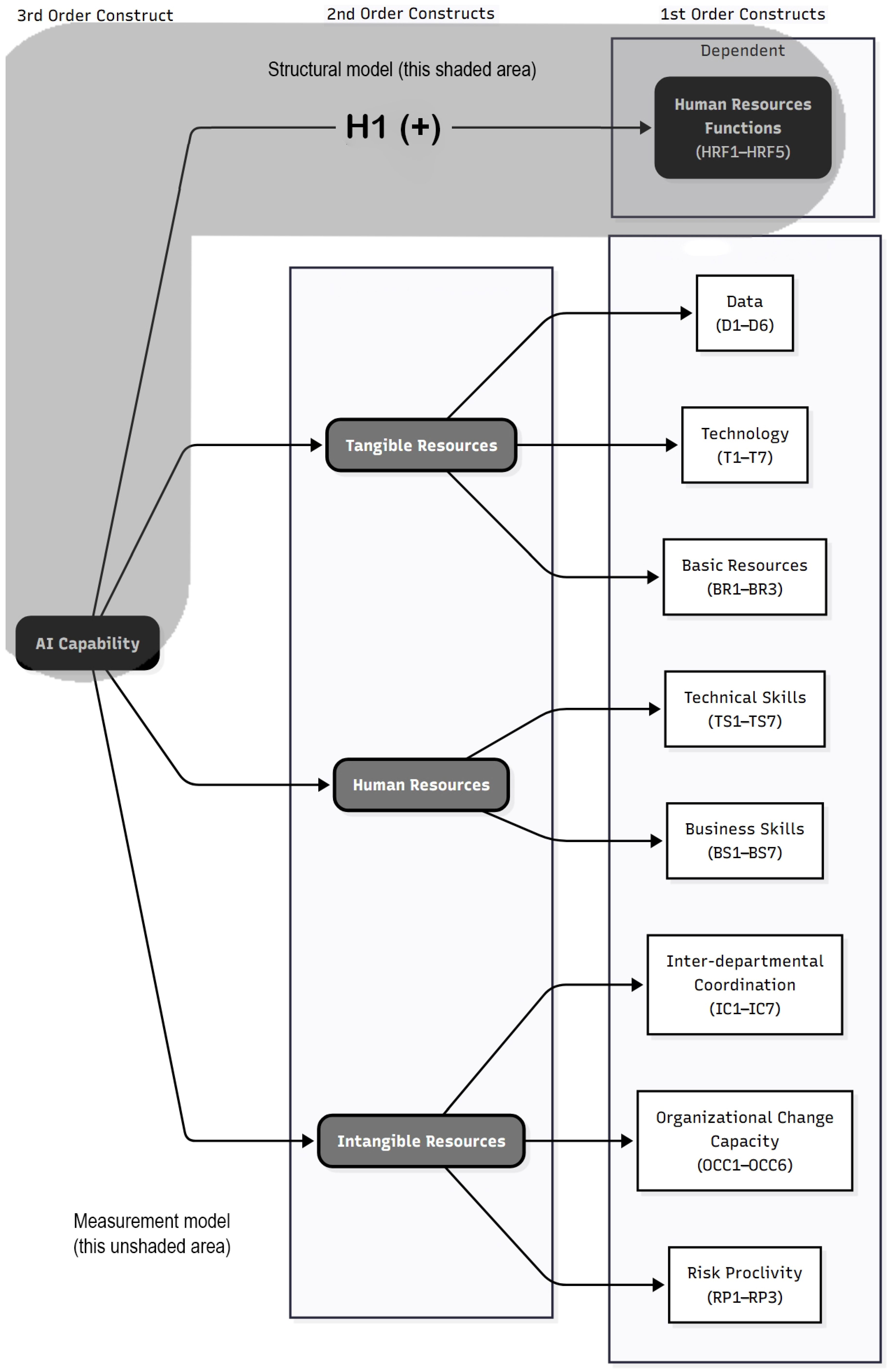
The scale developed by Mikalef and Gupta [5] was used to measure AI capability. AI capability is distinct from other digital capabilities, such as IT capability, as its constituent resources are specific. This study conceptualizes AI capability as a third-order mode A composite, comprising the following specific AI dimensions: tangible resources, human resources, and intangible resources. These dimensions, in turn, are modeled as second-order mode A composites, encompassing eight first-order mode A composites. These are grouped as follows: (a) tangible resources: data (six items), technology (seven items), and basic resources (three items); (b) human resources: technical skills (seven items) and business skills (seven items); (c) intangible resources: inter-departmental coordination (seven items), organizational change capacity (six items), and risk proclivity (three items).
To measure human resource functions (the dependent variable), the five items of Shahzad et al. [60] from the original scale of Pillai and Sivathanu [72] were employed. These were considered a mode A composite.
These scales, originally in English, were translated into Chinese using Brislin’s [73] back-translation procedure to ensure semantic equivalence. A bilingual professional first translated the items into Chinese; another professional then re-translated the items back into English.

4. Results

The results and analyses are presented here. The form chosen to construct the higher-order model used latent variable scores, employing the “Two-Step Approach” [74,75]. For the interpretation and analysis of the proposed model in PLS-SEM, two distinct stages were developed: (1) measurement model analysis; and (2) structural model analysis. This sequence ensured that the proposed measurement scales were valid and reliable.

4.1. Measurement Model Analysis

The individual item reliability is considered adequate when the item loading is greater than 0.707 (the acceptance value recommended by Carmines and Zeller [76]). In this study, the indicators and reflective dimensions met this requirement, being well above 0.7 (Table 2).
Table 2. Item loadings, construct reliability and convergent validity.
The construct reliability assessment employed Cronbach’s alpha (α) and composite reliability (ρ). Both indices serve the same purpose: to measure the internal consistency of a construct, although composite reliability is more appropriate for use in PLS as it is superior to Cronbach’s alpha [77]. For both indices, 0.7 is the basic benchmark [77,78,79]. In this research, all constructs and reflective dimensions were reliable, even exceeding values of 0.8 (strict reliability). The average variance extracted (AVE) measures convergent validity; that is, whether the set of indicators represents the same latent variable. All constructs and reflective dimensions achieved convergent validity, surpassing the recommended value of 0.5 [75] (Table 2).
Finally, the results of the discriminant validity assessment (the degree to which a construct differs from others) show that for each construct, the square root of the AVE was higher than the correlations between the constructs [77] and that the loadings of the constructs are higher in their respective constructs than in the rest of them (cross-loadings) [80]. This indicated the discriminant validity of the measures used (Table 3). In addition, the Heterotrait–Monotrait (HTMT) value is 0.89, below the threshold of 0.90 and significantly lower than 1, which supports the discriminant validity of the variables [66].
Table 3. Correlation matrix and discriminant validity.

4.2. Structural Model Evaluation

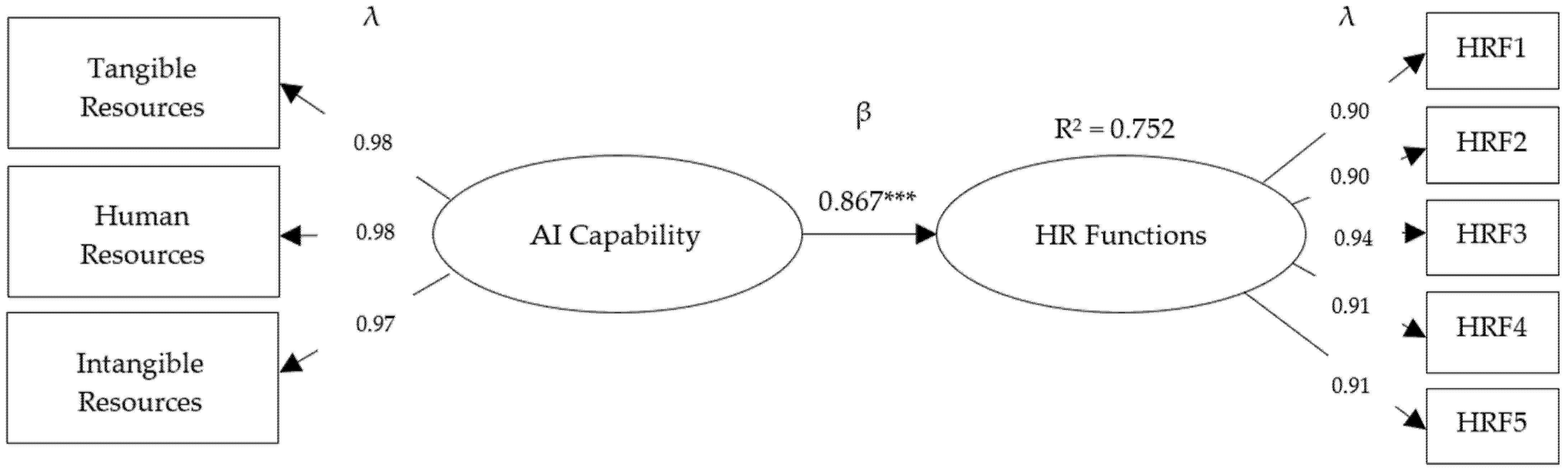
With the convergent and discriminant validity of the measurement model and its reliability ensured, the relationships between the different variables were tested. Significance testing was carried out by performing the bootstrapping procedure (10,000 subsamples) to assess the significance of the path coefficients. Thus, the t-statistic (pseudo-parametric test) and the estimated 95% percentile confidence interval for the path coefficient were obtained—if it did not contain zero, it was said that the estimated path coefficient was significantly different from zero. In this study, hypothesis 1 (H1) states that the effect of AI capability on HR functions is positive and significant (β = 0.87; the t-value exceeds the minimum level indicated by the one-tailed Student’s t-distribution with n–1 degrees of freedom, where n is the number of subsamples, at a confidence level of 99.9% and, therefore, a probability of being wrong in rejecting the null hypothesis: p < 0.001). Finally, the standardized root mean square residual (SRMR) was calculated for a composite factor model to determine the exact fit of the composite factor model. The model (total effect) achieved a composite factor model SRMR of 0.03, which indicates an appropriate fit, assuming the usual cut-off of 0.10 or a more conservative 0.08 [81]. Therefore, the hypothesis was supported (Table 4, Figure 1).
Table 4. Causal relationships: total effect.
Figure 1. PLS-SEM Results. *** p < 0.001, (based on t (9999), one-tailed test). λ = indicators’ loadings; β = path coefficient; and R2 = coefficient of determination.

5. Discussion

The findings of this study have important implications for academics, executives, human resource professionals, and policy makers in China’s health sector, who can leverage artificial intelligence technologies to optimize and enhance the organizational performance of human resources. Their adoption should be carefully planned and managed to fully exploit the benefits of this transformative technology.

5.1. Theoretical Implications

The findings of this study present several significant theoretical implications, which can be related to existing studies in the field of artificial intelligence and human resource management.
The research demonstrates that AI capability has a positive and significant impact on HR functions in China’s health sector. This finding aligns with previous studies that have explored the adoption of emerging technologies in organizational management. For example, Mikalef and Gupta [5] developed a comprehensive framework for AI capabilities based on the resource-based view theory, arguing that these capabilities enable firms to coordinate and effectively utilize their AI-specific resources.
The ability of AI to enhance HR functions suggests that organizations can increase their operational efficiency through the automation of repetitive tasks and the optimization of processes. This is consistent with studies in the literature identifying AI as a key tool for improving organizational performance through augmented intelligence and data-driven decision-making. The study also highlights the importance of both tangible resources (such as advanced technology and high-quality data) and intangible resources (such as organizational change capability and interdepartmental coordination) for the successful implementation of AI. This multidimensional approach to AI capabilities coincides with the work of various researchers who have explored how intangible resources can drive innovation and organizational performance.
The findings also underscore the challenges organizations face in terms of developing specific AI technical and business skills. This is reflected in the literature, where it is highlighted that the lack of AI capabilities is a major barrier to its effective adoption. The training and support of business leaders are essential to overcome these challenges.
Finally, this study provides a theoretical framework that can be used in future research to further explore the dynamics between AI and HR in different contexts and sectors. Understanding how AI capabilities can be cultivated and effectively leveraged remains a critical area for both theoretical and practical development.
In summary, the findings of this study not only corroborate existing theories on the integration of AI into HR management but also expand our knowledge of how these technologies can transform organizational practices in the health sector.

5.2. Practical Implications

The application of artificial intelligence technology in China’s healthcare sector has received strong support from government policies. The development of “Internet + Health” is accelerating the integration of the Internet, blockchain, IoT, artificial intelligence, cloud computing, and big data into the healthcare field, strengthening the exchange and protection of health data.
Furthermore, the planning of medical institution configurations also emphasizes the supportive role of informatization. In the Guidelines for the Planning of Medical Institution Configurations (2021–2025) [82], it is explicitly proposed to promote the deep integration of new technologies, such as artificial intelligence, with medicine, driving the construction of smart hospitals and the standardization of hospital information. This indicates that China’s healthcare sector is committed to building a more intelligent and standardized medical system.
The results of this study will help medical institutions in China to understand the importance of artificial intelligence in optimizing human resource functions. Taking favorable measures concerning each of the studied variables—data, technology, basic resources, technical and business skills, inter-departmental coordination, organizational change capacity, and risk proclivity—will positively impact HR functions operating in the Chinese healthcare sector. With the aid of intelligent tools and systems, HR leaders in the healthcare sector can carry out selection, training, and management more efficiently, thereby retaining more outstanding talent. At the same time, artificial intelligence can analyze data, monitor employee behavior, and predict staff attrition trends. With the continuous advancement of technology and ongoing policy support, artificial intelligence is expected to play an increasingly important role in the future of the healthcare sector.

5.3. Limitations and Future Research Directions

First, the number of samples selected for this study is limited, with a total of 331 questionnaires collected. The small sample size may lead to results that do not fully represent the entire medical community, introducing potential sampling bias. Second, the sample selection scope includes only five hospitals in three cities. In cities with different levels of development, the use of artificial intelligence in human resource management within the healthcare system may vary.
This study conducted a sampling survey solely within China’s medical industry. In different countries, given varying levels of economic development, healthcare standards, and policies, different scenarios may emerge, making the conclusions potentially inapplicable to other regions or industries.
We encourage future research to improve data diversity by collecting information from various aspects, such as human resource expenditures, industry efficiency improvements, and changes in human resource investment, to quantitatively analyze the relationship between artificial intelligence and the enhancement of human resource management in the medical industry. Analyzing whether artificial intelligence can improve risk resilience and optimization capability in the HR domain through its multiple roles in human resource management could be another call for research.

6. Conclusions

In China, the healthcare sector is actively responding to the call for artificial intelligence technology. The government has implemented numerous policies aimed at improving the quality and efficiency of medical services through technological innovation while optimizing human resource management in the healthcare sector. In this era of rapid AI development, the medical industry is undergoing a profound transformation. This research aims to demonstrate that AI capabilities have had a positive impact on human resource functions within China’s healthcare sector.
The results indicate that the healthcare sector in China already recognizes the importance of AI technology in medical human resource management. Through the formulation and implementation of various policies, healthcare institutions are encouraged to reform staffing and personnel systems; establish a dynamic personnel expansion mechanism; promote coordinated workforce allocation within public medical institutions in healthcare consortia; and achieve unified recruitment and management of personnel. These efforts will contribute to improving the efficiency of human resource allocation and optimizing the talent structure in the healthcare sector.
In summary, China’s healthcare policies regarding AI’s impact on human resource functions reflect comprehensive support for the digital transformation of the medical industry. Through technological innovation, the aim is to enhance the quality and efficiency of medical services, optimize healthcare resource allocation, and improve the accessibility and equity of healthcare services. With the continuous implementation of these policies, AI is expected to play an increasingly vital role in the healthcare sector, driving revolutionary changes in human resource management and providing strong technological support for the sustainable development of the medical industry.

Author Contributions

Conceptualization, B.Y.-A. and X.C.; methodology, B.Y.-A., X.C. and M.P.M.-R.; software, B.Y.-A., E.B. and X.C.; validation, B.Y.-A., M.P.M.-R., E.B. and X.C.; formal analysis, B.Y.-A., E.B. and X.C.; investigation, B.Y.-A., X.C. and M.P.M.-R.; resources, B.Y.-A., X.C. and M.P.M.-R.; data curation, B.Y.-A. and M.P.M.-R.; writing—original draft preparation, B.Y.-A., M.P.M.-R., E.B. and X.C.; writing—review and editing, B.Y.-A., M.P.M.-R., E.B. and X.C.; visualization, B.Y.-A., M.P.M.-R., E.B. and X.C.; supervision, B.Y.-A.; project administration, B.Y.-A. All authors have read and agreed to the published version of the manuscript.

Funding

This research received no external funding.

Data Availability Statement

The data presented in this study are available on request from the corresponding author. The data are not publicly available due to requirements of ethics approval.

Conflicts of Interest

The authors declare no conflicts of interest.

Appendix A

Figure A1. General Conceptual Framework of AI Capability and Human Resource Functions.

Appendix B

Table A1. Questionnaire of latent constructs.
ConstructsItemsSources
AI Capability [5]
Tangible
DataD1. We have access to very large, unstructured, or fast-moving data for analysis.
D2. We integrate data from multiple internal sources into a data warehouse or mart for easy access.
D3. We integrate external data with internal to facilitate high-value analysis of our business environment.
D4. We have the capacity to share our data across business units and organizational boundaries.
D5. We are able to prepare and cleanse AI data efficiently and assess data for errors.
D6. We are able to obtain data at the right level of granularity to produce meaningful insights.
TechnologyT1. We have explored or adopted cloud-based services for processing data and performing AI and machine learning.
T2. We have the necessary processing power to support AI applications (e.g., CPUs, GPUs).
T3. We have invested in networking infrastructure (e.g., enterprise networks) that supports efficiency and scale of applications (scalability, high bandwidth, and low-latency).
T4. We have explored or adopted parallel computing approaches for AI data processing.
T5. We have invested in advanced cloud services to allow complex AI abilities on simple API calls (e.g., Microsoft Cognitive Services, Google Cloud Vision).
T6. We have invested in scalable data storage infrastructures.
T7. We have explored AI infrastructure to ensure that data is secured from to end to end with state-of-the-art technology.
Basic ResourcesBR1. The AI initiatives are adequately funded.
BR2. The AI project has enough team members to get the work done.
BR3. The AI project is given enough time for completion.
Human Skills
Technical SkillsTS1. The organization has access to internal and external talent with the right technical skills to support AI work.
TS2. Our data scientists are very capable of using AI technologies (e.g., machine learning, natural language processing, deep learning).
TS3. Our data scientists have the right skills to accomplish their jobs successfully.
TS4. Our data scientists are effective in data analysis, processing, and security.
TS5. Our data scientists are provided with the required training to deal with AI applications.
TS6. We hire data scientists that have the AI skills we are looking for.
TS7. Our data scientists have suitable work experience to fulfill their jobs.
Business SkillsBS1. Our managers are able to understand business problems and to direct AI initiatives to solve them.
BS2. Our managers are able to work with data scientists, other employees and customers to determine opportunities that AI might bring to our organization.
BS3. Our managers have a good sense of where to apply AI.
BS4. The executive manager of our AI function has strong leadership skills.
BS5. Our managers are able to anticipate future business needs of functional managers, suppliers and customers and proactively design AI solutions to support these needs.
BS6. Our managers are capable of coordinating AI-related activities in ways that support the organization, suppliers and customers.
BS7. We have strong leadership to support AI initiatives and managers demonstrate ownership of and commitment to AI projects.
Intangible
Inter-departmental CoordinationPlease indicate to what extent do departments within your organization engage in the following activities:
IC1. Collaboration.
IC2. Collective goals.
IC3. Teamwork.
IC4. Same vision.
IC5. Mutual understanding.
IC6. Shared information.
IC7. Shared resources.
Organizational Change CapacityOCC1. We are able to anticipate and plan for the organizational resistance to change.
OCC2. We consider politics of the business reengineering efforts.
OCC3. We recognize the need for managing change.
OCC4. We are capable of communicating the reasons for change to the members of our organization.
OCC5. We are able to make the necessary changes in human resource policies for process re-engineering.
OCC6. Senior management commits to new values.
Risk ProclivityRP1. In our organization we have a strong proclivity for high risk projects (with chances of very high returns).
RP2. In our organization we take bold and wide-ranging acts to achieve firm objectives.
RP3. We typically adopt a bold aggressive posture in order to maximize the probability of exploiting potential opportunities.
HR FunctionsHRF1. IA for technology awareness is more cost-effective than other technologies.[60,72]
HRF2. IA technology helps HR managers to select the right candidates.
HRF3. IA technology helps HR managers to conduct online training and development sessions for new and existing employees.
HRF4. IA technology provides user-friendly mediums to monitor employees’ performance.
HRF5. Tracking employees’ activity through artificial intelligence technology is more efficient and time-saving.

References

  1. Russell, S.; Norvig, P. Artificial Intelligence: A Modern Approach, 3rd ed.; Prentice Hall: Upper Saddle River, NJ, USA, 2010; pp. 649–789. [Google Scholar]
  2. Morgenstern, J.D.; Rosella, L.C.; Daley, M.J.; Goel, V.; Schünemann, H.J.; Piggott, T. “AI’s Gonna Have an Impact on Everything in Society, So It Has to Have an Impact on Public Health”: A Fundamental Qualitative Descriptive Study of the Implications of Artificial Intelligence for Public Health. BMC Public Health 2021, 21, 40. [Google Scholar] [CrossRef]
  3. State Council of the People’s Republic of China. A New Generation Artificial Intelligence Development Plan; State Council: Beijing, 20 July 2017. Translated by DigiChina/New America, Published 1 August 2017. Available online: https://digichina.stanford.edu/work/full-translation-chinas-new-generation-artificial-intelligence-development-plan-2017/ (accessed on 19 July 2025).
  4. China Briefing. China’s Data Centers: New Cross-Regional Plan to Boost Computing Power Across Regions. 2022. Available online: https://www.china-briefing.com/news/china-data-centers-new-cross-regional-plan-to-boost-computing-power-across-regions/ (accessed on 19 July 2025).
  5. Mikalef, P.; Gupta, M. Artificial Intelligence Capability: Conceptualization, Measurement Calibration, and Empirical Study on Its Impact on Organizational Creativity and Firm Performance. Inf. Manag. 2021, 58, 103434. [Google Scholar] [CrossRef]
  6. Nawaz, N.; Arunachalam, H.; Pathi, B.K.; Gajenderan, V. The Adoption of Artificial Intelligence in Human Resources Management Practices. Int. J. Inf. Manag. Data Insights 2024, 4, 100208. [Google Scholar] [CrossRef]
  7. Agrawal, A.; Gans, J.S.; Goldfarb, A. Do We Want Less Automation? Science 2023, 381, 155–158. [Google Scholar] [CrossRef] [PubMed]
  8. Cornelli, G.; Frost, J.; Mishra, S. Artificial Intelligence, Services Globalisation and Income Inequality. BIS Work. Pap. 2023, 1135. Available online: https://www.bis.org/publ/work1135.htm (accessed on 18 August 2025).
  9. Babina, T.; Fedyk, A.; He, A.; Hodson, J. Artificial Intelligence, Firm Growth, and Product Innovation. J. Financ. Econ. 2024, 151, 103745. [Google Scholar] [CrossRef]
  10. Brynjolfsson, E.; Rock, D.; Syverson, C. The Productivity J-Curve: How Intangibles Complement General Purpose Technologies. Am. Econ. J. Macroecon. 2021, 13, 333–372. [Google Scholar] [CrossRef]
  11. Nan, D.; Sun, S.; Zhang, S.; Zhao, X.; Kim, J.H. Analyzing Behavioral Intentions toward Generative AI: The Case of ChatGPT. Univers. Access Inf. Soc. 2025, 24, 885–895. [Google Scholar] [CrossRef]
  12. Braganza, A.; Chen, W.; Canhoto, A.; Sap, S. Productive Employment and Decent Work: The Impact of AI Adoption on Psychological Contracts, Job Engagement and Employee Trust. J. Bus. Res. 2021, 131, 485–494. [Google Scholar] [CrossRef]
  13. Huang, M.-H.; Rust, R.T. Artificial Intelligence in Service. J. Serv. Res. 2018, 21, 155–172. [Google Scholar] [CrossRef]
  14. Kassa, B.Y.; Worku, E.K. The Impact of Artificial Intelligence on Organizational Performance: The Mediating Role of Employee Productivity. J. Open Innov. Technol. Mark. Complex. 2025, 11, 100474. [Google Scholar] [CrossRef]
  15. Perifanis, N.-A.; Kitsios, F. Investigating the Influence of Artificial Intelligence on Business Value in the Digital Era of Strategy: A Literature Review. Information 2023, 14, 85. [Google Scholar] [CrossRef]
  16. Malik, A.; Thevisuthan, P.; De Sliva, T. Artificial Intelligence, Employee Engagement, Experience, and HRM. In Strategic Human Resource Management and Employment Relations; Malik, A., Ed.; Springer: Berlin/Heidelberg, Germany, 2022; pp. 171–184. [Google Scholar] [CrossRef]
  17. Frey, C.B.; Osborne, M.A. The Future of Employment: How Susceptible Are Jobs to Computerisation? Technol. Forecast. Soc. Change 2017, 114, 254–280. [Google Scholar] [CrossRef]
  18. Acemoglu, D.; Restrepo, P. Robots and Jobs: Evidence from US Labor Markets. NBER Work. Pap. 2017, 23285. [Google Scholar] [CrossRef]
  19. Autor, D.H.; Katz, L.F.; Kearney, M.S. Trends in U.S. Wage Inequality: Revising the Revisionists. Rev. Econ. Stat. 2008, 90, 300–323. [Google Scholar] [CrossRef]
  20. Autor, D.H. Why Are There Still So Many Jobs? The History and Future of Workplace Automation. J. Econ. Perspect. 2015, 29, 3–30. [Google Scholar] [CrossRef]
  21. Arntz, M.; Gregory, T.; Zierahn, U. The Risk of Automation for Jobs in OECD Countries. OECD Social, Employment and Migration Working Papers; OECD: Paris, France, 2016; No. 189. [Google Scholar] [CrossRef]
  22. Ersoy, A.; Ehtiyar, R. The Impact of Artificial Intelligence on Hospitality Employees’ Work Outcomes. Adv. Hosp. Tour. Res. 2023, 11, 515–520. [Google Scholar] [CrossRef]
  23. Koo, B.; Curtis, C.; Ryan, B. Examining the Impact of Artificial Intelligence on Hotel Employees through Job Insecurity Perspectives. Int. J. Hosp. Manag. 2021, 95, 102763. [Google Scholar] [CrossRef]
  24. Zheng, Q.; Jin, Y.; Xu, X. Artificial Intelligence and Job Performance of Healthcare Providers in China. Front. Public Health 2024, 12, 1398330. [Google Scholar] [CrossRef]
  25. Li, J.; Bonn, M.A.; Ye, B.H. Hotel Employees’ Artificial Intelligence and Robotics Awareness and Its Impact on Turnover Intention: The Moderating Roles of Perceived Organizational Support and Competitive Psychological Climate. Tour. Manag. 2019, 73, 172–181. [Google Scholar] [CrossRef]
  26. Pan, Y.; Froese, F.; Liu, N.; Hu, Y.; Ye, M. The Adoption of Artificial Intelligence in Employee Recruitment: The Influence of Contextual Factors. Int. J. Hum. Resour. Manag. 2022, 33, 1125–1147. [Google Scholar] [CrossRef]
  27. Rotz, S.; Gravely, E.; Mosby, I.; Duncan, E.; Finnis, E.; Horgan, M.; LeBlanc, J. Automated Pastures and the Digital Divide: How Agricultural Technologies Are Shaping Labour and Rural Communities. J. Rural Stud. 2019, 68, 112–122. [Google Scholar] [CrossRef]
  28. Nan, D.; Zhao, X.; Chen, C.; Sun, S.; Lee, K.R.; Kim, J.H. Bibliometric Analysis on ChatGPT Research with CiteSpace. Information 2025, 16, 38. [Google Scholar] [CrossRef]
  29. Madanchian, M.; Taherdoost, H. Barriers and Enablers of AI Adoption in Human Resource Management: A Critical Analysis of Organizational and Technological Factors. Information 2025, 16, 51. [Google Scholar] [CrossRef]
  30. Böhmer, N.; Schinnenburg, H. Critical Exploration of AI-Driven HRM to Build Up Organizational Capabilities. Empl. Relat. 2023, 45, 1057–1082. [Google Scholar] [CrossRef]
  31. Haenlein, M.; Kaplan, A. A Brief History of Artificial Intelligence: On the Past, Present, and Future of Artificial Intelligence. Calif. Manag. Rev. 2019, 61, 5–14. [Google Scholar] [CrossRef]
  32. Ertel, W. Introduction to Artificial Intelligence, 2nd ed.; Springer: Cham, Switzerland, 2018; pp. 1–356. [Google Scholar]
  33. Mahalakshmi, V.; Kulkarni, N.; Pradeep Kumar, K.V.; Suresh Kumar, K.; Nidhi Sree, D.; Durga, S. The Role of Implementing Artificial Intelligence and Machine Learning Technologies in the Financial Services Industry for Creating Competitive Intelligence. Mater. Today Proc. 2022, 56, 2252–2255. [Google Scholar] [CrossRef]
  34. Duan, Y.; Edwards, J.S.; Dwivedi, Y.K. Artificial Intelligence for Decision Making in the Era of Big Data–Evolution, Challenges and Research Agenda. Int. J. Inf. Manag. 2019, 48, 63–71. [Google Scholar] [CrossRef]
  35. Poole, D.L.; Mackworth, A.K. Artificial Intelligence: Foundations of Computational Agents; Cambridge University Press: Cambridge, UK, 2010. [Google Scholar]
  36. Pavlou, P.A.; El Sawy, O.A. From IT Leveraging Competence to Competitive Advantage in Turbulent Environments: The Case of New Product Development. Inf. Syst. Res. 2006, 17, 198–227. [Google Scholar] [CrossRef]
  37. Mikalef, P.; Fjørtoft, S.O.; Torvatn, H.Y. Developing an Artificial Intelligence Capability: A Theoretical Framework for Business Value. In Business Information Systems Workshops: BIS 2019 International Workshops; Springer: Seville, Spain; Cham, Switzerland, 2019; pp. 409–416. [Google Scholar]
  38. Chen, L.; Fong, P.S. Revealing Performance Heterogeneity through Knowledge Management Maturity Evaluation: A Capability-Based Approach. Expert Syst. Appl. 2012, 39, 13523–13539. [Google Scholar] [CrossRef]
  39. Fink, L.; Neumann, S. Gaining Agility through IT Personnel Capabilities: The Mediating Role of IT Infrastructure Capabilities. J. Assoc. Inf. Syst. 2007, 8, 25. [Google Scholar] [CrossRef]
  40. Kasie, F.M.; Bright, G.; Walker, A. Decision Support Systems in Manufacturing: A Survey and Future Trends. J. Model. Manag. 2017, 12, 432–454. [Google Scholar] [CrossRef]
  41. Davenport, T.H.; Ronanki, R. Artificial Intelligence for the Real World. Harv. Bus. Rev. 2018, 96, 108–116. [Google Scholar]
  42. Day, G.S. The Capabilities of Market-Driven Organizations. J. Mark. 1994, 58, 37–52. [Google Scholar] [CrossRef]
  43. Abou-Foul, M.; Ruiz-Alba, J.L.; López-Tenorio, P.J. The Impact of Artificial Intelligence Capabilities on Servitization: The Moderating Role of Absorptive Capacity—A Dynamic Capabilities Perspective. J. Bus. Res. 2023, 157, 113609. [Google Scholar] [CrossRef]
  44. Brock, J.K.U.; Von Wangenheim, F. Demystifying AI: What Digital Transformation Leaders Can Teach You about Realistic Artificial Intelligence. Calif. Manag. Rev. 2019, 61, 110–134. [Google Scholar] [CrossRef]
  45. Tarafdar, M.; Beath, C.M.; Ross, J.W. Using AI to Enhance Business Operations. MIT Sloan Manag. Rev. 2019, 60, 37–44. [Google Scholar]
  46. Von Krogh, G. Artificial Intelligence in Organizations: New Opportunities for Phenomenon-Based Theorizing. Acad. Manag. Discov. 2018, 4, 404–409. [Google Scholar] [CrossRef]
  47. Sjödin, D.; Parida, V.; Palmié, M.; Wincent, J. How AI Capabilities Enable Business Model Innovation: Scaling AI through Co-Evolutionary Processes and Feedback Loops. J. Bus. Res. 2021, 134, 574–587. [Google Scholar] [CrossRef]
  48. Russell, S.J.; Norvig, P. Artificial Intelligence: A Modern Approach; Pearson: Madrid, Spain, 2016. [Google Scholar]
  49. Mikalef, P.; Lemmer, K.; Schaefer, C.; Ylinen, M.; Fjørtoft, S.O.; Torvatn, H.Y.; Niehaves, B. Examining How AI Capabilities Can Foster Organizational Performance in Public Organizations. Gov. Inf. Q. 2023, 40, 101797. [Google Scholar] [CrossRef]
  50. Bharadwaj, A.S. A Resource-Based Perspective on Information Technology Capability and Firm Performance: An Empirical Investigation. MIS Q. 2000, 24, 169–196. [Google Scholar] [CrossRef]
  51. Grant, R.M. The Resource-Based Theory of Competitive Advantage: Implications for Strategy Formulation. Calif. Manag. Rev. 1991, 33, 114–135. [Google Scholar] [CrossRef]
  52. Shollo, A.; Hopf, K.; Thiess, T.; Müller, O. Shifting ML Value Creation Mechanisms: A Process Model of ML Value Creation. J. Strateg. Inf. Syst. 2022, 31, 101734. [Google Scholar] [CrossRef]
  53. van Noordt, C.; Tangi, L. The Dynamics of AI Capability and Its Influence on Public Value Creation of AI within Public Administration. Gov. Inf. Q. 2023, 40, 101860. [Google Scholar] [CrossRef]
  54. Sharma, S.; Vredenburg, H. Proactive Corporate Environmental Strategy and the Development of Competitively Valuable Organizational Capabilities. Strateg. Manag. J. 1998, 19, 729–753. [Google Scholar] [CrossRef]
  55. Duchessi, P.; O’Keefe, R.; O’Leary, D. A Research Perspective: Artificial Intelligence, Management and Organizations. Intell. Syst. Account. Financ. Manag. 1993, 2, 151–159. [Google Scholar] [CrossRef]
  56. Haugh, B.A.; Kaminski, N.J.; Madhavan, P.; McDaniel, E.A.; Pavlak, C.R.; Sparrow, D.A.; Williams, B.L. RFI Response: National Artificial Intelligence Research and Development Strategic Plan; Institute for Defense Analyses: Washington, DC, USA, 2022. [Google Scholar]
  57. Acemoglu, D.; Restrepo, P. Artificial Intelligence, Automation, and Work. In The Economics of Artificial Intelligence: An Agenda; University of Chicago Press: Chicago, IL, USA, 2018; pp. 197–236. [Google Scholar]
  58. Belanche, D.; Casaló, L.V.; Flavián, C. Artificial Intelligence in FinTech: Understanding Robo-Advisors Adoption Among Customers. Ind. Manag. Data Syst. 2019, 119, 1411–1430. [Google Scholar] [CrossRef]
  59. Okeyika, K.O.; Ibeto, V.C.; Okere, A.I.; Umoh, B. The Application of Artificial Intelligence (AI) in Human Resource Management: Current State of AI and Its Impact on the Traditional Recruiting Process. Afr. J. Contemp. Res. 2023, 4, 127–136. [Google Scholar]
  60. Shahzad, M.F.; Xu, S.; Naveed, W.; Nusrat, S.; Zahid, I. Investigating the Impact of Artificial Intelligence on Human Resource Functions in the Health Sector of China: A Mediated Moderation Model. Heliyon 2023, 9, e21818. [Google Scholar] [CrossRef]
  61. Jiang, L.Y.; Wang, X.J.; Jin, C.L. Application and Admittance of Artificial Intelligence in Health Service Industry. Chin. J. Health Policy 2018, 11, 78–82. [Google Scholar]
  62. Zhou, W.P.; Yang, S.H.; Mu, N.; Jian, W.Y. Analysis of Variation Trend in Health Workforce Equity Allocation in China. Beijing Da Xue Xue Bao Yi Xue Ban = J. Peking Univ. Health Sci. 2022, 54, 477–482. [Google Scholar]
  63. Gefen, D.; Rigdon, E.E.; Straub, D. An Update and Extension to SEM Guidelines for Administrative and Social Science Research. MIS Q. 2011, 35, iii–xiv. [Google Scholar] [CrossRef]
  64. Hair, J.F.; Ringle, C.M.; Sarstedt, M. PLS-SEM: Indeed a Silver Bullet. J. Mark. Theory Pract. 2011, 19, 139–151. [Google Scholar] [CrossRef]
  65. Reinartz, W.; Haenlein, M.; Henseler, J. An Empirical Comparison of the Efficacy of Covariance-Based and Variance-Based SEM. Int. J. Res. Mark. 2009, 26, 332–344. [Google Scholar] [CrossRef]
  66. Hair, J.F.; Hult, G.T.M.; Ringle, C.M.; Sarstedt, M. A Primer on Partial Least Squares Structural Equation Modeling (PLS-SEM), 3rd ed.; Sage: Thousand Oaks, CA, USA, 2022. [Google Scholar]
  67. Ringle, C.M.; Wende, S.; Becker, J.-M. SmartPLS 4; SmartPLS GmbH: Oststeinbek, Germany, 2022. Available online: http://www.smartpls.com (accessed on 4 December 2023).
  68. Cea D’Ancona, M.Á. Metodología Cuantitativa: Estrategias y Técnicas de Investigación Social; Síntesis: Madrid, Spain, 1996. [Google Scholar]
  69. Government of the People’s Republic of China. 2022 China Health and Wellness Development Statistical Bulletin. Published on October 12, 2023. Available online: https://www.gov.cn/lianbo/bumen/202310/content_6908685.htm (accessed on 4 December 2023).
  70. Faul, F.; Erdfelder, E.; Buchner, A.; Lang, A.-G. Statistical power analyses using G*Power 3.1: Tests for correlation and regression analyses. Behav. Res. Methods 2009, 41, 1149–1160. [Google Scholar] [CrossRef] [PubMed]
  71. Cohen, J. Statistical Power Analysis for the Behavioral Sciences; Lawrence Erlbaum Associates: Hillsdale, NJ, USA, 1988. [Google Scholar]
  72. Pillai, R.; Sivathanu, B. Adoption of Artificial Intelligence (AI) for Talent Acquisition in IT/ITeS Organizations. Benchmarking 2020, 27, 2599–2629. [Google Scholar] [CrossRef]
  73. Brislin, R.W. Cross-Cultural Research Methods. In Environment and Culture; Altman, I., Rapoport, A., Wohlwill, J.F., Eds.; Springer: Boston, MA, USA, 1980; pp. 47–82. [Google Scholar]
  74. Agarwal, R.; Karahanna, E. Time flies when you’re having fun: Cognitive absorption and beliefs about information technology usage. MIS Q. 2000, 24, 665–694. [Google Scholar] [CrossRef]
  75. Wright, R.T.; Campbell, D.E.; Thatcher, J.B.; Roberts, N. Operationalizing Multidimensional Constructs in Structural Equation Modeling: Recommendations for IS Research. Commun. Assoc. Inf. Syst. 2012, 30, 367–412. [Google Scholar] [CrossRef]
  76. Carmines, E.G.; Zeller, R.A. Reliability and Validity Assessment; Sage Publications: Beverly Hills, CA, USA, 1979. [Google Scholar]
  77. Fornell, C.; Larcker, D.F. Evaluating Structural Equation Models with Unobservable Variables and Measurement Error. J. Mark. Res. 1981, 18, 39. [Google Scholar] [CrossRef]
  78. Nunnally, J.C. Psychometric Theory; McGraw-Hill: New York, NY, USA, 1978. [Google Scholar]
  79. Nunnally, J.C.; Bernstein, I.H. Psychometric Theory, 3rd ed.; McGraw-Hill: New York, NY, USA, 1994. [Google Scholar]
  80. Barclay, D.; Higgins, C.; Thompson, R. The Partial Least Square (PLS) Approach to Causal Modeling: Personal Computer Adoption and Use as an Illustration. Technol. Stud. 1995, 2, 285–309. [Google Scholar]
  81. Hu, L.T.; Bentler, P.M. Cutoff Criteria for Fit Indexes in Covariance Structure Analysis: Conventional Criteria Versus New Alternatives. Struct. Equ. Model. 1999, 6, 1–55. [Google Scholar] [CrossRef]
  82. Guidelines for the Planning of Medical Institution Configurations (2021–2025). Available online: https://www.gov.cn/zhengce/zhengceku/2022-02/01/content_5671603.htm (accessed on 30 May 2025).
Disclaimer/Publisher’s Note: The statements, opinions and data contained in all publications are solely those of the individual author(s) and contributor(s) and not of MDPI and/or the editor(s). MDPI and/or the editor(s) disclaim responsibility for any injury to people or property resulting from any ideas, methods, instructions or products referred to in the content.

Article Metrics

Citations

Article Access Statistics

Multiple requests from the same IP address are counted as one view.