


A Data-Driven Topic Modeling Analysis of Blockchain in Food Supply Chain Traceability


Abstract
1. Introduction
2. State of the Field
3. Research Method
3.1. Selection of Publications
3.2. Corpus Preparation
3.3. Topic Modeling and Selection of Optimal Number of Topics
3.4. LDA Model Framework and Topic Extraction
3.5. Bibliometric Analysis of Blockchain Research in FSC Traceability
4. Results
4.1. Descriptive Statistics
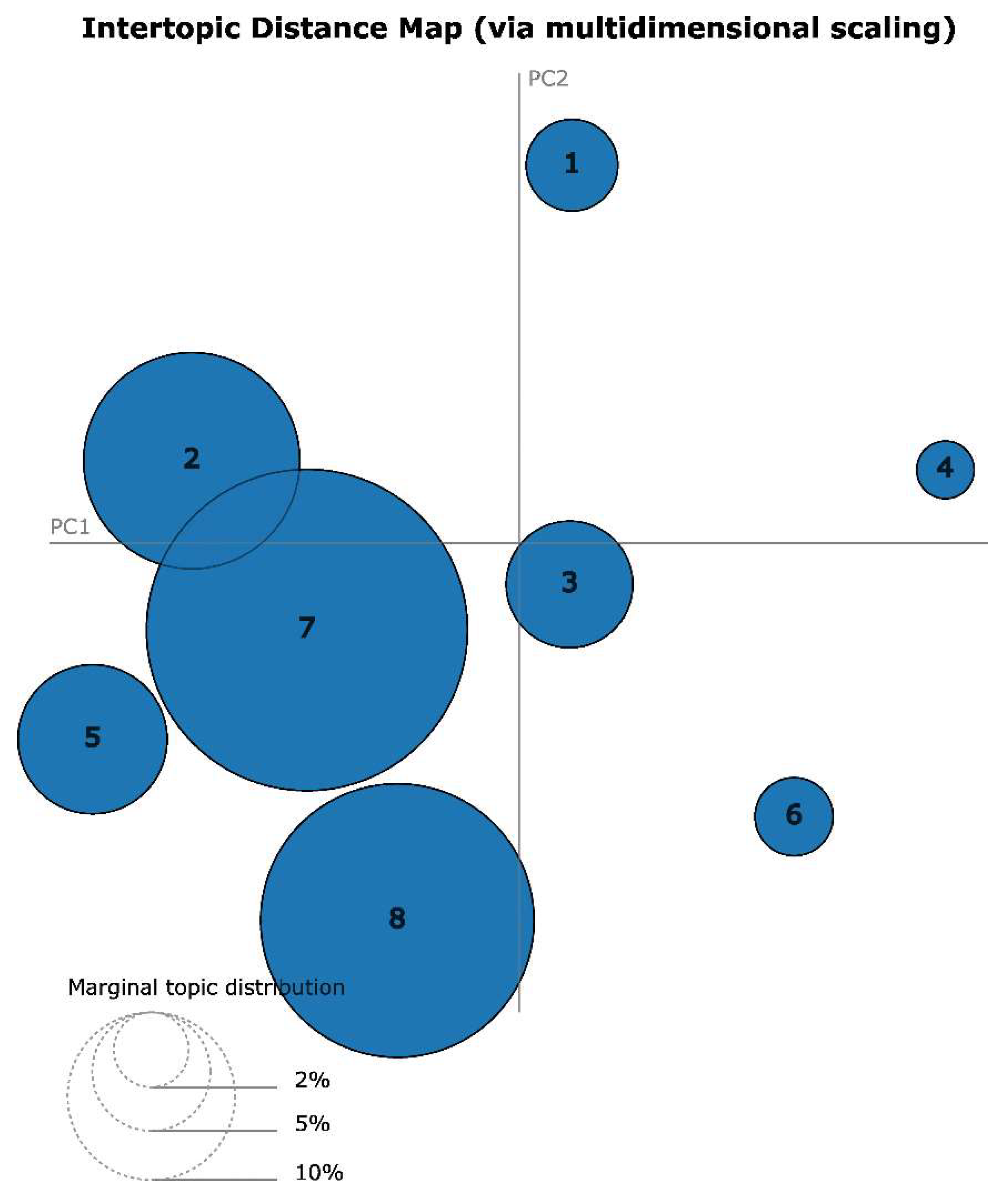
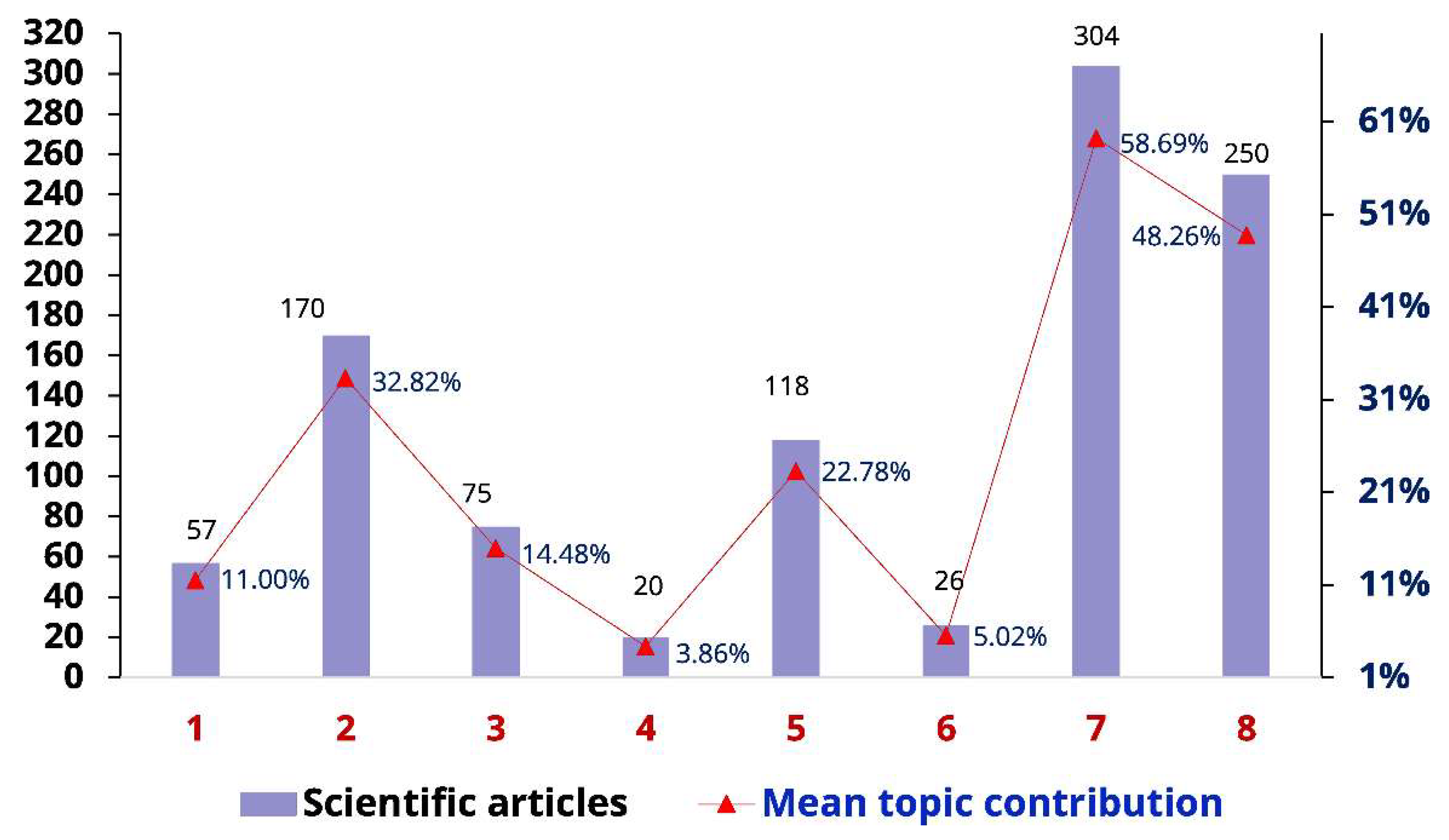
4.2. Latent Dirichlet Allocation
5. Discussion of Topics
5.1. Retailer Strategies in Blockchain-Enabled FSCs
5.2. Blockchain for Food Safety and Sustainability
5.3. Enablers of Blockchain Adoption in FSCs
5.4. Blockchain and Consumer Perceptions
5.5. Blockchain Adoption Challenges
5.6. Blockchain Frameworks for Sustainable Food Systems
5.7. Blockchain for Agri-Food Safety and Transparency
5.8. Blockchain Traceability Systems in FSCs
6. Conclusions
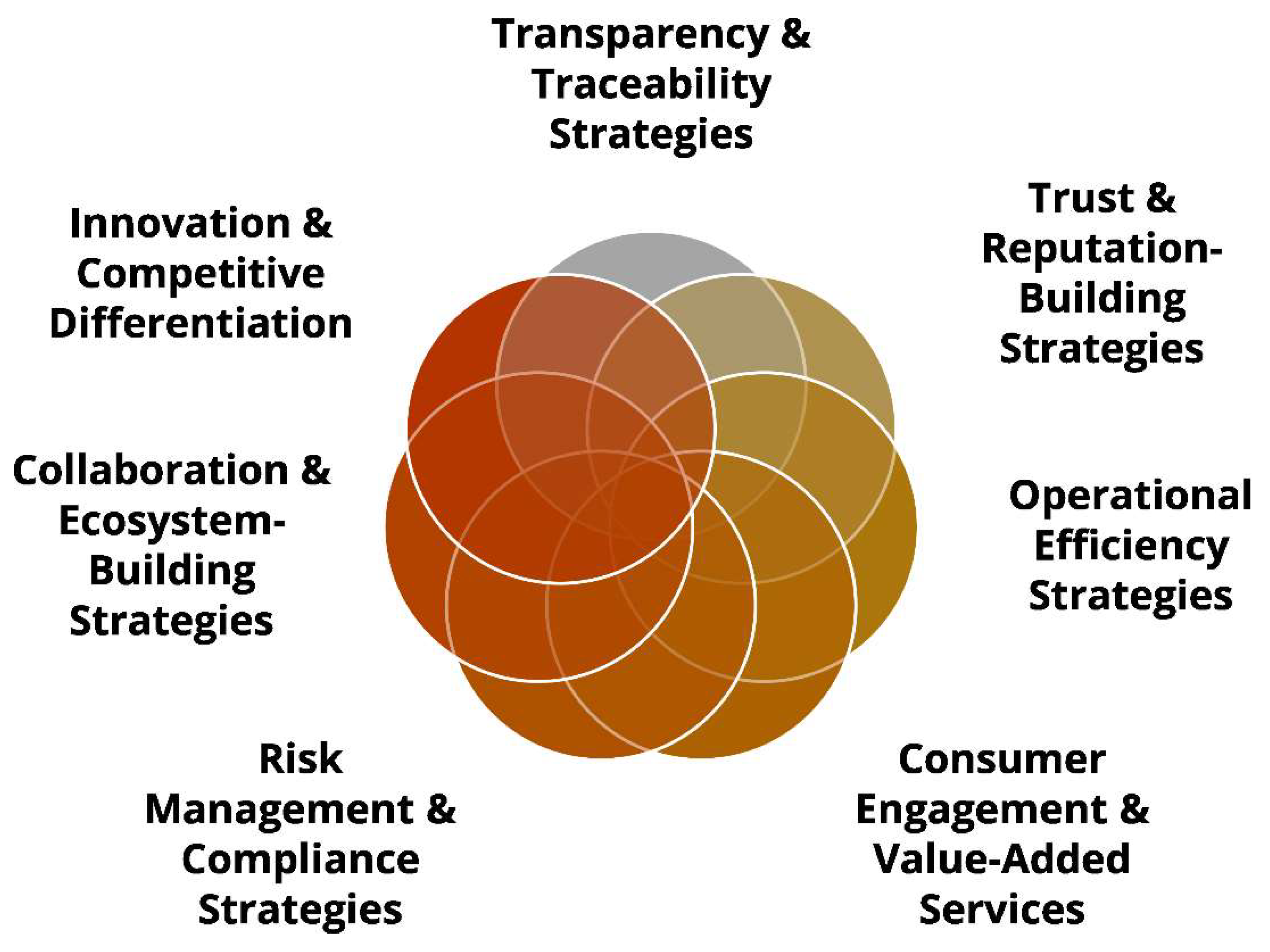
6.1. Research Implications
6.2. Research Limitations
Author Contributions
Funding
Institutional Review Board Statement
Informed Consent Statement
Data Availability Statement
Conflicts of Interest
Appendix A

| Research Area | Key Questions | Suggested Methodologies |
|---|---|---|
| Cost–benefit optimization & scalability | How can retailers balance blockchain costs with efficiency gains? What models reduce double marginalization? | Game theory, optimization models, case studies |
| Integration with complementary technologies | How can blockchain be integrated with IoT, AI, or federated learning for real-time decision-making? | Simulation, digital twin modeling, system architecture design |
| Consumer-centric perspectives | How do consumers perceive blockchain-enabled transparency? Are they willing to pay more for traceability? | Surveys, conjoint analysis, behavioral experiments |
| Retailer strategy & competition | How does blockchain adoption affect retailer competition, pricing, and sales modes? Are there first-mover advantages? | Analytical modeling, agent-based simulation, competitive benchmarking |
| Policy & governance interactions | How do subsidies, regulations, and policies influence retailer adoption of blockchain? What governance models ensure fairness? | Policy analysis, comparative case studies, multi-stakeholder interviews |
| Inclusion & equity | How can smallholder farmers and SMEs access blockchain FSCs affordably? Does blockchain risk widening digital divides? | Field studies, participatory research, mixed-method approaches |
| Resilience & risk management | How does blockchain improve resilience against disruptions (pandemics, climate shocks, fraud)? | Risk modeling, scenario analysis, longitudinal studies |
| Research Area | Key Questions | Suggested Methodologies |
|---|---|---|
| Food safety & crisis response | How can blockchain accelerate food recalls and improve accuracy during crises? What are best practices for integrating blockchain into national food safety systems? | Case studies (e.g., Walmart, EU), simulation of outbreak scenarios, policy analysis |
| Sustainability & waste reduction | How effective is blockchain (alone or with IoT/AI) in reducing food waste and carbon emissions? How does it support the triple bottom line (economic, social, environmental)? | Life Cycle Assessment (LCA), empirical field studies, system dynamics modeling |
| Technology integration | How can blockchain be combined with IoT, cloud computing, AR, and digital twins for end-to-end traceability? What technical barriers limit integration? | Pilot projects, architecture design, interoperability testing |
| Consumer trust & behavior | How does blockchain-enabled traceability influence consumer trust, purchasing behavior, and willingness to pay for safe/sustainable products? | Surveys, experiments, conjoint analysis |
| Cross-sector & regional adoption | What adoption challenges exist in different regions (e.g., developing vs. developed economies)? How do cross-sector collaborations (agriculture, logistics, retail, regulators) shape outcomes? | Comparative studies, cross-country case analysis, stakeholder interviews |
| Cold chain & perishables | How does blockchain adoption affect traceability, waste reduction, and emissions in cold chains? What are the implications for food safety and competitiveness? | Empirical studies in perishable supply chains, optimization modeling, bibliometric analysis |
| Governance & policy implications | How should policymakers regulate and incentivize blockchain for food safety and sustainability? What governance models ensure accountability, transparency, and interoperability? | Policy evaluation, scenario analysis, Delphi studies with experts |
| Research Area | Key Questions | Suggested Methodologies |
|---|---|---|
| Consumer demand & willingness to pay | How do consumer preferences for blockchain-enabled traceability vary across regions, demographics, and product categories? To what extent are consumers willing to pay a premium for food safety and sustainability? | Discrete choice experiments, surveys, cross-country consumer studies |
| Sustainability & circular economy | How can blockchain strengthen circular practices (e.g., 12Rs framework) in FSCs? What role does blockchain play in driving sustainable sourcing and reducing waste? | ISM-DEMATEL modeling, system dynamics, case studies |
| Institutional & cultural barriers | How do entrenched power structures (e.g., wholesalers, distributors) influence blockchain adoption? What strategies can overcome resistance among dominant actors? | Qualitative interviews, institutional analysis, stakeholder mapping |
| Technological integration & interoperability | How can blockchain be effectively integrated with AI, IoT, and other digital tools to enhance traceability and sustainability? How can interoperability and data privacy challenges be addressed? | Pilot projects, architecture testing, technical benchmarking |
| Trust & data reliability | To what extent can blockchain reduce reliance on pre-existing trust relationships? How can human data input errors be minimized to ensure blockchain integrity? | Mixed-method studies, experiments with automated data capture, blockchain–IoT integration |
| Conservation & resource management | How can blockchain, when combined with AI/IoT, improve fisheries management, prevent overfishing, and combat counterfeit seafood? | Empirical field research, fisheries modeling, conservation-focused pilots |
| Scaling & adoption dynamics | What conditions (policy, cost-sharing, ecosystem collaboration) are necessary to scale blockchain adoption in FSCs? How can smaller actors be incentivized to adopt blockchain despite power imbalances? | Comparative case studies, adoption modeling, policy evaluation |
| Research Area | Key Questions | Suggested Methodologies |
|---|---|---|
| Trust & communication strategies | How do communication tools (e.g., short videos, storytelling, labeling) shape consumer trust in blockchain-enabled FSCs? What strategies reduce the gap between expectations and actual willingness to pay? | Experimental studies, consumer behavior surveys, content analysis |
| Willingness to pay & gender/cultural differences | How do gender, cultural, and demographic factors influence willingness to pay for blockchain-certified products? Do these differences persist across product types (e.g., beef, halal meat, coffee)? | Discrete choice experiments, cross-cultural comparative studies, segmentation analysis |
| Consumer knowledge & education | How does consumer awareness of blockchain affect adoption? What role do education campaigns and user-friendly designs play in shaping perceptions? | Technology Acceptance Model (TAM), field experiments, longitudinal consumer surveys |
| Technology readiness & adoption | How do individual traits (optimism, innovativeness, discomfort) influence adoption intentions? How do blockchain-enabled FSCs align with Technology Readiness? | TAM-TRI integration, structural equation modeling, large-scale surveys |
| Integration with emerging technologies | How can blockchain combined with AI, AR, digital twins, or intelligent packaging improve consumer trust and product authenticity? | Pilot projects, experimental trials, technology adoption case studies |
| Ethical & religious food systems | How does blockchain adoption affect consumer trust in halal, kosher, or other religious/ethical food supply chains? | Qualitative case studies, focus groups, mixed-method research |
| Inclusivity & marginalized groups | How do smallholder farmers and marginalized consumer groups perceive blockchain-enabled traceability? Does blockchain improve inclusivity and access to safe, sustainable food? | Field studies, participatory research, surveys in low-income markets |
| Research Area | Key Questions | Suggested Methodologies |
|---|---|---|
| Organizational & managerial readiness | How do managerial perceptions, digital literacy, and top management commitment influence adoption success? What strategies can build internal advocacy for blockchain? | Surveys with managers, organizational readiness assessments, case studies |
| Cost & economic feasibility | How do costs (implementation, maintenance, training) interact with organizational factors to shape adoption? What financing models (subsidies, cost-sharing, tax relief) lower barriers? | Economic modeling, cost–benefit analysis, policy simulations |
| Technological & environmental contexts | How do blockchain adoption challenges differ across industries (e.g., seafood vs. fresh produce)? What environmental or infrastructural factors (e.g., digital infrastructure) hinder scaling? | Comparative case studies, Technology–Organization–Environment (TOE) framework applications |
| Cultural & social influences | How do cultural values (e.g., collectivism, uncertainty avoidance) affect consumer and organizational adoption? Do cultural differences shape trust-building in blockchain-enabled FSCs? | Cross-cultural surveys, cultural dimension analysis (e.g., Hofstede), structural equation modeling |
| Consumer trust dynamics | How do personal trust and system trust interact in shaping adoption? What happens when trust dimensions are imbalanced? | Experimental studies, trust mediation models, longitudinal consumer research |
| Collaborative ecosystem approaches | How can partnerships among governments, retailers, suppliers, and consumers help overcome adoption resistance? What governance frameworks enable inclusive blockchain ecosystems? | Stakeholder analysis, ecosystem mapping, Delphi studies with experts |
| Smallholder & resource-constrained contexts | How can blockchain adoption be made affordable and accessible for smallholders and SMEs? What scalable solutions address inequality in adoption? | Field experiments, participatory research, pilot projects in developing regions |
| Research Area | Key Questions | Suggested Methodologies |
|---|---|---|
| Framework design & operational efficiency | How can blockchain frameworks optimize operational efficiency (e.g., pricing, energy use, resource allocation) across diverse FSCs? What models ensure resilience against fraud and volatility? | Simulation modeling, optimization algorithms, IoT integration studies |
| Integration with eco-innovations | How can blockchain be combined with green technologies (e.g., waste utilization, bioplastics, energy-efficient systems) to promote sustainability? | Case studies, LCA (Life Cycle Assessment), comparative environmental impact analysis |
| Security & quantum-resilience | How can blockchain frameworks protect against emerging cybersecurity threats, including quantum-level attacks? What cryptographic approaches are most effective for FSC applications? | Security modeling, federated AI simulations, cryptography experiments |
| Consumer trust & market applications | How do blockchain frameworks enhance transparency, provenance, and authenticity in consumer-facing contexts (e.g., fine dining, seafood, greenhouse produce)? | Field experiments, consumer surveys, case studies with restaurants and retailers |
| Scalability & interoperability | How can blockchain frameworks be scaled across diverse cultural, economic, and geographic settings? How can interoperability between different blockchain systems be achieved? | Pilot implementations, multi-stakeholder workshops, interoperability testing |
| Inclusion of small-scale producers | How can smallholders and SMEs participate in blockchain frameworks without prohibitive costs? What incentives or cooperative models support inclusive adoption? | Participatory action research, pilot projects, cost–benefit analysis for SMEs |
| Energy efficiency & sustainability metrics | How can energy consumption of blockchain operations be minimized while maintaining transparency and security? How do blockchain frameworks contribute to measurable sustainability outcomes? | Energy modeling, IoT-enabled monitoring, sustainability performance assessment |
| Research Area | Key Questions | Suggested Methodologies |
|---|---|---|
| Traceability & transparency | How can blockchain ensure end-to-end traceability across complex agri-food supply chains? What mechanisms enhance transparency for consumers and regulators? | Case studies, process mapping, blockchain simulation |
| Integration with IoT & smart contracts | How can blockchain combined with IoT sensors and smart contracts optimize safety, coordination, and efficiency? What technological architectures are most effective? | Pilot projects, experimental validation, Hyperledger-based prototypes |
| Food safety & quality assurance | How can blockchain prevent adulteration, contamination, and fraud in dairy, horticulture, and other agri-food sectors? | Risk assessment, quality control studies, field trials |
| Scalability & regulatory compliance | What scalability challenges limit adoption in developing countries or smallholder systems? How can regulatory compliance be ensured while maintaining efficiency? | Multi-criteria decision-making, policy analysis, stakeholder interviews |
| Socio-economic & inclusive outcomes | How does blockchain adoption affect smallholders’ socio-economic viability and market access? How can marginalized producers be integrated into formal agri-food systems? | Field studies, participatory research, impact assessment |
| Operational efficiency & waste reduction | How can blockchain reduce post-harvest losses, improve distribution, and bridge demand–supply gaps? | Simulation modeling, optimization studies, supply chain analytics |
| Consumer trust & ethical sourcing | How can blockchain increase consumer confidence in ethical and safe sourcing practices? How can transparency influence purchasing behavior? | Consumer surveys, experimental studies, conjoint analysis |
| Research Area | Key Questions | Suggested Methodologies |
|---|---|---|
| System design & automation | How can blockchain-based traceability systems be automated for real-time monitoring and decision-making? What architectures (smart contracts, IoT integration, RFID) optimize efficiency? | Pilot implementations, system simulations, IoT/blockchain integration studies |
| Sector-specific applications | How can traceability systems be tailored for diverse sectors (halal meat, seeds, grains, etc.)? What features enhance sector-specific transparency and safety? | Case studies, field trials, comparative analysis |
| Decentralization & data integrity | How can decentralized blockchain structures reduce reliance on central authorities and ensure tamper-proof data? How effective are consensus mechanisms in multi-stakeholder FSCs? | Technical experiments, Hyperledger/Ethereum prototypes, simulation studies |
| Integration with IoT & AI | How can IoT sensors, AI algorithms, and blockchain work together to enable automated quality monitoring and predictive safety alerts? | IoT-enabled pilot projects, AI analytics integration, real-time monitoring studies |
| Scalability & interoperability | How can blockchain traceability systems be scaled across regions and supply chains while remaining affordable? What interoperability standards are needed for multi-platform adoption? | Multi-case implementation studies, interoperability testing, cost–benefit analysis |
| Regulatory & cross-border standards | How can regulatory frameworks support adoption and global harmonization of blockchain traceability? How can compliance be ensured across jurisdictions? | Policy analysis, comparative legal studies, expert Delphi panels |
| Consumer trust & engagement | How can blockchain traceability systems enhance consumer confidence and willingness to pay for verified products? | Consumer surveys, experimental studies, adoption behavior modeling |
References
- Ding, H.; Cheng, W.; Song, X.; Dong, G.; Cui, X.; Yu, W.; Wilson, D.I. Integration of Distributed Technologies for Intelligent Food Quality and Safety Management: Blockchain, IoT, and Federated Learning. Food Rev. Int. 2025, 41, 3016–3038. [Google Scholar] [CrossRef]
- El-tahlawy, A.S.; Alawam, A.S.; Rudayn, H.A.; Allam, A.A.; Mahmoud, R.; El-Raheem, H.A.; Alahmad, W. Advanced Analytical and Digital Approaches for Proactive Detection of Food Fraud as an Emerging Contaminant Threat. Talanta Open 2025, 12, 100499. [Google Scholar] [CrossRef]
- Enayati, M.; Gudimetla, P.; Arlikatti, S. Blockchain Technology as a Tool to Make Supply Chains More Resilient and Sustainable. Oper. Supply Chain Manag. 2024, 17, 165–178. [Google Scholar] [CrossRef]
- Guo, T.; Chen, Y.; Ren, Q.; Li, D.; Bo, W.; Wang, X. Blockchain-Based Trusted Traceability Scheme for Food Quality and Safety. J. Food Qual. 2025, 2025, 5914078. [Google Scholar] [CrossRef]
- Sugandh, U.; Nigam, S.; Khari, M.; Misra, S. An Approach for Risk Traceability Using Blockchain Technology for Tracking, Tracing, and Authenticating Food Products. Information 2023, 14, 613. [Google Scholar] [CrossRef]
- Apeh, O.O.; Nwulu, N.I. Improving Traceability and Sustainability in the Agri-Food Industry through Blockchain Technology: A Bibliometric Approach, Benefits and Challenges. Energy Nexus 2025, 17, 100388. [Google Scholar] [CrossRef]
- Le, M.T.; Dang, P.-A.T.; Le, C.Y.; Nguyen, T.T.T. Integrating Local Fine Food Traceability Mapping in Vietnam’s Fine Dining Sector. Appl. Food Res. 2025, 5, 101069. [Google Scholar] [CrossRef]
- Sun, F.; Wang, P.; Zhang, Y.; Kar, P. βFSCM: An Enhanced Food Supply Chain Management System Using Hybrid Blockchain and Recommender Systems. Blockchain Res. Appl. 2025, 6, 100245. [Google Scholar] [CrossRef]
- Conter, M. Recent Advancements in Meat Traceability, Authenticity Verification, and Voluntary Certification Systems. Ital. J. Food Saf. 2025, 14, 12971. [Google Scholar] [CrossRef]
- Osei, R.K.; Medici, M.; Hingley, M.; Canavari, M. Exploring Opportunities and Challenges to the Adoption of Blockchain Technology in the Fresh Produce Value Chain. AIMS Agric. Food 2021, 6, 560–577. [Google Scholar] [CrossRef]
- Farina, G.; Kocian, A.; Brunori, G.; Chessa, S.; Lai, M.B.; Nardi, D.; Schifanella, C.; Bonura, S.; Masi, N.; Comella, S.; et al. Interoperable Traceability in Agrifood Supply Chains: Enhancing Transport Systems Through IoT Sensor Data, Blockchain, and DataSpace †. Sensors 2025, 25, 3419. [Google Scholar] [CrossRef] [PubMed]
- Dal Mas, F.; Massaro, M.; Ndou, V.; Raguseo, E. Blockchain Technologies for Sustainability in the Agrifood Sector: A Literature Review of Academic Research and Business Perspectives. Technol. Forecast. Soc. Change 2023, 187, 122155. [Google Scholar] [CrossRef]
- Duan, K.; Onyeaka, H.; Pang, G. Leveraging Blockchain to Tackle Food Fraud: Innovations and Obstacles. J. Agric. Food Res. 2024, 18, 101429. [Google Scholar] [CrossRef]
- Mustafa, M.F.M.S.; Navaranjan, N.; Demirovic, A. Food Cold Chain Logistics and Management: A Review of Current Development and Emerging Trends. J. Agric. Food Res. 2024, 18, 101343. [Google Scholar] [CrossRef]
- Rejeb, A.; Simske, S.; Rejeb, K.; Treiblmaier, H.; Zailani, S. Internet of Things Research in Supply Chain Management and Logistics: A Bibliometric Analysis. Internet Things 2020, 12, 100318. [Google Scholar] [CrossRef]
- Ahmad, R.W.; Ko, K.-M.; Rashid, A.; Rodrigues, J.J.P.C. Blockchain for Food Industry: Opportunities, Requirements, Case Studies, and Research Challenges. IEEE Access 2024, 12, 117363–117378. [Google Scholar] [CrossRef]
- Akinbamini, E.; Vargas, A.; Traill, A.; Boza, A.; Cuenca, L. Critical Analysis of Technologies Enhancing Supply Chain Collaboration in the Food Industry: A Nigerian Survey. Logistics 2025, 9, 8. [Google Scholar] [CrossRef]
- Ellahi, R.M.; Wood, L.C.; Bekhit, A.E.-D.A. Blockchain-Based Frameworks for Food Traceability: A Systematic Review. Foods 2023, 12, 3026. [Google Scholar] [CrossRef]
- Kaur, A.; Singh, G.; Kukreja, V.; Sharma, S.; Singh, S.; Yoon, B. Adaptation of IoT with Blockchain in Food Supply Chain Management: An Analysis-Based Review in Development, Benefits and Potential Applications. Sensors 2022, 22, 8174. [Google Scholar] [CrossRef]
- Cordeiro, M.; Ferreira, J.C. Beyond Traceability: Decentralised Identity and Digital Twins for Verifiable Product Identity in Agri-Food Supply Chains. Appl. Sci. 2025, 15, 100318. [Google Scholar] [CrossRef]
- Acciarini, C.; Cappa, F.; Di Costanzo, G.; Prisco, M.; Sardo, F.; Stazzone, A.; Stoto, C. Blockchain Technology to Protect Label Information: The Effects on Purchase Intentions in the Food Industry. Comput. Ind. Eng. 2023, 180, 109276. [Google Scholar] [CrossRef]
- Bosona, T.; Gebresenbet, G. The Role of Blockchain Technology in Promoting Traceability Systems in Agri-Food Production and Supply Chains. Sensors 2023, 23, 5342. [Google Scholar] [CrossRef] [PubMed]
- Treiblmaier, H. The Impact of the Blockchain on the Supply Chain: A Theory-Based Research Framework and a Call for Action. Supply Chain Manag. Int. J. 2018, 23, 545–559. [Google Scholar] [CrossRef]
- Rejeb, A.; Sűle, E.; Keogh, J.G. Exploring New Technologies in Procurement. Transp. Logist. Int. J. 2018, 18, 76–86. [Google Scholar]
- Elkoraichi, Y.; Elfezazi, S.; Belhadi, A. Analysis of Barriers to Blockchain Technology Adoption in the African Agri-Food Supply Chain. Discov. Sustain. 2025, 6, 289. [Google Scholar] [CrossRef]
- Patel, A.S.; Brahmbhatt, M.N.; Bariya, A.R.; Nayak, J.B.; Singh, V.K. Blockchain Technology in Food Safety and Traceability Concern to Livestock Products. Heliyon 2023, 9, e16526. [Google Scholar] [CrossRef]
- Rejeb, A.; Keogh, J.G.; Treiblmaier, H. Leveraging the Internet of Things and Blockchain Technology in Supply Chain Management. Future Internet 2019, 11, 161. [Google Scholar] [CrossRef]
- Pakseresht, A.; Ahmadi Kaliji, S.; Xhakollari, V. How Blockchain Facilitates the Transition toward Circular Economy in the Food Chain? Sustainability 2022, 14, 11754. [Google Scholar] [CrossRef]
- Shi, X.; Chen, S.; Lai, X. Blockchain Adoption or Contingent Sourcing? Advancing Food Supply Chain Resilience in the Post-Pandemic Era. Front. Eng. Manag. 2023, 10, 107–120. [Google Scholar] [CrossRef]
- Rejeb, A.; Keogh, J.G.; Zailani, S.; Treiblmaier, H.; Rejeb, K. Blockchain Technology in the Food Industry: A Review of Potentials, Challenges and Future Research Directions. Logistics 2020, 4, 27. [Google Scholar] [CrossRef]
- Bumblauskas, D.; Mann, A.; Dugan, B.; Rittmer, J. A Blockchain Use Case in Food Distribution: Do You Know Where Your Food Has Been? Int. J. Inf. Manag. 2020, 52, 102008. [Google Scholar] [CrossRef]
- Vu, N.; Ghadge, A.; Bourlakis, M. Blockchain Adoption in Food Supply Chains: A Review and Implementation Framework. Prod. Plan. Control 2023, 34, 506–523. [Google Scholar] [CrossRef]
- Zhao, G.; Liu, S.; Lopez, C.; Lu, H.; Elgueta, S.; Chen, H.; Boshkoska, B.M. Blockchain Technology in Agri-Food Value Chain Management: A Synthesis of Applications, Challenges and Future Research Directions. Comput. Ind. 2019, 109, 83–99. [Google Scholar] [CrossRef]
- Rana, R.L.; Tricase, C.; De Cesare, L. Blockchain Technology for a Sustainable Agri-Food Supply Chain. Br. Food J. 2021, 123, 3471–3485. [Google Scholar] [CrossRef]
- Antonucci, F.; Figorilli, S.; Costa, C.; Pallottino, F.; Raso, L.; Menesatti, P. A Review on Blockchain Applications in the Agri-Food Sector. J. Sci. Food Agric. 2019, 99, 6129–6138. [Google Scholar] [CrossRef]
- Duan, J.; Zhang, C.; Gong, Y.; Brown, S.; Li, Z. A Content-analysis Based Literature Review in Blockchain Adoption within Food Supply Chain. Int. J. Environ. Res. Public. Health 2020, 17, 1784. [Google Scholar] [CrossRef]
- Pandey, V.; Pant, M.; Snasel, V. Blockchain Technology in Food Supply Chains: Review and Bibliometric Analysis. Technol. Soc. 2022, 69, 101954. [Google Scholar] [CrossRef]
- Li, K.; Lee, J.-Y.; Gharehgozli, A. Blockchain in Food Supply Chains: A Literature Review and Synthesis Analysis of Platforms, Benefits and Challenges. Int. J. Prod. Res. 2023, 61, 3527–3546. [Google Scholar] [CrossRef]
- Chiaraluce, G.; Bentivoglio, D.; Finco, A.; Fiore, M.; Contò, F.; Galati, A. Exploring the Role of Blockchain Technology in Modern High-Value Food Supply Chains: Global Trends and Future Research Directions. Agric. Food Econ. 2024, 12, 6. [Google Scholar] [CrossRef]
- Katsikouli, P.; Wilde, A.S.; Dragoni, N.; Høgh-Jensen, H. On the Benefits and Challenges of Blockchains for Managing Food Supply Chains. J. Sci. Food Agric. 2021, 101, 2175–2181. [Google Scholar] [CrossRef]
- Lascialfari, M.; Magrini, M.-B.; Cabanac, G. Unpacking Research Lock-in through a Diachronic Analysis of Topic Cluster Trajectories in Scholarly Publications. Scientometrics 2022, 127, 6165–6189. [Google Scholar] [CrossRef]
- Rejeb, A.; Rejeb, K.; Appolloni, A.; Kayikci, Y.; Iranmanesh, M. The Landscape of Public Procurement Research: A Bibliometric Analysis and Topic Modelling Based on Scopus. J. Public Procure. 2023. ahead of print. [Google Scholar] [CrossRef]
- Janmaijaya, M.; Shukla, A.K.; Muhuri, P.K.; Abraham, A. Industry 4.0: Latent Dirichlet Allocation and Clustering Based Theme Identification of Bibliography. Eng. Appl. Artif. Intell. 2021, 103, 104280. [Google Scholar] [CrossRef]
- Blei, D.M.; Ng, A.Y.; Jordan, M.I. Latent Dirichlet Allocation. J. Mach. Learn. Res. 2003, 3, 993–1022. [Google Scholar]
- Rejeb, A.; Rejeb, K.; Zrelli, I.; Kayikci, Y.; Hassoun, A. The Research Landscape of Industry 5.0: A Scientific Mapping Based on Bibliometric and Topic Modeling Techniques. Flex. Serv. Manuf. J. 2024, 1–48. [Google Scholar] [CrossRef]
- St John, J.; St John, K.; Han, B. Entrepreneurial Crowdfunding Backer Motivations: A Latent Dirichlet Allocation Approach. Eur. J. Innov. Manag. 2021, 25, 223–241. [Google Scholar] [CrossRef]
- Rejeb, A.; Rejeb, K.; Appolloni, A.; Jagtap, S.; Iranmanesh, M.; Alghamdi, S.; Alhasawi, Y.; Kayikci, Y. Unleashing the Power of Internet of Things and Blockchain: A Comprehensive Analysis and Future Directions. Internet Things Cyber-Phys. Syst. 2023, 4, 1–18. [Google Scholar] [CrossRef]
- Rejeb, A.; Rejeb, K.; Zrelli, I. Exploring the State-of-the-Art of Halal Food Research Using Latent Dirichlet Allocation. Discov. Food 2025, 5, 24. [Google Scholar] [CrossRef]
- Rejeb, A.; Rejeb, K.; Simske, S.; Keogh, J.G. Exploring Blockchain Research in Supply Chain Management: A Latent Dirichlet Allocation-Driven Systematic Review. Information 2023, 14, 557. [Google Scholar] [CrossRef]
- Rejeb, A.; Rejeb, K.; Simske, S.; Süle, E. Industry 5.0 Research: An Approach Using Co-Word Analysis and BERTopic Modeling. Discov. Sustain. 2025, 6, 402. [Google Scholar] [CrossRef]
- Guo, Y.; Barnes, S.J.; Jia, Q. Mining Meaning from Online Ratings and Reviews: Tourist Satisfaction Analysis Using Latent Dirichlet Allocation. Tour. Manag. 2017, 59, 467–483. [Google Scholar] [CrossRef]
- Rejeb, A.; Rejeb, K.; Appolloni, A.; Zailani, S.; Iranmanesh, M. Navigating the Landscape of Public–Private Partnership Research: A Novel Review Using Latent Dirichlet Allocation. Int. J. Public Sect. Manag. 2024. ahead of print. [Google Scholar] [CrossRef]
- Zrelli, I.; Rejeb, A.; Abusulaiman, R.; AlSahafi, R.; Rejeb, K.; Iranmanesh, M. Drone Applications in Logistics and Supply Chain Management: A Systematic Review Using Latent Dirichlet Allocation. Arab. J. Sci. Eng. 2024, 49, 12411–12430. [Google Scholar] [CrossRef]
- Rejeb, A.; Rejeb, K.; Appolloni, A.; Treiblmaier, H.; Iranmanesh, M. Uncovering the Themes and Trends in Crowdfunding Research Using Latent Dirichlet Allocation. Manag. Rev. Q. 2024, 75, 2033–2066. [Google Scholar] [CrossRef]
- Ligorio, L.; Venturelli, A.; Caputo, F. Tracing the Boundaries between Sustainable Cities and Cities for Sustainable Development. An LDA Analysis of Management Studies. Technol. Forecast. Soc. Change 2022, 176, 121447. [Google Scholar] [CrossRef]
- Weber, P.; Carl, K.V.; Hinz, O. Applications of Explainable Artificial Intelligence in Finance—A Systematic Review of Finance, Information Systems, and Computer Science Literature. Manag. Rev. Q. 2024, 74, 867–907. [Google Scholar] [CrossRef]
- Rejeb, A.; Rejeb, K.; Hassoun, A. The Impact of Machine Learning Applications in Agricultural Supply Chain: A Topic Modeling-Based Review. Discov. Food 2025, 5, 141. [Google Scholar] [CrossRef]
- Rejeb, A.; Rejeb, K.; Appolloni, A.; Treiblmaier, H. Navigating the Crowdfunding Landscape: A Study of Knowledge Trajectories Based on Main Path Analysis. Eur. J. Innov. Manag. 2023, 26, 415–448. [Google Scholar] [CrossRef]
- Ogunleye, B.; Lancho Barrantes, B.S.; Zakariyyah, K.I. Topic Modelling through the Bibliometrics Lens and Its Technique. Artif. Intell. Rev. 2025, 58, 74. [Google Scholar] [CrossRef]
- Aria, M.; Cuccurullo, C. Bibliometrix: An R-Tool for Comprehensive Science Mapping Analysis. J. Informetr. 2017, 11, 959–975. [Google Scholar] [CrossRef]
- Kaliisa, R.; López-Pernas, S.; Misiejuk, K.; Damşa, C.; Sobocinski, M.; Järvelä, S.; Saqr, M. A Topical Review of Research in Computer-Supported Collaborative Learning: Questions and Possibilities. Comput. Educ. 2025, 228, 105246. [Google Scholar] [CrossRef]
- Addou, K.; El Ghoumari, M.Y.; Achkdir, S.; Azzouazi, M. A Decentralized Model to Ensure Traceability and Sustainability of the Food Supply Chain by Combining Blockchain, IoT, and Machine Learning. Math. Model. Comput. 2023, 10, 498–510. [Google Scholar] [CrossRef]
- Aggarwal, M.; Rani, P.; Rani, P.; Sharma, P. Revolutionizing Agri-Food Supply Chain Management with Blockchain-Based Traceability and Navigation Integration. Clust. Comput. 2024, 27, 12919–12942. [Google Scholar] [CrossRef]
- Duong, C.D.; Tran, T.V.H.; Nguyen, T.H.; Ngo, T.V.N.; Vu, T.N. Blockchain-Based Food Traceability System and pro-Environmental Consumption: A Moderated Mediation Model of Technology Anxiety and Trust in Organic Food Product. Digit. Bus. 2024, 4, 100095. [Google Scholar] [CrossRef]
- Reitano, M.; Pappalardo, G.; Selvaggi, R.; Zarbà, C.; Chinnici, G. Factors Influencing Consumer Perceptions of Food Tracked with Blockchain Technology. A Systematic Literature Review. Appl. Food Res. 2024, 4, 100455. [Google Scholar] [CrossRef]
- Vitaskos, V.; Demestichas, K.; Karetsos, S.; Costopoulou, C. Blockchain and Internet of Things Technologies for Food Traceability in Olive Oil Supply Chains. Sensors 2024, 24, 8189. [Google Scholar] [CrossRef]
- Annane, B.; Alti, A.; Lakehal, A. A Blockchain Semantic-Based Approach for Secure and Traceable Agri-Food Supply Chain. Eng. Technol. Appl. Sci. Res. 2024, 14, 18131–18137. [Google Scholar] [CrossRef]
- Hassoun, A.; Kamiloglu, S.; Garcia-Garcia, G.; Parra-López, C.; Trollman, H.; Jagtap, S.; Aadil, R.M.; Esatbeyoglu, T. Implementation of Relevant Fourth Industrial Revolution Innovations across the Supply Chain of Fruits and Vegetables: A Short Update on Traceability 4.0. Food Chem. 2023, 409, 135303. [Google Scholar] [CrossRef]
- Kurniawan, M.; Suparno, S.; Vanany, I. Conceptual Framework for Halal Supply Chain Traceability and Food Safety in Indonesia Based on Blockchain Technology and Internet of Things to Support Sustainable Development †. Eng. Proc. 2025, 84, 27. [Google Scholar]
- Arvana, M.; Rocha, A.D.; Barata, J. Agri-Food Value Chain Traceability Using Blockchain Technology: Portuguese Hams’ Production Scenario. Foods 2023, 12, 4246. [Google Scholar] [CrossRef] [PubMed]
- Tsolakis, N.; Niedenzu, D.; Simonetto, M.; Dora, M.; Kumar, M. Supply Network Design to Address United Nations Sustainable Development Goals: A Case Study of Blockchain Implementation in Thai Fish Industry. J. Bus. Res. 2021, 131, 495–519. [Google Scholar] [CrossRef]
- Tsoukas, V.; Gkogkidis, A.; Kampa, A.; Spathoulas, G.; Kakarountas, A. Enhancing Food Supply Chain Security through the Use of Blockchain and TinyML. Information 2022, 13, 512. [Google Scholar] [CrossRef]
- Shardeo, V.; Patil, A.; Dwivedi, A.; Madaan, J. Modelling of Critical Success Factors for Blockchain Technology Adoption Readiness in the Context of Agri-Food Supply Chain. Int. J. Ind. Syst. Eng. 2023, 43, 80–102. [Google Scholar] [CrossRef]
- Toader, D.-C.; Rădulescu, C.M.; Toader, C. Investigating the Adoption of Blockchain Technology in Agri-Food Supply Chains: Analysis of an Extended UTAUT Model. Agriculture 2024, 14, 614. [Google Scholar] [CrossRef]
- Liu, Y.; Ma, D.; Hu, J.; Zhang, Z. Sales Mode Selection of Fresh Food Supply Chain Based on Blockchain Technology under Different Channel Competition. Comput. Ind. Eng. 2021, 162, 107730. [Google Scholar] [CrossRef]
- Li, T.; Xu, X.; Liu, W.; Shi, C. Pricing Decision of Three-Level Agricultural Supply Chain Based on Blockchain Traceability and Altruistic Preference. Sustainability 2023, 15, 3304. [Google Scholar] [CrossRef]
- Xing, X.; Miao, R. Investment Decision and Coordination of Fresh Supply Chain Blockchain Technology Considering Consumer Preference. Systems 2024, 12, 522. [Google Scholar] [CrossRef]
- Liao, C.; Lu, Q.; Shui, Y. Governmental Anti-Pandemic and Subsidy Strategies for Blockchain-Enabled Food Supply Chains in the Post-Pandemic Era. Sustainability 2022, 14, 9497. [Google Scholar] [CrossRef]
- Gupta, R.; Shankar, R. Managing Food Security Using Blockchain-Enabled Traceability System. Benchmarking 2023, 31, 53–74. [Google Scholar] [CrossRef]
- Vorwerk, S.; Rexroth, A. Blockchain in Food Safety. Dtsch. Lebensm.-Rundsch 2020, 116, 533–539. [Google Scholar]
- Rossi, S.; Gemma, S.; Borghini, F.; Perini, M.; Butini, S.; Carullo, G.; Campiani, G. Agri-Food Traceability Today: Advancing Innovation towards Efficiency, Sustainability, Ethical Sourcing, and Safety in Food Supply Chains. Trends Food Sci. Technol. 2025, 163, 105154. [Google Scholar] [CrossRef]
- Zhang, Y.; Gupta, V.K.; Karimi, K.; Wang, Y.; Yusoff, M.A.; Vatanparast, H.; Pan, J.; Aghbashlo, M.; Tabatabaei, M.; Rajaei, A. Synergizing Blockchain and Internet of Things for Enhancing Efficiency and Waste Reduction in Sustainable Food Management. Trends Food Sci. Technol. 2025, 156, 104873. [Google Scholar] [CrossRef]
- Baladraf, T.T.; Marimin, M. POTENTIAL ADOPTION OF BLOCKCHAIN IN FOOD COLD SUPPLY CHAIN: A BIBLIOMETRIC STUDY AND FUTURE RESEARCH AGENDA. J. Eng. Technol. Ind. Appl. 2025, 11, 112–125. [Google Scholar] [CrossRef]
- Petrontino, A.; Frem, M.; Fucilli, V.; Tria, E.; Campobasso, A.A.; Bozzo, F. Consumers’ Purchase Propensity for Pasta Tracked with Blockchain Technology and Labelled with Sustainable Credence Attributes. Front. Sustain. Food Syst. 2024, 8, 1367362. [Google Scholar] [CrossRef]
- Sharma, R.; Samad, T.A.; Chiappetta Jabbour, C.J.; de Queiroz, M.J. Leveraging Blockchain Technology for Circularity in Agricultural Supply Chains: Evidence from a Fast-Growing Economy. J. Enterp. Inf. Manag. 2021, 38, 32–67. [Google Scholar] [CrossRef]
- Thompson, B.S.; Rust, S. Blocking Blockchain: Examining the Social, Cultural, and Institutional Factors Causing Innovation Resistance to Digital Technology in Seafood Supply Chains. Technol. Soc. 2023, 73, 102235. [Google Scholar] [CrossRef]
- Zulkarnain, S. Development of Blockchain-Based System for Tracking Fish Species’ Taxonomy and Conservation Status. J. Fish Taxon. 2024, 31, 22–31. [Google Scholar]
- Tokkozhina, U.; Martins, A.L.; Ferreira, J.C. Multi-Tier Supply Chain Behavior with Blockchain Technology: Evidence from a Frozen Fish Supply Chain. Oper. Manag. Res. 2023, 16, 1562–1576. [Google Scholar] [CrossRef]
- Cao, S.; Foth, M.; Powell, W.; McQueenie, J. What Are the Effects of Short Video Storytelling in Delivering Blockchain-Credentialed Australian Beef Products to China? Foods 2021, 10, 2403. [Google Scholar] [CrossRef]
- Vázquez Meléndez, E.I.; Smith, B.; Bergey, P. Food Provenance Assurance and Willingness to Pay for Blockchain Data Security: A Case of Australian Consumers. J. Retail. Consum. Serv. 2025, 82, 104080. [Google Scholar] [CrossRef]
- Martinelli, E.; De Canio, F. Are Consumers’ Food Purchase Intentions Impacted by Blockchain Technology? Sinergie 2024, 42, 17–36. [Google Scholar] [CrossRef]
- Ellahi, R.M.; Wood, L.C.; Khan, M.; Bekhit, A.E.-D.A. Integrity Challenges in Halal Meat Supply Chain: Potential Industry 4.0 Technologies as Catalysts for Resolution. Foods 2025, 14, 1135. [Google Scholar] [CrossRef] [PubMed]
- Li, W.; Song, R.; Yu, K. Consumer Adoption of Food Blockchain Traceability: Insights from Integrating TAM and TR Models. Front. Sustain. Food Syst. 2025, 9, 1515188. [Google Scholar] [CrossRef]
- Lahane, S.; Paliwal, V.; Kant, R. Evaluation and Ranking of Solutions to Overcome the Barriers of Industry 4.0 Enabled Sustainable Food Supply Chain Adoption. Clean. Logist. Supply Chain 2023, 8, 100116. [Google Scholar] [CrossRef]
- Liu, H.; Osman, L.H.; Omar, A.R.C.; Rosli, N. THE MODERATING EFFECTS OF PERCEIVED COST ON BLOCKCHAIN ADOPTION INTENTION IN AGRICULTURAL SUPPLY CHAINS. Logforum 2024, 20, 585–599. [Google Scholar] [CrossRef]
- Duong, C.D. Exploring the Role of Cultural Values on Consumers’ Organic Food Consumption: Does Blockchain-Enabled Traceability Matter? Oeconomia Copernic 2024, 15, 1509–1546. [Google Scholar] [CrossRef]
- Duong, C.D.; Nguyen, T.H.; Ngo, T.V.N.; Dao Thanh, T.; Tran, N.M. Blockchain Technology and Consumers’ Organic Food Consumption: A Moderated Mediation Model of Blockchain-Based Trust and Perceived Blockchain-Related Information Transparency. J. Asia Bus. Stud. 2025, 19, 54–78. [Google Scholar] [CrossRef]
- Ta, V.L.; Duong, C.D. Investigating the Role of Blockchain-Enabled Drivers on Consumers’ Organic Food Consumption: A Stimulus-Organism-Response Perspective. Environ. Res. Commun. 2025, 7, 035003. [Google Scholar] [CrossRef]
- Rani, P.; Sharma, P.; Gupta, I.; Gaba, P. STP: A Permissioned Blockchain Solution for Dynamic Pricing and Traceability in Food Supply Chain. Peer-to-Peer Netw. Appl. 2025, 18, 1–32. [Google Scholar] [CrossRef]
- John, E.P.; Mishra, U. Integrated Multitrophic Aquaculture Supply Chain Fish Traceability with Blockchain Technology, Valorisation of Fish Waste and Plastic Pollution Reduction by Seaweed Bioplastic: A Study in Tuna Fish Aquaculture Industry. J. Clean. Prod. 2024, 434, 140056. [Google Scholar] [CrossRef]
- Rizwan, A.; Khan, A.N.; Ibrahim, M.; Ahmad, R.; Iqbal, N.; Kim, D.H. Optimal Environment Control and Fruits Delivery Tracking System Using Blockchain for Greenhouse. Comput. Electron. Agric. 2024, 220, 108889. [Google Scholar] [CrossRef]
- Sheriff, I.M.M.; Aravindhar, D.J. Towards Quantum-Resilient Food Systems: Federated AI and Lightweight Lattice Hashing for Blockchain-Based Traceability. SN Comput. Sci. 2025, 6, 659. [Google Scholar] [CrossRef]
- Kumar, A.; Srivastava, S.K.; Singh, S. How Blockchain Technology Can Be a Sustainable Infrastructure for the Agrifood Supply Chain in Developing Countries. J. Glob. Oper. Strateg. Sourc. 2022, 15, 380–405. [Google Scholar] [CrossRef]
- Sakthivel, V.; Prakash, P.; Lee, J.-W.; Prabu, P. Enhancing Transparency and Trust in Agrifood Supply Chains through Novel Blockchain-Based Architecture. KSII Trans. Internet Inf. Syst. 2024, 18, 1968–1985. [Google Scholar] [CrossRef]
- Armas, K.L.; Jacoba, F.P.; Hipolito, M.C. Blockchain Technology for Traceability and Transparency in the Onion Industry of the Philippines. Int. J. Eng. Trends Technol. 2023, 71, 162–169. [Google Scholar] [CrossRef]
- Khanna, A.; Jain, S.; Burgio, A.; Bolshev, V.; Panchenko, V. Blockchain-Enabled Supply Chain Platform for Indian Dairy Industry: Safety and Traceability. Foods 2022, 11, 2716. [Google Scholar] [CrossRef]
- Ghag, N.; Shedage, S. From Farm to Fork: Blockchain’s Impact on Agri-Food Distribution, Sourcing, and Safety. J. Foodserv. Bus. Res. 2025. [Google Scholar] [CrossRef]
- Susanty, A.; Puspitasari, N.B.; Rosyada, Z.F.; Pratama, M.A.; Kurniawan, E. Design of Blockchain-Based Halal Traceability System Applications for Halal Chicken Meat-Based Food Supply Chain. Int. J. Inf. Technol. Singap 2024, 16, 1449–1473. [Google Scholar] [CrossRef]
- Ahuja, R.; Chugh, S.; Singh, R. SeedChain: A Secure and Transparent Blockchain-Driven Framework to Revolutionize the Seed Supply Chain. Future Internet 2024, 16, 132. [Google Scholar] [CrossRef]
- Hameed, H.; Zafar, N.A.; Alkhammash, E.H.; Hadjouni, M. Blockchain-Based Formal Model for Food Supply Chain Management System Using VDM-SL. Sustainability 2022, 14, 14202. [Google Scholar] [CrossRef]
- Wang, L.; He, Y.; Wu, Z. Design of a Blockchain-Enabled Traceability System Framework for Food Supply Chains. Foods 2022, 11, 744. [Google Scholar] [CrossRef]
- Zhang, X.; Sun, P.; Xu, J.; Wang, X.; Yu, J.; Zhao, Z.; Dong, Y. Blockchain-Based Safety Management System for the Grain Supply Chain. IEEE Access 2020, 8, 36398–36410. [Google Scholar] [CrossRef]
- Van Nguyen, T.; Cong Pham, H.; Nhat Nguyen, M.; Zhou, L.; Akbari, M. Data-Driven Review of Blockchain Applications in Supply Chain Management: Key Research Themes and Future Directions. Int. J. Prod. Res. 2023, 61, 8213–8235. [Google Scholar] [CrossRef]
- Madzík, P.; Falát, L.; Pakdil, F. Exploring Blockchain Technologies in Sustainable Supply Chains—Unveiling the Latent Research Topics Using an AI Approach. Int. J. Prod. Res. 2025, 63, 8047–8073. [Google Scholar] [CrossRef]
- Balcıoğlu, Y.S.; Çelik, A.A.; Altındağ, E. Integrating Blockchain Technology in Supply Chain Management: A Bibliometric Analysis of Theme Extraction via Text Mining. Sustainability 2024, 16, 10032. [Google Scholar] [CrossRef]

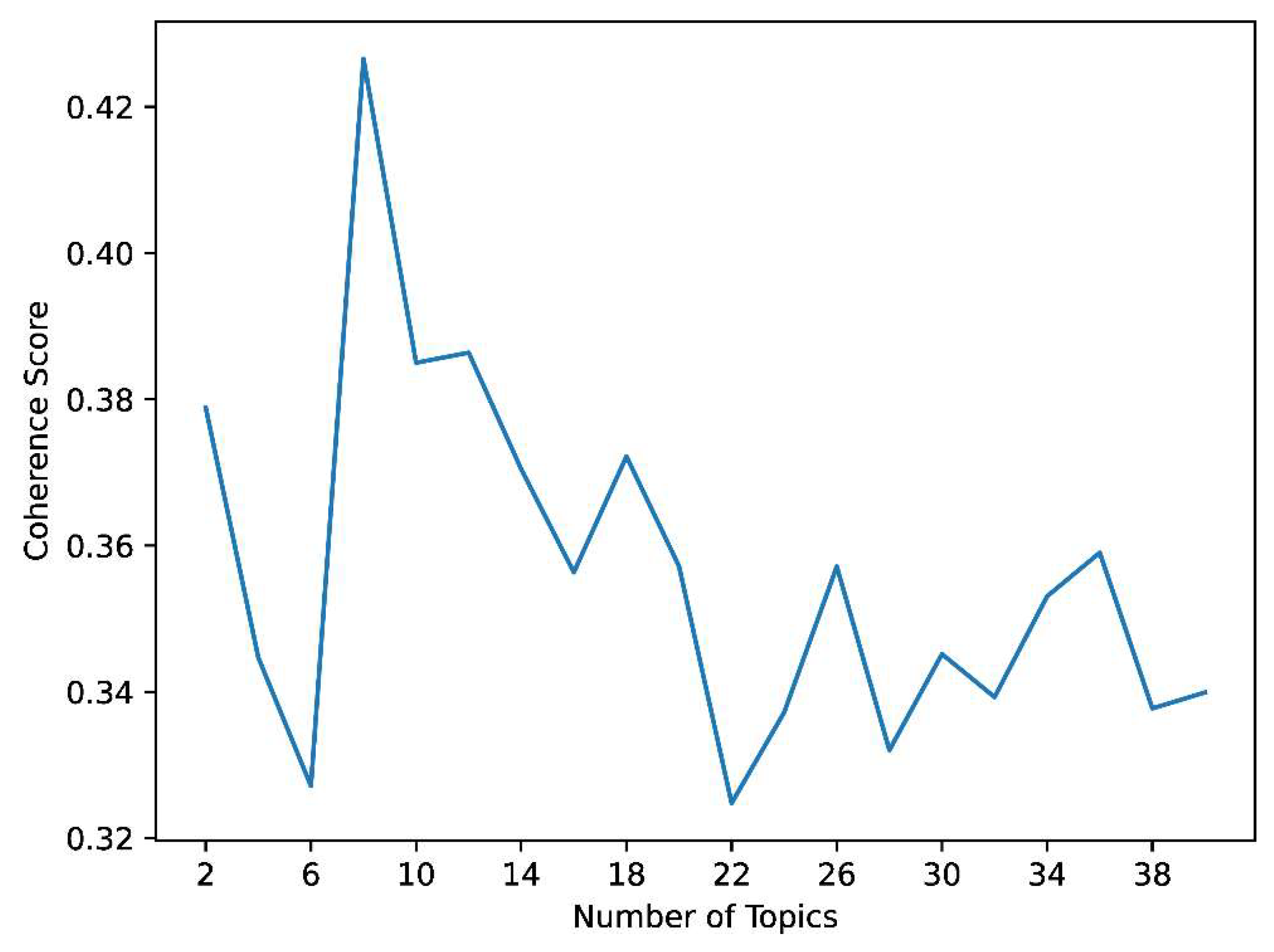
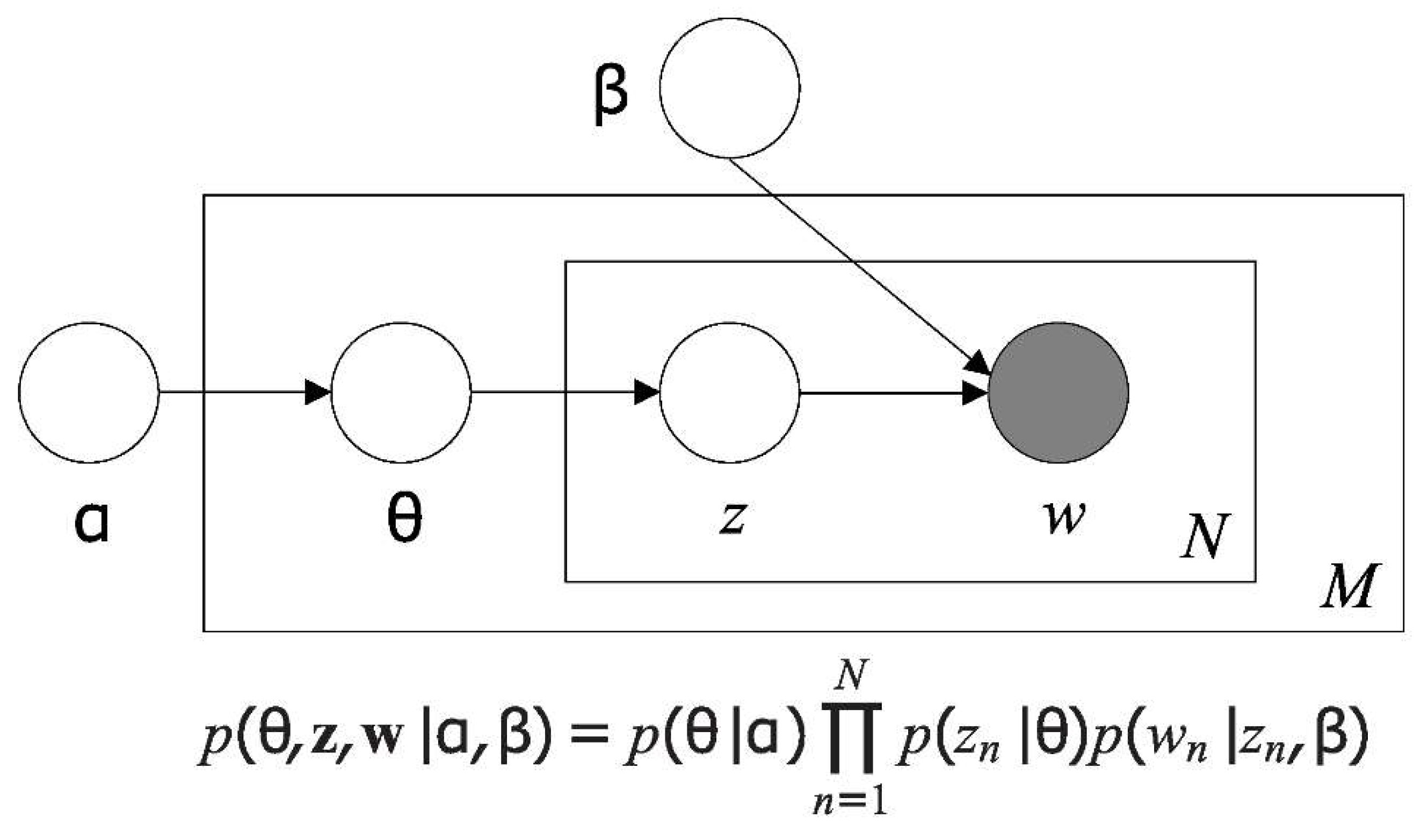
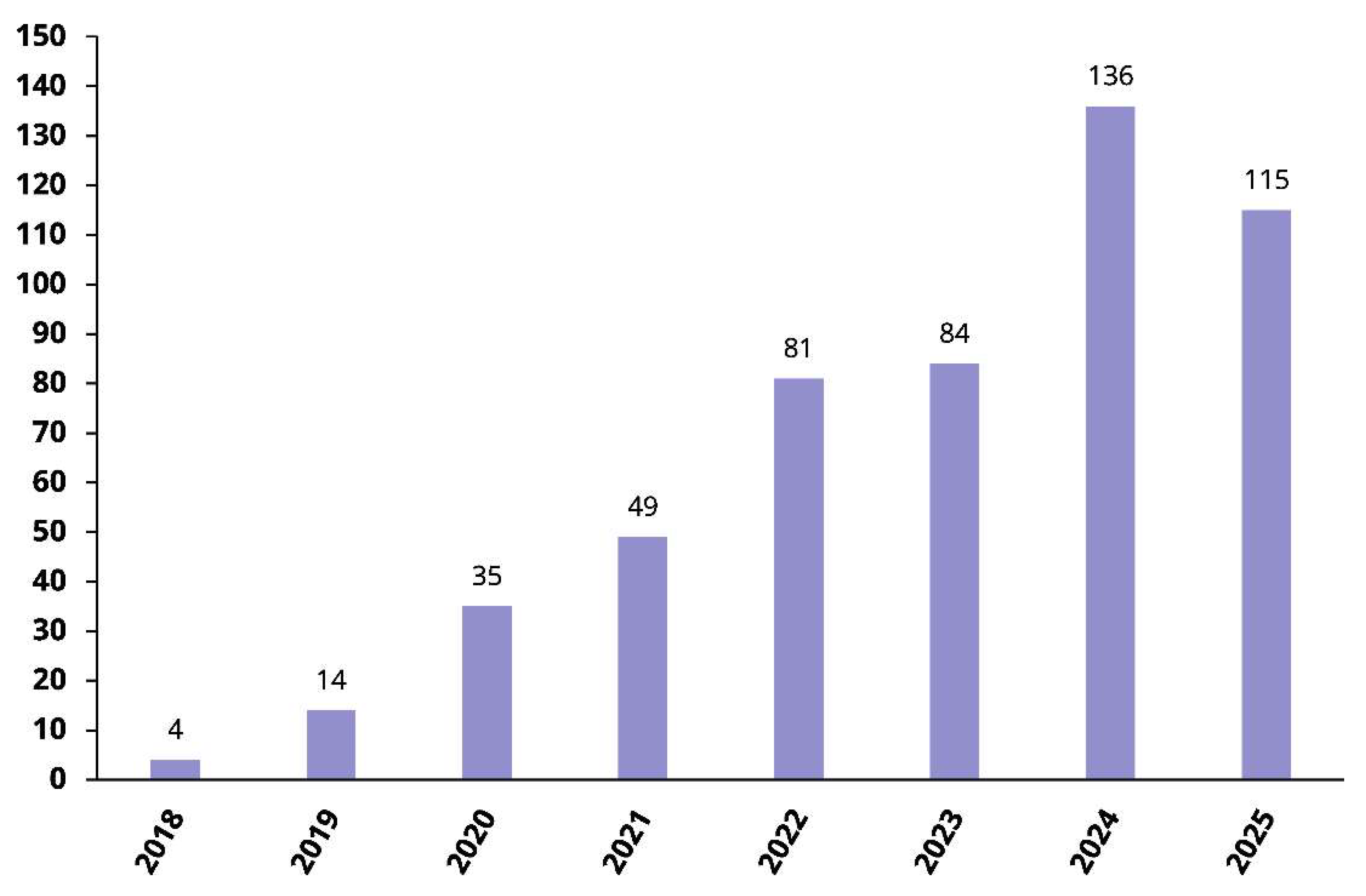
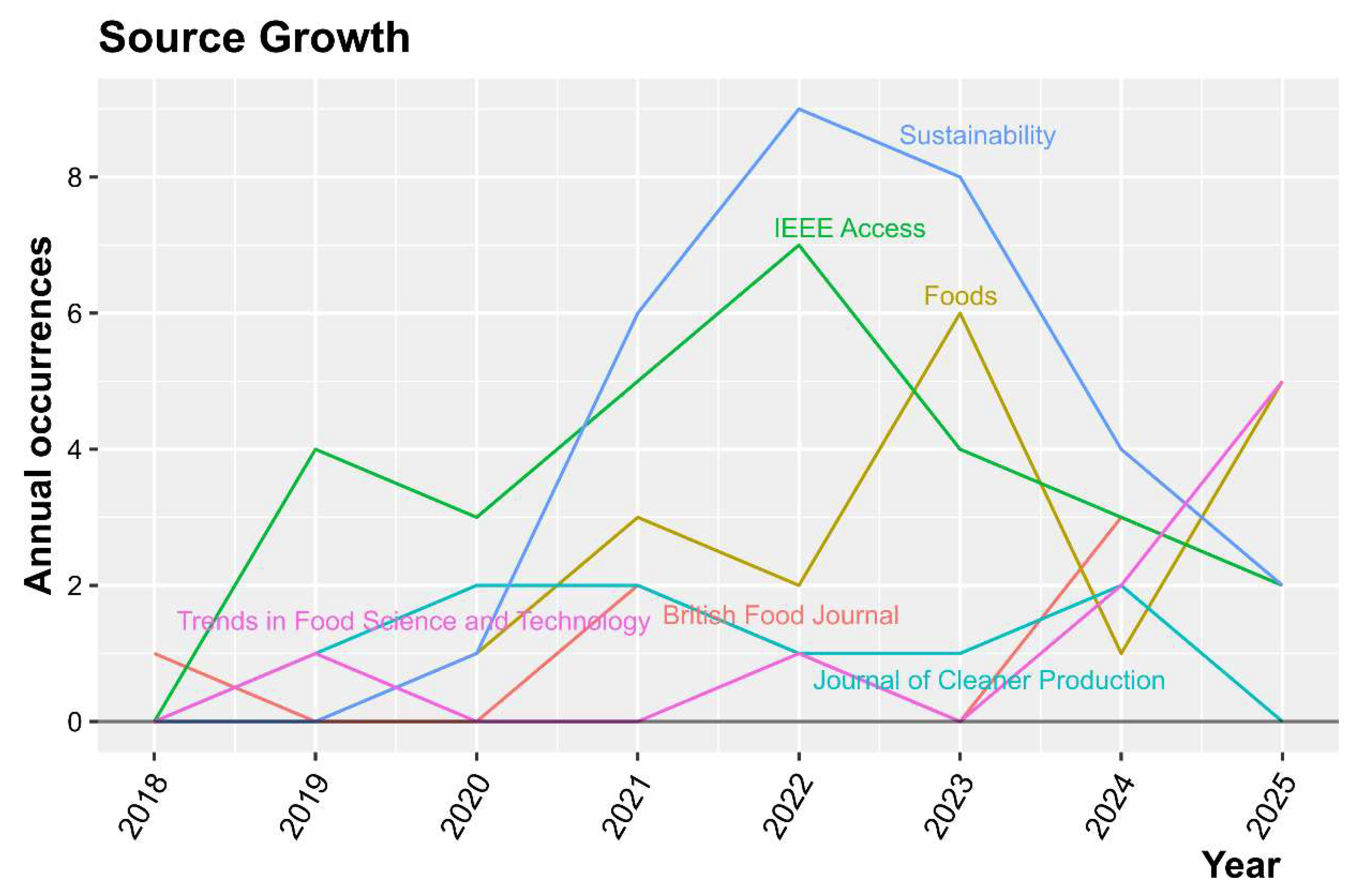
| Number of Topics | Coherence Score |
|---|---|
| 2 | 0.378835968 |
| 4 | 0.34465636 |
| 6 | 0.327121952 |
| 8 | 0.426552658 |
| 10 | 0.384988602 |
| 12 | 0.386371258 |
| 14 | 0.370418075 |
| 16 | 0.35633771 |
| 18 | 0.372183515 |
| Description | Results |
|---|---|
| Timespan | 2018:2025 |
| Sources (Journals) | 265 |
| Documents | 518 |
| Annual growth rate % | 61.58 |
| Document average age | 1.99 |
| Average citations per doc | 44.66 |
| Average citations per year per doc | 9.94 |
| References | 14,199 |
| Document types | |
| Article | 424 |
| Review | 94 |
| Document contents | |
| Keywords plus (ID) | 1668 |
| Author’s keywords (DE) | 1169 |
| Authors | |
| Authors | 1820 |
| Author Appearances | 2106 |
| Authors of single-authored docs | 14 |
| Authors collaboration | |
| Single-authored docs | 14 |
| Documents per author | 0.285 |
| Co-Authors per doc | 4.07 |
| International co-authorships % | 0.330 |
| Topic | Keywords | Label |
|---|---|---|
| 1 | 0.025*”retailer” + 0.023*”fresh” + 0.016*”BCT” + 0.014*”supplier” + 0.014*”product” + 0.012*”cost” + 0.012*”chain” + 0.011*”investment” + 0.011*”profit” + 0.011*”subsidy” + 0.010*”supply” + 0.009*”strategy” + 0.009*”sharing” + 0.008*”member” + 0.008*”decision” | Retailer strategies in blockchain-enabled FSCs |
| 2 | 0.042*”food” + 0.026*”BCT” + 0.015*”chain” + 0.015*”traceability” + 0.013*”supply” + 0.011*”technology” + 0.011*”sustainability” + 0.010*”system” + 0.010*”agrifood” + 0.009*”safety” + 0.008*”sector” + 0.007*”analysis” + 0.007*”challenge” + 0.007*”application” + 0.006*”research” | Blockchain for food safety and sustainability |
| 3 | 0.023*”BCT” + 0.013*”chain” + 0.012*”supply” + 0.008*”traceability” + 0.007*”enablers” + 0.007*”data” + 0.007*”information” + 0.006*”industry” + 0.006*”consumer” + 0.006*”transparency” + 0.005*”ASC” + 0.004*”management” + 0.004*”organic” + 0.004*”product” + 0.004*”seafood” | Enablers of blockchain adoption in FSCs |
| 4 | 0.008*”consumer” + 0.006*”batch” + 0.006*”signature manager” + 0.006*”meat” + 0.006*”video” + 0.006*”different” + 0.005*”use” + 0.005*”short” + 0.004*”tag” + 0.003*”agro” + 0.003*”ingredient” + 0.003*”towards” + 0.003*”item” + 0.003*”storytelling” + 0.003*”halal” | Blockchain and consumer perceptions |
| 5 | 0.039*”BCT” + 0.020*”food” + 0.019*”adoption” + 0.019*”chain” + 0.018*”supply” + 0.016*”consumer” + 0.016*”traceability” + 0.015*”trust” + 0.013*”barrier” + 0.009*”intention” + 0.008*”organic” + 0.007*”transparency” + 0.007*”perceived” + 0.007*”technology” + 0.006*”framework” | Blockchain adoption challenges |
| 6 | 0.008*”framework” + 0.007*”traceability” + 0.006*”technology” + 0.006*”supply” + 0.005*”chain” + 0.005*”greenhouse” + 0.005*”sea trace pricing” + 0.005*”provenance” + 0.004*”fish” + 0.004*”seafood” + 0.004*”fruit” + 0.004*”dining” + 0.004*”energy” + 0.003*”video” + 0.003*”surveillance” | Blockchain frameworks for sustainable food systems |
| 7 | 0.038*”BCT” + 0.036*”chain” + 0.034*”supply” + 0.027*”food” + 0.018*”traceability” + 0.012*”technology” + 0.009*”data” + 0.009*”agrifood” + 0.008*”system” + 0.008*”transparency” + 0.007*”safety” + 0.007*”quality” + 0.006*”challenge” + 0.006*”product” + 0.006*”application” | Blockchain for agri-food safety and transparency |
| 8 | 0.028*”chain” + 0.026*”BCT” + 0.025*”traceability” + 0.025*”system” + 0.022*”food” + 0.021*”supply” + 0.021*”product” + 0.018*”data” + 0.010*”information” + 0.008*”based” + 0.008*”quality” + 0.008*”consumer” + 0.007*”agricultural” + 0.006*”safety” + 0.006*”process”)] | Blockchain traceability systems in FSCs |
| Topic 1 | Topic 2 | Topic 3 | Topic 4 |
| Computers and Industrial Engineering | Sustainability | IEEE Access | Foods |
| Sustainability | Trends in Food Science and Technology | Sustainability | IEEE Access |
| Food Control | IEEE Access | Trends in Food Science and Technology | Sensors |
| IEEE Access | British Food Journal | British Food Journal | Agriculture |
| Electronics | Foods | Journal of Cleaner Production | Frontiers in Sustainable Food Systems |
| Topic 5 | Topic 6 | Topic 7 | Topic 8 |
| British Food Journal | Sustainability | Sustainability | IEEE Access |
| Sustainability | Journal of Industrial Information Integration | IEEE Access | Foods |
| Sustainable Futures | British Food Journal | Foods | Sustainability |
| Agriculture | Agriculture | Journal of Cleaner Production | International Journal of Advanced Computer Science and Applications |
| International Journal of Mathematical, Engineering and Management Sciences | Journal of Cleaner Production | Food Control | Electronics |
Disclaimer/Publisher’s Note: The statements, opinions and data contained in all publications are solely those of the individual author(s) and contributor(s) and not of MDPI and/or the editor(s). MDPI and/or the editor(s) disclaim responsibility for any injury to people or property resulting from any ideas, methods, instructions or products referred to in the content. |
© 2025 by the authors. Licensee MDPI, Basel, Switzerland. This article is an open access article distributed under the terms and conditions of the Creative Commons Attribution (CC BY) license (https://creativecommons.org/licenses/by/4.0/).
Share and Cite
Rejeb, A.; Rejeb, K.; Molavi, H.; Keogh, J.G. A Data-Driven Topic Modeling Analysis of Blockchain in Food Supply Chain Traceability. Information 2025, 16, 1096. https://doi.org/10.3390/info16121096
Rejeb A, Rejeb K, Molavi H, Keogh JG. A Data-Driven Topic Modeling Analysis of Blockchain in Food Supply Chain Traceability. Information. 2025; 16(12):1096. https://doi.org/10.3390/info16121096
Chicago/Turabian StyleRejeb, Abderahman, Karim Rejeb, Homa Molavi, and John G. Keogh. 2025. "A Data-Driven Topic Modeling Analysis of Blockchain in Food Supply Chain Traceability" Information 16, no. 12: 1096. https://doi.org/10.3390/info16121096
APA StyleRejeb, A., Rejeb, K., Molavi, H., & Keogh, J. G. (2025). A Data-Driven Topic Modeling Analysis of Blockchain in Food Supply Chain Traceability. Information, 16(12), 1096. https://doi.org/10.3390/info16121096

