Empowering Student Learning in Higher Education with Generative AI Art Applications: A Systematic Review


Abstract
1. Introduction
2. Literature Review
2.1. The Transformation of Arts Education in the Age of Generative AI
2.2. Technology Stratification and the Educational Equity Gap in AI-Driven Art Education
2.3. Generative AI Art in Education: Concepts, Functions, and Controversies
3. Methods
3.1. Review Design and Rationale
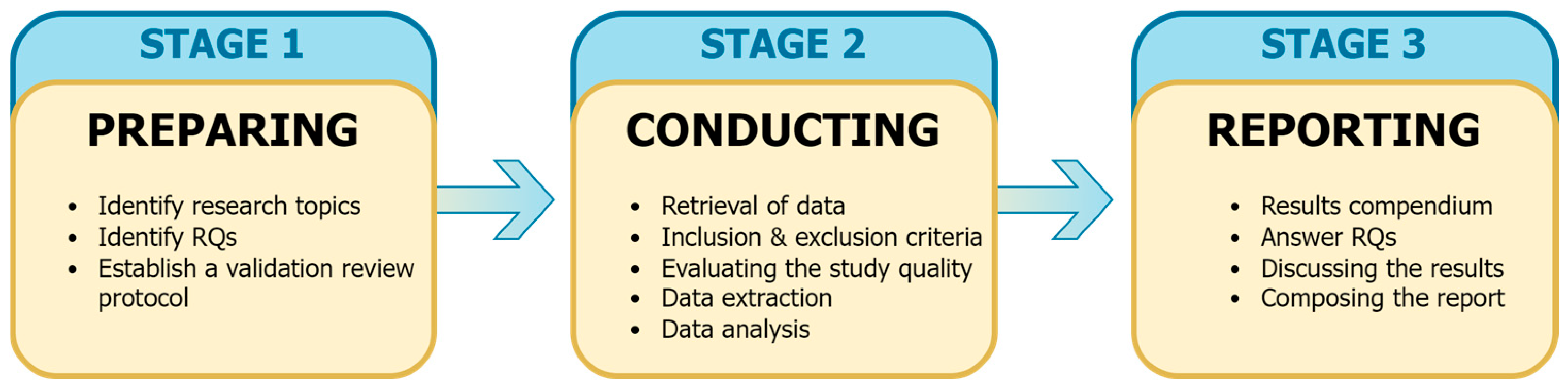
3.2. Preparing Stage
3.3. Conducting Stage
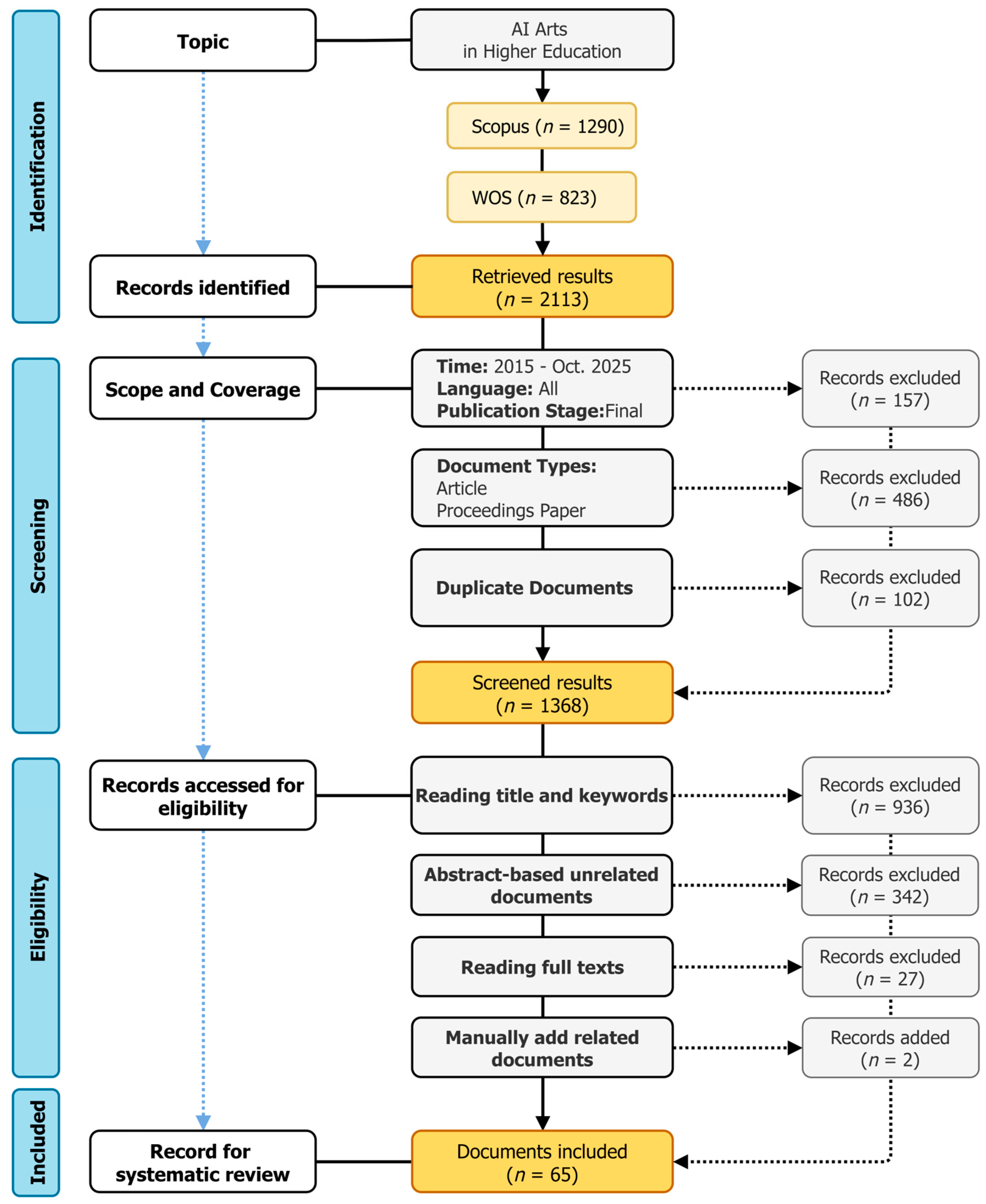
3.3.1. Retrieve Keywords
3.3.2. Screening and Cleaning Procedures
3.3.3. Qualifying Criteria for Data Selection
3.4. Reporting Stage
4. Results
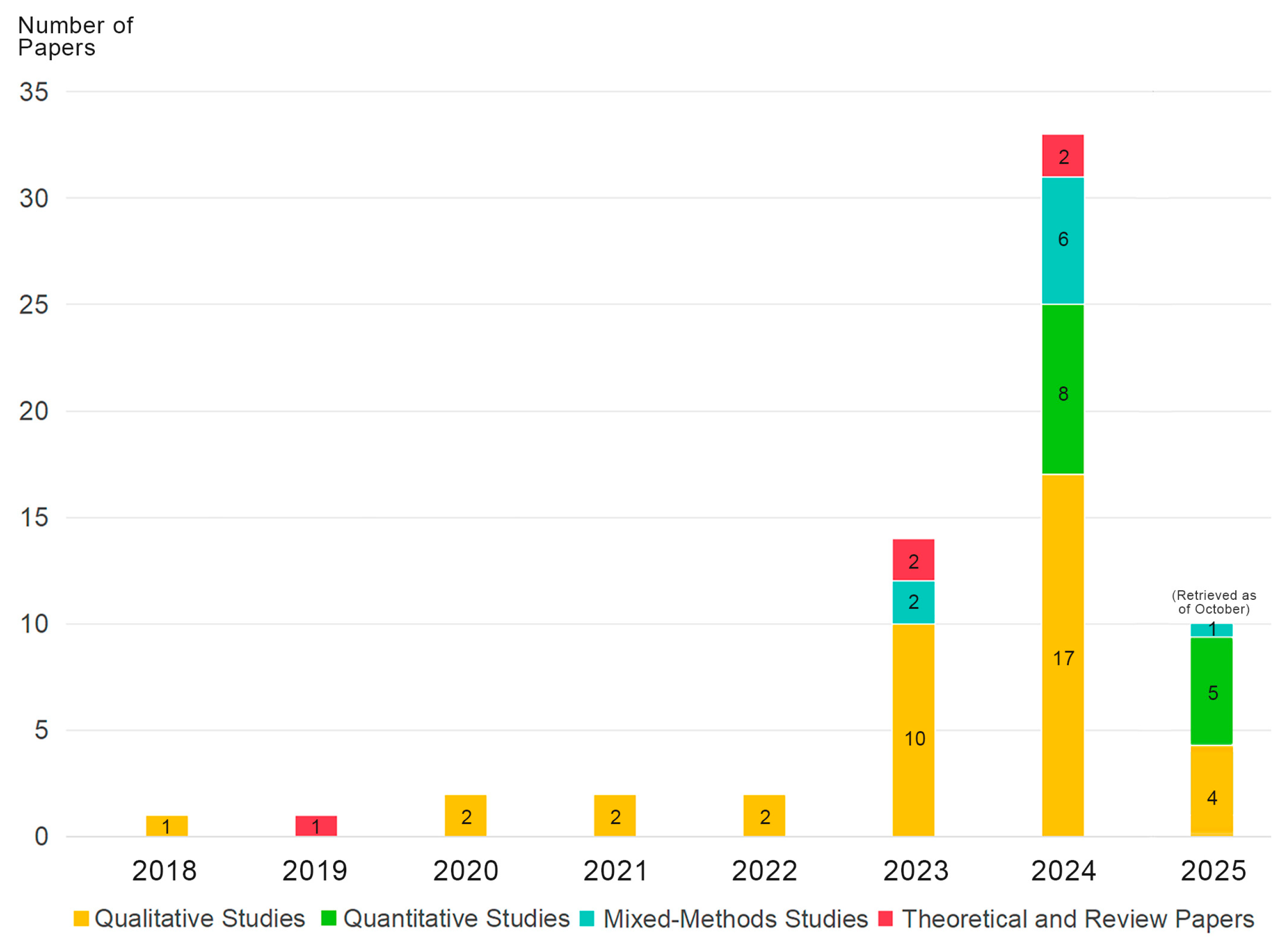
4.1. Overview of Included Studies
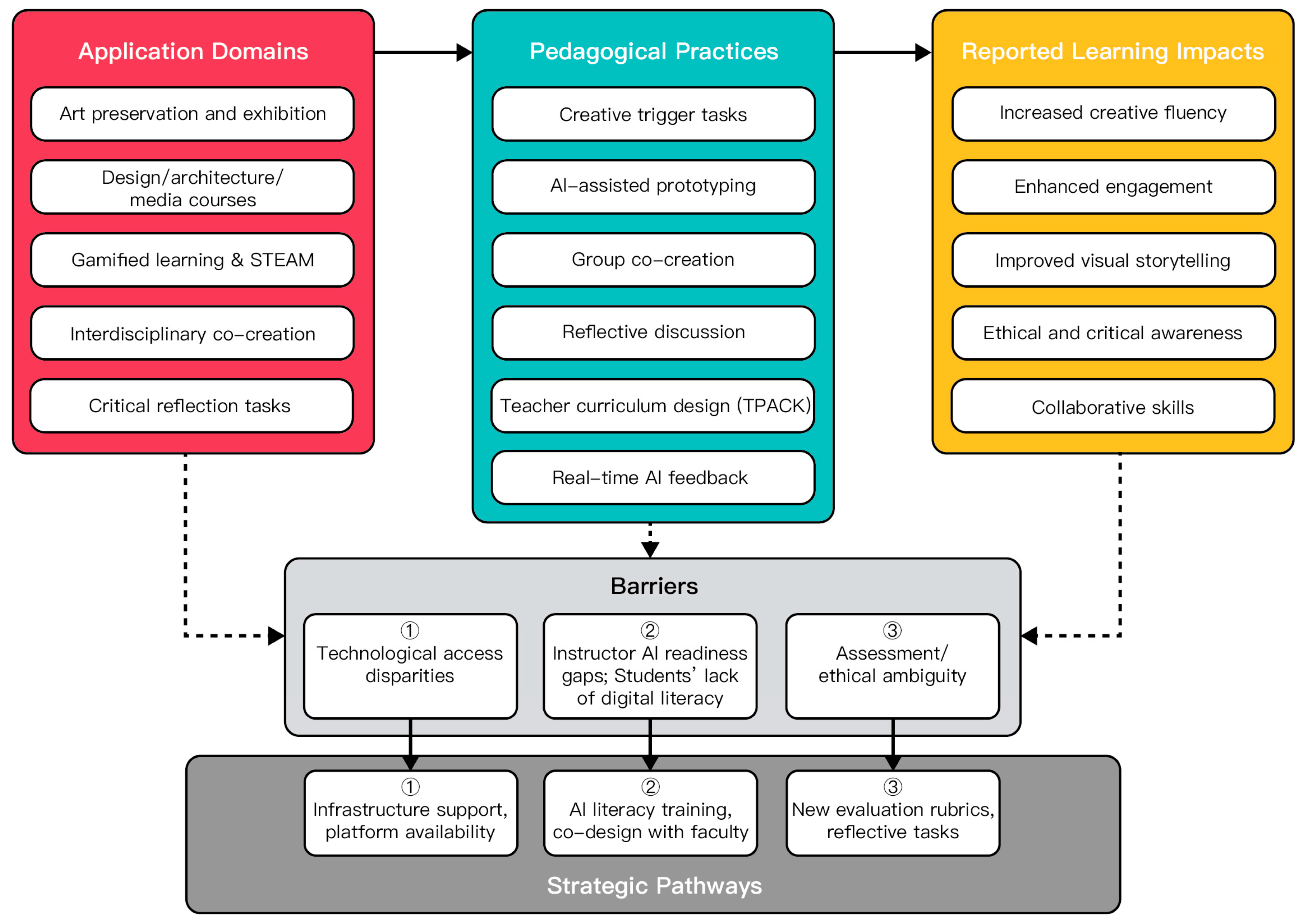
4.2. Application Domains of Generative AI Art in Higher Education
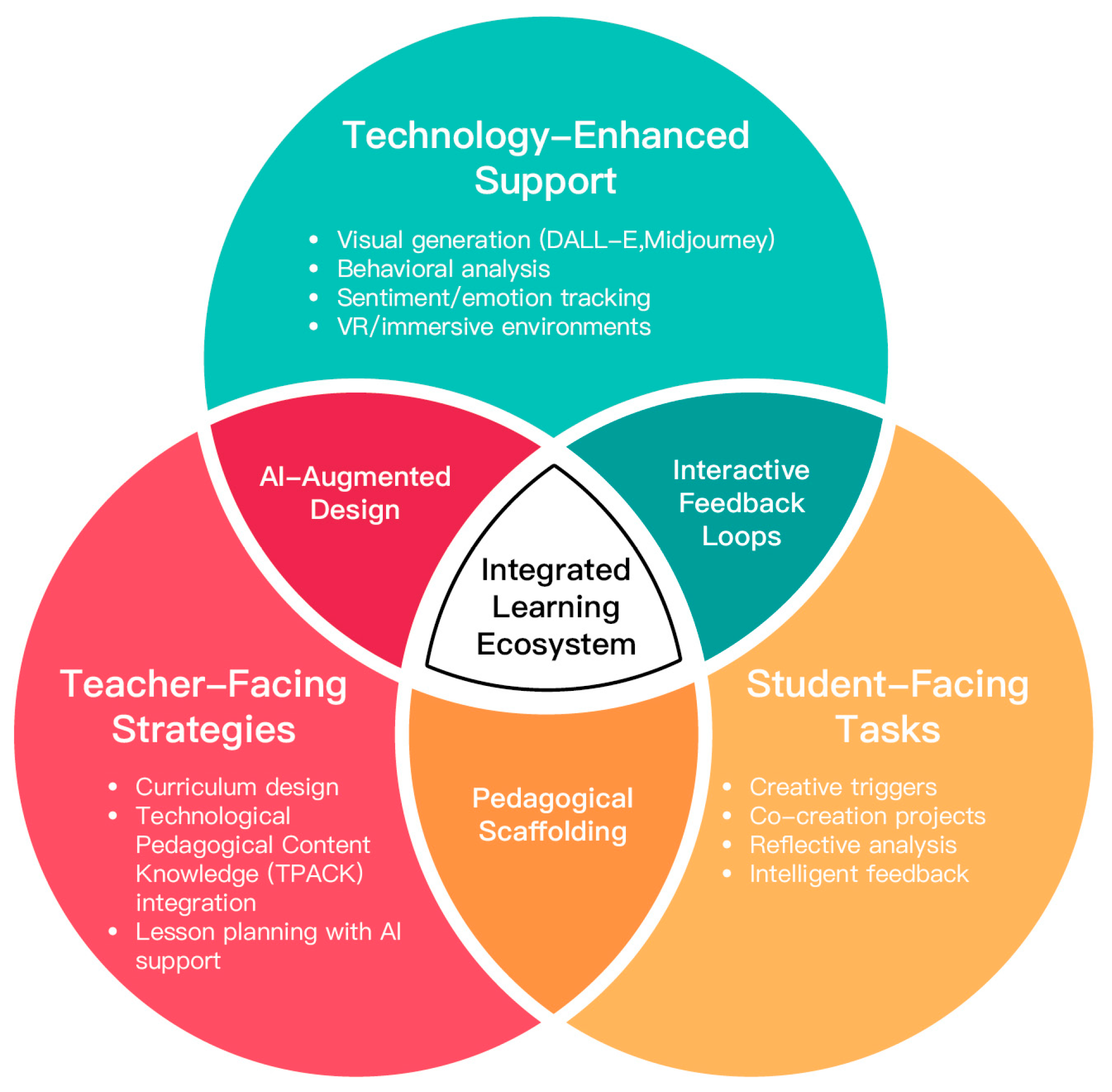
4.3. Pedagogical Practices and Reported Learning Impacts of Generative AI Art in Higher Education
4.4. Barriers and Future Opportunities for Equitable Integration
5. Discussions
6. Conclusions
Supplementary Materials
Author Contributions
Funding
Institutional Review Board Statement
Informed Consent Statement
Data Availability Statement
Conflicts of Interest
Abbreviations
| AI | Artificial Intelligence |
| HE | Higher Education |
| HCI | Human–Computer Interaction |
| IoT | Internet of Things |
| SLR | Systematic Literature Review |
| TPACK | Technological Pedagogical Content Knowledge |
| WoS | Web of Science |
Appendix A

| No. | Author | Year | Country/ Region | Methodology | Sample | Focus Area | Key Findings |
|---|---|---|---|---|---|---|---|
| 1 | Liu, Y. et al. | 2025 | China | Questionnaire survey | 316 interior design students | AI in interior design | This study showed that Stable Diffusion excelled in creativity, while Midjourney outperformed in esthetics and functionality. |
| 2 | Chen et al. | 2025 | Malaysia | Quasi-experimental design | 64 first-year undergraduate students | GenAI in a design and art course | This study showed that the ChatGPT-driven system significantly enhances student achievement, motivation, and self-efficacy. |
| 3 | Hwang & Wu | 2025 | China | Quantitative approach | 121 design students at universities | AI in enhancing the creative cognition of design students | The findings confirmed that AI positively impacted students’ innovative thinking. |
| 4 | Hiçyilmaz | 2025 | Türkiye | Case study design | 12 last-year students | Aimed to identify the experiences of students on the reflections of arts education. | The results of the study revealed that generative AI could be utilized as an educational tool that could support artistic creativity and learning. |
| 5 | Creely & Blannin | 2025 | Australia | Autoethnographic Inquiry Approach | A poem and a multimodal narrative | This study examines the relationship between generative AI and human creativity. | Collaboration with generative AI redefines the essence of creative output. |
| 6 | Ansone et al. | 2025 | Latvia | Mixed-methods approach | 10 students | How bachelor’s-level art students perceive and use generative AI in artistic composition. | This study views generative AI as an inspirational mentor, requiring structured training and balanced integration with traditional methods. |
| 7 | Huang et al. | 2025 | China (Taiwan) | Case Study, Participatory Observation | Art galleries and museums | AI in Art Preservation and Exhibition Spaces | This study explores AI applications in art preservation and exhibition. AI enhances preservation conditions and interactivity of exhibitions. |
| 8 | C. Wang | 2025 | China | Questionnaire Surveys | Confirmatory Factor Analysis | Individuals with various educational levels | This study investigates the multidimensional anxiety induced by AI painting tools. |
| 9 | Hwang & Wu | 2025 | China | Mix methods | “Visual Culture and Contemporary Art” course | AI in Graphic Design Education | This study investigated the impact of generative AI on graphic design education, highlighting the need for AI visual literacy, keyword-based image generation skills, |
| 10 | Zuo & Zhang | 2025 | China | Survey Experiment | Gamified Course | AI in Art and Design Education | The study highlights the importance of enhancing AI literacy among artists and designers through a gamified course on LoRA model training. |
| 11 | Weng et al. | 2024 | China (Taiwan) | Experimental design | University students | Interior Design Education | The study provided insights into students’ attitudes, perceptions, and skill improvements when using AI technology in interior design. |
| 12 | Cho | 2024 | Korea | Qualitative Conceptual Framework | Art educators | AI in Art Education, AI Competency for Teachers | This study identifies key AI competencies for art educators: esthetic AI competency, ethical AI competency, creative AI competency, educational AI competency, and developmental AI competency, based on UNESCO’s AI Competency Framework for Teachers. |
| 13 | Wang | 2024 | China | Mixed-methods | five universities | About the attitudes of Chinese students toward this technology | Chinese students’ attitudes toward AI painting are influenced by education level and gender, with higher education and male students showing more positive views. |
| 14 | Gao & Zhou | 2024 | China | Surveys, Interviews, Deep Learning | Undergraduate | AI Language Modeling, User Experience in HCI | The study explores AI user experience in Chinese universities, emphasizing personalized services, data mining, and HCI design. |
| 15 | Yang & Shin | 2024 | China South Korea | Qualitative, Case Study | Art and design students, teachers | AI in Art Education, Gen AI in Curriculum Design | This study examines the impact of Gen AI on art and design education, exploring its role in esthetic education, interdisciplinary teaching, and curriculum design. It discusses how Gen AI influences traditional teaching methods and student-teacher interactions in higher education. |
| 16 | Kyu & Shin | 2024 | China | Qualitative, Case Study | Visual arts students at G University | AI Integration in Character Design | This study investigates the challenges and strategies for integrating AI in character design classes. It highlights issues related to students’ lack of technical proficiency and understanding in using AI for art creation. |
| 17 | W. Gao et al. | 2024 | China (Hong Kong) | Qualitative | 24 participants, comprising practitioners, educators, and students | product design education | Fully incorporating GenAI in product design requires adaptation in educational initiatives, including capability development, curriculum content, and assessment methods. |
| 18 | Bartlett & Camba | 2024 | USA | Qualitative | students | Design Education, AI Ethics, Originality Concerns | AI can help explore new ways of designing products. Ethical concerns related to AI tools should be addressed in design education. |
| 19 | Shen et al. | 2024 | China | 308 questionnaires | art and design college students | Design education | This study combines the technology acceptance model with self-determination theory and also considers the possible risks associated with the new technology to construct an integrated theoretical model, |
| 20 | Park, Y.S. | 2024 | Korea | Theoretical Analysis, Conceptual Framework | Art educators, art students | AI in Art Education, Posthumanism, AI-assisted Art | Focusing on how AI can blur the distinction between human and non-human in art creation and education. It highlights the role of AI in promoting sustainable, creative practices. |
| 21 | Gül et al. | 2024 | Turkey | Qualitative | Students in Architectural Design Studio, 4 | Co-design with AI, Generative AI in Architecture, Creative Design in Education | Exploration of AI as a co-design partner in architectural education, with insights into creative design stimulation. GAI-A interface evaluated through Creativity Support Index, surveys, and interviews. The study discusses co-design possibilities and optimal utilization techniques for AI in architectural education. |
| 22 | Youn, Ahn Ji et al. | 2024 | Korea | Qualitative, Case Study | Universities | AI-based art education in university liberal arts | It suggests AI’s potential in personalized education, curriculum design, and student-teacher interactions, and discusses the need for platforms and content aligned with higher art education. |
| 23 | Lee J.-Y., | 2024 | Korea | Qualitative | Art education, students | Image-generating AI | This study explores the educational use of image-generating AI in art creation, highlighting the importance of critical and logical thinking in the process. |
| 24 | Ahmed et al. | 2024 | Bangladesh | Systematic Literature Review | 200 Undergraduate students | Generative AI in Education | This study reviews the opportunities, challenges, and student perceptions regarding the use of generative AI in education. |
| 25 | Yoon & Kam | 2024 | Korea | Qualitative analysis | University students majoring in Animation and Design | Cognition of Creativity and Work Efficiency | This study analyzes the impact of generative AI on students’ perceptions of creativity and work efficiency. |
| 26 | Fleischmann | 2024 | Australia | Qualitative Analysis | 74 design students | Generative AI in Design curricula | This study explores how students use AI for ideation and prototyping. Findings indicate AI’s ad hoc usage to speed up ideation, with skepticism about its creative output, and propose AI training for integration into curricula. |
| 27 | Ho | 2024 | Korea | Mixed methods Eye-tracking, Word Cloud | 18 undergraduate design students | Emotional Responses to Generative Art | This study investigates how generative art evokes emotional responses, using surveys and eye-tracking technology. |
| 28 | Heaton et al. | 2024 | Singapore | Qualitative | Art educators in Singapore | Pedagogic Reflections | This study reflects on the integration of AI in art education, analyzing the advantages and limitations of AI in teaching |
| 29 | Park | 2024 | Korea | Literature Review Philosophical Analysis | Art students | Analogue Art, Educational Significance | This study explores the significance of analogue art in comparison to digital art, especially AI art. |
| 30 | Fang & Jiang | 2024 | China | Experimental Design | Art students | IoT and AI in Art Education | This study integrates IoT and GANs into art education, creating a real-time interactive system for creative work generation. |
| 31 | Lee & Suh | 2024 | Korea | Experiment, TPACK Framework | AI Prompt Guides Fashion Design students | AI in Fashion Design Education | This study explores how AI, specifically ChatGPT and Midjourney, can be integrated into fashion design education using the TPACK framework. |
| 32 | Wei Dong et al. | 2024 | China | Case Study | Practical Design Application | AIGC in Brand Advertising Design | AIGC tools like ChatGPT, Midjourney, and Runway were applied in a course to help students experience AI in design. |
| 33 | Chen et al. | 2024 | China | Group Interviews, Questionnaire | Art teachers, Administrators | Generative AI in Higher Art Education | The study explores the perspectives of Chinese university art teachers on the integration of generative AI in art education. It reveals varying levels of readiness and anxiety and stresses the need for standardized AI tool usage and fostering collaborative efforts. |
| 34 | Erişti & Freedman | 2024 | Turkey | Qualitative Inquiry | Art educators, art and design students | Integration of AI and Digital Technologies in Art Education | This study investigates the impact of digital visual culture and AI in art education |
| 35 | Wang | 2024 | China | Mixed-methods Approach (Quantitative & Qualitative) | Students from 5 universities and 3 high schools | Chinese Students’ Attitudes Toward AI Painting Technology | This study explores Chinese students’ attitudes toward AI painting technology, finding that education level and gender significantly influence students’ perspectives. |
| 36 | Sáez-Velasco et al. | 2024 | Spain | Qualitative Focus Groups | 5 Students, 5 Educators | Impact of Generative AI in Arts Education | The study shows that both educators and students perceive generative AI as a useful tool for generating illustrations. However, they agree that human creativity cannot be replaced by AI. |
| 37 | Almaz et al. | 2024 | Egypt | Qualitative | Architecture designer | AI in Architectural Education | AI integration revolutionizes the design process, improves efficiency, sustainability, and creativity in architectural education. AI tools and BIM enhance design workflows and teaching methodologies. AI facilitates innovative design options and enhances real-time project optimization. |
| 38 | Fleischmann | 2024 | Australia | Survey | 74 undergraduates | Generative AI in Design Education | The study explores the integration of generative AI in design education, finding that while students use AI to speed up ideation, there is skepticism about its creativity. A training list for its curriculum integration is proposed. |
| 39 | Dai et al. | 2024 | Taiwan, China | Research Study (Survey) | / | AI in Design Education | The study explores AI Agent technology in interactive design education, showing that AI significantly enhances student motivation, participation, and confidence in learning. It is particularly useful for rapid prototyping and self-learning. |
| 40 | Trajkova et al. | 2024 | United States | Focus groups with thematic analysis | 24 university dance students | Co-creation in embodied contexts | The study explores embodied human co-creativity in dance improvisation. |
| 41 | Jendreiko | 2024 | Germany | Christian Educational | / | Teaching Prolog in Art and Design | The EGL method teaches Prolog as generative AI, making it an attractive tool for art and design students. It fosters logical thinking, AI literacy, and artistic literacy in non-STEM students. |
| 42 | Nair | 2024 | India | Surveys, Practical Tasks, Interviews | 100 participants | image generation tools impact on visual design | AI tools like DALL-E, RunwayML, and Adobe Firefly affect visual design. Design education helps create higher-quality and more creative images. AI cannot fully replace human designers |
| 43 | Grájeda et al. | 2024 | USA | Survey Neuromarketing Technologies (Eye Tracking, Facial Expression Analysis) | Students at a private university | Perceptions and emotional reactions to AI in arts education | AI tools are increasingly accepted by students, with growing utility and effectiveness in arts education. AI-enhanced classes elicit more positive emotions, such as joy and surprise, compared to traditional lecture-based methods. |
| 44 | Lee et al. | 2023 | South Korea, USA | Mixed-Methods, | STEAM students (art-focused) | Integration of Image-Generative AI in STEAM Education | This study integrates Stable Diffusion (a type of image-generative AI) into art-focused STEAM education. |
| 45 | Cheung & Dall’Asta | 2023 | China | Case studies, | University | AI art generation tools in architectural design | The study explores how AI art generation tools are applied in architectural design, focusing on collaborative use and intuitive frameworks to enhance the design process beyond image generation. |
| 46 | Hutson | 2023 | USA | Case study | 10 students in a digital art class | Impact of AI-generated art in digital art education | AI serves as an iterative tool for creative problem-solving in the visual arts. Students used AI tools like Craiyon for inspiration, refining with students using it to create original concepts or as concepts in Photoshop. AI helped enhance creativity, a basis for further development. |
| 47 | Fathoni | 2023 | Indonesia | Qualitative Case Studies | Generative AI in Art and Design Education | Create innovative and sustainable designs | The article discusses how generative AI solutions, such as text-to-image generators, can aid in creating innovative and sustainable designs while promoting academic integrity in art education. |
| 48 | Vartiainen & Tedre | 2023 | Finnish | Mixed methods | 15 students | AI in craft education | AI-generated creative making inspired reflection on craft but raised concerns about bias, copyright, and AI’s opaque influence. |
| 49 | Ting et al. | 2023 | Malaysia | Survey & Experiment | 202 undergraduates | Attitudes toward AI in Art | The study reveals that 54% of respondents could not identify emotions in AI artworks, and 55.3% could differentiate AI from human artwork. Positive acceptance of AI artworks is high (74%). No correlation found between exposure to AI and acceptance of AI art. |
| 50 | Kahraman et al. | 2023 | Turkey | Case Study | Interior design students | Interior Design Education | This study investigates the integration of AI in interior design education, using a case study where students design office spaces for TV series characters. |
| 51 | Y.-C. J. Huang et al. | 2023 | Netherlands | Case Study, Course Design | 9-week design activity | AI in Design Education | Explored integrating AI with design creativity and esthetics. Students designed AI exemplars based on personal visions. |
| 52 | Garvey, | 2023 | USA | Curriculum Design and Course Development | Undergraduate Students | Curriculum Design and Course Development | The course enables students to create art with AI tools like text-to-image generators and ChatGPT. |
| 53 | Kahraman et al. | 2023 | Turkey | Case Study | AI Design Tools Interior Design Students | AI in Interior Design Education | The study integrated AI tools into interior design education. Students created office designs inspired by TV series characters. The AI generated designs reflected character personalities and preferences. |
| 54 | Park | 2023 | USA | Literature Review | / | AI for new inquiry and creativity in art curricula | This study explores the impact of artificial intelligence on future art education by observing how it is explored in new media art projects. |
| 55 | Hsiao & Zhang, | 2023 | China (Taiwan) | Case study | / | Design of semiotics learning models | The research strives to establish a pedagogical approach for the application of generative AI image-based design semiotics. |
| 56 | Y.-C. J. Huang et al. | 2023 | Netherlands | Case Study (six design cases) | Design Students | Vision-Based AI Design Education | Students envision and prototype AI exemplars that are based on their personal vision and esthetic values |
| 57 | Shi et al. | 2023 | China | Control experiment | 50 students | Cross-Cultural Theatre Design Course | This study found that integrating virtual reality technology into theater design courses is more beneficial for students to master the subject and achieve better teaching outcomes. |
| 58 | Bolojan | 2022 | Austria/USA | Conceptual Analysis, Case Study | Architects, Designers | AI in Design, Augmented Creativity | This study explores how AI-augmented systems can enhance designers’ creativity. |
| 59 | Kim | 2022 | Korea | Conceptual | Artists, Designers, | Discussion, Artistic Exploration | This study explores how data and AI can be integrated into art thinking to open new creative possibilities. |
| 60 | Koh | 2021 | Korea | Case Study | Art educators, Visual artists | AI in Art Education, Future Directions in Art Education | This study explores the integration of AI in visual art creation and its implications for future art education. |
| 61 | Choi | 2021 | Korea | Case Study | Art and Design educators | Generative Design | This study explores the application of generative design methodology in art and design, proposing it as an alternative to traditional design approaches. |
| 62 | Kong | 2020 | China | Case Study | AHP and Grey Clustering, Art students | Application Strategies | This study explores the application of AI in modern art teaching, proposing three strategies to enhance AI integration: expanding adaptability, improving intelligent teaching modes. |
| 63 | West & Burbano | 2020 | USA | Qualitative | Universities | Explored the relationship between artificial AI and art and design | Research suggests whether machine creativity represents the evolution of artistic intelligence or a shift in creative practice. |
| 64 | Liu & Nah | 2019 | South Korea | Literature Review | Designers | AI’s Impact on Design Profession | This study explores how AI is transforming the role of designers. |
| 65 | Tao et al. | 2018 | China | Qualitative | / | AI in Visual Art | The study explores how human intelligence and AI complement each other in the field of visual art, emphasizing creativity, art standards, and the unique value of AI in art. It discusses the roles of AI in education and art reception. |
References
- Aler Tubella, A.; Mora-Cantallops, M.; Nieves, J.C. How to Teach Responsible AI in Higher Education: Challenges and Opportunities. Ethics Inf. Technol. 2023, 26, 3. [Google Scholar] [CrossRef]
- Kurtz, G.; Amzalag, M.; Shaked, N.; Zaguri, Y.; Kohen-Vacs, D.; Gal, E.; Zailer, G.; Barak-Medina, E. Strategies for Integrating Generative AI into Higher Education: Navigating Challenges and Leveraging Opportunities. Educ. Sci. 2024, 14, 503. [Google Scholar] [CrossRef]
- Zawacki-Richter, O.; Marín, V.I.; Bond, M.; Gouverneur, F. Systematic Review of Research on Artificial Intelligence Applications in Higher Education—Where Are the Educators? Int. J. Educ. Technol. High Educ. 2019, 16, 39. [Google Scholar] [CrossRef]
- Lee, U.; Han, A.; Lee, J.; Lee, E.; Kim, J.; Kim, H.; Lim, C. Prompt Aloud!: Incorporating Image-Generative AI into STEAM Class with Learning Analytics Using Prompt Data. Educ. Inf. Technol. 2024, 29, 9575–9605. [Google Scholar] [CrossRef]
- Nair, S.S. Redefining Creativity in Design: Exploring the Impact of AI-Generated Imagery on Design Professionals and Amateurs. In Proceedings of the 2024 11th International Conference on Computing for Sustainable Global Development (INDIACom), New Delhi, India, 28 February–1 March 2024; IEEE: New Delhi, India, 2024; pp. 1723–1728. [Google Scholar]
- Wei, D.; Li, L.; You, Z. Teaching Practices and Reflections on AIGC in Brand Advertising Design. In HCI International 2024 Posters; Stephanidis, C., Antona, M., Ntoa, S., Salvendy, G., Eds.; Springer Nature: Cham, Switzerland, 2024; pp. 113–124. [Google Scholar]
- Harle, S.M. Advancements and Challenges in the Application of Artificial Intelligence in Civil Engineering: A Comprehensive Review. Asian J. Civ. Eng. 2024, 25, 1061–1078. [Google Scholar] [CrossRef]
- Messer, U. Co-Creating Art with Generative Artificial Intelligence: Implications for Artworks and Artists. Comput. Hum. Behav. Artif. Hum. 2024, 2, 100056. [Google Scholar] [CrossRef]
- Leonard, N. Entanglement Art Education: Factoring Artificial Intelligence and Nonhumans into Future Art Curricula. Art Educ. 2020, 73, 22–28. [Google Scholar] [CrossRef]
- Squalli Houssaini, M.; Aboutajeddine, A.; Toughrai, I.; Ibrahimi, A. Development of a Design Course for Medical Curriculum: Using Design Thinking as an Instructional Design Method Empowered by Constructive Alignment and Generative AI. Think. Ski. Creat. 2024, 52, 101491. [Google Scholar] [CrossRef]
- Park, H.; Eirich, J.; Luckow, A.; Sedlmair, M. “We Are Visual Thinkers, Not Verbal Thinkers!”: A Thematic Analysis of How Professional Designers Use Generative AI Image Generation Tools. In Proceedings of the 13th Nordic Conference on Human-Computer Interaction, Uppsala, Sweden, 13–16 October 2024; Association for Computing Machinery: New York, NY, USA, 2024; pp. 1–14. [Google Scholar]
- Vartiainen, H.; Liukkonen, P.; Tedre, M. Emerging Human-Technology Relationships in a Co-Design Process with Generative AI. Think. Ski. Creat. 2025, 56, 101742. [Google Scholar] [CrossRef]
- del Campo, M.; Manninger, S. Architecture Design in the Age of Artificial Intelligence: The Latent Ontology of Architectural Features. In The Routledge Companion to Ecological Design Thinking; Routledge: Oxfordshire, UK, 2022; ISBN 978-1-003-18318-1. [Google Scholar]
- Pente, P.; Adams, C.; Yuen, C. Artificial Intelligence, Ethics, and Art Education in a Posthuman World. In Global Media Arts Education: Mapping Global Perspectives of Media Arts in Education; Knochel, A.D., Sahara, O., Eds.; Springer International Publishing: Cham, Switzerland, 2023; pp. 197–211. ISBN 978-3-031-05476-1. [Google Scholar]
- Ilieva, G.; Yankova, T.; Klisarova-Belcheva, S.; Dimitrov, A.; Bratkov, M.; Angelov, D. Effects of Generative Chatbots in Higher Education. Information 2023, 14, 492. [Google Scholar] [CrossRef]
- Kim, J.; Cho, Y.H. My Teammate Is AI: Understanding Students’ Perceptions of Student-AI Collaboration in Drawing Tasks. Asia Pac. J. Educ. 2025, 45, 1013–1027. [Google Scholar] [CrossRef]
- Sajja, R.; Sermet, Y.; Cikmaz, M.; Cwiertny, D.; Demir, I. Artificial Intelligence-Enabled Intelligent Assistant for Personalized and Adaptive Learning in Higher Education. Information 2024, 15, 596. [Google Scholar] [CrossRef]
- Ulger, K. The Creative Training in the Visual Arts Education. Think. Ski. Creat. 2016, 19, 73–87. [Google Scholar] [CrossRef]
- Samaniego, M.; Usca, N.; Salguero, J.; Quevedo, W. Creative Thinking in Art and Design Education: A Systematic Review. Educ. Sci. 2024, 14, 192. [Google Scholar] [CrossRef]
- Black, J.; Browning, K. Creativity in Digital Art Education Teaching Practices. Art Educ. 2011, 64, 19–24. [Google Scholar] [CrossRef]
- Hutson, J. Integrating Art and AI: Evaluating the Educational Impact of AI Tools in Digital Art History Learning. Forum Art Stud. 2024, 1, 393. Available online: https://digitalcommons.lindenwood.edu/faculty-research-papers/578 (accessed on 2 November 2025).
- Dilmaç, S. Students’ Opinions about the Distance Education to Art and Design Courses in the Pandemic Process. World J. Educ. 2020, 10, 113–126. [Google Scholar] [CrossRef]
- Voudoukis, N.; Pagiatakis, G. Massive Open Online Courses (MOOCs): Practices, Trends, and Challenges for the Higher Education. Eur. J. Educ. Pedagog. 2022, 3, 288–295. [Google Scholar] [CrossRef]
- Garcia, M.B. The Paradox of Artificial Creativity: Challenges and Opportunities of Generative AI Artistry. Creat. Res. J. 2025, 37, 755–768. [Google Scholar] [CrossRef]
- González-Zamar, M.-D.; Abad-Segura, E. Digital Design in Artistic Education: An Overview of Research in the University Setting. Educ. Sci. 2021, 11, 144. [Google Scholar] [CrossRef]
- Heaton, R.; Low, J.H.; Chen, V. AI Art Education—Artificial or Intelligent? Transformative Pedagogic Reflections from Three Art Educators in Singapore. Pedagog. Int. J. 2024, 19, 647–659. [Google Scholar] [CrossRef]
- Kohnke, L.; Moorhouse, B.L.; Zou, D. Exploring Generative Artificial Intelligence Preparedness among University Language Instructors: A Case Study. Comput. Educ. Artif. Intell. 2023, 5, 100156. [Google Scholar] [CrossRef]
- Sáez-Velasco, S.; Alaguero-Rodríguez, M.; Delgado-Benito, V.; Rodríguez-Cano, S. Analysing the Impact of Generative AI in Arts Education: A Cross-Disciplinary Perspective of Educators and Students in Higher Education. Informatics 2024, 11, 37. [Google Scholar] [CrossRef]
- Zhou, E.; Lee, D. Generative Artificial Intelligence, Human Creativity, and Art. PNAS Nexus 2024, 3, pgae052. [Google Scholar] [CrossRef]
- Ma, N.; Yu, D. Generative AI and the Evolution of Artistic Creativity. In Human-Computer Creativity: Generative AI in Education, Art, and Healthcare; Geroimenko, V., Ed.; Springer Nature: Cham, Switzerland, 2025; pp. 177–201. ISBN 978-3-031-86551-0. [Google Scholar]
- Yu, H.; Guo, Y. Generative Artificial Intelligence Empowers Educational Reform: Current Status, Issues, and Prospects. Front. Educ. 2023, 8, 1183162. [Google Scholar] [CrossRef]
- Gong, Y. Application of Virtual Reality Teaching Method and Artificial Intelligence Technology in Digital Media Art Creation. Ecol. Inform. 2021, 63, 101304. [Google Scholar] [CrossRef]
- Baradaran, A. Towards a Decolonial I in AI: Mapping the Pervasive Effects of Artificial Intelligence on the Art Ecosystem. AI Soc. 2024, 39, 7–19. [Google Scholar] [CrossRef]
- Terzidis, K.; Fabrocini, F.; Lee, H. Unintentional Intentionality: Art and Design in the Age of Artificial Intelligence. AI Soc. 2023, 38, 1715–1724. [Google Scholar] [CrossRef]
- Phillips, B.M.; Funari, C.; Oliver, F.; Berrien, J.; Burris, P.W.; Mesa, M.P. Joint Contributions of Teacher’s Pedagogical Content Knowledge and Book Reading to Preschooler’s Growth in Language Skill. Read. Writ. Interdiscip. J. 2022, 35, 1815–1838. [Google Scholar] [CrossRef]
- Cetinic, E.; She, J. Understanding and Creating Art with AI: Review and Outlook. ACM Trans. Multimed. Comput. Commun. Appl. 2022, 18, 1–22. [Google Scholar] [CrossRef]
- Grba, D. Deep Else: A Critical Framework for AI Art. Digital 2022, 2, 1–32. [Google Scholar] [CrossRef]
- Wojnowski, K. The Work of Art in the Age of Automated Creativity: On the Autonomy of AI Art. Prakt. Teoretyczna 2024, 53, 179–212. [Google Scholar] [CrossRef]
- Zhang, W.; Shankar, A.; Antonidoss, A. Modern Art Education and Teaching Based on Artificial Intelligence. J. Inter. Net. 2022, 22, 2141005. [Google Scholar] [CrossRef]
- Lazkani, O. Revolutionizing Education of Art and Design Through ChatGPT. In Artificial Intelligence in Education: The Power and Dangers of ChatGPT in the Classroom; Al-Marzouqi, A., Salloum, S.A., Al-Saidat, M., Aburayya, A., Gupta, B., Eds.; Springer Nature: Cham, Switzerland, 2024; pp. 49–60. ISBN 978-3-031-52280-2. [Google Scholar]
- Slotte Dufva, T. Entanglements in AI Art. In Global Media Arts Education: Mapping Global Perspectives of Media Arts in Education; Knochel, A.D., Sahara, O., Eds.; Springer International Publishing: Cham, Switzerland, 2023; pp. 181–196. ISBN 978-3-031-05476-1. [Google Scholar]
- Bellaiche, L.; Shahi, R.; Turpin, M.H.; Ragnhildstveit, A.; Sprockett, S.; Barr, N.; Christensen, A.; Seli, P. Humans versus AI: Whether and Why We Prefer Human-Created Compared to AI-Created Artwork. Cogn. Res. Princ. Implic. 2023, 8, 42. [Google Scholar] [CrossRef]
- Jiang, H.H.; Brown, L.; Cheng, J.; Khan, M.; Gupta, A.; Workman, D.; Hanna, A.; Flowers, J.; Gebru, T. AI Art and Its Impact on Artists. In Proceedings of the 2023 AAAI/ACM Conference on AI, Ethics, and Society, Montréal, QC, Canada, 8–10 August 2023; Association for Computing Machinery: New York, NY, USA, 2023; pp. 363–374. [Google Scholar]
- Epstein, Z.; Hertzmann, A. Art and the Science of Generative AI. Science 2023, 380, 1110–1111. [Google Scholar] [CrossRef]
- Kitchenham, B.; Pearl Brereton, O.; Budgen, D.; Turner, M.; Bailey, J.; Linkman, S. Systematic Literature Reviews in Software Engineering—A Systematic Literature Review. Inf. Softw. Technol. 2009, 51, 7–15. [Google Scholar] [CrossRef]
- Lim, W.M.; Kumar, S.; Ali, F. Advancing Knowledge through Literature Reviews: ‘What’, ‘Why’, and ‘How to Contribute’. Serv. Ind. J. 2022, 42, 481–513. [Google Scholar] [CrossRef]
- Snyder, H. Literature Review as a Research Methodology: An Overview and Guidelines. J. Bus. Res. 2019, 104, 333–339. [Google Scholar] [CrossRef]
- Tranfield, D.; Denyer, D.; Smart, P. Towards a Methodology for Developing Evidence-Informed Management Knowledge by Means of Systematic Review. Br. J. Manag. 2003, 14, 207–222. [Google Scholar] [CrossRef]
- Moher, D.; Liberati, A.; Tetzlaff, J.; Altman, D.G. Preferred Reporting Items for Systematic Reviews and Meta-Analyses: The PRISMA Statement. Ann. Intern. Med. 2009, 151, 264–269. [Google Scholar] [CrossRef]
- Page, M.J.; McKenzie, J.E.; Bossuyt, P.M.; Boutron, I.; Hoffmann, T.C.; Mulrow, C.D.; Shamseer, L.; Tetzlaff, J.M.; Akl, E.A.; Brennan, S.E.; et al. The PRISMA 2020 Statement: An Updated Guideline for Reporting Systematic Reviews. BMJ 2021, 372, n71. [Google Scholar] [CrossRef] [PubMed]
- Zhu, J.; Liu, W. A Tale of Two Databases: The Use of Web of Science and Scopus in Academic Papers. Scientometrics 2020, 123, 321–335. [Google Scholar] [CrossRef]
- Pranckutė, R. Web of Science (WoS) and Scopus: The Titans of Bibliographic Information in Today’s Academic World. Publications 2021, 9, 12. [Google Scholar] [CrossRef]
- Guz, A.N.; Rushchitsky, J.J. Scopus: A System for the Evaluation of Scientific Journals. Int. Appl. Mech. 2009, 45, 351–362. [Google Scholar] [CrossRef]
- Zhai, X.; Chu, X.; Chai, C.S.; Jong, M.S.Y.; Istenic, A.; Spector, M.; Liu, J.-B.; Yuan, J.; Li, Y. A Review of Artificial Intelligence (AI) in Education from 2010 to 2020. Complexity 2021, 2021, 8812542. [Google Scholar] [CrossRef]
- Scells, H.; Zuccon, G.; Koopman, B. A Comparison of Automatic Boolean Query Formulation for Systematic Reviews. Inf. Retrieval. J. 2021, 24, 3–28. [Google Scholar] [CrossRef]
- Swift, J.K.; Wampold, B.E. Inclusion and Exclusion Strategies for Conducting Meta-Analyses. Psychother. Res. 2018, 28, 356–366. [Google Scholar] [CrossRef]
- Snilstveit, B.; Oliver, S.; Vojtkova, M. Narrative Approaches to Systematic Review and Synthesis of Evidence for International Development Policy and Practice. J. Dev. Eff. 2012, 4, 409–429. [Google Scholar] [CrossRef]
- Kleinheksel, A.J.; Rockich-Winston, N.; Tawfik, H.; Wyatt, T.R. Demystifying Content Analysis. Am. J. Pharm. Educ. 2020, 84, 7113. [Google Scholar] [CrossRef]
- Saldaña, J. Coding Techniques for Quantitative and Mixed Data. In The Routledge Reviewer’s Guide to Mixed Methods Analysis; Routledge: Oxfordshire, UK, 2021; ISBN 978-0-203-72943-4. [Google Scholar]
- Ting, T.T.; Ling, L.Y.; Bin Ahmad Azam, A.I.; Palaniappan, R. Artificial Intelligence Art: Attitudes and Perceptions Toward Human Versus Artificial Intelligence Artworks. AIP Conf. Proc. 2023, 2823, 020003. [Google Scholar] [CrossRef]
- Vartiainen, H.; Tedre, M. Using Artificial Intelligence in Craft Education: Crafting with Text-to-Image Generative Models. Digit. Creat. 2023, 34, 1–21. [Google Scholar] [CrossRef]
- Park, Y.S. Creative and Critical Entanglements With AI in Art Education. Stud. Art Educ. 2023, 64, 406–425. [Google Scholar] [CrossRef]
- Martin, F.; Ceviker, E.; Gezer, T. From Digital Divide to Digital Equity: Systematic Review of Two Decades of Research on Educational Digital Divide Factors, Dimensions, and Interventions. J. Res. Technol. Educ. 2024, 1–25. [Google Scholar] [CrossRef]
- Shen, Y.; Yu, F. The Influence of Artificial Intelligence on Art Design in the Digital Age. Sci. Program. 2021, 2021, 4838957. [Google Scholar] [CrossRef]
- Huang, P.-C.; Li, I.-C.; Wang, C.-Y.; Shih, C.-H.; Srinivaas, M.; Yang, W.-T.; Kao, C.-F.; Su, T.-J. Integration of Artificial Intelligence in Art Preservation and Exhibition Spaces. Appl. Sci. 2025, 15, 562. [Google Scholar] [CrossRef]
- Cho, W. The Implications of UNESCOʼs AI Competency Framework for Teachers (2024) to Korean Art Education. Soc. Art Educ. Korea 2024, 92, 457–486. [Google Scholar] [CrossRef]
- Fleischmann, K. Making the Case for Introducing Generative Artificial Intelligence (AI) into Design Curricula. Art Des. Commun. High. Educ. 2024, 23, 187–207. [Google Scholar] [CrossRef]
- Zuo, T.; Zhang, Z. Introducing Open-Sourced AI to Art and Design Education: A Gamified Course on LoRA Model Training. In Entertainment Computing—ICEC 2024; Lecture Notes in Computer Science (including subseries Lecture Notes in Artificial Intelligence and Lecture Notes in Bioinformatics); Springer: Cham, Switzerland, 2025; Volume 15192, pp. 178–199. [Google Scholar] [CrossRef]
- Ho, A. Investigating the Emotional Responses to Generative Art. Arch. Des. Res. 2024, 37, 65–79. [Google Scholar] [CrossRef]
- Kyu, P.S.; Shin, D. Exploring the Challenges and Strategies for AI Integration in Art Education Classrooms. J. Korean Soc. Wellness 2024, 19, 151–155. [Google Scholar] [CrossRef]
- Liu, Y.; Xu, B.; Feng, J.; Wu, P. Analysis of the Application of Generative Artificial Intelligence in Interior Design Education. Ain Shams Eng. J. 2025, 16, 103757. [Google Scholar] [CrossRef]
- Chen, J.; Mokmin, N.A.M.; Su, H. Integrating Generative Artificial Intelligence into Design and Art Course: Effects on Student Achievement, Motivation, and Self-Efficacy. Innov. Educ. Teach. Int. 2025, 62, 1431–1446. [Google Scholar] [CrossRef]
- Fang, F.; Jiang, X. The Analysis of Artificial Intelligence Digital Technology in Art Education Under the Internet of Things. IEEE Access 2024, 12, 22928–22937. [Google Scholar] [CrossRef]
- Gao, X.; Zhou, Y. Exploring Computational Visual Interfaces for Artificial Intelligence Language Modeling User Experience among College Students: A Rooted Theoretical Approach. In Proceedings of the ISCER’24: Proceedings of the 2024 3rd International Symposium on Control Engineering and Robotics, Changsha, China, 24–26 May 2024; Association for Computing Machinery: New York, NY, USA, 2024; pp. 516–522. [Google Scholar]
- Mishra, P.; Koehler, M.J. Technological Pedagogical Content Knowledge: A Framework for Teacher Knowledge. Teach. Coll. Rec. Voice Scholarsh. Educ. 2006, 108, 1017–1054. [Google Scholar] [CrossRef]
- Almaz, A.F.; El-Agouz, E.A.E.; Abdelfatah, M.T.; Mohamed, I.R. The Future Role of Artificial Intelligence (AI) Design’s Integration into Architectural and Interior Design Education Is to Improve Efficiency, Sustainability, and Creativity. Civ. Eng. Archit. 2024, 12, 1749–1772. [Google Scholar] [CrossRef]
- Gül, L.F.; Delikanlı, B.; Üneşi, O.; Gül, E.Ö. Exploring Co-Design with an AI Partner: The GAI-A Interface in Architectural Education. In Cooperative Design, Visualization, and Engineering; Lecture Notes in Computer Science (including subseries Lecture Notes in Artificial Intelligence and Lecture Notes in Bioinformatics); Springer: Cham, Switzerland, 2024; Volume 15158, pp. 1–12. [Google Scholar] [CrossRef]
- Hwang, Y.; Wu, Y. The Influence of Generative Artificial Intelligence on Creative Cognition of DesignStudents: A Chain Mediation Model of Self-Efficacy and Anxiety. Front. Psychol. 2025, 15, 1455015. [Google Scholar] [CrossRef]
- Hiçyilmaz, Y. An Innovative Approach in Arts Education: Student Experiences of Abstract Art Practices Supported by Generative Artificial Intelligence. Sage Open 2025, 15, 21582440251382812. [Google Scholar] [CrossRef]
- Barragán Moreno, S.P.; Guzmán Rincón, A. Digital Divide as an Explanatory Variable for Dropout in Higher Education. Int. J. Educ. Technol. High. Educ. 2025, 22, 60. [Google Scholar] [CrossRef]
- Cotilla Conceição, J.M.; van der Stappen, E. The Impact of AI on Inclusivity in Higher Education: A Rapid Review. Educ. Sci. 2025, 15, 1255. [Google Scholar] [CrossRef]
- Bartlett, K.A.; Camba, J.D. Generative Artificial Intelligence in Product Design Education: Navigating Concerns of Originality and Ethics. Int. J. Interact. Multimed. Artif. Intell. 2024, 8, 55–64. [Google Scholar] [CrossRef]
- Ansone, A.; Zālīte-Supe, Z.; Daniela, L. Generative Artificial Intelligence as a Catalyst for Change in Higher Education Art Study Programs. Computers 2025, 14, 154. [Google Scholar] [CrossRef]
- Wang, S.; Sun, Z.; Chen, Y. Effects of Higher Education Institutes’ Artificial Intelligence Capability on Students’ Self-Efficacy, Creativity and Learning Performance. Educ. Inf. Technol. 2023, 28, 4919–4939. [Google Scholar] [CrossRef]
- Wang, C. Art Innovation or Plagiarism? Chinese Students’ Attitudes Toward AI Painting Technology and Influencing Factors. IEEE Access 2024, 12, 85795–85805. [Google Scholar] [CrossRef]
- Weng, C.-K.; Lai, C.-F.; Yeh, W.-C. Examining the Advantages of AI Integration in Interior Design Education. In Proceedings of the ICETC ’24: Proceedings of the 2024 the 16th International Conference on Education Technology and Computers, Porto Vlaams-Brabant, Portugal, 18–21 September 2024; Association for Computing Machinery: New York, NY, USA, 2025; pp. 161–166. [Google Scholar]
- Habib, S.; Vogel, T.; Anli, X.; Thorne, E. How Does Generative Artificial Intelligence Impact Student Creativity? J. Creat. 2024, 34, 100072. [Google Scholar] [CrossRef]
- Škiljić, A. When Art Meets Technology or Vice Versa: Key Challenges at the Crossroads of AI-Generated Artworks and Copyright Law. IIC-Int. Rev. Intellect. Prop. Compet. Law 2021, 52, 1338–1369. [Google Scholar] [CrossRef]
- Floridi, L.; Cowls, J. A Unified Framework of Five Principles for AI in Society. Harv. Data Sci. Rev. 2019, 1, 2–15. [Google Scholar] [CrossRef]


| Research Questions | Research Values |
|---|---|
| RQ1: In which domains have generative AI art been applied to support student learning in higher education? | Identify the disciplinary areas and educational settings in which generative AI art has been applied. |
| RQ2: What pedagogical practices involving generative AI art have been reported to enhance students’ creativity, engagement, or learning outcomes in HE? | Synthesize pedagogical strategies and their reported effectiveness in supporting student learning. |
| RQ3: What structural barriers and equity-related challenges hinder the effective integration of generative AI art into higher education curricula? | Reveal the key barriers to equitable integration of generative AI art in higher education. |
| Database | Search Scope |
|---|---|
| Scopus | Article title, Abstract, Keywords (TITLE-ABS-KEY) |
| Web of Science | TS (Topic) |
| Keywords | Synonyms Search |
|---|---|
| AI art | AI Art *, Artificial Intelligence Art *, AI in Art, Generative Art *, AI-Generated Art *, AI-Enhanced Art *, AI-assisted Art, Creative AI, Artificial Intelligence in Creativity, AI Design |
| Higher education | Higher Education, University, Design Education, Art Education, Creative Arts Education, University Students, Undergraduate, College |
| Criteria | Inclusion | Exclusion |
|---|---|---|
| Keywords are reflected in the title, abstract and keywords of the literature. | ✓ | |
| Peer-reviewed literature. | ✓ | |
| Articles related to AI art and higher education. | ✓ | |
| Technical articles not related to higher education. | ✓ | |
| Early childhood, elementary, middle and high school education levels. | ✓ | |
| Inaccessible, non-full-text, non-peer-reviewed research. | ✓ | |
| Studies related to medicine and therapy. | ✓ | |
| Duplicate articles in searches. | ✓ | |
| Journals and Conference proceedings. | ✓ | |
| Book chapter, Book, Editorial materials, Comments, etc. | ✓ |
| Field of Application | Specific Examples | Number of Publications |
|---|---|---|
| Art Preservation and Exhibition |
| 2 |
| Application in Different Art and Architecture Courses |
| 19 |
| Personalized Learning |
| 7 |
| AI-Enhanced Creative Practices |
| 13 |
| Expansion of Teaching Resources and Critical Discussion |
| 6 |
| Interdisciplinary Applications |
| 9 |
| The Social and Educational Impact of AI Art |
| 9 |
| Types of Teaching Practices | Use of AI Tools | Objectives/ Tasks Common | Assessment Methods | Reported Learning Impact |
|---|---|---|---|---|
| Creative Trigger Tasks | DALL-E, Midjourney, RunwayML | Stimulating Students’ Visual Imagination and Creative Thinking, Rapid Ideation and Prototyping | Student work analysis, instructor interviews, self-reflection | Enhanced expressive diversity, stimulated creative enthusiasm, and improved visual storytelling ability |
| Collaborative Co-creation | AIGC tools (e.g., ChatGPT, image generators) | Completion of an inter-professional AI arts co-creation project to improve communication and collaboration | Group project presentations, observational notes, learning journals | Improved collaboration, multimodal expression, and cross-disciplinary integration skills |
| Critical Reflection | AI artwork, generating image examples | Guiding students to explore AI ethics, originality and expression | Class discussions, reflective journals, questionnaires | Strengthened students’ critical understanding of AI technologies and ethical reasoning |
| Data-based Assessment | Eye-tracking, sentiment analysis systems | Analyzing Student Creative Behavior, Visual Attention and Emotional Response | Eye-tracking data, affective computing, behavioral tracking | Support personalized feedback and adaptive instruction |
| AI-driven pedagogical support | Generative AI tool + TPACK framework + curriculum platform | Supporting teachers in curriculum design to aid student understanding and engagement | Teacher interviews, TPACK assessment scales, learner feedback surveys | Facilitated the transformation of teachers’ roles toward learning facilitation and increased student engagement |
Disclaimer/Publisher’s Note: The statements, opinions and data contained in all publications are solely those of the individual author(s) and contributor(s) and not of MDPI and/or the editor(s). MDPI and/or the editor(s) disclaim responsibility for any injury to people or property resulting from any ideas, methods, instructions or products referred to in the content. |
© 2025 by the authors. Licensee MDPI, Basel, Switzerland. This article is an open access article distributed under the terms and conditions of the Creative Commons Attribution (CC BY) license (https://creativecommons.org/licenses/by/4.0/).
Share and Cite
Rong, W.; Xiao, M.; Zhao, L.; Zhou, X. Empowering Student Learning in Higher Education with Generative AI Art Applications: A Systematic Review. Information 2025, 16, 1070. https://doi.org/10.3390/info16121070
Rong W, Xiao M, Zhao L, Zhou X. Empowering Student Learning in Higher Education with Generative AI Art Applications: A Systematic Review. Information. 2025; 16(12):1070. https://doi.org/10.3390/info16121070
Chicago/Turabian StyleRong, Weihan, Mengyun Xiao, Long Zhao, and Xiaolong Zhou. 2025. "Empowering Student Learning in Higher Education with Generative AI Art Applications: A Systematic Review" Information 16, no. 12: 1070. https://doi.org/10.3390/info16121070
APA StyleRong, W., Xiao, M., Zhao, L., & Zhou, X. (2025). Empowering Student Learning in Higher Education with Generative AI Art Applications: A Systematic Review. Information, 16(12), 1070. https://doi.org/10.3390/info16121070